DJ Culture

Ah, Kansas.

I only spent five and a half years there, and yet somehow, it more shaped my psyche and who I am than the years as a child in Chicago or the four and a half years in its suburbs; even more so than the eight years spent in California. I’m not entirely sure why precisely that is, but it’s true. I think perhaps it’s because it was there I really and truly started writing, and started seriously thinking that my both life and career were going to be about writing. By the time we took the 1:30 a.m. train out of Emporia for California, my identity as a writer was firmly fixed in my head; when I stepped off the train into the California sunshine, I knew I was going to be a writer someday, somehow, some way.

And when I lived there, in Kansas, I wasn’t really aware of other Kansas writers. (I also wasn’t aware of other gay people there, either.) Now, of course, I know Sara Paretsky is a Kansan, along with Nancy Pickard and Kay Kendall and Lori Roy; I don’t know if Scott Phillips is a native, but he writes about Kansas. Alafair Burke grew up in Wichita.

And of course, there’s Scott Heim.

I recently read a novella by Scott, “Loam”, which was really good, and it put me to thinking about Mysterious Skin, the first of three novels he published, and alas, the only one that I’v actually read. I read it back in the late 1990’s, methinks, when I was scrabbling around trying to get caught up on gay lit and read as much of it as I could. I also saw the film (I’ll watch anything with Joseph Gordon-Leavitt in it, quite frankly), and while I have met him and spent a little time with him, and we follow each other on both Facebook and Twitter, I don’t know that I would safe in referring to him as a friend, I do consider him an acquaintance of whom I am very fond. He’s quite witty on social media, and I admire his skill as a writer…so I thought I should take a reread whirl with Mysterious Skin. 

I also wanted to read it as a dark crime novel, borderline noir; I was certain the story would hold up, but since Mystery Writers of America classifies it’s definition of a mystery as writing about the commission, solving, and/or aftermath of a crime….while it can be a stretch, Mysterious Skin kind of fits into that broad definition. Laura Lippman thinks we need to stop claiming literary works, like Crime and Punishment and Sanctuary as crime novels; but I honestly believe Sanctuary absolutely and positively is a masterwork of literary noir; the line between “Southern Gothic” and “crime fiction” is relatively tiny and there is a lot of crossover. Some of Flannery O’Connor’s work, definitely Southern Gothic, crosses over that fine line between literary fiction and crime.

I am not defining literary works, or works from other fields, as crime fiction to try to elevate crime fiction; it doesn’t need elevating to get respect, which was Laura’s point. Crime fiction deserves respect because it is good, and those who dismiss sneeringly as genre need to remember that literary fiction is just as much a genre as anything else.

As Nevada Barr said, “It’s either mystery or romance or just plain boring.”

6132sc9ejNL

The summer I was eight years old, five hours disappeared from my life. I can’t explain.  I remember this: first, sitting on the bench during my Little League team’s 7 P.M. game, and second, waking in the crawl space of my house near midnight. Whatever happened during that empty expanse of time remains a blur.

When I came to, I opened my eyes to darkness. I sat with my legs pushed to my chest, my arms wrapped around them, my head sandwiched between my knees. My hands were clasped so tightly they hurt. I unfolded slowly, like a butterfly from its cocoon.

I brushed a sleeve over my glasses, and my eyes adjusted. To my right, I saw diagonal slits of light from a small door. Zillions of dust motes fluttered through the rays. The light stretched ribbons across a cement floor to illuminate my sneaker’s rubber toe. The room around me seemed to shrink, cramped with shadows, its ceiling less than three feet tall. A network of rusty popes lined a paint-spattered wall. Cobwebs clogged their upper corners.

My thoughts clarified. I was sitting in the crawl space of our house, that murky crevice beneath the porch. I wore my Little League uniform and cap, my Rawlings glove on my left hand. My stomach ached. The skin on both wrists was rubbed raw. When I breathed, I felt flakes of dried blood inside my nose.

Like some of the best crime novels, Mysterious Skin is about survivors of a trauma, and the different ways people react to suffering through trauma. It actually isn’t a stretch to call it a crime or mystery novel; the central story is trying to determine what happened to Brian Lackey when he was seven years old and lost five hours of time. Brian at first becomes obsessed with UFO’s and alien encounters, as those are the only places he can find where other people also lost time; so he becomes convinced that he was kidnapped by a UFO and experimented on; all the evidence, such as it is, certainly points to that. The other boy, Neil, had a sexual relationship with his Little League coach, which he believed was consensual and that Coach loved him; as he grows up he becomes a hustler, tricking with johns cruising a park in Hutchinson (all these small cities in Kansas have/had gay cruising places; Emporia even had one) and eventually moving away to New York, where he continues hustling. Neil’s trauma is actually even unknown to him; he’s convinced himself that he was special and that Coach loved him; their sexual relationship wasn’t perverse or perverted or anything wrong, but rather based in love and consent; his own memories are very clouded, and as a young adult hustler he finds himself drawn to older men, much like Coach was.

It’s very definitely a literary novel, make no mistake, but it is, at heart, a novel about a crime and the trauma that comes from that crime and its aftermath; which fits the definition of “mystery” that comes from Mystery Writers of America. I doubt very seriously the panel of judges for the Best First Novel Edgar the year this was released would have picked it as a finalist (which it deserved to be); the subject matter is hard enough for people to deal with, let alone the sexuality of Neil, who is essentially a teen hustler, getting paid by older men for sex.

Beautifully written with a sparsity of language that Megan Abbott or James M. Cain or Shirley Jackson would embrace; Heim chooses words carefully to evoke powerful images and emotions and realities in as few words as possible, and while some might think the ending a bit of a cheat, leaving the door open to many possibilities–I feel like he found the absolute perfect place to end his novel: Neil coming to realize that what he experienced with Coach wasn’t love (something he has been adamantly refusing to understand since it happened–that whole I’m different than the others thing so many children feel under those circumstances–I’ve known any number of gay men who had relationships with adults when they were very young and didn’t realize it wasn’t love until they aged out of their Lolita-like relationships) and Brian finally piercing through the veil his mind has hidden the truth from all these years because it was too much for him to handle…until he could handle it.

Mysterious Skin is also an incredibly powerful depiction of what it’s like to be grow up working class in a sparsely populated state like Kansas–the worries about money, the beater cars you keep coaxing more life out of, that college might not be an option, and there aren’t that many good jobs to be had–and what it’s like to grow up queer under those circumstances. At one point in the book Heim says something incredibly smart and true–about how the stuff that is hip and cool on the coasts takes about three years to get to the center of the country; which is something I learned very quickly when I moved to California and all of my clothes were dated and wrong and out of style.

This is a truly terrific book, and I encourage you to read it, if you haven’t already.

The Former Enfant Terrible

I don’t know that I would consider myself a former enfant terrible; I’m not entirely sure I am not currently one, given the actual definition of the term. In French it means unruly child, and I don’t know that I was one of those or not, but the current Webster definition (that of a person whose unconventional or controversial behavior or ideas shock, embarrass, or annoy others)–that I can actually see. I’m certainly annoying; I can be embarrassing; and I am pretty sure I’ve said or done things other people might consider, or see, as shocking. I mean, just being gay shocks some people.

If I could choose which of those three verbs I would pick, if I could only be one: most definitely, without question, annoying.

I am sure there are many who would agree that I have already succeeded on that score. (shrugs) It happens.

Well, we’ve made it to Wednesday somehow, and that’s an accomplishment of which we can be terribly proud. Making it through any day these days is an accomplishment, really; I know that everyone else is as sick of the phrase the new normal as I am (it certainly begs the question of what is normal); and I’m not certain this is a ‘new normal’ anyway; the real new normal is what comes after all of this, and that’s the part I’m kind of worried about, to be honest. What will the new world, arising from the ashes of the COVID-19 pandemic like the phoenix of lore, look like? We had already established that there is a certain percentage of the population who aren’t civic-minded, don’t care about anyone outside of their immediate circle of selfishness, and believe that if they’re unhappy no one else should be; appallingly awful as they are, at least they’re setting example for everyone else of who not to be–although others–a much smaller amount, to be sure–see their wretched behavior and jump on the bandwagon of selfishness and hatred. We’ve always had those people in this country; they were Tories during the revolution; pro-slavery; America First while the Nazis ravaged Europe and began slaughtering undesirables; and so forth.

We started watching David Simon’s new HBO mini-series, The Plot Against America, based on the novel of the same name by Philip Roth. I’m not going to argue the merits of Philip Roth as a writer; he won every conceivable writing award during his lengthy career, and whenever I’ve dabbled into his canon, I’ve not really come away terribly impressed. At the direction of my friend Laura, I read When She Was Good, and I had read another one of his earlier novels already, Letting Go; I wasn’t really impressed terribly by either–I’ve never really understood, or gotten, novels about the sexual messes straight people get themselves into because of their warped sense of everything about themselves, let alone the American puritan ethic about sex and sexuality; I tried reading The Plot Against America because it was a topic that interested me: what if Nazi sympathizer and anti-Semite Charles Lindbergh had been elected president in 1940, rather than Roosevelt winning his unprecedented third term? I gave up about a chapter into it–as I often say about literary novels (looking at you, Jonathan Franzen), why would I read a novel about characters the author clearly doesn’t like? I”m not interested in people debating me about the genius of Philip Roth; I don’t get it, and that’s fine. I’ll give him another try–probably after I finish watching this show, I’ll probably give The Plot Against America another try, It came out around the same time I read Sinclair Lewis’ disturbing, if flawed, It Can’t Happen Here, which was chilling in its depiction of how easily Fascism could rise, and become perfectly acceptable, in this country (I sometimes wonder what Lewis, a brilliant social critic and writer, would think of these modern times in which we find ourselves), which is something I’ve chewed over a few times myself, and have considered writing about at some point. I saw the possibilities of where we are right now back in the 1980’s, during the height of the HIV/AIDS pandemic, as people died and no one cared because it was “the right people” who were doing the dying. That was what first inspired my alternate American history novel idea–one that still is bubbling in the back of my mind, the rise of the American dystopia, and the concurrent horrors that would come in its wake.

I do think that the times in which we currently live will be referred to by future historians as “the Oligarchy” or “the Oligarch Age,” as opposed to the truly falsely named “Gilded Age,” when workers were as disposable as animals and the capitalistic monsters rose to wealth and power in ways unforeseeable to the original founders.

I’m still reading Mysterious Skin (or rather, rereading it) and I’m very interested to find that I don’t remember as much of it as I had originally thought. It brings back to me a lot of memories of Kansas, and while I was never a child there, I can imagine what it would have been like. There’s a dark sensibility to this story, and the writing, that I’m really enjoying; I’ve always believed Scott Heim could write amazing noir stories, and kind of wish he would. I just haven’t been able to focus as clearly on reading as I would like lately; primarily because I’ve been writing again, and apparently, I can either focus on writing or focus on reading, but not both at the same time. It’s a very vivid depiction of being an outsider as a child–for both of its main male characters–and that is certainly something I can relate to, even now; although I never truly felt like an outsider until we moved to suburbia. After that, I spent the next twenty-three years feeling like I didn’t belong, in either my world or any world, for that matter. Heim really gets that across, and far better than I did in Sara.

The weather outside is frightful. Last night as we watched another episode of The Plot Against America, a massive thunderstorm rolled in, and it continued to rain throughout the night–and even this morning, this storm system (or another one, who knows? Not a meteorologist) is still raging outside my windows. Right now the rain has stopped, but when I first woke up it was coming down pretty intensely. It appears that is our forecast for the rest of the day as well, so it’s good, gloomy day for working from home. Ah, there was another blast of lightning, and thunder immediately behind. Yikes! Glad I am not going out there into that mess, quite frankly.

And of all things–because of course I don’t have enough works in progress–I started writing some new short stories last night–“In the Shadow of a Tomb,” “Procession of the Penitent,” “Dimestore Cowboy,” “The Plague Doctor” and “The Arrow in the Cardinal’s Cap”–mostly openings and an idea of the story, and who knows whether anything will ever come out of any of them, really, but it’s nice to be productive again, even if it’s scattered and all over the place. But I am going to try to spend this weekend sending stories out for submission again; it’s a really nice feeling to have stories out in the world, even if they don’t get taken.

And on that note, back to work. Have a lovely Wednesday, Constant Reader!

IMG_0808

Before

As Constant Reader is no doubt aware, I’ve been worried recently about my inability to sit down and write. I’ve done some writing, of course, in drabs and dribs here and there; applauding myself for getting as many as a thousand written in a day–which is a major drop off from what I used to be able to manage, pre-pandemic, although I must confess it’s been quite a while since I’d had one of those days before the world shut down. But I am very pleased to report–despite innumerable, continuous frustrations with my computer and its inability to function properly (thank again, Apple Mojave update; may your code-writers burn in hell for all eternity without respite or mercy)–that yesterday I managed to not only write, but I put down over three thousand words in slightly more than an hour and finished the first draft of the Sherlock story–thank you, baby Jesus–and now can let it sit for a while before I revise it again. It’s very rough, and probably more than a little bit jumbled, but I have it done and with a few reminders this week of Doyle’s style, I should be able to get it finished and turned in on time.

Huzzah!

I cannot tell you how nice it felt to get three thousand or so words down in such a short period of time, Constant Reader. It’s nice to know those muscles haven’t atrophied, and are still there when I need to call upon them. I’m also really glad to have the story draft finished; regardless of how good or bad it might be, it’s lovely to have a draft done so I can revise it and fix it at leisure during the last few days (eleven, actually) before the deadline hits. It’s caused me so much stress, quite frankly, and I am so relieved to know that I can still write, and my usual amount at that, even during a pandemic with all these additional stressors and irritants going on. And believe you me, there are plenty of those enough to go around.

I did start rereading Mysterious Skin again yesterday afternoon–after finishing the story, doing a load of dishes, folding clothes, and straightening the kitchen–and I am totally loving it. It’s weird–I do remember reading it before; I distinctly remember the cover, with pieces of cereal scattered across it, but I don’t remember actually reading it. I also remember the story, but mostly from the film. The reason I am finding it strange that I don’t remember reading it before (and to be fair, I didn’t remember a lot of things in the books I’ve reread in the Reread Project so far–I didn’t remember that there was a living mummy in Crocodile in the Sandbank; I thought the dolphin rescue was in Mary Stewart’s The Moon-spinners but it was actually in This Rough Magic; I didn’t remember there being a love interest in Nine Coaches Waiting…etc. etc. etc.) is because it’s resonating with me as I read it; I was a teenager living in Kansas during the time the book is set; I’d been to the state fair in Hutchinson; I’ve been to Pretty Prairie and I’vve even been through Little River, and the way Heim describes the countryside–it’s like being there again. Maybe when I first read the book I was still compartmentalizing my past; I used to do that quite a bit, shutting the door on painful memories of a deeply unhappy past, and lately I’ve begun unpacking all of those memories a bit more–not sure why, but that’s a subject for another time. But I am enjoying the book a lot, as I thought I would, and am really looking forward to getting deeper into it.

And reading it is making think about my own novel, Sara, to date the only novel I’ve published that is set in Kansas. Maybe I should reread some of my own work for the Reread Project? There’s quite a bit about my old books I honestly don’t remember–and I really should start keeping a list of my character names, at the very least. I think when I started up on the Kansas book again a few years ago, I had reread Sara and was horrified to realize I was using the exact same character names I’d used in it; in fairness, those character names have been hanging around in my head since I wrote my first novel forty years ago–the terribly written, highly cliched, trite handwritten manuscript that no one will ever see because I am not going to include it in my papers, should I ever get my shit together and get those donated–and I always recycle from unpublished work. I just started writing about Kansas and of course those names popped out–and so later, when I went back to work on another Kansas book those names popped right out again.

And oh, those Kansas memories, of towns named Council Grove and Salina and Cottonwood Falls; Neosho Rapids and Hiawatha and Yates Center; Garden City and Great Bend and Junction City; Derby and Newton and Pratt. The six towns that consolidated into my high school: Americus, Bushong, Allen, Dunlap, Admire and Miller. The other high schools we played against–Olpe and Madison and Hartford, Waverly and Lebo and Reading. Little towns that were drying up and blowing away; a couple of blocks, some abandoned buildings, maybe a little post office and a gas station. Bushong was just off the road the bus took from Americus to Northern Heights High School, which was about a half-mile or so east of Allen–which there wasn’t much to, either. You couldn’t see much of Bushong from the road; there were railroad tracks there when I was a teenager, and so the bus always had to stop, open the folding doors, and see if there was a train coming or not. There were bushes and trees hiding the remnants of the town from the state road–the Americus Road, is what we called it–but you could still see the roof of the abandoned all-grades-in-one school. Back when we lived in Americus we didn’t have street names or house numbers; Google Earth assures me that is no longer the case. We used to have to pick up our mail at the post office; everyone had a post office box. I remember our combination: three turns right, stop on 3,  a full left turn and stop between 8 and 9, turn back to the right and stop on 5.

The things you remember, right? But I’m sure I am remembering some things wrong; I invariably do, as I said the other day.

But, as I said, the thing is I am remembering, and I am not recoiling from the memories, which is also really nice. I’m not sure when the exorcism of my old demons from past lives occurred, but it did; I’m kind of sorry I shut all the memories away for so long. I think some of it has to do with writing Bury Me in Shadows, which started making me remember Alabama–I have no memories of living there, but I used to spend a few weeks down there every summer until we moved to the suburbs, at my grandmother’s house; I am setting the book in a county based on where we are from and my grandmother’s house is located precisely where my character’s grandmother’s house is located. (The funny thing is I keep trying to make things fit, but the truth is I don’t have to make anything fit into what I remember; it’s fiction, so I have the freedom to change whatever the hell I want to; the story itself is patched together from stories my other grandmother used to tell me when I was a kid–probably half-truths at best, outright lies at worse; perhaps some family legends? I don’t know, but those stories have hung around in my head for most of my life.) I’ve been wanting to write this story for quite some time, and even wrote it as a short story called “Ruins” back in my twenties, while I lived in Fresno.

The one thing I need to be careful about is I don’t want to mirror the ghost story I told in Lake Thirteen, which kind of makes me nervous. I’m always worried that I repeat myself; as a very kind reader gently asked me recently, how many car accidents has Scotty been in? 

Sadly, more than I want to admit.

And on that note, tis back to the spice mines with me.

IMG_0246

Beautiful People

UP at the crack of dawn, literally, to go to work this morning. I’m covering for someone on the morning screening shift–something I literally said I would never do again after getting sick–and yet here we are because I cannot say no to anything asked of me nicely.

I hate being such a pushover, but then again, I’ve always been easy.

Yesterday was my first day of really working from home for an entire day; it was strange, and I kept feeling guilty all day, like I was getting away with something? Everyone else, I suppose, has already adjusted to this entire working from home thing, but for me, this was my first “all eight hours at home” thing, and man, was it weird. I suppose it’s going to be equally weird once this is all over, when everyone is back in the office every day–which again, is going to take some getting used to; being around people after being in strict isolation for a lengthy period of time isn’t going to be like flipping a switch or something.

Paul and I continue to enjoy the Australian crime show My Life is Murder (or is it Murder is My Life?) on Acorn, starring the perfectly cast and always underrated Lucy Lawless. Naturally, I had to retire early last evening in order to get up early this morning–I suspect I’ll be tired tonight; one thing that has changed since I got over being sick is that I no longer go into a deep, restful sleep every night; now I wake up several times during the night (just like old times!) and don’t really rest as well as I should. I suppose the return of some sort of normalcy should make me happy, but it doesn’t–that’s not the normalcy I actually wanted back, frankly–but there you have it.

I tried to write for a bit last night after I finished working, but I was mostly doing data entry and my eyes were bleary, so I retired to the easy chair after being entreated by Scooter, who wanted my warm lap to sleep in (it was oddly cold yesterday; it was 52 degrees when I woke up in the morning), and so I picked out a short true crime thing on my Kindle to read–Little Slaughterhouse on the Prairie, which is about the Bloody Benders, a family of serial killers who lived in Labette County, Kansas, in the early 1870’s and definitely killed at least eleven men, if not more. Whether there was a financial motive or they just enjoyed killing people. no one is sure–not much is really known about the Benders, and what little information there is, is often contradictory. I heard the stories about the Benders when I lived in Kansas, and I’ve always wanted to write about them, but just reading this thing yesterday–outside of the killings, they just weren’t very interesting. I had hoped reading this might give me the background necessary to come up with an idea, but no such luck.

But I am confident I’ll be able to get a first draft of the Sherlock story finished this weekend, and I am going to work on revising the other two stories I wanted to get finished and turned in and are all due by the end of the month.

Bouchercon Sacramento was cancelled yesterday, which is a shame–not entirely unexpected, as the time continues to roll out and this doesn’t seem to be abating as quickly as everyone might have hoped at some point. It’s not looking good for football season, either–how weird would it be to watch football being played in empty stadiums? I cannot stand the thought of not having football season–talk about weird–but we’ve already seen college basketball and the NBA and NHL and MLB all cancel. Losing Sacramento Bouchercon was doubly sad for me because I was ill and had to cancel out of Dallas Bouchercon–so by the time it rolls around in New Orleans next year, it will have been two years since I’ve been to Bouchercon. But at least it’s in New Orleans next year, and maybe the people who were considering skipping because of the swampy heat of Labor Day weekend will reconsider, since there was no Bouchercon to be had this year. But my deepest sympathies to the Sacramento Bouchercon planning team, what a shame that all your work was for naught.

There’s a scary thought in the back of my mind that this pandemic is going to be killing off events like this–that they won’t come back, especially if they are required to go two years without happening.

These are indeed strange times.

I also don’t see New Orleans adhering to the “shelter-at-home” thing for much longer–it won’t be official, naturally, that order will stay in place, but New Orleanians are too social and love to be around other people far too much; I am sure many are chafing already to throw a party or something, because that’s kind of what we do here to get through rough times: have fun. But having fun runs the risk of killing people now, so…there’s that.

And apparently the entire world decided to email me after I walked away from my computer yesterday. Great.

And now, back to the spice mines. It’s Thursday, Constant Reader, in case you can’t remember what day it is from your own shelter-at-home situation.

IMG_0098

Always

Kansas.

We moved to Kansas the summer I turned fifteen. It was a bit of culture shock; we’d been living a middle-to-upper middle class suburb of Chicago for about four years then, after spending eight or nine years in a working-class, very blue-collar neighborhood in Chicago, populated primarily with eastern European immigrants, or second, maybe third, generation Americans from central to eastern Europe. All I really knew about Kansas, before moving there, was that it had been a part of the Dust Bowl during the depression; I’d read about “bleeding Kansas” in history books; and of course, tornadoes and The Wizard of Oz (which is a movie I’ve never cared for; I watched it once as a kid and never again). Neither Nancy Drew nor the Hardy Boys ever had an adventure there; nor had any of the other kids’ series or Scholastic Book Club mysteries I’d read. But it was in Kansas that I actually started writing seriously, and began to think about being a writer when I grew up. (It was also in Kansas that I had the bad creative writing professor, and other bad history professors; I actually cannot think of a single decent teacher I had at the university level in Kansas–but then again, I was incredibly miserable when I lived in Kansas and it’s entirely possible that misery bled over into every other aspect of my life.)

I also don’t want to make it seem as though the five or so years I spent there were completely miserable. I did have fun–I was always desperately trying to have fun to distract me from the terror that arose from my sexuality, which was a secret that must be guarded from everyone at all times; it’s laughable to think about it now, but that terror was very real to me then.

It was in Kansas I started writing about teenagers, and while none of that stuff I’d written was publishable–I still have the handwritten novel I started writing there somewhere; the thought of rereading it turns my stomach as I can only imagine how incredibly bad, trite, and cliched it all was–but those characters have lived on and appeared in my actual published work as an adult; primarily I kept the character names and the basis of who they were, fleshing them out and (hopefully) making them three dimensional. Sara is, to date, the only book I’ve published that is set in Kansas; Laura, the main character in Sorceress, is also from Kansas–but the book is set in California. And of course I’ve been playing with the Kansas book now for something like fifteen years–hopefully, that will be finished and done this year.

I love to read about Kansas, and two of my favorite crime writers–Lori Roy and Sara Paretsky–are also from Kansas; Lori’s first novel, Bent Road (it’s brilliant, as is everything she writes) is set in Kansas; Sara, of course, primarily writes about Chicago but wrote a stand alone several years ago called Bleeding Kansas I’ve always wanted to get around to. Nancy Pickard also wrote two stunningly brilliant novels set in Kansas–The Virgin of Small Plains and The Scent of Rain and Lightning; I cannot recommend them enough. One cannot talk about Kansas books, either, without mentioning Truman Capote’s “true crime novel” In Cold Blood, which I like to reread every now and then.

There’s just something noir about Kansas; I don’t know how to describe it, or why it feels that way to me; but there’s just something about the wide open spaces and the wind, that Peyton Place-like feel to the small cities…Emporia (the county seat; we lived about eight miles out of town in an even smaller town called Americus) even had its own full blown scandal where a minister and the church secretary had an affair and murdered their spouses; it was even made into a two-part mini-series filmed on location in Emporia starring Jobeth Williams as the femme fatale. Those small towns, scattered all over the northern part of Lyon County, once thriving and bustling but now barely hand on when I lived there…the abandoned schools, still standing (they’d all been consolidated into one high school in the 1950’s) in the emptying little towns…our consolidated high school, out in the middle of the country with the football field backing up to a pasture; and the explosive boredom for teenagers. I always turn back to Kansas somehow, whenever I am thinking creatively or wanting to write a new short story–so much material, really. Emporia even had a cult; the old Presbyterian College of Emporia had gone bankrupt sometime in the early 1970’s and The Way International had bought the campus, turning it into The Way College of Emporia and I have to tell you, those kids from The Way College were terrifying–and there were lots of stories and urban legends about what went on there on that campus; how much was true I’ll probably never know, but I do know they used to have armed security guards patrolling the edge of campus, and every teenager knew not to ever get cornered anywhere with no possible escape by two or more of those kids….they always traveled in groups, never less than two and rarely more than six, but always in multiples of two. They always looked very clean cut, but you knew them by the nametags they were required to wear, their empty glassy eyes, and the big smiles on their faces.

There’s also the story of the bloody Benders, serial killers who operated an inn and murdered their guests in the nineteenth century before disappearing; I’m sure every nook and cranny of Kansas has some kind of horrible tale of murder hidden away.

And about three or four miles from our high school–you had to turn right when you reached the state road from Americus to get there; if you turned left towards Council Grove you’d pass this place: an abandoned nuclear missile base, that is still there. We used to go there sometimes for kicks–opening the door and listening to the strange sounds from deep inside and water dripping. I had plenty of nightmares about that missile base.

But the only other gay novelist I know from Kansas is Scott Heim (or at least the only one I know of who sometimes writes about Kansas). I read his debut novel Mysterious Skin sometime in the mid to late 1990’s, and was blown away by it (the film is also quite good). Mysterious Skin is set in Kansas, of course, and while it is a literary novel, and a quite good one, for me there were some elements of noir to the story; I have moved it to the The Reread Project pile and hope to get to it again relatively soon, so i can discuss it with more credibility and authority. I’ve not had the opportunity to read his other two novels, In Awe and We Disappear, but I’m adding them to the “need to get a copy” list.

Over this past weekend I read a short story Scott wrote for Amazon; part of something called The Disorder Collection, along with stories from several other authors. You can buy “Loam” here; it’s well worth the ninety-nine cents.

We agreed to share the driving. The early-morning flights had left us feeling run-down, but my sisters said my eyes looked the least bleary, so I should drive first. The clouds had gone gray; it had started to rain. But we could take our time. The afternoon we’d been dreading lay before us in hot, wet highways flanked by sorghum and corn and glistening shocks of wheat. It was late summer, already harvest season, and the fields shuddered in the wind, the grains full and heavy as though fed with blood.

At the rental counter, a cheery, silver-haired clerk had offered us a white sedan, but Louise had disapproved. “A simple compact is fine,” she said, “and no extra options. Just make sure it’s as black as possible. Is ‘funeral black’ a color?” She’d glanced across the desk to Miriam and me, urging us to smile. No one had smiled since we’d met in the arrival lobby with hesitant hugs.

The clerk didn’t seem to grasp Louise’s reference, but when she collected our licenses, she was attentive enough to catch our dates of birth. She turned and yelled, “Girls, come look–triplets!”

It had been years since we’d been subjected to this kind of foolishness. We watched as her pair of coworkers stood from their desks and approached the counter. I could guess what was coming next: we didn’t look anything alike; we had varying shades of brown and blond hair; even our bodies and the ways we dressed, so different. Louise stopped their small talk before it could start, outstretching her hand to silence the room. “Look, our father just died, okay? Let’s sign what we need to sign and get this over with.”

One of the things I love about Heim’s work–and having only read one novel over twenty years ago and now this short story–is that he often writes about the aftereffects, and the aftermath, of traumas and how the victims deal and cope. This is something that interests me; I often think and wonder about how people who’ve dealt with something–my husband is a serial sex offender; my father murdered my mother, my grandfather was a serial killer–they had no control over cope and go on with their lives; I’m actually writing a story dealing with that sort of thing right now (one of the many stories I have in some sort of progress right now; it’s called “He Didn’t Kill Her”), and also those who were directly victimized–how do they deal? How do they cope? How do they go on with their lives after something so traumatic happens to them?

This is why this century’s reboots and sequels to Halloween interest me, because they show how Laurie Strode, years later, was psychologically damaged and who she became; one of the things I loved about the Scream films is they showed how everything that has happened to her has turned Sydney into a different person from who she imagined she’d be before the murders started.

Heim doesn’t write about the peripherally damaged; he writes about those who actually were damaged first-hand. In “Loam”, his triplets are clearly damaged by something that happened to them when they were children; they are returning to bury their father and clearly have not been back to Kansas in years. It isn’t clear what happened to them–it may have just been bad parenting in the beginning–and it isn’t until they stop at a second-hand store (what we used to call “junk shops” when I was a kid) and find some strange and mysterious pictures of their first grade classmates on a table that the memories of the past–and what they went through–begin to come to the fore.

I do wish Scott Heim would write more. This story, sad and dark and mysterious, is everything I love to read.

This: The afternoon we’d been dreading lay before us in hot, wet highways flanked by sorghum and corn and glistening shocks of wheat. It was late summer, already harvest season, and the fields shuddered in the wind, the grains full and heavy as though fed with blood–I wish I’d written that.

Buy it or borrow it if you have Amazon Prime. It’s very well worth the time.

IMG_0112

Stand by Your Man

Sunday morning and I’m feeling fine. Yesterday was kind of lovely; I am enjoying this healthy feeling I’m experiencing, and it’s been a while since I’ve not been feeling like shit, so this recovery has been absolutely lovely. Yesterday I managed to be productive yet again–I finished the floors and some odds and ends; there are a few odds and ends that I need to get done today as well–and I got some wonderful reading done; I also managed to get some writing done.

What’s that, you say? Actual writing? Yes, indeed. I wrote about a thousand words on the Sherlock story, give or take; I started writing two new short stories (don’t @ me, I am well aware, but I wanted to get both “Officer Friendly” and “The Pestilence Maiden” started, else I’d forget what they were about or the ideas), and I also did some thinking about all the books and projects that I have in some stage of completion, which was also lovely. It’s nice to slowly be working my way back into my writing again–I was beginning to think I’d never get there, frankly–and yes, it felt really good to be writing again. Today I have to make a run out to get some groceries–my first time leaving the house other than taking out the trash or using the grill–since I got sent home from work over a week ago. I have a mask and gloves, and portable hand sanitizer attached to my key ring. My goal for the morning is to finish this blog, do some other puttering around the house that I need to do before leaving, and then head to the store. When I get back home, I am going to sit down and bang out some more writing, and then at some point I’ll retire to my easy chair to do some more reading.

Now that I’ve actually started to read ebooks, I have to eat a lot of crow. I’ve been resisting reading ebooks for years–I’ve done it, when required, for book award judging, but never really like it and resented having to do it–primarily because I don’t like change, for one thing, and for another, I already spend far too much time looking at screens; the last thing I need to do is read something electronically to relax after staring at a computer screen for a minimum of eight hours a day. My eyes continue to get worse–and it’s a combination of age and blue screen effect, I am fairly certain–and reading electronically was probably not going to help that. But now that I’ve gotten started, I can’t seem to stop. I finished reading This Rough Magic yesterday morning–or was it Friday night? I don’t remember–and yesterday I read a Scott Heim story, “Loam”, and then moved onto another Mary Stewart, Nine Coaches Waiting, which is also fantastic. We watched Zombieland Tap Twice (it was something like that) which was much funnier than I thought it would be, and then the Octavia Spencer horror thriller, Ma–which could have been better, but was perfectly adequate. I do love Ms. Spencer, and wish she would get some better material to showcase her talents more.

I think we’re scheduled to  have shitty weather today, too–rain and so forth–and it looks kind of hazy and sepia-toned out there this morning, and windy–so I should probably get my act together faster this morning and get to the store  so I can not only get it over with, but get back home before the weather turns ugly. Good thing I just looked up the weather–that isn’t going to happen until this afternoon, and I should be able to get there and back before that occurs. It’s also fun to sit at my desk and write during crappy weather, I don’t know why that is, but I like having that tiny barrier of glass between me and the nastiness outside. I’m not sure why that is….but the only thing I like about driving in rain is the coziness of being warm and dry inside my car while only a thin sheet of glass and metal protects me completely from the elements. It’s weird, I know, but everything about me is actually pretty weird; always has been (and for the record, I never became truly happy until I stopped fighting and accepted the weirdness).

I greatly enjoyed Scott Heim’s “Loam”; he’s always been one of the finest writers that our community has produced over the last (gulp) thirty years, and his lack of production has always been a pity and a shame. I read and loved Mysterious Skin years ago, and have always intended to reread it; reading “Loam” got me to find my old copy and place it on the Reread Project pile, which now consists of it, two more Mary Stewart novels (Madam, Will You Talk? and Thunder on the Right), Thomas Tryon’s Harvest Home, Moonraker by Ian Fleming, Sing Me a Death Song by Jay Bennett, Shotgun Opera by Victor Gischler, A Queer Kind of Death by George Baxt, and Harlan Ellison’s collection Strange Wine (I also have Elizabeth Peters’ Crocodile on the Sandbank on deck in my Kindle app).

“Loam” is a long short story about three triplets from the small town of Collingwood, Kansas (is this a nod to Collinwood from Dark Shadows? Perhaps), who are returning for the first time in years, to arrange and attend their father’s funeral. The story begins with the three of them dealing with the rental car arrangements at whatever airport they flew into–I assume Kansas City, which is where I’d fly into if going to visit my part of Kansas–and then slowly, as they make the drive, Heim begins to peel back a trauma the triplets–and the other kids in their first grade class–possibly survived when they were very young; a Satanism scare, in which the teacher and her mentally handicapped son were accused of using (and abusing) the children. This begins to resurface when they stop at a second hand store and find a stack of pictures of their classmates and themselves at that age, possible evidence from the case, which was eventually dismissed as a hoax and a scare–similar to the Satanic scare that happened somewhere else, where the cops basically convinced the children they were abused and to accuse the day care operators of Satanism and abuse–and so we’re never really sure, as are the kids themselves–whether or not it actually happened. It’s very gruesome, and very Gothic, and extremely well written. I recommend it highly; and I wish Scott would write more. I’d never gotten around to his other two novels, In Awe and We Disappear; I’m going to make the time this year, methinks. “Loam” is a Kindle single, part of a group of six stories called “Disorder collection,” whatever that is, and you can get it here for 99 cents. You won’t regret it.

And then I started rereading Nine Coaches Waiting. Again, this is a Mary Stewart novel that I read once, long ago, as I was making my way through the Stewart canon as a teenager; I remember enjoying it, but it didn’t make a strong impression on teenaged me. But as I begin rereading it again yesterday, I could not help but marvel at Stewart’s skill. Nine Coaches Waiting consists of the perfect Gothic romantic suspense set-up; a young orphan girl comes to a huge mansion near the French/Swiss border (she has to fly to Geneva to get there) to be governess to an orphaned young French comte; his estate, Chateau Valmy, is being managed for him by his aunt and uncle; he usually lives with another uncle in Paris, but that uncle, an archaeologist, has been called away for six months to a dig in Greece, and so he has returned to his ancestral home to live with his other uncle. Linda, our twenty-one year old heroine, is half-French and fluent in both languages, but it’s made fairly clear to her during the hiring process that they prefer someone who only speaks English, so that the young Phillippe’s English also will become fluent–as she can only speak to  him in English. Under the cover of that lie Linda comes to Chateau Valmy, and becomes attached to her young charge…while not entirely trusting Phillippe’s aunt and uncle, her employers. What Stewart is doing with this novel is completely subverting the meek governess trope of romantic suspense, that began with Jane Eyre; her employer even mockingly calls her “Miss Jane Eyre” at one point. Victoria Holt went back to the governess well over and over in her novels, from Mistress of Mellyn to The King of the Castle, sticking to, and mirroring, the original trope; I love what Stewart is doing with it, and this is yet another example of what a master writer Mary Stewart actually was.

And on that note, perhaps it’s time for me to get back to the spice mines. Have a lovely Easter Sunday, Constant Reader.

grid-cell-12321-1387651353-4

The Silky Veils of Ardor

As Constant Reader knows, Gregalicious loves short stories. He regrets deeply that they are much harder for him to write than novels (I’ve often joked that I find it much easier to write a novel than a short story; the word count limitations are hard for me as I always tend to write probably more than is needed to illustrate a particular point–take this sentence, for example), and I am sure part of this insecurity comes from my oft-told tale about my first writing professor, who earwormed his petty nastiness into my brain and soul. (But also this gives me an enormous sense of personal satisfaction in that I know I’ve published more fiction than he did during his time on this planet; to this date, I still cannot find a single fiction publication for the prick.)

And while I am a firm believer in the mentality that writers should always be paid–even if merely a token–for their work, I will often write short stories if requested, and don’t mind donating a story for a good cause. The two stories I had in Bouchercon anthologies weren’t paid, nor was my story for Murder-a-Go-Go’s; like I said, when I am asked to write a story I am genuinely so flattered that the editor thought enough of me and my work to ask. I like writing short stories, even if they are a struggle for me, and there aren’t many places where one can get them published these days.

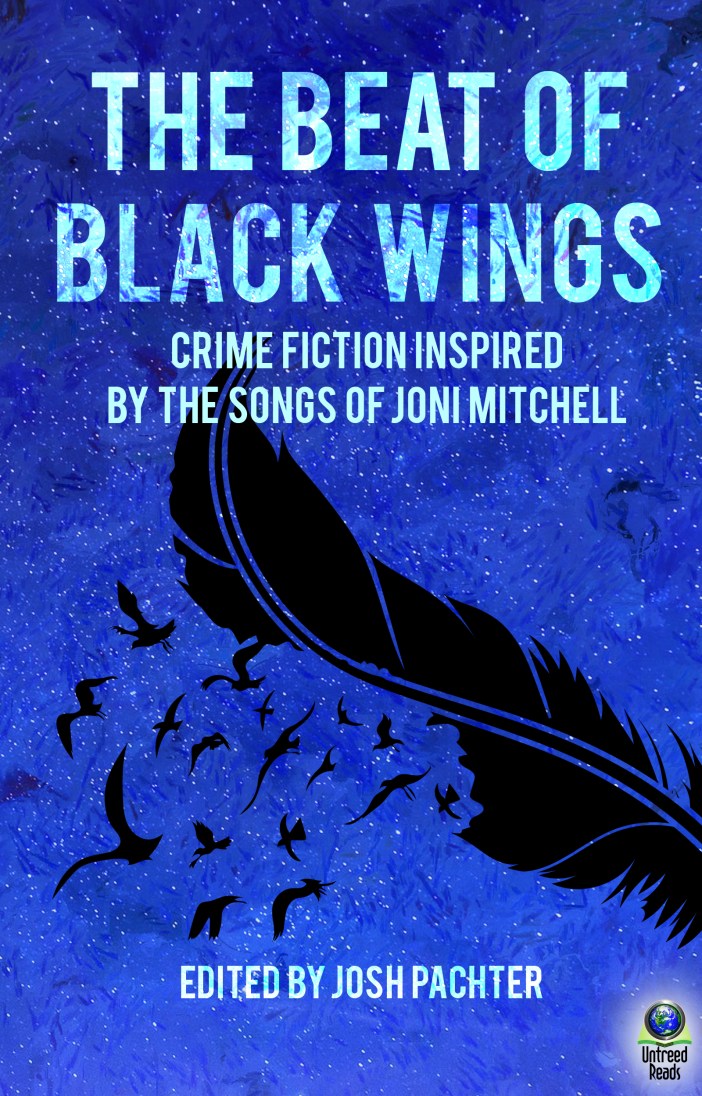
I was enormously flattered to be asked by short story master Josh Pachter to write a story for his anthology of stories inspired by the music of Joni Mitchell. The irony, of course, is that while I am familiar with Ms. Mitchell and her work–and I like what I know of it–I am not as familiar with her canon as I am with women singer-songwriters like Stevie Nicks, Dolly Parton or Carole King; I also realized that the songs of hers that I could name off the top of my head–“Free Man in Paris”, “Help Me”, “Big Yellow Taxi”, etc.–were the same ones anyone could; I wanted something not quite as famous and perhaps a little more obscure, something to which a Joni Mitchell fan would say oh yes, of course you chose that song.

So, I did what I often do in these situations: I asked my friend Michael Thomas Ford (aka That Bitch Ford), and he immediately came back with “You should pick ‘The Silky Veils of Ardor.’ It’s about that hot guy all the high school girls fall in love with and breaks their hearts.”

That was definitely intriguing, so I looked up the lyrics and listened to the song several times as I listened to Joni’s sweet voice singing them…and I knew immediately what story I was going to tell.

jonicover.final

The elevator doors opened. Cautiously, her heart thumping in her ears, she stepped out into the hotel lobby and took a quick look around. At the front desk, a young woman in uniform was checking in a couple. They didn’t look familiar. But it had been so long since she’d seen any of them…would she recognize anyone?

She didn’t notice she was holding her breath.

She walked across the lobby to the hotel bar entrance. A reader board just outside said WELCOME BACK BAYVIEW HIGH CLASS OF 1992!

The black background was faded, the white plastic letters yellowed with age.

The urge to head back to the elevators and punch at the UP button until the doors opened, get back to her room and repack her suitcases—everything she’d just carefully put away neatly in drawers and hung in the closet—was strong. She resisted, recognized the need as irrational, closed her eyes, clenched her hands until she felt her ragged bitten nails digging into her palms.

You can do this you can do this you can do this you can do this….

A dull murmur came from the hotel bar, laughter and talking, the rattle of ice against glass, the whir of a blender. From where she stood, she could see the bar was crowded, cocktail waitresses in too-short black skirts and white blouses with trays balanced on one hand maneuvering expertly around groups of people.

Maybe no one there was from the reunion. Maybe she was early. Maybe—

You can do this!

She’d always had social anxiety. Had never made friends easily, couldn’t make small talk, sometimes said the wrong thing, alienated people without even knowing what she’d done. Parties and dances had always been agony. Even with friends, people she felt relatively certain actually did like her, there was always the irrational fear she’d say the wrong thing, forget a birthday, commit some horrific social faux pas that would turn them against her, show them what a damaged, worthless person she actually was. She’d started seeing a therapist after college, years after she should have, but her parents thought therapy was all touchy-feely mumbo-jumbo for the weak and all you had to do was suck it up and forget about it, not worry, lock it all away in some dark corner of your mind and move on.

I have never attended a high school reunion, and frankly, have little to no desire to ever do so–with no offense intended to anyone I went to high school with. Our school was very small and remote, for one thing–my graduating class had only 48 students, and at that point, were the largest graduating class in our high school’s history. It’s not easy to get there–one would have to fly into either Kansas City or Wichita, rent a car, and drive for at least an hour just to get to the county seat, and of course, my high school was about nineteen miles (give or take) north of the county seat. I do think about going back from time to time, more to take a look around and see what’s different now as opposed to then; to refresh my memories a bit for writing about the region–which I’ve done somewhat already, but not nearly as much as I could. Using Google Earth has already shown me that my memory is faulty–I’ve fallen into Google Earth wormholes frequently–so while there is some idle curiosity about going back, there’s very little desire or motivation. It’s difficult, I think, for my classmates to understand that I really don’t have much desire to revisit that time of my life; it’s certainly not their fault but the four or five years I spent in Kansas also contain some of the darkest periods of my life.

I wrote a short story about a high school reunion under my Todd Gregory pseudonym; “Promises in Every Star,” which eventually became the title story of my Todd Gregory collection. I first had the idea for that story when I received the invitation to my ten year reunion, back in 1988; the title is a lyric from one of my favorite til Tuesday songs, “Coming Up Close,” from my favorite album of theirs, Welcome Home, which I can listen to over and over again, and have, many times; it’s definitely in my Top Five favorite albums of all time. I don’t remember where I originally published that story, but it was many, many years later, after I had the original idea and wrote the first draft (in long hand), and after that, I figured I was finished with high school reunion stories.

Until “The Silky Veils of Ardor.”

As I listened to the song, the more the story began to take shape in my head; a high school reunion, twenty-five years later; returning to the town where she went to high school for the first time since she graduated and moved away with her family. I had already written the opening, for another short story; as I revised and retooled that particular story, the character grew and changed and wasn’t the timid, nervous, medicated woman she originally was–but I loved that original opening, and decided to lift it from the initial drafts of that story onto this one. I found the original word document of the first draft, erased everything after the opening few paragraphs, and renamed the file THE SILKY VEILS OF ARDOR. The rest of the story flowed out of me after I finished rereading and tweaking the original opening to fit the new story, and I was off and running. I revised the story several times, and one of the things, one of the points, I was trying to make with the story is about how differently we see high school than our friends and classmates did–which is an idea I’d been toying with after an exchange on social media with some of my classmates after I’d posted something–a status update or a blog post, or something along those lines–about how miserable I’d been in high school; my friends were all astonished because how remembered high school was very different from the way they remembered it, and me. I remembered feeling isolated and lonely, like an alien from another planet set down into their midst; a freak everyone kept at arm’s length. They, on the other hand, remembered me as being popular and well-liked by everyone.

And that, my friends, is where this story came from. I still think about those tricks our memories play on us; our inability to see what was right in front of us if we could just see clearly.

The book will be officially released on April 7th from Untreed Reads; you can preorder it at any vendor that sells ebooks. There’s a stellar line-up of writers, and some of the proceeds are going to charity.

And thanks again to Josh Pachter for inviting me.

Here’s a link to Joni singing the song–this is the video I listened to for inspiration.

The First Noel

Merry Christmas! And if you don’t celebrate, HAPPY DAY OFF WITH PAY! Huzzah!

Later today we’re going to see The Rise of Skywalker in IMAX 3-D; I am very excited. I’ve managed to avoid spoilers completely on social media–an accomplishment only rivaled by my ability to do the same with The Force Awakens many years ago–it was out for weeks before we finally saw it, and I managed to completely avoid spoilers the entire time. And while I’m certainly sad that the Skywalker story is coming to an end at long last–some forty-two years or so since I first sat in a movie theater in Emporia, Kansas, to see the first one–The Mandalorian and Rogue One have proven conclusively that you don’t need a Skywalker to tell a great Star Wars story.

I spent Christmas Eve mostly relaxing. I finished reading Laura Benedict’s The Stranger Inside (it’s fantastic; blog post about it soon to come), and then watched a documentary about Dark Shadows creator Dan Curtis–it mostly focused on Dark Shadows, of course–and that was nice. I also decided that my next read is going to be an actual reread of Patricia Highsmith’s The Talented Mr. Ripley, which I’ve only read once–back when the film with Matt Damon was released, back in the late 1990’s, whenever that was. I’ve not read any of the other books in what is commonly known as the Ripleyad (Ripliad? I don’t know how they spell it), but I’ve slowly been working my way through the Highsmith canon over the years since (if pressed, I think I’d pick The Cry of the Owl as my favorite of those I’ve currently read; her short stories are also quite marvelous), and have not regretted a single moment of reading her. I decided to reread the first Ripley for any number of reasons–but primarily because I honestly don’t remember much of it, and what memories I do have are mostly of the film, and I am mostly curious to see how Highsmith handled his sexuality in the actual text; was it coded, or was it more obvious?

I also kind of want to watch the Netflix true crime documentary on Aaron Hernandez–also curious to see how they handle the sexuality issues involved with him.

For the record, RWA continues to throw gasoline on the dumpster fire they started on Monday, in case you were wondering–and each new story emerging makes them look even worse. I am so happy I never bothered joining that organization–which I considered, since I was leaning towards writing romantic suspense (The Orion Mask). But its history of problematic treatment of minority writers made me shy away from it, and again, so glad I listened to my gut.

I do have to work tomorrow–and Friday–these middle of the week holidays are a bit disconcerting. I also am taking off New Year’s Eve (Commander’s Palace luncheon, as per tradition) and New Year’s is a holiday, so next week will wind up being the same as this week: work Monday, two days off, and then back in for Thursday and Friday. Weird and unusual, yes–but also discombobulating a bit and will need to recenter and refocus.

And now I am going to retire to my easy chair with Ms. Highsmith for the rest of the morning. Happy day, everyone!

christmas wish

Meet Me Half Way

LSU won last night, 58-37, over Mississippi at Vaught-Hemingway Stadium in Oxford; but the defense gave up a lot in the second half–yards and touchdowns–and at times had me wondering if this would indeed turn into a trap game. A couple of offensive mistakes that the Rebels capitalized on, and suddenly they had pulled back within two touchdowns to 44-30 before the Tigers scored twice more to effectively ice the game. I may have sworn at the television a few times, as LSU’s pristine, well-oiled precision in the first half got sloppy in the second.

I suppose it is a measure of LSU’s success this season that a 21 point win in a rivalry game on the road felt disappointing; I guess this is what it means to become a member of an incredibly spoiled fan base. 58 points and over 700 yards on offense–and I was swearing at the television. Lord.

But the defense is going to have to play better than this if LSU is going to win the SEC title game against Georgia, who clinched the East by beating Auburn yesterday.

Yesterday was a good day on many fronts. I cleaned and organized, which of course always makes me happy; I didn’t get to the floors yesterday, but everything else is cleaned and organized, with a few more things to finish off this morning before I get back to work. I did have a relatively good day yesterday–cleaning and organizing capped by an LSU game is always the best Saturday possible for me. I also managed to read some more of The Ferguson Affair, and making notes on it. It’s not one of the stronger MacDonald novels–definitely not as good as some Lew Archers I’ve read–but it’s an interesting story, and I do like how the entire case begins with the main character, an attorney, being called in to represent a young woman accused of stealing, or rather, being part of a burglary gang robbing wealthy residents of the small city–and how it unrolls from there. I also made some notes on my current work-in-progress; dissecting why the story isn’t playing well in my head and realizing that it’s my own stubbornness and refusal to change things–even when they aren’t working. I always try to  make it work somehow before recognizing finally that it’s not working and must be changed; I have to go back and redo the first chapters of the book–which I’ve already kind of done. Part of the reluctance to see things clearly is because I don’t want to redo work I’ve already done—but if the work doesn’t work, accept that the time was wasted and redo it, for fuck’s sake. And so that is the task that lies before me today. I am going to go ahead and finish redoing chapter 13, because I’ve been in the middle of it for quite some time now–not finishing because deep down I knew I was going to have to go back and rework the earlier stuff, and why keep going when you know you’re going to have to revise and edit and rewrite what you are currently revising and editing and rewriting? Not an effective use of time or energy…and sometimes you have to just accept that you’ve wasted the time and be done with it. But I do believe I have now solved the key problem with my story, and it will now work going forward.

The other day I talked about the Stephen King short story “The Raft” (filmed as part of Creepshow 2), primarily in the terms of a book idea inspired by the trope of the story–essentially, four (or more) young people go somewhere no one knows they are, and something bad happens to them there–and they know rescue isn’t coming because no one knows where they are, and even if they did, it would take a while before anyone figured out they needed help–and wouldn’t know where to find them. Because of this, I kept thinking about “The Raft,” and finally at one point yesterday I got down my copy of Skeleton Crew and reread the story.

It’s extraordinary, really, and a good reminder of why Stephen King is one of my favorite writers.

It was forty miles from Horlicks University in Pittsburgh to Cascade Lake, and although dark comes early to that part of the world in October and although they didn’t get going until six o’clock, there was still a little light in the sky when they got there. They had come in Deke’s Camaro. Deke didn’t waste any time when he was sober. After a couple of beers, he made that Camaro walk and talk.

He had hardly brought the car to a stop at the pole fence between the parking lot and the beach before he was out and pulling off his shirt. His eyes were scanning the water for the raft. Randy got out of the shotgun seat, a little reluctantly. This had been his idea, true enough, but he had never expected Deke to take it seriously. The girls were moving around in the back seat, getting ready to get out.

Deke’s eyes scanned the water restlessly, side to side (sniper’s eyes, Randy thought uncomfortably) and then fixed on a point.

“It’s there!” he shouted, slapping the hood of the Camaro. “Just like you said, Randy! Hot damn! Last one in’s a rotten egg!”

“The Raft” is a terrifying story, and one that is all too easy to relate to. Randy is the main character of the story, and we see it all through his point of view. Deke is his best friend and roommate, on a football scholarship, handsome and well-built and holding the world in the palm of his hands; things come easily to him, especially women. The two girls with them on this adventure are Rachel, Deke’s current girlfriend, and LaVerne–who, as it turns out, isn’t a particularly nice girl in how we tend to define that sort of thing. Randy likes Rachel but really is into LaVerne; one of the dynamics of the story is that Deke and Rachel’s relationship is ending (but she isn’t aware) and LaVerne is poised to move in on Deke–and it happens during the course of the story. Randy loves Deke, Deke is his best friend and he admires him and would do anything for him; but he also harbors a bit of resentment for his beloved best friend–for whom everything seems to be easy, and women willing to crawl into his bed are easy to find; he also resents that women don’t seem to notice him when Deke is around. This is excellent character building by King; this makes Randy relatable.

(When I first read this story in the mid-1980’s, I had already become accustomed to being the “friend no one notices”; I always had male friends who were good looking and well-built and a lot of fun to be around, so I always felt eclipsed and that no one noticed me. This continued for many years, even after I came out in every aspect of my life–that weird mixture of love and resentment one can have for a friend who is always the center of attention who doesn’t even try to be; it just happens. It also reminds me of the dynamic at the root of A Separate Peace, which I read as a teenager; I need to go back at some point and reread that book to get a better sense of the novel and the queer undertones that even I–a closeted and terrified thirteen year old–was able to pick up on.)

The building of suspense–and the terror that comes when they realize the weird little oil slick on the water not only has intelligence but is a predator–is phenomenal, and yet another example of King’s story-telling genius.

I also could relate to the story because when I was a teenager in Kansas, there was a nearby lake we often went to, for swimming and so forth; it was out in the middle of nowhere, and it, too, had a raft you could swim out to and sunbathe on. (I used that lake in my novel Sara; in what I think is probably the best, most frightening horror I have ever written–that chapter at the lake is absolutely terrifying–or at least I think so, at any rate.)

But remembering–and rereading–“The Raft” also reminds me of the Short Story Project from last year, which I hadn’t intended to stop doing, but I got sidetracked with this year’s Diversity Project, among other things. But it’s time for me to get back to work on everything this morning, and so, Constant Reader, I bid you adieu as I head back into the spice mines.

aussiebum

Songbird

So, daylight savings time means I didn’t sleep as late as I have the last few mornings–simply because the clocks were turned back an hour. I woke up yet again at ten this morning–I went to bed around ten last night–and slept like a stone yet another night. Sleep really is the best thing, isn’t it? These last few nights of good sleep have been absolutely heavenly, and I feel a million times better than I did before this staycation started. I also can’t help but feel that missing Bouchercon–much as I hated to do so–was probably the smartest thing I could have done; thank you, doctor, for forbidding my travel.

And a belated congratulations to all the Anthony Award winners! I didn’t win for Best Short Story, but couldn’t be happier that Shawn Cosby did! He’s a great guy, a terrific writer, and also supports other writers. His debut novel, My Darkest Prayer, was fantastic; he recently signed a two book contract with Flatiron Books and I can’t wait to see what he does next, quite frankly. The other nominees–Art Taylor, Barb Goffman, and Holly West–are also terrific writers and awesome people who support other writers as well. Being nominated for an Anthony for a short story was one of the biggest thrills of my career so far.

It’s also weird that it’s a Sunday morning and  there’s no Saints game today.  It’s weird that both the Saints AND LSU have bye weeks the same weekend; but next weekend is going to be tough–LSU at Alabama for all the marbles; the Saints playing the hated Atlanta Falcons.

I imagine by the end of that weekend I am going to be quite worn out from emotion and adrenaline.

Angela Crider Neary, who moderated the Anthony Short Story nominees panel yesterday, very graciously sent me the questions she intended to ask me on the panel, so I thought I’d go ahead and answer them today–even though I’ve already lost. 😉

You’ve written in an impressive array of genres – over 50 short stories, two different private eye novel series, young adult novels (some with supernatural elements), and even some erotica as well as some horror and suspense.  Do you like one of these genres or formats (short or long) better than others, and tell us what you enjoy or find rewarding about writing each of them.  Are there any other genres you have written or would like to write?

I’ve also written some romance! I like all the genres I write in pretty equally; I just wish I was better at writing horror than I am. I’ve always had a strong passion for history, so I think historicals is something I’d like to try at some point–it surprises me that I haven’t already. I find writing short to be a lot more difficult than writing long; I always think of ideas in terms of books rather than short stories, and sometimes have to modify the idea down, as I can certainly never write all my ideas as novels unless I have an exceptionally long life. I’ve been experimenting with writing novellas lately–I’m in the process of writing two right now. Of course, there’s little to no market for novellas. I guess I’ll wind up self-publishing them or something.

I love the title of your current Anthony-nominated story, “Cold Beer No Flies.”  Is there a story behind this particular title, and how important do you think titles are for stories or novels?

Thank you, I’m rather partial to that title myself! When I was a teenager in Kansas, there was a bar in the county seat that was very similar to the bar in my story. It was simply called My Place and they had a reader board out on the side of the road and one day it said COLD BEER NO FLIES. That tickled me for some reason, and I never forgot it. About ten years later I wrote the first draft of the story with that title. It sat in my files for a very long time, and about ten years ago I revised it for the first time, shifted the setting from Kansas to the Florida panhandle, and changed the main character from a young woman to a young man. When Florida Happens came about, I revised it one last time and submitted it to the blind read process, and was delighted to have the judges score it highly enough for inclusion. (My story in the Blood on the Bayou anthology also went through the blind read, and was picked.)

You have two PI novel series set in New Orleans.  How would you describe these two series, how they differ from each other, and how you’re able to slip into the separate moods and characters of each of them?

The Chanse series is more hard-boiled than the Scotty series, which is more light and fun. Chanse is a completely different kind of  gay man than Scotty; he was raised working class, his family lived in a trailer park and were evangelical Christians in a small working class town in east Texas. He used football and a scholarship to LSU to get out, and finally came out officially after graduating from college. He’s more scarred emotionally, more bitter and cynical, and has a very low opinion of humanity. Scotty is the polar opposite of Chanse: from a wealthy society family on both sides, he grew up in New Orleans with extremely liberal, progressive parents who never had any issue with his sexuality, and was kind of a fuck-up in some ways, though–flunked out of college, worked as a stripper and a personal trainer, etc. But he has a very positive outlook on life, and has no baggage about his sexuality whatsoever; in fact, he revels in being gay. I’d never read a character like that before, and I felt like there needed to be one. Scotty is much more fun to write than Chanse–I kind of just make up the story as I go, because that’s kind of how Scotty lives his life, up for anything and everything–whereas Chanse is more rigid, more unhappy, and more of a tight-ass, so I have to plan his stories out from the very beginning.

You’re the co-founder of the Saints and Sinners Literary Festival, which takes place in New Orleans every spring.  Tell us about it.

Well, way back in 2002 my partner, myself, and Jean Redmann went out for dinner and drinks one night, and over the course of conversation the subject of writer’s conferences came up–and how queer writers were often not included, and if they were, were put on what we call a “zoo panel”–a panel where all the non-straight writers are gathered together which, no matter the good intentions, always felt like we were zoo animals people came to see and point at, and those panels inevitably devolved into “let’s teach the nice straight people about homophobia.” We thought it would be lovely to have an event of our own–open and welcoming all who wanted to participate–where being queer wasn’t the topic of discussion. We also thought it would be good to stress the importance of queer literature and its importance in its response to the AIDS epidemic, and try to honor the many writers we lost to the plague years. We figured we might be able to pull it off maybe once or twice before interest died down…and here we are, seventeen/eighteen years later, still going strong. I have less to do with the organizing now than I did in the beginning–most of it is my partner and his team–but I still get credit for it.

Your Lambda Literary Award winning Murder in the Rue Chartres was described by the New Orleans Times-Picayune as “the most honest depiction of life in post-Katrina New Orleans published thus far.”  There was such overwhelming personal and community devastation after the hurricane and flooding.  Why did you choose to write about the hurricane and what was that like for you?

It’s so weird to me that it’s been over fourteen years now. But even now, it’s impossible to describe, or talk about, everything that happened because of Katrina. 90% of the city was rendered uninhabitable, and for awhile we weren’t even sure if the city was going to come back–or if we would ever be able to come home. We were lucky, we were able to evacuate when so many couldn’t–and that guilt lasted a really long time. It took me a long time to forgive myself for leaving New Orleans to die. It’s very difficult to describe how New Orleanians feel about New Orleans, that deep love that runs through, and colors, everything. The entire time I was gone I felt unmoored, unanchored, unsure about the future. I also knew I was going to have to write about Katrina, and I didn’t really want to. I was one of the first to come back–I returned to New Orleans on October 11th, about six weeks or so after it happened. I had been blogging at that time for not quite a year–but I was blogging extensively throughout that time, describing what I was feeling and what I was seeing. (I only wish technology had advanced to the point where phones had cameras–I didn’t have a digital camera at the time and so was unable to document everything with pictures; all I have is memories and the blog.) Katrina was such an enormous event, that the entire world was aware of–I didn’t see how I could possibly continue to write fiction about New Orleans without acknowledging Katrina, but at the same time I didn’t want to write about it, either. The Scotty series–I’d finished and turned in the third book in that series, Mardi Gras Mambo, about three weeks before the storm and I’d intended to start writing the fourth almost immediately, after taking about a month off to rest and regroup. Ironically, the idea was called Hurricane Party Hustle and I wanted to write a book set in the city during an evacuation with another near-miss hurricane–which I’d already experienced three or four times at that point. Needless to say that idea was scrapped. I also didn’t see how I could write a light, funny book about New Orleans when we were still in the midst of everything.* I wasn’t even sure I wanted to write a Chanse book. My editor at Alyson Books, Joseph Pittman, kept after me, telling me I was the perfect person to write such a book, and so on and so on, and I finally agreed to write it–but only on the condition that Chanse, like me, had evacuated and returned on the same day I did. I didn’t think survival stories from Katrina were mine to tell.** Writing the book itself was incredibly difficult, and I found myself drinking a lot whenever I finished for the day. But in the end, it was incredibly cathartic to write the book and I am very grateful, to this day, that Joe wore me down and convinced me to write it.
*Of course, now, all these years later, I can actually see how a funny book could be written about New Orleans in the aftermath–particularly in the way New Orleanians who were here reacted. The ruined refrigerators, for example, that everyone dragged out to the curb for disposal and sealed with duct tape–people decorated their refrigerators or wrote slogans on them; some of them were enormously funny. New Orleans has always had a sort of gallows sense of humor about itself; we always laugh, no matter what, and I do regret that I wasn’t in a place where I could examine that.
**I did eventually write a survival story, “Survivor’s Guilt” (my story in Blood on the Bayou, it was nominated for a Macavity Award a few years ago), and while I still didn’t think I had the right to tell a survival story–I kept questioning myself the entire time I was writing it–I based a lot of it on survival stories I’d been told, and given the response to the story, I think I got it right. I have another idea for a noir story set in the aftermath as well–it came to me on a panel at Raleigh Bouchercon several years ago Katrina Niidas Holm was moderating, and she keeps pushing me to write it–and I think I’ll someday get to it.
I also think sometimes I might go ahead sometime and write Hurricane Party Hustle–probably enough time has passed to write a story about an evacuation and near-miss , and sometimes I think I might go back and write a Scotty book set during that time as well…maybe.
And on that note, back to the spice mines. Thanks to everyone who voted for my story for the Anthonys so it made the short-list; that meant a lot, and I appreciate it.
And here’s hoping I won’t miss Sacramento next year.

12342747_979916128736074_4778087642931571758_n