So Fine

Well, I got all my tax stuff done yesterday and uploaded into my accountant’s portal and that’s the end of that shit for at least this year now. I don’t know why I always hate doing this; it’s not fun, to be sure, but it never takes super long and it’s such a relief when it’s done…praise Jesus. But that put me into a mood–not sure if it was depression or what, but I wasn’t exactly in the greatest mood after finishing. Not a bad mood, by any means, but just a kind of weird funky malaise of some sort. It didn’t help that it was raining and gloomy all day. I had to run errands after work (in the rain), made it home and just sat down for awhile and took a red pencil to “When I Die,” and there was a lot of deleted material. That also kind of made me feel not so great, either–even though a lot of the deletions had everything to do with switching the story from about two couples to three young men. Paul and I watched two more episodes of the Dead Boy Detectives, which is really quite good and we are enjoying it a lot. There’s some queer subtext going on with the show, but nothing truly overt other than the Cat King.

I woke up this morning to the news about Tulane calling out the cops and campus police to break-up a protest for Gaza on the campus last night…and they brought out horse cops. The irony that the cops only get called or try to break-up protests by progressives on college campuses doesn’t escape me, but no one ever cares about Nazi marches or things like what happened in Charlottesville not that long ago. I always hear people complaining about how college students and the young don’t vote, don’t get involved, etc etc etc. Well, now they are engaging in world affairs, and they really don’t like seeing genocide on their screens. So, I guess it’s about what they chose to be interested in? And I don’t think having them arrested or the police physically assaulting them is going to change their minds? It always bothers me whenever I see the police attacking protestors. It’s definitely a free speech issue, and of course with memories of Kent State lingering in my mind…I just don’t like it. If the protestors aren’t being violent or damaging property (remember, the police’s job is to protect property, not people), what’s the harm? Don’t come for me, either–I also feel Jewish students have the right to feel safe on campus and of course there’s no place for anti-Semitism anywhere in American society, but spare me the pearl-clutching from the right–you know, the people who believe there were good people on both sides in Charlottesville? I had read that the students had closed down St. Charles Avenue for a little while the other day–again, an annoyance to drivers, nothing terrible or serious or revolutionary in any way–and was kind of pleased. Apparently, Tulane’s president feels that the protestors aren’t students for the most part (the old “outside agitators” thing, thank you, George Wallace for that terminology), but again, I despair. I also despair at the people who think the protestors should be shot and killed, which…seems unconstitutional in ways you don’t have to be a lawyer or a legal scholar to recognize. The fear that the crowd might become uncontrollable or violent isn’t a justification for denying the students their First Amendment rights.

Again, property not people, and the sooner most white Americans wake up from their lifetime of brainwashing about what the role of cops actually is the better. And I say that as a crime writer. I don’t like the notion that the cops are above the law, can violate it with impunity as well as the legal rights we all share in theory. I was thinking about this lately, about how most crime writers never delve into police corruption or never really challenge the notion that the cops are the good guys when all too often their frail humanity gets in the way. I’ve thought about this a lot since the original police brutality protests about innocent Black people being murdered by the cops–at his point there are so many I can’t remember them all or what actually got the country riled up in the first place. I have taken to thinking that I write a lot of copaganda; my police officers–always supporting characters and never the lead–are honest, hard-working, not corrupt, and can be counted on.

I do not feel that way in real life. I have had an idea for a book about police corruption in New Orleans for a really long time now; the problem (for me) is that it’s a Venus story, and I don’t think I necessarily have the chops to write from the perspective of an older Black woman cop nearing retirement. I’ve wondered how I could turn it into a Chanse or a Scotty book, where Venus hires them to look into a case that’s been written off; I had wanted to call it Just Another Random Shooting, but if it’s a Chanse or a Scotty I have to stick to the title scheme I started with. Or I could spin off Jerry Channing, my true crime writer, who has appeared in several of my books already and who I’ve wanted to write about for quite some time.

Interestingly enough, my hearing aids haven’t been working that great lately and I was beginning to think I’d have to take them in again for repair…but last night after I got home from work, both ears popped (a pressure thing) and this morning my hearing aids feel like they are turned up way too loud! I had to turn them down. Today I can hear my fingers clicking on the keys, I could hear Sparky whining for treats upstairs, and so on. I feel pretty good this morning and it looks like it’s going to be another beautiful (borderline too hot) day today after the gloom and rain of yesterday. Huzzah!

And on that note, I am heading into the spice mines. Have a lovely day, Constant Reader, and I may be back later, stranger things have happened!

Speak No Evil

Well, if there was any doubt left, summer has returned in full force to New Orleans. It’s a heat wave; in which the heat index has been over 110 for several days. When I ran my errands yesterday I was completely exhausted after getting back home and the groceries inside; this kind of heat saps your strength and your energy and sometimes, even your will to live. Opening the apartment door was like opening a preheated oven. I managed to get all my work-at-home duties taken care of, but tried to spend the rest of the day battling feeling tired and getting chores done. This is a three-day weekend, and I have a lot of work to try to get through over the course of this holiday weekend. I am also hoping to not set foot outside at any time until I have to go back to work Tuesday morning. It’s nice having another short work week, and then of course the next week I am heading north to spend some time with Dad. It’s hard to believe this year is nearly half over, isn’t it?

I was thinking yesterday that Elmore Leonard’s most famous piece of writing advice was “never start with the weather,” which is a “rule” that I break all the fucking time. The weather, especially in New Orleans, is almost a character here; it tells you everything you need to know about the time of year the story is set, for one thing. You can’t set a book or story in New Orleans in the summer time and not mention the weather; you just can’t. The weather impacts everything here, because we have what I lovingly and sort-of-jokingly refer to as “aggressive.” The heat and humidity is aggressive; hurricanes and thunderstorms here certainly are, and even the cold spells we get every winter (brief, always brief) can be also considered aggressive. It impacts people’s moods and what happens, really; so that advice cannot be followed when writing about New Orleans. I was primarily thinking about this yesterday when I was out in the heat and losing my will to live, mostly, which was completely understandable. Paul walked to the gym to ride the bike for a while yesterday and went through two bottles of water. So, yes, the weather here is aggressive and oppressive, and impacts story and character and setting and scene and place in New Orleans.

We started watching an ID true crime documentary series about the serial killers in Baton Rouge around the turn of the century and just after, Butchers on the Bayou, which is kind of interesting. I remember when it was happening–yes, a serial killer in Baton Rouge will make the news in New Orleans–and I remember when the first one was caught; I didn’t remember there was a second one operating at the same time. No wonder the police were overwhelmed; especially with all the crossing of jurisdictions and so forth–it’s the same problem they had with trying to solve the murders of the Jeff Davis Eight (eight women murdered over a several year period in Jefferson Davis Parish). And yes, I do at some point want to base a novel on the Jeff Davis Eight case; I keep thinking it fits more as a Chanse story but I’m not really sure I want to write another Chanse book. It wouldn’t really work as a Scotty story, and I have wondered and considered writing a new series–I have a character, Jerry Channing, who writes true crime and is a gay man that has appeared in several different books of mine; the problem with Jerry was when I was fleshing him out I realized what I was doing was combining Chanse and Scotty into a single person, and that wasn’t working for me. This also probably had something to do with me trying to come up with something whilst I was immersed in numerous other projects and not really being able to give it my full attention. I still might just go ahead and do it once I have all these current projects off my plate once and for all.

It is a good story, and it makes sense for him to be the one to investigate it–since he writes true crime. My primary concern about this is, obviously, there’s tons of novels about true crime podcasts and true crime writers and bloggers–Only Murders in the Building, anyone?–but it does make sense and works better. I guess there’s naught to do but give it a try and see.

I’m hoping to be able to spend some time reading this morning, too, before i head into the spice mines. I want to finish writing this and maybe write another Pride post over the course of the weekend; I’ve started several, but am trying to decide if I want to be Angry or if I want to be up-lifting. Some of the posts are angry–it’s hard to write about homophobia you’ve experienced without getting angry; and in one of them I am calling out homophobia I’ve personally experienced from the mainstream crime community. Sometimes I wonder if I should call this stuff out; there’s a part of me that sees talking about it and calling it out as vengeful–like ha ha ha, you were awful to me so now I am calling you out years later–and there’s a part of me that worries that I’ll come across as self-serving. (There’s nothing I hate more than the narcissistic activist; those who are only in it for themselves and don’t care about the broader picture and the macro.) I’ve known and seen some of this over the years more times than I’d care to–like the author who was all over #ownvoices, until she won a major award and now no longer mentions it at all, or “we need diverse books”–so, now that you’ve made it the work no longer needs to be done? Way to pull up the ladder behind you, sister! I certainly don’t want anyone to think that my primary concern is revenge or for me to become more successful; my mentality is “this happened to me and I don’t want it to happen to anyone else because it really sucked for me.” But times have changed, and while there are still instances of it that pop up from time to time within the community, it’s becoming a thing of the past and people are starting to call it out when they see it–which is a huge switch from when I was first getting started. The crime fiction community is a lot more welcoming to queer people in 2023 than it was in 2002. It’s lovely, of course, but I do think we should never forget our less progressive past–particularly since it wasn’t that fucking long ago.

Some things for me to ponder, I suppose.

And on that note, I am going to drink some more coffee and do some chores around the kitchen before I read for a bit and then work. Have a lovely Saturday, Constant Reader, and I will check in with you again at some point.

Garden District Gothic

Oh, Scotty VII, what an interesting path you took to publication.

Back when ebooks and Kindles first started to be a thing, they rather revolutionized publishing. This new technology rang the death knell on some independent book stores as well as some small presses, and it was considered the great equalizer: you no longer needed to follow the long-established path to publication that went writer/agent/publisher; and just having an agent was no guarantee your book would ever see print and if it did, that it would sell. You no longer needed a publisher to put your book out and get it to readers; all you needed to do was get a cover designed and format your manuscript and upload it. This excited a lot of people; I was one of them, but still approached the entire thing very cautiously. I have never had a problem with people who elect to self-publish their work rather than follow the traditional path; I certainly never followed the traditional path or ran my career the way I was supposed to, at least according to almost every author I knew.

But ultimately, for me, the ebook revolution and becoming a publisher/author hybrid seemed not only like a risk but a time-consuming one. I didn’t have the time available to market the books I was traditionally publishing the way I should, let alone having the time to have to do all the marketing myself.

But I was curious, and remained open-minded. A friend started her own company and wanted me to write some things for her–short, more like novellas than novels–and since I’d always wanted to spin Paige off into her own series (despite being concerned about writing a mainstream type book from a woman’s perspective) and so I thought, well, here’s a chance to try something new and different. I wound up writing two of these and was partly through a third when I began to realize that even with an independent publisher doing some of the work, I just didn’t have the time or money or incentive to work any harder at marketing these books than I already was–and they needed more attention and promotion than I was able to give them, so we decided to end the business relationship, the already done books came down from sales sites, and that was the end of that.

I did eventually slap up Bourbon Street Blues as an ebook on Amazon, and it’s done okay for me; I’ve not promoted it at all but copies sell every month–but I am not getting rich, either. I also have a longer short story up as an e-original (but it’s also in my print collection Survivor’s Guilt and Other Stories) and yes, I know I need to get Jackson Square Jazz up (one of these days), and perhaps when I’ve retired and have more time, I’ll explore the self-publishing option again just for the hell of it.

But there I was, with a partially completed manuscript and it was a very fun story; I hated wasting it (it was called The Mad Catter), and so, with a little bit of tweaking, I turned it into the seventh Scotty book, and renamed it Garden District Gothic.

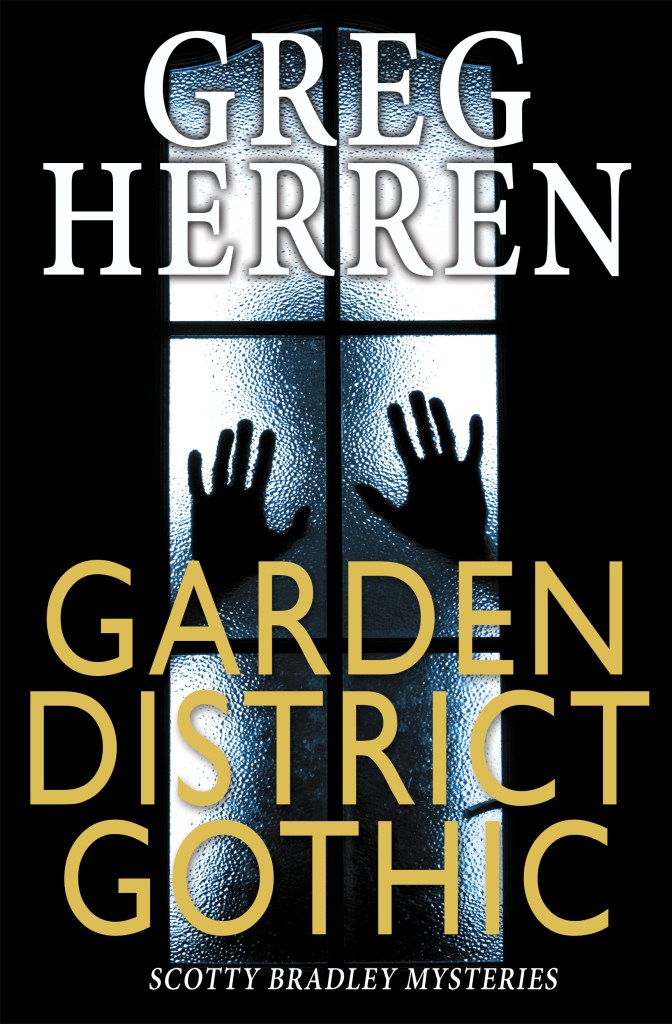
I really love the cover Bold Strokes gave me for it, too:

You know you live in New Orleans when you leave your house on a hot Saturday morning in August for drinks wearing a red dress.

It was well over ninety degrees, and the humidity had tipped the heat index up to about 110, maybe 105 in the shade. The hordes of men and women in red dresses were waving handheld fans furiously as sweat ran down their bodies. Everywhere you looked, there were crowds of people in red, sweating but somehow, despite the ridiculous heat, having a good time. I could feel the heat from the pavement through my red-and-white saddle shoes and was glad I’d decided wearing hose would be a bad idea. The thick red socks I was wearing were hot enough, thank you, and were soaked through. They were new, so were probably dying my ankles, calves, and feet pink. But it was for charity, I kept reminding myself as I greeted friends and people whose names I couldn’t remember but whose faces looked familiar as we worked our way up and down and around the Quarter.

Finally, I had enough around noon and decided to call it a day.

“I don’t think I’ve ever been so hot in my life, and I grew up in Alabama,” my sort of nephew, Taylor Wheeler, said in his soft accent, wiping sweat from his forehead as we trudged down Governor Nicholls Street on our way home.

It hasn’t been this hot in a while,” I replied, trying really hard not to laugh. I’d been forcing down giggles pretty much all day since he came galloping down the back steps the way he always does and I got my first look at his outfit. “But the last few summers have been mild—this is normal for August, usually.” It was true—everyone in town was complaining about the heat like it was something unusual, but we hadn’t had our usual hellish summer weather in a couple of years.

Last summer had been not only mild but dry, with little humidity and practically no rain—which was unheard of. Usually it rains every day around three in the summer, when the humidity has gotten so thick it turns to rain.

“I don’t even want to think about how much sweat is in my butt crack,” he complained, furiously waving the fan he’d picked up somewhere, trying to create a breeze.

I gave up trying to fight it and just gave in to the laughter.

One of the primary problems of turning The Mad Catter into Garden District Gothic was that the book was intended originally to be a sequel to a pair of books that no longer existed; vanished forever into the ether. I had established a character in earlier books of the series who was supposed to take front and center in this one, but I no longer had the back story and was facing the issue of how do I introduce this woman into Scotty’s world? And it was important, because the case involved a long ago murder that took place in this woman’s Garden District mansion–she didn’t own it at the time; she bought it from the original family that owned it, and owned it at the time of the unsolved murder–but I decided the easiest way to do this was make the woman a friend of Scotty’s older sister, which is how he knew her; and she had been a member of the cast of a reality-TV show called Grande Dames of New Orleans, which had been the centering of the previous book in the now-defunct series. I always thought the Grande Dames (obviously, my version of the Real Housewives franchises) was a clever idea and a fun one to explore as well as poke fun at in a fictional setting, and I hated wasting in a series that no one could access anymore. So I decided to keep Serena, and mention that she was in the cast of the new show which hadn’t started filming yet, and she had bought this big house as a centerpiece for her to be filmed in from the show, giving up her luxurious condo in One River Place. (This also gave me the opening to center the next Scotty book in the Grande Dames show.) The party that now opened the book was a housewarming party, so Serena could show off her new manse with the checkered past.

I had also created a character in the Paige series to serve as a kind of nemesis for her, a true crime writer named Jerry Channing, whom eventually I used as the impetus for getting the plot started in The Orion Mask. Jerry became rich and famous writing a book about the infamous, unsolved murder called Garden District Gothic, which in the Paige series seemed like a Scotty title to me, and I used it as a wink to those who were familiar with the Scotty series…and so, in writing about Scotty and the gang solving this old notorious murder, why wouldn’t I call the book Garden District Gothic, since it really is a Scotty title after all?

The murder was, of course, based on the Jon-Benet Ramsey murder that dominated the media and culture for so long back in the day. I just took the set-up of the story from that real-life case and started making up my own characters and backstories for them and went with it from there. The one thing that always bothered me the most about the case was the fact that people viewed the Ramsey family as speaking to the lawyers before calling the police as suspicious; no, it’s actually smart. Sure, it made them look “guilty” in the press (with all those headlines in the tabloids screaming this conclusively proves one of the family did it!!!! Who calls their lawyer first??? To which I again repeat, people who are fucking smart call their lawyer first. Period.), but it was the smart thing to do; someone had the presence of mind to realize that the most obvious suspects in the murder of a child are going to be the immediate family, and why–in a distraught state of grief over your child’s brutal murder–you would need to have a lawyer present when you’re being questioned by the police so you don’t say anything that could be misconstrued as an admission of guilt when you are not in fact guilty.

Always, always, always call the lawyers first. Always. If i have learned anything from my extensive reading of true crime and study of crime fiction, it is “never talk to the cops without a lawyer, especially if you are innocent.”

I was pleased with it when I was finished with it, but I’d kind of like to revise the ending a bit.

And of course, writing it left me with the decision of whether to reuse my Grande Dames of New Orleans reality show for the next Scotty book.

Tied Together with a Smile

Monday morning and facing down the three clinic days, which makes me tired to even just think about, honestly. I love working with my clients, though; that’s always a plus, and while my program coordinator is out quarantining (her roommate tested positive for COVID-19 last week), I think I can handle my job without her being there. (This is why I was so concerned about the stomach issues on Saturday; the last thing in the world I need right now it to have to go out on quarantine myself.)

There actually wasn’t a Saints game yesterday; I didn’t realize it was a bye week for the Saints–it was just weird that neither LSU nor the Saints had a game on the same weekend (I looked up the time for the game earlier in the week and didn’t realize it brought up next week’s game instead), and it’s been quite a while since that happened. In fact, I cannot remember the last time bye weeks fell on the same weekend–although to be fair, LSU wasn’t supposed to have a bye.

But still.

We watched the season finale of The Vow last night, and it seemed to wrap up pretty quickly; Paul was very quick to assert, “there’s going to be a second season, clearly” and after looking around on-line this morning a bit, I see that the show has been renewed for a second season. We enjoyed watching the show, despite its deeply uneven story-telling and a sense that it was longer than it needed to be; I also didn’t think compressing everything–from the arrests, etc. to the present day–into the final fifteen minutes of the finale was the best methodology; it really felt rushed, particularly since some previous episodes were obviously dragged out; it could have been six episodes, I think.

We also watched the first episode of the Jude Law mini-series The Third Day, and decided not to continue. It was very well done–some of the images were exceptional–but it was all just very murky and strange and really, you should watch one part of a three-part show and have literally no idea what’s going on, or have no sense of the characters, or why you should give a shit about their story. We won’t be watching more, I think, which is a shame; the previews looked wonderfully creepy and spooky; and while the first episode contributed greatly to the mood of creepy dread, that was about all we came away from it with, other than little to no desire to watch any more of it.

I started going through old journals yesterday–I found the one in which I started keeping the journal again (2017! It’s been three years!)–mainly because I am trying to get back into Bury Me in Shadows again; it’s been weeks since I worked on it, and I was thinking I needed to go through my notes and so forth to make sure everything is going into the story that needs to be in the story. The old journals are fascinating; there’s also the plans and notes for Royal Street Reveillon in them, as well as the birth of short stories that have since been written and even, in some cases, published; there are other story ideas and titles that never were followed up on–some of them are quite good, upon a review with fresh eyes–as well as sketches and ideas for stories that were written but wound up not really working after several drafts were completed (“The Problem with Autofill” is one of those; it’s a great concept but it doesn’t work because the central conceit winds up triggering how can you be so stupid as a reader reaction, which kills the story, frankly). It’s also interesting to see that this particular novel began being titled Bury Me in Satin, which I discarded early on, changing “satin” for “shadows”, which works ever so much better.

I also managed to do some filing and organizing, and I do feel much better about everything I now need to get done–and feel confident I can do it all.

I also read some short stories yesterday.

“Love & Other Crimes” is the title story from Sara Paretsky’s short story collection, and yes, it’s a V. I. Warshawski story. One of the problems I’ve always had with writing crime fiction short stories is the compression of the investigation aspect. I am used to spreading the story out from anywhere from sixty five thousands words to just over a hundred thousand; Royal Street Reveillon was slightly more than a hundred thousand, and is probably my longest novel. I wrote my first ever Chanse short story, “My Brother’s Keeper”, for my own collection Survivor’s Guilt and Other Stories, and I’ve started yet another, “Once a Tiger,” that has stalled, along with a couple of other investigation short stories that have never reached a complete first draft–some Venus stories (“A Little More Jazz for the Axeman,” “Falling Bullets,” and “Stations of the Cross”), and there’s a Jerry Channing story (he has appeared in the Scotty books; he’s a true crime writer) whose title I cannot recall at this moment. I struggle with these stories, obviously; reading Ross MacDonald’s Lew Archer short stories (The Archer Files) helped somewhat, as did reading Sue Grafton’s Kinsey short stories (Kinsey and Me); and it’s really no surprise that Paretsky–MWA Grand Master and crime fiction legend–can also pull off the private eye short story. A kid from the old neighborhood is being framed for murder; his sister rather snottily hired Vic to prove his innocence. She manages to do so–ironically, he was really implicated in another crime, just not the murder–and the success of the story makes me think that I should change the way I write these kinds of stories. I am not much of an outliner anymore–somewhere around Murder in the Rue St. Ann I realized that I never really stuck to the outline so wasn’t really sure I should keep doing them; instead, I either come up with a very loose synopsis–or just know where I am going to end it and start writing in that general direction and see where it goes. But…maybe I should outline the short stories that are investigations rather than just starting to write and seeing where they go; I always stop writing when I get stuck, and who knows if or when I will ever get back to it? But I am also digressing from the point of what a great story Paretsky opens her collection with! I don’t think all of the stories are necessarily Warshawski stories–the next, “Miss Bianca,” doesn’t appear to be–but I am really looking forward to seeing what other magic she hath wrought with her writing.

After reading the Paretsky story, I moved on to the Lawrence Block anthology The Darkling Halls of Ivy–whose theme is crime stories set in academia. The very first story is David Morrell’s “Requiem for a Homecoming,’ and it’s an interesting take on a crime story. A successful screenwriter returns to his alma mater for Homecoming as a special guest, and the story opens with him having a drink in a campus-area pub with an old friend from his college days…and then bringing up a twenty-year old murder that occurred when they were both undergrads. They talk a bit about the murder, and some things that never came out in the investigation all those years ago–including the pov character having gone out on a date with her once, but didn’t come forward because he supplemented his income by dealing drugs–the drug dealer would be an obvious suspect and this could have jeopardized his scholarship to USC for grad work in screenwriting–but there’s also a lot more to this fiendishly clever story. But Lawrence Block’s anthologies never disappoint; my bucket list includes getting to write a story for one of these.

And on that note, it’s off to the spice mines with me. Have a lovely Monday, Constant Reader.

Bohemian Rhapsody

Is this the real life? Is this just fantasy?

Sorry, couldn’t resist.

Tuesday and my second long day of the week; just like last week, Mondays and Tuesdays coming in as long days. When we move into our new building in October (I am still in denial about that) my schedule will probably be long days on Monday and Tuesday every week, so I am trying to get used to it ahead of time. I wasn’t tired at all yesterday; but remember, Sunday I was drained and worn out from the game Saturday night and went to bed relatively early that night. I’m not necessarily tired today, but more a little on the drained side. Hopefully, I won’t be too tired to finish editing/revising two Scotty chapters tonight when I get home from work.

If so, I’ll try to read some more of Circe. I hate that it’s taking me this long to read it! Not an indication of its quality, people! Buy it! Read it! Savor it!

I’ve always loved Greek mythology, ever since I was a kid and I read a library book, when I was about eight or nine, called The Windy Walls of Troy. I’ve also always wanted to write about the Trojan War; it’s a tale I’ve always loved, and one I have always wanted to try my hand at telling. (Which is why the Troy: Fall of a City series on Netflix was so disappointing; as was the Brad Pitt film Troy.)  I’ve been toying with the idea of writing a y/a set during the last year of the war; the part that the Iliad primarily focuses on, from the point of view of one of Priam’s bastard sons, promised to the priesthood of Apollo and raised in the temple, but still a part of the royal family. (I’ve also tried tracking down a copy of The Windy Walls of Troy, to no avail.) Madeline Miller also covered the Trojan War with The Song of Achilles, one of my favorite novels of this century; it made me weep, and I kind of want to read it again, now that I am enjoying her Circe. She did a really interesting job of weaving the gods and demigods into her narrative; how does one write about the Trojan War without including the gods? My thought, of course, was to try to do it as real, without the gods actually appearing in the story, but rather things that happen being seen as their work. But how do you do the Judgment of Paris without the golden apple and the three vindictive, spiteful, jealous goddesses?

Something to think about, at any rate.

I’m also having a lot of fun doing some slight research into the history of both New Orleans and Louisiana; I had another book idea the other night as a result of a Twitter conversation with Clair Lamb and Rebecca Chance (so it’s THEIR fault), but I think it actually applies and will fit into a paranormal series I want to write set in rural Louisiana in the parish I invented, Redemption Parish–doesn’t that just sound like a perfect name for a parish where supernatural stuff happens? It’s a matter of tying in all the stories and things I’ve already written set there…it also occurred to me the other night that even the novels and stories I write that aren’t connected to others actually are–I realized that my character Jerry Channing, who appears in the Scotty series AND appeared in The Orion Mask, also writes for Street Talk magazine and that awful editor who Mouse worked for originally in Timothy, which ties Timothy to the Scotty series as well. I always thought Timothy was the one book that stood on its own…not so much, as it turns out.

And now back to the spice mines.

36222748_1869197803374454_7295939582271422464_o

Remember the Time

Friday morning! I get to go into work late because I am, as always, passing out condom packs tonight in the Quarter for Southern Decadence; when we finish, I am officially on vacation all I ever wanted until I return to the office on September 11 (gulp). Huzzah! Huzzah! Part of that time will be, of course, spent in St. Petersburg at Bouchercon. (huzzah! huzzah!) I am still trying to get my Bouchercon homework finished; I am nearly finished with James Ziskin’s delightful Cast the First Stone, and hopefully will be able to finish Thomas Pluck’s Bad Boy Boogie before our panel next Friday. (If I can’t, I really need to turn in my book nerd card.) I am also hoping to take Madeline Miller’s Circe with me on the trip to read.

I don’t want to give the impression that Cast the First Stone isn’t as good as it is by taking so long to read it; I’ve been in a late summer/dog days of August malaise that has had me having a lot of trouble getting anything done; the house is a mess (worse than usual) and I’ve gotten nowhere on the Scotty book and I’ve done very little writing of consequence at all this month. I’m trying very hard not to beat myself up over this; it is what it is, and it’s not a reflection on anything I do or my career. August, particularly late August, is always hideous when it comes to trying to get anything done; the heat and humidity this particular year has been particularly hideous, and it really sucks the life and energy right out of you. I am taking the manuscript for the Scotty with me to St. Pete; and I am hoping I’ll be able to carve out time to reread and make notes and so forth over the course of the weekend.

I’m also trying to figure out the rest of the story for “The Blues before Dawn.” I am also wondering whether or not this is more of a novel rather than a short story. I can’t make up my mind about my main character, or a time period to set the story in. I fucking hate when that happens. But it also means I need to think about the story some more, which is also not such a bad thing; as it’s a historical I’ll need to do some more research–I’ve been realizing lately how skimpy my knowledge of New Orleans and Louisiana history (with a few exceptions) actually is.

Another mental challenge for this is my decision, made over the course of the summer, to think about creating a new series. The Chanse series is pretty much over; after I decided to stop with Murder in the Arts District I wasn’t sure I was, in fact, finished with the character and series, but as more time passes the less I am interested in writing another novel about him. That might change, but I am now more convinced than ever that ending the series was the right thing to do. I have, however, written a Chanse short story and started another (I’ve still not finished “Once a Tiger”), and feel relatively certain Chanse will live on in short stories from time to time. The endless struggle and utter lack of motivation I have in finishing this Scotty book is also kind of a tell that maybe it’s time to wind this series down as well–a much harder decision, as I love Scotty much more than I ever cared about Chanse. But in the meantime, I’ve been thinking about writing yet another series. I had thought about spinning Jerry Channing, the writer, who first appeared in The Orion Mask and then again in Garden District Gothic his own series; as a true crime writer who often follows and writes about true crime for magazines, and is always looking for a subject for his next book, he seemed perfect as the center of another series. But the character’s back story was problematic, and I realized his background, in some ways, might be far too similar (and thus derivative) to Scotty’s. Then again, so what if Scotty and Jerry are both formerly personal trainers? if that and being gay is all they have in common…I do have an idea for a Jerry novel that might work; maybe I should write that and see if a series might work.

But “The Blues Before Dawn” also has grown in my mind as a possible start for a series, and maybe it should be a novel rather than a story (this, by the way, happens to me all the time). I think writing a historical crime series set in New Orleans might be an interesting idea; there are only two in existence that I am aware of–Barbara Hambly’s brilliant Benjamin January series (which is antebellum and opens with A Free Man of Color), and David Fulmer’s Valentin St. Cyr Storyville series, which opens with Chasing the Devil’s Tail. (Don’t @ me; I am sure there are others I can’t think of, even now I am thinking James Sallis’ Lew Griffin series, the first of which is called The Long-Legged Fly, is historical.) But the other day I came across an interesting article about Algernon Badger, who was chief of police in New Orleans from about 1870-1876, as well as Jean Baptiste Jourdain, who was the highest ranking mixed race police detective in 1870, and in charge of the Mollie Digby kidnapping investigation.  There is so much rich history in New Orleans that I don’t know, have barely scratched the surface of; one of the many reasons I roll my eyes when people refer to me as “a New Orleans expert.” The concept of a high ranking police detective after the Civil War and during Reconstruction in New Orleans fascinates me; and I kind of like the idea of writing about the Prohibition era here as well.

I think I need to have a long chat with my friend, historian Pat Brady.

I also got a rejection yesterday for a short story; and was enormously pleased that it didn’t spend me into the usual downward spiral of depression. Obviously, I am disappointed my story won’t be used, but it was just so lovely to actually get a notification that they aren’t using my story that it just rolled off my back. (It was also a lovely note, which included some thoughts on the story; ironically, what they thought would have made the story better was something that I had personally thought when reviewing and revising; but I didn’t trust my judgment and didn’t make those crucial changes. You’d think after all this time I would have learned to trust my judgment!)

And now, I am going to go curl up in my easy chair and try to finish James Ziskin’s delightful Cast the First Stone.

37974616_1901683620125872_4497797199568044032_n

Freedom

Thursday. I don’t have to go in until later today, which is nice; it gives me the morning to slowly wake up and get going. I didn’t sleep well last night for some reason so I am going to be really tired this evening; which is fine, I suppose. Maybe I’ll sleep well tonight, who knows? Paul came home just as I was getting ready to go to bed, which was nice. Normality, such as it is, has returned to the Lost Apartment. I started reading William J. Mann’s Tinseltown: Murder, Morphine, and Madness at the Dawn of Hollywood. It won the Edgar several years ago for Best Fact Crime, and I’ve been wanting to read it for years. I’ve know Bill for years–I was also there at the Edgars the night he won–and have always enjoyed his work.

I started writing that short story “Burning Crosses” yesterday, and am trying really hard to not allow fear to stop me from working on it. I think it could be a really good story, but…it’s also potentially a dangerous one to try to tell. but I can’t let fear of reaction stop me from working on something. That’s just not a good thing, you know?

51AFYZxNRhL._SX304_BO1,204,203,200_

“Everyone in Venice is acting,” Count Girolamo Marcello told me. “Everyone plays a role, and the role changes. The key to understanding Venetians is rhythim–the rhythm of the lagoon, the rhythm of the water, the tides, the waves…”

I had been walking along Calle della Mandola when I ran into Count Marcello. He was a member of an old Venetian family and was considered an authority on the history, the social structure, and especially the subtleties of Venice. As we were both heading in the same direction, I joined him.

“The rhythm in Venice is like breathing,” he said. “High water, high pressure: tense. Low water, low pressure: relaxed. Venetians are not at all attuned to the rhythm of the wheel. That is for other places, places with motor vehicles. Ours is the rhythm of the Adriatic. The rhythm of the sea. In Venice the rhythm flows along with the tide, and the tide changes every six hours.”

Count Marcello inhaled deeply. “How do you see a bridge?”

“Pardon me?” I asked. “A bridge?”

“Do you see a bridge as an obstacle–as just another set of steps tp climb to get from one side of a canal to the other? We Venetians do not see bridges as obstacles. To us bridges are transitions. We go over them very slowly. They are part of the rhythm. They are the links between two parts of a theater, like changes in scenery, or like the progression from Act One of a play to Act Two. Our role changes as we go over a bridge. We cross from one reality…to another reality. From one street….to another street. From one setting…to another setting.”

I love Venice. We spent a mere twenty-four hours there on our trip to Italy several years ago, taking the train from the magnificent station in Florence through the Italian countryside north and then across the lagoon to the Venetian station. I walked ahead of Paul through that Italian station, unable to wait to catch my first glimpse of the city from the top of the stairs rising from the piazza and vaporetto station on the Grand Canal.

DSCN6269

I was enchanted from that first glimpse.

I’d always wanted to visit Venice–ever since reading Daphne du Maurier’s brilliant story “Don’t Look Now” and seeing the film version, which is incredible–and also Anne Rice’s Cry to Heaven. Seeing Venice, even if was only for twenty-four hours, was wonderful. We were also incredibly lucky because Venice wasn’t crowded; apparently that’s become a huge problem (goo.gl/ePMQjT). It was even a problem when Berendt was writing The City of Falling Angels.

The title comes from a sign Berendt saw one day while strolling around Venice, near an old church that was crumbling and in need of restoration: BEWARE OF FALLING ANGELS. Apparently, the statues of angels on the sides of the church and along the rooftop had become loose with the rotting of the masonry, and one had fallen, almost hitting a pedestrian. The book reminded me so much of Venice, and why the city had enchanted me during my all-too-brief visit. I want to write about Venice; I’ve been toying with a story for years, and as I am just now starting to write my Panzano story, maybe I will soon write the Venice story.

Anyway, Berendt is best-known, of course, for his book about Savannah: Midnight in the Garden of Good and Evil, which I read decades ago when it was new. I enjoyed it; it was an examination of the quirks and curiosities of the city, built around the lens of a murder committed by a member of Savannah society. The City of Falling Angels is the same type of book, only viewed around the lens, not of a murder, but the burning of the Fenice Opera House. It did turn out to be a crime; two men were convicted of arson, but Berendt uses the fire, the investigations, and the subsequent trial, to view Venice; and along the way he takes a look at the quirks, eccentricities, and curiosities of a place that, like Savannah, is quaint and historic and beautiful–yet also very small. A lot of the things he talks about in the book–the concerns of locals that Venice is no longer for the Venetians, that the city is losing its neighborhoods to tourism; that poorer and middle class Venetians are being pushed out in the name of tourism–are concerns that we locals now have about New Orleans, so that made the book even more interesting to me. When we were there, we stayed overnight at a wonderful little family run hotel just off the Rialto Bridge and on one of the side canals; the Hotel San Salvador. We, too, had a lengthy conversation with two of the young women working there–members of the ownership family–who told us the same thing: Venice is no longer for the Venetians. Their family can no longer afford to live in the city, despite owning a hotel there; they live on the mainland and commute into the city. Most of the city’s apartments are being bought up by foreigners who then rent them out to visitors, so it is also affecting business for establishments like the Hotel San Salvador. I loved the hotel, it was charming and quaint and cozy; I loved the second floor lounge overlooking the canal below, and the family who owned and operated it were so nice, friendly, and charming. If and when we return, we will undoubtedly stay there again.

I’ve met John Berendt exactly once; he was very nice, and I liked him. I like his books, too. My character, Jerry Channing, who appears in both The Orion Mask and Garden District Gothic, and whom I’ve considered spinning off into his own series, is based on him only in that he writes the same kinds of books and articles Berendt does; kind of a cross between Berendt and Dominick Dunne. (I still might spin Jerry off; a lot of my short stories, which have first-person narrators who are never identified, are told in what I imagine Jerry’s voice to be) In fact, Jerry’s biggest success is a book called Garden District Gothic (very meta of me), which is about the quirks and curiosities and eccentricities of New Orleans, viewed through the lens of a society murder in the Garden District. The Scotty novel that bears the same title is an investigation into that case twenty-five years later, in fact (again, very meta of me).

16903185_10210905674210634_792277906514866377_o

Anyway,  I highly recommend The City of Falling Angels. I think I enjoyed it a lot more because I’d been to Venice, but it definitely made me want to go back. It’s very well-written, and a lot of fun to read.

And now back to the spice mines.


Stay in My Corner

We binged the Netflix series Dear White People last night, and got so involved we couldn’t stop watching; it was one of those shows where you say “oh, just one more won’t hurt” and then it’s over and you’re saying it again and then “well, there’s only ONE left” and then it’s over and you just sit back and think, “wow.” Full realized characters, incredible acting, and the writing? Stellar. Again, it was told from almost everyone’s point of view, so you got to know everyone and their backstories, especially with each other. It was funny, provocative, timely, and diverse. Obviously, my favorite character was the young gay writer, coming to terms with his enormous crush on his hot but straight roommate, trying to figure out who he is while navigating the murky waters of a college campus and institutionalized racism–but no one had an issue with his sexuality. His also gay editor at the independent campus paper got off a line that has me still laughing–and it was repeated by another character in the same episode: “Labels are what keep people in Florida from drinking Windex.”

I finished reading a book yesterday, started a couple more and put them in the donation pile after a couple of chapters, and really was at a loss for what to read next; and finally settled on Victor Gischler’s The Pistol Poets. I did a panel with him years and years ago at the Louisiana Book Festival–really liked him, thought he was smart and funny and engaging–and then read his book Gun Monkeys, which I also enjoyed, and always meant to get more of his books. Sometime last year something reminded me of him, and I finally got some more of them. It has a great opening, and I am looking forward to spending some time with it today, as well as some cleaning, writing, and editing.

The other day, I wrote about the character of Jerry Manning, who appears in Garden District Gothic, and how much I liked the character. I also used him as a character in The Orion Mask–which I had somehow forgotten–and in fact, Jerry is the catalyst for that entire book. I had already created the character of Jerry for the Paige book I’d intended to write, and I liked him so much I actually introduced him to readers in The Orion Mask.

The Orion Mask 300 DPI

I had the idea for that book a long time ago; I’d always loved the romantic suspense novels of Phyllis A. Whitney, Victoria Holt, and Mary Stewart (although I would argue that she wasn’t a romantic suspense writer, simply marketed as one), and of course, Daphne du Maurier’s Rebecca is one of my favorite novels of all time. One of the reasons I loved that style of book so much is because they were not only mysteries, but there was a Gothic feel to them, stylistically and mood-wise, and I always wanted to write one. (I had already published what is my personal favorite of all my novels, Timothy, and really wanted to go back to that well again.) I originally came up with the idea for The Orion Mask many years ago; when I came to New Orleans for Mardi Gras the first time in 1995, only in all my notes and so forth it was called The Orpheus Mask;  the driving idea was a murder that happened a long time ago, and rare, valuable Mardi Gras masks had something to do with the crime. After moving to New Orleans and becoming more knowledgeable about the city and its history, I realized the Krewe of Orpheus was actually too new–plus, I couldn’t really use an actual Mardi Gras krewe. I still wanted to do the book, though, just wasn’t sure how to make it all work. I also knew it had to take place outside of New Orleans; for the story to work, the majority of the action needed to occur at a mansion in the countryside.

Fortunately, there are plenty of those. I was already using one for Murder in the Arts District, that was based on a sort of hybrid of Houmas House and Oak Alley, and thought, oh, what the hell, I’ll just use the same place for this book, too. It is fiction, after all. I’d created a fictional parish as well–Redemption Parish–for that first book, and had based a small town near the plantation on Breaux Bridge, just off I-10 between Baton Rouge and Lafayette that I’d visited with some friends from out of town years ago, but the town never really appeared in that story, so I could really use it for this book. But I still didn’t know how to connect the masks in…and then we went to Italy, and while we were there we went to Venice, and you cannot escape the Carnival masks or the Murano glass there. As we walked the cobbled alleys of that remarkably beautiful city (I so want to go back), it hit me in a flash: someone from Venice who worked with the glass came to America, to Louisiana, and the plantation not only was a farm but also produced glass, using the same techniques made famous by the Venetians, and they could have produced masks for the Kings of the major krewes of Mardi Gras made from the glass. I invented my own, now-defunct krewe–the Krewe of Orion–and everything fell into place.

My story, of course, which was about a young man whose mother died when he was very young, and who was raised by his father and stepmother, completely disconnected from his mother’s family and only comes to see them as an adult, which starts the story, didn’t really have the right hook I needed to get started. Why would he suddenly, after all these years, finally get in touch with his mother’s family?

And that’s where Jerry came in. Jerry, looking for another true crime to write another one of his books, has discovered the murder/suicide involving my character’s mother. I named the character Heath Brandon, after a friend of mine, by inverting his first and middle names (I’d actually given a character his actual name before we met; it was very odd because his name was so familiar to me when we met, but we’d never met before, and then one day I realized I had actually written a character with that name, but I digress.). I put Heath into another fictional city I’d created for another book, Bay City (based on Tampa), and had him work at the airport at an airline ticket counter (a job I’ve actually had), working for the fictitious airline I created for Murder in the Rue Dauphine and have always used ever since whenever I need an airline.

I sat up in a strange bed, wide awake, my heart pounding.

 Disoriented, I looked around in the gloom, not sure where I was or what had woken me up from my already restless sleep. I shivered. A storm was raging outside as my mind began the process of clearing out the fog. Wind was whipping around the house, rattling the windows and the French doors.  The rain was coming down in a steady stream. As I sat up further in my bed, lightning lit up the room, and I recoiled in horror. The brief flash of illumination had exposed the shadow of someone against the curtains over the French doors. I bit back a scream as I wondered if there was anything within reach in this strange room that I could use as a weapon. My eyes were still seeing spots as thunder shook the house as I remembered there was a table lamp on the night stand next to the bed. As my vision cleared, I could see through the gloom that the doorknob on the French doors was turning. I reached my hand out to the table and fumbled for the switch on the lamp. I found it and clicked it on, filling the room with bright yellow light.

I thought I heard footsteps running away along the gallery.  I threw the covers aside and climbed out of the massive bed. I dashed over to the fireplace on the other side of the bed, grabbed one of the brass pokers, and carried it over to the French doors. I flipped the lock off, turned the knob , and the wind immediately grabbed them out of my hands. They slammed against the walls and swung back. The wind pushed me back a few steps. Curtains moved away from the walls, and the canopy over the bed rippled as I struggled to latch the doors against the walls. Once this was accomplished, I tried to step out onto the gallery. Lightning flashed again as I stepped out onto the wide gallery. I wrapped my arms around me and wished I’d put on at least a T-shirt. The wind was blowing the rain onto the gallery, and the heavy drops were splashing my legs with water as I looked through the gloom in each direction.

I didn’t see anyone.

My heart still pounding, I closed and locked the doors again before heading back to the bed, still holding the poker in my hand. I put the poker into the bed next to me and slid underneath the covers. Maybe it had been a dream, maybe there really hadn’t been someone out there on the gallery trying to get into my room, and it was just my imagination working overtime. There wasn’t anyone out there, you fool, I scolded myself, you’re just a little off balance—but it’s understandable. It isn’t every day you meet a family you didn’t know you had a month ago. I switched the lamp off and pulled the covers back up to my chin, and lay there, staring at the canopy over my head.

It was hard to believe it had only been a month since I first noticed the bald man sitting in the airport lobby, and my entire life changed.

The bald man was Jerry, of course, and he tracked Heath down as he investigated the long ago murder/suicide, and it was Jerry who set the stage for Heath to come back to the family estate, Chambord, and  find the truth about what had happened all those years ago, about his mother and the Orion mask.

Writing the book was a lot of fun, and I’d love to do another, similar style book at some point.

I had thought about giving Jerry his own series, or his own stand-alone book; and when I started making notes I realized something: he had been a personal trainer/stripper (so had Scotty) and he came from a repressive small town and a white trash family (Chanse), and thus was basically repeating myself, which is one of my biggest fears. So I shelved the idea…but it runs through my mind periodically because the idea is a good one. I may have to write it about a different character, though.

Heavy sigh.

And now, back to the spice mines.


Magic Carpet Ride

We had the most marvelous electrical storm last night, which helped me sleep deeply and well. I don’t have to be at work until later–more bar testing tonight–and even as I sit here at my desk, it’s getting dark and gloomy outside, which clearly means another storm is on its way. I also had a weird dream about the Outdoor Kitties last night–I went outside to feed them and Scooter was outside, so I picked him up and brought him in…only another Scooter was inside, along with some gorgeously colored Maine coons and some beautiful kittens. This is when I woke up, confused that Scooter had somehow cloned himself, only to find him sleeping on me. Very weird, right? That’s the first dream I’ve had in years that I could remember when I woke up.

Figures it involves cats.

I still haven’t finished Cleopatra’s Shadows, but since I’m not going in until later today, I might be able to get through it today. It’s irritating, because there isn’t much left, and I really want to get to Universal Harvester. Ah, well. We watched another episode of The Handmaid’s Tale last night, and seriously, with everything else going on in the country today, it’s even more alarming and depressing in its realism. I also want to start watching American Gods; maybe this weekend. I have some appointments on Saturday, and some things to do–I definitely want to start working on the stored books sooner rather than later–and I want to get some work done on the book.

I’ve put the new Scotty aside for now, as I mentioned before. I was talking to a writer friend over lunch the other day–he’s in town for a conference, and very graciously treated me to lunch at Willa Jean in the CBD–and I was able to put my finger on precisely why I wasn’t feeling the new Scotty book. I had a similar problem with Garden District Gothic when I started writing it, and what I really think I need to do before I move forward with the new Scotty is go back and binge-read the first seven (!) books in the series. I kind of think something intrinsic to the series somehow might have gotten lost along the way in the books.

Garden District Gothic wasn’t supposed to be a Scotty book initially; it was intended to be another Paige book. (Just as Murder in the Rue Ursulines was originally intended to be a Scotty, and I turned it into a Chanse.) I won’t get into why the Paige series came to a premature end, but I will say that I love Paige, I loved writing about her, but I will say that I was being pressured to make that series something I wasn’t feeling, and I think it came across in the writing. I had created the character of Jerry Manning for one of the Paige books, with the intent of making him a focal point of the third. But I liked the character so much I also used him in The Orion Mask, and when I decided not to do another Paige, I didn’t want to lose the character in the process. I also liked the idea behind the book, the plot I came up with for it, and so I decided to simply turn it into a Scotty book and rejigger the story somewhat. Jerry was fun–I’ve debated giving him his own solo book, or series; a white trash boy who ran away from his repressive small town in Mississippi where he grew up, and had kind of a hardscrabble life when he got to New Orleans as a sixteen-year-old runaway with not much money. His backstory fascinated me. He worked days as a busboy in a French Quarter restaurant, lived in a crappy, run down roach-infested apartment in the Marigny, and then started dancing at the Brass Rail (my fictional version of the Corner Pocket). But Jerry was ambitious, refused to get caught up in the unfortunate world of the dancers there–although he did things for money he maybe shouldn’t have, while putting aside money with an eye to going to the University of New Orleans and getting a degree in creative writing, which he eventually was able to do. He also became a personal trainer and started working in Uptown, eventually becoming the personal trainer for wealthy women. (Aside: I’ve also always wanted to do a series about a personal trainer. The amazing thing about personal trainers is–at least, in my experience being one and having one–is that they are similar to hairdressers and bartenders, in that there’s a forced intimacy between the trainer and client; I learned a LOT about my clients, things they probably didn’t share with their close friends or in some cases, even their partners. That’s something I’ve always wanted to explore…) Because of this, Jerry was told a lot of insider gossip about New Orleans society, and when a big, shocking murder happened in the Garden District, one that exploded in the national consciousness, Jerry was privy to a lot of insider gossip, which he started recording, and eventually turned into a book he called Garden District Gothic. The book made him rich and gave him a perennial income (sort of like Midnight in the Garden of Good and Evil), and as a well-liked gay man who used pseudonyms for the real life people he wrote about, he wasn’t shunned but was actually welcomed into New Orleans society.

I love that character, and I wanted to tell that story.

Of course, I based the murder loosely on the Jon-Benet Ramsey case, and since it was fictionalized, I was able to make up all sorts of things and follow my own (disproved) original theories on the case. The family was the Metoyers, old New Orleans society/money; the mother in this case was a former runner-up to Miss Louisiana who was the second wife and stepmother to the father’s twin sons from his first marriage; and the daughter was Delilah Metoyer, murdered and found in the carriage house on the grounds of the Metoyer mansion in the Garden District. By timing it the way I did, I also made it possible for the Metoyer twins to be classmates of Scotty’s at Jesuit High School, and also to give them a history together–one of the twins bullied Scotty for being gay, until Scotty went out for the wrestling team and kicked his ass one day. I also added a new element: the twins’ mother, after leaving their father, disappeared, and the bully now wants Scotty and the boys to find his mother, and maybe figure out what really happened to Delilah all those years ago. I also re-utilized a character from one of the Paige books, Serena Castlemaine, and had her buy the old Metoyer house, and throw a housewarming party. It’s at this party that Scotty runs into Jerry–they slept together a million years ago–and also meets Paige, who I decided to move into the Scotty series as well, since her series was dead in the water and I’d ended the Chanse series (I didn’t want to lose her character). This book also, because of the introduction of Serena, Jerry and Paige, was going to serve as the launching point for the next Scotty, in which I rebooted the second Paige novel about a Real Housewives of New Orleans type show and turned it into a Scotty, and wrote the story the way saw it.

garden district gothic

Writing the book was really a lot of fun, despite the deadline stress, and I liked what I did with it. I liked being able to open it with the Red Dress Run, I liked bringing back the character of Frank’s nephew, Taylor, and showing how he was adapting to life in the Quarter without any worries about being openly gay after being thrown out by his parents. (I still think about giving Taylor his own book someday.)

I also love this opening:

You know you live in New Orleans when you leave your house on a hot Saturday morning in August for drinks wearing a red dress.

It was well over ninety degrees, and the humidity had tipped the heat index up to about 110, maybe 105 in the shade. The hordes of men and women in red dresses were waving handheld fans furiously as sweat ran down their bodies. Everywhere you looked, there were crowds of people in red, sweating but somehow, despite the ridiculous heat, having a good time. I could feel the heat from the pavement through my red-and-white saddle shoes, and was glad I’d decided against wearing hose. The thick red socks I was wearing were hot enough, thank you, and were soaked through, probably dyeing my ankles, calves and feet pink. But it was for charity, I kept reminding myself as I greeted friends and people-whose-names-I-couldn’t-remember-but-whose-faces-looked-familiar, as we worked our way up and down and around the Quarter.

Finally, I had enough and called it a day.

 “I don’t think I’ve ever been so hot in my life,” my sort-of-nephew, Taylor Wheeler, said, wiping sweat from his forehead as we trudged down Governor Nicholls Street on our way home.

“It is hot,” I replied, trying really hard not to laugh. I’d been forcing down giggles pretty much all day since he came galloping down the back steps the way he always does and I got my first look at his outfit. “The last few summers have been mild—this is what our summers are normally like.” It was true—everyone was complaining about the heat because it had been several years since we’d had a normal summer. It hadn’t even rained much the year before, which was really unusual.

“I don’t even want to think about how much sweat is in my butt crack,” he complained, waving the fan he picked up somewhere furiously, trying to create a breeze.

I gave up fighting it and laughed.

And on that note, it’s back to the spice mines.