Thursday and my last day in the office this week, praise Jesus. It’s not been my best week, what with the insomnia and tiredness. It’s kind of ironic that after finally getting past the endless fatigue of the past few years, and finally getting excellent sleep for months…that the insomnia has come back. I think it’s over-caffeination, frankly–lots of coffee these last few days, which wasn’t smart; yesterday morning I really felt the effects. Not to mention the endless irritation that social media has become, with bots flooding feeds with racism, misogyny, homophobia, and the most disgusting ableism and infantilization of people with people with medical conditions that I despair of this world and start rooting for the meteor strike–failing that, any extinction event on this planet would probably be a boon to the rest of the universe. I think maybe my weariness at this insane dumpster fire we’re living through might be seeping into my soul.1 I won’t let the bastards win, though–and if they send me to a camp, well, I’ll be defiant until they kill me.
I’m not, and never will be, a good little German.
And I did sleep better last night. I feel better this morning, if my legs are a bit tired. I definitely hit a wall yesterday afternoon after lunch, and was so tired that I thought it was Thursday by the end of the day. I ran an errand on the way home and had groceries delivered, and I also did some chores and picked up a bit before collapsing into my easy chair with Sparky for the evening. We finished off Season 3 of The Traitors–so much traitor on traitor violence!–and did not see that ending coming at all. Maybe when the show has been around longer, and people are more familiar with it and how it works, the players will watch past seasons and catch the patterns and shifts in how people inevitably end up going along with other people when they can’t make up their own minds–or how easily people can be manipulated and steered, which is part of its appeal, I think, and when the players talk about learning lessons about themselves from playing, I can totally see that. We at home viewers can roll our eyes at players being deceived, or making insane leaps of logic, often outsmarting themselves in the process–but we also aren’t there, and we are only being shown bits and pieces of their days and their interactions–and it is possible to bond very quickly with people when you’re completely immersed in a group with no outside contact–like fraternity hell weeks, or boot camp–and it’s also a very good lesson in how perceptive and intuitive you are–as well as making you doubt yourself. The finale of season 4 airs tonight, and we shall see if Alabama Rob can pull it off with his sweet demeanor, blue eyes, and prettiness.
Never trust a pretty Southern boy from rural Alabama. Just sayin’.
The hockey mess continues, and the Olympic players keep digging themselves in deeper, and the NHL and the teams aren’t helping matters at all, either. Every social media post gets ratioed, and apparently they are hoping to ignore it till the season ends and hope it all goes away before next season. That’s how ignorant they are in their misogyny; they don’t understand women in the least. Women are, as a general rule, incredible in their ability to maintain a grudge (I admire that because I am similar). I sure as hell carry grudges to the grave with me. I’ve been to Colorado exactly twice in my life since they passed anti-gay legislation decades ago; it has since been repealed an Colorado is mostly blue now…but I still won’t spend my money there, and my visits were work-related. I just mentally crossed Colorado off my list of places to visit, and never thought about it again. Likewise, I am not too keen on ever doing anything to help Florida economically, either. When I visit my family over in Panama City Beach-which is rare–I buy gas before I cross the state line into Florida, and make sure I wait till I cross it again on the way home. Any little bit I can do to not help their economy, I am so there.
But it looks like the women’s team–and all the women medalists–are going to have a massive celebratory party in Las Vegas thrown by Flavor Flav, and companies are stepping up to participate or sponsor it. Hope those cold double cheeseburgers and Aquafina water bottles (warm, I’ll bet) and ketchup packets in that back-ass tacky conference room was so much better than anything the women will experience in Las Vegas–and the women are also getting a lot of endorsement deals. The men’s accomplishment is forever stained and tainted by allowing themselves to be used as political props for a pedophile who hates women. Job well done, assholes. The “honor” of a White House visit? There’s no honor in being used like that, and then lapping it up as you lick the very boots of the monster who is stealing your glory and using it to prop his unpopular ass up. This will haunt you until the days you die…because the Internet is forever and if you think the women players are going to forget how you pissed all over the “friends” you pretend to “support”?
But no worries guys–there’s always prostitutes and gold-diggers to fuck. And as for the NHL’s so-called “Girl Dad” campaign? It’s kind of abhorrent now that we know those dads are okay with the sex trafficking of children. That’s a very specific version of utter ick.
Ugh.
And on that note, I am heading into the spice mines. Have a great day, and I will be here again tomorrow!
Those of you thinking the next election will change things, may I direct you to the elections of 2008 and 2020? ↩︎
Ah, Sunday in the Lost Apartment and how are you doing, Constant Reader? I slept pretty well last night, didn’t want to get out of the comfortable bed this morning, but nevertheless, here I am, having already downed one piece of coffee cake and cup of coffee and about to make a second cup. I don’t feel completely awake just yet, but I am hoping by the time I finish writing this I’ll be all warmed up to get back to my writing. I did some yesterday, about a thousand words or so, and I need to get strapped in and back to work this morning. Yesterday was an okay day; I didn’t get as much written as I would have liked, but I got some writing done. I didn’t read much of my book yesterday. Paul was off getting another tattoo and brought home a pizza from Midway on Freret (which is amazingly good, for the record). He didn’t get home until late, so we watched the first two episodes of The Recruit (there are so many of these similar type shows we’ve watched that we aren’t really sure which one is which, and the plots all kind of blur together, but they’re entertaining enough to watch), and I was tired and went to bed. I did also run my errands yesterday as well, and was very tired when the second episode finished; I was dozing off during it, which was why I thought it best to just go ahead and go on to bed and be done with the day, which is always a good thing now that the timeline of my life is now in the “collapse of the country” final stage. Woo-hoo! Just what I always wanted and dreamed of.
I was thinking yesterday–I saw something somewhere on-line about people “needing to prepare to live in a dystopia”–and it hit me that I already lived in one; New Orleans after Katrina, with so much of the city in ruins and so much not open and so few people here. It was so eerily quiet in those days, a weird stillness that seemed so very wrong, and adapting to schedule my days around when things would be open because if you didn’t pay attention you could miss your window of opportunity to get groceries, of which there wasn’t much to choose from. Same with the gym, the post office, places to eat–there also was a shortage of workers, so that was another drawback to businesses opening. I considered getting a part time job on top of the ones I already had at the time, just to help out…I never did. That was also when I was probably in the best physical condition of my life, too–the only thing I had control over was my body, so I controlled it as much as possible. Good times, right? Sigh.
It’s also Black History Month, which isn’t being celebrated by the government this year since, you know, the country is being run by racists now–well, openly racist and proud of it trash–and are doing everything they can to take us back to the days when being queer was a crime, anyone racialized had no rights when it came to white people, and women were second-class citizens who were completely responsible for home and family (despite the fact that women have always been in the workplace as working professionals–but they were limited to what jobs they could have: secretary, teacher, librarian, waitress, flight attendant, etc.). I know it’s difficult for white people to read Black fiction because they aren’t used to not being the heroic center of the story1; but reading books by voices different than those that cater directly to you is necessary because you need to see other perspectives that are also valid. Works by Wanda Morris and Tananarive Due bring the reality of being Black during Jim Crow to vivid horrific life; I am still reeling from the horrific truth of both Due’s The Reformatory and Colson Whitehead’s Nickel Boys. I can’t encourage people enough to read Black authors, and not just for Black History Month, which is performative support as opposed to actual support–like your rainbows in June that disappear on the 30th, not to be seen again until June 1 of the next year. I appreciate even the performative support, honestly, but it doesn’t fool me that it goes very deep, either.
We all really just want to be left alone to live our lives in peace, you know?
But people who’ve never been oppressed will claim to be oppressed and play victim–how many times have we seen that play out? I’ve seen straight white women call gay men pedophiles (including me) publicly on social media, and then cry and make themselves the victim for the outraged reaction from the gay men. Yes, bitch, I’m the bad one for blocking you for calling me a pedophile. Drink bleach, bitch. I don’t forgive or forget homophobia; it’s the straw that breaks the camel’s back every single time. There’s never any coming back from that–and microaggressions also add up until I can’t make excuses for people anymore–and another life lesson of the last five years have been that even a microaggression has to be called out. If it talks like a homophobe and acts like a homophobe…yeah, they are inevitably a homophobe…and yes, even people who think they are allies can be homophobes. I never wanted to be THAT gay, you know, the militant constantly pointing out how offensive people are being and so forth…but why protect the delicate feelings of snowflakes who clearly don’t give a flying fuck about how I–or any other queer–feel?
I don’t think I’ll ever get tired of the schadenfreude of watching those racist white bitches who gleefully wouldn’t vote for the highly qualified Black woman finding out they are also DEI hires, that they were the primary beneficiary from equal opportunity laws, and now they can just put up with the sexist jokes and the not getting paid the same and not getting promoted that turned working women into feminists in the first place. What’s even more interesting, at least to me, is that the anti-feminist women (Phyllis Schlafly, Ann Coulter, and others of their ilk) who benefited from feminist activism worked to undermine their success–and undermined all other women in the process. I really wish someone would just say to Ann Coulter when she’s bloviating (hilariously, MAGA hates her and the Left will never go anywhere near her, so who precisely is her current audience? Racists who hate Trump? Huge audience there, Ann, well done.) “shut up, no one cares what you think, you’re just a woman who couldn’t get into an Ivy for law school.” (Which is why she hates the Ivys, right there. There’s a lot wrong with the Ivys and the public perception of their ‘greatness’–but not letting Coulter in is worthy of applause.) The hilarity that they also voted to preserve their abortion rights but voted for Trump–you just can imagine how fucking smug they felt in the voting booth–who might ban abortion nation-wide with an executive order made me roll my eyes at the mental gymnastics those smug racist misogynist skanks had to perform to rationalize their votes.
White women have always propped up white supremacy because they “believed” that it protected them. I would even go so far as to say it also afforded them a taste of power that they didn’t get to feel otherwise in their lives (Southern women really lean into that ‘steel magnolia’ thing, which has always bugged the shit out of me. Just say you’re proud to be trash and be done with it), because in antebellum times they had power over their enslaved (check out They Were Her Property sometime) and after emancipation, they were still “above” freed Blacks, even with the power of life or death over the men. (Louisiana’s bizarre inheritance laws, which I researched again for A Streetcar Named Murder, have everything to do with rich men down here having both white families and biracial ones; so they couldn’t disinherit the white family in favor of the biracial one…which was enough of a problem that it had to be legislated here.)
Ugh.
And on that somber sad note, I will head into the spice mines and get to work. Have a lovely Sunday, and I may be back later. One never can be sure.
Precious delicate little snowflakes that they are. ↩︎
Wednesday Pay the Bills Day blog! And it’s also the middle of the week, and the three day weekend looms large. I don’t feel tired or groggy this morning, which is odd, but hey–what can I say? I slept well and feel good. The coffee is also good this morning, and I had the last piece of king cake this morning (yes, it’s all gone already and no, I didn’t have more than three smallish pieces); I’ll pick one up on the way home from work tonight, as I have to make some groceries to get us through until the weekend. I can’t wait for next week, when miraculously all prices will suddenly drop by at least 75% and gas will be back to a dollar. Woo-hoo, life-changing! As if. The presidential troll has already walked that lie back, as he is walking all of his campaign lies back, and things will just be worse, and of course, it’ll be the fault of Democrats somehow, despite the Right controlling all three branches of government and are going to overplay their hand (they always do)–but they will not give up power voluntarily so we’re looking at violence in the next election (should there be one) as the republic continues to limp on and try to recover from the latest Republican attempt to turn the entire country into Alabama. (And I say that as someone from Alabama–although Mississippi, Arkansas, and Tennessee would work just as well.) I mean, if you want to get a sense of what one-party Republican rule looks like, pick a fucking red state and see how it’s doing on every scale of quality-of-life metrics. Funny how regularly blue states aren’t on government welfare, isn’t it? So why would a view of politics and government clearly doesn’t work on a state level work on a national one?
Oh yes, Black and Brown people. You can never go wrong boiling everything right-wing to bigotry and prejudice of some sort. People will always vote against their best interests if you consistently tell them they are oppressed and play to their most basic instincts–it’s not YOUR fault, it’s Black/Brown/gay/trans people’s fault! THEY’RE TAKING AWAY YOUR BIRTHRIGHT!
Ironically, the “party of personal responsibility” loves to blame everyone else for their utter and complete failures.
The Internet continued to roil yesterday over the latest publishing scandal, and it’s even more amazing how many people “just had that vibe about him” and “everyone at his publisher knew not to leave female interns around him” and so on–to me, the latter goes to show how people in power covered for their cash cow, and while I know it’s generally not smart to take shots at big name people who are generally beloved, some of this anger should be directed at the institutions that covered for him and allowed him to get away with it for so long? There’s absolutely nothing wrong with trusting someone who has been kind or generous or supportive of you; I tend to not ask people who are that way with me whether or not they have problematic behaviors or values or beliefs; no one does. When you get a good impression of someone you tend to not look for reasons to not like them. Abusers are generally masters at gaslighting, and sadly, you can’t tell by looking at someone that they are a predatory abusers with a trail of victims in their wake. I also don’t feel like the gaslit people an abuser fooled need to publicly made statements or so forth to distance themselves. I get that the natural instinct is to make sure no one thinks you sympathize with them, or are a collaborator or are complicit, but I also don’t think it’s necessary, either. I also get that it’s hard when your hero takes a fall–which is why I think hero-worshipping is usually a mistake. People are fallible; that design flaw is baked in. You’re always going to be disappointed when someone you’ve given your money and your affections to do something that is against your values and system. But…no one’s values or beliefs are going to perfectly align with yours, and sadly, art doesn’t discriminate–people who do bad things can create amazing (and influential) art. Can you enjoy the art after (or already) you know the artist is a problem? I think that’s up to you. Caravaggio was deeply problematic, but his gorgeous art has lasted for centuries. And granted, someone who’s been dead for centuries is a bit different than a rapist who is still alive. Personally, having the works of a problematic current day artist in my house makes me a bit uncomfortable, but your mileage may vary.
This recent public rending of garments and gnashing of teeth in the wake of the latest “good guy turns out to be predator” publishing news seems funny (in the weird/strange meaning way, not haha funny) to me. For one, I’ve never completely trusted men who claim to be feminists; maybe it’s because I learned feminism from lesbians, but I refuse to identify as a feminist–as a male, I can’t truly be a feminist because I will never completely understand or appreciate the experiences of being a woman. I call myself a feminist sympathizer–please note I don’t say “ally” for the simple reason that I grew up in a society and culture of toxic masculinity, and no matter how much I think I’ve recalibrated that out of my system, every once in a while I’ll have a thought, immediately followed by man, it’s so hard to break that programming, isn’t it? I’m not sure why people feel guilty simply because they knew a predator and thought he was nice. The reasons predators succeed for as long as they do is because their carefully constructed persona is camouflage for the darkness within. Last spring someone I knew in the crime community1–well enough that I not only had his email address but I also had his cell number stored in my phone (if I have your cell number saved in my phone, I consider you a friend and have let you inside a bit). Was I surprised when he was arrested and charged with possession of (an incredible amount of) child pornography? Absolutely. Had I ever seen any sign of such a possibility at any time in any of my interactions with him over the last fifteen or so years? No. I didn’t berate myself for not seeing it sooner, or not having my primordial instincts triggered by his badness. There weren’t many, if any, kids around at writers’ conferences and award ceremonies and other professional environments where I ran into him. Granted, he also wasn’t a hero of mine, either. But…Stephen King’s support of J. K. Rowling was disappointing, and I don’t read him anymore. I didn’t get upset about it, nor did I mind donating all my copies of his books to the library sale. I didn’t know him personally; we met once and had a lovely, if brief, conversation. I don’t know if I have an equivalence for Neil Gaiman in my life?
But it does make me think that I am right to be so guarded with straight white men.
Which reminds me of another book I’ve wanted to write. Sigh.
And on that note, I am heading into the spice mines. Have a lovely day, Constant Reader!
An anthology I was in with him is being reissued with his story removed in a week or so; more to come on that. ↩︎
I did read some short stories this weekend from the Alfred Hitchcock Presents anthologies I’ve gotten from eBay over the last month or so, and they’ve been wonderfully delightful and deliciously wicked. They also remind me of where I got the idea that short stories should always have a wry, slightly ironic but gasp-inducing twist at the end. I remember vaguely watching Alfred Hitchcock Presents (we were always a family who were fans of Hitchcock) and, while I was too young to remember The Twilight Zone, I do remember Night Gallery. I am also loving reading stories by masters of crime fiction that I’ve not read before; in one of the anthologies the next story up is by the delightful Charlotte Armstrong. I just read one by Anthony Boucher (for whom Bouchercon was named) called “They Bite” that was incredibly creepy; in another one of the anthologies the next story is by Roald Dahl. I would love for us to go back to the wonderful world that existed back in those days, when the short story was a much more valued art form than it is today and there were all kinds of markets for them. Heavy heaving sigh.
So, I did pull out that story the copy-editor said was “powerful,” and as I read it my horror grew, until by the time I finished it I had noted so many errors and transition problems that I thought that cannot be the version I turned in and was in thorough panic mode when I remembered to check the laptop and sure enough, there it was. I did reread the story, did spot some mistakes, but the revision I did before turning it in was clearly the right thing to do, as the story was significantly better and made more sense and was actually, pretty good. It touched on themes I seem to keep returning to, over and over again, but what can you do? I cannot control my creativity that strongly, you know; I write the stories as they come to me. I do worry that I am repeating myself though–how many hangover scenes have I written over the years (which is hilarious, because I never really had hangovers the way other people have always talked about them)?
We started watching a new crime show that seemed to have a lot of potential, but there were a couple of annoying characters in the forefront of the show that undermined it for me, so we gave up after a couple of episodes. We did watch the final episode of The Ashley Madison Affair, which was pretty interesting to me. First of all, if anything, it emphasized the fact that not everyone is content with monogamy–and since we idealize monogamy and the nuclear family in this present day society (unrealistically, I might add), the concept of open and honest conversations about sexuality and monogamy and so forth are made very difficult to have. Women are trained from childhood to see cheating as the worst possible sin of all time, as well as to try to inhibit and control their sexuality as much as possible, denying themselves the same freedom to explore what they like and enjoy while also determining what they don’t like and don’t enjoy the way single man are often allowed. Dorothy Allison wrote very strongly about how societal views and beliefs and mores about female sexuality prohibited women from becoming their full selves; there’s always someone just raring to slut-shame a woman, isn’t there? A former friend of mine who claimed herself to be an ardent feminist (she became a TERF, of course) and that women had every right to be as sexually liberated as men would then turn around and slut-shame every female celebrity that ever came up for discussion. All models were really “escorts,” and every successful woman in entertainment slept her way to the top.
That’s an interesting feminist take, isn’t it?
We also started watching a gay teen movie, and turned it off within five minutes. It was terrible. We watched something else after that, but i honestly don’t remember what it was, to tell you the horrible truth. I hate this memory nonsense, seriously.
And on that note, I am heading into the spice mines. Have a lovely Monday, Constant Reader, and I’ll check in with you again tomorrow (or later, whatever the case may be).
On my Agatha Award nominees panel for Best Children’s/Young Adult at Malice Domestic a few (has it been that long already?) weeks ago, moderator Alan Orloff asked me the following: Greg, your book tackles multiple contemporary societal problems. How do you balance writing about such tough topics with ensuring that your work is compelling and hits the right mystery/suspense notes?
It was a great question, and as usual, I hadn’t read the questions before the panel so I answered off-the-cuff (I don’t know why I do this rather than prepare; I guess it’s either a preference to try to think quickly in the moment or sheer laziness or a combination of the two) and while I do like the answer I provided on the panel, the question lodged in my brain and I’ve been thinking about it ever since, and thought, hey, this could make a good blog entry, so here we are.
On the panel, I said something along the lines of how it’s often very difficult for people to understand situations or experiences they haven’t had themselves; which is why it was important to write about these things–so that the reader can see and feel, even if peripherally, what it’s like to go through something incredibly hard and life-changing, and develop empathy and sympathy by being able to put yourself into that moment and situation and wonder how would I handle something awful like this? As much as we like to shield young people and children from problems and suffering and so forth (or at least pay lip service to it; think of the children is far too often used as a cudgel to bludgeon non-conformists with), the reality of life is bad things happen. Never think bad things can’t happen to you because they happen to everyone without rhyme or reason or provocation. If one person reads this book and it makes them change the way they think about the topics covered in it, or enables them to feel sympathy for someone else in that situation, then the book had the effect intended. I have always tried to include social issues in my work because it’s important to me. I write mysteries and crime fiction because I want to see justice in an unjust world–and that hatred of injustice drove me to write this book.
And it isn’t difficult to balance the mystery/suspense notes with a social issue; if you build the crime around the issue, you’re still writing a crime novel, just one illustrating a social issue.
Basically, I wrote this book because I was angry.
The Steubenville rape case–there was a parallel one in Marysville, Missouri, that didn’t get nearly as much attention as the Steubenville story–made me very angry. And the more I read about both cases, the angrier I got. It shames me to admit that it took these two cases to finally break through my own societal grooming as a male to finally understand what it was like to be female in our society. It shames me to admit because it shouldn’t have taken me so long to get it, to understand. It took me a very long time to finally wrap my head around feminism and feminist issues…mainly because I could never understand the mentality that women were somehow lesser than men. Women aren’t another species, after all, and yes, the mores and expectations of our culture and society do shape boys and girls in different ways, marking the differences with sexist and misogynist tropes and ideas. I never understood why a girl who had sex was a slut, while the boy was a stud. I remember when the story about the Spur Posse in the 1990’s (I collected a lot of articles about them; I had wanted to write a book called When Stallions Die based around that case) broke and how that also kind of changed my world-view a little bit. (I often say that I spent most of my adulthood unlearning everything I was taught before I was an adult.) When I was growing up a husband could rape his wife and not be charged; as her husband he had a right to her body, and even rape itself was rarely reported (women didn’t want to be shamed, understandably, and it was always her shame, not the rapist’s), if ever prosecuted. I remember when I was in college there were rumors about a campus rapist–the girls whispered about it amongst themselves, and of course, they talked to me about it–which I also always wanted to write about.
So, in the wake of Steubenville and Marysville, I decided that it was long past time to write about it.
I had been toying with something I called “the Kansas book” for years. I had created this town and these characters when I was actually in high school, and wrote a rambling, disorganized, really bad handwritten first draft between the ages of 16 and 23. When I finished it I knew nothing would ever come of it because it was beyond repair. However, I have borrowed characters, scenes, and storylines from that original manuscript numerous times over the years since; and I had been trying to write a newer, better version of it. I knew I wanted the story to start with the discovery of the dead body of a star football player at the local high school, but I never really could get any traction with it. I kept thinking, this is trite and tired and been done so many times already.
But after Steubenville, while also having conversations with my women friends, it clicked in my head and I knew how to make the story work: rip it from the headlines! And I knew the body was one of the players who’d been involved in the “she deserved it” rape of a cheerleader over the summer. I knew that I wanted to make it damned clear how misogynist and sexist our legal system is, as well as our culture when it comes to protecting young girls and women. I started remembering things from my own past, things that made me embarrassed and ashamed and angry at myself. I had participated in the culture of toxic masculinity myself. I’d indulged in petty gossip about girls, and slut-shamed. I remembered a story I’d been told about how a cheerleader in another town, when I was in high school, had gotten drunk and pulled a “train” on six football players–a story I still remember, over forty years later.
And I wondered about that. That story made the rounds–and I didn’t even go to the same high school. And everyone shook their heads and clucked their tongues in shame at this girl’s slutty behavior. Can you believe what a slut she is?
I started thinking that maybe, just maybe, they had gotten her drunk? Too drunk to resist, too drunk to know what was happening? And I began to think that was probably a much more likely story than the one I’d been told. No seventeen year old high school girl goes to a party thinking “I’m going to take on the football team tonight!”
I think it was 2015 when I decided to change how I wrote. I was on a treadmill back them, book after book after book, deadline after deadline after deadline. It seemed like my life was nothing more than a long series of deadlines, one after the other and I could never relax because I had another deadline. I was tired of the stress involved in producing and the shame of missing deadlines, which meant missing the next and the dominoes would fall, one after the other. I decided I was going to not sign contracts for anything until I had a completed manuscript, so I wasn’t starting from scratch every time I turned something in and started the next one.
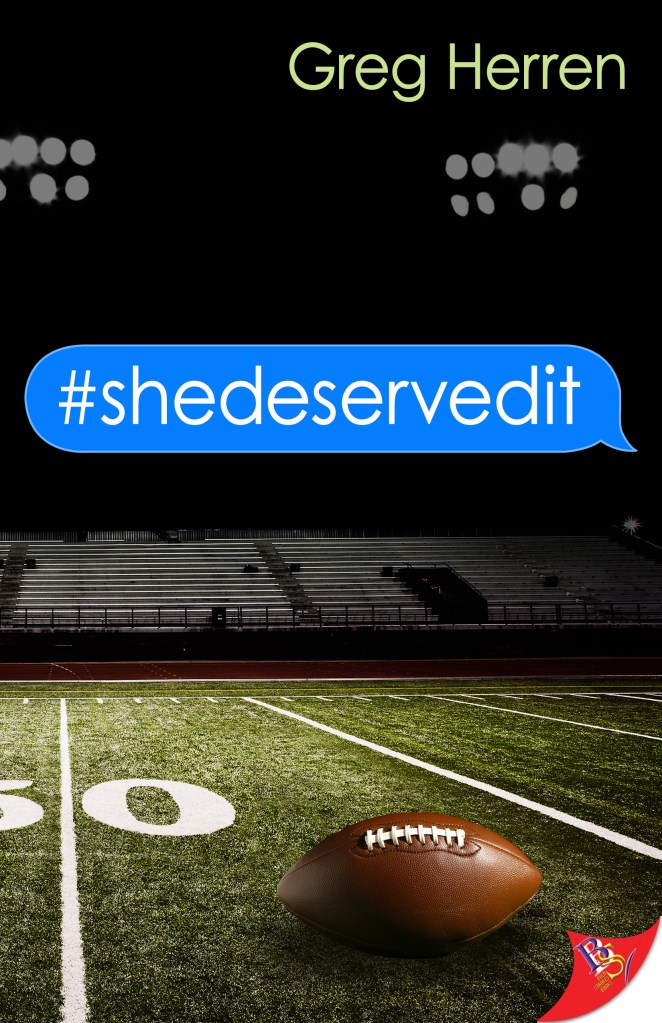
And finally, in July of 2015, I sat down and started writing a book I was no longer calling ‘the Kansas book’ in my head, but rather #shedeservedit.
I wrote over 97,000 words in one month–that’s how angry I was–and there wasn’t even a last chapter because I didn’t know how to finish the book. I sat on it for years, pulling it out every now and then, tinkering with it some more, but never really feeling it was ready–and I still didn’t know how to end it. I finally signed a contract for it because otherwise I probably would have never finished it and just kept futzing with it until I died, and I thought it was an important book to get out there. Sure, I went around and around about it; am I the right person to tell this story? Should someone else be writing it? I started reading other y/a novels about sexual assault, but they always left me feeling unsatisfied; the endings never really worked for me, which was the same problem I was having with this book. But I finally decided the best thing for me to do was sign the contract and give my editor a chance to look it over and give me input…and I am incredibly blessed to have an exceptional one in Ruth Sternglantz. The book is much better than it ever could have been without her insights, her vision, and her sensitivity. I was also very proud of this book when it was released, and I still am. I was both honored and shocked when it made the Agatha shortlist; even more so when it made the Anthony as well.
Alex jogs down the gravel path, his rubber cleats making crunching sounds on the shiny, sparkling white stones. The field, still lit up from the game, looks forlorn and lonely. The sod is chewed up from impacts and cleats and falling bodies. Some debris blows around in the slight warm wind, heavy with coming rain—plastic bags, strands from purple and gold pom-pons on a stick, wrappers from cheeseburgers and hot dogs sold at the concession stands. State championship flags snap and crackle on their poles on either side of the scoreboard. The janitorial team works their way up from bottom to top, picking up trash carelessly left behind by the crowd who’d filled the iron rows of seats.
The scoreboard still reads HOME 48 VISITORS 7.
He’s forgotten his arm pads on the sideline by the bench. He took them off when Coach Musson pulled the starters from the game when the fourth quarter started because the game was already won. He didn’t realize he’d left them behind until Coach Musson’s short post-victory pep talk was over and he went to his locker to take off his pads. His mom always says he’d forget his head if it wasn’t attached. Maybe she’s right. He could just get new ones, sure, but he’s superstitious about these arm-pads. He’d worn them all season last year when they’d won State again.
He knows it’s stupid, but why risk jinxing things?
He’s coming down from the adrenaline rush of the game, beginning to feel tired. His arm pads are right where he’d tossed them, underneath the bench where the big orange coolers of Gatorade sit during the game. The pads are just lying there, graying gold, his name written in purple marker on them.
He’s thirsty but wants to just sit for a minute. Let the locker room clear out a bit before he goes back to shower and change.
The wind is picking up. The summer has been long and hot and dry, but it’s supposed to start raining around midnight. There’s a bruise on his right calf, purple outlined in yellow and orange. He doesn’t remember getting hit there. He never remembers the hits. The games go by so fast. He spends every Friday afternoon with his stomach knotted. The pre-game warm-up seems to last forever. But once the whistle blows and the ball is kicked off the tee, time flies. Later his muscles will ache, the bruises will come up, his joints will start hurting.
He knows he can’t sit for long. India, his girlfriend, is waiting for him. He’s hungry—he can never eat before a game. He wants to grab something to eat before he has to be home. He hates his stupid curfew, but as his dad likes to remind him all the damned time: my house, my rules.
This wasn’t the original opening; originally the book opened with the quarterback missing and Alex, his best friend, goes out looking for him only to find his body floating in the river. But my editor recognized that wasn’t where the story began; we needed to see the night before and not in flashback, to set up everything for the rest of the story. (I am very stubborn and often need someone else to say to me, this isn’t working and this is why for me to give up on trying to make something work when it never will no matter how hard I try.)
I’m very proud of this book. I think for once I actually succeeded in what I was trying to do–and that was, of course, thanks to my editor’s wisdom–and while I most likely won’t win the Anthony (a very strong field), I am so pleased that the book got some recognition.
Tuesday morning, up again before sunrise and heading back into the office for the first time since last Monday. Yesterday was a good working at home day; I managed to get quite a bit accomplished and even managed to get Scooter (the Lost Apartment certainly feels like the Lost Apartment again now that the cat is back and in full-throated you’re not paying enough attention to meeeeeeeee mode again) and the mail and even made a bit of groceries as well (I forgot things, of course, which means stopping on the way home from the office tonight, hurray) which is nice; I also made a very (relatively) thorough to-do list for me to work on for the rest of the week. I also finished a (very) rough first draft of the short story, which I am going to let sit for a day or so before marking up the fuck out of it before turning it in. I also spent some more time with Carol Goodman’s quite marvelous The Lake of Dead Languages, which really is magical–I don’t know how she manages that melancholy Gothic tone she pulled off in this book, but it’s really a master class–before making dinner and collapsing into my easy chair.
It did feel good to get the draft of the story done. It was at 2300 or so words, and now it is sitting at about 5500; and some of the original 2300 bit the dust, so I managed to write maybe about 4000 words yesterday in a couple of hours? It’s good to know that I can still do that I suppose; that’s always a part of the malaise I experience whenever I finish writing something major–the fear that the ability to write will go away in the future and can no longer be counted on. But it felt really good to write yesterday–when will I ever learn that writing, or rather, forcing myself to actually sit down and do it–always is the best way for me to alleviate stress. It’s the not writing that inevitably is at the root of all my anxieties and stress, and actually writing–no matter how bad the thing I am writing might be–always makes me feel better, always centers me, and is always the best cure for whatever ails me at any time. The secret is to write, of course, always.
Bearing that in mind, of course after I get home this evening I should spend some time writing before spending some more time with the Goodman before shutting my brain off and watching television. Paul and I started watching Minx–I’d only watched the first few episodes before stopping–and those earlier episodes were much funnier the second time around; but I think there’s still some issues I have with the show’s depiction of the main character, but I know I’m enjoying the show a lot more this time around. than I did the first time I tried to watch. I just have an issue with the entire trope of the fierce woman with no sexual experience (or much to speak of, at any rate) finally learning the joys of a vibrator or having really good sex to “lighten” up her point-of-view; the show really leans into the idea of the angry feminist trope and all the baggage that comes with it. On the other hand, it was an incredibly sexist and misogynist period (spousal rape was still considered not a crime at the time this show is set), and as the Supreme Court leak from yesterday showed…misogyny runs deep in this country. (I am still too filled with rage to go down that particular path right now, but I am deeply, deeply, furious about this prospective ruling.) But I like the show overall; and it’s good to have a reminder of just how fucking bad things used to be as a reminder of what the right wants us to return to…
I’ve also started looking over my story this morning and the opening is actually…not bad. Maybe this story isn’t going to need nearly as much work as perhaps I may have thought. This is, naturally, very exciting.
And on that note, I am heading into the spice mines. Have a lovely Tuesday, Constant Reader–I’ll check with you again tomorrow.
God, it was miserably hot yesterday. I know, it’s New Orleans in July; the dog days of summer (I’ve never really quite understood what that meant, honestly; probably something about how a dog pants or something–so hot I was panting like a dog, or something along those lines anyway–it always makes my think about my grandmother’s mutt dog, Shag, lying down in the shade and panting) as it were, but it still does bear comment periodically about how motherfucking hot it is here sometimes in the summer.
I slept deeply last night, and didn’t really want to get out of bed this morning. I’ve been feeling tired again lately–not that horrible exhaustion I had for those months earlier this year, thank the heavens–and yesterday was one of those days again. It may be the heat, which is the most likely explanation, but I am not wanting to go back out into it today either–I am debating the wisdom of waiting to go to the grocery store until tomorrow or even seeing if it can be put off until next week sometime–which is probably self-defeating in some ways; but I also need to write this weekend (since I didn’t do much of that this past week) and I worry that going out into the heat and lugging bags of food into the house will defeat me for the rest of the day (which is always a possibility).
Decisions, decisions.
During our The Faking of the President on-line promotional appearance the other night we were talking about the 1970’s–if I considered myself a child of the that decade, and I actually do; I do remember bits and pieces of the 1960’s, but I turned nine in 1970 and that decade more shaped who I am rather than the 1960′–and as I mentioned yesterday, I’ve kind of started looking into the films of that decade a bit more. I kind of wanted to watch more Hitchcock movies yesterday–I was going to go for some of his 1970’s work, Frenzy and Family Plot, to be exact–but they are no longer on Amazon Prime for free (they were for quite a while) and that interface has also changed again and become even more user unfriendly; I cannot understand why Amazon cannot get its shit together on their streaming service, but came across the original film version of The Stepford Wives, either on Prime or the TCM app on HBO MAX, and settled in to watch that again. It’s a film (and novel) that is firmly anchored in the paranoid zeitgeist of the 1970’s, and fits very well into a reexamination of what was going on in that decade.
As I mentioned on the live stream the other night, the 1970’s were still a decade where wives were still defined as people in terms of their husbands; it was still very difficult for women to get credit on their own (this was actually how the subject came up–student loans and student credit cards), and I mentioned that my mom’s first credit wasn’t actually in her name, but as Mrs. (Dad) Herren. She had been working as long as I can remember, but her financial identity was still as the spouse of my father. The Women’s Liberation Movement began in the late 1960’s–espousing the radical concept that women were actual human beings in their own right and didn’t solely exist in terms of the man in their lives–and the 1970’s was when the stigma of divorce began to lessen; women no longer stayed in bad marriages or with abusive husbands. Rape was still basically a misdemeanor; spousal abuse was accepted and almost expected, and women were very much second class citizens, primarily defined as wives and mothers (this has changed somewhat, but really, not enough). Ira Levin wrote The Stepford Wives as a sort of social satire, but it was no less terrifying as a result; the revenge of men against women’s liberation. (You never hear the terms Women’s Lib or ‘libbers’ anymore) The Stepford Wives basically took the concept of how dehumanized women were to the nth degree; men really only want beautiful women who don’t think for themselves, think they’re wonderful lovers, live for their men and children, and should primarily focus on making sure their homes are spotless and perfect so their men don’t have to worry about anything but their jobs. The film leaned into this fully; I think the best part of the book was the fact that it never really explained what was going on in Stepford; it was alluded to, of course, but the truth was so terrible that the women–main character Joanna and her friend Bobbie–couldn’t possibly imagine what it was.
But seeing the actual Stepford wives, played by actresses, up on screen, truly epitomized not only how horrible what was happening in Stepford was, but how strange it was for Joanna and Bobbie to deal with, strangers who had only recently moved into town. Paula Prentiss played Bobbie–and why she was never a bigger star was something I never fully understood–and of course, stunningly beautiful Katherine Ross played Joanna–which made it all the more terrifying; she was so perfectly stunning and beautiful, how could you possibly improve on Joanna? The film of course couldn’t leave the truth ambiguous and merely hinted at; which was part of the power of the book…you never were completely sure if Joanna was simply going crazy because the truth of Stepford was presented so casually and normally. (Don’t bother with the remake; despite a stellar cast, it’s truly a terrible movie.)
The Stepford Wives, book and movie, both also fit perfectly into the paranoia of the decade; the 1970’s was a time where conspiracy theories abounded; there was a lot of interest in UFO’s and the Bermuda Triangle and Revelations/the end of the world, not to mention after Vietnam and Watergate mistrust of the government and elected officials were higher than ever before. But I also see The Stepford Wives as part of another literary trend/trope of the decade; the 1970’s was also a time when, as I mentioned on-air the other night, that white flight from the cities to the suburbs and rural eras began in earnest (although it was never, in the books, attributed to its real root cause: integrated public school systems and neighborhoods). There are at least three novels I know of that take the white flight to the rural areas (better schools! clean air! zero crime!) and turn them into horror novels–Burnt Offerings, The Stepford Wives, Thomas Tryon’s Harvest Home– where the urbanites discover far greater horrors out in the country than they ever encountered in the city; there are probably more (I am not certain The Amityville Horror fits into this category), but those three would make a great starting point for a thesis/essay. (Interesting enough, both book and movie of The Stepford Wives ends with a throwaway bit about the first black family moving into Stepford; I would absolutely LOVE to see a reimagining of the film by Jordan Peele from the perspective of the black family moving in, because the paranoia of the wife beginning to suspect that all is not right with all these white women who are devoted to housework and their families could also be played with from a racial as well as gender perspective.)
And as I watched the film again yesterday, I realized that my mother, with her obsessions with cleanliness and order, kind of was/is a Stepford wife.
I plan on spending the rest of this morning getting my kitchen/office–horribly out of control yet again–into some semblance of order before diving back into Bury Me in Shadows. I’d like to get the changes necessary done to the next three to four chapters today, and perhaps another four to five tomorrow, which would get me almost to the halfway point. I also need to compile a comprehensive to-do list for the coming week. I also want to spend some time with Blacktop Wasteland today as well.
We started watching a new series last night–Curon, which is an Italian show set in the Tyrol, in a region that changed hands between the Austrians and the Italians numerous times. The town is built on the shores of a lake, where the original town was submerged when the river was dammed; all that remains of the old town is the church’s bell tower, jutting up out of the water. There’s a story that if you hear the bells ringing, you’re going to die–and some seriously weird shit is going on in this town. The show opens with a flashback to the past, when a seventeen year old Anna is hearing the bells ringing and her father orders her out of the massive luxury hotel they live in; she’s not sure but she thinks she sees herself shooting her mother–a nightmare that haunts her the rest of her life. Flash forward to the present, and Anna is coming back to Curon, after leaving an abusive (it’s hinted at) husband with her twin children, now seventeen–Mauro and Daria–from Milan. Her father makes it clear they aren’t welcome there–but when Anna disappears the next day the twins are there to stay. It’s filmed very well, and there are apparently tensions still in the village from the olden days of the war between Austrians and Italians; Mauro is also hard of hearing and wears a hearing aid; Daria is boisterous, outgoing, and kind of a badass; and the teenagers they encounter, both outside of school and in it, are also kind of weird. There’s all kinds of history there, slowly being revealed to the viewer, while the tension continually builds. What is the dark secret of the town of Curon?
I also, while typing that last sentence, realized Curon also fits in with the trope of the urbanites coming from the big city to the country, and discovering far greater horrors there than they left behind in the city.
So here we are, on Memorial Day Monday, the final day of the three day holiday weekend, and I’m wondering–without checking social media (I do not intend to go on social media at all today)–how many people are wishing others have a Happy Memorial Day? Memorial Day isn’t a happy day–even though the majority of people don’t have to work today–it’s supposed to be a day of quiet reflection in honor (or memory) of those who have died serving the country in the military. It’s a day when you should visit the graves of the military dead and clean them, bring flowers, and reflect on their service. While I have no one in my family, on either side, who was lost to a battlefield, it’s still a somber day, and wishing others well or to have a happy day is in extremely poor taste.
But then, Americans generally have a tendency to go through their lives blithely, completely unaware of their own history and the meanings behind national symbology, holidays, memoriams, etc.
Yesterday was a blissful day. I quite happily finished reading The Red Carnelian, and then reread a kid’s mystery I remembered fondly, The Secret of Skeleton Island, book one of the Ken Holt series–one of my childhood favorites, and was very pleased to see that it still held up. I wrote for a little while, did some cleaning and organizing (not nearly enough of either, quite frankly), and then we finished watching Outer Banks, which is really quite something. It’s kind of a hodgepodge of story, really; at first, it didn’t seem like it was sure what it wanted to be, but once it decided to kick it up a gear after a few dull episodes of set-up, it really took off. A lost treasure, betrayals and murder, class struggles, the heartbreak of teen romance–it was a non-stop thrill ride, culminating in our hero, John B., and his star-crossed lover, Sarah, taking off to sea while being hunted by the cops and driving their boat directly into the path of a tropical storm. Cheesy, completely ridiculous, and over-the-top, Outer Banks turned to be much more fun than I would have ever guessed, particularly given the first few episodes, which were just tedious. We then moved on to another Netflix series, a joint British/Spanish production of a crime thriller called White Lines, set on Ibiza and focusing on the discovery of the body of Axel Collins, missing for over twenty years–and his younger sister’s determination to get to the bottom of who killed her brother. It’s trash, but ever so entertaining.
I also spent some time with Harlan Ellison’s collection of television columns from the Los Angeles Free Press from the late 1960’s, The Glass Teat. Harlan Ellison was a writing hero of mine, yet at the same time he was one of those people I never wanted to meet. He wrote one of my favorite short stories of all time (“Paladin of the Lost Hour”) and is probably my favorite short story writer of all time; he also wrote the best episode of the original Star Trek series, “The City on the Edge of Tomorrow”; and also wrote the original story that became the film A Boy and His Dog, which was a bit of a cult classic in the 1970’s and 1980’s. All of his stories are really exceptional, and he was very opinionated–if he thought you were a garbage writer and you wrote garbage, he would let you know–but his television writings, while undoubtedly accurate, are really dated. It also got me thinking about the time period, and the struggles that were going on in the country–the Vietnam War, the rise of feminism, the Civil Rights battle–and how much of that period is not only not remembered today, but the specific language of the time has been forgotten: people using words like groovy and squares and the establishment, etc.; I also remember how false those words seemed when filtered through the lens of television producers and writers trying to seem hip and modern and cool….which, naturally, killed the popular usage of the words; after all, after you’ve heard Greg Brady enthuse about something being “groovy” on The Brady Bunch, it’s kind of hard to use the word in any other way than ironic from that point on. But a lot of what he was complaining about, what he was eviscerating, is still true today–that the television networks are all too terrified to put something that actually mirrors people’s realities on; that the whole point of television is to sell products to consumers; and as such, the commercial concerns inevitably will outweigh the artistry and truth of the show.
I’d love to know what he thought of All in the Family, in all honesty.
Today I want to get to some serious work on the multiple projects lying around; I also have two short stories queued up on the Kindle to read–“Rain” by Somerset Maugham, and Cornell Woolrich’s “It Had to Be Murder,” which was adapted into Hitchcock’s film Rear Window. I’ve been aware of Woolrich for quite some time now, but I have yet to read his work. He is considered a noir master, not perhaps as well known today as he should be, considering how many of his stories and novels became famous films, and he was also gay in a time period where being gay was exceptionally difficult–so naturally, I have a growing fascination for him. I started reading his The Night Has a Thousand Eyes a few years ago, but had to put it aside to read something else (prep work for a panel I was moderating) and somehow never got back to it….maybe instead of proceeding with another book in the Reread Project–I’ve yet to select one–I can go back and finish reading that? I looked at the opening of “It Had to Be Murder” last night as I queued it up and was most pleased with how it opened…so am looking forward to reading the story today.
And on that note, it’s time for me to get back to the spice mines.
God, what a year for crime fiction, and what a year for crime fiction by women. The women are killing it this year–but then, they pretty much kill it every year, and have killed it every year since Agatha Christie’s first novel was released. I’ve read so many amazing crime novels by women this year that I can’t even begin to remember them all; I know there’s been terrific novels by Alafair Burke, Laura Lippman, Alison Gaylin, Lori Roy, Jamie Mason, Steph Cha, Angie Kim and so many, many others that I couldn’t being to name them all or possibly be expected to remember them all, either. (This is in no small part, of course, due to the fact that my memory works about as well as my desktop computer since the Mojave update.) There are so many others as well that I’ve not gotten to read yet–I am way behind on my reading of Catriona McPherson, for example, and Lori Rader-Day–and I’ve also been trying read more diverse books this year as well.
And just this past week, I finished reading Lisa Lutz’ amazing The Swallows.
Some teachers have a calling. I’m not one of them.
I don’t hate teaching. I don’t love it either. That’s also my general stance on adolescents. I understand that one day they will rule the world and we’ll all have to live with the consequences. But there’s only so much I’m willing to do to mitigate that outcome. You’ll never catch me leaping atop my desk, quoting Browning, Shakespeare or Jay-Z. I don’t offer my students sage advice or hard-won wisdom. I don’t dive into the weeds of their personal lives, parsing the muck of their hormone-addled brains. And I sure as hell never learned as much from them as they learned from me.
It’s just a job, like any other. It has a litany of downsides, starting with money and ending with money, and a host of other drawbacks in between. There are a few perks. I like having summers off; I like winter and spring breaks; I like not having a boss breathing over my shoulder; I like books and talking about books and occasionally meeting a student who makes me see the world sideways. But I don’t get attached. I don’t get involved. That was the plan, at least.
The Swallows is set at a second-tier elite boarding school in New England called Stonebridge. Alexandra “Alex” Witt has been hired to teach Lit there after leaving her previous teaching job under a cloud of some sort. The daughter of a failed literary writer who has taken to writing crime novels under a pseudonym and an Eastern European fencing Olympic medalist, Alex is a bit of a mess but also has a strong character and equally strong sense of self. The job at Stonebridge is given to her by a friend of her father’s, who is the headmaster, and when she arrives she refuses to live in the dorms and takes up residence in a crappy cabin near campus without power or phone or much along the lines of creature comforts. Alex is the primary point of view character–there are others, including another teacher/writer named Finn Ford (who is writing a book based on the school and what goes on there); a nerd boy who is on the edges of the popular kids, “The Ten”; Gemma, an orphan whose actions primarily drive the story (she is also one of The Ten), and several others. There’s also a dark secret at Stonebridge–a secret website that only a select few have access to, where the boys try to get the girls to give them blowjobs after which the boys score them…with an eye to winning what they call the Dulcinea Prize, awarded to the best blowjob performer at Stonebridge. Gemma has found out about this, and wants to do something about it–and her desire to get back at the boys who–in the most eye-opening and honest statement I’ve ever read, “see the girls as things rather than humans.” The horror of that realization drives the story, which grows darker and more complex and awful with every page.
The book is also darkly witty–there were a few times when its macabre humor made me laugh out loud–and the characters are absolutely, positively real; Lutz has created complicated people who do things that might not make sense on the surface, but that conduct and behavior only adds to their layers and complexity. It’s hard not to root for both Alex and Gemma to bring the rotten boys down, exposing their crimes to the world and the sunlight so they will shrivel up and die. The twists and turns of the story are all earned, all realistic, and all startling. The book is masterfully written, and never has a second-rate boarding school been brought to life in such a vivid fashion.
It reminded me, in some ways, of both Donna Tartt’s The Secret History and Bret Easton Ellis’ The Rules of Attraction, in the best possible way. I enjoyed both of those books, but not in the same way that I enjoyed this one; I think because Lutz’ story is more cohesive and her characters are somewhat likable and believable despite their flaws.
I greatly enjoyed this book, and look forward to reading more of Lisa Lutz’ canon.





 Queer and Loathing in America