Man of Constant Sorrow

This week a new anthology with a story by one Gregalicious is dropping, The Faking of the President, edited by Peter Carlaftes and from Three Rooms Press. Three Rooms also produced the 2018 St. Petersburg Bouchercon anthology I edited, Florida Happens, and thus it was lovely to be working with Peter, Kat, and the Three Rooms Press gang again. The book has turned out to be absolutely lovely, and I couldn’t have been more pleased to be asked to write a story for this.

The concept behind the book was, of course, to create noir stories built around a president. I was torn at first when asked to choose a president; there were any number of them that I truly like and admire….yet so many mediocrities. The 1850’s, the lead up or prelude to the Civil War, has been of particular interest to me of late, and I decided to chose someone from that period, where we had a string of mediocre presidents take up residence in the White House: Zachary Taylor, Millard Fillmore, Franklin Pierce, and finally James Buchanan. Buchanan is widely considered to be (or was considered to be, YMMV) the worst president in American history; he was the last president before Lincoln’s election and the outbreak of the Civil War. Buchanan did nothing to stop the coming eruption of war; if anything, he exacerbated the ill feeling between the two sections of the country. All the 1850’s presidents were Yankees with Southern sympathies; they were called “dough-faces” at the time (I don’t know why that particular term was used; so don’t ask. Google is your friend), and yes, many parallels between that time and our present day kind of exist, if you care to look to see them. Buchanan also conspired with the worst Chief Justice to ever lead our Supreme Court, Roger B. Taney, in the court decision that flamed the fans of regional hatred into an unforeseen heat that made the war even more inevitable than it already had been; Buchanan and Taney thought they were putting the slavery question to bed once and for all with the Dred Scott v. Sandford decision; by striking down the Missouri Compromise and the Kansas/Nebraska Acts as unconstitutional, the two attempted to make slavery the law of the land and permissible in the vast unsettled (by white people) territories as well as make it legal in the states that prohibited it.

Yeah, that kind of backfired.

Buchanan was also the only president who never married; and while there is certainly no proof or evidence that is conclusive, it is widely suspected that Buchanan was our first gay president. He lived, for example, for a long time with Senator Rufus King of Alabama; Andrew Jackson jeeringly called Buchanan “Aunt Fancy”; and their surviving letters bespoke an affection and longing between the two that went a bit deeper than being just good buddies. So, as a gay writer, I decided to write about Buchanan. But writing a period story set in the DC of the late 1850’s seemed a bit much and certainly more than I could handle; plus I couldn’t really come up with a plot. I thought about having Buchanan murder a slave he’d been forcing to be his lover and the ensuing cover-up; I made several abortive attempts at writing that story before finally abandoning the idea.

I had no idea what I was going to write–until I read an article on-line somewhere about Buchanan’s mysterious sexuality and sexual preferences, and the author said something along the lines of but for some historians, short of finding daguerrotypes of Buchanan naked with another man, nothing will ever serve as conclusive proof for the deniers.

And there it was. I started writing “The Dreadful Scott Decision.”

faking of the president cover


The cheap whiskey tasted like flavored turpentine, burning so intensely as it went down it felt like it was leaving scorch marks in its wake. Scott Devinney was just high enough from the joint he was smoking to consider that a plus—a sign that he was still alive no matter how numb he felt.

He was sitting in the dark in his cheap apartment near campus, streaming the panel he’d been on at the presidential historians’ conference at UCLA the previous weekend. It had aired live on a PBS network in Los Angeles—it took him a while to figure out how to access it, and now that he was watching it was even worse than he feared. He’d always suspected Pulitzer prize-winning historian Andrew Dickey was a homophobe; his behavior on the panel proved it without question.

Alas, Scott allowed Dickey to get under his skin. He wasn’t proud of that, and his doctoral advisor, Dr. Keysha Wells-Caldwell—also head of the department at UC-San Felice—wasn’t happy, either.

He wasn’t about to apologize to Andrew Dickey, though. He’d die first.

“You have no proof!” Dickey wagged his finger at Scott on the computer screen, his face reddened and his voice raising. “Just like the activists who try to claim Lincoln was gay without proof, there is no proof Buchanan was, either, no matter how bad you want him to be!”

He sighed and closed the window. He didn’t need to watch himself screaming in rage, embarrassing himself and the university in the process.

Which was what Keysha really cared about.

At one time, I seriously considered becoming a historian. I’ve always loved history, have loved to read it and study it,  and even write it (I still would love to do a Tuchman-like study of regnant women in the 16th century called The Monstrous Regiment of Women), but as with so many other things, poor professors in college stomped that desire right out of me. (The other problem, of course, being that I could never decide on a period to specialize in–although if forced I probably would have chosen the 16th century) I have heard, over the years, from friends who work in academia as well as reading books and so forth set in the academic world, how cutthroat and nasty the war over tenure can be; office politics as played by the Borgias or the Medici. My story “Lightning Bugs in a Jar” was sort of set in the academia milieu; I even considered writing a series about a college English professor at one time–it’s still there on the backburner; I may write it still. One of the novels I wrote under a pseudonym was set at a quasi-Seven Sisters style college in New England, and of course, my Murder-a-Go-Go’s story “This Town” was about sorority girls, and of course several Todd Gregory novels were set in fraternities.

So, what better idea for this story than a gay Buchanan historian, attempting to prove to the world that Buchanan was, indeed, the first gay president? And how far would he go to get that proof–which is the noir angle I needed for the story? And so the story was born…and you can order a copy here, or from any retailer.

And as you can see from the cover above, there are some fantastic writers who contributed to this book. I am very pleased to be sharing the table of contents with these amazing writers, and a bit humbled. Check it out–you won’t be sorry!

Mighty Love

I love nothing more than a great ghost story (which is why, although I loved the book, I was enormously disappointed with Peter Straub’s Ghost Story; it’s an amazing novel and a horror classic and one of my favorite horror novels of all time, but it is emphatically not a ghost story). I’m not sure why I love them so much, but even as a kid, reading the mysteries for kids I always gravitated towards the ones with some kind of ghostly title: The Ghost of Blackwood Hall, The Haunted Fort, The Phantom of Pine Hill, The Ghost at Skeleton Rock, The Haunted Showboat, The Ghost in the Gallery, etc. The ghosts and hauntings in these books were never real–just like the ghosts and monsters on Scooby Doo Where Are You? weren’t–but I still was drawn to them.

There was an ABC Movie of the Week when I was really young that I absolutely loved: The House That Would Not Die. It starred Barbara Stanwyck as a woman who moved into a house she’d inherited from a relative, along with her niece, and of course, the house turned out to be haunted. The story was terrific and it scared me a lot–and you can never go wrong with Barbara Stanwyck; I may even have watched it with my grandmother, who was a big Stanwyck fan. A few years later, we were somewhere–some people my parents knew had invited us over for dinner, and before and after, as the adults, my sister and I were deposited in the den to watch television and entertain ourselves while behaving. They had books, which I gravitated towards, I pulled down a volume of Reader’s Digest Condensed Books and found a ghost story inside. As I started reading, I was drawn into it and I realized it was the same plot, the same story, of the TV movie I’d liked, and kept reading. I read the entire thing that evening–it was condensed, after all–and thought, oh, I’d like to see that movie again.

Flash forward and I am in college, browsing in a second-hand bookstore when I find a worn paperback copy of the book. Pleased and delighted at the opportunity to not only read it again but read the entire version? For fifty cents? Absolutely.

It was Ammie, Come Home, which is one of my favorite ghost stories, and favorite novels, of all time. It was written by Barbara Michaels–for another dollar I picked up two more of her novels, Witch and House of Many Shadows. I loved all three books, but I’ve always preferred Ammie, considered it my favorite. Over the years Michaels–and her alter-ego, Elizabeth Peters-became one of my favorite writers of all time. I love her books, no matter what the name or brand or whatever you want to call it; they are all witty, with strong, likable female characters, there’s some little dash of romantic interest involved in all of them, and a very strong suspense component. The Peters novels were more mysteries; the Michaels sometimes involved the supernatural, and sometimes they didn’t.

But, oh, how I love Ammie, Come Home, and I recently, during my isolation, took it down and made it a part of this year Reread Project.

Ammie Come Home Barbara Michaels Fawcett Crest 1968 harry bennet cover art

By five o’clock it was almost dark, which was not surprising, since the month was November; but Ruth kept glancing uneasily toward the windows at the far end of the room. It was a warm, handsome room, furnished in the style of a past century, with furniture whose present value would have astonished the original owners.. Only the big overstuffed sodas, which face one another before the fireplace, were relatively modern. Their ivory brocade upholstery fitted the blue-and-white color scheme, which has been based upon the delicate Wedgwood plaques set in the mantel. A cheerful fire burned on the hearth, sending sparks dancing from the crystal glasses on the coffee table and turning the sherry in the cut-glass decanter the color of melted copper. Since her niece had come to stay with her, Ruth had set out glasses and wine every evening. It was a pleasant ritual, which they both enjoyed even when it was followed by nothing more elegant than hamburgers. But tonight Sara was late.

The darkening windows blossomed yellow as the streetlights went on; and Ruth rose to draw the curtains. She lingered at the window, one hand absently stroking the pale blue satin. Sara’s class had been over at three-thirty…

And, Ruth reminded herself sternly, Sara was twenty years old. When she agreed to board her niece while the girl attended the Foreign Service Institute at a local university, she had not guaranteed full-time baby-sitting. Sara, of course, considered herself an adult. However, to Ruth her niece still had the touching, terrifying illusion of personal invulnerability which is an unmistakable attribute of youth. And the streets of Washington–ven of this ultrafashionable section–were not completely safe after dark,

Even at the dying time of year, with a bleak dusk lowering, the view from Ruth’s window retained some of the famous charm of Georgetown, a charm based on formal architecture and the awareness of age. Nowadays that antique grace was rather self-conscious; after decades of neglect, the eighteenth century houses of the old town had become fashionable again, and now they had the sleek, smug look born of painstaking restoration and a lot of money.

Ammie, Come Home is possibly one of the best constructed, if not the very best, ghost stories I’ve ever read. As you can see from the opening paragraphs, Michaels does an exceptional job of setting everything up, giving us insights into her main character, Ruth Bennett, and her relationship with her niece. We go on to find out that Ruth is probably in her mid to late forties, was widowed in World War II, never remarried, and for the most part, it’s implied that her husband’s death pretty much was the end of any romance in her life; something she isn’t terribly interested in. This is, of course, foreshadowing–but not the way the reader might think. Yes, in the opening scene of the book, which features her niece Sara getting a ride home from one of her professors, that ah, yes, Ruth and Dr. Pat MacDougal are going to fall in love-but there’s more to Ruth’s history than that, which of course is the mark of the truly terrific writer. We also glean that childless Ruth has grown deeply fond of her niece Sara–and disapproves of Sara’s boyfriend Bruce (mainly because of his youth, the way he dresses, and what she thinks of as his smug superiority).

(This last, by the way, is the only part of the book that feels dated. Written and originally published in the 1960’s, Sara and Bruce are both college students and Pat works at a college–he’s a cultural anthropologist with a specialty in superstitions and rituals–so, as anyone who knows anything about the 1960’s knows, it was a decade of youthful rebellion and anti-establishmentarianism. There are occasional asides from both Ruth and Pat about the generation gap–this was also the first time this phrase was used, during this period–where the kids want to make change. There are a few mild arguments over that, but it’s always very good natured and never gets very deep. But the very generation gap is part of the structure of the novel; when strange things start happening in Ruth’s home, particularly involving Sara–Ruth and Pat immediately think of mental illness; Bruce is the only one open-minded enough to see the truth; that the house is haunted by a malevolent spirit–and there may even be more than one.)

It’s also very clever of Michaels to use that generational divide to explore the notions of the supernatural and a spirit world–because Bruce is given a forty-eight hour deadline to convince the older two in their quartet that Sara isn’t mentally ill but is being haunted. So, as Bruce convinces them–helped by more apparitions and events in the house–the reader is also being convinced that what’s going on in the house is supernatural in origin. How she does it is a master class in suspense/horror writing; and there are some lines that just the reader to the bone: And what looked back at her through Sara’s eyes was not Sara.

The ghost hunters eventually get to the bottom of the haunting of the old house in Georgetown by finding out the deeply hidden truth about what happened there centuries earlier, and finally freeing the spirits trapped to the house.

And maybe the creepiest, yet saddest, thing is the disembodied voice they hear, over and over, in the back yard, calling Ammie….come home…..come home…..Ammie…. —which is described as “it sounded like what the wind would sound like if it had a voice.”

And despite the dated 1960’s references, the book still holds up, over forty years later.

I rediscovered Michaels in the mid to late 1980’s, which was when I also discovered that she also wrote the Elizabeth Peters novels, and that the absolutely delightful Crocodile on the Sandbank, which I’d loved, wasn’t merely a stand alone, but the first book in a long-running, and completely fantastic, series featuring heiress Amelia Peabody and her Egyptologist husband Emerson. There isn’t a single dud in the Amelia Peabody series–and there are smart, funny, clever, and intricately plotted–and over the years the Peabody-Emerson clan had children, raised them, and those children grew up to be involved in the adventures of their parents–and every book, save one, actually took place in Egypt at the turn of the twentieth century. I need to reread Crocodile on the Sandbank, and in fact, would love to revisit the entire series. She wrote two other series as Elizabeth Peters as well–the Vicky Bliss series and the Jacqueline Kirby–as well as stand alones; every Peters novel is a gem, as is every novel she wrote as Barbara Michaels.

And now back to the spice mines.

I Fall to Pieces

And this morning I woke up to the good news that my COVID-19 test came back negative, which now begs the question: what was wrong with me? Was it some weird combination of sinuses, allergies, flu, stress and exhaustion? I mean, don’t get me wrong, I’m definitely thrilled to not have this and for this whole thing to be over, but…I’m very glad to know that I wasn’t infectious and out in public for a while. So I am just going to take the win, tomorrow’s a paid holiday, and I’m going to take the weekend to sort things out and hope I feel better and continue to rest.

I did wake up this morning feeling good for the first time in a very long time, which is also terrific. Today was the first day where I woke up and felt like myself–I have some things to deal with this morning, as I do every morning, but this time I woke up and didn’t dread dealing with any of it-and since I feel good, that makes me wonder just how much of this has been stress related? Probably more than I want to admit to; and there was probably some PTSD there as well. I also need to remember that feeling fine is also a relative thing and that it comes and goes with the PTSD stuff-and there could even be something today that makes it worse–always remember your emotions can turn on a dime when you’re going through something like this–and there’s never any indication that your mood is going to swing, or how wild that swing is going to be. Fun stuff–and the mood swinging lasts for a while after the situation normalized, too. 2005-2009 was not the most emotionally stable period of my life, if I am going to be completely honest, and fortunately most of it is now hazy in my mind. But I know there was some bad behavior on my part to people who didn’t deserve it–and I hope that I apologized for it.

Yesterday I was fatigued–my energy failed me in the afternoon–and that’s concerning, as I said earlier, but there’s really nothing I can do about whatever was wrong with me other than accept that it wasn’t COVID-19 and go on with everything in my life-and be extremely cautious going forward to make sure that I don’t get it now. It’s funny–knocking on wood here–but somehow I made it through the the HIV/AIDS pandemic without getting infected (I’ve never had any STI–gonorrhea, chlamydia, syphilis, trichomoniasis–other than HPV, and of course I had the bad kind, but without any re-occurrence) and so far I’ve not managed, despite Mardi Gras and a public contact job screening people for COVID-19, to not get that, either. At least so far–and I am going to be a lot more anal about going out in public and being around people from now on, too.

I read some more yesterday on Ammie, Come Home, and I marvel at how marvelously constructed this novel is. There’s never any point where it drags at all, and Barbara Michaels knows precisely how to build suspense and terror in such a… I want to say genteel way that makes it even more terrifying. The spectral encounters the characters have in the old house in Georgetown are absolutely heart-thumpingly terrifying and scary and creepy; it’s truly one of the most perfect ghost stories ever constructed…which is why it is one of my favorite novels of all time. Barbara Michaels was always considered a Gothic suspense writer, and some of her novels don’t have a supernatural touch to them, but the ones that do (House of Many Shadows, Witch, The Dark on the Other Side, Be Buried in the Rain, The Crying Child) are some of the best, quietest horror novels I’ve ever read; she built a quite large audience of readers who would most likely never read horror–but she certainly straddled the line between suspense and horror-which is why I think Gothic is such an interesting term.

Once I get this Sherlock story wrangled and under control, I am looking forward to going back to Bury Me in Shadows. It’s been on my mind a lot lately–and I’ve been having, as I previously mentioned, a lot of strange little creative bursts over the past week or so–and so today, once I get the business I need to get taken care of taken care of, I am going to get organized. I am going to whip this desk area into shape, organize all my notes and everything that is scattered all over the place, and be ready to hit the ground running once Easter has passed. I want to get this story finished–as well as several others that are in process–and then I am going to set a writing schedule to get Bury Me in Shadows whipped into submission shape so I can get it sent in to my publisher so I can then focus on doing the same for the Kansas book….and then I am going to start pulling together Chlorine. I probably won’t be this organized–I never am as organized as I plan to be, nor do I ever stick to the schedule I always try to stick to–but I like organizing and I like coming up with plans–that’s the sort of thing that makes me happy, and I am going to focus, as one always should in times of crisis, on doing things that make me happy.

And on that note, I am going to go take a shower, get cleaned up, and get moving again.

Have a lovely day, Constant Reader.

f64ada3c69569644c3ccfe02ec01a566_medium

Heaven’s Just a Sin Away

I’m tired.

I think the worst thing of all this is the uncertainty, you know? Every time the fatigue sets in, every time my mind gets foggy, every time I can feel my temperature going up, after the great here we go again thought comes the what if you actually test negative? What does that mean? If you don’t have this, what the hell is wrong with you?

Paul suggested that part of the fatigue could come from the lack of activity, and there’s a possibility that might be true. Once I finish this, I am going to get down on the kitchen floor and stretch, just to see how that feels. I am really not overly comfortable going for a walk, in all honesty; not knowing whether or not I am actually infected makes going out of the Lost Apartment seem like an incredibly foolish and irresponsible thing to do. I do have a mask–an official medical one, and gloves too–I had to buy these when Paul had his heart surgery all those years ago, and my tendency to hoard actually came in handy for once, so I suppose keeping a distance from others while wearing gloves and a mask should be okay, but there’s so much uncertainty about everything–hell, I don’t know if I actually am infected or not–that I just don’t know what I should be doing or should not be doing.

But I am lucky, because if I do indeed have this, at least it hasn’t moved into my lungs, at least not yet. I think it’s the lung part that is problematic for people; the inability to breathe, of course, would be horrifying, as well as feeling like you’re drowning. I go back and forth all the time on everything; it’s horrible to be indecisive, to not know what the right decisions are or even what the consequences of the wrong decisions could even be. This also isn’t like me, and I don’t know if it’s the foggy head or just the times or if I am simply being visited by some good old PTSD. Anything at this point is possible, and there are so many goddamned variables…and being trained since birth to always expect the worst doesn’t help much, frankly.

Yesterday wasn’t too bad, all things considered. I did some chores around the house once I woke up, ate some cereal, and then was exhausted (again, lack of activity, or illness?) and so I collapsed into my easy chair and couldn’t even focus on reading. I did get a few chapters more into Ammie, Come Home but after awhile put it aside and got lost in Barbara Tuchman’s A Distant Mirror. ESPNU also decided to replay a series of LSU games from last season–the Mississippi game, then the play-off game with Oklahoma and the national title game–so I had that on while I read and dozed off and on. I never nap; and I always have trouble sleeping–which is the truly weird thing about all of this; the amount of sleep I’m getting, and then again–maybe I’m tired from sleeping too much, I don’t know. After Paul got home and we watched the end of Schitt’s Creek (which I am very sad to say goodbye to; it may be my favorite sitcom of all time), and then I read some more before going to bed.

The exciting life of a gay mystery novelist.

I do have creative bursts, though-which gives me hope that someday soon I might actually start writing again. I’ve been thinking through Bury Me in Shadows, and I think i might have actually solved the mystery of what’s wrong with the story. In fact, rather than reading any of my various books that I have spread out on the end table next to my easy chair (the two afore-mentioned, along with Du Maurier’s The Breaking Point and my iPad, which has a plethora of books in its various book-reading apps) I should probably reread the entire manuscript, perhaps even do an outline, and then figure out how to make it better and revise it, so when I can get back on a roll with writing again I can get back to it. I’ve also been thinking about the Kansas book, and I think I’ve cracked that code at long last–since I started writing it in either 2015 or 2016, about fucking time, wouldn’t you say–and so maybe, just maybe, i can get to that too. I also have to write my Sherlock story. The kitchen is also a mess–there’s a load in the dishwasher that has to be put away and the sink is full of dirty dishes as well, and there are clothes in the dryer as well-and God knows when the last time I did the floors was. I am going to try to get some of this stuff handled at some point today.

And on that note, I am going to try to get started on everything and see how much I can get done before I run out of energy–not that I have a lot right now, but the coffee is helping give me a bit of a boost, which is always nice–and see what can get taken care of before the malaise comes back.

Sorry to be such a downer, and I hope all is well with you, Constant Reader–and stay safe.

grid-cell-12321-1387651354-6

Amarillo by Morning

So, this morning when I woke up, as my first cup of coffee brewed, I dialed the COVID-19 testing hot-line for staff at the day job and made an appointment to get tested. They scheduled me for 9:20 am; I was called at around eight thirty, which left me with about fifty minutes to wake up, drink some coffee, and pull myself together. Our clinic’s COVID testing set-up is in the parking garage which is the ground floor of our building; staff simply drives into the garage and pulls up to the area where the tents and check-in desk are set up, and the doctor comes out and swabs your nose. Needless to say, as I swilled down coffee and brewed another quick cup to take with me in the car, my nerves were definitely feeling a bit frayed. Saturday was a better day than Friday; yesterday was better than Saturday. So far this morning I seem to feel okay other than fatigue–going up stairs to put on a T-shirt and shorts to drive over to the office made my legs and hips ache a bit; it also triggered a small coughing fit (note: the only time my lungs feel tight is when I cough; other than that I breathe fine and they don’t phase me at all. But when I cough, I feel a tightness in the center of my chest that is pretty severe–but as I said, once the coughing spasm passed, I feel fine) but I got dressed and drove over to the office. It didn’t take long as the streets are pretty empty–there’s some traffic, to be sure, and a pandemic and over-burdened hospitals doesn’t seem to be stopping people from driving like thoughtless assholes–and then I pulled into the garage, got checked in, signed my consent to be tested form, and Dr. Halperin came out and swabbed both nostrils.

And while I can see why the vice-president thought it was invasive–I imagine anything put it any of his orifices would be invasive to him–it really wasn’t that bad. It’s certainly not the worst thing I’ve ever had done to me; I’d certainly rather get my nostrils swabbed like that on a regular basis than have an abscessed tooth ever again, and the worst part of it wasn’t the invasiveness at all. The worst part is the chemical on the swab–it doesn’t quite burn per se, but the closest experience I can think of to it is when you accidentally and deeply inhale mothballs; my eyes watered and it burned a little bit, but not painfully.

In a best case scenario, the test results will be back within 2-4 days–it may be longer, who knows? But I have to go into a strict quarantine until the results do come back, which means not leaving the house or running any errands or doing much of anything. Of course I have gloves and masks, so I can theoretically do some things and leave the house if necessary, but I shouldn’t really take the risk of infecting someone else by going out in public until I know for a certain whether I currently have it, or did have it, or don’t have it at all. I was also a little confused because I’d assumed there would be a blood draw to go with the swab test, but I am also conditioned to thinking about testing for different viruses (HIV, syphilis, and Hep C) so I assumed the testing would also have to involve blood. But then I realized, afterwards as I was driving home, that mucous doesn’t carry the HIV, syphilis or Hep C viruses (virii?); but the COVID-19 virus can be airborne transmitted–which means it must be in the mucous membranes along with the antibodies.

At least that makes testing for it that much easier, so that’s kind of a plus?

I also noticed, this morning, a little bit of PTSD kicking in from the good old HIV/AIDS pandemic days–“oh, look, I need to get tested for a potentially fatal virus and have to wait days to get the results back”–but I quickly tamped that down, shoved the lid closed and firmly padlocked it. I suppose it’s a bit of a surprise that particular version of all the PTSD’s I have locked behind various doors in my brain took so long to try to worm it’s way out, but it did finally show up and I was able to beat it down rather easily.

Thank you, coping mechanisms, developed over several decades of seemingly endless trauma.

I didn’t have to take a nap yesterday, but after we finished watching Miss Fisher and the Crypt of Tears, a lovely stand-alone film follow-up to the wonderful Miss Fisher series from Australia (it was kind of an Indiana Jones-lite adventure, set in Palestine in 1928 and quite fun), I got down my copy of Barbara Tuchman’s A Distant Mirror and opened it up to the chapter about the Black Death. Yes, I recognize that my recent fascination with plagues and epidemics and pandemics is probably morbid, given the current state of affairs in the world, yet my curiosity had always had a bit of morbidity to it and it’s really not surprising that it would take this kind of turn. (And I’m actually kind of glad; I was glad to finally read “Death in Venice” even if it left me a little cold; and it also led me down the path to rereading “The Masque of the Red Death”, and back into my Daphne du Maurier short stories) Realistically, while everyone talks about the Spanish influenza pandemic of a hundred years ago, primarily because it was the most recent pandemic (note to self: reread Katherine Anne Porter’s “Pale Horse Pale Rider”), the worst pandemic in history was clearly the bubonic plague, the Black Death, or, as it was known more simply during the fourteenth century, “the pestilence.”

Here’s how the chapter opens:

In October 1347, two months after the fall of Calais, Genoese trading ships put into the harbor of Messina in Sicily with dead and dying men at the oars. The ships had come from the Black Sea port of Caffa (now Feodosiya) in the Crimea, where the Genoese maintained a trading post. The diseased sailors showed strange black swellings about the size of an egg or an apple in the armpits and groin. The swellings oozed blood and pus and were followed by spreading boils and black blotches on the skin from internal bleeding. The sick suffered severe pain and died quickly within five days of the first symptoms. As the disease spread, other symptoms of continuous fever and spitting of blood appeared instead of the swelling or buboes. The victims coughed and sweated heavily and died even more quickly, within three days or less, sometimes in 24 hours. In both types everything that issued from the body–breath, sweat, blood from the buboes and lungs, bloody urine, and blackened excrement–smelled foul. Depression and despair accompanied the physical symptoms, and before the end “death is seen seared on the face.”

The disease was bubonic plague, present in two forms: one that infected the bloodstream, causing the buboes and internal bleeding, and was spread by contact; and a second, more virulent pneumonic type that infected the lungs and was spread by respiratory infection. The presence of both at once caused the high mortality and speed of contagion. So lethal was the disease that cases were known of persons going to bed well and dying before they woke, of doctors catching the illness at a bedside and dying before the patient. So rapidly did it spread from one to another that to a French physician, Simon de Covino, it seemed as if one sick person “could infect the whole world.” The malignity of the pestilence appeared more terrible because its victims knew no prevention and no remedy.

The chapter is pretty horrific, and it’s hard to imagine what it must have been like to live through in the fourteenth century. It’s impossible to know how many people died because they died so quickly that graveyards overflowed and burial pits had to be dug; people simply dragged the bodies of their dead loved ones to the pits and dumped them there. Estimates were obviously guesses and sometimes exaggerated; one monk’s reported death toll for one particular city, in fact, was more than what its recorded population showed. But it’s not inaccurate to guess that one third of the European population died during the pestilence; towns disappeared, families completely died out. Farms went untended because the farmers and their families died; there were also undoubtedly consequential deaths, not from the plague but because of it; young children whose parents had died starved to death, etc. Naturally they thought it was the end of the world, a punishment from God for sin; and the fourteenth century, which Ms. Tuchman describes as “calamitous”, was certainly ripe for that kind of belief.

One of the interesting things to me about this current pandemic is–and this may entirely be because I am not paying attention and my social media is sort of a bubble; but I cannot believe someone would be saying this about the pandemic and no one i know would notice it and be outraged enough to post about it–where are the evangelicals? Where are all those “end times” preachers and ministers and con artists to prey on the fears of their congregation? Why isn’t anyone pointing out that this could actually be the “rapture” where God is calling his own to him? I have seen that some trashbag minister called this God’s punishment for the gays–but it didn’t gain any traction.

Maybe one of the outcomes of this pandemic will be the ending of that nonsense. I rather doubt it, but you know, hope springs eternal.

I did read for a while yesterday–I got further into Ammie Come Home and I read a short story by Harlan Ellison, “On the Downhill Side”, from his collection Deathbird Stories, which I’d originally read years ago, before I moved to New Orleans, and this story is set in New Orleans. Oddly enough, when I opened the ebook in my Kindle app on the iPad (I was actually looking to see if the collection included his Edgar winning “The Whimper of Whipped Dogs”–it does) it was already opened to that story, so I read it, and as always with Ellison, loved it–and while it certainly is brilliantly written, it was written by someone who didn’t live here. I did love the story; like all of Ellison’s stories, the humanity in it was overwhelming and identifiable and relatable. I’ll probably give it, at some point, its own entry here.

And now I am feeling a bit tired, so I am going to go rest for a bit.

Sexy-Shirtless-Guys-8

Take Me Home, Country Roads

And here we are, Sunday morning, and the dawn of a new week. I am still controlling things with copious amounts of DayQuil–it really works wonders.

I finished reading Daphne du Maurier’s story “The Menace” yesterday, and am not quite sure what to make of it, to be honest. It was very strange, and again, like “The Archduchess”, not your typical du Maurier story (if it can be said that there is such a thing as a typical du Maurier story), but I also wasn’t certain how it fit the supposed theme of the stories in The Breaking Point–people pushed to their breaking point, and how they react or behave once they break. But it was an interesting read, and I’m not sorry I read it. I may wait before moving onto the other stories in the collection I’ve not read yet–“The Limpet” and “The Lordly Ones”–because these last two seemed like lesser stories…but it’s also kind of nice to know that du Maurier didn’t always hit it out of the park, too.

Makes me feel a little better about myself, don’t you know.

I also started rereading my favorite ghost story of all time, Barbara Michaels’ Ammie Come Home, which is just as charming, enchanting, and compulsively readable as it was the first time I read it, many many years ago when I was a just a child.

Yesterday was okay, health-wise, for the most part. It comes in waves, it seems, and I dosed myself regularly with DayQuil. At one point yesterday I wasn’t paying attention to the time, and  I could feel my nose starting to run and my temperature starting to go up, so I walked into the kitchen and dosed myself. I started shivering for a moment and then it kicked in and that was that. So, DayQuil, if you’re ever looking for testimonials…you know where to find me. The DayQuil seems to help keep the fever down, and to help with the coughing. There was a slight headache now and again, with several minor dry-coughing fits throughout the day, but no uncontrollable shivering, which for me was really the worst part of it other than feeling off. I am still sticking to my plan of getting tested tomorrow and self-quarantining for the rest of the week–it’s the only thing that makes sense and is responsible. I cannot assume that what I have isn’t the COVID-19 virus, and I cannot put other people at risk (any more than I already have–which is quite a lovely burden to shoulder, I might add). At worst, I’ll exhaust my sick and vacation time staying home for the week; at best, I’m getting better and not getting anyone else sick. I hate the thought that I put people at risk more than anything else, but I also didn’t know, so there’s that–but does that make it any better? Obviously, deliberately infecting people is worse, and now that I’ve been sick, I know better than to go to work every day until I know I don’t have it, or until I know I did have it and have taken the time to get over it completely.

I slept very well again last night, which was lovely, but I did feel tired most of the day yesterday. Going up and down the stairs seemed to really tire out my legs. But my breathing seems to still be okay–no tightness in my lungs, no restriction to my breathing–and while there were a couple of dry coughing fits (which go on until my lungs ached), for the most part my respiratory system seems to be functioning properly. So far so good this morning–although I should probably take a shot of DayQuil pretty soon; certainly before my second cup of coffee.

We watched a lot of episodes of Kim’s Convenience last night, which is a really cute and charming show that occasionally takes on some interesting and topical subjects. It’s very well cast, and I think my favorite character is the mom, who is absolutely hilarious. After a few hours spent with the Kims, we decided to try something else, and I remembered that we have Apple TV Plus (yes, we have too many streaming services, and I know I really should take the time some time to sit down and figure out which ones we need and which ones we don’t), and so I clicked over to that app and saw that Stephen Spielberg’s reboot of Amazing Stories was available, so we watched the first two episodes. The show is aptly titles, by the way–it is amazing. The stories are what Harlan Ellison called speculative fiction–that terrific catch-all that covers horror, fantasy, and science fiction, with all the crossovers and gray spaces in between. The first episode dealt with time travel; the second with spirits trapped in limbo, and both were so incredibly well done. The writing and acting and directing were pinpoint sharp; and the production values made it very clear we were watching a Spielberg production. The first starred Dylan O’Brien of Teen Wolf fame, and despite being about time travel it never created the paradox issues that usually pop up with time travel and was entirely satisfying at the end, with everything wrapped up beautifully. The ghosts in limbo story was equally emotionally honest and strong, about the bond of love between two young girls of color who were track stars and best friends since they were children, until one dies in a tragic accident. The two episodes were so sharp and strongly written they reminded me of Ellison and one of my favorite short stories of all time, “Paladin of the Lost Hour,” which was filmed as an episode of the mid-1908’s reboot of The Twilight Zone (that remains one of my favorite television episodes of all time as well); I am really looking forward to watching more of Amazing Stories–which reminded me I also pay for CBS All-Access, which means we can also watch Jordan Peele’s reboot of The Twilight Zone, which is also incredibly cool. It also made me think that the reboots of these shows should do what Rod Serling and the producers of other such shows in the 1950’s and 1960’s did–buy speculative fiction short stories from masters of the genre to film. Goddess knows there are plenty of them around these days.

And now I’m starting to fade a little bit, so I think I am going to repair to my easy chair and take it easy for a while. Have a lovely, and safe, Sunday, Constant Reader!

clayton snyder

Coal Miner’s Daughter

Wednesday, and here we are, in the middle of the week suddenly. It’s also a new month; didn’t March seem to last forever, to the point where it actually felt like it wasn’t just March but Bataan Death March? Does anyone besides me even know what the Bataan Death March was? Americans’ grasp and knowledge of our own history is astonishingly slender and leaves a lot to be desired–which is why the same policies that have failed, repeatedly, throughout our history–“trickle down economics”, anyone–always end up coming back around and fucking us all over again, repeatedly, as new generations continue to be fooled by the desire of the rich and the corporations to fuck us repeatedly, counting on the knowledge that no one knows it has all happened before.

It is astonishing how no one studies the past so we can learn from mistakes made and not repeat them, isn’t it?

I’m actually not, as today’s title might suggest, a coal miner’s daughter but actually a coal miner’s grandson; my grandfather was a coal miner, and received disability until the day he died for the black lung disease he acquired as a result. Alabama isn’t known for coal mining, and I do know that he used to go away to work in the coal mines, so I’m not exactly sure where it was he went to do the work; as a child I didn’t really listen to the stories as closely as perhaps I should have, or it’s the old memory-sieve thing, but I do remember seeing Coal Miner’s Daughter in the theater when it was released, and thinking, when they showed the shack Loretta Lynn grew up in, how similar it was to my maternal grandmother’s house. The house my father grew up in–where my grandfather lived up till pretty close to when he died, I think–wasn’t as ramshackle as my maternal grandmother’s. It never dawned on me to think about how much poverty my parents grew up as children; my maternal grandfather died when my mother was around eleven, and so the only money they ever got was his military pension from serving in the Pacific during the war–and it wasn’t much. My grandmother used to make most of her children’s clothes as well as her own; when I was a kid I remember my mother had mad sewing skills, but they fell into disuse as we moved up the economic ladder as I got older. My parents were, in fact, a perfect example of the upward mobility, the American dream, as it used to exist in those decades that followed the second world war. They married young and moved to Chicago when they were barely twenty and had two small children; they both worked in factories while my dad went to school at night to finish his engineering degree. By the time they were thirty they owned a house in the suburbs and my father was on his way up the corporate ladder; my mom stopped working when he finally made it to management and we were transferred to Kansas. It was always ironic to me that when I was a small child my parents both worked while everyone else I knew’s mom was a housewife; when the economy shifted in my teens my mother became a housewife while most other families became two income.

I didn’t grow up in Alabama, but I grew up thinking of Alabama as home and was raised to have a fierce, deep pride in not only being Southern but in Alabama. I grew up understanding the importance of both Alabama and Auburn football to the pride of the state, and pride in that the fierce rivalry between the two programs was one of the biggest and best in college football. My love for Alabama has grown more conflicted over the years, as I began to reexamine things I was raised to believe in as moral and right and developed my own code of ethics, morality, and right and wrong. Writing Bury Me in Shadows is, in some ways, an attempt to regurgitate and make sense of that through writing. The vast majority of my writing has always firmly centered New Orleans, and writing about New Orleans is probably what I’m best known for, if I am known at all. I have written bits and pieces here and there about other places I’ve lived; I turned Fresno into Polk for the frat boy books, and Tampa into Bay City for other stories, and of course, with the exception of Dark Tide, which was set in the panhandle of Alabama, I primarily fictionalize where I’m from in Alabama as Corinth County–which is where the main character of Dark Tide was from.

Bury Me in Shadows is my first book-length writing about Corinth County; and I decided to show it from the perspective of a native who didn’t grow up there, whose mother moved away before he was born, and has spent very little time there–and hasn’t, in fact, been there since he was eight years old. I am having some fun with it–you can’t go wrong with a meth lab, a burned out plantation house, and the rural woods in northwest Alabama–but it needs some work, and I think I’ve been away from it long enough now so that when I do have the time to go back and start revising and reworking and getting it ready to turn in, my eyes and perspective will be fresh.

I am starting to get more tired though, and it’s harder to get up in the morning than it was earlier in the week. I am only working the morning shift today; this afternoon I have some errands to run and I am going to do some work at home. I think that will help me with the tiredness–the screening process can be draining–and if I get my work done early, I can maybe spend some time reading or writing. I was too tired to read much more of “The Archduchess,” the du Maurier tale I am trying to get through this week, but it’s very interesting. The darkness that always imbues her work is there as the story goes on, which is about a very small European nation whose spring water has some kind of mystical rejuvenating power, but I haven’t gotten to the meat of the story as of yet. But it’s interesting, and I am curious to see where she is going with the story.

I also have a gazillion emails to try to get answered at some point today.

Just thinking about it makes me tired.

And on that note, it’s off to the spice mines. Have a lovely, lovely day, Constant Reader.

e4ebb2626bb0f2c5677c16d9ac93abbc

Forever and Ever Amen

Yesterday afternoon I got sucker-punched; there I was, having a good day and getting things done and then–WHAM! Right between the eyes–Southwest sent me a reminder email about my scheduled and ticketed trip to New York for the Edgars at the end of April. The 30th, to be exact, but because of the symposium and other duties, I was going to be flying up there on the 28th, hence the reminder email. It didn’t help that the email reminded me that today would have been the closing for TWFest/S&S, and I got teary-eyed and sad and overwhelmed and had to get off the computer and away from the world for a little while.

It was out of the blue–I’ve said this before and it’s my own advice to other people (“remember something unexpected will happen–a tweet, a Facebook post, an email–that will catch you off guard and trigger something internal”) but it’s still rough when it happens, and it did, in fact, derail the rest of my day; there was no writing accomplished yesterday, and I didn’t really do much of anything afterwards, other than binge a few more episodes of Ozark (greatly enjoying this third season; the performances are stellar, particularly Laura Linney and Julia Garner) and then went to bed early. I slept fairly well, and this morning I feel even, but man–was that ever rough yesterday or what?

This week I have to go to work at 8:15 at our other building (campus?) every morning before leaving around noon to head to our other building (campus?) on Elysian Fields for the afternoon shift. Adapting to what is essential a 9-to-5 life isn’t going to be easy for me; it’s something I’ve managed to avoid my entire life until age fifty-eight, although I have to confess (as I said the other day) there really is something to eight hours five days a week. I like getting home earlier than I usually do (around eight), and I just have to  adjust to having those early evenings free. Hurricane season is coming, and so is termite swarm season and the time when stinging caterpillars rain down from the live oak trees like something out of C-level horror film from the 1950’s–usually the second bill on a drive-in double feature; you know the kind of film I mean–and then comes the heat and humidity of the summer. It’s already hotter this year than it usually is at this time of the year; I can only imagine how truly unbearable July and August are going to be this summer. There are but two days left in this hellish March, and then it’s April. (And I do hope nobody is foolish enough to play pranks on April Fool’s Day…)

I’ve decided since my attention span is so limited that it’s time to go back to both the Short Story Project (which I’ve been doing these last few weeks, really) as well as the Reread Project. I had considered rereading Mary Stewart’s This Rough Magic next, since I don’t really remember much of it at all, but have decided to reread one of my all time favorites, and definitely my favorite ghost story of all time, Ammie Come Home by Barbara Michaels. It’s been awhile since I read it, and it was, of course, the first novel by Michaels I read. I had originally watched the Made for TV movie that was based on it (The House That Wouldn’t Die, starring none other than the magnificent Miss Barbara Stanwyck), and then later found it in a volume of Reader’s Digest Condensed Books (remember those?) about a year or so later at my grandmother’s. I eventually bought a used paperback copy when I was either fifteen or sixteen and read the full novel, and it’s been a favorite of mine ever since. (In those days, I preferred her work as Barbara Michaels–it wasn’t until years later that I really got into her novels under the name Elizabeth Peters, and there was no turning back from that moment.)

I have a lot of emails in my inbox to answer–remember, I was in a flurry of responding to emails when I got the reminder from Southwest that derailed my entire day yesterday–as well as to sort and file. I’ve absolutely got to get back on that horse and dive into my emails headfirst today, and I’ve got to generate some others and consolidate all my notes and create an overall to-do list. My primary concern with so many seemingly endless tasks is that I am going to forget something important; I need to get my equilibrium back–hopefully getting used to my next work schedule will be helpful in that regard–and I need to get better organized.

I always seem to be saying that, don’t I?

Hmmmmm.

But the sun is rising and the world is gray outside my windows, and it’s about time for me to head into the spice mines. Stay safe, everyone, and have a lovely day.

Diego_Instore

I Will Always Love You

Constant Reader should know by now that one of my favorite writers is Daphne du Maurier. I was a teenager when I first got my hands on a copy of Rebecca, and I have reread the book every few years ever since. Around this same time–I think I was thirteen?–I also got a copy of her short story collection, Echoes from the Macabre, and become forever also enchanted by her story “Don’t Look Now.” These short stories were kind of a revelation to me; I hadn’t read many short stories at this point outside of the ones I had to read for English classes (and quite frankly, forcing teenagers to read “The Minister’s Black Veil”, with all due respect, should be considered a violation of the Geneva Convention, as is making them read “Sinners in the Hands of an Angry God”), and her mastery of subtlety, and weaving small details that turn out to be hugely important later was one of the things I admired the most about du Maurier. Over the course of the next few years I would return to du Maurier, to read The Flight of the Falcon, Frenchmen’s Creek, The Winding Stair, Jamaica Inn, The King’s General, and Rule Britannia. I didn’t love these other novels as much as I loved (love) Rebecca, but I became an enormous fan of du Maurier and her writing style; I also loved how she subverted tropes and genre expectations with her novels. I also loved that she wrote across a broad range of genres and styles with her work; you never really know what you’re going to get when you pick up one of her novels.

I had gotten a copy of her short story collection The Breaking Point several years ago; it contains some of the same stories as Echoes from the Macabre (“The Pool,” “The Blue Lenses”–bloody fantastic story, and “The Chamois”), and opens with “The Alibi,” which I read as part of the Short Story Project a few years back (was it last year? The year before? Does time have any meaning anymore?) but the other day (was it last week? Two weeks ago? Time has no meaning anymore) when I was talking about “Death in Venice” in reference to du Maurier’s “Don’t Look Now” and someone asked had I read du Maurier’s “Ganymede”? I had not, so I looked it up and was most delighted to see it was included in The Breaking Point; I just hadn’t gotten into the book far enough, and it is sandwiched between “The Blue Lenses” (which you really must read) and “The Pool”; which explains when I never progressed further in the book, having already read those two stories.

So, having now read both “Don’t Look Now” and “Death in Venice”, I thought it was perhaps time for me to read “Ganymede,” which is the du Maurier tale most often academically associated with “Death in Venice”–but it is very different.

They call it Little Venice. That was what drew me here in the first place. And you have to admit that there is a curious resemblance–at least for people like myself, with imagination. There is a corner, for instance, where the canal takes a bend, fronted by a row of terraced houses, and the water has a particular stillness, especially at night, and hte glaring discordancies that are noticeable during the day, like the noise of the shunting from Paddington Station, the rattle of the trains, the ugliness, all that seems to vanish. Instead…the yellow light from the street lamps might be the mysterious glow you get from those old lanterns set in brackets on the corner of some crumbling palazzo, whose shuttered windows look blindly down upon the stagnant sweetness of a side-canal.

It is, and I must repeat this, essential to have imagination, and the house-agents are clever–they frame their advertisement to catch the eye of waverers like myself. “Two-roomed flat, with balcony, overlooking canal, in the quiet backwater known as Little Venice,” and instantly, to the famished mind, to the aching heart, comes a vision of another two-roomed flat, another balcony, where at the hour of waking the sun makes patterns on a flaking ceiling, water patterns, and the sour Venetian smell comes through the window with the murmur of Venetian voices, the poignant “Ohé!” as the gondola rounds the bend and disappears.

In Little Venice we have traffic too. Not sharp-nosed gondolas, of course, gently rocking from side to side, but barges pass my window carrying bricks, and sometimes coal–the coal-dust dirties the balcony; and if I shut my eyes, surprised by the sudden hooting, and listen to the rapid chug-chug of the barge’s engine, I can fancy myself, with my same shut eyes, waiting for a vaporetto at one of the landing-stages. I stand on the wooden planking, hemmed in by a chattering crowd, and there is a great surge and throbbing as the vessel goes hard astern. Then the vaporetto is alongside, and I, with my chattering crows, have gone aboard and we are off again, churning the water into wavelets with our wash, and I am trying to make up my mind whether to go direct to San Marco, and so to the piazza and my usual table, or to leave the vaporetto higher up the Grand Canal and thus prolong exquisite anticipation.

As Constant Reader knows, I spent a mere twenty-four hours in Venice on our trip to Italy back whenever that was (2014? 2015? Time has certainly ceased to have any meaning), and it was certainly not enough. Our trip was timed beautifully to avoid crowds of tourists I expected to see in Venice, Florence, and Pisa; it wasn’t planned that way but simply worked out for us. We arrived in the city on a bright sunny early afternoon; lugged our bags through the narrow streets to find our hotel, which was a charming family business on a back canal, not far from the Rialto Bridge and a very short walk to the Piazza San Marco. It did turn gray and start drizzling a bit as we walked around exploring the beautiful city, and I was completely enchanted by it; twenty four hours was certainly not enough. I did stand in the Piazza San Marco and say, quoting Indiana Jones and the Last Crusade, “ah, Venice.”

I’ve also been writing a story set in Venice, which I’ve been wanting to do since I was there–and probably should have done before now. It’s called “Festival of the Redeemer,” and in some ways it’s yet another homage to “Don’t Look Now”, but it is also it’s own story–it was kind of inspired by “Don’t Look Now”, but as I write it it’s become something else entirely. So, I wanted to reread “Don’t Look Now”–and then of course moved on to “Death In Venice,” before coming around to “Ganymede.”

I can see why the latter two stories (“Death in Venice” and “Ganymede”) are academically linked; there are similarities between the stories: two older men coming to Venice on a holiday; the city wasn’t either’s first choice of vacation spot; and soon after their arrival they find themselves obsessed with a beautiful teenaged boy. In the Mann story, his main character is a rather stuffy and pompous author whose successes and literary brilliances have earned him an honorary nobility in Germany; in the du Maurier, he is a classics scholar, an utterly unbearable pretentious snob, and basically a pedophile with a taste for post-pubescent boys. In the Mann story, Aschenbach’s obsession with teenager Tadzio is portrayed as both something noble and pure and beautiful; no lust, nothing impure, nothing to see here; it’s an aesthetic and pure admiration for the young man’s classical and breathtaking beauty, which inevitably leads to Aschenbach’s death because he has become aware of the cholera outbreak but he cannot bear to leave his beautiful young man behind. The story has thus been embraced by academia as a classic–even though the entire story rings with a hollow inauthenticity that renders the entire thing a pointless masturbatory exercise on Mann’s part: by trying to make a bold sentence about aging and death and the pursuit of beauty and love in a pure form, it overlooks the simple, basic thesis that Aschenbach is drooling over the good looks of a fourteen year old. Aschenbach is nothing more than another Humbert Humbert, convinced that his “love” for a child is something noble and pure rather than its tawdry reality.

Du Maurier doesn’t have that same sentimentality and nobility of purpose than Mann apparently had when undertaking his tome; she saw right through it and saw the story for it was, and her pastiche–if it was indeed influenced by the Mann story, and not something she thought up herself–lacks sentimentality and doesn’t pretend to be anything other than what it actually is: the self-justification of a pedophile for what happened to him in Venice–and the damage his peculiarity of taste causes. But du Maurier’s unnamed narrator (another trick of which du Maurier was fond; not naming her main characters) reads much like Humbert Humbert; he is trying to justify his tastes, predilections, and desires for young boys as something noble–but du Maurier exposes the tawdriness underlying his unsavory tastes. The object of his obsession also goes without name other than Ganymede; which our pedophile starts calling him once he sees him waiting tables in the Piazza San Marco, and is reminded, not only by what he does for a living but by his youthful beauty, of the myth of Ganymede–the only time in Greek mythology in which the beauty of a young man so moved Zeus that he brought him to Olympus, made him divine, and replaced his female cupbearer, Hebe, with him. And so the young man becomes Ganymede in the myth being spun by our narrator.

Nor is our narrator the only villain in this tale; Ganymede’s uncle notes the narrator’s interest in Ganymede and thus prepares to exploit the attraction; one is never certain whether Ganymede himself is in on the scam, or is an unwitting prop in his uncle’s procuring. The story, of course, concludes with a tragedy–most du Maurier tales do–but unlike Aschenbach, our narrator does not die in Venice; but causes the death of his obsession. The story concludes with our narrator back in London, living in his two-room flat in Little Venice, remembering his experience and remembering his Ganymede and the tragedy that ensued…but the story closes with him talking about another young waiter at another restaurant, in this “little Venice”, one who reminds him of Ganymede and the delusions he built up around him; he is doing the same thing with this new shiny object that has crossed his path…it is clearly, as du Maurier makes plain, his pattern.

I greatly enjoyed this story, and while I can see the parallels, as I said, with “Death in Venice”, I feel du Maurier took a more honest and realistic approach to telling her story than Mann did with his. I will reread this story again–its a great story–and will probably dive into some more du Maurier this summer.

cin2-play hard4

The Silky Veils of Ardor

As Constant Reader knows, Gregalicious loves short stories. He regrets deeply that they are much harder for him to write than novels (I’ve often joked that I find it much easier to write a novel than a short story; the word count limitations are hard for me as I always tend to write probably more than is needed to illustrate a particular point–take this sentence, for example), and I am sure part of this insecurity comes from my oft-told tale about my first writing professor, who earwormed his petty nastiness into my brain and soul. (But also this gives me an enormous sense of personal satisfaction in that I know I’ve published more fiction than he did during his time on this planet; to this date, I still cannot find a single fiction publication for the prick.)

And while I am a firm believer in the mentality that writers should always be paid–even if merely a token–for their work, I will often write short stories if requested, and don’t mind donating a story for a good cause. The two stories I had in Bouchercon anthologies weren’t paid, nor was my story for Murder-a-Go-Go’s; like I said, when I am asked to write a story I am genuinely so flattered that the editor thought enough of me and my work to ask. I like writing short stories, even if they are a struggle for me, and there aren’t many places where one can get them published these days.

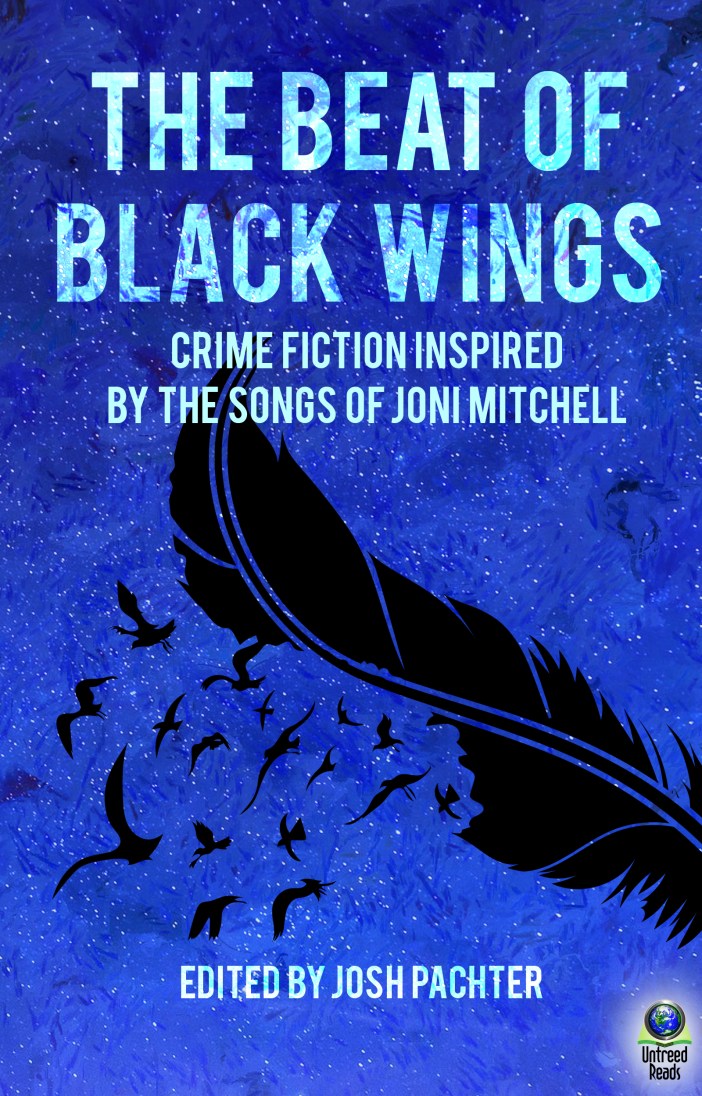
I was enormously flattered to be asked by short story master Josh Pachter to write a story for his anthology of stories inspired by the music of Joni Mitchell. The irony, of course, is that while I am familiar with Ms. Mitchell and her work–and I like what I know of it–I am not as familiar with her canon as I am with women singer-songwriters like Stevie Nicks, Dolly Parton or Carole King; I also realized that the songs of hers that I could name off the top of my head–“Free Man in Paris”, “Help Me”, “Big Yellow Taxi”, etc.–were the same ones anyone could; I wanted something not quite as famous and perhaps a little more obscure, something to which a Joni Mitchell fan would say oh yes, of course you chose that song.

So, I did what I often do in these situations: I asked my friend Michael Thomas Ford (aka That Bitch Ford), and he immediately came back with “You should pick ‘The Silky Veils of Ardor.’ It’s about that hot guy all the high school girls fall in love with and breaks their hearts.”

That was definitely intriguing, so I looked up the lyrics and listened to the song several times as I listened to Joni’s sweet voice singing them…and I knew immediately what story I was going to tell.

jonicover.final

The elevator doors opened. Cautiously, her heart thumping in her ears, she stepped out into the hotel lobby and took a quick look around. At the front desk, a young woman in uniform was checking in a couple. They didn’t look familiar. But it had been so long since she’d seen any of them…would she recognize anyone?

She didn’t notice she was holding her breath.

She walked across the lobby to the hotel bar entrance. A reader board just outside said WELCOME BACK BAYVIEW HIGH CLASS OF 1992!

The black background was faded, the white plastic letters yellowed with age.

The urge to head back to the elevators and punch at the UP button until the doors opened, get back to her room and repack her suitcases—everything she’d just carefully put away neatly in drawers and hung in the closet—was strong. She resisted, recognized the need as irrational, closed her eyes, clenched her hands until she felt her ragged bitten nails digging into her palms.

You can do this you can do this you can do this you can do this….

A dull murmur came from the hotel bar, laughter and talking, the rattle of ice against glass, the whir of a blender. From where she stood, she could see the bar was crowded, cocktail waitresses in too-short black skirts and white blouses with trays balanced on one hand maneuvering expertly around groups of people.

Maybe no one there was from the reunion. Maybe she was early. Maybe—

You can do this!

She’d always had social anxiety. Had never made friends easily, couldn’t make small talk, sometimes said the wrong thing, alienated people without even knowing what she’d done. Parties and dances had always been agony. Even with friends, people she felt relatively certain actually did like her, there was always the irrational fear she’d say the wrong thing, forget a birthday, commit some horrific social faux pas that would turn them against her, show them what a damaged, worthless person she actually was. She’d started seeing a therapist after college, years after she should have, but her parents thought therapy was all touchy-feely mumbo-jumbo for the weak and all you had to do was suck it up and forget about it, not worry, lock it all away in some dark corner of your mind and move on.

I have never attended a high school reunion, and frankly, have little to no desire to ever do so–with no offense intended to anyone I went to high school with. Our school was very small and remote, for one thing–my graduating class had only 48 students, and at that point, were the largest graduating class in our high school’s history. It’s not easy to get there–one would have to fly into either Kansas City or Wichita, rent a car, and drive for at least an hour just to get to the county seat, and of course, my high school was about nineteen miles (give or take) north of the county seat. I do think about going back from time to time, more to take a look around and see what’s different now as opposed to then; to refresh my memories a bit for writing about the region–which I’ve done somewhat already, but not nearly as much as I could. Using Google Earth has already shown me that my memory is faulty–I’ve fallen into Google Earth wormholes frequently–so while there is some idle curiosity about going back, there’s very little desire or motivation. It’s difficult, I think, for my classmates to understand that I really don’t have much desire to revisit that time of my life; it’s certainly not their fault but the four or five years I spent in Kansas also contain some of the darkest periods of my life.

I wrote a short story about a high school reunion under my Todd Gregory pseudonym; “Promises in Every Star,” which eventually became the title story of my Todd Gregory collection. I first had the idea for that story when I received the invitation to my ten year reunion, back in 1988; the title is a lyric from one of my favorite til Tuesday songs, “Coming Up Close,” from my favorite album of theirs, Welcome Home, which I can listen to over and over again, and have, many times; it’s definitely in my Top Five favorite albums of all time. I don’t remember where I originally published that story, but it was many, many years later, after I had the original idea and wrote the first draft (in long hand), and after that, I figured I was finished with high school reunion stories.

Until “The Silky Veils of Ardor.”

As I listened to the song, the more the story began to take shape in my head; a high school reunion, twenty-five years later; returning to the town where she went to high school for the first time since she graduated and moved away with her family. I had already written the opening, for another short story; as I revised and retooled that particular story, the character grew and changed and wasn’t the timid, nervous, medicated woman she originally was–but I loved that original opening, and decided to lift it from the initial drafts of that story onto this one. I found the original word document of the first draft, erased everything after the opening few paragraphs, and renamed the file THE SILKY VEILS OF ARDOR. The rest of the story flowed out of me after I finished rereading and tweaking the original opening to fit the new story, and I was off and running. I revised the story several times, and one of the things, one of the points, I was trying to make with the story is about how differently we see high school than our friends and classmates did–which is an idea I’d been toying with after an exchange on social media with some of my classmates after I’d posted something–a status update or a blog post, or something along those lines–about how miserable I’d been in high school; my friends were all astonished because how remembered high school was very different from the way they remembered it, and me. I remembered feeling isolated and lonely, like an alien from another planet set down into their midst; a freak everyone kept at arm’s length. They, on the other hand, remembered me as being popular and well-liked by everyone.

And that, my friends, is where this story came from. I still think about those tricks our memories play on us; our inability to see what was right in front of us if we could just see clearly.

The book will be officially released on April 7th from Untreed Reads; you can preorder it at any vendor that sells ebooks. There’s a stellar line-up of writers, and some of the proceeds are going to charity.

And thanks again to Josh Pachter for inviting me.

Here’s a link to Joni singing the song–this is the video I listened to for inspiration.