King of Rome

It’s Saturday, and I am feeling better. Yesterday was much better than Thursday; I drank a lot of fluids and didn’t seem to have any stomach issues; the headache came and went, and I coughed what probably was a normal every day amount of coughs–something in my throat that needed clearing–and while I did still have some fatigue and chest tightness, I was able to do some things as long as I took a break after. I did the dishes, and watched The 39 Steps. I did some laundry, and spent some time on Youtube. I moved necessary information from my old journal (now full) into my new one. We also watched Knives Out last night before retiring to bed, which we also enjoyed.

I did try to read, but it was tiring–awful, really, when you are required to stream for entertainment because it’s less taxing mentally–so I wasn’t able to do much of that. So, I put my fiction novel aside–Night Has a Thousand Eyes by Cornell Woolrich, and took down The Proud Tower by Barbara Tuchman, which is quite good; it’s her study of Europe in the generation/decades leading up to World War I. I had started it years ago and never finished–I don’t remember why, quite frankly–but was able to pick up again and read it here and there while I could focus. The lovely thing about non-fiction, and history in particular, is that you don’t have to worry too much about what came before where you’re reading if you pick it up again years later…history is history.

I also downloaded a copy of Uncle Tom’s Cabin, which I have never read, and thought perhaps that I should; how does the book that many historians consider partly responsible for the outbreak of the Civil War because it so enflamed abolitionist sentiments in its readers (never, ever doubt the power of fiction to help bring needed change) hold up today? I’ve read some interesting pieces on Gone with the Wind–book and movie, both for and against lately–and that put me in mind of Uncle Tom’s Cabin. I had reread a novel about the Civil Rights movement a few years ago that I read when quite young (The Klansman, by William Bradford Huie, a native Alabaman who taught at the University in Tuscaloosa; and the title was definitely a play on The Clansman, the novel Birth of a Nation was based on) and thought it even more powerful now than I did when I was a child; I saw the justifications of the horrific racist white people for what they were and it was plain to me, even as a child, that they weren’t the heroes of the story, even though they were the central characters of the book. So, I went to Project Gutenberg and downloaded a PDF of the book, and as I started reading the first few paragraphs…well, let’s just say the writing style is very dated and leave it at that. There’s also the use of the N word right there on Page One–which of course was common usage in the 1850’s and pretty much up until the 1950’s or 1960’s…and I started thinking that maybe someone should–since the book is now in the public domain–rewrite it and update for modern times? Or perhaps someone could do something like Alice Randall/The Wind Done Gone with it? Or perhaps it should best be left alone? The debate over these old books, primarily focused on Gone with the Wind lately, (and really, it’s mostly about the movie, not the book) and what should be done with and about them, is one I cannot make up my mind about. There’s probably a blog entry on that coming as well.

So far so good this morning. I don’t know if the fatigue is gone, but I slept for a very long time and very deeply. I still have a headache and my stomach is still bothering me this morning, so I am going to try keep putting in fluids since the dehydration issue seems to still be going on as well. There really are fewer things I loathe more than not feeling well, quite frankly. The weird issue with my stomach is that it literally feels tight and sore, like I did some kind of way too intense, way too long abdominal workout, and everything feels kind of bloated and gross? I’m not making that as clear as I should–use your words, writer boy!–but I’m not really sure what’s going on with it. I keep hoping it’s not anything serious, but…it’s still quite strange. The headache is coming and going; I’ll feel it for about fifteen minutes, and then it goes away before coming back. It’s not excruciating, more of a throb than anything else, and then it’s gone. Not enough to even take Tylenol over, frankly, but maybe I should; it might control it and keep it from coming back.

I’m hoping to have both the energy and the focus to write today; failing that, to at least read for a bit. When I finish this I have some emails to address–when do I not have an absurd amount of emails to answer–and hopefully can get most of that resolved before moving on to a highly productive day. One can dream, can’t one?

I have to say, I was really impressed with The 39 Steps. Yes, it was filmed in 1935 and yes, it’s rather dated now; but you can see how masterful Hitchcock was as a director. There’s not as much suspense in it–primarily due to the datedness of the movie–but it’s interesting, and I’ve always wanted to read the novel. I also found it interesting that Madeleine Carroll, who played the lead, was also the kind of icy beautiful blonde heroine Hitchcock gravitated towards for most of his career. But the concepts of the film–a man (played by Robert Donat) who unknowingly stumbles onto an espionage ring, and a female agent is murdered in his apartment, he is blamed and no one will believe the story he is telling; which she told him when he basically rescued her, and so he has to unmask the conspiracy in order to clear himself of the murder, is also Hitchcock’s favorite kind of story: what I call the “right man in the wrong place at the wrong time” kind of thing. Bourbon Street Blues was originally conceived that way, and let’s face it, almost all of the Scotty books really boil down to that simple concept–Scotty keeps accidentally stumbling into trouble. I do recommend it; other than being incredibly dated it’s quite fun to watch.

And if you haven’t seen Knives Out, you absolutely must. The crime is so amazingly Agatha Christie-like and complex that it’s like she wrote it herself, and the cast is magnificent–like those wonderful all-star film adaptations of Christie they started making in the 1970’s, like Murder on the Orient Express and Death on the Nile (which I want to rewatch but can’t find it streaming anywhere). The cast is absolutely perfect–every last one of them–and I do hope this signals the return of these kinds of films.

And now, I am going to go to my easy chair and wrestle with Woolrich for a bit before answering emails and writing.

In My House

Well, here it is Monday again and we’ve made it through another weekend; the last of May. Perhaps June will be the month this annus horribilis will turn around, but somehow I rather doubt it.

I grew up in the 1960’s. I was born in 1961, so when the decade ended I was nine and my earliest memory is me, maybe two years old or so, and the air raid sirens were going off in Chicago–they went off as a test every week on a certain day at a certain time, to ensure they were working and if Chicago was suddenly attacked by air–missiles, I suppose, from the Soviet Union or Cuba or perhaps a Canadian Air Force attack–we could get proper warning. I remember that the basement of my elementary school was a nuclear fallout shelter–or perhaps there was one accessible through the basement; my memory on this is cloudy but I can remember seeing the symbols (the black circle with three yellow triangles) on the wall above the stairs when I’d go down there to use the bathroom. I remember the Civil Rights movement and Vietnam and the violence meted out against people who protested inequality or an unjust war. I remember riots, and cities on fire, and leaders being murdered, shot and killed in a time when it seemed like the very fabric of the nation was being torn apart.

As a society, we tend to look back at the wild and crazy Sixties as a bizarre decade that opened with malt shops and bobby sox and the sock hop, which gradually morphed into something darker, and vastly different. The darkness and disillusionment didn’t lead to change in society or more equity; if anything, the resistance to civil rights for people of color became even more entrenched as other marginalized groups began advocating for their own rights and freedoms and equalities: women and queers. But the problems and inequities protested in the Sixties never went away completely; more doors were opened, to be sure, but the progress was slow and incremental, but below the surface it continued to simmer, and here we are, in 2020, dealing with these same old problems still.

Why is this so fucking hard, people? It doesn’t have to be.

I remember when Dr. King was murdered. I remember when RFK was murdered. (And yes I know these were political murders, so they were technically assassinations, but I’m sorry–murder is murder and it doesn’t need a fancy name to dress it up nice and pretty for consumption. MURDERED. They were MURDERED.)

I also remember the busing riots in the 1970’s.

My elementary school was segregated–in Chicago. I don’t know if all public schools in northern cities were segregated back then, but I do know ours was. The story was our principal would regularly turn away Black families trying to enroll their children by telling them the school was full, but any white family who came in was permitted. We had a lot of Hispanic/Latinx students at my school though; so clearly the bigotry was targeted at Black families. It was very strange, and even stranger to think about now, looking back; my elementary school was (with the exception of no Black children) the proverbial melting pot of cultures and countries (as taught to us as children–no mention of non-whites in that melting pot, of course). Most of my neighborhood–and therefore my schoolmates–were immigrants, either first or second generation; the woman down the street who babysat my sister and me’s parents immigrated from Poland. We had Poles and Latvians and Lithuanians; Czechs and Slovaks and Serbs and Croatians; Greeks and Mexicans and Nicaraguans and Guatemalans and Cubans and Puerto Ricans. Ironically, I also had classmates who identified by their principality in what used to be the Holy Roman Empire before it became Germany: Bohemians and Bavarians and Hessians (they were made very uncomfortable when we studied the mythology of the American Revolution, since the Hessians were mercenaries hired by King George III).

My high school in the suburbs, despite its size, only had a handful of black students; Bolingbrook is much more integrated now than it was at its inception. And of course, my high school in Kansas was completely free of black children. I had one black teacher before graduating from high school; and that was the sixth grade. My first black teacher in college was in Women’s Studies–she was a great teacher, and during that semester was denied tenure. I often wonder what ever happened to her; I don’t even remember her name. But she was the first teacher I ever had that truly opened my eyes to what our society and culture was actually like, rather than viewed through the rose tinted lenses all white children were given back then; what it was like for women and minorities in this country. As I was also beginning to realize at the same time that I didn’t necessarily have to be closeted and miserable for the rest of my life, and maybe wasn’t, and didn’t have to be, a square peg, she had a profound influence on me and this was when I first began to challenge, and question, everything I had been led to believe was carved into stone as truth.

It disturbs me that I do not remember her name. It disturbs me now to realize had I not been gay and had I not taken her class…I might not have ever questioned and reevaluated everything I was raised and socialized to believe. Sometimes when I see this right-wing assholes bloviating and spewing their bullshit and lies and bigotry, I sometimes think that, but for an untenured Women’s Studies professor and my sexuality, could have been me.

And it sickens me.

I don’t have the answers to how to solve what’s wrong with our country. But I do know the answer of how not to–which is to continue not listening to the people, to not listen to people of color, to not listen to anyone who is a minority of any kind in this country; to not listen to anyone who is anything other than a cisgender white male.

The Pledge of Allegiance ends “with liberty and justice for all.” It doesn’t say “with liberty and justice for white people.”

I’m not perfect. Every once in a while a thought will pop up in my mind that no longer fits my current worldview, something from the lizard part of my brain and the way I used to think, was conditioned to think, before my gradual enlightenment and reexamination of everything was I trained to think and believe, and it horrifies me. But I don’t pretend it doesn’t happen; I examine it, try to dissect and dismember it, to ensure it never pops into my brain again.

It’s work, but it’s work that needs to be done.

Black lives matter. No one should have to live in fear for their life every time they leave their goddamned house, or go into a nice neighborhood, or just go about their fucking day-to-day business.

This country and what it stands for was a terrific ideal that we, as flawed people and humans, have never actualized into reality or lived up to. It isn’t too late for us to start now. But we have to examine everything we’ve been taught, white people. We need to look at our art, our culture, our society, and our politics, with a skeptical, questioning eye, and we need to do the work. Our country will never heal without it…and if you care about this country as much as you claim you do–or you are, indeed, a true Christian–you will do this work so that everyone is equal in the eyes of the law and everyone has the same opportunities to succeed, to life, liberty and the pursuit of happiness.

Because we who are minorities–whether racial, gender, class, sexuality, religion–are never going to shut up and we are never going to go away. You don’t have to like us; you can still think I’m a faggot if it makes you happy and you somehow think that’s what your invisible sky lord demands. But your business has to serve me, and you have to treat me the same way you treat everyone: with the respect and dignity every human being deserves.

I don’t really understand what is so controversial about that.

Left to My Own Devices

Thursday morning and here we are, with a mere two more days before we can call it the weekend again. I’m not really sure why I am looking so forward to it; I just have to write and clean and do shit all weekend. Yay? But I guess it’s lovely because I am on my own schedule, I suppose?

I didn’t sleep for shit last night, which was highly annoying. Also, convenient because I forgot to set my alarm. Fortunately, my eyes opened at promptly six this morning. Huzzah?

So, overnight my HBO app on my Apple TV magically converted to an HBO MAX app, and I got lost in there for hours last night, just exploring all the options. I doubt I’ll ever watch the eight or nine Harry Potter movies ever again, but they are there, along with all kinds of over things. Scooby Doo Where Are You in its original two series is there–I watched one last night, delighted, before making dinner–and of course TCM is there, and there are so many classic films I’ve either not seen, or haven’t seen in a very long time. One of my all time favorites, Body Heat, is also there; I can’t wait to rewatch, as I’ve been wanting to rewatch it for quite some time. Also a lot of classic Hitchcock films, many of which I’ve never seen, including North by Northwest and several others. Essentially, with HBO MAX, combined with Hulu and Netflix and Prime and Disney Plus, I really don’t think I ever will have an excuse to be bored ever again, as there’s always something I can watch on one of those streaming services. There’s also some very good classic Hollywood, thank to TCM (Mildred Pierce, Laura, Bringing Up Baby, etc.). In other words, I am quite pleased.

Alas, that will undoubtedly cut into my reading and writing time–but better that than Youtube black holes, right?

Larry Kramer died yesterday, and I thought, “you know, I’ve been meaning to reread Faggots for a really long time and perhaps this is the time to do so, as a tribute to Larry and everything he did for us all.” As I took the book from the stack, I also realized this meant pushing Night Has a Thousand Eyes back into the pile, and this was probably the kind of thing that has happened with far too great a frequency and why I’ve never gotten back to reading the Woolrich, so I decided to go ahead and read the Woolrich and then I’ll get back to the Kramer. Faggots was one of the first “gay” books I read after coming out officially (I had read Gordon Merrick and The Front Runner and The Swimming-Pool Library while in the closet. Faggots was recommended to me when I walked into my first gay bookstore, Tomes and Treasures, in Tampa in the early nineties; the incredibly sexy bookseller–on whom I had a major crush–told me I should read it and Dancer from the Dance, so I bought both and read them) and I sometimes joke that “it almost pushed me back into the closet.” The gay sexuality was so in in-your-face, and all the kinks and other variations depicted within the covers of that book–plus the clear misery and unhappiness of the main character, Fred Lemish–kind of was shocking to someone as naïve as I was when I first came out.

This also made me think about my life in those years prior to my thirty-third, which was when I stopped passively floating through my life and tried to take control of it–to start actively living instead of passively letting my life happen to me. I rarely talk about, or even think much about, my life between moving to the suburbs when I was ten and my thirty-third birthday; primarily because my existence was so completely miserable and tragic and pitiful. There was the duality of living as both a closet case in my more regular day-to-day life (and fooling no one, as I was quick to find out later), plus my hidden, furtive life on the edges of gay world. It’s difficult for me to look back at that twenty-three years and not wince or recoil in embarrassment at what a miserable life I was leading, and how desperately unhappy I was all the time. But that time was necessary, because it was also that same period where I was starting to recognize, and learn, that almost everything I was raised to believe was not just a lie but a horrible one. Unlearning those decidedly terrible values and lessons is an ongoing process to this very day, but it’s also terribly important and necessary to shed all that conditioning in American exceptionalism, evangelical Christianity with its bizarre morality and cognitive dissonance, and the true American legacy of white supremacy. As I thought about this last night–we watched the first episode of CNN’s docuseries The Movies on HBO MAX last night, and I was remembering, not only the unhappy first more-than-half of my life, but started unpacking the rest as well.

And it will inevitably show up in my writing at some point.

ANd now back to the spice mines. Have a lovely Thursday, Constant Reader.

Liberation

Constant Reader is no doubt aware–or may not be, who knows–that I’ve always had a love for wrestling, particularly in professional wrestling. I first became a published writing of fiction with two wrestling stories, “The Wrestling Match” in Men for All Seasons, an anthology of erotic (porn) sport stories, and “Headlock”, published in Men magazine. Yes, I started my career writing gay porn, you got a problem with that?

I published quite a few more over the years, eventually collecting them into a book titled Wanna Wrestle?–which was the first time in my publishing career I was fucked over by a publisher, but that’s a story for a different time–and eventually, as “Greg Herren writing as Cage Thunder”, published an erotic novel about a gay professional wrestler called Going Down for the Count. Alas, by the time that book came out, the market for gay erotica had completely dried up (thanks, free Internet porn!) and so it didn’t sell as well as it might have, say about ten years earlier. I’ve long been toying with a wrestling noir novel, Muscles, which I was hoping to write last year (ha ha ha ha ha) and might eventually get around to; the story has taken firmer shape in my head over the last few years.

So, I was very interested when I saw on Twitter that Hector Acosta (an Edgar finalist for Best Short Story) had recently put up a wrestling short story on the Mystery Tribune website, “Besos”:

Fabi el Fantastico beat La Sombra Blanca with a kiss, and the crowd hated him for it.

Cries of maricon littered ringside, landing next to crumpled wads of paper and empty cups. Grabbing his pink feathered boa, Fabi climbed the turnbuckle and soaked it all in. Lips painted rojo vivo turned up in a smile even as the crowd pelted him with what he told himself was warm beer, the arena voicing their unhappiness at seeing some exotico beat their idolo in the ring.

Fabi el Fantastico beat La Sombra Blanca with a kiss, and the crowd hated him for it.

Cries of maricon littered ringside, landing next to crumpled wads of paper and empty cups. Grabbing his pink feathered boa, Fabi climbed the turnbuckle and soaked it all in. Lips painted rojo vivo turned up in a smile even as the crowd pelted him with what he told himself was warm beer, the arena voicing their unhappiness at seeing some exotico beat their idolo in the ring.

Their boos grew as Gloria Gaynor’s defiant voice escaped out of the speakers, Fabi swaying to the tune. A big reason the gimmick worked as well as it did was because of his willingness to go the extra mile.

It’s why he came out to this song, feathered boa suggestively dangling from the front of his wrestling trunks, and the reason his finishing move revolved around locking lips with his opponent, which per wrestling logic, confused them to the point he could roll them up for an easy three count.

Voice cracking, Fabi sang about surviving and blew more besos, his sweat mixing with the heavy mascara running down his face. He was preparing to step down when the beer bottle sailed out of the crowd and struck him on the forehead.

It’s a great story; short, sweet and to the point–with a couple of twists added to the story for good measure; proof you don’t need a lot of room or a lot of words to tell a great story full of surprises for the reader. He really captures the feel of an arena filled with wrestling fans; the sounds and feels and emotions of the crowd, and the characters are all remarkably well developed. Highly recommended.

You can read the rest of the story, here, at Mystery Tribune.

Generic Jingle

Phyllis A. Whitney is one of my all-time favorite authors.

I first discovered her, as Constant Reader is probably already aware, when I was a kid looking for mysteries in the school library. I distinctly remember that day in the fourth grade when I found The Mystery of the Hidden Hand on the shelves at the Eli Whitney Elementary School library; this was during my period of fascination with the ancient world (I was getting the Time-Life series Great Ages of Man; and had just gotten the volume Classical Greece). The description on the back of the book told me it was set in Greece, and had to do with antiquities and Greek history; that was all I needed and I signed it out. (I have, in the past, mistakenly identified The Secret of the Tiger’s Eye as my gateway drug into Whitney’s novels; I remembered incorrectly.) I enjoyed the book tremendously; I returned it and checked out The Secret of the Tiger’s Eye. I went on to read many of her children’s mysteries; she won two Edgars for Best Juvenile and was nominated twice more. After we’d moved to the suburbs, Signet started reissuing her children’s mysteries, and I started buying them at Zayre’s: The Mystery of the Angry Idol, The Secret of the Spotted Shell, The Mystery of the Black Diamonds, The Mystery of the Golden Horn, The Mystery of the Gulls, and numerous others. (I started collecting them again as an adult, thanks to eBay.)

I won’t tell the story again of how I rediscovered Whitney as a romantic suspense writer for adults; I’ve told that story any number of times, and I read almost everything she wrote for adults–but with The Ebony Swan I noted a decline in the quality of her writing, and never read anything she published after that. (I do intend, at some point, to read the ones I’ve never read–it’s the completist in me.)

ea0a5236e1de7732223993bee68f37c8

Cunningham’s department store is quiet again now. Sylvester Haring still puts his head in the door of my office whenever he goes by, to call out “Hi, Linell!” and perhaps to linger and study the pictures on my walls, to speak briefly of the past. But his days are given over to the humdrum of catching shoplifters and petty thieves, instead of trailing a murderer.

He never mentions that one picture we hunted down together, or the tragic denouement to which it led. But now and then we cock an eyebrow at each other because we are conspirators and know it.

Not that the law was in any way defeated. Payment in full was made for all those terrible things that happened. But still, Haring and I know what we know and the case as it broke in the papers told only half the story.

There are still things about Cunningham’s that make me shiver. I can never cross that narrow passageway that leads past the freight elevators into the display department without a feeling of uneasiness. I cannot bear the mannequin room at all, and I will go to any length to avoid setting foot in it. But most of all I am haunted by the symbols that came into being during the case.

The color red, for instance. I never wear it anymore, because it was the theme of those dreadful days. It ran beneath the surface of our lives like a bright network of veins, spilling out into the open now and then to accent with horror. And there are the owls. Sometimes in my dreams that eerie moment returns when I stood there in the gloom with all those plaster creatures crowding about me, cutting off my escape.

Nor will I ever again breathe the scent of pine without remembering the way the light went out and those groping hands came toward me. Strange to have your life saved by the odor of Christmas trees.

But the worst thing of all is when I imagine I hear the strains of Sondo’s phonograph. For me, those rooms will never be free of ghostly music and I break into cold chills in broad daylight whenever a radio plays Begin the Beguine.

And while there are some romantic aspects to The Red Carnelian, it’s probably one of the least romantic suspense-like novels she published (Skye Cameron, The Quicksilver Pool, and The Trembling Hills were not mysteries, at least not that I recall; but they were also early in her career and once she hit her stride, she became enormously successful). It’s a straight-up murder mystery, told in the first person point of view of Linell Wynn, who works at Cunningham’s Department Store on State Street in Chicago, writing copy for advertising posters, ads, and so forth. When the story opens, the entire store is on edge, because the window display manager, Michael “Monty” Montgomery, is returning to work that day from his surprise honeymoon; he and Linell had been a thing before his sudden elopement caught everyone by surprise. He’d married Chris Gardner, whose father Owen ran the luxury floor–the 4th–evening gowns and jewelry and furs. Linell claims that she and Monty were cooling things off when he suddenly eloped; I’m not entirely convinced that’s not something she claims to salvage her damaged pride. Naturally, later that day Monty is murdered, and of course, Linell finds the body; a fact which she, on the advice of Bill Thorne (one of the store’s vendors) keeps quiet from the police. He was killed near one of the window displays, by a golf club; Linell found the broken end of it in the window before she finds the body and put it back in the golf bag, thus handling the murder weapon. She also finds a piece of stone, a red carnelian, in the window display and puts it in her smock pocket and forgets about it.

Linell, of course, immediately becomes suspect number one–but it doesn’t take long for her, her store detective buddy Sylvester Haring, and new love interest Bill (who she does suspect from time to time) to find out almost every single person working in the store who’s a character in the book has a reason for hating Monty and wanting to see him dead. Linell of course also finds herself targeted from time to time by the killer–who never actually kills her (obviously)–as she sort of starts figuring out the who’s and what’s and why’s of the story.

It’s quite a good read; the characters are very well fleshed out, and the writing itself is pretty good. Whitney always wrote in a more Gothic style, in her books for adults; a style that seems a little dated now as well but still manages to hold your interest. I also would imagine a teenager reading the book today would have to look up what a “phonograph” was–although its usage makes it fairly clear to me what it is; but of course I grew up with phonographs and vinyl records and needles and all the accoutrement that goes along with them.

I’d recommend it as a gateway to Whitney’s other, more romantic suspense type work; it works very well as a stand-alone cozy type mystery novel.

It’s A Sin

Ah, SIN.

The human concept of sin is something that has alays fascinated me; as does the societal distinction that sin isn’t necessarily a crime. Adultery, after all, made the Top Ten in the Bible; but adultery isn’t a crime, at least in our country. Maybe I’ve been reading too much medieval plague history, but as a result the entire concept of sin v. crime has been running through my head a lot. We also always tend to speak and think of historical as being more religious and superstitious than our modern, “rational” time; which is why when the religious superstitions start finding their way out of the woodwork, people are always surprised. I’ve seen that a lot, actually, since 2008; the surprise of people who were just now noticing that much of organized religion is steeped in bigotry propped up by skillful, selective usage of their “holy” book while ignoring the parts that do not prove their bigotry and ignorance as holy. I’ve been toying, since the start of this current pandemic and the beginning of my own plague readings, with a story called “The Flagellants,” based on an idea obtained from rereading Barbara Tuchman’s A Distant Mirror and it’s plague chapter–about a movement of religious fanatics who believed God had sent the plague as a punishment for mankind’s sin (as fanatics have always believed in divine punishment as long as they have believed there are gods in the sky), and marched through the streets praying and repenting loudly while flogging themselves; their theory (if one can call it that) was that they were representing mankind’s penitence to God and therefore their behavior was intended to get God to take the scourge away. This set me to thinking about that Christian group that loves to show up here in the Quarter during Southern Decadence and Carnival to loudly tell us all, through megaphones and over amplifiers, that we are all sinners that need to repent and find our way back to the Lord, and wondering why they weren’t parading through the streets of the Quarter, doing something similar. (Their faith isn’t as strong as they would have us believe, apparently.) And so I started writing said story, but wasn’t really sure where to take it…I have some ideas; hopefully this weekend will help me sketch some of those ideas out.

Ah, sin.

A three day weekend is always a delight; I’m of the mind that every weekend should be three days rather than two. It generally takes me one day to rest and recover from the weekend, which is when I do my errands and clean and so forth, and then I am centered enough and rested enough (after two good night’s sleep) to get some work done on Sunday. With a three day weekend, that gives me an extra day to simply focus on writing. Naturally, of course, if every weekend was a three day weekend it would eventually prove also to not be enough time for me, I suppose, and so probably best to leave things as they are and simply enjoy those weekends when they come around. I have some plans for today; primarily a grocery run and perhaps a trip to the gym, along with some cleaning and organizing and perhaps some writing/brainstorming.

We continue to enjoy The Great on Hulu; I do recommend it, it’s very entertaining if not always the most historically accurate–and as I have stated many times, when it comes to television or film adaptations of actual historical events, accuracy inevitably goes out the window (the most egregious example of this being The Tudors. By combining Henry VIII’s sisters Margaret and Mary into one person, and then having her die without children, they essentially erased not only the Brandon/Grey line–no Nine Days’ Queen Jane Grey–but also the Scottish Stewarts; so no Mary Queen of Scots or any of the royalty since the death of Elizabeth I); and complaining about historical inaccuracies in fictional representations of actual history is low-hanging fruit, as it were.

I also want to finish reading Phyllis A. Whitney’s The Red Carnelian, and I’ve also started rereading a book from one of my favorite kids’ series, the Ken Holt mysteries by Bruce Campbell. The Ken Holt series is always neck and neck with The Three Investigators as my favorite kids’ series; they are very well written, action-packed, and well plotted as well; with a kind of hard-boiled edge to them. The first book in the series, The Secret of Skeleton Island, (a title also used in The Three Investigators series) introduces us not only to our young hero but to the people at Global News (Ken’s father is a globe trotting reporter; his mother is dead, and since his father is gone a lot Ken is at a boarding school somewhere outside of New York; I always assumed it was up the Hudson valley but it may have actually been Long Island), and how Ken meets up with, and basically is adopted into, the Allen family. I’m actually enjoying the book–and considering it was written for 9-12 year olds in the late 1940’s/early 1950’s, and it still holds up, is saying quite a bit. The fact these books never caught on or were as popular as, say the Hardy Boys, and have been out of print for decades, is disgraceful.

And on that note, I am going to head into the spice mines. Have a lovely Saturday, Constant Reader, and I look forward to speaking to you again this weekend.

IMG_1305

I Want a Dog

I don’t actually want a dog. I love dogs–always have–but our apartment just isn’t big enough to add a dog, and we don’t have a yard, either. Plus our work schedules are so all over the map and erratic we could never get on a proper “walk the dog” schedule for one, which isn’t fair to the dog. (However, I do love other people’s dogs. Dogs and cats always seem to gravitate toward me as well.) We never intended to even have a cat; we had a mouse when we lived in the carriage house and the advice we got from everyone was, simply, “get a cat and the problem is solved.” That’s how we acquired Skittle; and of course, after his early and untimely passing we barely went two weeks before adopting Scooter…and of course, over the years we’ve fed and befriended any number of outside strays. Currently, Tiger has been around the longest; Simba is more recent, and there’s also a tuxedo hanging around out there that’s still too timid to come close. (He did let me pet him the other day, but then bolted when I put some food out for him.) But Paul and I are the cat whisperers, and soon the tuxedo will be named and part of the herd out there.

And you got to love a tuxedo cat. Especially when their white paws look like they are wearing little white gloves!

Friday, and it’s really Memorial Day weekend eve. I am looking forward to three lovely days off, during which I have a shit ton of things to get done. This week hasn’t been a good one for me regarding energy and focus; I’m never quite sure why that is, or why some weeks I am completely useless and another week I’m highly functional and productive–here’s hoping this weekend is one of those highly productive times, because I need to catch up from this past week’s uselessness. Paul wasn’t home last evening; he was out visiting (and maintaining social distancing) a couple of friends, so I finished watching The Story of Soaps, moved on the catch up on Real Housewives (both Beverly Hills and New York), watched another episode of The Dark Side of the Ring (this one detailing the sad and tragic death of Owen Hart), and then finally went to bed early. I had a very good night’s sleep; I feel very rested and awake this morning, which is a very good thing, obviously. Today is syringe access Friday, which means standing in the parking lot in the horrible heat and humidity for five hours, and I am also getting fitted for PPE this morning–our STI clinic appears to be reopening now on June 1, so I have to wear PPE in order to see my clients. I had to fill out a bizarre questionnaire preparatory to being fitted this morning–some of the questions I simply couldn’t answer; I assumed it was a generic questionnaire used for both PPE and HAZMAT gear, based on some of the questions–and I have a bit of trepidation about this now I didn’t have before; but that’s entirely because of the questionnaire. I’ll definitely let you know how the fitting goes, because it’s going to be a completely new and different experience for me.

The heat and humidity are coming back, and of course, there’s already been a named storm, prior to the official opening of hurricane season on June 1. I am trying not to be overly concerned about this year’s hurricane season, quite frankly–how do you have an evacuation under these incredibly trying circumstances–and so that’s going to be some more added stress to the already hot and humid climes we will be dealing with.

I also don’t have a lot of confidence on how a major storm coming in this year will be handled, from prep and evacuations to the aftermath.

Well, there’s a cheery thought for the morning..

And on that note, back to the spice mines. Hope you all have the Friday you deserve! (PS The tuxedo cat just came through the fence!)

IMG_1090

I Don’t Know What You Want But I Can’t Give It Anymore

And so it is now Wednesday, and we’re already about halfway finished with this week. Isn’t that lovely? Of course, I always hear my mother’s voice in the back of my head whenever I say things like that–you know you’re just wishing your life away when you do that–ah, my mother. Someday I’ll stop hearing her voice in my head.

Although I still do and am staring down fifty-nine this year, so chances are that voice is never going to get out of my head.

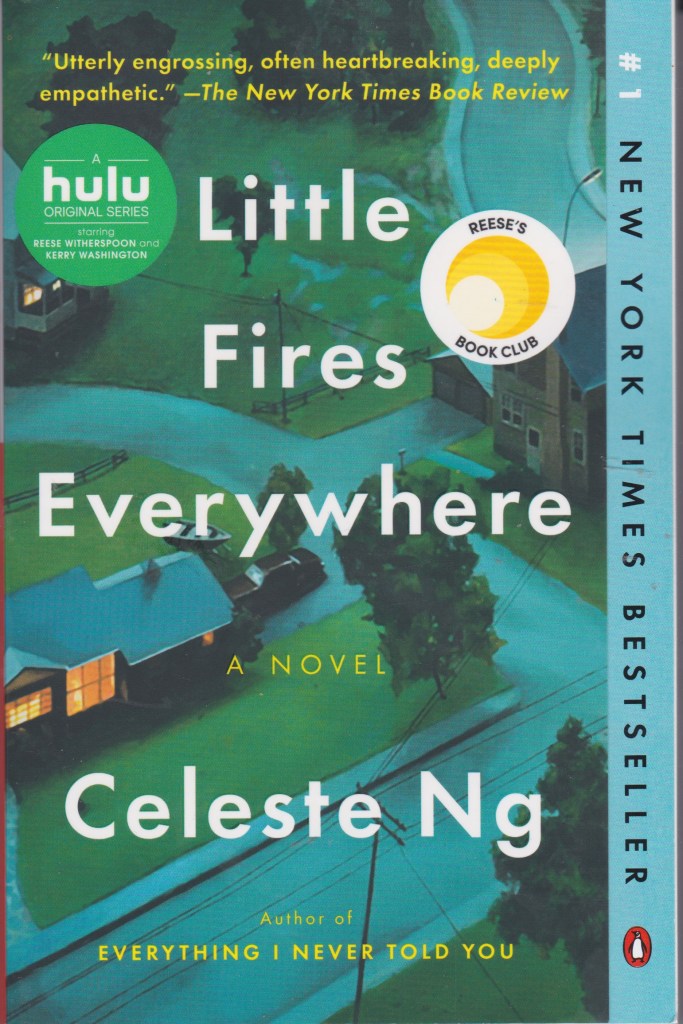
We finished watching Little Fires Everywhere, and I have to say, Reese Witherspoon makes a terrific villainess. It’s extremely well done–the writing and acting are top notch–and it really is amazing what you can do with a soap-opera style plot with strong writing and an excellent cast and good directing. As I watched, I couldn’t help thinking what a great Abby Reese Witherspoon would make in a reboot of Knots Landing. But I do encourage everyone to watch. It’s a terrific show, Kerry Washington is also fantastic, as are all the young actors playing the teenagers, and while it reminded me some of Big Little Lies, it’s a completely different plot and a completely different story–although the character Witherspoon plays is remarkably similar in both (although in Big Little Lies she never went completely to the dark side the way she did in this). It also handles class and race and gender issues over the course of the story, showing that it can be done–and done well–with the right creative team in place, particularly if they are committed to properly handling the issues.

Now I think tonight we’ll go back to Gold Digger–I think the next two episodes dropped Monday–and see if it continues to hold our interest as well.

I slept deeply and well last night. I woke up at seven this morning, and was actually awake, but chose to lightly nap in bed for another hour because the bed felt so relaxing and comfortable–plus, I wasn’t really feeling the day, you know? The longer I stayed in bed relaxing the longer I could put off dealing with anything this morning. Not that there is anything I don’t want to deal with– as I am particularly fortunate in that nothing I have to deal with is terrible; I just get lazy periodically–which is why being described as hard working or prolific amuses me endlessly. Granted, I hold myself to a much higher standard than perhaps I should; on the other hand, sometimes I think I wouldn’t get nearly as much done if I were easier, and kinder, on myself.

I also started rereading House of Many Shadows by Barbara Michaels this week, and I am now getting to the meat of the story; all the characters are in place, in the enormous house in the Pennsylvania countryside; it’s established that Meg, the heroine, has been in a car accident that caused some sort of brain damage which causes her to have either visual or audial hallucinations; the caretaker of the place is the owner’s stepson, whom she knew when they were children and didn’t like each other; and the previous tenants were evicted and not happy about it. It’s interesting–I’ve been very careful with Bury Me in Shadows to not mimic Barbara Michaels, and yet…in rereading this one I realize how incredibly similar the set-up of my work-in-progress is to this particular Michaels novel. Not that I’m plagiarizing her by any means, and there are only so many story situations and set-ups one can come up with; but similar enough for me to be a teeny bit concerned.

And now, back to the spice mines.

IMG_1023

How Can You Expect To Be Taken Seriously?

Monday and here we are, getting ready to stare down yet another week.

We watched more of Little Fires Everywhere last night, and it really is extremely well done. It really is an interesting look at race and privilege and power; all while using tropes that were staples of soap operas. As the show amps up and starts racing along to its climax, the basis of the majority of the drama of the show is a custody struggle over an adopted baby–a storyline so stale for soap operas that I don’t know that the few left even use it anymore. But with strong writing, excellent production values, and an enormously talented cast, this stale trope not only works in this instance, but works very well. I am curious, though, as to why the book is set in 1997 rather than the present; the reason behind it isn’t apparent, and it feels incredibly current; although the music at school dances and so forth is rather jarring, and it takes a moment to remember that the story is set over twenty years ago. I don’t even notice the lack of smart phones and social media. I’m just sorry that I didn’t get a copy of the book to read along while I watch, which was such a terrific experience with Big Little Lies. 

And Reese Witherspoon certainly has a type of woman that she regularly plays, doesn’t she? Super Karen?

I finished a dreadful first draft of “Falling Bullets” last night, and it is dreadful. Fortunately there are other drafts to be done, and corrections and edits that can be made to it, but at this point I’m just happy I finished a draft–it’s been awhile since I’ve finished something I’ve started. At first I was rather nonplussed because about 1500 of the 2000 words I’d already written–mostly the stuff I’d written Friday evening–didn’t really work anymore; but I went back to the beginning and started tweaking things, and was even able to tweak enough of the 1500 problematic words to save most of them. So, while I am not pleased with the draft and its condition, I am pleased that it is finished, at around 4600 words.

I also finished reading Thunder on the Right yesterday, and had a lovely time with it. I do think it is one of the lesser Mary Stewart novels–but a lesser Mary Stewart is better than  a lesser writer’s best, so there’s also that.

I have decided to take today off from work; I am not feeling as great as I should, and literally cannot face another day of data entry and condom packing. Fortunately I have enough vacation time accrued for me to take yet another day off–although I really need to start letting the time build up again, for when this is all finally over and done with, so I can take an actual vacation, which is something I am going to be in seriously need of–and so am going to stay home, finish some odds and ends, and then get ready to face the rest of the week. I also have to work early tomorrow morning, so will have to get to bed early this evening; and I think we’re going to maybe start slowly opening the STI clinic next week. I am of two minds about this–I am certain we can do it safely, but at the same time I worry whether clients will be willing to come in to get their screenings done. I miss my old life, quite frankly, and like everyone else, long to get back to it. But unlike everyone else, I don’t see the old normal coming back. This situation has changed so much about our lives and how we do things, and in many cases, things that were considered “impossible” before have now been shown to be possible. I can’t imagine, for example, that the expensive old version of the book tour will return now that we have seen it can be done relatively inexpensively virtually. I easily can see publicists cutting expenses at publishers by arranging on-line interviews and readings and Q&A’s and book club meetings rather than spending money for an author to travel. And for authors who can’t foot the cost of their own tours, well–here’s an inexpensive alternative that may actually work.

Next up for the Reread Project is an old favorite of mine by Barbara Michaels, House of Many Shadows. Dr. Barbara Mertz wrote, of course, wonderful mysteries as Elizabeth Peters (if you’ve never read the Amelia Peabody series, you really, really  need to), and wrote suspense novels that may or may not have a supernatural bent to them–Ammie Come Home is, obviously, by far and away my favorite of these–as Barbara Michaels. I rediscovered the Michaels novels in the late 1970’s/early 1980’s, and became just as addicted to them as I would to the Elizabeth Peters novels later that decade; House of Many Shadows is one of my favorites of the Michaels novels; The Crying Child is another. The rest are also good without question, but to my mind those three are head-and-shoulders above the others. The Michaels novels also have great, great titles: Wait for What Will Come, Be Buried in the Rain, The Dark on the Other Side, and Witch, to name only a few. And, if I am being complete honest, Bury Me in Shadows was inspired by the Michaels novels; as was Lake Thirteen.

And the humor in the Scotty books probably owes more than a little to the influence of the Elizabeth Peters novels.

I also gave up on rereading Katherine Anne Porter’s long short story about the Spanish flu, “Pale Horse Pale Rider.” I can certainly understand why critics and literary enthusiasts shit themselves over Porter’s writing, but it just doesn’t work for me. I don’t care about her characters or what happens to them, and Porter is definitely one of those authors who–to me–loves the sound of her own voice; what could be said in a sentence or two turns into rambling pages and pages in which she basically says the same thing, over and over again. And she never wastes any time on making the reader care about her characters, or even getting to know them well. I thought, when I first read her Collected Stories years ago and found them to be tedious and boring (as I was rereading “Pale Horse Pale Rider” I could actually hear a Lit professor enthusing about her works in my head), and I thought I’d give them another chance, thinking perhaps I had matured enough as a reader to enjoy them now; that it was my own immaturity as a reader and lover of the written word that kept me from enjoying them in the first place.

I am pleased to report I am wrong, and that I find Porter’s work as constipated and dull as I did the first time, and there’s nothing wrong with not liking her work. I still dislike The Great Gatsby, even after reading it three times, after all; let the literary snobs come for me. I don’t care. Scoff at me all you like, I will never like or admire Porter.

And on that note, I think I’ll go lay back down for a bit. Have a lovely Monday.

IMG_1024

DJ Culture

Ah, Kansas.

I only spent five and a half years there, and yet somehow, it more shaped my psyche and who I am than the years as a child in Chicago or the four and a half years in its suburbs; even more so than the eight years spent in California. I’m not entirely sure why precisely that is, but it’s true. I think perhaps it’s because it was there I really and truly started writing, and started seriously thinking that my both life and career were going to be about writing. By the time we took the 1:30 a.m. train out of Emporia for California, my identity as a writer was firmly fixed in my head; when I stepped off the train into the California sunshine, I knew I was going to be a writer someday, somehow, some way.

And when I lived there, in Kansas, I wasn’t really aware of other Kansas writers. (I also wasn’t aware of other gay people there, either.) Now, of course, I know Sara Paretsky is a Kansan, along with Nancy Pickard and Kay Kendall and Lori Roy; I don’t know if Scott Phillips is a native, but he writes about Kansas. Alafair Burke grew up in Wichita.

And of course, there’s Scott Heim.

I recently read a novella by Scott, “Loam”, which was really good, and it put me to thinking about Mysterious Skin, the first of three novels he published, and alas, the only one that I’v actually read. I read it back in the late 1990’s, methinks, when I was scrabbling around trying to get caught up on gay lit and read as much of it as I could. I also saw the film (I’ll watch anything with Joseph Gordon-Leavitt in it, quite frankly), and while I have met him and spent a little time with him, and we follow each other on both Facebook and Twitter, I don’t know that I would safe in referring to him as a friend, I do consider him an acquaintance of whom I am very fond. He’s quite witty on social media, and I admire his skill as a writer…so I thought I should take a reread whirl with Mysterious Skin. 

I also wanted to read it as a dark crime novel, borderline noir; I was certain the story would hold up, but since Mystery Writers of America classifies it’s definition of a mystery as writing about the commission, solving, and/or aftermath of a crime….while it can be a stretch, Mysterious Skin kind of fits into that broad definition. Laura Lippman thinks we need to stop claiming literary works, like Crime and Punishment and Sanctuary as crime novels; but I honestly believe Sanctuary absolutely and positively is a masterwork of literary noir; the line between “Southern Gothic” and “crime fiction” is relatively tiny and there is a lot of crossover. Some of Flannery O’Connor’s work, definitely Southern Gothic, crosses over that fine line between literary fiction and crime.

I am not defining literary works, or works from other fields, as crime fiction to try to elevate crime fiction; it doesn’t need elevating to get respect, which was Laura’s point. Crime fiction deserves respect because it is good, and those who dismiss sneeringly as genre need to remember that literary fiction is just as much a genre as anything else.

As Nevada Barr said, “It’s either mystery or romance or just plain boring.”

6132sc9ejNL

The summer I was eight years old, five hours disappeared from my life. I can’t explain.  I remember this: first, sitting on the bench during my Little League team’s 7 P.M. game, and second, waking in the crawl space of my house near midnight. Whatever happened during that empty expanse of time remains a blur.

When I came to, I opened my eyes to darkness. I sat with my legs pushed to my chest, my arms wrapped around them, my head sandwiched between my knees. My hands were clasped so tightly they hurt. I unfolded slowly, like a butterfly from its cocoon.

I brushed a sleeve over my glasses, and my eyes adjusted. To my right, I saw diagonal slits of light from a small door. Zillions of dust motes fluttered through the rays. The light stretched ribbons across a cement floor to illuminate my sneaker’s rubber toe. The room around me seemed to shrink, cramped with shadows, its ceiling less than three feet tall. A network of rusty popes lined a paint-spattered wall. Cobwebs clogged their upper corners.

My thoughts clarified. I was sitting in the crawl space of our house, that murky crevice beneath the porch. I wore my Little League uniform and cap, my Rawlings glove on my left hand. My stomach ached. The skin on both wrists was rubbed raw. When I breathed, I felt flakes of dried blood inside my nose.

Like some of the best crime novels, Mysterious Skin is about survivors of a trauma, and the different ways people react to suffering through trauma. It actually isn’t a stretch to call it a crime or mystery novel; the central story is trying to determine what happened to Brian Lackey when he was seven years old and lost five hours of time. Brian at first becomes obsessed with UFO’s and alien encounters, as those are the only places he can find where other people also lost time; so he becomes convinced that he was kidnapped by a UFO and experimented on; all the evidence, such as it is, certainly points to that. The other boy, Neil, had a sexual relationship with his Little League coach, which he believed was consensual and that Coach loved him; as he grows up he becomes a hustler, tricking with johns cruising a park in Hutchinson (all these small cities in Kansas have/had gay cruising places; Emporia even had one) and eventually moving away to New York, where he continues hustling. Neil’s trauma is actually even unknown to him; he’s convinced himself that he was special and that Coach loved him; their sexual relationship wasn’t perverse or perverted or anything wrong, but rather based in love and consent; his own memories are very clouded, and as a young adult hustler he finds himself drawn to older men, much like Coach was.

It’s very definitely a literary novel, make no mistake, but it is, at heart, a novel about a crime and the trauma that comes from that crime and its aftermath; which fits the definition of “mystery” that comes from Mystery Writers of America. I doubt very seriously the panel of judges for the Best First Novel Edgar the year this was released would have picked it as a finalist (which it deserved to be); the subject matter is hard enough for people to deal with, let alone the sexuality of Neil, who is essentially a teen hustler, getting paid by older men for sex.

Beautifully written with a sparsity of language that Megan Abbott or James M. Cain or Shirley Jackson would embrace; Heim chooses words carefully to evoke powerful images and emotions and realities in as few words as possible, and while some might think the ending a bit of a cheat, leaving the door open to many possibilities–I feel like he found the absolute perfect place to end his novel: Neil coming to realize that what he experienced with Coach wasn’t love (something he has been adamantly refusing to understand since it happened–that whole I’m different than the others thing so many children feel under those circumstances–I’ve known any number of gay men who had relationships with adults when they were very young and didn’t realize it wasn’t love until they aged out of their Lolita-like relationships) and Brian finally piercing through the veil his mind has hidden the truth from all these years because it was too much for him to handle…until he could handle it.

Mysterious Skin is also an incredibly powerful depiction of what it’s like to be grow up working class in a sparsely populated state like Kansas–the worries about money, the beater cars you keep coaxing more life out of, that college might not be an option, and there aren’t that many good jobs to be had–and what it’s like to grow up queer under those circumstances. At one point in the book Heim says something incredibly smart and true–about how the stuff that is hip and cool on the coasts takes about three years to get to the center of the country; which is something I learned very quickly when I moved to California and all of my clothes were dated and wrong and out of style.

This is a truly terrific book, and I encourage you to read it, if you haven’t already.