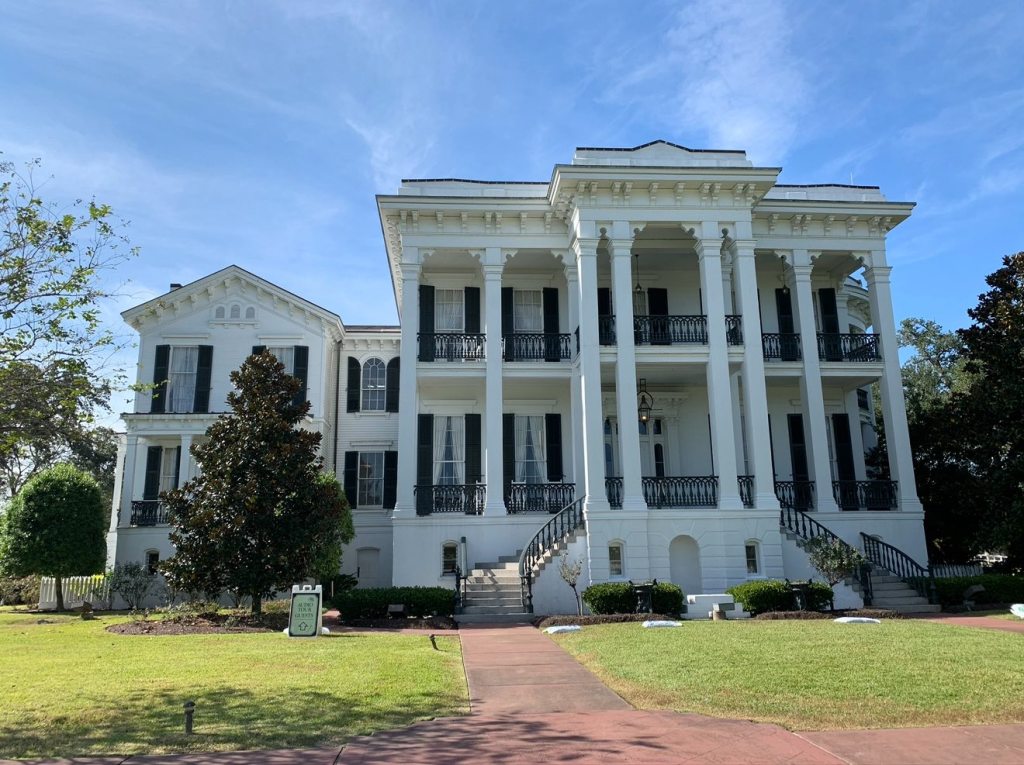
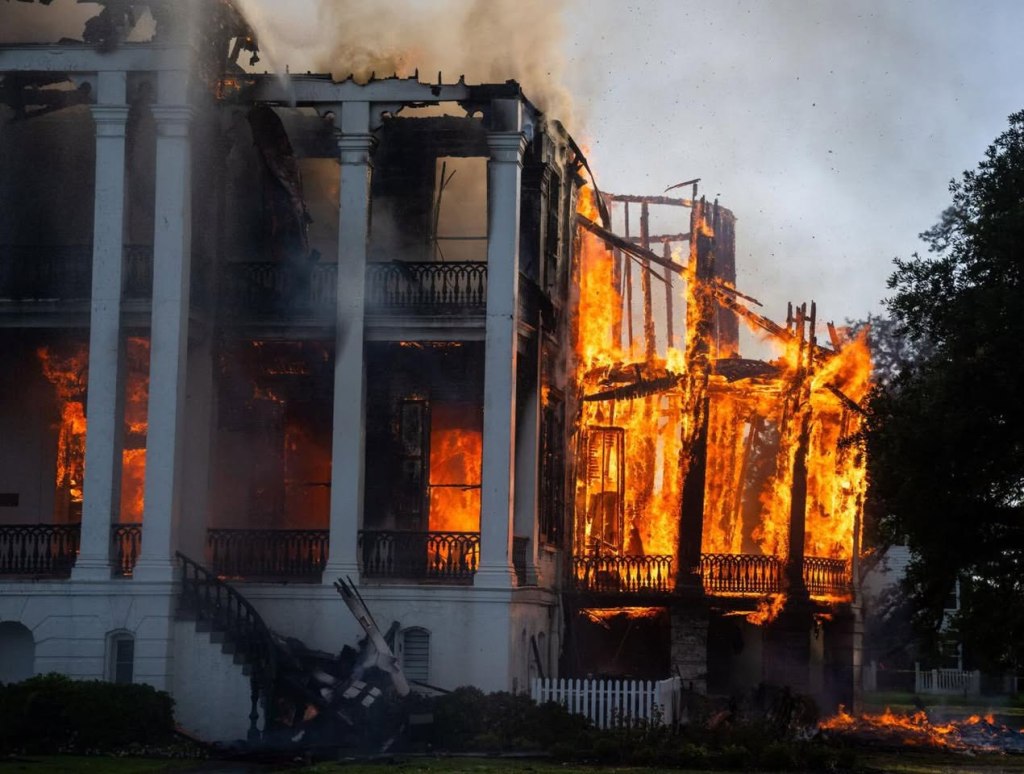
Nottoway Plantation, one of the beautiful old homes along the River Road north of New Orleans, burned to the ground Thursday.1 But what that lovely old historic home actually was? Just a monument to enslavement and stolen wealth. I also can’t help but hope the backstory to the fire is some Gothic shenanigans, a la Rebecca and Manderly burning to the ground.
Nottoway beforeNottoway after
I’ve certainly come a long way from that kid who was raised to believe in white supremacy and the Lost Cause ideology, haven’t I? My relationship to the South has always been fraught, once I began to read more and understand more and deprogram myself from that horrific grooming as a child. I can remember, though, reading Gone with the Wind when I was ten or eleven for the first time and my hackles being raised by the happy, contented enslaved people and how they were described and how they talked. (I loved the story itself, but the racism was so unrelenting and unending and horrible; I need to do a deconstruction of that book sometime–as well as other “make white people feel better about racism” books.)
Nottoway was a beautiful home, but it was also one of the most monstrous sugar plantations in Louisiana with an excessively brutal history. I am not sorry in the least this horrific place–where they teach nothing about the true history of the place and rent out for weddings and parties for white people (“yes, you too can have a Scarlett O’Hara wedding on an old plantation! So what about the brutal treatment of generations of enslaved people?”). It really was nothing more than a monument to oppression, cruelty, and the evil that men can do.
I started dealing with the ghosts of my own Southern past in Bury Me in Shadows, and this new repurposed book from an old manuscript is also going to deal with race in Alabama, too. I just have to finish this damned Scotty book and get it out of my scalp. New Orleans also has its own dark, bloody and brutal history I have to deal with at some point, too. I was reading a piece about Madame LaLaurie and her abuse of her enslaved people, and wondering how to turn that into a short story–and likewise, my Sherlock story will also have to deal with race, because of the Voodoo Queen. I’m not afraid to address any of these issues, really; as long as I do it and am mindful of the potential for offense and/or getting it wrong (I have a great editor, thank God) and tread carefully. You really can’t write about the South authentically without talking about race.
After I finished working yesterday, Paul and I ran some errands (including Costco) and by the time we got back I was completely worn out and exhausted. I started reading a Dana Girls 2mystery (one of the kids’ series I collect) titled Mystery at the Crossroads, which was originally published in 1954–right around when the Hardy Boys/Nancy Drew books began being revised to remove problematic content–and ho boy, is there some problematic content in this book! It’s about “gypsies”–and every handy stereotype about the Romani people is crammed into this book. But it was easy to read, it engaged my brain, and now maybe today I can get back into reading something substantial.
I also rewatched two movies last night–the animated Beauty and the Beast (yes, I get that it’s problematic but I love it) and Jesus Christ Superstar before falling asleep in my chair. Paul woke me at one, and I managed to sleep through the night and this morning I feel rested and good. I have some errands to run today, but I am going to try to just clean and read and rest and relax as much as humanly possible. I am still not 100% recovered from the illness, but I am getting there.
And on that note, I am going to head into the spice mines. Have a lovely day, Constant Reader, and I’ll be back on the morrow, if not sooner.
And yes, the Lost Cause traitors are weeping publicly of the loss. Since it was one of those destination wedding/party places that glossed over its hideous history…good riddance. ↩︎
I will be writing about the Dana Girls for my newsletter at some point; I want to write about all the kids’ series I read growing up. ↩︎
Several weekends ago, I did an on-line panel for Outwrite DC. The moderator was John Copenhaver (whom you should already be reading), and my co-panelists were the always delightful and intelligent Kelly J. Ford, Margot Douaihy, Renee James, and Robyn Gigl. The video is actually up on Youtube, if you would like to watch it. John’s questions were insightful and intelligent (as always), and the conversation was marvelous, inspiring, and fun; there’s nothing I love more than communing with other queer crime writers (or any writers, to be certain), and I always try very hard to not monopolize panels because I do have a tendency to talk too much–especially if and when I get going on a topic I am passionate about. So, I thought it might be fun to take John’s questions and turn them into a long form interview, for thoroughly selfish and totally self-promotional reasons.
The panel blurb claims that “queer characters are riveting and necessary material for crime fiction and how those stories can shape (and perhaps reshape) the landscape of contemporary crime fiction.” Do you agree with this statement—and why do the stories of queer characters have the potential to shape crime fiction?
I completely agree with this statement. Queer crime fiction has a very proud history that was never really recognized or appreciated by the mainstream crime writers, readers, organizations, and conferences. That is changing for the better.
New blood is always necessary for any genre–horror, romance, crime, literary fiction–because genres tend to stagnate after a certain period of time. The cultural shifts of the late 1960’s and 1970’s echoed in crime fiction, for example; you couldn’t write crime in those periods without addressing all the cultural and social shifts; Ross Macdonald’s later novels are a good example of this. The 1970’s saw a lot of anti-hero books being written. The private eye sub-genre had grown quite stale by this time, which was when the women really moved in and gave it a shot of adrenaline–Marcia Muller, Sara Paretsky, and Sue Grafton blazed that trail, and revitalized a sub-genre that had kind of lost its way. Queer writers and crime writers of color are currently doing the same to the entire genre. Voices and perspectives we aren’t used to seeing are now getting into print and changing how we see, not only our genre, but each other. Crime fiction has always given voice to societal outsiders and outliers; queer people and people of color are the ultimate outsiders and outliers in this country. Who better to tell stories of societal alienation?
Why did you choose your sub-genre? How do you think the sub-genre has influenced the types of characters you write?
Well, I write in several different ones. Chanse MacLeod was a straight private-eye series; Scotty Bradley was more of an amateur sleuth/humorous series, but he does have a private eye license in Louisiana. A Streetcar Named Murder was a cozy, with an amateur sleuth heroine who gets caught up in a family mystery. I’ve also done young adult and “new adult,” whatever that is (it’s been described as ages 16-25), and Gothics with a touch of the supernatural. I tend to write things that I like to read, and I have a varied reading taste. I started writing the Chanse series because I wanted to do a harder-edged private eye series with a queer twist and set it in New Orleans. I didn’t know about J. M. Redmann’s Micky Knight series when I started writing Chanse; would I have done something different had I known she’d already covered the hardboiled lesbian private eye in New Orleans? We’ll never know, I suppose. Scotty was meant to be a lark; a funny caper novel and a one-off. And here we are nine books later…
As for Streetcar, I had been wanting to try a traditional mystery with a straight woman main character for a long time. When the opportunity presented itself, I jumped in with both feet. I like trying new things and pushing myself. Having to follow the “rules” of a traditional cozy was a challenge–especially because I have such a foul mouth in real life. I love noir so am working on two different gay ones at the moment.
Why do you think amateur detectives are appealing? Do you think there’s a reason queer characters often find themselves in the role of amateur detective?
I think it’s because we all think we’re smarter than the police? We enjoy seeing a character we can identify with figuring things out faster than the cops, especially without access to all the evidence, interviews, and forensics the cops do. Murder She Wrote has been off the air for about thirty years and yet the books based on the show continue coming out every year. If we start out in mysteries reading the juvenile series–Nancy Drew and the Hardy Boys and Judy Bolton and all the rest were amateurs, so we always cut our teeth in the genre with them to begin with. Scotty is basically an amateur, even though he has a private eye license he rarely uses; he and the boys never get hired (although they kind of do in the new one, coming this November.)
Let’s talk about place. Greg, your books take place in the South. Why is place important to the crime novel—why is it especially important to the queer crime novel?
Place shapes who we are–not just as queer people, but as people in general. There are similarities between growing up in a small town in the Midwest and growing up in one in the South, but the differences are very marked. I’ve lived all over the country–pretty much everywhere but New England or the Northwest–and always felt, as a Southerner (despite no accent and not growing up there) like an outsider. Couple that with being gay in a time when it was still considered a mental illness, and you have someone always on the outside looking in. But I have that Southern pull to write about the South–although many would say that writing about New Orleans and writing about the South are not the same; like me, New Orleans both is and isn’t of the South, and I feel that very strongly. I’ve written books set in California and Kansas, even one in upstate New York, but I very much consider myself a Southern writer.
Place is even more important in a queer crime novel because place shapes the queer people so much. As a writer, I think one of my strengths is setting and place, and I think that comes from being very much a fan of Gothics growing up. Gothics are known for place and mood, and I think those are two things I do well.
All of you write wonderfully flawed characters. Sometimes, as LGBTQ+ writers, we feel the burden of representation and the urge to write only positive LGBTQ+ characters as an attempt to undo history’s (the dominant culture’s) demonization of us. Unfortunately, that can be limiting—even flattening. Clearly, you’ve all struck a beautiful balance with your characters. Talk a bit about how you approached this issue.
The flaws, to me, are what make the characters seem real. Nancy Drew and the Hardy Boys always annoyed me because they were so perfect; no one is that perfect, and anyone that close to perfect in real life would be irritating and insufferable. I am am quite aware that I am flawed (one of my biggest flaws is believing I am self-aware because I most definitely am not), but I am not trying to be perfect; I just want to be the best version of myself that I can be. By showing queer people with all their facets and flaws and failures and blind spots, we’re showing the reader that we are human; despite what those who hate us say or claim, we are human beings just like everyone else, just trying to get through life and do the best that we can. The villain in my first book was a gay man–and the entire book was a commentary on how we, as queer people, tend to overlook flaws and red flags from members of our own community. Just because someone is queer doesn’t mean they are a good person–and queers with a criminal bent do exist, and often take advantage of that sense of camaraderie we feel with each other, especially when we don’t know the person well. I tend to trust a queer person more readily than I will a straight person, and that’s wrong–which is why I think we feel so much more hurt when queer people betray us.
Speaking of the demonization of LGBTQ+ folks … Ray Bradbury of Fahrenheit 451 fame said, “There is more than one way to burn a book. And the world is full of people running around with lit matches.” What do you think about the current tactics to ban queer books from schools, libraries, and even bookstores in places like Florida, Arkansas, and Texas? Why are they targeting queer books?
This is, I hope, the last gasp of the homophobes who’ve never updated their hate speech in over fifty years. What the hate group “Moms for Liberty” are doing and saying is no different than what Anita Bryant said and did in the 1970’s, what Maggie Gallagher and her evil co-horts at the National Organization for Marriage repeated, then came the One Million Moms…all too often it’s the cisgender straight white women who are the real foes of progressive politics who fight to uphold a bigoted status quo. They always claim they’re concerned moms worried about their children–but are perfectly fine with them being shot up at school; working in a meat factory on the night shift at thirteen (have fun in hell, Sarah Huckabee Sanders, when you get there and French-kiss your Lord and Master Lucifer); or shouldn’t have the right to vote…they know better than a child’s actual parents, you see, about what the child needs or wants. Maybe they should spend more time with their own children than worrying about everyone else’s? Phyllis Schlafly, queen skank of the conservative right, ignored her own family while she embarked on her crusade to strip women of their rights and autonomy–all the while shrieking like a hyena into any microphone nearby that she was fighting progress to save the American family while selling some Leave it to Beaver-like nonsense as reality. I always felt sorry for her gay son. Imagine that as your mother.
As for why, it’s about control and power. I actually respected Anita Bryant more, because she truly believed all the vile, horrible, unChristian things she said and espoused. Most of the others, including the unspeakably vile and disgusting Moms for Liberty, are working a grift for money, attention and power. Hilariously, they’ve sold their souls in the worst possible way in the guise of family, religion and God; if they’ve ever actually read their Bibles, they need to work on their reading comprehension skills as they are both apostates and blasphemers who will spend eternity doing the breast stroke in the lake of eternal fire. Hope they enjoy it.
Sorry your husbands and children don’t love you, but who can really blame them?
What are you working on next? What’s coming up?
I have a short story in an anthology called School of Hard Knox from Crippen and Landru (and somehow got a co-editor credit for the book with Donna Andrews and Art Taylor); Death Drop, the first in a new series from Golden Notebook press, drops in October; and the ninth Scotty comes out in November, Mississippi River Mischief. I am writing a gay noir, and may be writing second books for the new series I started with Crooked Lane last year as well as a sequel to Death Drop, and have a couple of short stories I want to finish to submit to anthologies I’d love to be in.
The cemetery where Mom rests is small. I remember it as being much bigger, of course, but everything there is smaller than I remember. But most of my memories of Alabama predate my adulthood, so things that seemed enormous to a child don’t seem quite so large to an adult.
I’ve written about it before, just as I’ve written plenty of stories (and even a book! Or two!) set in the county of my birth, where my people are from as we say in the South, and where my people are buried. Before Mom died, I hadn’t been to this cemetery since we laid my paternal grandfather to rest in those blurry years between the turn of the century and Hurricane Katrina. But I’ve written about this cemetery in an unpublished short story I originally wrote in 1983, called “Whim of the Wind” that opens When I was young and spending the summers in Alabama, the graveyard at White’s Chapel held a peculiar fascination for me. When I wrote those words, I was living in California and hadn’t been back to Alabama in at least two or three years; it would be another eight before I returned for my last visit pre-funerals. That story was loved and appreciated not only by my professor but by the class as well. I tried several times to get it published, but to no avail; there’s something missing from the story itself that makes it incomplete, but no editor whose ever read it has been able to put their finger on it. (I do recall having solved the problem after reading Art Taylor’s brilliant story “The Boy Detective and the Summer of 1974”, but of course didn’t write it down and don’t remember what it was. (I shall reread Art’s story at some point to see if it triggers my memory; it really is upsetting that I didn’t write it down–which I always do)
And yes, it’s called White’s Chapel. I always assumed it was called that because it was “whites only”; Dad told me over the weekend of the funeral that it was built by someone named White, which is how it got its name. Hurray for it not being racist in origin? Small victories. But when I was there that time, we drove around the county and through the little town/village which was really where all the Blacks in the county were forced to live, which is no longer the case but was when my parents were children. Lovely, right? I still don’t remember ever seeing any Black people during my childhood visits, which seems hardly possible, does it?
I am both of Alabama and not of Alabama. Dad and I talked about that this weekend, too–I don’t think my sister feels the same tug from Alabama that I do. It’s weird for him to go back there, too–there’s hardly anyone left that he knows; even my aunt commented that she didn’t know a lot of people in the county anymore, and thats kind of sad. The land my grandmother’s house sat on has been sold and the house itself–uninhabitable for years–will be torn down and that part of my history, that part of my life story, will be gone forever. My grandfather’s house, where Dad grew up, is long gone and I think my eldest cousin’s son is going to build a house there. The small, battered old houses I remember from when I was a kid are also all gone; enormous McMansions of brick and mortar with columns and muli-car garages dot the landscape now, so it doesn’t seem as poor down there as it used to.
We started the day at the cemetery where my maternal grandparents rest alongside my youngest uncle, thrown from a rolling car when he was eighteen and the car rolled over him; I remember the funeral but never knowing much more than he died in a wreck (the driver was drunk; the other two riders escaped with minor injuries). There are lots of relatives and ancestors at Studdard’s Crossroads cemetery, which is also well off the paved county road on an incredibly narrow red dirt road. We stayed there for a few hours, and then headed over to see where my mother’s grandparents were buried; another where my other uncle is buried, and finished off at White’s Chapel, with Mom and my paternal two uncles (one died when he was two). It’s so beautiful there, and so different than what I remembered and have written about–which is actually a good thing; I completely fictionalized the present-day county predicated on my childhood memories–but yes the pine forests and the red dirt, the incredibly blue sky, and fall away drops alongside the roads (not near as steep and deep as I remembered).
I’m glad I went. Seeing Dad again, seeing that he’s okay, lifted an enormous weight from my shoulders–I was terribly worried and hated being almost eight hundred miles away–but also being able to talk to him about Mom, and their shared histories, as well as more family histories on both sides that I didn’t know, was a big help. I by no means think I am over the hump or well on the way to recovery; I know from my own bitter experience that you can have a good day after a trauma and thus think with relief, oh good now I can get on with everything only to have one of the dark days immediately after. It takes time to heal, and I am never going to stop missing my mother. I just have to get used to not having her anymore.
(I had originally intended to post this yesterday, but then I got the Anthony news and that kind of sidetracked the day for me.)
Saturday here in the Lost Apartment and Paul is coming home tonight. Huzzah! Also a big day in college football down here in the South, with Georgia-Tennessee this afternoon and LSU-Alabama tonight (and the good news for Florida and Texas A&M fans is one of them has to win the game, so one team’s losing slide will temporarily stop). I have things to do this morning, lots of things to do and many miles to walk before I sleep. Last night I was very tired when I finished my day’s work; and so repaired to my easy chair with Scooter in my lap and watched Low Country, a documentary series about the Murtaugh family crimes in South Carolina. Ironically, I started watching it because I vaguely remembered hearing about the story–wife and son murdered, father shot and wounded, etc.–but I did not know the back story to all of it, which this series provides a small window into; it really only covers the recent crimes, not the criminality of the family going back almost a hundred years–but as I watched, I started seeing similarities to the book I am writing now (powerful corrupt wealthy family that basically rules a rural area as their own duchy), and ideas and things to make my own book better started riffing through my mind. One thing that urban people never get about rural areas is how much of that sort of thing goes on, especially in the South. I am really going to have to go back and dig deeper with what I’ve already done, but I am confident I can get that all worked out this weekend and then get to work on the second half of the book next week.
I slept really well again last night. I started falling asleep in my chair once I finished watching Low Country–again, worth the watch, and yes, very shocking that rural counties in the twenty-first century are still so feudal, so undemocratic, so twisted that any one person or family can be so above the law that they essentially control the justice system in the region, to the point that they get away with murder–and so went to bed early. Scooter has started sleeping with me at night, purring and cuddling, and that also helps me sleep (Paul and I have agreed that Scooter’s super power is the ability to put anyone to sleep by cuddling and purring) and I woke up feeling very settled and relaxed and rested this morning, which is terrific since I have so much to get done today (as always). But I am going to do some cleaning this morning while I do some computer clean-up and so forth (ugh, my files are such a scattered and disgusting mess, it’s not even funny; I would be better about this, of course, if Macs didn’t have that search function) and don’t plan to go anywhere today. I’ve ordered groceries to pick up for tomorrow–I also have to air up one of my tires–and other than that, I don’t plan to leave the house tomorrow either. I need to get caught up and reorganized and all of that–the usual stuff I complain about on here every day. The week went by relatively quickly, too. I read some more of the new Wanda Morris novel, which I took to bed with me but I didn’t stay awake long enough to read more than a few pages–which were fantastic. I can’t begin to talk about how delighted and exciting it is to see new perspectives, new voices, and new stories from marginalized authors. I’m just sorry it took so long to get us to this point, but this was exactly what our genre needed.
My book’s official release date is rapidly approaching, and I am trying not to get over-anxious and/or nervous about it. I need to start pushing the book more, but I am not really certain how or what to do, to be honest. I’m excited about it, of course. The reviews have thus far been pretty favorable–other than that snarky Kirkus one, but even it didn’t bother me at all, and besides, they’re known for being snarky in their reviews and always have been; I guess that’s growth of a sort. Bad reviews don’t get under my skin the way they used to when I first started doing this, you know. I tend to stay away from Goodreads and Amazon reviews–therein lies the path to madness–but my skin has thickened a lot over the years and I know what my reactions will be and why put myself into a position of any kind that might emotionally unbalance me? God knows I don’t need any help in that direction, for sure.
I also watched another documentary about gay porn, Seed Money: The Chuck Holmes Story which was very interesting. Holmes was Falcon Studios, one of the bigger and more successful brands in gay porn for a very long time, and it did give me some ideas for future projects. I will probably, most likely, keep writing Scotty books until I die (for those of you who were wondering; the next one will probably be another Carnival mystery, French Quarter Flambeaux), but I may not write anymore young adult novels. It’s not that I don’t want to or have a lot of ideas for them, but my time is limited and I want to explore other writing options and genres within crime fiction. I really am feeling the desire to work on my queer historical noirs–beginning with Chlorine–and then moving on to cover other parts of queer history from the second half of the twentieth century. Obscenity would be about gay porn; Indecency would be built around Joey Stefano’s arrest in Tampa for public indecency…and of course there would be more but that’s the original trilogy I’d want to write. They wouldn’t be connected stories–the only commonality would be the fight against oppression and repression–but I think they would be a lot of fun. I have titles for others–Beefcake, Peplum, Physique–but don’t have stories to go with those yet (although I do introduce a Bob Mizer-like character in Chlorine who could drive one of them; Peplum would be, in some ways, a sequel to Chlorine–but it wouldn’t have to be, since I’ve not really decided on the end of that book yet, but one of the possibilities does leave the path open to a sequel.
And on that note, I am going to get to work on the chores and get cleaned up and get this party started. Have a lovely Saturday, and GEAUX TIGERS!
The late Joan Didion famously said we tell ourselves stories in order to live. I’ve parsed the statement any number of times–it’s most commonly taken to mean that it’s important we tell stories of the human experience (the good, the bad, the mediocre and all the varieties in between) to better understand ourselves, our society and culture. I had never read Didion myself until several years ago; of course I knew who she was and what she had written–although if asked before reading her work, I would have only been able to name Play It as It Lays, which I still haven’t read. One of my co-workers had a library copy of her Miami in his officer a few years ago, and I idly picked it up when I was in his office. He recommended very strongly that I read Didion, and so it was with Miami I started; the opening line (Havana dreams come to dust in Miami) sold me on the book. I enjoyed it, and went on to read other works of hers: A Book of Common Prayer, Slouching Toward Bethlehem, and After Henry, among others. I loved the way she wrote; that the complexity of her work came from her poetic use of language and words rather than on complicated sentences. It was reading Didion’s essays (and Laura Lippman’s) that made me start thinking about writing essays myself; I started one trying to use a similar style to Didion–which was interesting–but think it’s rather more important to stick to my own voice, for better or for worse; there was only one Didion, and there should only be the one.
As I was being interviewed the other night I was talking about my re-education; about having to unlearn and relearn things from when I was a kid. I’ve been thinking about this a lot lately; part of it was turning sixty this past year, part of it was writing two books back-to-back that are sort of based in my own personal history–so remembering what Alabama and Kansas were like for me meant exploring a lot of my past, reliving and rehashing it with the perspective of time having passed and with a coldly sober, unemotional eye. I remembered, as I was talking about the Lost Cause and other American mythology we are taught as children (Washington and the cherry tree; Honest Abe the rail-splitter; and so many other Americans of the past we have deified) , the Didion quote and found a new meaning in it. When I was a child, I remember that in the South, for some reason, my cousins and their friends and the adults never would refer to someone as a liar; etiquette, perhaps, or politeness being behind this oddity. What they said instead of saying you were lying was “Oh, you’re telling stories.” If someone was a liar, you’d say “he tells stories.”
We tell ourselves stories in order to live.
Given this weird rural Southern thing about “telling stories”, this can be reinterpreted as we tell ourselves lies in order to live–and it all falls into place, because we do tell lies to ourselves in order to live with ourselves, within this culture, within this society. Never has this been more evident than is this strange battle the right has started about Critical Race Theory–which wasn’t being taught in any American public school below the collegiate level. If there’s nothing in American history that we should be ashamed of, why is there so much opposition to the truth? Why are we taught lies in order that we may live?
The war cry of the white Southerners who want to keep their monuments to white supremacy and treason has been “Heritage not hate!” But the heritage is hate, which was the entire point of Bury Me in Shadows. You cannot have it both ways: you cannot celebrate a history of treason against the United States, while claiming to be “more patriotic” that other Americans who do not celebrate the killing of American soldiers (ask Jane Fonda about how posing on an enemy gun goes over). The bare facts of the matter are that some (not all) of the states where it was legal to enslave people were afraid they would lose their right to enslave people, and as such they decided they were better off starting their own country. They wanted a war they couldn’t possibly win, and the fact that it didn’t end quickly has more to do with the incompetence of the Union generals and their political ambitions (there are reasons there are no statues of George McLellan anywhere to be found) than the righteousness of the Confederate cause and the brilliant leadership of Robert E. Lee. They abhor Sherman as a war criminal (“he waged war on civilians!” Um, we also firebombed Dresden during the second world war, and what were Nagasaki and Hiroshima if not the obliteration with atomic weapons of civilian populations? Sherman said “war is hell”–you cannot start a war and then complain about how the other side chooses to fight it.). They claim it had nothing to do with slavery and everything to do with “states’ rights”…when the reality is the only state right they were concerned about was the right to enslave people–they certainly wanted the federal government to enforce the Fugitive Slave Act against the wills of the free states, didn’t they? Their end game in Congress and the courts was to force the federal government to permit enslavement in every state of the union and every territory; this was the crux of the Dred Scott Decision of the Supreme Court, which more than anything else set the stage for the war.
If there’s nothing terrible about the actual history, why so much fear around the truth?
We tell ourselves lies in order to live.
If the truth is too terrible to be faced, then it absolutely needs to be.
There’s nothing quite so romantic as a lost cause, is there? Whether it’s the Jacobites in England with their toasts to “the King across the water”; the emigres from the French Revolution; or the Confederacy, losing sides inevitably always romanticize their defeat and the loss of a better world their victory would have created. An entire industry has developed in this country around the mythology of the Lost Cause; how could it not when one of the most successful American films of all time portrays the Lost Cause so sympathetically? The opening epigram of Gone with the Wind reads “There once was a land of Cavaliers and cotton fields known as the Old South…” And yet the movie depicts an incredibly classist society, predicated on the enslavement of Africans; the entire idea behind the founding of this country was the elimination of class distinctions–the equality of all.
But even Margaret Mitchell, when asked if the Tara in the movie was how she pictured it as she wrote about it, scoffed and said, “Tara was a farm.”
And not everyone in the old South was rich or owned a plantation. Not everyone was an enslaver, and not everyone was on board with the Lost Cause. But we rarely hear about the Southerners who fought on the Union side in the war; we never hear about Southerners who were abolitionists; and we never hear about the atrocities inflicted on those loyalist Southerners by the rebels, either.
And speaking of war crimes, what about Andersonville?
We tell ourselves lies in order to live.
We cannot celebrate our achievements without acknowledging our failures. It is far worse to not learn from a mistake than making the mistake in the first place. It is not unpatriotic to look at our history, culture, and society critically, to examine and evaluate how we are failing to live up to the ideals upon which our country was founded. The Founding Fathers were not mythical gods of infallibility; they were all too human, with all the concomitant jealousies, pettiness, arrogance and ego that comes with it. They were, for one thing, mostly unable to conceive of a society where women and non-white people were deserving of equality under the law. But they also knew they were not perfect, which was why they created a system that could adapt to the changing tides of history.
George Santayana’s famous quote, “Those who cannot learn from history are doomed to repeat it” is something I think about every day. I also love the George Bernard Shaw quote, “What we learn from history is that we learn nothing from history.“
We need to stop telling ourselves lies. The truth might seem to be too much to be faced; it might be ugly and hideous and shameful…but it will also set us free.
Today is one of those days in which I’ll be running around all day and feeling scattered before I finally can come home and relax at last. I have an eye appointment out in Metairie–I really need new glasses; my eyes have gotten so bad that the ones I have now just do not work as well as they should, which makes me terribly uncomfortable about driving and so forth–and then errands all over the place. I also have boxes and boxes of condom packs to take by the office, so I can get them out of the house; I was really productive yesterday and may have broken my condom-packing record while watching In the Heat of the Night (the Oscar winning film, not the television series based on it) and then catching up on The Real Housewives franchises that I still watch. (I have some ambivalent feelings about these shows, but will discuss that at greater length when I have more time to spend on writing an entry then I do this morning.) The movie was interesting to watch, and I have some very deep thoughts about that as well; but I will say for now that they did a really excellent job of capturing small town/rural Southern areas of the time and what they were like…and they could have just as easily filmed that movie in the area of Alabama where I am from.
If you are a film fan, I do highly recommend Pictures at a Revolution by Mark Harris, in which he examines the five films nominated for the Best Picture Oscar in 1967–the year In the Heat of the Night won–and how those five vastly different films were representative of the enormous cultural and societal shifts going on in the country at the time. It’s fascinating. (The other nominees were Guess Who’s Coming to Dinner, Bonnie and Clyde,Dr. Dolittle, and The Graduate.)
I still haven’t made my to-do list yet; that’s one of the things I want to get done today; at least one for the weekend that I can revise for next week, and then I want to get back into the habit of doing one every week, knowing that there will be some weeks where I get it all done, weeks where I only get some of it done, and weeks when I won’t get any of it done. I am trying to stay focused and I am also trying to be easier on myself going forward; no more feeling like a failure when I don’t get as much done as I need or want to, no more Imposter Syndrome, no more allowing myself to be easily tripped into dark places that I really need to not go to anymore. It’s strange to be almost sixty and still trying to grow and rewire myself; I would have thought years ago that by now I would have everything figured out. But I don’t–and I don’t think anyone ever really does, to be honest. I also need to remember that I am not perfect, I am human, and humans will always make mistakes…and the thing is to not let the mistakes take you somewhere dark and self-abusive, but to correct them the best way you can and learn from them and not repeat them–which is part of the issue I am having with the Real Housewives shows, I think (but more on that at a later date, like tomorrow).
It’s gray outside this morning–it rained off and on yesterday, mostly from the late afternoon on–and I will probably get soaked at some point while I run my errands; it’s inevitable, really–but hopefully traffic won’t be too bad.
And on that note–as you can tell, I still haven’t quite figured out what I want this blog to be going forward–I am going to call it quits this morning and head back into the spice mines. Have a lovely Friday, Constant Reader.
I am from the South, which is probably something Constant Reader is sick of hearing about–but I feel like I always need to make that clear. While I grew up in Chicago and Kansas, I have always identified as Southern, as being from Alabama. It’s where I was born, and it’s where, as we say down here, my people are from. I was raised and shaped by natives of Alabama, who were raised and shaped and became who they were in Alabama, because of Alabama, and who identify completely as Alabamians.
I’ve now lived in the south for twenty five years this coming August 1st; even though many Southerners don’t think of New Orleans as Southern. (I would not dispute that thought, either; New Orleans is of the South but is not the same as the rest of the South…but once you cross the Orleans Parish line you are definitely back in the South, but southern Louisiana, while still similar, isn’t the same because of Acadiana.)
My relationship with the South, and with being Southern, is a complicated one, and one that I am constantly evaluating and examining, over and over again. I have pride of region, which is definitely a Southern trait; woe be to those who might condemn or stereotype or insult the region to my face. I am aware of the faults, and the flaws, and the horrors; I don’t need anyone to tell me or lecture me about its history and how it came to be the way that it is now., or of it’s racist history or of the current racism which still seems to be the majority opinion here. I’ve heard all the inbreeding jokes, and jokes about toothless people and hillbillies and white trash and people of Wal-mart and so forth; so by all means, keep them to yourselves. I also have always understood the difference between heritage and hate; I may have been very young but I remember the Civil Rights Movement vividly.
I was never a fan of Confederate statues, for example; I never understood the insistence on venerating men I didn’t consider heroes but traitors, even when I was young. I remember always thinking, but they lost, and they hated the United States, why should we revere that? The cognitive dissonance of being “patriotic Americans” while venerating those who fired upon the flag and tried to start their own country disturbed me when I was a kid and it never made sense to me, and no matter how many times the mythology of the happy slave was spoon-fed to me, whether it was Gone with the Wind (both book and movie), or any of the many other examples from fiction, film and television. The Biblical example of Pharaoh and Egypt (beyond their reject of the one God), holding the Hebrews in bondage as slaves was always right there, too.
And if might equals right, hadn’t the complete and utter defeat of the Confederacy, in such an incredibly humiliating fashion, a complete defeat that left the rebellious slave states in smoking ruins and their economy wrecked (much as Germany was after World War II), further proof that slavery and secession were wrong?
And yet it is an incredibly beautiful part of the country, whether it’s the gorgeous Smoky Mountains in Tennessee and North Carolina or the massive live oaks of New Orleans, the swamps of Louisiana andthe pine forests of Mississippi and Alabama, the lower Ozarks in Arkansas, the beaches of Alabama and Florida’s Gulf Coast. Savannah and Charleston and New Orleans are beautiful cities; the college campuses of the Southern states are breaktaking in their beauty.
Driving through Mississippi and Alabama, the countryside is so beautiful, the , with the pine tree forests and the red earth, the sloping hills and flowing rivers, that it always inspires my creative brain to think about stories and writing and books. I love the South, despite all the things that are wrong with it, because it’s also a part of me, of who I am. I love its contradictions–like how when you drive through the Smoky Mountains at night you will come across three enormous crosses rising out of the fog that announce the presence of a megachurch…and the same highway exit also plays host to Triple X Super Store.
It’s also interesting that I am returning to my first real manuscript about Alabama, set in a fictional recreation of the part of Alabama from which I came originally, while reading Kelly J. Ford’s debut novel, Cottonmouths–because even though Ford’s book is about Arkansas, the small country town and its surrounding rural area is very similar to my Alabama.
From behind, the woman standing with a guy next to the Love’s Truck Stop air pump looked like any other woman: long hair, too skinny, big purse, big sunglasses. But when the woman turned and smiled, Emily’s chest tightened and her insides tingled in a forgotten but familiar way. Rumors of Jody’s return had come as whispers around town, but until now Emily had lacked proof.
A warm breeze blew petroleum fumes and cigarette smoke into her face while she sought further confirmation of who she’d seen. Gas spilled onto her hand. Startled, she released the trigger on the pump and swiped her hand across her jeans. She sheltered her eyes from the sun to scan the parking lot. But the woman and the guy were gone.
Back on the highway, Emily tried to keep her mind as empty and barren as the farmland that rolled by. When that didn’t work, she turned up the radio and hit scan, unable to settle on the station offerings from the nearest town–country or Christian or the same four pop songs on repeat interspersed with commercials for pawn shops and car lots. Midway through the miles she punched the radio off and tried to tell herself that her new fast food job and her time at home were temporary, though she’d been back a month already.
Cottonmouths is many things, all wrapped up into a compelling story told with gorgeous language. Emily, the main character, has essentially flunked out of college and is wrestling, as so many Southern queers do, with the bipolarity of a deeply Christian small town/rural upbringing struggling against her deepest secret of desire for other women. She’s an outsider, which gives her the ability to see everyone and everything around her with brighter clarity than the insiders have the chance to see–she can see the hypocrisy in her deeply Christian town, and the abhorrence of difference, which makes her feel not only like an outsider but horribly, terribly lonely. It is this lesbian desire within her that ultimately led to her flunking out of college, an inability to come to terms with who she actually is despite being raised in a way that makes her loathe who she actually is. So she has returned to the dying little town of Drear’s Bluff, with its explosive boredom, feeling like a failure for flunking out of college and terrified to admit to people outside her parents that she has failed. She can only find a part time job working fast food in nearby Fort Smith–a job she is too ashamed to admit to her parents she has had to take.
And more than anything, she feels trapped. She wants to escape this town, escape its suffocating claustrophobia, and be free–but she needs money to do that, and without money–as is all too true for most people, she cannot escape.
The return of her best friend from high school, Jody, whom she sees at the Love’s Truck Stop, is the trigger that starts the story in motion. Jody, whom the good people of Drear’s Bluff consider “white trash”, has a baby and is unmarried and living in the old trailer parked on her family’s land. Emily’s past with Jody is also fraught; her family took Jody in when she was a teenager when her mother took off, and one night Emily made a move on her–and the next day Jody was gone, back to her mother and out of her life. This guilt has always plagued Emily; wrapped up in the strict confines of the narrow-minded Christianity she was raised with, and with Jody back now, Emily isn’t so sure what she wants or needs–but those unresolved feelings of first love and desire have now bubbled back up to the surface again.
Cottonmouths is what I would call “rural Southern noir;” while crime and criminal activity is a driving force to the story, it’s also more than that–it’s a compelling portrait of a slice of American life so many Americans it doesn’t affect do not want to face: the death of the small town way of life, the loss of employment opportunity, the collapse of hope for something better. It’s about different kinds of yearnings, and how hope can be twisted into seeing criminality as the only way out. Like Daniel Woodrell and Tom Franklin, Flannery O’Connor and so many others, Ford shows us the reality of rural Southern life; how the deep religious belief can go hand in hand with smug superiority and class warfare–how those who theoretically follow Christ, who ministered to the poor and sick, can somehow hate the poor and look down on them.
There are so many little touches here that ring so true–Love’s Truck Stops, which are scattered throughout the south along its highways and byways; the prayer circles where they drink Virgin Bloody Mary mix; the judgment for not attending church twice on Sundays and for Bible study on Wednesdays; and the viciousness of gossip and the fear that everyone will talk about you, and judge you, and laugh at you–or rather, passive-aggressively shake their heads while murmuring Christian platitudes while the gleam of enjoyment shines in their eyes.
I enjoyed this, and I am really looking forward to what comes next from Kelly J. Ford.
So I went ahead and sent out three stories on submission yesterday; “This Thing of Darkness,” “Night Follows Night”, and the Sherlock story. Will any of them actually be accepted? Who knows, but that’s all part and parcel of the joy of being a writer who likes to write short stories despite being rarely asked to write them. I have like 86 short stories in some form of progress now, but it felt really good to write finis on these and sent them out. If they are rejected, oh well; I’ll just save them for my next short story collection.
See how that works? Staying positive is always a plus, you know?
And last night before I went to bed I checked the Pandora’s Box known more commonly as my email inbox to discover a delightful email from the editor of the Sherlock anthology that she loves the new edition of the story and is sending me a contract! How absolutely delightful. I am glad “The Affair of the Purloined Rentboy” will see print, and as always, it’s lovely to get that kind of affirmation. It’s also a period piece, which was just as daunting as writing a Holmes story set in New Orleans–the only rule for the anthology was that it couldn’t be set in London, and Holmes and Watson couldn’t be English. So I made Holmes a Louisianan–and we never are quite sure where Watson is from. But it was great fun, challenging, and very, as I said, daunting. While I’ve read the Holmes stories–and the Nicholas Meyer novels, and other stories written by modern day Sherlockians (notably, Lyndsay Faye and Laurie King), I don’t think of myself as an avid Sherlockian. Even now, I cannot think of the plot of either A Scandal in Bohemia or The Red-headed League.
So, I wasn’t a hundred percent certain I could write such a story that would be worthy of publication, but it was a challenge–and I do enjoy challenges. I like pushing myself as a writer, trying something different, seeing if I can continue to grow as a writer. (But just between you and me, the only reason I even thought I could possibly do this was because it was specified not to be canon–no London, not the late nineteenth century, no need for continuity. No, this was a way I could write a Sherlock story and make it entirely my own as well. And of course, setting it in 1916 was also a bit of a challenge for me as well; I’ve never done much period/historical writing, and since I knew, once the title came to me, that Storyville had to be involved (how else could one write “The Affair of the Purloined Rentboy” and not involve Storyville?), which presented a host of other issues. Fortunately, I’ve been reading lots of New Orleans history lately, and one of the books was about Storyville: Gary Krist’s Empire of Sin (highly recommended, by the way), and in a short story I wouldn’t have to have the ongoing detail a novel would require, so I thought, fuck it, let’s give it a shot.
I was also able to use one of the locations I often use in Scotty books, the Hotel Aquitaine, which made it even more fun for me.
So, apparently, the thinking positive thing might actually work. How lovely!
Also, yesterday I (the ever-present resident Luddite) managed to figure out how to go back and read the chat from the Queer Noir at the Bar reading on Friday night–I kept accidentally closing it, and when I was reading I never looked at it–and wow. Everyone was so gracious and kind about my reading! I’m glad, though, that I wasn’t reading the chat while I was reading because it would have freaked me out. Thank you all for being so kind.
I also started reading Kelly J. Ford’s Cottonmouths, and as I read, I began to remember why I hesitated to read it. Being from the South, and from a particularly poor part of the South, I sometimes have trouble reading about that world; because of the memories it brings back, and while Ford’s prose is magnificently beautiful, she also brought me right into a world I know so well–a world I’ve been trying to shake off my entire life. There’s probably something to be said, or perhaps written, about my struggle with where I am from; the deep pride instilled in me my entire childhood about being Southern and the defensiveness that automatically arises whenever someone else is critical of (what I still think of) as home; and how that pride also runs concurrent with a river of shame–two rivers, running parallel, a kind of Tigris and Euphrates within my soul, my psyche, my being. I’ve started and never finished any number of stories and novels set in Alabama; my files run over with them. Bury Me in Shadows is the first manuscript set in Alabama I’ve ever finished a full draft of (there are a couple of short stories I’ve finished; Dark Tide is also set in Alabama but down in a little town on Mobile Bay–which isn’t quite the same thing), and I have yet to complete it enough to turn it into my publisher. Reading Kelly’s book takes me to the same places Daniel Woodrell’s work takes me, or Ace Atkins’ The Ranger series…that inner conflict, that inability to decide, that pride of place and where I come from coupled with shame. I could see it all so clearly in my head as I read that first chapter…she may have been writing about rural Arkansas but it could have been rural Alabama. It’s real, it’s vivid, and it’s beautiful.
The rural south is savage in its beauty.
My whole life has really been about dualities; being Southern but not growing up there; closeted self v. authentic self; being a writer but also always having some other job for whatever reason. My identity has always been sort of splintered; it’s probably why I am so constantly down on myself because I never really feel whole, or like I fit in somewhere–because I’ve been outside my entire life.
And, I have found few things trigger me to dark emotion–anger or depression–than being reminded that I am an outsider.
We started watching Perry Mason, and we’re enjoying it–but it’s really not Perry Mason. It’s something entirely else, with the characters given the same names as the ones Erle Stanley Gardner used. The cast is fantastic, and it’s a terrific noir series (if a bit reminiscent of Penny Dreadful: City of Angels–which we stopped watching, for reasons that are not pertinent here), so we will keep watching–but, it’s not really the same show or characters.
And it makes me want to reread one of the originals again.
And on that note, tis back to the spice mines with me.
Constant Reader knows I am a child of the South; my childhood is filled with memories of summers spent at my grandmother’s in the country in Alabama: picking wild blackberries in the woods, orangish-brown creeks and rivers, fields of cotton and corn, towering pines trees and hollows filled with kudzu. I remember the heavy thick humidity of lazy afternoons, the four o’clock bushes blossoming every day at four, the round rocks in the gravel roads, the way darkness pressed against the screens at night with moths and other insects fluttering their wings trying to get to the light, lightning bugs floating in the air glowing yellowish-green as the sun went down, the sound of rain beating out a rhythm on a tin roof. Next week I am off to visit my parents, and will be driving through the south; through Mississippi and Alabama and Georgia and Tennessee. I used to get creative on those long drives, particularly through Alabama, where exit signs and Birmingham itself trigger a lot of memories, things I’ve forgotten, and make me itch to sit down and start writing. I’ve written a lot about Alabama, but have only published two of my Alabama stories (“Son of a Preacher Man” and “Small Town Boy”), as well as one book, Dark Tide. But even though my main character in the novel was from upstate Alabama, it was set down on the Alabama Gulf Coast–which is really not much different than the Mississippi or Florida panhandle coasts.
I really do think the next book will be an Alabama one.
If you’re not familiar with Ace Atkins, you need to go buy his books NOW. He wrote a wonderful New Orleans-based series, featuring music history professor Nick Travers, some terrific stand-alones, and now is writing the Robert Parker Spenser novels in addition to a great series set in upstate Mississippi featuring former Ranger Quinn Colson. I am several volumes behind on that series–I am taking one with me next week–and they are truly fantastic; the first two were back-to-back finalists for the Best Novel Edgar award. Yesterday, I read his contribution to Mississippi Noir, “Combustible.”
“I shouldn’t be doing this,” I said.
“Hell you shouldn’t,” Shelby said. “You fucking owe me.”
“Why?”
“Don’t you want to meet Lyndsay Redwine?”
“Ever since I saw her in a bikini at the city pool.”
“Then shut the fuck up and drive.”
Shelby was fourteen. And she talked like that.
This delightfully dark little story, which plays with point of view (not easy to do in a short story), is incredibly well done. Atkins has an eye for the rural South; he makes it easy to imagine and visualize the area, the characters, and the situations they find themselves in. A lot of this is done through voice, again not easy to do, and the story, as the best ones often do, inspired me to want to write something.
I do recommend it, and so far Mississippi Noir is knocking my socks off.






 Queer and Loathing in America