Tennessee Williams is kind of responsible for my career, in a very indirect way. Sounds impressive, doesn’t it? But it’s true, even if he had been dead almost two decades.
When we first moved to New Orleans, Paul got a job working for the Grants Director of the Arts Council of New Orleans, and at that time, the Tennessee Williams New Orleans Literary Festival had an office in the Arts Council’s suite. Paul got to know the director, and he convinced me to volunteer with him at the 1997 Festival…which was my introduction to the world of the book/writing festival/conference. I had the best time. That first year I met so many authors, and they were so kind and lovely. I volunteered again the next year, after Paul was hired part time (he left the Arts Council), and that was the year I met the author who would offer to mentor me. Three years later, I had a book contract and had sold some short stories and there was no turning back for one Gregalicious at that point.
So, yes, Tennessee Williams had a hand in the establishment of my career as a professional writer. I began reading the plays again, and started using quotes from them as epigraphs for my books.
It was a no-brainer when John Copenhaver asked me to contribute to this anthology to write about Tennessee Williams, even if it wound up being kind of peripheral to the story itself. The anthology is up for preorders everywhere, or you can preorder from Bywater here.
There was a little brass plaque on the next to the table the host showed me to.
The plaque was below an enormous tinted picture window looking down Dauphine Street. Engraved on the face were the words “TENNESSEE’S TABLE.” The host offered me a menu as I sat in a chair facing the door, placing another down on the setting across from me. “Why Tennessee’s Table?” I asked. “Are there tables for Alabama and Mississippi, too?”
I was joking, but in my two months in New Orleans thus far I’d found there were historic markers pretty much everywhere you looked. The others explained why the place was historic, but this one had no explanation, no words in smaller type below explaining why it was there.
This meant there was a story behind the plaque. I was also finding out the city had a story about almost everything.
His grin exposed a chipper incisor. “Tennessee is for Tennessee Williams, the playwright,” he explained, adding, “He loved the Quarter Scene and had lunch here every day he was in town. This was his favorite table, and he’d just call whenever he’d get in and let them know, so they’d reserve it for him. They put the plaque up after he died.” He winked. “We get a lot of Williams tourists who like to trace his steps—I guess to commune with his spirit, maybe? The plaque makes it easier for them.”
And less hassle for the staff, I added mentally.
I’d heard of Tennessee Williams. He’d also been out and proud when that could have been career and social suicide. The name brought up memories of chalk dust, a cold classroom in winter, and canned dry hot air. We must have studied him in high school. A Streetcar Named Desire and Cat on a Hot Tin Roof, I think the plays were? I’d slept with a Williams scholar once, on a vacation in Honolulu. I’d met him on the beach. He had a stack of non-fiction books piled up on his nightstand for a paper he was writing, pages marked by a forest of Post-It notes.
You see the peripheral connection in that excerpt, don’t you? That’s all Tennessee had to do with my story, other than a later mention.
That table and plaque did exist. The Quarter Scene closed and was replaced by Eat, but it now called the Quarter Scene again. I don’t know if the plaque is still up by his table or not, but I always sat there whenever I ate there.
Years ago, when we first moved here, I started working on two novels. One became Murder in the Rue Dauphine, the other was a kind of Tales of the City kind of thing about three young gay men who rented apartments around a courtyard in the Quarter, with an older gay man living in the main house and kind of being a mentor to them all. I called that one The World is Full of Ex-Lovers, and began putting it together by writing short stories. One of those stories was called “Tennessee’s Table,” and that was what I immediately thought of when casting about in my head to write a Tennessee Williams inspired kind of story. I dug it out of the files–it was dreadful–and threw everything out except the very opening with the main character arriving at the Quarter Scene to meet someone for lunch. I also realized that this story would actually work in a longer project I am also writing–a book set in 1994 New Orleans called Never Kiss a Stranger, and so I wrote that story with the idea that I could insert it into the novel manuscript.
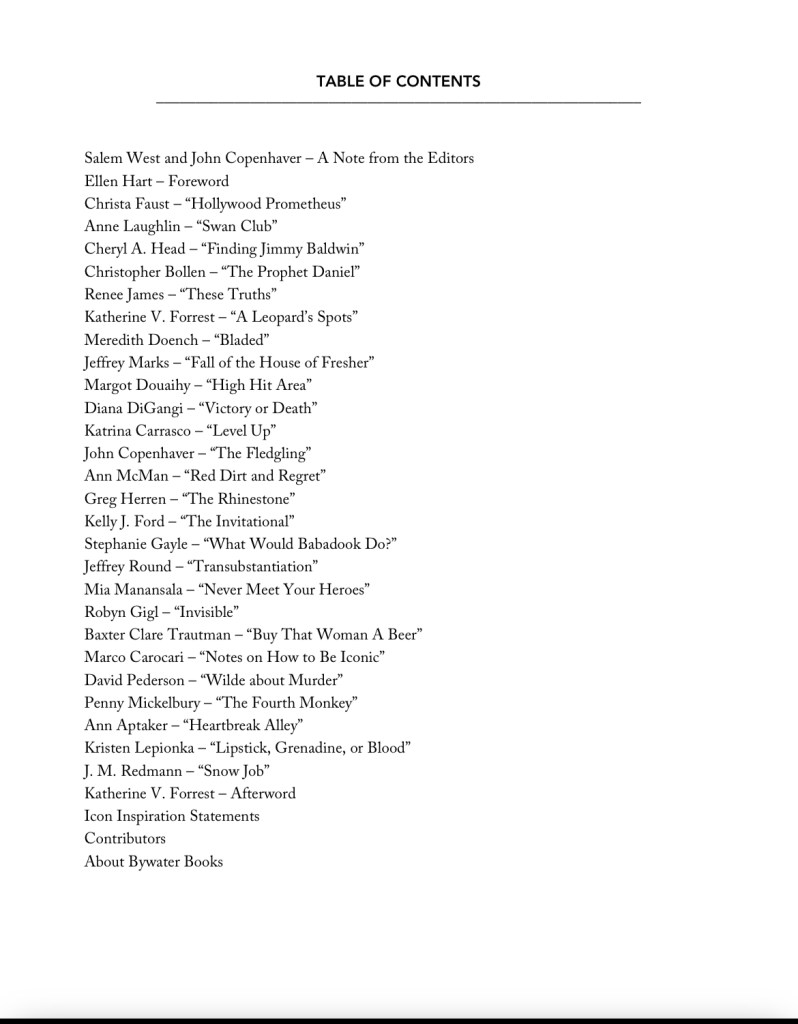
I am kind of pleased with it, to tell you the truth. It’s called “The Rhinestone.”
No jury duty today! And I think I am finished with it all this time around. Trials, according to what the judge told us on Monday, rarely start this close to the weekend of the last push of Carnival, so if I don’t have to report today I shouldn’t have to report anymore. I was only there for an hour or so yesterday before we were released, which was great. I came to work–my testing in the clinic shifts were covered–and got some odds and ends and other things taken care of. I wasn’t feeling too hot by the end of the day–and getting home from work was a nightmare–but by the time I went to bed I was feeling terrible. I woke up to a fever this morning, a sore throat and some major coughing. I decided that it was wiser to use sick time rather than risk getting everyone at the office sick–which would thus spread exponentially, call me Typhoid Greg–and so called out. I can’t remember the last time I missed work because I was sick; probably when I had COVID? I should probably take a test today myself, shouldn’t I? Heavy heaving sigh. I’ll do that before I go lie down with my book.
As far as jury duty goes, this wasn’t too terrible, really. And I don’t mind doing it, either. I always serve whenever I am called; the only time I’ve tried getting out of it was when I was supposed to serve the week after the shoulder/arm surgery, which wasn’t possible. I find it interesting and a solemn responsibility; it’s part of our civic duty as citizens after all, and weighing the evidence and deciding someone’s fate is kind of a big deal. Plus I like seeing how the courts actually work in real life, as opposed to books and movies. (The judge also said on Monday that court isn’t like Law and Order, there’s a lot more they don’t show. It’s really funny the cultural impact those shows have had on the country; someone should do a study on that. I have some thoughts myself about it and other “copaganda” shows, as well as the books about cops/lawyers.)
The not feeling well definitely sucks, though. All of my joints ache, and my legs feel exhausted. I did have to park fairly far from the house, on Race between Camp and Magazine. I’ll try to get the car moved today, so it’s closer to the house. I am hoping this doesn’t last another day–I don’t want to take another sick day and if I do, I still need to go by the office and get my computer so I can work at home on Friday–and the COVID test is negative. If the COVID test isn’t negative, it won’t matter because I won’t be allowed back into the building until next week anyway. I don’t want to use all my sick time, but if I have COVID, there’s no choice.
Good news! The COVID test was negative. I am feeling a bit better, but still running a fever. I also have a tickle in my throat and it’s sore. It also looks like a beautiful day outside, and the weather should be lovely for the parades this weekend, if I am feeling up to it. I definitely want to do Iris and Muses, if I can, and maybe some Thoth on Sunday. Bacchus is too much of a madhouse, but I love Orpheus on Monday because the crowd starts clearing out early because people need to go home and get ready for Fat Tuesday. I just hope I’m feeling better by tomorrow so I can go in to work. I do not like being sick.
The good news is that I signed a short story contract yesterday. It’s been a hot minute, so I am very well pleased. (This is for a submission to an anthology call; the other one I signed was one I was asked to write, so it’s a bit different.) I’m not sure if I can talk about this anthology or talk about my story–which I am dying to tell you about–but I’ll have to be annoying and not say anything for now. One I can talk about is called “The Rhinestone,” since the contract is already signed and the book has been announced. I have to revise and edit the story with notes, but it’s kind of a done deal. “The Rhinestone” is a book excerpt, and what’s really funny about this particular book excerpt (besides the fact that the book itself isn’t finished; this is from Never Kiss a Stranger) is that it was the actual kernel the entire book idea grew from, too. Funny how that works sometimes, isn’t it? I’ve often had ideas that I thought were interesting, but didn’t know if it was a short story or a novel until I tried writing it one way or the other. I used to always be expanding short stories into novels (because I overwrite and always have more to say); it was around 2012 that I began thinking in terms of maybe your novel ideas can actually be written as short stories instead), but shortly after we moved here, Paul and I had lunch at a place called the Quarter Scene, which was either queer-owned or just extremely queer friendly. It was our first time eating there, and I don’t remember why we did in the first place or why we were in the Quarter. Regardless, the table we were seated at–in the big picture window–had a little plaque on the wall reading TENNESSEE’S TABLE with the note that whenever he was in town, Tennessee Williams always sat at that table for lunch. We both thought that was kind of cool, and I thought “Tennessee’s Table” was a great title for a short story. The original story in and of itself wasn’t anything–just two gay friends meeting for lunch and sharing stories. It was a melancholy little story, really, not much to it. But when I started working on Never Kiss a Stranger–I originally wrote it as a long novella, about 30k words–I decided to reuse that setting and write a scene between two of the main characters. When I was asked to write for this anthology–the theme was the story had to be inspired by a queer icon–Tennessee Williams, who has had an enormous impact on both Paul’s and my life, was a no brainer. And then I thought, hey, that scene is set at Tennessee’s Table, why not adapt that back into a short story? So I pulled the chapter and reworked it a bit. I also have notes to make it stronger as a short story, so looking forward to revising that.
As for the country and the world, well, it kind of speaks for itself with no need for comment from me, does it?
And on THAT sad note, I am heading into the spice mines. Have a lovely day, Constant Reader, and I’ll check in with you again tomorrow.
Monday! A new week, full of options and possibilities. Isn’t that the best way to look at Monday, rather than groaning about having to go back to work after the weekend? I suppose it’s easy for me to say that because Monday is my administrative day at the office, so I ease back into my job and don’t see clients until Tuesday. It was a nice weekend, to be honest. I didn’t get as much done as I had planned–I never do–but I got what needed doing done. It was a weekend of watching the Olympics, which I always enjoy, and relaxing and hanging out with Paul and Sparky, which is always my favorite thing to do. I need to shave this morning, both my head and face, but overall, it should be a relatively easy and stress-free day for the most part. Huzzah!
I can’t believe it will be August soon, too. I did not work on that short story this weekend whose deadline is Wednesday, but I may be able to get some of it done this week. I forgot all about it, to be honest, and that’s why I need a to-do list to reference. (Note to self: do that today, or else you’ll be floundering all week.) I guess the first thing on the list is to actually make one? Smart, because that way I can cross something off the list to begin with and feel like I’ve accomplished something already. Now that I think about it some more, that’s what I always used to do, too. It’s weird not remembering things like that, and then having it pop back into my head. That’s been happening with my writing lately, too–I’ll remember something that I used to do, or always do and have forgotten about. I remember that with Murder in the Rue St. Ann I started using Tennessee Williams quotes to open my books with, and that I gradually moved away from that over the years to using other quotes to kind of coyly suggest what the theme of the book might be to readers who are paying attention, or are simply marvelous quotes about either being gay, or New Orleans. I have a quote or two for the opening of the next Scotty–I changed the name of it yesterday, not wanting to play with fire–and yesterday I was thinking about the book, and what it was going to be about going forward, and I found another way to involve Scotty’s family, which will be interesting to play out, since he and the boys are staying at his Diderot grandparents while the renovations are being done on their Decatur Street home–so I can also riff on how different it is to live in the Garden District as opposed to the Quarter, where he’s lived most of his life. (I am calling it Hurricane Season Hustle now; which doesn’t seem to tempt fate quite as much as the previous title did, plus I was going to use that title for the fourth Scotty that fateful summer of 2005….)
Pretty cool.
I think this is going to be a good week, or at least this morning feels like it’s going to be one. I think I should probably keep getting up early on my weekends so I can get more done; the sleeping late always seems to give me a more lackadaisical approach to my weekends, and I inevitably end up losing track of time and suddenly it’s after twelve and I haven’t gotten anything done that I wanted to get done, which is never a good thing. And while I don’t like the idea of getting up every morning at the same time–I guess on weekends I could push it back from six to seven, so it’ll feel like sleeping late but really isn’t that much–if I want to get things done on the weekends efficiently I’ll need to get up early. Maybe I’ll let myself sleep late on Saturdays? I don’t know. But I need to shake things up in my life and get back on my regular horses again–writing and the gym. Both will make a difference in my life, won’t they?
I also need to read more. It’s weird that I have reader’s block, which I didn’t even know was a thing. But if I get up early on weekends, I can get the blog done early and can repair to my chair to read for a few hours over my coffee in the mornings. Perhaps if I look at sleeping late as cutting into my reading time, that will get me out of bed on the weekends…or I could continue using my weekends as down time where I mostly futz around the house. And the books continue to pile up around here while I let them go and don’t read. Heavy sigh. And I have so many marvelous books to read around here, and more coming in on the regular, too. And maybe there’s a connection between my not reading and not writing, too. Hmmm. They do kind of go hand in hand, don’t they?
Something else to unpack.
Story of my life, really.
And on that note, I am going to head into the spice mines. Have a lovely Monday; I’ll most likely be back later, and if not, I’ll be here again tomorrow morning!
World and Olympic gymnastics champion Daiki Hashimoto
If you will recall from my last entry about the Chanse series, I had a new editor for the second book in the series. I had also written a proposal for the follow-up, Murder in the Rue St. Claude, which was going to be about a nursing home and an angel of death. The second book ended with a tragedy for Chanse, and the last scene of the book was Chanse saying goodbye to someone before their life-support was turned off. I did a trickery and was going to have the person be in the nursing home, still living, only a suspicious death happens there and one of the workers talks to Chanse about her fears. The editor wasn’t the most professional or organized person, and I had to send the proposal to her three times on request with no contract offer. I was very irritated by this, but there were also a lot of changes going on there–including moving the offices from LA to New York, which I thought was an incredibly stupid business decision…and I wound up with yet another new editor right before Katrina hit. I honestly wasn’t sure if I would go back to writing ever again–one of the lulls in my career–but things eventually settled down and I started house sitting for a friend in Hammond over on the north shore while I waited for the city to reopen so I could drive into the city and get some more things from the house. I did, my friends’ trip was cut short, and I was going to return to Kentucky to my parents’ after one more swing by the apartment to pick up things. Imagine my surprise that my mail service was open, my grocery store and bank were open, and so was my gym. We’d moved into the main house from the carriage house, which hadn’t been rented yet as it needed some work before the hurricane, and so….I just moved back into the carriage house and cleaned up around the property and kept an eye on the main house, as well as emptying out the water from the machines that were trying to keep the insides of the apartments dry (the roof was gone).
While I was in Hammond, my new editor got me to reluctantly co-edit an anthology about New Orleans called Love, Bourbon Street (a title I hate to this day), and he was trying to talk me into writing a Chanse book about Katrina. I didn’t really want to, but he kept insisting and finally, I gave in and agreed to write it. However, the nursing home I was researching was a place they left people to die in–wasn’t touching that with a ten foot pole–and it occurred to me that I could wrap the case around Hurricane Katrina. He was hired by the client the Friday before Katrina, and obviously he couldn’t do the job now.
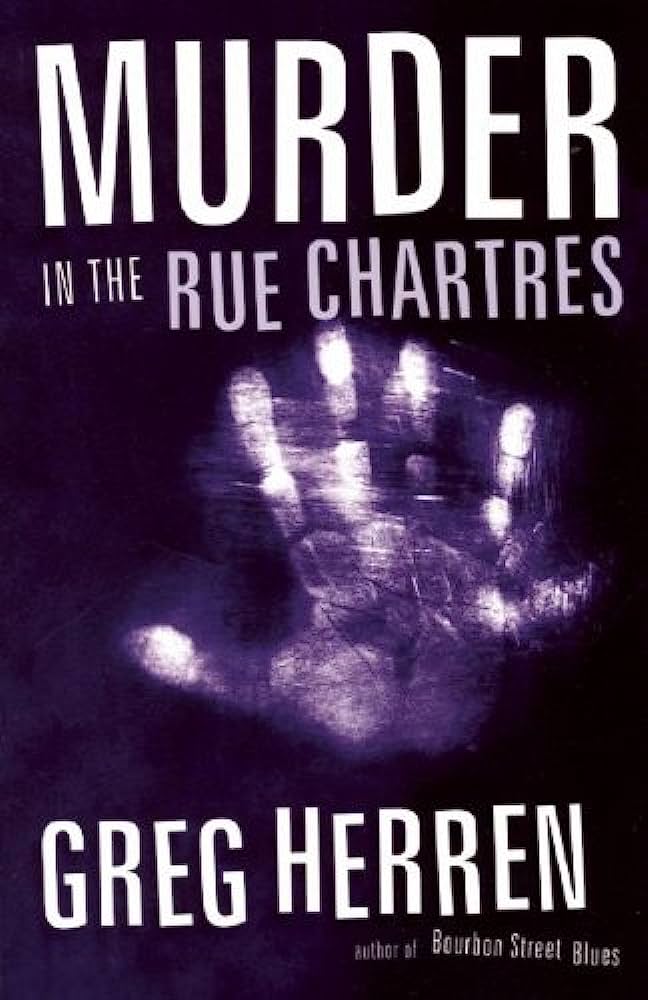
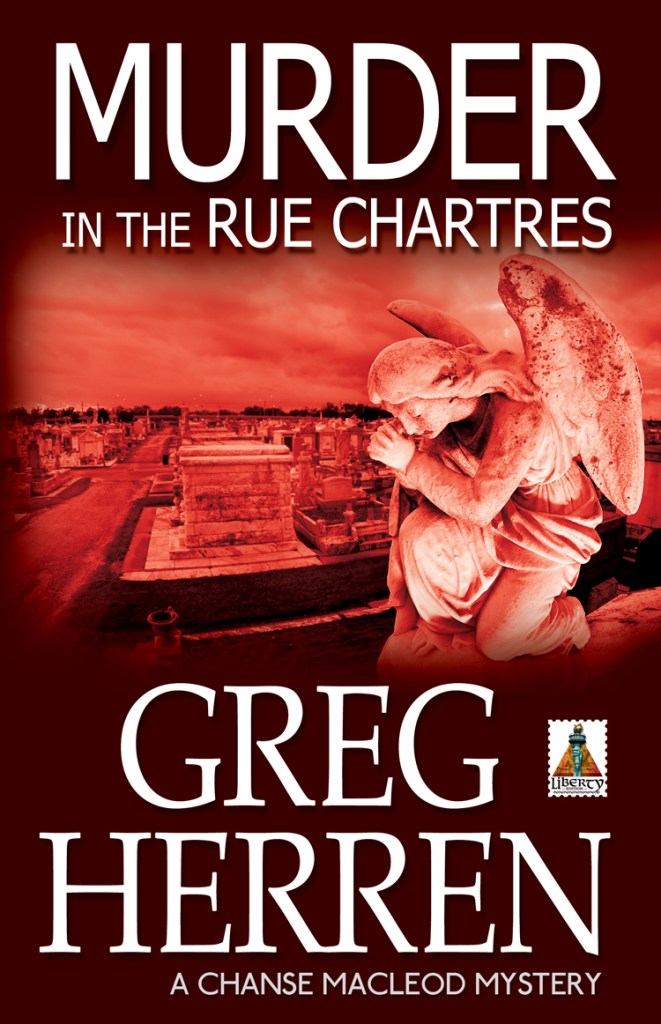
And that was the seed from which Murder in the Rue Chartres (no title at the time of contract) grew.1
This is the original cover from Alyson Books.This is the new cover for the Bold Strokes ebook
It was six weeks before I returned to my broken city.
Usually when I drove home from the west, as soon as I crossed onto dry land again in Kenner, excitement would bubble up inside and I’d start to smile. Almost home, I’d think, and let out a sigh of relief. New Orleans was home for me, and I hated leaving for any reason. I’d never regretted moving there after graduating from LSU. It was the first place I’d ever felt at home, like I belonged. I’d hated the little town in east Texas where I’d grown up. All I could think about was getting old enough to escape. Baton Rouge for college had been merely a way station—it never occurred to me to permanently settle there. New Orleans was where I belonged, and I’d known that the first time I’d ever set foot in the city. It was a crazy quilt of eccentricities, frivolities, and irritations sweltering in the damp heat, a city where you could buy a drink at any time of day, a place where you could easily believe in magic. I couldn’t imagine living anywhere else. Any time I’d taken a trip before, within a few days I’d get homesick and started counting the hours until it was time to come home.
But this time wasn’t like the others. This time, I hadn’t been able to come home, and had no idea how long it would be before I could. Now, I was nervous, my stomach clenched into knots, my palms sweating on the steering wheel as I sang along to Vicki Sue Robinson’s “Turn the Beat Around” on the radio. It was everything I’d feared for the last few weeks when I thought about coming home, the anxiety building as the odometer clocked off another mile and I got closer to home.
It was different.
The most obvious thing was the lack of traffic. Even outside the airport, the traffic was usually heavy, sometimes slowing to a complete standstill. But other than a couple of military vehicles, a cement mixer, and a couple of dirty and tired looking sedans, I-10 was deserted. There was a film of dirt on everything as far as I could see, tinting my vision sepia. Huge trees lay toppled and debris was everywhere. Signs that used to advertise hotels, motels, restaurants, storage facilities, and pretty much any kind of business you could think of were now just poles, the signs gone except for the support skeleton. Buildings had been blown over, fences were wrecked and down, and almost everywhere I looked blue tarps hung on roofs, their edges lifting in the slight breeze. My breath started coming a little faster, my eyes filled, and I bit down on my lower lip as I focused back on the road.
No cars joined at the airport on-ramp, or the one at Williams Boulevard just beyond it. No planes were landing or taking off.
Most of the writing I did in the fall of 2005 was my blog, which at the time was on Livejournal. (The old stuff is still there, but I started making things private after a year because of plagiarism; I guess people thought they could steal my words if they were on a blog.) I documented as much of the experience as I could, so people outside of Louisiana could see that the city wasn’t fully recovered despite no longer being in the news. American attention had moved past New Orleans by the spring of 2006.
When I started writing the book, I was really glad I had done that with the blog, because more than anything else it reminded me of the emotions I was going through, that horrible depression and not remembering things from day to day, the need for medications, panic attacks, depression, and the way the entire city just seemed dead. I did repurpose a lot of stuff that was on the blog–rewritten and edited, of course–and I could tell, as I wrote the book, that I was either doing some of the best work of my life to that point or I was overwriting it mercilessly. You never can be sure.
But I also needed to flesh out the murder mystery I came up with, and I also wanted to write about a historical real life tragedy of the Quarter. The client who hired him that Friday before Katrina roared into the Gulf and came ashore was engaged, and she wanted Chanse to find her father, who’d disappeared from their lives when she and her brothers were very young. But what happened to her father? Who killed her, and why? Was her murder a reaction to her looking for him?
I had started using Tennessee Williams quotes to open my New Orleans novels with the third (Jackson Square Jazz: “A good looking boy like you is always wanted” from Orpheus Descending) and I liked the conceit so much I kept doing it. I knew someone who’d built a crime novel around the basic set up of Cat on a Hot Tin Roof, and I thought, what if the person who knows all the answers has been in a mental hospital for decades? Then what if Mrs. Venable had succeeded in getting Catherine locked up with all of Sebastian’s secrets lobotomized out of her head?
I named the family Verlaine as a nod to the Venables, and aged Mrs. Venable as well as gender swapping her (this was also a bit influenced by The Big Sleep), and I was off to the races.
My editor wrote me when he finished reading the manuscript and told me it was one of the best mysteries he’d ever read. The reviews! My word, I still can’t believe the reviews, and how good they were. I got a rave in the Times-Picayune, Library Journal and Publishers Weekly.
And yes, it won a Lambda Literary Award for Best Gay Mystery.
The irony that two books I wanted nothing to do with, let alone write or edit, ended up with each winning Lambda Literary Awards, does not escape me. ↩︎
Sunday morning in the Lost Apartment and the sun is shining. It actually looks like a stunningly gorgeous day out there for parades, and of course King Arthur, the last of the day, is one of my favorites (a lot of gays ride in King Arthur). Yesterday was a slow day. I woke up after sleeping for ten hours feeling a little inside out, and the weather wasn’t a help. It rained off and on all day; the parades were all moved up because of the threat of weather (which was accurate; we had a flash flooding thunderstorm later on in the day), and since I was so tired and wrung out, I didn’t feel like attending any of them. I’ll probably go out for King Arthur, maybe for some of the earlier ones, and we’ll see how it goes.
As I said, I was extremely tired all day yesterday and decided to let my body and brain rest for most of it. I did do the dishes and I did get some things done early on, but I soon repaired to my easy chair, where I spent the rest of the afternoon reading–more on that later–but one of the things I wanted to reread was “La Cote Basque” by Truman Capote. I knew it was the story that turned his “swans” against him; I read it many years ago when I went through a Capote phase, when I was able to get past my distaste1 for him personally to start reading his work–which I quickly became a fan of; I love his writing, especially In Cold Blood, and I’ve always preferred the novella Breakfast at Tiffany’s to the film. I always thought he wasted his incredible talents, like so many did, and I am starting to appreciate him more as a person than I ever did before2 and now am curious about reading biographies of him. I never watched any of the films made about him, but now…now I am thinking I should watch them. Capote, Tennessee Williams, and Gore Vidal all knew each other and were contemporaries; openly gay men who didn’t give a fuck about morés and ignored the rule of “don’t ask don’t tell” that pretty much was the only way gay men or other queers could really survive the reality of the deeply homophobic world they existed in. I cannot imagine, but that was also the reality of the world I was also born into, creating internal conflicts that I am still trying to unravel to this day–like why I held Capote in so much distaste, which was really internalized homophobia, which I’ve been confronting since I first watched Capote v. The Swans, and trying to process my way through it.3
Ironically, I wound up rewatching those first two episodes again, because Paul wanted to watch–he also feels the same as me about Capote, which is partly why we never saw any of the earlier films about him–and it’s well done enough for me to easily sit through it again, and it surprised me because I never became bored, even though I’d already seen those episodes. We watched two more episodes of Lupin yesterday, despite my falling asleep during the second, after which we retired to bed.
And here I am this morning, feeling rested and not at all as tired and drug out as I was yesterday, which is a very good thing. I don’t know how much of anything I am going to get done today–I do know I want to spend some time reading and editing, if not writing–and of course there’s always picking up to do around here, and maybe I could vacuum.
I also spent some time yesterday finishing reading the novelization of one of my favorite movies of all time, The Last of Sheila, which I really enjoyed almost as much as I did the film,4 which will be covered in its own entry. I’ve been entranced by this film since I first saw it as a child one Sunday after church, and it still holds up; I’ve never once rewatched, knowing the surprise ending, and been bored or not entertained. (It’s also weird because there are scenes in Capote v the Swans showing Capote shooting Murder by Death, which was one of my earliest memories of seeing Capote, written by Neil Simon, one of the most popular playwrights of the middle part of the century that no one talks about anymore either but he was everywhere back then; I doubt Murder by Death holds up–and I didn’t really like it that much when I saw it in the theater back then, either.)
I’m also thinking it might be fun to revisit In Cold Blood and some other Capote works while I watch the show. I’ve always liked his short stories and his writing style…
And on that note I am heading into the spice mines. Have a lovely King Arthur Sunday, everyone, and I’ll catch you maybe later.
Definitely will be more on this later, probably once I’ve finished watching. Capote v. the Swans.↩︎
It’s probably hard to imagine what Southern Decadence is like unless you’ve actually been to it; even the hundreds of pictures I’ve taken and shared on social media over the years can’t even remotely begin to get the concept of what it’s like across–the same as Carnival, really; it has to be seen and experienced to be truly understood. My first Southern Decadence was in 1995, which was around the twenty-second or third time it was held; my knowledge of Decadence, primarily from urban legend and tales told from one gay to another and passed down over the years, is sketchy and probably untrustworthy (if you’d like the unvarnished truth and read about the history, I highly recommendSouthern Decadence in New Orleans from LSU Press, co-written by Frank Perez and Howard Philips Smith; I have a copy and thoroughly enjoyed reading it. Alas, my memory isn’t what it used to be, but the story is it began as a bar crawl for a friend who was moving away, and grew from those humble beginnings into a massive event that draws queers from all over the world).
That first Decadence I came to was also one of the hottest, temperature wise, or perhaps it was simply because I wasn’t used to the summers in New Orleans yet since I didn’t live here. I just remember being in Oz one afternoon and just soaked in my own sweat, and going down the back staircase from the second floor–the staircase that opens out onto the dance floor–and having to hold onto the railing because the steps were slick and wet. The railing was also wet, and when I touched the walls so were they–all the humidity and body heat and sweat–but at the same time it was so much fun. Gorgeous, flirty and friendly men everywhere, everyone scantily dressed and getting wasted and just having a good time. This was during the height of the circuit parties, most of which have died off over the years–there’s no longer a Hotlanta weekend in Atlanta in mid-August anymore, for example–but back then, it seemed like every month if you had the time and the money there was a circuit party somewhere you could fly off to and be yourself and have fun being in an entirely gay environment for a few days. That was, for me, one of the primary appeals of circuit parties and gay bars–they were safe havens for everyone to be out and proud and loud…and after a few weeks navigating the straight world for work and play and life in general…it was lovely to let loose in, for want of a better word, a safe space.
Circuit parties also had their downsides, don’t get me wrong–Michelangelo Signorile detailed some of those in his book Life Outside, which got taken out of context an awful lot–drug use and rampant sex and bad choices also led to other problems, not to mention the spread of HIV and other STI’s; the very first time I ever went to a circuit party–Halloween in New Orleans, 1995–there was a very Masque of the Red Death feel to it; here were all these gay men crowded into a riverfront warehouse, doing drugs and dancing and having a great time while the plague raged outside the doors. I even wrote about that in my diary on the flight back to Tampa a few days later.
But Decadence was always my favorite, out of all of them, and it was something I looked forward to every year. My workouts were always planned so I would hit peak physical condition for Decadence and maintain through Halloween, before starting to work on the Carnival body. It feels weird to talk about it that way, but that was my mentality and my schedule for years. Bulk up for a couple of months, then lean down leading into the event.
I had always wanted to write about Southern Decadence, and I know I’ve written about how I came up with the idea for the book numerous times; standing on the balcony at the Pub watching one of the strippers fight his way through the mob of gay men to get to the Pub so he could work, Paul saying you really should write a book about Southern Decadence and seeing a scene vividly in my head as I looked down at the sea of sweating gay men. I’ve also written about where the idea for the character and his family came from. So what is there left for me to say about Bourbon Street Blues?
The new cover for the ebook edition.
The name’s Dansoir. Dick Dansoir.
Okay, so that really isn’t my name. It’s my stage name from the days when I was on the go-go boy circuit. I started when I was in college, at Vanderbilt up in Nashville. As with almost everything that goes on in my life, I became a go-go boy on a fluke. The Goddess brings interesting experiences into my life all the time. Sometimes I don’t think it’s all that great, to tell the truth, but she always seems to be watching out for me.
I was working out at my gym one day when this guy came up to me and asked me if I wanted to make some easy money.
Like I hadn’t heard that one before.
I was twenty-one at the time, just turned, but I wasn’t some wide-eyed dopey innocent. I was raised in the French Quarter, after all, and by the time I went off to college at age eighteen I had pretty much seen everything. French Quarter kids have a lot more life experience than other kids their age. You can’t really help it. The French Quarter is like Disneyland for adults, and growing up there, you get used to seeing things that other people can only imagine.
Anyway, this guy said he was a booking agent and scout for this agency that booked dancers in gay bars throughout the deep South. The troupe was called Southern Knights.
“You can make a lot of money this way,” he said to me above the sounds of people grunting and weights clanging. “You’ve got the look we like.”
I looked at myself in one of the mirrors that are everywhere in gyms. I was wearing a white tank top and a pair of black nylon jogging shorts. I was pumped up from lifting, and if I did say so myself, I looked pretty good. I’m only about five-eight—nine if I have thick-soled shoes on. I have curly blond hair that’s darker underneath. The sun does lighten it, but that darkness underneath always makes people think I dye it. I don’t. I have big, round brown eyes. I am also one of those blonds lucky enough to be able to tan. I’d gotten a good tan that summer and it hadn’t faded yet. The white tank top showed the tan off nicely. I also have a high metabolism and can stay lean rather easily.
But scam artists are everywhere. I wasn’t about to fall for a line from some stranger in the gym. For all I knew, it was a trick to get my phone number, or an escort service, or something else I didn’t want to be involved in.
Not that I have anything against escorting. People go to escorts for all kinds of reasons—loneliness, fear of commitment, whatever—but they do fulfill a need in the gay community, and more power to them. I just never saw myself taking money from someone for having sex. I like sex. I enjoy it. So, it just never seemed right for me to tale money for doing something I like.
Besides, taking money for it would make it work. I prefer to keep my status amateur.
I got a copy of the book out yesterday and skimmed/read it again, to get another look and remind myself of Scotty’s roots and beginning. I realized yesterday, as I turned the pages of an ARC (yes, I still have ARC copies of Bourbon Street Blues available), several things: one, that the reason I always hate reading my own work is because my brain is trained to read my work editorially, to fix and edit and correct and look for things needing to be fixed (and I can always find something) and that second, it’s really been so long since the last time I looked at this book–or any of the earlier Scottys–was four years ago, when I was writing Royal Street Reveillon. So, by making the obvious effort to flip the editorial switch off, and having so much distance from the book that it almost seemed like something new to me, I was able to skim/read the entire thing without wincing in horror or pain or embarrassment.
The original cover, which always makes me smile.
Bourbon Street Blues was also the last novel I wrote that didn’t have an epigram of any kind, let alone Tennessee Williams: I started that practice with Jackson Square Jazz with a line from Orpheus Descending: “A good-looking boy like you is always wanted.”
Reading the book took me back to the days when I was writing it. The Greg who wrote Bourbon Street Blues is still here, I’ve just been through quite a bit since then and have changed because of my experiences. There were some sentences in the book I would change now to make better, but there are still some jewels in there, and well, I can kind of understand now why the character is so well-liked. He’s charming and humble and kind; sure he talks about “being irresistible” a lot, but that’s part of the charm. Guys find him attractive. He doesn’t necessarily see it, but is more than willing to accept it and not question it. He enjoys his sexuality and he enjoys having sex. I wanted Scotty to be unabashedly sexual and to have no hang-ups, carrying no stress or issues about being a very sexual gay man.
As I read the book again, I also started seeing something that had been pointed out to me over the years a lot–and began to understand why this was pointed out to me so much; an old dog can learn new tricks, apparently–but I still think other people are wrong. The book isn’t “all about sex,’ as some have said. Rather, Scotty sexualizes men; he sees them as potential partners and appreciates beauty in men. His friend David also loves to get laid, so they cruise a lot–whether they are at the gym (either the weight room or the locker room), a bar, wherever they are–and so people get the idea that the book itself is incredibly sexual, even though there is literally only one sex scene in the entire book and it’s not graphic; Scotty’s weird mish-mash of spirituality and beliefs and values make the act itself a sacred ritual, and that was how I wrote the scene; from a spiritual, commune-with-the-Goddess perspective. It’s also funny in that people are so not used to seeing world through the Gay Male Gaze that it’s jarring, and puts sex and sexuality into the minds of the reader.
The question is, would people think the same if this was done through the Straight Male Gaze, in which women are sexualized? Since this is the default of our society–literature, film, television–is flipping the script to show the Gay Male Gaze so uncommon and so unheard of that it triggers such a reaction from some of the readers?
There’s also so much innocence in the book, and it’s also interesting to see it as a kind of time-capsule: Scotty doesn’t have a computer; his rent (on Decatur Street in the Quarter, with a balcony) is $450 a month (ha ha ha ha, that’s what the condo fee would be now monthly); and he also doesn’t have a cell phone. The whole point of the book was to do a Hitchcockian wrong place/wrong time now you’re in danger kind of story; and that is precisely what Bourbon Street Blues is. I’d forgotten that one of the running gags in the book is that he never gets a chance to sleep much throughout the story so he’s tired all the time and just wants it all to be over so he can go to bed.
Another thing that’s dated: even in 2002, in my naïveté and innocence, the evil politician running for governor–when described by Scotty’s brother Storm as problematic–even he doesn’t support an outright ban on abortion–he wants to ban it but with the rape, incest and health exceptions.
Even in 2002 I couldn’t conceive of anyone running for statewide office calling for an outright ban on abortion.
How things change.
It was also interesting that I got two things very wrong in the book, too: for one, I was thinking for some reason the swamp on the edges of Lake Pontchartrain on the way to Baton Rouge on I-10 was the Atchafalaya (it’s the Manchac/Maurepas), and while I had always remembered I’d given Scotty’s mom a name in this book but forgotten it later when I needed a name for her in a different book–I had the name wrong. I thought I’d called her Marguerite in Bourbon Street Blues then named her Cecile in a later book; I had actually called her Isabelle. (I’ve even told that story–about the names–before on panels and been WRONG ALL THIS TIME!)
It was also interesting and fun to remember–as I read–that Scotty was also not looking for a boyfriend. He was perfectly happy and content being single (which was also something important I wanted to write about–a gay man who didn’t care about finding a life-partner, figuring if it was meant to be it would happen). I also presented him with two potential love interests–Colin the cat burglar and Frank the hot daddy–with that actually being resolved without him having to make a choice between them. I also had the book end with Scotty being slowly persuaded into becoming a private eye.
Originally I had conceived it as a stand alone novel, but the publisher offered me a two-book contract, so when I was writing Bourbon Street Blues I knew there was going to be a sequel. This freed me to leave some personal things open for him; I knew I was going to bring Colin back in the next book so he was going to have to choose between them, and I also knew the personal story needed to be wrapped up by the end of the third book, which was going to be the end of the series with everything resolved. That changed when I wrote Mardi Gras Mambo, but that’s a story for another time.
Bottom line: it’s a good book and I am proud of it. It’s only available now as an ebook from Amazon, but I hope to eventually make it available through every service as well as get a print-on-demand version for those who might want one.
Gore Vidal was one of three rather important gay male writers who emerged from the wreckage of World War II (the others being Tennessee Williams and Truman Capote), and I have always enjoyed reading his work–even if it’s not page turning material; I like the way he writes and I like the way he tells his stories.
He wrote six or seven major works of fiction based in American history that tell, in their own way, a more clear-eyed vision of what American history was and how the nation developed; called the Narratives of Empire, they certainly weren’t published in order but rather, I gather, in the order that struck his fancy; he was also busy writing other things and feuding with other writers–notably Capote, Norman Mailer, and William F. Buckley–and he obviously had a flair for the outrageous and controversial; The City and the Pillar, a very frank and daring and sympathetic look at the experiences of one young man navigating the world as a gay man, made him so controversial he was unpublishable for a number of years; he spent the time writing mysteries under the name Edgar Box and writing screenplays. Myra Breckinridge, which undoubtedly does not hold up to modern scrutiny and eyes; the book was clearly intended as satire, examining societal gender constructs and views on sexuality as well as the role of women. I read it for the first time maybe ten years ago, and it struck me as quaint; an artifact of a time certainly less enlightened, but trying to head for the light. (It may be worth a reread.) He also wrote Julian the Apostate, which I greatly enjoyed and read one year beside the pool during Saints & Sinners, back when it was in May and we used to always spend the weekend at the Olivier House on Toulouse Street.
But the Narratives of Empire began with, I think, Washington DC, followed by 1876 and later Burr; he also wrote about the aftermath of the Spanish-American War and the growth of the American empire in Empire, which I have also read and greatly enjoyed. I’ve not read all the titles yet; but reading Lincoln next after Empire made the most sense to me as some of the real-life characters depicted in that book are also in Lincoln, and it’s been a very long time since I read anything about Lincoln.
Elihu B. Washburne opened his gold watch. The spidery hands shows five minutes to six.
“Wait here,” he said to the driver, who said, “How do I know you’re coming back, sir?”
At the best of times Congressman Washburne’s temper was a most unstable affair, and his sudden outbursts of rage–he could roar like a preacher anticipating hell–were much admired in his adopted state of Illinois, where constituents proudly claimed that he was the only militant teetotaller who behaved exactly like a normal person at five minutes to six, say, in the early morning of an icy winter day–of the twenty-third of February, 1861, to be exact.
“Why, you black—!” As the cry in Washburne’s throat began to go to its terrible maximum, caution, the politican’s ever-present angel, cut short the statesman’s breath. A puff of unresonated cold steam filled the space between the congressman and the Negro driver on his high seat.
Heart beating rapidly with unslaked fury, Washburne gave the driver some coins. “You are to stay here until I return, you hear me?”
Growing up with Southern parents and the so-called “Southern heritage”, Lincoln’s place in history was, to say the least, still resented. The lionization of Lincoln after his death was, in some part, made possible by his murder; there’s not telling what the judgment of history would be on him had he lived to serve out his second term. Would we revile Lincoln for the reconstruction policies he would have followed? How different would the face of our present day nation be had he lived? An enormous mythology has sprung up around Lincoln since his death; “Honest Abe the rail-splitter” is a tale told to school children to this day, or how a young girl told him to grow a beard, and so on and so forth. The Civil War has been analyzed and written about endlessly; no one person could ever hope to read and digest all the documentation that exists of the conflict, let alone all the books published centering the war. I was always interested in Lincoln–even as a child I couldn’t wrap my mind around the mentality that people claiming to be “patriotic Americans” reviled Lincoln and glorified the Confederacy; I still am unable to consider such without triggering a massive amount of cognitive dissonance in my brain–and read lots of children’s books about him, but by the time I was an adult I was no longer interested in reading further biographies of the man. I am relatively uninterested in the possibility that he may have had relationships with men; without definitive proof that will always be a theory, and let’s face it, there is more evidence (although nothing conclusive) about his predecessor James Buchanan’s sexuality than there ever will be about Lincoln’s–hence my story “The Dreadful Scott Decision” I wrote for The Faking of the President.
Lincoln’s task was to preserve the Union in the face of its collapse, and that is what he strove to do. Was secession constitutional? Lincoln didn’t think so; the Constitution did not provide for the dissolution of the Union but at the same time it stated that any rights or restrictions not granted to the federal government in the document thereby fell to the individual states. So, does that mean the states held the right to leave the union? Andrew Jackson certainly didn’t think so, since he threatened to send federal troops into South Carolina during the nullification crisis. Part of the reason I actually wanted to read this book at this time was because of the stark reminder that Lincoln’s presidency, and the Civil War, serve as proof that mollifying white supremacy and continually compromising with an angry volatile minority, never ends well. (We are seeing it again now with the old Confederate states allied with their rural midwestern states…and of course as always, the ones threatening insurrection or secession claim to be “true patriots.”
Whatever, Mary.
Lincoln serves to humanize the man, and is also equally frank about Lincoln’s own white supremacist beliefs. Is Vidal’s assertion that Lincoln wanted to take the freed slaves and colonize them into Central America or somewhere back in Africa while reimbursing the slave owners for the loss of “property” accurate? It’s not the first time I’ve heard this (never heard it in school, though) and it seems likely to me. I also liked how Vidal got the panic of what it was like to live in Washington during there war so spot on; we never think about that, or how Maryland was a slave state surrounding the district, or that slavery existed and was legal in the district itself; slaves built the White House and the Capital. We never see into Lincoln’s head or from his point of view in this book–a masterful trick of Vidal’s, who thus leaves Lincoln a mystery to the reader.
It’s a compelling narrative, and it also shows us the point of view throughout of one of the conspirators who were hanged for plotting to kill him–David Suratt–and this jumping around from points of view–either of those who admired Lincoln, hated him, or thought him incompetent–gives a more three-dimensional view of the man we have deified for the last 156 years. He was definitely smart, a master politician, and, as Vidal says in the closing paragraphs of the book–if Washington was the father of our country, Lincoln was the father of our modern country.
Galatoire’s is a New Orleans institution; like Antoine’s and Arnaud’s and Commander’s Palace, it is one of those places you simply have to experience. This wasn’t my first time at Galatoire’s, but it was my first time there in a while. Galatoire’s was immortalized by Marda Burton and Dr. Kenneth Holditch in their book Galatoire’s: Biography of a Bistro, and Stella famously took Blanche there for dinner the night of the poker game in A Streetcar Named Desire. I don’t think I’ve ever been into Galatoire’s and left without feeling, at best, tipsy; at worse, staggeringly drunk. Last night I merely had a Bloody Mary and a glass of white wine; fortunately Paul and I had about a six-block walk to the car in the infernal heat of a late June evening, so I was completely sober by the time we got to the car.
We were at a dinner party in honor of author Lou Berney, whose last novel The Long and Faraway Gone is one of the best crime novels I’ve ever read, and whose next novel, November Road, drops in October (we were able to score ARC’s at the dinner). I’ve known Lou since Bouchercon in Raleigh, when he and I graced the stage on a panel with Lori Roy and Liz Milliron, moderated by the incomparable Katrina Niidas Holm. (Lori and Lou went on to win Edgars the following spring; coincidence? I THINK NOT.) It was a lovely evening, despite the extreme heat (and don’t laugh; it is unusually hot, even for New Orleans, this June; this is August weather).
Did I mention I got an ARC of Lou’s new book?
Today’s short story, the next one up in Promises in Every Star and Other Stories, is, of all things, a story about a baseball player, “Phenom.”
The arms around me hit a grand slam tonight.
It didn’t matter; we lost the game anyway. But I didn’t care. I’ve never really cared much about baseball. In fact, I’d never been to a game until our local team signed Billy Chastain. As soon as I saw him being interviewed on the local news, I knew I was going to start going to games. It’s not that I don’t like baseball, I just never cared enough to go. But all it took was one look at Billy Chastain, and I was sold.
The interview had been one of those special pieces. He’d been a high school star, played in college a couple of years, and then one year in the minors, where he’d been a force to be reckoned with; with an amazing batting average and some outstanding play at third base, he’d been called up to the majors for this new season, and everyone was talking about him. I just stared at the television screen.
Sure, he was young, but he was also composed, well spoken, and seemed mature for his age. He was also drop dead gorgeous. He had thick bluish-black hair, olive skin, and the most amazing green eyes. They showed clips of him fielding and batting—and then came the part that I wished I’d recorded: they showed him lifting weights. In the earlier shots, it was apparent he had a nice build; he seemed tall and lanky, almost a little raw-boned; but once they cut to the shots of him in the weight room, I was sold. His body was ripped as he moved from machine to machine in his white muscle shirt and long shorts, his dark hair damp with sweat. As his workout progressed and his muscles became more and more pumped, more and more defined, I could feel my cock starting to stir in my pants. And then they closed the segment with a shot of him pulling the tank top over his head and wiping his damp face with it. I gasped. His hairless torso slick with sweat, his abs were perfect, his pecs round and beautiful, and the most amazing half-dollar sized nipples which I wanted to get my lips around.
I bought tickets and started going to every home game.
Our team sucked, to be frank, and it was soon apparent that there was no World Series or even division pennant in our future that year. But Billy was a great player and everyone was talking about him. He was leading the division in hits and had one of the highest batting averages in all of baseball. He made the cover of Sports Illustrated with the headline PHENOM, his beautiful face smiling out at people on newsstands all over the country. There were several shots of him inside without a shirt on; shots I had scanned into my computer, enlarged and printed out for framing. I made sure my seats were always behind third base, so I could get as great a view of him as humanly possible, in his tight white pants that showed every curve and muscle of his legs—and the amazing round hard ass I thought about when I closed my eyes and masturbated. Every so often he would look up into the stands and smile, saluting us with a wave.
I wrote “Phenom” for the Alyson erotica anthology Fast Balls; I was asked by the editor to write a story.
I’m not a big baseball fan; my parents forced me to play when I was a kid and yes, the experience was incredibly traumatic. I do love going to games and watching in person; but watching on television isn’t something I’ve ever really enjoyed a lot. So, writing a baseball story was a bit of a challenge for me.
Then I remembered, when I was a teenager in high school, following the Kansas City Royals, and a Sports Illustrated cover with young star Clint Hurdle with the word PHENOM on it…and I thought, you know, I can write about a player instead of the game, and that was my starting point: a hot young baseball star turns up in a gay bar after a game and a fanboy’s dream comes true.
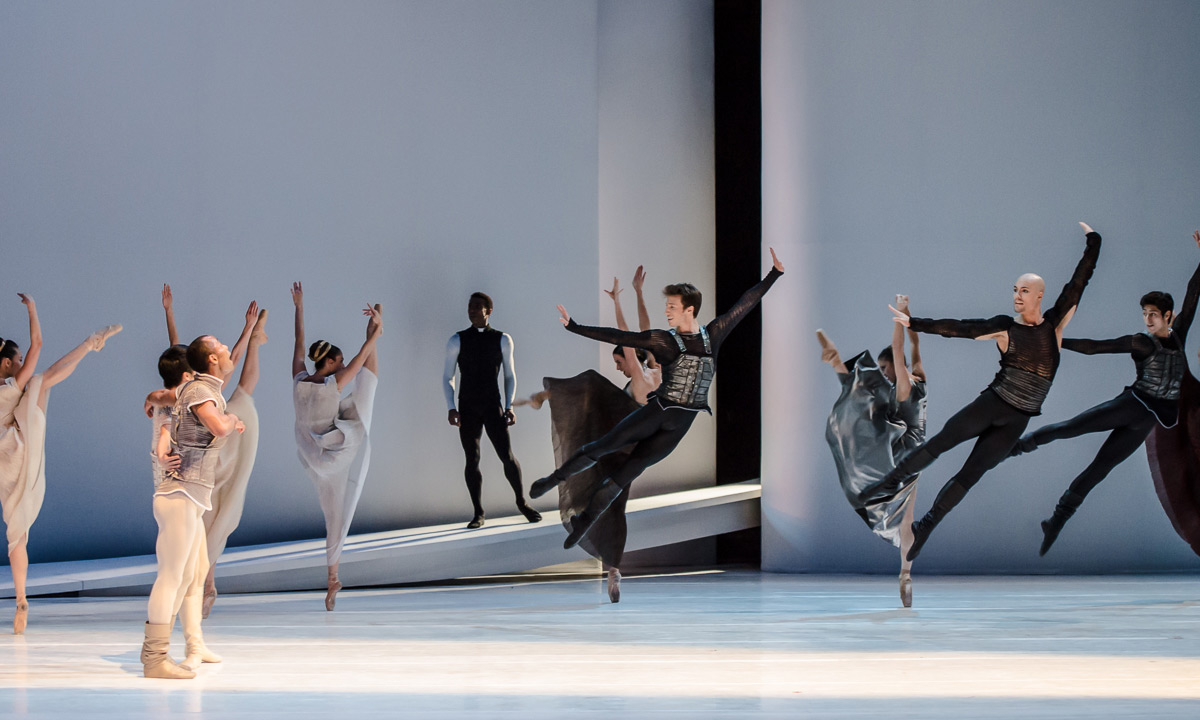
I’ve seen ballets–or parts of them–on television or Youtube; and I remember, as a child, being taken to see The Nutcracker (isn’t everyone dragged to that as a child?), which I hated (interestingly enough, many things that most children love are things that I didn’t; The Nutcracker is one; The Wizard of Oz another). But as lovely and awe-inspiring as seeing ballets on Youtube or on television can be, there is nothing like being in an auditorium and watching one being performed live on the stage in front of you. I liken it to the difference between watching figure skating on television and then watching it in person; it’s very different, and you never watch it on television in quite the same way again. Romeo and Juliet is, of course, an ubiquitous story; everyone knows it, to the point that it has become almost trite and hackneyed; it’s been adapted for everything imaginable–opera, ballet, film, and of course West Side Story–but, at its heart, it is still a beautiful and sad story.
The opening sequence of the ballet reminded me so much of the opening of West Side Story that I couldn’t help wonder how much the ballet influenced the musical’s choreography, or vice versa.
I read Romeo and Juliet when I was a sophomore in high school. I’d taken a class called Dramatic Literature; a class in which we read plays. Romeo and Juliet was paired with West Side Story (it’s also the class where I first read Tennessee Williams; A Streetcar Named Desire and Cat on a Hot Tin Roof, to be exact); we even watched the films (the version of Romeo and Juliet was the 1968 Franco Zeffirelli production, with Leonard Whiting and Olivia Hussey with the gorgeous score by Michel Legrand). Shakespeare’s language was, to me at fourteen, a mysterious puzzle I couldn’t unlock; archaic references I didn’t understand written in verse, yet somehow beautiful in how the words were put together. At the time, I didn’t understand how two families could feud so bitterly and violently in an Italian city during the Renaissance; of course, now that I’ve read so many Italian histories (I am still greatly enjoying The Black Prince of Florence), I am more than a little surprised that the feud between Capulet and Montague was so bloodless (see the Pazzi-Medici feud, circa fifteen century).
Yet, despite the overwhelming familiarity with the story, it was impossible not to be drawn into last night’s version of it; despite there being no dialogue, no words. The entire story was, as is typical with the ballet, acted out without words and through dance. The choreographer’s choices in telling the story were quite interesting; the stage setting was incredibly minimalist, with emotions and passions being evoked through the movement of the two curved walls that served as set pieces; the long rising ramp that served as not a way to exit the stage but as Juliet’s fabled balcony; and the use of costume and lighting.
The friar was used as a connective device throughout each scene; he was, if anything, the true star of the show, and its emotional heart. The dancer who played the role was magnificent. The ballet was a thing of beauty; I couldn’t stop marveling at how fantastic the dancers were, the exceptional shapes and lines they could form with their bodies, the almost super-human stretches and leaps and twirls and spins, the intimacy of their lifts and how they could mold their bodies around one another’s.
It was also my first time inside the Mahalia Jackson Theater for the Performing Arts since Katrina; ironically, it was also the first time the Ballet des Monte-Carlo performed there since 2005. Both the outgoing and incoming mayor were there; the Honorary Consul for Monaco, and the ambassador from Monaco were all introduced and thanked from the stage.
And yet, as a crime writer, and someone with a vested interest in group dynamics and politics, who has viewed documentaries about ballet companies, with a knowledge of human nature and interaction,I couldn’t help wondering, as the company took its well-deserved bows to a long standing ovation last night, what turmoils and temperaments boiled beneath the surface of the linked hands and bowing bodies; what slights and grudges boiled behind the smiling faces; which members of the company were friends and which were enemies; who were lovers and friends and who were enemies and rivals, who was gay and who was straight.
I definitely want to write a ballet noir.
And here are two short stories, for the continuation of the Short Story Project.
First up is “Split Second” by Daphne du Maurier, from the New York Review of Books collection of Don’t Look Now and Other Stories:
Mrs. Ellis was methodical and tidy. Unanswered letters, unpaid bills, the litter and rummage of a slovenly writing-desk were things she abhorred. Today, more than usual, she was in what her late husband used to call her “clearing” mood. She had wakened to this mood; it remained with her throughout the morning. Besides, it was the first of the month, and as she ripped off the page of her daily calendar and saw the bright clean 1 staring at her, it seemed to symbolize a new start tom her day.
The hours ahead of her must somehow seem untarnished like the date; she must let nothing slide.
“Split Second” is an exceptional exercise in character. Du Maurier thoroughly examines and exposes Mrs. Ellis’ character from beginning to end, and while she doesn’t go into a great amount of detail, it isn’t hard to figure out exactly whom she is from what we are told as readers. She’s a widow and her entire world revolves around her daughter, who is off at school; she decides, after a thorough cleaning of her home to go for a walk and is almost run down by the laundry truck as she walks back home. But when she gets back to her house, things are different. It is her house, but it’s no longer the house she left behind; other people are living there, her neighbors are gone–the entire world has changed and shifted as she walked home. It’s a horrifying story, even as the reader begins to glean what has actually happened long before Mrs. Ellis does; not that she ever does, even by the end of the story, and that is part of what makes it so sad, so effective, so powerful; no one has ever quite captured that elegant, melancholy sadness the way du Maurier does.
I then moved on to “The Picture of the Lonely Diner” by Lee Child, from the Mystery Writers of America anthology, Manhattan Mayhem:
Jack Reacher got out of the R train at Twenty-Third Street and found the nearest stairwell blocked off with plastic police tape. It was striped blue and white, tied between one handrail and the other, and it was moving in the subway wind. It said: POLICE DO NOT ENTER. Which, technically, Reacher didn’t want to do anyway. He wanted to exit. Although to exit, he would need to enter the stairwell. Which was a linguistic complexity. In which context, he sympathized with the cops. They didn’t have different kinds of tape for different situations.POLICE DO NOT ENTER IN ORDER TO EXIT was not in their inventory.
Lee Child is one of the most successful writers in our genre today; everything he publishes is a New York Times best seller, and his character, Jack Reacher, is one of those ubiquitous characters that will go down in the history of the genre, like Poirot, James Bond, and Kinsey Millhone. I am years behind on Lee’s novels; but if you’ve not read Lee Child, you simply must read The Killing Floor, the first Reacher novel. It is quite superb. This story isn’t Child at his best, but Reacher the character is at his best at novel-length, with the labyrinthian plots Child somehow concocts and manages to keep track of (one of my favorite fanboy moments was having lunch with him and Alafair Burke at the Green Goddess here in New Orleans several years ago; while I just sat there wide-eyed and listened to the two of them talk about writing and publishing, praying that I didn’t have sauce running down my chin), but this story does evoke the melancholy that Child evokes in his novels; the inevitability of fate and the powerlessness of humans to counteract it once the gears are moving. I do recommend the story; there is some amazing imagery in it as well.
And on that note, I am back to the spice mines. There are bed linens to launder, and short stories to edit, and a chapter to write; it is rainy and gloomy outside my windows this morning but I am well-rested and ready to work.
Or maybe it’s just the caffeine kicking in. Who knows?









 Queer and Loathing in America