Who’s Zoomin’ Who

And Chapter Twelve of Royal Street Reveillon is coming along nicely. The draft isn’t terrific–there are holes in the plot that will need to be plugged, and scenes missing, etc.–but it’s moving along. I am actually thinking this could wind up being twenty-five chapters long, making it one of the longest Scottys ever.

Then again, it’s been a while since there’s been a Scotty, hasn’t it?

Paul’s birthday is this weekend, too–it’s actually tomorrow–so that will probably interfere with my plans to get a lot of work done this weekend, but that’s fine. I would prefer to get back on schedule with both the book and the short story collection–and I have another short story to write, as well, for an anthology I’ve been asked to submit to–and of course, as always on Friday morning, the house is an utter disaster area. How does this happen every week? I try to keep up with it, I really do, and yet here I sit this morning in a disaster area, with files and paper and mail piled up everywhere I can see, the sink full of dirty dishes, and a load of laundry needing to be folded. Heavy heaving sigh.

But today is my short day at work, so i can get some of this done before I head in to the office, and hopefully I’ll be able to get some of the cleaning done tonight after work so I can focus on the writing/editing I need to do this weekend.

One can dream, I suppose.

I read two short stories for the Short Story Project as well.

First up is “Sleeping Dog” by Ross Macdonald, from The Archer Files:

The day after her dog disappeared, Fay Hooper called me early. Her normal voice was like waltzing violins, but this morning the violins were out of tune. She sounded as though she’d been crying.

“Otto’s gone.” Otto was her one-year-old German Shepherd. “He jumped the fence yesterday afternoon and ran away. Or else he was kidnapped–dognapped, I suppose is the right word to use.”

“What makes you think that?”

I am very sad to report that with “Sleeping Dog” I finished The Archer Files; the only things left in the book are short story fragments, which I may read, just for the hell of it and to see how those fragments might have been incorporated into other stories or novels of MacDonald’s; God knows I’ve done this any number of times myself. (The most recent example of this is my story “The Silky Veils of Ardor,” which is the story I recently revised from editorial notes and sent in earlier this week. It started as a story called “Death and the Handmaidens,” which no one would publish. I liked the story structure–in which a woman comes to a gathering of people she usually doesn’t see; in the original story it was a writer’s conference hotel bar. However, I took that character and that setting and turned it into a 25 year high school reunion weekend, rather than a writer’s conference, and even used the hotel bar setting. It worked, I have to say, much better in the newer version. I am, however, going to use the title “Death and the Handmaidens”, and the basic premise behind the original story to revise it yet again. I am far too stubborn to ever let something go, as we all know.) “Sleeping Dog” breaks the cardinal rule of crime fiction: never kill a dog or a cat. But the missing dog is the thread that leads to the solving of an old murder, and the disappearance of the dog also sets into motion events that lead to yet another murder in the present day. Terrific story, dead dog aside, and I am rather sad to say goodbye to The Archer Files.

Next up was “Wall Street Rodeo” by Angela Zeman, from the MWA anthology Manhattan Mayhem, edited by Mary Higgins Clark.

“Mr. Emil Bauer, I’d hope to see here. Especially today.”

I had rubbed against a hunchback this noon. Accidentally, of course. I’d never be so crass as to touch the poor fellow on purpose. Besides, everyone knows the luck comes from an accidental touch. Thus, you understand my excitement. Then I positively tripped over little James here, who dropped his five-dollar bill right in my path! Don’t tell ME that’s not luck! So, I hustled him and his cash right here. To Emil’s spot. “Please meet my friend, newly minted, you might say, heh, in this neightborhood.” I flourished my hand toward the child. “Mr. James Conner.”

Emil glanced fuzzily at the boy. “How old is it?”

This is a fine story, about a long ago crime and a hidden cache of stolen money, and it takes a roundabout way to get to the point, but it’s kind of clever in how it dodges and feints and fools the reader. It’s not one of the stronger stories in Manhattan Mayhem, but in fairness, some of these stories are so fantastic it would be hard to compete with them.

And now back to the spice mines.

13082527_1298944620118917_9066161767416363977_n

Jungle Love

Well, I finally got those story edits done yesterday, and it wasn’t that hard to do. I don’t know why I was resisting looking them over, reading the notes, and looking at the story; and frankly, the story is stronger for them. I now await whether or not there will be further notes–if I did a good enough job correcting things for the editor–and I feel as though a millstone has been lifted from around my neck. I honestly don’t understand myself sometimes. This wasn’t a big deal, and yet I avoided it for at least three weeks, not only letting it hang over my head like the sword of Damocles but it was always there, in the back of my mind as I worked on other things, nagging at me from the darkened recesses of my brain, worrying me the way I’d worry a loose tooth with my tongue.

And getting it done? Such an enormous relief.

And of course, once I conquered that beast, I went back to that pesky chapter and yep, sure enough, I was able to start whipping it into shape and what’s more, it was relatively easy. I guess I’d had so much trouble getting the damned thing done in the first place–and yes, for the record, it wasn’t the mess I thought it was–that I thought fixing it would be nearly as painful as writing it was. Nope, it wasn’t. Sigh. And now I know I can get back on track and on schedule. HUZZAH!

Seriously. This is why writers drink.

So I, for one, am really looking forward to this weekend and getting a lot of things done. Hurray!

I also read two more Ross MacDonald stories, from The Archer Files.

First was “The Angry Man”

I thought at first sheer terror was his trouble. He shut the door of my office behind him and stood against it, panting like a dog. He was a gaunt man in blue jeans, almost black with sweat and dirt. Short rust-colored hair grew like stubble on his hatless scalp. His face was still young, but it had been furrowed by pain and clawed by anger.

“They’re after me. I need help.” The words came from deep in his laboring chest. “You’re a detective, aren’t you?”

“A sort of one. Sit down and take a little time to get your breath. You shouldn’t have run up those stairs.”

Next was “Midnight Blue” :

It had rained in the canyon during the night. The world had the colored freshness of a butterfly just emerged from the chrysalis stage and trembling in the sun. Actual  butterflies danced in flight across free spaces of air or played a game of tag without any rules among the tree branches. At this height there were giant pines among the eucalyptus trees.

I parked my car where I usually parked it, in the shadow of the stone building just inside the gates of the old estate. Just inside the posts, that is–the gates had long since fallen from their rusted hinges. The owner of the country house had died in Europe, and the place had stood empty since the war. It was one reason I came here on the occasional Sunday when I wanted to get away from the Hollywood rat race. Nobody lived within two miles.

Until now, anyway. The window of the gatehouse overlooking the drive had broken the last time that I’d noticed it. Now it was patched up with a piece of cardboard. Through a hole punched in the center of the cardboard, bright emptiness watched me–human eye’s bright emptiness.

“Hello,” I said.

The stories are pretty good; I’m glad I took a break from reading the MacDonald stories because the style and voice were starting to grate on me. Don’t get me wrong; I think MacDonald–despite the occasional casual racism and misogyny–is one of crime’s best stylists, and I love Archer’s voice. But reading story after story consecutively was starting to grate a bit, particularly since some were clearly better than others. Both of these are gems; both of them wind up twisting and turning far away from their simple, casual beginnings.

I also have to say that reading the MacDonald stories, as well as Sue Grafton’s Kinsey and Me collection, along with Laura Lippman’s Tess Monaghan short stories in Hardly Knew Her have not only inspired me but kind of taught me how to write a private eye short story. We’ll see how my Chanse stories turn out, I suppose…but at least now I am willing to try writing them, whereas last year I never would have dared try.

IMG_1234

Do What You Do

Ah, it’s only midweek and I’ve not made much progress on anything; the kitchen is a mess, and time is just slipping through my fingers on a daily basis. It’s a frustrating feeling, made even all the more frustrating because I know, even as I procrastinate, that I am going to deeply regret the procrastination the following day; and yet, I do it. I suppose this would be fodder for my therapist; why do I defeat myself all the time, or set myself up to fail? Is it a fear of failure, so if I do it to myself it won’t feel like failure?

These are the mysteries of Greg that I ponder on a daily basis.

I did work on a story yesterday, rather than the Scotty book or the website writing I’d promised to do, which I need to do, both of which I should just fucking do and get out of the way. Eye roll.  The story isn’t one I am sure about; it’s one that I originally wrote back in the late 1980s during one of my I’m going to take this writing thing seriously even though I have no idea what I’m actually doing periods when I used to write piles of short stories (rather like I have done this year already), and it’s one that I’ve always thought would work. I’ve taken a run at it again several times over the years, but at last I think I have it in a place where it will actually work. The voice is the key to this story, and I think I’m getting it right; the story itself is working itself out, but once I am finished with it this time around I need to go back and make sure I’ve got the voice right. This is, of course, not one of the stories I’m including in the collection, or the one I need to get the edits done on (of course, see what I mean about being self-defeating?), and the irony, of course, is that the edits aren’t that involved; and yet somehow I just can’t make myself do them.

Idiot.

But so it goes, and how it goes every day of my life. I am often called prolific, which always amuses me to a degree; I think of myself as lazy, because I know how much more I could get–or should be getting–done. I also know about all the time I waste, and how that time could have been used ever so much more productively.

In my own defense, however, I will say that I like this story I am working on–“Fireflies”–and I’ve always liked the story, and am glad that I am finally getting to it. I have so many story partials; so many stories that have been dancing around elusively in my brain for so long, yet whenever I try to finish them they dance away just out of the reach of my fingertips; “Fireflies” is one of those stories. It’s nice to finally be getting it finished, even though I should be working on other things. But I’ve diagnosed what’s wrong with both “Don’t Look Down” and “My Brother’s Keeper” this week; I’ve also figured out what’s wrong with “Once a Tiger” and how I can move forward with it. These are good things, really; and I am getting somewhere with the Scotty book as well with my brainstorming.

I just need to get past this feeling that Chapter Eleven is such a sloppy mess that I don’t want to even look at it again. I either need to go fix it, or move on to Chapter Twelve instead of agonizing over it like an idiot.

We started watching Shooter, a really terrific Ryan Philippe series last night; I think it was a limited series–a one-off, because I don’t really see how it could go another season. He plays one of the top Marine sharpshooter/snipers, who has retired; he is dragged back into the business by an old Marine buddy who now works for the Secret Service to figure out how someone is going to try to assassinate the president. He doesn’t realize he is being set up to take the fall for the assassination, and the conspiracy runs pretty fricking deep; but he manages to get away from the authorities and has to prove his innocence. It’s pretty good–and Ryan Philippe never disappoints. I’ve been a fan since his days as gay teenager Billy Douglas on One Life to Live back in the early nineties; and I am glad to see him keeping his career going on television now that he’s no longer in demand for film roles. He really makes a hot dad.

I also read two short stories for the Short Story Project. First up was “A Bus Ticket to Phoenix” by Willy Vlautin, from Jim Fusilli’s Crime Plus Music:

Otis woke that morning to Lenny in the bathroom yelling on the phone. It was past 11 a.m. at Winner’s Casino in Winnemucca, Nevada. Under the covers he shivered in the cold and could his breath fall out and disappear into the room. He got up to find the window open and the heat off.

He set the thermostat to high, shut the sliding glass window, and looked out to see some snow falling. It covered the van and trailer and the houses behind the motel. He stood seventy-seven years old, tall and thin with greasy brown hair. He found his clothes on the floor, dressed, and walked across the street to the casino. He used the toilet, lost five dollars on video poker, and went to the casino restaurant for breakfast.

Vlautin, the author, is a seasoned professional musician, which explains why this story rings so true and authentic, I suspect. Some old guys, professional musicians who are now getting old and have never made it big, just always managed to find work and have spent almost their entire lives on the road, are now touring with some musclebound young up and comer in country music. The crime is that their stuff keeps disappearing, with something being stolen at every stop on this tour. The singer is kind of a dick, and so is his manager…and while the crime aspect of the story isn’t it’s strength, the depiction of the lonely, melancholy life on the road–and coming to the end of your lives without ever having made it big while continuing on because you can’t do anything else, is the most poignant and powerful part of this story.

I then moved back to Ross Macdonald’s The Archer Files, for another Lew Archer story, “Wild Goose Chase.”

The plane turned in towards the shoreline and began to lose altitude. Mountains detached themselves from the blue distance. Then there was a city between the sea and the mountains, a little city made of sugar cubes. The cubes increased in size. Cars crawled like colored beetles between the buildings, and matchstick figures hustled jerkily along the white morning pavements. A few minutes later I was one of them.

The woman who had telephoned me was waiting at the airport, as she had promised. She climbed out of her Cadillac when I appeared at the entrance to the waiting room, and took a few tentative steps towards me. In spite of her height and her blondness, the dark harlequin glasses she wore have her an oddly Oriental look.

“You must be Mr. Archer.”

A man is on trial in this unnamed northern or central California city for the murder of his much older, much wealthier wife. He clearly killed her for her money, or so the prosecution would have you believe. His only defense is at the time of the murder, he was with another woman–another woman whom he will not name, despite her being his only real chance at acquittal since everyone thinks he’s guilty. It is this woman who has hired Archer, and she has her own reasons for not wanting to be named…and so as Archer goes about his investigation, another murder is committed and he finally solves the case by finding the real killer…and yet everyone involved is guilty to some degree; perhaps not legally, but at least morally. This is the kind of case where the detective needs a long hot shower after to wash the stink off; which is of course, for me as a reader, the best kind of story. (Oh, yes, all that time period racism and misogyny is on display in this story; which kind of, as always, put me off–as you can see in the above opening paragraphs of the story.)

And now, to stop procrastinating and get back to the spice mines.

97612dfb2e439db8a71f6394e6f11103

Lonely Old Night

Monday morning, and a pretty good weekend of sleep has worked it’s magic. I’m not tired this morning, neither mentally nor physically, and that has to count for something. I was getting rather down on myself last evening , as we watched Friends from College on Netflix; I hadn’t gotten nearly enough done as far as writing and editing are concerned, managing to procrastinate almost the entire weekend. Oh, sure, I got chores done and errands run, but yeah, didn’t really do much of anything yesterday other than work on the revision of a story and read some more short stories. This means I am behind schedule yet again, but feeling good this morning has to count for something. I tend to think having days like yesterday–days with zero motivation to write/edit–are my subconscious telling me I need to take a break and let my mind relax a little bit.

Or, that could just be my justification.

And on the other hand, if that’s the case, so be it.

But I also realized, over the course of this incredibly lazy weekend, that part of the problem I am having with some of these short stories is that I don’t know the characters as well as I should–particularly with “Don’t Look Down”–and I need to know them better; I also need to know what their story is. Same with the Scotty; part of the reason I am having such an issue moving forward with Chapter Twelve isn’t just that Chapter Eleven is a sloppy mess; I need to at least have a better understanding of where the book is going rather than trying to write my way into it. So, I’m going to brainstorm a bit between clients today and tomorrow; as I said before, this is probably the most complicated Scotty book since Mardi Gras Mambo, and so I need to be a lot more careful with it than I’ve been with the previous ones. It can easily go off the rails, and I don’t want that. God, how I don’t want that!

But i am hoping–hoping–to break through on it today; I’d love to get the short story collection finished by this weekend and at least four more chapters of the Scotty so I can have the entire thing finished by the end of May. Goals.

I also read two short stories from Jim Fusilli’s Crime Plus Music.

The first was “1968 Pelham Blue SG Jr.” by Mark Haskell Smith.

While one of us was fucking the middle-aged Goth chick against a dumpster in the alley, we went and got beer. We didn’t think it would be a big deal. This kind of thing happened all the time and we tried to give each other space for a quick bang whenever we could. It made being in the van easier and gave us stories to share. For some of us, the sex was the main reason we played these gigs. It wasn’t for the money.

We found a bar a block away. It was one of those places that calls itself a tavern and has a list of beers written on a chalkboard behind the bar. They had mismatched sofas and coffee tables scattered around the room and shitty electro-groove music dripping out of the speakers. Maybe this is what people are into these days. It’s not like anyone came to our show. We had seventy-nine paying customers and one horny soccer mom wearing vintage Hot Topic. Maybe everyone else was sitting in thrift-store living rooms listening to laptops making music.

The second was “Are You With Me, Dr. Wu?” by David Corbett.

Shocker Tumbrel first encountered the loving Buddha inside a padded holding cell at San Francisco County Jail.

Twelve hours earlier, a SWAT team had dragged him out of a shooting gallery two blocks from the Bottom of the Hill, the club where his band had joined a handful of other outfits in a benefit to save the venue, one of the few left in town to offer live music, now targeted for condo gentrification at the hands of the usual cabal of city hall sellouts and bagman developers.

In all honesty, I didn’t care for either of these stories. The first is a Barry Hannah-style stream of consciousness story, about a band who go out for a beer after a show while one of their own, for want of better phrasing, “fucks a middle-aged Goth chick behind a dumpster.” When they come back, both of them are gone along with a lot of their equipment; they track them down and that’s the end of it. A lot of telling, not much showing, and characters I didn’t care much about. The second story was kind of all over the place; opens with two older guys from a punk band, with one of them overdosing on heroin while the other is too high to do anything about it, and he winds up in rehab, and that’s when the story gets really strange and all over the place. Not two of the stronger stories in the book, but the book is still worth reading–don’t get me wrong!

And now, back to the spice mines.

1026-1

Angel

Wednesday morning.The sun is shining outside, Scooter is on my desk staring outside at the outdoor kitties, and my kitchen is a disaster area. In other words, it’s a typical morning here at the Lost Apartment.

We continue to watch, and be enthralled by, The Alienist. There are only three episodes left, which is disheartening, but all good things must come to an end, and we shall simply have to find something else to watch.

I continue to work on “Don’t Look Down,” which is probably the longest short story I’ve ever written and will undoubtedly wind up either a novelette or a novella or however they determine what those things are. Which is fine; it’s just taking a lot longer to pull together than I thought it would, but I am also working on it piecemeal; a bit here, a bit there, and I am not worrying about language or sentence structure or so forth as I sort of map the story out. I’ve worked my way through the first half again, and now I have to work  my way through the back half, which needs to be strengthened and made more creepy. I also worked on “My Brother’s Keeper” a bit yesterday, filling in a couple of scenes that were missing–again, structural issues being repaired and filled in; I’ll go back over it and make it resonate stronger emotionally in a future draft. I also realized I never got around to doing the edits on a short story I got from the editor; I need to get that done, as well as some website writing I forgot about. My bad! Oops! Must get on that….

So here are some short stories. First up is “Trial by Combat,” by Shirley Jackson,  from The Lottery and Other Stories:

When Emily Johnson came home one evening to her furnished room and found three of her best handkerchiefs missing from the dresser drawer, she was sure who had taken them and what to do. She had lived in the furnished room for about six weeks and for the past two weeks she had been missing small things occasionally. There had been several handkerchiefs gone, and an initial pin which Emily rarely wore and which had come from the five-and-ten. And once she had missed a small bottle of perfume and one of a set of china dogs. Emily had known for some time who was taking the things, but it was only tonight that she had decided what to do. She had hesitated about complaining to the landlady because her losses were trivial and because she had felt certain that sooner or later she would know how to deal with the situation herself. It had seemed logical to her from the beginning that the one person in the rooming-house who was home all day was the most likely suspect, and then, one Sunday morning, coming downstairs from the roof, where she’d been sitting in the sun, Emily had seen someone come out of her room and go down the stairs, and had recognized the visitor. Tonight, she felt, she knew just what to do. She took off her coat and hat, put her packages down, and, while a can of tamales was heating on her electric plate, she went over what she intended to say.

Again, what Shirley Jackson is able to do so beautifully is also what, I think, Raymond Carver tried to do in his stories: the small details and foibles that make up human personalities. Emily’s struggle to get up the nerve to confront the person she thinks is stealing from her, how she goes over it again and again in her head before marching down the stairs–it’s just so utterly human, and real. I wish someone would do a movie like Short Cuts from Jackson’s short stories. She’s better than Carver.

“And Now to God The Father” by Daphne du Maurier, The Doll and The  Lost Short Stories

The Reverend James Holloway, Vicar of St. Swithin’s, Upper Chesham Street, was looking at his profile in the glass. The sight was pleasing to him, so much so that he lingered a considerable time before he laid the mirror back upon the dressing table.

He saw a man of about fifty-five years of age, who looked younger, with a high forehead and magnificent iron-grey hair, that was apt to curl slightly at the temples.

The nose was straight, the mouth narrow and sensitive, and he had been told that his deep-set eyes could be in turn humorous, dangerous, and inspired. He was tall and broad-shouldered; he carried his head a little to one side, and his powerful chin was tilted in the air.

This is another of du Maurier’s lost gems. It isn’t so much a story as a character study, of a particular kind of cleric; one who is more interested in his social position and the invitations he gets than actually doing anything to help unfortunate people, which is supposed to be his calling and his purpose. We see him flit through meetings and flirtations with wealthy and titled women…and then he actually causes harm and damage, trying to clean up a mess created by a profligate earl’s son. Of course he does the wrong thing, because he is the worst kind of cleric. Brilliant character study, absolutely brilliant, with that macabre du Maurier twist.

IMG_1242

Valotte

Tuesday!

It’s supposed to get up to a high of eighty-one degrees today, which would be lovely, considering how cold it was when I woke this morning. Shiver.  Of course, it didn’t snow here and all things considered, I should be grateful that I live somewhere that snow is an anomaly rather than the norm.

We’re still enjoying The Alienist, and I am now rather curious about the book. I’m not going to have time to read it anytime soon, of course, and it’s not like my TBR pile isn’t higher than Mount Everest, but I am curious about it. I know it was extremely popular, and as I said, we are greatly enjoying the show.

I also watched Southern Charm New Orleans last night. I watch reality television; always have, beginning with The Real World back in the early 1990’s. It was…interesting. I will say this; New Orleans looked absolutely beautiful on the show, but…I will probably continue to watch; and I will say this for it: it’s not as bad as the execrable show The Big Easy was. If you have Amazon Prime and want to watch a truly awful show about New Orleans, The Big Easy is just sitting there, free, on Prime.

Yesterday I managed to work on both “Burning Crosses” and “My Brother’s Keeper”; the latter is getting very close to being finished. I also worked a little bit on “Don’t Look Down,” but I think I am going to focus on working on Chapter Eleven of the Scotty next. I am terribly unhappy with it, and while there’s a big part of me urging me to keep moving forward on the book, I am so eminently dissatisfied with this chapter that I don’t know that I’ll be able to. So, I may just give it a light going over before moving on to Chapter Twelve. Plus, the light going over might help me with Chapter Twelve.

Ah, rationalization.

First up today in the Short Story Project is “The Great Wave” by S. J. Rozan, from Lawrence Block’s Alive in Shape and Color:

The water’s cool silk slipped past her shoulders, her breasts, her hips. Terence permitted her to swim whenever and for however long she wanted, in the tiled pool in the basement just outside her suite. He required her to swim nude, as she had done at the beginning, when she was here by choice and the smooth sluicing delight of her swims always brought her out joyful, aroused, and aching for him. Arousal, ache, certainly joy, were no more, but she was she grateful for the sensation, however temporary, of fluid, enveloping protection.

She drew breath and dove. Powerful kicks and strong strokes propelled her through this underground underwater world, and though she still, always, felt a stab of despair when her fingers found the slick hard wall where the water ended, once she kicked off and turned she was again alone and almost free. Terence couldn’t swim. Her life, her body, the place she now lived, he had and would continue to invade; but in the water she could be without him. She knew he was sitting forward in his rattan chair, watching her, and so when she resurfaced to swim laps she alternated the side of her breathing as she changed direction. The whole time she was in the pool she never saw him.

I’ve said it before, and I will say it again: S. J. Rozan is one of my favorite crime writers–writers in general, really. This is a terrific story; like the Oates from yesterday, it’s about a woman who is being held prisoner by a man, but while it explores the same themes as the Oates story from yesterday, it tackles them in a completely different way, and the story ends perfectly. Two definite thumbs up here, but I have to say I am getting a little weary of “women being held captive” stories–nothing to do with this story, it just seems like I’ve read a lot of them lately. Or perhaps because the Oates and Rozan stories resonated so strongly, I don’t see how another writer could possibly do a better job? The bar definitely has been set pretty high for this theme.

And then there’s “Like Mother Used to Make” by Shirley Jackson, from The Lottery and Other Stories:

David Turner, who did everything in small quick movements, hurried from the bus stop down the avenue to his street. He reached the grocery on the corner and hesitated; there had been something. Butter, he remembered with relief; this morning, all the way up the avenue to his bus stop, he had been telling himself butter, don’t forget butter coming home tonight, when you pass the grocery remember butter. He went into the grocery and waited his turn, examining the cans on the shelves. Canned pork sausage was back, and corned-beef hash. A tray full of rolls caught his eye, and then the woman ahead of him went out ans the clerk turned to him.

“How much is butter?” David asked cautiously.

No one mastered the small short story quite like Shirley Jackson; and what I mean by small is the poignant sadness of a quiet life. David Turner is one of those Milquetoast-y people, but at the same time he is incredibly happy with the quiet, peaceful little life he has made for himself. He is overly fond of a female neighbor, thinks there’s more to the relationship than there really is–and as it turns out, she is actually quite awful–but David is one of those people whose interaction with other people is so limited, so timid, so shy, that he doesn’t even recognize how horrible she really is; and maybe the fact that she treats him so contemptuously when we are seeing everything from his point of view makes her seem much more monstrous. It’s a sad, melancholy little tale, and I couldn’t stop thinking about for quite a while after I finished reading it; wondering about David and where this was going to go from here. Jackson was such a genius.

And now, back to the spice mines.

26904063_2066803340016325_8735152679423967153_n

Solid

It still feels chilly this morning, after a weekend of lowered temperatures. But the sun is shining, and all feels well with the world. I wrote yesterday; a lot, in fact, well over three thousand words; which is a lot for me to do on a weekend day. I even did it all by two pm, so I had the rest of the day to putz around. I finished a very weak first draft of “Burning Crosses,” worked on “Don’t Look Down” some more, and finished a very weak Scotty Chapter 11. But i know how to fix “Burning Crosses,” so that’s not a problem, and I know what I need to do with “Don’t Look Down,” which I just can’t seem to focus on. I also recognize that my feelings about the Scotty manuscript are the usual loss of faith I always have somewhere mid-manuscript; and I just need to ignore it and soldier on, with the mantra I can always fix this later! I can always fix this later!

Which I seem to be using a lot lately. I’m not quite sure what that says about the quality of what I’ve been writing.

I’m in this weird place right now with my writing; trying to feel more confident in it and my ability, while at the same time my insecurity is undermining me while I am actually writing. I need to ignore the things that pop up in my head as I work on the Scotty book, the slings and arrows hurled at me over the years that I can’t seem to get out of my mind and try to remember all the positive things that have been said about me and my work; which I don’t tend to take as seriously as the negative.

Honestly.

We started watching Lost in Space and Troy: The Fall of a City; we stopped because Paul didn’t like them–I was, so it gives me something to watch when I’m on the treadmill at the gym. We also gave Siren on Freeform a try; neither one of us was terribly sold on it, although I’d be willing to give it another episode or two before giving up on it entirely. Then we moved on to The Alienist, and yes, we are both committed to it. I never read the novel when it came out, but I do remember it made quite a stir when it did, and that the queer publishing community stood up and took note of it as well. I never could grasp why, but now that I am watching the show, I see why; there is a serial killer praying on boy prostitutes in 1890’s New York, and the ‘alienist’, Dr. Kreuzler, is rare in that time that he doesn’t see homosexuality or trans issues as either sinful or mental illness; it’s very queer positive, if you can get past the slaughter of the boy-prostitutes, which are particularly gruesome. But it’s very well done and interesting; we’ll keep going.

I also read some short stories. First up is  “Les Beaux Jours” by Joyce Carol Oates, from Lawrence Block’s Alive in Shape and Color:

Daddy please come bring me home. Daddy I am so sorry.

Daddy it is your fault. Daddy I hate you.

Daddy, no! I love you Daddy whatever you have done.

Daddy I am under a spell here. I am not myself  here.

The place in which I am a captive–it is in the Alps, I think. It is a great, old house like a castle made of ancient rock. Through high windows you can see moors stretching to the mountainous horizon. All is scrubby gray-green as if undersea. The light is perpetual twilight.

Dusk is when the Master comes. I am in love with the Master.

Daddy no! I do not love the Master at all, I am terrified of the Master.

I’d not read Joyce Carol Oates before a few years ago; I read her short story that was a Macavity finalist the same year I was, and was blown away by it. I always thought Oates was more of a literary writer, but she writes crime and horror and dark stories, and she does it incredibly well. This story is Oates at her best; disturbing and creepy and horrifying. She manages to get the voice of the trapped girl perfectly; that strange mix of Stockholm syndrome and desperation to get away; the fear that she might die there. Very disturbing.

“Truth Comes out of Her Well to Shame Mankind,” by Thomas Pluck,  also from Alive in Shape and Color:

The cracking of the skulls was performed by a practiced hand. The bowl separated from the eye sockets and teeth. These were no virgin cannibals like the lost colonists of Roanoke, with their hesitation marks. Whatever people had done this had been done before, and had perhaps been doing it for a very long time.

Devin cupped the skull in his palm, reminded of how Danes toasted before a drink.

Thomas Pluck is one of the better writers we have in the crime fiction world right now, and I hope this appearance in the Block anthology is a sign that he’s beginning to get his due. He wrote a story for Blood on the Bayou that was superb; I have his novel Bad Boy Boogie, in my TBR pile. This story, about an arrogant ass of a man who visits an archaeological site, being led by a woman he didn’t get along with in college, is not only chilling but timely; men all so frequently are unaware of the damage they leave in their wake, aren’t they, and this story is about that very thing; carelessness, just as The Great Gatsby was about the carelessness of the Buchanans. Very well done.

And now, back to the spice mines.

30595147_10156310071713256_742405299911118398_n

Some Like It Hot

Our weather forecast for today is grim; thunderstorms and downpours and flash flooding. Happy Saturday! Right now, even at this early hour, it’s already grim and gray outside; yesterday my sinuses were bothering me–another sign, not only of impending heavy weather but that I’m getting old because I am predicting the weather with my body–and I was incredibly tired when I got home. I repaired to my easy chair and read some more of Bryan Camp’s The City of Lost Fortunes (it’s wonderful, preorder it now), and then watched the first episode of two Netflix series, the Lost in Space reboot and Troy: The Fall of a City. I enjoyed both–although of course with Troy, I know how it ends–and there was a moment when Helen was telling Paris the myth of Actaeon and mentioned the goddess Diana and I was all “wrong! Helen would have called her Artemis!” which then sent me into another spiral because Wonder Woman is also from Greek mythology yet her name is Diana…and did the Greeks have the name Diana, or was it Roman? Yeesh, my mind.

It’s getting darker and the wind is picking up.

The plan for today is to do some writing, do some cleaning, and finish reading Bryan’s book. I also need to catch up on Riverdale and Krypton. Heavy sigh. I am really happy with some of the work I’ve been doing this week, and need to stay focused. I want to get “Don’t Look Down” finished, and I need to write an introduction to the short story collection, and there’s another story that needs to be done, and I still haven’t work on that revision based on editorial notes on another story. As you can see, it never ends for one Gregalicious. But as I said, I’m enjoying the work–which I couldn’t say last year–and that’s always a plus. I think the direction in which I am taking the Scotty novel in Chapter Eleven is quite fun and different; whether I am right in that assumption or whether it’s more a symptom of my creative ADHD, I suppose we’ll see once we have the first draft completed. But I have to have a completed first draft in order to see, don’t I?

Heavy heaving sigh.

Anyway I’ve got two more stories read for The Short Story Project. First up is “Office at Night” by Warren Moore,  from Lawrence Block’s anthology In Sunlight and In Shadow:

Margaret heard the train rumble by as Walter looked at the papers on the desk. The cord on the window shade swung, whether from the trains’s vibrations or from the breeze through the window, she didn’t know. She couldn’t feel either, nor did she feel the blue dress–her favorite–clinging to her curves. All she saw was Walter, and all he saw were the files in the pool of light from the desk lamp.

She had put the papers in the file cabinet and rested her arm atop the folders for seemed like–could have been–a lifetime ago. The phrase brought a slight smile to Margaret’s face. Any time could be a lifetime, depending on how long you lived. And she had thought from time to time that she and Walter might have had a lifetime together. Before she had died.

I really enjoyed this story; which is about lost opportunities and melancholy. Margaret was a large woman while alive; tall and big boned, tauntingly called Large Marge by the cruel children in the small town where she grew up. This made her withdrawn and shy. As soon as she was able she moved to New York, moved into a rooming house, and got a job, slowly starting to build a life for herself and leave “Large Marge” behind. Then she accidentally is killed–not in a crime or anything, just an accident–and her ghost visits the office where she worked, and loved her boss–but that past history made her unable to speak up, unable to say anything, unable to make a try for happiness. Like I said, it’s more about that sense of sadness and melancholy than a story with beginning, middle and end; but it’s incredibly well written and that melancholy…wow.

The next story was “Still Life 1931” by Kris Nelscott, also in Lawrence Block’s  In Sunlight and in Shadow.

She first noticed outside Memphis: they didn’t ride segregated in the box cars. At the time, she was standing outside yet abotehr closed bank. The line of aggrieved customers wrapped around the block–men in their dusty pants, stained workshirts, caps on their heads; women wearing low heels, day dresses, and battered hats.

Lurleen looked just different enough to attract attention. Her green cloche hat was a bit too new, her coat a little too heavy. Her shoes were scuffed like everyone else’s. but hers were scuffed from too much travel, not age and wear.

This story is absolutely amazing, and one of the most powerful in this collection, which is saying a lot. Set in the early 1930’s, Nelscott captures the era perfectly; the failing banks and the desperation of people losing their savings; the racial issues in the deep South; and Lurleen’s own sense of who she is, of right and wrong. When the story opens, Lurleen, recently widowed, is taking the train to small towns and cities all over the South, closing bank accounts she’d opened years earlier and withdrawing all the cash. The story opens with her in line at one bank where a run has happened; the bank has closed “temporarily”, but the sign on the door doesn’t indicate any time when the bank might reopen. As the story progress, we learn that Lurleen, before her marriage, worked for the NAACP, going around the South and interviewing witnesses and survivors, documenting lynchings and racial violence in the South. The story is powerful; Lurleen is well developed, and I was sorry when the story ended because I wanted to know more about Lurleen and the work she had done, the work she was going to begin doing again. According to the author bio, Nelscott is planning to write more about Lurleen, which is kind of exciting; I certainly hope she does.

And now back to the spice mines.

IMG_4188

Too Late for Goodbyes

Well, we made it to Friday, didn’t we? I do feel sometimes as though wishing for the weekend, or counting the days until payday, is kind of wishing my life away. (My mother used to tell me that when I was younger, and it’s one of those things I’ve never forgotten. Whether or not that’s a good thing, I’m not sure. Most of my mother’s sayings are like that; my favorite being always expect the worst and you’ll never be disappointed. I’m never sure if that means lower your expectations to avoid disappointment, or if it means the opposite–if you always think the worst is going to happen you’ll make it happen? So confusing. But most of these came from her incredibly pragmatic mother, so I tend to think the former rather than the latter in this case.)

I wrote close to three thousand words yesterday; and yet felt disappointed with my output. Two thirds of them were my short story “Burning Crosses,” which I am enjoying but again am struggling to write and the rest were on the next chapter of the Scotty book, which I actually enjoyed writing. I am hoping to get both this story and maybe two chapters of the Scotty finished this weekend; I want to do some cleaning as well (quelle surprise) and I want to finish reading my Bryan Camp novel so I can blog about it before the release next week. It’s really good, and you NEED to preorder it. Seriously.

I’ve gone back to streaming The Shannara Chronicles, and have seriously gotten sucked into the show. I’ve now watched the first episode of Season Two, and am liking the direction it’s taking. I don’t remember the books; I only read the first two–The Sword of Shannara and The Elfstones of Shannara–and I think the show was culled from the second book on. Paul’s back home now, so it’s going to be tricky watching shows he’s not watching; the Festivals are over and he won’t be home late anymore or working on the weekends.

For the Short Story Project, I offer the following two stories:

First up is “Orange is for Anguish, Blue for Insanity” by David Morrell,  from Lawrence Block’s Alive in Shape and Color.

Van Dorn’s work was controversial, of course. The scandal his paintings caused among Parisian artists in the late 1800s provided the stuff of legend. Disdaining conventions, thrusting beyond accepted theories, Van Dorn seized upon the essentials of his craft to which he’d devoted his soul. Color, design, and texture. With those principles in mind, he created portraits and landscapes so different, so innovative, that their subjects seemed merely an excuse for Van Dorn to put paint upon canvas. His brilliant colors, applied in passionate splotches and swirls, often so thick that they projected an eighth of an inch from the canvas in the manner of a bas-relief, so dominated the viewer’s perception that the person or scene depicted seemed secondary to technique.

Impressionism, the prevailing avant-garde theory of the late 1800s, imitated the eye’s tendency to perceive the edges of peripheral objects as blurs. Van Dorn went one step further and so emphasized the lack of distinction among objects that they seemed to melt together, to merge into an interconnected, pantheistic universe of color. The branches of a Van Dorn tree became ectoplasmic tentacles, thrusting toward the sky and the grass, just as tentacles from the sky and the grass thrust toward the tree, all melding together in a radiant swirl. He seemed to address himself not to the illusions of light but to  reality itself, or at least his theory of it. The tree is the sky, his technique asserted. The grass is the tree, and the sky is grass. All is one.

David Morrell is a long time best selling author, and I’ve met him several times; he’s an incredibly nice man. He’ll always be known as the author of First Blood–he calls himself “Rambo’s Father,” but he’s enjoyed a lot of success throughout his career. This story is one of my favorites from this collection, and perhaps one of the top five new stories I’ve read for the Short Story Project. It’s fan-fucking-tastic; a story about art and obsession and madness and genius; I could devote an entire entry to simply unpacking and deconstructing the themes and symbols and metaphors in this fucking brilliant story. Alive in Shape and Color is a fantastic collection, frankly, that if you like short stories you should definitely read; but this story is so good I would tell you this book is worth the cover price in order to read this story alone. I fricking loved it. LOVED it.

Next up was “The Preacher Collects,” By Gail Levin, from Lawrence Block’s In Sunlight and In Shadow:

They call me “Reverend Sanborn.” I was born Arthayet R. Sanborn, Jr., in Manchester, New Hampshire, sone of Arthayer and Annie Quimby Sanborn. I graduated from Gordon College, a good Christian school in Wenham, Massachusetts, and in Woonsocket, Rhode Island, before I went to Nyack, New York, where I led the First Baptist Church, located on North Broadway. My job came with the security of a home, just next to the church, where I lived with my wife, Ruth, and our four children.

Before long I met at church our neighbor and long-time parishioner, Marion Louise Hopper. An aging spinster, she lived alone in her family’s old house next door to the church. She liked to boast that her younger brother, and only sibling, was a famous artist, named Edward. Edward Hopper, however, appeared to want as little as possible to do with Nyack and his sister.

I didn’t care for this story as much as some others, but it’s well written. It’s about a minister who basically robs Edward Hopper’s work from his sister, who still lives in the family home, but we never really get a sense of why he does this, his justifications for it, and it just moves from this to that to there to this to that to there; it was kind of emotionally flat for me. Of course, I also read this right after the Morrell story in the other collection, and it may very well be that affected my perception of this story. I’ll give it another go at some point, which would be only fair.

And now, back to the spice mines.

1e3769b75af0e60ee6016d9974644998

Freedom

Thursday. I don’t have to go in until later today, which is nice; it gives me the morning to slowly wake up and get going. I didn’t sleep well last night for some reason so I am going to be really tired this evening; which is fine, I suppose. Maybe I’ll sleep well tonight, who knows? Paul came home just as I was getting ready to go to bed, which was nice. Normality, such as it is, has returned to the Lost Apartment. I started reading William J. Mann’s Tinseltown: Murder, Morphine, and Madness at the Dawn of Hollywood. It won the Edgar several years ago for Best Fact Crime, and I’ve been wanting to read it for years. I’ve know Bill for years–I was also there at the Edgars the night he won–and have always enjoyed his work.

I started writing that short story “Burning Crosses” yesterday, and am trying really hard to not allow fear to stop me from working on it. I think it could be a really good story, but…it’s also potentially a dangerous one to try to tell. but I can’t let fear of reaction stop me from working on something. That’s just not a good thing, you know?

51AFYZxNRhL._SX304_BO1,204,203,200_

“Everyone in Venice is acting,” Count Girolamo Marcello told me. “Everyone plays a role, and the role changes. The key to understanding Venetians is rhythim–the rhythm of the lagoon, the rhythm of the water, the tides, the waves…”

I had been walking along Calle della Mandola when I ran into Count Marcello. He was a member of an old Venetian family and was considered an authority on the history, the social structure, and especially the subtleties of Venice. As we were both heading in the same direction, I joined him.

“The rhythm in Venice is like breathing,” he said. “High water, high pressure: tense. Low water, low pressure: relaxed. Venetians are not at all attuned to the rhythm of the wheel. That is for other places, places with motor vehicles. Ours is the rhythm of the Adriatic. The rhythm of the sea. In Venice the rhythm flows along with the tide, and the tide changes every six hours.”

Count Marcello inhaled deeply. “How do you see a bridge?”

“Pardon me?” I asked. “A bridge?”

“Do you see a bridge as an obstacle–as just another set of steps tp climb to get from one side of a canal to the other? We Venetians do not see bridges as obstacles. To us bridges are transitions. We go over them very slowly. They are part of the rhythm. They are the links between two parts of a theater, like changes in scenery, or like the progression from Act One of a play to Act Two. Our role changes as we go over a bridge. We cross from one reality…to another reality. From one street….to another street. From one setting…to another setting.”

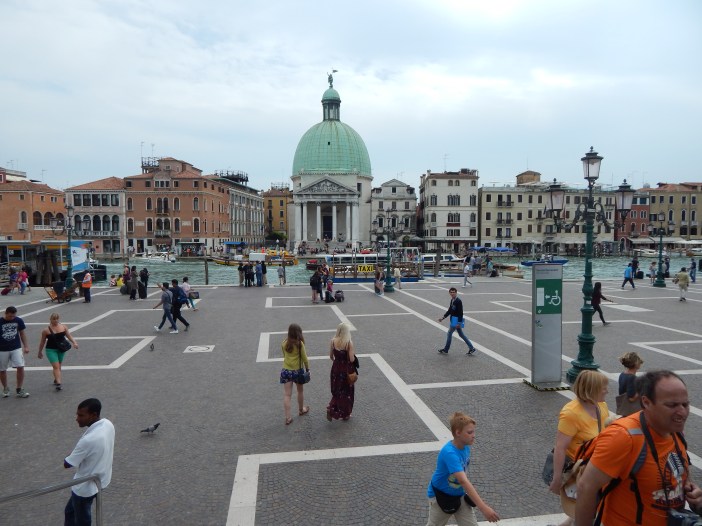
I love Venice. We spent a mere twenty-four hours there on our trip to Italy several years ago, taking the train from the magnificent station in Florence through the Italian countryside north and then across the lagoon to the Venetian station. I walked ahead of Paul through that Italian station, unable to wait to catch my first glimpse of the city from the top of the stairs rising from the piazza and vaporetto station on the Grand Canal.

DSCN6269

I was enchanted from that first glimpse.

I’d always wanted to visit Venice–ever since reading Daphne du Maurier’s brilliant story “Don’t Look Now” and seeing the film version, which is incredible–and also Anne Rice’s Cry to Heaven. Seeing Venice, even if was only for twenty-four hours, was wonderful. We were also incredibly lucky because Venice wasn’t crowded; apparently that’s become a huge problem (goo.gl/ePMQjT). It was even a problem when Berendt was writing The City of Falling Angels.

The title comes from a sign Berendt saw one day while strolling around Venice, near an old church that was crumbling and in need of restoration: BEWARE OF FALLING ANGELS. Apparently, the statues of angels on the sides of the church and along the rooftop had become loose with the rotting of the masonry, and one had fallen, almost hitting a pedestrian. The book reminded me so much of Venice, and why the city had enchanted me during my all-too-brief visit. I want to write about Venice; I’ve been toying with a story for years, and as I am just now starting to write my Panzano story, maybe I will soon write the Venice story.

Anyway, Berendt is best-known, of course, for his book about Savannah: Midnight in the Garden of Good and Evil, which I read decades ago when it was new. I enjoyed it; it was an examination of the quirks and curiosities of the city, built around the lens of a murder committed by a member of Savannah society. The City of Falling Angels is the same type of book, only viewed around the lens, not of a murder, but the burning of the Fenice Opera House. It did turn out to be a crime; two men were convicted of arson, but Berendt uses the fire, the investigations, and the subsequent trial, to view Venice; and along the way he takes a look at the quirks, eccentricities, and curiosities of a place that, like Savannah, is quaint and historic and beautiful–yet also very small. A lot of the things he talks about in the book–the concerns of locals that Venice is no longer for the Venetians, that the city is losing its neighborhoods to tourism; that poorer and middle class Venetians are being pushed out in the name of tourism–are concerns that we locals now have about New Orleans, so that made the book even more interesting to me. When we were there, we stayed overnight at a wonderful little family run hotel just off the Rialto Bridge and on one of the side canals; the Hotel San Salvador. We, too, had a lengthy conversation with two of the young women working there–members of the ownership family–who told us the same thing: Venice is no longer for the Venetians. Their family can no longer afford to live in the city, despite owning a hotel there; they live on the mainland and commute into the city. Most of the city’s apartments are being bought up by foreigners who then rent them out to visitors, so it is also affecting business for establishments like the Hotel San Salvador. I loved the hotel, it was charming and quaint and cozy; I loved the second floor lounge overlooking the canal below, and the family who owned and operated it were so nice, friendly, and charming. If and when we return, we will undoubtedly stay there again.

I’ve met John Berendt exactly once; he was very nice, and I liked him. I like his books, too. My character, Jerry Channing, who appears in both The Orion Mask and Garden District Gothic, and whom I’ve considered spinning off into his own series, is based on him only in that he writes the same kinds of books and articles Berendt does; kind of a cross between Berendt and Dominick Dunne. (I still might spin Jerry off; a lot of my short stories, which have first-person narrators who are never identified, are told in what I imagine Jerry’s voice to be) In fact, Jerry’s biggest success is a book called Garden District Gothic (very meta of me), which is about the quirks and curiosities and eccentricities of New Orleans, viewed through the lens of a society murder in the Garden District. The Scotty novel that bears the same title is an investigation into that case twenty-five years later, in fact (again, very meta of me).

16903185_10210905674210634_792277906514866377_o

Anyway,  I highly recommend The City of Falling Angels. I think I enjoyed it a lot more because I’d been to Venice, but it definitely made me want to go back. It’s very well-written, and a lot of fun to read.

And now back to the spice mines.