Sunday morning, I am up early, and it’s 35 degrees here. No snow here that I am aware of, but some places along the Gulf Coast did get snow, like Gulf Shores, Alabama. This morning is the best I’ve felt in the morning this entire weekend, and I think after yesterday’s low-energy-didn’t-even-unload-the-dishwasher day, it’ll be nice to get things done this morning and have a nice day. I did run those errands yesterday, so I don’t have to leave the house today (tomorrow may be a different story); and it’s warm and cozy inside this morning, too, which is marvelous–can some time in my easy chair with a book and a blanket be in my future? Absolutely! I am also going to shave and get thoroughly cleaned up this morning, too. AMBITIOUS, right? Getting up early and feeling genuinely rested is a lovely feeling, I must say.
We finished Run Away last night, which was fun and interesting and went into an entirely different path than I expected from the beginning. We then moved on to the new Agatha Christie adaptation, Seven Dials, which is based on one of my favorite Agatha Christies, The Seven Dials Mystery. I’ve always been an odd Christie fan; I started reading her when I was about ten or eleven, and spent most of my teens reading the entire Christie canon. While I did enjoy her more famous and iconic novels, my favorites of hers have always been lesser-known, and are probably considered her weaker ones. My absolute favorite is Endless Night, followed by The Secret of Chimneys, Death Comes as the End, N or M?, and The Pale Horse, among others. I really liked the character of Bundle (Lady Eileen Brent), and she is quite fun in this adaptation as well. We watched the first two episodes last night, and there is one more to go today. I suppose we’ll watch Stranger Things next, as completists, but there’s a lot of good shows to watch at the current moment, a tough problem to have.
As I mentioned, yesterday wound up being a low energy day. I didn’t run all the errands I needed to, cutting some things out because I was tired and didn’t want to push my luck. I did make groceries at Rouses and the Fresh Market, but after bringing everything in I was pretty wiped for the rest of the day, and my brain couldn’t really focus enough to read, so it was back to documentaries for me in the afternoon while Sparky napped in my lap. I did clean up and organize some computer files–an endless task indeed–which I will probably do more of today. The apartment isn’t neat and orderly, but it’s getting there. Today may also be a “prune the books” kind of day, too. I definitely need to empty the dishwasher and take the recycling out, for sure, and get the rugs back in order. It’s weird to have tomorrow of as well, but…there are worse things. I took Wednesday off for a funeral, too, so this is going to be a very strange week for me. Normality will return next week, but then it’s Carnival.
Sigh.
I’m really getting used to–and spoiled–by all this time off from work.
Despite the temperature, it’s beautiful and sunny outside today, with a blue sky and no clouds to be seen anywhere. I just saw that it also snowed in Pensacola, which is wild…Pensacola being about two hours or so from New Orleans east on I-10. Snow below I-10 is kind of crazy; I always joke that I moved south of I-10 specifically to avoid cold weather. I definitely need to write a Scotty set during the blizzard last year…I’ve decided to jump ahead with the series rather than trying to keep the books in a continuous timeframe, realizing at the way things are going in a couple of years the books would be considered historical fiction if I kept on the way I was, so I am going to skip ahead and recap in the intro to the next one. I can also go back and write more that are out of order, if need be; other series have done that, too.
And on that note, I am going to get another cup of coffee and read for a bit. Have a lovely Sunday, Constant Reader, and I’ll be back tomorrow morning.
SMFS Official Announcement: 2025 Derringer Award Finalists
Since 1998, the Short Mystery Fiction Society has awarded the annual Derringers—named after the popular pocket pistol—to outstanding published stories. The awards recognize outstanding stories published during 2024. Results of membership voting are scheduled to be posted on May 1, 2025.
The full listing of our nominees and the markets that published the finalist stories has been compiled and supplied by Derringer Coordinator Paula Messina.
Oddly enough, the second Chanse was the fourth novel I published, and therein lies a tale.
Funny how with these earlier books there’s always a story, isn’t it?
So, I sold Murder in the Rue Dauphine to Alyson in September of 1999–but the pub date wasn’t until February 2002. I saw no point in writing a sequel to the book immediately; primarily because there was a nearly two and a half year wait between signing the contract and when they were able to schedule me in. So, I figured I had about a year and a half before I needed to get it finished (everyone told me it would be released a year after the first, and in all honesty, what was the point of writing two or three books while waiting for the first to come out so the others could be scheduled?), and so, with time to spare and a lengthy period of time to “waste”, I decided to start thinking about the “what ifs”–what if the book sells super-well and is popular? What if this isn’t just a one-off standalone and could be turned into a series? The more I thought about it, the more I liked the idea and I liked letting my mind roam.
So, what would I do if the series took off and I needed to write more?
Being creative and full of energy in my late thirties, and thrilled to death that now I wouldn’t die without having published a novel, I reread the manuscript and my analysis of who Chanse was and why he was who he was, and I started mapping out a personal journey for him, that lasted several books. He was a cynical loner, with a couple of friends, and he was still really not adjusted to being gay when the first book opens. He was estranged from his immediate family of younger sister and brother and his parents; he never returned to Cottonwood Wells after leaving for LSU. He’s ashamed of his family but he also knows they will never accept his sexuality, either, so it’s very easy for him to cut them off almost entirely. So, his journey was going to be like that of the main characters of the show Moonlighting; each case would teach himself something about life and himself, and he would grow from the lesson learned in each book. Each book going forward would have a life lesson for him (Rue Dauphine did as well; the lesson was ‘you can’t just trust someone automatically because they’re queer.’); and the one he’d learn in the second book would be about love and trust (the third would be about sacrifice, the fourth would deal with his family, the fifth would have him fall in love with someone else, the sixth would deal with him dealing with losing his best friend to her husband and realizing he does need other people, and the seventh, the swan song for the story, would find him ready to finally commit to someone and live with them, so the series would be seven books long).
Shortly after I sold the first book, I again learned that lesson myself–the case in the first book was inspired by a gay con artist who’d gotten involved with a non-profit here in the city and then blew out of town overnight, having stolen/embezzled a shit ton of money and leaving a pile of debts behind. I had written to a local color magazine for the gay community (I can’t remember the name!) about writing for them. I wrote something for them, and they hired me to be editor of the magazine, as the business was expanding and it would free up the founder to focus on the new directions while I ran the magazine. It was fun, I got to work with a lot of fun new friends, and…then it all blew up in our faces. It was very similar to the earlier situation–a gay con artist blows into town, makes a lot of promises, runs up a lot of debt and then it just blew up completely. Turns out the guy was a con artist with a record of credit card fraud, and he was on the FBI watchlist so yes, I did get interviewed several times by the local office of the FBI.
The second book, which had the working title Murder in the Rue Royal, was based on that story, but I had already been playing around with a stalker storyline, and then I realized how I could cross the two stories into one seamlessly and write the book. I managed to get another first draft finished when a two-book deal to write the Scotty series for Kensington and Alyson dropped the option for the second book, saying “two mystery series with a gay main character in the same city by the same author are too similar to each other”–which I took as a challenge to make Bourbon Street Blues and Scotty as different as I possibly could to prove them wrong. So, the manuscript went into a drawer and I started happily working on Scotty instead…and again, it was a stand-alone that morphed into a series.
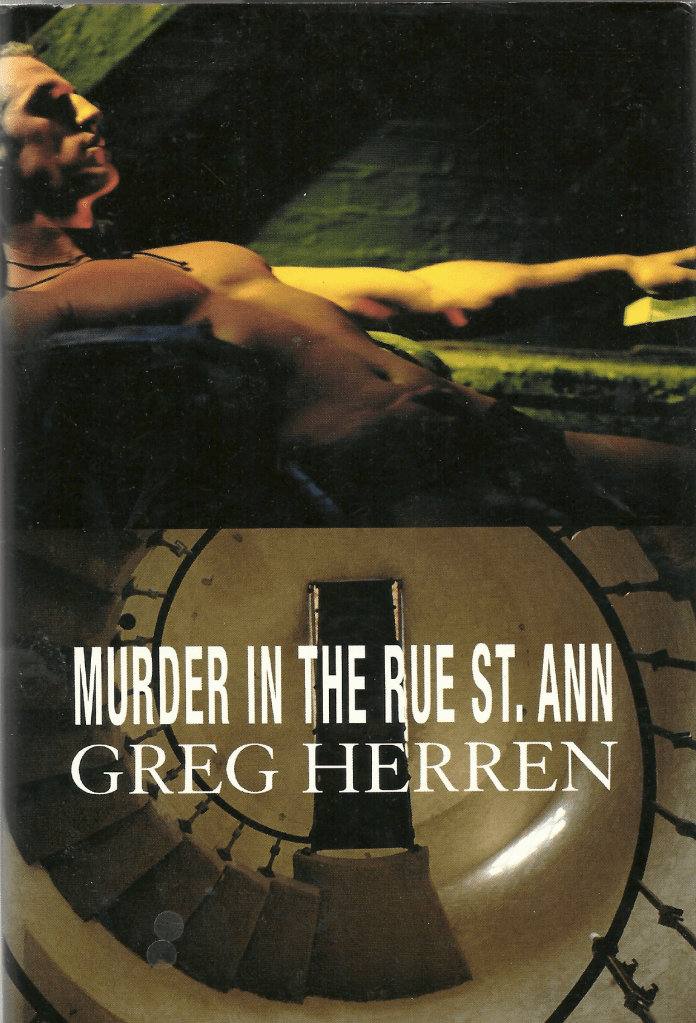
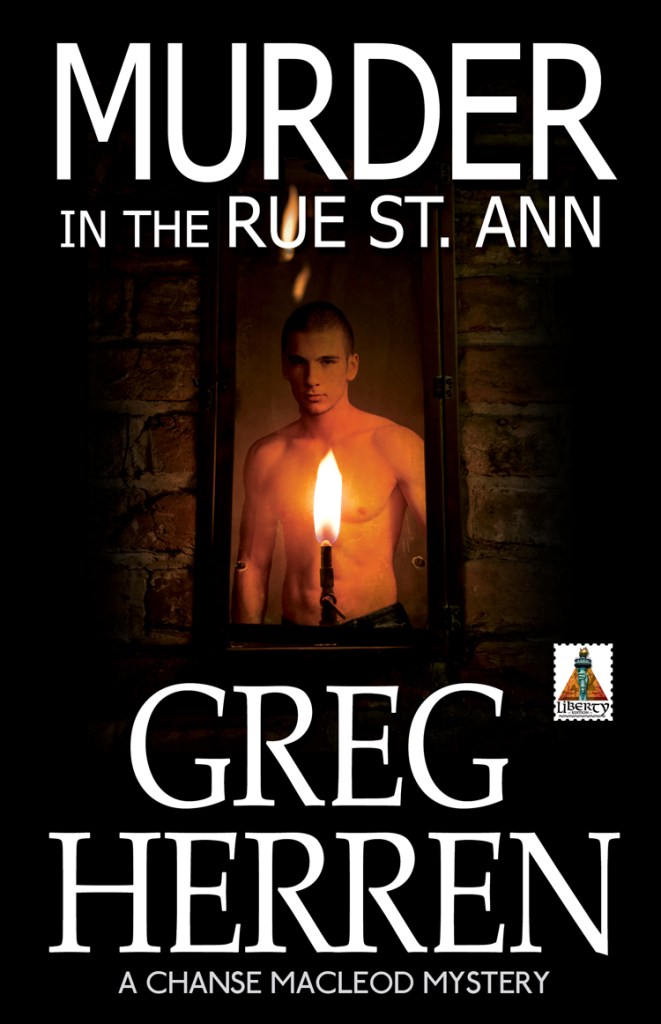
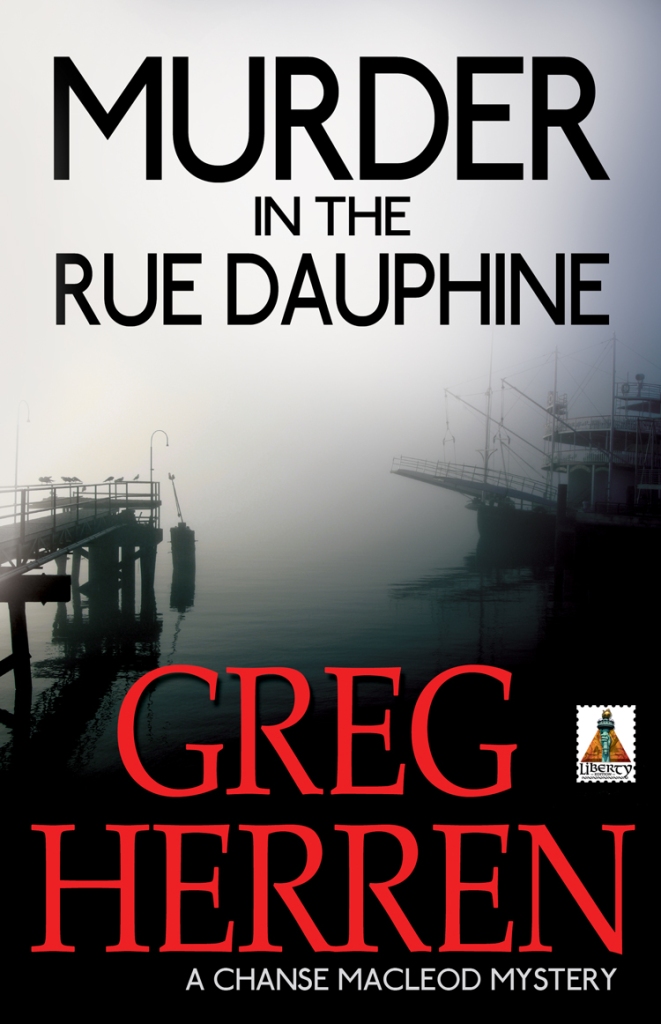
This was the Insightoutbooks edition cover of Murder in the Rue St. AnnThis is the new cover the book got when Bild Strokes Books republished the book as an ebook.
I took a streetcar named St. Charles down to Canal, crossed the street and walked down to Royal.
It was eleven o’clock in the morning on one of those splendidly sunny September days that makes you glad to be alive. Taking the streetcar had been a good idea. The long heat of summer had broken, and the air was crisp and in the mid-seventies. The sky was that blue unique to New Orleans, with wispy white clouds scattered across its expanse. There was just a hint of cool moisture in the air. There were a lot of people milling around the sidewalks on Canal— a good sign for the tourist season. Canal used to be the main shopping drag of the city, with huge department stores like Maison Blanche and D. H. Holmes. Those were long gone. They had either gone out of business or fled to the suburbs— now it was mostly hotels, fast food, and Foot Lockers.
There were hopes that putting the Canal streetcar line back in place would stimulate a recovery for the street. So far, all the construction work had simply made the Quarter difficult to get to from uptown. Add to that the chore of trying to find a place to park that would get me a ticket in two hours or cost ten dollars, and I was kind of glad I was having car trouble—the streetcar down and a cab home was very simple.
Not that riding the streetcar didn’t bring its own set of aggravations. If the cars ran on any fixed schedule, I’d never been able to figure it out. You could wait for one for half an hour and then three in a row, all packed to the gills, would show up. The streetcar ostensibly operated as public transportation, but was also a de rigeur tourist attraction. There was no way of telling when you’d be able to catch one with a place to sit. But when you did, it was nice to find a window seat on a sunny day and enjoy the city clacking by.
So, when Alyson chose to drop the Chanse series after I signed with Kensington, Murder in the Rue Royal went back into a drawer, which was fine–it wasn’t a good book–and I moved on with my life. The advance for signing with Kensington paid for our move back to New Orleans from Washington, and moving back here was absolutely worth ending the Chanse series for, seriously. I still didn’t have an agent, but I’d been signed to book contracts by two publishers already, and I figured it might be easier now. We accomplished the move, get our new apartment set up on Sophie B. Wright Place, and started putting our lives back together. I don’t remember the timeline of how it came to be, but I was still working with Alyson on my first and second erotic anthologies (Full Body Contact and FRATSEX), so I was aware when my editor left and a new person, that I knew slightly, moved from assistant editor to senior editor. We were talking on the phone one day about Full Body Contact and she casually mentioned, “I don’t see your second Chanse book here on the schedule, what’s going on?” and I told her the story, “Oh for fuck’s sake, when can you get it done by?” and that became the second contract for Chanse.
So, after finished Jackson Square Jazz and turning it in, I broke out Murder in the Rue Royal (the title had already been changed on the contract to Murder in the Rue St. Ann; my new editor didn’t like the alliteration) from the drawer, blew the dust off it, and reread the manuscript. I looked at my timeline for the series, and saw that this was the one where he was supposed to fuck up his relationship, but I didn’t see it in the manuscript. I reread the first book, thought long and hard about Chanse and who he was at this point in his life and after several long days of musing it hit me, between the eyes: jealousy. Jealousy would be what fucks up his relationship, and it only made more sense to me that Chanse would be the jealous one. Paul had a loving, accepting family and was more secure in and of himself as a gay man and what he wanted out of life. Paul was considering becoming ground-based at the New Orleans airport so he could settle down and have more of a life with Chanse, which also has Chanse very alarmed and makes the jealousy even more intense….so what would be the thing that would set Chanse’s jealousy off? Something from Paul’s past that Chanse didn’t know but finds out about in the worst possible way?
I had had some issues, believe it or not, with stalkers over the years. I had always wanted to write about a stalker, so what if Paul had a stalker? Why would Paul have a stalker? And then it occurred to me that Paul had a past he wasn’t ashamed of, but had never mentioned to Chanse. Not out of a fear that Chanse wouldn’t understand, but mainly because he had no need to tell him because it wasn’t anything dark. He had done some nude modeling when he was younger and he had also done some soft-core wrestling fetish porn, which is where the stalker came from. And what if I could work the con man he’s been hired by was someone Paul knew from the soft-core fetish porn? What if the guy contacted Paul because he’d been getting threatening notes on top of everything else going on in his life? And what if Chanse ran into Paul when he was leaving the con man’s offices, which brings all this out about Paul’s past? What if it shook a jealous, possessive, insecure Chanse enough for them to fight about it? And what if Paul disappears after the con man is murdered?
That was something I could work with, and so I did.
I’ve always called Murder in the Rue St. Ann my most under-appreciated work. By the time the book had come out, Paul had lost his eye to the muggers and we were in recovery mode. I didn’t do much of anything to promote the book (other than a signing at Outwrite in Atlanta, where I signed all of my books until they closed), and it kind of came and went quickly. I felt it was the most unappreciated of all my books. Jackson Square Jazz had come out earlier in the year before Paul was attacked, and it sucked all the oxygen up that year intended for me–it was the Lambda nominee, not Rue St. Ann–and I didn’t pay much attention to the book after it came out, either. The ‘christians” came for me a few months after the book’s release as well, and then Katrina…so yeah, Rue St. Ann got no press, got no attention, but somehow still managed to sell well.
I did have the next one planned, Murder in the Rue St. Claude, which there was a proposal in for, but Alyson was also going through other, deeply concerning changes that showed how little the higher-ups knew about anything, let alone publishing. But that’s a tale for another time, I think.
It’s always weird for me to talk about my writing and my books and so forth on here; I always worry that I am either contradicting and/or repeating myself. When you’re as self-obsessed as I am, that can be a problem; talking about myself is probably my favorite thing to do–on here, at least. And I feel like I’ve told the story of where Chanse came from and how the series developed from the very beginning many, many times.
It was when I was living in Houston that I rediscovered crime fiction, and the old love was even deeper once it was rediscovered. This was the period when I read most of the Perry Mason novels, discovered Paretsky and Grafton and Muller, and decided to give Travis McGee and John D. MacDonald another try. (I had read The Dreadful Lemon Sky when I was a teenager, but I hadn’t liked it; I was more into the classic detective mystery, with lots of suspects and a denouement with everyone gathered in a drawing room as the identity of the killer was unveiled–the McGee series was definitely not that. But MacDonald had written a superb introduction to Stephen King’s first short story collection, Night Shift, and I had always wanted to give him another chance–pun fully intended.) I devoured the McGee series this time around; and I really admired the character and how fully rounded and developed he was (I should give the series a reread; I’d be curious to see how they hold up now)…and armed with all these new private eye novels and Perry Mason puzzles, so I started coming up with my own version. Even the name was a shout out to McGee. My character was also tall with sandy/dirty blond hair, a former college football player, and he lived in Houston, with an office downtown and a secretary named Clara. The title of the first book was going to be The Body in the Bayou, and I started basing the case on the tragic Joan Robinson Hill case, immortalized in Tommy Thompson’s Blood and Money (the premise of the story was that the character representing Joan’s father hires Chanse after Joan’s death to find dirt on John–and then John is murdered; fictionalized, of course.) I wrote about six or seven really bad chapters long hand before giving up. I didn’t know how to write a novel then nor did I understand the concept of rewrites and revisions and drafts. (My ignorance was truly astounding.) The hurdle I couldn’t clear was typing. I was a terrible typist. I’d had a job in California working for an insurance brokerage that was computerized, and had a word processing program that I used to write short stories on; it made such an incredible difference that I knew I would have a much better shot at actually making my dreams come true if I only had a word processor…
In 1991, after I moved to Tampa, I managed to get a word processor, and that was what I wrote my first two and a half young adult novels on–the original drafts of Sara, Sorceress, and Sleeping Angel–and used it happily for several years until it finally died on me. But by then, I was living with Paul and had swung back around to wanting to write adult crime fiction again, and I wanted to write the Chanse character that I’d already created…so I picked back up on The Body in the Bayou, moved it from Houston to New Orleans, got rid of the office and the secretary, and made Chanse gay. I kept the title, but threw away the story; I wanted it to be a gay story, too. I don’t really remember the plot, but it had to do with the murder of a beautiful boy-toy for a wealthy closeted gay man in New Orleans…and Chanse knew the boy-toy from his days working as an escort before he landed the rich man, I wrote about six or seven chapters of this before we moved to New Orleans….and I realized I’d have to throw it all out again because it was all wrong; I’d made the classic mistake so many writers make when writing about New Orleans: writing about it having never lived here, I only had tourist experiences–which are vastly and dramatically different from the actually “living here” experiences. So, once again, I threw it all out and started over, this time calling it Tricks instead of The Body in the Bayou.
The title morphed again to the less saleable Faggots Die after the first draft; and I remember talking to Felice Picano–he was coming into town for the Tennessee Williams Festival, and I picked him up at the airport. As we drove back into the city from Kenner, we talked about my book and the series, and he nixed the new title as well as the old one. “No one, ” he wisely said, “will pick up a book called Faggots Die, and Tricks sounds like a pornographic memoir of your sex life.” Felice was actually the one who suggested I mimic titles for the series from a classic writer…and we were throwing titles around in the car when I said, “You know, the streets in the Quarter are technically rues–Rue Bourbon, Rue Royale, Rue Dumaine–and the murder happens on Dauphine. Maybe Murder in the Rue Dauphine?”
“That’s perfect,” Felice said, and then we played with Poe titles the rest of the way into the city–incidentally, one of them was The Purloined Rentboy, which became my short story “The Affair of the Purloined Rentboy”, so never throw anything away.
And thus was Murder in the Rue Dauphine titled; and the plan for the series titles was also devised–the branding was changed by the publisher, but I can honestly say my first book was titled by Felice Picano.
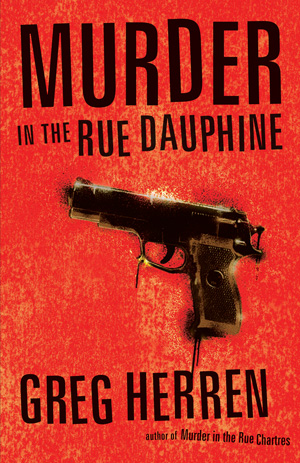
Murder in the Rue Dauhoine has had three covers in its 21 years of existence. This center one is the current.
Never come to New Orleans in the summer. It’s hot. It’s humid. It’s sticky. It’s damp. It’s hot. Air conditioners blow on high. Ceiling fans rotate. Nothing helps. The air is thick as syrup. Sweat becomes a given. No antiperspirant works. Aerosols, sticks, powders, and creams all fail. The thick air just hangs there, brooding. The sun shows no mercy. The vegetation grows out of control. Everything’s wet. The buildings perspire. Even a simple task becomes a chore. Taking the garbage out becomes an ordeal. The heat makes the garbage rot faster. The city starts to smell sour. The locals try to mask the smell of sweat with more perfume. Hair spray sales go up. Women turn their hair into lacquered helmets that start to sag after an hour or so.
Even the flies get lazy.
My sinuses were giving me fits as I left the airport and headed into the city. It was only 7 o’clock in the morning but already hotter than hell. The air was thick. I reached for the box of tissue under my seat and blew my nose. The pressure in my ears popped. Blessed relief.
As I drove alongside the runways I could see a Transco Airlines 737 taxiing into takeoff position. I saluted as I drove past, thinking it might be the flight that my current lover was working. Paul looked good in the uniform. It takes a great body to look sexy in polyester. He does.
He’d be gone for four days on this trip. I was at loose ends. I’d wrapped up a security job for Crown Enterprises the previous Wednesday. The big check that I’d banked guaranteed I wouldn’t have to worry about money for a while. I like when money’s not a concern.
And so began a series that lasted for seven titles and about twelve years or so; I don’t remember what year the last book in the series was published. I never expected anyone would publish it; it was intended to be a “practice novel” so I would get used to rejections and learn. It was also the first manuscript I ever wrote that went through multiple drafts before I thought it was finished enough to send out on query. It was supposed to be an exercise in learning humility and getting experience with the business while I wrote the book I did expect to get an agent with and sell–which was what I’d always called “the Kansas book” for over a decade at this point. (It eventually morphed into #shedeservedit.) But you never really learn what you’re supposed to when you’re stubborn, thin-skinned, and used to being demeaned and talked over and not taken seriously, for any number of reasons. I sent the manuscript to three agents: two sent me lovely but form rejections, which was disappointed but not surprising. I took this well, put the manuscripts away to send to three more once the final rejection came.
It came on a Friday, if I recall correctly. I went to pick-up the mail and my manuscript was there. Not a surprise, of course, but still a little disappointing. I went out to my car and opened the package…and paper-clipped to the title page of the rubber-band bound manuscript was a torn piece of used paper, with a note in ink reading I find this manuscriptand characters neither interesting or compelling with the agent’s initials at the bottom.
It was like being slapped in the face.
By the time I got home I was in a raging fury. I was literally shaking with rage when I came inside. How fucking unprofessional, I thought as I sat down at my computer to check my emails, trying to decide how I would enact my vengeance on this rude piece of shit.1 There was an email there from the editor I was working with on an anthology which had taken my first-ever fiction short story and thus would be my first publication. I had never read the signature line–mainly because I was so excited for my first fiction sale (NARRATOR VOICE: it was porn). This day, he concluded his email with Please send us more work. We definitely want to see more from you and as my ego preened, slightly soothed from the insulting agent note from earlier in the day2, I also looked down at the signature line and realized I was communicating with the senior editor at Alyson Books! I immediately wrote him back a very short note: I’ve written a novel with a gay private eye set in New Orleans, would you be interested in that? and before I could talk myself out of it, hit send.
He wrote back immediately and said please send it to me ASAP!
I put the same manuscript back in a new envelope, and drove back to the postal service to get it in the mail before I changed my mind, and breathed a sigh of relief once I got back to the car–and immediately forgot all about it.
Six weeks later I came home to a phone message from the editor. I called him back, he made me an offer, and my career leapt forward much faster than I expected…and it started a roll of good luck and “being in the right place at the right time” that has kept me publishing almost non-stop since Murder in the Rue Dauphine was released in 2002.
It sold really well, got mostly favorable reviews, and scored me my first Lambda Literary Award nomination.
Not bad for a manuscript and characters who were neither interesting or compelling, right?3
It also took me a long time to realize–or rationalize–that the note wasn’t meant for me. (I was most offended that I wasn’t even worthy of an actual form rejection letter; that was the truly insulting part for me.) I realized when telling this story on a panel somewhere, that the note was probably meant for an intern or a secretary or an assistant, who just shoved the whole thing in an envelope to do the rejection and through some wild Lucy-and-Ethel office shenanigans, it went out without the rejection letter and with the note intended for internal eyes only…and made me wonder, how different would my career and life be had that fuck-up not happened?
We’ll never know, I guess.
Not really proud of this reaction, but I did get the last laugh. ↩︎
Said agent died a few years later. I may have smiled and said good, a la Bette Davis vis a vis Joan Crawford’s death. ↩︎
I may be more forgiving about a lot of things these days, but I will always be petty about that hateful agent. ↩︎
I was Executive Vice President of Mystery Writers of America for three years (2020-2022), and it isn’t something I talk about much. I never wanted to be seen as using this volunteer position (which basically was chairman of the board) to promote myself or my career, which is why I never really talked about it much other than referring to it here as “my volunteer work.” It was exhausting, exhilarating, and frustrating at the same time. I dealt with a lot of firsts–first EVP to cancel the Edgar banquet, first EVP who had a Grand Master die on him before the Edgar presentation, on and on and on–but one thing I am really proud of that I accomplished in the role was the creation of the Lillian Jackson Braun Award, facilitated by two board members. Cozies are often overlooked when it comes to awards–they are the romance novels of the crime fiction community, looked down on, mocked, and not taken seriously–and I’ve experienced crime writers talking smack about cozies from even before I was published. The establishment of this award was a first step, I felt, for MWA to appreciate and uplift this subgenre so that it’s taken more seriously.
I had always wanted to write one, and that became A Streetcar Named Murder. I’ve also been reading more of them, too, since I realized I had allowed the opinion of others to influence my reading habits. I’ve long enjoyed Donna Andrews’ and Ellen Hart’s series, and there are so many terrific cozy writers out there…Ellen Byron, Sherry Harris, Katherine Hall Page, Leslie Budewitz; the list could go on forever, really.
So I’d been meaning to get around to the first Lillian Jackson Braun winner, presented earlier this year–and what a pleasant surprise Buried in a Good Book by Tamara Berry turned out to be.
“There are at least three dead bodies in there.”
Tess Harrow stood in front of the log cabin, mentally calculating where each of the corpses would be found. The basement would have one of them. She could see damp seeping up from the underground barracks, the stonework crumbling with neglect. It would be a crime not to store a body there. The lean-to on one side of the cabin, which was living up to its name and looked one strong breeze away from toppling over, was ideal for another. The chimney was large enough for someone small, and…
“Four. Four dead bodies.”
She nodded once and hefted her suitcase. There would be an additional corpse under the porch–she was sure of it. The rotted wood and craggy slates made the perfect cover for one final interment.
“You are so weird,” muttered Gertrude. Tess’ s teenaged daughter didn’t bother lifting her own suitcase, opting instead to dragit on the ground. The bump of the bag matched the slump of her shoulders. The prospect of sharing her home with a few corpses wasn’t doing much to improve a mood that had been questionable to begin with. “Please tell me we at least have Wi-fi out here.”
At first, I wasn’t sure what was going on in this opening sequence, and Berry draws this out a little bit, as we slowly are introduced to bestselling thriller writer Tess Harrow and her teenaged daughter, Gertrude (Gertie). Tess and Gertie’s father divorced some six months before the start of the book, and he’s pretty much ignored her since leaving Tess for a younger woman. Tess, behind on her latest book–she hasn’t started it–decided to remove herself and her daughter from Seattle and come out to stay at her grandfather’s extremely rural cabin–no power, running water, or wi-fi–so she can focus on finishing her book and get Gertie away from the Internet so she won’t know her dad isn’t reaching out to her. Within moments of their arrival, they head down to the pond on the property just as the water explodes and it starts raining fish–and body parts. A dead body had been in the pond, and the “blast fishing” not only killed the fish but dredged up the corpse. Soon we meet the local sheriff–a dead ringer for Tess’s police detective, and she starts plotting her new book by basing it on what is happening around her.
This is an wickedly clever concept: Tess isn’t investigating the murder, but trying to figure out how to plot her book since it’s based on the criminal investigation going on around her. These are some of the most amusing parts of the book–as Tess tries to change the crime so it’s not obvious she is basing it on a true crime, and changing characters and relationships around so they don’t bear too close a resemblance to the real thing, but she keeps stumbling on clues–and the police detective is getting awfully tired of her bizarre theories and interruptions. Berry makes this even funnier, by having the cop actually be one of her readers, and constantly telling her how she gets things wrong in her books. There are a lot of weird things going on up on these woods–and every element, no matter how disparate, ties in to the mystery–a flock of toucans, an eccentric’s missing cat, Bigfoot sightings, and a town full of suspects, including identical triplets (I did this in a book too!)–and there were several points where I had no idea how this was all going to play out and work out, but I was also having an incredibly good time reading it. It’s funny, and I really like the characters of Tess and Gertie, as well as their supporting cast.
I do, and while they may not make up the majority of my reading pile, it’s always a joy to find a new cozy series I enjoy. One of my favorite mysteries of all time, James Anderson’s The Affair of the Blood-Stained Egg Cosy, is definitely a cozy mystery–a house party murder, with secret passages and international espionage and a jewel thief–and is LONG overdue for a prestige mini-series, preferably by either Acorn or Britbox. (I should reread that book; it’s been a hot minute) I don’t think cozies and their writers are given the respect they deserve, ever–rarely do you see a cozy on a Best of the Year list or making the short-list for awards (besides the Agathas), and I’ve heard crime writers slag off the sub-genre, way more times than I would prefer. Anyone who thinks a cozy is lesser or somehow “easier” to write than any other kind of crime novel is more than welcome to give writing one a try. It’s always amusing to me to see the hypocrisy of crime writers whining that literary writers don’t take them seriously…and then in their next breath go on to mock cozy writers. (I did have a wonderful “gotcha” moment with a straight white male mystery writer once; he was complaining about how crime fiction isn’t considered literature, and later on in the same conversation he made a snide remark about cozy writers…and boy did he stumble for words when I replied, “So when lit writers treat you like a cozy writer you don’t like it?” He won’t talk smack about cozies in MY presence again…)
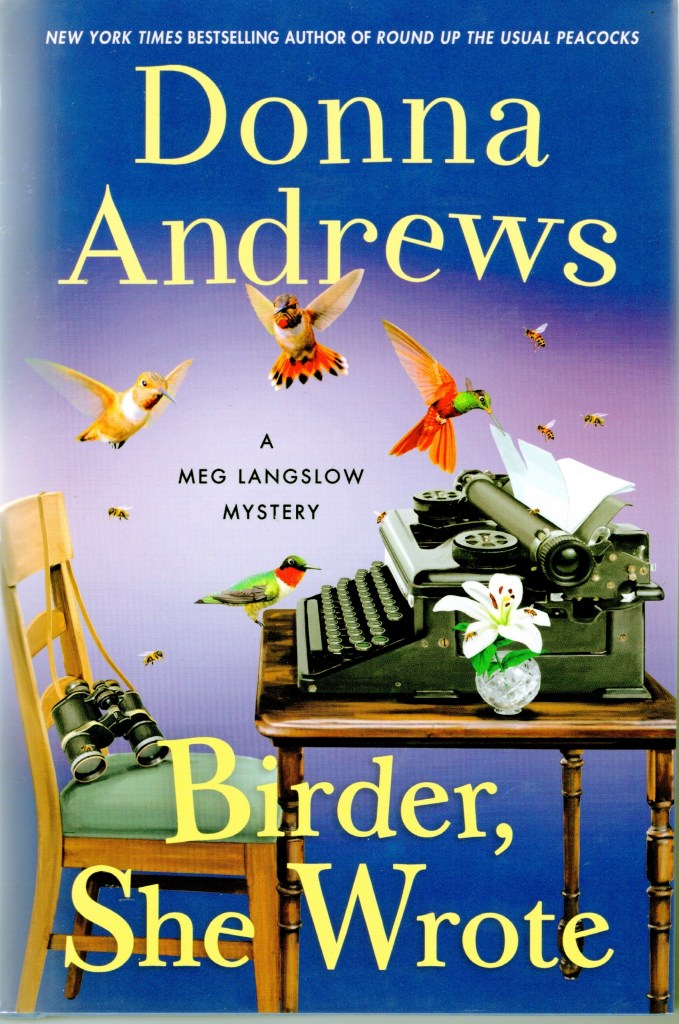
Anyway, I digress. One of my favorite series of all time is the Meg Langslow series by Donna Andrews, and we are on book thirty-three now, with thirty-four on my chair sidetable, halfway finished reading, and Book 35 available for preorder already.
That is a pretty impressive track record, and career. If I wrote a Scotty per year from now on, it would take me until I am eighty-eight to get to book 35. YIKES.
“This is the life,” I said, as I wriggled into an even more comfortable position in the hammock.
I wasn’ttalking to anyone in particular. As far as I knew, there was no one within earshot. But just in case there was, I was going to do my best to look–and sound–like someone who was deeply contented and should not be disturbed for anything short of an actual emergency. Although the people most apt to – me were safely occupied elsewhere–Michael, my husband, was teaching his Friday classes at Caerphilly College, and my twin sons, Jamie and Josh, were at school until three.
My-notebook-that-tells-me-when-to-breathe, as I called my comprehensive to-do list and calendar, was nearby, but I’d already checked, and nothing in its pages had to be done right now. For the next hour I was on hammock time. I could read. I could put on my headphones and listen to some music. Or I could just lie here and enjoy the balmy May weather, the masses of blooms in our flower beds, and the fascinating aerial ballet of hummingbirds darting to and from the nearby feeder.
The hummingbirds. I sat up with a frown. The last time I’d found the time to watch them, there had been half a doxen of them, impossibly small, their iridescent jewel-toned bodies sparking in the sunshine as they paused, sipped, and darted away. Now there was onlyone, flitting around the feeder. And he didn’t seem to be feeding–just darting about.
And that title is a gem.
The entire series has bird-puns for titles, which is amazingly hard to do, and if you don’t think so–try coming up with thirty-three bird pun titles for crime novels without looking at Donna’s backlist. I suggested one to her many years ago that I keep hoping she’ll use–but she hasn’t yet, and I despair my bird pun title will ever make it into her canon.
I do feel that I also should, in the interest of full disclosure, let you know that Donna Andrews is not only one of my favorite writers but one of my favorite people in this business. We first met years ago when we were both on the MWA board (she was on The Good, the Bad, and the Emus back then), and I found her to be intelligent, kind, charming and funny. That was when I started reading her, and what a joy this series has been for me all these years. Donna’s books, to me, are the perfect example of why this sub-genre (amateur sleuth, no blood or sex or violence–at least not much, and little to no swearing) is called “cozy”–because that’s how reading one of her books makes me feel, cozy. Honestly, there’s nothing better than curling in my easy chair with a blanket, a purring kitty in my lap, as I revisit my friends in Caerphilly again.
Because she writes so well it seems like a real place, one that I am happy to escape my life into twice a year.
I could talk about this series all day, I love it and the characters so much. Caerphilly reminds me a lot of Schitt’s Creek and Ted Lasso–ensemble casts in places where everyone is kind and looks out for one another, but also doesn’t interfere and lets you make and learn from your own mistakes. This time out, Donna has added a new McMansion style neighborhood to the town, Westlake, with people retiring from major cities to the “rustic” charms of Caerphilly–only to complain incessantly about those very rustic charms to begin with–and beekeeper Edgar is square in their sites, his hives just across a small stream from their backyards. Meg calls them the NIMBYs (not in my backyard), and I think we’ve all encountered these types (which is why dumps and toxic waste always ends up around poorer communities). Someone has poisoned all of Edgar’s bees–and Meg agrees to look into who could have done something so heinous. But while looking for an old African American cemetery, Meg and her friends not only find the cemetery deep in the woods, but they also find the dead body of one of the worst of the NIMBYs, and the game is afoot.
The sadness at finishing the book was derailed by knowing this year’s Christmas Meg murder mystery was already in my TBR pile, which I immediately started reading when I finished Birder She Wrote. Don’t be daunted by the massive backlist, either–if you’ve not read any of these books, you can start anywhere and then work your way through the series; there are never any spoilers other than those from Meg’s personal life–and frankly, I don’t mind those kinds of spoilers, because its fun to go back and see how she met her husband, when they got married, the twins, etc.
There’s nothing like paying the bills to ruin your day, is there?
Heavy heaving sigh. But there’s nothing else to be done about it, but it certainly is depressing to think about how much work went into earning that money only to see it disappear from sight so quickly. It’s disheartening, to say the least.
I had another short story rejected this week; not a big deal, really. I don’t take those kinds of things quite so personally any more; certainly not as hard as I used to. I do have a brief, momentary flash of why do I even bother, and then I get over it. I write stories that I want to write; ideas that I want to explore in story form. And while these stories certainly fit the definition of mystery as defined by the Mystery Writers of America (“fiction having to do with the commission of, the solving of, or the aftermath of a crime”), they aren’t really mystery stories. They’re crime stories, yes, but are more dark and about what can drive someone to commit a crime, or planning a crime, and so forth. This recently rejected story wasn’t even about a crime that had already happened; it was about the planning of one, and having to readjust the time-line because of an error made by one of the co-conspirators. I liked the idea, and I still like the story, but I am going to have to broaden my base of submissions to include places that aren’t necessarily are looking for a mystery story.
I do have a couple of stories still out there at major markets…markets that I basically consider to be brass rings; or, if you prefer a sports metaphor, I am swinging for the fences. I never get terribly disappointed when those hits wind up being caught in the outfield, or get thrown out at the plate. You have to try for the fences, you know, sometimes, but more often than not it’s just going to be a pop-fly right to an outfielder waiting with his glove.
It’s still disappointing, however–don’t get me wrong. You always hope.
A lot about this business is based in hope, really.
We are continuing to enjoy both Castle Rock and Sharp Objects, but the latter sometimes feels like it is being drawn out to make the series longer. But the acting is stellar, the writing is terrific, and the production values are pretty amazing. We will continue to watch.
And I started reading Eryk Pruitt’s What We Reckon, another Anthony finalist for Best Paperback Original. It’s his third novel, following Dirtbags and Hashtags. I’m not very far into it, but it’s got a really great noir feel to it that I suspect I am going to really enjoy.
And now, back to the spice mines. Have a lovely Friday, everyone!




 Queer and Loathing in America