Miss Americana and The Heartbreak Prince

One question that always exasperates authors is the old standard, where do you get your ideas from?

I get why it annoys writers to be asked this; who wants to be psycho-analyzed on a panel or at a reading? It’s a process, of course, and one that cannot be distilled into a quick, witty, quotable sound bite–and the ultimate truth is, it’s almost always different in every case–whether it’s a novel, an essay or a short story; I certainly have not gotten inspiration the same way every time. A lot of the Alabama fiction, for example, that I have written/am writing/have thought about writing, comes from stories my grandmother told me when I was a child about the past–mostly her family’s past, and certainly those stories were self-aggrandizing and self-serving, and still others were apocryphal: the ancestress, for example, who killed a Yankee soldier come to rob her during the Civil War? Yeah, that one was almost certainly lifted from Gone with the Wind–but I have since come to find out that Mitchell probably took the story from legends as well–that story seems to exist everywhere in local legend throughout the former Confederacy (I mention this in passing in Bury Me in Shadows, which also originated in one of my grandmother’s stories).

A while back, I started thinking about doing period novels centering gay male characters and telling their stories about the times when prim-and-proper society swept all things gay under the rug and homophobia was king (or Queen, I suppose). I had already come up with a great idea for a gay noir centered around a health club that operated as a money-laundering front for the local mob in a city in Florida called Muscles, which I hope to write at some point…I cannot recall exactly how or why Muscles led into thinking about other one-word titled gay noir novels set in different periods of the twentieth century; but there you have it. I think Muscles led me to think about setting one in a gay bar in the early 1990’s, built around the time gay porn star Joey Stefano was arrested while performing at a Tampa gay bar for public indecency; Indecency was such a great title that I couldn’t forget it–and I also figured I could link the two books, the way I always link my books together in an Easter eggy kind of way that the majority of people don’t notice but pleases me immensely. Right round that same time a gay man who was very active as a fundraiser and a donor for political causes died; he had started out owning a company that published gay-interest magazines with nude models and had been arrested, and served time, for using the mail to deliver pornography; I wanted to write about him and the rise of gay porn films in Southern California and call it Obscenity. So there it was: a trilogy of loosely connected gay noirs I hoped to write someday…and then one day, as I was blogging–I think maybe two years ago? I don’t recall–my mind was wandering (as it is wont to do) and I started riffing about an idea that was forming in my head as I wrote the entry for a book set in 1950’s Hollywood, dealing with the underground gay community, McCarthyism, and scandal-mongering that would open with a gay movie star’s body being found naked in the surf at the beach…only the autopsy found that the water in his lungs actually contained chlorine…so he hadn’t drowned, he’d been murdered and the body moved. I called it Chlorine; and that was, for me, kind of the end of it–I wrote the idea down, created a folder for it, and posted the entry.

So, I am sure you can imagine my surprise when I checked Twitter a few hours later and had a ridiculously high amount of–what do they call them? Mentions? Anyway, I had no idea what had triggered this–I rarely get much interaction there–and so when I went to check…some people had read my blog and were all about Chlorine–and the more they tweeted about it, the more people had gotten drawn into this conversation. I was thrilled, to say the least, to see so much attention on-line for something that was really just an amorphous idea…and then a great first line occurred to me: The earthquake woke me up at nine in the morning. So I opened a new Word document, typed in that line, and next thing you know, I had an over 3000 word first chapter written, and the entire plot was forming in my mind already. I took voluminous notes, and decided that, once I got finished with everything I was in the midst of writing already, I would give Chlorine a shot.

And in the meantime, I could start reading up on the period, gay Hollywood, and root myself firmly in the period.

Which is how I came across Robert Hofler’s The Man Who Invented Rock Hudson: The Pretty Boys and Dirty Deals of Henry Willson.

On November 29, 1954, The Hollywood Reporter’s gossip columnist Mike Connolly wrote about the proud, happiest day of Rock Hudson’s life. The movie star had just been cast in George Stevens’ cattle-and-oil epic Giant, and Connolly’s one-line blurb commemorating Rock’s celebration party was as cryptic as it was pumped with news ready to break: “Saturday Mo-somes: Phyllis Gates & Rock Hudson, Margaret Truman & Henry Willson.”

In one of his rare acts of discretion, newshound Connolly dispensed with the ampersand that should have wedded the names Rock Hudson and Henry Willson. Fifty years into the future, “Mo-somes” could be read as slang for the two men’s sexual orientation. But not in 1954. Back then, “Mo” meant something far less provocative but nearly as colorful

“Mo” was short for the Mocambo, the Mount Olympus of Sunset Strip nightclubs. Pure tinseltown fantasy, the Mocambo was an over-heated study in contrasts where oversized tin flowers and humongous velvet balls with fringe festooned flaming candy-cane columns that framed a dance floor designed to induce claustrophobia when more than two couples got up to fox-trot. The tables were equally miniscule, making it possible for the establishment to charge lots of money for not much food, which nobody could see. Overhead, rococo candelabras gave off so little illumination that revelers kept bumping into each other by mistake, and sometimes now, as they tried to check themselves out in the flecked mirrors that recast everybody’s reflection in tones of warm, flattering, fake gold.

I had a vague idea of who Henry Willson was before I read this book–he appeared in the Rock Hudson bio I read a few months ago as well as in Tab Hunter’s memoirs–and of course, Jim Parsons played him in the Ryan Murphy alternate-history Hollywood. I was also vaguely aware–my memory is a lot dimmer than it used to be–of the gay Hollywood underground; the Sunday afternoon pool parties at George Cukor’s, for example–and I had read some gay Hollywood histories (the ones by William J. Mann are particularly good), but I knew my main character in Chlorine needed a Henry Willson-like agent, and so I needed to research Henry Willson. Willson was, of course, notorious in his time and the passage of time since his heyday has done nothing to soften that image. He was the definitive “casting couch” agent–and per this book, which is very well written and very entertaining–men who wanted to be movie stars (whether gay, straight or bi) were more than willing to service Henry if it meant a leg up in the business. And Henry did work very hard for his clients, polishing rough material into diamonds for the camera. He taught them how to speak, how to walk, the proper silverware, how to behave in public; manners and etiquette. Henry believed that talent wasn’t as important to being a movie star as having star quality–the indescribable something that all major stars have, that is impossible to describe–and he knew what he was doing. He also frequently renamed them–hence the proliferation of the one syllable first names with the two or three syllable last names: Rock Hudson, Tab Hunter, Troy Donahue, Chad Everett, Guy Madison, etc.

This book provided a wealth of information as well as inspiration for me, as did the Rock Hudson biography I read several months ago. This period of Hollywood history is fascinating, and I love that writing this book–or rather, planning and researching, since I haven’t really started writing it–is giving me an amazing excuse to study gay Hollywood history and the post-war film industry.

Make no mistake about it–Henry Willson was good at what he did, but he was also a terrible person; trying to make it in a homophobic culture, society and industry at the time in which he lived would definitely twist a person. He was an arch-conservative; a Log Cabin Republican of his time, friends with the horrific Roy Cohn. Was it camouflage to help protect him and his clients from the Red Scare days of McCarthyism, when being queer was also just as suspect? Or was he really that terrible of a person? The author makes no judgments; rather leaving it to the reader to. make up their own minds about who Henry was as a person. As terrible as he was–and some of the things he did, like the casting couch, were pretty unforgivable–I did feel sorry for him in some ways, and in basing a character on him I kind of have to find the humanity in the monster. He was not attractive in a business that revolved around beauty; while the straight male pigs who ran the business used their power to force women to sleep with them, Henry used and abused his own power to get beautiful men to sleep with him.

My own main character–a second-tier movie star who slept his way into parts and a career–is also not entirely likable; but I think I’ve gotten deep enough inside of his head to at least make him identifiable and relatable to the reader…but I guess we will just have to wait and see.

I do recommend this book, if you’re interested in Hollywood history in general or gay Hollywood history specifically.

Shake It Off

Believe it or not, we have finally reached the last Monday of 2020.

As always, I have a lot of work to do, but I slept exceptionally well for a change and the bed was comfortable and felt so lovely I stayed in bed for another hour after I woke up initially; sue me. I have a gazillion things to do today, including going to the bank and making groceries as well as going to the gym at some point; I also have to work on the book today. The work went very well yesterday and I was enormously pleased with what I managed to get done yesterday. I have a mere five chapters left to revise and a final chapter yet to be written; all of which needs to be done by Friday, and I do feel like it can be done–especially since I don’t even need to leave the house on either Tuesday or Thursday. I am not certain if the gym is going to be open on Friday–I guess I can ask when I go there today; I do find it strange that they don’t post their holiday hours anywhere around the front desk or on the front door, but it’s also not “my” gym, so I guess they can run it however they please. I also have a gazillion emails to answer, which doesn’t sound in the least bit fun or interesting, but it has to be done.

I did, as I mentioned earlier, manage to get a lot done yesterday–and not just on the book. More cleaning and organizing was required–still have some more to do today at some point–as well as making new folders, both physical and virtual, and of course, this meant more filing. While it was busywork, it needed to be done, and I actually did the floors in the kitchen–well, the rugs anyway–which always makes the kitchen look ever-so-much better. I am going to do the rugs in the living room today at some point, and then over the rest of the week do the actual floors themselves–and yes, I am going to do the windows as well.

I intended to start reading the new Alison Gaylin–I am lucky to have a very advance copy of The Colleciive, available from your local independents and on-line this coming summer of 2021–but I got caught up in Czity of Nets, which is, of course, Chlorine research, and after reading through it (I went ahead and bought the ebook; I do believe I must have donated the hardcover after I finished reading it, as Chlorine had yet to occur to me at the time I read it) I thought about it some more and was like, dude, you’re going to be writing the Kansas book next–maybe you should do some more background on it…because truth be told, most of it is being written based on almost forty year old memories of Kansas, and that really won’t do, will it? So, I went into a Kansas internet wormhole for quite some time and actually got pretty far afield from what I was originally looking up–you know how one thing inevitably leads to another on-line–and soon I was looking up rivers and lakes and the small rural towns scattered around the nucleus of Emporia, which was the county seat of where I lived as a teenager–towns with names like Admire and Allen, Bushong and Cottonwood Falls, Council Grove and Neosho Rapids, Olpe and Hamilton and Reading and Hartford. I’ll probably also take another read of In Cold Blood while I work on this revision as well; few writers have captured Kansas quite the way Capote did in that book. I also started looking at history as well–the history of Bleeding Kansas and the Kansas-Nebraska Act, both of which were preludes to the Civil War. And as much as I am basing my fictional city of “Liberty Center” (shout out to Philip Roth and his When She Was Good) on Emporia, I also have to remember–just as how Bury Me in Shadows is a fictionalized version of the part of Alabama I come from–that I am fictionalizing the town; so I can make changes as needed and the fictionalization doesn’t have to be exact.

It’s so wild that the Kansas book is going to finally be finished and published–and all the different iterations it’s gone through over the course of my life. I actually started writing this book originally in high school–which is when I came up with the character names and places–and it was actually the very first manuscript I completed, by hand, in 1983 after writing it for about four years, continuing the stories I started writing about these characters in high school. This book will bear very little resemblance to any of those earlier iterations; over the years I’ve used the character names in other works, primarily my only other Kansas book, Sara–which I really need to reread to make sure I don’t re-use names I’ve already used. I think the ones I’ve used since high school were used in Sara, which I thought would be my one book about Kansas, so I threw all the character names and place names into it. I had wanted to connect this book in a way to Sara as well; since they are about the same part of Kansas, and I try to connect all of my work in some way, but I’ve never ever liked the name I came up with for the county seat, and now I’ve settled on Liberty Center….but I also tell myself that the two differently named counties can actually be next door neighbors, Liberty County can be right next to Kahola County, and thus Kahola High can be Liberty Center’s arch rival.

Looking into those small towns, some of them considered to be ghost towns now, also piqued my interest. I have several ideas about writing about Kansas–the Bloody Benders, of course, and I have a great title for a prairie noir called Kansas Lonesome I really want to write–and as I said, this book has been through many iterations. The great irony of finally publishing this–and finishing it, let’s be honest–still doesn’t mean I am writing the Kansas book I’ve always wanted to write; this book does focus on the murder of a high school football player, as the Kansas book I’ve been wanting to write since around 2002 did; but this is a vastly different story from what I originally wanted to write–and I still may write that book, centered around Kahola rather than Liberty Center; I’m not sure–and there’s also the cult college thing–the Way International and their Way College of Emporia, which isn’t there anymore; they closed the campus and sold the property to Emporia State University–and the Way has declined over the decades since they were large and wealthy enough to buy a bankrupt Presbyterian college in a small city in Kansas–but that’s a whole other story. There’s also the megachurch story I want to write about Kansas….which is also sort of tied into my original story of the quarterback’s murder. Who knew Kansas could be so inspirational?

But you see how I wind up wasting days….

And on that note, tis time to return to the spice mines. Those emails will not answer themselves, after all, and I’ve got a lot to get done today before the sun sets. Have a happy final Monday of 2020, Constant Reader!

22

One of the annual things about November that I enjoy watching–but don’t participate in–is Nanowrimo. Maybe I should participate, I don’t know. For many years I never needed to–I wrote the 95k first draft of the Kansas book in thirty days–but as bad as I have been lately about writing, maybe I should have taken part in it this year. Anyway, it’s always enjoyable for me to watch other writers working hard, being productive, and hitting goals. Well done, all of you! Keep on keeping on, and keep on being inspiring to those of us too afraid to officially set these sorts of goals and accountability!

This morning I am going to go vote. I had intended to early vote–just stroll over to the Smoothie King Center the last Saturday of early voting–but forgot all about until it was too late that Saturday–and my work schedule didn’t permit going the last two weekdays that followed thereafter. So, this morning I shall bundle up and trundle over the International School on Camp Street to vote, like I inevitably and invariably always do. It never takes very long–I think the longest line I’ve ever been in was four or five people–and then I can walk back home and get ready for the day’s work. Huzzah? Huzzah.

Boy, do I miss the crepe myrtles.

Yesterday, though, was a good day. I didn’t get everything finished that I wanted to, but I made progress rolling the stone up the hill, and I may even be able to start getting even closer to the top. Stranger things have happened, you know. I am starting to feel even a bit more confident about myself and life in general again. I did start rereading the story fragments that make up both “A Dirge in the Dark” and “Condos, for Sale or Rent”–I’ll get to “Please Die Soon” today, I hope–and there’s possibilities there. I’m not really sure of what direction either story is going to go in, and I am not entirely sure how either story ends; but I do think I should be able to get finished first rough drafts of all of them sooner rather than later.

I’ve also decided that I need to get my shit together with the first ten chapters of Bury Me in Shadows before I move on to the final fifteen chapters; there are things I need to set up in those chapters and I also need to strengthen the voice of my main character–as well as make the reader doubt more whether he’s reliable or not as a narrator. And no, that’s not a spoiler…and even if it were, the book won’t be out until late 2021 anyway, so you’d forget by the time the book comes out anyway.

And most importantly, it’s the tone of the book that really matters. That’s going to be the real struggle.

I had dinner with a writer friend in from out of town last night–her daughter goes to Tulane– and we went to Lula, a new place that is located in what used to be a furniture shop on St. Charles for decades whose name I can no longer remember; it was always there, so I never really gave much thought to trying to remember its name–and it will eventually come to me; it’s where we bought Paul’s love seat, which has sadly been tattered and shredded by cats over the years (EDITED TO ADD: the store was Halpern’s; I knew I’d eventually remember!). The service was good, and while we met early for a New Orleans dinner engagement (six pm), it got much more crowded the longer we were there. The food was good–I had the shrimp and grits, and frankly, only in Oxford, Mississippi have I ever had shrimp and grits that was better than mine–and then I walked home. I was very tired by then, and fell into a sad wormhole of Youtube videos about 80’s music (33 80’s Songs You’ve Forgotten! 100 80’s Songs Everyone Grew up With! Fifty 80’s Songs Everyone Remembers!) until I basically dozed off in my easy chair between nine and ten, when I repaired to the bed. Anyway, the dinner was lovely–we discussed writing, publishers, the crime fiction genre–and I always forget how invigorating such conversations always are for me. I love talking to other writers (unless they’re complete assholes–and you know who you are) because it does make me think about my own work more, and what things I could be better at doing (right now, it’s making myself do the work), but I remain ever hopeful that I’ll be able to dive back into my work and get it moving again sometime soon. I did pull the first ten chapters of Bury Me in Shadows into a single document for editing last night, so that’s something, at any rate.

Tonight when I get home from work I am going to go to the gym–despite the slight soreness in my back, which I totally know why I’m sore and what I did wrong, so I am going to skip the lat pulldowns, or use a different bar–and then I am going to come home and read The Hot Rock and/or write for the majority of the evening. I know I don’t want to check the election results or follow them the way I usually do–I don’t think my stomach, psyche, or anything can handle it–but I am probably going to have to take a look before I go to bed so I don’t have to wake up in the morning to bad news. I’m not kidding when I say I am terrified by this election, and can’t remember another such time when the soul of the country was on the ballot the way it is now. I thought the 2008 election was an important one for the direction of the country, same with 1992…but I don’t ever remember living through one this important. This must be how people felt about the election of 1860–which basically boiled down to, are we voting to save the union or are we voting for civil war? We know how that turned out, and this election feels very similar to that one–but at least then they didn’t have 24/7 news and social media. (Which is part of the reason, I now realize, why I’ve been reading Vidal’s Lincoln.) I can remember fearing for the future of the country on election nights before, but I don’t ever remember the existential dread and fear that I been pushing down deep inside of my soul the last few weeks. I really no longer trust my fellow Americans, I’m afraid, to be decent human beings–and given my previously held low opinion of humanity (working service and at the airport stomped most of my optimism about my fellow Americans right out of my system), that’s really saying something.

But I have always taking voting to be my sacred privilege and duty; I have nothing but contempt for those who do not hold it in the same regard that I do. Yes, there are problems with a two-party system (we’re really seeing that right now), and yes, many times you are voting for the lesser of two evils than for a candidate who mirrors your beliefs and values–but this country was founded on the basic principle of citizens voting and being participants in the process–abdicating that responsibility, regardless of how deeply cynical you might feel about voting and everything else about our political system, is in and of itself a statement of contempt for the country, your fellow citizens, and probably the most unpatriotic thing you could do other than sell state secrets to unfriendly foreign governments. If you don’t like the system, work to change it. That’s how it works, and how it was always intended to work. The founders imbued the citizenry with the right to change things if we so desired–and yes, they were racist misogynists with a side of homophobia and religious zealotry, but they designed the government and the system so that it could be changed, course corrections made, and always improved…but it has to start with voting. Whenever someone complains about something to do with the government or the system, I stop listening the minute they try to justify their not casting of a ballot–because they aren’t interested in actually making change; they are only interested in complaining, while at the same time claiming moral superiority by not participating in a “rigged” or “unfair” system. Well, guess what? Our judiciary is also a flawed, rigged, unfair system–but you don’t get to “not participate” in our legal system simply because you think it’s a failing system–as you will soon find out if you are accused of a crime. You don’t get to tell the police or the district attorney that you don’t believe in the system and therefore you won’t participate–that’s the fastest route to a jail sentence I can think of. And maybe it’s a failed analogy–always possible–because you have to be accused of something before you get dragged into the legal system–perhaps the better analogy would be taxes. You can’t get out of your taxes because you don’t believe in the system.

Although it would be interesting if someone sued the IRS to get out of paying taxes because they felt disenfranchised by the electoral college (taxation without representation)–but I’ll leave that to the lawyers.

And on that note, tis time to get on with my day. Stay safe, Constant Reader, and stay sane. Regardless of today’s outcomes, we will endure.

The Other Side of the Door

Friday and I am taking the day off from the day job. Yes, I know it was a short week already and I should probably save the vacation day for sometime later in the year when it would really come in handy, but this was a rough week for me and I feel entitled to take a mental healing day, so sue me, okay?

The Lost Apartment is, as always, a disheveled hovel that looks like two college-age males live here, and that always plays a part into my emotional stability. I am not sure why that is, but I simply cannot abide clutter and dust and dirty windows–being raised, no doubt, by a woman who made Joan Crawford look slovenly probably has something to do with it–and it always weighs on my mental stability, which is always tenuous at best. I had hoped to do something about that over Labor Day weekend, and while progress of a sort was definitely made, not enough to really make a difference; rather, it was more like a lick-and-a-promise; a mere surface touching that simply kept it from looking like a condemned property. But the heat has been so horrifically intense this year that doing anything in the kitchen/laundry room is misery, let alone going outside and climbing a ladder to clean the windows. But….if I get up early one morning, it should still be cool enough to be bearable.

Right?

One can dream, at any rate.

This morning is probably the morning I should have done the windows, ironically. It’s not terribly sunny this morning, and it doesn’t feel particularly hot here in the Lost Apartment, either. There are an insane amount of tropical systems being tracked by the Hurricane Center; I’ve seen reports ranging from four to seven; and there’s a low pressure system just off the coast here in the Gulf that apparently is going to bury us with rain even if it doesn’t develop into anything stronger. I also allowed myself to sleep in this morning–note to self: set alarm for tomorrow–and it felt terrific to get rest again. I’ve already started a load of the bed linens, and when I finish this I am going to start filing in an attempt to get the office under control. Today is my day to clean and start working through all the emails that have accumulated; and later this afternoon I will try to get some writing done. I’m also going to read a couple of short stories today, rather than diving into Babylon Berlin; I don’t want to risk getting sucked into it, which I suspect will happen. I’m also reading–and savoring–Gore Vidal’s Lincoln, which is another of his American Empire series; I’ve already read Century–and I’ve always enjoyed Vidal’s work whenever I can bring myself to read it. He has a very distinct writing style that I enjoy, but I also don’t think I would have particularly liked Vidal had we ever met; he seemed like a difficult person, and an intellectual snob–and there are few character traits I despise more than snobbery of any kind. But he was incredibly smart, and a talented writer; I know I’ve enjoyed everything of his that I’ve read–and would, and probably should, like to revisit both The City and the Pillar and Myra Breckinridge again. (I would imagine Myra Breckinridge would not fly today…) I also find some of my reading choices this year thus far, looking back, to be…interesting. I’ve read a lot of plague literature, obviously, and now I seem to be gravitating to Civil War narratives. Curious.

Yes, I just got a local “tropical advisory” alert, and it looks like we’re going to get hit with a lot of heavy rain Tuesday and Wednesday. Huzzah. Of course, I love rain–it’s the risk to my car from street flooding I don’t like very much. I mean, there’s nothing more comforting than sleeping, all warm and dry, inside when it’s pouring outside, is there? I’ve always loved that warm and dry feeling when it’s raining outside, even if I am simply inside a car driving through a storm. (It always reminds me of the Trixie Belden volume The Mystery of Cobbett’s Island, which opens with Trixie and the Bob-Whites being driven by Miss Trask through a storm to a ferry to the island, and I think Trixie says something about that safe, warm feeling during storms, and it’s always stuck in my head as the perfect way to sum up why I love thunderstorms and downpours. And yes, so many things in my life inevitably lead back to the mystery series for kids I read as a child.)

Wednesday is also a work at home day for me, so I can just stay home and watch and listen to the rain while making condom packs and continuing my Cynical 70s Film Festival, which I think may move onto Chinatown and Don’t Look Now. I’ve already seen both of those, but as a lot of the films I am including in this “film festival” could also be considered crime/neo-noir, it only makes sense to rewatch both with an eye to the cynicism of the 1970’s as well as to the neo-noir aspects of both (in all honesty, I’m not really sure what the definition of neo-noir actually is; just as there’s no definition for noir, there really isn’t one for neo-noir, either; I suspect it’s because the classic films noir were black and white films and later noirs were filmed in color. I could be wrong, but that’s my takeaway). Don’t Look Now, is, of course, one of my favorite short stories of all time; and the film is extraordinary.

I’m also rather curious to see this new Netflix adaptation of du Maurier’s Rebecca. Constant Reader knows how much I love me some Daphne du Maurier; and of course, Rebecca is right up there as one of my favorite novels (the original Hitchcock film version is also one of my favorite films of all time; it’s why I generally have avoided remakes and the dreadful sequels to the original novel). Armie Hammer wouldn’t have been my choice to play Maxim de Winter, but the female casting–particularly Kristen Scott Thomas as Mrs. Danvers–is rather intriguing to me. I’ve always seen Mrs. Danvers clearly in my head as Judith Anderson–her performance was so definitive–that it’s hard for me to see anyone else in the role. Hammer is no Olivier, really, and I honestly think that if I were to recast the film currently I would have gone for Kenneth Branagh as Maxim, Saoirse Ronan as his second wife, and probably either Emma Thompson or Maria Doyle Kennedy as Mrs. Danvers…I’ve also always wondered, whatever happened to Mr. Danvers?

Just like I’ve always wanted to delve into the psyche of Veda Pierce.

I kind of want to reread Mildred Pierce and Rebecca now. Sigh.

And on that note, tis back to the spice mines with me.

The Samurai in Autumn

Autumn seems but a distant dream these hot New Orleans August days.

I slept really well last night–dream-free, for the first time in awhile–and have lots to do today. I have, of all things, a mammogram scheduled for today. I have a lump–two actually–one in my right pectoral, close to the center of my chest, and another one directly below it. They’ve been there for awhile, and my doctor believes they are merely fatty cysts and not a problem of any kind, but also thinks its perhaps better to be safe rather than sorry. I knew that “breast cancer” was a possibility for men, even if on the low side, and again, I am not terribly concerned about it–but having a mammogram, something women do (or should do) all the time, is going to be an interesting experience.

I was very tired when I got home from work yesterday; too tired to write, too tired to read, too tired to do much of anything, so I just collapsed into my easy chair and read some more of the section in Barbara Tuchman’s The March of Folly titled “The Renaissance Popes Trigger the Protestant Secession.” It’s a book I’ve reread many times over the years–it has four sections; the first about the Trojan War, the second about the Popes, the third about Britain forcing the American colonies into revolution, and the fourth is “America Loses Herself in Vietnam.” I’ve never actually read the fourth section; my knowledge of the Vietnam conflict is very limited, actually, and I should eventually read up on it more–but what I do know of it hasn’t really encouraged me to read any more about it, frankly. It was a mistake from beginning to end, and it also triggered an enormous societal divide in our country that endures to this day; much of our social unrest, and the partisan divide, was initially started because of Vietnam, and then politicians used that divide in a very short-sighted and, as Tuchman would call it, have engaged into a march of folly for short-term political power that has ultimately further divided the country and undermined our democracy.

I’m going to eventually read that section, of course, and at some point i really need to learn more facts about the war than simply things I’ve heard and the movies I’ve seen; fictions based on the reality are still fictions, of course. I have an idea for a story or book that comes from the war–but also am not sure I am the right person to write it. The “#ownvoices” movement is an important one, and while nuanced, is one i have very strong opinions about. The problem is one cannot make general statements, because there are examples of people writing from other experiences that have been done exceptionally well; Barbara Hambly’s Benjamin January series, about a free man of color in pre-Civil War New Orleans, springs to mind. But there also egregious examples in the other direction–and plenty more of them to choose from to use when arguing about the need for #ownvoices–but you know how cisgender straight white people get when their privilege is even slightly, politely questioned (American Dirt, anyone?). But writing a noir novel from the point of view of a young man of Vietnamese descent–while born and raised in the United States–makes me a little squeamish; I certainly don’t want to take a publishing slot from an #ownvoices Vietnamese-American writer, and who knows if I’d even do a good job writing from that perspective? I’ve also always wanted to write a book (or some short stories) from the perspective of Venus Casanova, my African-American police detective from both the Scotty and Chanse series; I have an idea for two books with Venus as the main character, and have actually started writing two short stories centering Venus: “A Little More Jazz for the Axeman” and “Falling Bullets”, but have, over the last few months, began to question whether I should be telling those stories as well as potentially taking publishing slots away from actual African-American writers who can easily write authentically from their own experience. And yes, I know I could write the stories and then ask someone of color to be a “sensitivity reader” for them; but at the same time that always sort of reeks of the standard defense of white people who’ve said or done something racist: I have a black friend so I can’t be racist!

Um, yes, you can have friends of color and still say or do racist things.

We also watched two more episodes of Babylon Berlin last night–Paul commented at one point, “they really have an enormous budget, don’t they?”–and it’s quite enthralling, and quite an interesting lesson in history. As I said yesterday, not many Americans know much about the Weimar Republic phase of German history, other than it collapsed under the rise of Hitler. While exploring the case the main character, Gereon (I think that’s his name), is investigating, it actually stretches tentacles out in several other directions, and as one of the episodes last night showed a riot of Communists and the brutal suppression of the protest by the police, it occurred to me that what the show is doing is putting a face on the turmoil in the capital city of a collapsing republic, showing, in terms of humanity and human suffering, how someone like Hitler could rise to power. In our modern era, it’s very easy to forget how very real the threat (and fear) of Communism was in the west, and to Germans in particular. It’s very brilliantly written and very well-produced and filmed beautifully; the acting is stellar, and it’s providing insights into the situation in Germany in that period that we, as Americans, rarely see…and it brought to mind last night the line in Cabaret, “The Nazis will take care of the Communists and then we’ll deal with the Nazis.”

I also found my copy of the book, and have move it to the top of the TBR pile.

I do highly recommend the show.

And now back to the spice mines.

King of Rome

It’s Saturday, and I am feeling better. Yesterday was much better than Thursday; I drank a lot of fluids and didn’t seem to have any stomach issues; the headache came and went, and I coughed what probably was a normal every day amount of coughs–something in my throat that needed clearing–and while I did still have some fatigue and chest tightness, I was able to do some things as long as I took a break after. I did the dishes, and watched The 39 Steps. I did some laundry, and spent some time on Youtube. I moved necessary information from my old journal (now full) into my new one. We also watched Knives Out last night before retiring to bed, which we also enjoyed.

I did try to read, but it was tiring–awful, really, when you are required to stream for entertainment because it’s less taxing mentally–so I wasn’t able to do much of that. So, I put my fiction novel aside–Night Has a Thousand Eyes by Cornell Woolrich, and took down The Proud Tower by Barbara Tuchman, which is quite good; it’s her study of Europe in the generation/decades leading up to World War I. I had started it years ago and never finished–I don’t remember why, quite frankly–but was able to pick up again and read it here and there while I could focus. The lovely thing about non-fiction, and history in particular, is that you don’t have to worry too much about what came before where you’re reading if you pick it up again years later…history is history.

I also downloaded a copy of Uncle Tom’s Cabin, which I have never read, and thought perhaps that I should; how does the book that many historians consider partly responsible for the outbreak of the Civil War because it so enflamed abolitionist sentiments in its readers (never, ever doubt the power of fiction to help bring needed change) hold up today? I’ve read some interesting pieces on Gone with the Wind–book and movie, both for and against lately–and that put me in mind of Uncle Tom’s Cabin. I had reread a novel about the Civil Rights movement a few years ago that I read when quite young (The Klansman, by William Bradford Huie, a native Alabaman who taught at the University in Tuscaloosa; and the title was definitely a play on The Clansman, the novel Birth of a Nation was based on) and thought it even more powerful now than I did when I was a child; I saw the justifications of the horrific racist white people for what they were and it was plain to me, even as a child, that they weren’t the heroes of the story, even though they were the central characters of the book. So, I went to Project Gutenberg and downloaded a PDF of the book, and as I started reading the first few paragraphs…well, let’s just say the writing style is very dated and leave it at that. There’s also the use of the N word right there on Page One–which of course was common usage in the 1850’s and pretty much up until the 1950’s or 1960’s…and I started thinking that maybe someone should–since the book is now in the public domain–rewrite it and update for modern times? Or perhaps someone could do something like Alice Randall/The Wind Done Gone with it? Or perhaps it should best be left alone? The debate over these old books, primarily focused on Gone with the Wind lately, (and really, it’s mostly about the movie, not the book) and what should be done with and about them, is one I cannot make up my mind about. There’s probably a blog entry on that coming as well.

So far so good this morning. I don’t know if the fatigue is gone, but I slept for a very long time and very deeply. I still have a headache and my stomach is still bothering me this morning, so I am going to try keep putting in fluids since the dehydration issue seems to still be going on as well. There really are fewer things I loathe more than not feeling well, quite frankly. The weird issue with my stomach is that it literally feels tight and sore, like I did some kind of way too intense, way too long abdominal workout, and everything feels kind of bloated and gross? I’m not making that as clear as I should–use your words, writer boy!–but I’m not really sure what’s going on with it. I keep hoping it’s not anything serious, but…it’s still quite strange. The headache is coming and going; I’ll feel it for about fifteen minutes, and then it goes away before coming back. It’s not excruciating, more of a throb than anything else, and then it’s gone. Not enough to even take Tylenol over, frankly, but maybe I should; it might control it and keep it from coming back.

I’m hoping to have both the energy and the focus to write today; failing that, to at least read for a bit. When I finish this I have some emails to address–when do I not have an absurd amount of emails to answer–and hopefully can get most of that resolved before moving on to a highly productive day. One can dream, can’t one?

I have to say, I was really impressed with The 39 Steps. Yes, it was filmed in 1935 and yes, it’s rather dated now; but you can see how masterful Hitchcock was as a director. There’s not as much suspense in it–primarily due to the datedness of the movie–but it’s interesting, and I’ve always wanted to read the novel. I also found it interesting that Madeleine Carroll, who played the lead, was also the kind of icy beautiful blonde heroine Hitchcock gravitated towards for most of his career. But the concepts of the film–a man (played by Robert Donat) who unknowingly stumbles onto an espionage ring, and a female agent is murdered in his apartment, he is blamed and no one will believe the story he is telling; which she told him when he basically rescued her, and so he has to unmask the conspiracy in order to clear himself of the murder, is also Hitchcock’s favorite kind of story: what I call the “right man in the wrong place at the wrong time” kind of thing. Bourbon Street Blues was originally conceived that way, and let’s face it, almost all of the Scotty books really boil down to that simple concept–Scotty keeps accidentally stumbling into trouble. I do recommend it; other than being incredibly dated it’s quite fun to watch.

And if you haven’t seen Knives Out, you absolutely must. The crime is so amazingly Agatha Christie-like and complex that it’s like she wrote it herself, and the cast is magnificent–like those wonderful all-star film adaptations of Christie they started making in the 1970’s, like Murder on the Orient Express and Death on the Nile (which I want to rewatch but can’t find it streaming anywhere). The cast is absolutely perfect–every last one of them–and I do hope this signals the return of these kinds of films.

And now, I am going to go to my easy chair and wrestle with Woolrich for a bit before answering emails and writing.

Love is a Catastrophe

Friday morning and I am home from work.

I got sent home yesterday; I started feeling bad on Tuesday afternoon, took a vacation day on Wednesday and got up yesterday morning to go to work. I felt terrible; dehydrated, exhausted, and some stomach issues I’d really rather not explain. I didn’t see how I was going to make it through the entire day, but of course, once I got to work they recognized that some of what I was experiencing could be COVID-19; so I was sent to get tested and then sent home to wait for the results to come back. This morning I am not as exhausted; I slept really well last night, but going up and down the stairs makes my leg muscles ache, and my joints are all achy, so today I am going to continue to try to take in as many fluids as I can–still dehydrated this morning–and rest.

Since I was so tired I decided to just sit in my easy chair yesterday and watch movies–the streaming services to the rescue! I watched the film version of Mary Stewart’s The Moon-spinners on Disney; they adapted it as a starring vehicle for a teenaged Hayley Mills, and thus had to make changes to the plot and story that didn’t really work as well as the original plot, plus having her be a teenager took away one of the main strengths of every Stewart story; the agency of the heroine. She was still pretty capable, but it came across as a watered down version of the kick-ass heroine I remembered from the book. But Crete looked absolutely beautiful.

I then moved on to a rewatch of Cabaret, which holds up really well. It’s a really chilling film, and visually it’s stunning; but the more times I watch the film the more I appreciate Michael York and Joel Grey, and the less impressed I am with Liza. Don’t get me wrong–she’s fantastic, and the musical numbers showcase what a powerful performer she is, but I don’t think she really brings as much depth and sadness to the character as is warranted; but she certainly has star power. I think that Sally is actually a rather sad character, and while Minnelli beautifully captures the vulnerability, the sadness isn’t really there…and I found myself not wondering, at the movie’s end, what happened to her from there on; which isn’t usually a good sign. But she probably didn’t wind up happily married with a brood of children, did she, and who wants to think about that?

From there I moved on to a rewatch of How the West Was Won, one of those sprawling epic pictures from the time when that was what the Hollywood studios churned out to compete with television. Even small parts have stars in it, and I remember watching this movie when I was a kid and being impressed by its sprawl and sweep. I decided to watch it again, partly because of the recent discussion about Gone with the Wind and its problematic depictions of the slave owning South, the Civil War, and its aftermath; so I wanted to rewatch this picture through a modern lens and as an adult. I remembered in the second half of the film there was a scene where a US Army officer, who negotiated with the natives (Indians, of course, in the film) being angry because the railroads kept breaking their promises–which was pretty progressive for the early 1960’s, and to see how that could be viewed through the modern lens. The movie doesn’t really hold up, plot-wise; it’s very cheesy and corny, but there are some good performances–particularly Debbie Reynolds–and Spencer Tracy’s narration is quite excellent. The scene I remembered was there, and plays very well through a modern lens; George Peppard in all his youthful beauty plays the officer. Just the title itself is problematic though; but this, you must remember, was how the white settlement of the western part of the continent was viewed: the west was won by white people. I suppose How the West Was Conquered doesn’t have the same ring, but “won” is essentially the same thing. Anyway, the story hinges on the Prescott family–Karl Malden, Agnes Moorhead, Carroll Baker, and Debbie Reynolds–setting out for the west and encountering the problems of the frontier as they go; mostly white people who prey on those moving west. The parents are drowned when their boat encounters rapids; Carroll Baker has fallen for James Stewart, playing a mountain trapper, and they decide to settle on the land where the parents are buried while Debbie Reynolds keeps going west, winding up in St. Louis, where she becomes an entertainer and eventually winds up in San Francisco. As an older, bankrupt widow she moves to a ranch she owns in Arizona, and invites her nephew (the George Peppard character) and his family to join her there…and so on. I think it was nominated for a lot of Oscars, primarily for its high production values and it was a big hit at the time…but yes, definitely doesn’t hold up.

Paul came home shortly thereafter, and we watched the finale of 13 Reasons Why, and the less said about that the better. The cast is appealing and talented, but the finale was so manipulative emotionally–it does work, by the way, because of the cast; I was teary–as was the entire season that it’s hard not to be angry. Plus there was some serious misinformation included…maybe I will post about it, but it needs its own entry.

And now I am going to go lie back down again because I am not feeling so hot again.

Happy Friday, everyone!

Man of Constant Sorrow

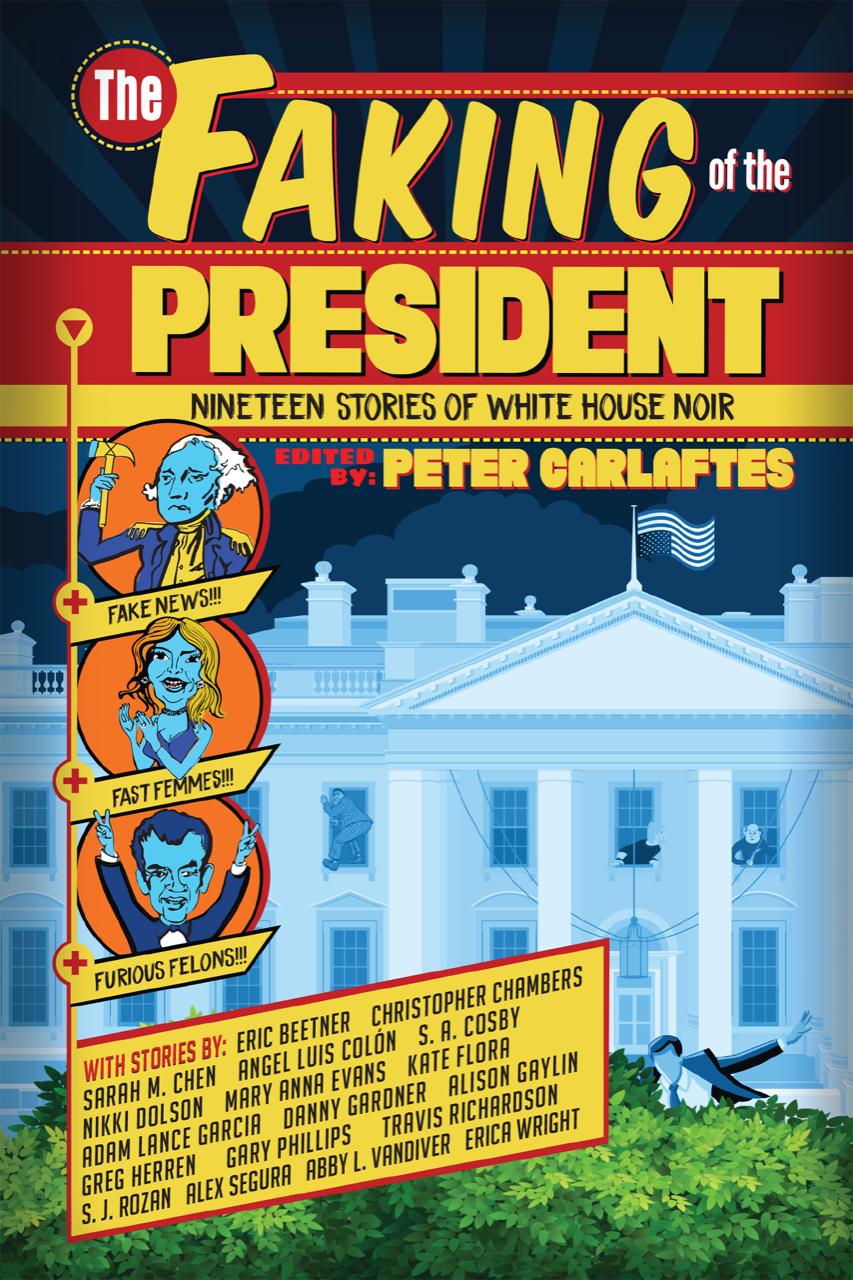
This week a new anthology with a story by one Gregalicious is dropping, The Faking of the President, edited by Peter Carlaftes and from Three Rooms Press. Three Rooms also produced the 2018 St. Petersburg Bouchercon anthology I edited, Florida Happens, and thus it was lovely to be working with Peter, Kat, and the Three Rooms Press gang again. The book has turned out to be absolutely lovely, and I couldn’t have been more pleased to be asked to write a story for this.

The concept behind the book was, of course, to create noir stories built around a president. I was torn at first when asked to choose a president; there were any number of them that I truly like and admire….yet so many mediocrities. The 1850’s, the lead up or prelude to the Civil War, has been of particular interest to me of late, and I decided to chose someone from that period, where we had a string of mediocre presidents take up residence in the White House: Zachary Taylor, Millard Fillmore, Franklin Pierce, and finally James Buchanan. Buchanan is widely considered to be (or was considered to be, YMMV) the worst president in American history; he was the last president before Lincoln’s election and the outbreak of the Civil War. Buchanan did nothing to stop the coming eruption of war; if anything, he exacerbated the ill feeling between the two sections of the country. All the 1850’s presidents were Yankees with Southern sympathies; they were called “dough-faces” at the time (I don’t know why that particular term was used; so don’t ask. Google is your friend), and yes, many parallels between that time and our present day kind of exist, if you care to look to see them. Buchanan also conspired with the worst Chief Justice to ever lead our Supreme Court, Roger B. Taney, in the court decision that flamed the fans of regional hatred into an unforeseen heat that made the war even more inevitable than it already had been; Buchanan and Taney thought they were putting the slavery question to bed once and for all with the Dred Scott v. Sandford decision; by striking down the Missouri Compromise and the Kansas/Nebraska Acts as unconstitutional, the two attempted to make slavery the law of the land and permissible in the vast unsettled (by white people) territories as well as make it legal in the states that prohibited it.

Yeah, that kind of backfired.

Buchanan was also the only president who never married; and while there is certainly no proof or evidence that is conclusive, it is widely suspected that Buchanan was our first gay president. He lived, for example, for a long time with Senator Rufus King of Alabama; Andrew Jackson jeeringly called Buchanan “Aunt Fancy”; and their surviving letters bespoke an affection and longing between the two that went a bit deeper than being just good buddies. So, as a gay writer, I decided to write about Buchanan. But writing a period story set in the DC of the late 1850’s seemed a bit much and certainly more than I could handle; plus I couldn’t really come up with a plot. I thought about having Buchanan murder a slave he’d been forcing to be his lover and the ensuing cover-up; I made several abortive attempts at writing that story before finally abandoning the idea.

I had no idea what I was going to write–until I read an article on-line somewhere about Buchanan’s mysterious sexuality and sexual preferences, and the author said something along the lines of but for some historians, short of finding daguerrotypes of Buchanan naked with another man, nothing will ever serve as conclusive proof for the deniers.

And there it was. I started writing “The Dreadful Scott Decision.”

faking of the president cover


The cheap whiskey tasted like flavored turpentine, burning so intensely as it went down it felt like it was leaving scorch marks in its wake. Scott Devinney was just high enough from the joint he was smoking to consider that a plus—a sign that he was still alive no matter how numb he felt.

He was sitting in the dark in his cheap apartment near campus, streaming the panel he’d been on at the presidential historians’ conference at UCLA the previous weekend. It had aired live on a PBS network in Los Angeles—it took him a while to figure out how to access it, and now that he was watching it was even worse than he feared. He’d always suspected Pulitzer prize-winning historian Andrew Dickey was a homophobe; his behavior on the panel proved it without question.

Alas, Scott allowed Dickey to get under his skin. He wasn’t proud of that, and his doctoral advisor, Dr. Keysha Wells-Caldwell—also head of the department at UC-San Felice—wasn’t happy, either.

He wasn’t about to apologize to Andrew Dickey, though. He’d die first.

“You have no proof!” Dickey wagged his finger at Scott on the computer screen, his face reddened and his voice raising. “Just like the activists who try to claim Lincoln was gay without proof, there is no proof Buchanan was, either, no matter how bad you want him to be!”

He sighed and closed the window. He didn’t need to watch himself screaming in rage, embarrassing himself and the university in the process.

Which was what Keysha really cared about.

At one time, I seriously considered becoming a historian. I’ve always loved history, have loved to read it and study it,  and even write it (I still would love to do a Tuchman-like study of regnant women in the 16th century called The Monstrous Regiment of Women), but as with so many other things, poor professors in college stomped that desire right out of me. (The other problem, of course, being that I could never decide on a period to specialize in–although if forced I probably would have chosen the 16th century) I have heard, over the years, from friends who work in academia as well as reading books and so forth set in the academic world, how cutthroat and nasty the war over tenure can be; office politics as played by the Borgias or the Medici. My story “Lightning Bugs in a Jar” was sort of set in the academia milieu; I even considered writing a series about a college English professor at one time–it’s still there on the backburner; I may write it still. One of the novels I wrote under a pseudonym was set at a quasi-Seven Sisters style college in New England, and of course, my Murder-a-Go-Go’s story “This Town” was about sorority girls, and of course several Todd Gregory novels were set in fraternities.

So, what better idea for this story than a gay Buchanan historian, attempting to prove to the world that Buchanan was, indeed, the first gay president? And how far would he go to get that proof–which is the noir angle I needed for the story? And so the story was born…and you can order a copy here, or from any retailer.

And as you can see from the cover above, there are some fantastic writers who contributed to this book. I am very pleased to be sharing the table of contents with these amazing writers, and a bit humbled. Check it out–you won’t be sorry!

I’ve Had The Time of My Life

New Orleans is, of course, more than Mardi Gras; but whenever anyone mentions New Orleans, most people’s minds immediately go there.

It is probably the most famous thing about New Orleans, no matter how hard we try to convince outsiders that there’s more to the city that our annual bacchanal…Mardi Gras is always the default; so much so that the entire season is collectively (and incorrectly) called Mardi Gras; Mardi Gras is merely Fat Tuesday (mardi gras literally translates into fat Tuesday) and the rest of the season is Carnival. No matter how often you try to correct people, it never takes and so I’ve gotten to the point where I no longer correct people. It is what it is.

Likewise, people think of Carnival as a debauched event, and there is some truth to that–women do show their breasts for beads, and I’ve seen guys drop trou as well. However, I can also honestly say I’ve never seen that happen on the actual parade route on St. Charles Avenue; perhaps that happens down on Canal Street during parades, but it doesn’t happen in Uptown. I’ve only witnessed it happen in the Quarter–people on Bourbon Street displaying the required flesh for people up on balconies with a seemingly endless supply of beads, demanding boobs or butts or balls in exchange for a strand of beads. I’ve personally never dropped trou for beads–never will; why on earth would you when they are thrown with such reckless abandon from floats during the parades?

Like most New Orleanians, I had some vague knowledge of the history of Carnival in New Orleans; I knew that the theme song “If Ever I Cease to Love” came about because of a visit from a member of the Russian Romanov royal family in 1872; the Carnival colors of purple, green and gold were also in his honor. I knew that Comus, Momus, Proteus and Rex were the original krewes that paraded; that the flambeaux carriers originally were necessary to light up the parades in the darkness of the night; I also knew that the members of those original krewes–that still exist today, even if some of them no longer parade–were made of the city’s ruling class elites, and the krewes were offshoots of the exclusive Gentlemen’s Clubs in the city–the Boston Club, the Pickwick Club, etc.–that also still exist today.

But I didn’t know a lot about the history; I didn’t know much beyond what I would read in the annual Arthur Hardy’s Parade Guide, which I buy religiously every year. It’s easier, of course, now; there are parade apps that track the parades so you know where they are; whereas before you just had to stand on the route and wait, or (if you are lucky enough, like we are, to live close to the parade rout) listen for a marching band before heading down to the Avenue.

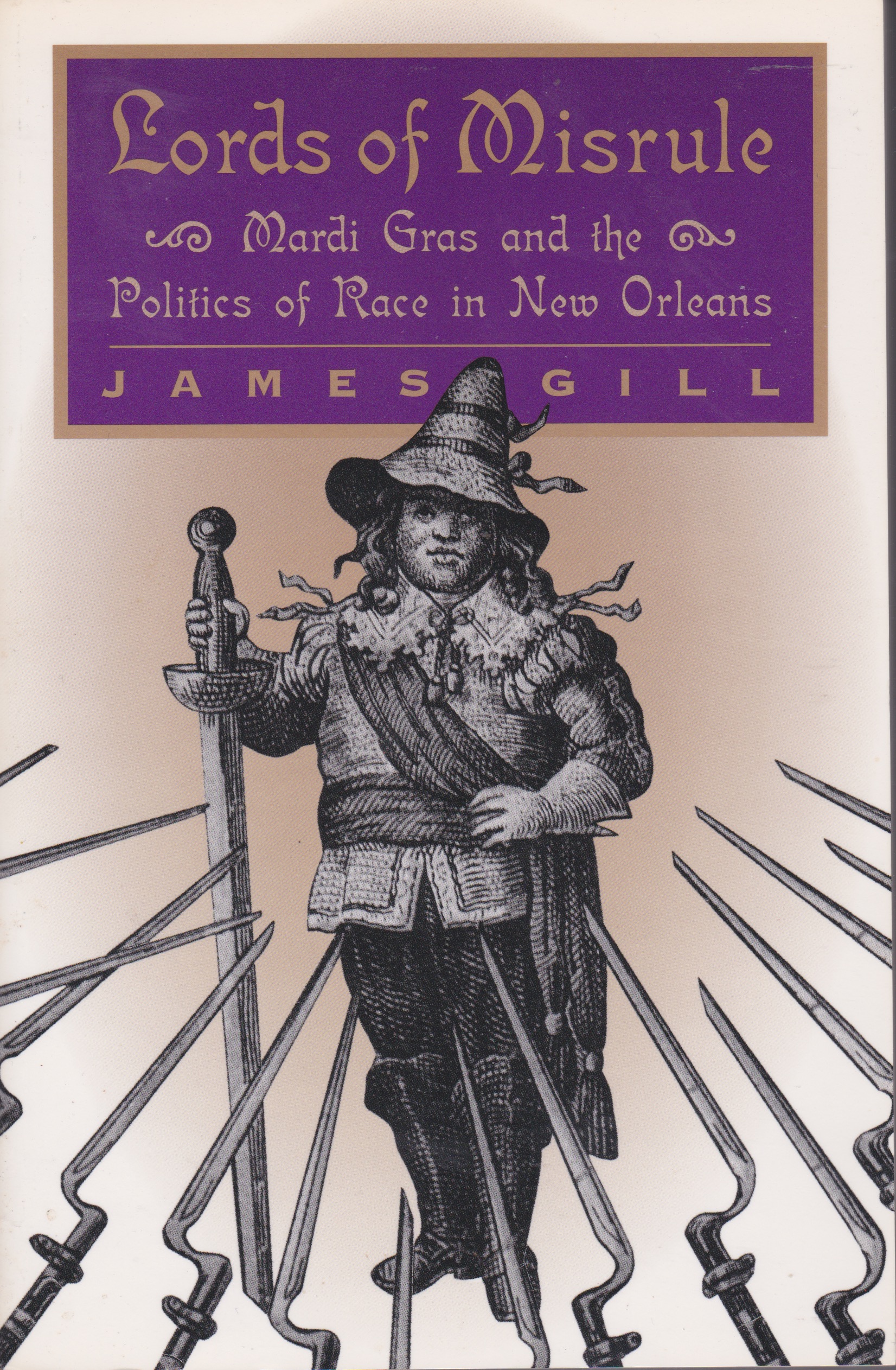
So I decided recently, since I’m reading a lot of New Orleans history, to read James Gill’s Lords of Misrule: Mardi Gras and the Politics of Race in New Orleans.

lords of misrule

The white men in jackets and ties were obviously out of their element. Normally, at this time of day, they would be preparing to leave home or office for a couple of drinks, lunch, and maybe a card game at their clubs. Now, on December 19, 1991, they shifted in their seats, returning hostile glances from a large contingent of black men and women in the packed basement of New Orleans City Hall. The city council was meeting in spartan surroundings while its regular chambers were being renovated, but the physical discomforts were nothing compared to the general psychic unease as everyone waited for the great debate on an ordinance to desegregate Mardi Gras parades and gentlemen’s luncheon clubs.

New Orleans is a Southern city, with all that entails and perhaps even more. There were slaves here before the Louisiana Purchase; both the French and the Spanish brought slaves to New Orleans and Louisiana. New Orleans didn’t hold out long as a Confederate city; it surrendered to the Federal navy fairly early in the war, and with that surrender, the Union plan to control the Mississippi was one step closer to fruition. Racism, Jim Crow, and all the horrible white supremacy that comes with those things were evident here; the Plessy v. Ferguson Supreme Court decision that established the horrific doctrine of “separate but equal” was a case that originated in New Orleans, and had to do with segregated railroad cars. Several years ago Mayor Mitch Landrieu and the city council finally agreed to remove the Confederate statues and other memorials commemorating the city’s racist past; General Lee no longer stands with his back to the North on his plinth in Lee Circle; the statue of General Beauregard outside the entrance to the New Orleans Museum of Art was removed, and the statue of Jefferson Davis on the neutral ground along Jefferson Davis Parkway was also taken down. Perhaps the most egregious memorial–the Battle of Liberty Place memorial–was also removed in the dead of night.

New Orleanians like to pretend that New Orleans doesn’t have that same vein of racism and white supremacy the rest of the South does; but it’s definitely there. It might have more a genteel veneer over it, but it’s definitely there. Orleans Parish is probably the most progressive parish in the entire state–but that’s also an incredibly low bar to set. The vast majority of people I know were in favor of the removal of the memorials, and whenever it came up on a local news website, the comments against the removal were almost inevitably from non-New Orleanians, and usually ginned up the standard Louisiana complaints about New Orleans: out of control crime, poverty, crumbling infrastructure. But all of those things were also true when the city was segregated and operating under Jim Crow; anyone who reads New Orleans history knows that the city was always a hotbed of crime and sin and debauchery.

Lords of Misrule opens with the attempt by the city council in 1992 to desegregate the krewes; my first-ever attendance at Carnival was a mere three years later, and people were still talking about it. The result was three old-line krewes (Comus, Momus, and Proteus) decided to stop parading rather than desegregate (there is a krewe now parading under the name of Proteus again; I don’t know if it is actually the same, original Krewe of Proteus or a newer krewe who took the name). Opponents of the ordinance claimed it would kill Carnival, which is now one of the primary economic engines of the city; nearly thirty years later we can attest that didn’t happen. Modern Carnival attendees don’t now about those krewes and they aren’t missed. But Gill uses this battle at the city council as a jumping-off place to examine the history of the racial politics in the city, and throughout, he uses Carnival–and how racist events in the city, such as the Battle of Liberty Place–to illustrate and illuminate that history.

It’s an enjoyable read, a little eye-opening in places, but a good read, and he also does an excellent job of exploring how Comus was not only  Confederate, but later, if not directly tied to, then definitely sympathetic to the Klan and the cause of white supremacy. Some of these civic leaders who would be, or had been, King of Comus or King of Rex also were leaders of the rebellion, the Klan, and so forth.

And it isn’t until the final chapters that any bias on the part of Gill becomes even remotely obvious; I got the distinct impression in the final chapters that Gill opposed the desegregation of the krewes–but he never comes out and says that; the final chapters simply read that way to me. I could be wrong.

But I do recommend it. It’s a good, interesting read, and sheds some important light on forgotten parts of New Orleans history.

Dueling Banjos

Writing about the rural Deep South is difficult.

I’m from the deep south, yes, but I didn’t grow up there. I spent a lot of time there, my parents were Southern, and so a lot of my values and mind-view for a number of years were patterned in the Southern mindset. I draw from my memories of summers in the rural backwoods of the mid-central-western part of the state, about seventy miles from the Mississippi state line or so, but there are also so many attitudes and mentalities and stereotypes and tropes about the rural Deep South that it is easy to become lazy and fall into those. I am trying very hard not to do that, but as I said, it’s hard. Stereotypes and tropes exist for a reason, after all–they weren’t created from nothing; there’s always a core kernel of truth in them, whatever they’ve become once the seeds were planted–but the key is to burrow into them to dig out the core kernel of truth to build upon, so you’re telling the truth. But I worry, as I continue to excavate into this book, that I am relying on negative tropes and stereotypes.

I think I was thirteen when Deliverance was released; we saw it at the drive-in, which was something my parents loved to do with us when we were kids. I didn’t understand a lot of what was going on in the movie–it was the kind of macho bullshit I loathed as a child, a loathing that has only somewhat lessened as an adult, so I stopped paying attention to it and I think I may have even dozed off. But I did see the scene early in the movie which has forever cemented into people’s minds a link between the backwoods South and redneck morons–“Dueling Banjos.” The open notes of the song are all that is needed to reference a joke about passing from civilization into the land of the uneducated, probably inbred, backwoods hillbillies; it has come to symbolize moonshine-makin’, overalls-wearin’, cousin-marryin’, dangerous rural Southern people. I’ve made the joke myself from time to time–driving through the Southern countryside at night, “You can almost hear the banjo notes, can’t you?”

Deliverance and “Dueling Banjos” are such a part of our zeitgeist and popular culture that the book and film have become kind of shorthand Southern references–even for people who don’t know the origins of the references. I’ve never read the book, but I bought a copy a few years ago because I heard one of the references in something–a talk show, a book, a film, a television show; I don’t remember which–but I thought it was time for me to read the book and possibly watch the film in its entirety; that there was a possibly an essay in both about masculinity, rape culture, and the American male. (For those of you who don’t know, many male-on-male rape jokes were born directly of Deliverance.) I never did get around to reading the book or watching the movie; to be honest, I’d completely forgotten about them and the essay idea until recently. I also never got around to reading the book because I’d heard bad things about James Dickey, who wrote the novel. Dickey was primarily a poet, and considered one of the better American ones of the second half of the twentieth century by the Academy, and Deliverance was his only novel. I knew people who knew Dickey, and the reports back on him were terribly unpleasant, if not surprisingly so. (American letters has produced some horrific examples of toxic masculinity with its iconic, deified authors.)

Southern people are masters at grievance; they’ve been aggrieved for quite some time now–probably as far back as when the rumblings in the northern states began against slavery.  Everything is always someone else’s fault; even that language from the 1960’s came back to haunt Alabama during the special election to replace Jeff Sessions in the Senate: “outside agitators.” That was always a favorite fallback of Southern white supremacy; people of color in the South were perfectly happy with the way things were set up, with not voting or having opportunities, and being segregated away from white people, until “outside agitators” stirred them up against their kind, genial white overlords. Outside agitation goes all the way back to slavery; Southern politicians and leaders railed against “Yankee agitation on the slavery issue.” It’s all there, in black and white, in the history books–if you know what to look for.

The politics of race in the South have always been problematic, but nothing is more irritating to me than white apologia fiction set in the South; in which the white people aren’t racists; those nasty lower class white trash people are the real racists, not the educated whites. I’ve seen this in any number of books and it never ceases to irritate me when I come across it; this historical revision that relieves the guilt of Southern white people is kind of like, as my friend Victoria says, how after the Second World War  no Germans had really been Nazis and everyone in France was a resistance fighter.

Bitch, please.

I guess all those southern white civil rights activists were working undercover, because they sure weren’t public in their opposition. (And yes, I know–not all Southern white people; but I sure don’t see any white faces in any of the footage from the civil rights marches and school integrations that weren’t in military uniform…or certainly not as many as novels and fictions would have us believe.) To Kill a Mockingbird is problematic to me in that I don’t believe for a minute that the sheriff and the cops in Maycomb, Alabama, were worried about the rednecks from the county lynching Tom Robinson and gathering up some of the good white people from town to defend the jail; history shows that the police were often Klansmen, or at least more sympathetic to the cause of white supremacy than they were to civil rights. That scene, while powerful, doesn’t ring true to me–it again divides Southern whites into the educated professionals and the uneducated racist rednecks, and I am not certain of the accuracy. The publication of Go Set a Watchman upset a lot of fans of the original work with its depiction of Atticus as a segregationist; they felt betrayed that the heroic white champion of racial tolerance and justice from Mockingbird was turned into a segregationist…but it was honest and real and rang true to me.

And seriously, I highly recommend anyone interested in looking at how Southern white people viewed civil rights during the 1960’s dig up The Klansman by William Bradford Huie.

This is, of course, part of the problem I am having with writing this first draft of a book set in the rural South that deals, in part, with issues of race in the modern rural South. I don’t want to be heavy-handed, nor do I want this to be another oh look another white person discovers how terrible racism is book, nor do I want it to be another “white savior” book; there are plenty of those already. But I also want to be honest; and how does one do that? There are always going to be those who criticize such a book for failing, or trying too hard, or some such. Southern racism, xenophobia, homophobia, and misogyny do exist, and having an openly gay teenager with roots in Alabama spend the summer there helping take care of his dying grandmother, while dealing with some other issues that arise during his visit, seems like a good lens to view all of these things through.

Or at least, seems to be one, at any rate.

I think this is one of the reasons I am having so much trouble writing this book and getting this draft done; I am so worried about being offensive or crossing some line as well as wanting to do it well and do it right that I am overthinking everything, and it’s like I have this incredible overwhelming sense of confidence about my abilities as a writer. But I am going to press on, all the while worrying…but I must needs remember: I can always fix everything in future drafts.

Part of my goals for the weekend are to finish writing a promised essay, to get three chapters of the book written, and to finish reading Steph Cha’s amazing Your House Will Pay. I also need to reread everything I’ve written for Bury Me in Shadows, and make notes as I go.

Heavy thoughts for a Friday morning, Constant Reader.

And now back to the spice mines.

IMG_2015