Wednesday morning that doesn’t feel like a Wednesday, following close behind a Tuesday that didn’t feel like a Tuesday. Sigh. I have today off to attend a memorial service for a close friend, and so tomorrow is also going to feel a bit off, too–another day in the office before work-at-home Friday and the weekend. Yesterday was weird, you know? I was a bit stiff and sore from Monday’s fender-bender, and my energy just felt off all day. It was very weird, honestly, and probably a hangover from the adrenaline spike on Monday afternoon. That accident could have been so much worse than it was, too. Thank goodness for staying calm in the moment, right? It was a bit cold yesterday morning, too, but it felt okay when I left for the office. I had an errand to run on the way home, and I was back in my chair with a purring kitty before it got terribly dark, which was a very nice outcome. I was very tired when I got home, too, so didn’t really do much of anything last night…and I slept for almost twelve hours! I’m not sure what that was about, but I feel rested and good this morning, the coffee is going down easily, and Sparky is perched on my desk watching the windows.
There was an arson attack in the Bywater the other night–some friends’ home burned, along with eight parked cars and I think maybe one more house? Arson is terrifying in a city with a long history of burning–I don’t even know how many great New Orleans fires there have been, but I do know big swathes of the Quarter burned down several times in the eighteenth century. I also know that under the right conditions the entire city could easily go up in flames again. When we lived on Camp Street in the mid-to-late nineties, there was an arsonist setting fires in the lower Garden District; theoretically, he burned down a house on Coliseum Street as well as the old Coliseum Theater–which I am still not convinced wasn’t an insurance fire–how convenient for the property owner not to have to deal with a historic building and the insane process to tear it down. There’s a big building full of condos there now…and I know at one point I had wanted to write a Chanse book about an arsonist here, but somehow never got around to it…and of course, this recent arson has me thinking about a New Orleans arsonist again; I also wrote two Scotty books about fires–Bourbon Street Blues has a house fire, and Jackson Square Jazz came out of the Cabildo fire…and of course, I also wrote about the fire at the Upstairs Lounge in a Chanse, too. So I have written about fires in New Orleans…funny how you forget things you actually wrote yourself, isn’t it?
I think when I get home from the service (and the errands we are going to run afterwards) I am going to get some chores done around here so I don’t have to do them this weekend. I won’t be as tired as I usually am on Thursday, either, so I should be able to get things done tomorrow night after work, too. I think I am in the clinic alone again, but that’s fine. It’ll be a busy day for me, too–lots of things will need to get caught up for the week, now that I am missing a full day–but it’ll be fine. I can also get some reading done, too–it really is wild how hard it is for me to sit down with a book these days, you know? I was remembering yesterday about how much I used to read–and when I was growing up books were also a lot longer. I spent the summer before my junior year reading Michener–I read Hawaii, Centennial, Tales of the South Pacific, and Chesapeake that summer; I really wish he would have done Louisiana–and the summer before my senior year reading Herman Wouk (Marjorie Morningstar, Youngblood Hawke, The Winds of War, and War and Remembrance) while also reading thick volumes by Taylor Caldwell, Irving Wallace, and many others.
And now it takes me two weeks to reread The Postman Always Rings Twice. How things change.
And on that note I am going to head into the spice mines as the world and country burn to the ground around me. Have a lovely midweek Wednesday, Constant Reader, and I will be back tomorrow morning before work! See you then!
The fortune queen of New Orleans, stroking her cat in her black limousine…
Ah, Cher’s 1970’s musical career. This one was always a big hit at Tea Dance at both Cafe Lafitte in Exile and the Pub on Sundays; there’s really nothing like a gay sing-along, is there?
I suppose being a fan of Cher as a child was kind of a sign? What is it about performers like Cher and Bette Midler and Liza Minnelli that draws young boys into their fandom who are going to wind up gay? Why was I drawn to actresses like Joan Crawford, Bette Davis, Barbara Stanwyck, Katherine Hepburn, and Doris Day before I knew I was gay? It’s something I’ve often wondered about–what is it about those women that draw us in like Formosan termites to a lit chandelier on a Monday night after Mother’s Day?
Ah, Formosan termites. That brings me around to today’s blatant self-promotional post for Mississippi River Mischief.
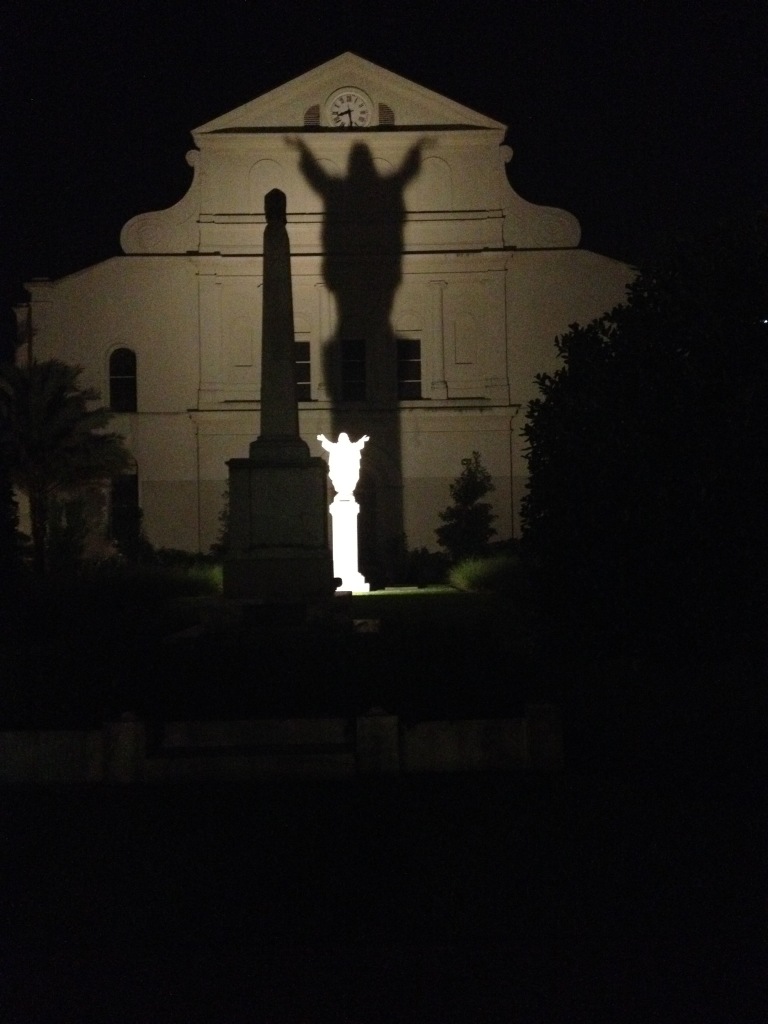
Isn’t this a cool, spooky looking shot? I took this out one of my kitchen windows one Sunday afternoon during a mighty New Orleans-style thunderstorm, and love how spectral and haunted-looking it turned out.
I still can’t believe that it took me this long to write about the swarming termites.
No one warned Paul and I about them, for the record. We had no idea that first May we lived here on Camp Street that the city was infested with swarming Formosan termites whose breeding season was the few weeks past Mother’s Day every May, and they are a scourge. We were swarmed, and had no idea what to do with them or how to handle the situation, or anything. We were running around the apartment spraying Raid everywhere, swinging at them with brooms, and they were everywhere. When the swarm finally passed, the apartment was filled with wings and corpses. It was horrible. We talked to the property manager, who apologized for forgetting to warn us–and the primary problem with the apartment on Camp Street (which was where Chanse also lived) was we had a very bright security light mounted on the front corner of the building–which drew them, and our apartment was right there. We learned to turn off everything that gave off light–including the television–when the first scout flew into the apartment, the mad dash around turning off everything, and then sitting there in the dark with maybe a couple of candles lit, waiting for the fury of the swarms to die down.
But that damned outside security light…ugh.
They are quite literally like one of the Biblical plagues of Egypt, and you see why the Egyptians constantly cried to Pharaoh to let the Israelites go.
But now that we live in the back of the house, we’ve been pretty insulated from dealing with them. Sometimes when I walk the garbage out in May, I can see a small swarm around one of the street lamps, but all the lights in the front of the house are off. We usually turn everything off if and when a scout flies into the television screen and immediately light candles and sit in the dark until we feel the coast is clear.
So when I started writing Mississippi River Mischief, I thought the best way to open the book was with the line It was the Monday after Mother’s Day and the termites were swarming. I posted this on Twitter, and local meteorological icon Margaret Orr replied “what a great opening line!” which kind of made my week (I am a big Margaret Orr fanboy) and helped me realize I was on the right track in writing something about New Orleans that rarely makes it into fiction. (Author’s note: That isn’t the opening line anymore; I added Scotty asking the guys a question about the renovation, and then after he talks, that’s where the line is. I just couldn’t get the prose to work with that as the first sentence; it read awkwardly, so I moved Scotty speaking up.)
Nature, and the natural world, is all around us here in New Orleans; the occasional alligator will sometimes lumber into the city limits; snakes and nutria and squirrels are all over the place, and of course there are the insects–the flying cockroaches (aka palmetto bugs), the swarming Formosan termites, the stinging caterpillars–peculiar to here. The tropical climate makes everything over-bloom and grow and expand and try to reclaim the natural balance of the region before it was settled. This is NOT the place for you if you have pollen allergies or have sinuses sensitive to the air pressure (I do); and I swear by Claritin-D for allergy and/or sinus relief (not the over-the -counter kind, but the kind you have to ask for at the pharmacy because you can make meth with it). OH–and the gecko lizards, always darting around and running up the side of buildings or fences or trees.
So, yes, since Scotty had finally bought the building he’s lived in all these years, I thought it was time to talk about termite swarms, as they would be an enormous headache for a property owner, and what better way to start a book where Scotty is now a landowner than with swarming termites?
I am always delighted when people think I capture New Orleans perfectly in my work.
I love New Orleans, and while I, along with everyone else who lives here, reserve the right to be irritated, exasperated, and annoyed with the city–God help you if you talk shit about the city if you don’t live here (“bitch, you live in Metairie”) in front of people who do.
Trust me, it won’t end well.
I fell in love with New Orleans officially when I came here to visit for my thirty-third birthday, which was a lot of fun and probably one of the best birthday weekends of my life, if not the best one pre-Paul (we had yet to meet at that time). I do sometimes wonder when I think back to visiting, and then living, in New Orleans in the 1990’s, if there’s nostalgia involved in my memories. That New Orleans no longer exists; the flood waters from the levee failure after Hurricane Katrina ended that time with a very firm line of demarcation so that everything was thus defined ever after as before and after. There were also the post-flood years in which the city was being rebuilt and rescaled and rethought and repopulated, but it’s never been the same as it was before the flood and it never will go back to that. There was a definite sense before that New Orleans was stuck in time and nothing was going to change anything–something drastic was needed to solve all the problems. It was thought at the time that the one positive was that maybe New Orleans would rise from the ashes like the mythological phoenix; a hard reboot that could fix everything.
It didn’t. Some of the old problems remained, some of them were eliminated, and new ones arose. The streets still collapse into potholes and constantly need repair; the sidewalks still tilt and get broken up by ground subsidence and live oak tree roots. There’s always something for the locals to complain about when it comes to life and living here in New Orleans. When Paul and I first moved here all those years ago, we had no idea what we were in for–but the nice thing was it was the first place I’d ever lived where I felt like I chose it; Mom and Dad chose where I lived for most of my life. I chose Tampa over Houston, but it wasn’t from an overwhelming decision that I desperately wanted to live in Florida (I didn’t; I moved for my job). But New Orleans–New Orleans was the first place I ever visited that I wanted to live. It’s really the only place I’ve ever wanted to live, or had an opinion about, or actually felt anything for; I am a New Orleanian, and a Louisianan by extension.
It’s really beautiful here, and I thought so when we moved into this crumbling neighborhood in a decaying city whose best days looked to be past already. In the daylight the city’s scars and wounds and damage is clear; but in the night, with shadows dancing and the light limited, it was still so gorgeous it can steal your breath away–and great apartments were enormous, high-ceilinged, hardwood floored, and cheap.
1996 was a whole different world; Bill Clinton was about to be reelected, gay sex was still a crime, and “don’t ask don’t tell” didn’t solve anything; it just made the realities of being a queer in military service even more difficult. There was still the remains of the Camp Street on-ramp to the Crescent City Connection on the neutral ground on the other side of Martin Luther King Drive; the Coliseum Theater was still there–closed and shuttered, but still existing, and there was this incredibly beautiful old house that was a ruined, crumbling wreck that looked haunted and absolutely fascinated me; I wish I’d taken pictures of it. (It has obviously been renovated.) Paul and I moved into the Lower Garden District right before it’s renaissance and gentrification. We lived on the Square; the park was just outside our front door and down the walk and across the street. Coliseum Square was dark at night then; all the streetlights in the park were either shot out or burned out, and the fountains were dry and rusted. The beautiful, graceful live oaks were there, of course, resting some of their heavy branches on the grass. All the big gorgeous houses around the park were derelict and run down, gorgeous ruins waiting for a buyer with money and a love for old houses. A gay couple bought one of them and spent the next year renovating it; it’s still a stunningly beautiful house. One by one those old houses were bought up and remade–and now Jennifer Coolidge lives in a house fronting the park (she sometimes comes to our corner at St. Charles for parades during Carnival).
I always think of Scotty as kind of a gay personification of New Orleans; the two are always entwined in my brain. Uninhibited, unashamed, unabashed, and always up for a good time–you could say that easily about them both. It’s really funny that back when I created him I didn’t think there was enough story in him to be a series–and here we are, on the eve of the ninth being released. Obviously, people responded to him in the way that I wanted them to; they’ve embraced his weirdness and eccentricity, and that of New Orleans as well. I couldn’t create a character like Scotty who lived anywhere else; anywhere else he wouldn’t work, would be judged harshly and looked down on by people for his hedonistic attempts to suck all the juice out of life as he can.
And I’ll probably still be writing him when I die–which, hopefully, won’t be for a long time yet.
Up early to head over to the West Bank to get my oil changed before heading to the panhandle this afternoon. My life is really a non-stop thrill ride, isn’t it?
I was grumpy yesterday, partly because I knew I wouldn’t be able to be productive over the course of this weekend which is of course silly on its face; why be irritated about something you have no control over? It is what it is, and I promised to do this and I want to see my dad, so I don’t know why I was feeling grumpy about the whole thing. I’m trying not to let things I cannot control hold sway over my emotions, my mood and my life anymore; as you can see, it’s not going 100% better–but I have to say overall I feel better about everything on a daily basis a lot more. I’ve not really been writing–using the excuse of this weekend’s trip to justify not doing so, but …there were two options. Try to write, knowing I’d have to take a break this weekend and get something done; or just blow it off and let my brain rest. Since the writing was not coming easily and felt like pulling teeth, it probably was just as well I wasn’t feeling motivated because that feeling turns into disgust and depression if the writing doesn’t go well, so I have to be careful with that sort of thing. But I was able to read some more of the Riley Sager, which I am enjoying, and of course I’ll get to listen to Stephen Graham Jones in the car on the way over there and back. My mind also wanders when I drive, even as I am listening, and I come up with ideas and things while i am behind the wheel of the car. I-10 east isn’t a fun drive, but at least I don’t have to go all the way to Lake City in eastern Florida in order to catch a highway south, thank you baby Jesus.
Clearly, the best day and time of the week to get my car serviced is Saturday mornings at seven. I left the house just before seven this morning, drove over there, got the car serviced and paid for it, then made a quick grocery making run on Manhattan Boulevard and walked back into the house with the grocery bags at about eight thirty this morning. There was little to no traffic, and since I can’t eat anything solid yet, there was no reason to stop at either Sonic or Five Guys on the way home (not that they were open yet, and if they were, they’d be serving breakfast, shudder). That went so smoothly–and yes, believe you me, I was feeling some anxiety as I walked out to the car this morning–that I am now beginning to wonder if letting myself sleep in on the weekends rather than setting the alarm for six to get up like I do every day of the week….I mean, I am awake and feeling functional right now, which is more than I can usually say at this time when I’ve allowed myself to sleep in a bit. (Tug also is used to being fed when I get up at six, so needless to say, he was having some Big Kitten Energy this morning as I kept hitting snooze.) It was also a lovely morning out–it was only sixty-nine degrees outside, which felt amazing; we’re obviously having a cold snap–and I also took a different exit since there was so little traffic; I stayed on 90 and got off at Camp Street instead of Tchoupitoulas, which brought me up Magazine–which I’ve not really drive up in a very long time–at least not since the office moved in 2018. It’s also very different down there, so I am going to need to walk around and explore that part of the neighborhood at some point.
LSU is playing at Missouri today; Missouri is undefeated but not ranked very highly, but there’s no telling how the game will turn out. It depends on which LSU teams shows up, I reckon. I think I’m going to be leaving around noon, so I can catch the beginning of the game and have an idea of how it’s going to go before Dad texts me and I depart on my four and a half hour journey into the heart of the panhandle; the belly of the beast, as it were. I read some more of the Sager novel in the waiting room of the dealership this morning; I’m enjoying it, for sure, but it has a bit of a slow start because of the necessary exposition and back story; I’ve gotten to the place where the present-day narrative is really starting to take off, so I imagine it will read like a brush fire now. Alabama is also at Texas A&M; I think Alabama has found its groove now and is most likely going to win out the season. Plus, I really hate Jimbo Fisher–I’ve hated him since he was at Florida State, and let’s not forget what he did to that program before getting his big payday at A&M (which he has yet to earn).
We finished off this season of Only Murders in the Building, which wrapped up the case of the Broadway show murder and ended with yet another murder in the building which is the set-up for the next season. I doubt Meryl Streep will return for another season, but hey, you never know. We also watched this week’s Ahsoka, but my mind was drifting a lot. I’m not sure if that was the season finale; I thought last week’s could have served as the finale, to be honest. But Our Flag Means Death is back, so we can watch that tomorrow when I get back (yay!) and something else has also dropped a new season for us to watch, but I’m not sure what it is at the moment.
And on that note, I am going to pack and start doing the last minute things I need to get done before I depart. Have a lovely Saturday, Constant Reader–I may not be back here until Monday, so try to go on without me.
And somehow, almost twenty-one years have passed since Scotty Bradley burst forth into the world with Bourbon Street Blues, one of what I hoped was the most unconventional and original amateur sleuths in the history of crime fiction. This is neither the time nor the place to again tell the story of how I created him, or how what was supposed to be a one-off stand alone book became a series spread out over twenty years (!!!); I’ve told those stories endlessly over the last twenty years both here and on panels. But Scotty remains very precious to me all these years later, and I still care about getting him and his life right on the page. I don’t torture him or make his life as miserable as I do Chanse’s (poor, poor Chanse), but he has his own problems and issues that he has to face–but his endless optimism and willingness to face things head on and deal with them, rolling with the punches and always getting back up, has never once wavered in all the years I’ve been writing him. I love him, his family–even the stuffy Bradley side; I love that the unconventional family their son married into pushes every single one of their buttons–and I love his New Orleans.
The other night I was scrolling through Youtube and, just for the hell of it, searched for a song that I’ve been trying to find a digital copy of for my Spotify or Apple Music accounts; Erin Hamilton (Carol Burnett’s daughter) remade Cheap Trick’s “The Flame” as a dance song (she also did the same with that old 1970s classic, “Dream Weaver” and I prefer her versions to the originals), and I love the extended remix. I found the video on Youtube and as I listened to it, it brought back a lot of memories of going out to the gay bars, hitting the dance floor and staying out there all night, getting caught up in the music and just having a great time. I think this song predated the turn of the century, so it’s a late 90’s recording…anyway, it really made me think, put me back into a Scotty place in my mind, and as I listened, sang along, and bopped my head, the next Scotty book started forming in my head….and I realized that’s been part of the disconnection I felt writing the last few Scotty books; sure, I could and can still write him, and sure, I could get back into his head space, but it was much harder for me to do than it used to be. I thought it might be because I don’t go to the Quarter at all anymore, or that I don’t spend any time in gay bars anymore; that I don’t know what it’s like to be a gay man in his forties (almost fifties) today–my own memories are of a completely different world than the one we live in now. But now I know what I was doing wrong–I was listening to the wrong kind of music while writing him. If I want to ease back into Scotty’s mind and world, I need to listen to dance music I used to hear in the gay bars.
And can I say that it’s a real shame that it’s so hard to track down old gay bar dance remixes?
Knowing this means I’ll probably keep going with Scotty for a while longer, at any rate. I love him, I love the character, and I know I’ve been avoiding dealing with some things in that series that will eventually have to be addressed…but it’s absolutely lovely to know that I can slip back easily into his mind-space just by listening to great old gay dance remixes.
“I think we should turn it into a home gym,” I said into the gloom. “I mean, wouldn’t it be great to just have to go downstairs to work out? And we can put in a sauna and a steam room. What do you think, guys?”
It was the Monday night after Mother’s Day, and the termites were swarming.
That was why we were sitting around the living room in the dark. The only illumination in the entire building came from two blasphemy candles, flickering in the center of the coffee table. Modeled after Catholic prayer candles, one had a picture of Drew Brees in his Saints jersey with a halo and heavenly light shining on his head with the words Pray to Breesus around the base. The other was St. Chris Owens of Bourbon Street.
So, yeah—blasphemy candles. They’re very popular here.
Yet even the scant pale light from the teardrop shaped flames was enough to draw an occasional scout termite from the gloom. We wouldn’t see it until it landed on the glass lip of one of the candles, before dive-bombing into the flame. There would be a brief sizzling sound, and then the yellow flame flickered and turning briefly reddish as the termite immolated. Once it was consumed, the flame would be steady and yellow again.
The swarming rarely lasted more than an hour, but that hour seemed to last an eternity.
Termites have always been the bane of New Orleans’s existence. The domestic kind were bad enough. Houses and buildings were tented to get rid of infestations, the bright yellow and red stripes announcing to the world that a termite Armageddon was happening inside. The city’s original termite problem had grown exponentially worse since the particularly vicious Formosan variety had hitched a ride on a freighter to the fertile feeding grounds of our old, mostly wooden city shortly after World War II. The dampness of our climate must have made them feel like they’d arrived at termite Disney World. The little fuckers love wet wood, so the entire city was an all-you-can-eat buffet. They’d killed live oaks that had survived hurricanes, destroyed historic homes, and I’d heard that they could even chew through brick and mortar.
Maybe that was an urban legend, but it wasn’t one I was interested in proving.
Formosan termites swarmed.
The first rule of surviving Formosan termite season was speed. Every source of light had to be turned off the moment you spotted the first scout. They’re drawn to the light, like moths, but unlike moths, they’re drawn to the light in the hundreds of thousands, turning your home into a scene from Cecil B. DeMille’s ultimate cheesefest The Ten Commandments. The big streetlamps along Decatur Street outside drew the swarms, horrifying clouds of little monsters flying around, frantically trying to mate while shedding wings like revoltingly nasty snowflakes.
It is incredibly hard for me to believe that I have written seventeen or so books and countless short stories set in New Orleans and never have once addressed the swarms of Formosan termites we live through every spring. They return after Mother’s Day and haunt us in the evenings, usually between eight and nine pm, until Memorial Day, give or take. They aren’t a nightly occurrence, thank the heavens, but they are usually at their worst on Mondays and Tuesdays. No one had warned Paul and I about them, so the first time we were swarmed we didn’t know what to do. Remembering that horror from the old apartment on Camp Street (we had a massive security light attached to the house right outside our living room, so any light at all inside would draw clouds and clouds of them inside), how was it possible I had never written about the Formosan termite swarms? And with Scotty having bought the building on Decatur Street from Millie and Velma–who I sent into retirement along the Gulf Coast of Florida–and learning about the responsibilities and drawbacks to being a New Orleans home-owner, as well as trying to figure out how to redesign the interior for more functionality as a single-family dwelling? Of course, the question of what to do with the empty retail space on the first floor would be an issue; I wouldn’t want a living space right on the sidewalk of Decatur Street at any time of day or night or month or year. I also wouldn’t want to deal with renters, either, and thus neither would Scotty. But the space can’t just be left vacant, either. So, I thought it would be a great way to open the book with them sitting out the swarms in the dark, with a couple of candles lit, talking about the renovation plans?
After I finished writing Royal Street Reveillon, I was pretty damned pleased with myself. I thought it was perhaps the best Scotty book of the entire series, and reflected my growth as a writer along with Scotty’s growth and development as a character. When I finished it, I had the thought I always have whenever I finish writing a series book: maybe that should be the last one. But I immediately dismissed that thought from my head; I had left something in the personal story of Scotty and the boys hanging with a bit of a cliffhanger, so I knew there had to be one more book at least to tie off that loose end. I was also thinking about a local-ish political scandal of the last decade–the usual, a conservative Christian pro-family politician outed for having an inappropriate relationship with a teenager (who was over seventeen, the age of consent for boys in Louisiana), and a political powerhouse dynasty that had ruled a near-ish parish for generations was dead in the water. I had been thinking a lot also about taking Scotty and the boys outside of New Orleans and the safety of Orleans Parish for an adventure; as my knowledge of Louisiana grew exponentially along with my study of the state’s history, I really wanted to set a book in a part of Louisiana I could fictionalize and have some fun with. I had already created a couple of fictional parishes and towns in previous work; The Orion Mask particularly was set in fictional Redemption Parish–but Redemption wouldn’t work for this one, so I needed another one.
While I was thinking this through, I remembered that two Nancy Drew mysteries were connected to New Orleans–she was only here for a couple of chapters of The Ghost of Blackwood Hall, but most of The Haunted Showboat was set here, or just outside of the metropolitan area (a quick reread showed that “Carolyn Keene’s” Louisiana and New Orleans bore no resemblance whatsoever to the reality…but I knew I had a Nancy Drew Easter egg in Bury Me in Shadows (Blackwood Hall), and I wanted to put one in a Scotty book–so why not a showboat? The ruling dynasty of the invented parish–St. Jeanne d’Arc, for the record–was given the same name as the relatives of Bess and George’s that they and Nancy were visiting in The Haunted Showboat, Haver. I even named the house in Mississippi River Mischief the same name as the Havers’ home in The Haunted Showboat, Sunnymeade.
And yes, the Havers’ showboat/gambling casino was also named the River Princess.
I originally planned on the case coming to Scotty through his sort-of-nephew, Frank’s blood nephew Taylor; someone he met in group therapy (which he is doing to help get through what happened to him in the previous book), or possibly even a boyfriend, someone he’s seeing. I could never get it to work right…and finally, I realized it couldn’t come from Taylor. Taylor is going to continue growing as a person and as a character, but this was too soon after his own trauma for him to be trying to help other people. And then I remembered David, Scotty’s best friend, the music teacher. David’s not been in a book since Mardi Gras Mambo, but I’ve never forgotten about him. And it made sense–David has moved on from his old school and now teaches at NOCCA (our local Fame high school), and the kid is one of his students–and David finds out by confiscating the kid’s phone in class. I wanted to create a character based on this absolute sweetheart of a young man I met; I don’t remember how we met, but friends of a mutual friend were in New Orleans, and wanted me to meet them for drinks…and they had a daughter who went to school here. The kid was a friend of hers, absolutely adorable and sweet, and a ballet major at Tulane. After the daughter and her friend left, the parents immediately turned to me and asked me, “is he gay? <The daughter> think so, and so do we.” What I should have said was, “Well, he’ll let people know if and when he’s ready”; what I actually said was “absolutely.” (I did later find out the kid did eventually come out; wherever he is, I hope he is happy and living his best life. He was so sweet and charming and likable…) When I started writing the character, I made him unlikable, arrogant and sure of himself and his own beauty, and the effect it had on other people. That was wrong, and I went back and made him more of a naïve kid, with a strong sense of right and wrong; and the story worked a lot better. It wasn’t like Scotty to be so judgmental about this kid; if anything, especially after what happened to Taylor, he’s be super-protective.
And this tale–the corrupt old politician and the beautiful teenager working at the food court at Lakeside Mall–gave me a chance to dig into something from Scotty’s past that’s never been truly explored: that his first lover was his high school wrestling coach when he was about fifteen/sixteen. This came up in Jackson Square Jazz–which of course has been unavailable for thirteen years–and I always meant to circle back around to it, just never did…but over the years there have been throwaway lines in books about how Scotty has always preferred older men (Frank is fifteen years older; we’re not really sure how old Colin is), and so to bring it up again in this instance? Yes, perfect.
I loved my story about the corrupt politician, the wrecked showboat in St. Jeanne d’Arc Parish, and the teenager, but something was missing.
I realized two things: something very important was missing, and the crimes of the Haver family were just too big and too many to fit into this book, so I chose to focus on only one…and then the Murdaugh case broke. The Murdaughs were a real life Haver family, and their crimes were almost exactly the same! So, I ripped one of their crimes from the headlines and made that the primary focus of the story, and it was the right choice: the book started falling into place and the story began flowing. I was very nervous about the book–slicing out all the other crimes while building up only one was tricky, since they were all woven through the entire manuscript and the new one had to be as well. I also wasn’t sure if the subject matter was handled appropriately; the old/young daddy/boy thing is the gay community is often mistaken for something much worse than it is, and talking about gay teenagers’ sexuality is also kind of a third rail. But I trust my editor, and she loved it.
Saturday morning and lots to do before hitting the road tomorrow. The lovely thing is it isn’t that much of a drive, about five and a half hours, and there’s a Whataburger in Tuscaloosa. Yay! I have The Drowning Tree by the amazing Carol Goodman queued up on my Audible app and ready to go once I hit the road. I have to make a grocery run today for Paul, and was thinking about dropping books off at the library sale, but I don’t know. It’s hot and the grocery thing is going to be exhausting enough as it is, and I have a lot to get done today. I was exhausted yesterday after work. The escape room thing was quite fun, and then we had lunch at Olive on Carondelet, a Middle Eastern place (sobs with joy! I got to have a gyro) and then I came home to work. The walk home was exhausting in the heat, and of course, I actually drifted off to sleep in my easy chair a bit. I got some more Alfred Hitchcock Presents books in the mail as well, and I started reading this delightfully creepy story I haven’t quite figured out yet, but the suspense and the build is sensational. We also watched the International Male catalog documentary (more on that later), and then I finished doing the laundry before going to bed, exhausted and ready to sleep for an eternity.
Despite the hideous heat yesterday, it actually wasn’t terribly humid and there was also a lovely cool breeze so the walk didn’t seem that dreadful, or at least not while I was doing it. The sun was merciless, though, and it was in the mid-nineties.I also marveled as I walked home a different way than usual–I took Camp Street to Prytania, rather than St. Charles–and I again marveled that not only do I live in New Orleans, but how quickly things change. I was also puzzling out some knots and final corrections I need to make to this manuscript before turning it in tomorrow–a walk is always lovely for things like that; even in the heat, and I need to remember that more often, quite frankly. I was also thinking, as I walked, about how I am always worried about repeating myself, or writing the same book again. It’s easy enough to do when you forget what you’ve already written and published, as I am wont to do at this stage. My editor’s notes were kind of amusing, in some ways, because one thing that he was pointing out was something that I always do–and something that I’ve noticed in the other two active manuscripts on hand–which is a tendency to name the characters with alliterative names. (For example, in the pro wrestling noir everyone, it seems, has a first name that begins with T) I also have a tendency to write hangover scenes, and car crashes. Now that I have this permanent brain fog or whatever it is that’s going on in my head since last summer, it’s even harder for me to remember past books that I’ve written; so I think I am going to have to start blogging about past books I’ve published so that I can remember them. I’ve done some of these posts before in the past, because I like to try to remember what was going on while I was writing the book; what I was trying to do with the book; how long had I had the idea for the book and where did it come from; what changed from the original idea during the process of writing it and what other influences got involved after getting started; and so on. I also like to think about the voice and the tone, how did I do with the setting and scene? What was I going for with the main character, and why? Facebook reminded me yesterday that at some point in the past twelve years the box o’books for The Orion Mask arrived on this date–and I just walked past the house that inspired a part of the book recently, and I was amazed yet again at how much detail I’d gotten wrong.
So, I decided to rent the documentary All Man: The International Male Story last night, for a multitude of reasons. Now that I’m in my sixties my former indifference to nostalgia has lessened (and I do tend to worry that I look back through rose-colored glasses, making the past seem better and more idyllic than it was; I have to always remember yes, but you were also a neurotic mess then, too), and so yes, there was a bit of a curiosity involved with my wanting to watch. I think I only ever bought one thing ever from International Male–a red pirate blouse, a fluffy shirt, if you will, and I got it to go as a pirate for Halloween–but I always got the catalogue, and I often liked their clothes…but was also always very consciously aware that to wear those clothes, you also had to look like their models; the lesson that beautiful people can wear anything and look good I’d learned early in life. I also had no fashion sense because I never was able to develop one–because men’s clothes were hideous, and there weren’t many options when I was growing up. I’ve also have a very mild case of color blindness with certain shades of certain colors–I can’t tell dark blue from black, for example–and I am never entirely sure what colors go with other ones. I do know that red, black and white all work together, so usually my dressier clothes are some combination or variation of those colors. But for the most part, I don’t care about what I wear and I don’t know what’s in style or not. I’m never sure if the clothes I am wearing match and/or look good on me, and I’ve stopped worrying about it. When I was younger, I used to deplore the fact that men’s clothes were so dull and boring. I love hats, for example, but men don’t really wear any hats other than baseball or cowboy anymore. I have some lovely hats, but never have any place to wear them. I have a marvelous fedora I bought in New York many years ago, but I never go anywhere here that I could wear it; it would be perfect for something like the Anthony Awards or something, but it has it’s own special box and that’s another item to take on the plane…so it just sits in its box in the closet. But I used to love the International Male catalogue, because the clothes, to me, looked kind of fun and cool. I’ve never been a cool or fun gay, and I’ve never been a fashion gay. But the International Male catalogues allowed me to escape into a world where I could wear something off one of its pages in a place that was exotic and exciting and fun. (I’ve also always kind of wanted a pith helmet. I had one in college and I loved it) So, it was interesting to watch how the business came to be, and how it really did kind of help change the way men dress and the way we look at men in more sexualized way now than we did when I was a kid. (I’m trying to remember things that resonated with me before I came out finally; that’s my current nostalgia kick) I do recommend it; it’s very well done and it’s kind of a nice story. The catalogue impacted a lot of gay teens in rural places in the 80’s and 90’s, and it should be remembered for that reason alone.
My first exposure to crime fiction short stories came in the Alfred Hitchcock Presents anthologies. My grandmother used to get the Dell paperbacks, and the stories always had a delightful little twist of some sort, always macabre. I’ve always remembered those anthologies, and recently went on an eBay binge of buying copies. Two more arrived yesterday, Alfred Hitchcock Presents My Favorites in Suspense and Alfred Hitchcock Presents Stories That Go Bump in the Night. I started reading a long story in My Favorites in Suspense, “Composition for Four Hands” by Hilda Lawrence, and it’s really quite good; the suspense and tension builds with every paragraph, and I’m still not entirely sure what’s going on in the story–but we have a bedridden woman who cannot speak, and she suspects some of the other people in the story might be wanting to kill her, but we don’t know who and we don’t know why; nor do we know yet how she ended up in this condition. The writing style is quite Gothic in tone, which of course I love, and I am hoping to finish reading the story this morning. I have quite a lot to get done today, but I did sleep marvelously and I feel very alive, rested and alert this morning. Good thing as I do have so much to do. I want to also watch the LSU game this evening (GEAUX TIGERS!) but will be on the road during the game tomorrow, alas.
And on that note, I am heading into the spice mines. Have a marvelous Saturday, Constant Reader, and I will check in with you again tomorrow morning, if not later.
Saturday morning. I was incorrect about the department meeting; it’s later this month (when I’ll be in Bethesda, actually) so I went to the health fair, was told I should increase my exercise (duh, since I do none now) and other than that, I appear to be perfectly healthy–or at least per my vitals and blood work, at any rate.
How fortunate they weren’t testing for mental stability, eh?
But it was a lovely day to work-at-home. It was still cold overnight, but the high yesterday hovered in the high seventies, topping out at a solid, spring-like eighty degrees at one point in the afternoon, which was also nice. I filed and cleaned when taking breaks from work; laundered the bed linens, finished off the dishes, and straightened the rugs as well as sweeping and vacuuming. We got caught up on Yellowjackets and The Mandalorian, and while I was waiting for Paul to come home from the gym, I rewatched this week’s Ted Lasso with the captions on so I could catch things I missed on first viewing (something I do with every episode, as I did with Schitt’s Creek), and I have to say I enjoyed it a lot more on the second viewing than I did on the first. I am very curious to see where the show is going and how it’s going to end–but unlike everyone else, I’ve decided to not theorize about it or jump to conclusions predicated on my interpretation of what I’ve seen; instead I just want to enjoy the ride and trust the writers to do their jobs, which they’ve done superbly on every step of the journey thus far.
I slept really well last night and feel very rested this morning. I have to get the mail today and I should make a small grocery run while I am out, but ugh, how I hate the grocery store lately. It saps my strength and will and makes me want to curl up with Scooter and pretend the rest of the world doesn’t exist anymore out there. There’s not much we really need, to be completely honest; but I need to know what I want to make for dinner this weekend and what I am going to be taking for lunch next week. Decisions, decisions–but it feels good to be rested and clear-headed this morning. I don’t know that I feel particularly inspired this morning, but that’s okay. Once I finish this, I am taking my coffee and repairing to my easy chair to read Scorched Grace, which I hope to finish this weekend.
Anne Perry, a very successful author, died this week. She had an unfortunate past, having committed the crime that Peter Jackson’s film Beautiful Creatures was based on (also known as the film that gave us Kate Winslet and Melanie Lynskey) as a teenager, and served her time. I didn’t know Ms. Perry, nor have I ever read any of her work. This wasn’t out of any sense of oh I can’t possible be supportive of her! She killed someone! but more because they weren’t the kind of stories I particularly enjoy. I did ride in an elevator with her once at a Bouchercon, and she was polite, reservedly friendly (understandable), and seemed kind. I’ve been thinking lately that I’d like to read more historical crime fiction, particularly around the first World War (looking at you, Charles Todd!), but that TBR stack is already way too deep and tall and wide. However, Ms. Perry’s death has, of course, brought all that about her teenaged crime back into the news and onto social media to be rehashed and discussed and, well, frankly beaten into the ground. Ms. Perry’s situation also is key to a broader discussion about criminal justice, and our criminal justice system and how it operates. (Ms. Perry’s crime was committed in Australia, I believe.) I see a lot of people talking about how they don’t believe in redemption, and how they could never bring themselves to support someone who’d done something so terrible, etc. etc. etc. And it’s very true; we as a society tend to look askance at people who’ve served time in prison–and tend to judge them harshly.
How can you believe in a criminal justice system if you don’t believe in the potential of human redemption? I’m not an expert on any of this stuff, let me make that very clear at this point. I am merely examining this from a layman’s perspective and coming from a logical place to try to dissect all of this with nuance and rationality; what can I say, I took Geometry in high school and was on the debate team. I don’t think you can believe in our criminal justice system if you don’t believe in redemption, which seems kind of Old Testament to me; once a criminal always a criminal is what that boils down to, and if there is never even the slightest possibility that someone can be redeemed, what is the point of jailing them? Punishment? That seems kind of draconian and not very humanist, frankly. The odds are stacked against convicts as it is when they are released; as most of us will always keep an eye at them in askance, just waiting for them to commit another crime to prove that they belong in jail and should never be released. I understand the sex-offender registry–women and children are vulnerable and should be aware someone who may be a predator is living in their area now–but at the same time, it feels….punitive. Sex crimes are horrible, to be sure, but if they are so horrible and the offender is statistically going to commit the same kind of crime again–why let them out in the first place? Getting one of those flyers back when we lived on Camp Street is what inspired me to write my short story “Neighborhood Alert,” which is one of my favorite stories that I’ve done, and tried to use the story to illustrate the potential consequences that can come from such alerts.
I also think it’s interesting that people are so unforgiving in real life while they will read–and root for–characters like Tom Ripley or Hannibal Lector or Dexter. But that’s fiction, they say in response, to which I say so you would be repulsed by them if they were real, but you root for them in fiction? Make it make sense to me.
Ultimately, she did her time for her crime, and then spent the rest of her life writing crime novels successfully. Enough people either didn’t know about her past, or didn’t care enough to make them give up the pleasure of reading her work. As I said, I’ve not read her work but it’s not out of any sense of moral outrage or superiority, but because they aren’t the kind of books I ordinarily read–although now I kind of want to read one, to see how good she was. If you don’t want to read her, or didn’t, because of her past that’s your choice and your decision. But please don’t think for one moment you have the right to tell me what I can or cannot read, or what I can or cannot enjoy–because then you are no better than right-wingers trying to ban books and close libraries, and that is something I will not, do not, and cannot, support on any level.
I also kind of believe that redemption is possible, but not unless there is atonement and a desire to change. If I didn’t believe that, well, I don’t know how I could live with myself. This is a question I explored in my nasty little story “This Thing of Darkness”–can you atone for something terrible you did as a teenager? Especially if you are never punished for the crime itself? How do you live with yourself with such a thing on your conscience? (This is also the theme for one of my favorite books of all times, Thomas Thompson’s Celebrity)
And on that note, I am making another cup of coffee and heading to the chair with Margot Douaily. Have a lovely Saturday, Constant Reader, and I’ll be back here again tomorrow, as always.
Thursday morning and my last day in the office of the week–tomorrow I took the day off for miscellaneous appointments and things (and yes, a trip to Metairie is required, sigh) which will be nice. I don’t have to get up super-early to go, for one thing, so I can allow myself to sleep in a bit, and then I can leisurely enjoy my coffee throughout the morning before it’s time to head out there. I am also going to stop at Costco on the way back home, so it’ll be a big day for one Gregalicious. I imagine by the time I get home I will be hot, sweaty, crabby and ready to spend the evening inside with the air conditioning.
Such an exciting life I lead!
I slept really well last night–an enormously pleasant surprise, given the questionable sleep I got the previous two nights–but according to my Fitbit, it was yet another bad nights’ sleep. I am beginning to think my Fitbit doesn’t know what it’s talking about when it comes to my sleep, you know? I feel rested and a bit groggy this morning, which hopefully the coffee will take care of (fingers crossed) but I will say yesterday I felt a bit out of it for most of the day. I didn’t get nearly us much accomplished as I’d intended when I got home from the office last night–I didn’t really do much of anything, to be honest. I wrote for a little while before retiring to the easy chair, where I fell into a spiral of videos about French history, which is always fun for me. When Paul got home we watched Obi-wan Kenobi, which I am really enjoying, on-line haters be damned, and the little girl who plays Princess Leia is fantastic–it’s completely believable she would grow up into Carrie Fisher’s Princess Leia, and props to Disney Plus for pitch-perfect casting. The show is also doing a really great job of filling in some gaps in the story of Star Wars, too.
Today hopefully will be a good one. I want to get some more writing done–for whatever reason, “Never Kiss a Stranger” is finally taking shape the way I want it to, although now I am worried that its going to wind up being far too long, and far too melancholy, than I want it to be. Its a melancholy story, really, so that’s probably a really good thing, but…I don’t suppose melancholy is the right mood; I am thinking I want to go for a Daphne du Maurier tone (which I love); I don’t want to call it gothic either, but if you’ve read du Maurier you know what I mean. Hmmm, perhaps I should dip into her collection Echoes from the Macabre again, to get a better sense of what I am talking about here…that is actually a really good plan, now that I think about it.
You can never go wrong rereading du Maurier.
One thing that is interesting/kind of fun about writing this novella is that it is set in a place that no longer exists–New Orleans in 1994. I was talking to some of my younger co-workers (ha ha ha, they’re all younger now, I am the old man of the department by a LOT now) about how different New Orleans was when I moved here in 1996 than it is now; and I was thinking about that some more last night. Gentrification hadn’t really gotten started in the city yet; it was a crumbling, dying city whose glory days were in the past. The Lower Garden District was considered a bad neighborhood back in those days; we moved in just as it was started to regenerate…but there was still a crack house next door, and of course the Camp Street on-ramp to the Crescent City Connection was still there, about fifty yards of concrete climbing into the sky and just ending (if you ever watch the Brad Pitt/Tom Cruise version of Interview with the Vampire, there’s a scene when Louis–Pitt–leaves a movie theater in New Orleans that is showing Tequila Sunrise. That was the Coliseum Theatre, which was closed but still there when we moved into the neighborhood. It burned to the ground a few years later. Anyway, as Louis/Pitt walks out, the camera pans back and shows a highway on-ramp with cars going up–that was the old Camp Street on-ramp, still in use when the movie was filmed but not when we moved here two or three years after the movie’s release). I also imagine that on-ramp, when it was still connected to Highway 90, was a bitch for traffic in the neighborhood, since the bridge backs up all day now; I imagine there were times when that ramp backed up all the way down Camp to probably the Garden District. Where it was now is a lovely neutral ground that separates Camp and Coliseum Streets, beautifully designed and landscaped so it seems like a perfect extension of Coliseum Square. That’s why I want to write about that time period, when gay bars still occasionally got raided by the cops, when there were still two bathhouses in New Orleans, when many of us could only be openly gay when we went to the bars in the Quarter on the weekend, and how frenetic and wild and crazy those weekends were; all the gay bars in the Quarter were packed every weekend, and of course, deeply closeted gays from the surrounding areas–the rural parishes and Mississippi–would come into the city so they could let go and be free.
But even that wasn’t a guarantee of anything, either. Death stalked the gay bars back in those days–another reason I want to write about that time–and you couldn’t really trust the cops and sometimes it was dangerous to walk back to the lower Quarter or Marigny where you’d parked your car. There was this weird sense of being an outlaw; despite the Lawrence v. Texas decision there’s still a sodomy law on the books here in Louisiana, and once this Supreme Court gets to decide Lawrence v. Texas was wrongly decided (because make no mistake, this Supreme Court is definitely going to dial us back to 1900, and it wouldn’t surprise me if they decided to take the right to vote away from women, too), once again my sex life will become an enforceable crime in Louisiana yet again.
Sigh.
Well, writing that last paragraph certainly made me melancholy. Too bad I don’t have time to work on the novella before heading into the office. Have a great Thursday, Constant Reader! I will chat with you again tomorrow morning.
Well, it’s Saturday morning, how are you all doing out there? I am doing well–I cannot believe how much better I’ve been sleeping lately; I almost feel completely rested for the first time in I don’t know how long–and there’s no LSU game today. You know what that means, don’t you? That means a day to clean and write and get things done as much as humanly possible. I may even clean the windows this morning–crazier things have happened, of course, but there you go.
I made it to the gym for my third workout of the week last evening, and it was the first time I’ve gone where it was dark when I set out for the place and even darker when I walked home. There was an unusual occurrence as I walked there–I actually got cat-called by a woman in a car as she drove by while I waited on the corner for her to pass. It completely caught me off guard–and trust me, it’s been a very long time since anything like that has happened to me. As I said, it was a very pleasant surprise but I also don’t think it served as an indicator of dramatic changes and improvements to my body in the two weeks since I returned to the gym, but I will say I’ve noticed that my muscles are being kick-started up again to look better than they have been–taut rather than slack, if anything. When I was a trainer I always used to tell my clients that once you’ve built a good, strong muscular base that it’s much easier to get back to that after some time away from the weights–I did notice the other night while doing my bicep curls that my arms looked better, and the definition was coming back, which was lovely. The trick is going to be my storage of excess body fat around my middle, which, coupled with my enormous ribcage, tends to make me upper body barrel-shaped–and my narrow hips and pelvic girdle always ends up looking–because of the barrel shape–like I have no ass, which I absolutely hate and despise. And yes, while the entire point of going back to the gym is to be healthier, lower my cholesterol and blood pressure, and reduce my body fat percentage, the side effect of looking better physically certainly is working as a motivator–perhaps not as strong of one as back in the day, when I wanted to run around gay bars shirtless and attracting flirtatious attention, but it is a motivating factor.
I’m also enjoying wandering around the neighborhood on my walks to and from the gym; getting to know the neighborhood better that I’ve lived in for the better part of the last twenty-four years or so. There’s an absolutely fascinating house on Camp Street, hidden behind a church, that has its entire first floor porch (or gallery, or balcony; whatever you want to call it) hidden from the street and the sidewalk by a massive, thick hedge that reaches all the way up to the second floor balcony; it’s so thick you literally cannot even see that the lower floor porch/gallery is even there. Anyone sitting there is completely hidden from the sidewalk. Likewise, the gorgeous house on Coliseum Square owned by the actress Jennifer Coolidge is similar; the back yard and its fence is completely hidden by a towering, thick hedge and trees and enormous elephant ferns–so sitting in the back yard you would feel like you were sitting in a forest clearing rather than in the heart of a city, which is a very cool effect.
We are very much enjoying the second season of The Mandalorian, to the point where I honestly think the smartest thing Disney–and Lucasfilm–could have done was do these “meanwhile, somewhere else in the galaxy” movies and series to flesh out the skeletal structure of the universe as laid out in the Skywalker stories rather than continue the sad, twisted melodrama of the Skywalkers. I rather enjoyed the final trilogy when I saw them in the theater, and of the three films The Force Awakens is probably the strongest–it’s also the only one I’ve been able to watch more than twice. The more I watch The Last Jedi and The Rise of Skywalker the more flawed the films seem; although I will argue The Last Jedi is not as bad a film as the fanboys screamed to the ends of the known universe it was. I think they listened too much to the fan complaints and thus rejiggered the script of the final film to the point where groundwork laid in the second was completely ignored or totally betrayed by the third. But The Mandalorian is quite marvelous, and it’s the highlight of our Fridays every week,
We are also watching The Murders at White House Farm on HBO MAX, which is quite good. Based on a true story about the mass murder of a family–in which it was originally thought the mentally ill daughter murdered her parents, her twin sons, and then herself–it’s remarkably well written and well-acted; the story also hinges on a chief inspector who simply accepts the evidence at face value and asks no questions, preferring to close the case as it seems without looking any deeper. This is a problem with police investigations, which we have seen, time and again, in true crime documentaries and books and weekly series: the police tend to come up with a theory of the crime and look only for evidence that supports that theory, even if it means ignoring other evidence that contradicts their theory. This should scare everyone, as it is a terrible flaw in police investigating; they are not necessarily looking for the truth and the actual criminal as they are looking for someone they can convict in court, regardless of whether they committed the crime or not.
If you don’t think that’s a serious problem for our justice system–although this series takes place in the UK, the statement still holds—then I don’t know what to tell you other than I hope it never happens to you.
I also hope to find some time–around the cleaning, writing, and organizing–to finish reading Westlake’s The Hot Rock. I also landed a copy of Lawrence Block’s first Burglar book–Burglars Can’t Be Choosers–and I am looking forward to being immersed in that. I’ve read one of his burglar novels before–I think it was The Burglar in the Library–and really liked it, so it only makes sense that if I intend to read the entire series I would go back to the very beginning. I should also get back to reading Elmore Leonard; it’s been years since I read anything of his and I know I greatly enjoyed the ones I did read (although I disagree with his writing advice that you should never start a novel or story by talking about the weather; I do it all the time. But then again, in New Orleans the weather is a very important part of the fabric of the city).
I also want to get some work done on short stories this weekend. I really do need to prioritize the novel, though. Decisions, decisions–there is so little time in which to get everything done (as well as have the necessary down time) that it will undoubtedly make me quite mad by the end of the year, when the book is finally due.
And on that note, I am heading into the spice mines for the day. Have a lovely Saturday, Constant Reader, and perhaps today will see the end of the election.
As far as summers go, I’d say this is one of the cruelest of my life thus far. (Nothing, however, including this one, has been as bad as 2005; let me make that very clear–but this one also isn’t over yet and apparently the Saharan dust storm that was hindering the formation of hurricanes is over now. Yay.)
I read an interesting piece on Crimereads about Robert S. Parker and his creation of his iconic character, Spenser, which put me back in mind of how I came to create MY character, Chanse MacLeod–who I have been thinking about lately ( I’ve decided that rather than writing novels about him I’m going to work on some novellas, and then put four of them together as a book; currently the working titles for the first three are “Once a Tiger,” “The Body in the Bayou,” and “The Man in the Velvet Mask”–I still need a fourth, and it’s entirely possible that any of these could turn actually into a novel, and I do have some amorphous ideas about what the fourth one could be), and reading this piece, which is excerpted from a scholarly tome about the genre I would like to read (Detectives in the Shadows: A Hard-boiled History by Susanna Lee), made me start thinking about how I created Chanse, and the entire process that the series actually went through over the years of his development.
It also made me think about looking at Chanse, the series, the characters, and the stories I chose to tell in a more critical, analytic way; I am not sure if I can do this, actually–while I’ve not published a Chanse novel since Murder in the Arts District back on October 14, 2014 (!!! Six years? It’s been six years since I retired the series? WOW)–which means I do have some distance from the books now, I still am the person who wrote them…even though I barely remember any of them now; I cannot recall plot points, or character names, outside of the regulars who populate every one of the books (I also cheated by using some of the same regulars in the Scotty series; Venus Casanova and Blaine Tujague, the police detective partners, appear in both series; and Paige Tourneur, Chanse’s best friend and a reporter, originally for the Times-Picayune who eventually moved on to become editor of Crescent City magazine, also turned up in the Scotty series, in Garden District Gothic and then again in Royal Street Reveillon. Serena Castlemaine, one of the cast members of the Grande Dames of New Orleans, who shows up in the most recent two Scotty books–the same as Paige–is a cousin of the deceased husband of Chanse’s landlady and erstwhile regular employer, Barbara Palmer Castlemaine).
I first created the character of Chanse MacLeod while I was living in Houston in 1989, and the series was intended to be set in Houston as well. I didn’t know of any crime novels or series set in Houston, one of the biggest cities in the country, and I thought that was strange (and probably wrong). Houston seemed like the perfect city for a crime series–huge and sprawling, economically depressed at the time but there was still a lot of oil money and speculators, con artists and crime–and the original story was called The Body in the Bayou (a title of which I am very fond, and is currently back in the running to be the title of a Chanse novella), because Houston also has bayous. I was reading John D. MacDonald’s Travis McGee series at the time, and loving them–I particularly loved the character of Travis McGee–and how twisty and complicated (if sometimes farfetched) the plots of the novels were. I had read The Dreadful Lemon Sky when I was thirteen, and liked it; but promptly forgot about MacDonald and McGee; a Book Stop in Houston that I frequented reminded me of them and I started picking them up. I had also discovered Sue Grafton and Sara Paretsky by this time, and was falling in love with the crime genre all over again, developing a taste for the more hard-boiled side I disliked as a teenager. This was when I decided to try writing in this field again–for most of the 1980’s I was trying to write horror and science fiction (and doing so, very badly).
But coming back to the field that I loved as a kid, tearing through the paperback stand alones from Scholastic Book Club and all the series, from Nancy Drew to the Three Investigators to Trixie Belden before graduating on to Agatha Christie and Ellery Queen and Erle Stanley Gardner, seemed preordained, and also seemed somehow right; writing mysteries, or crime fiction, seemed to me the right path to becoming a published author (turns out, that was the correct assumption for me to make, and one that I have never regretted).
Chanse was originally, as a straight man, a graduate of Texas A&M and a two year veteran of the Houston Oilers; an injury eventually led to early retirement and joining the Houston PD, where he only lasted another three years before quitting and getting a private eye license. He had a secretary, a woman of color named Clara, who was heavyset and in her early fifties. That was about as far as I got; I think I wrote a first draft of a first chapter which established him as having his office near NASA, in Clear Lake (which was near where I lived) and his first case was going to involve a wealthy oil family in River Oaks. Chanse was also six four, dirty blond hair, green eyes, and weighed about two-twenty. When I fell in love with New Orleans four or five years later, I started revising the character and started writing The Body in the Bayou while I lived in Minneapolis. By this time I’d discovered that gay fiction was actually a thing, and that queer mysteries actually existed: Joseph Hanson, Michael Nava, RD Zimmerman, etc. I wanted to write about New Orleans, and I wanted to write a more hard-boiled, MacDonald like hero than what I was reading. (Not that Hanson, Nava, and the rest weren’t doing hard-boiled stuff; they were–I just wanted to subvert the trope of the straight male loner-hero detective.)
Chanse was definitely a loner, and after I moved to New Orleans I once again started revising the manuscript and story that eventually became Murder in the Rue Dauphine. He was cynical about life, love and relationships, even as he was slowly inching his way into a relationship with a flight attendant named Paul Maxwell; he had only two friends, really: Paige Tourneur, who’d been his “beard” while he was at LSU and in a fraternity and was now a reporter for the Times-Picayune; and Blaine Tujague, a former one-night stand and fellow gay man on the NOPD (I changed his backstory to having attended LSU on a football scholarship and a career-ending injury in the Sugar Bowl at the end of his senior year, which led him to joining NOPD, where he lasted for two years before going out on his own). He also lived in a one bedroom apartment on Camp Street, across the street from Coliseum Square in a converted Victorian, the living room also served as his office–and that was the same place where Paul and I lived when we first moved to New Orleans.
The series and the character evolved in ways I didn’t foresee when I first imagined him as that straight private eye in Houston; or even when I rebooted him into a gay one in New Orleans. The original plan was to have him evolve and grow from every case he took on–which would parallel some kind of personal issue and/or crisis he was enduring as he solved the case–the first case was about his concerns about getting involved in a serious relationship as he investigated a case that made him realize he was very lucky to have found someone that he could be with openly; the second case was about investigating someone who wasn’t who they claimed to be while at the same time he was finding out things about Paul’s past that made him uncomfortable. Katrina, of course, came along between book two and book three and changed everything; I know I also wrote another that dealt with the issues between mothers and children which made him reexamine his own relationship with his mother.
The great irony is I probably need to revisit the books to talk about them individually, or to even take a stronger, more in-depth look at the character; maybe that’s something I can do (since I have ebooks of the entire series) when I am too tired to focus on reading something new or to write anything.
And it’s really not a bad idea to reexamine all of my books and short stories at some point, in order to get an idea of what to do (and how to do it) going forward.








 Queer and Loathing in America