Weird Science

I loved kids’ series when I was, well, a kid. I still have fond memories of reading and collecting as many of the books as I could–I still have all my copies–and while of course times have changed, I feel bad for kids today who don’t have the plethora of series to choose from that I did when I was a kid.

Of course, I chose all of them, pretty much.

And while the most popular kids’ series were Nancy Drew and the Hardy Boys, my favorites were the ones that weren’t as well known, didn’t last as long, and vanished from print during the late 1960’s and through the 1970’s. I always preferred Judy Bolton, Trixie Belden, and Vicki Barr to Nancy Drew; I enjoyed The Three Investigators, Ken Holt, and Rick Brant far more than I liked the Hardy Boys, but you could get Nancy Drew or Hardy Boys books almost anywhere, whereas the others were incredibly hard to find. Our babysitter used to take us to the Goldblatt’s Department Store on 26th Street in Chicago when she went, pulling her buggy behind her (Dad says Mom used to pull me and my sister in hers to the grocery store, but I don’t remember that). Mom would always give my sister and I two dollars each to spend, and I loved going there because in the basement was the kids’ section, and while my sister was looking at dolls or single records (remember 45’s?) I discovered the remainder table, where Goldblatt’s marked down some of the lesser known Grosset & Dunlap/Stratemeyer Syndicate books on a big table, for like thirty-nine cents, which was a big deal because I could get a lot of books at that price. They were all series books I’d never heard of, but they sounded interesting. It was off that table that I got my first Ken Holt. Rick Brant, and Biff Brewster mysteries. The Biff Brewster books weren’t as good as the other two series, but today I want to talk about Rick Brant, and why I loved the series so much.
Rick Brant, being tall for his age, had no trouble making the final connections on his latest invention. He screwed the bell on solidly, then stepped back to view his handiwork.

The doorbell was now in an unusual position. Instead of being at waist level, it had been moved to the inside of the doorframe and placed up high.

It looked fine. A stranger might have to hunt a little before he saw the push button, but he’d find it all right. Rick went inside and threw the switch that would send electricity into the gadget and went to collect the family.

Mrs. Brant was in the kitchen, supervising the supper preparations for the family and the scientists who made their home on Spindrift Island.

Rick sampled the cake frosting in a nearby bowl and invited, “Can you come out on the porch for a minute, Mom? There’s something I want to show you.”

Mrs. Brant looked up from the roast she was seasoning, a twinkle in her eyes. “What is it now, Rick? Another invention?

“Wait and see,” he said mysteriously. “I’ll go get Dad and Barby.”

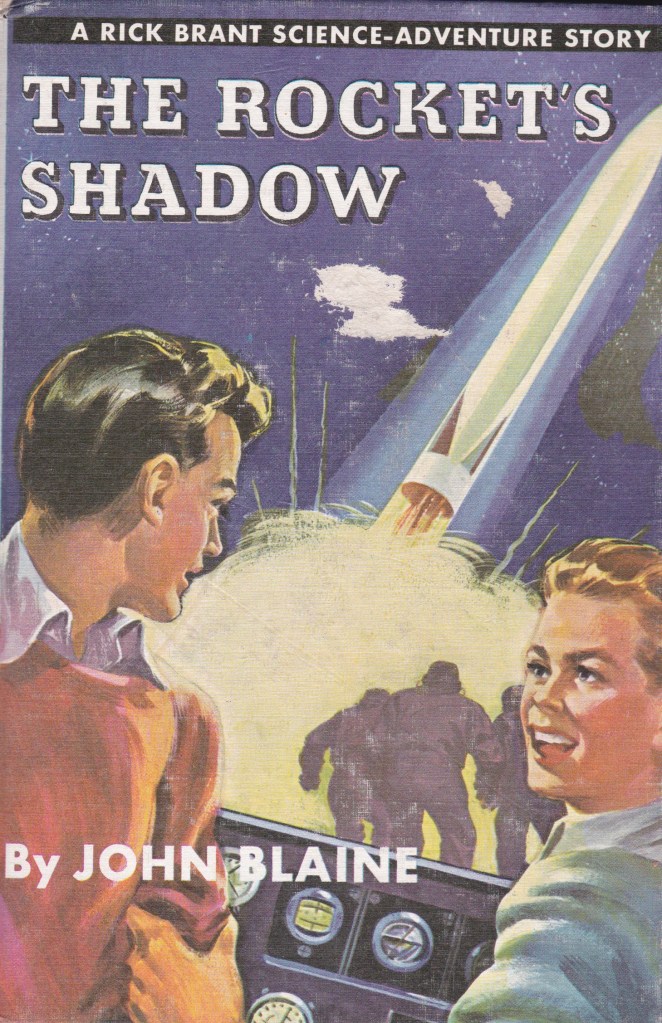
And so opens the first Rick Brant Science Adventure. I bought four Rick Brant books that day (The Rocket’s Shadow, The Egyptian Cat Mystery, The Flying Stingaree, and The Flaming Mountain), all of which had some appeal to me. I wasn’t really that much into science or rocket ships, but I did buy the first because it was, well, the first in the series, and OCD Child Greg had to read the first book. I didn’t have to read the series in order–I did try that with the Hardy Boys, but gave up when it was time for Book 4 and the title, The Missing Chums, didn’t excite me so I got one of the later volumes, The Mystery of the Aztec Warrior instead. There was a pyramid on the cover. I’ve always been a sucker for pyramids–but I always felt obligated to eventually get to the first volume of every series. It wasn’t always necessary, but in some cases–The Three Investigators, Trixie Belden, Judy Bolton–they really did set the stage for the rest of the series and it helped to have read the first one.

I’ll be completely honest here, too: I was never good at science. I don’t know why that was, but I just was never good at any of it–biology, chemistry, physics; math and science were my two Achilles heels. I only read a couple of the Tom Swift books, and even those were because one was reissued in paperback and renamed In the Jungle of the Mayas (the Mayans built pyramids!) but I got the impression the Swift books were more about science than a case or a mystery or anything. The Rick Brant series, on the other hand, while having some insane titles (The Electronic Mind Reader, The Wailing Octopus) like all series did, there were also some that were called “mysteries.” So, yes, science, but also mystery.

I also had no idea it was going to become one of my favorite series.

When I first read The Rocket’s Shadow in the late 1960s/early 1970s, it was already significantly dated. Originally published in either 1946 or 1947, the background to the story was that the scientists on Spindrift Island, off the coast of New Jersey, were trying to build a rocket to send to the moon. Several different groups were trying to accomplish this, and whoever succeeds first was going to get a very lucrative government contract…and their efforts are being sabotaged. Rick’s father, Dr. Hartson Brant, is world-renowned, and of course Rick is very interested in science and is always inventing things to either save time or effort, and they aren’t usually very practical, even though they do work. Rick and his younger sister Barby go to school on the mainland–Spindrift is separated from the coast by tidal flats that are underwater during high tide–but everyone on the island is determined that their rocket will succeed and they’ll catch the saboteurs.

Rick soon figures out a clue and gives chase to some of the saboteurs, who turn on him and attack him–only he is rescued by a blond hitchhiker carrying a military duffle. He and Rick run the attackers off, and then Rick brings his new friend, Don Scott–“Scotty”–home with him because he has no place to go. He’s out of the military and has no family, was just wandering the roads to see where he wound up. The close bond between Rick and Scotty1 resonated with me, especially their sense of camaraderie and affection for each other. They had no girlfriends or even any girls who might be potential dates at first (some were introduced in the series later, Barby growing up for Scotty and a new scientist comes to the island and has a teenaged daughter Jan who is sort of an interest for Rick–but the girls are never more important to them than they are to each other.2

Obviously, by the time I got and read the book we were already into the Apollo space programs from NASA, and we landed on the moon in 1969–so all the science in The Rocket’s Shadow was off and wrong–also the rocket got there in like twenty minutes, not possible even now–and as such, the series could never really be updated and revised like the Hardys and Nancy Drew. The Rocket’s Shadow would have had to have been completely rewritten, and I’m not sure how you could introduce Scotty as a hitchhiker/war vet (he lied about his age) today.

I enjoyed all the books in the series. I did eventually get them all over the years and read them, and many of them are dated. High tech walkie-talkies don’t seem so impressive in a cell phone world, and of course, there are some trips to foreign lands (Asia and Pacific Islands) that are probably more than a little racist and dated now. But I loved The Lost City, where they are off to Tibet to set up a radio receiver on the opposite side of the world from Spindrift to triangulate with the rocket on the moon, and they discover a lost city of Mongols and the tomb of Genghis Khan. They also meet, in that book, an Indian youth named Chahda who helps them out and becomes basically a member of the family, and they take him off the streets of Delhi and pay for him to go to school. Chahda was incredible smart and adventurous too–but not sure how he’d hold up under modern scrutiny in these more evolved times.

And maybe when I’m retired I’ll reread the series critically. The books can be found on ebay and second-hand sites; some are available as ebooks, either on Amazon or Project Gutenberg.

  1. I am even now wondering if this character is why I’ve always liked the name Scotty, and have used it repeatedly for characters of my own creation. ↩︎
  2. I do find in also amusing that my parents–so worried about me reading books about girls instead of boys; did they not understand just how homoerotic the relationships between boys in these books were. This amuses me greatly now. ↩︎

Regret

I rebooted my life when I was thirty-three years old.

I had already started the process of merging my two lives into one, but I had thought that process would make me happier than I had been since I wasn’t pretending to be someone I wasn’t anymore, and badly, for that matter. I thought all of my problems, you see, had to do with being closeted and living two separate lives, and merging them and being myself for the first time would make me happy and once unleashed from my prison, all of my dreams would come true. That didn’t happen, and I was just as at sea in the queer world as I had been in the straight one. I didn’t really know how to be out. Part of the hard reboot was the decision to never look back at my past, to stay in the present and look to the future. The past was painful, I wasn’t proud of it, and I wasn’t that person anymore.

And truth be told, I didn’t like that person very much.

But since Mom died last year, I’ve been on a voyage of self-discovery and reflection which also entailed looking back at my life and its various stages. Looking back and relitigating my childhood and my early adulthood is a waster of energy, but I’ve found that the passage of time has softened the edges some and put a cheesecloth over the lens in my brain.

Queer kids don’t get to have the same kind of childhood, puberty and high school experience the majority of kids do, and as such our development of our sense of self often gets stunted. (I think this is still true, even though more people are coming out earlier and earlier every year.) We don’t learn how to date and fall in love and all the practice kids get with relationships in high school. I did date, but as The Only Gay Boy in Kansas (which is what I believed) I dated girls, which was unfair to both them and me; something I’ve been a bit ashamed of all these years–the girls deserved better than that, but not dating, not going steady with a girl, would have marked me as an even bigger outcast and weirdo…and all I wanted in high school was to be “normal”… or like everyone else. I realized that my normal was different than most people’s, and now…now I am not as bitter or get as angry about how I was treated, shamed, humiliated, and embarrassed by ignorant kids who clued into my difference and used it as a weapon against me. Sure, they were monsters, and learning that there were literally no straight people I could ever trust is something that I have carried for the rest of my life: straight people can’t be entirely trusted, even the ones who say they like you–and most of them will always let you down eventually.

Not all of them, of course, but I am never surprised when it happens. I never let people completely in, to this day. Paul was the first, and there have been some others over the years, too. The teen years, and my twenties, were very scarring. I turned 21 in 1982, and was trying to figure out how I was going to live the rest of my life. I think had it not been for HIV/AIDS, it wouldn’t have taken me so long to reconcile my warring selves. HIV/AIDS made it even harder for me to come out. I heard all my straight friends making gay jokes and hateful AIDS jokes and knew I couldn’t trust them; being myself would have meant losing my life as I knew it then–and for some reason, despite being miserable in trying to fit again into a square hole as a round peg, I thought I would be even more miserable if I came out. My “secret” friends were all dying, and I would go from a hospital ward back to the fraternity house where I got to listen to my “brothers” make AIDS jokes, and make jokes about my own sexuality, which drove me even deeper into the closet.

Language matters. And crude, coarse jokes based in identities are damaging to the people who hear them, especially when it comes from people you thought were your friends. But by all mean, yes, I get how using slurs and other language to convey contempt of other people is something you should be able to use and not made to feel about it (eye roll to infinity). I mean, free speech, amirite? It’s always funny how people think that means freedom from consequence.

How do I feel about it? Let’s just say almost everyone who was a shit to me back then has died horribly in one of my books or in a short story…and I definitely smiled while writing their death scene. I used to obsess over my past, reliving the slights, hurts, and other indignities inflicted upon me over the course of my life by homophobic garbage. But looing back was always painful, with so much regret…and then I decided I was going to live the rest of my life without regret, and I would no longer regret anything about my past. My new rational was, everything that happened to me my entire life shaped me into the person I am, so if I am pleased with my life I shouldn’t have regrets about anything, right?

This was the hard reboot at thirty-three, when I decided I wasn’t happy with how my life was going and so I wanted to change things, shake it up a bit. I no longer wanted my life to be something that happened to me, but rather something I made happen. I essentially let go of all the pain and regret and misery that came before and closed it all off in my mind, only reaching back in there for memories to use in my writing. Writing about some of these situations also gave me a better understanding and more perspective on what happened and why, and also opened my eyes a little bit to the people who inflicted damage on me. I didn’t grow up overnight, of course, but these realizations about my past, my life and my identity rebooted my life from the slow-moving train-wreck it seemed to be for so long, one where I felt I was just a sideline observer to my life, letting it happen rather than trying to make things happen for myself, I was waiting for life to simply drop opportunity into my life for no other reason than I was me and deserved it. I used to think that good fortune and good luck didn’t come my way because I didn’t deserve it, while having all of my dreams mocked and belittled or told they were unrealistic or unattainable for someone like me, whatever the hell that was supposed to mean. I grew up thinking I was a weirdo, an outsider, and destined for failure–and you hear things like that enough, you start believing them, you know?

I decided to prove everyone wrong and close the door, once and for all, on my past; that Greg no longer existed and there was a new Greg in town. Part of that included refusing to look back and feel regret; my thought was that having regrets negated your current happiness, or your opportunity to actually be happy and feel settled; because had you not had the experiences, or responded to them the way you had, your life would be on a different path and while it could certainly have turned out better than it had, it also could have turned out worse. There’s nothing wrong, I believed (still do), in being content with your lot while still striving and feeling ambition for more, nor did I believe that either invalidated the other. I’ve been pretty happy for quite some time, overall; so how can I wish something hadn’t happened the way it had, or something turned out differently? That would change the course of my life, and not necessarily for the better.

And I am learning more about myself, and I think I see myself more clearly now than I ever have before. I love my life. I love Paul, New Orleans, my day job and my writing career (not necessarily in that order, but Paul is always first). I’m finding that there’s a lot of things in my past that I can also mine for my work, which is very cool; certainly a lot more than I thought. I am feeling ambitious about my writing again, which is something I’ve not felt in a very long time, so I am actually excited about writing for the rest of the year and all the things I should be able to get done.

I’ve certainly come a long way since I was that kid in Kansas with big dreams.

Only You (And You Alone)

Ah, Thursday and my last day in the office for the week. Awesome. Yesterday morning I once again did the old “don’t leave the house until 7:30” again, and once again I wasn’t groggy or tired by the time I left the house. Bizarre how that minor shift in how my days are structured has created such a significant change to everything. I really need to remember to pay attention to routines before they become ruts, so I can change them and avoid said rut.

I did finish the first draft of a short story Tuesday night, and I am most pleased with it. I am writing it for an open call for an anthology, and I am very pleased that I got a first draft done long before the deadline. (I’m still bitter about missing the Chessies anthology deadline, for which I was working on three stories. Note to self: never write three stories for a submissions call because you think it sounds like a great idea. It is not, nor is it ever, a good idea.) Yay, me! I also decided to work on revisions of some other stories in progress; I am still struggling working on this book, but I’ve also decided I need to really immerse myself in it for at least one day so I can get a handle on this plot and figure out where it’s going and what needs to come in and what needs to come in so that I really feel like I have a grasp on the characters and the story. Those stories in progress are the first drafts I never got a chance to revise for the Chessie anthology, and all three will fit snugly into the end of my short story collection…so technically, if I can get the three stories whipped into shape, I can also go ahead and get the collection turned in. Huzzah! All three of the stories are actually ghost stories of a sort; “Passenger to Franklin” needs some serious revision, and so does “When I Die,” which is a terrific concept and really needs some work too. I think I can get one of my oldest and most beloved stories of my own whipped into shape and added into this collection as well, which just goes to show–never discard an idea or throw out a story because you’ll eventually come back to it someday.

I wrote out the opening paragraphs of the next Scotty, which I want to write this fall and hopefully get turned in around November or December. I am pretty pleased with the plot and story of this one, too, but I also need to spend some time brainstorming the plot and how it twists and turns around and turns out. I still haven’t dipped into my Paul Tremblay yet, and I think I may save it for Sunday morning reading over my coffee. Saturday morning I am going to reread/skim Death Drop so I can get a better feel for the current WIP and make sure I have the voice right, which I don’t think I do yet, which is also why I think I am having so much trouble writing it. It’s always a struggle for me to write a book when I don’t hear the voice of the character in my head, so I need to get it there ASAP.

I feel like I am making progress with my writing, even if working on the book is like pulling recalcitrant teeth.

I feel pretty good this morning, a little tired perhaps, which is oddly different that the past few weeks, when I was tired earlier in the week and felt more rested as the week progressed. This of course made no damned sense at all, but that’s okay. Few things in my life have ever made sense, and a lot of it probably is related to the anxiety and medications, as well as this week’s change in schedule. Last night when Paul got home we watched the first episode of The Sympathizer, which was very intense. I loved the book, and the new series is actually quite excellent–but more on that as it develops, obviously. I also managed to fold the laundry and do a load of dishes. I also picked up two new books, the new Scott Carson (aka Michael Koryta) and the new Alyssa Cole. I want to get some serious reading done this weekend as well as some cleaning and writing, and I also need to get my taxes completed this weekend and off to my accountant. An odious chore, to be sure, but a necessary one. I also have a lot of errands to do this weekend–we need to go to Costco, I need to make groceries, and of course there’s a shit ton of cleaning that needs to be done. I will need to work on reorganizing the freezer/refrigerator tonight in order to make sure there’s room for what we pick up this weekend.

And on that note, I am heading into the spice mines. Have a lovely Friday Eve, Constant Reader, and one never knows, I could be back later.

Mistaken Identity

I became a fan of Patricia Highsmith in the late 1990’s, although I’d been a fan for a lot longer–I didn’t know she’d written the book that Hitchcock’s magnificent Strangers on a Train was based on. It was the release of the Anthony Minghella film version of The Talented Mr. Ripley that finally got me to start reading Highsmith; I read the book on which it was based and I became a big fan of Ripley, the queerness of the story, but the film never really resonated with me the way the book did…and I think it was acting and directorial choices. Damon also played Ripley as a nerdy, socially awkward type desperate for friendship and for love, and while I think Highsmith definitely created him as a striver, his striving had a lot more to do with sociopathy than unrequited love. It never made sense to me in the movie that he started impersonating Dickie on his way to Italy. Why would he do this? Was he trying to transform into Dickie before he even met him? (Whether Tom actually did know Dickie before the Greenleafs hire him to go to Italy isn’t clear in any adaptation of the story, including the novel–which I’ve not read in a while, so my memories of the book aren’t to be trusted. I should probably read it again sometime this year, to help me with my essay on Saltburn... and I should also read Brideshead Revisited.)

As a Highsmith fan fascinated by her mind and talent as well as someone who’s been interested in her Tom Ripley character–I never read the four other books in the Ripley series; I wasn’t terribly interested in seeing how things went for him after the first book ended–primarily because of the potential queer undertones in the relationship with Dickie. In the Minghella film, Tom does make a move on Dickie–and this is where, in the movie, Dickie completely changes his attitude toward Tom and just wants to get rid of him. I think this particular scene is where the audience’s sympathies are now fully with Tom going forward; we’ve all been rejected by someone we loved, and many of us have been rejected as cruelly and nastily as Dickie turns on Tom, and poor heartbroken Tom who has now had all of the rugs pulled out from underneath him…we are fully on board with him from hereon out; I certainly wasn’t sorry when Tom snaps and kills him in the boat. This motivation, I think, is a failure in the script; Tom is a sociopath incapable of feeling, so it never made sense to me in the movie. (I do not remember how this played out in the book, which is yet another reason I need to go back and read it again.)

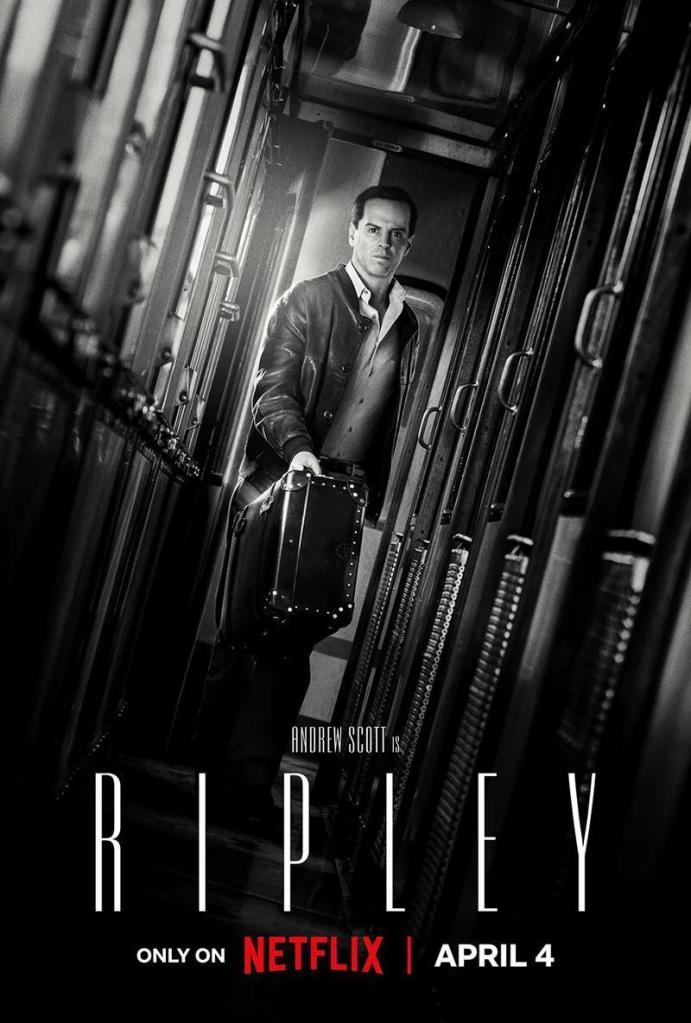
I had already been thinking about Ripley a lot lately; since watching Saltburn and trying to see the inspirations there to compare the two. I’d been looking forward to the Netflix adaptation–which I think is going to go further into the Ripley series, beyond the first book–since it was announced; one can never go wrong with Andrew Scott in a lead role.

But the series is an entirely different animal than the Anthony Minghella film from the late 1980’s, and I realized, while watching the series, that I had always viewed the novel through the lens of that movie….and now I need to read it again.

It’s fun, though, when an adaptation can give you another reading of a book; every time I’ve read The Talented Mr. Ripley I’ve viewed it a new way–but always through that Minghella lens; the only other book I’ve read differently on a reread (every reread, really) is Rebecca.

High praise indeed.

The queer undertones from the original story are still there in this mini-series, but Andrew Scott plays Tom as older and as an already career criminal, committing check fraud and insurance fraud on a very small scale. He lives in a shitty place, barely has the money to live decently, and these little frauds he perpetrates aren’t big time enough to ever earn him a big score. (It also reminded me of how, in pre-Internet and cell phone and computer days, how easy it was to swindle people.) When he gets the chance to travel to Europe to try to persuade DIckie to come home, it’s just another step, another con, a new opportunity to begin life anew in another country and get to know Dickie and perhaps infiltrate his life. As he’s so well established already as a con man and small-time crook, his pretending to be Dickie on the cruise ship makes more sense, and takes on a more sinister tone. The black-and-white cinematography was beautiful, languid, and breathtaking. The pacing of the series is tantalizingly slow, which seemed at first to be a slow-burn and a major risk; I do remember thinking how are we ever going to sit through eight hours of this? But as the story progresses and Tom’s cons and crimes become more complex and clever, it all makes sense. It makes sense that he would kill Dickie and take his place when Dickie tried to get rid of him (in the series, why Dickie would go out to sea alone on a boat with someone he’s trying to get rid of and thinks could be dangerous struck me at first as insanely stupid–but it was all of a piece with Dickie and his arrogance. He’s a rich white American, no one would ever dare harm HIM, right?), and the rest of series seems to fly by as Tom continues fooling everyone by never letting anyone who knows him as Dickie meet Tom, and the people who know him as Tom never see Dickie. Superb, and Andrew Scott was fantastic as Ripley; I felt like this was the version of Ripley Hitchcock would have given us.

At one point, Paul turned to me and said, “It’s funny how you root for the sociopathic killer,” and I replied, “because the rich people are horrible, and you want to see them suffer.”

And that’s the true genius of Highsmith; she doesn’t make Tom sympathetic, but by putting us into his mindset and seeing everything from his point of view…you start rooting for the sociopath because he’s the most sympathetic character in the book.

Which is a view of the rich I can certainly get behind.

Highly recommended, and I am looking forward to the next season.

Broken Hearted Melody

Ah, Wednesday and the midpoint of the week has arrived. It’s been a good week so far; I’ve not been super-tired at all this week and I think the shifting of my arrival at work from 7:30 to 8 was a smart decision. I imagine, though, it’ll eventually start getting difficult for me to get up later as it has getting up earlier, once I am used to the change. In other words, it won’t feel like I am getting to sleep late eventually.

I saw something interesting yesterday on social media that really resonated with me: Your life should not be a museum, and that’s kind of what my mentality has been. I tend to get stuck in ruts so easily, and I like to accumulate things that have meaning to me (have I introduced you to my library yet?), but do I really need to keep these “artifacts” of my past? I never look at these things, rarely have anyone over to see them, so therefore what is the point? Everyone at the day job laughs about how, at a co-worker’s wedding last fall, someone made a joke about how I always wear Crescent Care T-shirts to work and were surprised to see me outside of the office and wearing something else–and since the joke was made, I’ve not worn one. Not once. I had started wearing them every day during the pandemic when I came to work and it was a further simplification of my life: I didn’t have to pick out something to wear to work, But when he made the joke, I wasn’t offended, but it did kind of snap me out of a rut. You have plenty of other clothes you never wear, and they aren’t doing any good hanging in the closet, I realized finally, so I started wearing my clothes instead of the work T-shirt. I generally don’t care about clothes most of the time but I eventually get to the point, periodically, where I’ll get interested in clothes again and will buy some–I had a shoe experience earlier this year, and now have two gorgeous new pairs of shoes to show for it.

So, why not buy some more Polo style shirts in colors I generally don’t wear or don’t have in the closet? Yes, that’s my way of saying that I did order some new shirts for work yesterday.

Yesterday was also the fifty-year anniversary of women being able to get their own credit cards without their husband or any kind of male co-signer. I remember when this happened, by the way, and I also remember when my mother got her very first credit card; it didn’t have her name but rather Mrs. My Dad. I remember thinking, “yeah, but it’s STILL technically his name.” People also don’t remember that about fifty years ago was when women/wives stopped being subsumed into their husband’s identity at the expense of their own: I am constantly amazed by plaques commemorating civic leaders and donors that list women as Mrs. Chanse MacLeod or Mrs. Scotty Bradley. Women had no identity beyond their husband once they were married. They couldn’t get bank loans, and I am not sure about bank accounts, either, for that matter; women were basically chained to their husband for life and if she got a divorce, she was basically screwed. Once women had financial freedom and no longer needed a husband…well, the divorce rate rose significantly, which is why men were so opposed to treating women like equals.

“What, you mean I have to convince her to marry me? Spinsterhood and divorce aren’t unpleasant fates anymore? That’s it–women need to be controlled.

Sigh.

We also finished The Gentlemen last night, and I was very pleasantly surprised that it did have a most excellent finale. I don’t know if there will be more seasons, or if it was merely a mini-series, but I really enjoyed it and kind of am in the place where I worry about the continuation; so many shows go on long past their expiration date (looking at you, Friends and Thirteen Reasons Why) and lose me in a later season. (I really worried about it with Ted Lasso.) But we’ve got some other shows lined up to watch, I think the national finals for college gymnastics is on this weekend, and I also would like to get some more writing done this weekend. I did write last night on revising a short story, but today I am going to get back to work on the book (and hopefully finish the short story). It’s been a good and productive week thus far, and I really like this “go in later” thing I accidentally stumbled over on Monday morning. I made it through the day yesterday without getting tired, and I felt good when I came home to His Majesty Sparky, who is now addicted to the squeeze treats I bought for him. But I only have one more day in the office this week, and suddenly it’s the weekend again. I also worked on my taxes a bit more yesterday. Sigh.

And on that note, I am heading into the spice mines again. Have a lovely Wednesday, Constant Reader, and I will be back probably a little later.

What’d I Say

Tuesday morning and I slept well again. It’s kind of amazing what a change to my day getting up a mere ten minutes later can make. Yesterday morning I had to swing by the Cat Practice to get his Royal Sparkiness food when they opened at eight. I wound up getting to the office around eight fifteen, and I felt alert and awake all day. Was it a one-time thing perhaps? Well, sleeping ten minutes later again this morning and planning on leaving the house for the office a bit later so I don’t have to rush may make a difference for today too, so we are experimenting with leaving later and staying at the office later and seeing if that also makes a difference today as well. After work, I swung by uptown to pick up the mail, which included my first foray into poetry reading, Mary Oliver’s Why I Wake Early, a recommendation from Carol Rosenfeld, which I am looking forward to delving into. I also got my Frances and Richard Lockridge short story collection from Crippen and Landru, and the new Scott Carson (Michael Koryta) Lost Man’s Lane, which should be quite fun.

Last night we watched more of The Gentlemen and Star Wars: The Bad Batch, which is kind of fun and very well done. We should finish The Gentlemen tonight, and perhaps move on to our next show to watch.

I can’t say that I was sorry to see that the homophobic right-wing bitch Beverly LaHaye passed away. Well, I am sorry that it took so long for that horrific piece of shit to die–more proof that evil never dies, like Mitch McConnell. I really hope she suffered, and that it was incredibly painful, so she was released from the pain only to have the pearly gates slammed in her fucking face and the hell-slide opened up below her feet sending her to join her true Lord and Master Satan in the lake of eternal fire. She founded the Concerned Women for America, by the way, which was the right-wing predecessors of Moms4Liberty and the vicious hateful pieces of trash who were horrified that I dared to speak to high school students about chasing their dreams. I hope it was a slow metatastic cancer that sapped her energy, her will, and made every waking moment a misery.

She deserved worse, frankly.

Yes I am petty–and proud of it.

And no, I have no sympathy for those who might be mourning her. She was a horrible person, and when you’ve harmed that many people–when it the purpose of your life to spread hatred and bigotry using Christ’s name (the ultimate in bearing false witness) you don’t get to expect people not to celebrate your passing. In fact, you should probably rethink your life if you think people will pop open champagne when they hear you’ve finally deservedly died and gone to hell.

I did write yesterday, about three thousand or so (probably more), which felt good. The book is still sucking incredibly, I might add, so I think I need to think about it some more and where it’s going. I also started working on a short story, “The Last To See Him Alive,” which I think is a great title and it’s working….so far. We’ll see how it goes today, though, won’t we? But I think working on the book first and then moving on to work on a short story may be the way for me to balance my creativity needs while getting everything done that needs to be done, or that I want to get done.

Speaking of poetry–did I mention here that I wanted to start reading it, and understanding it? Probably, since my memory is a sieve. Anyway, I have The Complete Poetry of Edgar Allan Poe on my desk, and the other day I opened it, just for the hell of it, to any page and it opened to his poem, “Tamerlane,” and I realized I’d gotten a short story title from it:

Kind solace in a dying hour!

And that’s where the title for “Solace in a Dying Hour” came from, so thank you, Mr.Poe and your poetry. I’ve also got story titles out of Shakespeare before, too, and I am glad I am going to start reading poetry and studying it. I’ve always felt like that was definitely a missing element in my education.

And on that note, I am heading into the spice mines. Have a lovely Tuesday, Constant Reader, and I may be back later, one never can be entirely sure, can one?

Home Cooking

I don’t remember how I initially stumbled across a movie from 1970 (or 1971, could have been 1969 for that matter) called Something for Everyone; all I know was it was during the pandemic. It’s a very dark comedy, and it’s so queer you’ll be amazed that it was from that time period. It was directed by Harold Prince (yes, that Harold Prince), and starred beautiful young Michael York and a glamorous post-Mame-on-Broadway Angela Lansbury. I loved the film, and really, if anything, it has a lot more in common with Saltburn than The Talented Mr. Ripley does. So when I watched it, I was delighted to see that it, like so many films, was based on a book, and I decided I wanted to read said book, The Cook by Harry Kressing.

“Based on” as it turned out, was a bit of a stretch.

One hill stood out. It was steeper than the others, and higher. Also, it had no peak. While the rounded, wooded tops of the surrounding hills undulated, one into the other, this one broke the rhythm with an abrupt, flat surface.

For a few minutes Conrad just stared, shielding his eyes from the sun. Then he dismounted and dragged his bicycle off the road. When he was out of sight he chained it to a tree and concealed his rucksack under some brush. Then he started up the hill.

It was an easy climb until near the top. There he discovered a sheer cliff. It was at least twenty feet high. But if it ran all the way around no one would be able to reach the plateau.

Nevertheless, he circumambulated rather more than half the hill without finding a break in the cliff face. He began to have doubts. Possibly ladders were required. They could be brought, or lowered down.

Disappointed, he increased his pace.

In his haste he nearly missed the stairway cut in the cliff face. The steps were very narrow and high, and at a nasty angle.

When he gained the plateau he encountered another barrier: a deep moat, with water in the bottom and smooth, sheer sides, encircled the fantastic castle-like structure. There was a single drawbridge, up and locked. There was absolutely no way across.

For the record, if you are ever asked for an example of a movie that’s better than the book, feel free to use The Cook filmed as Something for Everyone, because the movie is much better.

I’m not sure what I was expecting from the cook, but the underlying story, the theme, has to do with Conrad’s obsession with a castle that has been abandoned because the family that owns it no longer can afford to maintain it and have moved out to a smaller mansion. Both the book and the movie follow this central premise, the difference being the queerness. The Cook’s queerness comes from it’s upset of the status quo; someone coming along who takes charge of all the folks in this small area of Germany who are all just drifting along in their lives lazily. In the book, this is because he is such a master of cooking that no one can resist giving him what he wants once he feeds them. His mastery of cooking is so complete that he can make a delicious diet for someone and they can eat everything they want and lose weight; if they need to gain weight he can feed them to that end. Feeling ill? His meal will cure you, and on and on.

The book is more of a fairy tale with a primary moral to it–don’t be seduced by pleasure. In the book, the pleasure all comes from food and Conrad’s mastery is gained by his skills, and his strength of will. His dream is to have banquets of incredible food and great conversation in the castle, so he starts training his employers to be good hosts, spending money on serving wear of which they could be proud, and so on. The villagers and the family, which he marries into, eventually become such gluttons that no one ever leaves the palace and everything goes to waste. It’s a dark little story, very moralistic and very Kafka-esque in writing style.

I enjoyed the book, but I enjoyed the film much more. I watched it on Youtube, and I wish it could be restored digitally and released to streaming. I liked that the film had the same moral–only in the movie it was Michael York’s beauty and sexuality that provided the convincing pleasure to everyone involved. This would be an excellent film to remake with one of our amazingly sexy, beautiful and talented crop of young actors.

Drop Me Off In New Orleans

Ah, some more blatant self-promotion! I’ve done some on-line panels so far this year, which has been terrific. Here are the questions from one I did, turned into an interview so I can promote myself! I believe these questions were for a queer crime panel, and the credit for the questions goes to the one and only J. M. (Jean) Redmann; you can order her books here.

Why did you choose your characters and their professions? What drew you to them?

Hmmm. This is tough, because I have so many books and so many different main characters…I think I’ll stick to my two primary series to answer the question. I wanted to write about a gay private detective in New Orleans, and I wanted him to be a big man, a former college football player who may have been able to be a journeyman NFL player had he not been injured in his final college game. I wanted him to be uncomfortable in his gay skin, and the point of his journey throughout the series was to grow and learn until he was finally comfortable in that skin, and able to be loved and give it.

Scotty, on the other hand, was created as a stand-alone character and I wanted him to basically be the antithesis of Chanse; in which he had few if not hang-ups, was completely comfortable being a sexually active gay man with a snarky sense of humor covering an incredibly big and kind heart. He didn’t really need to grow much–he usually is the catalyst for other characters’ growth–but as he’s aged, I’ve really enjoyed his journey.

What attracted you to writing mysteries?

I always liked them. As long as I can remember, my two biggest reading passions were history and mystery, with horror/Gothics close behind. I would check anything out of the library with mystery, haunted, ghost, phantom, secret, or clue in the title. Then I discovered the series books–The Three Investigators, Trixie Belden, et al–and after that there was no turning back.

What does being queer/gay/lesbian bring to your story?

I think queer people have the outsider point of view down to an art form because that’s how we see the world–from the margins. The easiest way to critique society, the culture, and how people interact with each other is from a remove–and queer people see all of those things from a remove through no fault of their own. I didn’t have role models when I was growing up, at least to teach me how to be a decent adult gay human being, so I had to learn it all on my own for the most part. I’ve also been confused and mystified by American culture, philosophy, and society, because it wasn’t designed for people like me. When I came out, I was just at sea in the queer world as I always had been in the straight one, and I’ve never forgotten those experiences, either, and they also inform my work.

How do we deal with how the wider world deals with queer characters? Especially in these times?

It can be depressing, which is emotionally and psychologically dangerous. It’s bad enough experiencing homophobia, but then to immerse yourself in it in order to write about it? Even more horrific. Watching Pray Away this weekend made me furious with the ex-gay movement all over again; listening to queer people hating themselves and their desires in order to be at peace with God in some twisted way? But if God is infallible…this is the doctrine Christianity gets hung up on. They think we’re mistakes, but if their God is infallible, He had to have made us perfect and its willful sin or the devil whispering in our ears. This is their incredibly harmful and dangerous rhetoric. If God tests humans, perhaps he made queer people to test the faithful–and they are failing.

But they can never admit to that.

How do you deal with diversity? No author can be everything their characters need to be, how do you handle reflecting the wider world?

I write mostly about New Orleans, and beyond that, mostly the south with occasional forays into other areas of the country–upstate New York, Kansas, California–and you cannot write about a city like New Orleans realistically without having Black characters, period. New Orleans is a majority Black city. You also can’t write about the South without touching on the issues of race and a problematic history. I’ve always included diverse characters in my books. I don’t like to describe skin color, frankly, and most white writers do it in the form of food, which I find unsettling–do you want to eat them? Cinnamon skin, cocoa, cafe au lait, eggplant, dark chocolate, etc.–I’ve seen all of those used to describe skin color and it always makes me recoil because it’s so damned lazy. I don’t think I would ever write from the perspective of a Black character–there are plenty of Black authors who can do that more authentically, and given how most diversity pledges by major publishers also inevitably end up in quotas, I don’t want to take a spot from a Black creator. I do love reading work by racialized authors, but I would never try to write from that perspective.

How do you use setting? What does it bring to the story?

Setting is one of my strengths, I think, so I always use it to enhance my story. I am also very lucky in that I live in New Orleans, where anything can happen on any given day and you can never go too far over the top about anything–if anything, you have to tone things down to be believable. I think setting is important because it tells you so much about the characters–why do they live there, how has it shaped them, did they live somewhere else, how do they deal with the challenges, what annoys them, what do they love–and is an important foundation for your story.

How do your books start—not the book beginning, but the start of the process of writing the book. Where do the ideas come from and how does that coalesce into a book?

It usually is something I find interesting and I think I should write about that. Sometimes the ideas take years to coalesce and come together, sometimes they are immediate. The Scotty books inevitably begin with three disparate things I want to address in one book, and then I have to figure out how to combine them all into a story. The next Scotty’s prompts are evacuation, statute of limitations, and obsession. It’s coming together in my head enough that I think I’ll be able to write it this fall.

Once you’re writing, what’s your process? Outline? Write from start to finish?

I used to outline, but now I kind of have it in my head and then will only go back and outline when I am stuck, so I can see where I went wrong in the manuscript. I always write from beginning to end. I don’t know how people can write backwards! I’ve thought about trying it sometime, though.

What are the hard parts of writing for you? The parts you enjoy?

Definitely the middle. The middle is soul-destroying, and always triggers Imposter Syndrome. I also hate copy edits, but recognize them as a necessary evil.

I love the actual writing and revising and all of that. There’s nothing like putting down a good word count for the day, regardless of how bad those words might be. I think revising is magic: you take garbage and turn it into something terrific.

Which writers influenced you?

All of them, in one way or another. I especially love Shirley Jackson, Patricia Highsmith, Daphne du Maurier, and John D. MacDonald. Currently? Alison Gaylin, Megan Abbott, Laura Lippman, Michael Koryta, Alex Segura, Michael Thomas Ford, S. A. Cosby, Kellye Garrett, and Alafair Burke–there really are so many. I always take something away from everything I read, whether good or bad.

What are you working on now?

Right now I am writing a sequel to Death Drop, in the Killer Queen series. I also have a ton of short stories and novellas in progress, and I already have ideas for the next three or four (or more) books.

Any advice for newer writers?

Keep writing and keep believing in yourself, and keep reading.

Last words of wisdom?

If you want to be a writer, read Benjamin Dreyer’s Dreyer’s English and Stephen King’s On Writing.

Gotta Travel On

The Ides of April and Tax Day, huzzah. I’ve filed for an extension for mine because I just couldn’t deal with it before, which is kind of childish and more than a little immature; the key word here is avoidance. But I plan to get it all finished this week, God willing and the creek don’t rise. I am going into the office a little later than I usually do, because I have to swing by the Cat Practice to get Sparky’s food on the way to the office. It’s an Admin Day, so not a big deal for me to not be there as early as usual.

I feel rested and good this morning, which is a very pleasant change and surprise. I did go to bed a little early last night, but I spent most of the day writing in my journal, watching documentaries, and later on in the evening we watched more episodes of The Gentlemen. I also finally looked up the name of the star, Theo James, because it was bothering me that I recognized him and couldn’t place him. I am liking it a lot more than I would have thought, frankly; not being a big fan of producer/showrunner Guy Ritchie, but it’s actually quite fun. I also went down some rabbit holes of research yesterday, which is always a lot of fun for me. I also started reading Paul Tremblay’s The Pallbearer’s Club, which I had a little trouble getting into at first, but I remembered having this issue with A Head Full of Ghosts, too–like the latter, he’s playing with form and style and point of view in the former, which is a bit hard to get used to it, so it’s slow going (for me) at first, but as always, there’s such depth and compassion in his writing it’s easy to see why his career has taken off. I’ll try to read some more of it when I get home from work tonight, after I do the day’s writing. I am definitely planning on writing every day now, even if it’s just a little something. I made lots of notes yesterday in my journal, too, which was very cool.

I decided yesterday, when watching a lengthy documentary of LSU football highlights (I was doing this around chores, listening to the documentary while Sparky and Paul slept on the couch) that one of the problems I’ve been facing with writing lately, something I’ve talked about on here a lot, is how I’ve not really been able to focus all of my creative energies on anything that I am writing, but have any number of things in-progress that my mind keeps attention-deficiting between, skittering around between projects and ideas without really landing effectively on anything for long enough to get very far. Yesterday I decided, as I grabbed the journal and hit play on the documentary that I was going to free-form take notes and scribble out ideas as they came to me, regardless of what they were about or for, even if they were entirely new project notes. I did a lot of scribbling, and most of it focused on one project, which really needs to get done by the end of the year, as well as some others I was a bit surprised still were there and fresh in my mind. I also know now that if I rewrite at least three of these short stories drafts that I have on hand, that collection will be complete.

I also found the voice for a new project idea I’ve had in the front of my mind for a while, primarily because we watched those ‘troubled teen cure’ documentaries at the end of the previous week. I had an idea for one set in Kansas, based on a foster home where the kids went to my high school. I didn’t think much of it when I was in high school–other than how much harder those kids had it than the rest of us–and sometime in the years since high school I thought, I could write a crime novel around that story even though it would entirely be fictional and the real place was simply a starting point for my fictionalization. The title came to me this weekend–The Crooked Y–and so that’s definitely moving up the list of “what to write next.”

As you can tell, writing is becoming more important to me and it feels good for my mind to be creating again, even in this current ADHD way, which is so much better than the dry well experience I’ve been having since…well, since Mom died, really. 2023 was a lot of personal trauma; and relentless from January on, which makes it not surprising, I suppose, that my brain has been fallow for so long.

And on that note, I am going to start getting ready to head into the spice mines for the day. Have a great Monday, Constant Reader, and I may be back later.

Floridays

Michael Koryta is one of my favorite writers.

I may not have discovered him had I not been an award judge one year, and his book So Cold the River was entered. I absolutely loved the book, that perfect hybrid of crime and horror that is so often far too hard to find, let alone have it be done well. The Prophet and The Ridge cemented his place as one of my favorite writers. I had bought The Cypress House when it was new, but somehow had never gotten around to reading it–there are several volumes of unread Koryta books that I am looking forward to getting to at some point. I know I picked it up and started it at one point, but something happened to distract me and I never got back to it. Last weekend, I finally decided it was time.

And I am very glad I chose it at last.

They’d been on the train for five hours before Arlen Wagner saw the first of the dead men.

To that point it had been a hell of a nice ride. Hot, sure, and progressively more humid as they passed out of Alabama and through southern Georgia and into Florida, but nice enough all the same. There were thirty-four on board the train who were bound for the camps in the Keys, all of them veterans with the exception of the nineteen-year-old who rode at Arlen’s side, a bou from Jersey by the name of Paul Brickhill.

They’d all made a bit of conversation at the outset, exchanges of names and casual barbs and jabs thrown around in that way men have when they are getting used to one another, all of them figuring they’d be together for several months to come, and then things quieted down. Some slept, a few started card games, others just sat and watched the countryside roll by, fields going misty with late-summer twilight and then shapeless and darl as the moon rose like a watchful specter. Arlen, though, Arlen just listened. Wasn’t anything else to do, because Paul Brickhill had an outboard motor where his mouth belonged.

What a great opening.

Koryta is an exceptional writer. He doesn’t always blend the supernatural/horror into his crime novels, but I love it when he does–very few authors (Paul Tremblay being one of them) who can deliver such extraordinary hybrid work. I’ve loved every Koryta novel I’ve read–there was one about caves that absolutely terrified me, being claustrophobic and afraid of the dark, so much so that I never did read the sequel–it got under my skin that much. (I will read the sequel, never fear!) He has also started using the name Scott Carson for these hybrid books, to differentiate them from the straight-up crime novels.

The Cypress House is a historical novel, hard-boiled and noir to its core. Set in the 1930’s during the Depression, Arlen and Paul’s journey is about finding work at government projects–they are heading for the Florida Keys to build a highway connecting the keys to mainland Florida. Arlen is a WWI veteran, a survivor of the horror that was the Belleau Wood..and it was during his service in the war that he began seeing premonitions of death in people–their eyes are filled with smoke, and he knows they are going to die. As they speed through the night in Florida, he starts seeing smoke in the eyes of everyone on the train, and knows they have to get off the train, which they do at the next stop. Paul isn’t sure he believes Arlen, but he’s attached himself to the older man like a puppy, so he also doesn’t get back on the train.

They later learn a hurricane swept through the Keys and killed everyone on the train.

The two men accept a ride to a work camp in Tampa, which winds up with them at the Cypress House, a beachfront “resort” on an inlet in the middle of the swamp jungles which is a mob front…and meet the beautiful Rebecca Cady, who runs the place. When their driver’s car explodes, they are now stuck there–and are thrown in jail for their trouble by the corrupt local sheriff and judge, Solomon Wade, who is connected to the mob all over the country and runs drugs in through the inlet. Arlen decides to help Rebecca, whom he is falling in love with, and then all hell breaks lose.

Koryta is a master of building suspense and tension, and the chapters where the three of them are riding out a hurricane/massive storm surge was absolutely chilling and terrifying, especially when you’ve done that yourself. The historical setting is apt, and as I have said before, a lot of remote places in the South are still run this way–an authoritarian sheriff and other politicians who are essentially tin-pot dictators. This book reminded me of great Florida novels of the past–John D. MacDonald and Robert Wilder’s Flamingo Road spring to mind–and this would also make a great movie.

The Cypress House is yet another feather in the cap of Koryta’s canon. Highly recommended. You should be reading Koryta/Scott Carson. Fix that if you’ve not.