I Will Follow You Into the Dark

I’ve always thought that my favorite two literary genres–crime and horror–were flip sides of the same coin. I sometimes reduce my theory to the barest of bones–both are about death but in crime the monsters are human. Horror novels always have elements of mystery and suspense woven into the story–there are always characters trying to figure out what is actually going on, and usually suspecting humans, only to find out it is not–and there’s also a lot of death. You have to figure out what is causing those deaths, and the best horror novels seem like straight-up mysteries until you find out otherwise. I didn’t really start reading horror until Stephen King and Peter Straub, and much as I love the genre, my first love will always be mysteries…but reading the kids’ series, with all their phony ghosts and hauntings and phantoms and spirits, got me really interested in the concept of ghosts–something that stays with me to this very day. (I mostly write about ghosts when I try horror; because Gothic is my absolute favorite and that runs across both genres.)

This is one of the reasons I fell in love with Michael Koryta’s novels. The first I read was So Cold the River, which was more of a ghost story/mystery about a haunted and cursed resort hotel in Indiana, which was a wild ride and great fun to read. He’s also written some other crime novels that crossed over into the supernatural; The Ridge was another favorite. I also wondered how he was writing both straight up crime fiction and sometimes supernatural styled mysteries; I was always told you couldn’t write in two genres like that under the same name.

And then he started releasing those types of novels under the name Scott Carson, so maybe there is something to that old publishing truism? I don’t know why he rebranded those books under a different name and it’s none of my business other than to satisfy idle curiosity. But I did recently finish one of his Scott Carson novels, and Where They Wait is an excellent illustration of the blurred line between horror and crime.

I was never a dreamer.

I mean that in the most literal sense. Figuratively speaking, I absolutely consider myself a dreamer. Aspirational, at least. Optimistic? To a point, although my profession–journalism–mandates a certain cynicism. When I say I was never a dreamer, I mean at night, in the depths of sleep.

No dreams. Just didn’t have ’em. Not good, bad, happy, or sad.

Slept well, though. I slept well. That’s hard to believe these days, but I know that it was true once.

People talk about their dreams all the time. I dated a woman for a few years who would wake up and recite the bizarre and vivid stories that had accompanied her through the night. Sometimes, I’d be tempted to pretend that I could share the experience. Dreaming sounds normal, right? Seems like something that should happen to all of us. And yet we don’t know much about the mechanisms of dreams, for all of our scientific research and psychological theorizing. We believe dreaming is tied to memory, that REM sleep is an archival process. We believe dreams are indicative of repressed emotions, or perhaps harbingers of maladies that haven’t yet offered physical symptoms. Warnings. Messages from the dead. From God. We believe all of these things and more, but what we know is this: dreams are still not fully understood after all these years. They come and they go.

For most people, at least.

I have always been interested in dreams, and what they say about our psyches and consciences. I’ve never studied the psychology of dreams–what little I did read was all supposition and theory, as there is no real answer to what dreams mean–is it just our brains doing freestyle, like a jazz singer bopping up and down the scales using their voice as an instrument, or are they the key to who we are, our hopes and dreams and traumas? I like to play around with dreams a lot in my work, since there is no real consensus on why some people do and some people don’t, why some remember their dreams and why others don’t; do people not remember their dreams because there’s nothing to remember, and on and on from there.

But dreams are at the heart of this chilling and masterful suspense novel, which is really more about tech horror than anything else. Our main character is a journalist who reported on the Afghanistan war, has recently been laid off from his job, and gets a call from an old buddy from the area where he grew up to write a puff piece on a local tech company and it’s newest development; a wellness relaxation app which sounds like every other relaxation app–other than it’s not. Given the latest version of the app to experiment with and write about, it starts affecting him in dreams–scary nightmares about an a shipwreck, and ghosts coming to visit him ,and the dreams are so incredibly vivid that he’s not entirely sure whether they were dreams or not. And as he discovers more, he finds that everything to do with the app is connected to him in some way, as his dreams become more vivid and sometimes waking; to the point he’s not sure if things are actually happening or he’s losing his mind.

This book was fantastic: the story is great, the pacing fantastic, the characters absolutely real–and the horror is terrifying, absolutely terrifying. Carson knows how to build suspense and suck the reader in along for the ride.

Highly recommended.

We Will Rock You

While I was in Kentucky, the Anthony Award finalists were announced, and as always, a friend-studded list. So many great books (and people) listed here. Congrats to all!

BEST HARDCOVER NOVEL

  • All the Sinners Bleed by S.A. Cosby
  • Everybody Knows by Jordan Harper
  • Time’s Undoing by Cheryl A. Head
  • Face of Greed by James L’Etoile
  • The Last Devil to Die by Richard Osman

BEST PAPERBACK NOVEL

  • No Home for Killers by E.A. Aymar
  • Hide by Tracy Clark
  • Because the Night by James D.F. Hannah
  • The Taken Ones by Jess Lourey
  • Magic City Blues by Bobby Matthews
  • Lowdown Road by Scott Von Doviak

BEST FIRST NOVEL

  • The Peacock and the Sparrow by I.S. Berry
  • Play the Fool by Lina Chern
  • Scorched Grace by Margot Douaihy
  • Mother-Daughter Murder Night by Nina Simon
  • City Under One Roof by Iris Yamashita

BEST CHILDREN’S/YA

  • Finney and the Secret Tunnel by Jamie Lane Barber
  • Myrtle, Means, and Opportunity by Elizabeth C. Bunch
  • The Sasquatch of Hawthorne Elementary by K.B. Jackson
  • The Mystery of the Radcliffe Riddle by Taryn Souders
  • Enola Holmes and the Mark of the Mongoose by Nancy Springer

BEST CRITICAL/NONFICTION

  • Finders: Justice, Faith, and Identity in Irish Crime Fiction by Anjili Babbar
  • Spillane: King of Pulp Fiction by Max Allan Collins and James L. Traylor
  • A Mystery of Mysteries: The Death and Life of Edgar Allan Poe by Mark Dawidziak
  • A Fever in the Heartland: The Ku Klux Klan’s Plot to Take Over America, and the Woman Who Stopped Them by Timothy Egan
  • Fallen Angel: The Life of Edgar Allan Poe by Robert Morgan
  • Agatha Christie, She Watched: One Woman’s Plot to Watch 201 Christie Adaptations Without Murdering the Director, Screenwriter, Cast, or Her Husband by Teresa Peschel
  • Love Me Fierce In Danger – The Life of James Ellroy by Steven Powell

BEST ANTHOLOGY/COLLECTION

  • School of Hard Knox, edited by Donna Andrews, Greg Herren, and Art Taylor
  • Here in the Dark: Stories by Meagan Luca
  • Happiness Is a Warm Gun: Crime Fiction Inspired by the Songs of The Beatles, edited by Josh Pachter
  • The Adventure of the Castle Thief and Other Expeditions and Indiscretions by Art Taylor
  • Killin’ Time in San Diego: Bouchercon Anthology 2023, edited by Holly West

BEST SHORT STORY

  • “Real Courage” by Barb Goffman
  • “Knock” by James D.F. Hannah
  • “Green and California Bound” by Curtis Ippolito
  • “Ticket to Ride” by Dru Ann Love and Kristopher Zgorski
  • “Tell Me No Lies” by Holly West

Let’s Kill Tonight

I had never read Jim Thompson before this past week.

I knew of him, of course; it’s very difficult to be a crime writer/reader and not to have. He probably isn’t as revered as authors like James M. Cain or Patricia Highsmith, but he also wrote dark stories about outsiders from society living on the fringes who tend to do whatever they need to in order to go on surviving, and that’s the kind of fiction I’ve always enjoyed reading for the most part. I kind of avoided him because…well, because straight white male writers of his era tend to be misogynistic, racist, and homophobic; those things tend to make me recoil as well as take me out of the story. I bought my copy of The Killer Inside Me a number of years ago, primarily out of curiosity and feeling like I should at least give him a go, and for some reason it jumped out of me when I was selecting books to take on the trip this past week…although thinking about it more, I think I bought it (and took it on this trip) because I was thinking about Chlorine, and wanted to read some noir. This was the one everyone seemed to think I should read, and so…into my backpack it went. I read it at night in the motel in Alabama last weekend, and it did not disappoint.

I’d finished my pie and was having a second cup of coffee when I saw him. The midnight freight had come in a few minutes before; and he was peering in one end of the restaurant window, the end nearest the depot, shading his eyes with his hand and blinking against the light. He saw me watching him, and his face faded back into the shadows. But I knew he was still there. I knew he was waiting. The bums always size me up for an easy mark.

I lit a cigar and slid off my stool. The waitress, a new girl from Dallas, watched as I buttoned my coat. “Why, you don’t even carry a gun!” she said, as though she was giving me a piece of news.

“No,” I smiled. “No gun, no blackjack, nothing like that. Why should I?”

“But you’re a cop–a deputy sheriff, I mean. What if some crook should try to shoot you?”

“We don’t have many crooks here in Central City, ma’am,” I said. “Anyway, people are people, even when they’re a little misguided. You don’t hurt them, they won’t hurt you. They’ll listen to reason.”

As simply written as this book is in terms of language–you’re not going to find complicated sentences in Thompson’s work–it’s actually a very smart and clever novel that kind of sneaks up on you, and also pulls the trick Patricia Highsmith/Daphne du Maurier were so good at: making you root for a horrible person to get away with committing crimes. Thompson has captured Lou Ford’s point-of-view and voice so brilliantly that you can’t help admiring him as he goes on his spree of torture, illegality and murder, fooling almost everyone in “Central City” (I loved the comic-book simplicity of the city name) into thinking he’s not only a good guy, but a decent one and a friend to everyone who is just going around doing his job. He also is very quick on his feet, often confounding people asking him questions about the strange crimes on his periphery by the intelligence and honest-to-God-seeming confusion by the questions in the first place. It’s a great act, and he pulls it off time and again over the course of the book, and Thompson/Lou do such a great job with said act that you start to root for him to get away with things. All the interior happenings and crimes also tend to distract the reader from what is actually going on in the book–which is that all of Lou’s crimes circle a local businessman/power broker whom he blames for murdering his half-brother…who took the blame for a crime involving a little girl when they were young that Lou committed. Lou also is a very unreliable narrator, who doesn’t give us anything beyond his own point of view and train of thought, which disguises from the reader brilliantly his own pathology.

I can imagine this book alarmed and disturbed people with its stark and realistic view of what can go wrong when a sociopath is given a gun and a badge, and how an exceptionally smart killer, which Lou is, can use the system to cover up his own crimes and pin blame on others. And it does seem, all the through the book, like Lou is going to be able to explain it all away and get away with all of his crimes…

I really enjoyed this book, and it made me realize I’ve been a little unfair to the straight white male writers of the past by avoiding their work. I’m definitely going to read more Thompson; this was exceptional and I do recommend you read it.

Are You Lonesome Tonight?

Lonesome is a great word that doesn’t get as much use as it used to; it was a very popular emotion/feeling for songwriters (especially those in the genre then known as “country and western”) to write about back in the 50’s and 60’s. It’s a very evocative word, and I am not sure why I don’t hear it as often as I used to. I love the word, and one of my ideas is to write a book called Kansas Lonesome at some point. The premise would be that there’s a podcast called that, which covers Kansas true crime stories throughout the state’s history; I am not sure how that podcast will play into the story I want to write, but that’s the foundation of that book, whatever it turns out to be. I am currently in the process of writing a short story (one of many, by the way) with a college student investigating a crime site out in the countryside to sus out background information for a podcast episode for the producer/star of the podcast. I do think the book may be inspired (Kansas Lonesome) on a homophobic incident that occurred in my old school district in Kansas; a young lesbian was put off the bus and banned from riding for saying she was a lesbian. The school district tried to cover up everything, but it turned out the girl was the only one telling the truth, the bus driver was fired, and the superintendent lost out on a big career move…and a few months later, she disappeared. Her name was Izzy Dieker, and as best as I can tell, she’s not turned up yet and it’s been over two years since she went missing. There are just some articles noting her disappearance, and then….nothing.

That is a great premise for a crime novel, isn’t it? Kansas Lonesome is becoming what I will soon probably be referring to now as “the Kansas book,” now that the other one was finally finished and published. But I think I will probably write The Crooked Y first; there is so much material in Kansas for prairie noir, isn’t there?

It really is amazing how much crime–specifically brutal murders–have happened in such a sparsely populated, deeply Christian red state. (“But crime only happens in those scary big cities!” Fuck off, trash. And by the way, immigrants aren’t coming for your women or your jobs.) The Benders are another grisly story from Kansas’ blood-drenched past, and I’ve always wanted to write about them, too; and hope to do so before I run out of time on this mortal coil.

And last week I stumbled across another fascinating tale of corruption and illegality involving a district attorney, a judge, and a police chief…a truly horrifying tale about how justice can be (and is all too frequently) twisted to fit the agendas of people who are evil but so convinced of their own righteousness that bending rules and not turning over evidence to defense attorneys, suborning perjury and coercing confessions from people?

Sidebar: Yes, Sarah Palin, that’s the real America, you charlatan snake-oil salesperson. Hope you’re enjoying being completely forgotten, grifter and Grandmother of Bastards.

Anyway, that’s a lot of words to talk about how Kansas is actually a horrific true crime state, with lots of examples of horrible murders and desperate people. I sometimes wonder if has anything to do with how flat the state is, and how sparsely populated. I know sometimes those winter winds off the prairies are brutal, whistling around the house and rattling the windows, trying to find a way into the warm cozy inside. Sometimes that wind can whistle, too–and I can imagine in a time without electricity or much entertainment, listening to that wind and being so lonesome out on the prairie could easily drive you mad1. I could write a book of short stories and simply call it Kansas Lonesome, with the premise that the podcast host and researchers are doing the background research into these old crimes or something. That could be an interesting way of bringing those stories together…but I also think Kansas Lonesome is too good of a book title to not use it for the novel I was thinking about earlier in this entry–the one about Izzy Dieker.

Loneliness, though, while sad and depressing, is a writer’s friend. When you’re lonely, you have to entertain yourself, and I always drag out the journal at those times, or warm up my computer and start writing away. I think a lot of my creativity came from being lonely as a child, the recognition I clocked early that I wasn’t like other kids in many ways so I stayed away from them because I didn’t know if they were going to make fun of me or bully me. and so I retreated very often into my own mind. I read a lot, obviously, and watched a lot of television and movies (while reading), and I just kind of lived in my imagination for lengthy periods of time. I preferred my own world, frankly, and still do; I hate leaving my own world for the real one.

I do wonder sometimes if I would have still wanted to be a writer if I had felt like I belonged, if I was like every other little boy. But even when I was a kid, I looked at the future that was expected of me and found it wanting. A Lot. I hated the very idea of fitting into one of the ticky-tacky houses in the suburbs and the day job that was all-consuming and the wife and the kids and the lawn work and upkeep on the house and…yeah, that sounded always terrible to me, and the older I got the more I resisted that future. Had I followed the path laid out for me by society and family I would have been absolutely miserable by now. Would I have been so attached to books if I had friends, kids in the neighborhood and the comfort of knowing people did actually like me? It was the love of books and wanting to give other people the feeling I got when I read one I enjoyed that made me want to be a writer in the first place, and the more I read the more I wanted to write. I used to write all the time when I was a kid–things I didn’t take seriously at the time, and would completely dismiss…but I was always writing. I made up a world once, with its own countries and lineages and so forth, kind of a fantasy alternate kind of history. I wrote my own versions of the Hardy Boys and Nancy Drew. I wrote short stories in high school. I started writing a novel when I was seventeen, and while I might have gone months without writing at times, I always was writing, always coming up with titles and ideas, and I was always happiest when I was creating.

And now, here I am hurtling toward my sixty-third birthday with a lot of publishing credits to my name and boxes and boxes of ideas…that I want to digitize and throw away the paper files in an attempt to cut back on clutter. I have my next two years’ writing schedule pretty much figured out already. I’m happy. That’s the bottom line of everything, isn’t it? Being happy? I love my life. I love writing. I love connecting with readers and other writers. And I think I am continuing to grow and develop as a writer. I don’t ever want my best work to be behind me, and I don’t think it is. I’m feeling good and optimistic again, and that’s always a good thing.

  1. There was a really great chapter in James Michener’s Centennial that talked about this very thing; how on the prairies in the winter the wind could drive one mad. After I read that book I could never listen to the wind again without remembering that. ↩︎

Mistaken Identity

I became a fan of Patricia Highsmith in the late 1990’s, although I’d been a fan for a lot longer–I didn’t know she’d written the book that Hitchcock’s magnificent Strangers on a Train was based on. It was the release of the Anthony Minghella film version of The Talented Mr. Ripley that finally got me to start reading Highsmith; I read the book on which it was based and I became a big fan of Ripley, the queerness of the story, but the film never really resonated with me the way the book did…and I think it was acting and directorial choices. Damon also played Ripley as a nerdy, socially awkward type desperate for friendship and for love, and while I think Highsmith definitely created him as a striver, his striving had a lot more to do with sociopathy than unrequited love. It never made sense to me in the movie that he started impersonating Dickie on his way to Italy. Why would he do this? Was he trying to transform into Dickie before he even met him? (Whether Tom actually did know Dickie before the Greenleafs hire him to go to Italy isn’t clear in any adaptation of the story, including the novel–which I’ve not read in a while, so my memories of the book aren’t to be trusted. I should probably read it again sometime this year, to help me with my essay on Saltburn... and I should also read Brideshead Revisited.)

As a Highsmith fan fascinated by her mind and talent as well as someone who’s been interested in her Tom Ripley character–I never read the four other books in the Ripley series; I wasn’t terribly interested in seeing how things went for him after the first book ended–primarily because of the potential queer undertones in the relationship with Dickie. In the Minghella film, Tom does make a move on Dickie–and this is where, in the movie, Dickie completely changes his attitude toward Tom and just wants to get rid of him. I think this particular scene is where the audience’s sympathies are now fully with Tom going forward; we’ve all been rejected by someone we loved, and many of us have been rejected as cruelly and nastily as Dickie turns on Tom, and poor heartbroken Tom who has now had all of the rugs pulled out from underneath him…we are fully on board with him from hereon out; I certainly wasn’t sorry when Tom snaps and kills him in the boat. This motivation, I think, is a failure in the script; Tom is a sociopath incapable of feeling, so it never made sense to me in the movie. (I do not remember how this played out in the book, which is yet another reason I need to go back and read it again.)

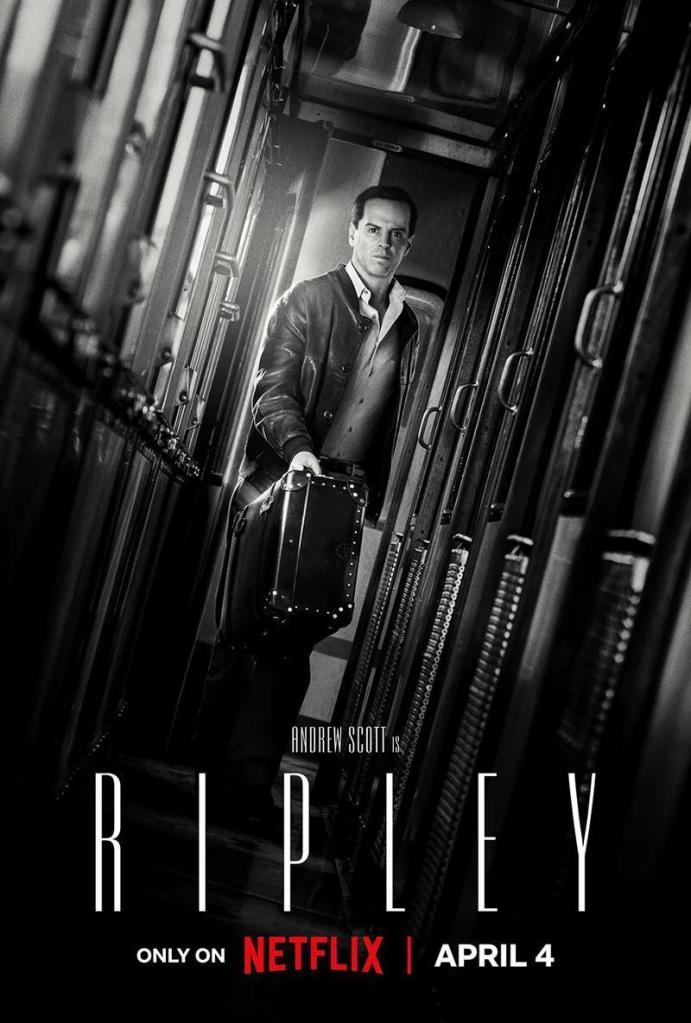
I had already been thinking about Ripley a lot lately; since watching Saltburn and trying to see the inspirations there to compare the two. I’d been looking forward to the Netflix adaptation–which I think is going to go further into the Ripley series, beyond the first book–since it was announced; one can never go wrong with Andrew Scott in a lead role.

But the series is an entirely different animal than the Anthony Minghella film from the late 1980’s, and I realized, while watching the series, that I had always viewed the novel through the lens of that movie….and now I need to read it again.

It’s fun, though, when an adaptation can give you another reading of a book; every time I’ve read The Talented Mr. Ripley I’ve viewed it a new way–but always through that Minghella lens; the only other book I’ve read differently on a reread (every reread, really) is Rebecca.

High praise indeed.

The queer undertones from the original story are still there in this mini-series, but Andrew Scott plays Tom as older and as an already career criminal, committing check fraud and insurance fraud on a very small scale. He lives in a shitty place, barely has the money to live decently, and these little frauds he perpetrates aren’t big time enough to ever earn him a big score. (It also reminded me of how, in pre-Internet and cell phone and computer days, how easy it was to swindle people.) When he gets the chance to travel to Europe to try to persuade DIckie to come home, it’s just another step, another con, a new opportunity to begin life anew in another country and get to know Dickie and perhaps infiltrate his life. As he’s so well established already as a con man and small-time crook, his pretending to be Dickie on the cruise ship makes more sense, and takes on a more sinister tone. The black-and-white cinematography was beautiful, languid, and breathtaking. The pacing of the series is tantalizingly slow, which seemed at first to be a slow-burn and a major risk; I do remember thinking how are we ever going to sit through eight hours of this? But as the story progresses and Tom’s cons and crimes become more complex and clever, it all makes sense. It makes sense that he would kill Dickie and take his place when Dickie tried to get rid of him (in the series, why Dickie would go out to sea alone on a boat with someone he’s trying to get rid of and thinks could be dangerous struck me at first as insanely stupid–but it was all of a piece with Dickie and his arrogance. He’s a rich white American, no one would ever dare harm HIM, right?), and the rest of series seems to fly by as Tom continues fooling everyone by never letting anyone who knows him as Dickie meet Tom, and the people who know him as Tom never see Dickie. Superb, and Andrew Scott was fantastic as Ripley; I felt like this was the version of Ripley Hitchcock would have given us.

At one point, Paul turned to me and said, “It’s funny how you root for the sociopathic killer,” and I replied, “because the rich people are horrible, and you want to see them suffer.”

And that’s the true genius of Highsmith; she doesn’t make Tom sympathetic, but by putting us into his mindset and seeing everything from his point of view…you start rooting for the sociopath because he’s the most sympathetic character in the book.

Which is a view of the rich I can certainly get behind.

Highly recommended, and I am looking forward to the next season.

Waterloo

Thursday and Work-at-Home Day Eve.

I did have a pretty good day yesterday; although I did start flagging a bit in the afternoon. I paid the bills, always depressing, and then stopped on the way home to make groceries and cleaned things up a bit around the apartment. I wrote last night and made some progress on the book–not enough, but it’s never enough–and also started working on another short story for a submissions call that I think’s deadline is next month sometime? It may even be later, one truly never knows unless one checks–and I really need to be better about putting deadlines for submission calls on my calendar. But that would make sense and be efficient!

You see where this is going, don’t you? Yes, I am starting to come out from under a bit, and yes, I am pretty pleased about it. My email inbox is down to almost nothing, and I’m starting to feel like my old self again–creative, with my mind zapping around in a million directions at all times, but now again able to zone in with extreme focus again when I need to. Whew. That’s quite a relief. I wasn’t terribly stressed; I just figured I’d have to figure out another way to push myself back into the writing somehow. I do wonder sometimes if not having stress and anxiety would become a problem for me in and of itself–but that is a vestige of the stress and anxiety, isn’t it? I’m so unused to this! I feel like I have so much more time than I did before, if that makes sense? My life has pared down in many ways, on every level, and I kind of like it like this. I like not getting worn out by the emotional rollercoaster of anxiety and all of its horrific side effects. I like being relaxed instead of tightly spooled. I like sleeping at night, and not being tired in the morning. I hated that feeling of drowning, not being able to keep up, and always falling further and further behind on everything.

I slept well again last night, which was great. I feel rested today, which is great, and my brain is actually functioning this morning. Let’s hope this is a good omen for the weekend, shall we? After I wrote last night, I did some cleaning around here and watched news clips on Youtube to catch up on what’s going on around the world. The Key Bridge collapse yesterday was a horrible event, and of course the right decided that it was somehow Pete Buttigieg’s fault that a container ship lost power and hit the bridge? Honestly, they are such garbage, and we’re lucky as a nation that we have someone compassionate, driven, and smart as Secretary of Transportation. After all, Maryland is a pretty consistent blue state, so why would they deserve any help from the White House had the coup attempt succeeded? We’d be living in a different country, for one thing, and we need to be sure that different country never happens. I think Dobbs and the Alabama Supreme Court decision on IVF were bridges too far for most Americans, as the special election in Alabama showed us this week. Women and men are PISSED OFF, and just because the media wants to keep shoving the right down our throats while undermining the left doesn’t mean a fucking thing. All the polling in Alabama was distinctly off, and it was a 35 point swing from the 2022 election. The Democrats need to keep hammering them on their discrimination and their contempt for women as anything other than brood mares; incubators for their children.

And how lovely would it be if a blue Congress codified the right to choose, the freedom to marry? The best fuck you ever to Alito and Thomas, the worst and most corrupt justices since Roger P. Taney. Congressional Republicans also exposed themselves by voting down IVF protections. And my guess is there will be another insurrection when Don Poorleone loses in November, count on it. The difference this time will be that the National Guard will be there in no-time, and if they kill more traitors like Ashli Babbitt, so be it.

And for the record, everyone involved in January 6th? We sent the Rosenbergs to the chair. Stop whining and do your time. You’re not patriots, you’re traitors. And for the record, conservatives in 1775 were Tories, i.e. were on the side of the British. Sorry you can’t read and aren’t capable of coherent, logical thought, but if you don’t know any history it’s probably best if you don’t bring it up. That’s why the Tea Party particularly infuriated me; they adopted an “iconic” Revolutionary War event, dressed themselves up that way, and called themselves “patriots”–for opposing the Affordable Care Act. In other words, they were calling themselves the modern-day equivalents of people protesting a massive corporate tax cut. What? That’s right, the tea tax was also a tax break for the East India Company, so they could sell tea in the American colonies more cheaply than American vendors, which also raised the question (again) of “taxation without representation.” The Affordable Care Act was definitely not taxation without representation–and the Tea Party was the root source of the MAGAts, and Sarah Palin was once its queen and shining star. Remember when we thought she was the worst the Republicans could inflict on the country? Ah, for the innocence of 2008 again; when grifting became a major player in American politics.

Heavy heaving sigh.

I have long been tired of the idea that the only real Americans live in the country and small towns, are Christians, and thus are the real patriots. Cities are the economic engines that drive the country, for the record. The point of our system is that we all cooperate together; the entire point of the government is compromise; not demand things all be your way and if you don’t get your way, you throw a tantrum and bring everything crashing down. There’s also no one way to be an American, either. The hijacking of patriotism by the right–by people who don’t understand their country or its government–is something I’ve long deplored. The goal was never perfection–the founders were very aware of human frailties and weaknesses–but to always strive to be better. And are red states better places to live than blue ones? Our new governor here in Louisiana seems determined to out-Desantis Desantis; who knows how much worse things are going to be here once he is finished doing the job of utter destruction of Louisiana that Bobby Jindal started?

I wish I had more time to devote to studying our politics here in Louisiana so I could write about it more.

And on that note, I am heading into the spice mines. Have a great Thursday, Constant Reader, and you never know; I may be back later.


A Teenager in Love

Monday morning and back to the office blog. I did write some yesterday–not nearly enough–and I did get some things done this weekend. I bought blinds for the breakfast nook, but I think they are too small; I may have to exchange them for another, larger set. Which is okay; I can do it after work one night as the Lowe’s is just up Elysian Fields. Tonight after work I have to go to the gym to do PT, and then I’m coming home to do some more writing and cleaning. Paul’s moving into the Monteleone on Wednesday, which means I’ll be here alone with the Sparkster, and also means Sparky will be very needy. He loves the cat treats I got him this weekend, no surprise there, and so I will continue to dole them out for good behavior. I feel rested this morning, which is different from most usual Monday mornings, but I think that has to do with making myself get up early Sunday morning and not sleeping late again the way I did Saturday morning.

Still, that felt amazing.

I feel pretty good this morning, too. The temperature dropped again over night, so there is a bit of a chill in the air this morning. I need to actually look at the program for S&S this weekend so I can put the stuff I am doing on my calendar and can start planning for the weekend. It’ll be weird being home alone for the long weekend (Wednesday thru Monday), but I’ve been a Festival widow since January anyway, so it probably won’t even be noticeable. I’ve also taken Monday off, as it’s always brutal getting up at six in the morning after the Festivals have concluded. It was a little odd this morning, though; Sparky usually comes and starts smacking me in the face with his paw just before the alarm goes off, and continues to do so while purring and cuddling until I get up. He didn’t come out from under the bed until I actually got out of bed, and just followed me downstairs instead of insisting on food immediately. His bowl was completely empty this morning, too.

I did write about a thousand new words on the short story yesterday, but my mind kept wandering and I got up to do something and just never went back. I also edited the 2000 words or so I had already done, so I think it was probably more new words than merely a thousand. It still feels a little rusty for me when I’m writing, but the best way to get past that is to keep writing until it starts to feel natural again and my mind stops wandering when I am writing. That’s the weirdest part. Usually when I write I shut out everything and am laser-focused, that’s not the case anymore and that’s fine.

My mind is still bouncing all over the place, too. It’s trying to spike my anxiety, too, but I just take some deep breaths and calm down, which is a lot easier to do with the new medications.

I did finish reading The Cook by Harry Kressing, which was an interesting and short read. It was a black comedy of sorts, more of a Kafka-esque fable than anything else, but in all honesty I enjoyed the movie version (Something for Everyone) a lot more than I did the book; in the book Conrad seduces everyone with his incredible food and force of will; in the movie, he’s played by a stunningly beautiful young Michael York who actually sexually seduces his prey until he gets what he wants. I will do a more in-depth review of the book at some point, but it does play into my thoughts that Saltburn owes more to that movie than it does The Talented Mr. Ripley or Brideshead Revisited.

We also finished watching season two of The Tourist, which was twisty and clever and fun and we really enjoyed it and are really looking forward to the third season–the second ended with a terrific cliffhanger twist that definitely will make for a fascinating and exciting third season. Plus, Jamie Dornan and Danielle Macdonald have some amazing chemistry together.

I also watched some documentaries last night about Jayne Mansfield, who I’ve been thinking about a lot lately. I’m not entirely sure what triggered me to thinking about her again. I first read about her in Earl Wilson’s The Show Business Nobody Knows when I was a teenager, and from there went on to read May Mann’s biography of her, Jayne Mansfield. She was very interesting to me, and was thrilled when her daughter began her career as an actress. I remember thinking Mariska Hargitay? She must be Jayne Mansfield’s daughter because what are the odds of there being two Mariska Hargitays? and watched her for years on Law and Order: SVU. Oh, now I do remember. I bought a copy of the Wilson off ebay because I thought it might be helpful with Chlorine, to give me an idea of what it was like to be in show business in the 1950’s, and of course, he devoted a chapter to her. I bought another bio of her off eBay recently, and she is very interesting, as she always has been to me. I’ve only seen one film of hers, Will Success Spoil Rock Hunter, which I thought was hilarious and she was fantastic in it. Benjamin Dreyer brought her up on one of the social media channels this weekend, and so I thought I’d find what I could of her on Youtube. Her story was actually perfect for someone like Jackie Collins or Jacqueline Susann to have written a huge trashy novel about, I’ve always thought. I also loved that she was actually–despite her image as a sexy dumb blonde–incredibly smart, almost genius level. And she only worked in show business for about ten years–while having four children, too, and keeping that incredible figure.

It’s funny; I’m not sure if you’ve ever noticed, Constant Reader, but I generally use song titles for my blog posts. About twelve years ago it was getting harder and harder to think up song titles organically, so I started using themes–Stevie Nicks songs, Pet Shop Boys songs, top 100 hits of 1977, that sort of thing. I can’t remember now which years I’ve used so I recently went back to the top 100 of 1959, I think; it’s interesting how many titles and songs have to do with teenagers; clearly, modern songwriters don’t have to write about teenage heartbreak anymore to appeal to young listeners. I also started watching Eras: The Taylor Swift Concert Movie, and I have to say I am very impressed. I can’t dedicate three and a half hours to watching it, but putting it on and listening while doing chores is terrific. Her show is amazing–I still have over an hour to watch (and am bummed she didn’t do “Red”) and I am actually looking forward to it. I also love how much right-wingers hate her.

And on that note, I am heading into the spice mines. Have a lovely day Constant Reader, and I may be back later, you never can be sure. I’m tricky that way!

Smoke Gets in Your Eyes

Saturday morning and I was exhausted, not rising up out of bed until well past eight. Sparky tried to get me up (five a.m. for food; he doesn’t recognize Daylight Savings Time) several times–I did get up to feed him at six–before giving up and curling up to my side and going to sleep. I could hardly disturb him by getting up, could I? Plus I still felt very tired, exhausted, until I finally did get up. PT was particularly intense yesterday–I had a new therapist who was filling in for my regular–and she was just stunned, repeatedly, at how well I was doing and how strong I was, which was really nice. She kept commenting on it the entire time, which was a lovely thing for my ego and only encouraged me to keep pushing harder. I came home, worked, did some chores around here. and then ran a couple of errands after the work was done. I was exhausted (I think I did seven loads of laundry? It had built up and Friday is when I do the bed linens), and just collapsed into my chair. I finished watching Feud–I didn’t think last week’s was the final, if it did indeed end with him dying–and then watched LSU’s gymnastics team trounce North Carolina in their last meet of the season (SEC meet is next weekend) before watching this week’s Abbott Elementary and retiring to bed, exhausted. I have a busy day ahead of me–reading, writing, errands, other chores–and my house is also a mess, sigh. But I’m not going to allow all the things I need to get done to overwhelm me and thus guarantee none of it will get done.

And I definitely need to make groceries.

But I do feel tired–fatigued–in my muscles. The shoulders are fatigued, and so are my legs and my lower back feels a bit tight. Fortunately I bought that hand-held massage device (which can’t be used as a vibrator, get your head out of the gutter), so I think I am going to use it and that foam back roller today, maybe stretching a bit will help the leg fatigue. I also am going to get cleaned up this morning–shaving the face and head, which I don’t keep up with as much as I should, bad Gregalicious, bad Gregalicious. I need to get to work on myself more than anything else, and need to stop thinking “meh, good enough”. I think later on this year I’m going to have to make a trip to the outlet mall in Gonzalez and get some new clothes–dressier pants and shirts, at any rate–to go with the fancier shoes I have; I’ve never matched outfits to a couple of pairs of Oxfords, which makes wearing them more difficult–bothering my OCD–because the outfits have to be made to somehow match the shoes, and I don’t always succeed. I usually am bored by shopping for clothes; but now that I am thinking about experimenting with style, it actually sounds a bit more intriguing than it ever did before, frankly…and now that I am thinking about it more, that was undoubtedly triggered by my anxiety.

And now that I no longer have the anxiety anymore, maybe shopping for clothes will cease to be an ordeal for me. And I do love argylle.

It’s a very bright and sunny morning here in New Orleans, too–which reminds that I need to size the windows and order blinds, so I should also check on office supplies and maybe order for pick-up or delivery–and so I am feeling like I should be able to get things done today (or it’s the coffee kicking into gear here); we’ll see how it goes and how long my energy lasts–it should be a major grocery run today, but then again Paul won’t be home after Wednesday so…probably not? Heavy sigh. I guess I’ll NOT do a major grocery run today and then add things during the week that we need. I also bought a half-gallon of milk thinking we were out and SURPRISE! There was a half-gallon in the refrigerator already. AH, well.

And on that note, I am going to head into the spice mines. I have things that I need to get done this morning, and I also want to read a little bit before I dive into the day headfirst. May your Saturday be amazing and wonderful and cool, Constant Reader, and I’ll check in with you again later.

Two Out of Three Ain’t Bad

Ah, Third Chanse.

If you will recall from my last entry about the Chanse series, I had a new editor for the second book in the series. I had also written a proposal for the follow-up, Murder in the Rue St. Claude, which was going to be about a nursing home and an angel of death. The second book ended with a tragedy for Chanse, and the last scene of the book was Chanse saying goodbye to someone before their life-support was turned off. I did a trickery and was going to have the person be in the nursing home, still living, only a suspicious death happens there and one of the workers talks to Chanse about her fears. The editor wasn’t the most professional or organized person, and I had to send the proposal to her three times on request with no contract offer. I was very irritated by this, but there were also a lot of changes going on there–including moving the offices from LA to New York, which I thought was an incredibly stupid business decision…and I wound up with yet another new editor right before Katrina hit. I honestly wasn’t sure if I would go back to writing ever again–one of the lulls in my career–but things eventually settled down and I started house sitting for a friend in Hammond over on the north shore while I waited for the city to reopen so I could drive into the city and get some more things from the house. I did, my friends’ trip was cut short, and I was going to return to Kentucky to my parents’ after one more swing by the apartment to pick up things. Imagine my surprise that my mail service was open, my grocery store and bank were open, and so was my gym. We’d moved into the main house from the carriage house, which hadn’t been rented yet as it needed some work before the hurricane, and so….I just moved back into the carriage house and cleaned up around the property and kept an eye on the main house, as well as emptying out the water from the machines that were trying to keep the insides of the apartments dry (the roof was gone).

While I was in Hammond, my new editor got me to reluctantly co-edit an anthology about New Orleans called Love, Bourbon Street (a title I hate to this day), and he was trying to talk me into writing a Chanse book about Katrina. I didn’t really want to, but he kept insisting and finally, I gave in and agreed to write it. However, the nursing home I was researching was a place they left people to die in–wasn’t touching that with a ten foot pole–and it occurred to me that I could wrap the case around Hurricane Katrina. He was hired by the client the Friday before Katrina, and obviously he couldn’t do the job now.

And that was the seed from which Murder in the Rue Chartres (no title at the time of contract) grew.1

It was six weeks before I returned to my broken city.

Usually when I drove home from the west, as soon as I crossed onto dry land again in Kenner, excitement would bubble up inside and I’d start to smile. Almost home, I’d think, and let out a sigh of relief. New Orleans was home for me, and I hated leaving for any reason. I’d never regretted moving there after graduating from LSU. It was the first place I’d ever felt at home, like I belonged. I’d hated the little town in east Texas where I’d grown up. All I could think about was getting old enough to escape. Baton Rouge for college had been merely a way station—it never occurred to me to permanently settle there. New Orleans was where I belonged, and I’d known that the first time I’d ever set foot in the city. It was a crazy quilt of eccentricities, frivolities, and irritations sweltering in the damp heat, a city where you could buy a drink at any time of day, a place where you could easily believe in magic. I couldn’t imagine living anywhere else. Any time I’d taken a trip before, within a few days I’d get homesick and started counting the hours until it was time to come home.

But this time wasn’t like the others. This time, I hadn’t been able to come home, and had no idea how long it would be before I could. Now, I was nervous, my stomach clenched into knots, my palms sweating on the steering wheel as I sang along to Vicki Sue Robinson’s “Turn the Beat Around” on the radio. It was everything I’d feared for the last few weeks when I thought about coming home, the anxiety building as the odometer clocked off another mile and I got closer to home.

It was different.

The most obvious thing was the lack of traffic. Even outside the airport, the traffic was usually heavy, sometimes slowing to a complete standstill. But other than a couple of military vehicles, a cement mixer, and a couple of dirty and tired looking sedans, I-10 was deserted. There was a film of dirt on everything as far as I could see, tinting my vision sepia. Huge trees lay toppled and debris was everywhere. Signs that used to advertise hotels, motels, restaurants, storage facilities, and pretty much any kind of business you could think of were now just poles, the signs gone except for the support skeleton. Buildings had been blown over, fences were wrecked and down, and almost everywhere I looked blue tarps hung on roofs, their edges lifting in the slight breeze. My breath started coming a little faster, my eyes filled, and I bit down on my lower lip as I focused back on the road.

No cars joined at the airport on-ramp, or the one at Williams Boulevard just beyond it. No planes were landing or taking off.

Most of the writing I did in the fall of 2005 was my blog, which at the time was on Livejournal. (The old stuff is still there, but I started making things private after a year because of plagiarism; I guess people thought they could steal my words if they were on a blog.) I documented as much of the experience as I could, so people outside of Louisiana could see that the city wasn’t fully recovered despite no longer being in the news. American attention had moved past New Orleans by the spring of 2006.

When I started writing the book, I was really glad I had done that with the blog, because more than anything else it reminded me of the emotions I was going through, that horrible depression and not remembering things from day to day, the need for medications, panic attacks, depression, and the way the entire city just seemed dead. I did repurpose a lot of stuff that was on the blog–rewritten and edited, of course–and I could tell, as I wrote the book, that I was either doing some of the best work of my life to that point or I was overwriting it mercilessly. You never can be sure.

But I also needed to flesh out the murder mystery I came up with, and I also wanted to write about a historical real life tragedy of the Quarter. The client who hired him that Friday before Katrina roared into the Gulf and came ashore was engaged, and she wanted Chanse to find her father, who’d disappeared from their lives when she and her brothers were very young. But what happened to her father? Who killed her, and why? Was her murder a reaction to her looking for him?

I had started using Tennessee Williams quotes to open my New Orleans novels with the third (Jackson Square Jazz: “A good looking boy like you is always wanted” from Orpheus Descending) and I liked the conceit so much I kept doing it. I knew someone who’d built a crime novel around the basic set up of Cat on a Hot Tin Roof, and I thought, what if the person who knows all the answers has been in a mental hospital for decades? Then what if Mrs. Venable had succeeded in getting Catherine locked up with all of Sebastian’s secrets lobotomized out of her head?

I named the family Verlaine as a nod to the Venables, and aged Mrs. Venable as well as gender swapping her (this was also a bit influenced by The Big Sleep), and I was off to the races.

My editor wrote me when he finished reading the manuscript and told me it was one of the best mysteries he’d ever read. The reviews! My word, I still can’t believe the reviews, and how good they were. I got a rave in the Times-Picayune, Library Journal and Publishers Weekly.

And yes, it won a Lambda Literary Award for Best Gay Mystery.

  1. The irony that two books I wanted nothing to do with, let alone write or edit, ended up with each winning Lambda Literary Awards, does not escape me. ↩︎

Memory

Ah, how I love cats.

I’ve been putting my cats into my books now for quite some time.

It’s kind of funny, because I never wanted to be one of those people–posting pictures of my pets, writing them into my books–until, of course, I actually acquired a pet. It never occurred to me to put Skittle into any of my books, until we lost him to a very rapidly advancing cancer when he was only seven.

Skittle was such a beautiful cat.

Skittle came to us when he was about six months old, when we were still living in the carriage house. (We’d gotten a mouse, and were advised by friends, neighbors and landlady to just get a cat…to which were both like “Really? We don’t want a cat and we know nothing about them” but after the third mouse sighting, it was, yeah, we need a cat. We got Skittle on Christmas Eve, 2003, as a bit of a Christmas present to ourselves. (We never saw the mouse again.) And cute and tiny as he was, we had no idea what a cat was like or what was normal behavior for them…and he had us completely charmed and under his thumb by the end of the day–head butts, making biscuits, cuddling and a non-stop purr machine. Skittle was beautiful, but was afraid of the outside for a while. He’d been found at about two weeks old in the middle of the road in a rainstorm, so the sound of cars scared him for a long time, and he was terrified of going outside for the first few years. Then one night I was coming home from a party–Paul was staying in the Quarter for the TW Fest, and I was home taking care of the cat–and the front door didn’t latch. When I got up the next morning the door was wide open, and Skittle was nowhere to be found. I called him a few times, and he came out from under the main house and sat down on the walk, nonchalantly cleaning himself as a very-relieved me ran and grabbed him.

After that, we had to watch and make sure the door closed because he’d dash out if he had the chance. He always let us catch him eventually, but he liked to explore and check for vermin and other live toys to torture. He was a great hunter, and could take a palmetto bug out of mid-air with a massive leap. He loved to play fetch, was very affectionate, and loved people, always winning them over by winding through their legs and rubbing against them, begging to be petted. He was also long-haired and I swear he shed that entire coat at least three or four times a year; his hair was everywhere. He also was smart–he trained me to know what four different noises he made were: food, water, litter box to be cleaned, and I either want to be petted and go to sleep on you in your chair. When I had a laptop as my primary computer (from 2003-2010), I had it sitting on a metal tray at eye level while I used a separate keyboard, and Skittle loved to go to sleep up there. When I got an actual desktop computer again, he lost his place to sleep while I worked, and he did. Not. Like. That. One. Bit.

He got sick first over Memorial Day that weekend, and he was dehydrated. The vet rehydrated him again and he was back to his normal self…but over Labor Day he was sick again. It was cancer, and from the first diagnosis that Tuesday after Labor Day and when we took him back a few weeks later….it had spread to all of his organs, and it became just a matter of time. Keeping him alive would require three months in the hospital, thousands of dollars, and no guarantee he would make it through.

We were both devastated when we brought him home that Wednesday night, and we made an appointment to send him over the Rainbow Bridge for Saturday. We spoiled him that Thursday and Friday–treats and tuna, as much as he wanted. Ironically, those last few days, he seemed like himself again to the point that I had to be the monster on Saturday morning and convince Paul it was better to let him go now, rather than watch him decline because he wasn’t getting any better; it was almost like he knew so he wanted us to remember him the way he always was. Paul spent that entire day after we got back in bed, while I was an empty shell of myself, removing all reminders–toys, food, etc. because every time I found one I’d start crying again, so I rounded them all up.

I wanted to get another cat, but Paul was so heartbroken, he wasn’t sure he could handle another so soon. (I was also heartbroken, but I also knew we had to rescue another one.)

Scooter was such a handsome fellow, too.

Thursday the vet called to let me know Skittle’s ashes were ready for us to pick up, so I went over there on my way to work in the morning and picked them up. They had some cats there for adoption from the SPCA, and there was a beautiful orange boy, named Texas, who was so sweet I wanted to take him home right then. But I didn’t know if Paul would be upset if I brought home a replacement cat, so I didn’t, but I remembered him and thought I’ll talk to Paul about it tonight.

Paul was asleep on the couch when I got home from work that night, and so I turned on the television and thought, “I’ll ask him about Texas when he wakes up.” I read while something was on television–a Real Housewives marathon, I think–and about an hour later, Paul sat up on the couch, completely freaked out that he’d just seen a mouse looking at him from the top of the recycling bin. I hadn’t seen anything. He was just dreaming–and his subconscious was letting him know it was okay to get another cat. Thirteen years later, he still insists there was a mouse. So I told him about Texas, told him to go by and look at home and if he wanted him, to make all the arrangements and I’d pick him up after work. Paul fell in love with Texas, and nothing would do except that I pick HIM up from work and we’d go together to get him.

Scooter jumped out of the crate and hid under the coffee table, which was a bit concerning. But after about an hour of us leaving him alone, he came out, crawled onto the couch and onto Paul, laid down on his chest and started purring and headbutting him, and then he came over to me and did the same. We renamed him Scooter that first night, and for thirteen years, we had this incredibly sweet ginger boy.

Such a sweet boy. Around this time was when I realized that if I started putting MY cats into my work meant they would live forever. So I gave Chanse’s friend Paige (who hadn’t yet appeared in a Scotty book an orange and white cat named Skittle. I gave Scotty a cat named Scooter, and I can’t remember which cat I gave to Valerie in my cozy series; it was either Skittle or Scooter. Jem also has a black cat in Death Drop, but he is fictional–what else but Shade?

We had Scooter for thirteen years. He had a bout with diabetes, but insulin shots cleared that up (thank God; I hated giving him those shots) and he was mostly healthy. One morning last summer before I went to work I noticed Scooter was huffing–and having trouble breathing. I tried to soothe him, but I could tell he was terrified…and thought, Oh no, this is probably it for him, how am I going to break it to Paul? Later that morning he called me at work to tell me we needed to take Scooter in, and we were probably going to lose him. We took him over that morning, and they called us later to let us know it was congestive, and he wasn’t going to make it. They had him comfortable, but whenever they took him out of the oxygen thing he’d start huffing again. It was, alas, fatal, so I walked over there and held him while they put him to sleep and he crossed the rainbow bridge. I sobbed all the way home, and still can’t think about him without tearing up.

The house felt so empty without a cat. But finally we steeled ourselves and headed to the SPCA to pick out a new rescue.

Sparky!

And we brought Sparky home, and I’ve been entertaining you all with tales of the kitten here ever since. He’s a darling, and he’s getting so much bigger than the little kitten with a big voice and adorable energy. He picked us out–just as Skittle did–and I love that he’s got orange coloring, as you can see above.

And I guess I’ll have to start another series so I can immortalize Sparky, too.