Little Willy

Today’s title song always kind of amused when it was a hit; I was a tween at the time and since willy is also a euphemism for…well, you can see where this is going.

I found it highly (if more than a little bit juvenile) amusing that someone wrote a song about a small penis.

Hello, Monday morning of my sort-of-vacation! The vacation starts Tuesday evening when I get off work, actually, but it’s also kind of lovely to know I only have to work my two long days at the office this week before I can lounge around the house and do what I want when I want to do it. How lovely, right?

I did manage to squeeze out about thirteen hundred words or so on the WIP, and I also printed out the pages of the manuscript i am suppose to be dedicating myself to finishing in July. (I’ve already redone the first four chapters of it before I had to push it to the side for Royal Street Reveillon, whose time had come.) I did look at the first few pages again, and liked what I was reading. So, I’m still undecided about what to do. Should I push through on the WIP, getting that first draft finished, or should I get back to work on what I scheduled myself to do for the month of July? Truth be told, I am actually thinking that what with the five day vacation looming, I could theoretically go back and forth between the two; but the voices are so terribly different, I’m not sure how well that would work.

Yet another example of why writers drink.

I started reading Mickey Spillane’s I the Jury yesterday as well. It’s a short novel, really, and I can’t imagine it taking a long time for me to finish. I’ve never read Spillane, but of course I know all about him, his writing, his character Mike Hammer, and everything he kind of stood for. Spillane was one of the last writers who kind of became a folk hero/celebrity of sorts; it was a lot more common back in the 1950’s and 1960’s; Hemingway, Spillane, Gore Vidal, Truman Capote, and Norman Mailer all were celebrities of sorts; I believe Spillane even played his own character in one of the film versions of his work. He also used to regularly appear in commercials and advertisements as Mike Hammer in the 1970’s, which is kind of hard to imagine now. It would be sort of like Stephen King being hired to do commercials and print ads for, I don’t know, Jim Beam? The author as celebrity is something I’m not sorry we’ve gotten away from as a society and a culture, quite frankly. The idea behind reading I the Jury as part of the Diversity Experiment is precisely because it’s the kind of book I’d never really read; Sarah Weinman asked the other day on Twitter if Spillane counted as camp (I personally think it does; my responses was something along the lines of “Imagine Leslie Nielsen playing him”) and then realized I needed to read at least one of the books, as part of the Diversity Project.

But Gregalicious, you might be wondering, why are you reading a straight white male novelist writing about what basically is the epitome of toxic masculinity in his character Mike Hammer?

Well, first of all, the name of the character itself: Mike Hammer. It almost sounds like a parody of the private eye novel, doesn’t it, something dreamed up by the guys who wrote Airplane! and not an actual novel/character to be taken seriously. We also have to take into consideration that Spillane’s books were also, for whatever reason, enormously popular; the books practically flew off the shelves. (Mike Hammer is actually one of the best gay porn star names of all time; alas, it was never used in that capacity.)

But it’s also difficult to understand our genre, where it came from, and how far it has come, without reading Spillane; Spillane, more so than Hammett or Chandler, developed the classic trope of the hard-boiled male private eye and took it to the farthest extreme of toxic masculinity. Plus, there’s the camp aesthetic I was talking about before to look for as well.

Chanse was intended to be the gay version of the hardboiled private eye; I patterned him more after John D. MacDonald’s Travis McGee than anything or anyone else. But reading a macho, tough guy heterosexual male character from a toxic masculine male author is also completely out of my wheelhouse; and therefore, it sort of fits into the Diversity Project along the lines of well, the idea is to read things you don’t ordinarily read; not just writers of color or different gender identities or sexualities than your own.

And there’s also an entire essay in Ayn Rand’s nonfiction collection of essays on art devoted to Mickey Spillane; it should come as no surprise to anyone who’s ever read any of Rand’s fiction that she was a huge fan of Spillane. Given what a shitty writer Rand was, that’s hardly a ringing endorsement–but it also gives me something else to look out for as I read Spillane’s short novel.

There’s also a reference to Spillane in one of my favorite novels, Larry McMurtry’s The Last Picture Show–in which some of the  boys are wondering if blondes have blonde pubic hair, and “the panty-dropping scene in I the Jury” is referenced.

Interesting.

And now back to the spice mines.

IMG_1242

You Are The Sunshine of My Life

Sunday morning. It took me awhile to fall asleep last night; the last time I remember looking at the clock it was around three in the morning and I was still pretty much awake.  I did manage to doze off around that time, though, and while I still woke up around eight thirty, I feel somewhat rested this morning.

I didn’t do any writing yesterday; I wound up cleaning and organizing and doing that sort of thing for most of the day, interspersed with reading. It was, despite having to go out in the heat and humidity of the early afternoon, kind of a lovely day, really. It wasn’t as terribly hot as I feared it would be, and once I was back inside the cool of the inside of the Lost Apartment, I was able to get some things I needed to get done finished; I also need to finish the organizing I started yesterday but never quite finished. I also came up with some amazing and key things for the WIP, which technically I should be finishing up today–big surprise, it’s not finished nor will it be by midnight–so I am also trying to figure out what I want to do; should I follow my schedule and reluctantly put it to the side, to go back and spend the month revising the other I’d planned on working on for July, or should I go ahead and work my way through this first draft, trying to get it finished this week, and then diving back into the other?

Decisions, decisions.

I suspect I’ll keep working on the WIP, if I am going to be completely honest. Yes, it’s been horrible, like extracting teeth by gripping them with my fingers and yanking really hard, but also last night I had some more breakthroughs about the main character as well as the story I am telling. I also remembered some more things I need to go back and litter through the first sixteen chapters I’ve written–not that big of a deal, as they are all early draft and intended to be worked on more any way–but I am always feeling pressed for time, as is always the case.

Paul is departing to visit his mother for a week, starting tomorrow; I am taking a stay-cation of my own built around the 4th of July holiday. I am only working Monday and Tuesday this week before having a delightful five consecutive days off from work; suring which I have deeply ambitious plans to get a lot of cleaning, organizing, and writing done…as well as a lot of reading. I am going to step away from the Diversity Project with my next read–triggered by a Twitter conversation with the amazing Sarah Weinman–and am going to read Mickey Spillane’s I the Jury next. In a way, though, it’s really still a part of the Diversity Project, just not the way I’d originally seen it: a necessary adjunct, or rather, corollary to the Diversity Project should be reading, and examining, and critiquing, the crime genre’s long fascination with a particular type of masculinity; the Mike Hammer novels are certainly the perfect examples of that, almost to the nth degree.

And can I really call myself a student of my genre without reading Spillane?

I am sure the books themselves are problematic; almost everything from that time period is in some ways (I still remember reading a James Ellroy novel–I don’t remember which one–which had some incredibly horrible homophobia in it; it was painful and difficult to read, but absolutely in line with the thinking of cops in the 1950’s; and I do believe sometimes it’s necessary to read these problematic texts, to critique and understand them and the time period from whence they were originally written and published.

A conversation I had on Twitter with Rob Hart (whom you should also be reading; his next novel The Warehouse, sounds absolutely terrific and I am eagerly awaiting its release) also triggered a thought; that perhaps a non-fiction/memoir type book about me, my reading life, and queer representation in mainstream crime novels might be an interesting thing to write; whether or not there’s an audience or a publisher for such a work remains to be seen, of course, but it does sound like an interesting intellectual challenge.

It might also be horrifically difficult, but reading is about learning, isn’t it?

And on that note, none of this stuff is going to get done unless i start doing it, you know?

Have a lovely Sunday, Constant Reader.

IMG_1316

I Will Survive

As Pride Month comes to a close, here is a list of all the queer crime writers I posted about over the month; a handy list for anyone wanting to check out queer crime writers. This is by no means a comprehensive list, either; there are so many wonderful queer crime writers and there were only thirty days in June, alas.

I am also going to list the book whose cover I used in the post I made.

Ready? Here goes.

Joseph Hanson, Fadeout

Barbara Wilson, Murder in the Collective

Michael Nava, Lay Your Sleeping Head

Katherine V. Forrest, Murder at the Nightwood Bar

George Baxt, A Queer Kind of Death

Ellen Hart, Wicked Games

J. M. Redmann, The Intersection of Law and Desire

John Morgan Wilson, Simple Justice

Randye Lorden, Brotherly Love

Nathan Aldyne, Cobalt

Mark Richard Zubro, A Simple Suburban Murder

Sandra Scoppetone, I’ll Be Leaving You Always

James Robert Baker, Adrenaline

Mary Wings, She Came by the Book

R. D. Zimmerman, Closet

Dean James, Faked to Death

Claire McNab, Blood Link

Mabel Maney, The Case of the Good-For-Nothing Girlfriend

Keith Hartman, The Gumshoe, the Witch, and the Virtual Corpse

Christopher Rice, A Density of Souls

Greg Herren, Survivor’s Guilt and Other Stories (guest posted by the amazing Jeffrey Marks)

Grant Michaels, A Body to Dye For

Patricia Highsmith, The Talented Mr. Ripley/The Price of Salt

Jaye Maiman, I Left My Heart

Neil Plakcy, Mahu

Ann Aptaker, Tarnished Gold

Michael Craft, Eye Contact

John Copenhaver, Dodging and Burning

Rob Byrnes, Straight Lies

Kristen Lepionka, The Last Place You Look

Renee James, Transition to Murder

Dharma Kelleher, Chaser

Anne Laughlin, A Date to Die

Do bear in mind that this is merely a good starting point; there are so many terrific queer crime writers writing terrific queer mysteries. There are also a lot of non-queer people who are writing terrific queer mysteries these days as well. I couldn’t name everyone; and in fact, on the last two days of Pride Month I had to double (triple today) up to make sure I used all the writers I wanted to talk about.

Thanks, everyone, for playing along; your likes and comments and shares were deeply appreciated.

A better resource for queer mysteries and queer crime writers, if you’re looking for something a bit comprehensive, check out either Judith A. Markowitz’ The Gay Detective Novel: Lesbian and Gay Main Characters & Themes in Mystery Fiction, and Drewey Wayne Gunn’s The Gay Male Sleuth in Print and Film: A History and Annotated Bibliography.

IMG_1086

I Sing the Body Electric

I’ve been reading a lot of history lately (nothing new there, really; my favorite non-fiction generally tends to be history), focusing primarily on New Orleans and Louisiana for the most part. As I read histories of New Orleans, here and there I find little bits, here and there, about the queer subculture in the long years and decades before Stonewall; little bits, here and there, more of asides in longer narratives than anything else. There were, of course, male prostitutes in Storyville back in the day–generally not housed or regularly employed in the houses, but should a customer be desirous of, shall we say, male companionship, the madams would send a runner down to a gay watering hole a few blocks away in the Quarter and find someone looking to make some quick cash…and they never failed to find someone willing to satisfy the “peculiar tastes” of the john.

Finding this, and other references to bordello activity by reformers protesting their existence and wanting them shut down, as “sodomy” quite naturally piqued my interest. As a port city that was, at one time, the largest port and largest city in the southern United States, a city that was also a blend of many different cultures and so forth, New Orleans clearly had always had havens for homosexuals in those dark times when we were outlaws. As I read other New Orleans histories, I do keep an eye out for these references, and mark the pages in order to find them easily again.

There’s a lot of stories untold there in the past, and I’ve been considering the possibilities of writing more historical-based fiction in New Orleans. I’ve already started a short story about a young gay man who occasionally picks up extra cash by working in one of the brothels at night “on demand,” and I think it has some terrific potential.

Queer people have often been erased by history, just as people of color and women have been, and while I will most likely never write non-fiction (you can’t make things up, which is the primary drawback for me), I do enjoy reading histories that focus on the gay community.

For example, David K. Johnson’s award-winning The Lavender Scare, about the purge of gay employees from the federal government in the 1950’s as intelligence risks (their sexuality left them open to blackmail from foreign spies; at least this was the fear) eventually led to my short story “The Weight of a Feather” (which I am still not convinced shouldn’t have been a novel); and as such, was quite delighted when Johnson released another scholarly look at queer American history this year, Buying Gay: How Physique Entrepreneurs Sparked a Movement.

I had, of course, known that “physique pictorial” magazines essentially were the original gay porn magazines; those images still can be found on the Internet.

buying gay

Johnson’s thesis holds that the mailing lists, and sales, of these magazines early on developed a cohesive gay market, and the recognition of said market gradually led to activism and wholesale societal change; that the magazines themselves created a sense of community by letting deeply closeted and frightened gay men know they weren’t alone; there were others like them, and helped them feel seen.

This further extrapolated into films and books, and gradually a gay rights movement.

The book is well written and deeply researched, as was The Lavender Scare (recently filmed as a documentary I am looking forward to seeing), and shed a light on a time I don’t know much about; few people know much about that time. One of the greatest tragedies of the community is how it was ravaged by HIV/AIDS in the 1980’s and 1990’s, until the development of the drug cocktails that first extended life, and eventually managed to make HIV a manageable infection rather than a fatal one; a lot of oral histories were lost as a result, and an entire generation of gay men was not only lost, but deprived the next generation of community elders and mentors.

I’ve been toying, over the last few years, with several ideas for noir novels with gay themes and characters set in the decades before Stonewall, and Buying Gay will, should I ever decide to do so, prove to be an invaluable source of material.

Well done, Dr. Johnson.

Brother Louie

I’m feeling a little better.

I think part of the problem was just exhaustion, in addition to some stomach upset. I spent most of the day yesterday (other than doing the laundry) pretty much curled up in my easy chair with Scooter sleeping in my lap while I read. What did I read? Nothing I loved enough to talk about publicly, frankly; my rule is to never post about a book that I didn’t absolutely love, or at the very least truly enjoy. I slip up with this from time to time, and have taken potshots at authors from time to time; it’s not something I’m terribly proud of, but reading is, after all, subjective; something I hate may be more to someone else’s taste, and I’ll never denigrate a book or author publicly because I know how much work it is to produce a novel.

At the very least, I like to show respect for a colleague’s hard work. And make no mistake about it, producing a novel is very hard work–hell, just typing  a novel is hard work.

After finishing the disappointing novel, I turned to Anne Somerset’s Unnatural Murder, which is about the notorious murder of Sir Thomas Overbury in the Tower of London during the reign of King James I of England; the murder was masterminded by the wife of one of the King’s notorious favorites. It was one of the most scandalous trials involving the royal court in English history, and the resolution, the revelations in the trial, and the later pardons from the King to both the favorite (Robert Carr, Earl of Somerset) and his beautiful wife Frances Howard, began an undermining of the monarchy, which inevitably led to the English Civil War, the downfall of the Stuart monarchy for a time, and the execution of King Charles I.

King James I, the man who brought the crowns of England and Scotland together in the same monarch, had male favorites rather than female; beautiful men he showered titles and honors on throughout his life. Whether James ever acted physically on his attractions and love for beautiful men is not known; he himself vehemently denied any kind of physicality with other men; but he certainly preferred the company of beautiful men to that of beautiful women. Robert Carr was only one of the many male favorites the King loved during his lifetime; Carr was followed by George Villiers, Duke of Buckingham, who was also close to James’ son, King Charles I. Whether the favorites themselves were gay–they also, like James, always had wives and children–or even bisexual is unknown; certainly in the case of Buckingham the King was the only male he was ever linked with. I do think it’s possible that James never had a physical relationship with any of his favorites; it may have been a “look and love, but never touch” sort of thing for him. He was deeply religious and his desires were, of course, anathema to the church, and he also had a very real fear of being murdered and/or deposed; his mother was deposed and later beheaded (Mary Queen of Scots was his mother), and his father was murdered (Lord Darnley), most likely in a plot masterminded by his mother’s lover. He was less than a year old when he became King of Scotland; he was nearly forty when he followed his mother’s bitter rival Elizabeth I to the English throne.

It is interesting (at least to me) that in this Elizabethan/Jacobean period (and shortly thereafter) produced many royals with same sex attractions; Henri III of France ruled during this time and his affections for male favorites was quite well known; Louis XIV’s brother Philippe Duc d’Orleans was also infamous for the same reason. There have been other sexually suspect kings and royals throughout history; James’ own granddaughter Queen Anne was, if not one in fact, a lesbian by inclination. (See The Favourite.)

This morning I feel much better; my stomach seems settled and I slept well, after resting and relaxing for most of the day yesterday. Today I need to venture out into the stifling heat and humidity, and I also need to write. Oh! Yes, I did spend some time in my easy chair with my MacBook Air going over the copy edits of Royal Street Reveillon, which is inching closer and closer to publication date, which is lovely. It’s been a while since the last Scotty book–Garden District Gothic, which I think was released in 2016? Has it really been three years since the last Scotty book? Then again, it’s also hard to wrap my mind around the idea that my first book was released seventeen years ago.

I also think taking a day away from the pressure of trying to get caught up on the WIP was a smart thing to do. I may try to write a chapter later today. I don’t know. I am wondering if I should just keep plowing through this until the first draft is finished before seeing if i can get the other manuscript revised in what time is left before August 1, when I have to dive into something else entirely for two months. There’s also short stories to write, revise, edit, and so on, and so forth. It truly never ends for me, you know. And there’s still yet another unfinished manuscript in a drawer that needs to be worked on as well. Heavy heaving sigh.

And let’s not forget, I also started writing another Chanse book this past weekend.

Heavy heaving sigh.

Focus, Gregalicious, focus.

I also need to figure out what I’m going to read next, quite frankly. I may take a break from the Diversity Project and read one of the many books in the dusty TBR pile…I don’t know. I’ll just, after getting everything done that needs to be done to day, just look through the bookcases and the piles of books and see what’s there to read.

And there’s always non-fiction, of course. It’s not like I don’t have a massive pile of books on Louisiana and New Orleans history and folklore I could get lost inside.

And on that note, tis back to the spice mines.

IMG_1030

My Love

Monday morning gave me no warning, of what was to be.

Heavy sigh.

I’m still reeling from a highly productive day yesterday that, ultimately, achieved nothing. Writing the first chapter of a new Chanse novel–when I had thought I was finished with the character, outside of short stories–was probably not the smartest way to go with my work, but at the same time I’m not terribly upset by it or see the day as wasted. I did managed to write over three thousand words in less than two hours, and they were actually good words, ones that I probably won’t be discarding if I decide I want to work on this more–I can always keep it there in my back pocket, and if I get stuck on something else I’m working on, I can work on it, and therefore never lose a day to not being able to figure out what’s going to happen next with anything.

Sigh. I told you I have creative ADD. The struggle is real, yo.

I’ve not worked on the WIP now for two solid weeks, which is completely insane. I’d hoped to have the first draft finished by the end of June–which now is not very bloody likely–so I could move back to the Kansas book and get it revised by the end of July. I’d like to keep to that schedule somewhat; if I can somehow manage a chapter a day on the WIP I’d be awfully close to finished by the end of the month, and the revisions on the Kansas book might actually allow me to go back and forth between the two throughout July. It would be awesome to have both finished by the end of July, although not very probable; the heat here is going to start picking back up again (it’s already in the nineties every day) and the heat and humidity are such energy drains. My preference for a New Orleans summer would be to never go outside unless absolutely necessary; that unfortunately isn’t possible, so I try to deal with it the best I can…which is changing my socks regularly, washing my face every few hours, and praying for October to arrive.

Football season is also just around the corner, and experts are predicting terrific seasons for both LSU and the Saints; we’ll see how that goes.

I started reading Howard Zinn’s The Twentieth Century over the course of the weekend; while I still want to keep up with the Diversity Project–which has been amazing so far–I think I might spend the summer reading mostly non-fiction. I have all these books about New Orleans history, as well as Louisiana history, and I really should start making my way through those as well. The primary problem, of course, being that reading nonfiction often kickstarts my creativity genes into gear and I start coming up with other ideas for stories and novels–as it is, if I spent the rest of my life writing the ideas I’ve already had, I’d never be able to finish writing them all, so having new ideas all the time is hardly the best thing for me…although don’t get me wrong, I don’t ever want my creativity to ever just completely shut down on me, either.

I can’t imagine ever having my creativity just completely shut down.

I hope it never happens–although I always worry it will.

And on that note, tis back to the spice mines.

IMG_1035

Crocodile Rock

Oh, Louisiana.

My beautiful, beautiful state. Louisiana is basically a lush, fertile state chock full of important natural resources, and also sports the nickname “Sportsmen’s Paradise,” because outdoor sports–hunting, fishing, etc.–are abundant here. Lots of hunting, lots of fishing, that sort of thing.

But Louisiana also is known for corruption, being backwards in many ways, and some truly bizarre politics/politicians. It’s easy to say that Louisianans have a very cynical view of politics and politicians–no one is really surprised when one of our elected officials is caught doing something criminal or morally questionable; the basic presumption is that they’re all crooks and liars unless proven otherwise. We can never forget that one gubernatorial election featured bumper stickers and campaign slogans that read Vote for the crook, it’s important–when Governor Edwards, convicted for taking bribes in office, was running again after serving time and his opponent was notorious racist and former Klan Grand Wizard David Duke.

And for the record, that election was in the early 1990’s–not that long ago.

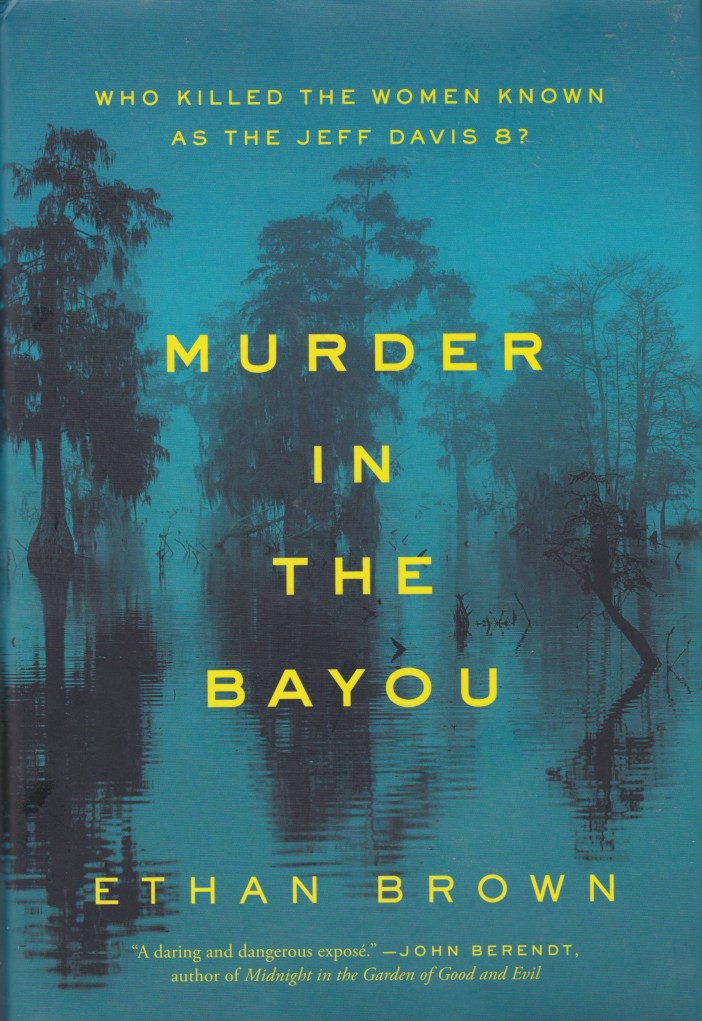
As I said yesterday, I watched a four hour documentary on Hulu this past week called Murder in the Bayou, about what is called the “Jeff Davis 8”–eight women murdered over a period of less than three years in and around the Jefferson Davis Parish village of Jennings. The women all  had issues with drugs, and also came from really poor backgrounds. The documentary was interesting, and seemed geared to the idea that there was a serial killer operating in the parish–and for some reason, the cops simply couldn’t track said killer down, and eventually the killings stopped.

I also remembered that there was a book about the murders, with the same title, by New Orleans journalist Ethan Brown, and I had a copy. So, after I finished watching the documentary Friday afternoon, I got the book down from the shelves and looked to see if there were any photographs included. There weren’t–just the flyer with the reward posted, with photos of all the victims on it. I started reading…

murder in the bayou

On May 20, 2005, Jerry Jackson, a soft-spoken slim African-American retiree with a short salt-and-pepper Afro, prepared to cast a fishing line from a hulking bridge over the Grand Marais Canal on the outskirts of Jennings in southwest Louisiana. Jackson peered down at the muddy rush below, the corroded, cylindrical rain pipes along the canal belching water, the collapsed pedestrian bridge far out in the distance. As he prepped his fishing line, Jackson imagined the catch that day, white perch, a small bass with a strong spine that’s so abundant in Louisiana it’s the state’s official freshwater fish. In low-lying southwest Louisiana, where rain is constantly siphoned to prevent flooding, drainage canals are as common as the perch. These canals provide sustenance for poor Louisianans for whom fishing is both a generations-old tradition and a day-to-day necessity. For hobbyists such as Jackson, who made the approximately ten-mile trip to Jennings from his cramped trailer on a dead-end street in nearby Welsh, drainage canal democratize fishing. Expensive shrimp boats and fishing equipment aren’t necessary–all one needs to do is drop a line into the water.

As Jackson peered deeper into the Grand Marais Canal, he spied the outline of a human body. “It had come up on the news that someone had stole some mannequins,” Jackson told me, “so I thought that one of the mannequins ended up in the water somehow.” Jackson focused his eyes on the figure. “I saw flies, and mannequins don’t attract flies.”

It didn’t take me long to get into the book to realize there was information, crucial information, about the victims in the book that wasn’t included in the documentary; in fact, the documentary left a lot of important information out. Yes, the women all had addiction issues, but they also were sex workers–turning to sex work to either get drugs, or to get the money to buy drugs. The police didn’t cooperate much with Mr. Brown, and the sister of one of the victims played a very prominent role in the documentary; she was only mentioned by name once in the book. Brown also shared the information that many of the victims were witnesses to other crimes, and theorized they were all killed to silence them–and that it wasn’t a serial killer after all. Brown also isn’t convinced completely that the police were so inept and incompetent to handle these kinds of investigations (something that came up a lot in the documentary), but that the parish police were actually corrupt, involved in the drug trade, and connecting all the dots also led to a peripheral involvement by a powerful politician. Naturally, the police and the politician disagree with Mr. Brown’s theories and conclusions…but he also includes, in the book, other crimes in the parish that may or may not have been connected to the murders, as well as corruption within the police department; things that were not in the documentary.

One of the things that struck me, while watching and again when reading the book, is how tragic the cycle of poverty is in these small towns, not just in Louisiana, but across the country. The class divide–marked in Jennings by literally railroad tracks that separate the good part of town from the bad–is truly staggering; I would imagine it’s much the same in big cities only not as obvious. The poor and uneducated people in places like Jennings are trapped in a terrible cycle of poverty that they cannot seem to break, which is truly sad, and the disruptive nature of the families they were born into doesn’t help much, either. And once someone starts spiraling down into drug addiction, there’s nowhere to turn to for help getting off the drugs…and there’s no money for rehab, which is incredibly expensive.

I can’t imagine how horrible it would be to stuck like that, with no hope for the future.

The book is very well written, and it’s not terribly long; I read it in one day, and it’s a terrific read. I do recommend it, and I also recommend watching the documentary as well. I’m curious about why they chose to leave some stuff out of the documentary that’s in the book–perhaps it has something to do with both using the same title but not adapting the book or using it as source material, or something along those lines–but it’s very interesting to see the two very different takes on the murders.

And yes, learning more about these murders did, in fact, give me an idea for another Chanse novel; the first idea I’ve had for a Chanse novel since I wrote Murder in the Arts District. I can easily see fictionalizing this story, with Chanse as the investigating private eye…or someone else, really; it doesn’t have to be Chanse, and the issues at play here–the disposability of drug addicted sex workers, class distinction, and corruption in the parish power structure–are things I would love to explore in a novel.

Like I don’t have anything else to write already, right?

And now back to the spice mines.

Slow Ride

Well, I finally finished that fucking Chapter Fourteen, and yes, it’s rough, but it’s not nearly as bad as I feared it would turn out, nor as it was heading last week when I tried to work on it. Today I figured out a way to plough through it, and now I have to figure out how the fuck I am going to get another eleven chapters out of this story–but truth be told, the elements of the plot are pretty much all in place now and now it’s a matter of playing them out. I also recognized that there’s not an emotional stability at the core of the story–there is, I just haven’t been putting it in, so that’s the next thing I need to do in the next draft, or as this one progresses along I can start putting it in.

I keep saying to myself that someday this will get easier, but thirty-odd books later and here I still am, plodding through a manuscript and ready to throw in the goddamned towel.

Sunday morning and I’m on my second cup of coffee. My kitchen is a mess, and I have to figure out how to use a new app on my computer because I’m being interviewed by Eric Beetner and S. W. Lauden for their Writer Types podcast, which is very cool. I was briefly on it when they were interviewing people in the bar at St. Petersburg Bouchercon, but that was also the now notorious Low ‘n’ Slow afternoon, so I only vaguely remember it and still to this day have no idea what I actually said to them. Not good, really, when it’s going to be broadcast. I think I listened to it, and I didn’t embarrass myself too badly; but I’ve been told any number of times that people can’t tell when I’m wasted.

I’ve always thought they were being kind to lessen my own embarrassment. Maybe they were, who knows?

My relationship with alcohol has always been a tricky one. I only had liquor once before I graduated from high school and I got very drunk at a friend’s birthday party my junior year. I didn’t drink again until the night I graduated, and after I recovered from that horrible hangover I pretty much was drunk every night until we moved to California, where the drinking age was 21 and I was still only nineteen. California was also a lot stricter about checking ID’s than Kansas had ever been, so I was totally sober for two years before I came of legal age to drink again….and then was drunk every night for the next six or seven years again, followed by another few years of utter sobriety, and then when I started going out to gay bars, I still remained sober most of the time, drinking only water and finally, gradually, progressing back to beer again. I don’t drink much anymore–there were many years of New Orleans life where Paul and I went out every weekend night, including Sunday Tea Dance–but since I hung up my dancing shoes, I don’t really drink hardly at all anymore. I’ll have a drink or two when I’m out for dinner, or at a party, or during a conference–I am usually wasted every night at Bouchercon–but once the conference is over, I come back home to sobriety. We generally don’t drink at home–I still have a bottle of wine I bought on the notorious Target expedition with Wendy Corsi Staub in St. Petersburg–and we still have bottles of vodka and gin and tequila left over from the Iris parties of old; and we haven’t had an Iris party in about five years or so.

Although I am sure this October in Dallas there will be drunken, sloppy tales of Gregalicious to tell.

I’m probably going to try to get some writing done after the interview, and some cleaning, and I’d like to read more of Black Diamond Fall. I’m not reading as quickly as I used to, and I am sure it has something to do with social media and they need to constantly be checking it–which is a need that absolutely positively has to be reined in because it’s such a waste of time.

And that sounds like the perfect segue back into the spice mines this morning. Have a lovely Sunday, Constant Reader.

391758_518814131481439_1891156379_n

Who’d She Coo

Here it is, a lovely Saturday morning, and I am steeling myself to go to the gym. I have things to do this weekend–writing, and a manuscript to edit, and I’d also like to get some short stories out for submission as well, around cleaning the house–and going to the gym is an errand that has been put off for far too long. The excuses and rationalizations I can come up with for not going to the gym are legion.

Thanks to a Scott Heim post yesterday on Facebook, I had a blissful moment remembering one of my favorite TV shows of my youth, The Snoop Sisters, and the glorious ABC Movie of the Week Do Not Fold, Spindle, or Mutilate–which was, actually, the original catfishing story. Four elderly women (played magnificently by Helen Hayes, Mildred Natwick, Myrna Loy, and Sylvia Sidney) as a joke sign up for a computer dating service–back in the days when computer programs were ‘written’ on hole-punch cards; computer dating was actually a new and exciting thing in the 1970s, with all the newfound freedom of the sexual revolution, the pill, and feminism. Of course, the young man their “perfect woman” is matched up with is deranged, and he begins stalking and terrorizing the women. I watched that movie every time it aired, and guess what? It’s on Youtube! (Isn’t everything, really?) So, I am going to try to carve some time out in my schedule to rewatch it…because I, of course have so much free time.

I slept fairly well last night, all things considered, and woke up before seven this morning–but stayed in bed until about seven thirty. There’s still a mess in the kitchen–something I’m going to have to do something about this morning, because I won’t be able to do anything in this mess I can see when I turn my head in any direction, so it’s fortunate that I did, in fact, wake up so early. Last night I tried watching Bad Times at the El Royale, which looked like a fun, twisty, noirish thriller–but about forty-three minutes into it, I gave up. The cast is terrific, and there was a lovely 70’s vibe to it (it was set in the 1970’s, at a motel that straddles the California/Nevada line in Lake Tahoe), but after forty-five minutes of nothing happening, I couldn’t sit through another hour and forty five minutes. The movie was, frankly, certainly too long, and if the first half of your movie is basically just backstory and set-up…you need to re-edit your film. Sorry not sorry. I even gave up before Chris (THOR!)  Hemsworth showed up–which should tell you how bad the film was.

Which is a pity, as the cast was amazing.

I think tonight we will watch Always Be My Maybe. I do love Ali Wong.

My Pride Month posts and tweets about queer crime writers are getting some lovely traction, which is always nice, and I do marvel at the way things have changed over the the course of my lifetime. It does occur to me that I am not celebrating or talking about things on here for Pride Month; perhaps I should rectify that, and perhaps I will. It’s been a long journey, and a long life for me–I certainly never thought I would live this long, even when I was a kid–and I do think, from time to time, about the fatalistic way I viewed my life after I came out and started living–rather late–as a gay man. One of the many, many stories I have in some sort of progress is set in the early 1990’s in New Orleans; and deals with some of that sort of the thing. It’s a long story, and probably will wind up being a novella which I will either self-publish on Amazon or include in my next collection of short stories (which I can also self-publish on Amazon if my publisher doesn’t want it). It’s called “Never Kiss a Stranger”–I mention it from time to time–and it’s also a way for me to recapture what New Orleans was like at that time–sleepy and crumbling in the sun.

And yes, at the end of the month, I will post the list of queer crime novels and authors here, so people can use it as a reference. I also think it’s going to be published somewhere? Maybe the Mystery Scene blog? Anyway, someone asked if they could use it and post it someplace like that, and obviously, I said yes to it.

And now, perhaps it’s time to get back to those old spice mines.

1779349_627736810596526_1248564005_n

Baby I Love Your Way

So, it’s Friday, and $562 later (not including the cost of the appointment itself) at the optometrist’s later, I am home. But I have my first new glasses in three years on order, and a year’s supply of contact lenses, which I am trying to get better about wearing more regularly. Part of the resignation to being old and not going to the gym regularly (if at all) anymore was the loss of contact lenses as an option years ago…I still don’t like the progressive lenses, but I am getting used to them, and I am very hopeful my vanity is going to kick in and get me off my ass.

I mean, if I don’t have to wear my glasses…

Don’t hold your breath.

So, here’s an insight into how my brain and my memory works. For years, I’ve been trying to remember the name and author of a book I read during a horror phase in the 1980’s–during that time I fantasized of being a horror novelist. When I worked at Bank of America, I didn’t have a car, and had to take the bus to and from work. I had to change busses at the Manchester Mall, going and coming, and on paydays I would, rather than catching the next bus, going into the mall, go to the B. Dalton and browse the books, and after getting a bag of books, I would eat in the food court–there was a place that had an amazing hamburger with grilled onions and bell peppers, but it wasn’t cheap and this was part of my payday treat for myself. (It was during this time period that I also went through a fantasy period; this was when I read the rest of The Shannara Chronicles and  The Belgariad) There was a horror novel that I read that has always stuck with me; when I moved to Houston from California I left most of my books behind, alas. For years I’ve been trying to remember the author’s name and the book’s title; it was set in rural New Jersey, the main characters were from New York and for some reason were spending the summer, independently of each other, in this small rural town. I remember there was a demon or a devil in a tree in the prologue which consumed someone; but there’s not much more I remember, except how brilliantly and vividly the author described things; there was a scene with the young woman working in a public library in Manhattan that was so vivid I could see the cracks in the paint and the plaster.

Today I was listening to Spotify and cued up The Best of New Order. When the song “Ceremony” came on I thought, that’s a great title for a horror short story or novella sand I was starting to reach for a pen when it hit me between the eyes, that novel set in rural New Jersey you’ve been trying to remember for twenty years was titled The Ceremonies.

A quick check on Google, and sure enough, the book is The Ceremonies by T. E. D. Klein.

And now I need to get a copy so I can reread it.

And now back to the spice mines.

20545401_1498457780215237_5840052073179370524_o