Monday morning, and the weekend–well, I did manage to go over my edits on the Sherlock story (huzzah! And there were some absolutely lovely, ego-boosting comments in there from the editor as well) and so that was something, at any rate. I didn’t do much else of anything all weekend, other some volunteer work and a lot of nothing. But I am hopeful that this will be a productive week for one Gregalicious–hope always does spring eternal–and I do have some ideas for how to move forward on some things, so there is that.
I slept decently last night, and feel okay this morning–I suspect I’ll feel more tired later on, as it wasn’t a very deep sleep and I was awake before my seven o’clock alarm went off–and I am not groggy this morning, and let’s be honest–not groggy is always a plus around here.
I feel rested and ready to face the work week, which isn’t my usual Monday morning feeling, and I suppose that is an improvement over the usual Monday morning doldrums, frankly.
I did manage to get the edits on my Sherlock story finished and sent back last night–and to my delight, woke up to a lovely email from the editor this morning. Quick turnarounds from editors are not the norm, believe you me (typed the former editor apologetically), and it’s delightful to know that I can review the manuscript today over my lunch hour. And maybe–just maybe–I can get some writing and reading done every night when I get home from the office, or when I go off duty on the days I am working from home. I am starting to adjust to this reality–which means, of course, that undoubtedly it’s going to change and/or shift again at some point in the future. From what I am seeing on the news–which I try to avoid as much as possible; there’s only so much terrible news I can stand at a time–it appears that infections are rising and spreading rapidly again; and even in states whose governors were in denial for so long about the realities of a pandemic (pesky science anyway) are starting to wake up to the reality that they were wrong and are even admitting they were wrong; will wonders never cease?
I’m kind of disturbed at the interruption of my reading schedule, more so than anything else. I did go on a nice reread streak with the Kindle app on my iPad a month or so ago (time literally has no meaning anymore to me; it still is staggering that we are only going on month four of the pandemic) or whenever that was; I am having more trouble reading new-to-me fiction than I am rereading novels I’ve completely forgotten everything about (it was lovely rereading those Mary Stewart novels as though for the first time). Kelly J. Ford’s Cottonmouths is actually quite marvelous, and the slowness of my reading of it has more to do with my inability to focus than any authorial fault of hers. The sense of place is very strong and real, and I am definitely already vested in her main character, and her unrequited love for her former best friend from high school. It’s a very timeless and real story–and I am really curious to see where it goes from these early chapters I’ve managed to focus on enough to read.
We’re still watching the lengthy first season of the Mexican show The Club, and are very close to the end–the first season has 23 or 24 episodes, and we finished episode 17 last night. These later episodes are also shorter–clocking in closer to half an hour than three quarters of an hour, as the earlier ones did.
And on that note, I am going to head back into the spice mines and send off some emails and delete some others before it’s time to hop in the shower.
When I was a kid and into comic books (and in all honesty, I never tired of comic books; getting out of them was generally an economic decision as well as one of time), one of my absolute favorites was Teen Titans.
The Teen Titans were all the sidekicks of the major super-heroes; kind of a junior Justice League: Robin, Wonder Girl, Aqualad, and Kid Flash, later adding more members like Green Arrow’s sidekick, Speedy. They were teenagers, and as a kid, I could relate to them more than I could to the adult super-heroes (which, of course, didn’t stop me from enjoying the adult super-heroes). Eventually, they were relaunched as the New Teen Titans, in the mid to late 1970’s (I could be wrong about these dates, but it’s what I remember). The News Depot on Commercial Street in Emporia had about four or five magazine racks (they didn’t sell hardcover novels, only paperbacks), and the last rack, closest to where the books started, was where they stocked the comic books. I remember The New Teen Titans from buying them in Emporia, which is where I get the dates from.
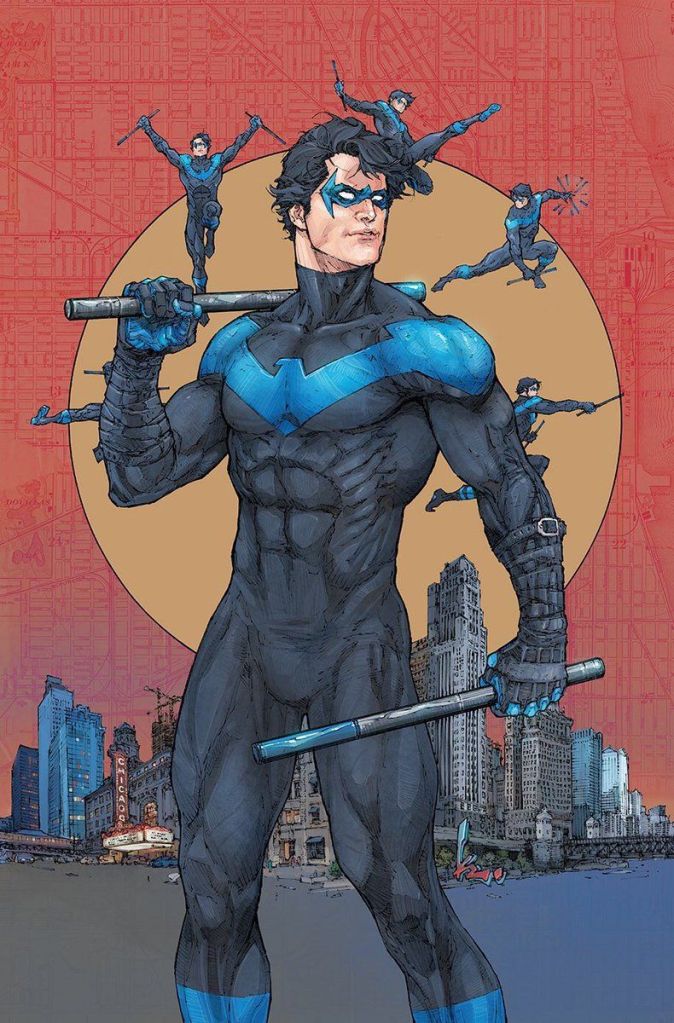
This new iteration of the Titans included non-sidekick heroes: Starfire and Cyborg and Raven and Jericho. In the early 1980’s Dock Grayson progressed from Robin to Nightwing, becoming an adult–and one of my absolute favorite heroes.
I love this new iteration of Dick Grayson. (I also remember when the news broke in the late 1980’s that DC was killing off Robin and being initially traumatized at the loss of Dick Grayson–and then remembered there was a new Robin–Jason Todd–and that MY Robin was now Nightwing and sighed in relief.)
I never watched any of the animated series–which I really need to correct–but I subscribed to DC Universe solely because they were launching an original, live action Titans series, and it was from the Greg Berlanti production team, which had done so well with the Arrowverse series. (I eventually stopped watching these shows, but will undoubtedly go back to them at some point.)
I watched season one during a period last year when I was going to the gym again–between New Year’s and Carnival–and watched an episode every day I went while walking on the treadmill. I enjoyed the show, but wasn’t sure if it would be something Paul would like–he tired of the Arrowverse before I did–and I have never pushed my love of super-heroes on him too much (he does watch the films with me). I liked the show, but it never really grabbed me; I thought it was incredibly well done, and of course, the actor they hired to play Dick–who was no longer Robin but also not yet Nightwing–was gorgeous.
That’s Brenton Thwaites in the remake of The Blue Lagoon. But don’t let the fact he appeared in that keep you from watching Titans–he’s actually quite good in it. And he’s not that baby-faced anymore.
Much better.
When Season One opens, the Titans have disbanded and scattered. Dick is now a detective with the Detroit police department, trying to distance himself not only from his teammates but from his own past, with Batman. But he still suits up from time to time and wreaks havoc on the criminals of the city–but he’s concerned that he can no longer control his rage, which is part of the reason he no longer wants to be a masked vigilante anymore.
The primary driver of the Season One plot is Rachel, a young girl with strange powers she doesn’t understand and she’s afraid of; in the first episode her mother (or so she thinks; played by Sherilynn Fenn from Twin Peaks) is murdered and she’s been having dreams in which she sees the death of Dick’s parents…and with her own mother murdered and going on the run, she tries to track Dick down. (Rachel is, I assume, eventually going to become Raven.) Teagan Croft plays the part well.
Teagan Croft as Rachel Roth
Kory Anders, a gorgeous and perhaps the best written part on the entire series, is chasing Rachel as well–but cannot remember who she is or why. As a long-time Titans fan, I knew she was Starfire–and she forms a great bond with Rachel, as well as Dick–they sleep together; I do remember them as a couple from the comics. Brilliantly played by Anna Diop, she also gets the best lines, and perhaps the coolest super powers.
Anna Diop as Starfire
We also meet Beast Boy, aka Gar Logan, when Rachel escapes from some villains trying to capture her and winds up at the mansion where the Doom Patrol live (this is kind of a backdoor pilot for The Doom Patrol series; I am interested in watching the show, which was produced after some recasting–and they brought in some big names: Brendan Frasier, Timothy Dalton, and Matt Bomer); after Dick and Kory catch up to her there, Gar leaves with them and they continue their adventures.
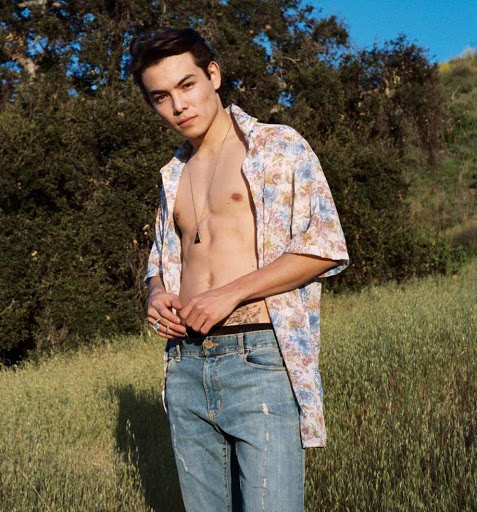
Ryan Potter as Beast Boy
Gar quickly becomes my favorite character on the show.
We also meet Hank and Dawn, aka Hawk and Dove, who now live in DC and are a couple–Dawn used to be with Dick (which plays out more in backstory in season two) and both are great characters, played very well by Alan Ritchson and Minka Kelly.
Hawk and Dove
Those who are paying close attention will recognize Ritchson–he guest starred on Smallville a few times as Aquaman. He’s also gorgeous.
It doesn’t hurt you in the super-hero casting process to have underwear model on your resume.
We also get to meet Wonder Girl, Donna Troy, played quite well by Conor Leslie.
Conor Leslie as Wonder Girl
The entire first season really revolves around the mystery of who Kory is, and why so many people are out to either capture or kill Rachel. Oh, I also forgot, we also meet new Robin, Dick’s replacement, Jason Todd.
Curran Walters as Jason Todd, Robin 2.0
He’s pretty–almost cartoonishly so–both Paul and I thought that he actually looks like a comic book character.
So, the Titans essentially reunite, Season One ends with a cliffhanger involving the big bad, and Season Two begins with not only the big bad being defeated, but an evolution of Rachel’s powers–the former Titans take off, while Dick brings the new Titans (Gar, Rachel, and Jason) to Titans Tower in San Francisco to train and become the new team. Not a bad first season, not bad at all.
But Season Two? Season Two is epic.
I won’t spoil anything–but there are two big bads–CADMUS Labs (aka Lex Luthor) and Deathstroke–played by Esai Morales (in the Arrowverse he was played by Manu Bennett; not sure why the switch, or if the two universes aren’t connected after all, despite Greg Berlanti’s involvement). We also meet Conner Kent (Superboy), Rose Wilson, Jericho Wilson, and Bruce Wayne/Batman.
Even better? KRYPTO.
Joshua Orpin as Superboy, Conner Kent, with Krypto
I think this is from one of the recent reboots of the comic book universe, but Conner is a clone, developed from a combination of Superman’s DNA and Lex Luthor’s and grown at CADMUS Labs. I’ve always loved Superboy–which is one of the reasons I watched every season of Smallville–and was very happy to see this addition to the cast.
I also greatly loved the mute character of Jericho from the comics, and was delighted to see him added to the cast, and played by Chella Man–and even cooler, the actor is trans.
Chella Man as Jericho, and various iterations of the character over the years.
Chelsea Zhang is pretty badass as Rose, too.
We also all too briefly meet Aqualad, played by Pretty Little Liars’ Drew Van Acker.
Season Two not only has the two big bads, but also explores in greater detail–which we didn’t really see much of in season one–the two great tragedies that led to the break-up of the original Titans team, and why Dick was questioning being a caped crusader in the first place….plus we see Dick transition back into being a hero, being reborn as Nightwing.
It’s very well done, and I highly recommend it, if you’re into super-heroes.
And it’s now the fifth of July, and so far–at least for me–the second half of this annus horribilis is off to an okay start. Yesterday was oddly not humid or hot; there wasn’t much direct sunlight and even by noon I hadn’t been forced to turn on the portable Arctic Air coolers that have so far made life in the kitchen/office bearable; I remain, as ever, buried and behind in all of my work, which is to be expected, of course–par for it, actually. I am always behind and scrambling to catch up, and since my personality is this peculiar combination of Type A mixed in with almost chronic laziness, this will most likely always be my state of being.
The sun is out, however, this morning, and while it remains cool here in the Lost Apartment, there’s no telling how hot it perhaps might get in here later this afternoon. I accomplished very little yesterday, truth be told; I started working on “You Won’t See Me” and didn’t get very far, because it was wandering off into a different direction than where it was originally intended to go–it wasn’t until I quit writing in disgust and adjourned to my easy chair that I realized (or remembered)where I’d wanted to go with the story in the first place, so I made some notes and went back to reading Cottonmouths. Later we streamed a lot more of The Club, which has a rather lengthy first season–it’s been a while since I’ve seen a season of anything recent that runs for over twenty episodes–and an awful lot has happened. We’re finally into the mid-teens, and halfway finished with the show, which we are still enjoying. And Cottonmouths remains quite delightful.
I refuse to allow myself to give into despair this fair morning over what I wasn’t able to get accomplished over the last two days. This morning I feel, for want of better terms, not only vivacious but alive and rested. The clouds of exhaustion that have made my thinking not as clear have lifted, or so it seems at this very moment, and we shall see how this day turns out, won’t we? I hope to get quite a bit accomplished today–we have the clinic open the next two days–and I have been sleeping well lately. I’m actually feeling close to normal for the first time in months, and while mentioning it also has me concerned that I might be jinxing it in some way, it’s actually been quite lovely.
It is very difficult to not fall into the ease of despair with the news every day–hell, every day for the last few years, quite frankly. The pandemic is raging out of control and might not get better for a while; Florida, for example, has reported more new cases over the last eight days than Louisiana has had since it first arrived here (um, where are all those people claiming it was irresponsible for us to have Carnival NOW? Cavorting on the beaches in Florida?), and as the crisis seems to continue to deepen rather than get better, the return to normality everyone seems to want gets pushed further and further back because of selfishness, frankly. As I joked to Paul yesterday about not getting much writing done yesterday, “What’s the point of writing anything new when who knows if there will even be a publishing industry next year?”
I’ve not, to be honest, thought much about my writing career this year, or at least since March. It was lovely being nominated for a Lambda Award–it’s been years since the last time–but I also knew once I saw Michael Nava’s name on the short-list I didn’t have a prayer of winning. But the nominations are always nice. I have thought about writing more Scotty books–I did leave their personal story on a cliffhanger in Royal Street Reveillon, after all–but there are two manuscripts in the hopper I need to finish first, and I want to work on Chlorine next. I need to get this Secret Project finished and out of my hair in order to get back to the two manuscripts–I’ve solved the issues with Bury Me in Shadows over the course of the pandemic–and I’ve also solved the plot issues with the Kansas book while I’ve essentially been too distracted and too exhausted and too ill to actually do any actual writing. My goal for this week–and yes, the week, not today–is to get that proposal finished; get a couple more of these stories under control and/or closer to finished; and if I have a highly productive week, to take next weekend off again to rest and recharge while trying to make some progress in the TBR pile. I want to reread another Perry Mason novel–I have The Case of the Calendar Girl in a hardcover I found in a used bookstore sometime during my travels over the past few years, and watching the new HBO Perry Mason has made me want to reconnect with the original character again–and I also want to get back into reading through both the John D. MacDonald and Ross MacDonald and Margaret Millar canons; which will help me get into a place where I will be able to get Chlorine written sooner rather than later. I also have some Dorothy B. Hughes novels on hand I’ve not read as well…and of course, there’s the Diversity Project to get back to at some point, in addition to the Short Story Project. I have Sara Paretsky’s short story collection on its way, as well as the latest Lawrence Block anthology, which I think is called In the Darkling Halls of Ivy (I could be wrong but it’s something like that), and of course, I still have his previous anthology on my side table, untouched.
So much to read, so much to watch, so little free time in which to do it all–and that includes, I might add, so little time to write everything I want to write before I die.
And on that note, I am going to head back into the spice mines. Have a lovely Sunday, Constant Reader–I certainly hope that I do.
And a happy 4th of July to you, too, Constant Reader.
It’s always bothered me that people consider this our national birthday, when it’s really not. July 4th is actually Independence Day; when the Declaration of Independence began to be signed and we officially shrugged off the yoke of the British Empire. Independence was, of course, qualified; it was independence for white men, naturally; women still were second-class, and no slaves were freed with this declaration. It would take almost another hundred years before the abolition of slavery; 150 for women to get the right to vote; and full equality with the straight white man is still a dream to be fought for in our laws and courts and hearts. But we can celebrate the ideal that was established by the flawed founding fathers, who were, as are all men, imperfect–no matter what the mythology we are taught from birth claims.
And it cannot be denied that our country was built over the bones and blood of the indigenous people whose land was taken from them.
So, there will be political speeches, and fireworks displays, and firecrackers going off and scaring pets pretty much the entire day. There will be picnics and barbecues and no mail delivered. Flags and parades and patriotism on display wherever you look. Hell, even I’m going to light some charcoal and cook out later today. But the United States is generally incapable, as a nation, of self-reflection and critical analysis of its past, present, and future; such is seen by a segment of the population as a lack of patriotism (because somehow blind allegiance to a party and its members, as well as slavish devotion to the symbols of democracy, rather than to the democracy itself, is somehow seen as true patriotism) and derided. But it is only through self-criticism, critique, and reflection that the democracy grows stronger with mistakes corrected and the course reset.
For no one is truly free and equal until all are free and equal.
I took yesterday as a day of rest; I answered some pressing emails in the morning and then walked away from my computer. I watched Hamilton (see other blog post) which was truly delightful; we finished Season Two of Titans, which was also marvelous, and Dick Grayson finally emerged from the shadow of Robin and donned the Nightwing costume in the finale (Season 2 was so much better than Season 1, and I liked Season 1; cannot wait for Season 3); and then we moved onto a Mexican series called The Club, which was highly entertaining and fun. We’re not even halfway finished with it, either, so we have several more nights of cheesy fun as our heroes establish themselves as Ecstasy dealers to the upper class of Mexico City–and the lead, Pablo, is absolutely gorgeous.
It was lovely having a relaxing day, as it always is; one in which I cast aside my cares and worries, and simply get lost in being entertained. I slept well again last night–I have quite a streak of that going now, which is absolutely lovely–and so now today, I am going to spend the day the way I usually spend my second day of the weekend–reading, writing and cleaning. The sink is filled with dirty dishes, and the dishwasher is also full (of clean dishes, that must be put away) and at some point this weekend I need to buy a new broom, clean the filter in the vacuum cleaner, and actually clean the floors. Today I am going to work on some in-progress short stories, while tomorrow I am going to work on the Secret Project (it would be lovely to get it finished tomorrow, and sent off to the publisher, but you know how that usually winds up). I also want to spend some time with Kelly J. Ford’s Cottonmouths, perhaps even finishing it, which would be lovely; I really need to get back into the swing of reading every day, else I have no prayer of ever getting caught up on the always-growing TBR pile.
I’m not sure what stories I am going to work on today, to be honest. There are several which are finished in the first draft form and need to be revised, things added and changed; still others are incomplete and need to have a first draft finished in order to get things worked on a bit. I was thinking about trying to take on “Please Die Soon,” “Gossip,” and “You Won’t See Me”; but there are any number of others that are simply begging to be finished. I’ve also got those novellas in progress–four or five, at last count–and it would be lovely to make some sort of progress on some of those as well. I also am quite aware I am most likely being overly ambitious here; laziness will inevitably seep into my bones at some point and I’ll just say the hell with it and walk away from my computer.
And on that note I am heading into the spice mines. Wish me luck.
I can’t think of many musicals that when I finished watching, I was simply awestruck. Oh, sure, Beauty and the Beast and Aladdin both always make me cry (the animated film versions, natch) and I’ve enjoyed some others, but as a general rule I kind of missed out on the gay musical gene. My general lack of interest in musicals, particularly stage ones, generally catches people off-guard; the stereotype, indeed, runs that deep. Some of my friends were stunned that I wasn’t an enormous Sondheim fan, for example. (They did turn me on to Company and Sunday in the Park with George, but while I recognize the ability and talent involved…I haven’t sought out others.) In some queer genetic DNA mix-up, I got the football gene instead of the musical theater one.
Hamilton, though. I mean.
Alexander Hamilton was always one of my favorite founding fathers. He literally came from nothing and nowhere to become one of the most important US historical figures of the Revolution and the creation of the country–the American monetary and financial system was his work. (It is definitely flawed, and has become much more so with the passage of time; unchecked corruption inevitably seeped in and exploited, and continues to exploit, those flaws, but it was still an enormous achievement.) He was killed in a duel, was the first Secretary of the Treasury, aide-de-camp to Washington during the war…truly remarkable. He was flawed, of course, as all the Fathers were. The development of the need for a mythology in which our founding fathers’ flaws were erased and they were raised to God-like stature over the centuries to come has inevitably clouded the necessary truths of history and papered those cracks over with lies and myth. The history I was taught, and read, as a child, was fictional.
I remember being excited when the Chernow biography was published to great fanfare and acclaim; I had a copy, but I don’t recall if I read it or not. That was during the cloudy times, and I am not sure where my copy of it is today else I was have spent most of the rest of yesterday rereading it. When the stage show debuted, to great acclaim and quickly became a national sensation, I was again happy, but couldn’t believe all the buzz and rapture I was hearing. I listened to the cast show recording and, while some of the songs were definitely catchy and memorable, it’s really an opera–and out of the context of the show itself…you literally have to listen to the entire thing to get it and appreciate it.
But watching the film yesterday was a revelatory. In context, with the visuals and seeing it all together–the lighting, the staging, the choreography, the performance, the costumes–it is truly a rousing masterpiece. I was moved to tears several times…and at the very end the number “Who Will Tell Your Story” reveals that the true hero of the show (and his life) was Eliza Hamilton, his wife. And what an extraordinary woman she was! She outlived her husband by fifty years, preserved his legacy, founded the first orphanage in New York City, and launched the drive to raise money for the Washington Memorial (with Dolley Madison and Louisa Adams), not to mention losing her oldest son as well in a duel–and the humiliation of the public exposure of her husband’s affair. The performance by Philippa Soo was exceptional (as was the young woman playing her sister, Angelica–and that number, “Satisfied,” with the rewind? Amazing).
My friend Pat Brady, a historian who wrote a biography of Martha Washington, always says that “women were the secret weapon of the American Revolution,” and she was right. Those American women of that time were just as exceptional as their men.
Was it historically accurate? Not completely, but not as inaccurate as offerings such as The Tudors, Reign, and The White Queen.
Now, I get the mania and the fandom. From the opening notes, I knew I was watching something different than anything I’d ever seen before. An excellent, highly talented cast; terrific staging and choreography…and an appealing story. There is nothing quite as American as the rags-to-riches story; because in our heart of hearts, we always think of ourselves being that underdog who is somehow going to take the world by storm and not miss our shot.
I’ll probably watch again at some point, but I am going to bask for now in the pleasant afterglow of seeing it for the first time.
Now I regret not seeing the original cast performing it live on stage. It must have been amazing to witness.
It’s also July now, as one can tell by the tropical weather experience New Orleans is currently enjoying; heat index averaging high nineties over a hundred everyday, your occasional heat advisory (“stay indoors if at all possible”), thunderstorms and flash flood warnings out of nowhere and some Sahara sand storm dust thrown in for shits and giggles.
I finished watching the only season of the original Jonny Quest yesterday while making condom packs, and I have to say, the original writers of this show had some serious issues with Asians, and most especially the Chinese. It’s unusual that in a decade and time period when the Cold War was particularly chilly–it originally aired only a few years after the Cuban Missile Crisis, and in prime time that single season–the Russians were never the villains. Dr. Quest’s arch enemy was the evil Chinese scientist Dr. Sun; and in several episodes the villains were Chinese. They also had a remarkable number of adventures in Asia–China, Taiwan, India, Hong Kong, Singapore, and Nepal; and the natives were always either evil or horrible stereotypes (as were any jungle natives they encountered in either South America or Africa). Hadji, a series regular, was a particularly stereotypical magical Indian youth–who managed to charm snakes, levitate others, and numerous other magic tricks while chanting “Heem, heem, salabeem” or some such nonsensical thing. He was always in a turban and Nehru jacket, and even in beach scenes, when the others wore swim trunks, he wore a Gandhi loincloth. Why?
I also watched a couple of episodes of Scooby Doo Where Are You, and despite the simplistic, casual racism of Jonny Quest, it’s still the superior show. I’ve not watched any of the later reboots of Jonny Quest–the one from 1986 shows up on HBO MAX as the second season, and in the mid-nineties The Real Adventures of Jonny Quest launched, with the boys aged to teenagers from eleven year olds, and Race’s daughter added to the mix (I guess to deflect the deep queerness of the original); the animation in this version is perhaps the best of all three versions–with Race finally achieving his full muscle-god bodyguard perfection–but whenever I’ve tried to watch, the “it’s not really Jonny Quest” disappointment always sets in and I stop watching.
We also got deeper into Season 2 of Titans, and it gets better and better with every episode, frankly. The Jericho story is particularly heartbreaking; and I love that they are using the second season (with some continuity errors) to explore how the team came to break apart in the first place (the show begins with the Titans already broken up, and them coming back together to confront the big bad of Season One) and how, essentially, all the action of Season One really was set into motion. It’s very exceptional story-telling, frankly, and the plotting and pacing is, for the most part, superb. Also superb is the addition of several new cast members: Rose Slade, Conner Kent, and Deathstroke as the big bad, with Aqualad appearing briefly as set up for the original conflict between the Titans and Deathstroke. We only have two episodes left, and I was glad to see the show was renewed for a third season already…although, given the pandemic, who knows when it will ever be filmed or when it will actually air.
Today, as I already mentioned earlier this week, is the day I am taking off. I have some emails to respond to, and some other things I need to get done this morning, but as soon as I get all of that done I am going on sabbatical for the rest of the weekend. I want to get a lot of writing done this weekend–the Secret Project must be finished, and there’s a couple more short stories in progress I want to work on and develop, but today for the most part I’m planning on mostly cleaning and reading and chilling out, so I can just let my brain relax and recuperate and my body to rest, so that the rest of the weekend I can get the writing I need to get done finished. I am looking forward to getting back into Kelly J. Ford’s Cottonmouths–the first chapter was blistering–and getting through all the emails in my inbox. I also have my edits for the Sherlock story, which I’ll also have to get through this weekend–perhaps today–I am giving myself until one to deal with the Internet and emails and so forth before shutting down for the holiday weekend.
It’s very strange outside this morning, neither light nor dark but sort of grim-looking and hazy. The trees aren’t moving so there’s no wind of any kind out there. I’m not sure what the weather is supposed to be like today–there’s usually not much point in checking the forecast as it’s inevitably always the same–hot humid chance of rain–and usually, after June, we surrender to it and don’t bother with daily updates and just start paying attention to tropical formations and depressions coming across the Atlantic or forming deep in the Gulf. It isn’t hot in the kitchen/office this morning yet–the absence of the blindingly brilliant morning sun has helped, and I haven’t had to turn on the portable Arctic Air coolers yet (but I know it’s inevitable), but it actually feels pleasantly cool down here this morning thus far, which is rather nice, quite frankly.
I still have three stories out for submission (“The Snow Globe”, “Moves in the Field,” and “This Thing of Darkness”), but I do want to spend the summer trying to get more out there. One of the biggest disappointments I’ve found as a writer is the continual drying up of short story markets that actually pay, and while others have sprung up in their place they either don’t pay, or pay so little as to just be a token (and might as well be unpaid, for that matter). I’ve always been concerned about the decline of the short story market, because I do think the form is important to literature, and to crime fiction in particular. I personally love the short form–despite my constant struggle with it–and I also know I am just as guilty as anyone in its decline, because I don’t read them as much as I should. I do buy anthologies and short story collections–Sara Paretsky’s is winging its way to me even as I type this, along with the new one edited by Lawrence Block–and I am probably going to be putting together another one of my own at some point over the next year or so (provided the world doesn’t burn to the ground in the meantime). I was calling it Once a Tiger and Other Stories, but I have to completely rethink the title story, “Once a Tiger,” and so I may need to rename it. I would also like to include some of these stories I’ve recently sold–which will delay the collection more, as the original publications have to occur first, but I was thinking perhaps The Carriage House and Other Stories, or Night Follows Night and Other Stories. I also would love to collect all my love story/romance short stories into an edition–I’ve published three or four, but have a lot more just sitting in files needing to be revised or rewritten or finished.
And on that note, I am going to head back down into the spice mines. Have a lovely day, everyone.
Thursday; three-day weekend eve, and I am working from home today. I have a lot of on-line trainings to do, and some condom packs to make, and various other duties that don’t require showering and putting on presentable, appropriate clothing.
Seriously, you really don’t want to see me on a weekend–particularly a long weekend. Pity the people at the grocery store.
This week, though, seemed to last forever, which is something that is becoming more and more common as the COVID pandemic continues. I always thought when you got older time went by faster? That no longer seems to be the case–whether it’s the dumpster fire the country has become, or the COVID disaster, or any number of any other things, or some combination of all of them, days and weeks seem to last for months. I had hoped that moving into the second half of this interminable annus horribilis might change some of that, but no…yesterday was the first and it was a dreadful, wearing, exhausting day that killed the euphoria I was experiencing from the two short story sales that came with the first two days of the week (which is still, I think, fairly remarkable; I sent the things out in the morning–there is one still pending–and within two days had contracts for two of them). Okay, the euphoria may not be completely dead, but it’s on life support.
The good news is that physically I feel fine–no more sickness, no more exhaustion, and I have been enjoying restful nights of sleep for over a week now, which has to be some kind of record for one Gregalicious. (Don’t get me wrong, I still have aches and pains, but those are the normal, your body has one foot in the grave and the other on a banana peel aches and pains that comes with getting older; I need to use my back roller today to release all the tension and stress accruing in my back, and the closure of my gym has not helped at all with physical fitness, either.)
Last night as I waited for Paul to come home, I sat in my easy chair and scrolled through the Cloud folder on my iPad, taking a look at some in-progress short stories (nothing like a couple of sales to get you going on writing short stories) trying to decide which ones to try to take a whack at over the course of this weekend, and with all due modesty, I really need to let go of some of this self-defeating insecurity I carry around inside my head. Two of the in-progress stories I read–“You Won’t See Me” and “He Didn’t Kill Her”–are actually quite well written, if I do say so myself (and I am saying that), even if I am not sure how to finish the stories. I like the concept of both stories, actually; and maybe if I pull them up and start writing the proper way to complete them will come to me–or some way to finish them, even if it’s not the right ending; sometimes the right ending comes when you write the wrong ending, if that makes sense? I also want to finish my quarantine story, “Condos for Sale or Rent”.
Also, in other exciting news, for the first time in my career a book I am included in, The Faking of the President, was covered in the New York Times, here:https://nyti.ms/31CR0br
Yet another review of an anthology that doesn’t mention my story–can’t imagine why I am insecure about my story-writing ability–but hey, any promo for the book is the most important thing, and to hell with my writerly ego. (This new version of WordPress doesn’t allow me to change a link into a hyperlink, so I can just say “click here”–but I will continue to try to figure this out.)
Yesterday we were in a heat advisory; today I don’t see the emergency alert in my inbox, so I guess today is going to be cooler than yesterday. Granted, cooler is one of those things when it comes to New Orleans weather that is more of a matter of which degree of hellish we are going to experience for the day; the kitchen/office was literally unbearable last night as I made dinner, even with my wonderful little Arctic Air coolers going (I may need to order some more of them, to be honest).
We watched another few episodes of Titans last night, and I have to say, Season Two is so much better than Season One; and Season One, while clunky at times, wasn’t bad at all. The addition of Deathstroke as the big bad for the season was genius, the episode with Aqualad was an all too brief appearance for him (and the actor, who was also on Pretty Little Liars, was prime eye candy), and now the addition of Cadmus Labs, Conner Kent, and of course–you can’t have Cadmus Labs or Conner Kent without Lex Luthor! I do hope this has been renewed for a third season. It’s quite good.
And now, back to the spice mines. Have a lovely 4th of July weekend eve, Constant Reader!
And yesterday morning I awoke to the delightful news that I sold another one of the three stories I sent out on submission on Monday; how splendid! So, “Night Follows Night” will be out in an anthology next year; I will of course keep you all posted on further developments.
So, that was a great twenty-four hours for my always desperately needy authorial ego, was it not? That, along with the excellent reception my reading for Timothy got last Friday night, was a lovely balm for me and my ever-tortured soul. This is what I mean when I talk about the bipolarity of writing; so much of the time it’s just you and the computer screen, the accusatory blank Word document open before you (or one with some words, not good, grouped together on it already) as you grimly search your mind for something intelligent, or at least semi-coherent, to start typing. And even when you manage to get something typed up and saved and rewrite and revise and polish…there’s still no guarantee you’ll eventually sell the story, and even when you do–no guarantee anyone reading it will like it, it will be included in reviews in a positive way, or there will ever be any feedback (and sometimes, awful as it is, I appreciate the negative because it means someone noticed, which is really, when you examine it more deeply, kind of sad.
“Night Follows Night” was actually inspired by my watching some documentary–I’m not sure what it was called–about a young man who had escaped from a religious cult his parents still belonged to; I think he and his brother had gotten away from it. It was horrifically sad, more than anything else–I want to say the cult was called the Children of God, but that wasn’t it, I don’t think–and all I could think about was how difficult it must have been to find the courage to run away from that and out into a cold, cruel world with just the clothes on your back and whatever money you were able to scrounge up. Around this same time I was reading one of Margaret Millar’s brilliant novels, How Like an Angel, which was also built around a religious cult, and I started thinking about it some more….the cult in the documentary also sexually abused its members, regardless of age or gender, and that also struck a chord in my head. When I started writing it I called it “This Thing of Darkness”–because, really, this backstory is incredibly dark, and carrying that around in your head would also be remarkably dark. But after the first draft or so, I chose to use that title for another story and changed this one’s title to “And The Walls Came Down.” While that kind of fit better, I still didn’t much care for it, and eventually came up with “Night Follows Night”–which I think truly fits; because for my poor main character, he never really gets to enjoy the daylight; it’s always night in his head.
Wouldn’t that be a horrible way to live?
And maybe–just maybe–I’m better at this writing thing than I ever give myself credit for?
Yes, I know–I need to stop that crazy talk right now!
This week for some reason seems to have lasted forever already; Paul and I both commented on this very strange occurrence after watching some episodes of season two of Titans, which is much better than Season One–and I really liked Season One. The boy candy is certainly there, and the women characters are enjoyable; and the fight scenes have yet to start seeming “I’ve seen this before”, which eventually killed Arrow for us; much as we loved the earlier seasons. I’m so delighted to see one of my favorite comic book super-hero teams done so well; there are too many members to do the Legion of Super-Heroes justice, so I’ll settle for Titans. I was also sorry to read that Krypton was cancelled after its second season; I have yet to watch it (I may get Paul to rewatch Season One with me), and am hoping it’s going to show up on DCUniverse or HBO MAX one of these days.
And there’s a delightful three day weekend looming. I am itching to get back to some of the short stories I have in progress, and I want to get the Secret Project completed. I actually have an extra day (HUZZAH!) so I can laze around for an entire day, gradually cleaning and so forth as I read Cottonmouths and perhaps do the floors (which are frankly disgusting) and I probably should clean the vacuum cleaner, and as always, so much to be done. But if I take that kind of a day on Friday, that means I have Saturday and Sunday to write (oh, and Hamilton is airing Friday night on something streaming–Disney Plus, perhaps?) and there’s absolutely no reason why I can’t get some great writing done.
Unless, of course, I undermine and defeat myself again as I am so prone to do.
Sometime during my first cup of coffee Entergy shut off our power–they were doing some work out there on the street for about thirty minutes–and this is, of course, one of the major flaws of the Keurig: what happens when the power goes off during your first cup? But it wasn’t as big a catastrophe as one might have thought; remember, I was cutting back on caffeine during the Great Dehydration Debacle of 2020, and I realized that I could survive a low caffeine morning–hell, there were mornings last week where I had zero caffeine, and there was no body count.
I also tried a new recipe Monday night–creamy pasta with shrimp and mushrooms (basically, it’s an Alfredo sauce, and who knew it was that fucking easy to make homemade Alfredo sauce?)–and it was actually quite delicious, despite the fact I forgot one of the ingredients. I added more cheese to the sauce then the recipe called for (because OF COURSE), and I will certainly make this again; and will eventually begin fiddling with the recipe to see if I can make it even better.
And on that note, tis time to return to the mines of spice. Have a lovely Wednesday, Constant Reader.
So I went ahead and sent out three stories on submission yesterday; “This Thing of Darkness,” “Night Follows Night”, and the Sherlock story. Will any of them actually be accepted? Who knows, but that’s all part and parcel of the joy of being a writer who likes to write short stories despite being rarely asked to write them. I have like 86 short stories in some form of progress now, but it felt really good to write finis on these and sent them out. If they are rejected, oh well; I’ll just save them for my next short story collection.
See how that works? Staying positive is always a plus, you know?
And last night before I went to bed I checked the Pandora’s Box known more commonly as my email inbox to discover a delightful email from the editor of the Sherlock anthology that she loves the new edition of the story and is sending me a contract! How absolutely delightful. I am glad “The Affair of the Purloined Rentboy” will see print, and as always, it’s lovely to get that kind of affirmation. It’s also a period piece, which was just as daunting as writing a Holmes story set in New Orleans–the only rule for the anthology was that it couldn’t be set in London, and Holmes and Watson couldn’t be English. So I made Holmes a Louisianan–and we never are quite sure where Watson is from. But it was great fun, challenging, and very, as I said, daunting. While I’ve read the Holmes stories–and the Nicholas Meyer novels, and other stories written by modern day Sherlockians (notably, Lyndsay Faye and Laurie King), I don’t think of myself as an avid Sherlockian. Even now, I cannot think of the plot of either A Scandal in Bohemia or The Red-headed League.
So, I wasn’t a hundred percent certain I could write such a story that would be worthy of publication, but it was a challenge–and I do enjoy challenges. I like pushing myself as a writer, trying something different, seeing if I can continue to grow as a writer. (But just between you and me, the only reason I even thought I could possibly do this was because it was specified not to be canon–no London, not the late nineteenth century, no need for continuity. No, this was a way I could write a Sherlock story and make it entirely my own as well. And of course, setting it in 1916 was also a bit of a challenge for me as well; I’ve never done much period/historical writing, and since I knew, once the title came to me, that Storyville had to be involved (how else could one write “The Affair of the Purloined Rentboy” and not involve Storyville?), which presented a host of other issues. Fortunately, I’ve been reading lots of New Orleans history lately, and one of the books was about Storyville: Gary Krist’s Empire of Sin (highly recommended, by the way), and in a short story I wouldn’t have to have the ongoing detail a novel would require, so I thought, fuck it, let’s give it a shot.
I was also able to use one of the locations I often use in Scotty books, the Hotel Aquitaine, which made it even more fun for me.
So, apparently, the thinking positive thing might actually work. How lovely!
Also, yesterday I (the ever-present resident Luddite) managed to figure out how to go back and read the chat from the Queer Noir at the Bar reading on Friday night–I kept accidentally closing it, and when I was reading I never looked at it–and wow. Everyone was so gracious and kind about my reading! I’m glad, though, that I wasn’t reading the chat while I was reading because it would have freaked me out. Thank you all for being so kind.
I also started reading Kelly J. Ford’s Cottonmouths, and as I read, I began to remember why I hesitated to read it. Being from the South, and from a particularly poor part of the South, I sometimes have trouble reading about that world; because of the memories it brings back, and while Ford’s prose is magnificently beautiful, she also brought me right into a world I know so well–a world I’ve been trying to shake off my entire life. There’s probably something to be said, or perhaps written, about my struggle with where I am from; the deep pride instilled in me my entire childhood about being Southern and the defensiveness that automatically arises whenever someone else is critical of (what I still think of) as home; and how that pride also runs concurrent with a river of shame–two rivers, running parallel, a kind of Tigris and Euphrates within my soul, my psyche, my being. I’ve started and never finished any number of stories and novels set in Alabama; my files run over with them. Bury Me in Shadows is the first manuscript set in Alabama I’ve ever finished a full draft of (there are a couple of short stories I’ve finished; Dark Tide is also set in Alabama but down in a little town on Mobile Bay–which isn’t quite the same thing), and I have yet to complete it enough to turn it into my publisher. Reading Kelly’s book takes me to the same places Daniel Woodrell’s work takes me, or Ace Atkins’ The Ranger series…that inner conflict, that inability to decide, that pride of place and where I come from coupled with shame. I could see it all so clearly in my head as I read that first chapter…she may have been writing about rural Arkansas but it could have been rural Alabama. It’s real, it’s vivid, and it’s beautiful.
The rural south is savage in its beauty.
My whole life has really been about dualities; being Southern but not growing up there; closeted self v. authentic self; being a writer but also always having some other job for whatever reason. My identity has always been sort of splintered; it’s probably why I am so constantly down on myself because I never really feel whole, or like I fit in somewhere–because I’ve been outside my entire life.
And, I have found few things trigger me to dark emotion–anger or depression–than being reminded that I am an outsider.
We started watching Perry Mason, and we’re enjoying it–but it’s really not Perry Mason. It’s something entirely else, with the characters given the same names as the ones Erle Stanley Gardner used. The cast is fantastic, and it’s a terrific noir series (if a bit reminiscent of Penny Dreadful: City of Angels–which we stopped watching, for reasons that are not pertinent here), so we will keep watching–but, it’s not really the same show or characters.
And it makes me want to reread one of the originals again.
And on that note, tis back to the spice mines with me.
Several years ago–more than I really care to recall, really–another writer told me he was “getting older and becoming more concerned with <his> legacy.” This took me aback. I’d never given a thought to such a thing, and to this day, it’s not something I give much thought or consideration to; I still don’t, really. I mean, it’s not really up to us as writers to worry about what legacy we leave behind, is it? I have always assumed once I am dead and gone both me and my work will eventually be forgotten; and even if by some weird, bizarre chance I should have some sort of revival or discovery by some future gay mystery scholar–who cares? I mean, won’t I be dead and beyond caring about such things?
Why should I be concerned about whether I’m just as unknown after death as I was when I was alive?
I became interested in Cornell Woolrich a few years ago; I don’t remember why exactly, or how he came to my attention; I just remember ordering this book and several others over the years. Woolrich has been dead for quite some time, and isn’t really remembered very much today outside of some enthusiasts of crime fiction history. I was very surprised to find out that some of his stories and novels had been filmed; “It Had to Be Murder,” for example, became Hitchcock’s Rear Window, which is something, right? Woolrich was gay and an alcoholic–so many writers of the period were (and frankly, I think using a typewriter for writing had a lot to do with it)–and he eventually died from complications from alcoholism. I thought it would be nice to read some of his work, particularly during Pride Month.
Every night he walked along the river, going home. Every night, about one. You do that when you’re young; walk along beside the river, looking at the water, looking at the stars. Sometimes you do that even when you’re a detective, and strictly speaking, have nothing to do with stars.
He could have taken the bus, ridden home as all the others did, when he came off duty. It wasn’t even the shortest route to where he lived, this walk beside the river. It took him out of his way a little. He didn’t mind that. It sounded better when you whistled, with the water there beside you. It made the stars seem brighter, and it made you want to look at them more, when the water was there below them to catch them upside down. It made you dream better; those dreams you have in your head in your twenties. You can’t dream in a bus, with all your fellows around you.
And so–every night he walked along the river, going home. Every night, about one, a little after.
It really took me awhile to get through this one, to be honest. I started it a few years ago, and it didn’t really grab me; this time I was determined to see my way through to the end. Sickness, and other things–it’s not like the world isn’t ablaze, after all–kept me from completing it, and in all honesty, even finishing it yesterday morning forced me to start skimming. It’s a great concept, but it’s got too much filler.
The concept behind it–a man who can see the future tells a rich man he knows when he is going to die, and the effect this has on the rich man and his daughter–is quite excellent; it’s in the execution that it falters. The opening is strong enough: Shawn, a young policeman, tends to walk home along the river after his shift is over. On this particular night he comes across a trail of things–money, a compact, a lipstick, things that might have fallen out of a woman’s purse; he eventually finds the purse, and the woman it belongs to is on a bridge, ready to jump. He stops her, takes her to an all-night diner, and she tells him the sad story of how her father and she became involved with this man who can see the future and how desperate she and her father have become as the man’s other predictions come true and they become convinced her father is going to die.
But the telling of the story is over half the length of the book, and Woolrich doesn’t take it into prose; he uses the device of her desperately telling her sad tale of woe precisely the way I just described it–she’s telling him the story, and the story drags precisely for that reason: it’s passive storytelling, not active, and certainly not how I would have told it. It’s a personal preference, and Woolrich IS a very good writer; I just don’t think he should have told it so passively. The suspense and drama comes from the question of whether the man with the gift of prophecy is actually a fraud or for real; but if it’s fraud, to what end? The second half of the book moves much faster, but also has a lot of dead weight/filler as well, hence the skimming; it may just be a more dated style. I also find it kind of hard to believe that the New York police would take this story seriously enough to put up to eight men on it–and there’s a horrific scene where the cops, needing access to an apartment so they can eavesdrop on the prophet, essentially set up the woman who lives there (and has been arrested for solicitation before, but not for over six years) for solicitation so they can use her apartment–and dismiss this horrifying abuse of power and her civil rights as just and necessary; and even laugh about her being sent away for at least thirty days!
But overall, it’s a good story and well-told, if a bit slow in places. Woolrich had a way with words, for sure, and sure, I think it’s worth a read; if for no other reason than to see how writers in the past handled suspense.