Under the Boardwalk

I hadn’t been sure that I would keep writing young adult novels after I revised, rewrote and published the first three (Sorceress, Sleeping Angel, and Sara) I didn’t know if it was a direction I wanted to keep going in. I knew I wanted to do stand-alones–always have wanted to do stand-alones–and I also like writing about teenagers and young adults.

You may remember (doubtful) me talking about a horror novel a while ago that I started writing in the 1980’s called The Enchantress that I only got about three or four chapters into before abandoning (because I didn’t know where to go next with it; and the first chapter I specifically remember rereading at some point in the decades since and shuddering in horror at how badly it was written), but one of the places in the book really stuck in my head–an old family-owned hotel called Mermaid Inn, which sat on the shores of Tuscadega Bay (which was my stand-in for Choctawhatchee Bay–my grandparents retired to a house on that bay and I’d always wanted to write about that area; still do–it’s where “Cold Beer No Flies” was set). After shelving The Enchantress (which I do think about from time to time, and wonder if I should revisit the idea) I kept thinking, you should write a book and call it Mermaid Inn because that is a great title!

I made a folder for it, wrote a few sketchy notes, and then… it sat in my files for a very long time.

If you will remember, I had originally planned to write an entire series of interconnected young adult novels, a la the Fear Street series by R. L. Stine, and one of the varied locations they would be spread out over would be Tuscadega, Florida, in the panhandle on a fictional bay. That was part of the note I scribbled for the folder–set this in the panhandle of Florida, and somehow connect it to the fictional Alabama county you’re going to write about someday.

I decided to write Mermaid Inn sometime after Hurricane Katrina, when I discovered yet again my own ignorance of geography. I was beginning to realize that the panhandle wasn’t the right setting for this book and decided to set it on the Alabama Gulf Coast, which made me realize I had absolutely no clue about that part of Alabama’s geography. I’d just never really given it much thought, to be honest; I knew Mobile was on the bay, and I knew that when you drive on I-10 through Mobile you have to take a tunnel below the Mobile River. I just had always assumed there was nothing south of Mobile in Alabama–I mean, it’s ON the water–and figured that those lower prongs of Alabama that reach down along the sides of the bay were uninhabitable wetlands. I discovered this to not be the case when visiting friends for the first time who lived in Alabama south of Mobile. They told me to take an exit off I-10 and drive south, which I didn’t think was possible.

Turns out it was–and I realized…this will work for my book! So I filed it away and forgot about it again.

I don’t remember precisely why I decided to write Mermaid Inn, but I did, and set in a small town on the prongs, south of Mobile; my friend Carolyn Haines helped me with some background and I know she told me some stories about closeted society men in Mobile and their hijinks and I thought, I could use this for the book and I think that may have been the impetus? And then I created my character, Ricky Hackworth, from Corinth, Alabama–po’ white trash who needs a swimming scholarship to attend the University of Alabama. (Sidebar: alert readers will recognize that Beau’s last name in Bury Me in Shadows–and at one point in the story he mentions he’s only the second Hackworth to go to college; “besides my cousin who got a swimming scholarship.”)

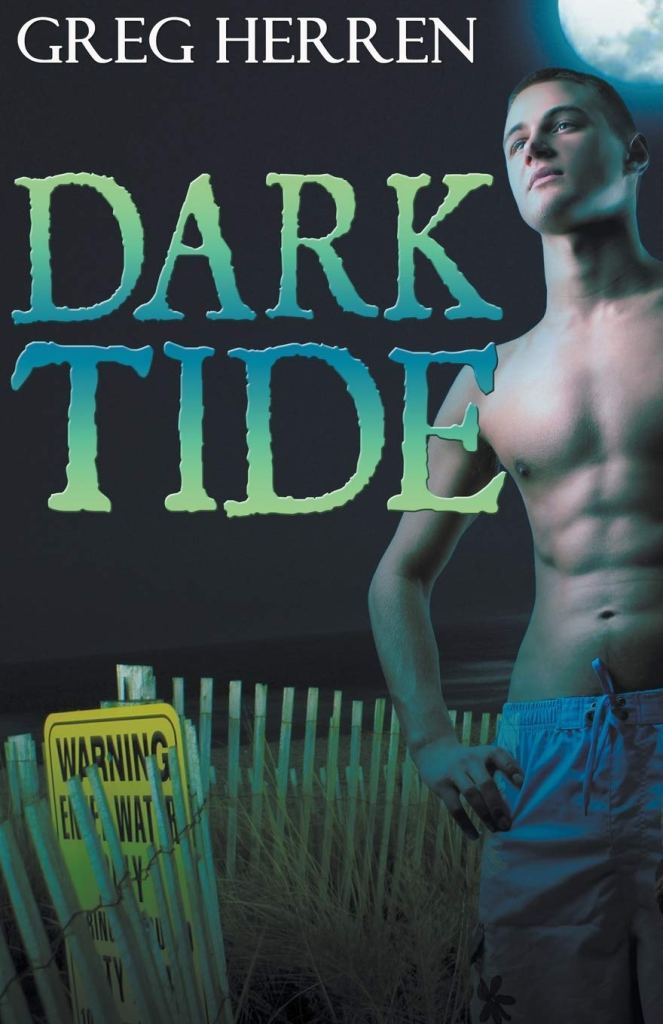
Bold Strokes didn’t like the title, and for perhaps maybe the fourth or fifth time in my career my original/working title didn’t make it on the cover. They recommended Dark Tide, which I really liked because it gave the sense of the book’s mood and tone and voice…and darkness.
The engine of my pickup truck made a weird coughing noise just as I came around a curve in the highway on the Alabama Gulf Coast and I saw Mermaid Inn for the first time.

My heart sank.

That’s not good, I thought, gritting my teeth. I looked down at the control panel. None of the dummy lights had come on. I still had about a half tank of gas. I switched off the air conditioning and the stereo. I turned into the long sloping parking lot of the Inn, pulling into the first parking spot. I listened to the engine. Nothing odd. It was now running smooth like it had the entire drive down. I shut the car off and kept listening. There was nothing but the tick of the engine as it started cooling.

Maybe I just imagined it.

Hope springs eternal.

The last thing I needed was to spend money on getting the stupid old truck fixed. Maybe it just needed a tune-up. I couldn’t remember the last time it had one.

Dad gave me the truck when I turned sixteen. It had been his work truck since before i was born–it was two years older than I was. He’d finally broken down and bought himself a new one. This old one was dependable and had almost two hundred thousand miles on it. Dad had taken good care of it. He’d babied it, gotten an oil change every three thousand miles without fail, and I could count on one hand the number of times it had been in the shop to be repaired.

It still had the original transmission.

It might not have been the nicest or prettiest car in my high school parking lot, but it got me where I needed to go and got good gas mileage. Since I was saving every cent I could for college, that was a lot more important than horsepower and cosmetics and a loud stereo that rattled your back teeth. The swimming scholarship I’d accepted from the University of Alabama wasn’t going to remotely cover anything close to the lowest estimate of what my expenses might be, but it was the best offer I’d gotten.

And I was grateful to have it. If they hadn’t offered, I wouldn’t be going at all.

Swimming was my ticket out of Corinth, Alabama.

That opening scene!

Dark Tide was probably my most hard-boiled young adult title published to that point. It was a dark story, and Ricky was poor–an economic condition I’d touched on with Sara, and something I generally try to avoid when writing. I’ve been poor, and I know how it feels; I don’t like remembering those days of checkbook mistakes and bounced checks and not having enough money from one paycheck to another. Ricky has taken a summer job as the lifeguard at Mermaid Inn in Latona, Alabama (Latona is another name for Daphne, which is actually a town on the prongs below Mobile), to save money to pay for college expenses his swimming scholarship to the University of Alabama wasn’t going to cover, and the water being there meant he could continue training. Once he arrives and is shown to his room on the uppermost floor of the building and meets the owner’s daughter, he learns that his predecessor from the summer before had simply disappeared–and young teenaged boys disappear with an alarming regularity over the past few years. He starts asking questions, mostly out of curiosity, and also starts having horrible dreams, about vicious mermaids beneath the water, and there are a lot of stories about killer mermaids from the days of the indigenous people and the Spanish. I wrote some terrific scenes in this book that I was really proud of–one particular dream sequence was especially chilling–and I was also trying something with the rhythm of the words, which I hadn’t done in a very long time, and I think it worked.

Writing Dark Tide was important to me because this was the book that reminded me again that I was writing stand-alones to help keep the series books fresher, more creative, and less paint by the numbers, too.

Take a Chance On Me

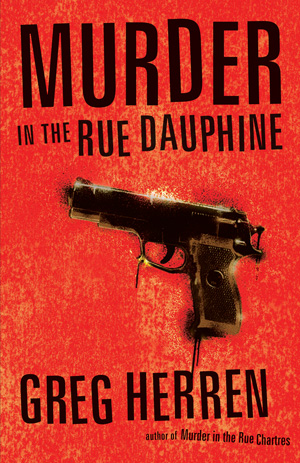
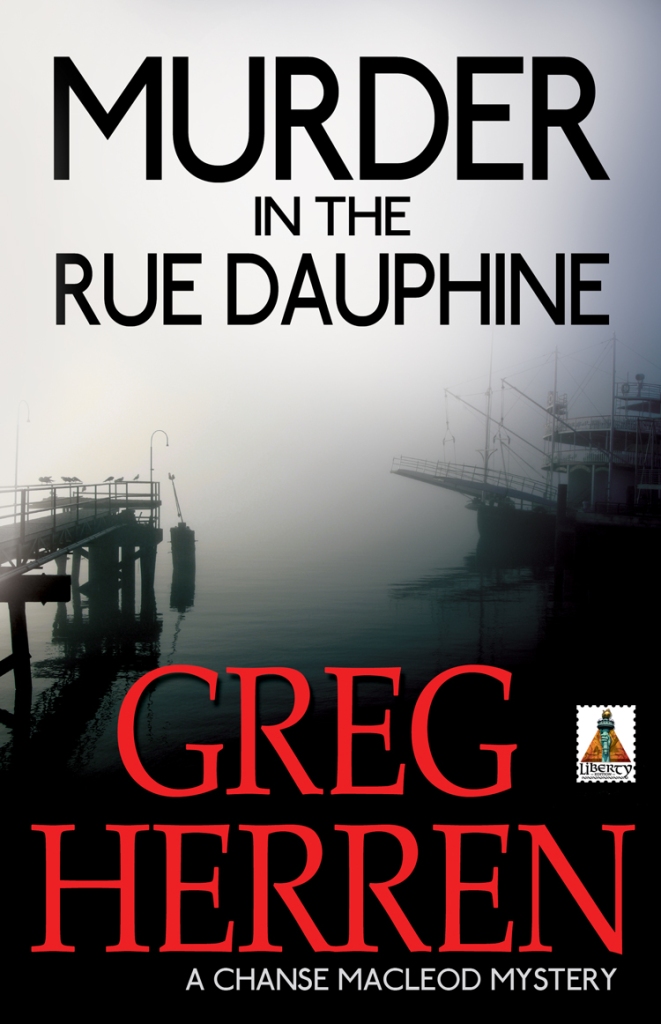
Ah, Murder in the Rue Dauphine.

It’s always weird for me to talk about my writing and my books and so forth on here; I always worry that I am either contradicting and/or repeating myself. When you’re as self-obsessed as I am, that can be a problem; talking about myself is probably my favorite thing to do–on here, at least. And I feel like I’ve told the story of where Chanse came from and how the series developed from the very beginning many, many times.

It was when I was living in Houston that I rediscovered crime fiction, and the old love was even deeper once it was rediscovered. This was the period when I read most of the Perry Mason novels, discovered Paretsky and Grafton and Muller, and decided to give Travis McGee and John D. MacDonald another try. (I had read The Dreadful Lemon Sky when I was a teenager, but I hadn’t liked it; I was more into the classic detective mystery, with lots of suspects and a denouement with everyone gathered in a drawing room as the identity of the killer was unveiled–the McGee series was definitely not that. But MacDonald had written a superb introduction to Stephen King’s first short story collection, Night Shift, and I had always wanted to give him another chance–pun fully intended.) I devoured the McGee series this time around; and I really admired the character and how fully rounded and developed he was (I should give the series a reread; I’d be curious to see how they hold up now)…and armed with all these new private eye novels and Perry Mason puzzles, so I started coming up with my own version. Even the name was a shout out to McGee. My character was also tall with sandy/dirty blond hair, a former college football player, and he lived in Houston, with an office downtown and a secretary named Clara. The title of the first book was going to be The Body in the Bayou, and I started basing the case on the tragic Joan Robinson Hill case, immortalized in Tommy Thompson’s Blood and Money (the premise of the story was that the character representing Joan’s father hires Chanse after Joan’s death to find dirt on John–and then John is murdered; fictionalized, of course.) I wrote about six or seven really bad chapters long hand before giving up. I didn’t know how to write a novel then nor did I understand the concept of rewrites and revisions and drafts. (My ignorance was truly astounding.) The hurdle I couldn’t clear was typing. I was a terrible typist. I’d had a job in California working for an insurance brokerage that was computerized, and had a word processing program that I used to write short stories on; it made such an incredible difference that I knew I would have a much better shot at actually making my dreams come true if I only had a word processor…

In 1991, after I moved to Tampa, I managed to get a word processor, and that was what I wrote my first two and a half young adult novels on–the original drafts of Sara, Sorceress, and Sleeping Angel–and used it happily for several years until it finally died on me. But by then, I was living with Paul and had swung back around to wanting to write adult crime fiction again, and I wanted to write the Chanse character that I’d already created…so I picked back up on The Body in the Bayou, moved it from Houston to New Orleans, got rid of the office and the secretary, and made Chanse gay. I kept the title, but threw away the story; I wanted it to be a gay story, too. I don’t really remember the plot, but it had to do with the murder of a beautiful boy-toy for a wealthy closeted gay man in New Orleans…and Chanse knew the boy-toy from his days working as an escort before he landed the rich man, I wrote about six or seven chapters of this before we moved to New Orleans….and I realized I’d have to throw it all out again because it was all wrong; I’d made the classic mistake so many writers make when writing about New Orleans: writing about it having never lived here, I only had tourist experiences–which are vastly and dramatically different from the actually “living here” experiences. So, once again, I threw it all out and started over, this time calling it Tricks instead of The Body in the Bayou.

The title morphed again to the less saleable Faggots Die after the first draft; and I remember talking to Felice Picano–he was coming into town for the Tennessee Williams Festival, and I picked him up at the airport. As we drove back into the city from Kenner, we talked about my book and the series, and he nixed the new title as well as the old one. “No one, ” he wisely said, “will pick up a book called Faggots Die, and Tricks sounds like a pornographic memoir of your sex life.” Felice was actually the one who suggested I mimic titles for the series from a classic writer…and we were throwing titles around in the car when I said, “You know, the streets in the Quarter are technically rues–Rue Bourbon, Rue Royale, Rue Dumaine–and the murder happens on Dauphine. Maybe Murder in the Rue Dauphine?”

“That’s perfect,” Felice said, and then we played with Poe titles the rest of the way into the city–incidentally, one of them was The Purloined Rentboy, which became my short story “The Affair of the Purloined Rentboy”, so never throw anything away.

And thus was Murder in the Rue Dauphine titled; and the plan for the series titles was also devised–the branding was changed by the publisher, but I can honestly say my first book was titled by Felice Picano.

Never come to New Orleans in the summer. It’s hot. It’s humid. It’s sticky. It’s damp. It’s hot. Air conditioners blow on high. Ceiling fans rotate. Nothing helps. The air is thick as syrup. Sweat becomes a given. No antiperspirant works. Aerosols, sticks, powders, and creams all fail. The thick air just hangs there, brooding. The sun shows no mercy. The vegetation grows out of control. Everything’s wet. The build­ings perspire. Even a simple task becomes a chore. Taking the garbage out becomes an ordeal. The heat makes the garbage rot faster. The city starts to smell sour. The locals try to mask the smell of sweat with more perfume. Hair spray sales go up. Women turn their hair into lacquered helmets that start to sag after an hour or so.

Even the flies get lazy.

My sinuses were giving me fits as I left the airport and headed into the city. It was only 7 o’clock in the morning but already hotter than hell. The air was thick. I reached for the box of tissue under my seat and blew my nose. The pressure in my ears popped. Blessed relief.

As I drove alongside the runways I could see a Transco Airlines 737 taxiing into takeoff position. I saluted as I drove past, thinking it might be the flight that my current lover was working. Paul looked good in the uniform. It takes a great body to look sexy in polyester. He does.

He’d be gone for four days on this trip. I was at loose ends. I’d wrapped up a security job for Crown Enterprises the previous Wednesday. The big check that I’d banked guaranteed I wouldn’t have to worry about money for a while. I like when money’s not a concern.

And so began a series that lasted for seven titles and about twelve years or so; I don’t remember what year the last book in the series was published. I never expected anyone would publish it; it was intended to be a “practice novel” so I would get used to rejections and learn. It was also the first manuscript I ever wrote that went through multiple drafts before I thought it was finished enough to send out on query. It was supposed to be an exercise in learning humility and getting experience with the business while I wrote the book I did expect to get an agent with and sell–which was what I’d always called “the Kansas book” for over a decade at this point. (It eventually morphed into #shedeservedit.) But you never really learn what you’re supposed to when you’re stubborn, thin-skinned, and used to being demeaned and talked over and not taken seriously, for any number of reasons. I sent the manuscript to three agents: two sent me lovely but form rejections, which was disappointed but not surprising. I took this well, put the manuscripts away to send to three more once the final rejection came.

It came on a Friday, if I recall correctly. I went to pick-up the mail and my manuscript was there. Not a surprise, of course, but still a little disappointing. I went out to my car and opened the package…and paper-clipped to the title page of the rubber-band bound manuscript was a torn piece of used paper, with a note in ink reading I find this manuscriptand characters neither interesting or compelling with the agent’s initials at the bottom.

It was like being slapped in the face.

By the time I got home I was in a raging fury. I was literally shaking with rage when I came inside. How fucking unprofessional, I thought as I sat down at my computer to check my emails, trying to decide how I would enact my vengeance on this rude piece of shit.1 There was an email there from the editor I was working with on an anthology which had taken my first-ever fiction short story and thus would be my first publication. I had never read the signature line–mainly because I was so excited for my first fiction sale (NARRATOR VOICE: it was porn). This day, he concluded his email with Please send us more work. We definitely want to see more from you and as my ego preened, slightly soothed from the insulting agent note from earlier in the day2, I also looked down at the signature line and realized I was communicating with the senior editor at Alyson Books! I immediately wrote him back a very short note: I’ve written a novel with a gay private eye set in New Orleans, would you be interested in that? and before I could talk myself out of it, hit send.

He wrote back immediately and said please send it to me ASAP!

I put the same manuscript back in a new envelope, and drove back to the postal service to get it in the mail before I changed my mind, and breathed a sigh of relief once I got back to the car–and immediately forgot all about it.

Six weeks later I came home to a phone message from the editor. I called him back, he made me an offer, and my career leapt forward much faster than I expected…and it started a roll of good luck and “being in the right place at the right time” that has kept me publishing almost non-stop since Murder in the Rue Dauphine was released in 2002.

It sold really well, got mostly favorable reviews, and scored me my first Lambda Literary Award nomination.

Not bad for a manuscript and characters who were neither interesting or compelling, right?3

It also took me a long time to realize–or rationalize–that the note wasn’t meant for me. (I was most offended that I wasn’t even worthy of an actual form rejection letter; that was the truly insulting part for me.) I realized when telling this story on a panel somewhere, that the note was probably meant for an intern or a secretary or an assistant, who just shoved the whole thing in an envelope to do the rejection and through some wild Lucy-and-Ethel office shenanigans, it went out without the rejection letter and with the note intended for internal eyes only…and made me wonder, how different would my career and life be had that fuck-up not happened?

We’ll never know, I guess.

  1. Not really proud of this reaction, but I did get the last laugh. ↩︎
  2. Said agent died a few years later. I may have smiled and said good, a la Bette Davis vis a vis Joan Crawford’s death. ↩︎
  3. I may be more forgiving about a lot of things these days, but I will always be petty about that hateful agent. ↩︎

A Love Song

Yesterday was pleasant and relaxing. The kitchen ceiling didn’t leak from the torrential storms (but the leak over the stairs came back; it’s always something). I watched some football games (the Alabama-Georgia game was very entertaining, if the Texas-Oklahoma State one was a massive snooze-fest) while reading Christmas Presents by Lisa Unger, which I really enjoyed (more on that later), and then capped off the evening with the Florida State game on in the background while I did things–some more reading, some brainstorming, some cleaning and organizing. I didn’t finish watching, and went to bed early. It was a nice, restful, relaxing kind of day, and that was really nice. Being forced to recuperate and rest hasn’t been terrible, to be completely honest; it’s kind of amazing how quickly I have adapted to not being active and just keeping my mind free from stressors and relaxing. The house is a mess, of course, but I am not letting it get to me and am just doing the minimum I can, with the occasional big thing–dishes, laundry, something. I’m not going to say that I’ll be glad to go back to the office, but this has kind of given me kind of a taste of what retirement will look like, and it doesn’t suck. It’s still a long way off, to be sure, but it’s also making me rethink paid time off. Is it better to do dribs and drabs with long weekends, or is it better to save the time and take an entire week away? I kind of liked this long period of not going to work.

It’s also really easy to lose track of days and dates, too. I often find myself wondering what day it is, or what the date is, and have to check. I also slept deeply and well again, staying in bed late this morning, which is also fine.

Today I want to get some writing done. I’ve been doing a lot of thinking about this new book, and it’s really time for me to buckle down, put my ass in the chair, and really start writing this thing. I also want to get cleaned up today–I really need to shave my head; I’ve not done that since before the surgery and it’s getting frightfully long for me (does anyone else remember when the length of a man’s hair was something we were judged about? Like men with long hair was such a huge issue, one that would define our culture and society) and I also need to shave my face. I was a little worn down yesterday, too–it’s hard to remember sometimes that my body needs rest still because it’s not finished healing yet–and for someone who is pretty active (or restless, anyway), getting tired doing things I normally do is bothersome. But I have another week and a day before I have to get up to an alarm and head back into the office, which is going to be the real test: can I make it through a shift in the clinic? The jury is still out.

It’ll be interesting to see what the college football selection committee will do when it comes to picking the final four for the play-offs this year. Who will be included? We have three undefeated teams, two one-loss conference champions, and lots of noise. It will be weird to have no SEC representation in the last play-off series ever, given how many times the SEC has won it–and not just with the same team, either. This century has seen national titles for Auburn, Florida (two), Georgia (two), LSU (three), and Alabama (six). Five teams from the same conference, four of them winning more than one. (This is why I laugh when people talk about “SEC bias”–well, how many national titles has your conference won since 2000 and with how many different teams? The most is two–the Big 12 with Texas and Oklahoma, the ACC with Florida State, and Clemson1, and the Big 10 with just Ohio State. There’s a reason for the bias; it’s called success on the field.) But I can see how they would pass over Alabama for Texas; Texas beat Alabama in Tuscaloosa. On the other hand, the last four titles in a row were won by the SEC (LSU, Alabama, and Georgia twice), and the Big 12 hasn’t won a title since Oklahoma back in 2002. Texas is kind of SEC-Lite, though; beating the SEC champion this year and coming into the conference next year. I saw LSU’s schedule next year and it’s brutal; USC, UCLA, and Oklahoma on top of Florida, Alabama, Mississippi, Texas A&M, and Arkansas, with Vanderbilt thrown in on top as lagniappe. No Auburn or Mississippi State, but at least there are two easy FCS schools on the schedule. Talk about a brutal schedule–and we’ll have a new quarterback. Looks like another rollercoaster of a season. This last season’s defense was terrible, but still–LSU only lost to Florida State (undefeated, ACC champ), Alabama (one loss to another one loss conference champion AND SEC champ) and Mississippi (two losses, to Alabama and Georgia); which, given how shitty the defense was, is kind of impressive. So, not a bad season, really, if a bit disappointing. But I didn’t believe the pre-season hype, either; I thought LSU was overrated simply for beating Alabama last year, and was correct. And now the season is effectively over; I have idle curiosity about the play-offs and will of course watch whichever bowl LSU winds up in, whether it’s a New Year’s 6 game or not (probably not; there are a lot of good two loss teams–Missouri and Mississippi–and they need to find a high profile bowl for Georgia and possibly Alabama, too). But it was a fun season, even if a bit disappointing for LSU fans, but I’ll take 9-3 over Orgeron’s last two years as head coach any day of the week. I am not completely sold on Brian Kelly yet, either, but he’s better for the program than Orgeron was, and he’s not insane like Les Miles, either. (Kelly, at least, knows how to work the time clock, which Miles never quite had a grasp on.)

I’m hoping the Saints draft Jayden Daniels, to be honest. This was a truly dismal Saints season–and we won’t even talk about the disappointing Tulane loss yesterday, or that it looks like they are going to lose their coach to a higher profile program, either.

I think my next read is going to be David Valdes’ Finding My Elf, which is a holiday-themed young adult romantic comedy. I met David earlier this year (he’s also a friend of my friend Kelly) on the y/a panel at Saints & Sinners, where I didn’t really belong (my feelings about being considered a y/a writer are a subject for a different time; but the short version is I write books about teenagers now and then, and because the characters are teenagers they’re classified as y/a, but I don’t write them any differently than I write for adults. Maybe I am making too big of a distinction, and this doesn’t from any sense or mentality that y/a is somehow lesser, because it’s not–there’s some absolutely terrific y/a and middle-grade work out there. I leave categorizing my work to the industry because trying to make sense of it is too much for me and I don’t want or need my head to explode.) Anyway, David was absolutely marvelous; his book You Spin Me Round was already in my TBR pile, but I can’t pass up reading a Christmas y/a romcom during Christmas season, can I? I’m also considering writing a romance myself–a gay one, of course–and already have the set-up and the opening scene written up in my head. Maybe I’ll be able to find the time to write it this next year; stranger things have happened.

And on that note, I am heading into the spice mines. Have a lovely Selection Sunday, Constant Reader, and I’ll be back with some blatant self-promotion later.

  1. Miami also won a title in 2001, but they were not in the ACC at the time. ↩︎

Lost in Love

Saturday morning and we’ve at long last made it to the weekend! Huzzah! I have a lot to do this weekend, and I even have to leave the house both nights. This afternoon I am attending a co-worker’s wedding; tomorrow I am having dinner at San Lorenzo with my friend Ellen. Woo-hoo! Yesterday was a good day. I did my work-at-home chores, along with chores, and then ran some errands so I wouldn’t have to do them today–a decision I am very grateful for this morning, believe you me. I then read Angel Luis Colón’s Infested for a while, finished my reread of Death Drop, and watched an episode of Moonlighting. I also rewatched the last two episodes of Our Flag Means Death again–glad I did; I slept through most of them and they were most witty and clever and funny. When Paul got home we started the new season of Elité, but it’s more a habit and completionism to continue watching it at this point. It’s glory days are long past, I barely remember who any of the characters are, and I don’t really remember much of last season, to be honest.

Sigh. But those first three seasons are still epic television. This is kind of what I mean when I talk about shows that keep going because they’re successful when they should have stopped when they were ahead; the season three finale was an excellent stopping place–but at the same time I would have been terribly bummed had the show ended there, too. Be careful what you wish for, right?

The sun was bright and high this morning, just as it was yesterday morning, which leads me to believe the time change should have been this weekend instead of two or three weeks from now. It used to always be in October; and I don’t know why or when it was changed to November, but if we’re going to have to do this every year, can’t we at least have it happen when it always used to happen? I slept really well last night–I’ve been sleeping well all week, actually. I think the change in the weather has helped with that dramatically. I still feel a bit groggy this morning, but that’s okay. I am going to write this and read some more of Infested once it’s posted, and then I have some things to do around here. The wedding window period is from 4-9, with the actual ceremony around five. I am going to try really hard not to be that person who always arrives ahead of the scheduled time and has to sit around waiting for everyone else to show up–the story of my life–and I am quite determined not to even summon a Lyft until four o’clock.

I’m really enjoyed Infested, but I knew I would. I’ve been a long-time admirer of Angel’s work for quite some time now, and his narrative voice is absolutely perfect in this book. I’m not sure if it’s considered middle-grade or y/a–that line is always so blurry–but it’s quite engaging and I really like the main character. I’m also not entirely sure I’ve read a book before that’s set entirely in the Bronx? (And why is it “the Bronx”? It’s not “the Queens” or “the Brooklyn” or “the Manhattan”, but just saying “Bronx” without the article is weird…although I suspect that’s entirely from years of hearing it said with the article.) I am really enjoying it.

I’ve thought about writing for middle grade (I’ve literally thought about writing everything other than fantasy –I even have some science fiction, incredibly bad, in the files) but am not sure if I can do it, which is precisely the reason I should try writing it. I’ve always wanted to do my own kind of Nancy Drew-style series for kids, have wanted to ever since I was a kid reading those books, and I’d really like to at least give it a try at some point before I finally exit the planet or am unable to write anything anymore. Although can I really write for middle-graders when I don’t know any kids that age? Writing is writing, I suppose, and the best thing to do is try it and write the very best book I can with the very best characters I can; I do think two of my strengths as a writer are likable characters and a good narrative style that draws the reader in. Can that translate to middle grade mysteries? I guess I will never know unless I try–and maybe, just maybe, I could write one set in New Orleans?

And on that note, I am heading into the spice mines with my book to read. Have a lovely Saturday; I may be back later; you never know!

Afterglow

And just like that, here we are at Friday again. It’s going to be a very strange fall weekend, since we have no LSU game, but they do occasionally have bye weeks, so I guess that’s how I should look at this particular weekend. The Saints have an early game on Sunday, though, so that should be relatively normal. The question is, should I wait to run my errands until Sunday during the Saints game? I mean, Sunday mornings are the best for making groceries already because everyone’s at church, so the one-two punch of church and the Saints playing should mean abandoned aisles and a quick, easy trip. Decisions, decisions.

We’ve been having a quite marvelous cold spell this week–cold for New Orleans, of course, which means June-type weather for most of you–and so I’ve been sleeping most marvelously, which has been lovely, and of course the three-day-per-week getting up early thing has been sending me to bed earlier than I usually go, and the getting up early hasn’t been quite as awful as it once was. Is this a permanent, lasting change to my body clock? We shall have to see how it goes from now on, but it’s not a bad thing. Maybe even on the days when I don’t have to get up that early I should go ahead and get up if I wake up organically at six; more time in the morning to get things done, really, and going to bed early isn’t a terrible thing.

Remember me talking about flexibility? Maybe it’s time to start getting up every morning at six, getting emails answered, and then move on to doing some writing. Adaptability–something I’ve stubbornly been resisting all the time–is never a bad thing, and maybe part of the issues I’ve been having this year have affected me, mentally, in ways I didn’t even think about. Usually I do exactly that; I adapt to my situation and figure out ways to get everything done and stay on top of things. I’ve really not been doing a very great job of that this year, and why have I been so resistant to adapting and changing my habits and routines? Sure, I’m fifty-nine, and it’s a lot easier when you’re younger to change your habits and routines, but you shouldn’t become so mired in them at any age that you can’t change.

Yesterday’s entries in this month’s horror film festival were a rewatch of Christine (adapted by John Carpenter from one of my favorite Stephen King novels) and a wonderful old British 1970’s horror film, The House That Dripped Blood.

Christine is one of those King novels that made me roll my eyes when I first heard about it; “really? A haunted car?” (For the record, after reading Christine, I vowed I would never roll my eyes at the concept of a King novel again–because not only did it work, it was fucking terrifying.) Christine is another King novel that could be classified and sold as a y/a; it’s about teenagers, and the special kind of hell life can be for some teenagers. The empathy with which he wrote Arnie Cunningham, and the obvious love his best friend Dennis had for him, was the primary force that drove the book, and I also owe Christine an enormous debt of gratitude (but that’s a story for another time) as a writer myself. I saw the film version in the theater when it was released, and to this day, the book remains one of my favorite Kings and the movie, which had to take some liberties with the novel, is one of my favorite King adaptations. It’s flawed, of course, and isn’t nearly as good as the book, but it also holds up after all this time as well. It was directed by John Carpenter, and while it’s not one of his better movies, it’s a good one. Keith Gordon plays Arnie, John Stockwell plays Dennis, and Alexandra Paul plays Leigh, the girl who both boys wind up interested in–all three are fresh-faced and appealing, and I never really understood why none of them had bigger film careers. (The only other film of Keith Gordon’s I recall is him playing Rodney Dangerfield’s son in Back to School, which undoubtedly hasn’t aged well.) The primary difference between film and novel is in the movie, it is the car, Christine, herself that is evil; there’s an opening as she is coming off the line in Detroit in 1957 and already has a taste for blood; in the book, it was never really clear whether the car itself was evil, or if Roland LeBay, the first owner, somehow infused the car with his rotted soul–in either case, the reader comes away from the book unsure of what the source of evil was, and I think that was better served; also, in the book we could see Arnie’s point of view, and Arnie himself, like Carrie in Carrie, was much more of a victim than it appeared in the film.

The House That Dripped Blood was from Amicus Studios in the UK, rather than a Hammer Studios picture, and was written by the great Robert Bloch, best known for writing the novel Psycho. It’s an anthology film–I really miss the terrific old horror anthology films; Amicus and Bloch teamed up for another one of my favorites, Asylum; Stephen King and George Romero tried to revive the form in the 1980’s with their Creepshow collaborations–and includes both Peter Cushing and Christopher Lee in its cast. There are four stories included in the film–I don’t know if Bloch based them on his own short stories or not–about tenants in this particular large country house in England. The film opens with the arrival of an inspector from Scotland Yard, investigating the disappearance of a film star who’d been renting the house, and the rental agent for the house tells the inspector the stories. The first is about a novelist writing about a psychopathic killer named Dominick that he starts seeing everywhere; the second is about a man who becomes obsessed with a wax figure in a wax museum in the nearby town; the third is about a father and daughter who engage a governess, but are harboring a dark secret; and the final story is about the actor, who is major horror film star (and a bit of a diva) who buys a cloak for the vampire film he is making and becomes convinced that the cloak belonged to a vampire–and is also turning him into one. I had never seen this film before, and had always wanted to; I remember it being advertised in the paper when I was a kid, and it’s now free for streaming on Prime. It’s not bad–the production values were low (hilariously, the diva actor in the fourth segment complains about how low budget is on the film he is making, which is why he is going looking for a cloak in the first place), and the acting isn’t bad; you can really never go wrong with either Cushing or Lee, frankly. Asylum is definitely a better film, but I enjoyed The House That Dripped Blood but probably won’t watch it again.

As for the debt I owe Christine, that’s a little bit more complicated. I moved to Tampa in 1991 for two reasons: to restart my life and start living openly as a gay man, and to get away from my old life after a two-year transition in Houston and to start a new one, one that included me pursuing writing seriously for the first time. I had been writing all of my life at this point–I still have the first novel I completed, in long hand and never typed up, and had had bursts of short story writing throughout the 1980’s–but I wanted to start really taking it seriously, and trying to get better, and actually trying to get published. I bought an inexpensive word processor that summer–not a computer, it’s only functionality was as a word processor, and you could save your documents to a floppy disc as well as print them out on what was essentially a typewriter–and since I was at the time thinking about writing horror, I decided to take some of the framework of the handwritten book (and some of the characters, and the town) and write a horror novel about teenagers, from the perspective of an adult looking back at what happened in high school. The book opened with the main character getting an invitation to the ten year reunion, and we learn he left for college and never went back. He starts remembering high school–and the course of the novel is the story of what happened and why he’s never gone back (a concept I’ve returned to numerous times). And while the bulk of the story was going to be about high school and teenagers, I didn’t see it as a book for teens–and I was following the same book structure as Christine, right down to the framing device of the memory chapters bookending the beginning and the end. I was even going to write the first part in the first person, before switching to multiple third person points of view in the second half. I was about five or so chapters into the book when I discovered young adult horror fiction, notably Christopher Pike, and realized this book–and the two I was planning to write after–would work better if written for teens and removing the framing device. I did do the first part in first person, and switched halfway through to multiple third person POV; this was what later served as the first draft of Sara. I started remembering all of this as I rewatched Christine yesterday; as well as a lot of other things I had thought about and planned back in the early 1990’s when I wrote the first drafts of Sara, Sorceress, and Sleeping Angel.

It’s chilly in New Orleans this morning–we’re having that vaunted cold spell, which means it’s a frigid 68 degrees–and I am taking a vacation day today to try to get caught up on things, plus errands. Scooter has to go to the vet for a blood glucose level test, and I have to take Paul to Costco so he can order new glasses, and then I have prescriptions to pick up and on and on and on. I need to proof my story in Buried, I need to revise my story “The Snow Globe,” the Lost Apartment is a scandalous disaster area, and I need to get back to work on Bury Me in Shadows. There’s also about a gazillion emails I need to read and answer…it seriously never seems to end, does it?

But Scooter clearly feels better–he’s back to knocking over the trash cans and pushing things off surfaces to the floor, his eyes are brighter and more alert, and he seems more energetic; he’s running up and down the stairs rather than meandering, like he had been–and I am hopeful we will soon be able to take him off the insulin. But I’ve gotten so used to giving him the shot twice a day I don’t really notice it that much anymore, and it doesn’t phase either of us at all. He’s also a lot more cuddly than he has been, and more affectionate–which is also kind of hard to believe; I hadn’t really noticed that he wasn’t as affectionate as he had been.

It’s so lovely that it’s cold enough for me to wear sweatshirts again! I love sweatshirts, frankly; my favorite attire is sweats, and I hate when it’s too warm or humid for me to wear one. I am even thinking I might need to turn off the ceiling fans (!!!). Madness! I am really looking forward to getting home from these errands, getting into my sweats, and relaxing as I get things done all day–and I”m really looking forward to tonight’s sleep.

And now it’s off to the errands. Have a lovely day, Constant Reader.

Crazy for You

Wednesday morning, and I am awake ridiculously early. I actually woke up just before four, but stayed in bed until six–at which point I got out of bed and figured might as well be productive instead of just laying here staring at the alarm clock. It’s also my long day at the office, but c’est la vie. It is what it is. If anything, I should sleep really well tonight, at the very least.

I didn’t read any short stories yesterday, alas, as I spent most of my weekend reading Karen McManus’ One of Us Is Lying, a huge phenomenal bestselling young adult novel that’s being adapted as a TV mini-series, a la Thirteen Reasons Why.

Scan

Bronwyn

Monday, September 24, 2:55 pm.

A sex tape. A pregnancy scare. Two cheating scandals. And that’s just this week’s update. If all you knew of Bayview High was Simon Kelleher’s gossip app, you’d wonder how anyone found time to go to class.

“Old news, Bronwyn,” says a voice over my shoulder. “Wait till you see tomorrow’s post.”

Damn. I hate getting caught reading About That, especially by its creator. I lower my phone and slam my locker shut. “Whose lives are you ruining next, Simon?”

Simon falls into step beside me as I move against the flow of students heading for the exit. “It’s a public service,” he says with a dismissive wave. “You tutor Reggie Crawley, don’t you? Wouldn’t you rather know he has a camera in his bedroom?”

Well, that’s a start, isn’t it?

The book is sort of a Breakfast Club turned on its ear;  if one of the student archetypes from that film had died during detention and all the other kids in there had a reason to want him dead. It’s a clever idea (one I am kicking myself for not thinking of myself), and the story is, above all else, compulsively readable. The book is told in shifting first person point of view; we get inside the heads and see the viewpoint of all four of the kids who are now suspects, which isn’t an easy thing to do McManus not only takes us there, but by seeing their lives through their eyes–their families, their relationships with friends, their ambitions and goals and so forth–we as readers begin to care about them, which makes knowing that one (or more) of them might be a killer even more problematic for the reader because you become emotionally vested.

Like The Breakfast Club, McManus takes the typical student stereotypes–the brain, the jock, the criminal, the beauty, and the outcast–and turns them on their ears.

In the 1980’s, the teen movie was reinvented and made much more real, more relatable, and more fun than what those that had come before. Serious films about teens were usually told from the point of view of the adults (The Blackboard Jungle, Up the Down Staircase) with an occasional exception, like Rebel Without a Cause. The 60’s saw the teen movie evolve into beach and surfing movies, and of course the Disney films like The Computer Wore Tennis Shoes and Now You See Him Now You Don’t–silly comedies that viewed teen life as though it were something frozen in time from the 1950’s (and even that wasn’t particularly realistic–malt shops, sock hops, etc) But beginning with Fast Times at Ridgemont High, the teen films of the 1980’s evolved into something different, something else, and John Hughes was one of the driving factors of that with his films, like Sixteen Candles, The Breakfast Club, and Pretty in Pink, among others (those are the Molly Ringwald trilogy, probably the most famous and best-remembered). In all honesty–and don’t come for me–I never thought The Breakfast Club was that great of a movie; sure, the actors were appealing, there were some great scenes, some funny moments–but the most, to me, honest part of the movie was when they were sitting around talking and Claire said they wouldn’t be friends at school on Monday because that’s what I had  been thinking all along. 

But One of Us Is Lying completely subverts that and turns it  on its head; as it does with a lot of other y/a book tropes, and again, the story moves very well. As someone who has read a lot of crime (and all of Agatha Christie) I was able to figure out who the killer was early on; but most teenagers I suspect would be completely caught unawares.

I really enjoyed this and couldn’t put it down because I wanted to find out what happened to the characters, and I cared about them; and it even ends with a John Hughes moment, which was nice.

Self Control

Monday morning, and heading into day two of my Facebook imprisonment. Interestingly enough, I find that I’m not really missing it all that much; I suspect I’m not the first person to suffer a Facebook ban who’s found it surprisingly liberating, and I’m equally certain that is hardly the intent behind the banning. If you think about it, truly, punishing members by banning them is actually kind of arrogant on Facebook’s part, you know? “Oh, you’ve been bad, so you can’t post or interact with anyone on here for a week!” Does it not occur to them that not being able to use Facebook could, in fact, be like going cold turkey on smoking and actually cure one of wasting time on their actual site?

I also find it fascinating that hate speech–rape threats, racism, misogyny, homophobia, transphobia, Islamophobia–doesn’t violate their community standards, but guys wearing speedos or skimpy underwear do. Which has everything to do with the moral rot at the core of our society, frankly; the pearl-clutching mentality that the human body and sexuality is distasteful and not something people should ever talk about. Dorothy Allison wrote a brilliant essay decades ago about how if Americans could ever get over their unnecessary societal prudishness and learn how to talk honestly and openly about sex and sexuality, many of our societal problems would go away.

Thanks, Puritans.

I’m very glad I grew up in a time when there was no social media; and while I certainly don’t ever want to go back to having to write on a typewriter and mail submissions in, I cannot even begin to imagine what it would be like to be a teen today and have to deal with social media. One of the things that makes writing y/a hard for me is my lack of understanding about social media and how it really works; plus not understanding how much teens and young people are addicted to their phones. (I am one to talk; but when I think about being a teen, I can’t comprehend how different my life would have been with a smart phone; and how different that would have made high school in general. One of the issues I have with the WIP–which is a y/a–is precisely that; even when I started writing and publishing y/a back in the day the smart phone wasn’t as prevalent and all-pervasive as it is today.) I remember Lois Duncan talking, at her Grand Master interview for MWA’s Edgar Symposium a few years ago, about updating her y/anovels and having to constantly call her grandchildren because she needed a way to get rid of cell phones in order for the plot to work. I even had to deal with that some in my own books–Lake Thirteen and Sleeping Angel both required isolation; so those parts that required such isolation took place in the back country, in cellular dead spots.

I also sometimes wonder how much social media–and my smart phone–has impacted my ability to focus–and not just while writing or editing, but in general. I can’t think of a single time recently when I’ve watched a television show where I’ve not turned to my phone or my iPad “just to check social media.” This is not a good thing; and perhaps this Facebook-imposed exile is just the thing I needed to get my focus back.

Hmmmm.

And since I do have a lot to do, I should most likely be grateful to Facebook’s ridiculously random enforcement of ‘community standards.’ It’s kind of nice to have the habit broken, in a way. Maybe going forward I should use it merely as a way to promote my books.

Hmmmm.

And on that note, this short story ain’t going to write itself.

So for Monday, here’s a hot guy in his underwear.


marcus

You Won’t See Me

Wednesday after the holiday, and it’s back to the office with me today. I suppose it’s kind of apropos that my first day back at work is a twelve hour day; office testing then main  office testing then bar testing at the Pub. But it’s also a short work week, I am extremely well rested, and I should be able to hang. I finished the revisions yesterday and am going to let them sit for a few days, and I’ll get back to the final read and polish this weekend. I still think there’s some more work needing to be done, in addition to the trimming. The manuscript now sits at about 101,000 words, and that’s not only my longest manuscript ever but it’s probably too long for a manuscript that will be marketed as y/a. I also started writing a new short story over the course of this weekend, and worked out how to fix some others that are either already in progress or in need of revision, which is absolutely lovely. I think as I let the manuscript settle, I am going to work on my short stories as well as start planning out the next book. My plan for the summer was to be finished with this one by the end of June so I could spend July and August working on the next Scotty and planning out the book to follow that one, so I may be a week or so behind. In any case, I feel very good about where I am sitting right now and I am not going to beat myself up over not staying on schedule.

This doesn’t mean, of course, that I am not going to try like hell to get back on schedule.

The Lost Apartment is also clean; there’s a little touching up here and there–mostly upstairs, which is not my responsibility–that needs to be done, but other than that everything is sparkling and clean and neat and tidy. I wonder how long it can stay that way? Paul is returning on Saturday night; my hope is that I can do all the shopping I’ll need to do, preparatory for his return, either tomorrow morning before work or Friday morning before work. As Saturday is my last full day without him here, I am hoping to go over the manuscript that day for the last time, and then figure out what agents to send it to. I’ve not tried to land an agent in over twelve years; so I have to steel myself for the rejections. I also need to update my CV, which is always hopelessly out of date, which also means I need to go back and figure out when I published what. Heavy heaving sigh. Ah, well. I also want to get back to reading; I was so busy focusing on the manuscript that my mind was too tired when I was finished working to do any reading. I finished bingeing Scream yesterday, which was quite fun, and then I watched Cabaret again on my TCM app; La Bare, a documentary by Joe Manganiello about a male strip club in Dallas; and a documentary about a once-promising college football player whose career kind of imploded for a variety of reasons, The Identity Theft of Mitch Mustain, which was very well done (and also got me looking forward to college football season again).

So, I suppose I should get ready for work and make a to-do list for the next few days to make sure I don’t miss anything.

And here’s a hunk to get your week off to a nice start, the always delightful Chris Evans:

IMG_2304

At Seventeen

The spice mines have not been kind to me lately; I’ve been in one of those awful malaises that I hate so much. I am behind on the book (of course) and I’ve been struggling with some short stories I needed to write. However, yesterday I made some progress on the book (huzzah!) and I think I am snapping out of it. The first thing I saw this morning on social media was this, from Anne Rice:

“To be a writer one thing is required. Write. That’s the big secret. It’s one word. Get the words down on paper, one way or another, and save them. Believe in your own voice, too, and your own way of doing it. Don’t listen to people who say negative things. They’re common. Writers are precious.”

That helped some, and I am hopeful that I am not coming out of the malaise.

Today’s horror topic is Christopher Pike.

christopher-pike-books

I’ve often talked about how discovering the works of Christopher Pike in the early 1990’s was a revelation to me about young adult fiction, which I had dismissed most of my life; I’d gone almost directly from the kids’ mystery series to Ellery Queen and Agatha Christie and Phyllis A. Whitney and Victoria Holt and so forth; adult mystery and suspense. It was finding Pike–and later, R. L. Stine’s Fear Street books–that got me started writing the y/a books in the 1990’s, and even planned on connecting them all together, like the way Stine did.

Christopher Pike’s novels were seriously twisted. The first ones I bought copies of were Whisper of Death, Witch, Die Softly, and Remember Me. I was startled at how ‘adult’ the themes in the books were; when I was a teen the few books about teens I remembered were about “should I or shouldn’t I have sex?” or “drugs are bad for you” or “this is what happens if you DRINK”–that tiresome moralizing shit I couldn’t be bothered with–and in almost every instance it was about white kids in the suburbs, safely middle class. Pike’s characters were all mostly white still, but there wasn’t any overt, hit-you-in-the-head-with-a-baseball-bat type nonsense. Some of the kids were poor, from broken families, having sex, drinking, doing drugs…in other words, these were teenagers dealing with adult problems, and doing the best they could.

whisper-of-death

Whisper of Death was the first one that I read, and I couldn’t believe what I was reading, from page one. The point of view character, Roxanne, and her boyfriend, Pepper, were driving home to their small town from an abortion clinic in a nearby, larger city. Roxanne is the product of a single parent home; her mother ran away when she was a little girl, her father is blue collar and drinks too much, and Pepper, her boyfriend, is higher up on the economic scale and made it clear from the moment she realized she was pregnant that abortion was the only option. Pepper’s cavalier attitude about the situation–the palpable relief he feels now that it’s over–also has her questioning whether he is the right guy for her. So, Roxanne’s nerves and feelings are already on edge and raw as the true terror starts…every town they pass through on the drive home is abandoned. Even in their home town, there’s no one around but find three other teenagers they slightly know, and soon discover the only thing they have in common, really, is a connection through a girl named Mary Sue, who recently committed suicide, and who also apparently wrote short stories about the five of them dying in horrible ways.

As they look for other people, one by one they begin dying the way their deaths were described in Mary Sue’s stories.

I went back and read all of Pike’s books, enjoyed them all–and again, all of them were really dark and twisted. Remember Me, which turned into a trilogy, was about a dead girl whose spirit was trying to figure out who pushed her off a balcony at a party and killed her, for example. He also got me to discover Stine and Jay Bennett–who wrote amazing hard-boiled y/a thrillers. Pike also showed me that you could really push the boundaries in y/a fiction.

And now, the spice mines are calling me again.