I Did Something Bad

Wednesday! Short weeks really do seem to zoom past, don’t they? Yesterday was actually a good day. I felt rested and not tired–but by the time I got home from running my errands I had to rest a bit before doing the chores, which I did do: unloaded and reloaded the dishwasher, and folding a load of clothes. Now the week is half-over, and I am staying on top of the daily chores so this weekend I can do some more deep clean, organizing, reading, resting, and writing. I also spent some time reading both Moonraker and Murder Takes a Vacation (which I am loving, but I knew I would because I loved the character, Mrs. Blossom, since Laura Lippman introduced her in one of her Tess books).

And it’s always a pleasure to read good writing, you know?

In other exciting news, the weight loss has stopped. I weighed 177 at the doctor’s office last week; yesterday I weighed 192. It was also a good day; I , I was walking better, and I even walked across the street at lunchtime to CVS to get ice cream and a candy bar (still have some weight to gain back, after all!) and didn’t get worn out. I was tired by the end of the work day and while running my errands, but that’s fine. I stayed at the office all day and didn’t leave early, so that should have been expected. I finally got my new debit card, the purple LSU eye of the tiger card, and it’s gorgeous. I’ve also been kind of overeating lately but am hungry all the time and craving things. This weekend I am going to try one of those delivery apps to get lunch; I need to pop that cherry.

I also picked up my copy of Summer House by Yigit Karaahmet, translated by Nicholas Glastonbury; which came highly recommended by Kristopher Zgorski’s BOLOBooks blog, which always has great tips for books to read. I also swung by the library to pick up Sisterhood of the Lost Cause: Confederate Widows in the New South racism, which I am reading as research for my lengthy entry on the Lost Cause mythology, and an even deeper dive into the history of racism in this country and how it was allowed to perpetuate after the Civil War–which was a huge fucking mistake. It’s also going to be helpful as I continue to unpack my own grooming into prejudice and bigotry as I try to be a better person than what I was raised to be.

I am feeling so much better these days, and people are noticing that I look better, too. I look healthier and not as gaunt and skeletal (that fifteen pounds came in handy, clearly), which is also incredibly nice. I’m still not there and I know it’s going to take a hot minute, and I have to be patient, but I’ve also tentatively scheduled a trip to Alabama to meet Dad for their anniversary in late June. That will be the real test, won’t it? I’ve gotten behind on my audiobooks in the car listening, too, so that trip will probably help get me going on that as well. If someone would have told me twenty years ago that I’d love audiobooks, I would have laughed in their face. I’ve never liked being read to, but somehow audiobooks are different.

As far as the Patti LuPone discourse on-line is concerned, all I have to say is she needs to play Helen Lawson in a remake of Valley of the Dolls and leave it at that.

And on that note, I am heading into the spice mines. Have a lovely midweek Wednesday, and I’ll be back later.

Bold Strokes retreat, Bombay Beach, album cover photo

End Game

Ah, Monday of Memorial Day and all is well in the Lost Apartment. I finished cleaning up the kitchen yesterday, which was amazing to walk down into this morning, and I swear I will never allow it to get that bad ever again–do it every weekend, Gregalicious, and it will get easier as it goes. I am trying to keep up with my chores throughout the week rather than pushing them to the weekend–always a recipe for disaster–and if I can keep up, life will be better and I can get other, deeper cleaning that needs to be done taken care of.

Yesterday I started getting creative again. I got up early, around six–don’t ask me why, it’s apparently a thing for me now, which is great since that’s when I have to get up for work–and had breakfast, wrote my blog and a newsletter about Victoria’s death (which reminded me I’d never eulogized Felice Picano, so I started working on that), and then read The Get Off for a while (it’s so excellent) and also more of Moonraker. I worked on the kitchen and get it taken care of–just some minor touches for my workspace tomorrow, and then I can slowly get the living room into order as well. I gathered everything I need to have handy when working on the Scotty book (the older volumes with post-its stuck throughout the pages, and yes, they are color-coded; the notebook with everything written thus far in its most recent draft; the cast list; and my thick folder of notes and research, most of which won’t be used); I should have done this months ago. I started writing the prologue, with a very short homage to Valley of the Dolls, and even started putting the tarot reading together. Not bad for a rest day where I also got the kitchen floors under control and barbecued, don’t you think? After dinner, we watched Fountain of Youth on Apple–John Krasinski and Natalie Portman and a treasure hunt, which was just a little too silly to be enjoyable–and the season finale of The Last of Us. This morning, I have to do the dishes and run the dishwasher, and then start picking up the living room while I swill coffee and listen to Taylor Swift while also taking reading breaks. I also started reading something new for non-fiction, Old Man River: The Mississippi River in North American History by Paul Schneider, which I am already loving. As you can see, my creative ADHD is exploding off the charts again so I am going to need to start writing more than just the blog and the newsletter soon, else I’ll explode.

I’m also up before seven today, with a good night’s sleep behind me and facing the last day of this holiday weekend. I do have to make a little groceries today; so I am going to try to do some things around here before I head over there. Dishes and the living room, mostly, as well as some self-care and reading. I feel pretty good this morning, only slightly physically weak, and I actually made it all the way upstairs last night without having to stop and rest on the way up. I’m eating more and more every day–and trust me, after worrying about gaining weight for 2/3rds of my life, it’s nice to eat whatever I want whenever I want without fear or self-loathing about it.

And it’s a short work week, which will be nice. I don’t think we’re booked heavily in the clinic this week, but I am pretty much caught up on everything at the office so the week should be a fairly simple and easy one to ease back into the regular routine. I’ve gotten up early every day of this holiday weekend, so getting up early to go to work isn’t going to be an issue tomorrow morning. Huzzah!

And I’m enjoying my morning coffee again. I don’t drink nearly as much as I used to before the illness, because I get shaky and jittery, but at least it is tasting good to me again. Normality seems to be slowly returning to one Gregalicious, but it is slowly happening, and I am very relieved on that score. I am also feeling ambitious again, which hasn’t happened in a long time, and I feel pretty good about that as well.

And on that note, I am heading into the spice mines for the day. Those books aren’t going to read themselves, nor are those dishes going to wash themselves (self-cleaning dishes would be amazing), and Sparky is acting like he wants my desk chair or my lap or both, so I may as well repair to the easy chair. Have a lovely Memorial Day, and remember to toast those we lost in service to our country.

You know, the suckers and losers.

What can I say? I was hungry!

Hell is for Children

Hollywood has always been interesting to me, ever since I was a kid. I am not as obsessed with Hollywood and celebrity culture as I used to be; I used to love awards shows but now find them kind of tedious and a lot of to-do about nothing very much. Paul and I used to watch any and every awards show, regardless of what they were for; now it’s just easier to follow live updates and skip the forced, awkward scripted banter and speeches where winners attempt to thank everyone they know before the band starts playing them off.1 That’s always cringey to me–not for the person the band is playing for, but for the event itself. I get that they want it to end on time, but at the same time it seems bad form to celebrate someone and then cut them off as they do celebrate? Your mileage, as they say, may vary.

One thing I did notice when my Hollywood fascination was at its peak was how cleaned up and sanitized Hollywood bios were, as opposed to the fiction written about Hollywood. You’d never know, for example, from reading a biography of Spencer Tracy that he wasn’t just “good friends” with Katharine Hepburn, or that Roddy McDowell never married for a reason, or that some stars may have been forced to have sex with casting directors, agents, and producers to get started. But those marvelous Hollywood novels (dismissed and disdained by critics as trash) were so much fun to read, and they always ended in tragedy. I also always wondered–affairs and divorces were also fairly common amongst Hollywood celebrities–how much truth there was in those stories; often I could identify characters as real people (for some books–cough Valley of the Dolls cough–trying to figure out who the characters were based on was part of the fun of reading them). And of course, the existence of “studio fixers”–yeah, there’s still a bunch of stories from Hollywood’s past we may never know the real story behind, let alone the stuff they buried so completely it’ll never be known–definitely speaks to the need for them, so yeah, Hollywood had a lot of secrets.

And now, knowing what I know about powerful Hollywood figures and how they behave? I’d be more surprised if they didn’t see the contract players as a harem of men and women for them to play games with.

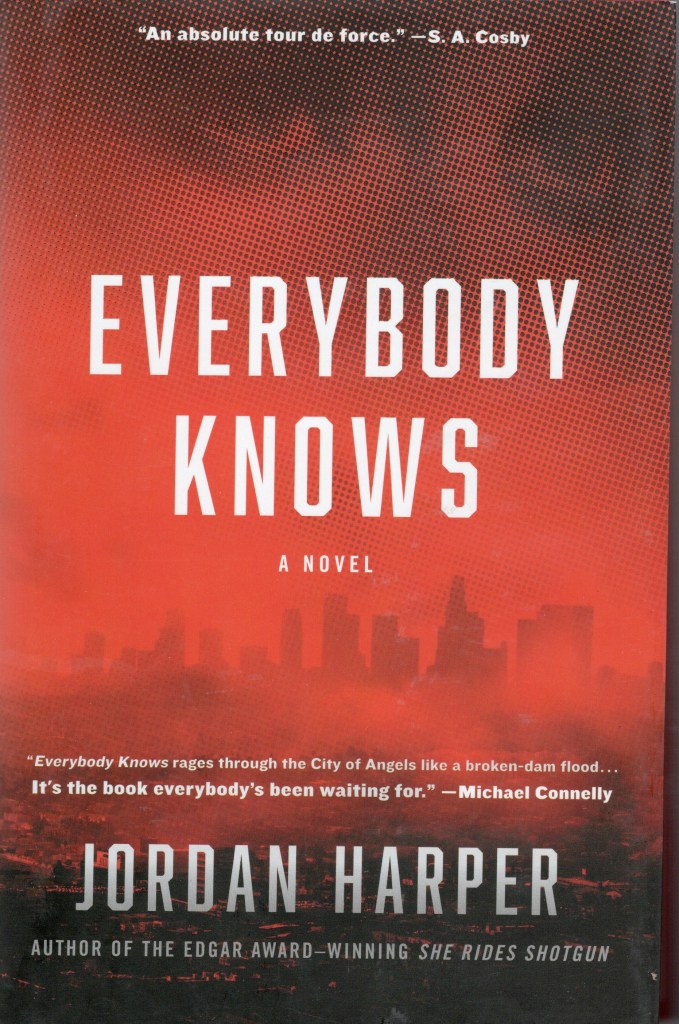
I also have a tendency to avoid highly praised writers and books (and other forms of entertainment, of course), because I always end up disappointed, which is fault of neither author nor their work. Jordan Harper has been praised a lot, so I was hesitant to read him…but having now read Everybody Knows, I don’t regret waiting to read it because I saved a real treat for myself.

For want of a better word, wow.

Los Angeles burns.

Some sicko is torching homeless camps. Tonight they hit a tent city in Los Feliz near the 5. The fire spread to Griffin Park. The smoke makes the sunset unbelievable. The particles in the air slash the light, shift it red. They make the sky a neon wound.

Mae waits outside the secret entrance to the Chateau Marmont. She watches Saturday-night tourists wander Sunset Boulevard, their eyes bloodshot from the smoke. They cough and trade looks. They never thought the Sunset Strip would smell like a campfire.

Mae moves around the sidewalk like a boxer before the fight. Her face is sharp and bookish, framed in a Lulu bob. She wears a vintage floral jumpsuit. She’s got eyes like a wolf on the hunt–she hides them behind chunky oversized glasses. Nobody ever sees her coming.

Jordan Harper is an amazing writer. That’s where we need to start with this book. Yes, the story is compelling and fascinating and dirty and sleazy and makes you kind of want to take a Silkwood shower. The characters–all of them, from the two leads on–are defined and fully dimensional, with interior lives and motivations. Our two main characters, Mae and Chris, are modern-day fixers…but in modern times they’re called “flacks” and work for “p.r. firms”, even if their job is the same as the tough guys who worked for MGM and Warners and Fox back in the day. But the writing is what sold me on book and writer; those opening paragraphs are as fine a series of opening paragraphs I’ve ever read. The dialogue is real, the characters are awful but you understand why they are awful–and both Mae and Chris have seen their fair share of horrific cover-ups and helping their clients get off scot-free every time they get in over their heads. In the very first chapter, Mae is on the job helping a young former child actress transitioning into adult roles out of drug overdose situation in her rooms at the Marmont, and her quick thinking and moving gets the young woman out of there without being seen or caught.

Mae is very good at her job.

Her boss sets up a meeting with her–off the books, away from the office–but on his way to meet her, he is murdered. It’s supposedly a car-jacking go wrong, but Mae has to wonder, is it? He’d seemed like he was about to hit a financial bonanza, but needed her help. Mae decides to look into his murder–which Chris winds up working as well from another direction. Mae and Chris didn’t work out the first time–but they’ve never forgotten each other, and soon join forces. Both were coming to the conclusion that their jobs were sleazy and they were helping bad people get away with doing bad things, and when they realize what is at the root of all the trouble, they see it as an opportunity to make some cash and perhaps do a little good on their way out to retirement.

And what’s going on in Hollywood is something horrible, indeed.

I loved this book, and deeply resented not having the time to read it all the way through in one sitting, so am really glad I made the time to sit down and finish it–in one sitting. I was about forty or fifty pages in, and sat down and didn’t budge till it was done. That authorial voice! The influence of the hardboiled masters is clearly there, but Harper has his own distinctive style and authorial voice that makes him unique in the business–and that’s not an easy thing to do.

I can’t wait to read more of his work.

  1. I do think this aversion, or lack of interest, in awards shows has come from attending so many writing awards banquets, and yes, it’s a lovely problem to have. At some point I will go talk about my antipathy to awards…but must and always will confess to loving being nominated for things. My jones for that itch to be scratched has happened more than I could have ever dreamed. ↩︎

Lonely Boy

Friday work at home day blog, in which I have PT in a little while and all kinds of things on the agenda to get done. I was productive last night, chore wise, and while I still have some chores to do, I am further ahead than I usually am when I wake up on Friday morning. The weather turned cold yesterday afternoon, and I came straight home. Sparky was feeling needy when I got home, so I had to spend some time cuddling and playing with him (he managed to get the hanging mouse toy off it’s string…but this morning he is playing with the string, and the mouse is nowhere to be found). I watched some news–always a downer–and then the Staged Right Youtube channel’s history of Ethel Merman’s career; from which my primary takeaway was Helen Lawson in Valley of the Dolls was so clearly based on Ethel that I can’t believe she didn’t sue…and it made me want to reread the book again. There was a downpour that started right before i went to bed–and it was even colder when I slipped under the covers. Although a quick check tells me it’s 58 outside…sigh.

But I am awake. My arm feels a bit fatigued, but that’s okay, I just need to monitor myself more at PT and at the gym. I am definitely mentioning it this morning, though–even if it makes me feel like a whiner. This is my arm, that had a serious injury and a major surgery, so I need to get past that kind of self-defeating mentality and understand that they need to know if it’s been tired, hurting, fatigued, etc. If I don’t tell them what I am feeling accurately because I want to please them (a problem my entire life, which has created more issues than its resolved, frankly), this could be bad for my arm.

It’s funny, because the other day I was emailing a friend who’d said something kind to me, and one thing I said in response was Oh, good. I always worry that I am a pest or am too much. He replied that he toned himself down sometimes, too, for the same reason: being too much. After I got his response, I started thinking about it, worrying that phrase and that feeling that both of us, gay men in their sixties, have to tone ourselves down because people think we’re “too much”, and parsed it some more during Ethel Merman’s career history and some other Youtube videos last night. Too much. How many times have I been told I am “too much,” that I’m not “masculine” enough1, that I need to change who I was and how other people saw me (narrator voice: you cannot control other people’s perceptions of you. All you can do is hope for the best) and that has impacted how I feel about people and how I act and behave, and how much of myself I reveal and share with them. Sigh. Keep unpacking that shit, Gregalicious, and remember, you are who you are and never let anyone dim your bright queer light.

And remember–no one ever tells a straight man he’s “too much”–even when they sexually assault women, so…maybe fuck all the way off?

All right, I am now home from PT. The sun has come out, but it’s supposed to rain all day and most of the weekend. I’ve decided to wait until Sunday morning to go to the Apple Store in Metairie. I don’t really want to deal with evening traffic to get there and back–traffic back into the city is always a nightmare around that time–and they open later, so I can get up later and go later and not have to worry about traffic and so forth. PT was a bit harder this morning, but some things were easier. I am going to make a to-do list for the weekend, as well as a list of all chores I want/need to get done this weekend, and figure out some other things.

And on that note–several hours later, my bad–I am heading BACK into the spice mines. Have a great Friday!

  1. I am writing another essay–which I hopefully will finish someday–about this very thing; the strait-jacket of toxic masculinity I was raised with and conditioned by education, school, and culture to think and believe was the only “normal” way to be a man. It’s called “Are You Man Enough.” ↩︎

Ladies Who Lunch

Americans have always been fascinated by rich people.

We all want to be rich, after all; as someone once said, “The United States is a nation of temporarily distressed millionaires.” So, in lieu of actually being rich, we obsess about them. The rich used to be celebrities for no other reason than being rich. It’s always been interesting to me that in our so-called “classless” society (which was part of the point; no class privilege, everyone is the same in the eyes of the law) we obsess about the rich, we want to know everything about them, and we lap up gossip about them like a kitten with a bowl of cream. I am constantly amazed whenever I watch something or read something set in Great Britain, because that whole “royalty and nobility” thing is just so stupid and ludicrous (and indefensible) on its face that I don’t understand why Americans get so into it; the fascination with the not-very-interesting House of Windsor, for one. We fought not just one but two wars to rid ourselves of royalty and nobility…yet we can’t get enough of the British royals, or the so-called American aristocracy. (Generic we there, I could give a rat’s ass about the horse-faced inbred Windsors and their insane wealth, quite frankly.)

I wanted to be rich when I was a kid; I spent a lot of time in my youth fantasizing about being rich and famous and escaping my humdrum, everyday existence and becoming a celebrity of sorts with no idea of how to do so. I was intrigued by the rich and celebrities; I used to read People and Us regularly, always looked at the headlines on the tabloids at the grocery store, and used to always prefer watching movies and television programs about the rich. (Dynasty, anyone?) I loved trashy novels about obscenely wealthy (and inevitably perverted) society types and celebrities–Valley of the Dolls has always been a favorite of mine, along with all the others from that time period–Judith Krantz, Harold Robbins, Jackie Collins, Sidney Sheldon and all the knock-offs. I was a strange child, with all kinds of things going on in my head and so many voices talking to me and my attention definitely had an extraordinary deficit; I always referred to it as the “buzzing.” The only time I could ever truly focus my brain was either reading a book or watching something on television–and even as a child, I often read while I was watching television. (Which is why I read so much, even though that buzzing isn’t there anymore and hasn’t been for decades.)

As I get older and start revisiting my past (its traumas along with its joys) I begin to remember things, little clues and observations that stuck in my head as a lesson and remained there long after the actual inciting incident was long forgotten. I’ve always had a mild loathing for Truman Capote, for example, which really needs to be unpacked. Capote was everywhere when I was a child; there was endless talk shows littering the television schedules those days–Dick Cavett, Merv Griffin, Mike Douglas, John Davidson, and on and on and on–and Capote was always a popular guest on these shows. I wasn’t really sure what he did or who he was, but he was someone famous and he was on television a lot. I saw him in the atrocious film Murder by Death, and I know I knew/had heard that he was a homosexual, a gay; and I also knew I was a gay. It terrified me that I was destined to end up as another Capote–affected high-pitched speech and mannerisms, foppish clothing that just screamed gay at anyone looking; Capote made no bones about who or what he was and refused to hide anything…yet he gained a kind of celebrity and fame and success in that incredibly homophobic time period, and no one had a problem with putting him front and center on television during the day time.

But this isn’t about my own self-loathing as evidenced by my decades of feeling repulsed by Truman Capote; that I will save for when I finish watching Capote v. the Swans.

“Carissimo!” she cried. “You’re just what I’m looking for. A lunch date. The duchess stood me up.”

“Black or white?” I said.

“White,” she said, reversing my direction on the sidewalk.

White is Wallis Windsor, whereas the Black Duchess is what her friends called Perla Apfeldorf, the Brazilian wife of a notoriously racist South African diamond industrialist. As for the lady who knew the distinction, she was indeed a lady–Lady Ina Coolbirth, an American married to a British chemicals tycoon and a lot of woman in every way. Tall, taller than most men, Ina was a big breezy peppy broad, born and raised on a ranch in Montana.

“This is the second time she’s canceled,” Ina Coolbirth continued. “She says she has hives. Or the duke has hives. One or the other. Anyway, I’ve still got a table at Côte Basque. So, shall we? Because I do so need someone to talk to, really. And, thank God, Jonesy, it can be you.”

I do want to be clear that once I started reading Capote, he quickly became a writer whom I admired very much; I don’t think I’ve ever read anything he’s written that didn’t take my breath away with its style and sentence construction and poetry. He truly was a master stylist, and perhaps with a greater output he might have become one of the established masters of American literature, required reading for aspiring writers and students of American literature. In Cold Blood is a masterpiece I go back to again and again; I prefer his novella Breakfast at Tiffany’s to the film without question; and I was blown away by his debut novel, Other Voices Other Rooms, which was one of those books that made me think my childhood, and my being from Alabama, might be worth mining for my work.

I read “La Côte Basque 1965” years ago, and didn’t really remember it very much other than remembering I didn’t care for it very much. I was aware of the scandal that followed its publication and that all of Capote’s carefully cultivated rich society women friends felt betrayed by it and turned on him, which sent him into a decline from which he never recovered, before dying himself. I’ve always seen Capote as an example of wasted talents. Anyway, I read the story but not being familiar with his social set, I didn’t recognize any of the people gossiped about in the story or who the woman he was lunching with represented (Slim Keith, for the record), and so it kind of bored me; it was a short story about someone having lunch and gossiping about people the reader had no way of knowing who they were or anything about. I assumed this was because the story was an excerpt from the novel, and the novel itself would establish who all these women were and their relationships with each other. But I did know it was all thinly veiled gossip about his friends, and they never forgave him for it. (I also didn’t recognize “Ann Hopkins” in the story as Ann Woodward; I hadn’t known until the television series that he was involved in her story. I primarily knew about her from reading The Two Mrs. Grenvilles and articles in Vanity Fair, and I actually thought, when reading that book, that it was based on the Reynolds tobacco heir murder that Robert Wilder based his book Written on the Wind on; it wasn’t until later that I learned about the Woodward incident) so I thought, well, it was an entertaining if confusing read.

It was kind of like listening to two strangers talk in a Starbucks and gossip about people you don’t know; entertaining but nothing serious, not really a story of any kind, and I didn’t at the time see how it would all fit into a novel as a chapter in the first place. What purpose to the overall story did this nasty gossip play? Why was it necessary for Ina to share these stories at this particular lunch (and don’t get me started on White Duchess and Black Duchess)? Were these people she was talking about important to the book as a whole? It was hard for me to tell, and I put it away, thinking at the time probably a good thing he never finished the book.

Watching the show about fallout from the story’s publication, I decided to read the story again.

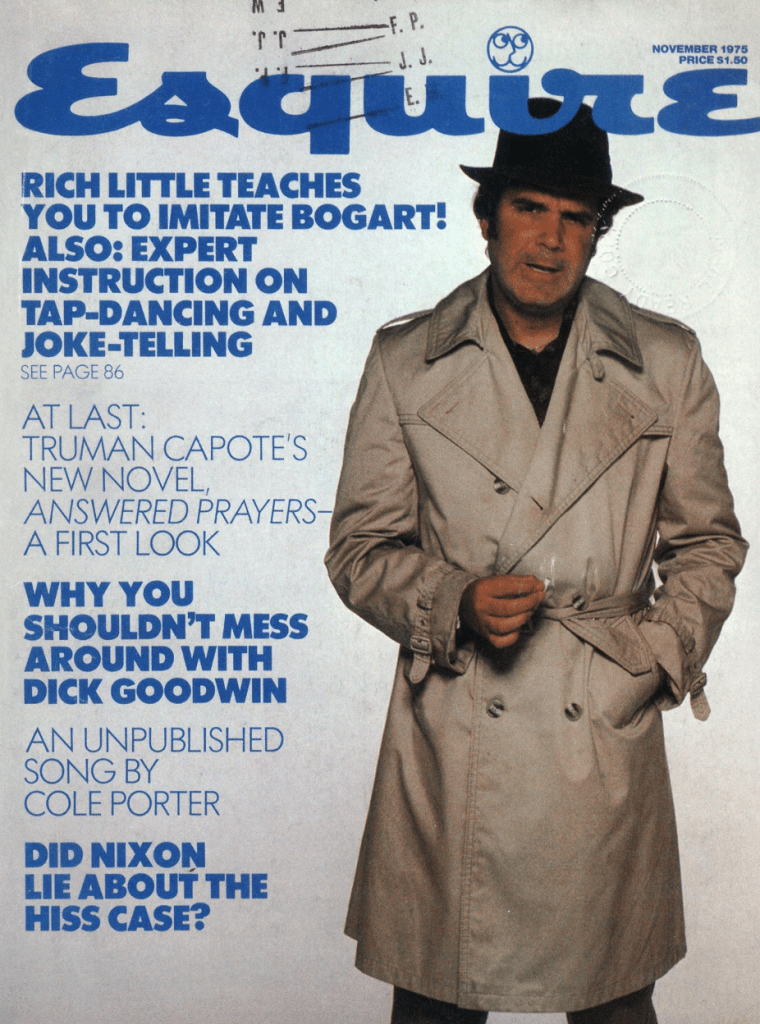
And I still question why Esquire chose to publish it, as well as why Capote thought this chapter was the one to send them. Capote was a genius, of course, and after In Cold Blood was one of the biggest names in American literature (he truly invented the true crime genre); of course they are going to publish whatever he sent them, no matter how bad it was. It wasn’t promoted as a story, after all, it was a novel excerpt.

What I’ve not been able to figure out from any of this is why he thought he could publish this without any fallout from his “swans.” I guess it went to the grave with Capote, who clearly didn’t–and I don’t think ever did–understand why they were so upset with him, which just astonishes me. (Someone once thought I based a character on her–I didn’t–and was very angry with me. I didn’t care, because I neither cared about the person nor her concerns, but I know how careful you have to be as a writer with these sorts of things.)

I wish I could say I liked it better on the reread. I did not. It’s still the same mess it was when I originally read over twenty years ago. It’s just a rich woman being bitchy to her gay friend she feels free to be bitchy about her friends with, and when you have no context (even knowing this time who the actual people were, and yes, he barely disguised them) about the women being discussed or anything about them…it’s just boring, gossip about people you don’t know and you don’t know enough to care about, so it’s just a bitchy little boring lunch. I don’t know what could come before that or after, as an author myself; had I been the fiction editor at Esquire I would have been pissed that was what he sent in, and I would have definitely taken a red pencil to it before I would have published it–and Esquire? Why did Esquire, a men’s lifestyle magazine, publish this when the right place would have been Vogue or Vanity Fair or even The New Yorker. None of it made sense then, none of it makes sense to me now; and if this is the best example we have of Answered Prayers, maybe it’s not such a bad thing that the manuscript–if it ever existed–disappeared.

Sorry, Truman, you were a great writer but this one was a swing-and-a-miss.

Pledge Pin

It is very bright and sunny this morning; it was in the seventies yesterday but took an alarming dip over night. It is currently forty-three degrees outside, with a forecast of a high of merely fifty-six. The weather? She is bipolar in New Orleans in the winter, and we never really know what to expect from day to day. I’ve also realized that my mom also became obsessed with the weather when she was older, and I now check it every morning when I never really did before.

I had thought I had more to do today with the Bold Strokes Book-a-thon; but I was wrong–it’s next weekend that I have three panels on Saturday. Today is just a reading, and I’ll be reading from Mississippi River Mischief, of course, since it’s my most recent release from them. Other than that, I’ll be spending the day cleaning up and writing and doing things around here. I did get a lot accomplished yesterday–not as much as I had hoped or wanted, of course, that never happens–but I feel better about things around here now than I did before. I think I still haven’t gotten my stamina back yet, which is going to probably take a hot minute anyway right? I start strength PT on Monday, which should be exhausting. I did sleep really well last night, which was terrific; I really cannot get used to sleeping so well every night. I mean, I can, but feeling so rested when I get up every day rather than tired and groggy has been marvelous.

I spent some time with Tara Laskowski’s marvelous The Weekend Retreat last night and will definitely try to finish it today, if I can. It’s quite excellent, and is kind of a master class in both point of view and how to structure a novel. There are three point of view characters (four, if you count someone who is merely identified as “the weekend guest”), and the three women she uses are very different and the voices she’s created for them are distinct and unique. It’s very well done, and it also follows the structure of four that I’ve often noticed in novels–three that are in the same generation and whose lives are entwined, along with another who is not (Valley of the Dolls, Peyton Place, The Best of Everything, Class Reunion)–the list of books that follow that plot structure are countless, and something I’ve always wanted to write about. Anyway, Tara’s book is terrific and I am looking forward to spending more time with it this weekend.

We also watched this week’s Reacher last night, and we’re both a bit amazed at how different this season is from the first; but the books often were very different from each other. Sometimes they were intimate stories, sometimes they were action-adventure romps with very high stakes. Alan Ritchson is simply perfect as Reacher, and he has a very strong supporting cast in the season, but the dialogue is a bit hackneyed, cheesy, and clichéd at times. The action sequences are fantastically shot and choreographed, though, and the story is pretty good.

I also started watching the original BBC miniseries of Brideshead Revisted, which I’ve never seen, and I also got a copy of the book, which I’ve never read…but have become more interested in them both since watching Saltburn and seeing it compared to Brideshead. I’ve been sorting my thoughts on Saltburn since watching and enjoying it, which means it obviously had an impact on me and stimulated me intellectually. It’s been a long time since I’ve seen a film that has engaged my mind and my knowledge of film and novels so thoroughly.

Sparky also wreaked havoc on the kitchen again last night while I slumbered, so there’s some picking up that needs to be done, and since the kitchen will again be the background for my reading, I should probably work on clearing the counters and the dishes and all that; of course, I imagine Sparky will make an appearance during the reading, too, since he is very determined and doesn’t take no for an answer (at least for the first five or six times he is told no).

I also need to run a couple of errands today so I won’t really have to leave the house again other than PT until Tuesday morning. I love when I don’t have to leave the house, seriously. To me, that’s the real appeal of retiring–not having to leave the house every day.

Hmmm.

And on that note, I am heading into the spice mines. Have a marvelous Saturday, Constant Reader, and check out the Bold Strokes Book-a-thon if you have time!

destination unknown

Thursday, and I am so relieved that the recovery is going well, and that I can actually start fending for myself. The brace isn’t rigidly locked anymore, and I have a lot more freedom of movement–plus I no longer need that wretched sling, which I hated, and I am no longer attached to anything. Granted, I haven’t been since last Friday, when the pain ball1 was removed Later this morning I am calling to make my first PT appointment, and another referral to follow up on as well. I also slept in my bed last night for the first time since the surgery. I was sleeping super-well in my easy chair, and was a little worried about going back to the bed (I will worry about anything, thanks, anxiety!) because I usually sleep on my left side–which is the bad arm–but I fell asleep lying on my back and shifted to the right side and back a couple of times, but other than that, I was dead to the world. I also slept for another ten hours last night, and I am thinking that I need to get this rest. My body is demanding it, and it feels marvelous to sleep so deeply and restfully–this is what I am always longing for most of the time….but I’m not going to start going to bed at eight once I am back to work because yeah, that would be terrible.

I took it easy yesterday after getting home from my appointment and a couple of errands. The temperature has turned cold (for New Orleans, don’t @ me), which always makes the apartment feel a bit more snug. I did some straightening up, took a long hot shower (still not easy, but so much better than before), and then curled up in my chair with Sparky and J. D. O’Brien’s Zig Zag, which I enjoyed very much (more on that later). I’m still trying to figure out a way to comfortably type with the brace, which isn’t as easy as one might expect. because the brace raises the hand so it’s not flush with the keyboard. It just feels awkward and so I need to find a position to type that doesn’t feel awkward–or I need to get used to it. I don’t know that I’ll have the brace on long enough to worry about Carpal tunnel syndrome, but you know me–anxiety always on the starting line waiting for the starting gun. We also finished watching Bodies, which I also highly recommend. It’s extremely well done, and very clever. If you liked Dark, you’ll definitely enjoy Bodies. I haven’t picked out my next read yet, but I have some incredibly delightful options to choose from. Yay! I love having a massive TBR-pile filled with terrific books by great writers. I am leaning towards Christmas Presents by Lisa Unger; I do want to read some holiday themed novels this Christmas season.

Christ, it’s Christmas season already. I may have to have my annual viewing of A Charlie Brown Christmas soon. I feel more like being in the holiday spirit this year. We haven’t decorated in years (and what little decorating we did was kind of half-assed, anyway) because the one thing Scooter would–in his long, comfortable life as a lap cat–actually spring into action against was the tree. That first Scooter Christmas was the last time we decorated, and I feel pretty confident that Sparky would see the tree as an amusement park, since everything is a toy to him and all he wants to do is play. I didn’t notice until the other day–and maybe it’s a recent development–but Sparky has some orange in his coat. It’s more obvious when he’s lying on his back, but we did end up with another orange cat, even though we didn’t realize it! The string of orange babies continues!

I was also thinking some more yesterday about being a writer–and the many different ways there are to be one. What is the difference between an author and a writer? Are authors artists? What is literary art and what is not, and who decides? Can genre fiction be art (of fucking course)? This was triggered by one of those things on one of the social media platforms where you were supposed to “quote text” my favorite books by women, and right off the top of my head I rattled off five great ones…and then I started remembering more, and more, and still more. I’ve read hundreds, if not thousands, of marvelous novels and short stories and essays and columns written by women. Why were those the five that popped up into my brain at first, why are they so implanted on my brain that I would come forth with these titles; any such list from me will always include The Haunting of Hill House by Shirley Jackson and Rebecca by Daphne du Maurier, and I will never apologize for that. Which left me with only four, and there were so many options. My mind immediately defaulted to four women writers I love, and then had to pick which of their canon was the best. Then I remembered a beautiful novel about friendship, love and loss that made me weep (Somewhere Off The Coast of Maine by Ann Hood) and thought, damn it, I loved that book and I want it on my list…and then started remembering all the others, the dozens if not hundreds, of other women writers whose works entertain, enlighten, and edify my life. There are so many great women writers, currently and in the past, who wrote so many amazing books that it would be hard to name them all, and I would certainly always forget scores of them. For some reason yesterday I was thinking about Taylor Caldwell–who used to write massive doorstopper books about rich people and industries, as well as interesting historical fiction. If remembered at all today, it would probably be for Captains and the Kings, but that wasn’t one of my favorites of hers–that would probably be Testimony of Two Men, which was about medicine in the late 1800’s and a courageous doctor who believed in modern breakthroughs rather than “we’ve always done it this way”–so of course the entire medical establishment was trying to ruin him as he bravely stuck to his principles and tried to modernize American medicine. I would probably hate it if I read it today for the first time–my politics, ethics, morals, and tastes have dramatically changed since I was a teenager, which was when I read Caldwell–but I do remember it fondly. And there’s Grace Metalious, who wrote Peyton Place; Jacqueline Susann and Valley of the Dolls; Jackie Collins and Hollywood Wives; any number of Agatha Christie novels–I mean, there have always been so many great women writers around. Does anyone remember Rona Jaffe? I’ve always wanted to reread The Best of Everything, and I think I have a copy of it somewhere. Then there’s the scifi/fantasy writers, too–Anne McCaffrey and The Dragonriders of Pern, Ursula LeGuin and A Wizard of Earthsea, the amazing Octavia Butler….as I said on whatever social media platform that was, I could sit here and name women writers who wrote books that I loved all day. Victoria Holt, Mary Stewart, Phyllis A. Whitney, Dorothy Eden, Susan Howatch…seriously. Maybe I should write a book of essays about women writers that aren’t remembered much today? ANYA SETON! How I loved Anya Seton back in the day–and all the crime women–Margaret Millar, Charlotte Armstrong, Dorothy L. Hughes, Mary Roberts Rhinehart, Helen MacInnes, Patricia Highsmith, and Mignon Eberhard, to start.

I bet no one else remembers Edna Ferber–and if they do, it’s for Giant and it’s because of the movie (many of her books became famous films: Cimarron, Saratoga Trunk, Show Boat, and So Big). Now that I think about it, I think she addressed race issues in both Saratoga Trunk and Show Boat….which may be worth revisiting. She was also a member of the Algonquin Round Table.

This entry sounds and feels more like me than the more recent ones have, doesn’t it? I am itching to dive back into the book this morning, after I pay some bills and do some other aggravating chores. I also have a prescription ready to pick up; so since I have to go to a Midcity pharmacy to get it, I may as well make a grocery run on Carrollton.

I didn’t realize what a difference sleeping in the bed would actually make, really.

And on that note, I am heading into the spice mines for the day. Have a blessed Thursday, Constant Reader, and I’ll check in with you again a little later, as I really need to do a lot more promo. OH! That reminds me, here is a lovely review of Mississippi River Mischief; check it out! That absolutely made my day–and reminded me that I need to do more self-promotion.

  1. I had a contraption attached to my left shoulder that dispensed a nerve-deadener to the arm, so I wouldn’t feel pain. It lasted for 72 hours, and by the time it was empty, I didn’t have any pain, which was great. I also had to carry it around in basically a fanny pack, so it was one more thing I had to drag around those stressful first 72 hours. However, if you are going to have surgery, ask for one. It was amazing. ↩︎

Not That Funny

I do not recall which was my first story under the name Todd Gregory, and I am far too lazy to wade through everything to try to find out. I used the name the first time sometime between the release of Bourbon Street Blues and Mardi Gras Mambo, so we’re looking at sometime between 2003 and 2006, and I think it was either “The Sea Where It’s Shallow” or “The Sound of a Soul Crying”; I could also be mistaken in my memory. I’m not really sure of much anymore, and when I try to pin down a specific moment in the timeline of my life I am inevitably proven to be incorrect.

Although maybe my CV may hold the answer–hang on, let me check. Okay, per my CV I started using the name in 2004, and it was actually a story called “Wrought Iron Lace,” which was published in an anthology called A View to a Thrill, with the connecting theme voyeurism (the other two stories, to be fair, came out the same year). Ah, “Wrought Iron Lace,” my gay erotica version of Rear Window, in which a gay man in a wheelchair with two broken legs watches someone move in from his balcony across the courtyard, and his balcony also affords him a view into his new young neighbor’s bedroom, with the inevitable of course happening. (The courtyard set up was one I had wanted to use for quite some time; I loosely touched on it in Murder in the Rue Dauphine but I had wanted to do a kind of Tales of the City kind of thing about gay men living around a courtyard in the Quarter and kind of forming a little family group, a la the Maupin novel as well as Valley of the Dolls and call the novel The World is Full of Ex-Lovers. I returned to the courtyard set-up for another story, written and published as Greg Herren called “Touch Me in the Morning,” where I also used two of the characters I thought up for that novel. Another scene I originally imagined for that novel became the short story “Someone to Lay Down Beside Me,” which appeared as a Todd Gregory story in the anthology Dirty Diner.)

But one of the things that had interested me, the more time I was out and around gay people, was how many gay men I knew had been in college fraternities–myself included. Almost every gay man I knew who’d been in a fraternity also had lots of prurient tales of illicit sexual experiences with their fraternity brothers–something that never once happened to me (I never once had sex with any of my fraternity brothers; to the best of my knowledge I am the only gay man to pass through the doors of my chapter), and that eventually led to me doing my final erotica anthology under my own name: FRATSEX.

FRATSEX was a good anthology, but I was not prepared for it to become a phenomenon. It earned out, thanks to preorders and subsidiary rights sales, before it was published, something that has never happened to me since; I got a royalty check for the book a month before it was released–and it continued selling for years. I got substantial checks for FRATSEX every six months until Alyson decided it no longer need to honor its contracts and pay its authors and editors the contractually obligated royalties twice a year it had agreed to, before it finally went belly-up after years of bad management and even worse business decisions. (I should point out that usually erotic anthologies had a very short shelf life; they usually never sold out their initial run, never did additional print runs, and certainly were gone within a year of release. FRATSEX was most definitely not that.)

But when Kensington decided to pass on the next Scotty book, they came back to me with another offer for something else: a gay erotic fraternity novel intended to follow the same sales path as FRATSEX. I had no idea what to call the book–but the money was too good to pass up, and so I signed the contract for a book whose working title was Fraternity Row. (I had suggested A Brother’s Touch or My Brother’s Keeper for titles; both of which icked out Marketing.) I think it was my editor who struck gold with Every Frat Boy Wants it.

As I walk into the locker room of my high school to get my backpack, I’m aware of the sound of the shower running. Even before I walk around the corner that will reveal the rows of black lockers and the communal shower area just beyond, I can smell that pungent smell; of sweat, dirty clothes and sour jocks. I would never admit it to anyone, but I love that smell. Especially when it’s warm outside—the smell seems riper, more vital, more alive. For me, it is the smell of athletic boys, the smell of their faded and dirty jockstraps. At night, when I lie in my bed alone jacking off in the dark quiet, I close my eyes and I try to remember it. I imagine myself in that locker room after practice, the room alive with the sound of laughter and snapping towels, of boys running around in their jocks and giving each other bullshit as they brag about what girls they’ve fucked and how big their dicks are. I try to remember, as I lie there in my bed, the exact shape of their hard white asses, whose jock strap is twisted just above the start of the curve, and below the muscled tan of their backs. It’s the locker room where I first saw another boy naked, after all—the only place where it’s acceptable to see other boys in various states of undress. The locker room always haunts my fantasies and my dreams.

And now,  as I reach the corner, I hesitate. Who could still be showering at this time? Everyone else has left; baseball practice is long over, and I’d be in my car heading home myself if I hadn’t forgotten my bag and I didn’t have that damned History test tomorrow. Could it be Coach Wilson? I shudder as I have the thought. I certainly hoped it wasn’t him. He was a nice man, but Coach Wilson was about a hundred years old and had a big old belly that made him look like he’d swallowed every single basketball in the equipment room. I take a deep breath and walk around the corner.

Maybe it was—um, no, that was too much to hope for. Just get your bag and go.

The locker room is filled with steam from the hot water in the shower. Wisps dance around the overhead lights, and it was so thick I could barely see the floor and make out the row of black painted metal lockers. Yet, through the steam, I can barely see a tanned form with his back turned to me, his head under the water spigot, hot water pouring down over his muscled back and over the perfectly round, hard whiteness of a mouth-wateringly beautiful ass. I catch my breath as I stare, knowing that I shouldn’t be—the right thing to do is call out a ‘hello’, pretend not to look, get what I need and get the hell out of there. But I am utterly transfixed by the sheer beauty of what I am seeing. I bite down on my lower lip, aware that my dick is getting hard in my pants as I watch. I can’t tear myself away—I don’t want to turn and go or stop staring, the body is too perfect. And with the wetness cascading down over it, the glistening flow of the water emphasizing every defined muscle in the lovely male form that has haunted my dreams and my fantasies ever since I transferred here my junior year and started going to this small rural high school.  Go, hurry, before he turns around and catches you watching—what are you going to say? Um, sorry I was staring at your ass?

But still I keep standing there, continuing to run the risk he’ll catch me, every second passing making it more likely. How long can he stand there like that without moving?

We-ell, that certainly starts off with a literal bang, doesn’t it?

I had no idea how to write this book, or what it was even going to be about when I signed the contract (I always say yes to money and try to figure it all out later). I’d had an idea, years before, for a book about a fraternity while I was actually living in one, and came up with three main characters: Eric Matthews, Chris Moore, and Blair Blanchard. The three were all friends, all pledge brothers, and all different. Eric came from an upper middle-class family, Chris was strictly middle-class and had a job, and Blair was the son of two movie stars, an aspiring actor himself, and was always intended to be gay gay gay. I had originally wanted to write a Lords of Discipline sort of novel about a fraternity and a secret society within the fraternity–still might; I think it’s a good idea–and so I thought, well, you belonged to a fraternity, and you created a fictionalized version of it for this book idea, so start there.

I fictionalized both Fresno and Fresno State into Polk and CSU-Polk, and my fictional fraternity’s physical house was based on the actual fraternity house, as well as the way its parking lot adjoined a sorority’s at the end of a cul-de-sac, with the fraternities’ parking lots on one side of the little road and the sorority ones on the other side, just like at Fresno State. My fictional fraternity house had a two story dormitory wing attached to the chapter room and meeting/party space/cafeteria, and so on. I created an entirely new character, closeted eighteen year old Jeff Morgan, who had just moved to Polk right after high school graduation (his family was transferred) and enrolls in summer school. In the opening sequence, Jeff is actually in his Economics class and bored, having a very vivid and erotic daydream about a boy he’d had a crush on in high school. Jeff is so involved and vested in the daydream he doesn’t even notice that the class was dismissed until a handsome classmate snaps him out of the daydream…that classmate is Blair Blanchard, who befriends Jeff and invites him to come hang out at his fraternity. It’s also soon apparent that Blair is not only openly gay but has no issue with it; he doesn’t really talk about it around the house, but everyone knows. Blair is the first openly gay person Jeff has ever known–Jeff is from Kansas and hopelessly naïve–and thinks he’s falling in love with Blair; but he isn’t sure how Blair feels about him.

Every Frat Boy Wants It is really Jeff’s story, and about how Jeff slowly comes into himself as a person; accepting his own sexuality and embracing who he is–while having a strange relationship with Blair that he doesn’t quite understand. It’s his first relationship of any kind, and he doesn’t understand why Blair keeps pushing him away–leads him on, turns him off, and so forth, on and on and on–and is told really in a series of vignettes, essentially sex scenes with both elaborate set-ups and follow-ups that have lasting impacts on him, with the story of his unrequited love for Blair running through them all. He even winds up shooting a porn film while on vacation with Blair in Palm Springs at Blair’s movie star father’s place. Eric and Chris turn out to be pledge brothers of Jeff’s–he eventually has a three way with them; they don’t identify as gay but “play around with each other”–until, of course, the very end when Blair and Jeff finally get past all their misunderstandings and disagreements and jealousies and commit, once and for all to each other.

The book did very well–that scorching hot cover also didn’t hurt–and they asked me for a sequel.

That sequel became Games Frat Boys Play, and was adapted from another novel idea I’d had lying around for quite some time (never throw anything away!).

My favorite memory of this book, though, is that I had to go to a conference in Atlanta for the weekend for a queer specfic event. (I still don’t know why I was invited; at that point I had edited one horror anthology and that was it, really) and the book was due. I was in Atlanta for four days; I did my panels and spent the rest of the time holed up in my room, writing madly in a desperate attempt to get this damned book finished and venturing across the street for Arbys whenever I got hungry. I set a writing record for myself that weekend–21000 words in three days–and the book was finished before I drove back to New Orleans. So whenever I talked about writing over twenty thousand words in a weekend? This is the book I am talking about.

Morning Night and Day

Inoculation Day, Part II.

I am glad to be getting it, don’t get me wrong, but reports of reactions to the second shot–feeling flu-like symptoms, light fever, and chills–has me a bit concerned. However I am planning on taking a personal day tomorrow anyway, so I can get caught up on personal things. I also am picking up my new air fryer at the post office today; I am very excited. I’ve never had an air fryer before, and am really interested to see how it works (after the last attempt at deep frying things resulted in a grease fire, I am loathe to try that again); I’ll make nuggets in it tonight and will let you know how that went, okay?

The first morning of the week when I don’t have to get up at six is always a lovely morning. I feel more rested than I have all week, which feels great, and am hopeful that the end result of the inoculation won’t be me feeling sick for a day or two. I started to say I dislike being sick, but then realized it’s kind of a stupid thing to say because who likes being sick? No one, that’s who. Alas, last evening Paul was was still working, so as I relaxed alone in the living room, I rewatched some episodes of Schitt’s Creek and Ted Lasso that I enjoyed. It was lovely, really; both shows really hit the same chords in some ways despite being so vastly different; in the first, it’s the charm and kindness of the town that fixes the broken Rose family and helps them develop into the best version of themselves; whereas in the latter it’s Ted himself who fixes the broken culture at the Richmond soccer team by helping everyone there become the best version of themselves. Seriously–if you’ve not watched either show, you need to.

I am hoping to spend some time this evening after work with Alyssa Cole’s When No One is Watching; if I do get sick from today’s shot, I can curl up in my easy chair under some blankets and read, if nothing else, right? I think the next book on deck will be a reread of Jacqueline Susann’s The Love Machine, which I read once (back when I was making my way through the Susann ouevre) and never again; it never really connected with me the way Valley of the Dolls did, but I kind of want to give it another read. A friend posted an excerpt from it on Twitter a few weeks ago (recently, at any rate) and seeing that made me giggle a bit; the excerpt was funny, and evidence that the so-called “love machine” of the title, a television executive named Robin Stone, was actually lousy in bed. I didn’t care much for the book at the time I read it–there was something very strange about its structure that didn’t sit right with me when I was a teenager; I do remember what that was but I don’t want to think about it too much before I get into the reread–just as I didn’t care much for Once Is Not Enough, reading each book only once and never revisiting (unlike Valley of the Dolls, which I revisit periodically) and am curious if my original perceptions of those two books will still hold accurate the second time around.

It’s cold in New Orleans this morning–forty-four degrees, which was a precipitous drop from yesterday’s low seventies/high sixties and rainy (on the way home from work yesterday I had to turn the air on in the car). But it’s a lovely bright day–the sun has blessedly finally moved so that it is blocked by the house next door so it’s no longer shining directly into my face (I am going to need to get curtains for my windows, which I really hate; fucking neighbor cutting down the damned trees!)–and I do feel rested this morning, which is absolutely lovely. I have a long day of data entry to stare down; as well as the trip into the office for the shot. I have some things–odds and ends–to also do in the office once I get there; filing and so forth, so I’ll be there for an hour or so as well.

Pretty exciting life I am leading here, huh?

And on that note, tis back to the spice mines with me. Have a lovely Thursday, Constant Reader.

Mean

When I was a child and lived on the south side of Chicago, elementary school was dismissed every day at 3:15 pm. It took about ten minutes for my sister and I to walk the block home, meaning we usually could just catch the last minutes and closing credits of Dark Shadows every day. This was disappointing, of course, because we loved the show and tried to keep up with it; the older woman down the street with whom our mother left us every morning on her way to catch the bus for her shift spooling wire at an electronics factory in Cicero and fed us both breakfast and lunch also watched, and would tell us the following morning what was going on in Collinwood (she also got us to watch One Life to Live and General Hospital with her; but we weren’t as veste in Llanview and Port Charles as we were with the haunted Collins family).

But at three thirty every day one of the affiliate networks in Chicago showed reruns of old movies, and we generally watched the movie–we weren’t allowed outside unless our mother was home–and she usually got home around four. My grandmother had already given me a taste for old movies and mysteries, so watching the afternoon movie wasn’t a hardship for me, and it kept my sister and I quiet while Mom made dinner and did whatever housewifely and motherly chores she had to take care of before Dad came home.

It was watching those afternoon movies where I first encountered The Bad Seed.

Later that summer, when Mrs Penmark looked back and remembered, when she was caught up in despair so deep that she knew there was no way out, no solution whatever for the circumstances that encompassed her, it seemed to her that June seventh, the day of the Fern Grammar School picnic, was the day of her last happiness, for never since then had she known contentment or felt peace.

The picnic was an annual, traditional affair held on the beach, an among the oaks, of Benedict, the old Fern summer place at Pelican Bay. It was here that the impeccable Fern sisters had been born and had lived through their languid, eventless summers. They had refused to sell the old place, and had kept it up faithfully as a gesture of love even when necessity made them turn their town house into a school for the children of their friends. The picnic was always held on the first Saturday of June since the eldest of the three sisters, Miss Octavia, was convinced, despite the occasions on which it had rained that particular day, and the picnic had to be held inside, after all, that the first Saturday of June was invariably a fine one.

If The Bad Seed has lost its ability to shock and horrify, it’s because in the decades since it was published (and adapted into both a play and film) the notion of a child being a killer has gone from being shocking to the general public to one that is kind of accepted; children do kill, and despite all the societal push towards sentimentality toward children. Rhoda is a sociopath, if not a psychopath; her inability to feel remorse or empathy or any other kind of human emotion is chilling to read about–she’s a stone cold killer, and clearly, she thinks nothing of killing to get something she wants: whether it’s the penmanship medal from her school, or a nice trinket promised to her, and then to shut up the janitor who sees through her and threatens to expose her; there’s a progression there. First she kills on impulse to get something she wants, then she coldly and calculatedly kills to protect herself. Rhoda is maturing as a killer, which is very chilling for the reader. The book is told entirely from the point of view of Rhoda’s mother, Christine–who is very slowly coming to realize, time after time, that her child is a monster, despite the innocence of childhood and everything we are taught to think, sentimentally, about children.

Psychology was starting to come into its own in the United States during the 1950’s, and you can see how crime writers took to psychology in that decade: The Bad Seed asks the question of nature v. nurture (although its answer is that it’s nature, genetic, and cannot be helped–and there’s some truth to that. I’m not entirely sure that sociopathy or psychopathy is learned behavior; are these cold-blooded killers born that way or are they creations of their environment? The solution Mrs. Penmark comes up with and executes in the novel is dramatically different from the film–the film had to abide by the Production Code, whereas novels had no such restrictions on them–and I believe the book’s ending actually works better than the film’s.

One thing that the book does brilliantly is depict the emotional turmoil and distress of the mother, slowly beginning to suspect and find proof that her child, that she loves so dearly, is actually a monster.

I first read this book when I was a teenager; I’d already seen the movie when I discovered the book on the shelves at the library, and so I checked it out and read it. I enjoyed it tremendously at the time–and it also had me watching other teens and young children for signs of sociopathy for a few years–and so thought it might be worth a revisit. It was, most definitely; it’s a bit dated, and of course the notion of a killer child isn’t quite so shocking as it was back during the Eisenhower administration–we’ve seen too many real life examples of this, and of course the trope of the killer child has been used, over and over again, in crime fiction and in films, so it’s not the brace of cold water in the face that it once was (kind of like how Beast in View by Margaret Millar was groundbreaking in its time–its still a great read–but what Millar did in that novel has been copied and imitated so much that it’s almost a cliche; one has to read these books with those sort of things in mind). Agatha Christie also used the trope of the sociopathic child (although in a quick google search it turns out Christie’s sociopathic child killer predated The Bad Seed; honestly, Christie did everything first).

It was a very pleasant reread, and as always, it’s interesting to visit (or revisit) books that were considered shocking in their time, only to have them turn out to be fairly tame–I’m looking at you, both Peyton Place and Valley of the Dolls–as well as to see how far the crime fiction genre has progressed. (I still consider Peyton Place to have a place in crime fiction, even though most people don’t. And while the crimes in the book may not be the driving point of the story, those crimes do impact everyone in the town in some way….there’s another essay to be written, probably after I reread the book at some point. It’s been awhile since I’ve revisited both Peyton Place and Valley of the Dolls….perhaps that can be my Christmas present to myself.