Thursday morning and my Sparky alarm-cat has me up before six! It’s fine, I was tired and sleepy last night so went to bed around nine, and I slept really well, too. The coffee is hitting the spot this morning, and I’ve already had some breakfast. I am now back up over 190, and my face isn’t gaunt, skeletal and frightening to see in the morning mirror anymore. Tomorrow is of course Remote Friday, and then it’s the weekend, huzzah! I am hoping to finish a newsletter today, too.
I was saddened to hear the news about Edmund White yesterday. It seems like our queer literary icons are all dying now, doesn’t it? Dorothy, Felice, Victoria, and now Ed. I didn’t know Ed very well–well enough to call him Ed, I suppose–but every interaction we ever had was pleasant, and he was always kind to me. I saw a lot of people talking about A Boy’s Own Story yesterday, but my favorite of his works that I’ve read will always be The Farewell Symphony. I fell way behind on his work over the years, but that doesn’t mean I didn’t appreciate him for his talent and what he has done and meant to queer literature over the last fifty or so years. My condolences to his husband, Michael Carroll, and all his friends and family who are grieving.
I also realized last night that we are losing that last generation of gay writers whose careers straddled HIV/AIDS; those that were publishing before, during and after. That’s some history being lost, but most of Ed’s books were autobiographical novels, so that history is still there. As I get older, I am also beginning to understand the drive to write memoirs.a It’s gay history that doesn’t otherwise get recorded, and we need to leave records behind of what it was like to be gay during our lifetimes and the changes, both good and bad, that we’ve witnessed.
I did some chores–not enough, of course–when I got home from work yesterday, but I was pretty tired from the day. I usually have a second person working with me in clinic, but she was out sick yesterday so I did it all by myself. I also stayed on top of my Admin work and was highly efficient, if extremely tired, when it was time to make groceries and come home. I unloaded the dishwasher and finished the laundry (there’s still another load to put in the dishwasher), and we watched another episode of Department Q, which we are really enjoying.
I was worried last night, as I dozed off in my easy chair, that I may have overdone it yesterday and would be worn out this morning, but since I am up earlier than my norm I am going to have to assume that I am not, in fact, worn out. The thing is I have to keep pushing myself to do more and be more active rather than being the slug that I prefer to be; because that first time might exhaust me, but the second time it doesn’t.
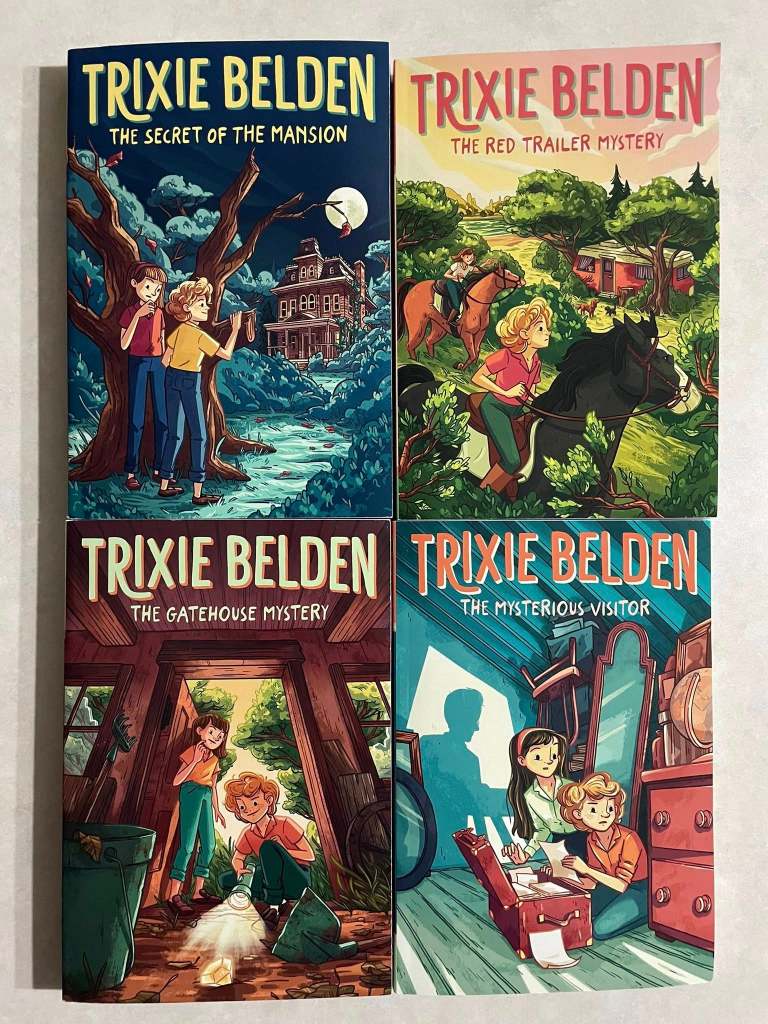
In other interesting kids’ series news, Random House is rereleasing the Trixie Belden series with new covers and using old illustrations from previous editions. I don’t know if they are going to do the entire series or not, but so far the first four (The Secret of the Mansion, The Red Trailer Mystery, The Gatehouse Mystery, and The Mysterious Visitor) are out in the wild now. I’m debating whether or not to get the new editions–it’s just more clutter for the house, actually–but it might be fun to revisit them, and I don’t know where my copies are. I always preferred Trixie to Nancy Drew, but Nancy was ubiquitous you were always more likely to find those while Trixies were harder to find. (They were also a lot cheaper–I was getting the ones referred to by collectors as “Whitman uglies” because the covers were bad–I didn’t think so, but I am not a Trixie expert.)
I was too foggy and tired last night to either write or read, so hopefully that will be different tonight.
And on that note, I am heading into the spice mines. Have a lovely day, Constant Reader, and I’ll be back on the morrow.
Not sure how I feel about these new covers, but Trixie and Honey look age-appropriate at least!
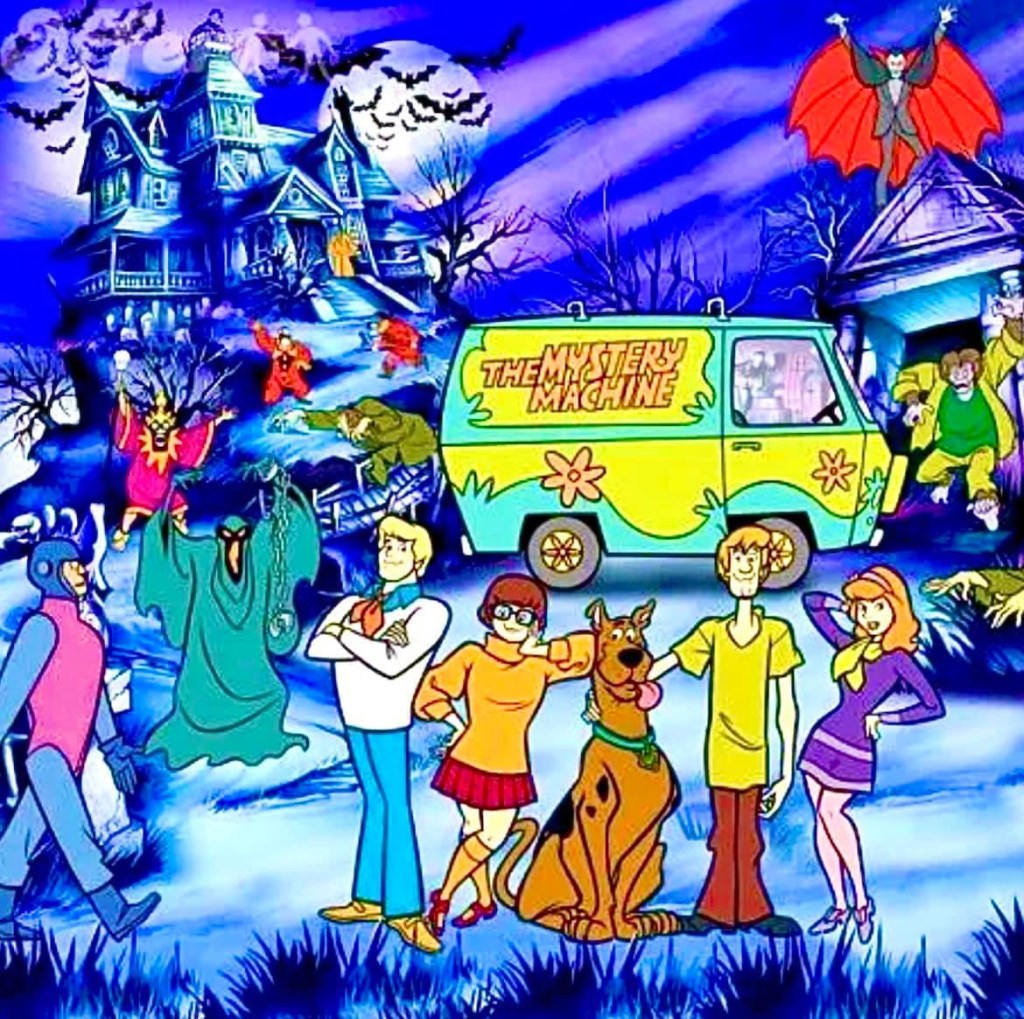
The other day after work I was too tired to write and so I settled into the easy chair with one Sparky for cuddle time, but needed something to watch. I finished burning through the news to get caught up as I do every day, and then started searching for something else to watch when I saw Scooby Doo, Where Are You? in my “Up Next” list as I scrolled through it. It’s always tricky when I need something to watch on my own without Paul–it has to be something he’s not interested in watching–and at some point over the last four years I started revisiting this show from my childhood but never finished the rewatch–mainly because I am now in my sixties; far too old for the audience they were going for.
While I wouldn’t say Scooby Doo Where Are You? was necessarily a huge influence on me and my life, I did love it and watched it every Saturday. It started sometime after Jonny Quest and The Hardy Boys cartoon was cancelled, and a kid who was devouring kids’ series books by the stacks and checking out every book in the school and public library that had the words mystery, secret, clue, haunted, ghost, riddle, or phantom in the title, the adventures of the Scooby gang was usually the highlight of my Saturday morning cartoon experience. I have not been a fan of anything that came in the wake of the original half-hour show (we will never discuss the abomination/hate crime that was Scrappy Doo), and for the purpose of this entry (and really, in my heart and mind) we will pretend that the show was cancelled after the original series run and nothing was rebooted, restarted, revamped, or overhauled in the years since the original Scooby Doo money train was derailed.
But saying Scooby Doo didn’t cement my interest in mysteries wouldn’t be true. The show did, silly as it was (watching as an adult I couldn’t help but wonder, “why would the bad guys go to such extremes to scare people off?”–which also is a contrivance often used in the Nancy Drew/Hardy Boys type books, too), but I watched it every Saturday morning. I kept watching through the next iteration, the hour long show with guest stars, but after that I was too old and had better things to do on Saturday morning than watch cartoons. I’ve always had a soft spot for Scooby, just as I did for the animated Hardy Boys show and Jonny Quest, and unlike many others, I never see reboots or remakes or re-imaginings as “destroying my childhood” because I am not a moron. I can see how the show appealed to kids–you can never go wrong with a sentient Great Dane with limited speaking abilities–and I remember writing Scooby fan-fic when I was young. I started out “novelizing” episodes, and started writing my own. I’d forgotten about that when I was originally rewatching, but in my head the kids’ series I eventually came up with was linked very much, not only to other kids’ series, but Scooby Doo as well.
I don’t want to adapt Scooby or write Scooby books anymore, but I do occasionally want to go back to my kids’ series and think, why don’t you give this a try? Often times, the reason I don’t write things I think might be fun challenges is mostly cowardice and Imposter Syndrome. Can I really write kids’ fiction? Can I really write historicals? However, writing Jonny Quest might be interesting, especially with a reading of the Quests as a queer family.
One of the things about Scooby Doo that always interested me as a kid, and continues to interest me as an adult: Velma. Velma was clearly the smartest of the gang1, which was fun and unusual, and Daphne (‘danger prone Daphne’) wasn’t dumb despite being the pretty one, even though she often needed rescuing. Over the years the character of Velma was really interesting to me–being a brain, of course, meant she had to wear glasses and was hopelessly far-sighted–because she wasn’t easily scared and she was often the one who figured everything out. It was also interesting to me over the years to see many people read Velma as a coded lesbian, which begs the question why? She never has any interest in the opposite sex, but none of them do, really–it’s not that kind of show. We have no background on the gang, either–how are they able to just drive around the country at their age without having to check in with parents, and where does their money come from?
Of course, this is asking a lot out of a children’s cartoon series, which is also why I find it odd to revisit these shows looking for queer coding, and you can usually find it. The all-male environment of Jonny Quest, which is also a kind of “found family” show or Velma not being a late 1960’s/early 1970’s stereotyped girl are good examples of this.
I’ve always wanted to do a reread of all the kids’ series (I still have the books) to reread them for queer coding. I’ve already mentioned before that there was homoeroticism in both the Ken Holt and Rick Brant series–deliberate or not, it’s hard to say–but does this exist in the more popular Nancy Drew and Hardy Boys books. Is tomboy Trixie Belden a budding butch lesbian, with Honey her future femme wife? What about cousins Bess and George in the Nancy Drew series, who are also almost a parody of butch/femme dynamics?
This is the kind of stuff I would love to write–critical queer theory about kids’ mystery series, books, and television programs.
Maybe when I retire.
Calling themselves that also always amused me, since gangs usually are criminals of some sort or another; gang is usually mean that way, even though it’s just a descriptor for a group of people with a similar interest. ↩︎
And another Wednesday Pay the Bills Day has dawned anew. It rained over night, and I suspect we’re going to be getting a lot more rain over the next few days; the weather forecast certainly believes it to be so. I do love rain, and outside of the constant fear of flooding out the car, I don’t even mind driving in it. There’s something about being warm and cozy and comfortable while everything outside is getting wet that just makes my entire body relax. I remember thinking about this when I was a kid once–I was in the car, we were heading for Alabama from up north, it was raining outside and I had a blanket wrapped around me while I was reading The Mystery of Cobbett’s Island, which opens with Trixie and her Bob-White friends in a station wagon in the rain heading for the ferry to the island. Ever since then, whenever it rains all I want to do is curl up with a book under a blanket. I it rains a lot this weekend, I should get a lot of reading handled.
I was a bit tired and drained when I got home from work last night. I did a load of laundry and hung out with Sparky for most of the evening while I scribbled in my journal while doing 1970’s research on Youtube for my next book. I also worked on the book some last night, and feel a lot better about what I am doing. The Imposter Syndrome has been finally chased away by the need to tell this story and develop these characters, and that’s always a good sign. I also thought about that Sherlock story a lot more, too, and may even start writing it this weekend, one never knows. I also figured out how to solve the problem of another short story that’s been bedeviling me for over ten years, and I want to include it in my collection. I still haven’t made a to-do list, so I seem to be floundering around looking for something to do every day but can’t remember what I need to do, and that’s always a problem. I also need to make sure I update the bills list before Monday, too–but that will have to wait until I pay the bills and wait for everything to update. I know Entergy is due today, which absolutely must be paid; the summer is the only time I really don’t care about my carbon footprint.
And football season is drawing closer with every passing day.
Sigh.
Politics and the news continue to be dumpster fires and I really need to avoid social media. I don’t know why I let people infuriate me on social media, but I do, and it’s dumb. What do I care about a total stranger’s beliefs and values? Sure, I hate racism and the phobias and misogyny and fascism as much as any sentient human being, but you’re never going to change someone’s mind on social media when most people are there to provoke anger and arguments and I keep falling for the bait. Social media hasn’t been fun in nearly a decade, and it continues to get worse with every passing day; but we’ve all become addicted to it and I need to step away from it. Publishing and publishers have been insisting for quite some time that we authors need to be there and build a following and so forth to market our books and sell copies, but is that really effective? I think maybe the next time I have a book coming out, I may invest in some ads on social media and see if that makes the needle move at all…it may also bring trolls and assholes in its wake, as well.
And I checked the weather and we are not only in a heat advisory but also rain through next week with thunderstorms every day through the weekend. Woo-hoo! Definitely a good stay inside and read forecast. I really need to get going on my reading…but it’s hard to read when you’re writing something new, at least for me, at least now. I don’t know if I stopped reading when I was writing before, but I don’t think that is the case. I think my abilities to do everything that I was able to do before has slowed down and I don’t have the brain function anymore to juggle many different projects the way that I used to, and it’s also nice to finally be in a place where I can primarily focus my brainpower entirely on the writing without it being diluted by other responsibilities. I like that idea an awful lot, quite frankly.
And on that note I am going to get cleaned up and head into the spice mines. I may be back later as there are some drafts I need to finish–they’re building up again, and I don’t like that one bit–but you never know. But have a lovely middle of the week, Constant Reader, and I always do appreciate it when you check in on me, so thank you again.
I loved kids’ series when I was, well, a kid. I still have fond memories of reading and collecting as many of the books as I could–I still have all my copies–and while of course times have changed, I feel bad for kids today who don’t have the plethora of series to choose from that I did when I was a kid.
Of course, I chose all of them, pretty much.
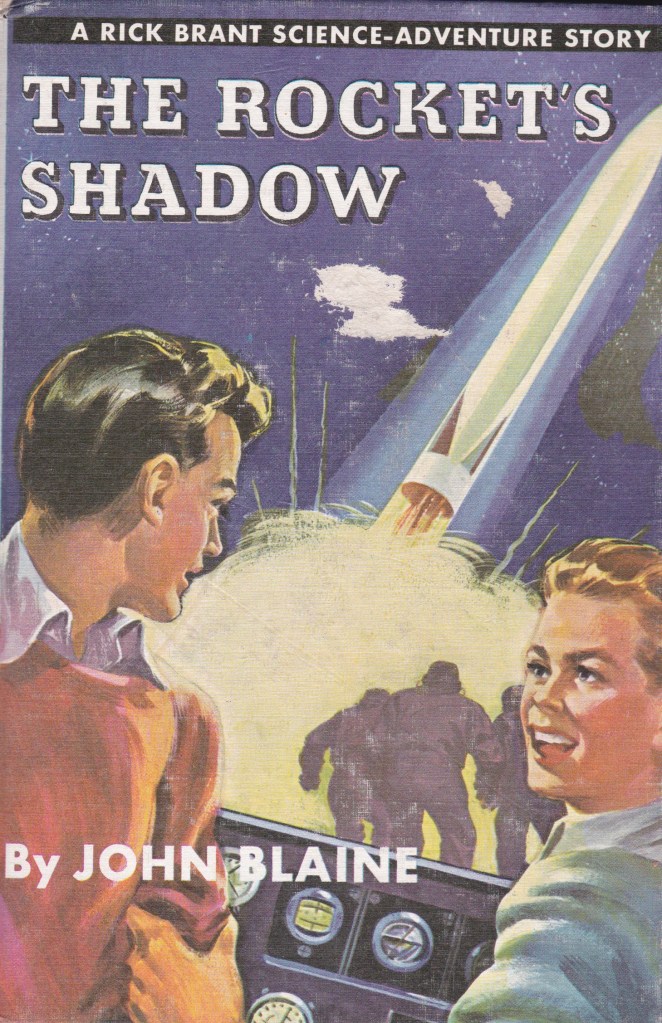
And while the most popular kids’ series were Nancy Drew and the Hardy Boys, my favorites were the ones that weren’t as well known, didn’t last as long, and vanished from print during the late 1960’s and through the 1970’s. I always preferred Judy Bolton, Trixie Belden, and Vicki Barr to Nancy Drew; I enjoyed The Three Investigators, Ken Holt, and Rick Brant far more than I liked the Hardy Boys, but you could get Nancy Drew or Hardy Boys books almost anywhere, whereas the others were incredibly hard to find. Our babysitter used to take us to the Goldblatt’s Department Store on 26th Street in Chicago when she went, pulling her buggy behind her (Dad says Mom used to pull me and my sister in hers to the grocery store, but I don’t remember that). Mom would always give my sister and I two dollars each to spend, and I loved going there because in the basement was the kids’ section, and while my sister was looking at dolls or single records (remember 45’s?) I discovered the remainder table, where Goldblatt’s marked down some of the lesser known Grosset & Dunlap/Stratemeyer Syndicate books on a big table, for like thirty-nine cents, which was a big deal because I could get a lot of books at that price. They were all series books I’d never heard of, but they sounded interesting. It was off that table that I got my first Ken Holt. Rick Brant, and Biff Brewster mysteries. The Biff Brewster books weren’t as good as the other two series, but today I want to talk about Rick Brant, and why I loved the series so much.
Rick Brant, being tall for his age, had no trouble making the final connections on his latest invention. He screwed the bell on solidly, then stepped back to view his handiwork.
The doorbell was now in an unusual position. Instead of being at waist level, it had been moved to the inside of the doorframe and placed up high.
It looked fine. A stranger might have to hunt a little before he saw the push button, but he’d find it all right. Rick went inside and threw the switch that would send electricity into the gadget and went to collect the family.
Mrs. Brant was in the kitchen, supervising the supper preparations for the family and the scientists who made their home on Spindrift Island.
Rick sampled the cake frosting in a nearby bowl and invited, “Can you come out on the porch for a minute, Mom? There’s something I want to show you.”
Mrs. Brant looked up from the roast she was seasoning, a twinkle in her eyes.“What is it now, Rick? Another invention?“
“Wait and see,” he said mysteriously. “I’ll go get Dad and Barby.”
And so opens the first Rick Brant Science Adventure. I bought four Rick Brant books that day (The Rocket’s Shadow, The Egyptian Cat Mystery, The Flying Stingaree, and The Flaming Mountain), all of which had some appeal to me. I wasn’t really that much into science or rocket ships, but I did buy the first because it was, well, the first in the series, and OCD Child Greg had to read the first book. I didn’t have to read the series in order–I did try that with the Hardy Boys, but gave up when it was time for Book 4 and the title, The Missing Chums, didn’t excite me so I got one of the later volumes, The Mystery of the Aztec Warrior instead. There was a pyramid on the cover. I’ve always been a sucker for pyramids–but I always felt obligated to eventually get to the first volume of every series. It wasn’t always necessary, but in some cases–The Three Investigators, Trixie Belden, Judy Bolton–they really did set the stage for the rest of the series and it helped to have read the first one.
I’ll be completely honest here, too: I was never good at science. I don’t know why that was, but I just was never good at any of it–biology, chemistry, physics; math and science were my two Achilles heels. I only read a couple of the Tom Swift books, and even those were because one was reissued in paperback and renamed In the Jungle of the Mayas (the Mayans built pyramids!) but I got the impression the Swift books were more about science than a case or a mystery or anything. The Rick Brant series, on the other hand, while having some insane titles (The Electronic Mind Reader, The Wailing Octopus) like all series did, there were also some that were called “mysteries.” So, yes, science, but also mystery.
I also had no idea it was going to become one of my favorite series.
When I first read The Rocket’s Shadow in the late 1960s/early 1970s, it was already significantly dated. Originally published in either 1946 or 1947, the background to the story was that the scientists on Spindrift Island, off the coast of New Jersey, were trying to build a rocket to send to the moon. Several different groups were trying to accomplish this, and whoever succeeds first was going to get a very lucrative government contract…and their efforts are being sabotaged. Rick’s father, Dr. Hartson Brant, is world-renowned, and of course Rick is very interested in science and is always inventing things to either save time or effort, and they aren’t usually very practical, even though they do work. Rick and his younger sister Barby go to school on the mainland–Spindrift is separated from the coast by tidal flats that are underwater during high tide–but everyone on the island is determined that their rocket will succeed and they’ll catch the saboteurs.
Rick soon figures out a clue and gives chase to some of the saboteurs, who turn on him and attack him–only he is rescued by a blond hitchhiker carrying a military duffle. He and Rick run the attackers off, and then Rick brings his new friend, Don Scott–“Scotty”–home with him because he has no place to go. He’s out of the military and has no family, was just wandering the roads to see where he wound up. The close bond between Rick and Scotty1 resonated with me, especially their sense of camaraderie and affection for each other. They had no girlfriends or even any girls who might be potential dates at first (some were introduced in the series later, Barby growing up for Scotty and a new scientist comes to the island and has a teenaged daughter Jan who is sort of an interest for Rick–but the girls are never more important to them than they are to each other.2
Obviously, by the time I got and read the book we were already into the Apollo space programs from NASA, and we landed on the moon in 1969–so all the science in The Rocket’s Shadow was off and wrong–also the rocket got there in like twenty minutes, not possible even now–and as such, the series could never really be updated and revised like the Hardys and Nancy Drew. The Rocket’s Shadow would have had to have been completely rewritten, and I’m not sure how you could introduce Scotty as a hitchhiker/war vet (he lied about his age) today.
I enjoyed all the books in the series. I did eventually get them all over the years and read them, and many of them are dated. High tech walkie-talkies don’t seem so impressive in a cell phone world, and of course, there are some trips to foreign lands (Asia and Pacific Islands) that are probably more than a little racist and dated now. But I loved The Lost City, where they are off to Tibet to set up a radio receiver on the opposite side of the world from Spindrift to triangulate with the rocket on the moon, and they discover a lost city of Mongols and the tomb of Genghis Khan. They also meet, in that book, an Indian youth named Chahda who helps them out and becomes basically a member of the family, and they take him off the streets of Delhi and pay for him to go to school. Chahda was incredible smart and adventurous too–but not sure how he’d hold up under modern scrutiny in these more evolved times.
And maybe when I’m retired I’ll reread the series critically. The books can be found on ebay and second-hand sites; some are available as ebooks, either on Amazon or Project Gutenberg.
I am even now wondering if this character is why I’ve always liked the name Scotty, and have used it repeatedly for characters of my own creation. ↩︎
I do find in also amusing that my parents–so worried about me reading books about girls instead of boys; did they not understand just how homoerotic the relationships between boys in these books were. This amuses me greatly now. ↩︎
Ah, some more blatant self-promotion! I’ve done some on-line panels so far this year, which has been terrific. Here are the questions from one I did, turned into an interview so I can promote myself! I believe these questions were for a queer crime panel, and the credit for the questions goes to the one and only J. M. (Jean) Redmann; you can order her books here.
Why did you choose your characters and their professions? What drew you to them?
Hmmm. This is tough, because I have so many books and so many different main characters…I think I’ll stick to my two primary series to answer the question. I wanted to write about a gay private detective in New Orleans, and I wanted him to be a big man, a former college football player who may have been able to be a journeyman NFL player had he not been injured in his final college game. I wanted him to be uncomfortable in his gay skin, and the point of his journey throughout the series was to grow and learn until he was finally comfortable in that skin, and able to be loved and give it.
Scotty, on the other hand, was created as a stand-alone character and I wanted him to basically be the antithesis of Chanse; in which he had few if not hang-ups, was completely comfortable being a sexually active gay man with a snarky sense of humor covering an incredibly big and kind heart. He didn’t really need to grow much–he usually is the catalyst for other characters’ growth–but as he’s aged, I’ve really enjoyed his journey.
What attracted you to writing mysteries?
I always liked them. As long as I can remember, my two biggest reading passions were history and mystery, with horror/Gothics close behind. I would check anything out of the library with mystery, haunted, ghost, phantom, secret, or clue in the title. Then I discovered the series books–The Three Investigators, Trixie Belden, et al–and after that there was no turning back.
What does being queer/gay/lesbian bring to your story?
I think queer people have the outsider point of view down to an art form because that’s how we see the world–from the margins. The easiest way to critique society, the culture, and how people interact with each other is from a remove–and queer people see all of those things from a remove through no fault of their own. I didn’t have role models when I was growing up, at least to teach me how to be a decent adult gay human being, so I had to learn it all on my own for the most part. I’ve also been confused and mystified by American culture, philosophy, and society, because it wasn’t designed for people like me. When I came out, I was just at sea in the queer world as I always had been in the straight one, and I’ve never forgotten those experiences, either, and they also inform my work.
How do we deal with how the wider world deals with queer characters? Especially in these times?
It can be depressing, which is emotionally and psychologically dangerous. It’s bad enough experiencing homophobia, but then to immerse yourself in it in order to write about it? Even more horrific. Watching Pray Away this weekend made me furious with the ex-gay movement all over again; listening to queer people hating themselves and their desires in order to be at peace with God in some twisted way? But if God is infallible…this is the doctrine Christianity gets hung up on. They think we’re mistakes, but if their God is infallible, He had to have made us perfect and its willful sin or the devil whispering in our ears. This is their incredibly harmful and dangerous rhetoric. If God tests humans, perhaps he made queer people to test the faithful–and they are failing.
But they can never admit to that.
How do you deal with diversity? No author can be everything their characters need to be, how do you handle reflecting the wider world?
I write mostly about New Orleans, and beyond that, mostly the south with occasional forays into other areas of the country–upstate New York, Kansas, California–and you cannot write about a city like New Orleans realistically without having Black characters, period. New Orleans is a majority Black city. You also can’t write about the South without touching on the issues of race and a problematic history. I’ve always included diverse characters in my books. I don’t like to describe skin color, frankly, and most white writers do it in the form of food, which I find unsettling–do you want to eat them? Cinnamon skin, cocoa, cafe au lait, eggplant, dark chocolate, etc.–I’ve seen all of those used to describe skin color and it always makes me recoil because it’s so damned lazy. I don’t think I would ever write from the perspective of a Black character–there are plenty of Black authors who can do that more authentically, and given how most diversity pledges by major publishers also inevitably end up in quotas, I don’t want to take a spot from a Black creator. I do love reading work by racialized authors, but I would never try to write from that perspective.
How do you use setting? What does it bring to the story?
Setting is one of my strengths, I think, so I always use it to enhance my story. I am also very lucky in that I live in New Orleans, where anything can happen on any given day and you can never go too far over the top about anything–if anything, you have to tone things down to be believable. I think setting is important because it tells you so much about the characters–why do they live there, how has it shaped them, did they live somewhere else, how do they deal with the challenges, what annoys them, what do they love–and is an important foundation for your story.
How do your books start—not the book beginning, but the start of the process of writing the book. Where do the ideas come from and how does that coalesce into a book?
It usually is something I find interesting and I think I should write about that. Sometimes the ideas take years to coalesce and come together, sometimes they are immediate. The Scotty books inevitably begin with three disparate things I want to address in one book, and then I have to figure out how to combine them all into a story. The next Scotty’s prompts are evacuation, statute of limitations, and obsession. It’s coming together in my head enough that I think I’ll be able to write it this fall.
Once you’re writing, what’s your process? Outline? Write from start to finish?
I used to outline, but now I kind of have it in my head and then will only go back and outline when I am stuck, so I can see where I went wrong in the manuscript. I always write from beginning to end. I don’t know how people can write backwards! I’ve thought about trying it sometime, though.
What are the hard parts of writing for you? The parts you enjoy?
Definitely the middle. The middle is soul-destroying, and always triggers Imposter Syndrome. I also hate copy edits, but recognize them as a necessary evil.
I love the actual writing and revising and all of that. There’s nothing like putting down a good word count for the day, regardless of how bad those words might be. I think revising is magic: you take garbage and turn it into something terrific.
Which writers influenced you?
All of them, in one way or another. I especially love Shirley Jackson, Patricia Highsmith, Daphne du Maurier, and John D. MacDonald. Currently? Alison Gaylin, Megan Abbott, Laura Lippman, Michael Koryta, Alex Segura, Michael Thomas Ford, S. A. Cosby, Kellye Garrett, and Alafair Burke–there really are so many. I always take something away from everything I read, whether good or bad.
What are you working on now?
Right now I am writing a sequel to Death Drop, in the Killer Queen series. I also have a ton of short stories and novellas in progress, and I already have ideas for the next three or four (or more) books.
Any advice for newer writers?
Keep writing and keep believing in yourself, and keep reading.
Last words of wisdom?
If you want to be a writer, read Benjamin Dreyer’s Dreyer’s English and Stephen King’s On Writing.
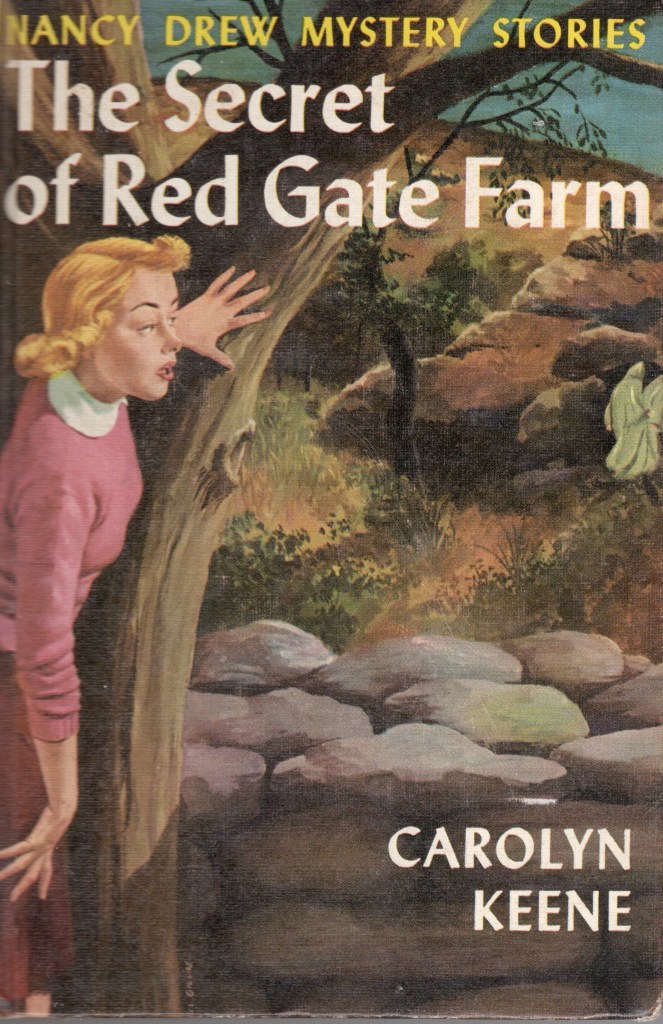
Nancy Drew wasn’t the first kids’ sleuth series I discovered (Trixie Belden’s The Red Trailer Mystery and The Three Investigators’ The Mystery of the Moaning Cave came first), but when I was in the fifth grade, sometime between 1969 and 1970, we had a table of books in the back of the room that had belonged to the (now grown) children of our teacher. I was already reading mysteries checked out from the library or ordered from the Scholastic Book Fair, so when I saw The Secret of Red Gate Farm there on the table, along with the banner NANCY DREW MYSTERY STORIES, I couldn’t pass it up.
And on the back was a listing of all the titles in the series to that point in Nancy Drew history when this copy was printed. This was very exciting for me–a series? Of mysteries? I’d never heard of such a thing, and my life was about to be changed forever.
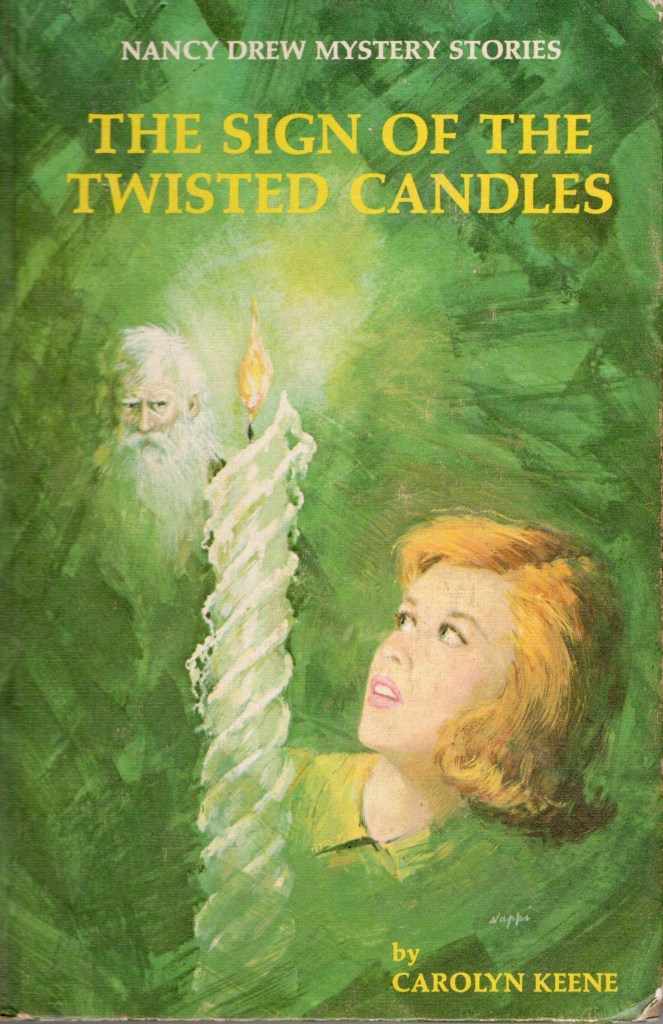
I recently found excellent replacement copies for my collection at the library sale–my copies of Crossword Cipher and Red Gate Farm are seriously dilapidated and wrecked–and I don’t remember if I have a revised text copy of Twisted Candles, so I picked it up, too. I do sometimes wonder if my collecting this books isn’t part of the neuroses I think it it is and part of a tendency to hoard things, especially books.
It probably will not come as a surprise to anyone that it always really bothered me that I didn’t read or acquire the books in order. There were other volumes in the series back on the table, including The Mystery at Lilac Inn, The Hidden Staircase, and The Haunted Showboat. (There was also a Dana Girls, The Secret of the Old Well. I eventually acquired the first and third books, The Secret of the Old Clock and The Bungalow Mystery, from the Woolworth’s on 26th and Pulaski in Chicago.) Nancy Drew was my first real foray into collecting a kids’ series, and of course, my parents were delighted that I moved on to the Hardy Boys without argument as ordered; they never liked me reading books with female heroines, which of course made Nancy Drew even more appealing to me because it was forbidden. (So, of course, I kept reading and acquiring them whenever I could when I wasn’t being supervised. So, yes, I was even in the closet as a Nancy Drew reader,)
But even as the revised texts appealed to me more because the font was better and the books were illustrated, I did notice, even as a kid, that Nancy was a lot more passive than she was in the original texts. Things happened to Nancy in the newer books, and her personality was bland to the point of being beige. It also irritated me that of course this rich lawyer’s daughter didn’t have a job, didn’t go to school, didn’t seem to have any responsibilities whatsoever other than traveling around doing as she pleased and stumbling over mysteries (sometimes the mystery came to Nancy). Her friends all adored her, would do anything she asked, and she was good at everything she tried. As someone who was not good at everything he tried, this annoyed me. Why not give her some flaws? Why make her this super-character who was perfect in every way? As I got older and revisited the original texts more, I could see why aficionados preferred the older versions, despite being dated and rife with racial and racist stereotypes; because Nancy wasn’t perfect in her original incarnation. She was a bit arrogant, definitely classist, and very headstrong to the point of being willful. She was also absolutely fearless, and had very deep convictions about right and wrong, and how wrongs must always be righted. She was fascinating but realistic. She’s aware of her privilege–even as she uses it as needed–but tries to use it to help others less fortunate, which is kind of admirable. The original text Nancy was the kind of character a girl between the ages and nine and thirteen would find aspirational, would want to be like, a role model of sorts presented at a young and formative age that they, too, could be smart and independent and liked as themselves, rather than as someone’s daughter or girlfriend or wife.
Even as a kid, I was drawn to strong, independent female characters. That has never changed.
Most of my collection of Nancy Drew mysteries–and all the other kids’ series I collect–are currently in boxes in my storage attic. There just isn’t room to have them out on display (which makes me crazy, but it’s either that or the copies of my own books, and my vanity trumps not displaying the books every time), because I do have copies of every Nancy Drew except for maybe one or two, and there are some revised editions I don’t have. Shortly after I got to the age where I could actually buy them with my own money, the editions changed; they went from the old flat matte covers to what aficionados and collectors call “the flashlight editions”, because there’s a flashlight as the logo on the spine (rather than the little black box with Nancy in profile) and they went to a glossy cover; also on the cover where NANCY DREW MYSTERY STORIES was changed to a banner across the top in yellow (the Hardy Boys’ banner was blue), and I didn’t like the new glossy covers or the flashlight editions or the banner…plus, I wasn’t going to start over and collect them all in this new format; this was when I started looking for them at yard sales, second hand stores, and flea markets (before the Internet and ebay).
I’ve also noticed how rabid the fans for both Nancy Drew and the Hardy Boys can be. I belong to several Facebook groups for fans and collectors, and those people can get worked up really easily–and of course, it always has something to do with bigotry and change. They hated the new Nancy Drew series because (gasp, the horror!) Ned was Black and even greater horror, she has sex. There was a lot of pearl-clutching over this, as there was about the new Hardy Boys series, in which Joe was made much younger, their mother was killed off, and there were a lot of supernatural elements to both (I never finished the Nancy Drew show, but not out of distaste; I always appreciate new interpretations and find the changes made interesting. I never finished because I forgot about it, in all honesty)–again, pearl clutching–but every so often it amuses me to think about writing a book built around this fandom. But it would of course have to be a fictional series, but it could be really, really funny.
And I think the Hardy Boys may now be in the public domain? I don’t know how that works, but I’d love to be able to write my own. I’ve always wanted to, and if I could actually use the original characters…how fun would that be? I’ve also always hoped to get a gig ghostwriting for either series…I suppose it’s not impossible, but I’m not sure they are still releasing new titles in either series. There have also been spin-off series, too–but I’ve never read outside the original canon. Once they stopped being published in hardcover, I don’t care about collecting the paperbacks or reading them, either.
But Nancy was important in the formation of my interests in reading and what I write, and maybe she wasn’t my favorite series of them all, but I have an appreciation for her and the books still to this day.
My goal is to write an entry on every series I collect–I think I’ve already done The Three Investigators–but so what if I have? My blog, my entries!
Next up, I will probably read the original text of the Hardy Boys’ The Mark on the Door, which I picked up in a tweed edition sans dust-jacket at the library sale.
Masculinity is something I’ve always felt I viewed from the outside.
It’s very strange; for someone who doesn’t look back very often and has a rather healthy disdain for nostalgia, for some reason since the pandemic started, I’ve been revisiting my past a lot. I don’t know, perhaps it was triggered by having dinner with an old friend from high school a while back (which also inspired me to write a horribly dark short story); or perhaps it’s because of short stories or novel ideas I’ve been toying with, but lately, I’ve been thinking about my past much more so than I usually do, and what it was like for me growing up. I wrote a Sisters in Crime quarterly column several years ago about the first time I realized, once and for all, that I was indeed different from everyone else–it centered the first time I heard the word fairy used towards me as a pejorative, as well as the first time I was called a faggot. I’ve also been examining and turning over issues of masculinity inside my head for quite some time (most of my life). #shedeservedit was itself an examination of toxic masculinity and how it reverberates through a small community when it’s allowed to run rampant and unchecked: boys will be boys. Some short stories I’ve published have also examined the same subject.
What can I say? My not being the American masculine ideal has played a very major part in shaping my life and who I am; how could it not? I used to, when I was a kid, pray that I’d wake up the next morning and magically be turned into the kind of boy I was supposed to be, the kind that every other boy I knew–from classmates to cousins to everything I watched on television and at the movies.
Society and culture have changed in many ways since I was a little boy who didn’t fit so easily into the conformist role for little boys; roles for male and female were very narrowly defined when I was a child, and children were forced into conforming to those roles almost from birth. Boys were supposed to be rough and tumble and play sports and get dirty and like bugs and frogs and so forth; girls were supposed to be feminine and play with dolls or play house, wear dresses and mother their baby dolls. Boys weren’t supposed to read or enjoy reading (but I was also supposed to get good grades and be smart), and that was all I wanted to do when I was a kid. I used to love Saturdays, when my mother would go to the grocery store and drop me off at the library on her way. I loved looking at the books on the shelves, looking at the cover art and reading the descriptions on the back. I loved getting the Scholastic Book Club catalog and picking out a few books; the excitement of the day when the books I’d ordered arrived and I could go out on the back porch when I got home and read them cover to cover. I was constantly, endlessly, pushed to do more “boyish” things; I played Pee-wee baseball (very much against my will), and later was pushed into playing football in high school–which I hated at first but eventually came to love…which just goes to show, don’t automatically hate something without trying it. But yeah, I never loved playing baseball. I was enormously happy when we moved to Kansas and I discovered, to my great joy, that my new high school didn’t have a team.
One less traditionally masculine thing for me to participate in was always a bonus.
The things that I really wanted to do weren’t considered masculine pursuits, and as a general rule I was denied them as much as possible. My parents forbade me from reading books about girls–Nancy Drew, the Dana Girls, Trixie Belden–which, quite naturally, made me want them more (my entire life the best way to get me to do something is to tell me either not to do it or tell me I can’t do it…either always makes me want to do it). Oddly enough, when my reading tastes became more adult–when I moved from children’s books to reading fiction for adults–they didn’t seem to care that I was reading books by women about women quite so much as they did when I was younger; either that, or they gave up trying as they finally saw me as a lost cause–one or the other; I don’t know which was the actual case. Maybe my embrace of football in high school overrode everything else suspect about me. It’s possible. My family has always worshipped at the goalposts…and I kind of still do. GEAUX TIGERS!
I spent a lot of my early life trying to understand masculinity and how it worked; what it was and why it was something I should aspire to–and never could quite wrap my mind around it. The role models for men always pointed out to me–John Wayne, etc.–never resonated with me; I always thought they were kind of dicks, to be honest. The whole “boys don’t cry, men never show emotions, men make the money and the entire household revolves around their wants and needs” shtick never took with me, and of course, as I never had any real sexual interest in women…the whole “locker room talk” thing was always kind of revolting to me, because I always saw girls as people. It probably had something to do with the fact that I was more likely to be able to trust girls than boys; I had so many boys decide they couldn’t be friends with me anymore because at some point other kids calling me a fairy began having an negative impact on their own lives all through junior and senior high school (to this day, I’ve never understood this; why were we friends before, and what changed? It wasn’t me…I didn’t suddenly switch gears from butch boy to effeminate overnight) it’s little wonder I have difficulty ever trusting straight men…but in fairness, I have trouble trusting everyone. But I never quite understood the entire “boys are studs girls are sluts” thing, but I also never truly understood the dynamics of male/female attraction. Yes, I dated in high school; I dated women in college before I finally stopped entirely. And yes, I also have had sex with women, back then–but never really enjoyed it much.
In all honesty, I still don’t understand masculinity, at least not as it was defined in my earlier decades of life. I’ve never understood the cavemen-like mentality of responding with violence (no matter how angry I get, I never get violent); I’ve never understood the refusal to recognize that women are human beings rather than life support systems for vaginas and wombs and breasts; I’ve never understood the mentality that a man’s desires should trump (see what I did there?) bodily autonomy for women. No man has a right to a woman’s body, nor does any man have a right to tell a woman what she can or cannot do with her body. Maybe always being an outsider looking in and observing has something to do with my mindset, maybe my difference and always having mostly female friends most of my life is what shaped me into understanding these things.
I also mostly only read women’s books, to be honest. There are some straight male writers I read and admire (Ace Atkins, Bill Loefhelm, Michael Koryta, Harlan Coben, Chris Holm, Stephen King, Jeff Abbott and Paul Tremblay, just to name a few) but I really have no desire to read straight male fantasies that reduce women to caricatures and gay men, if they do appear, as stereotypes; but after I recently read I the Jury by Mickey Spillane, a comment someone left on my post gave me a whole new perspective on how to read such books from the 40’s 50’s, and 60’s; the perspective of reading these books as examples of post-war PTSD…and that opened my eyes to all kinds of questions and potential critical analyses; that the horrors of World War II and what the veterans saw and experienced shaped the development of the culture of toxic masculinity that arose after the war (not that toxic masculinity didn’t exist before the war, of course, but the war experience certainly didn’t help any and it most definitely reshaped what “being a man” meant). I was thinking about doing a lengthier critical piece, on I the Jury, along with the first Travis McGee novel, and possibly including Ross Macdonald, Richard Stark and possibly Alistair MacLean. There’s certainly a wealth of material there to take a look at, evaluate, and deconstruct–and that’s not even getting into Ian Fleming and James Bond.
I’ve also always found it rather interesting that Mickey Spillane was Ayn Rand’s favorite writer. Make of that what you will.And on that note, I am off to bed. The last two days have been long ones, and tomorrow and Sunday will also be long days. I’m planning on driving back to New Orleans on Sunday–timing it so I get back after the parades are over so I can actually get home–regardless of what happens here. It’s not been an easy time here, and I am very tired.
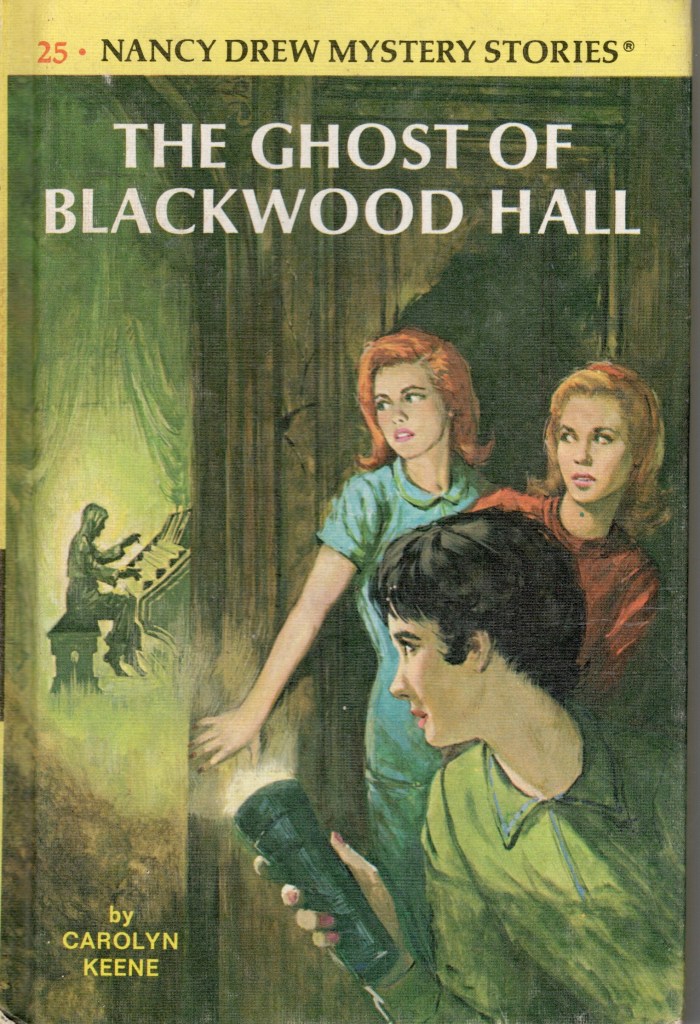
One of the most fun, for me, things about being a writer is being able to pay homage to books and writers I’ve enjoyed or felt a connection to in some way. I do this in at least every book I write–sometimes it’s as little a thing as having one of my characters reading a book I greatly enjoyed–and sometimes it’s a little more sly and tongue in cheek. For one example, I wondered occasionally while writing Bury Me in Shadows if anyone would notice that the name of the plantation house that burned during the Civil Was was Blackwood Hall–I only called it that once or twice; I usually referred to it as “the ruins”–and that it was a ghost story…hence The Ghost of Blackwood Hall, which had always been one of my favorite Nancy Drew mysteries when I was a kid (my favorite books in any series were ones that dealt with ghosts, hauntings, or the supernatural–it never was anything supernatural–in them; even as a kid I had, apparently, this morbid fascination with death and the afterlife that has continued into my adulthood). Vieux Carré Voodoo was also inspired, in some ways, by The Mystery of the Fiery Eye, one of my favorite Three Investigators mysteries–a jewel stolen from an idol that cultists will kill to get back is at the heart of both stories, and I also took inspiration somewhat from Wilkie Collins’ The Moonstone, which I had also read and loved as a child.
I’ve not picked up a Nancy Drew mystery in years to read through, until recently. I remember the series fondly–it wasn’t my favorite, nor was the Hardy Boys; but those books were more easily accessible and easier to find in stores and libraries than the other kids’ series, and with the kind of obsessive behavior I’ve always had–which hasn’t tempered much with the passage of time–once I started reading a series I wanted to read (and own) the complete set. This odd childhood obsession has never abated, even as I am now past sixty; I don’t have room to have all my series books out displayed on bookshelves (they are some of the boxes in the attic and the storage unit) and I think I am missing a few volumes from each series I do collect–but without being able to put them out, it’s hard for me to know which ones I am missing, so I’ve kind of held back on collecting them over the last decade or so. Discovering eBay in the wake of Hurricane Katrina was a big impetus in getting me to start collecting (trying to finish collecting) again, but the lack of space for storage–let alone putting them out on display in bookcases–inhibited me and I began to wonder about the advisability and the point of collecting children’s book series if I was simply going to put them in boxes and store them. It seemed kind of dumb, in all honesty, and so I stopped.
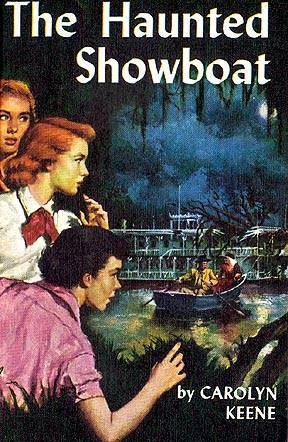
But the kids’ series had an enormous impact on me growing up and as a developing writer. I honestly think that The Haunted Showboat, number 35 in the Nancy Drew series, was my first actual encounter with New Orleans and Mardi Gras; it was either the fourth or fifth Nancy Drew mystery I had actually read (I started with The Secret of Red Gate Farm, The Mystery at Lilac Inn, and The Hidden Staircase; I think the next I read was The Haunted Showboat or Password to Larkspur Lane) and I do believe it was Nancy Drew who introduced me to New Orleans (outside of US History; I knew the Battle of New Orleans and the Louisiana Purchase and all of that, but this was my first non-historical introduction to the city).
I used to be able to list the books in order as well as give some background on the story; my memory isn’t quite as reliable on that score as it used to be. I joined some fan groups on Facebook, primarily to see if there were other alternatives than eBay and scouring second hand stores for the copies of the series books I am missing (and that’s a whole other story; there’s definitely a murder mystery novel that can be built around adult fans of kids’ series, seriously), and have been taken aback by the toxicity that can show up in these groups: hatred of anything new or daring or different to do with the characters (they have gone to TOWN on the new television series for both Nancy Drew and The Hardy Boys–hating changes and updates with the fiery white hot passion of a dozen burning suns–and it inevitably comes down to ‘political correctness’ and ‘being woke’–despite knowing that all the earlier series books were revised in the 1950s thru the early 1970s to get rid of dated stereotypes and racism), but that is a subject for a different time (I’ve not watched Nancy Drew–literally forgot about it–but I’ve liked The Hardy Boys).
Anyway, as I am writing a new Scotty book, I decided to do some research into Nancy Drew and New Orleans–mainly deciding to reread both books that were set, at least in part, here.
So, I went on line (much easier than going through the boxes in storage–which is yet another example of how stupid it is for me to keep storing books) and ordered copies of both The Haunted Showboat and The Ghost of Blackwood Hall, which, according to a synopsis I read on a Nancy Drew website, had Nancy, Bess and George come to New Orleans–which I didn’t remember. I remembered that the book was about Mrs. Putney being swindled out of her jewelry, and it had something to do with spiritualism, which eventually led Nancy and her friends to the abandoned, haunted Blackwood Hall–but I did not remember them coming to New Orleans. This struck me as strange–I certainly vividly remembered other parts of the story, particularly a scene when Ned and Nancy stumbled into quicksand (which, according to everything I read and saw on television and/or movies as a child, I thought would be more of a danger to me at every point of my life).
Both books arrived on the same day, but since I do remember The Haunted Showboat more than I remembered anything New Orleans with The Ghost of Blackwood Hall, I decided to look through the latter and read the New Orleans section again.
Yeesh.
Despite my obsession with collecting and reading the entire series, as I mentioned earlier, Nancy Drew was never my favorite of the kids’ series; I liked The Three Investigators and Ken Holt most of all, and I always thought both Trixie Belden (the original six) and Judy Bolton were better written and more interesting than Nancy (Judy was also a goody two-shoes, but she was more rounded and developed, as were her friends), and looking through The Ghost of Blackwood Hall made me remember why she was never a favorite; the books aren’t very well written. (The original texts were much better than the revised ones, but it was a very low bar to hurdle, seriously.) And yet I had to have all the books and read them all; I watched the 70s television series with pre-Dynasty Pamela Sue Martin; and I still sort of have a soft spot for good ole Nancy; but man, these revised texts are simply terrible–and the later, newer books steadily declined in quality–I remember one where Nancy and her friends, being chased by a bad guy, duck into a room and–this is so stupid, it was even shown as an illustration–hide by sitting in chairs and holding up picture frames because of course the bad guy would look at them sitting still and believe they were a photograph or a painting.
Even as a kid, I knew that was fucking stupid.
Anyway, so Nancy is hired by a jeweler to help out his client Mrs. Putney–who clearly isn’t the sharpest tool in the shed–who is a widow and received a message from “beyond the grave” from her husband that she needed to bury her most valuable jewelry in the woods for safekeeping. (She’s also told to tell “no man or woman” about this; which is why the jeweler brings her to Nancy because she’s a “girl”–but the jeweler is a man…I guess in her mind he doesn’t count because he’s the one who spots that her jewelry is all fake, once she’s reconsidered her stupidity and dug the jewels back up.) There’s a lot of gullibility and superstition in this book, for the record, that doesn’t really make any logical sense. In a weird sequence of events, Nancy winds up with the name of a man from New Orleans who was an accomplished jewelry designer and “capable of making fakes that look real”–so she decides to follow the clue to New Orleans to look for information on the man. Because of course. Anyway, despite the fact that Mrs. Putney isn’t paying for this trip and in fact warns her not to go–Carson Drew, Nancy’s father, decides to foot the bill for her, Bess and George to fly down to New Orleans and follow this laughable clue that could only be a valuable one in a Nancy Drew mystery. (As I was reading this part again, I started thinking about how expensive this would be back then–the revised text was written in 1967, the original in the late 1940’s–and how amazing it was that all three eighteen year old girls had nothing else to do and could hop on a flight to New Orleans just like that; I am sure even back then it was more expensive to buy a ticket at the last minute.)
None of this mattered, of course, to young Greg when he was reading it the first time…and yes, I am being harsh about a kids’ series book which I am clearly too old for, but c’mon. And I knew when I was a kid that the books weren’t well written. (One thing that always annoyed me about this series and the Hardy Boys was they never really deduced anything or solved an actual mystery; really, the books were usually about catching a criminal whose identity was known almost from the start through a series of contrivances.)
But…
Once they are in New Orleans–after Bess tells a strange woman on their flight where they are staying in city: Nancy, seated in front of them, was sorry their hotel had been named. She had wanted to keep their visit to New Orleans as secret as possible. Um, you’re on a flight to New Orleans. So, since it’s too late to call on the suspect’s former boss, they go sight-seeing–but Nancy ducks into every jewelry and/or pawn shop they come upon.
The trip proved to be pleasurable, if not profitable. Their inquiries led them into many sections of New Orleans. The French Quarter, where the buildings were charming in their elegance of a bygone day, interested them most. Beautiful ironwork, delicately tinted plaster walls, old courtyards, once the center of fashionable Creole family life, fascinated the girls.
On a balcony, a brightly-colored parrot chattered at them in friendly fashion. A smiling woman, bearing a basket of flowers, stopped to sell a flower to each girl. On all sides, the visitors saw interesting characters, and heard the soft-spoken dialect which was a blend of French, Cajun, and Gumbo.
GUMBO IS NOT A LANGUAGE.
And since Cajun is a derivative of French…sigh. And by 1967 New Orleans wasn’t really bilingual anymore. It had begun to die out around the turn of the twentieth century, and it’s definitely a rarity here now to find anyone native who speaks both English and French, or speaks French as their first language.
The next day they visit their suspect’s former employer, who knows nothing, and then do some site-seeing before lunch “in a quaint restaurant.”
“New Orleans is wonderful!” Bess exclaimed. Counting on her fingers, she added, “We’ve seen the banana wharf, the market, the garden district, and that old cemetery where all the dead are buried in tombs above the ground.”
“That’s because this place is below sea level,” said George. “Say, do you suppose that guide that we believed the story about the tomb which is supposed to glow at night with an unearthly light?”
“He said spirits come out and weave back and forth like wisps of fog,” said Bess.
“That’s just what they are–fog,” George declared practically.
“Oh, I don’t for a minute believe in ghosts,” Bess replied quickly.
“I wish we had time to go to Grand Isle, the haunt of Lafitte and his men,” said Nancy.
“Who is he?” Bess asked.
“He was a famous pirate,” Nancy replied. “According to tradition, when burying treasure, he always murdered one of his band and left his ghost to guard the hidden loot!”
I guess Bess never studied about the Battle of New Orleans–and no one at either the Stratemeyer Syndicate or Grosset & Dunlap knew that you capitalize “Garden District.” Then comes a really weird section where the girls visit a spiritualist photographer on whose works sometimes “spirit writing” appears. Naturally, Nancy’s image has a warning to stop sleuthing, and then the lights go out and when they come back on, the photographer is unconscious, along with Nancy, are gone! This for me is a particularly weird section. Nancy is the point of view character, even if at a distance. Why would you then switch to Bess and George frantically searching for Nancy rather than showing her capture and abduction and eventual escape? WHY HAVE THE ACTION TAKE PLACE OFF THE PAGE?
Oh, and when Nancy regained consciousness, she was tied up and trapped in a basement near the Quarter.
A basement. Near the French Quarter. In New Orleans, which we’ve already learned is below sea level and therefore bodies can’t be buried in the ground.So of course we have basements.
But Nancy leads the cops back to the house, where all evidence of her being tied up and so forth have disappeared:
To their surprise the policeman remarked soberly, “This isn’t the first time queer things have happened in this section of the city.”
Ah, so it must be the Faubourg Marigny. Lots of queers lived there and in the lower Quarter back then. But I guess the girls should consider themselves lucky that they found an English-speaking cop–who would never say “this section of the city.” He’d name the neighborhood–“this isn’t the first time queer things have happened in the Marigny.” So anyway, the girls decide to go home, and fortunately, there’s a flight from New Orleans to River Heights within an hour. They pack and head for the airport just in time to catch their flight home–when Bess mentions something else mysterious that is going on that she knows about and just hasn’t mentioned before for some reason, and of course, as always, this side story subplot is connected to the main one.
And that’s where I stopped, since that was the end of Nancy’s adventures in New Orleans.
Sigh.
The Haunted Showboat, on the other hand, opens with an immediate eye-roller for New Orleanians:
“Would a trip to the Mardi Gras interest you, Nancy, and also a mystery to solve?” Bess Marvin asked.
Mardi Gras is French for Fat Tuesday, so basically Bess just asked her if she would interested in a trip to “the Fat Tuesday.” Yes, I am well aware that outside of New Orleans it’s all lazily considered Mardi Gras, but it’s really Carnival. Mardi Gras is quite literally Fat Tuesday, the final day of Carnival, and while I’ve grudgingly come to accept that there’s no way that people will ever not refer to the entire event as “Mardi Gras”–even I have a tendency to get lazy and say”Mardi Gras” when I mean Carnival–it will never not bother me. Of course, Bess isn’t from Louisiana and she can be forgiven for getting this wrong, and even using “the” as unnecessary definitive article can be forgiven. But–and this is something that always annoyed me about both Nancy Drew and the Hardy Boys–never is it mentioned in this book that Nancy and her friends have been to New Orleans before, and never was it mentioned on that previous trip in The Ghost of Blackwood Hall that Bess and George have New Orleans relatives.
Wouldn’t you think that would have come up in The Ghost of Blackwood Hall? Of course it didn’t, because when book 25 was written they had no idea that Book 35 would return Nancy and friends to New Orleans and Louisiana. (This kind of continuity thing used to drive me nuts; Nancy and the Hardys were ‘well known’ as amateur detectives, and every book opens with a reference to their first series book as well as the most recent, and closed with a teaser for the next, despite the fact that really, every mystery they solved was a stand alone with no connections to the past or the future. A couple of other continuity errors that always bugged me with Nancy is that Ned is mentioned as her boyfriend in the revised text of Number 5, The Secret at Shadow Ranch even though she meets him for the first time in Number 7, The Clue in the Diary; she finds her dog Togo as a stray at the opening of The Whispering Statue’s original text; but she already has Togo in the revised text of earlier volumes and yes, I am aware that I have spent way too much time in my life obsessing about Nancy Drew and continuity errors in the series–and there are a lot.)
Anyway.
If anything, The Haunted Showboat is actually worse than The Ghost of Blackwood Hall in so many ways, and not just in the aforementioned minor ways. First of all, the cousin of Bess and George’s, who invited them down, is named Donna Mae, because back in the day you could always make your audience know “hey this is set in the South” by giving a female character two first names–and always something Mae. (Ellie Mae Clampett is another example; for the record, out of dozen and dozens of southern women relatives there is exactly one whose name was “Something Mae”.) It takes a while for them to get to Louisiana–Nancy’s car is stolen once, and the replacement is sabotaged–because of course the criminals down in Louisiana will stop at nothing to keep this teenager from the midwest to interfere with their plans!–but there’s one part of their trip that is absolutely hilarious: they drive through Mobile on their way to New Orleans, but somehow get to the Mississippi River before they get to New Orleans or the plantation outside of town they are visiting:
Soon the girls reached the broad Mississippi and gazed at the peaceful, somewhat muddy river.
SOMEWHAT MUDDY?
Nancy then follows the River Road and turns inland. This geography makes literally no sense at all. But..it’s Nancy Drew, and the worst is yet to come.
You see, the Havers–who live at Sunnymead–have two black servants: Mammy Matilda and Pappy Cole. And oh yes, it’s just as racist and horrible as you can imagine–especially when you add in the “voodoo drums” they hear when canoeing through the swamp to get to the wrecked and haunted showboat, the River Princess. Anyway, yes, you can just imagine how dated and awful these depictions are. And everyone calls it “the Mardi Gras,” which no one does in the real world, either. The Quarter is referred to (correctly) as the “Vieux Carré”, but an aside says “or the old city”–it means “old square”, not old city–and of course they have lunch at Antoine’s.
There’s also an Uncle Rufus, who lives in the swamp in a tiny cabin and does voodoo spells.
There’s also a swamp episode and a wrecked, haunted showboat in an episode of Scooby Doo Where Are You?, which I’ve always wondered whether it was inspired (or stolen) from this edition.
So, neither book has aged particularly well–I’m still trying to wrap my mind around Gumbo as a language–and I suppose I shouldn’t be surprised by the racist depictions of Black characters in The Haunted Showboat, but the book is still in print and kids are still reading it. Everyone knows that the original texts of the Hardy Boys and Nancy Drew series were updated in the 1950’s and through the 1960’s to get rid of problematic depictions of non-white characters; it might not be a bad idea for them to do it again now. No one should be reading The Haunted Showboat as it stands today, really.
But it was an interesting time travel to revisit the books again. At some point I’d love to talk about all the kids’ series I read when I was a child, but…time.
I think the first time I ever encountered amnesia as a plot point was in, of all places, Trixie Belden Mystery Number Sixteen, The Mystery of the Missing Heiress. Janey, a young woman who’d been in a car accident and been found wandering aimlessly along Glen Road near the Belden farm, had amnesia–and who she was turned out to be the key to the mystery bedeviling Trixie and the other Bob-Whites.
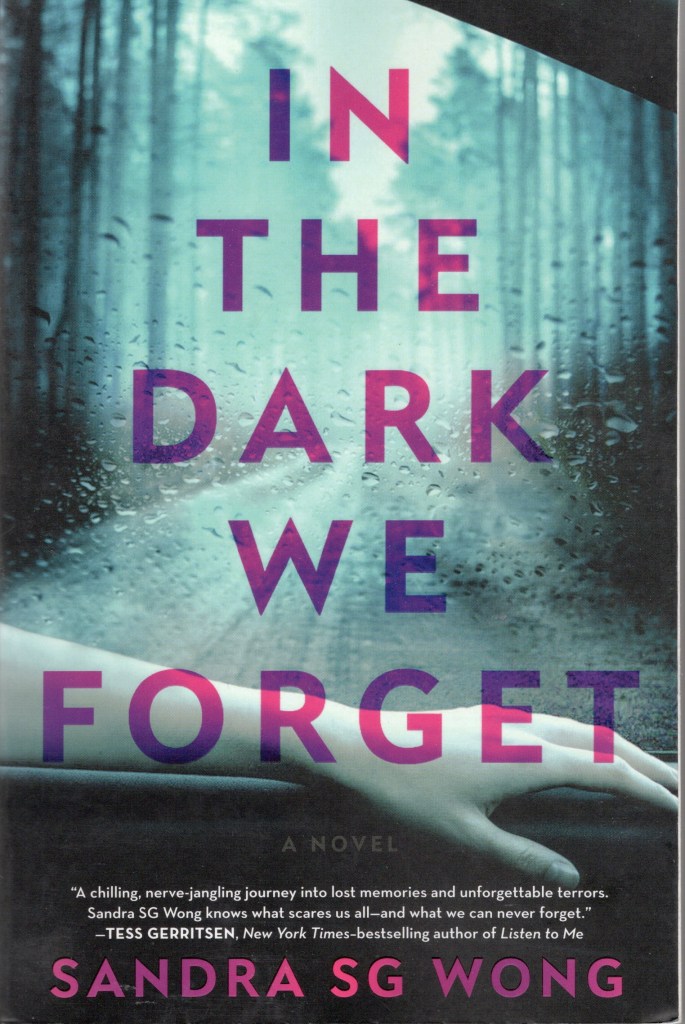
Amnesia is actually not nearly as common as film and television (especially soaps, where it is one of the handiest tropes at hand, along with evil twins and so on) would make it appear to be, and it’s not as simple as the visual media make it appear. I had to do research on amnesia for Sleeping Angel, and it was very interesting to see how many different types there are, and what causes them–there’s physical trauma to the brain, and then there’s psychological, where something has happened to the person with amnesia that is so traumatic to their very identity that their mind erases it. So, bearing that in mind, I was curious to see how Sandra SG Wong handled the subject in her recent In the Dark We Forget.
I awake with a shiver. Full on, from toes to the tingling roots in my scalp.
Sharp corners dig into my shoulders, down the length of my spine, underneath one set of ribs. My feet twitch. I feel the backs of my shoes slip on something wet
Shoes. Why am I wearing shoes while I sleep?
I push up on my elbows, can’t hold myself up, fall back with a thump onto those sharp corners again. I blink up at a murky sky. My head aches, like I’ve taken a chill. I hear a soft rustling of leaves, a lone chirping bird. My ears are cold. A slight breeze blows grit into my cheek. My eyes widen. Why am I outside?
That sounds like a frigging nightmare, doesn’t it? Imagine waking up somewhere and not only not knowing where you are, but who you are and how you got there. Wong’s main character remembers nothing about herself–her name, where she lives, anything–and is soon found by a charitable passer-by who picks her up and takes her to a local police station, where the mystery around this woman slowly begins to unfold.
The challenge for a writer telling this kind of story is that the reader doesn’t find out anything about the character until the character does herself–which is incredibly hard to do; does the loss of memory affect the person’s personality, their character, who they are themselves? Do they behave differently? What do you do when you start finding out unpleasant things about yourself that you have to face, things you may not want to believe are true?
Wong handles it all with the accomplished skill of a master. We start caring about the character, curious to find out who she is and how this all happened, and Wong keeps the reader on the edge of their seat the entire time. As the truths begin to slowly play out–who she is, what she was involved in, what was going on in her life that somehow wound up with her unconscious in the woods–Wong deftly starts showing us flashes of who the character is, and wisely never gets into the psychological vs physical questions about the amnesia itself. Her main character is also unreliable–not just because of the amnesia, but as we find out ever more about her, and the kind of person she is, we also begin to have to wonder if she’s telling the truth about anything…everything…or something in between.
Beautifully written and dripping with suspense, I greatly enjoyed my first experience with the fiction of Sandra SG Wong, and suspect you will as well, Constant Reader. Get a copy, read it, and thank me later.
I always like Fridays mainly because I can sleep a little later than I am used to–after three completely hideous mornings of getting up at six; it really is relative, isn’t it? I mean, I just get up an hour later than I do on those mornings, and yet it feels like I slept for twenty years or something. Just can me Greg Van Winkle–although I think falling asleep in 2022 for twenty years would be terrifying when you woke up; imagine the leap from 2002 to now.
But for whatever reason I feel good this morning, whether it’s the sleep or whatever, and that’s a very good feeling. I feel rested and relaxed, which is always a lovely feeling, and I am looking forward to a three day weekend. I am going to read and write and do all kinds of things–as always, I have an ambitious plan for the weekend–but tomorrow I am doing some self-care (which is always lovely) before I run my errands, and I am going to try to get that all out of the way tomorrow, so I don’t really have to leave the house much the rest of the weekend, other than going to the gym (oh, yes, that’s on the list for this weekend) and an errand I have to run Monday. I am hoping to start and finish John Copenhaver’s The Savage Kind this weekend, and while I have an enormous TBR pile, I really should just read queer books this month. I think I’ll start revisiting Joseph Hanson, and I’ve also got The Devil’s Chewtoy in the pile as well. And hopefully, I’ll get some writing done this weekend as well. I didn’t work on “Never Kiss a Stranger” yesterday; instead I worked on another project that a publisher has shown interest in, but I need to get it figured out and a draft written. I’d originally planned to get that draft written this month–I am so far off schedule this year that it isn’t funny–but it does interest me and I played around with it a while last night before we finished watching The Victim, which is really well done. We also watched the new episode of Obi-wan Kenobi, and I don’t understand what the on-line bitching by the male virgins in the basement is all about. Why is it so difficult for people to grasp that there would be non-white humans in space in the future as well as a long time ago in a galaxy far, far away?
Although I suppose their preference would be an all-white universe.
Sad.
I was thinking last night–while I was waiting for Paul to come downstairs and watch television with me; as pop culture list videos autoplayed on Youtube while I doom-scrolled on my iPad–about writerly ticks; things I always seem to wind up writing about a lot more than I should; like of course I am reading something Greg wrote, because here is the part where there’s a thunderstorm or ah, there it is–the car accident Scotty gets into in every book (and sometimes Chanse, too) or ah, this must be New Orleans as written by Greg because its all about hot and humid. One of the reasons I do love living in New Orlenas is because I love rain. One of the things I miss the most about my office on Frenchmen Street (besides the awesome street name) is that the building directly behind my actual office had a tin roof, so every time it rained I’d open the window so I could hear the rain drumming on the tin roof. It always made me think of my childhood; my grandfather’s house had a tin roof when I was very young–the barn’s was never replaced–so I can remember listening to the rain while I was lying in bed, all snug and warm and dry; to this day I find a weird emotional comfort when it’s raining outside and I am snug and dry and under a blanket inside the Lost Apartment. I can even remember a scene from a Trixie Belden book–The Mystery of Cobbett’s Island–where Miss Trask was driving Trixie and the other Bob-Whites to Cobbett’s Island for a vacation, and it started raining on them; I was reading it in the car on the way to Alabama from Chicago and ironically, it was raining on the car as I read. I even started writing one of my many attempts to write a juvenile series a la Nancy Drew/the Hardy Boys/Trixie Belden with the characters getting caught in a thunderstorm while driving en route somewhere–I don’t remember anything else, but I remember writing about them riding in the rain….and ever since then, it seems like I write alot about thunderstorms. There’s even a thunderstorm scene in A Streetcar Named Murder, because of course there is.
I always write about rain–and I don’t think i could ever live in a desert climate again because I would miss rain too much.
So, note to self: no rain and no car crash in the next Scotty. We’ll see if I can stick to that.
And on that note, tis off to the spice mines. Have a lovely day, Constant Reader.





 Queer and Loathing in America