Love is Like a Butterfly

Tuesday morning and I feel good again. I was very tired when I got home from work yesterday (my supervisor being in Europe is just as stressful as I suspected it would be), and just kind of chilled out last night. I did start outlining what I’ve already written on the Scotty, and I did start looking at stories for this anthology I am going to try to submit something for–I think I can finally change and edit a certain story that’s been in my files for decades. We started watching the new Menendez Brothers documentary on Netflix last night, and will probably finish it tonight. And despite the stress of yesterday morning, I did manage to get all my work done at the office, so I am pretty caught up.

I am going to Alabama this weekend; I heard from Dad and so I am going to drive up there after work on Friday, and come back home on Sunday; a short visit with Dad and then back home. I am going to go up to Kentucky later this month; I need to reschedule some things, but that’s all do-able.

I just looked at the Hurricane Milton updates and am very worried about all my friends who live in Florida. I lived in Tampa for five years in the nineties, when I worked for Continental Airlines; yes, the Tampa airport is the airport where I worked, with the white shirt with epaulets and the navy blue pants and the name tag. (The opening scene of The Orion Mask is set at Tampa Airport; my main character was an airline employee.) We never had anything really major happen there of a tropical nature when I lived there, so it was never anything I worried about before moving to New Orleans. I think about the barrier islands in Tampa Bay, and how narrow the peninsula that St. Petersburg sits on actually is; it’s not impossible that this monster storm could wipe a lot of that area clean. I remain hopeful that somehow this won’t be the coming disaster it appears to be; I can’t even imagine how bad the best case scenario could be. There was significant wind damage to New Orleans with Katrina, which people tend to forget about because of the catastrophic flood that ensued when the levees failed. Roofs will come off, trees will be uprooted and flung about with great force; if it’s as strong as they are saying it could be when it comes ashore, the wind could move cars. I hope everyone gets out that is able. It turns my stomach to think about what could happen there. I hope none of it comes to pass–but I am also realistic. I hope everyone I care about who lives in Florida was able to get out and is okay, and worst case scenarios do not come to pass.

I think I’m going to take Gabino with me to Alabama, and I was looking for a horror novel to listen to in the car, and I am leaning towards listening to Paul Tremblay’s Survivor Song or The Pallbearer’s Club. I do love his writing, though, so it’s fun to read Tremblay; but I do love his work and he’s probably one of my favorite horror writers of this current epoch of horror fiction. I’ll have to pick out some more later for the trip up to Kentucky.1 It seems a bit surreal to be thinking about trips and such things–the minutiae of life–while destruction looms for Florida, doesn’t it? (And what does this mean for the Florida football team? They are on the road at Tennessee this weekend, but supposed to be playing at home the following weekend; I suspect that game will be moved to Lexington.) It’ll be hot without power, but at least October is cooler than August or September. Small favors, indeed.

And on that sad note, I am heading into the spice mines. Keep everyone in the path of the storm in your thoughts, and send some positivity their way–and hope they won’t need it.

  1. It also just occurred to me that I am being counter-intuitive with the trip up there; there’s certainly no reason for me to go from weekend to weekend; I can also go during the week and come back the following week. I hate being so obtuse as to think that ‘trip for a week’ means Sunday to Sunday. ↩︎

Shakin’

Holiday Monday, and I slept deeply and well again last night. I’d set the alarm, thinking it was probably better to start getting up early again, since it’s back to the office with me tomorrow but Sparky was being super cuddly and sweet in the bed this morning, and it was cold, and so I stayed in bed for another hour or so. I finished reading Tara Laskowski’s The Weekend Retreat, which I greatly enjoyed (more on that later). I made jambalaya, and did some dishes and started a load of laundry. I also reread some of my own unfinished work, trying to decide what to focus on next. I have to say I am regularly pleased with my work now when I go back and reread it; what can I say? I don’t know if that means I am getting rid of the self-deprecation and “not good enough” mentality I’ve struggled with my entire life, but it’s a welcome change to read some of my work and think this is pretty good.

I also worked on the house some more and it’s starting to look like it did before the acquisition of High Energy Kitten and my surgery–cluttered but at least neat. It’s almost there, you know, and maybe putting some finishing touches on it today before I go to my first STRENGTH PT appointment this afternoon. (I’ll be making groceries after that, I might add.) I’ve also decided that my next read with be R. F. Kuang’s Yellowface; I do enjoy a writer-behaving-badly story. I’ve written my own, too–“Quiet Desperation”, which was included in my collection Survivor’s Guilt and Other Stories, as well as a Kindle single–but I don’t think I ever want to write an entire novel about a writer behaving badly. I may write an entire novel with a writer as the main character–I keep circling back to my true crime writer, who’s now appeared in several of the Scotty books, as well as The Orion Mask–but I don’t think I’m quite there yet.

It is interesting to revisit unfinished projects and decide which of them to focus on and finish. I know that my next short story collection will be finished if I finish a novella and throw it in; but I’d kind of wanted to do a novella collection. One of the novellas–the longest one–will be rather easily turned into a novel, which I think is what I may do with it; there are three or four more that I can finish and turn in as a solitary book. “Festival of the Redeemer” is completed in first draft form, and rereading it yesterday made me realize that it’s next draft can be longer, of course, but I don’t think there’s enough story there to turn it into a novel; same with “Fireflies” and “Never Kiss a Stranger,” so maybe those three can be the novella collection (Festival of the Redeemer and Two More Tales–which I am choosing to call it so I can have a Venetian cover, a la du Maurier). “A Holler Full of Kudzu” might be the one I finish to complete the short story collection. There are also a lot of short stories I’d like to rework and/or finish for some calls that I’ve seen, which could always be fun. But the exciting thing here is I am feeling excited about writing again for the first time in I don’t know how long.

It’s also weird to think that the Scotty series is turning twenty-one this year; on May 1st, to be exact. I definitely should write another Scotty this year, and it does look like Hurricane Party Hustle is the one to do–it’ll also give me the opportunity to write about what it’s like to ride out a big storm and live without power, all the while having Katrina flashbacks. I also have the story for that already fleshed out, and yesterday I even figured out how the book opens, and how the mystery comes to Scotty’s attention in the first place, which is more than I usually have when I start, LOL. That one will be followed by the cursed Mardi Gras of 2019, French Quarter Flambeaux, which will be another fun story to write, and then Quarter Quarantine Quadrille, which will cover the shutdown and COVID madness. So, there are at least three more Scotty books for me to write, which will take the series to twelve books, and then I’ll think about it some more. Scotty’s family–parents and grandparents–are getting older, and will soon have to start dying off, which I really don’t want to deal with.

But it’s nice to feel excited about everything again, isn’t it? And normal, after so many years of abnormality?

And on that note I am heading into the spice mines. Have a lovely holiday, everyone, and I’ll probably be back later.

Jealous of My Boogie

Research is always important for a writer, always.

I will generally spend years doing research for books before I start writing them; my scattershot approach to research usually goes something like hey this sounds interesting I should look it up which then takes me down wormholes and I’ll become obsessed with something, I’ll come up with a story idea that I can use the research for, and then it may sit in the files for years, occasionally striking my fancy sometime when I come across something else that might fit in with that, and so on. A lot of my research never makes it onto the pages of my books, either–I could have written chapters on glass-making and the Murano style of Venetian glass in The Orion Mask, but finally decided that, while I thought it was all interesting–Phyllis A. Whitney used to use her books to educate her readers about the area she was writing about, which I loved–but it definitely bogged down the story because there was no way I could figure out to tie the glassmaking to the modern day story.

That was very disappointing, I don’t mind saying.

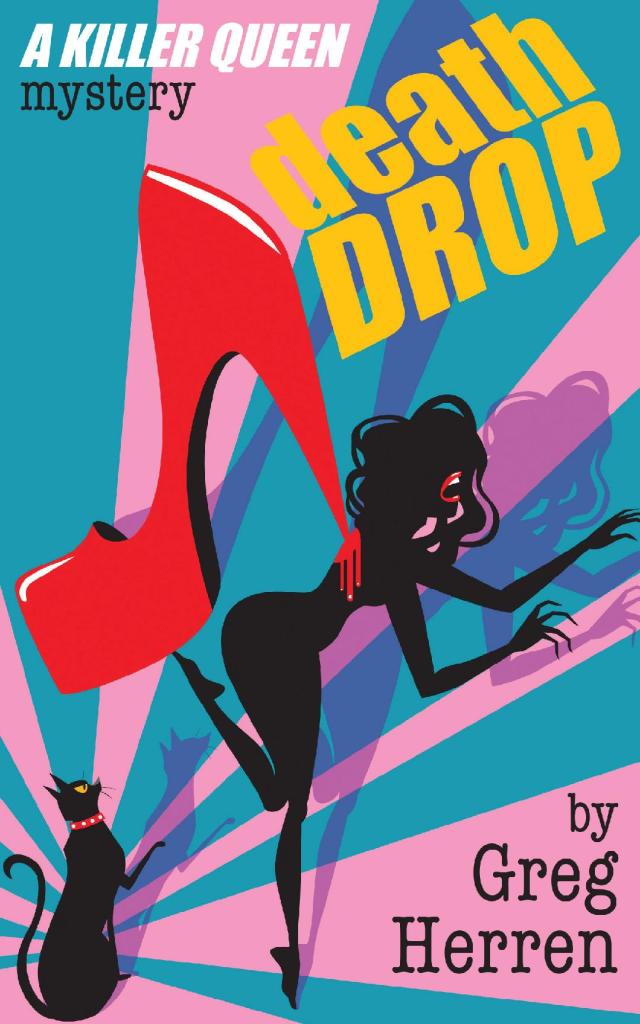
Likewise, I didn’t have as much time to research drag the way I should have before I started writing Death Drop. Ordinarily, I would have wanted to actually talk to the local who runs the drag school; I would have talked to any number of queens about performing, how they got into it in the first place; and there are so many aspects of drag culture and so many levels and layers to it that it was impossible for me to get the research done and write the book at the same time. Ideally, I would have liked to have actually paid someone–preferably my former supervisor, who went to the drag school and now works full-time in drag as Debbie with a D (check out her Instagram, seriously)–to do the full drag on me–wig, make-up, pads, dress and shoes. (I kind of still need to do this, so I know how it feels; I relied on memories of high school plays for the make-up and wearing a Minuteman costume with real buckled and heeled shoes for walking in heels; I didn’t care for that one bit and have nothing but the deepest sympathies for women or anyone who has to wear any kind of heel on a daily basis. I can still feel how sore my calves were the next day.)

That was part of the reason I made the book an origin story for Jem and “Joan Crawfish,” the drag name he is christened with at the last minute as he sent down the runway at the Designs by Marigny fashion show. I don’t know drag lingo or slang–outside of whatever I’ve picked up from watching RuPauls Drag Race and having co-workers who do drag and the occasional drag show I’ve caught over the years–and so neither does Jem/Joan. And the second book–set in Florida at the Miss Queer America pageant–will include some of that, as it will have to as he’s already finished the drag school he was considering entering at the end of Death Drop.

It doesn’t hurt that my current supervisor does pageants and was even Miss Gay Mississippi USofA; so I have a good source of information that I see at the office every day, which is….kind of cool, actually.

I do feel pressure to drag it up a bit more in this second book (You Gone, Girl) than I did in the first, but the pageant itself makes for a lot of drama and comedy, and that’s not even taking into consideration all the protests and bomb threats and things and other shenanigans that the evil witches from Moms4Freedom are throwing at the pageant.

And I am going to have some serious fucking fun with those Moms4Freedom bitches, believe you me.

The Wurlitzer Prize (I Don’t Want to Get Over You)

And here we are on yet another Pay-the-Bills Wednesday. Paul is leaving today, and won’t be back until a week from Saturday. I also don’t have Scooter for cuddles and company. Will I go mad living under conditions of absolute reality? Even larks and katydids are believed by some to dream.

Yesterday was a much better day than I’ve had in quite some time, all things considered. I slept incredibly well, so didn’t start off my day either sleepy or groggy or tired, which is always a plus. The work day was relatively low-key; we were slow in the morning but busy in the afternoon, and frankly, I prefer it that way; busy in the morning inevitably means tired in the afternoon, and if we’re so it’s agony. But over all, a good day at the office and an auspicious beginning to the month of August. (I also didn’t note that it was the anniversary of both of our moves to New Orleans; first in 1996, then again on August 1 2001 when we moved back home from That Horrible Year Away.)

I ran errands on my way home–mail, prescriptions, groceries–and then came home to a sink full of dirty dishes which needed attention, so I took care of that as well as another load of laundry, and then sat my ample buttocks into my desk chair and banged out the revision of Chapter 3 I’d been stuck on for a little less than a week (not so much stuck as tired and didn’t want to bother with it, in brutal honesty) and got it finished and under control before moving onto Chapter Four. I also worked on “Whim of the Wind” for a little while, and also did some more research into the history of the city I am fictionalizing for the WIP, which I continue to fail to discuss. Perhaps this weekend? Perhaps. I kind of want to see if I can get past Chapter 4 before I talk about the book publicly, but that’s nothing more than my own superstitions, which is pretty stupid. As a general rule I don’t believe in things like jinxes and curses and so forth, but I do believe you can actually speak things into existence sometimes. The only takeaway I got from Psych 101 in college was the concept of visualization; that picturing something in your mind can make it happen–but not like winning the powerball or anything like that, but more along the lines of why you always spill something full when you’re carrying it no matter how careful you are…because your mind cannot picture a negative–you can’t see yourself not spilling it; so when you think about not spilling it, you will because you see yourself in your mind actually spilling it. (It’s like how you cannot prove a negative–you can rarely prove you aren’t something; but it is incredibly easy to prove you are. I use this example: someone drinks a lot. They don’t think they have a problem, they don’t wake up in the morning feeling like death warmed over twice and wanting another drink. But once someone says, “You have a drinking problem”, you can’t prove that you don’t. You can say you aren’t, but that’s denial. You can stop drinking for a time period—but if you start drinking again, well, there, you see, you were in recovery and then relapsed! You cannot win, so why bother trying?) It is much harder to prove something isn’t true than it is proving something is. Guilt is the same way–how do you convince the cops, who are convinced you are, that you aren’t?

I will say this about the WIP–it’s more hardboiled and noir than what I usually write, I am having a lot of fun with it, and it’s been a long time since I wrote anything set in Florida, if I ever have? Dark Tide started as a Florida panhandle novel, but I moved it to the Alabama coast; “Cold Beer No Flies” was a panhandle story, too. But this is me fictionalizing Tampa–come to think of it, my main character in The Orion Mask lived in a fictional Tampa I am using again for this one–and I’ve not set foot in Tampa, other than flying in and out for Bouchercon in St. Petersburg, since I moved away in December 1995 to once again reboot and restart my life.

I was tired after all my errands yesterday–the thermostat in my car let me know it was 101 when I left the office yesterday; it is insane for it to be that hot, even in New Orleans. It’s exhausting dealing with this insane summer heat this year. But I did get some writing done yesterday, which was a good thing, and of course Paul finished packing. Heavy heaving sigh. Ah, well, I have Superman and Lois to catch up on, and My Adventures with Superman, and so many old classic films to watch, so I shouldn’t have any trouble keeping myself entertained so I don’t feel lonely or bored. And of course I could be writing, which is always difficult in August…I also think about how about eighteen years ago I was finishing (finally) Mardi Gras Mambo at long last in that last, fateful August before Katrina. It really was a completely different world all those years ago; maybe I ‘ll go back and read those old Livejournal entries from August of 2005, so I can remember the world before once again. I also have a lot of reading to get caught up on, as well. I have some errands to run this evening on the way home from work, and then I am going to be inside for the night. We did watch another episode of Gotham Knights last night–very intense, as the season finale moves closer–but now I have to wait for Paul to come home to finish. Heavy heaving sigh.

But perhaps I’ll use all this solitude productively. One never knows, and on that note, I am heading into the spice mines. Have a lovely Wednesday, Constant Reader, and I will check in with you again tomorrow.

Evangeline

One of the great joys of my life has always been history. One of the many reasons I love New Orleans so much is because the city has never completely paved over and replaced its history; on a foggy night in the French Quarter, the sound of mules pulling tour carriage clopping on the streets can make you feel like you’ve somehow stepped through a window into the past, and I love that. I’ve never known much beyond some basics of New Orleans and Louisiana history; and I’ve been going down rabbit holes since right around the start of the pandemic, learning more and more about the history here. It’s humbling to realize how little I actually did know. I knew when the French arrived; I know how English Turn got its name and when Louisiana was turned over to Spain (1763, to be exact) and when it became American (1803). I also know Napoleon sold Louisiana to the Americans before he succeeded in forcing the Spanish to return it to France….so he could sell it to the Americans. I know New Orleans fell to the Union in 1862 during the Civil War; I know a little bit about Storyville and Huey Long; and I know that the landing boats used for the Normandy invasion in World War II in 1944 were built here. I know a smattering of things post-war about New Orleans–but the gaps in my knowledge are staggering, and I know even less about the rest of the state’s history.

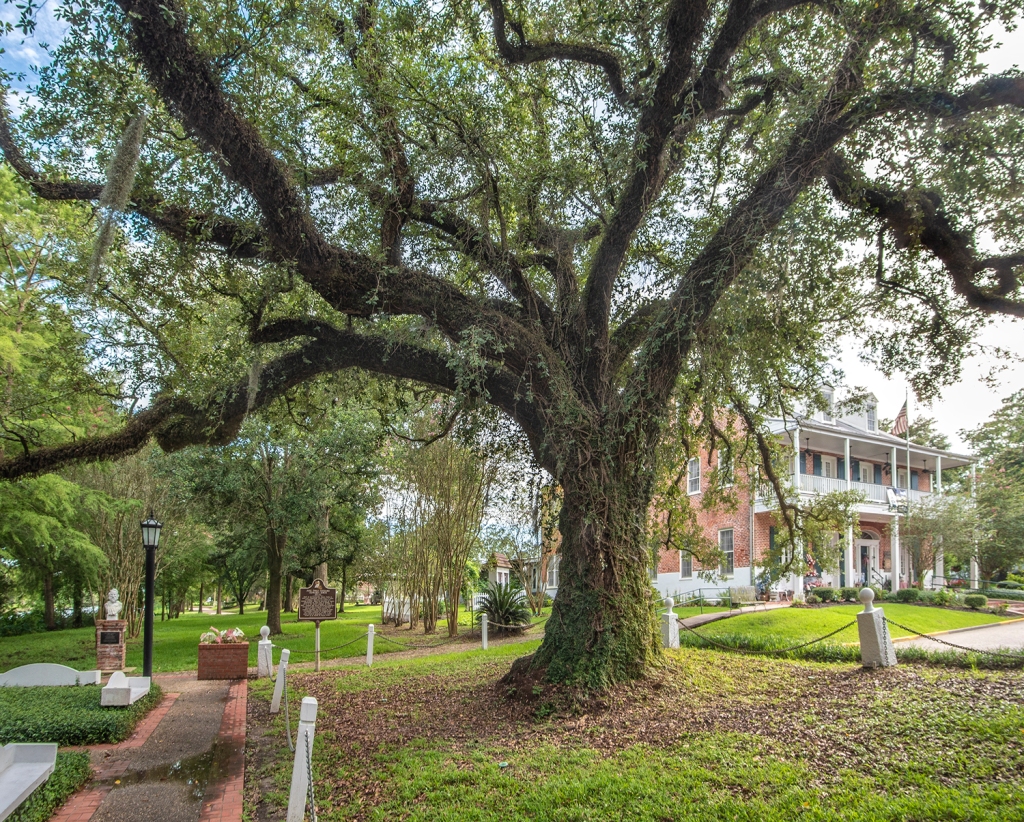
I know that the Cajuns are actually Acadians, from French Nova Scotia, kicked out after the French and Indian War and forced to resettle elsewhere–many of them, after a long and mostly horrific journey, arrived in the swampy wetlands of Louisiana and made their home here. I know that Longfellow’s epic poem “Evangeline”, about two lovers tragically separated during what is called le grande derangement–the Great Expulsion–who promise to find each other once they reach Louisiana. It’s a tragic poem, and of course the Evangeline Oak in St. Martinsville is supposedly the”place” that the fictional lovers finally found each other after so many years, but their pairing was simply not meant to be–the story is a tragedy, after all–but that was how the “Cajuns” came to be Louisianans, and even after they arrived it wasn’t easy for them here. The Creoles of New Orleans looked down their aristocratic noses at the lower class farmers, and so they settled in the part of Louisiana still known as Acadiana to this day.

I have a copy of Evangeline somewhere. I really should read it.

One of these years, I am going to explore my state more. I’ve lived in Louisiana now for almost twenty-seven years, and I’ve never done much in terms of exploration, sight-seeing, and research. The Atchafalaya Basin fascinates me, as does Acadiana. The more I read about the history of both New Orleans and Louisiana, the more I realize how little I know (I always laughed off being called a “New Orleans expert,” because there’s literally a library filled with information about the past of both the city and the state to completely humble me and make me realize I know actually very little about either, and definitely do not qualify to be called expert on anything Louisiana.

I’ve slowly started writing about the rest of Louisiana, but I often fictionalize the places I write about; they are loosely based on the reality but I get to play around with that sort of thing and that’s better for me than trying to write about the real places and making it all up. My first time outside of New Orleans writing about Louisiana was really Bourbon Street Blues, when Scotty is kidnapped by the bad guys and winds up deep in a swamp. “Rougarou” was when I came up with a fictional town and parish outside of New Orleans, which I’ve used since then again. Need had portions that were set in the rural parishes outside of the New Orleans metropolitan area. The Orion Mask and Murder in the Arts District also were heavily reliant on being set (at least partially) in a fictional parish between New Orleans and Baton Rouge. “Solace in a Dying Hour” is another one of these stories. Oh, and Baton Rouge Bingo also had a lot of action outside of New Orleans as well.

I probably should have majored in History for college, but what would I have done with that kind of degree other than teach? Ah, the paths not taken, since I never had any desire to be a teacher, probably my subconscious saying um, you cannot be a teacher because of who you really are which was probably smart. Besides, I wouldn’t have ever been able to pick a period to specialize in; I would have had to be like Barbara Tuchman, interested in everything and picking certain periods that intrigued me for study. How could I ever choose between the Wars of Religion and seventeenth century France, or the Hapsburgs in Spain and Austria? Although I suppose I could have specialize entirely in the sixteenth century, primarily because it was such a tumultuous transitional century. I wish I was a trained researcher, but I suppose I could still learn how to do research properly despite my great age; the problem is time. Fall Saturdays are given over to college football (and I am not giving up one of the great joys of my life) and of course Sunday I watch the Saints. But if I am going to write historical fiction set in New Orleans or Louisiana, why wouldn’t I avail myself of all of the magnificent research facilities here in the city? UNO, Tulane, Loyola and I’m sure Xavier all have archives in their libraries documenting the past here; there’s the Historic New Orleans Collection and the Williams Research Center and really, so so very much. I also need to explore the bayou parishes and the river parishes, and make my way further north to explore Acadiana…and if I ever want to write a book based on the Jeff Davis Eight, I would need to go visit that parish and look around, get a grasp for how it feels and looks there.

So much to do, so little time…and one of the great problems about Louisiana and New Orleans history is trying to decipher what is fact and what is fiction; as so many “historians” and “writers” (looking at you, Robert Tallant and Harnett Kane) often wrote legends and lore as historical fact. I’m not sure how much of Gumbo Ya-Ya is actually true or not, but for writing fiction…perhaps it doesn’t matter as much how right it is? I have this idea for a story, predicated on something I recently discovered again–I have a tendency to forget things–but there was a community just outside of New Orleans called St. Malo, which was settled by Filipinos who’d escaped bondage on Spanish sailing ships. Filipinos in Louisiana in the eighteenth century? But it’s true; and the community was mostly houses and buildings built over the water; the 1915 hurricane destroyed it completely and it was never resettled, with those who survived moving into the city proper. I have an idea for a story called “Prayers to St. Malo” that would be built around that, but the story is still taking shape. There is always more to learn about regional history here…and since I am doing such a deep dive into Alabama history, why not continue diving in regional here?

Louisiana is unique and special and different–which is why I think I felt at home here that fateful thirty-third birthday when I came to New Orleans to celebrate it. New Orleans was the first place I ever felt like I belonged, and I’ve never regretted moving here. I just wish I’d started diving into the local history sooner.

Highway to Hell

I realized the other night that, of all things, I take more pride in my short stories than I do in my novels. Isn’t that strange? Novels are, in theory, much more difficult to write than a short story–even at its barest minimum, a novel should be at least fifty thousand words while short stories generally cut off around a thousand. I think it’s because I still carry the scars from that asshole writing professor in college. I always struggle with short stories, and always have; I used to say that if I wrote a successful short story it was completely and entirely by accident. But writing erotica was an excellent tutorial in short story writing; in what other type of short story is “beginning, middle, end” so clearly delineated?

My first short story that got published outside of the realm of erotica was “Smalltown Boy,” which was published in 2003, I think. It’s still one of my favorite stories of my own; it’s an Alabama story and I am still very proud of it. I used to think I’d never get a short story published anywhere that wasn’t erotica, so when my stories started getting acceptances and published in non-erotica markets, it was very cool.

I like writing short stories because I can encapsulate an idea in that short form rather than writing an entire novel. I can also experiment with voice, style, theme, setting and story. I have any number of stories that don’t work but are completed; I have a lot more than were started and stalled because I didn’t know how to finish them. I think I have around a hundred short stories or so in progress; I actually counted a few years ago because someone asked and I didn’t know the answer.\

Several years ago, an Australian crime writer I’ve known for decades reached out and asked me if I would contribute a story to an anthology her publishing company was producing, The Only One in the World, which was a Sherlock Holmes collection–but the only rule was you couldn’t set the stories in London, period; I had never written anything close to a Holmes story and have never really been much of a Holmesian (I do love Laurie King’s Mary Russell series), but it was a challenge so I said yes–because for me, I love writing challenges because they push me out of my comfort zone and make me try things I might not ordinarily try. That story became “The Affair of the Purloined Rentboy” (still one of my favorite titles of all time) and it was a lot of fun to write, and I enjoyed the hell out of myself writing it…to the point I’ve considered revisiting my Holmes and Watson in 1916 New Orleans, several times.

Last year, the Sherlock editor, Narrelle Harris, reached out to me to see if I’d write something for a new anthology, The Fresh Hell, and there was a list of horror tropes we were given to chose from. Being from Louisiana, how could I not pick “haunted bayou”?

And so I started writing a story that became “Solace in a Dying Hour.”

Madeleine Chaisson opened her eyes and knew that the next time she shut them would be the last.

She cocked her head to listen. Even amongst those few (some say blessed, others cursed) who could hear them, most would describe the strange sounds they made as they danced about the dark, still waters as whistling. But Madeleine was special, different, not like the others.

She heard them clearly. She knew they weren’t whistling. They were singing.

But the sound she heard now was just the gulls over Bayou St Ferdinand shrieking as they swooped and flapped their wings looking for morsels of food. 

Dirty scavengers, she thought with a scowl. She hated the gulls; had since she was a little girl growing up in this very house.

How much gull shit had she cleaned off the dock during her long lifetime? Papa would backhand her if he saw any of the dried white splotches with black pellets on the dock when he brought the boat back in from a day shrimping out in the Gulf.

‘It rots the wood, you lazy cochon,’ he’d say in his sing-song southeast Louisiana Cajun accent while she rubbed her stinging cheek. ‘And who will have to rebuild the damned thing when it collapses? Don’t I already work hard to keep you clothed and fed?’

Even with him years in his grave, after she began wondering if that was even true, she’d still take the bucket out and scrub the gull shit from the weathered old wood.

If I were a witch like they always said, I could have snapped my fingers and cleaned it, she thought with a snort.

The new anthology debuted today, and it is available on Amazon and other sellers here in the United States; here is the link to Bookshop.org : here. This link is to the trade paper; there’s also a much more expensive hardcover edition as well if you disdain paperbacks.

“Solace in a Dying Hour” is another one of my south Louisiana stories. It took me a long while to get to the point where I was comfortable writing about Louisiana outside of New Orleans (don’t ever ask me about the colossal error in geography I made in Bourbon Street Blues…I SAID DON’T ASK!); I think my first was “Rougarou.” I also wrote and published “A Whisper from the Graveyard” since that one, and this is my third. I’ve started building a fictional world of Louisiana outside of the city over the last seven or eight years or so; it could be longer since I no longer have any sense of time anymore. I have revisited rural Louisiana in books like Need, The Orion Mask, and A Streetcar Named Murder; I have more stories and books I am going to write about my fictional rural Louisiana; I’ve also fictionalized the north shore several times already.

“Solace” is an homage of sorts to two other stories I really loved, “Do the Dead Sing?” by Stephen King and “An Unremarkable Heart” by Karin Slaughter. Both involve someone lying in bed dying, and reliving some pretty horrible things that happened over the course of their lives. I had been studying Louisiana folklore and legends for quite some time, but it was around 2017 or 2018 that I started really doing a deep dive into Louisiana history and culture. A co-worker had moved to Houma, which is deep in the bayou country, and she was doing the same. She was who suggested I write about le feu follet, the swamp lights some see. There are numerous definitions and descriptions of who and what le feu follet actually are; I decided I wanted to use the lights and the whistling aspects of their legend, and I wanted the story to focus on a woman who’s lived a very hard life and been through some things…but who could not only see le feu follet for what they actually are and appear, but could tell that they weren’t whistling, but singing. I also kind of based her on my maternal grandmother, a very quiet woman who never showed emotion and never complained about anything; things were what they were and you just dealt with them, period. I wanted to get that sense of quiet strength that you can usually only find in rural Southern women, that practical pragmatism that has gotten them through hard lives and a lot of tragedy.

My maternal grandmother was pretty amazing, really.

I am very proud of the story and how it turned out; the anthology itself is amazing, and the cover is gorgeous. I hope you enjoy it should you choose to check it out.

Sugar Hiccup

Saturday morning and lots to do before hitting the road tomorrow. The lovely thing is it isn’t that much of a drive, about five and a half hours, and there’s a Whataburger in Tuscaloosa. Yay! I have The Drowning Tree by the amazing Carol Goodman queued up on my Audible app and ready to go once I hit the road. I have to make a grocery run today for Paul, and was thinking about dropping books off at the library sale, but I don’t know. It’s hot and the grocery thing is going to be exhausting enough as it is, and I have a lot to get done today. I was exhausted yesterday after work. The escape room thing was quite fun, and then we had lunch at Olive on Carondelet, a Middle Eastern place (sobs with joy! I got to have a gyro) and then I came home to work. The walk home was exhausting in the heat, and of course, I actually drifted off to sleep in my easy chair a bit. I got some more Alfred Hitchcock Presents books in the mail as well, and I started reading this delightfully creepy story I haven’t quite figured out yet, but the suspense and the build is sensational. We also watched the International Male catalog documentary (more on that later), and then I finished doing the laundry before going to bed, exhausted and ready to sleep for an eternity.

Despite the hideous heat yesterday, it actually wasn’t terribly humid and there was also a lovely cool breeze so the walk didn’t seem that dreadful, or at least not while I was doing it. The sun was merciless, though, and it was in the mid-nineties.I also marveled as I walked home a different way than usual–I took Camp Street to Prytania, rather than St. Charles–and I again marveled that not only do I live in New Orleans, but how quickly things change. I was also puzzling out some knots and final corrections I need to make to this manuscript before turning it in tomorrow–a walk is always lovely for things like that; even in the heat, and I need to remember that more often, quite frankly. I was also thinking, as I walked, about how I am always worried about repeating myself, or writing the same book again. It’s easy enough to do when you forget what you’ve already written and published, as I am wont to do at this stage. My editor’s notes were kind of amusing, in some ways, because one thing that he was pointing out was something that I always do–and something that I’ve noticed in the other two active manuscripts on hand–which is a tendency to name the characters with alliterative names. (For example, in the pro wrestling noir everyone, it seems, has a first name that begins with T) I also have a tendency to write hangover scenes, and car crashes. Now that I have this permanent brain fog or whatever it is that’s going on in my head since last summer, it’s even harder for me to remember past books that I’ve written; so I think I am going to have to start blogging about past books I’ve published so that I can remember them. I’ve done some of these posts before in the past, because I like to try to remember what was going on while I was writing the book; what I was trying to do with the book; how long had I had the idea for the book and where did it come from; what changed from the original idea during the process of writing it and what other influences got involved after getting started; and so on. I also like to think about the voice and the tone, how did I do with the setting and scene? What was I going for with the main character, and why? Facebook reminded me yesterday that at some point in the past twelve years the box o’books for The Orion Mask arrived on this date–and I just walked past the house that inspired a part of the book recently, and I was amazed yet again at how much detail I’d gotten wrong.

So, I decided to rent the documentary All Man: The International Male Story last night, for a multitude of reasons. Now that I’m in my sixties my former indifference to nostalgia has lessened (and I do tend to worry that I look back through rose-colored glasses, making the past seem better and more idyllic than it was; I have to always remember yes, but you were also a neurotic mess then, too), and so yes, there was a bit of a curiosity involved with my wanting to watch. I think I only ever bought one thing ever from International Male–a red pirate blouse, a fluffy shirt, if you will, and I got it to go as a pirate for Halloween–but I always got the catalogue, and I often liked their clothes…but was also always very consciously aware that to wear those clothes, you also had to look like their models; the lesson that beautiful people can wear anything and look good I’d learned early in life. I also had no fashion sense because I never was able to develop one–because men’s clothes were hideous, and there weren’t many options when I was growing up. I’ve also have a very mild case of color blindness with certain shades of certain colors–I can’t tell dark blue from black, for example–and I am never entirely sure what colors go with other ones. I do know that red, black and white all work together, so usually my dressier clothes are some combination or variation of those colors. But for the most part, I don’t care about what I wear and I don’t know what’s in style or not. I’m never sure if the clothes I am wearing match and/or look good on me, and I’ve stopped worrying about it. When I was younger, I used to deplore the fact that men’s clothes were so dull and boring. I love hats, for example, but men don’t really wear any hats other than baseball or cowboy anymore. I have some lovely hats, but never have any place to wear them. I have a marvelous fedora I bought in New York many years ago, but I never go anywhere here that I could wear it; it would be perfect for something like the Anthony Awards or something, but it has it’s own special box and that’s another item to take on the plane…so it just sits in its box in the closet. But I used to love the International Male catalogue, because the clothes, to me, looked kind of fun and cool. I’ve never been a cool or fun gay, and I’ve never been a fashion gay. But the International Male catalogues allowed me to escape into a world where I could wear something off one of its pages in a place that was exotic and exciting and fun. (I’ve also always kind of wanted a pith helmet. I had one in college and I loved it) So, it was interesting to watch how the business came to be, and how it really did kind of help change the way men dress and the way we look at men in more sexualized way now than we did when I was a kid. (I’m trying to remember things that resonated with me before I came out finally; that’s my current nostalgia kick) I do recommend it; it’s very well done and it’s kind of a nice story. The catalogue impacted a lot of gay teens in rural places in the 80’s and 90’s, and it should be remembered for that reason alone.

My first exposure to crime fiction short stories came in the Alfred Hitchcock Presents anthologies. My grandmother used to get the Dell paperbacks, and the stories always had a delightful little twist of some sort, always macabre. I’ve always remembered those anthologies, and recently went on an eBay binge of buying copies. Two more arrived yesterday, Alfred Hitchcock Presents My Favorites in Suspense and Alfred Hitchcock Presents Stories That Go Bump in the Night. I started reading a long story in My Favorites in Suspense, “Composition for Four Hands” by Hilda Lawrence, and it’s really quite good; the suspense and tension builds with every paragraph, and I’m still not entirely sure what’s going on in the story–but we have a bedridden woman who cannot speak, and she suspects some of the other people in the story might be wanting to kill her, but we don’t know who and we don’t know why; nor do we know yet how she ended up in this condition. The writing style is quite Gothic in tone, which of course I love, and I am hoping to finish reading the story this morning. I have quite a lot to get done today, but I did sleep marvelously and I feel very alive, rested and alert this morning. Good thing as I do have so much to do. I want to also watch the LSU game this evening (GEAUX TIGERS!) but will be on the road during the game tomorrow, alas.

And on that note, I am heading into the spice mines. Have a marvelous Saturday, Constant Reader, and I will check in with you again tomorrow morning, if not later.

The Tinderbox of a Heart

Yesterday I was very tired. I’ve not been sleeping well this week, but at least on Tuesday I felt rested; yesterday I just felt tired, physically and intellectually. I did get some work done last night on the book, and today I feel very rested; I slept wonderfully last night, which was absolutely marvelous, quite frankly, and am very glad for it. Today is the last day in the office for me until a week from Monday–this is the weekend I’m going north to see Dad (I may not be around on here at all once I leave on Sunday) which is yet another reason why I need to get this revision finished. I feel confident that I can get it done before I go on this trip; I keep thinking that I’m almost done…

I haven’t started reading the new Megan Abbott; I’d hoped to spend some time with her new book last night but I was fried when I finished working on the book and just collapsed into my chair to provide a cat bed for Scooter. It was very cool yesterday morning when I left for the office, but the inferno had returned by the time I got off work. A small but welcome respite from the summer’s heat (Facebook memories reminded me that we’d been in a heat advisory at this time of year several times over the past few years–proving yet again the long COVID of last year did affect my memory. I saw an article I meant to read yesterday that said even mild cases of COVID caused a type of brain damage, or brain rewiring of a sort, which needs to be studied. I know my memory changed during the pandemic, but I also turned sixty during it, too. Was it the long COVID experience I had that rewired/altered my brain, or was that an after-effect of the trauma imposed by the shutdown and everything that followed in its wake? I can’t remember if I was having memory issues before I got sick last summer; but if that was indeed the case, it got much worse after I recovered…and was really bad while I was sick. It’s so hard to tell, so hard to remember, you know?

A case in point about my memory has been these last two manuscripts I’ve been working on since last fall. For one thing, it took me a lot longer than usual to write and revise both of them (I must also provide the caveat that the end of the last year and the beginning of this one was a very difficult time, all things considered) but as I am revising this manuscript I am continually amazed at how little I remember of it, let alone remember writing it. Again, this is very alarming, but at the same time I can also honestly say I’ve never stacked books like this before while writing them; going from one to another and then back and forth again repeatedly; I don’t remember much of the Scotty book, to be honest, either–but I remember more of it than I do this one. It’s a good manuscript, though; I like the characters and I like the story, and it seems like they want me to write a sequel to it, which is also kind of cool; I already have a title for the next one and an idea, amorphous yet still an idea, for what the story would be. After I get back from Kentucky, I’ll tell you a bit more about this project; I realize I’ve been very mysterious about it, but there’s not any reason for it other than my own superstition and fear of jinxing things by talking about them–which is just another symptom of my own neuroses, of course.

There are two tropical systems trying to form in the Atlantic right now. One looks like it’s going to head up the Atlantic coast, or will never come near land and just head north before dissipating; the other looks like it’s heading for the Caribbean Sea and the Yucatan. Yay for hurricane season, he typed sarcastically. I was also thinking last night about future Scotty books; I think I am going to cap that series at ten. I think Mississippi River Mischief is the ninth Scotty, which would only give me one more title for the series. No, scratch that; I will make no promises or any commitments regarding the future of that series, and will leave it the way I always have in the past: if I get an idea for one, I will write another one.

What I have been thinking about lately is that I want to write books I feel passionate about; I want to tell stories and write books that will have some kind of impact, or require a lot of emotional and intellectual work on my part, if that makes any sense. Last night Scott Heim tweeted an excerpt from the opening of Jim Grimsley’s beautiful novel Winter Birds, and I remembered again how much I love Jim Grimsley’s writing and his authorial voice (I inevitably default, when it comes to Jim, to Comfort and Joy, which is one of my favorite Christmas stories of all time; but his other work is also lyrical and poetic and beautiful, too). It also made me think about my own writing and my own authorial voice. Do I have a distinctive authorial voice? Can someone read my work without knowing its mine and be able to tell that it’s mine? I know that I can write beautifully and poetically when it suits the story; I know I can do a voice that can sound haunting and sad. I try to always do different things when I write out of series; I want to write different types of stories and use different kinds of authorial voices and write in different styles. I think my best work inevitably tends to be Gothic in voice and style; those are certainly the favorites of my own works that I’ve written (Timothy, Bury Me in Shadows, Lake Thirteen, Sorceress, The Orion Mask), and whenever I write about Alabama, I seem to lapse into this very lovely, literate-sounding voice. I’m not quite sure why that is, but it’s been mostly in short stories; I do want to write more about Alabama and my complicated relationship with my home state. I am passionate about writing both Chlorine and Muscles, which are on deck for me; I am wavering about whether to leave “Never Kiss a Stranger” as a novella or whether to expand it out into a novel; I can see it working either way. I don’t want any of the novellas to turn into novels, frankly; I don’t have the time necessary left to me to write everything that I want to write in the first place. But am I trying to force novels into novellas because that’s how I decided to write them, or are they better off as novellas? These are the things that make you want to load your pockets with heavy stones and walk into the river.

And LSU did beat Wake Forest yesterday, forcing a third game to determine who plays Florida in the finals of the College World Series. GEAUX TIGERS!

And on that note, I am heading back into the spice mines. Have a lovely Thursday, Constant Reader, and I will check in with you again tomorrow.

Homeward Bound

So, when Ellen Byron was preparing to interview me for our live stream event from Murder by the Book, she sent me some questions to prepare myself with. They were good questions, actually, and I thought that taking time to answer them when I can think about the responses would be an excellent BLATANT SELF-PROMOTION post.

So, without further ado, here we go!

What inspired your book? Series premise and the specific story?

That’s an interesting story, actually. I had been toying with the idea of writing a cozy for a long time–I’ve always liked them–but never was sure I could do it; there were rules, after all, and I’m terrible about following rules, always have been. Several friends have been encouraging me for years to do it, but I always hesitated. It was (I thought) outside of my comfort zone, and while I would toy with ideas here and there, none ever came to anything. My partner’s office is near a costume shop, and he’d had to go in there one day for some reason or another, and as is his wont, he struck up a conversation with an employee about the costume business, how they made money, how they stayed open all year, etc etc etc. He’s very curious. Anyway, that night I mentioned to him that someone had yet again suggested I write a cozy, and he wasn’t sure what one was, so I gave him a thumbnail overview, and he said, “Oh, you should do a costume shop” and proceeded to tell me about his conversation with the shop employee. I agreed it was an interesting idea, and stowed it away in the back of my head for future reference, and would think about it now and then, come up with characters and a community for the main character to be a part of, and so on. But at the same time I kept thinking New Orleans wasn’t the right place for a cozy series–basically looking for ways to fail instead of reasons to succeed, which is the underlying theme of my life, really–and so it went. An editor I’ve worked with before was interested in the idea of my writing a cozy series, so I wrote up a proposal and sent it off. They liked it, but couldn’t sign it, and recommended I take it somewhere else, so I did. It evolved from a costume shop to an antique shop during the process of me signing a contract with Crooked Lane; they liked everything about my idea except for the shop itself, so I had to change that. I went down to Magazine Street and walked for a block, writing down every kind of shop I saw, and sent the list in–and we all came to an agreement about the series being structured around an antiques business. As for the story, well, I wanted to talk about and explore the gentrification of New Orleans that has been ongoing almost this entire century, and how real estate has just exploded around here. (It still staggers me that our rent was $450 when we first moved here; the lowest rent I’ve seen advertised in our neighborhood is around $1500 for less than thousand square feet. Our original apartment now rents for $2500 per month now, which is insane.) What happens to Valerie–the fear of a new tax assessment pricing her out of her house–actually happened to a friend of mine; and the prices just seem to keep going up all the time. You can’t even buy a condo in my neighborhood for less than $350, 000 now–the asking prices for houses in the neighborhood are completely insane. Every time I see a new listing in the neighborhood for half a million dollars or more I think, we really should have bought when we moved here–but home-ownership is New Orleans isn’t something Paul or I have ever been terribly interested in. Termites, tornados, hurricanes, floods, black mold–no thanks! But man, what a return on our investment had we bought in 1996!

We both write series set in New Orleans. Why do you find it so inspiring? Especially when you’ve lived in so many other places?

I’ve lived all over the country–we’re from Alabama, and I’ve lived in Chicago on the south side, the suburbs, Kansas, Fresno, Houston, Tampa, Minneapolis and then New Orleans. New Orleans is the only place I’ve ever been to where I felt like I belonged, where I fit in; where I didn’t seem like the eccentric one. New Orleans embraces its eccentrics and doesn’t judge them, and I like that. I knew that first time I came here on my birthday in 1994 that if I moved here all my dreams would come true. And they have, which has been kind of lovely. And no writer could ever exhaust the inspiration New Orleans provides. I’ve written fifteen books set here and countless short stories at this point, and haven’t even scratched the surface. I’ve never written about the music scene here, for one glaring example, or restaurants or the food industry or…you see what I mean? There’s not enough time in my life to write everything I want to about New Orleans.

Tell us about your protagonist. Where did the inspiration for her come from?

My sister never had any interest in going to college or having any kind of career other than being a wife and mother. She was a straight A student and had numerous scholarship offers, but had little to no interest. I used to always think she had wasted her potential, but gradually came to the realization that she has the life she always wanted when she was growing up, and has never missed having a career outside of the home–so rather than feeling bad about her lost potential, I should have been happy that her dreams came true. I started thinking about that more, and thought that would make a great starting place–a woman like my sister who wasn’t really very interested in college but went because it was expected of her…only to fall in love, get married, and drop out when she had twins. I really like the idea of a woman who’s not yet thirty, who wasn’t really sure what she wanted from life and then sidetracked to wife-and-mother, but with her kids now off to college and her husband having died…what do you do for the rest of your life when you’re a widow at thirty-eight and your kids have left for college? And the more I thought about her, the more I liked her and wanted to write about her.

Why did you choose the Irish Channel as the neighborhood?

My Scotty series is set in the French Quarter, and the Chanse series was set in the lower Garden District (where I’ve always lived and always default to it for that very reason), so I wanted to do something different this time out. Before I moved here, I had friends who lived in the Channel and I loved their house and I loved their neighborhood. I had already started writing a novella set in their old house, and I thought, why not use that same house for this series? The Channel did used to be considered a bad part of town, too, when we first moved here (so was the lower Garden District, which we didn’t know), and so I thought the gentrification issue would work better there than in my neighborhood. That part of the Channel is one I used to spend a lot of time in. As my character mentions in the book, I used to hang out at the Rue de la Course coffee shop at the corner of Magazine and Harmony–it was where I would meet friends for coffee. I’m still bitter it closed.

Similarities in our series: both widows, both have family mysteries, both live in the Irish Channel, you have jokes about potholes, I have a plot point about them. Let’s talk about NOLA’s potholes.

Oh, the potholes! Ironically, an active one ate one of my car tires a few weeks ago. Usually, if I am going someplace and have to turn around, there’s usually room for me to make a U-turn or I can turned into a driveway and turn around. This particular day the bar on the corner had reopened after being sold, closed, and renovated for a few months. So, there were cars everywhere, including blocking the driveways, and I thought, fine, I’ll just go around the block, which I hadn’t done in years. Because I hadn’t done that i years, I forgot there’s a massive pothole right when you make the turn so you have to jog left to avoid it. I hit the pothole, hard, and when I did, I thought oh that’s not good and as I continued driving I noticed the car was pulling to the left–which was the tire that hit the pothole. Sure enough, it was flat. It had a nail in it, and I happened to hit the pothole perfectly so that the nail dragged, tearing a hole in the tire. So, yes, New Orleans is a city of potholes–all different shapes, sizes, and depths. When the streets flood the water hides the potholes, and if they are really deep…the one on our street (which is reforming after being filled in and paved over for like the fiftieth time) ate a pick-up truck when that end of the street flooded a few years ago, so our street was blocked until the water went down and a tow truck could get in.

You have a Nolier than thou joke – I have OhNo!LA, an app that’s a runner in the book.

I wish I could claim credit for that joke, but I stole it from Bill Loefhelm, another New Orleans crime writer when we were on a panel together talking about writing about New Orleans and the need to get things right. He responded to a question about accuracy by saying something like “Yes, you really don’t want to set off the Nolier-Than-Thou people” and it still makes me laugh whenever I think about it because it’s so true! In all honesty, I am one of those people–nothing is more infuriating to me than reading something set in New Orleans that doesn’t get it right–but I’ve loosened up some as I’ve gotten older. I was even wondering if that was still a thing while I was writing this book…but since it’s come out I’ve seen any number of locals posting reviews and comments about “how (he) got New Orleans right” so it is still a thing. (And I’m glad and grateful people think I get ir right.)

How would you say your past experiences and jobs in life inform your writing?

I always say that life is material, as is every experience you’ve had. I’ve had so many jobs over the years and have been fired so many times I can’t keep track of them all anymore. But I also had a huge variety of jobs–fast food to retail to food service to banking to insurance to an airline to being a personal trainer to managing a health club to being a magazine editor to my present job working in an STI clinic as a sexual health counselor. Whenever I am creating a character and need a job for them, I inevitably fall back on one of my experiences. The main character in The Orion Mask worked at an airport–I’ve written a lot of characters who work for airlines–and so I try to get away from my own experiences once I catch myself doing it again. I have always had jobs that required interaction with other humans, so I’ve gotten to observe a lot of human behavior. I’ve written about high school students in Kansas (where I went to high school). I’ve written about fraternities because I was in one (hard as it is to believe now). I played football in high school, I’ve written about football players in high school. The only places I’ve lived that I’ve not written about are Chicago, Houston, and Tampa (I have written about Florida, but just the panhandle, where I spent of time as a kid).

I read a blog post where you talked about your relationship with the city. How has it morphed over the years and where does it stand now? It sounded like doing promotion and writing about the city reignited your love for it. What’s your writing process? You write in different genres. Is the process different?

As sad as it is to admit, it’s very easy when you live here to start taking New Orleans for granted. As I said before, I usually am so focused on what I am doing–work, writing, errands, chores, etc.–that I don’t pay much attention to my surroundings as I should (I think we are all guilty of this to some degree). About a year before the pandemic, my day job moved. I had worked in our office on Frenchmen Street for well over ten years–right across the street from Mona’s, in that block between Decatur and Chartres, so I was a block outside the Quarter five days a week, and we also used to do a lot of testing in the French Quarter gay bars and passing out condoms during Carnival, Southern Decadence, and Halloween. So I used to spend a lot of time in and around the Quarter. It was lovely–I could go to the Walgreens or the Rouse’s on Royal and there was a bank branch on Chartres Street, too, by the Supreme Court building. Anytime I didn’t have anything in the house to pack for lunch I could just walk into the Quarter and get something not only amazing but inexpensive. I used to walk past where Scotty lives all the time. After we moved into our new building in the 7th Ward, I don’t go into the Quarter much anymore. So I was starting to feel a bit disconnected from New Orleans already before the pandemic shut everything down. But I realized when I started doing promo for this book that I am not disconnected from New Orleans. I’ve just lived here so long that I don’t take as much note of the unusual or the weird as I used to–it’s become normalized to me. I’ve acclimated. It’s still just as weird and wild and crazy here as it always has been, it just doesn’t strike me as weird and wild and crazy the way it used to. I need to take more walks and spend more time exploring the city and checking things out. I don’t know if all the hidden places I used to take friends to eat in the Quarter are still there, either. Maybe after Mardi Gras…

Garden District Gothic

Oh, Scotty VII, what an interesting path you took to publication.

Back when ebooks and Kindles first started to be a thing, they rather revolutionized publishing. This new technology rang the death knell on some independent book stores as well as some small presses, and it was considered the great equalizer: you no longer needed to follow the long-established path to publication that went writer/agent/publisher; and just having an agent was no guarantee your book would ever see print and if it did, that it would sell. You no longer needed a publisher to put your book out and get it to readers; all you needed to do was get a cover designed and format your manuscript and upload it. This excited a lot of people; I was one of them, but still approached the entire thing very cautiously. I have never had a problem with people who elect to self-publish their work rather than follow the traditional path; I certainly never followed the traditional path or ran my career the way I was supposed to, at least according to almost every author I knew.

But ultimately, for me, the ebook revolution and becoming a publisher/author hybrid seemed not only like a risk but a time-consuming one. I didn’t have the time available to market the books I was traditionally publishing the way I should, let alone having the time to have to do all the marketing myself.

But I was curious, and remained open-minded. A friend started her own company and wanted me to write some things for her–short, more like novellas than novels–and since I’d always wanted to spin Paige off into her own series (despite being concerned about writing a mainstream type book from a woman’s perspective) and so I thought, well, here’s a chance to try something new and different. I wound up writing two of these and was partly through a third when I began to realize that even with an independent publisher doing some of the work, I just didn’t have the time or money or incentive to work any harder at marketing these books than I already was–and they needed more attention and promotion than I was able to give them, so we decided to end the business relationship, the already done books came down from sales sites, and that was the end of that.

I did eventually slap up Bourbon Street Blues as an ebook on Amazon, and it’s done okay for me; I’ve not promoted it at all but copies sell every month–but I am not getting rich, either. I also have a longer short story up as an e-original (but it’s also in my print collection Survivor’s Guilt and Other Stories) and yes, I know I need to get Jackson Square Jazz up (one of these days), and perhaps when I’ve retired and have more time, I’ll explore the self-publishing option again just for the hell of it.

But there I was, with a partially completed manuscript and it was a very fun story; I hated wasting it (it was called The Mad Catter), and so, with a little bit of tweaking, I turned it into the seventh Scotty book, and renamed it Garden District Gothic.

I really love the cover Bold Strokes gave me for it, too:

You know you live in New Orleans when you leave your house on a hot Saturday morning in August for drinks wearing a red dress.

It was well over ninety degrees, and the humidity had tipped the heat index up to about 110, maybe 105 in the shade. The hordes of men and women in red dresses were waving handheld fans furiously as sweat ran down their bodies. Everywhere you looked, there were crowds of people in red, sweating but somehow, despite the ridiculous heat, having a good time. I could feel the heat from the pavement through my red-and-white saddle shoes and was glad I’d decided wearing hose would be a bad idea. The thick red socks I was wearing were hot enough, thank you, and were soaked through. They were new, so were probably dying my ankles, calves, and feet pink. But it was for charity, I kept reminding myself as I greeted friends and people whose names I couldn’t remember but whose faces looked familiar as we worked our way up and down and around the Quarter.

Finally, I had enough around noon and decided to call it a day.

“I don’t think I’ve ever been so hot in my life, and I grew up in Alabama,” my sort of nephew, Taylor Wheeler, said in his soft accent, wiping sweat from his forehead as we trudged down Governor Nicholls Street on our way home.

It hasn’t been this hot in a while,” I replied, trying really hard not to laugh. I’d been forcing down giggles pretty much all day since he came galloping down the back steps the way he always does and I got my first look at his outfit. “But the last few summers have been mild—this is normal for August, usually.” It was true—everyone in town was complaining about the heat like it was something unusual, but we hadn’t had our usual hellish summer weather in a couple of years.

Last summer had been not only mild but dry, with little humidity and practically no rain—which was unheard of. Usually it rains every day around three in the summer, when the humidity has gotten so thick it turns to rain.

“I don’t even want to think about how much sweat is in my butt crack,” he complained, furiously waving the fan he’d picked up somewhere, trying to create a breeze.

I gave up trying to fight it and just gave in to the laughter.

One of the primary problems of turning The Mad Catter into Garden District Gothic was that the book was intended originally to be a sequel to a pair of books that no longer existed; vanished forever into the ether. I had established a character in earlier books of the series who was supposed to take front and center in this one, but I no longer had the back story and was facing the issue of how do I introduce this woman into Scotty’s world? And it was important, because the case involved a long ago murder that took place in this woman’s Garden District mansion–she didn’t own it at the time; she bought it from the original family that owned it, and owned it at the time of the unsolved murder–but I decided the easiest way to do this was make the woman a friend of Scotty’s older sister, which is how he knew her; and she had been a member of the cast of a reality-TV show called Grande Dames of New Orleans, which had been the centering of the previous book in the now-defunct series. I always thought the Grande Dames (obviously, my version of the Real Housewives franchises) was a clever idea and a fun one to explore as well as poke fun at in a fictional setting, and I hated wasting in a series that no one could access anymore. So I decided to keep Serena, and mention that she was in the cast of the new show which hadn’t started filming yet, and she had bought this big house as a centerpiece for her to be filmed in from the show, giving up her luxurious condo in One River Place. (This also gave me the opening to center the next Scotty book in the Grande Dames show.) The party that now opened the book was a housewarming party, so Serena could show off her new manse with the checkered past.

I had also created a character in the Paige series to serve as a kind of nemesis for her, a true crime writer named Jerry Channing, whom eventually I used as the impetus for getting the plot started in The Orion Mask. Jerry became rich and famous writing a book about the infamous, unsolved murder called Garden District Gothic, which in the Paige series seemed like a Scotty title to me, and I used it as a wink to those who were familiar with the Scotty series…and so, in writing about Scotty and the gang solving this old notorious murder, why wouldn’t I call the book Garden District Gothic, since it really is a Scotty title after all?

The murder was, of course, based on the Jon-Benet Ramsey murder that dominated the media and culture for so long back in the day. I just took the set-up of the story from that real-life case and started making up my own characters and backstories for them and went with it from there. The one thing that always bothered me the most about the case was the fact that people viewed the Ramsey family as speaking to the lawyers before calling the police as suspicious; no, it’s actually smart. Sure, it made them look “guilty” in the press (with all those headlines in the tabloids screaming this conclusively proves one of the family did it!!!! Who calls their lawyer first??? To which I again repeat, people who are fucking smart call their lawyer first. Period.), but it was the smart thing to do; someone had the presence of mind to realize that the most obvious suspects in the murder of a child are going to be the immediate family, and why–in a distraught state of grief over your child’s brutal murder–you would need to have a lawyer present when you’re being questioned by the police so you don’t say anything that could be misconstrued as an admission of guilt when you are not in fact guilty.

Always, always, always call the lawyers first. Always. If i have learned anything from my extensive reading of true crime and study of crime fiction, it is “never talk to the cops without a lawyer, especially if you are innocent.”

I was pleased with it when I was finished with it, but I’d kind of like to revise the ending a bit.

And of course, writing it left me with the decision of whether to reuse my Grande Dames of New Orleans reality show for the next Scotty book.