Monday morning and it’s back to the spice mines with me this morning. There are worse things I could do, one supposes. The cold has arrived; it’s only 29 outside and I can absolutely tell as I swill coffee and shiver a bit here at my home workspace. Sparky has been glued to me since I got up–although why he isn’t cuddled up with Paul in the bed is indeed a mystery to me; that’s where I’d be if the alarm hadn’t gone off and I could have slept another few hours, comfy and cozy and warm under my pile of blankets. But I am awake, it’s not terribly cold inside (it could be worse) and we didn’t lose power, which is a big plus. That was my primary concern–the loss of power and no heat, like that year we didn’t have heat and it froze on Mardi Gras day. Shiver. That was beyond miserable, and not an experience I would like to relive at any point in my life.
This is my first full week of work this year so far–I think; there may have been one earlier that I’ve forgotten about, but it’s been a hot minute since I’ve had to go into the office four days in a row. I don’t think I have to work in the clinic this morning, but have been wrong before. Either way, it’ll be fine. I do hope Dad and the rest of my family in Kentucky have power and are safe and warm and staying inside. They are–I just checked the power outage map up there. Whew. It’s really not feeling too terribly cold this morning; despite the low temperature, but my hips, ankles and Achilles tendons are aching this morning. The most fun thing about being old when it gets cold is these aches I never used to have.
I found myself in a bit of malaise yesterday; more of an emotional exhaustion than anything else. The state of the country and the world just got to be a bit overwhelming for me this weekend–the existential horror of everything was a bit too much and it kind of got to me. What can I say? How are you coping with the daily burning of the Constitution by the fascist administration? I couldn’t focus to write–I did take some notes, but when thinking about anything that I am currently writing, it just seemed kind of pointless and frivolous. I know we need art and literature to help people get through these horrifying times, and feeling and expressing and creating joy in dark times can be a beacon of hope for people trying to cope…but sometimes, I just need to accept that it’s overwhelming and sometimes it causes paralysis. I didn’t do much of anything yesterday other than do some dishes and just mindlessly watch political commentary or old sports highlights or history videos while paging through a non-fiction history (The Fall of the Dynasties, to be exact). I did watch the I Want My MTV documentary–the cultural impact of MTV in the 1980s cannot ever be overestimated–which was kind of fun and had me remembering the early days of it and how we were all addicted to it back then.
One of the few bright spots of this year so far has been the enormous reception to Heated Rivalry, and how its two young stars–Connor Storie and Hudson Williams–have become global superstars in a matter of weeks. I was happy to see they got to carry the Olympic torch in Italy, which was incredibly cool for them. I wish them nothing but the best, and I have to say that I am absolutely delighted for them both, for the show, and the representation. Can we also drop the “but it was written by a woman!” nonsense? Regardless of the politics of who writes who and what is or isn’t cultural appropriation and so forth–which is far too nuanced to be discussed in 120 characters or whatever the fuck the limit is on those Twitter-style social media apps–can’t we just enjoy the fact that a show about two men falling in love is the hottest thing on the planet right now? Can we stop being concerned about straight people watching and their opinions, and whether or not they’re pandering for views or clicks?
I would like to take a moment to remind everyone that the biggest selling gay novel of the modern post-Stonewall era was The Front Runner by Patricia Nell Warren? I knew Patricia very well, and I can assure you that she was definitely not a man.
Heavy sigh.
And on that note, it’s off to the spice mines with me for the day. Wish me luck on the day–who knows what it will bring in its wake. I’ll be back tomorrow, though. No worries!
Moving between your sophomore and junior years in high school isn’t easy on any teenager. I wasn’t quite as nervous about this move as I had been when we moved from Chicago out to the suburbs–which was a major shift in everything I was used to, moved me away from friends I’d been going to school with since first grade, and made me that thing no one wants to be: the new kid–primarily because I’d already experienced being the new kid once already, and had never really gotten over it. Suburban life wasn’t good for me, really–I got picked on and bullied alot, called gay slurs pretty regularly, kids didn’t want to be my friend because they’d open themselves up to the same bullying I was experiencing. So, while I was going to miss the people I did consider to be my friends–which was yet another eye-opening experience in and of itself, but more on that later–but I wasn’t going to miss the bullying, the being targeted, the snickers after I walked past people in the halls, and worrying about having a place to sit in the cafeteria every day (my sophomore year I joined Choir to get out of the lunch break–we were always dismissed fifteen minutes early so we could eat, so I would grab something quickly and eat it as fast as I could; I still eat fast to this day).
I even thought it could be a fresh start for me, and all of that could stay in the past.
While I sometimes will joke about how glad I was to get out of Kansas five years later, I appreciated my time there. My high school was actually–given its size–a much better school than the enormous one I attended in the suburbs; I actually learned there and participated in class. I was, of course, horribly lonely; it’s never been easy for me to talk to people I don’t know (painful shyness, to the point of anxiety), and as always, when nervous and uncomfortable I resort to humor and jokes and being a clown. I never felt like I fit in there, but it was so much better than my old school experience–and the slurs didn’t start there until the second semester of my senior year. That was fine; I just had to make it through a few more weeks by then and at that point I was ready to get out of there and move on with my life.
Kansas wasn’t a particularly welcoming place for a gay teenager in the mid-1970’s, but then most places weren’t at the time. I remember thinking I was the only gay kid in Kansas, the only one at either school I attended, and there was absolutely no one I could trust to talk to about it. I missed having real friends, ones like I read about in books or saw in movies and television shows; it wasn’t until much later in life that I realized I never had real friends because I never trusted anyone enough to actually be honest with them, tell them the truth about me–and the real basis of friendship is mutual trust. I obviously have always had serious trust issues–the whole no one can find out hell of my first few decades of life–but I never felt close to people because I didn’t trust them enough to not turn on me, walk out of my life, and/or mock me if I told them the truth.
So, for a long time I rather held it against Kansas and the area where we lived for not being more open and welcoming, and it was unfair. Would rural Alabama have been better? New Orleans? Nebraska or Texas or California? Even in the cities with a big queer population at the time–New York, Chicago, San Francisco–I wouldn’t say the life of queer kids going through the hell of being closeted in public school was better there. Maybe it was, maybe it wasn’t; I don’t know. But when you live in Kansas and are a queer kid in the 1970’s…I felt like I was marooned on a distant planet.
Oddly enough, the little book store in the county seat, the News Depot–they had a massive newspaper/magazine section, and also carried comic books; it was there I started reading them again–that I found the books that were my foundational queer reading: Gordon Merrick’s The Quirk, Patricia Nell Warren’s The Front Runner, and Marion Zimmer Bradley’s The Catch Trap (and yes, I am aware of the allegations against her as well as her husband–and his, I believe, actual crimes; but I cannot deny the book was foundational reading for me, either). The clerk didn’t even give me a second glance whenever I bought one of these books; I also had to bury them in my room in stacks of other books so my mom wouldn’t find them (my biggest fear was always one day my mom would get bored, wander into my room to find something to read, and wonder, ‘The Quirk? What’s that about?”). There were sex scenes in them, too–sex scenes I read over and over again, memorizing the page numbers so I wouldn’t have to use a bookmark or turn down a page, which was far too risky. I already had a vague idea of what gay sex was like, gathered from insults and comments in other books; but these were pretty graphic and left no doubt in my mind whatsoever about what was involved.
And boy, I wanted to find out how it actually felt.
(I never actually found a gay bookstore until I moved to Tampa in 1990. But I would spend hours in bookstores in the years prior looking for anything that might even be remotely gay or gay-friendly; and occasionally I would find something like Dancer from the Dance or The Swimming-Pool Library but what I really wanted was something fun to read with positive gay characters. characters who weren’t stereotypes or to be pitied or felt sorry for; gays who lived their lives openly and proudly, and maybe solved crimes, fell in and out of love, experienced life that wasn’t all solemn and dreary and sad. Don’t get me wrong–I am not dogging either of those books; they are wonderful novels and beautifully written, but…I am a genre guy, not a litfic guy, and I wanted to read some gay crime or horror or romance or something entertaining. Once I discovered the wealth of books and authors that actually existed in the genres? There was no turning back.)
I had always felt like I didn’t belong anywhere–my earliest childhood memories are of me being aware I wasn’t like the other kids, in many ways, and how odd and different I felt. That feeling never changed growing up–hell, there are still times when I feel like I am from another planet–and the moving around didn’t help, either…I do remember thinking, every time I moved to a new city and state as an adult, ah, here we go again–no friends, no life, and no idea how to find anyone who is like me–if there are any people like me.
It was often discouraging. I felt like I was going to always be alone.
By the time I was twenty it was time to go, to leave Kansas and never go back. I felt so stunted, and so unhappy, like my potential hadn’t been tapped and never would if I remained there. I knew if I stayed in Kansas I would wind up probably very unhappily married, with kids and a whole life I didn’t want, had never wanted, but was expected of me. I knew I would never be happy there, completely happy–and so when the chance presented itself to move to California (California! You can imagine how exciting that sounded to me), I took it and never looked back.
With the passing of time and more perspective, a lot of the bitterness I used to feel about my experience there has changed. I don’t know that the experience there now would be any different than it was in the 1970’s, but I suspect that even had we stayed in the suburbs of Chicago those last few years of high school and first years of college would have been equally scarring and stifling; that’s pretty much how it was for queer kids everywhere back then. Some of the kids I was friends with, or knew, from my old high school in Kansas have friended me on Facebook, and me being a big ole queer must not bother them too much; it’s not like I hide it anymore (those days are forever gone) and they don’t unfriend or block me (although my feed could be hidden from their walls; I’ve certainly done that). I’ve revisited Kansas some in my work already–some short stories, a novel here and there–but this latest visit there in the world I created for #shedeservedit might be a bit unfair; but in a town where toxic masculinity has been allowed to run unchecked, I can’t imagine it would be a comfortable place for a gay teen.
And that’s enough for today. Hope you have a lovely Monday, Constant Reader, and I will check in with you again tomorrow.
Sometimes I try to remember the first time I saw or heard or watched or read something, anything, that made me feel less weird, less like an outsider…often to no avail. I can never remember if it was That Certain Summer (a very SPECIAL ABC Movie of the Week), or reading Larry McMurtry’s The Last Picture Show, or discovering The Front Runner on the paperback racks at the News Depot on Commercial Street in Emporia; and then I will remember something else, some vague memory of something–hints about Richard the Lion-Hearted in Norah Lofts’ The Lute Player, or subtle hints here and there throughout history (Edward II and Piers Gaveston; Louis XIV’s brother Phillippe Duc D’Orleans; James I and Robert Carr; Achilles and Patroclus)…Mary Renault’s Alexander the Great series…I can never remember precisely the first time I was exposed to who and what I am in popular culture, nor can I remember if it was positive or negative. I do know that in my own life, it was made very clear to me when I was very young that what I am was not normal, was unacceptable, wasn’t what I was supposed to be. My earliest memories are of me not being like other boys, and it took me a while to realize that the others were just playing at being boys (something I was never very good at) and were actually like that; that they weren’t, underneath, just like me, just better at pretending than I was.
This is why we have emphasized, as a community, the importance of representation in popular culture; kids needs to see themselves reflected in the culture they consume so they don’t feel like they don’t belong. Queer kids aren’t raised queer; we don’t learn how to be queer by interacting with our peers (who are mostly straight when we are kids), nor do we learn anything about being queer while we are inside the educational system in this country. I’ve always firmly believed that queers take longer–at least in the olden days–to form lasting romantic relationships because we don’t have “trial runs” when we are kids; we don’t get to date, we don’t get to “go steady”, etc. We don’t get to play House with other kids of the same gender, we don’t learn societal and cultural expectations about relationships and how they work when we are actually kids. Our queer adolescence doesn’t actually start until we come out–admit it to ourselves without shame, and then start telling our family and our friends and our co-workers that we aren’t wired the same way they are. It’s very tricky, and very complicated and sometimes very messy.
Representation absolutely matters.
And we cling to that representation when it shows up. When a prime time show like SOAP introduces the first long-running gay character to the world in Jody Dallas (does anyone even remember this was Billy Crystal’s big break, playing gay on a sitcom in the 1970’s/early 80’s?), we watch–even if the depiction is problematic to the extreme (you also learn very early that your hunger for representation will also force you to turn a blind eye to some things). Steven Carrington on Dynasty, the terrible film Making Love from the early 1980’s, as well as some other problematic depictions and films along the way–we took what we got, and always had to remember that these characters and stories also had to be palatable to straight people…that, in fact, these characters and stories were created with straight people in mind.
As they used to say, “but will it play in Peoria?”
As i stare down sixty this month, I am very happy to see that representation becoming common-place. It’s lovely to see gay books–THRILLERS, even–being published by major presses with queer characters in them. It’s lovely seeing straight writers including sensitive depictions of queer characters and their stories in their books.
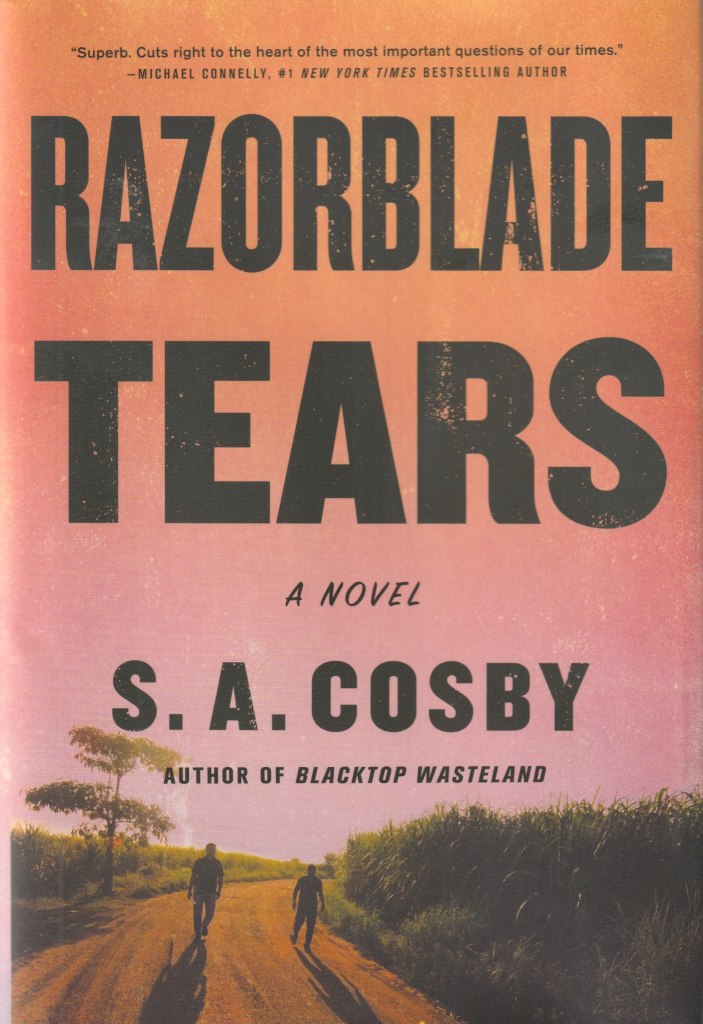
And over the year, yes, problematic tropes that can make you very, very tired have also developed–which makes me wary every time I approach a book by a non-queer person that takes on a trope without hesitation, as S. A. Cosby’s Razorblade Tears does, and that trope is one of the biggest and most hated by the queer community: bury your gays.
Ike tried to remember a time when men with badges coming to his door early in the morning brought anything other than heartache and misery, but try as he might, nothing came to mind.
The two men stood side by side on the small concrete landing of his front step with their hands on their belts near their badges and guns. The morning sun made the badges glimmer like gold nuggets. The two cops were a study in contrast. One was a tall but wiry Asian man. He was all sharp angles and hard edges. The other, a florid-faces white man, was built like a powerlifter with a massive head sitting atop a wide neck. They both wore white dress shirts with clip-on ties. The powerlifter had sweat stains spreading down from his armpits that vaguely resembled maps of England and Ireland respectively.
Ike’s queasy stomach began to do somersaults. He was fifteen years removed from Coldwater State Penitentiary. He has bucked the recidivism statistics ever since he’d walked out of that festering wound. Not so much as a speeding ticket in all those years. Yet here he was with his tongue dry and the back of his throat burning as the two cops stared down at him. It was bad enough being a Black man in the goo ol US of A and talking to the cops. You always felt like you were on the edge of some imaginary precipice during any interaction with an officer of the law. If you were an ex-con, it felt like the precipice was covered in bacon grease.
“Yes?” Ike said.
My faulty memory doesn’t remember how and when I first became aware of S. A. Cosby. What I do remember is that I bought and read one of his earlier works (perhaps his debut?) My Darkest Prayer, and enjoyed it thoroughly. Hard-boiled with a healthy dose of noir, I had a great time reading it–and was thrilled when his Blacktop Wasteland debuted to raves and attention and lots of recognition. Cosby can write like a house afire; and while he keeps up a rat-a-tat pace of story, he also manages to construct sentences and paragraphs beautifully, with a poet’s gift for language–spare and tight, yet poetic and beautiful at the same time (Megan Abbott is the Galactic Empress of this).
So, when I heard the “elevator pitch” for Razorblade Tears, I inwardly winced a bit, even as I had to admit Shawn’s guts; taking on bury your gays is a ballsy move–and also a bit of a dangerous one. If you don’t stick the landing…you’re fucked.
For those of you who don’t know what bury your gays means, it’s very simple: a show, or a book, or a movie, will introduce gay characters (lesbians, queers, whatever initial in the all encompassing umbrella those characters might choose for their identity), get the audience (and especially the queer viewers) deeply vested in them–and then kill them off suddenly and unexpectedly, all so the other queer characters (but usually the straight ones) will experience some kind of personal growth…in other words, you introduce a gay man into your narrative simply to later use him as a plot device, so the other characters can mourn and experience personal growth.
That’s probably explained badly, but you get the gist: gays will inevitably die. A good example of this is the so-called groundbreaking AIDS movie, Philadelphia–but the Tom Hanks character in that movie existed so that Denzel Washington’s character could grow and develop and move on from his own homophobic beliefs and fears about HIV/AIDS; as Sarah Schulman, one of our community’s finest minds, once said, “the entire point of Philadelphia is to make straight people feel better about HIV/AIDS and the gay men dying from it.” (Sections of her book Stagestruck: Theatre, AIDS, and the Marketing of Gay America are absolutely brilliant; it should be required reading for any Queer Studies course.)
The plot of Razorblade Tears is so deeply steeped in “bury your gays” that the gays are already dead when the book opens. The gays in question–Derek and Isiah–were brutally murdered, and the police don’t seem to care too much about looking into who killed them. Their homophobic fathers–both ex-cons–decide to look for their son’s killers. Both Ike and Bobby Lee feel a lot of guilt about their sons and how they rejected them both–their relationship, their eventual marriage, their child–while they were alive; finding their killers isn’t just about revenge but also a matter of atonement. In some ways, it’s like this book is borne from the anger every queer child rejected by their parents feels–you’ll be sorry when I’m dead.*
Ike and Bobby Lee are, indeed, sorry now that their sons are dead.
This also falls into another long-existent fictional trope: don’t fuck with a father. How many films (I’m looking at you, Liam Neeson), books or television shows are about a father’s rage, a father’s revenge, what a father will do to save or avenge their children?
Ike and Buddy Lee aren’t supermen, though. Cosby’s strength (besides his ability with words and images) is how well he creates characters and makes them human through their faults and frailties. Ike and Buddy Lee don’t much like each other as the story begins to move along–I kept thinking of the old Sidney Poitier/Tony Curtis movie, The Defiant Ones–but their ability to look past their own internal prejudices to see the commonalities between them as they unite in this foolhardy crusade to avenge their murdered sons is the real strength of the book here. (As well as the language.) You eventually start to understand them, care about them, want them to get their vengeance…even as you know it will bring them no peace.
I have to admit, I was hesitant to start reading this. I really was concerned I wasn’t going to be able to read it with the empathy necessary for Ike and Buddy Lee and their suffering–that I would think, yeah, well, maybe you should have thought about that when he was alive–but the book ultimately isn’t about their redemption, either; which is a genius move by Cosby. He makes their pain all too real–I cannot imagine the pain any parent should feel when their child dies–but he makes it clear there’s no easy answers here for Ike and Buddy Lee, and that pain will go on even if they get justice for their sons.
Shawn is also a master of writing about the Southern working class–about the poverty, the lack of opportunity, the societal neglect and how those factors all combine to keep those already mired in it trapped with little chance of escape; he clearly loves the rural South but not so much that he can’t expose the tragedy and ugliness that exists there.
It’s a powerful book, and I do recommend it….although the people who probably should read it inevitably won’t. I can recommend it, and do, enthusiastically; it’s a very powerful book, and it made me think–and what more can you want from art?
*sadly, I have seen all too often that a lot of those parents aren’t sorry when their rejected child dies; far too regularly they will say something along the lines of “So-and-so died for me years ago.”
Thursday morning and here we are, with a mere two more days before we can call it the weekend again. I’m not really sure why I am looking so forward to it; I just have to write and clean and do shit all weekend. Yay? But I guess it’s lovely because I am on my own schedule, I suppose?
I didn’t sleep for shit last night, which was highly annoying. Also, convenient because I forgot to set my alarm. Fortunately, my eyes opened at promptly six this morning. Huzzah?
So, overnight my HBO app on my Apple TV magically converted to an HBO MAX app, and I got lost in there for hours last night, just exploring all the options. I doubt I’ll ever watch the eight or nine Harry Potter movies ever again, but they are there, along with all kinds of over things. Scooby Doo Where Are You in its original two series is there–I watched one last night, delighted, before making dinner–and of course TCM is there, and there are so many classic films I’ve either not seen, or haven’t seen in a very long time. One of my all time favorites, Body Heat, is also there; I can’t wait to rewatch, as I’ve been wanting to rewatch it for quite some time. Also a lot of classic Hitchcock films, many of which I’ve never seen, including North by Northwest and several others. Essentially, with HBO MAX, combined with Hulu and Netflix and Prime and Disney Plus, I really don’t think I ever will have an excuse to be bored ever again, as there’s always something I can watch on one of those streaming services. There’s also some very good classic Hollywood, thank to TCM (Mildred Pierce, Laura, Bringing Up Baby, etc.). In other words, I am quite pleased.
Alas, that will undoubtedly cut into my reading and writing time–but better that than Youtube black holes, right?
Larry Kramer died yesterday, and I thought, “you know, I’ve been meaning to reread Faggots for a really long time and perhaps this is the time to do so, as a tribute to Larry and everything he did for us all.” As I took the book from the stack, I also realized this meant pushing Night Has a Thousand Eyes back into the pile, and this was probably the kind of thing that has happened with far too great a frequency and why I’ve never gotten back to reading the Woolrich, so I decided to go ahead and read the Woolrich and then I’ll get back to the Kramer. Faggots was one of the first “gay” books I read after coming out officially (I had read Gordon Merrick and The Front Runner and The Swimming-Pool Library while in the closet. Faggots was recommended to me when I walked into my first gay bookstore, Tomes and Treasures, in Tampa in the early nineties; the incredibly sexy bookseller–on whom I had a major crush–told me I should read it and Dancer from the Dance, so I bought both and read them) and I sometimes joke that “it almost pushed me back into the closet.” The gay sexuality was so in in-your-face, and all the kinks and other variations depicted within the covers of that book–plus the clear misery and unhappiness of the main character, Fred Lemish–kind of was shocking to someone as naïve as I was when I first came out.
This also made me think about my life in those years prior to my thirty-third, which was when I stopped passively floating through my life and tried to take control of it–to start actively living instead of passively letting my life happen to me. I rarely talk about, or even think much about, my life between moving to the suburbs when I was ten and my thirty-third birthday; primarily because my existence was so completely miserable and tragic and pitiful. There was the duality of living as both a closet case in my more regular day-to-day life (and fooling no one, as I was quick to find out later), plus my hidden, furtive life on the edges of gay world. It’s difficult for me to look back at that twenty-three years and not wince or recoil in embarrassment at what a miserable life I was leading, and how desperately unhappy I was all the time. But that time was necessary, because it was also that same period where I was starting to recognize, and learn, that almost everything I was raised to believe was not just a lie but a horrible one. Unlearning those decidedly terrible values and lessons is an ongoing process to this very day, but it’s also terribly important and necessary to shed all that conditioning in American exceptionalism, evangelical Christianity with its bizarre morality and cognitive dissonance, and the true American legacy of white supremacy. As I thought about this last night–we watched the first episode of CNN’s docuseries The Movies on HBO MAX last night, and I was remembering, not only the unhappy first more-than-half of my life, but started unpacking the rest as well.
And it will inevitably show up in my writing at some point.
ANd now back to the spice mines. Have a lovely Thursday, Constant Reader.
Sunday morning, and so much on my plate this morning. That’s okay, Constant Reader, I slept really well and once I have enough caffeine in my system, I will be up for the challenge. I still need to do some chores around the apartment today as well, but I am going to be keeping my head down and focussing on the things that need to be finished today–or at least, that’s the plan this morning. Being distracted is, of course, always a possibility; I may even close my web browsers to avoid that once I get started on my work.
Yesterday I spent some time with S. A. Cosby’s My Darkest Prayer, which is absolutely fantastic. That voice, and the influence of writers of color–Walter Mosley and Gary Phillips–are apparent, as are the biggies of crime–Chandler and both MacDonalds (Ross and John D.) are also there. The result is staggeringly original, a little raw, and completely absorbing. One reason I want to get all my writing and chores done this morning is so I can curl up in my chair with the book later today.
I also started streaming a CNN documentary series last night on Hulu–The Movies, which is very similar in set-up to their decades documentary series; a history of film by decade, which is quite frankly the smartest way to go; you certainly can see the difference in film by decade. It was fun to see films I’ve either not seen nor heard of (or had but forgotten) talked about, along with the blockbusters, the big movies, the award-winners, and how stars built their careers from their big break movie. I highly recommend The Movies, even if you aren’t a film fan; it’s also an interesting look at how films reflected the times they were made, which is always, for me, the best way to examine popular culture. (I really wish someone would write a non-fiction book about the gay publishing boom of the 1970’s, a decade that saw a gay novel, The Front Runner, hit the New York Times bestseller list; saw the birth of a queer literary sensibility, and also saw the enormous success of the Gordon Merrick novels–and no, please don’t say why don’t you write it, Gregalicious? There’s no time for me to write anything like that, and as it is, I have to start reading VOLUMES of research about gay life in post-war Hollywood, as well as what was going on in Hollywood in that time as well, and again, so very little time.) I think literature also holds up a mirror to society much in the same way as film and television does; it would be interesting to see a series of essays on how books published not only reflected, but influenced the society which produced them.
As I was reading My Darkest Prayer yesterday, I was thinking about how some of our larger cities, with their more cosmopolitan and international feel, should be reflected more in crime novels by, about, and for minorities. I’d love to read some crime fiction about New Orleans about people of color by people of color–whether it’s African-American, or Latino, or Vietnamese, for that matter. I’d love to see the same for cities like New York, Boston, Chicago, Houston and Los Angeles, to name a few. I loved Steph Cha’s Juniper Song novels, as well as her soon-to-be-released Your House Will Pay, which is, simply stated, genius. I’ve always wanted, for example, to give Venus Casanova, the African-American police detective who is both my Scotty and Chanse series (as is her partner, Blaine Tujague) her own story–but at the same time I have never thought myself capable of telling her story, or having the right to do so, at any rate. I have a great idea for such a story–a way of writing the end to her story, as it were, which would of course mean removing her from the two series I already write afterwards, which would probably rank up there with shooting myself in the foot as it would mean introducing a new cop to both series…although that in and of itself might not be such a bad idea, either. Could be just the thing to shake both series up a little bit.
I’ve also thought about writing a stand-alone Colin book. I’d once thought about spinning him off into his own series–wouldn’t a gay undercover operative make for a great series? I had thought, originally, that after the initial Scotty trilogy I would write Colin out of the series (SPOILER) and possibly give him his own series. I thought it would be fun to do a gay kind of Indiana Jones/James Bond hybrid with our boy Colin as the lead of the story. (It’s always fun to revisit ideas I had in the past.) Katrina of course ended that possibility, but I am still thinking it might be an interesting idea to write a Colin stand alone before tackling the next Scotty, which is going to be Hollywood South Hustle. There are–I will tell you this now–some unresolved Colin issues left over at the end of Royal Street Reveillon, and it might be interesting to tell Colin’s story before we get around to getting back to another Scotty book. I’m also probably going to do at least one more Chanse novel as well, but I don’t know when I’m going to get to either of these stories–Chanse, Scotty, or Colin’s.
But the Venus story is reverberating in my brain, and I might just have to write it to get it out of my system. It’s working title is Another Random Shooting and I’m jotting ideas down in my journal as they come to me.
And on that note, tis time to get back to the spice mines. I want to get the Major Project done today, and some work on the book, too.

 Queer and Loathing in America