All I Need

Sunday, Sunday. Can’t trust that day, especially when an hour was stolen from me during my sleep. Sunday is my sleep-in day, and while it’s not entirely unusual, I absolutely detest that I woke up at just before what-is-now-ten-thirty. Since I can’t drink coffee after noon for fear of its impact on my sleep–but I like my coffee in the morning–I will be able to have only, at most, two cups. This is also infuriating.

It’s not sunny out there this late morning, but more grayish again, as though it might rain. It may just be a cloud cover, but the sun is always bright in New Orleans; the lack of brightness is bizarre and also feels off–in addition sleeping  in until not-really-ten-thirty. But looking on the positive side, I worked out yesterday and the rest seems to have helped my muscles recover; they don’t feel either sore or tired or both this morning. I should be grateful for small victories, I suppose, and stop complaining.

I watched two more episodes of Seven Seconds last night, and it is absolutely riveting. It reminds me a lot of the lamented American Crime, where you saw everyone as three-dimensional characters; I like seeing it from every perspective, and while it’s easy to feel some sympathy for the guy who committed the actual crime and why he covered it up; the pain of the family of the victim is almost unbearable to watch–but Regina King is such an amazing and brilliant actress you can’t help but watch. I’ve always been a fan of hers; she was exceptional in American Crime, but this? Give her all the awards right now, and please cast her in everything; she is so good that as I watched I thought if I ever write a television show or movie I want to write a great part for her to play. As good as the show is, as it progresses it is starting to drift away from the nonjudgmental view that it had in the first episodes, which is fine–I think part of the reason American Crime failed to find an audience was because you didn’t know who to root for, or if you should root for anyone, which makes viewers uncomfortable, as they, for the most part, want to have good guys and bad guys–but I kind of wish they hadn’t gone so far with making the guy who committed the crime a villain. I felt sorry for him before; I am losing sympathy, and that’s why they are doing it; but when he was sympathetic it made the show more layered, complex, and nuanced.

Heavy sigh.

I got all my errands done yesterday, but forgot to get something I need for dinner today–but it’s just a twenty ounce bottle of root beer and I can walk to Walgreens and get that when I’m ready to put everything into the crock pot. The St. Patrick’s/St. Joseph’s Day Irish Channel parade is today, so I’m not moving my car. I decided to wait to go to Costco until next weekend; I am going to take one of my co-workers car shopping that day, and as punishment he’ll have to go to Costco with me when we’re finished.

I started writing yet another Chanse short story yesterday; “Once a Tiger.” It’s an idea for a Chanse novel that I had a long time ago and always wanted to write, sort of like how the Chanse short story I wrote last week was a book idea I never wrote. I had intended to get some other things done, but after the errands and the gym I was tired, so I sat down to watch Seven Seconds (Paul was at the office) and got sucked into it. I also watched two episodes of Versailles–this season is about the Affair of the Poisons–and read short stories. I need to clean today–I’m hoping it won’t rain so I can finally do the damned windows–but I also want to write today. So I should probably wrap this up and get back to work, so I can get the root beer from Walgreens and be done with it all, you know?

Sigh. Heavy lies the head, and all that, you know.

The first story I read was a reread; Nathaniel Hawthorne’s “The Minister’s Black Veil”:

THE SEXTON stood in the porch of Milford meeting-house, pulling busily at the bell-rope. The old people of the village came stooping along the street. Children, with bright faces, tripped merrily beside their parents, or mimicked a graver gait, in the conscious dignity of their Sunday clothes. Spruce bachelors looked sidelong at the pretty maidens, and fancied that the Sabbath sunshine made them prettier than on week days. When the throng had mostly streamed into the porch, the sexton began to toll the bell, keeping his eye on the Reverend Mr. Hooper’s door. The first glimpse of the clergyman’s figure was the signal for the bell to cease its summons.

“But what has good Parson Hooper got upon his face?” cried the sexton in astonishment.

All within hearing immediately turned about, and beheld the semblance of Mr. Hooper, pacing slowly his meditative way towards the meeting-house. With one accord they started, expressing more wonder than if some strange minister were coming to dust the cushions of Mr. Hooper’s pulpit.

“Are you sure it is our parson?” inquired Goodman Gray of the sexton.

“Of a certainty it is good Mr. Hooper,” replied the sexton. “He was to have exchanged pulpits with Parson Shute, of Westbury; but Parson Shute sent to excuse himself yesterday, being to preach a funeral sermon.”

I read this story either in high school or in college originally; whenever it was that I originally read it, my young mind was bored with it and thought it rather silly. I hated The Scarlet Letter, still do so much that even thinking of rereading it gives me dyspepsia; but I greatly enjoyed The House of the Seven Gables, although I remember nothing much about it except that the old woman’s name was Hepzibah, which I always thought was a great Gothic name for a creepy old lady. Rereading this story, it made a little bit more sense to me; it’s really a parable. Parson Hooper, for a reason unbeknownst to his parishioners and to the reader, has chosen to hide his face for the rest of his life behind a black veil; I remember reading this and being deeply annoyed about never finding out the reason. But rereading it now, I got a stronger sense of it; the parson has done this and the reasons why really aren’t important; what’s important is how uncomfortable it has made everyone else, and why; it’s about human nature and psychology, and is a lot more clever than I thought as a teenager. It still, however, reads in that stilted, archaic early nineteenth century formal style that is grating and annoying to the modern reader, however.

I then moved on to “The Last Temptation of Frankie Lymon” by Peter Blauner, from the anthology Crime Plus Music, edited by Jim Fusilli. I originally bought this anthology because it had a story by Alison Gaylin inspired by a song recorded by the band X, whom I used to love in the 1980’s–the story is quite brilliant, I might add–but had never gone back and read any of the others. So, I picked it up and this is the lead-off story for the collection.

He walked into the bar wearing the jacket that Sam bought for the Ebony photo shoot last year. A mostly wool blazer with two rows of brass buttons, that must have cost–what?–like forty to fifty dollars at Blumstein’s. He felt bad because Sam was living on about two hundred a week as a food inspector in the Bronx, while trying to manage the comeback for him, But what could you do? All the star clothes he used to have in his grandmother’s closet were either child-sized and long ago outgrown or had holes in them because he’d nodded off with a cigarette in his mouth.

So now the jacket felt heavy as a burden on his shoulders as he eyed his surroundings and tried to get comfortable. The bar was around the corner from his grandmother’s and he half recognized some of the people from the neighborhood, where he hadn’t lived since back in the day. There were mailmen and bus drivers wearing turtlenecks or open-collared shirts with jeans. Doormen and janitors in T-shirts and growing out their hair into bushy naturals as they rapped effortlessly to short-skirted former double Dutch girls from the block with sleepy eyes and soft mouths, who kept going “uh-huh, uh-huh, right on” as that Gladys Knight “Grapevine” song played on the jukebox.

Frankie Lymon was a real person; the lead singer for Frankie Lymon and the Teenagers, known for their hit “Why Do Fools Fall in Love”. Lymon’s story is one of those cautionary tales about the music industry, fame, and hitting it big when you’re young; he was only twenty-four when he died of an overdose–a has-been at 24. This story, which is basically a fictionalized imagining of his last day, is heartbreaking. He has fallen on hard times but has cleaned up and gotten to a point of recovery from his addiction; he’s trying to make a comeback but makes the sad, fateful decision to go into the local neighborhood bar near where he is staying with his grandmother–and runs into someone from his past, with her own broken dreams and broken life. It’s powerfully written and the characters realized strongly; you can’t stop reading even though you know it’s all a train wreck unfolding in front of you. Kudos to Blauner for such a powerful story.

I then went back to Sue Grafton’s Kinsey and Me collection, where the next offering was the story “The Parker Shotgun.”

The Christmas holidays had come and gone, and the new year was under way. January, in California, is as good as it gets–cool, clear, and green, with a sky the color of wisteria and a surf that thunders like a volley of gunfire in a distant field. My name is Kinsey Millhone. I’m a private investigator, licensed, bonded, insured; white, female, age thirty-two, unmarried, and physically fit. That Monday morning, I was sitting in my office with my feet up, wondering what life would bring, when a woman walked in and tossed a photograph on my desk. My introduction to the Parker shotgun began with a graphic view of its apparent effect when fired at a formerly nice-looking man at close range. His face was still largely intact, but he had no use now for a pocket comb. WIth effort, I kept my expression neutral as I glanced up at her.

“Somebody killed my husband.”

Grafton never disappoints, and as I have mentioned before when talking about these Chanse short stories (it pleases me to no end that I can now talk about them in the plural), reading Grafton’s Kinsey Millhone short stories, along with the Lew Archer short stories by Ross Macdonald and the Tess Monaghan ones by Laura Lippman, have been an education in writing the private eye short story; something I never felt confident about doing before. This story is excellent in that is has a great opening–how can you not keep reading after that–and Kinsey’s detecting skills are put to a great test here. I also learned a lot about shotguns in reading this story. I guess the thing that’s so terrific about reading these private eye short stories is seeing, while reading them, how they could have easily been expanded into novels while also seeing how the author pared down what could have been a novel into a pleasing, satisfying short story.

I also picked up the MWA anthology Vengeance and started reading some more of the stories in there; I believe I may have blogged about one of them already. But when reading Alafair Burke’s “The Mother”, the story began to sound familiar; and sure enough, I was right: I’d read it before. I started paging through the stories and yes, I’d read them all; I read them flying back from a trip to New York on a plane. The book includes Karin Slaughter’s chilling, and Edgar winning, short story “The Unremarkable Heart,” which is one of my favorite short stories of all time. But I had to put Vengeance back up on the shelf because I’d already read those stories, alas; I will only allow myself to reread, and write about, short stories I originally read before I started blogging back in 2004 (!), so as to avoid repetition.

And now, I am going to get my second and final cup of coffee before walking to Walgreens. Have a lovely Sunday, Constant Reader!

IMG_3519

Cool It Now

I still have that horrible throaty cough periodically, but my voice is more normal and I don’t feel off, which I am counting as a win. I also think that my body has changed on me again; my eating habits are bad–I often forget to eat and rarely, if ever, get hungry–but now my blood sugar will drop, leaving me feeling tired and ill. I need to start making sure that I fuel my body properly; gallons of coffee in the morning aren’t the way to go, and that is also inhibiting my sleep at night.

Heavy sigh.

But once the Olympics are over, I can go back to getting in bed at ten and reading for a half an hour or so before going to sleep; I am greatly enjoying The Black Prince of Florence, as well as my other current non-fiction read, Joan Didion’s essay collection After Henry. Didion is amazing; the way she crafts sentences and paragraphs is both lyrical and beautiful. I wish I had one tenth of her skill. I also made some progress with the Short Story Project, and am thinking I may write a Chanse short story. Reading all these Tess Monaghan (Laura Lippman) and Kinsey Millhone (Sue Grafton) and Lew Archer (Ross Macdonald) short stories are showing me how it’s possible to write and craft a private eye short story; and I have an idea in my head about one where Chanse goes back to LSU for a fraternity reunion that might turn deadly. It’s just a thought; I’ve always wanted to do that in a novel, but it might just be a short story, you know? One of my problems has always been that I think in terms of novels as opposed to short stories; I’ve certainly turned short stories into novels (Sorceress and Sleeping Angel come to mind), and am even thinking of turning another one into a novel. Reading all these short stories has been inspiring me to write short stories, which is incredibly cool. I have several in progress right now; I’ve been asked to write for two anthologies where the story is inspired by a song; which is something I have certainly done before, and I’m having a lot of fun with those. I also want to write something for the MWA anthology, and I have another I am writing to submit to another anthology as well. I am still working on the WIP and the Scotty, never fear–the Scotty is taking a timely and dark turn, which is kind of cool–but I have all these short stories dancing around in my head!

Bitchin’.

I also read two short stories over the weekend. The first was Sue Grafton’s “Long Gone,” from her Kinsey and Me collection.

September in Santa Teresa. I’ve never known anyone yet who doesn’t suffer a certain restlessness when autumn rolls around. it’s the season of new school clothes, fresh notebooks, and finely sharpened pencils without any teeth marks in the wood. We’re all eight years old again and anything is possible. The new year should never begin on January 1. It begins in the gall and continues as long as our saddle oxfords remain unscuffed and our lunch boxes have no dents.

My name is Kinsey Millhone. I’m female, thirty-two, twice divorced, “doing business as” Kinsey Millhone Investigations in a little town ninety-nine miles north of Los Angeles. Mine isn’t a walk-in trade like a beauty salon. Most of my clients find themselves in a bind and then seek my services, hoping I can offer a solution for a mere thirty bucks an hour, plus expenses. Robert Ackerman’s message was waiting on my answering machine that Monday morning at nine when I got in.

One of the things that rarely gets mentioned in discussion about Sue Grafton’s work is how funny she can; and this particular story, with Kinsey having to interview a husband who wants to hire her to find his wife, and having to deal with his three children, all under five, is actually, despite its dark tone and subject matter, kind of breezy and funny. Kinsey’s droll sense of humor, and her sympathy for the missing wife–which comes from her own dour outlook at marriage and family–made me laugh out loud several times during the course of reading the story. It’s a pity that Grafton didn’t write more short stories, because these are gems.

I then moved on to “The Barber” by Flannery O’Connor, from The Complete Stories.

It is trying on liberals in Dilton.

After the Democratic White Primary, Rayber changed his barber. Three weeks before it, while he was shaving him, the barber said, “Who you gonna vote for?”

“Darmon,” Rayber said.

“You a n*****r-lover?”

Rayber started in the chair. He had not expected to be approached so brutally. “No,” he said. If he had not been off-balance, he would have said, “I am neither a Negro- nor a white-lover.” He had said that before to Jacobs, the philosophy man, and–to show you how trying it is for liberals in Dilton–Jacobs–a man of his education, had muttered, “That’s a poor way to be.”

A writer friend of mine–probably one of my closest friends who is also a writer–is a huge Flannery O’Connor fan. As I mentioned when I talked about reading her story “The Geranium,” I had read her A Good Man Is Hard To Find and wasn’t overly impressed with it. Also, as I said when I read “The Geranium,” the racism and use of the n-word is kind of hard for me to see. And yet…in this story, it fits and has to be used, even though it fills me with distaste to see it on the page and to read it. “The Barber,” you see, is the perfect personification of what it’s like to live in the South and be confronted by in-your-face racism all the time. This doesn’t excuse it by any means, or say it’s okay; but wow, how honest and true this story is.

Rayber is a liberal, who clearly believes in racial equality; he is a teacher at the local college and when he is confronted with the racism from his barber and some of the other men in his shop, he is startled, shocked; doesn’t know what to do. Part of his white privilege comes from being surrounded, he believes, by people who believe the same way he does; that racism and bigotry and segregation is wrong and a moral evil. He doesn’t know what to do when he is confronted by it in the face of his barber, someone whose chair he has sat in for years, presumably, and allowed to apply a straight razor to his face and neck. Now, this pleasant person whom he has never really paid a whole lot of attention to and has never really given much of a thought to, other than he provides a service well that Rayber needs, is confronting him with a hideousness that is quite horrifying while holding a sharp razor at his throat. What makes this all the more brilliant is how O’Connor doesn’t even make that connection for the reader; she just puts it out there and lets the reader come to his own realization. And afterwards, after being mocked by the barber and his friends in the shop for how he chooses to cast his vote, he spends the next week angry and bitter about the experience, and preparing to explain his vote logically and rationally the next time he gets shaved; to reason with the barber and tell him how wrong racism is…and inevitably, when that times comes, as the barber jovially mocks him for his vote, he eventually becomes frustrated and physically lashes out.

This story resonated strongly with me. Whenever I am confronted with something I find morally abhorrent, to my face, it catches me so off-guard that I can’t really respond logically and rationally–sometimes even at all– because it is hard for me to understand that there are people out there who actually can hold positions I hold morally abhorrent; I’ve never been able to wrap my mind around, for example, homophobia. I don’t get it. I do not understand how anyone can simply devalue and deny another human being their humanity. It’s hard for me to write homophobic characters because I cannot fully flesh those characters out and make them anything other than one-dimensional; I cannot grasp hatred like that. But, as one editor told me early in my career, even Hitler loved his dogs. I could relate to O’Connor’s character, and his inability to understand, to realize, what he was dealing with; that behind the friendly face and jovial attitude is someone whose core values and beliefs are so repugnant to him that they didn’t seem POSSIBLE.

And that is the mark of a truly gifted writer.

I haven’t been able to stop thinking about that story since I read it, and again, the mark of a great writer. Ms. O’Connor made me think, made me reflect, got under my skin and made me question my own self, not only as a person but as a writer.

Wow.

And now back to the spice mines.

RyanPaevey14

I Want to Know What Love Is

It’s been raining pretty much most of the weekend, which is fine. I went to get groceries, pick up a prescription, and get the mail before getting home and starting to work on the mess that is my home; I also finished writing a chapter of one manuscript and started writing another–which was my writing goal for yesterday. Today’s is to do second drafts of two short stories to prepare them for submission. I also have to go to the gym and finish the cleaning of the apartment and organizing my office. I started reading the big y/a best seller One of Us Is Lying by Karen McManus yesterday; I can see why it’s a bestseller and I can also see why it’s being developed into a television series a la Thirteen Reasons Why; it’s a deceptively simple yet surprisingly complex story, and likewise–well, I’ll talk some more about it once I’ve finished.

I’m enjoying writing again for the first time in years, which is a good thing, and I am actually putting a lot of thought and planning into what I’m writing, which is a really good thing. What I’ve written over the last six or seven years has been a lot more organic, coming to me as I wrote it from a basic premise and perhaps knowing what the end was; without putting near as much thought into theme and what I am trying to say, what I am trying to explore with the story, than I used to–I mean, it worked, but it also made the work a lot harder than it needed to be. I think this is particularly true of short stories; I think that’s primarily what I’ve been doing wrong in writing them–my entire approach to short stories has been wrong, and I’ve been, as I said, making it a lot harder on myself than it necessarily needs to be.

Which is, sadly, what I always tend to do for myself: make things harder than they need to be.

Heavy heaving sigh.

In addition to cleaning and everything else I did yesterday, I also managed to start watching Season 2 of Black Sails, which continues to enthrall. I am still liking the idea of finally writing my pirate novel (Cutlass), but not as much as before; it remains one of those dreams that I hold on to for when I am making a living as a writer again and able to not have a day job any longer. (There are several of those; they also require not only making a living but making enough money to travel and do research.)

Some day. I never give up on the dream.

The Short Story Project also continues; yesterday I read a story by Ross MacDonald from The Archer Files and one by Karl Edward Wagner from the gorgeous two volume collection The Best Horror Stories of Karl Edward Wagner, produced by Centipede Press maybe seven or eight years ago.

MacDonald’s story, “The Bearded Lady,” was quite good, as everything written by MacDonald is.

The unlatched door swung inward when I knocked. I walked into the studio, which was high and dim as a hayloft. The big north window in the opposite wall was hung with monkscloth draperies that shut out the morning light. I found the switch beside the door and snapped it on. Several fluorescent tubes suspended from the naked rafters flickered and burned blue-white.

A strange woman faced me under the cruel light. She was only a  charcoal sketch on an easel, but she gave me a chill. Her nude body, posed casually on a chair, was slim and round and pleasant to look at. Her face wasn’t pleasant at all. Bushy black eyebrows almost hid her eyes. A walrus mustache bracketed her mouth, and a thick beard fanned down over her torso.

The door creaked behind me. The girl who appeared in the doorway wore a starched white uniform. Her face had a little starch in it, too, though not enough to spoil her good looks entirely. Her black hair was drawn back severely from her forehead.

Lew Archer, on his way from Los Angeles to San Francisco, decided to stop in the small town of San Marcos and look up an old army buddy, inadvertently stumbling into a murder case. The story is interesting, the writing whipcrack smart, with MacDonald’s trademark, cynical short paragraphs immediately getting to the essence of a character. Don’t we, as readers, already have a strong impression of who that young woman is as a person after those three sentences? I’ve often wondered how one solves a murder in a short story–or writes a detective short story. I’ve tried and failed often enough. But the great thing about the Short Story Project is I am starting to understand how to write them, how they work, and how to make them work; which is a lovely thing. I have several ideas for Chanse short stories that I’ve never written because I didn’t know how; now I rather do, or at least have an idea, thanks to The Archer Files and Kinsey and Me (Sue Grafton). Both books are great learning tools for people who want to write detective stories, and MacDonald’s influence on Grafton is clear. (Although I’d still love to see someone do an essay, or book of criticism, comparing and contrasting MacDonald’s work with that of his wife: The Murderous Millars would be a great title.) MacDonald’s stories usually have to do with damaged and dysfunctional families; “The Bearded Lady” is another one of those, and is very well done. I highly recommend it.

The Wagner story I read was from the second volume of he Best Horror Stories of Karl Edward Wagner, which was titled Walk on the Wild Side, and was titled “The Last Wolf.”

The last writer sat alone in his study.

There was a knock at his door.

But it was only his agent. A tired, weathered old man like himself. It seemed not long ago that he had thought the man quite young.

“I phoned you I was coming,” explained his agent, as if to apologize for the writer’s surprised greeting.

Of course…he had forgotten. He concealed the vague annoyance he felt at being interrupted at his work.

Nervously the agent entered his study. He gripped his attache case firmly before him, thrusting it into the room as if it were a shield against the perilously stacked shelves and shelves of musty books. Clearing a drift of worn volumes from the cracked leather couch, he seated himself amidst a puff of dust from the ancient cushions.

I received both volumes of Wagner when I was judging the Bram Stoker Award for Best Single Author Collection, or whatever it is called; it was so long ago that I don’t even recall who the finalists were or who actually won. My memory is perforated like Swiss cheese nowadays, with holes and gaps; it also works like a sieve as new knowledge, and new books I’ve read, tend to pass through it without catching hold (I used to be able to name every book I’ve read, the plot, the main characters–and even some of the minor; over the years that ability has been sadly lost to time). I don’t, for example, remember the titles or the contents of the Wagner stories I read; but the books are beautiful volumes and I remember being impressed by his writing, so I kept them on my shelves. It was only a week or so ago that I realized, that I remembered, them; and that they might make a good addition to my year-long study of short fiction.

I’ve often said that writing about writers, about the business of writing and publishing, sometimes (often) feels masturbatory to me; only other writers would be interested in such a story. And yet writers pop up in my work all the time; Paige is a journalist and wannabe novelist in the Chanse series (and now that I’ve retired that series she’s migrated, apparently, over to the Scotty); another writer character I’ve created has appeared in several novels of mine–one Scotty, The Orion Mask, and one pseudonymous; he also appears to be the voice I used in several first-person short stories, including “An Arrow for Sebastian.” I have another such short story in process; I’ve not quite worked out how to make the story work, but there you have it. I was tempted to write an entire series about a writer, but as I started to develop my gay male writer character more I soon realized I had turned him into a hybrid of Scotty and Chanse; there was nothing new or original about him other than he was a writer and not a private eye. (I really do want to reread Azimov’s Murder at the ABA, though, and Elizabeth Peter’s brilliant Die for Love and Naked Once More.)

“The Last Wolf” is also about a writer, a writer who firmly believes in himself and his work, and that his work is art, and art should never be compromised for commerce. The world in which he lives is one where he is the last (apparently) person attempting to still write fiction; novels have fallen by the wayside and short stories are no longer published; the world has completely changed and his agent wants him to try to write for television shows–which, as described, sound horrifically awful. The writer refuses, the agent leaves, and he goes back to his typewriter. This story could easily be seen as angry, or even whiny; in the hands of a lesser author, the story would be precisely that. But Wagner paints a picture with his words, and maybe it resonated with me more because I am an author myself, but the sympathy rests entirely with the author. (Although I am one of those whose eyes roll so hard that  they almost unscrew when I hear another author speak of their ‘art’; but that’s a topic for another day.) I am looking forward to digging back into Wagner’s work again this year.

And now, I need to file and organize, perhaps vacuum, before I head to the gum. I want to get some things written today, and I need to revise those stories.

Hello, spice mines.

Sigh.

26196451_321860411641954_3040436925599999815_n

Round and Round

So, I did it. I went to the gym yesterday for the first time in months, and God knows when the last time I went without a trainer appointment. I am very proud of myself for taking this first step, and I have to remember to stay motivated. It felt fantastic. I’d forgotten how great endorphins feel. I went in, and did some stretches before heading to the weight machines. I went all the back to my origins (something I seem to be doing a lot this year), and started doing my work outs the way I did when I first got back in shape way back in 1995: a full body workout (chest, back, shoulders, biceps, triceps, leg press, and calf raises, then abs and cardio) and did low weights, tried to not overdo it, and only did one set of 15 on everything. I will go up to two sets of everything on the fourth workout; three sets on the seventh, and up the weights on the tenth, and then on every fourth thereafter. I am not concerned about gaining size; this is more of a cardiovascular than strength workout. Maybe by the summer I might change to something more muscle building, but any workout with weights is going to gain some size. I’d like to hit my goal weight of 200 by July; we shall see. I also am not certain what that is going to do to my build, to be honest. But I can adapt…and posting publicly about this is also going to shame me into being more consistent.

And this morning I still feel good; I can tell I exercised, but am not sore. Yay! SO lovely to know I am doing it right. It’s hard to believe that it’s been so long since I learned about the body and how to exercise properly. I wonder–yes, I just googled my old gym in Tampa; it closed in 2003 and was still owned by the same person when it closed as when it opened. Good ole Metroflex and Alan. When I wrote Murder in the Rue Dauphine I based the gym Chanse worked out at on Metroflex; I even named the manager Alan. I’d completely forgotten about that until just now….

We watched I, Tonya last night and really enjoyed it. I have a lot of thoughts about it, but I’m going to let them digest for a few days before I post about it. The cast is excellent, and I think the movie is, too.

I have lots I want to get done on this holiday Monday; I am making an excursion to Metairie, and have lots of writing to do, and lots of editing, and tons of emails to anwer and get caught up on.

The Short Story Project continues. Yesterday I read the first story in Sue Grafton’s Kinsey and Me, “Between the Sheets”:

I squinted at the woman sitting across the desk from me. I could have sworn she’d just told me there was a dead man in her daughter’s bed, which seemed like a strange thing to say, accompanied, as it was, by a pleasant smile and carefully modulated tone. Maybe I’d misunderstood.

It was nine o’clock in the morning, some ordinary day of the week. I was, I confess, hungover–a rare occurrence in my life. I do not drink often or much, but the night before I’d been at a birthday party for my landlord, Henry Pitts, who’d just turned eighty-two. Apparently the celebration had gotten out of hand because here I was, feeling fuzzy-headed and faintly nauseated, trying to look like an especially smart and capable private investigator, which is what I am when I’m in good form.

My name is Kinsey Millhone. I’m thirty-two years olds, divorced, a licensed P.I., running my own agency in a town ninety-five miles north of Los Angeles. The woman had told me her name was Emily Culpepper and that much made sense. She was very small, one of those women who at any age will be thought “cute,” God forbid. She had short dark hair and a sweet face and she looked like a perfect suburban housewife. She was wearing a pale blue blouse with a Peter Pan collar, a heather-colored Shetland sweater with grosgrain ribbon down the front, a heather tweed skirt, hose, and Capezios with a dainty heel, I guessed her to be roughly my age.

“Between the Sheets’ is a delight, if for no other reason than the fact that it’s actually a traditional mystery story; one that is solved by viewing the crime scene, interviewing people, and observing the clues left behind by the killer and making deductions. This is particularly fun because the Kinsey novels are hardboiled style private eye novels, tough with sparse prose and told from Kinsey’s slightly cynical, world-weary point of view. This short story, still in that voice, though, has several moments os humor, and could easily have been an Erle Stanley Gardner Perry Mason story, or an Agatha Christie–although Christie’s short stories always seemed to me to border on the noir side.

The other story I read was “Barn Burning” from The Collected Stories of William Faulkner, an enormous volume I’ve only occasionally dipped into:

The store in which the Justice of the Peace’s court was sitting smelled of  cheese. The boy, crouched on his nail keg at the back of the crowded room, knew he smelled cheese, and more: from where he sat he could see the ranked shelves close-packed with the solid, squat, dynamic shapes of tin cans whose labels his stomach read, not from the lettering which meant nothing to his mind but from the scarlet devils and the silver curve of fish–this, the cheese which he knew he smelled and the hermetic meat which his intestines believed he smelled coming in intermittent gusts momentary and brief between the other constant one, the smell and sense just a little but of fear because mostly of despair and grief, the old fierce pull of blood. He could not see the table where the Justice sat and before which his father and his father’s enemy (our enemy, he thought in that despair; ourn! mine and him both! He;s my father!) stood, but he could hear them, the two of them that is, because his father had said no word yet:

“But what proof have you, Mr. Harris?”

Faulkner is one of my all-time favorite writers; his “A Rose for Emily” is one of the greatest short stories ever written–if not the greatest–and both Sanctuary and The Sound and the Fury are works of art most writers can only aspire to. There’s no sentimentality in Faulkner, at least not to me; he doesn’t romanticize poverty, he doesn’t romanticize the rural Southern experience, nor does he write about heroic figures. He writes about damaged and flawed human beings, and while his work is called “Southern Gothic,” I’m not sure if gothic is the right word. For me at least the descriptor gothic conjures up an entirely different image and style of story and writing. Reading Faulkner reminds me of home, reminds me of relatives and summers spent in rural Alabama, of orange-meat watermelons and fireflies and  four o’clocks and screen doors and ticks on dogs and red dirt and big red Coca-Cola coolers with a bottle opener on the side. “Barn Burning” is told from the perspective of a young boy, Colonel Sartoris Snopes, and opens with his father being found not guilty, for lack of evidence, of burning the Harris barn after a dispute about a loose hog; but despite the lack of evidence the Snopes family is banished from the county and sent on their way to the next sharecropping farm, where things go bad yet again, but this time Sarty can’t let it happen. It’s about learning the difference between right and wrong, and learning that sometimes loyalty to blood simply because of blood isn’t enough. It’s a terrific story, with great imagery and beautiful language use, and yes, reminded me of my long love affair with Faulkner’s work. He’s not easy to read by any means; but so worth the effort.

And now,  back to the spice mines.

tumblr_o5h18dblnH1uzn77yo1_540

Pink Houses

Another cold morning in New Orleans. The Saints are up in Minneapolis playing the Vikings today, with the winner going to the NFC championship game to play Philadelphia in Philadelphia, so I shouldn’t complain about how cold it is here! I am hoping to finish cleaning the kitchen this morning so I have to time to go lift weights for the first time since AUGUST before the game. And stretch, and do some cardio. I am taking this get back in shape goal for this year seriously, Constant Reader.

I also didn’t read a short story yesterday, but I started reading one of the Kinsey Millhone stories in Kinsey and Me, and it’s quite good; I look forward to finishing it today during the game, and reading another to get back on track. But I am doing much better this year on the Short Story Project than I ever have in past years, and I have so many short story collections and anthologies to choose from; which is part of the reason I decided to make 2018 the year of the short story. I was also inspired yesterday to start writing two short stories–“Sorry Wrong Email” (which is going to take a lot of work to get right) and “Neighborhood Warning”, which I think can be really really good. I also want to work on finishing the final draft of another short story today, and this week I need to start reading the submissions for Sunny Places Shady People. With no offense to my Blood on the Bayou contributors, I think this one might be even better, I also need to finish an interview for my Sisters newsletter column (basically, writing the introduction and putting the questions in the proper order for flow) and I also need to work on my two manuscripts, and of course the Scotty Bible languishes. Heavy heaving sigh, the work of a Gregalicious is never done. I also want to read a novel; another goal for the year is getting the TBR pile down to a workable size. Tomorrow I am going to Target, and probably going to make it Leg Day at the gym in the afternoon (I have a long work day on Tuesday, so I can’t do an every other day; the nice thing about Leg Day is no cardio; just stretch, do legs, and some abs).

I watched the 1970 film Airport yesterday, based on the Arthur Hailey novel, it was one of the year’s biggest hits and was nominated for lots of Academy Awards, and even got great reviews. It was also the movie that kicked off the ‘disaster movie’ trend of the 1970’s, and spawned several sequels. The opening sequence of the movie was pretty interesting, as they showed all the ticket counters for the various airlines at “Lincoln International” in Chicago; obviously a stand-in for O’Hare. What made it interesting was how none of the airlines whose counters were shown, or were mentioned in the PA announcements over the opening credits (Continental Airlines Flight 220 is now boarding) exist anymore: Northwest, Eastern, TWA, Continental, Braniff, Pan Am. It’s hard to imagine today, with our limited choices, but just twenty years ago they were a lot of options.

The movie had, as all these types of films usually did, what was called an ‘all-star cast’; Oscar winners Burt Lancaster, George Kennedy, Van Heflin, and Helen Hayes (who would win a second Oscar for her role); as well as other bankable stars as Dean Martin and Jean Seberg; newcomer Jacqueline Bisset, stunningly beautiful who would hit major stardom later in the decade in The Deep; stage actress Maureen Stapleton in one of her first roles and who would later win an Oscar of her own; and assorted others (Gary Collins, for example) in small parts early in their career. The premise of the film is simple: a major airport is in the throes of a several day long snowstorm; it was inspired by the blizzard of the winter of 1966 (which I remember), and how the airport operates in such a crisis, and the personal stories of the airport employees intercrossed with those of several people who pass through the airport. Burt Lancaster plays Mel Bakersfeld, general manager of the airport, who is married to his job and ignores his wife and family as a result. His marriage to Cindy (Dana Wynter) is in shambles, and he’s strongly attracted to the widowed Tanya Livingston (Jean Seberg) who is some sort of manager for Trans Global Airlines (her job is never really defined in the movie; it certainly was in the book–Hailey was nothing if not thorough). They of course don’t act on their attraction, but it’s there–and she is considering a transfer to San Francisco and  ‘fresh start’ since they have no future. He fights with his wife several times on the phone, mostly to show how unreasonable she is–obviously his job should come before his wife and family! Dean Martin plays asshole pilot Vernon Demerest, who also happens to be Mel’s brother-in-law, married to Mel’s sister (played by Barbara Hale, best known for playing Della Street on the original Perry Mason series). He’s a great pilot, but a dick–and he and Mel disagree frequently about airport operations, etc. He’s also having an affair–the latest of many–with co-worker Gwen Meighan (Jacqueline Bisset), who tells him before they work their flight to Rome that she’s pregnant–including the icy line “You can stop twisting your wedding ring, I know you’re married”–which in turn doesn’t really either of them sympathetic. The head of Customs and Immigration’s niece is also going to be on the Rome flight…as it soon becomes apparent that this particular flight is going to be the film’s focus and everyone’s paths are going to cross in some way regarding Trans Global Flight 22, The Golden Argosy. Helen Hayes plays Ada Quonsett, an older woman who stows away on flights to try to visit her daughter and grandchildren in New York, caught and being sent back to Los Angeles, but she manages to evade her watcher and sneak aboard Flight 22. Also on the flight is D. O. Guerrero, a bankrupt failure with mental problems and lots of debts who also happens to be a demolitions expert, and his briefcase, which contains a bomb. He wants to blow up the plane so his wife (coffee shop waitress Inez, played by Maureen Stapleton) will collect on his flight insurance. (He’s played by Van Heflin.) This is before security, metal detectors, etc., and the rash of hijackings in the late 1960’s and early 1970’s started the change to tighter airport security (so many New York to Florida flights were hijacked and redirected to Havana that it became a joke in the zeitgeist; “my flight was hijacked to Cuba.'” Of course, after the flight takes off it becomes apparent to those on the ground that he must have a bomb; the flight crew tries to get it from him with the end result he sets it off in the bathroom, blowing a hole in the side of the plane and causing explosive decompression. Gwen was trying to get into the bathroom to him when the bomb goes off and experiences severe injuries. The damaged plane has to return to Chicago as all other airports are closed; and of course, the issue of the big runway being blocked by a plane stuck in the snow that opens the movie now becomes crucial; the plane must be moved because the damaged aircraft needs as much room as possible to land, since its rudder, and steering are damaged which means the brakes might be as well.

Complicated, right? Of course the plane gets moved, and the flight lands safely. Mel’s wife admits she is having an affair and wants a divorce, and it looks like asshole Vern might do the right thing with Gwen after all. At least if Mel and Tanya get involved, they’ll be together at the airport all the time, although as they prepare to drive off together at the end, there’s another crisis…but this time Mel says “let him handle it” which means…what, exactly? He’s not going to be a workaholic anymore?

The acting in the movie isn’t good, but then again they aren’t really given a lot to work with. Hailey’s books probably don’t hold up, but they were huge bestsellers in their day–I read them all. He always focused on an industry or business–medicine, hotels, airports, hospitals, banks, power companies–did a lot of research, and then wrote enormous, sprawling books that not only showed how the businesses worked but told melodramatic stories about the people who worked there or were involved somehow. His novel Hotel was also filmed, and then turned into a Love Boat like weekly television series in the 1980’s; in the book and movie the St. Gregory Hotel was in New Orleans (based on the Monteleone, actually), in the TV show it was moved to San Francisco. The book, written in the 1960’s, also dealt with racial issues; I should really reread both it and Airport. The Moneychangers, which was about banking, I read when I worked for Bank of America, and I was amazed at how spot-on he got working in a bank. I should reread Airport to see how different airports were in the 1960’s than they were in the 1990’s, when I worked for Continental. But his male leads, who usually ran the business, were Ayn Rand-ian style supermen: married to their jobs, good at them, and devoted to the point there was no room in their lives for a personal life, which also kind of made them unlikable.

But back to the film–as corny and badly acted as it was, despite the terrible dialogue, they did a really great job of building up the suspense about the bomb as well as would the plane be able to land safely; and since that was the most important part of the film, it worked on that level. It was also hard to not laugh a bit from time to time, having seen the spoof Airplane! so many times I can speak the dialogue along with the movie when watching; it’s weird seeing this stuff not being played for laughs  (although Airplane! was primarily based on Zero Hour! with elements from Airplane 1975. In an interesting aside, Arthur Hailey did the novelization of Zero Hour!, which was called Runway Zero-Eight). It was also interesting seeing how much things have changed since this film was made: divorce isn’t the societal horror it was back then; people don’t stay in bad marriages “for the sake of the children” anymore; abortion wasn’t legal in the US when the film was made so Gwen’s abortion would have to be in Sweden, if she chose to have one; and of course, all the changes in airport security. The plane itself was a Boeing 707; which aren’t used anymore. Stowaways can’t really get onto planes anymore, either.

Plus, back in the day the concept that airline crews were boozing and sexing it up all the time, and that flight attendants (then stewardesses) were good time girls fucking every pilot they could lure into their clutches was such a stereotype–one the airlines actually bought into because they had age, size and looks standards for the women, and ran print and television ads playing up the sexiness of their stewardesses–that it took years for that to be changed…and it still exists to a certain extent.

It was certainly not something I learned from the Vicki Barr Stewardess mystery series for kids! I’ve always wanted to write a crime series about a flight attendant–kind of an update of Vicki Barr but not for kids–but can never really figure out how to make it work. Maybe someday.

Back to the spice mines! The kitchen ain’t going to clean itself!

26167850_2049469171964082_7159993896036773975_n

Church of the Poison Mind

Sue Grafton very famously said that if you want something, you have to voice that desire out loud; say it to someone.

It’s very strange; we are often taught–at least I was–that ambition in slight moderation is a good thing, but over-weaning ambition is a bad thing. I was taught that bragging is unbecoming; because if you truly did something well or a great job at something, you wouldn’t need to boast, would you? This was drilled into my head for as long as I can remember: you get complimented, you don’t brag, and if you do get complimented, you are gracious and self-deprecating.

This is so deeply ingrained in me that it is very hard for me to be ambitious, or share my ambitions with anyone; it’s hard for me to take pride in what I’ve accomplished; and I always look for a way to turn any compliment into a “if I can do it, anyone can” kind of thing.

Another friend of mine thinks daily affirmations is also a way to get what you want; if you say what you want out loud to your mirror (or your computer, whatever), you can create the kind of mindset that will help you attain your goals. I wrote some out last year, at the beginning of the year, but after a few weeks I started feeling self-conscious about doing it, kind of silly, and I stopped.

Self-defeating, isn’t it?

So, in the interests of breaking this cycle, and of getting better at taking compliments and believing more in myself, here are some goals I want to achieve:

I will take my career to go to the next level.

I will get an agent.

I will write reviews for the New York Times.

I will sell short stories to high paying markets.

I will get a story selected for the Best American Mystery Short Stories series.

I will get a short story published as part of the Bibliophile series.

I will win a major writing award.

Whew. I already feel like writing all the down is going to jinx me in some way. NO NEGATIVITY NO NEGATIVE THOUGHTS.

So, there’s that. I’ve also made some great progress on the Short Story Project, including “Dear Penthouse Forum (A First Draft” and “The Babysitter’s Code.”

You won’t believe this, but this really did happen to  me just last fall, and all because I was five minutes late, which seemed like a tragedy at the time. “It’s only five minutes,” that’s what I kept telling the woman behind the counter, who couldn’t be bothered to raise her gaze from her computer screen and make eye contact with me. Which is too bad, because I don’t need much to be charming, but I need something to work with. Why did they make so many keystrokes, anyway, these ticket clerks? What’s in the computer that makes them frown so? I had the printout for my e-ticket, and I kept shoving it across the counter, and she kept pushing it back to me with the tip of a pen, the way I used to with my roommate Bruce’s dirty underwear, when we were in college. I’d rounded it up with a hockey stick and stashed it in the corner, just to make a pathway through our dorm room. Bruce was a goddamn slob.

“I’m sorry,” she said, stabbing that one key over and over. “There’s just nothing I can do for you tonight.”

And so begins yet another delightful Laura Lippman story, only written in the style of a letter to Penthouse Forum. That premise, very clever in and of itself, also makes the story a bit of a time capsule; does Penthouse and it’s sister digest of letters, Penthouse Forum Letters, even exist anymore? How long before no one even remembers their existence anymore? And why did I not ever try to write them? It was good money. But I am digressing. This clever story goes on to have our main character trapped in the Baltimore airport overnight; unable to swing the money for an airport hotel or can back to his apartment, and then a beautiful woman in her thirties shows up to not only save the day for him, but to entice him with the possibility of incredible, strings-free sex. (Which was pretty much the theme of every letter to Penthouse Forum; there were erotic flash fiction.) But being a Lippman story, there’s more going on than just incredible, no strings attached sex, and when the story turns, it’s unexpected and quite delightful.

This second story from Hardly Knew Her, “The Babysitter’s Code,” was originally published in Plots with Guns in 2005; and this is the period when Lippman moved from her delightful Tess Monaghan series (which I should reread) to writing her stand-alone thrillers; or literary fiction about crime, which is what they really should be described as. That broadening of her scope, and stretching of her talents, is very clear in this story.

The rules, the real ones, have seldom been written down, yet every girl knows them. (The boys who babysit don’t, by the way. They eat too much, they leave messes, they break vases while roughhousing with the kids, but the children adore the boys who babysit, so they still get invited back.) The rules are intuitive, as are most things governing the behavior of teenage girls. Your boyfriend may visit unless it’s explicitly forbidden, but the master bedroom is always off-limits, just as it would be in your own house. Eat what you like, but never break the seal on any bag or box. Whatever you do, try to erase any evidence of your presence in the house by evening’s end. The only visible proof of your existence should be a small dent on a sofa cushion, preferably at the far end, as if you were too polite to stretch across its entire length. No parent should come home and peer into the Pringles can–or the Snackwell’s box or the glass jar of the children’s rationed Halloween candy–and marvel at your capacity. There is nothing ruder that a few crumbs of chips at the bottom of a bag, rolled and fastened with one of those paper clips, or a single Mint Milano resting in the last paper cup.

This story is more of a character examination than an actual story, and it’s also slightly reminiscent of Raymond Carver’s “Neighbors,” and talks about an essential truth we all tend to really ignore: when someone is alone in our homes, whether they are watching our children or pet-sitting or cleaning, they are privy to our secrets. And this house has plenty of secrets, in this affluent suburb of Baltimore; secrets that are too hard for our young babysitter to resist, as she snoops through the lady of the house’s closet and underwear drawers, and observes the crumbling marriage of the wealthy homeowner, his much younger trophy wife, and their genetically damaged baby. This story is both wistful and sad, more so than suspenseful, although the fear of being caught is always there. It’s also a very insightful look at how a teenage girl’s mind works. Brava, Ms. Lippman, brava.

I also discovered a volume I’d forgotten, and was very excited to rediscover. I’d forgotten that one year Sue Grafton skipped a book in the Alphabet Series and instead published a short story collection, Kinsey and Me, and I am really looking forward to diving into it. Yay!

I am really enjoying the Short Story Project of 2018.

Here’s a hunk for you.

47e2523bc858fca1cffee55a6058b425--sexy-guys-sexy-men

If This Is It

Sue Grafton died this week.

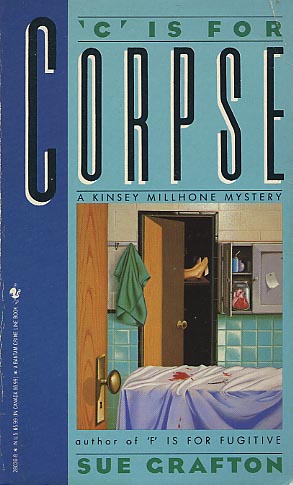
Bookstop in Houston, the late 1980’s. I hadn’t read mysteries in years, abandoning the genre in the late 1970’s because I was tired of the straight white male point of view, and I wasn’t really aware there was any other, to be honest. I’d always loved the genre; as a kid I read every mystery I could get my hands on, from Mary C. Jane’s books for kids to the Hardy Boys to Nancy Drew to Trixie Belden to The Three Investigators. I read all of Agatha Christie and Ellery Queen. I was a huge fan of the Gothic suspense writers, Phyllis A. Whitney and Victoria Holt and Mary Stewart. I read Charlotte Armstrong. But once that store of writers and their works had been exhausted, I tried reading the male voice…and didn’t care for it. I couldn’t quite put my finger on what the problem was, but they weren’t anything I could enjoy. So I moved away from the genre, reading family sagas and romance novels and science fiction and horror and fantasy; literary fiction and historicals; I’ve always read, and I always will. But I remember stopping at the Book Stop in Houston on pay day–I always went to a bookstore on pay day–and they had a little glossy magazine about new books and writers they always put in the bag. The cover story was an interview with a writer I’d never heard of, and about her new book, D is for Deadbeat.  “Wow,” I thought as I read it, “a woman private eye? This sounds interesting.” So on my next pay day I bought the first four books in the series: A is for Alibi, B is for Burglar, C is for Corpse, and D is for Deadbeat.  I enjoyed the first two, and they got me thinking about my own plans about being a writer. (I’d given up the idea of being a crime writer–which was my first inclination–when I lost interest in the genre in the late 1970’s.) And then I read C, which to this day remains my favorite of the entire series. I was hooked, sold, and a Grafton fan for life.

And I realized that despite some of the criticism she received (misogynistic at its heart; male critics dismissing Kinsey as “a man in a skirt,’ which was such utter bullshit I couldn’t believe a paid critic could be that ignorant and obtuse–now, of course, I can readily believe it), she had really reinvented the form; by creating a tough, loner female private eye she had forever changed the form and recreated it. And made me realize, hey, if someone can write a series about a female private eye, why can’t I write a series about a gay one? 

She made me realize that anything was possible in the form; if you only had the courage to shatter the mold and recast it.

Reading Grafton led me to the other great women writers–Sara Paretsky, Marcia Muller–and the ones who came in their wake: Lia Matera, S. J. Rozan, Laura Lippman, Megan Abbott, and so many others. And I grew to love the genre again,  and realized that it was what I was meant to do myself.

I had the great good fortune to meet her here in New Orleans at a party given in her honor; I don’t recall why she was in town, I know she came to the Williams Festival one year and I got all of my books signed. But she made time for a conversation for everyone at the party, was gracious and friendly and kind. I don’t remember what we talked about–I was too in awe and tongue-tied to be anything other than a blithering idiot, so I mostly stuck to  innocuous party conversation, but I remember she was very kind, had a wonderful warm smile. and an infectious, joyous laugh.

I started buying the books in hardcover around I; I am woefully behind on the series, and now there won’t be another to come; the series ended before she reached Z, only falling one short; if I am not mistaken, I have W, X, and left.

Thanks for all the years of great reading, and inspiration.

RIP, Sue.

0553280368


Our House

..in the middle of our street.

We will not be discussing the embarrassment that was last night’s LSU “game.”

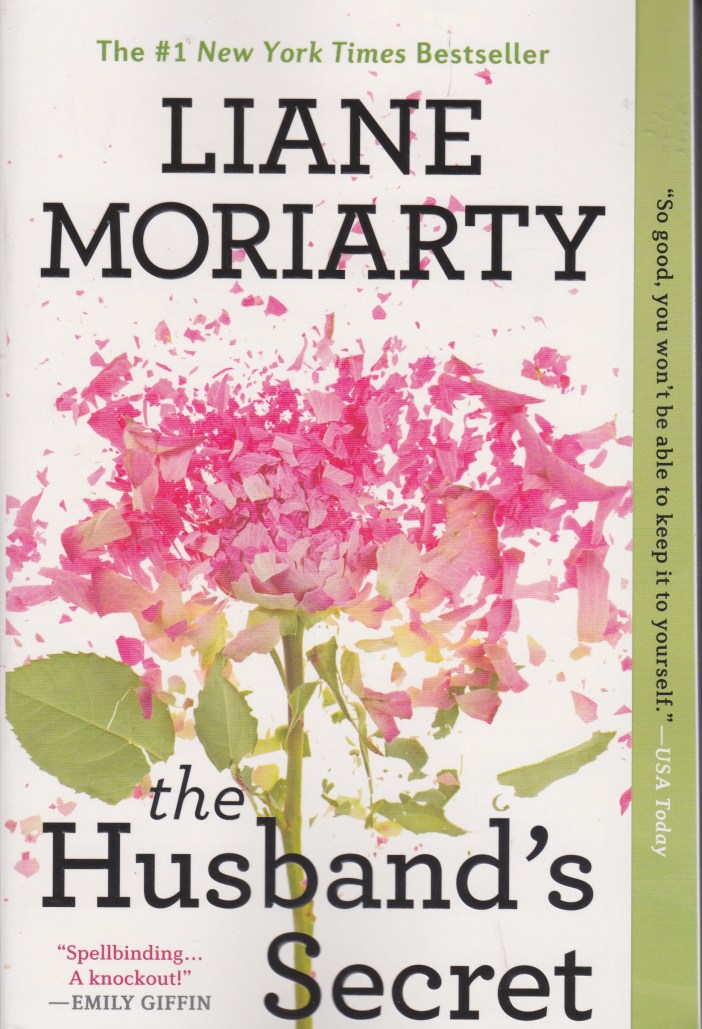
Friends are in town, and we had lunch with them at Commander’s Palace yesterday, which was lovely. I didn’t read the menu carefully and got something that had fried eggs on the top–which ran with yolk when you broke it; shudder–but I simply pushed them away with my fork and ate everything else. I was very tired after that, and came home, worked for a little while, and then curled up with Liane Moriarty’s The Husband’s Secret. I had read Big Little Lies concurrently with watching the HBO series, and enjoyed both the book and the show, so wanted to read another one of her novels. I wasn’t quite sure what I was expecting with this one–the jacket blurb mentioned that a wife finds a sealed envelope addressed to her from her husband, with the words To be opened only in the event of my death.

I would have opened it immediately, of course.

the husband's secret

It was all because of the Berlin Wall.

If it weren’t for the Berline Wall, Cecilia would never have found the letter, and then she wouldn’t be sitting here, at the kitchen table, willing herself not to rip it open.

The envelope was gray with a fine layer of dust. The words on the front were written in a scratchy blue ballpoint pen, the handwriting as familiar as her own. She turned it over. It was sealed with a yellowing piece of sticky tape. When was it written? It felt old, like it was written years ago, but there was no way  of knowing for sure.

She wasn’t going to open it. It was absolutely clear that she should not open it. She was the most decisive person she knew, and she’d already decided not to open the letter, so there was nothing more to think about.

Although, honestly, if she did open it, what would be the big deal? Any woman would open it like a shot. She listed all her friends and what their responses would be if she were to ring them up right now and ask what they thought.

Liane Moriarty is compulsively readable. And that’s not a quality in an author that should be dismissed lightlyAs I mentioned the other day with Louise Penny, it’s hard to classify Moriarty’s work; there’s a crime involved, but is it really crime fiction? I’m not sure it’s marketed that way; this book has a jacket blurb from Anne Lamott, for example, rather than Sue Grafton or Sara Paretsky. She is an enormous bestseller; which is no small feat for an Australian writer to accomplish in the United States, particularly when she is writing about Australia (although Colleen McCullough was quite successful in the US with The Thorn Birds, before she turned to ancient Rome). She structures her books around three women as the main characters; and she writes about the issues that concern women–I suppose, in a way, her novels could be classified as modern domestic suspense. Like the previous masters of domestic suspense (a classification title I am still not entirely convinced I like), she writes about every day women thrust into extraordinary situations, and she also shoehorns in some brilliant social commentary along with social issues, like Margaret Millar and Charlotte Armstrong and Dorothy B. Hughes did. The books are, as I said, compulsively readable and hard to set aside until you’ve reached the end.

Women writers, no matter their success, are rarely taken as seriously as male writers. I’m not sure if it’s because women writers tend to focus on women and issues that affect them while men, in theory, tackle larger themes. Male characters written by men are off saving the world in genre fiction, bedding fabulous babes and getting into fistfights, surviving by their skills or because their masculinity is superior to that of the bad guys. Or the male characters are finding dissatisfaction and misery in their maleness (I’m looking at you, literary fiction), prisoners of societal expectations of manliness and resenting putting aside their fantasy of what their life should be and having to settle for something that is less than that fantasy. Rarely do you find male characters (I’m not saying they don’t exist, so don’t come after me; I am fully cognizant of the fact that these are all incredibly broad generalizations) who are struggling with the work/home balance, juggling having to have a career and an income with finding time to be participants in their children’s lives or even, for that matter, simply helping around the house.

Men do not drive the story in Liane Moriarty’s novels, but they do impact it. They serve as catalysts for her stories, but her books are about the women whose lives are impacted by the men in them.

The Husband’s Secret,  like Big Little Lies, tells the story of three women whose lives intersect due to a private grammar school, St. Agatha’s in Sydney. Rachel is the aging part-time school secretary, widowed and haunted by the unsolved murder of her teenaged daughter many years before. The loss of her daughter has embittered her, and the only thing she basically has to live for is her grandson. Her story is set into motion when the perfect daughter-in-law she doesn’t much like and her son tell her that Lauren, the daughter-in-law, is being sent by her company to New York for two years, taking the only thing in her life she cares about–the grandson–away from her; just as her daughter was taken from her some twenty-five years or so earlier.

Tess’ world has just been ripped apart by the announcement by her husband and her best friend/first cousin that they are in love and want to be together–but out of respect for her having consummated the relationship. Her cousin, Felicity, is like a sister to her; their mothers were twins and they were born within days of each other. Felicity also used to be overweight; over the past year she has lost weight and become beautiful. Tess, betrayed and hurt, uses her mother’s recent accident in which she broke her ankle as an excuse to grab her son Liam and leave Melbourne, returning to Sydney to sort out her life and her future–enrolling young Liam in St. Agatha’s.

Cecilia, the third woman, is like Madeline in Big Little Lies; married, highly competent and efficient, the organizer that winds up running everything and basically being Supermom. She married a handsome rich man, and they have three daughters together. She’s hardly as confident as she seems; it’s a veneer to protect her and hide her own insecurities as she ruthlessly organizes her life and tries to put the world in order–one of those people who are basically exhausting to talk to; who leave you tired and drained when you finish speaking with them and you aren’t sure why.

Their lives intersect primarily because of the letter Cecilia finds in her attic, although Tess is less involved with the other two women, only peripherally floating into their orbit through the school, but the book’s theme is grief and motherhood and how these three different and incredibly complex women deal with both. What sacrifices do mothers have to make for their children, and what do they owe themselves? What is too far, too much, and where do you draw the line? Rachel’s life was decimated by her daughter’s murder and the lack of a conclusion to the story; to the extent that she walled herself up away from the rest of her family, and her relationship with her son has suffered–it is only through the events of this book that she finally realizes that her son is suffering not only from the loss of his sister and the loss of his father but from the loss of his mother. What does Tess owe to her young son in the wake of the apparent end of her marriage, and the horrific betrayal by her husband and her cousin? Does she try to ride out this love affair, rise above her own hurt and anger and put her child first? Is it better for Liam if she ends the marriage or tries to get past everything and forgive him, if that’s the option? She also is forced to take a long hard look at her own life at who she is and who has become as a person, and who does she want to become?

Cecilia’s journey is, of course, the most shattering. Her husband’s secret, contained in the letter, turns her world upside down and inside out; nothing is what she thought it was, what she believed, and she too is faced with a horrible choice: any decision she makes is going to be incredibly difficult to live with–but what can she live with for the sake of her daughters?

There is some reader manipulation; it’s important for the narrative that Cecilia not read the letter until a certain point, and when she does, the chapter ends with her starting to read–which felt unfair, particularly as the book shifted to another viewpoint in the next chapter. It would have been just as effective, I thought, for the text of the letter to appear and not show Cecilia’s reaction before shifting to the other viewpoint; that’s the editorial and/or authorial I would have made. It just kind of felt manipulative.

The book is very clever, certainly smart–I enjoy the way Moriarty writes, and she has a great way of finding the word rhythm that works, slightly altering those patterns as she shifts from viewpoint to viewpoint to give the reader a stronger sense of the character and their voice; a nice hat trick which is not easy to pull off. The decisions the women make–all affected by the letter Cecilia finds–may not be happily ever afters, but are all things they can, they find, live with. They can go on, they can endure, they can survive.

And maybe that is a happily ever after, after all.

After finishing this, I started reading Lisa Unger’s In the Blood, which immediately grabbed my interest; it was hard to put it down in order to get sleep.

And now, back to the spice mines.

Never Gonna Let You Go

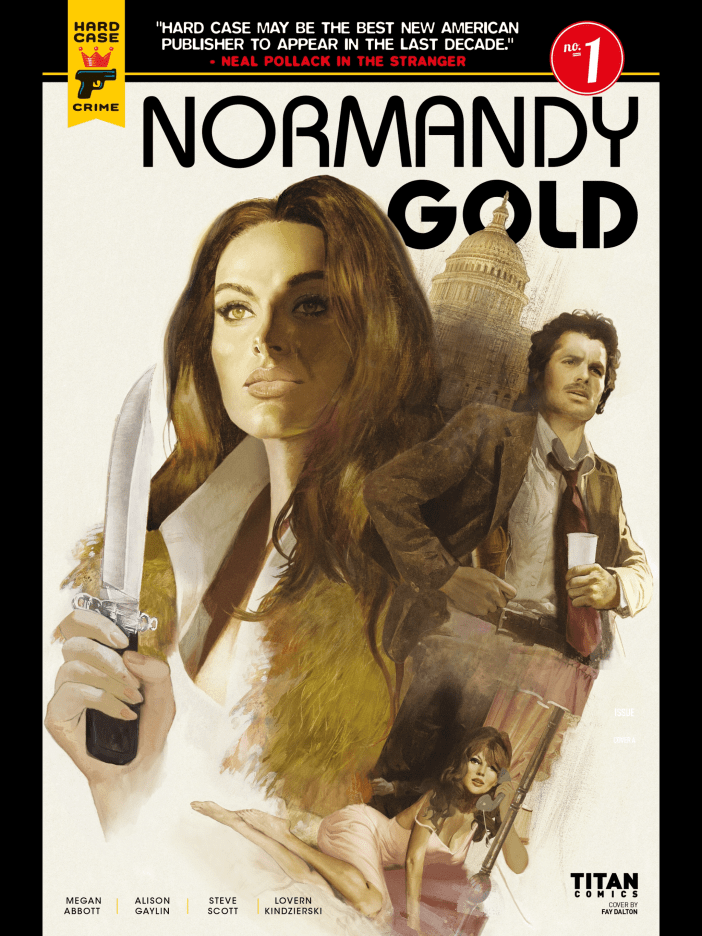
Have you read the comic book co-written by Megan Abbott and Alison Gaylin, Normandy Gold?

IMG_1772

It will come as no surprise that its fantastic. Megan Abbott and Alison Gaylin are two of the best crime writers of our Golden Age of women crime writers.

One of the things that can get confusing with crime fiction is the subgenres and the sometimes slight distinctions between them; take hard-boiled vs. noir as an example. I think the confusion comes because a hard-boiled crime novel, when made into a film, can fit into the film noir category, which is a bit broader than the genre definitions crime novels can use and books can fall into; for example, The Maltese Falcon and The Big Sleep are hard-boiled detective novels; the films, however, are classic film noir. (Your mileage may vary; I am speaking only for myself and how I classify books.) For me, a detective novel that is dark and brooding and cynical in nature is hard-boiled, Sue Grafton and Sara Paretsky’s novels, for me, fall into this category, as do Hammett’s detective fiction and Chandler’s. James M. Cain’s novels were noir, as are Megan Abbott’s. Alison Gaylin’s detective novels are more hard-boiled; her stand alone novels are more noir. For me, a noir novel doesn’t have a professional investigator as the main character; those are hard-boiled.

Charles Ardai’s Hard Case Crime line of novels contains both noir and hard-boiled fiction; the team-up of Gaylin and Abbott with the graphic serial novel Normandy Gold is a fine addition to Hard Case, and one of the best comics/graphic novels I’ve come across in a long while. As I read the first issue on my iPad, all I could think was how glorious this is; excellent, crisp dialogue and incredible storytelling, along with some amazing artwork. If there are awards for graphic novels, just start sending them along to the team that produced this now!

Normandy Gold firmly straddles the line between noir and hard-boiled with guns blazing. Set in the 1970’s, Normandy is a small town sheriff in rural Oregon. Her mother was a prostitute, and she ran away when she was a teen to try to find a better life for herself, leaving her younger sister behind. One day she gets a call from her sister, and is still on the line with her as her sister is murdered. Normandy comes to Washington DC to find out what she can about her sister’s death; the cops have written it off as just another dead whore no one cares about and unsolvable. But Normandy also finds out her sister wasn’t just a prostitute; she worked for a very elite, high level escort service, and decides to go undercover to find what happened to her sister.

This typical-sounding set-up comes alive in the hands of two master storytellers, and the art itself is stunningly beautiful. The story moves very quickly, and the 1970’s setting is perfectly done; not a false note in the entire first issue. This is the kind of story that, as a film in the 1970’s, would have earned a star like Jane Fonda or Ellen Burstyn or Ann-Margret an Oscar nomination, if not the statue itself. Vividly realized, you keep turning the pages to see what happens next…and when you get to the end of the issue, you’re sorry it’s done but can’t wait to read the next.

Highly recommended.