Do the few newspapers that still do print editions even have comics pages anymore? For many years, that was the only part of the newspaper I would read. I’d page through the rest of the paper and read things that were interesting, but I stopped taking a physical newspaper back when the Times-Picayune ceased publishing daily, and only had an on-line subscription, which I cancelled when they published an article by editorial staff that was vile, disgusting, unAmerican, and nothing I could support anymore. I cancelled the New York Times because of their Trump coverage and the legion of crimes they’ve committed against the queer community for decades. The Washington Post also was cancelled because of bad reportage on queer issues (there’s nothing like having your life “both-sidesed”; because yes, the homophobic trash who think I shouldn’t exist have a right to be heard). I would never go anywhere near the Wall Street Journal or Forbes; actually, the best reporting in the country on politics and queer life comes from Rolling Stone and Vanity Fair, of all places.
Go figure.
Obviously, the last place I ever expected to run into queer representation on the comics page (Doonesbury added a gay character in the 1970s, and addressed AIDS with his death in the 1980ssssssss) was in a family comic strip.
On March 26, 1993, Lynn Johnston’s For Better or Worse began a short running story (I think it ran for two weeks; I could be wrong) in which oldest son Mike’s best friend Lawrence comes out to him, which starts a bit of an upheaval in both families, and spread out over several days in the paper.
Whenever someone talks about how representation matters, I think about two things: this comic strip, and Ryan Phillippe playing gay teen Billy Douglas on One Life to Live around this same time.
I had seen queer representation before, of course; Billy Crystal as Jody on Soap, the eternally confused Steven Carrington on Dynasty, a show where no one even considered the possibility of bisexuality (which could have been an even more compelling story), and films like Longtime Companion and La Cage aux Folles and Victor/Victoria. But unlike those previous characters, most of whom were already adults. Billy on One Life to Live and Lawrence on For Better or Worse were teenagers–which definitely awakened ire in the homophobes and christians. Some papers refused to run this strip, which was incredibly moving and touching, as Lawrence and Mike come to terms with their friendship (nothing changed between them, just as Joey and Billy on OLTL remained friends), but he also had to deal with his parents’ reaction, the reaction of Mike’s family, and so forth. It all eventually worked out for the best–also like OLTL–and as I tore open the paper every day for those days this story ran to see what happened next.
I also kept thinking how much of a difference this would have made in my life when I was a teenager–both the show and the comic strip–which is why these kinds of things are important. No one on the homophobic “side” ever thinks about what it feels like to be a queer kid, constantly getting told (bombarded, really) that they aren’t normal, they are different, and therefore suspect. That’s why queer kids commit suicide at higher rates than their straight counterparts.
I can only imagine how much hate–and how many death threats–Johnston got for writing this series of strips. I always liked the comic–I also liked that the characters aged, grew, and changed–and someday I’d love to sit down with a collection of the entire strip, to catch up with the characters and see how they are doing now.
I also don’t think this comic strip gets enough credit for doing this, either.
Growing up as a queer kid in the 1960’s and the 1970’s wasn’t the easiest path to trod. First came the realization that my wiring was different from everyone else’s, followed quickly by the shame from being different and of course, the ever-popular feeling among queer kids when they recognize their queerness that I was the only one in the world and no one, under any circumstances, could ever know. I honestly don’t remember the first time I came across a gay character anywhere–it had to be in a novel, though–and I slowly became aware that it wasn’t just me, but there weren’t any others like me anywhere around me. (I do sometimes wonder how differently my life would have turned out had we never left the Chicago suburbs for the empty plains of Kansas; I certainly would have met other gay men much earlier in my life but….being an out gay man in Chicago in the 1980’s might not have boded well for me otherwise in the long term, if you catch my meaning.) I do remember the first gay characters I saw in film and television; I remember being highly entertained and feeling connected, in some way, to celebrities like Paul Lynde and Charles Nelson Reilly; but Liberace’s flamboyance repelled me. The few times I’d seen gay characters they were horrific stereotypes, and I can remember being confused, thinking I’m not like that, though. I can remember TV movies like That Certain Summer which was about a gay man coming out to his son and his son having to deal with it; I didn’t watch because I was afraid that watching it, even though it was an ABC Movie-of-the-Week, would tip off my parents and my sister that I was like that–or even just curious about it, which wouldn’t fly.
It was Billy Crystal as Jodie Dallas on SOAP that gave me my first real exposure to a continuing regular series character who was a gay man–and his confusion (which had a lot to do with the writers fighting with the network censors and trying to appease the gay community) about his gender and sexuality in that first season struck me as a bit on the absurd side–but I also understood his thinking well had I been born a woman this would have been all a lot easier.
Of course, now, as an adult gay man with years of living the life behind me as well as writing about it, I see how incredibly absurd on its face was that story-line.
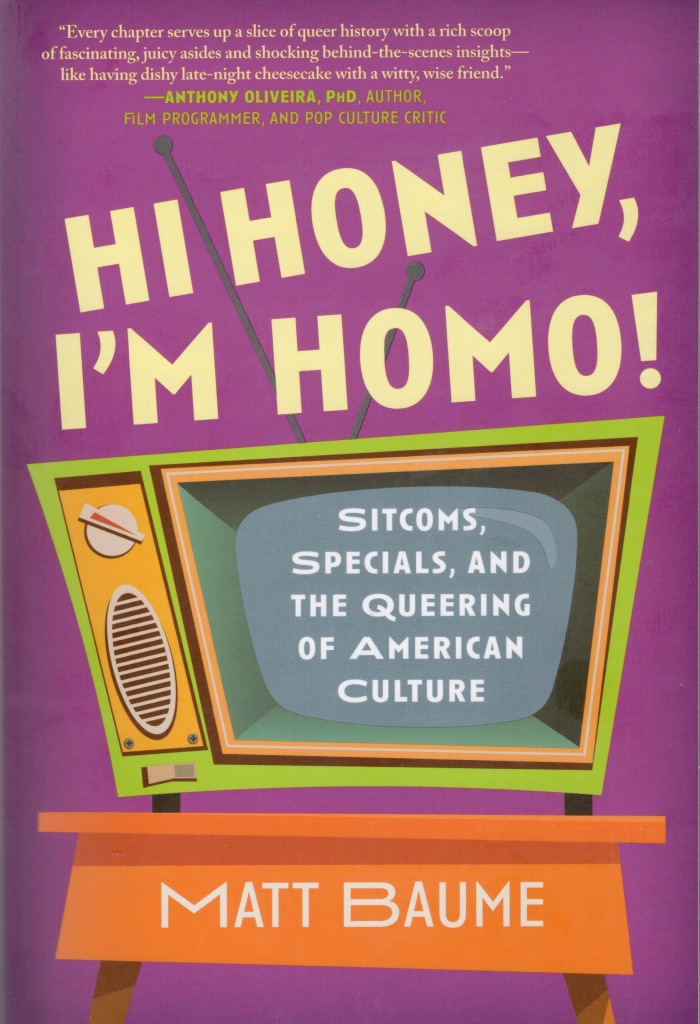
I first found Matt Baume’s Youtube channel during the pandemic, as I was scrambling to find things to watch while i made condom packs and did other make-work at home duties to maintain my paycheck. I may have found him through James Somerton’s channel? But while Somerton is often very dour and doom-and-gloom and “this is how they betray us” (don’t get me wrong, there’s a place for that and it’s needed), Baume is much more cheerful and positive about representation: he presents queer rep in popular culture in the context of the time; what the show/movie creators were trying to do with the rep; why they chose to do the rep in the first place; and the battles and struggles they had to make sure their rep made it to the viewers the way they wanted it to–and how that representation may have helped change hearts and minds when it comes to queer representation in art and culture. So when I found out Baume had written a book about queer representation in network sitcoms–written versions of his Youtube channel most likely–I had to have it.
I’m really glad I read it, too.
The essays contained within are well-written in a light, easy to read and comprehend way, without all the academic language that inevitably drags these kinds of things into the impenetrable territory that gets cited in other academic papers but otherwise never get read. Each chapter, from Bewitched through Modern Family, also contextualizes the queer representation in its time and place within the sociopolitical climate of each show, as well as the queer influences. Bewitched was probably the queerest show to ever air, be a hit and win Emmy Awards before Will and Grace; which makes it all the more memorable is that it was all coding and subtext, with witches standing in for queer people–and the similarities were obvious: they had to hide who they were from mortals for fear of persecution, bigotry, and violence. Sound familiar?
Baume also names and shames all the anti-queer activists of my lifetime, from Anita Bryant to Donald Wildmon (my own personal nemesis) to A Million Moms and so forth; Wildmon himself is probably the worst of them all; much as I loathe Bryant, I think she sincerely believed that queer people were a danger and sinful. I also think Bryant and Phyllis Schlafly were the last true-believer homophobes to lead movements; everything since has been a cynical grift for money and political power. Ronald Reagan and the Republicans saw, in 1980 and with the evangelical turnout in 1976 that carried an actual Christian to the White House (Carter was perhaps the most truly Christian president we’ve ever had; his religious values colored his policy. It’s ironic that Christians hate him as a general rule and always point to him as an example of a failed presidency rather than what his presidency actually proved; a true Christian believer isn’t pragmatic enough to lead a country; because sometimes, as The West Wing noted in an episode title, sometimes you have to kill Yamamoto; things for the greater good that are horrific on a personal level) and noted that “lip-service” to “Christian ideals” was all it took to get “Christians” to vote for you.
And this is a good place to serve as your regular reminder that the “party of family values” elected our only divorced presidents, yet are the same people who tried to remove Bill Clinton from office for lying about a blow job because it was evidence of his poor character and someone with such poor character shouldn’t be president.
I recommend this book, not only because it’s an interesting look at the evolution of queer representation in television comedy series, but because it also is educational by tracing the opposition to queer equality during the same time period.
I also learned by reading the book that Baume was the Communications Director for AFER, an organization that fought for marriage equality. So, buying and reading his book is also an excellent way to say thank you for his advocacy.
It’s today that I officially run out of time on this draft; tomorrow I need to get it emailed in. I think I’ll be okay; I wrote six thousand words yesterday and only have six thousand more to go before I can call it an official draft that I can send in with an email of apology and explanation. It’s fine, really, everything is fine. I am remarkably calm about everything these days. I’m not sure why that is, but I do like it, and am delighted that it appears to be becoming a theme for me in 2023. But I am very excited to get this draft finished and turned in–I think it’s eventually, with some work, going to be one of my better ones–but now I have the foundation and skeleton of the book finished; soon I will go in and do all the little touches and finishes that will turn it into something fun and readable for readers. But I still have more to write yet–there are two chapters left to write–and while I did get six thousand words down yesterday, I have to do another six in order to get it finished. Which is fine and do-able, of course. And it’s always nice to finish something right before a weekend away.
We watched more of The Recruit last night, which we are really getting into, so I am looking forward to seeing another episode tonight or maybe two? We shall have to see, of course. I was very tired after getting home and writing last night; last night’s sleep wasn’t as deep as my sleep has been lately, but that’s okay; I did sleep decently even if I did have to keep waking up. I have a lot to do tonight, as well–and I would like to get back to doing some reading. But once I have the manuscript finished, I can have my evenings after work free for a few days; I’m not planning on getting into the weeds on editing until I get back from Alabama. Hopefully that will give me the time to do some short story writing that needs finishing, as well. The kitchen is a mess, too–I really don’t like going away for the weekend with the house in a mess to come home to, but I don’t know if I’ll have the time to do anything about it in the meantime. And then of course it’s parade season again the next two weekends, and before you know it it’s Lent and it’s all over again for another year. The first quarter of the year in New Orleans is always a challenge…
Cindy Williams died yesterday–it took me a minute to remember that Penny Marshall had also passed away already–and of course, most of the commentary and posts defaulted to Laverne & Shirley, and why wouldn’t they? It was a highly rated–if sophomoric–comedy series for eight seasons on ABC, and it did make her both rich and famous. But the thing I always thought was kind of sad was that she was actually capable of a lot more than a slapstick lowbrow comedy on television (hey, she got rich from it, and it made a lot of people happy, too) because she’d given some really fine performances in very good films like American Graffiti and The Conversation (both of which I watched during my Cynical 70’s Film Festival; most people remember American Graffiti as a fun comedy about one Saturday night in 1962 in Modesto, California–but it was a lot darker and more serious than people generally remember. It also was set in 1962, not the 50’s, but it was in that weird aftermath period where the music was still very similar–the Beatles hadn’t crossed the sea yet–and until the Kennedy assassination, the early 1960’s seemed very much like a continuation of the 1950’s until everything changed. I always wondered what Cindy Williams may have made of herself as an actress in film had she not taken the Laverne & Shirley gig. And that Tuesday night ABC line-up was something: Happy Days, Laverne & Shirley, Three’s Company, SOAP, and Hart to Hart.
Ah, my teen years.
I recently rejoined the Horror Writers’ Association; I am not really sure why, to be honest. They sent me a “we want you back” email and I was talking to That Bitch Ford and I thought, sure, why not? You’re not really a horror writer but you ARE a writer who has written some fiction that could be classified as that and you’re always looking for new places to submit short stories and….so I did. I’d forgotten why I’d initially let the membership go, and it barely took a month for me to be reminded. There was a contretemps on the official Facebook page for the group, and then it just kept spiraling out of control with all the nastiness, bigotry, and hatred. As an author, I would always like to be seen as an author first and treated with the common courtesy that any author should expect from their peers, particularly in a nonprofit organization that serves them. But, as I have been reminded all-too-many times since Murder in the Rue Dauphine was sent out into the world, there will always be those people–in publishing, bookselling, reviewing, etc.–who will always define me by my sexuality and denigrate both me and what I write because of it. As I often say on panels when it comes to genre, the adjective gay trumps anything that follows: mystery, horror, science fiction, romance, etc. I am also very aware that gatekeeping in publishing–while on the decline–has always been there to keep the “undesirables” out. Seeing someone whom I didn’t know–and have no desire to know now–erupting on the HWA page and spewing hate-filled rhetoric, and then doubling-down by appearing on a white supremacist/Nazi’s podcast for several hours…well, you put on the SS uniform, it’s kind of hard to deny your complicity in the Holocaust after the war. And watching it all go down over the last few days reminded me of why I left the organization in the first place–the overt and covert bigotry in the organization.
And for the record, when you’re talking about diversity and you say but it has to be about the writing! that’s a dogwhistle people like me have been hearing for decades. What you are saying is the reason our genre is not more diverse is because the non-white non-straight writers aren’t good enough.
Yeah, that was all I needed to hear to know where I stood with HWA, and so when it was time to renew the next time, I just let it go.
And I am also incredibly proud of myself because usually my response to situations like this one–this most recent blow-up, and that comment all those years ago–is to say okay I have to get involved so I can fix this. I am very happy that instead my thought is, oh yes, this is why I let it lapse and will do so again. I’ve been fighting this kind of shit for decades, and frankly, I’m tired. I just want to focus on me for a while and let everyone else fix all the things that need fixing.
And on that note, I am heading back into the spice mines. Have a lovely Tuesday, Constant Reader, and I will check in with you again tomorrow, when Pay-the-Bills Day rolls around again.
Sometimes I try to remember the first time I saw or heard or watched or read something, anything, that made me feel less weird, less like an outsider…often to no avail. I can never remember if it was That Certain Summer (a very SPECIAL ABC Movie of the Week), or reading Larry McMurtry’s The Last Picture Show, or discovering The Front Runner on the paperback racks at the News Depot on Commercial Street in Emporia; and then I will remember something else, some vague memory of something–hints about Richard the Lion-Hearted in Norah Lofts’ The Lute Player, or subtle hints here and there throughout history (Edward II and Piers Gaveston; Louis XIV’s brother Phillippe Duc D’Orleans; James I and Robert Carr; Achilles and Patroclus)…Mary Renault’s Alexander the Great series…I can never remember precisely the first time I was exposed to who and what I am in popular culture, nor can I remember if it was positive or negative. I do know that in my own life, it was made very clear to me when I was very young that what I am was not normal, was unacceptable, wasn’t what I was supposed to be. My earliest memories are of me not being like other boys, and it took me a while to realize that the others were just playing at being boys (something I was never very good at) and were actually like that; that they weren’t, underneath, just like me, just better at pretending than I was.
This is why we have emphasized, as a community, the importance of representation in popular culture; kids needs to see themselves reflected in the culture they consume so they don’t feel like they don’t belong. Queer kids aren’t raised queer; we don’t learn how to be queer by interacting with our peers (who are mostly straight when we are kids), nor do we learn anything about being queer while we are inside the educational system in this country. I’ve always firmly believed that queers take longer–at least in the olden days–to form lasting romantic relationships because we don’t have “trial runs” when we are kids; we don’t get to date, we don’t get to “go steady”, etc. We don’t get to play House with other kids of the same gender, we don’t learn societal and cultural expectations about relationships and how they work when we are actually kids. Our queer adolescence doesn’t actually start until we come out–admit it to ourselves without shame, and then start telling our family and our friends and our co-workers that we aren’t wired the same way they are. It’s very tricky, and very complicated and sometimes very messy.
Representation absolutely matters.
And we cling to that representation when it shows up. When a prime time show like SOAP introduces the first long-running gay character to the world in Jody Dallas (does anyone even remember this was Billy Crystal’s big break, playing gay on a sitcom in the 1970’s/early 80’s?), we watch–even if the depiction is problematic to the extreme (you also learn very early that your hunger for representation will also force you to turn a blind eye to some things). Steven Carrington on Dynasty, the terrible film Making Love from the early 1980’s, as well as some other problematic depictions and films along the way–we took what we got, and always had to remember that these characters and stories also had to be palatable to straight people…that, in fact, these characters and stories were created with straight people in mind.
As they used to say, “but will it play in Peoria?”
As i stare down sixty this month, I am very happy to see that representation becoming common-place. It’s lovely to see gay books–THRILLERS, even–being published by major presses with queer characters in them. It’s lovely seeing straight writers including sensitive depictions of queer characters and their stories in their books.
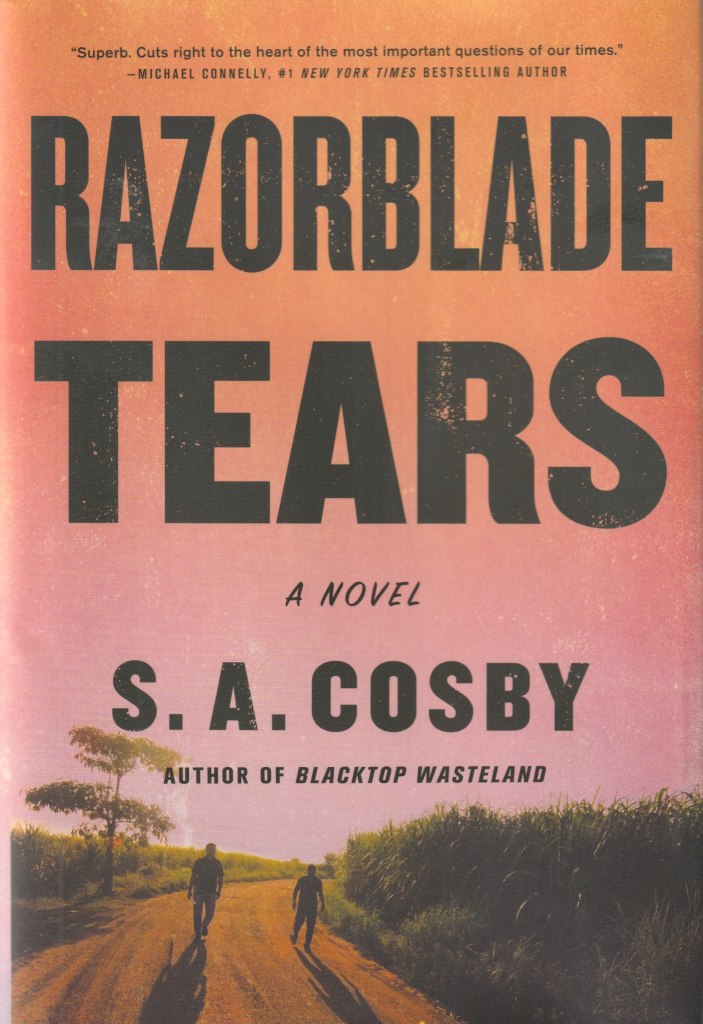
And over the year, yes, problematic tropes that can make you very, very tired have also developed–which makes me wary every time I approach a book by a non-queer person that takes on a trope without hesitation, as S. A. Cosby’s Razorblade Tears does, and that trope is one of the biggest and most hated by the queer community: bury your gays.
Ike tried to remember a time when men with badges coming to his door early in the morning brought anything other than heartache and misery, but try as he might, nothing came to mind.
The two men stood side by side on the small concrete landing of his front step with their hands on their belts near their badges and guns. The morning sun made the badges glimmer like gold nuggets. The two cops were a study in contrast. One was a tall but wiry Asian man. He was all sharp angles and hard edges. The other, a florid-faces white man, was built like a powerlifter with a massive head sitting atop a wide neck. They both wore white dress shirts with clip-on ties. The powerlifter had sweat stains spreading down from his armpits that vaguely resembled maps of England and Ireland respectively.
Ike’s queasy stomach began to do somersaults. He was fifteen years removed from Coldwater State Penitentiary. He has bucked the recidivism statistics ever since he’d walked out of that festering wound. Not so much as a speeding ticket in all those years. Yet here he was with his tongue dry and the back of his throat burning as the two cops stared down at him. It was bad enough being a Black man in the goo ol US of A and talking to the cops. You always felt like you were on the edge of some imaginary precipice during any interaction with an officer of the law. If you were an ex-con, it felt like the precipice was covered in bacon grease.
“Yes?” Ike said.
My faulty memory doesn’t remember how and when I first became aware of S. A. Cosby. What I do remember is that I bought and read one of his earlier works (perhaps his debut?) My Darkest Prayer, and enjoyed it thoroughly. Hard-boiled with a healthy dose of noir, I had a great time reading it–and was thrilled when his Blacktop Wasteland debuted to raves and attention and lots of recognition. Cosby can write like a house afire; and while he keeps up a rat-a-tat pace of story, he also manages to construct sentences and paragraphs beautifully, with a poet’s gift for language–spare and tight, yet poetic and beautiful at the same time (Megan Abbott is the Galactic Empress of this).
So, when I heard the “elevator pitch” for Razorblade Tears, I inwardly winced a bit, even as I had to admit Shawn’s guts; taking on bury your gays is a ballsy move–and also a bit of a dangerous one. If you don’t stick the landing…you’re fucked.
For those of you who don’t know what bury your gays means, it’s very simple: a show, or a book, or a movie, will introduce gay characters (lesbians, queers, whatever initial in the all encompassing umbrella those characters might choose for their identity), get the audience (and especially the queer viewers) deeply vested in them–and then kill them off suddenly and unexpectedly, all so the other queer characters (but usually the straight ones) will experience some kind of personal growth…in other words, you introduce a gay man into your narrative simply to later use him as a plot device, so the other characters can mourn and experience personal growth.
That’s probably explained badly, but you get the gist: gays will inevitably die. A good example of this is the so-called groundbreaking AIDS movie, Philadelphia–but the Tom Hanks character in that movie existed so that Denzel Washington’s character could grow and develop and move on from his own homophobic beliefs and fears about HIV/AIDS; as Sarah Schulman, one of our community’s finest minds, once said, “the entire point of Philadelphia is to make straight people feel better about HIV/AIDS and the gay men dying from it.” (Sections of her book Stagestruck: Theatre, AIDS, and the Marketing of Gay America are absolutely brilliant; it should be required reading for any Queer Studies course.)
The plot of Razorblade Tears is so deeply steeped in “bury your gays” that the gays are already dead when the book opens. The gays in question–Derek and Isiah–were brutally murdered, and the police don’t seem to care too much about looking into who killed them. Their homophobic fathers–both ex-cons–decide to look for their son’s killers. Both Ike and Bobby Lee feel a lot of guilt about their sons and how they rejected them both–their relationship, their eventual marriage, their child–while they were alive; finding their killers isn’t just about revenge but also a matter of atonement. In some ways, it’s like this book is borne from the anger every queer child rejected by their parents feels–you’ll be sorry when I’m dead.*
Ike and Bobby Lee are, indeed, sorry now that their sons are dead.
This also falls into another long-existent fictional trope: don’t fuck with a father. How many films (I’m looking at you, Liam Neeson), books or television shows are about a father’s rage, a father’s revenge, what a father will do to save or avenge their children?
Ike and Buddy Lee aren’t supermen, though. Cosby’s strength (besides his ability with words and images) is how well he creates characters and makes them human through their faults and frailties. Ike and Buddy Lee don’t much like each other as the story begins to move along–I kept thinking of the old Sidney Poitier/Tony Curtis movie, The Defiant Ones–but their ability to look past their own internal prejudices to see the commonalities between them as they unite in this foolhardy crusade to avenge their murdered sons is the real strength of the book here. (As well as the language.) You eventually start to understand them, care about them, want them to get their vengeance…even as you know it will bring them no peace.
I have to admit, I was hesitant to start reading this. I really was concerned I wasn’t going to be able to read it with the empathy necessary for Ike and Buddy Lee and their suffering–that I would think, yeah, well, maybe you should have thought about that when he was alive–but the book ultimately isn’t about their redemption, either; which is a genius move by Cosby. He makes their pain all too real–I cannot imagine the pain any parent should feel when their child dies–but he makes it clear there’s no easy answers here for Ike and Buddy Lee, and that pain will go on even if they get justice for their sons.
Shawn is also a master of writing about the Southern working class–about the poverty, the lack of opportunity, the societal neglect and how those factors all combine to keep those already mired in it trapped with little chance of escape; he clearly loves the rural South but not so much that he can’t expose the tragedy and ugliness that exists there.
It’s a powerful book, and I do recommend it….although the people who probably should read it inevitably won’t. I can recommend it, and do, enthusiastically; it’s a very powerful book, and it made me think–and what more can you want from art?
*sadly, I have seen all too often that a lot of those parents aren’t sorry when their rejected child dies; far too regularly they will say something along the lines of “So-and-so died for me years ago.”
I still can’t believe we have tickets for tonight’s game. We try to make it to at least one game every season, if we can; we’ve managed to go to at least one game per season since our first trip to Tiger Stadium, when we went to the Ole Miss game in 2010. We’ve seen some exciting games there; we’ve seen some blowouts, and we’ve seen some games that were closer than they should have been. One of the things I love about being an LSU fan is that they are never boring to watch. That 2007 national championship year was probably, overall, the most interesting and fun season of college football that I can remember. It’s also LSU’s Homecoming, and of course, we’re playing hated rival Florida; both teams undefeated, both ranked in the Top Ten. And while a loss for either team doesn’t necessarily mean being taken out of the conference championship race, or out of national hopes, it would mean an uphill battle the rest of the season–and another loss will spell the end of all hopes for the season.
Not looking forward to driving to and from Baton Rouge, though.
But Death Valley is going to be rocking–after all, it’s Saturday night in Death Valley!
It’a also going to be in the 60’s–perfect stadium weather tonight.
Very exciting.
I’m going to try to get some writing done, as well as some cleaning around the Lost Apartment, before we head out this afternoon. I also have to walk over to the International School to vote in the Louisiana primaries.
I’m not really sure what to do with Bury Me in Shadows. On the one hand, I’d really love to get it finished and turned in soon; on the other, I’m worried that I’m rushing to get it out of my hair. Of course, I can always turn it in and do a final revision before the official deadline it will be given, but…I don’t really like doing that. I did it with Royal Street Reveillon, though, and that seemed to work really well. So, maybe? I don’t know; I am very torn. I do think this might be one of the better books I’ve written, and more attention to it could make it my best. But again, I am terribly worried about turning it in, getting it on the schedule and then trying to get another finished draft finished before it’s due for production–because I absolutely have no idea what my life will be like at that time.
Last night I watched, of all things, the E! True Hollywood Story: Dynasty on Youtube. It occurred to me, really, how correct they were when they said Dynasty encapsulated the 1980’s more than any other television show; Dallas might have averaged higher ratings throughout its lengthy run, and there were certainly other successful night time soaps in the 1980’s, but Dynasty really captured the era more so than anything else–and let’s not forget, Dynasty had the first openly gay character in a television drama series (Jody on SOAP was probably the first; but it was a comedy), and then of course, Rock Hudson’s appearance on the show when he was dying from HIV/AIDS–not revealed until after he’d left the show–made the epidemic world-wide news and shone a bright light on an epidemic that was actually being largely ignored by the world at the time and when it was talked about, well–as said by a horrific bigot on Designing Women a few years later, “it’s killing all the right people.”
I also watched the final episode of Showtime’s Murder in the Bayou last night, and cannot help but feel sorry for the families of the victims. The mystery of who murdered the Jeff Davis 8 will most likely never be solved, which is an absolute shame, but it is such amazing fodder for a novel. Every time I watch an episode, I think to myself how to structure such a book, and start populating it with characters. It’s definitely a Chanse novel more so than a Scotty; obviously I could do it as a stand alone–which is still a possibility–but almost from the very beginning I’ve seen it as a Chanse novel; primarily because Chanse is from a small town in east Texas, which would give him good insight into the class differentials in a small town, as well as some insight into police corruption. I’ve never done a Louisiana corruption novel yet; this is almost too perfect a case to hang such a story upon.
I know I said Murder in the Arts District was probably going to be the last Chanse novel, but I always add the caveat “unless I get a good idea.” I was burned out on writing Chanse when I finished that book, and I felt like it was probably past time to retire the character from my canon. I’ve written one short story with him as the main character, “My Brother’s Keeper,” which was included in Survivor’s Guilt and Other Stories, and I’ve started writing another one, “Once a Tiger,” which started off strong but then petered out as I wrote it. It’s still unfinished, and I think it’s going to have to be overhauled completely. It’s a great idea–Chanse comes back to LSU to solve a murder at his old fraternity–but it doesn’t really get traction in the way I started writing it. As I was thinking about the story for the new Chanse novel last night, I also recognized that some things that I was thinking about, as far as Chanse was concerned, would have to change; I really do need to go back and read the last few books in the series again. I am probably going to cross over a character from the Scotty series into this Chanse, should I write it–Jerry Channing, the true crime writer. I may not, it just seemed like he would be the perfect person to bring the murders in a western Louisiana parish to Chanse’s attention.
Anyway, we’ll see. I need to finish Bury Me in Shadows, the Kansas book, write some more short stories, finish “Never Kiss a Stranger,” and, of course, Chlorine.
I also found myself thinking about some other stories I have in progress, in particular “Please Die Soon,” which I think is going to be pretty good–if I ever finish it.
And on that note, I’m going to get cleaned up and go vote. Happy Saturday, Constant Reader!


 Queer and Loathing in America