The Long Run

Not only do I write two private eye series, erotica, and the occasional stand alone,  I also, sometimes, write what’s classified as young adult fiction. I have not published anything that could remotely be considered y/a in quite a while, and therein lies a tale (I think the last book I published that could be considered “young adult” was Dark Tide; I could be wrong. I no longer remember when and in what order my non-series books came out).

To be clear, the fact that I even call those books “y/a” even though I don’t really think of them as young adult fiction is a marketing thing, really; in my mind, they’re simply novels I wrote about teenagers. I started writing about teenagers when I actually was one; the stories I wrote in high school weren’t bad, for a teenager, and were the first indication–from my fellow classmates, and my English teacher–that I could seriously become a published writer if I chose to try to do so; the utter lack of seriousness my writing aspirations received from my family was kind of soul-crushing. But I always wanted to write about teenagers, from the very beginnings; I wanted to do my own Nancy Drew/Hardy Boys style series, and then progressed to other stories.

I progressed as a reader pretty quickly when I was growing up; I went from the series books, like the Hardy Boys and Nancy Drew, and the Scholastic Book Club mysteries, to Agatha Christie, Charlotte Armstrong, and Ellery Queen when I was around eleven or twelve, if not younger; I know I read both Gone with the Wind and Antonia Fraser’s Mary Queen of Scots when I was ten. The few books I read that were considered “children’s books” (there was no such thing as young adult fiction then) were books like The Outsiders and The Cat Ate My Gymsuit and I did enjoy them; I just didn’t think of them as either being particularly authentic or realistic. Nor did they have any bearing on my life, or the lives of my friends–I viewed them like youth-oriented television shows like The Brady Bunch, existing in some bizarre alternate universe that has no basis in actual reality or what those of us who were that age were actually experiencing. I always thought there was something missing–complicated and authentic books about the lives of real teenagers and the real issues they faced everyday, without getting into the insanity of the preachy-teachy “issue” books that usually wound up as ABC After-school Specials, which I loathed. 

Not all “issue books” were bad, in all fairness; some, like Lisa Bright and Dark, about a girl struggling with mental illness whose parents refused to face their daughter’s reality, so her friends tried to help her by serving as amateur psychologists, and  I Never Promised You a Rose Garden, about a teenaged girl in a mental hospital dealing with her illness were actually quite good. But I loved books like The Cheerleader, about a poor girl in a small New England town with ambitions and dreams that far exceeded those of most of her friends…dealing with issues of popularity, sex, and first love.  David Marlow’s Yearbook was also a favorite, and while not marketed to kids, was about high school, but had some themes and plot-lines considered far too heavy for teens to digest in the 1970’s. You can also see it in the pap that was considered movies for teenagers; G-rated bubble-gum like The Computer Wore Tennis Shoes, and inevitably came from Disney and starred Kurt Russell. (These movies are an interesting time capsule; I did try to watch one of them recently on Disney Plus and didn’t last three minutes in that squeaky clean, sex-free college environment.)

(Also, I would like to point out at this time there were terrific books being published in the 1970’s for teens that dealt with major issues and were groundbreaking; Sandra Scoppetone was writing about queer teens back then, and there were some others doing terrific work at the time–I just wasn’t aware of those books until much later.)

My first three young adult novels–Sorceress, Sleeping Angel, Sara–were written as first drafts in the early 1990’s, put in a drawer, and forgotten about for nearly twenty years. Sorceress  had no queer content in it at all; it was my version of the truly popular trope of romantic/domestic suspense where an orphaned girl goes to live in a spooky mansion far away from her old life (Jane Eyre, Rebecca, almost everything written by Victoria Holt), and slowly becomes aware that everything in the house isn’t as it seems. It was a lot of fun to write–I loved those books and I loved putting a modern spin on them. Sleeping Angel’s first draft was never completed, and the published version is vastly different than what the original first draft contained; there are still some vestiges of the original plot there in the book that are never truly explained, and by the time I realized, after many drafts, that I hadn’t removed those vestiges from the book it was too late to do anything about it other than hope no one noticed. The book did well, won an award or two, and is still a favorite of my readers, according to what I see on social media. One of the things I added to the story was a queer subplot about bullying, which is what I think readers truly responded to, and I also feel like adding that to the story in addition to the other changes I made to it made it a stronger book. Sara was always intended to have gay characters and a gay plot; I originally started writing it as a novel for adults and realized, over the course of writing it, that actually the teenage story was the most interesting part and I could deal with some issues there if I switched the focus of the book to the teenagers. One thing that changed from the 1991 first draft to the draft that was published is that the character I originally had being bullied for being gay, even though he wasn’t (another character, one of the biggest bullies, actually was), was actually not only gay but had come out, and so the book also talked about the reverberations of a popular football coming out, and what impact that had on the school social structure and hierarchy.

Sara, incidentally, is one of my lowest selling titles–which also kind of breaks my heart a little bit.

Since those three, there have been others I’ve written–Lake Thirteen, Dark Tide–and I’ve also dabbled in what is called “new adult fiction”–books about college-age or just out of college-age characters–this is where The Orion Mask and Timothy and the current one I’m working on, Bury Me in Shadows, fall on the marketing spectrum.

One of the questions I had to deal with in writing young adult novels with queer content was the question of sex. I had already been through being banned in Virginia because I had written gay erotica (a really long story that I revisited recently with Brad Shreve on his podcast; I really do need to write in depth about the entire experience); what would happen if ‘notorious gay porn writer’ Greg Herren began writing fiction specifically aimed at teenagers? But the truly interesting thing about being used as a political pawn by the right-wing fanatics in the power games they play is that once they’ve made use of you, they forget about you and move on. My young adult fiction was released without a single complaint, protest, or any of the sturm und drang that my speaking at a high school to a group of queer and queer-supportive youth created scant years earlier.

Interesting, isn’t it?

And yet…there is no sex in any of those books. None. I don’t  remember my gay teens even getting a chaste kiss, let alone a sex life, or fantasies, or a boyfriend.

And what about desire?

A couple of years ago someone tagged me on Facebook on an article about just that very subject; that was when I started writing this post (three yeara ago, looks like) but I never finished writing this until this morning.

Go ahead and read it. I’ll wait.

Okay, welcome back. Some interesting points, no?

Now, check out this one. 

I know, it’s a lot of information to process, but it’s something we should all be thinking about, particularly as the calls for diversity in publishing and popular culture continue. Sex is, quite obviously, a touchy subject when it comes to young adult fiction, but when it comes to questions of sexuality and being a sexual minority, what is too much and what is not enough? Even depictions of straight sexuality is frowned on and controversial when it comes to young adult fiction. (For the record, that is also considered the case for crime fiction–no explicit sex scenes–or at least so I was told when I was first getting started; doubly ironic that my mystery series were what the right-wing Virginian fanatics considered porn–I really do need to write about that.)

I also have noticed the elitism evident in hashtags like #ownvoices and #weneeddiversevoices that have come and gone and return periodically on Twitter; those actively involved in promoting those tags, when it comes to queer books, make it abundantly clear they only care about those published by the Big Five in New York–which is a good target, I agree, and they do need to be doing better when it comes to diversity and “own voices” work–but this focus also ignores the small presses, particularly the queer ones, who have been doing this work all along and making sure queer books were still being published for all ages and getting out there and made available to those who want and need them. I am absolutely delighted to see queer books by queers being published by the Big 5, and young adult work in particular…and yet…there are some serious issues still with the Big 5–and with what is called ” young adult Twitter”.

I do find it interesting to see who they decide are the “cool kids” and who they banish to the outer tables with the freaks and geeks.

It’s part of the reason I don’t engage with young adult twitter, to be honest. I really have no desire to return to the high school cafeteria at this point in my life.

And I’ll write about teenagers whenever there’s a story I want to tell involving teenagers–which currently is the Kansas book; I turned my protagonist in Bury Me in Shadows into a college student because it actually works better.

And on that note, tis back to the spice mines with me. (And huzzah for finally finishing this post!)

It’s Nice to Have a Friend

Yesterday was kind of lovely, really. As I took a vacation day to get caught up on things, get some rest, and try to get the Lost Apartment under control again (I also discovered, among other things, that vacuum cleaners have filters you are supposed to clean monthly, which explains so much), it was kind of a nice day. I did get the bed linens laundered and a load of laundry done; I did the dishes and ran the dishwasher, and I also intended to vacuum, which is when I realized my vacuum cleaner has not been sucking properly in quite some time (I’d even looked into buying a new one, several times) and then thought, why don’t you google it and see if it’s something you can fix, which of course led to the shocking discovery about the filters. I removed it and washed it thoroughly (so disgusting, really). But, embarrassing as that was, it was also lovely to realize that I do not, in fact, need to buy a new one–at least until the filter has finished air drying, I reinstall it, and see if it starts picking things up again.

I also got a lovely notice on Facebook that my former editor at Alyson, Joe Pittman, had tagged me in a post, and when I went there to see what it was, was greeted with a reminiscence of his days at Alyson, and:

Hi everyone, it’s Joseph. It’s September. I’ve got another story of my publishing life, one of the most rewarding moments from my varied career. Let’s call it Love, Alyson Books.Okay, let me go back in time. It’s 2005 and I was hired by a small publisher named Alyson. The company had just relocated from Los Angeles to New York, and they were searching for a new staff. I applied for the Executive Editor position I saw advertised, got called in that day for an interview. I wasn’t exactly dressed for a job interview, but the woman I spoke with said that was fine. “I assume you have grown up clothes.”

I got the job, and two weeks later started. Every staff member had just been hired, and we had lots of manuscripts and contracts to cull through. From the publisher, to the marketing director, an editor, a production editor, and an assistant and me. That’s it, six of us. We had a big task set before us. Alyson had a storied history in the world of LGBT publishing and had released many iconic books. There was a lot on our shoulders.Our job? To bring Alyson into the 2000s, and show how LGBT themes had hit the mainstream. We had to totally revamp the list. We published 50 books a year, we had a very small budget, and as Executive Editor, I was told by the boss that I would be “the face of the imprint.” I embraced the role until it came to an ignominious ending.But in two and a half years, I felt I did some of the most important work of my career.

It started, horribly, with Hurricane Katrina, but led to a book and a series that would help define the LGBT past, present and future. It was a series with titles that began with the word “Love.” And that’s what these books were, love stories dedicated to a certain city, to a movement, to a community.The thing about working at Alyson, it wasn’t like traditional publishing, where agents sent you a manuscript, you read it, you liked it, you acquired it. Sure, we did a bit of that, but mostly we had to come up with our own ideas, track down authors who would be ideal in crafting our idea into a book. I hit the jackpot with an existing Alyson author, mystery writer Greg Herren. Greg lived in New Orleans, and he and his partner Paul Willis went through hell that late August. Katrina ripped their lives apart, as it did to so many others in the region. My idea, let’s get a bunch of writers together to pen nonfiction stories about their city. Why they lived there, what they loved there. Greg was reticent at first. The wounds of the city too fresh. But the book happened.

LOVE, BOURBON STREET was published to great acclaim, and that next year it won the prestigious Lambda Award for Best Anthology. I remember sitting in the audience when the book was announced the winner. I couldn’t have been more proud of Greg and Paul’s dedication to the project, I couldn’t have been happier for the city New Orleans.

Love, Bourbon Street is a book I don’t really remember much about, to be perfectly honest. It happened, and came about, in that gray time after the evacuation and before we were able to move back into the Lost Apartment (which, to me, closed the circle, even though the city’s recovery would still take more time–a lot more time); I think it even came out while we were still living in the carriage house amidst the clutter and boxes and praying every day that the Lost Apartment would be suitable for living again soon. I remember I was still house sitting for my friend Michael on the North Shore in Hammond when Joe called me with the idea–the great irony was earlier that day Paul had called me, and suggested we do a fundraising anthology about New Orleans by New Orleans writers, and I had emphatically said no. Most every one of the writers we knew were still displaced, no one could come back to New Orleans even if they wanted to, and we were all, from the blogs and emails I was reading, in bad places emotionally. I didn’t even know if I could write anymore; I was grimly writing a blog post almost every day so that the creativity wouldn’t completely stagnate, but other than that–nothing was happening. I had pitched a fourth Scotty book to Kensington, but at some point while I was on the road I’d emailed my editor there to say obviously I cannot write that book now–it was, ironically, going to be called Hurricane Party Hustle and be set during a hurricane evacuation when most everyone in the city had left, only for it to turn east at the last minute and spare the city (which had happened at least three or four times since we’d moved to New Orleans in 1996)–and I certainly never thought I was going to write another Chanse book; the second one had come out the previous year while Paul and I were still getting over the Incident and I think I did one signing for it; it came and went with very little fanfare and I had pretty much figured that series was dead in the water as well. I had been rewriting the manuscript that would eventually be published as Sara because an editor at a Big 5 publisher had asked me to write a y/a for them earlier that year and I’d decided that was what I would do after I, if I, ever finished Mardi Gras Mambo.

But I wasn’t sure if I would ever write about New Orleans again, or if there would even be a New Orleans for me to write about.

Given the fact, though, that Paul wanted to do this and my publisher called me later the same day to suggest it, my superstitious lizard brain decided it was something we needed to do; I don’t remember how long it took for me to either call Joe back or email him that we would do it, but we did. It was difficult to do, primarily because recruiting people spread out all over the country wasn’t easy, nor was getting people who were terribly depressed to try to write something about why they loved New Orleans when 90% of the city lay in ruins was a bit much. Also, people would agree to write something and then change their mind right before the deadline, which kept pushing the delivery date–already a tight turn around, because Alyson wanted to release it on the one-year anniversary–back. Finally, I pulled all the essays together into a single document, saw how many words were left to reach the contracted minimum, and started pulling together my own essay, the anchor piece, “I Haven’t Stopped Dancing Yet.” I remember I worked on it over the weekend that Paul had his eye finally removed, and so he was asleep thanks to painkillers most of the time and would only wake up for me to clean the socket before going back to sleep. It ended up being almost thirty thousand words, and I really don’t remember very much about writing it, if I’m going to be honest; I don’t. I just remember pulling it into the word document of the manuscript, seeing that we now had the length requirement covered, saved the document, and hit send.

That same fall, as we were doing the whole Love Bourbon Street, Joe was also calling and emailing me, trying to convince me that I had a duty and obligation to write another Chanse novel. “You’re right there,” he kept saying, “and who better to let the world know how it felt, how it feels, and what’s it like to go through something like this?” Again, I kept resisting. I didn’t know if I could write, I didn’t know when i would write, I didn’t know anything. And then, in late September, I drove back into the city once it was reopened, to check out the damage to the house and see what all we had lost, as well as to see if anything clothes-wise was salvageable from the upstairs. As I crossed the causeway bridge and saw all the damage to Metairie, I recoiled from it all, felt sick to my stomach and a headache coming on; by the time I got onto I-10 I had gone numb again so I could handle it all. As I noticed the mud-line on the walls along the highway, the words It was six weeks before I returned to my broken city popped into my head, and as I came around the curve in the highway, right near the Carrollton exits and the Xavier campus and the Superdome came into view, the words started coming into my head and I knew that not only could I write this book, I needed to write this book.

As soon as I got back to my sanctuary in Hammond, I emailed Joe and said, I am going to do the Chanse book and it’s going to be called Murder in the Rue Chartres.

And yes, both books won Lambda Literary Awards (my only wins, out of 14 or 15 nominations in total) in back to back years.

So that’s the story of how a very kind and generous editor essentially saved my career as a writer.

It’s funny, because whenever I think about possibly doing a collection of essays, it always takes me a while to remember, well, you’ve already published one that will take up a quarter of the book.

And now, to have some serious cleaning joy with my clean-filtered vacuum cleaner.

End Game

I’m really becoming a huge fan of Paul Tremblay.

I’ve always enjoyed horror, ever since I was a kid; I used to love watching Creature Features on WGN in Chicago, and getting scared–sometimes having nightmares. But the supernatural has always interested me, as well as horror; in the 1980’s and even into the early 1990’s I saw myself as becoming a horror writer rather than a crime writer. And while I’ve written some “scary” stories and novels, I don’t know that I could classify them as horror– I think Sara and Sorceress are probably the closest I’ve ever come to writing horror; maybe even Lake Thirteen would count (it certainly bears my favorite cover of all my novels). But I see myself as more of a fan of horror than a writer of it; as I’ve said many times, I tend to write more about human monsters than supernatural ones. I had heard great things about Paul Tremblay before I started reading his actual work; my friend Megan in particular is a big fan of his, and based on her recommendation I started reading A Head Full of Ghosts, but it didn’t really strike my fancy that first time, and so I put it aside and moved onto something else. I did pick it up again later, and then, of course, I couldn’t put it down.

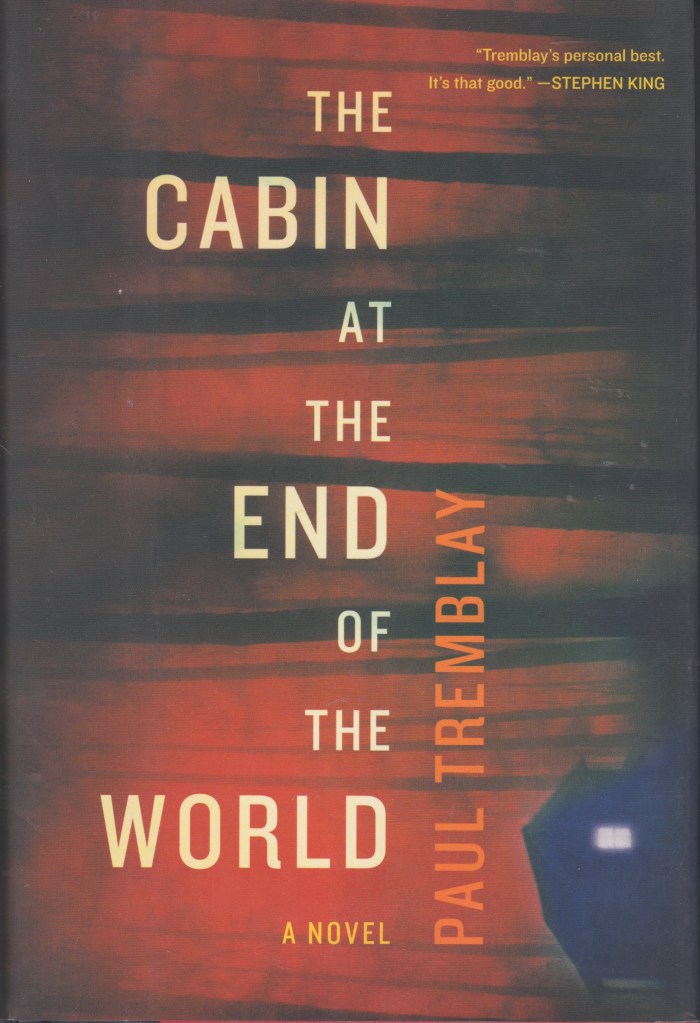
After finishing The Coyotes of Carthage, I was looking through the TBR piles, pulled out a book or two before putting them back, and then finally decided to read a second Tremblay, The Cabin at the End of the World.

It was a most excellent choice.

The girl with the dark hair walks down the wooden front stairs and lowers herself into the yellowing lagoon of ankle-high grass. A warm breeze ripples through the blades, leaves and crab-like petals of clover flowers. She studies the front yard, watching for the twitchy, mechanical motion and frantic jumps of grasshoppers. The glass jar cradled against her chest smells faintly of grape jelly and is sticky on the inside. She unscrews the aerated lid.

Wen promised Daddy Andrew she would release the grasshoppers before they got cooked inside the homemade terrarium. The grasshoppes will be okay because she’ll make sure to keep the jar out of direct sunlight. She worries, though,, that they could hurt themselves by jumping into the sharp edges of the lid’s punched-in holes. She’ll catch smaller grasshoppers, ones that don’t jump as high or as powerfully, and because of their compact size there will be more leg-stretching room inside the jar. She will talk to the grasshoppers in a low, soothing voice, and hopefully they will be less likely to panic and mash themselves against the dangerous metal stalactites. Satisfied with her updated plan, she pulls up a fistful of grass, roots and all, leaving a pockmark in the front yard’s sea of green and yellow. She carefully deposits and arranges the grass in the jar, then wipes her hans on her gray Wonder Woman T-shirt.

Ironically, in my earlier paragraphs I talked about writing crime because I want my monsters to be human; ironically, the monsters in Paul Tremblay’s latest, sublime entry into the horror genre could easily be considered a crime thriller as well because his monsters are all too human, and this set-up is just as terrifying as any supernatural horror novel I’ve ever read. Being out in the country has never really appealed to me very much (ironically, my current work-in-progress is set out in the country) precisely because it’s no safer out in the country than it is in the city; at least in the city someone will hear your screams or cries for help. The very isolation of the country is part of its terror for me; in no less part because country people always smugly assert (and reassure themselves) that crime and murder are MUCH more likely to happen in the big, bad, dangerous city.

Sidebar: I still think there’s a terrific essay to be written about the proliferation of rural horror/crime novels in the 1970’s, directly tied to the inherent racism of white flight from integrated schools and neighborhoods to the suburbs and the country, and perhaps someday I will have the confidence to write the essay based on that abstract theme.

Tremblay has set his terrifying tale in a small cabin on a lake in upstate New Hampshire, close to the Canadian border, where our heroes–a married gay couple (Andrew and Eric) are spending a ‘back-to-nature’ vacation with their adopted child, Wen. The story is told in the present tense (always creepier in horror, seeing the action unfold as it happens rather than in the much safer past tense–it’s happening as opposed to it’s already happened) and the point of view shifts between the two dads and their young daughter. Wen is out on the lawn catching grasshoppers and naming them when a big man appears suddenly out of the woods, friendly and nice, he tries to win her over but ultimately fails, sending her running inside to warn her daddies that they are no longer alone in their rustic cabin–with no cell service and no wi-fi (which, ironically, was part of the cabin’s original appeal–to unplug; that appeal will righteously bite the in their ass now that a Dionysian influence has arrived in their idyllic world).

The big man, Leonard, isn’t alone; he has three friends with him, all wearing similar button-down shirts in different colors and jeans: Redmond, kind of an asshole every-straight-man; Sabrina, a nurse; and Adriane, who is older. As the three family members barricade themselves into the cabin, the four seemingly normal visitors let them know they are there to present them with a horrible, horrific choice: they have seen, in visions and dreams, that the apocalypse is nigh, but have been shown the cabin and the small family, and told that if one of them will voluntarily sacrifice himself, the end of the world will be stopped.

This is, of course, every parent’s worst nightmare: a threat to not only their family but to their child, and Tremblay does an amazing job of letting us, the readers, get to know all three of the family members, developing them into complicated, realistic characters with backstories and levels and layers; I also applaud him for writing about a same-sex family and making the characters absolutely real. (This is how you do it, people; read the book and take notes). Wen is completely believable as a little girl; the family bond and love is absolutely real; and that makes the horror even more horrible, more horrifying, more of a gut-punch…as we go through every step of the process with them, all over the course of less than twenty-four hours, as their lives are irrevocably altered and changed, as they refuse to believe the story of their visitors, but slowly but surely the wonder begins to creep in…what if this is absolutely real and they are indeed messengers from God?

I will leave it to the horror academics to discuss the symbols and symbolism threaded throughout the story–but I have to bring up the colors of the shirts the visitors are wearing, and the fact there are four of them: representing the four horsemen of the apocalypse along with their warnings of doom. The questions of faith, of existing as gay in a heterosexist society, of family and love–all of these are beautifully explored and written about, and the building of tension and suspense is unparalleled; it’s really hard to put the book down and walk away from the story without finding out how it all ends–will they make the sacrifice, or will the world end? Are the visitors right–and how will anyone ever know if they were, because the world not ending doesn’t prove anything if the sacrifice occurs.

Or are they just insane?

I highly recommend this book, and cannot wait to read more Tremblay.

West End Girls

Well, we made it to Wednesday, did we not? It’s also Payday, aka Pay-the-Bills Day, which of course is always a popular day around here–NOT.

But I managed to write another 1300 words yesterday on something–not Bury Me in Shadows, I am putting that off until the weekend, when I will have time to sit down and reread the entire manuscript (I am already rewriting the first chapter in my head; it’s main character is transitioning from a high school student to a college student suffering from depression); instead I had a thought about a bunch of fragments, ideas and the occasional scene, of a something that needs to be stitched together and an ending tacked onto it called “A Holler Full of Kudzu,” which I’ve been fragmentally writing for several years now. It’s a Corinth County, Alabama story; set in the distant past of the mid to late (vague, will depend on the music choices) 1970’s, in the point of view of a thirteen year old. I don’t quite have the voice or tone right yet; that’s going to have to wait until I have the entire thing stitched together. It’s already well over 6000 words and I did originally think it might be the seeds of a novel, but I don’t think there’s really quite enough story to flesh out a novel but a length of somewhere between twenty and thirty thousand might just be right for it. My publisher does publish ebook novellas, and that might be the right place for it–plus it can always go into the anchor position of a collection.

It’s weird to feel so good about so many things.

I was hesitant to write the story, because I’ve already gone to that well twice already–“Smalltown Boy” and “Son of a Preacher Man”–but I have also realized all of my stories don’t necessarily need to be connected, but there’s also a way at some point to connect all of these stories together. I’m not certain why I am always so determined to connect my stories together; my young adults–Sorceress, Sleeping Angel, Sara, Lake Thirteen and others–are all loosely connected; I’d wanted to do an entire series of young adult horror/suspense that were connected together by threads; Laura in Sorceress was from the same place in Kansas where Sara took place; one of the characters in Sara was from the Chicago suburb the main character of Lake Thirteen was from; and of course, both Sleeping Angel and Sorceress took place in the same California mountain town. There’s another I’ve written that’s been languishing forever in a drawer that is also set in Woodbridge, and I keep forgetting about it, to tell you the truth. This is why I had that OCD moment a few weeks back and counted how many things I had in progress, in a vain attempt to get a handle on it all.

I suppose I could create a spreadsheet. But Lord, another thing to do? Then again, it could keep me from writing–that weird dichotomy of hating to do something I actually love to do. I am sure my great mood lately has everything to do with having written, and doing good work recently; I actually am looking forward to getting all my work done today so I can dive back into the story. I’d love to have it finished by the weekend, but I don’t necessarily have to have it finished in order to start the reread of Bury Me in Shadows; with the sweeping changes I am going to making to it, it will be mostly to see what I can actually keep and still works with the age changes for the main character.

We are almost finished with Dark Desire, and I have to say I am quite impressed with the writers of this show; it has so many twists and turns! Every time we start to think we know what the truth is we get shocked by an out-of-nowhere twist, and the personal stories are so complicated and messy! We had started to get a little bored with it around the sixth or seventh episode (maybe?) because it seemed relatively predictable; boy, were we ever wrong! Tonight we’ll polish off the last four episodes–they are only about thirty-three minutes long–and then we’ll have to decide what to watch next. There are so many choices!

It seems like it was just yesterday we were complaining about the trouble finding something we wanted to watch–but realitically, I was just thinking last night how we’ve watched so much stuff we can’t even remember it all.

And on that note tis back to the spice mines with me. Have a lovely morning, Constant Reader.

The Former Enfant Terrible

I don’t know that I would consider myself a former enfant terrible; I’m not entirely sure I am not currently one, given the actual definition of the term. In French it means unruly child, and I don’t know that I was one of those or not, but the current Webster definition (that of a person whose unconventional or controversial behavior or ideas shock, embarrass, or annoy others)–that I can actually see. I’m certainly annoying; I can be embarrassing; and I am pretty sure I’ve said or done things other people might consider, or see, as shocking. I mean, just being gay shocks some people.

If I could choose which of those three verbs I would pick, if I could only be one: most definitely, without question, annoying.

I am sure there are many who would agree that I have already succeeded on that score. (shrugs) It happens.

Well, we’ve made it to Wednesday somehow, and that’s an accomplishment of which we can be terribly proud. Making it through any day these days is an accomplishment, really; I know that everyone else is as sick of the phrase the new normal as I am (it certainly begs the question of what is normal); and I’m not certain this is a ‘new normal’ anyway; the real new normal is what comes after all of this, and that’s the part I’m kind of worried about, to be honest. What will the new world, arising from the ashes of the COVID-19 pandemic like the phoenix of lore, look like? We had already established that there is a certain percentage of the population who aren’t civic-minded, don’t care about anyone outside of their immediate circle of selfishness, and believe that if they’re unhappy no one else should be; appallingly awful as they are, at least they’re setting example for everyone else of who not to be–although others–a much smaller amount, to be sure–see their wretched behavior and jump on the bandwagon of selfishness and hatred. We’ve always had those people in this country; they were Tories during the revolution; pro-slavery; America First while the Nazis ravaged Europe and began slaughtering undesirables; and so forth.

We started watching David Simon’s new HBO mini-series, The Plot Against America, based on the novel of the same name by Philip Roth. I’m not going to argue the merits of Philip Roth as a writer; he won every conceivable writing award during his lengthy career, and whenever I’ve dabbled into his canon, I’ve not really come away terribly impressed. At the direction of my friend Laura, I read When She Was Good, and I had read another one of his earlier novels already, Letting Go; I wasn’t really impressed terribly by either–I’ve never really understood, or gotten, novels about the sexual messes straight people get themselves into because of their warped sense of everything about themselves, let alone the American puritan ethic about sex and sexuality; I tried reading The Plot Against America because it was a topic that interested me: what if Nazi sympathizer and anti-Semite Charles Lindbergh had been elected president in 1940, rather than Roosevelt winning his unprecedented third term? I gave up about a chapter into it–as I often say about literary novels (looking at you, Jonathan Franzen), why would I read a novel about characters the author clearly doesn’t like? I”m not interested in people debating me about the genius of Philip Roth; I don’t get it, and that’s fine. I’ll give him another try–probably after I finish watching this show, I’ll probably give The Plot Against America another try, It came out around the same time I read Sinclair Lewis’ disturbing, if flawed, It Can’t Happen Here, which was chilling in its depiction of how easily Fascism could rise, and become perfectly acceptable, in this country (I sometimes wonder what Lewis, a brilliant social critic and writer, would think of these modern times in which we find ourselves), which is something I’ve chewed over a few times myself, and have considered writing about at some point. I saw the possibilities of where we are right now back in the 1980’s, during the height of the HIV/AIDS pandemic, as people died and no one cared because it was “the right people” who were doing the dying. That was what first inspired my alternate American history novel idea–one that still is bubbling in the back of my mind, the rise of the American dystopia, and the concurrent horrors that would come in its wake.

I do think that the times in which we currently live will be referred to by future historians as “the Oligarchy” or “the Oligarch Age,” as opposed to the truly falsely named “Gilded Age,” when workers were as disposable as animals and the capitalistic monsters rose to wealth and power in ways unforeseeable to the original founders.

I’m still reading Mysterious Skin (or rather, rereading it) and I’m very interested to find that I don’t remember as much of it as I had originally thought. It brings back to me a lot of memories of Kansas, and while I was never a child there, I can imagine what it would have been like. There’s a dark sensibility to this story, and the writing, that I’m really enjoying; I’ve always believed Scott Heim could write amazing noir stories, and kind of wish he would. I just haven’t been able to focus as clearly on reading as I would like lately; primarily because I’ve been writing again, and apparently, I can either focus on writing or focus on reading, but not both at the same time. It’s a very vivid depiction of being an outsider as a child–for both of its main male characters–and that is certainly something I can relate to, even now; although I never truly felt like an outsider until we moved to suburbia. After that, I spent the next twenty-three years feeling like I didn’t belong, in either my world or any world, for that matter. Heim really gets that across, and far better than I did in Sara.

The weather outside is frightful. Last night as we watched another episode of The Plot Against America, a massive thunderstorm rolled in, and it continued to rain throughout the night–and even this morning, this storm system (or another one, who knows? Not a meteorologist) is still raging outside my windows. Right now the rain has stopped, but when I first woke up it was coming down pretty intensely. It appears that is our forecast for the rest of the day as well, so it’s good, gloomy day for working from home. Ah, there was another blast of lightning, and thunder immediately behind. Yikes! Glad I am not going out there into that mess, quite frankly.

And of all things–because of course I don’t have enough works in progress–I started writing some new short stories last night–“In the Shadow of a Tomb,” “Procession of the Penitent,” “Dimestore Cowboy,” “The Plague Doctor” and “The Arrow in the Cardinal’s Cap”–mostly openings and an idea of the story, and who knows whether anything will ever come out of any of them, really, but it’s nice to be productive again, even if it’s scattered and all over the place. But I am going to try to spend this weekend sending stories out for submission again; it’s a really nice feeling to have stories out in the world, even if they don’t get taken.

And on that note, back to work. Have a lovely Wednesday, Constant Reader!

IMG_0808

Before

As Constant Reader is no doubt aware, I’ve been worried recently about my inability to sit down and write. I’ve done some writing, of course, in drabs and dribs here and there; applauding myself for getting as many as a thousand written in a day–which is a major drop off from what I used to be able to manage, pre-pandemic, although I must confess it’s been quite a while since I’d had one of those days before the world shut down. But I am very pleased to report–despite innumerable, continuous frustrations with my computer and its inability to function properly (thank again, Apple Mojave update; may your code-writers burn in hell for all eternity without respite or mercy)–that yesterday I managed to not only write, but I put down over three thousand words in slightly more than an hour and finished the first draft of the Sherlock story–thank you, baby Jesus–and now can let it sit for a while before I revise it again. It’s very rough, and probably more than a little bit jumbled, but I have it done and with a few reminders this week of Doyle’s style, I should be able to get it finished and turned in on time.

Huzzah!

I cannot tell you how nice it felt to get three thousand or so words down in such a short period of time, Constant Reader. It’s nice to know those muscles haven’t atrophied, and are still there when I need to call upon them. I’m also really glad to have the story draft finished; regardless of how good or bad it might be, it’s lovely to have a draft done so I can revise it and fix it at leisure during the last few days (eleven, actually) before the deadline hits. It’s caused me so much stress, quite frankly, and I am so relieved to know that I can still write, and my usual amount at that, even during a pandemic with all these additional stressors and irritants going on. And believe you me, there are plenty of those enough to go around.

I did start rereading Mysterious Skin again yesterday afternoon–after finishing the story, doing a load of dishes, folding clothes, and straightening the kitchen–and I am totally loving it. It’s weird–I do remember reading it before; I distinctly remember the cover, with pieces of cereal scattered across it, but I don’t remember actually reading it. I also remember the story, but mostly from the film. The reason I am finding it strange that I don’t remember reading it before (and to be fair, I didn’t remember a lot of things in the books I’ve reread in the Reread Project so far–I didn’t remember that there was a living mummy in Crocodile in the Sandbank; I thought the dolphin rescue was in Mary Stewart’s The Moon-spinners but it was actually in This Rough Magic; I didn’t remember there being a love interest in Nine Coaches Waiting…etc. etc. etc.) is because it’s resonating with me as I read it; I was a teenager living in Kansas during the time the book is set; I’d been to the state fair in Hutchinson; I’ve been to Pretty Prairie and I’vve even been through Little River, and the way Heim describes the countryside–it’s like being there again. Maybe when I first read the book I was still compartmentalizing my past; I used to do that quite a bit, shutting the door on painful memories of a deeply unhappy past, and lately I’ve begun unpacking all of those memories a bit more–not sure why, but that’s a subject for another time. But I am enjoying the book a lot, as I thought I would, and am really looking forward to getting deeper into it.

And reading it is making think about my own novel, Sara, to date the only novel I’ve published that is set in Kansas. Maybe I should reread some of my own work for the Reread Project? There’s quite a bit about my old books I honestly don’t remember–and I really should start keeping a list of my character names, at the very least. I think when I started up on the Kansas book again a few years ago, I had reread Sara and was horrified to realize I was using the exact same character names I’d used in it; in fairness, those character names have been hanging around in my head since I wrote my first novel forty years ago–the terribly written, highly cliched, trite handwritten manuscript that no one will ever see because I am not going to include it in my papers, should I ever get my shit together and get those donated–and I always recycle from unpublished work. I just started writing about Kansas and of course those names popped out–and so later, when I went back to work on another Kansas book those names popped right out again.

And oh, those Kansas memories, of towns named Council Grove and Salina and Cottonwood Falls; Neosho Rapids and Hiawatha and Yates Center; Garden City and Great Bend and Junction City; Derby and Newton and Pratt. The six towns that consolidated into my high school: Americus, Bushong, Allen, Dunlap, Admire and Miller. The other high schools we played against–Olpe and Madison and Hartford, Waverly and Lebo and Reading. Little towns that were drying up and blowing away; a couple of blocks, some abandoned buildings, maybe a little post office and a gas station. Bushong was just off the road the bus took from Americus to Northern Heights High School, which was about a half-mile or so east of Allen–which there wasn’t much to, either. You couldn’t see much of Bushong from the road; there were railroad tracks there when I was a teenager, and so the bus always had to stop, open the folding doors, and see if there was a train coming or not. There were bushes and trees hiding the remnants of the town from the state road–the Americus Road, is what we called it–but you could still see the roof of the abandoned all-grades-in-one school. Back when we lived in Americus we didn’t have street names or house numbers; Google Earth assures me that is no longer the case. We used to have to pick up our mail at the post office; everyone had a post office box. I remember our combination: three turns right, stop on 3,  a full left turn and stop between 8 and 9, turn back to the right and stop on 5.

The things you remember, right? But I’m sure I am remembering some things wrong; I invariably do, as I said the other day.

But, as I said, the thing is I am remembering, and I am not recoiling from the memories, which is also really nice. I’m not sure when the exorcism of my old demons from past lives occurred, but it did; I’m kind of sorry I shut all the memories away for so long. I think some of it has to do with writing Bury Me in Shadows, which started making me remember Alabama–I have no memories of living there, but I used to spend a few weeks down there every summer until we moved to the suburbs, at my grandmother’s house; I am setting the book in a county based on where we are from and my grandmother’s house is located precisely where my character’s grandmother’s house is located. (The funny thing is I keep trying to make things fit, but the truth is I don’t have to make anything fit into what I remember; it’s fiction, so I have the freedom to change whatever the hell I want to; the story itself is patched together from stories my other grandmother used to tell me when I was a kid–probably half-truths at best, outright lies at worse; perhaps some family legends? I don’t know, but those stories have hung around in my head for most of my life.) I’ve been wanting to write this story for quite some time, and even wrote it as a short story called “Ruins” back in my twenties, while I lived in Fresno.

The one thing I need to be careful about is I don’t want to mirror the ghost story I told in Lake Thirteen, which kind of makes me nervous. I’m always worried that I repeat myself; as a very kind reader gently asked me recently, how many car accidents has Scotty been in? 

Sadly, more than I want to admit.

And on that note, tis back to the spice mines with me.

IMG_0246

Always

Kansas.

We moved to Kansas the summer I turned fifteen. It was a bit of culture shock; we’d been living a middle-to-upper middle class suburb of Chicago for about four years then, after spending eight or nine years in a working-class, very blue-collar neighborhood in Chicago, populated primarily with eastern European immigrants, or second, maybe third, generation Americans from central to eastern Europe. All I really knew about Kansas, before moving there, was that it had been a part of the Dust Bowl during the depression; I’d read about “bleeding Kansas” in history books; and of course, tornadoes and The Wizard of Oz (which is a movie I’ve never cared for; I watched it once as a kid and never again). Neither Nancy Drew nor the Hardy Boys ever had an adventure there; nor had any of the other kids’ series or Scholastic Book Club mysteries I’d read. But it was in Kansas that I actually started writing seriously, and began to think about being a writer when I grew up. (It was also in Kansas that I had the bad creative writing professor, and other bad history professors; I actually cannot think of a single decent teacher I had at the university level in Kansas–but then again, I was incredibly miserable when I lived in Kansas and it’s entirely possible that misery bled over into every other aspect of my life.)

I also don’t want to make it seem as though the five or so years I spent there were completely miserable. I did have fun–I was always desperately trying to have fun to distract me from the terror that arose from my sexuality, which was a secret that must be guarded from everyone at all times; it’s laughable to think about it now, but that terror was very real to me then.

It was in Kansas I started writing about teenagers, and while none of that stuff I’d written was publishable–I still have the handwritten novel I started writing there somewhere; the thought of rereading it turns my stomach as I can only imagine how incredibly bad, trite, and cliched it all was–but those characters have lived on and appeared in my actual published work as an adult; primarily I kept the character names and the basis of who they were, fleshing them out and (hopefully) making them three dimensional. Sara is, to date, the only book I’ve published that is set in Kansas; Laura, the main character in Sorceress, is also from Kansas–but the book is set in California. And of course I’ve been playing with the Kansas book now for something like fifteen years–hopefully, that will be finished and done this year.

I love to read about Kansas, and two of my favorite crime writers–Lori Roy and Sara Paretsky–are also from Kansas; Lori’s first novel, Bent Road (it’s brilliant, as is everything she writes) is set in Kansas; Sara, of course, primarily writes about Chicago but wrote a stand alone several years ago called Bleeding Kansas I’ve always wanted to get around to. Nancy Pickard also wrote two stunningly brilliant novels set in Kansas–The Virgin of Small Plains and The Scent of Rain and Lightning; I cannot recommend them enough. One cannot talk about Kansas books, either, without mentioning Truman Capote’s “true crime novel” In Cold Blood, which I like to reread every now and then.

There’s just something noir about Kansas; I don’t know how to describe it, or why it feels that way to me; but there’s just something about the wide open spaces and the wind, that Peyton Place-like feel to the small cities…Emporia (the county seat; we lived about eight miles out of town in an even smaller town called Americus) even had its own full blown scandal where a minister and the church secretary had an affair and murdered their spouses; it was even made into a two-part mini-series filmed on location in Emporia starring Jobeth Williams as the femme fatale. Those small towns, scattered all over the northern part of Lyon County, once thriving and bustling but now barely hand on when I lived there…the abandoned schools, still standing (they’d all been consolidated into one high school in the 1950’s) in the emptying little towns…our consolidated high school, out in the middle of the country with the football field backing up to a pasture; and the explosive boredom for teenagers. I always turn back to Kansas somehow, whenever I am thinking creatively or wanting to write a new short story–so much material, really. Emporia even had a cult; the old Presbyterian College of Emporia had gone bankrupt sometime in the early 1970’s and The Way International had bought the campus, turning it into The Way College of Emporia and I have to tell you, those kids from The Way College were terrifying–and there were lots of stories and urban legends about what went on there on that campus; how much was true I’ll probably never know, but I do know they used to have armed security guards patrolling the edge of campus, and every teenager knew not to ever get cornered anywhere with no possible escape by two or more of those kids….they always traveled in groups, never less than two and rarely more than six, but always in multiples of two. They always looked very clean cut, but you knew them by the nametags they were required to wear, their empty glassy eyes, and the big smiles on their faces.

There’s also the story of the bloody Benders, serial killers who operated an inn and murdered their guests in the nineteenth century before disappearing; I’m sure every nook and cranny of Kansas has some kind of horrible tale of murder hidden away.

And about three or four miles from our high school–you had to turn right when you reached the state road from Americus to get there; if you turned left towards Council Grove you’d pass this place: an abandoned nuclear missile base, that is still there. We used to go there sometimes for kicks–opening the door and listening to the strange sounds from deep inside and water dripping. I had plenty of nightmares about that missile base.

But the only other gay novelist I know from Kansas is Scott Heim (or at least the only one I know of who sometimes writes about Kansas). I read his debut novel Mysterious Skin sometime in the mid to late 1990’s, and was blown away by it (the film is also quite good). Mysterious Skin is set in Kansas, of course, and while it is a literary novel, and a quite good one, for me there were some elements of noir to the story; I have moved it to the The Reread Project pile and hope to get to it again relatively soon, so i can discuss it with more credibility and authority. I’ve not had the opportunity to read his other two novels, In Awe and We Disappear, but I’m adding them to the “need to get a copy” list.

Over this past weekend I read a short story Scott wrote for Amazon; part of something called The Disorder Collection, along with stories from several other authors. You can buy “Loam” here; it’s well worth the ninety-nine cents.

We agreed to share the driving. The early-morning flights had left us feeling run-down, but my sisters said my eyes looked the least bleary, so I should drive first. The clouds had gone gray; it had started to rain. But we could take our time. The afternoon we’d been dreading lay before us in hot, wet highways flanked by sorghum and corn and glistening shocks of wheat. It was late summer, already harvest season, and the fields shuddered in the wind, the grains full and heavy as though fed with blood.

At the rental counter, a cheery, silver-haired clerk had offered us a white sedan, but Louise had disapproved. “A simple compact is fine,” she said, “and no extra options. Just make sure it’s as black as possible. Is ‘funeral black’ a color?” She’d glanced across the desk to Miriam and me, urging us to smile. No one had smiled since we’d met in the arrival lobby with hesitant hugs.

The clerk didn’t seem to grasp Louise’s reference, but when she collected our licenses, she was attentive enough to catch our dates of birth. She turned and yelled, “Girls, come look–triplets!”

It had been years since we’d been subjected to this kind of foolishness. We watched as her pair of coworkers stood from their desks and approached the counter. I could guess what was coming next: we didn’t look anything alike; we had varying shades of brown and blond hair; even our bodies and the ways we dressed, so different. Louise stopped their small talk before it could start, outstretching her hand to silence the room. “Look, our father just died, okay? Let’s sign what we need to sign and get this over with.”

One of the things I love about Heim’s work–and having only read one novel over twenty years ago and now this short story–is that he often writes about the aftereffects, and the aftermath, of traumas and how the victims deal and cope. This is something that interests me; I often think and wonder about how people who’ve dealt with something–my husband is a serial sex offender; my father murdered my mother, my grandfather was a serial killer–they had no control over cope and go on with their lives; I’m actually writing a story dealing with that sort of thing right now (one of the many stories I have in some sort of progress right now; it’s called “He Didn’t Kill Her”), and also those who were directly victimized–how do they deal? How do they cope? How do they go on with their lives after something so traumatic happens to them?

This is why this century’s reboots and sequels to Halloween interest me, because they show how Laurie Strode, years later, was psychologically damaged and who she became; one of the things I loved about the Scream films is they showed how everything that has happened to her has turned Sydney into a different person from who she imagined she’d be before the murders started.

Heim doesn’t write about the peripherally damaged; he writes about those who actually were damaged first-hand. In “Loam”, his triplets are clearly damaged by something that happened to them when they were children; they are returning to bury their father and clearly have not been back to Kansas in years. It isn’t clear what happened to them–it may have just been bad parenting in the beginning–and it isn’t until they stop at a second-hand store (what we used to call “junk shops” when I was a kid) and find some strange and mysterious pictures of their first grade classmates on a table that the memories of the past–and what they went through–begin to come to the fore.

I do wish Scott Heim would write more. This story, sad and dark and mysterious, is everything I love to read.

This: The afternoon we’d been dreading lay before us in hot, wet highways flanked by sorghum and corn and glistening shocks of wheat. It was late summer, already harvest season, and the fields shuddered in the wind, the grains full and heavy as though fed with blood–I wish I’d written that.

Buy it or borrow it if you have Amazon Prime. It’s very well worth the time.

IMG_0112

I’ve Been In Love Before

And just like that, it’s Friday again in New Orleans, with a weekend dawning full of promise and potential. How I choose to squander that promise and potential remains to be seen, quite frankly.

But I am sure I will earn another Olympic gold in procrastination and justification. I am getting rather good at it.

So last night we watched the season finale of American Horror Story: 1984. Sigh. Another season of  great potential, an interesting and diverse cast, and a terrific idea….yet the entire season left me feeling meh. Paul and I laughed our way through the finale, which, for a “horror story” is perhaps not the best intended reaction? I guess making an homage to slasher films from the 1980’s, including a summer camp, and then making it completely camp wasn’t what I was expecting, and frankly, when it comes to clever campy homages Scream set a bar so damned high that its sequels couldn’t even clear–but they came close. For a brief moment, as I watched, I did think oh, this is clever–he’s doing a pastiche of an entire series of slasher movies, like following the arc of the Friday the 13th’s first few films or so…but no, I wasn’t right. But that would be a much more clever idea than what we were given, frankly.

I’ve always said that the line between the horror and crime genres–be it film, novels, short stories, or television–is a very thin one that gets crossed rather frequently. The Silence of the Lambs is considered a horror film (I’ve not read the book; it’s in my TBR pile along with Red Dragon, and I will eventually get to them both), but it’s also very much a procedural: Clarice Starling, federal agent, is part of the team trying to catch a brutal serial killer, Buffalo Bill. Filming it as a horror film made it suspenseful and terrifying; much more so than had it been filmed as a straight-up procedural (which is why I am very curious about the novels). I’ve always wanted to do a straight-up novel about a mass, or spree, killing–which is what slasher movies really are at heart–that begins in the aftermath of a night like Halloween, when the police are called to the scene of a mass killing with brutalized, butchered bodies everywhere–or when the state police arrive at the camp at Crystal Lake; the first quarter/third of the book is the discovery of the bodies and the lead detective trying to place together the time-line of the murders. That’s as far as I’ve ever gotten with the idea, honestly; if I can ever figure out where to go from there, I’ll probably write it (although it occurs to me that what would be rather clever would be to alternate between the night before, when it’s happened, and the following morning as the detective puts the time line together….hmmmm *makes note*).

I also have an idea about a novel set in a ghost town in the California mountains–I’ve had this idea for quite some time, going back to the 1980’s (almost all of my California ideas were born in the 1980’s, when I lived there), and my mind keeps coming back to it from time to time. I think the idea was born from reading Stephen King’s short story “The Raft”, and then seeing it on film in Creepshow 2 (Paul Satterfield in that skimpy yellow speedo made quite an impression on me; it even occurs to me now that may have subliminally had a connection to my short story “Man in a Speedo”); the basic concept was the same–five or six college students decide to spend a weekend camping in a ghost town, getting drunk and high and having sex–only to have it all go South in the most terrifying way. I also realize that the “group of young people come to a remote location and all get killed off gradually” is probably the more hoary of the horror tropes; in order to do something like that one has to not only do it exceptionally well,  but say something new. I wanted to call it Sunburst, because that would be the name of the remote ghost town; a town that sprung up around a gold mine that eventually petered out and the town died with it. I also wanted it to be set in the mountains because–well, because the mountains in California are so beautiful–I wanted to set it on a mountain top that had a lovely view across a valley or canyon to Yosemite National Park.

This is why I never get anything done, really–I have so many ideas, and get new ones all the time, and so things get pushed to the side and forgotten until something reminds me of the original idea. I also like to think that I will eventually come back around to the idea and write it…it has happened before, of course–Sara, Sorceress, Sleeping Angel, Dark Tide all come to mind–and so it’s not so hard to believe those ideas’ time will eventually come. Hell, even Bury Me in Shadows was originally conceived of in the 1980’s, as a short story I wrote called “Ruins”–and the idea was always there in the back of my mind; which is partly why I finally decided to write the damned thing.

Finishing it, on the other hand, seems to be an enormous problem thus far. I am hoping to break this lengthy non-writing streak–well, I’ve been writing a bit here and there, just not producing on a daily basis the amount I not only should be but can do as a general rule–this weekend. The LSU game is Saturday night, and while yes, Auburn-Georgia is in the afternoon, I’m not so sure I care that much about watching it. Background noise, maybe, and if it’s a Georgia rout I can always turn it off….and I’m not so sure when the Saints game is on Sunday. I am also falling into the trap of thinking oh I have a week off for Thanksgiving come up and I can finish it then. No, no, NO. I should finish it before then, so I can spend that week polishing it and making it pretty before sending it off on December 1.

I seriously don’t know what to do, to be perfectly honest. I just know I need to be writing more than I am–and if not the book, then a short story or something. AUGH.

And since I don’t have to go in until later, I might as well do some this morning.

Have a lovely Friday, Constant Reader.

augRussian-Hotties6

Come Go with Me

I’ve always enjoyed horror as a genre, both in film and in novels. One of the greatest joys of the last decade or so has been the rise of horror television, with terrific shows like American Horror Story (despite its many flaws), The Exorcist, Castle Rock, and so many others. I suppose even The Walking Dead sort of counts as a horror program.

I do not consider myself to be anything more than a horror fan, frankly; I am not an expert, I’ve not read (or watched) everything, I’ve never done any comprehensive studying of the genre. I don’t know what are tropes or stereotypes or what-may-have-you, unless they are so obvious it’s like being hit in the head with a baseball bat. The Haunting of Hill House is one of my favorite novels; Stephen King is one of my favorite writers; I could watch all four Scream movies a million times without ever getting bored or not being entertained–I even enjoyed the MTV television series called Scream, which had nothing to do with the films.

I know so little about the genre that I’m not even sure of the sub-genres contained within; I could write pages about the sub-genres in crime fiction, but horror? I’d be hard-pressed to even name them.

I’ve written two vampire novellas (“The Nightwatchers” and “Blood on the Moon”) and an entire gay erotic vampire novel (Need), and a ghost story novel (Lake Thirteen) and a monster novel (Sara), and I suppose Sorceress would be considered gothic horror–I certainly followed the blueprint for Gothic novels with that one, which was kind of the point. And while there are any number of horror short stories in the files, as well as aborted novels, I’ve never really had much luck in publishing horror. Crime is the genre I know best, and you should always, as they say, write what you know; I always fear my horror attempts are ridiculously derivative of Stephen King–but then again, steal from the best.

I also don’t have a much time to read as I would like, and as such, I tend to primarily read within the crime genre, branching out into horror only occasionally–writers like Bracken MacLeod, Paul Tremblay, Christopher Golden, Michael Rowe, and some others spring to mind–and the pile of unread horror in the TBR stacks continues to grow, it seems, by leaps and bounds every year as I never seem to get around to reading any of them.

But this year, as I’ve noted, I’ve made a conscious effort to read more diverse writers, and the end result of that has been me finding any number of terrific writers I might not have read had I not made an effort, had I allowed myself to continue with the ease of white privilege and simply reading other white writers.

I only regret not making the effort sooner.

certain dark things

Collecting garbage sharpens the senses. It allows us to notice what others do not see. Where most people would spy a pile of junk, the rag-and-bone man sees treasure: empty bottles that might be dragged to the recycling center, computer innards that can be reused, furniture in decent shape. The garbage collector is alert. After all, this is a profession.

Domingo was always looking for garbage and he was always looking at people. It was his hobby. The people were, not the garbage. He would walk around Mexico City in his long, yellow plastic jacket with its dozen pockets, head bobbed down, peeking up to stare at a random passerby.

Domingo tossed a bottle into a plastic bag, then paused to observe the patrons eating at a restaurant. He gazed at the maids as they rose with the dawn and purchased bread at the bakery. He saw the people with the shiny cars zoom by and the people without any cash jump onto the back of the bus, hanging with their nails and their grit to the metallic shell of the moving vehicle.

I’m not sure where I first heard of Silvia Moreno-Garcia; I am friends with members of the horror writing community on social media, and we have friends in common; so I am sure I heard of this book first from one of our mutual friends on Facebook (I have also purchased her next novel, Gods of Jade and Shadow). I decided, as always, to read horror in celebration of Halloween; alas, illness and being overly busy has limited my reading lately, and as such, outside of my annual reread of The Haunting of Hill House, the only horror I was able to squeeze into October was Certain Dark Things, and this is not, by any means, to be seen as any kind of judgment of Ms. Moreno-Garcia’s consummate skill as a storyteller; this has everything to do with me being tired, ill, and unable to focus as a result. Those moments when I was able to focus was when I was able to read this book; and it is, quite frankly, a pleasure and a treasure.

Certain Dark Things is set in a Mexico City that teems with ugliness, darkness, poverty and corruption. As I read the descriptions of the city, I couldn’t help but think damn I bet she could write some brilliant noir set in this version of Mexico City–like I said, my mind always reverts to crime fiction–but this Mexico City, this world Moreno-Garcia has created, is steeped in reality and actual Mexican history–of which I know some, but not nearly enough (my interest in history is colored by, sadly, the white supremacy of American educational systems; focused primarily on the United States and Europe, with some Egyptian thrown in for good measure).

Moreno-Garcia also throws everything anyone who’s ever read about vampires into question from the absolute beginning of the book: perhaps because of Stoker’s Dracula, and every film/television adaptation of some form of it ever since, I have a tendency to always think of vampires as being eastern European/Transylvanian in origin; almost every vampire novel or story I’ve read has been almost entirely white. I myself, when writing my own little vampire stories, fell victim to these same tropes (although I did have Creole witches, which upon new reflection is also kind of problematic). So Certain Dark Things also opened my mind; why would supernatural/paranormal creatures always be white? Are there no supernatural/paranormal creatures or beings from other, non-white cultures?

There are two main characters in the novel: Atl, the female vampire, descended from a long line of vampires going back to Aztec days (and not your typical, Transylvanian vampire, either), and Domingo, a poor young man of the streets who sorts through garbage looking for things to sell to support himself. In this world, there is, like in Charlaine Harris’ Sookie Stackhouse novels, an awareness that vampires and other creatures like them exist; so Domingo isn’t as terrified when he encounters Atl as he might be, were their reality still in question. Domingo is drawn to Atl, wants to help her and be with her, but it’s not in a romantic way, nor is it a product of being “glamoured” (as Harris called it in her work), either; it’s more along the lines of Atl being the first person to truly see Domingo, and appreciate him, and recognize his humanity despite being of the streets.

And that’s very powerful.

Atl herself is on the run. In this new world Moreno-Garcia has created, Mexico City is an independent city-state where vampires aren’t permitted; she has run there after the annihilation of her clan of vampires in north Mexico. She is on the run and needs to get out of Mexico completely; she has run to the city to hide and to try to find the means to get out of the country. There are many different kinds of vampires in this world; with different abilities and different powers.

There’s a third character, Ana Aguirre, a single mother who works as a police detective in the city, dealing with corruption and sexism every single day, not taken seriously by her superiors, and trying to do whatever she can to ensure a good future for her daughter. Ana is also a strong character, defined and complex; her inner struggle over her own integrity warring with what is the best thing to do for her daughter is masterfully described, and very relatable.

I’d read an entire series about Ana Aguirre in this world, frankly.

Moreno-Garcia doesn’t over-explain this world, either; but somehow, with sparsity of description and a minimal approach to the past few decades that changed the world as we now know it, she manages to create an entire world that is completely believable and easy to become immersed in. The story moves quickly, the characters growing more depth from each experience they have, and it’s all too soon over.

I would love to read more books about Atl and her world; I’d love to read more of Moreno-Garcia’s work.

This is a truly terrific work. I highly recommend it.

The Next Time I Fall

Wednesday has rolled around again and it’s Pay-the-Bills Day. Huzzah.

That’s the worst part of being an adult, methinks–being responsible financially.

hate it.

Ah, well, it’s an evil thing that must be done, alas, for there is no choice.

I was still extremely tired yesterday when I got home from work; it was a long day, of course, and I am probably still recovering from whatever that was I caught at Tiger Stadium Saturday night–my throat is still sore–and I slept like a stone last night. I was so relaxed and comfortable this morning I didn’t want to get out of bed, and in fact, stayed in bed much longer than I probably should have. What can I say? Sleep is essential, and necessary, and I clearly needed more. I probably should have stayed home again yesterday, to make sure I was completely rested and over everything, but…yeah. I felt well enough to go to work and so I did.

I am, as ever, behind on everything; I tried yesterday but just didn’t have the energy to focus and get things done. I’ll have to do better today, as the month of October is clearly slipping through my fingers. But I have to make groceries on the way home from work tonight, and I’m not sure how much energy I’ll have once I get home. I need to remember to conserve my energy, and not expend it all the time. This weekend I seriously need to get my shit together and get some work done on the Lost Apartment–it’s seriously filthy; the LSU-Mississippi State game is the marquee game on CBS Saturday, so it’ll be on smack dab in the middle of the day, at 2:30–which means I’ll be on the emotional rollercoaster until sometime after five. So, clearly Saturday is the day I need to run errands and focus on cleaning around here, so I can devote Sunday to writing.

I keep getting more ideas on how to make Bury Me in Shadows a better book than it currently is; so that’s going to be my primary focus for the rest of this month–getting that finished. I think part of the problem I’ve been having this month so far has been lack of focus; I’ve been far too scattered with my energies this month, which is always a problem with me–that and focus. Squirrel! See what I mean?

And let’s be serious, any ideas I get on how to make the current WIP better are welcomed. I groan and moan about the additional work its going to cause me, but I already knew the manuscript needed work, and there were holes and inconsistencies in the story–the ever popular oh why would they do this other than I need them to in order to advance the story keeps popping up, and that’s what, frankly, needs the work. There’s nothing worth than having contrivances in your story.

Last night the SEC Network rebroadcast the LSU-Florida game, and as I already mentioned, I was too tired to do much of anything last night–even read–so I just put the television on the game yet again–I rewatched it Sunday night, but was so ill and tired I kept falling asleep and it was primarily on for background noise, that’s how tired I was–and as I watched the  game again my mind started wandering again–back to the first LSU game Paul and I ever attended, back in 2010 against Ole Miss. That game was also a nail-biter, with LSU finally clinching the win with a touchdown in the final minute of the game. LSU has, as I’ve mentioned before, never lost when we are in the stadium. I then remembered that I promised to dedicate my next book to the Judge and his wife, Janet, if they gave us those tickets–which they did, and so I did, and that book was, I believe, Sleeping Angel. Janet and the Judge have gifted us with their game tickets at least once per season ever since–others have given us tickets over the years as well, and we’ve sometimes bought them on Stubhub–and as I was thinking about Sleeping Angel, I realized, wow, I haven’t thought about that book in YEARS.

I had written a foreword for the new edition of Jay B. Laws’ The Unfinished, which was brought back into print yesterday byReQueered Tales–this was the essay I was struggling with several months ago–and while I did get it finished (the publisher loved it, I might add, writing me back to tell me it was beautifully written), in the posts about the book’s release yesterday I was referred to as “legendary writer Greg Herren” and other such complimentary things. I am always, inevitably, taken aback by such pronouncements–I don’t see myself as legendary, or any of the other kind ways people refer to me these days; mainly because when I think of legendary queer crime writers I think about Michael Nava and John Morgan Wilson, among others. It isn’t fake humility, either–although I’ve been accused of that before. I generally don’t, as a rule, tend to think about myself in those kinds of terms; therein lies, I believe, the path to madness–which I really don’t need any help finding, thank you very much. Felice Picano told me once, a long time ago, that if you stick around long enough you’ll get respected for the longevity, if nothing else…and it’s also weird to me when I realized I’ve been doing this consistently for seventeen years.

I was also thinking, in my roundabout way last night, about the need to buckle down and focus. I was talking with another writer friend yesterday about short stories–we’d both written a story for the same anthology–and we exchanged our stories, which turned out to be vastly different. But I loved hers–it’s wickedly funny–and she loved mine, which was also very cool. I love writing short stories, even though I often struggle with them, and right now I have two out for submission, and about three that are pending publication. I have two collections I want to do–Monsters of New Orleans, which would be Gothic horror stories set here, and Once a Tiger and Other Stories, which would compile my crime short stories that have been written and/or published since Survivor’s Guilt and Other Stories was published. I was also thinking I need to rename Once a Tiger and Other Stories; maybe This Town and Other Stories, since people really seemed to like my story in Murder-a-Go-Go’s a lot. I was also thinking about doing the four novellas into one book thing, like Stephen King has done–which would most likely have  Never Kiss a Stranger anchoring the collection. I’d of course have to get permission from Kensington to reprint “The Nightwatchers” in this collection, and if they don’t give it to me, I’d have to write another, which wouldn’t be the end of the world, either. I’d always wanted to turn “The Nightwatchers” into a series; it’s loosely connected to both the vampire novella and novel I later wrote as Todd Gregory–“Blood on the Moon” and Need–but have never gotten back to them. (The next book I’d planned would have been Desire.)

I was also thinking I should dedicate another book to the Judge and Janet; the game experience was so amazing on Saturday night I should do something incredibly nice for the two of them again.

And maybe I should revisit Sleeping Angel. It, along with Sorceress, was set in the mountains of California, in the small city of Woodbridge; I’d intended to write several novels set there, and connect all my y/a fiction together in some way. Laura, the main character in Sorceress, was from the small rural area of Kansas where I also set Sara; and I keep forgetting that Dark Tide is also kind of connected to Bury Me in Shadows, which is also kind of connected to Lake Thirteen and Sara. 

I also have an unfinished manuscript, tentatively titled Spellcaster, which is also set in Woodbridge with some character overlap.

I was trying to do an R. L. Stine thing.

And on that note, the bills aren’t going to pay themselves, so I best put on my mining cap and head back into the spice mines.

552300_526660110697064_982318603_n