New Fire from an Old Flame

I grew up watching soap operas, and yes, soaps also influenced my development as a writer–which means I have to be careful not to slip into melodrama.

I know my grandmother watched them, and so did the lady down the street who babysat us in Chicago: One Life to Live, General Hospital, and Dark Shadows. I’ve always recognized Dark Shadows as a major influence on me as an artist and author; that and the old black-and-white crime movies my grandmother loved to watch with me. It’s why I’ve always had a taste for the dark and Gothic, and Dark Shadows merged horror with mystery in an expert blend that I can vividly recall to this day–and often go there in my work sometimes.

One Life to Live was always interesting, and they did stuff other shows weren’t doing. Viki’s Dissociative Identity Disorder storylines–including when it came back when she was under heavy emotional stress, usually involving memories of her father–was riveting; so was the Carla storyline, in which a beautiful young light-skinned black woman was passing for white, and involved with a white doctor. (I was terribly disappointed to find out, years later, that actress Ellen Holly, the first Black female star of a soap, received death threats and was also victimized by bigotry within the cast and crew and network.) It was never a favorite through the late 1970s and 1980s, but I watched; Erika Slezak was terrific as Viki and Robin Strasser was INCREDIBLE as her arch-enemy and stepmother, Dorian Lord. Andrea Evans returned in the 1980s as Tina, Viki’s ward…only to find out that Tina was actually her half-sister because her mother, Viki’s best friend, had an affair with Viki’s father…which led to yet another return of Viki’s DID.

Like all soaps, it was complicated.

But it was in the 1990s that One Life to Live became must-watch television.

Novelist Michael Malone was hired, out of nowhere, to be the headwriter, and he reshaped the show completely to his vision of what good storytelling should be, and the issues the show should be bringing forward. He introduced some new characters, slowed down the pacing of the show, and dove into the interior lives of the long-term characters, as well as their history. There were any number of explosive storylines during this period that made the show must-watch television; I recorded it every day so I would never miss anything. (All My Children and General Hospital were also having glorious runs at the same time; ABC was firing on all daytime cylinders.)

And then they brought in a new character, a friend of Viki’s son Joey, Billy Douglas–which was also Ryan Philippe’s big break.

Seriously, how adorable was young Ryan Philippe?

Daytime had dipped their toe in the water of queer characters before, before quickly ending the storyline and writing the character out. But in the early 1990s, Malone was willing to push the envelope and confront homophobia in all of its ugliness. It began with the arrival in town of Reverend Andrew Carpenter, who was shortly followed by his father, Sloan, from whom he was estranged. The reason of the estrangement was the father’s rejection of his gay son, who subsequently died from HIV/AIDS. Andrew can’t get past how his father rejected his brother due to homophobia, and they didn’t reconcile before the brother’s death. Already something was building here, and then Joey Buchanan’s (Viki’s younger son) friend Billy–a popular athlete, just elected class president–comes out to him. Joey is surprised, but accepting, and is there for Billy as he agonizes over what to do. Eventually, he goes to Andrew for counseling–and young villainess Marty Saybrooke, whose romantic interest in Andrew has been rebuffed, overhears the counseling session and tells everyone that not only is Andrew gay, but he’s been grooming (the term wasn’t used there) Billy into becoming gay too! The town is then torn asunder over the sudden outbreak of homophobia; Billy comes out to his parents and is rejected by his father, everything comes to a head, and the truth comes out–and Marty would get “punished” for her crimes later, in the most horrific way possible (again, must-watch television)–and Andrew and his father reconcile; the AIDS quilt is brought to Llanview; and people become more accepting of Billy. They introduced a love interest for him, but viewer reaction to this was harsh, and so they wrote Billy out by sending him off to Yale, never to be seen again.

Since then, almost every show gradually had gay or lesbian or bisexual characters, but I have stopped watching soaps, finally giving up on them in the late 1990s because I couldn’t really spare the time to watch anymore. But Billy, acted brilliantly by young Ryan Philippe, and beautifully written, was one of the first and best portrayals of a gay teenager on television, and I’ve been a fan of Philippe ever since.

It’s a shame One Life to Live no longer airs, going down in the bloodbath of soaps after the turn of the century. The show’s run in the first half of the 1990s was extraordinary–including the brilliantly conceived and written gang-rape of Marty that happened at a fraternity party, and the aftermath was explosive and brilliant. One Life to Live at the time also had a fantastic cast, wracking up Emmy wins left and right…and it was shortly after the Billy storyline concluded that they cast Nathan Fillion as Joey–and another fandom was born for me.

I’ve often wondered how much impact that story and character had on the public perception of queer people as well–during the Clinton administration things began to look up a bit from the horror of the 1980s, and I think television definitely had something to do with it, with positive representation.

I Can’t Believe She Gives It All To Me

And just like that Wednesday has rolled around again, and today is the day I meet with the orthopedic surgeon to determine just what needs to be done to repair my torn left biceps muscle. I am a little nervous, to be honest, and more than a little trepidatious about it. I’ve not had any kind of surgery since having my tonsils out as a child and a potentially cancerous lesion removed in 2007, so I’ve kind of been lucky on that score (I don’t consider tooth extraction–even the wisdom teeth–as surgery; just how my mind works so don’t @ me, okay?). Dr. Google has told me that I’ll need physical therapy, a soft cast, and a sling (not the fun kind) for a while, maybe as much as six months to a year, which is definitely not pleasant or anything I want to happen to me at any time, but if needs be, it needs be, I guess.

At least after today I won’t have to wonder any more.

But my rebooting the week seemed to have done the trick. Yesterday was a good day; I slept really well and was in a very good mood when I came to work. A friend texted me to remind me that it was also my first birthday since Mom died, and so subconsciously I was probably grieving, which was why the energy felt so off Monday (the news of Tiger’s passing didn’t help much in that regard) and it really should have hit me when I got Dad’s note in the mail. It’s funny, I keep trying to tell Dad that it’ll gradually get easier but it really never does, does it? Hell, just typing since Mom died makes my eyes fill. I need to remember to keep being kinder to myself, and not so hard always on myself. After work I ran errands again–much as I hate driving all the way uptown every day, at least when I do there’s a place to park when I get home, and Paul’s expecting something, and I needed to make a little groceries on the way, too–and followed my Monday strategy of showering after emptying the dishwasher and putting my groceries away. I did finish the new draft of “Whim of the Wind” last night–and I have a place to try getting it published now–so I am going to let that sit for a couple of days before digging back into it. I’m glad that I let go of the sentimental attachment to the story since I wrote it back in college; it makes so much more sense to revise it into something different but keeping the same feel and vibe. I don’t think I stuck the landing on the second draft, but I have something to work with now, and that’s terribly important.

I tried working on another story after I finished that revision but alas the fountain had run dry by then. I did pull up both stories I want to get to work on, and maybe after my appointment this afternoon–and errands after that–I’ll be able to sit here and finish both stories tonight. I slept great last night–even better than i had the night before–and actually didn’t wake up until four (then five, then the alarm) which was probably the longest stretch of “straight through” sleep I’ve had in I don’t know how long. It was again miserably hot yesterday, but these last few days haven’t felt quite as hellish as the ones before. Paul was late getting home last night (board meeting) and after I finished writing for the evening, was kind of lost. I did do a load of laundry and another load of dishes, even going so far as to clean and straighten up the kitchen (I also showered when I got home; the twice daily showers seem to be doing the trick–getting things done and sleeping well) before repairing to my easy chair to watch some Youtube. Yesterday evening I revisited some scenes from old soaps, mostly General Hospital and All My Children–I still haven’t accepted that it’s no longer on the air–and I was also thinking about all the actors from soaps we lost to HIV/AIDS back in the day; and how many really gorgeous young men had appeared on the soaps when I used to watch and then just disappeared…which, of course, makes me wonder. (I love that the actor who played Derek Mallory, the police chief on Edge of Night back in the late 70s and early 80s, started in gay porn movies.) Someone really should write about that; and how actors had to remain closeted to have careers until the modern day era where there are only four soaps left, but they often have gay characters and storylines now. (was it Christian McLaughlin who wrote Glamourpuss, about a closeted gay soap star who gets outed, so the show makes his character gay and turns him into the villain?), I remember when Donna Pescow played the lesbian nurse on All My Children back in the day–she wasn’t around long, of course, the occasional queer character rarely lasted for long–but i would love to read a book about the history of queer actors and queer storylines on the daytime soaps–I remember the gay teen storyline on One Life to Live back in the day (Ryan Philippe’s first big break as an actor was playing that gay kid) and remember thinking wow what a difference this storyline would have made to teenaged me back in the day.

Representation matters, people. It really does. And if you’ve never not seen yourself reflected back to you in popular culture, you literally have no idea what it feels like or how moving it is when you finally do.

And on that note, I am heading into the spice mines. Have a lovely day, Constant Reader, and I’ll check in with you again later.

Stomp!

Friday, Friday, got to get down it’s Friday!

Another lovely night’s sleep was enjoyed by one Gregalicious, and my mood is pleasant as a result. It really is insane how much better I feel when I’m getting regular sleep that is good; hopefully today I’ll be able to get a lot accomplished–despite the horror of knowing that we are in an excessive heat warning, with the heat index potentially climbing up to 115 this afternoon and staying there for most of the rest of the day. Yikes! I do have to go to the gym today–which would be on foot, which will send me out into the madness of the heat–but I shall survive. New Orleans and heat kind of go hand-in-hand, after all, and while this summer seems a bit more extreme than past ones, at least we have a working a/c system in the house now (which has also made a remarkably marked difference from the last two summers around here).

I need to make a to-do list, and I have a shit ton of emails to answer. Heavy sigh. It never ends.

I also need to type up my notes from my meeting with my editor yesterday, so that I am prepared to fix what’s wrong with #shedeservedit, so I can get it finished by the end of the month, which is when it’s due. I also have to finish going over the edits for Bury Me in Shadows, so I can get that finished as well–just to ensure that everything with it that she did (this is the line/copy edit) I’m okay with; fortunately I trust her but there are a few things she wants me to check. And while I do hate putting Chlorine aside for a little while, if I can get the Bury Me in Shadows things finished on time I can go back to working on it for Sunday. I don’t know, we’ll see how the weekend goes, I suppose.

Gregalicious plans, and the gods laugh.

But this morning my coffee is wonderful, and I am basking in the glow of feeling good about a lot of things. I’ve not felt good for a while; my memory is such a joke these days that it seems as though I haven’t felt good in a while about myself and my life and my writing in general for a long time. Not sure how true that is, or if it’s really just another side effect of a nasty pandemic (on-going!); but I definitely am hopeful this lasts for a while.

I watched the Olympics yet again last night; it was terrific to see Sunisa Lee become the first Asian-American all around gymnastics gold medalist, and I think possibly the first Olympic medalist of any kind of Hmong descent. The Hmongs are an ethnic minority of southeastern Asia, spread out over Vietnam, Cambodia and China; and they were recruited and used by the American military during the Vietnam War to fight the illegal war in Laos–and then of course, once we pulled out, we pretty much left them out to dry (see also: Iraqi Kurds after the First Gulf War. Sensing a theme?), and they were finally welcomed and recognized as political refugees and allowed entry to the US (big of us, right?) in the early 1980’s. I first became aware of the Hmong people and culture when I lived in Fresno–a large number of them settled there–and my parents also lived next door to a Hmong family in Houston (my mother became rather fond of the family matriarch over their years of being neighbors). I’m not sure if there are any Hmong-Americans in New Orleans; I do know there’s a large Vietnamese community here in the East (that French colonial tie between New Orleans and Vietnam–banh mih is like the Vietnamese version of a po’boy, although I think banh mih might have, probably, existed first).

Then again, there are a lot of other cultures in New Orleans that rarely get written about–Greeks, Vietnamese, the Isleños from the Canary Islands, the Haitians and Dominicans–which is yet another indication of how I could be writing about the city for the rest of my life and never scratch the surface of all the different cultures and ethnicities and influences here.

I also watched 54: The Director’s Cut again–I rented it a few years ago on Prime, I think–and while I remembered it as a much better movie than the theatrical release (which was really sappy and terrible and borderline homophobic), I’d forgotten how completely queer the director’s cut is. I was actually thinking last night about writing an essay about Studio 54-despite never having been there–but knowing that it existed was one of the first times in my young gay life that I became aware that it was possible for people like me to live differently than what I had been raised to believe was my life path and what was the cultural norm (“Looking for Studio 54” is the title I jotted down in my journal), and watching this (much better) version of the film while I made my condom packs yesterday was interesting (I also thought about doing a compare/contrast between the two different versions of the film, “A Tale of Two Studio 54’s”, but I can probably write that into my “Looking for Studio 54” essay); I think the first time I watched the director’s cut I was still completely in the headspace that Shane, the main character (a dazzlingly beautiful Ryan Philippe in all of his youthful glory) was straight but willing to do what he needed to do to get ahead; on second watch, it’s even more clear that Shane’s sexuality is incredibly fluid and while it was possible that he might be gay and just coming to realize it, it’s also not impossible that he could be bisexual. This film is a lot more sexual than the theatrical release, and has no problem exploring the gory details of the hedonism–the drugs and sex–that were the hallmark of that period and of the club itself. There are also some parallels between this movie and Saturday Night Fever–the good looking kid going nowhere who loses himself in the joys of a disco, the only really joy in his life–and there’s also the sense of Shane, rejected by his father for being a disappointment (how many gay men can relate to that experience?) and finding and making his own family; while Shane’s sexuality definitely is fluid in the film, and it never really answers the questions it raises, so much of Shane’s journey parallels the journey of so many young men in the 1970’s drawn to the glittering lights of New York away from their drab lives wherever they were originally from…yes, there’s definitely an essay there, and one that requires watching the film again and probably the theatrical release as well.

And on that note–hello spice mines! Good to see you–and Constant Reader, I will see you tomorrow.

Vanishing Point

Tuesday morning and I’m doing okay this morning, how are you, Constant Reader? (I ask very sincerely.)

I feel a little sleepy still this morning; not sure how that’s going to play out over the course of my day but it frankly does not bode well. I thought I had slept pretty well–I did wake up a few times–but this morning I am questioning it. I made it through almost the entire day yesterday without feeling tired at all; I did go to bed earlier on Sunday than I usually do, but come on. A half an hour can make that significant of a difference the next morning? I suppose it’s possibly, even if it seems terribly unlikely. I did manage to get a lot done yesterday–maybe not as much as I would have liked, but I did get it done–and same for today; I have a lot to get done, the deadline is pressing, and I actually may have to take my work-at-home days off this week in order to try to get everything done. I don’t think I will have to go anywhere or run any errands other than perhaps a mail run on Saturday, so other than that and going to the gym (I have to do that tonight as well) I should be able to do nothing other than write and work and clean up around here and maybe fill a few more boxes with books (my OCD brain is just itching to start going through the boxes of books in my storage attic and some of the ones I have in the living room, covered by a blanket, that sort of pass for tables). I would also like to finish reading The Russia House at some point and move on to my next read.

I did get some work done on the book last night–not as much as I needed to, so I am going to be playing catch up for a while, hence the consideration of needing to use vacation time this weekend (it’s not a big deal, and I’ve not used much vacation time over this past year thanks to COVID-19; not nearly as much as I would have used otherwise–no Edgar week trip to New York last year and this; no board meeting in New York in January; no trip to Bouchercon in Sacramento last fall, etc.) so maybe taking another couple of days here to get my book done isn’t such a bad idea, and if it’s done–I can enjoy my three day Easter weekend by being lazy and reading and cleaning….and Paul will be free for that weekend as well with my Festival widowhood officially ending this coming Sunday evening. There are also some calls for submissions I’d like to get some short stories written or revised for, and as I have said any number of times, it would be lovely to get some more short stories out there on submission.

Last night I finished watching Visible on Apple Plus, and I have to say I really enjoyed it–and even though it was about queer representation on television–it was also educational for me in ways I hadn’t anticipated it being. The series pulled no punches about representation–pointing out that the growth in queer rep on television for many years was incredibly limited, and primarily to white gay men at that; no lesbians, no bisexuals, no transpeople, no other races or melanin; it also made me realize that I myself had always lumped all queers together without respect to race or even the differences between the letters in our alphabet soup community; it was also incredibly educational on gender issues, particularly those of people who identify as non-binary. And that’s really the thing about our world, isn’t it? We never know everything, and we have to be open-minded about learning about new things, especially when they help broaden our understanding of humanity, what it means to be human, and how every human deserves to be treated with dignity and respect and empathy (until they prove unworthy, through their own actions as an individual and not consider that representative of others like them; i.e. “well, I worked with a trans-woman who was an awful person, so therefore all transpeople must be awful”). I found it overly simplistic in some places, of course–“women and gay men are natural allies” negates the awful truth that many anti-gay organizations were led by women (looking at you, Anita Bryant and Maggie Gallagher) and there are any number of right-wing women today who are not allies to the queer community, and are actually actively hostile to it.

But it was lovely being reminded of how much I’d loved My So-Called Life, and how much that love was due to Wilson Cruz and Rickey. I did think they glossed over HBO’s Angels in America, which certainly deserved as much attention as other shows they talked about, but it seemed to only be a very quick segment about how AIDS was being depicted and moved on very quickly from it….but nothing can cover everything with the depth one would prefer; hence the Planet Egypt series that jumped from King Narmer and Dynasty Zero in episode ahead a couple of thousand years to the 18th Dynasty for episode 2. It was also interesting being reminded of how the American Family Association and others of its ilk hounded Tales of the City off PBS–something I am sure PBS regrets to this day, given how successful it was as well as its follow-ups–and of course, I also remembered (having never forgotten) how seventeen-year-old Ryan Philippe launched his career playing gay teenager Billy Douglas on One Life to Live (I will always be a fan of his forever for this; it could have easily ended his nascent career), but I wish the docuseries had explored that story-line more in depth–it wasn’t just about a gay teenager being rejected by his family and trying to deal with homophobia and being out at that time; the show also tackled HIV/AIDS in a compelling story about how Father Andrew’s gay brother had died from it which was why he was so open and understanding with Billy; how Andrew’s homophobic father had to be brought around to mourn his son instead of being ashamed of his life; and how Andrew was also accused of molesting Billy by a vengeful young woman whose advances Andrew had scorned….and it all concluded with a visit to the AIDS Quilt. It was powerful and moving and must-see TV for me back then–in the early to mid-90’s One Life to Live was the fucking bomb, y’all. (They also covered consent, and the gang rape of a girl at a fraternity party when she’d had too much to drink–decades before we addressed this as a society, and still haven’t resolved the issue, frankly.)

If and when I ever do my book of essays, I may do one on One Life to Live during this time.

And on that note, tis back to the spice mines with me. Have a lovely day, Constant Reader, and I will see you tomorrow.

What Have I Done to Deserve This?

It’s Saturday, and how lovely that feeling is. I am going to try to avoid social media as well as email interactions this weekend, as I want to be productive and I really don’t need any help with getting distracted. I was a condom packing machine yesterday, and Scooter was happily cuddled up to my feet as I had my lap desk and was working. I finally came up with the working system for maximum efficiency, and ultimately I was able to double my productivity in the same amount of time, which was quite impressive. It had been bothering me that I wasn’t as fast at home as I was at the office–or rather, in my old office on Frenchmen Street–but I also didn’t have the proper set-up until yesterday. I also had taken some time on Thursday to fold inserts, which also sped up my time yesterday. I also watched this week’s Real Housewives episodes, rewatched “The Bells” episode of Game of Thrones season eight (it’s quite a spectacle; more on that later) and then Dangerous Liaisons and The Maltese Falcon on the TCM menu on HBO MAX (which I love; there’s so much excellent film on that menu–things I want to rewatch and things I’ve always wanted to see). After dinner we finished off watching Into the Night, which had a lovely cliffhanger, and then started a Mexican Netflix drama, Control Z, which is quite intense. I do have to run an errand today, and I do have to spend some time cleaning out my email inbox–it’s ridiculously out of control again (doesn’t take long!)–and then I am going to reread Bury Me in Shadows and make notes on what to keep and what has to change. I’d also like to spend some time with “A Holler Full of Kudzu,” but there’s only so much time in one day and I only have so much attention span, really.

It’s gloomy and overcast out there this morning; we’re expecting rain off and on for most of the weekend because of now-Hurricane Hannah. I slept fairly decently most of the night, but still woke up feeling a little tired this morning. As much as I would like to be lazy for the day–and really, rereading a manuscript is the epitome of lazy, since I’ll be doing it in my easy chair–but it’s quite interesting and sort of amazing how much of a difference a good night’s sleep makes in my productivity when it comes to writing. The more tired I am, the more snappish I become–so it’s always a good idea to not be on social media or answer emails, as little things really get under my skin when I’m in that condition–but hopefully that won’t be an issue this evening. We shall see, I suppose.

I’m not really sure why I got the bug in my ear to rewatch that episode of Game of Thrones–it’s really amazing, given what a cultural phenomenon the show was while it was airing, how little anyone talks about it anymore. I think this is primarily due to the enormous disappointment the majority of viewers felt with its conclusion, and I certainly can’t disagree with those disappointed feelings. I, too, wasn’t terribly pleased with how the show ended, but at the same time, I wasn’t expected this world–which mirrored actual history with all its gore and good-doesn’t-always-win and evil-sometimes-goes-unpunished reality–to come to a happy ending; although Sansa did wind up as Queen of the North, so at least there’s some sense of justice in that, after everything she went through. And with her red hair, and all the suffering she endured, an argument could be made that she was sort of based on Queen Elizabeth I–who against incredible odds and twenty-five years of living in the shadow of the executioner–finally climbed to the throne. But I want to talk more about “The Bells” and the sack of King’s Landing–which was another episode that had fans disappointed and outraged. I was one of the few fans who was all about the city being destroyed; and I was also really pleased that they showed it from the ground for the most part–with Daenarys and Drogon only seen from below as the city burns and people die. It was exactly how I imagined the sacking of cities throughout history to look–rape and murder, blood in the streets, pillaging, hysterical terrified crowds running for their lives and praying for sanctuary as their world collapses around them. Conquerers never showed mercy; the concept everyone was hoping for that to happen once the bells were rung is very modern. Cities have historically been subject to such sackings throughout history; maybe not with a dragon involved, but read accounts of the many times Rome fell, or the fall of Constantinople–this wasn’t a modern world by any means, and modern concepts of justice and mercy weren’t in play. Cersei herself said it in Season One: “when you play the game of thrones, you either win or you die.” She played, she died, and she took her capital city with her. Power politics in medieval history–the closest proximation to the world of Game of Thrones–were bloody and cruel and merciless, and the Popes and the Church were just as involved and as ruthless as any king or emperor. Arya even alluded to this when she was wearing the face of Walder Frey and wiping out his entire house: “You didn’t kill all of the Starks. You should have ripped them out, root and stem. Leave one wolf alive and the sheep are never safe.” Ergo–if you don’t kill all of your enemies, you have no one but yourself to blame when they kill you.

Dangerous Liaisons is a great movie, and a great story as well. When the film came out, I bought a copy of the novel and was enthralled by the petty games of seduction and revenge that played out in its pages. (I didn’t see the film until years later, when I rented the video; I’ve seen both the Glenn Close version and the Annette Bening, Valmont; and of course the modern day remake with Ryan Philippe and Sarah Michelle Gellar, Cruel Intentions. There was an earlier, modern day version made in the 1960’s I’ve not seen; it’s in French and I’ve always wanted to see it.) The novel is exceptional; originally published (and banned) in France in 1782, it was quite a cause celebre at the time; depicting the immorality and debauchery of the aristocratic class, it has sometimes been described as being one of the initial steps on the road to revolution in 1789. It’s an epistolary novel; you are reading the letters the characters all write to one another, so you see how the Marquise and the Vicomte are playing with their innocent, naive friends and relatives quite well. They are only honest with each other–although, of course, in this modern age the lesson I took from it was never put anything in writing, which is just as true today as it was then–and I had always wanted to do a modern, gay version. I eventually did, with Wicked Frat Boy Ways, but while I am proud of the book I also wish I could redo it some, revise and add to it more.

The film is extraordinary, and Glenn Close was certainly robbed–as she has been many times–of the Oscar for Best Actress.

As for The Maltese Falcon, it’s still a great movie, but I didn’t finish watching–and would prefer to rewatch when I can give it my full attention. It really is marvelously written, acted, directed, and filmed. I should probably reread the novel someday.

And on that note, I am going to dive back into the spice mines. The kitchen and living room are both a mess; I have errands to run, and of course, that manuscript to read. Have a lovely, safe Saturday, Constant Reader, and I will see you tomorrow.

Do What You Do

Ah, it’s only midweek and I’ve not made much progress on anything; the kitchen is a mess, and time is just slipping through my fingers on a daily basis. It’s a frustrating feeling, made even all the more frustrating because I know, even as I procrastinate, that I am going to deeply regret the procrastination the following day; and yet, I do it. I suppose this would be fodder for my therapist; why do I defeat myself all the time, or set myself up to fail? Is it a fear of failure, so if I do it to myself it won’t feel like failure?

These are the mysteries of Greg that I ponder on a daily basis.

I did work on a story yesterday, rather than the Scotty book or the website writing I’d promised to do, which I need to do, both of which I should just fucking do and get out of the way. Eye roll.  The story isn’t one I am sure about; it’s one that I originally wrote back in the late 1980s during one of my I’m going to take this writing thing seriously even though I have no idea what I’m actually doing periods when I used to write piles of short stories (rather like I have done this year already), and it’s one that I’ve always thought would work. I’ve taken a run at it again several times over the years, but at last I think I have it in a place where it will actually work. The voice is the key to this story, and I think I’m getting it right; the story itself is working itself out, but once I am finished with it this time around I need to go back and make sure I’ve got the voice right. This is, of course, not one of the stories I’m including in the collection, or the one I need to get the edits done on (of course, see what I mean about being self-defeating?), and the irony, of course, is that the edits aren’t that involved; and yet somehow I just can’t make myself do them.

Idiot.

But so it goes, and how it goes every day of my life. I am often called prolific, which always amuses me to a degree; I think of myself as lazy, because I know how much more I could get–or should be getting–done. I also know about all the time I waste, and how that time could have been used ever so much more productively.

In my own defense, however, I will say that I like this story I am working on–“Fireflies”–and I’ve always liked the story, and am glad that I am finally getting to it. I have so many story partials; so many stories that have been dancing around elusively in my brain for so long, yet whenever I try to finish them they dance away just out of the reach of my fingertips; “Fireflies” is one of those stories. It’s nice to finally be getting it finished, even though I should be working on other things. But I’ve diagnosed what’s wrong with both “Don’t Look Down” and “My Brother’s Keeper” this week; I’ve also figured out what’s wrong with “Once a Tiger” and how I can move forward with it. These are good things, really; and I am getting somewhere with the Scotty book as well with my brainstorming.

I just need to get past this feeling that Chapter Eleven is such a sloppy mess that I don’t want to even look at it again. I either need to go fix it, or move on to Chapter Twelve instead of agonizing over it like an idiot.

We started watching Shooter, a really terrific Ryan Philippe series last night; I think it was a limited series–a one-off, because I don’t really see how it could go another season. He plays one of the top Marine sharpshooter/snipers, who has retired; he is dragged back into the business by an old Marine buddy who now works for the Secret Service to figure out how someone is going to try to assassinate the president. He doesn’t realize he is being set up to take the fall for the assassination, and the conspiracy runs pretty fricking deep; but he manages to get away from the authorities and has to prove his innocence. It’s pretty good–and Ryan Philippe never disappoints. I’ve been a fan since his days as gay teenager Billy Douglas on One Life to Live back in the early nineties; and I am glad to see him keeping his career going on television now that he’s no longer in demand for film roles. He really makes a hot dad.

I also read two short stories for the Short Story Project. First up was “A Bus Ticket to Phoenix” by Willy Vlautin, from Jim Fusilli’s Crime Plus Music:

Otis woke that morning to Lenny in the bathroom yelling on the phone. It was past 11 a.m. at Winner’s Casino in Winnemucca, Nevada. Under the covers he shivered in the cold and could his breath fall out and disappear into the room. He got up to find the window open and the heat off.

He set the thermostat to high, shut the sliding glass window, and looked out to see some snow falling. It covered the van and trailer and the houses behind the motel. He stood seventy-seven years old, tall and thin with greasy brown hair. He found his clothes on the floor, dressed, and walked across the street to the casino. He used the toilet, lost five dollars on video poker, and went to the casino restaurant for breakfast.

Vlautin, the author, is a seasoned professional musician, which explains why this story rings so true and authentic, I suspect. Some old guys, professional musicians who are now getting old and have never made it big, just always managed to find work and have spent almost their entire lives on the road, are now touring with some musclebound young up and comer in country music. The crime is that their stuff keeps disappearing, with something being stolen at every stop on this tour. The singer is kind of a dick, and so is his manager…and while the crime aspect of the story isn’t it’s strength, the depiction of the lonely, melancholy life on the road–and coming to the end of your lives without ever having made it big while continuing on because you can’t do anything else, is the most poignant and powerful part of this story.

I then moved back to Ross Macdonald’s The Archer Files, for another Lew Archer story, “Wild Goose Chase.”

The plane turned in towards the shoreline and began to lose altitude. Mountains detached themselves from the blue distance. Then there was a city between the sea and the mountains, a little city made of sugar cubes. The cubes increased in size. Cars crawled like colored beetles between the buildings, and matchstick figures hustled jerkily along the white morning pavements. A few minutes later I was one of them.

The woman who had telephoned me was waiting at the airport, as she had promised. She climbed out of her Cadillac when I appeared at the entrance to the waiting room, and took a few tentative steps towards me. In spite of her height and her blondness, the dark harlequin glasses she wore have her an oddly Oriental look.

“You must be Mr. Archer.”

A man is on trial in this unnamed northern or central California city for the murder of his much older, much wealthier wife. He clearly killed her for her money, or so the prosecution would have you believe. His only defense is at the time of the murder, he was with another woman–another woman whom he will not name, despite her being his only real chance at acquittal since everyone thinks he’s guilty. It is this woman who has hired Archer, and she has her own reasons for not wanting to be named…and so as Archer goes about his investigation, another murder is committed and he finally solves the case by finding the real killer…and yet everyone involved is guilty to some degree; perhaps not legally, but at least morally. This is the kind of case where the detective needs a long hot shower after to wash the stink off; which is of course, for me as a reader, the best kind of story. (Oh, yes, all that time period racism and misogyny is on display in this story; which kind of, as always, put me off–as you can see in the above opening paragraphs of the story.)

And now, to stop procrastinating and get back to the spice mines.

97612dfb2e439db8a71f6394e6f11103

Bella Donna

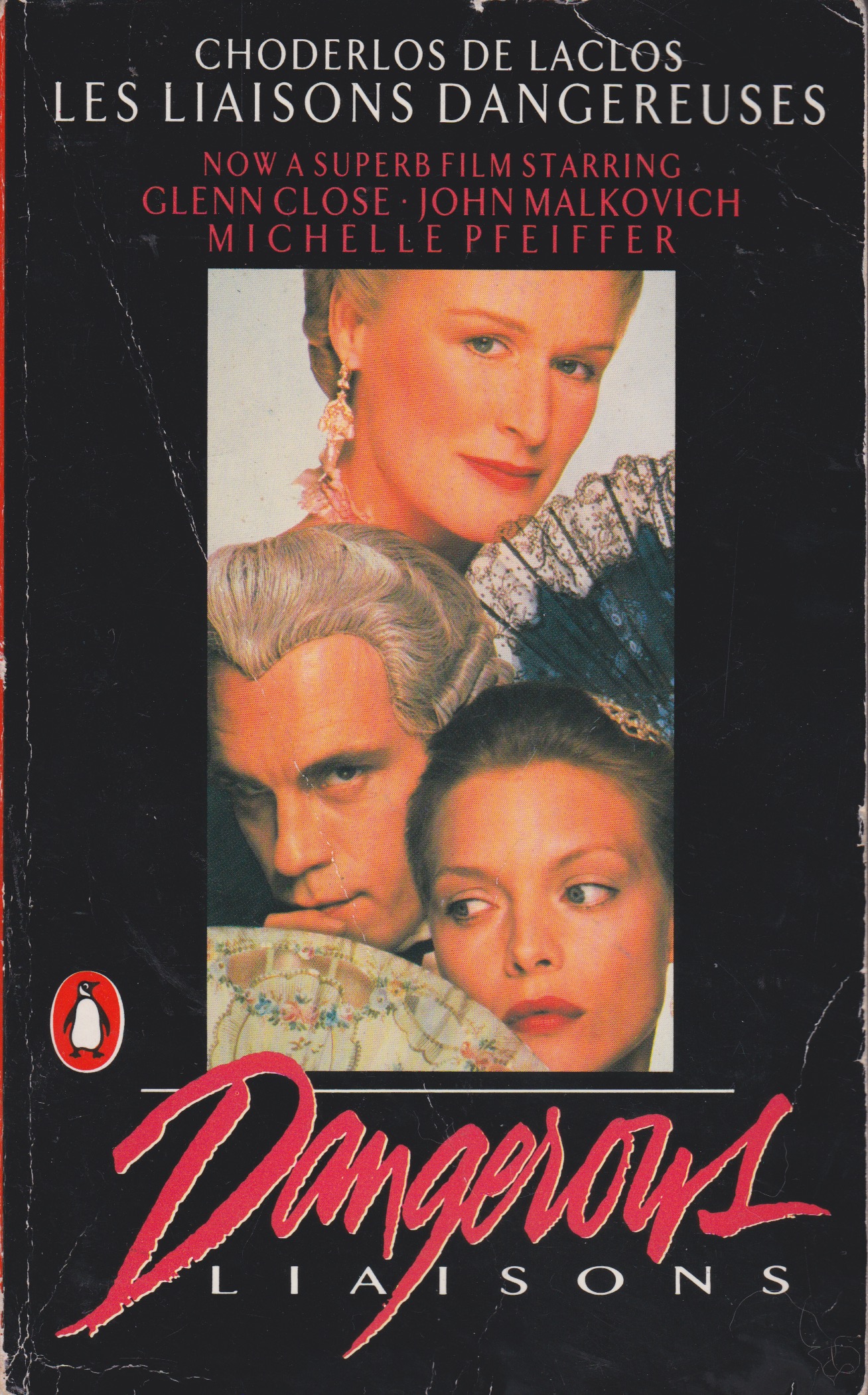
I’ve been, over the course of the last week, rereading Les Liaisons Dangereuses by Choderlos de Laclos; originally published in 1782 as the sun set on the absolute Bourbon monarchy. My interest and curiosity in the novel had been piqued by watching the two competing film versions of the same story that had come out in the same time period; the more famous Dangerous Liaisons and the overshadowed Valmont. The book had been adapted into a quite successful play; the play was the basis for the former film while the book served as the template for the latter–the director, Milos Forman, had been intrigued by the play but the rights had already gone; the book, however was in the public domain and he was determined to film his story. Even now, I wonder about the wisdom of his decision and his financial backers. Dangerous Liaisons wound up being an enormous hit and was nominated for a boatload of Oscars; his film came out second and was mostly overlooked. I preferred Valmont at the time, for reasons I shall explain; but on reviewing the films it is clearly the inferior of the two.

dangerous-liaisons

I also thought it was interesting that publishers associated the book in print with the first film…

The story itself has always, always, fascinated me; it is incredibly dark, and rather on the noir side. Madame de Merteuil, a widow (her title is actually Marquise), is angry because her lover, the Comte de Gercourt, has left her to become affianced to her young cousin Cecile Volanges; a fifteen year old innocent who has been living and being educated in a convent. It is this innocence that Gercourt is attracted to; and as an affianced husband he no longer requires a mistress. The Marquise’ jealousy is, of course, primarily motivated by ego; men do not leave her. So she concocts a scheme to despoil the innocence of young Cecile, and wants to enlist her dear friend, the Vicomte de Valmont, to seduce the girl and turn her into a wanton so that on her wedding night Gercourt would not only be disappointed but humiliated; she also thinks Valmont will help her because in the past, Gercourt had seduced a mistress of Valmont’s. But seducing a virgin isn’t the kind of challenge a practiced roué as Valmont; his interest lies in seducing Madame de Tourvel, a deeply religious and devoted wife whose husband is away on business, nor does he particularly feel the need for revenge against Gercourt. So the Marquise instead has to find another method of having the young girl seduced, and the story goes from there.

glenn-close-and-john-malk-001

I love the book. It’s extraordinary; and it is an epistolary novel, told and advanced through the letters of everyone involved in this game of seduction and the corruption of innocence and virtue. The reader is thus able to engage with each player, and Laclos is able to create each character and their voice distinctly. It’s also a fascinating character study; as the Vicomte and the Marquise explain to each other each step in their game–eventually leading to a bet between the two; if Valmont is somehow able to accomplish his seduction of Tourvel, the Marquise will be his for one night. But also, we see Tourvel’s letters to the Vicomte as she tries to resist him; her letters to friends where she talks about the struggle in her own soul between virtue and sin. We see Cecile’s letters to her friend Sophie, back in the convent, as her own innocence and childhood is slowly taken away from her as she is first excited and scared at the thought of her impending marriage; her innocent, almost childlike love for her music instructor, the Chevalier Danceny (whom the Marquise, having failed at getting Valmont to seduce Cecile, targets to be Cecile’s despoiler), and then her ultimate education into sensuality by Valmont (who finally does seduce Cecile and take her as his mistress to revenge himself on her mother, who has written disparagingly about him to Tourvel and thus hindered his seduction of her). The letters between the Marquise and Valmont also reveal how they became the way they are; their own brief affair which ended when they recognized in each other another such as themselves and decided to be friends and allies instead, and the ultimate game they are actually playing with each other.

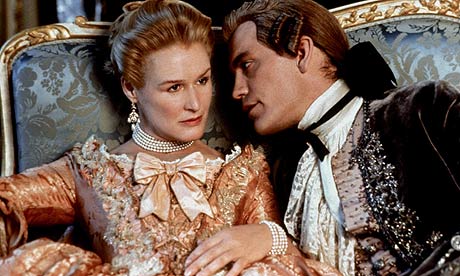
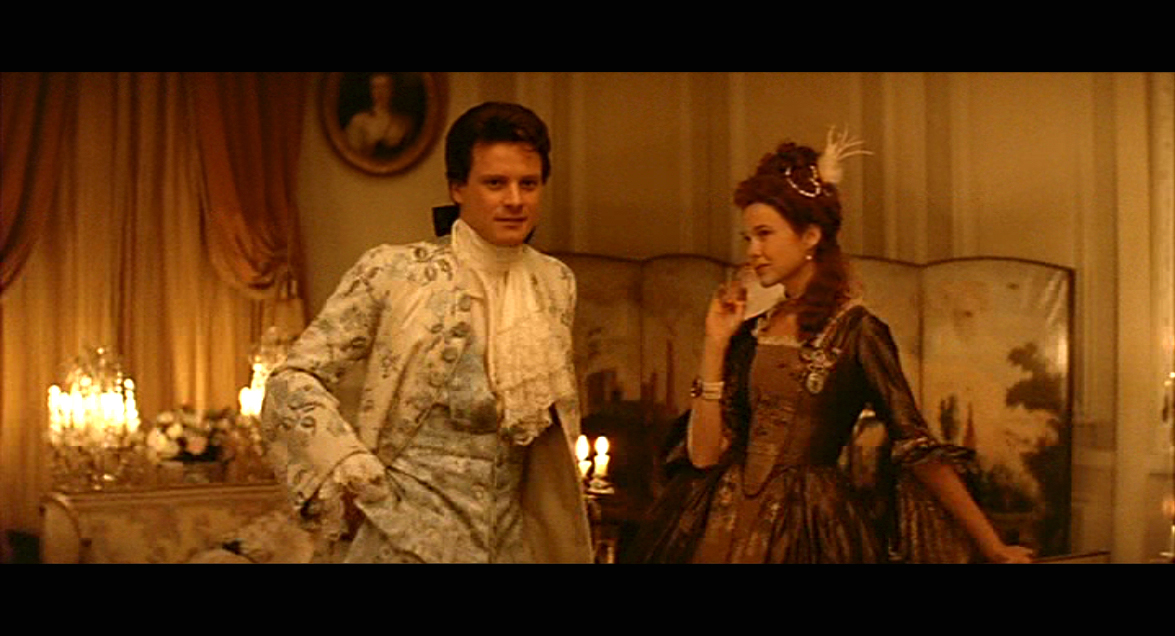
The original film, with Glenn Close and John Malkovich in the leads, with Michelle Pfeiffer as Tourvel, Uma Thurman as Cecile, Keanu Reeves as Danceny, and Swoosie Kurtz as Cecile’s mother Madame de Volanges, was very sumptuously filmed; gorgeous sets and costumes and cinematography. But I was repelled by it when I watched it; I couldn’t really believe either Close or Malkovich as these master seducers–although I readily believed them as manipulators. The film itself seemed incredibly cold and dark to me. I much preferred Valmont; with Colin Firth and Annette Bening in the roles, with Meg Tilly as Tourvel, Fairuza Balk as Cecile, Henry Thomas (from E.T. now a young man) as Danceny, and the amazing Sian Phillips as Cecile’s mother. The backstory is set up better–we see Gercourt dumping the Marquise brutally, for example, and Bening and Firth are just so luminously beautiful it was easier to believe they’d be able to seduce pretty much anyone.

tumblr_l89but6kut1qzu6rfo1_1280I read the book after seeing the films; I’ve reread it several times, and after rereading it this last time and rewatching the movies, I am not ashamed to say that I was wrong originally. <I>Dangerous Liaisons</I> is more true to the book as it was written; that coldness, the dark viciousness at the heart of the novel drives that movie far more than it does <I>Valmont</i>; the main characters aren’t quite as dark and nasty and chilling in the second version; she’s simply a woman scorned and he’s just kind of a dick. That sense of evil entitlement that Close and Malkovich embraced and played to the hilt; that seductive sleaziness just isn’t there.
And I now prefer the first film.

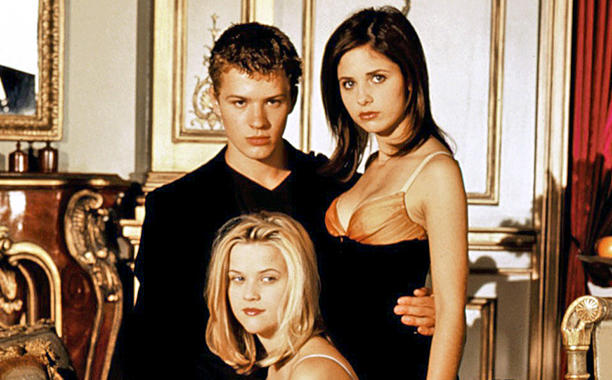
It was adapted yet again in the late 1990’s as Cruel Intentions and updated to the world of a modern day prep school and filthy rich kids, with beautiful Ryan Philippe and Sarah Michelle Gellar in the leads as step-siblings, Reese Witherspoon in the Tourvel role as a young girl who’s kind of became the spokesperson for modern virtue and virginity pledges, and Selma Blair as Cecile; whom Catherine’s latest boyfriend has left her for. It takes place over the summer between semesters–and the motivation for Gellar as Catherine to have Cecile seduced, and the reason her boyfriend leaves her for Cecile, doesn’t really play as well. (In an interesting aside, Swoosie Kurtz appears early in the movie as Sebastian’s–the modern day Vicomte–therapist whose daughter he seduces. The darkness at the heart of the story is there in this adaptation, making it even darker as it is about cynical teenagers/high school students. I intend to watch it again; I’ll probably talk about it here once I do.


MSDCRIN EC012

And now back to the spice mines.