It was the sixth Chanse, and I was trying something different with the opening of this one. I hadn’t read Ross Macdonald before I became a writer, and I was very much in the “John D. is my favorite Macdonald crime writer” camp. I had been on panels with Chris Rice a few times and he raved about Ross every time, so I kept thinking you need to read Ross Macdonald and so, sometime after Katrina, I started reading the Archer novels, moving on to stand alones and the short stories eventually. When it was time for me to write this book, I thought, tryto write an opening in Ross Macdonald’s style, and try to keep that world-weary, cynical pov through the whole book.
The house was a tired-looking single shotgun, badly in need of paint and listing to one side. It was in the middle of a block on Constance Street, facing the river. There was a rusted cyclone fence around the front yard. A statue of the Blessed Virgin Mary sat inside a circle of stone to the left of the walk leading to the front gallery. I put my car into park and verified the address—sorry I’d quit smoking for maybe the ten thousandth time.
In my line of work, it’s never a good idea to make a decision when you’re tired.
But I’d given my word, even though I’d been ready to fall asleep. It didn’t mean I had to take the job—whatever it was. All I had to do was find out what the problem was, maybe even just give some advice—which would most likely be eithernothing anyone can do or this is a job for the police.
Besides, whoever lived in this dump sure as hell couldn’t afford a private eye.
I shut off the engine and got out of the car. It was already over eighty degrees, and it wasn’t even noon yet. Beads of sweat popped out on my forehead. Early April, and it felt like summer already. I sighed and pushed the gate open. It only opened about six inches before it caught on the cracked pavement of the walk and stopped. I sighed and stepped through, catching my jeans on the fence with a slight ripping sound. I swore under my breath and examined the tear. The jeans weren’t new, but it was still annoying.
This book had several different inspirations.
First, the casino used to have MMA fights every weekend, so we had MMA fighters in the city. One of their requirements to fight was they had to have a current negative HIV and Hep C test, and guess what we do at my job? For the longest time, all these hot young fighters would come into the office every Saturday to get cleared to fight, and they came in fairly regularly. I used to talk to them a lot–I wrestled, and MMA is a lot more violent–to get some kind of idea why they did this, how they got into it, and so on. I had thought about writing a mystery about a murdered MMA fighter, but could never really get my mind around it…and then I decided, what if he was the client? Interesting.
The second source of inspiration came from a decision of the Archdiocese of New Orleans to close some churches/parishes in the city, and my friend Billy Martin was involved in the protests to save Our Lady of Good Counsel (it was a gorgeous church), even getting arrested. I wanted to do something around this as it was something that actually happened, and I also got to skewer the Archdiocese (any place that could hire David Vitter’s horrific wife to be their legal counsel deserves every skewering it gets)…so I filed that thought away.
The third and final inspiration was serving on jury duty for a civil trial. It was, of all things, a Katrina insurance fight–in which the insurance company was trying to not pay out a claim (all of us in the jury were like, “why on earth would you allow a Katrina insurance case to go to trial in New Orleans? We fucking hate insurance companies.” The fact that it was Lloyd’s of London (who became famous in the wake of the San Francisco earthquake when the president of the company wired the San Francisco office, “pay every claim”) made it even more of an eyeroll for me. An apartment complex on the west bank had sustained damage in the storm, and the insurance company was claiming they didn’t have to pay out “because the claim is for issues that predated Katrina and the place was a shithole” while claiming the complex could have reopened after Katrina “because it was gorgeous” and so they didn’t have to pay out for lost income. The first person who was called to the stand was the complex’s forensic accountant who corroborated all of the plaintiff’s claims and basically made it clear that Lloyd’s was just trying to get out of a huge payment. After he testified, we took a long lunch as they were all in conference…and the claim was settled. I think the lawyers from Lloyd’s hoped that the plaintiff would eventually back down and wouldn’t go to court–and they called that bluff and were decimating Lloyd’s in court.
I mean, the place couldn’t be a shithole and a beautiful property available for rental. Make up your fucking minds, trash at the insurance company.
And what if the MMA fighter’s mom was fighting the closing of her church, had worked for someone suing an insurance company, and then she disappears?
Yes, that was a lot of fun to write. And I was pretty pleased with how it turned out in the end, too. It was also my first Chanse novel with Bold Strokes, and they gave me that beautiful cover above that I love. It made a lovely transition for the series.
Several weekends ago, I did an on-line panel for Outwrite DC. The moderator was John Copenhaver (whom you should already be reading), and my co-panelists were the always delightful and intelligent Kelly J. Ford, Margot Douaihy, Renee James, and Robyn Gigl. The video is actually up on Youtube, if you would like to watch it. John’s questions were insightful and intelligent (as always), and the conversation was marvelous, inspiring, and fun; there’s nothing I love more than communing with other queer crime writers (or any writers, to be certain), and I always try very hard to not monopolize panels because I do have a tendency to talk too much–especially if and when I get going on a topic I am passionate about. So, I thought it might be fun to take John’s questions and turn them into a long form interview, for thoroughly selfish and totally self-promotional reasons.
The panel blurb claims that “queer characters are riveting and necessary material for crime fiction and how those stories can shape (and perhaps reshape) the landscape of contemporary crime fiction.” Do you agree with this statement—and why do the stories of queer characters have the potential to shape crime fiction?
I completely agree with this statement. Queer crime fiction has a very proud history that was never really recognized or appreciated by the mainstream crime writers, readers, organizations, and conferences. That is changing for the better.
New blood is always necessary for any genre–horror, romance, crime, literary fiction–because genres tend to stagnate after a certain period of time. The cultural shifts of the late 1960’s and 1970’s echoed in crime fiction, for example; you couldn’t write crime in those periods without addressing all the cultural and social shifts; Ross Macdonald’s later novels are a good example of this. The 1970’s saw a lot of anti-hero books being written. The private eye sub-genre had grown quite stale by this time, which was when the women really moved in and gave it a shot of adrenaline–Marcia Muller, Sara Paretsky, and Sue Grafton blazed that trail, and revitalized a sub-genre that had kind of lost its way. Queer writers and crime writers of color are currently doing the same to the entire genre. Voices and perspectives we aren’t used to seeing are now getting into print and changing how we see, not only our genre, but each other. Crime fiction has always given voice to societal outsiders and outliers; queer people and people of color are the ultimate outsiders and outliers in this country. Who better to tell stories of societal alienation?
Why did you choose your sub-genre? How do you think the sub-genre has influenced the types of characters you write?
Well, I write in several different ones. Chanse MacLeod was a straight private-eye series; Scotty Bradley was more of an amateur sleuth/humorous series, but he does have a private eye license in Louisiana. A Streetcar Named Murder was a cozy, with an amateur sleuth heroine who gets caught up in a family mystery. I’ve also done young adult and “new adult,” whatever that is (it’s been described as ages 16-25), and Gothics with a touch of the supernatural. I tend to write things that I like to read, and I have a varied reading taste. I started writing the Chanse series because I wanted to do a harder-edged private eye series with a queer twist and set it in New Orleans. I didn’t know about J. M. Redmann’s Micky Knight series when I started writing Chanse; would I have done something different had I known she’d already covered the hardboiled lesbian private eye in New Orleans? We’ll never know, I suppose. Scotty was meant to be a lark; a funny caper novel and a one-off. And here we are nine books later…
As for Streetcar, I had been wanting to try a traditional mystery with a straight woman main character for a long time. When the opportunity presented itself, I jumped in with both feet. I like trying new things and pushing myself. Having to follow the “rules” of a traditional cozy was a challenge–especially because I have such a foul mouth in real life. I love noir so am working on two different gay ones at the moment.
Why do you think amateur detectives are appealing? Do you think there’s a reason queer characters often find themselves in the role of amateur detective?
I think it’s because we all think we’re smarter than the police? We enjoy seeing a character we can identify with figuring things out faster than the cops, especially without access to all the evidence, interviews, and forensics the cops do. Murder She Wrote has been off the air for about thirty years and yet the books based on the show continue coming out every year. If we start out in mysteries reading the juvenile series–Nancy Drew and the Hardy Boys and Judy Bolton and all the rest were amateurs, so we always cut our teeth in the genre with them to begin with. Scotty is basically an amateur, even though he has a private eye license he rarely uses; he and the boys never get hired (although they kind of do in the new one, coming this November.)
Let’s talk about place. Greg, your books take place in the South. Why is place important to the crime novel—why is it especially important to the queer crime novel?
Place shapes who we are–not just as queer people, but as people in general. There are similarities between growing up in a small town in the Midwest and growing up in one in the South, but the differences are very marked. I’ve lived all over the country–pretty much everywhere but New England or the Northwest–and always felt, as a Southerner (despite no accent and not growing up there) like an outsider. Couple that with being gay in a time when it was still considered a mental illness, and you have someone always on the outside looking in. But I have that Southern pull to write about the South–although many would say that writing about New Orleans and writing about the South are not the same; like me, New Orleans both is and isn’t of the South, and I feel that very strongly. I’ve written books set in California and Kansas, even one in upstate New York, but I very much consider myself a Southern writer.
Place is even more important in a queer crime novel because place shapes the queer people so much. As a writer, I think one of my strengths is setting and place, and I think that comes from being very much a fan of Gothics growing up. Gothics are known for place and mood, and I think those are two things I do well.
All of you write wonderfully flawed characters. Sometimes, as LGBTQ+ writers, we feel the burden of representation and the urge to write only positive LGBTQ+ characters as an attempt to undo history’s (the dominant culture’s) demonization of us. Unfortunately, that can be limiting—even flattening. Clearly, you’ve all struck a beautiful balance with your characters. Talk a bit about how you approached this issue.
The flaws, to me, are what make the characters seem real. Nancy Drew and the Hardy Boys always annoyed me because they were so perfect; no one is that perfect, and anyone that close to perfect in real life would be irritating and insufferable. I am am quite aware that I am flawed (one of my biggest flaws is believing I am self-aware because I most definitely am not), but I am not trying to be perfect; I just want to be the best version of myself that I can be. By showing queer people with all their facets and flaws and failures and blind spots, we’re showing the reader that we are human; despite what those who hate us say or claim, we are human beings just like everyone else, just trying to get through life and do the best that we can. The villain in my first book was a gay man–and the entire book was a commentary on how we, as queer people, tend to overlook flaws and red flags from members of our own community. Just because someone is queer doesn’t mean they are a good person–and queers with a criminal bent do exist, and often take advantage of that sense of camaraderie we feel with each other, especially when we don’t know the person well. I tend to trust a queer person more readily than I will a straight person, and that’s wrong–which is why I think we feel so much more hurt when queer people betray us.
Speaking of the demonization of LGBTQ+ folks … Ray Bradbury of Fahrenheit 451 fame said, “There is more than one way to burn a book. And the world is full of people running around with lit matches.” What do you think about the current tactics to ban queer books from schools, libraries, and even bookstores in places like Florida, Arkansas, and Texas? Why are they targeting queer books?
This is, I hope, the last gasp of the homophobes who’ve never updated their hate speech in over fifty years. What the hate group “Moms for Liberty” are doing and saying is no different than what Anita Bryant said and did in the 1970’s, what Maggie Gallagher and her evil co-horts at the National Organization for Marriage repeated, then came the One Million Moms…all too often it’s the cisgender straight white women who are the real foes of progressive politics who fight to uphold a bigoted status quo. They always claim they’re concerned moms worried about their children–but are perfectly fine with them being shot up at school; working in a meat factory on the night shift at thirteen (have fun in hell, Sarah Huckabee Sanders, when you get there and French-kiss your Lord and Master Lucifer); or shouldn’t have the right to vote…they know better than a child’s actual parents, you see, about what the child needs or wants. Maybe they should spend more time with their own children than worrying about everyone else’s? Phyllis Schlafly, queen skank of the conservative right, ignored her own family while she embarked on her crusade to strip women of their rights and autonomy–all the while shrieking like a hyena into any microphone nearby that she was fighting progress to save the American family while selling some Leave it to Beaver-like nonsense as reality. I always felt sorry for her gay son. Imagine that as your mother.
As for why, it’s about control and power. I actually respected Anita Bryant more, because she truly believed all the vile, horrible, unChristian things she said and espoused. Most of the others, including the unspeakably vile and disgusting Moms for Liberty, are working a grift for money, attention and power. Hilariously, they’ve sold their souls in the worst possible way in the guise of family, religion and God; if they’ve ever actually read their Bibles, they need to work on their reading comprehension skills as they are both apostates and blasphemers who will spend eternity doing the breast stroke in the lake of eternal fire. Hope they enjoy it.
Sorry your husbands and children don’t love you, but who can really blame them?
What are you working on next? What’s coming up?
I have a short story in an anthology called School of Hard Knox from Crippen and Landru (and somehow got a co-editor credit for the book with Donna Andrews and Art Taylor); Death Drop, the first in a new series from Golden Notebook press, drops in October; and the ninth Scotty comes out in November, Mississippi River Mischief. I am writing a gay noir, and may be writing second books for the new series I started with Crooked Lane last year as well as a sequel to Death Drop, and have a couple of short stories I want to finish to submit to anthologies I’d love to be in.
Saturday morning and Paul comes home today! Huzzah! Huzzah! I of course literally have no idea what time he will be arriving–he never tells me these things and I never think to ask–but it’s fine. Yesterday was a good work-at-home day. Sam the handyman came by in the morning to finish touching things up and clean everything up, which was marvelous, and now the apartment sort of looks like our apartment again. It’s great, and it makes me want to clean, which is something I’d forgotten that I enjoyed so much. I’ve really let the housework slide since the pandemic started (sure, let’s blame it on that, shall we?) but a lot of it had to do with the walls in the living room. tl;dr= we had some leaks, and water damage to the walls in the living room. The leaks were repaired, but the plaster and paint somehow never got finished and we’d been living with that for a while….and when you have places where the bare wall is showing…the apartment, even clean and sparkling from ceiling to floor, would look deranged and damaged and sloppy. I think I felt a little defeated, to be honest.
I’ve felt defeated a lot over the last few years, if I’m going to be honest. But I’ve been feeling oddly better lately about things lately, even optimistic at times. I know, right? It’s kind of scary. It’s like I don’t even know who I am anymore, but I have full faith in the universe to deliver yet another blow the way it always does when I start feeling like this again–a sense of contentment and peace. I’m sleeping better, getting better rest, and I am getting things done rather than sitting in my easy chair every night scrolling through social media while Youtube videos stream endlessly on continual play. Ironically, I remember feeling this way on another hot August Friday in New Orleans, two weeks before Hurricane Katrina. I had just finished Mardi Gras Mambo at long last and turned it in, and that Friday I had met with the Admissions office at UNO to see about finishing my degree in English and pursuing a master’s, and even potentially eventually a PhD. Yes, I had ambitions. The meeting had gone incredibly well. We scheduled a meeting with the chair of the English department, and it looked fortuitous and very good; I’d have to pay for the semester required to get the English degree, but it looked like I’d get the master’s not only without having to pay, but I’d also get an on-campus part-time job. I don’t reflect back very often, but sometimes I remember that last optimistic August before Katrina and wonder how different my life would look now had Katrina never happened…or at least had the levees held. I’ve always felt the lack of educational degree and study keenly; I was far too young when I started school and majored in English to really appreciate the in-depth examination of classic literature and other forms. None of what little I learned stuck, either. I have also always been made to feel that the books I actually did read and appreciate were lowbrow; on par for someone as uneducated and unserious like me. I’ve not read much of the classic writers, for example; I’ve never read Edith Wharton or Jane Austen or much of Henry James; I may give Hemingway another try at some point but I was unimpressed with both A Farewell to Arms and The Old Man and the Sea. Fitzgerald wrote beautifully about horrible people I’m not interested in; I love Faulkner but he’s a lot of work to read (but I will go to my grave loving “A Rose for Emily” and wishing I had written one thing that perfect), so I’m not going to read Faulkner for pleasure–even though I take great pleasure in the voice and the rhythm of the words and so forth, I’m still looking for characterization and story.
Hell, there are any number of classic mystery writers I’ve never read, for that matter. I had never read Ross Macdonald until I was on a panel with Christopher Rice who sang his praises highly enough for me to get a couple of his books…and have always been delighted that I did. I think I’ve read one Rex Stout novel, but I can’t remember anything about it and I think I am thinking of a television adaptation with William Conrad and Timothy Hutton? Or did I imagine that, too? One of the things I am loving about reading the short stories in these marvelous old Alfred Hitchcock Presents anthologies is getting to read authors I’ve heard of that I’ve not read. Yesterday night I read “Curious Adventure of Mr. Bond” by Nugent Barker, from Stories That Scared Even Me; “Four O’Clock” by Rice Day, “Of Missing Persons” by Jack Finney, and Paul Eiden’s “Too Many Coincidences”, from My Favorites in Suspense. I enjoyed them all, but the Barker was my least favorite of the four. It’s written in Ye Olde Timey Style, and it goes on for far too long, and it’s big twist I saw coming. I also didn’t much care for Mr. Bond. The Day story was one of those macabre little tales of irony with the kind of ending that Daphne du Maurier mastered and I’ve always loved–and aspire to write. (The trick is the ending has to be earned.) The Finney story was also one of those, but a bit more melancholic than macabre.
I also spent some more time with Superman last night. First I watched a documentary called Look Up In The Sky! The Amazing Story of Superman, which I followed with this week’s episode of My Adventures with Superman. I was very pleased to see Jimmy Olsen talked about in the documentary, and the actor from the television series, Jack Larson, was openly gay and was in a very long term relationship that lasted until he died in 2015, as someone very kindly reminded me on Twitter the other day in response to my talking about Jimmy on here. I am really intrigued at the idea of writing a Jimmy Olsen story…although I’m not exactly sure what I would do with such a thing, and I’m equally sure publishing it would be a trademark/copyright violation of some sort. I’ll make a note and keep chewing on it, though.
I also worked on the book some last night (at last) which felt marvelous and overdue. It was so hot yesterday–even with the air conditioner on full blast and desperately trying to keep up, you could tell inside that everything outside was roasting. I am quite pleased to have gotten past the revision of Chapter Five at long last and I have to say, I am most happy with what I did. Of course, Chapter Six is from scratch, which is going to be an enormous pain in my ass, naturally; writing anything where nothing other than a thought exists at the moment is always harder than revising. Revising can be either tedious or a lot of fun; it’s when your making the book better written and deepening characters and cleaning up shit and building on the ideas you’ve already gotten down but didn’t express particularly well as you were just madly trying to get words on the page and the story advanced and all of that.
Whew. Breathe.
I also woke up to a marvelous email–I just checked–from my editor on Mississippi River Mischief letting me know when the edits would come and included…”This book is fabulous, btw.”
Whew,
And on that marvelous note, off to the spice mines with me!
Masculinity is something I’ve always felt I viewed from the outside.
It’s very strange; for someone who doesn’t look back very often and has a rather healthy disdain for nostalgia, for some reason since the pandemic started, I’ve been revisiting my past a lot. I don’t know, perhaps it was triggered by having dinner with an old friend from high school a while back (which also inspired me to write a horribly dark short story); or perhaps it’s because of short stories or novel ideas I’ve been toying with, but lately, I’ve been thinking about my past much more so than I usually do, and what it was like for me growing up. I wrote a Sisters in Crime quarterly column several years ago about the first time I realized, once and for all, that I was indeed different from everyone else–it centered the first time I heard the word fairy used towards me as a pejorative, as well as the first time I was called a faggot. I’ve also been examining and turning over issues of masculinity inside my head for quite some time (most of my life). #shedeservedit was itself an examination of toxic masculinity and how it reverberates through a small community when it’s allowed to run rampant and unchecked: boys will be boys. Some short stories I’ve published have also examined the same subject.
What can I say? My not being the American masculine ideal has played a very major part in shaping my life and who I am; how could it not? I used to, when I was a kid, pray that I’d wake up the next morning and magically be turned into the kind of boy I was supposed to be, the kind that every other boy I knew–from classmates to cousins to everything I watched on television and at the movies.
Society and culture have changed in many ways since I was a little boy who didn’t fit so easily into the conformist role for little boys; roles for male and female were very narrowly defined when I was a child, and children were forced into conforming to those roles almost from birth. Boys were supposed to be rough and tumble and play sports and get dirty and like bugs and frogs and so forth; girls were supposed to be feminine and play with dolls or play house, wear dresses and mother their baby dolls. Boys weren’t supposed to read or enjoy reading (but I was also supposed to get good grades and be smart), and that was all I wanted to do when I was a kid. I used to love Saturdays, when my mother would go to the grocery store and drop me off at the library on her way. I loved looking at the books on the shelves, looking at the cover art and reading the descriptions on the back. I loved getting the Scholastic Book Club catalog and picking out a few books; the excitement of the day when the books I’d ordered arrived and I could go out on the back porch when I got home and read them cover to cover. I was constantly, endlessly, pushed to do more “boyish” things; I played Pee-wee baseball (very much against my will), and later was pushed into playing football in high school–which I hated at first but eventually came to love…which just goes to show, don’t automatically hate something without trying it. But yeah, I never loved playing baseball. I was enormously happy when we moved to Kansas and I discovered, to my great joy, that my new high school didn’t have a team.
One less traditionally masculine thing for me to participate in was always a bonus.
The things that I really wanted to do weren’t considered masculine pursuits, and as a general rule I was denied them as much as possible. My parents forbade me from reading books about girls–Nancy Drew, the Dana Girls, Trixie Belden–which, quite naturally, made me want them more (my entire life the best way to get me to do something is to tell me either not to do it or tell me I can’t do it…either always makes me want to do it). Oddly enough, when my reading tastes became more adult–when I moved from children’s books to reading fiction for adults–they didn’t seem to care that I was reading books by women about women quite so much as they did when I was younger; either that, or they gave up trying as they finally saw me as a lost cause–one or the other; I don’t know which was the actual case. Maybe my embrace of football in high school overrode everything else suspect about me. It’s possible. My family has always worshipped at the goalposts…and I kind of still do. GEAUX TIGERS!
I spent a lot of my early life trying to understand masculinity and how it worked; what it was and why it was something I should aspire to–and never could quite wrap my mind around it. The role models for men always pointed out to me–John Wayne, etc.–never resonated with me; I always thought they were kind of dicks, to be honest. The whole “boys don’t cry, men never show emotions, men make the money and the entire household revolves around their wants and needs” shtick never took with me, and of course, as I never had any real sexual interest in women…the whole “locker room talk” thing was always kind of revolting to me, because I always saw girls as people. It probably had something to do with the fact that I was more likely to be able to trust girls than boys; I had so many boys decide they couldn’t be friends with me anymore because at some point other kids calling me a fairy began having an negative impact on their own lives all through junior and senior high school (to this day, I’ve never understood this; why were we friends before, and what changed? It wasn’t me…I didn’t suddenly switch gears from butch boy to effeminate overnight) it’s little wonder I have difficulty ever trusting straight men…but in fairness, I have trouble trusting everyone. But I never quite understood the entire “boys are studs girls are sluts” thing, but I also never truly understood the dynamics of male/female attraction. Yes, I dated in high school; I dated women in college before I finally stopped entirely. And yes, I also have had sex with women, back then–but never really enjoyed it much.
In all honesty, I still don’t understand masculinity, at least not as it was defined in my earlier decades of life. I’ve never understood the cavemen-like mentality of responding with violence (no matter how angry I get, I never get violent); I’ve never understood the refusal to recognize that women are human beings rather than life support systems for vaginas and wombs and breasts; I’ve never understood the mentality that a man’s desires should trump (see what I did there?) bodily autonomy for women. No man has a right to a woman’s body, nor does any man have a right to tell a woman what she can or cannot do with her body. Maybe always being an outsider looking in and observing has something to do with my mindset, maybe my difference and always having mostly female friends most of my life is what shaped me into understanding these things.
I also mostly only read women’s books, to be honest. There are some straight male writers I read and admire (Ace Atkins, Bill Loefhelm, Michael Koryta, Harlan Coben, Chris Holm, Stephen King, Jeff Abbott and Paul Tremblay, just to name a few) but I really have no desire to read straight male fantasies that reduce women to caricatures and gay men, if they do appear, as stereotypes; but after I recently read I the Jury by Mickey Spillane, a comment someone left on my post gave me a whole new perspective on how to read such books from the 40’s 50’s, and 60’s; the perspective of reading these books as examples of post-war PTSD…and that opened my eyes to all kinds of questions and potential critical analyses; that the horrors of World War II and what the veterans saw and experienced shaped the development of the culture of toxic masculinity that arose after the war (not that toxic masculinity didn’t exist before the war, of course, but the war experience certainly didn’t help any and it most definitely reshaped what “being a man” meant). I was thinking about doing a lengthier critical piece, on I the Jury, along with the first Travis McGee novel, and possibly including Ross Macdonald, Richard Stark and possibly Alistair MacLean. There’s certainly a wealth of material there to take a look at, evaluate, and deconstruct–and that’s not even getting into Ian Fleming and James Bond.
I’ve also always found it rather interesting that Mickey Spillane was Ayn Rand’s favorite writer. Make of that what you will.And on that note, I am off to bed. The last two days have been long ones, and tomorrow and Sunday will also be long days. I’m planning on driving back to New Orleans on Sunday–timing it so I get back after the parades are over so I can actually get home–regardless of what happens here. It’s not been an easy time here, and I am very tired.
I got up again before seven this morning–despite staying up an hour or so later last night than I usually do; I was waiting, hoping Paul would be coming home, but he didn’t get home again until after I went to bed. I didn’t get nearly as much done yesterday as I would have liked because I got distracted by reading Kellye Garrett’s marvelous Like a Sister, and by the time I finished the book it was late afternoon and the tiredness I was feeling yesterday morning–I mentioned it, remember? I wasn’t as awake and alert as I had been the day before–I decided to just kick back and relax for the rest of the day. I watched a lot of history documentaries on Youtube; watched a lot of news worried about Ukraine; and then last night I decided to watch The Drowning Pool, a 1970’s film version of Ross Macdonald’s book–with significant changes made to the book–moving it to Louisiana for one (more on this later). When the movie was finished I went to bed, and woke up early again this morning (body clock has reset, for good or ill). I have to make groceries this morning, as well as gas up the car (can’t wait to see how much gas costs today; but I am more than willing to pay more to save Ukrainian lives, frankly) and head home for some more editing work. I am going to work on my manuscript today; and I have a manuscript from Bold Strokes I need to get edited this week as well. Lots of heavy lifting to get done this week, but I think I can manage.
I also need to select my next book to read. I’ve narrowed it down some; the leading contenders include Harlem Shuffle by Colson Whitehead, The Twelve Jays of Christmas by Donna Andrews, The Prophets by Robert Jones Jr., and All Her Little Secrets by Wanda M. Morris. A plethora of treasures in my TBR pile, no? There’s also some short story collections and anthologies I want to start working my way through–not to mention a short story I need to write by the end of the month (see why I need lists?)–so I think once I get home from the grocery store I will most likely have to make this week’s to-do list. I also have some emails to write for sending tomorrow. But I don’t feel as paralyzed this morning as I usually am by a daunting pile of work that needs doing. We’ll see how I feel when I get home from the grocery store, though, I suppose. Usually dealing with the groceries wears me out and I am pretty much useless afterwards; I don’t know if that is actual physical or mental exhaustion or laziness settling in. I know that my energy levels have significantly decreased over the past pandemic years, and sometimes I do wonder if it’s maybe Long COVID; exhaustion and loss of energy seems to be one of its leading symptoms, and of course, both tend to trigger depression, which creates a massive downward spiral. But I keep testing negative for it, so what do I know?
So, The Drowning Pool starring Paul Newman as Lew Archer, renamed Lew Harper in the movie, and the location was moved from southern California to Louisiana for some reason. The movie is very cynical, so it definitely fits into my Cynical 70’s Film Festival, but it’s not a very good movie. (I’ve read the book, and while the family structure of the film seemed familiar, there’s a lot of significant diversion from the book.) One of my favorite parts of the movie is one of those things Louisiana/New Orleans people always point out in movies and television shows: the geography makes no sense. Harper is summoned to New Orleans by an old flame, whom he meets in a Royal Street antique shop for some reason. She doesn’t anyone to know she’s hired him, so why would you meet in the Quarter? The airport is in Kenner; why would you make him drive all the way into the heart of the city when you could have simply met him at a lounge or bar out near the airport, where they would be a lot more anonymity? Anyway, the old flame (Joanne Woodward, wasted in a role far beneath her talents) has gotten him a room at a motel in the small town she lives in, and she runs off, promising to be in touch…and here is the weird Louisiana geography part. He leaves the Quarter, takes the causeway across Lake Pontchartrain, eventually crossed the river in Baton Rouge, and then winds up somewhere in swampy Acadiana. That’s all fine…but why would you take the causeway to the north shore to get to Baton Rouge when I-10 heads directly there from New Orleans? He added at least another hour to his trip by crossing the lake. There’s another scene where he’s tracking someone down, following his girlfriend as she gets off the St. Charles streetcar, crosses the street, and enters a home. Harper later refers to the man’s “apartment in the French Quarter”–um, the streetcar doesn’t run through the Quarter, it didn’t in 1975, and it was clearly St. Charles Avenue (there are several more of these, in fact; the bayou area near the town was clearly filmed in the Manchac Swamp). The plot is convoluted and didn’t make a lot of sense–blackmail, Joanne Woodward’s husband is a closet case, someone has stolen an account book from a local oil baron’s company that exposes their pay-offs and bribes and other illegal activities–and Newman, while handsome and charming, doesn’t really put a lot of effort in the role. Your mileage might vary, of course, but I found it to be disappointing. The only thing about the film of note was very young Melanie Griffith playing Woodward’s nymphet teenage daughter…and I kept wondering how old IS she to be so sexualized in a film? But it was also the 1970’s…in catching up on the 1970’s films I’m constantly amazed at how much unnecessary nude scenes for women there are, or gratuitous sex scenes that add nothing to the plots in these films. But I also appreciate the grittier, more realistic if cynical point of view of the films; there’s nothing pretty or noble about humanity in these movies…which also kind of explains how “hopeful” movies like Rocky and Star Wars were so enormously successful during the latter part of the decade.
And on that note, i think I am going to head into the spice mines. Have a lovely Sunday, Constant Reader, and I will check in with you again tomorrow.
I did the windows yesterday, and it is literally amazing how I can forget between window cleanings what a difference it makes. It had been so long since I’d done it I need to do them again–it’s never easy getting all that caked on dirt and dust and debris off the glass, even when you do it weekly, as I used to do–but it’s a start.
I woke up early and feeling rested yesterday, which was absolutely lovely–and it was an absolutely lovely day in New Orleans, if a bit warm for mid-November. Did I get as much done as I needed and/or wanted to? Of course not. I did some other cleaning and straightening around the Lost Apartment; made some notes on some projects I am working on, and reread “The Snow Globe” to get a better idea of what I am dealing with on the revision, which I am going to get done today before I go to the gym. I’m also making the week’s to-do list, doing some other chores around the house, and feeling a lot better about things. Yes, I am behind on everything, but a little bit of focus and a little bit of desperation never hurt me, or anything I’ve worked on.
Rereading the story was, actually, something i’d been dreading doing; I always hate to reread something I’ve written, as I always tend to be highly critical and negative, and this story was no exception. I do love the story a lot–it was written to be submitted to a war on Christmas anthology and wasn’t accepted (the anthology never happened, either; long ugly story)–but it definitely needs some work. I originally came up with the story for a Halloween anthology, to be completely honest; there was a call for submissions, I think maybe from the Horror Writers’ Association, for stories with a Halloween theme. I distinctly remember reading the call and then an image popped into my head–me standing on the balcony at the Pub, looking down on Bourbon Street and the front doors of Oz, as a man in a devil costume came out; and he was hot as fuck; perfect body, body paint to make his skin red, and a skimpy red bikini, and thought Satan has a great six-pack, which I then made the opening line of the story. I believe at the time the story was called “All Hallow’s Eve” or something along those lines; but the story never made it past the opening paragraph. When the chance to write a story for the Christmas anthology came along, I remembered that opening and I remembered the joke I made on the Facebook post and thread about Christmas horror stories–I wanted to write about a Satanic snow globe–and immediately saw how to turn my unfinished Halloween story into a Christmas horror story called “The Snow Globe” merely by changing a single letter in the opening line: Santa had a great six-pack.
Voila! And the story began to flow. As I said, it was rejected from the anthology I wrote it for–and in the notes I got from the editors, which was lovely (one rarely gets notes on a rejected story) they basically told me I should have made it more than it was–which I had also thought about doing, but was afraid to–and so naturally, with that confirmation that the initial instincts I’d ignored from lack of confidence were, in fact, correct, I went back to the drawing board and revised it. And clearly, it needed one more revision. I have editorial notes on this story already, which I completely agree with, and I don’t know why–other than utter and sheer laziness–that I have not gone ahead and worked on this story to get it finished and out of the way. That is my goal for this morning–get the damne thing finished and be done with it–and then I can move back on to the book that has been stalled for weeks now.
Last night we watched a few more episodes of Mr. Mercedes, which finally introduced the character of Holly Gibney, who quickly became one of my favorite King characters–which was why I was so delighted she showed up in The Outsider–and so far the character is being played as she was written in the book, which is quite lovely. I think the show has padded/built up some things that I don’t remember from the book–but since I don’t remember them from the book, I am not entirely sure there were changes made. I just know I am deeply enjoying the show–it’s really a shame it hasn’t gotten as much success as it should have. (Maybe it did, I don’t know; but I rarely, if ever, heard anything about the show and there are three seasons…so there wasn’t a lot of social media buzz about it.)
The Saints play this afternoon–I think the game starts around three-ish, if I am not mistaken–and then of course there will be a new episode of The Undoing tonight. That should give me more than enough time to get this story finished, some chores done, and a trip to the gym for a workout. This is my fourth week since we rejoined the gym, and I am eminently proud that I have gone three days a week ever since. I can’t get over how much better I feel physically–the stretching really helps, too–and that correlates with how much better I’ve been sleeping. Who knew that exhaustion would help one sleep? (Sarcasm, don’t @ me)
I also read a few more chapters of The Hot Rock yesterday, which I am enjoying. Westlake’s style in this book is very reminiscent of Rob Byrnes’ brilliant caper novels (Straight Lies, Holy Rollers, Strange Bedfellows)–although since Westlake is the influence here, I should probably say I can see his influence on that unappreciated trilogy; it still kind of amazing to me that I’ve not read more Westlake (or Lawrence Block, for that matter), which is something I am going to need to rectify. (I’ve also never read Ed McBain, but I read some of his Evan Hunter novels.)
As I have often said, my education in crime fiction is a little lacking when it comes to the classics; I’ve not read all of Ross MacDonald or Raymond Chandler, for example, and I’ve also never read a Dick Francis novel either, for that matter. I think I’ve read a Nero Wolfe or two, but not many–although I have thought about using the trope of that series for a book of my own–the brilliant investigative mind who never leaves his/her house so needs a legman, from whose point of view the story is told–and there are any number of other classic crime fiction writers I’ve not cracked a spine on. But with new books I want to read being released all the time and being unable to even keep up with the canon of current writers whose work I love–not to mention all the new-to-me writers I keep discovering–there’s just simply no way I can ever read everything I want to read.
I’ve been doing some more research on Chlorine, recently reading Confidential Confidential, about the scandal rag of the 1950’s, and Montgomery Clift Queer Star, an academic treatise of multiple essays about reading Clift performances and films as queer, which was very interesting. Reading these two books also reminded me of something else that was going on in the time period which I wish to cover–red-baiting and the House Un-American Committee hearings; another period of America not living up to her ideals. It’s probably hard to explain to people who didn’t grow up, or were old enough, to remember the existential threat of the Soviet Union that had Americans seeing Communist spies and Communist infiltration everywhere; without an understanding of the highly paranoid state created by politicians and news outlets, neither the Korean nor Vietnam Wars would have most likely happened. That fear of Communism was also used by conservatives to gin up racial hatred as well as systemic discrimination against people of color and queer people–the queers were considered a national security threat because if you were queer and worked for the government in any capacity, you were thus opened up to blackmail by Communist agents. This was an actual thing, and I all too often see that key element left out of writings about the time, both fiction and non-fiction.
It would thus be wrong to leave Red-baiting out of Chlorine, which will mean more research. Heavy heaving sigh.
And on that note, the dryer just clicked off, so I should fold the clothes and get ready to get back to to work on the story. Have a lovely Sunday, Constant Reader.
Monday morning and facing down the three clinic days, which makes me tired to even just think about, honestly. I love working with my clients, though; that’s always a plus, and while my program coordinator is out quarantining (her roommate tested positive for COVID-19 last week), I think I can handle my job without her being there. (This is why I was so concerned about the stomach issues on Saturday; the last thing in the world I need right now it to have to go out on quarantine myself.)
There actually wasn’t a Saints game yesterday; I didn’t realize it was a bye week for the Saints–it was just weird that neither LSU nor the Saints had a game on the same weekend (I looked up the time for the game earlier in the week and didn’t realize it brought up next week’s game instead), and it’s been quite a while since that happened. In fact, I cannot remember the last time bye weeks fell on the same weekend–although to be fair, LSU wasn’t supposed to have a bye.
But still.
We watched the season finale of The Vow last night, and it seemed to wrap up pretty quickly; Paul was very quick to assert, “there’s going to be a second season, clearly” and after looking around on-line this morning a bit, I see that the show has been renewed for a second season. We enjoyed watching the show, despite its deeply uneven story-telling and a sense that it was longer than it needed to be; I also didn’t think compressing everything–from the arrests, etc. to the present day–into the final fifteen minutes of the finale was the best methodology; it really felt rushed, particularly since some previous episodes were obviously dragged out; it could have been six episodes, I think.
We also watched the first episode of the Jude Law mini-series The Third Day, and decided not to continue. It was very well done–some of the images were exceptional–but it was all just very murky and strange and really, you should watch one part of a three-part show and have literally no idea what’s going on, or have no sense of the characters, or why you should give a shit about their story. We won’t be watching more, I think, which is a shame; the previews looked wonderfully creepy and spooky; and while the first episode contributed greatly to the mood of creepy dread, that was about all we came away from it with, other than little to no desire to watch any more of it.
I started going through old journals yesterday–I found the one in which I started keeping the journal again (2017! It’s been three years!)–mainly because I am trying to get back into Bury Me in Shadows again; it’s been weeks since I worked on it, and I was thinking I needed to go through my notes and so forth to make sure everything is going into the story that needs to be in the story. The old journals are fascinating; there’s also the plans and notes for Royal Street Reveillon in them, as well as the birth of short stories that have since been written and even, in some cases, published; there are other story ideas and titles that never were followed up on–some of them are quite good, upon a review with fresh eyes–as well as sketches and ideas for stories that were written but wound up not really working after several drafts were completed (“The Problem with Autofill” is one of those; it’s a great concept but it doesn’t work because the central conceit winds up triggering how can you be so stupid as a reader reaction, which kills the story, frankly). It’s also interesting to see that this particular novel began being titled Bury Me in Satin, which I discarded early on, changing “satin” for “shadows”, which works ever so much better.
I also managed to do some filing and organizing, and I do feel much better about everything I now need to get done–and feel confident I can do it all.
I also read some short stories yesterday.
“Love & Other Crimes” is the title story from Sara Paretsky’s short story collection, and yes, it’s a V. I. Warshawski story. One of the problems I’ve always had with writing crime fiction short stories is the compression of the investigation aspect. I am used to spreading the story out from anywhere from sixty five thousands words to just over a hundred thousand; Royal Street Reveillon was slightly more than a hundred thousand, and is probably my longest novel. I wrote my first ever Chanse short story, “My Brother’s Keeper”, for my own collection Survivor’s Guilt and Other Stories, and I’ve started yet another, “Once a Tiger,” that has stalled, along with a couple of other investigation short stories that have never reached a complete first draft–some Venus stories (“A Little More Jazz for the Axeman,” “Falling Bullets,” and “Stations of the Cross”), and there’s a Jerry Channing story (he has appeared in the Scotty books; he’s a true crime writer) whose title I cannot recall at this moment. I struggle with these stories, obviously; reading Ross MacDonald’s Lew Archer short stories (The Archer Files) helped somewhat, as did reading Sue Grafton’s Kinsey short stories (Kinsey and Me); and it’s really no surprise that Paretsky–MWA Grand Master and crime fiction legend–can also pull off the private eye short story. A kid from the old neighborhood is being framed for murder; his sister rather snottily hired Vic to prove his innocence. She manages to do so–ironically, he was really implicated in another crime, just not the murder–and the success of the story makes me think that I should change the way I write these kinds of stories. I am not much of an outliner anymore–somewhere around Murder in the Rue St. Ann I realized that I never really stuck to the outline so wasn’t really sure I should keep doing them; instead, I either come up with a very loose synopsis–or just know where I am going to end it and start writing in that general direction and see where it goes. But…maybe I should outline the short stories that are investigations rather than just starting to write and seeing where they go; I always stop writing when I get stuck, and who knows if or when I will ever get back to it? But I am also digressing from the point of what a great story Paretsky opens her collection with! I don’t think all of the stories are necessarily Warshawski stories–the next, “Miss Bianca,” doesn’t appear to be–but I am really looking forward to seeing what other magic she hath wrought with her writing.
After reading the Paretsky story, I moved on to the Lawrence Block anthology The Darkling Halls of Ivy–whose theme is crime stories set in academia. The very first story is David Morrell’s “Requiem for a Homecoming,’ and it’s an interesting take on a crime story. A successful screenwriter returns to his alma mater for Homecoming as a special guest, and the story opens with him having a drink in a campus-area pub with an old friend from his college days…and then bringing up a twenty-year old murder that occurred when they were both undergrads. They talk a bit about the murder, and some things that never came out in the investigation all those years ago–including the pov character having gone out on a date with her once, but didn’t come forward because he supplemented his income by dealing drugs–the drug dealer would be an obvious suspect and this could have jeopardized his scholarship to USC for grad work in screenwriting–but there’s also a lot more to this fiendishly clever story. But Lawrence Block’s anthologies never disappoint; my bucket list includes getting to write a story for one of these.
And on that note, it’s off to the spice mines with me. Have a lovely Monday, Constant Reader.
And it’s now the fifth of July, and so far–at least for me–the second half of this annus horribilis is off to an okay start. Yesterday was oddly not humid or hot; there wasn’t much direct sunlight and even by noon I hadn’t been forced to turn on the portable Arctic Air coolers that have so far made life in the kitchen/office bearable; I remain, as ever, buried and behind in all of my work, which is to be expected, of course–par for it, actually. I am always behind and scrambling to catch up, and since my personality is this peculiar combination of Type A mixed in with almost chronic laziness, this will most likely always be my state of being.
The sun is out, however, this morning, and while it remains cool here in the Lost Apartment, there’s no telling how hot it perhaps might get in here later this afternoon. I accomplished very little yesterday, truth be told; I started working on “You Won’t See Me” and didn’t get very far, because it was wandering off into a different direction than where it was originally intended to go–it wasn’t until I quit writing in disgust and adjourned to my easy chair that I realized (or remembered)where I’d wanted to go with the story in the first place, so I made some notes and went back to reading Cottonmouths. Later we streamed a lot more of The Club, which has a rather lengthy first season–it’s been a while since I’ve seen a season of anything recent that runs for over twenty episodes–and an awful lot has happened. We’re finally into the mid-teens, and halfway finished with the show, which we are still enjoying. And Cottonmouths remains quite delightful.
I refuse to allow myself to give into despair this fair morning over what I wasn’t able to get accomplished over the last two days. This morning I feel, for want of better terms, not only vivacious but alive and rested. The clouds of exhaustion that have made my thinking not as clear have lifted, or so it seems at this very moment, and we shall see how this day turns out, won’t we? I hope to get quite a bit accomplished today–we have the clinic open the next two days–and I have been sleeping well lately. I’m actually feeling close to normal for the first time in months, and while mentioning it also has me concerned that I might be jinxing it in some way, it’s actually been quite lovely.
It is very difficult to not fall into the ease of despair with the news every day–hell, every day for the last few years, quite frankly. The pandemic is raging out of control and might not get better for a while; Florida, for example, has reported more new cases over the last eight days than Louisiana has had since it first arrived here (um, where are all those people claiming it was irresponsible for us to have Carnival NOW? Cavorting on the beaches in Florida?), and as the crisis seems to continue to deepen rather than get better, the return to normality everyone seems to want gets pushed further and further back because of selfishness, frankly. As I joked to Paul yesterday about not getting much writing done yesterday, “What’s the point of writing anything new when who knows if there will even be a publishing industry next year?”
I’ve not, to be honest, thought much about my writing career this year, or at least since March. It was lovely being nominated for a Lambda Award–it’s been years since the last time–but I also knew once I saw Michael Nava’s name on the short-list I didn’t have a prayer of winning. But the nominations are always nice. I have thought about writing more Scotty books–I did leave their personal story on a cliffhanger in Royal Street Reveillon, after all–but there are two manuscripts in the hopper I need to finish first, and I want to work on Chlorine next. I need to get this Secret Project finished and out of my hair in order to get back to the two manuscripts–I’ve solved the issues with Bury Me in Shadows over the course of the pandemic–and I’ve also solved the plot issues with the Kansas book while I’ve essentially been too distracted and too exhausted and too ill to actually do any actual writing. My goal for this week–and yes, the week, not today–is to get that proposal finished; get a couple more of these stories under control and/or closer to finished; and if I have a highly productive week, to take next weekend off again to rest and recharge while trying to make some progress in the TBR pile. I want to reread another Perry Mason novel–I have The Case of the Calendar Girl in a hardcover I found in a used bookstore sometime during my travels over the past few years, and watching the new HBO Perry Mason has made me want to reconnect with the original character again–and I also want to get back into reading through both the John D. MacDonald and Ross MacDonald and Margaret Millar canons; which will help me get into a place where I will be able to get Chlorine written sooner rather than later. I also have some Dorothy B. Hughes novels on hand I’ve not read as well…and of course, there’s the Diversity Project to get back to at some point, in addition to the Short Story Project. I have Sara Paretsky’s short story collection on its way, as well as the latest Lawrence Block anthology, which I think is called In the Darkling Halls of Ivy (I could be wrong but it’s something like that), and of course, I still have his previous anthology on my side table, untouched.
So much to read, so much to watch, so little free time in which to do it all–and that includes, I might add, so little time to write everything I want to write before I die.
And on that note, I am going to head back into the spice mines. Have a lovely Sunday, Constant Reader–I certainly hope that I do.
I often talk about how my education in the so-called “classics” is somewhat lacking; this is also true, not just of the great canon of literary fiction, but within my own genre as well (which is why I never pose as an expert on crime fiction; I am not one). I had never read Ross MacDonald–I was aware of him, and Lew Archer–but never had any real desire to read him until I was on a panel with Christopher Rice, who mentioned MacDonald as one of his favorite writers and an inspiration. Hmmm, I thought, perhaps I should give MacDonald a try.
So, in the years following that panel, I started reading the Archer novels, and enjoyed them tremendously. I’ve not read all of them, and I’ve not read any of his stand-alones…but what I liked the most about them was the style; how MacDonald put words and sentences together to create not only character, but mood and a kind of dark, noir-ish hard-boiled sensibility that I really admired. Early in my writing career, I patterned Chanse–both character and series–after John D. MacDonald’s Travis McGee series; later, after I started reading Ross MacDonald, I tried to see if I could create my own version of that sensibility and writing style; influenced by both MacDonalds but trying to create my own version, if that makes any kind of sense. I’d say Murder in the Irish Channel came the closest of any of the books to perfecting that style; I don’t know if Murder in the Arts District replicated the feat (which means I am going to have to reread it, even if cursorily, damn it).
There’s nothing more tedious than rereading your own work.
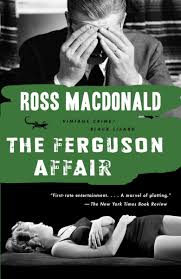
But I recently decided it was past time to give one of Ross MacDonald’s stand-alones a shot, and chose The Ferguson Affair.
The case began quietly, on the women’s floor of the county jail. I was there to interview a client, a young nurse named Ella Barker who had been arrested on a stolen-property charge. Specifically, she had sold a diamond ring which was part of the loot in a recent burglary; the secondhand dealer who bought it from her reported the transaction to the police.
Our interview started out inauspiciously. “Why you?” she wanted to know. “I thought people in trouble had a right to choose their own lawyer. Especially when they’re innocent, like me.”
“Innocence or guilt has nothing to do with it, Miss Barker. The judges keep an alphabetical list of all the attorneys in town. We take turns representing defendants without funds. My name happened to be next on the list.”
“What did you say your name was?”
“Gunnarson. William Gunnarson.”
“It’s a funny name,” she said, wrinkling her nose.
Reading books written in the past–no matter how far back–can often be jarring. One has to take into consideration the context of the time in which the book was written; The Ferguson Affair, for example, was published originally in 1960, and if you don’t think the world and society and culture have changed dramatically in the time since the final full year of the Eisenhower administration, you might want to think again. The book was published the year before I was born, so technically the book is only slighter older than I am, and it came out in a world without color television, cable, cell phones, etc. Technology had advanced so far in those fifty-nine years it might as well have been published a hundred years ago.
The Ferguson Affair was published in the midst of the period when he was producing the Lew Archer novels, and a lot of the Archer hallmarks also appear in this book; a complicated, winding plot that begins as something very small–in this case, the arrest of Ella Barker for pawning stolen property–and then continues, over the course of the investigation, to expand outwards into something much bigger, most dastardly, and more deadly. William Gunnarson, the main character of the book, is an attorney in a small California city named Buenavista, reminiscent of the town of Santa Teresa where some of the Archer books are set (and was later borrowed by Sue Grafton for her Kinsey Millhone books in a homage to MacDonald). Gunnarson is married and his wife is nine months pregnant and ready to give birth at any moment; more on that later. He is interviewing his client when word comes that someone had tried to kill the pawnshop owner who turned her in; Gunnarson is allowed to ride along to the pawnshop, which is on Pelly Street–clearly the wrong side of the tracks, and the Latin side of town. Ella was given the diamond ring she pawned for her engagement to Larry Gaines, the lifeguard at the fancy Foothill Club (the Buenavista country club), after discovering he was stepping out on her with retired screen star Holly May. The ring was loot from a robbery; the police suspect Ella knows more about the gang of robbers than she is letting on–because the victims of the robbery have all been patients at the hospital where she works as a nurse.
The book proceeds from there, with twists and turns involving kidnapping and extortion, murder and robbery; and while it is a fun ride as all MacDonald novels are, there is definitely some 1960’s era um, that’s a bit racist stuff when it comes to the Latinx people he comes into contact with over the course of the story.
And that doesn’t even take into consideration how Gunnarson treats his pregnant wife, Sally. Nine months pregnant and about to give birth at any given moment, he can’t be bothered to call her to tell her he’s coming home late for dinner which she is preparing. He never checks in on her to see if she’s okay; and in fact, he’s not around when she finally does go into labor, and someone else has to make sure she gets to the hospital in time for the birth. There’s none of the modern sentimentality about pregnancy and childbirth; he actually teases and mocks her about being so pregnant during the brief time he gives her any attention at all. I’m not really sure why it was necessary for her to be pregnant, to be honest; it bore no relation to the story in any way, and all it did was make Gunnarson seem, to my modern eyes, like an asshole.
It did occur to me that this story could have just as easily been an Archer novel/story; only set in the past, to give a key insight into who Archer was as a character, and how he developed. I could totally see this being Archer’s marriage, and Archer being the kind of husband who would always put his wife and family last; as was expected of men at the time, and the wife getting tired of it and divorcing him. (I am not an Archer expert; I’ve read some of the books, not all, and while I do enjoy them when I do read them, I don’t have details memorized. I do seem to recall that Archer had been married and divorced; I think his ex-wife is mentioned a few times…but like I said, this works as an early Archer story, but back then it wasn’t common for series books to be written out of order; maybe that was why this wound up not being an Archer? I don’t know, but it’s an interesting theory.)
Reading the book, though, made me think more about writing another Chanse novel, which I think may happen at some point in the next few years. I’d recommend it to you if you’re a MacDonald fan and want to achieve completion with his works; it’s probably not the best place to start with MacDonald if you haven’t read him before.
I slept well again last night, so here’s hoping that Monday night’s shitty night of sleep was an aberration. I feel very rested and well this morning, which is a lovely change from yesterday morning’s horror.
Paul was home late last evening, so I was able to finish watching Greatest Events of World War II in Colour, which I highly recommend. It’s incredibly well done, and powerfully moving. The final two episodes, “Liberation of Buchenwald” and “Hiroshima”, are the perfect pair to end the series with; in my last post I talked about how the “Dresden Firestorm” episode brought up questions of morality, both national and that of war; how absolutely fitting that “Liberation of Buchenwald” was the very next episode; so that any sympathy one might have felt for the German citizens killed during bombing raids and so forth, evaporates almost immediately. The documentary is also one of the first times I’ve ever seen anything about World War II and the Holocaust that absolutely puts the lie to the German everyday citizen’s claim, afterwards, that they didn’t know anything about the death camps. They knew, and at best, just didn’t care. At worst, cheered the mass slaughter of “undesirables”. Thank God Eisenhower brought in the press to document the horrors of the camps.
Even more horrifying is knowing that the threat of Soviet Communism was deemed so terrible that the Western nations chose not to pursue a lot of war crimes trials against horrible Nazis, and instead helped rehabilitate them into German society, deciding it was simply better to move on–the past was the past, the Nazis were defeated, and Communism was apparently worse–to our everlasting shame.
“Hiroshima” naturally deals with the development of atomic weapons and the lead-up to the decision to use them on the Japanese. The reason given at the time was that Japan would never surrender, and the conquest of the home islands would have cost many American lives; so President Truman–also wanting to finish off Japan as quickly as possible, before the Soviet juggernaut could turn east–made the decision to wipe two cities off the map–and the xenophobic racism that allowed the Americans to be more brutal with the Japanese then they ever were with the Germans; had the Germans won the Battle of the Bulge and taken Belgium back, would the Americans have dropped atomic bombs on say, Frankfurt and Munich? Highly unlikely.
I highly recommend this series. World War II changed the face of the world, and politics, forever; and almost everything that has gone on in the world ever since the war ended has been affected and colored by the war. It was the war that made minorities in the United States–who fought, bled and died for this country in a brutal and bloody war–no longer willing to accept second class status. For many closeted queers, it gave them the opportunity to meet others like themselves, and planted the seeds for the gay neighborhoods in places like San Francisco and New Orleans and New York–gay men and lesbians no longer felt isolated and alone, knew there were others like them, and tried to make community, eventually leading to the queer rights movement. Women participated in the war and stepped up to replace the fighting men in their jobs, and soon realized they could be more than wives and mothers, chafing against their once-again restricted roles after the end of the war–which of course led to the Women’s Movement…and that’s not even taking into consideration the changes wrought in the world in geopolitical terms.
Even if you aren’t interested in watching all ten episodes, I strongly encourage everyone to watch “The Liberation of Buchenwald.” The Holocaust was real, it happened, the Western nations allowed it to happen, and it must never happen again. And if you have the capacity to even consider, for one moment, the notion that it was a hoax–fuck all the way off, and I hope your death is slow, painful, and horrific.
I kind of want to revisit Herman Wouk’s The Winds of War/War and Remembrance series; such a well done fictionalization of the war, as seen through the eyes of the Henrys, a naval family. Of course the two volumes total something like three thousand pages–I’ll never in a million years ever have the time for a deep reread–but they were amazing, and I read them as a teenager.
Yesterday I taped Susan Larson’s “My Reading Life” with Jean (J. M.) Redmann, which is always a delight. Susan is smart and fun, as is Jean, and it’s all I can do to keep up with them and not come across as a drooling idiot. But it’s always lovely to talk to Susan and Jean about books and writing, and even more delightful, Susan told me she’d enjoyed Survivor’s Guilt and Other Stories, which was of course the crowning jewel of my month. As you know, Constant Reader, I have constant doubts about my short story writing ability, and so getting Susan’s stamp of approval meant a lot. I’ll post a link for the show when it airs.
Today is a half-day, and after tomorrow my vacation for Thanksgiving begins. I’m hoping to get a lot done–like always–and maybe I won’t; but at least I feel confident I can get a lot of reading done. I also have my blog entries about The Hunter by Richard Stark and The Ferguson Affair by Ross MacDonald to write. I also would like to catch up on all the things–little things, nothing major–that I always seem to let slide since I don’t have much time.
LSU has also managed to maintain its number one ranking, despite the abysmal showing of the defense last Saturday against Mississippi. I saw an interview with Joe Burrow after the game in which he simply shrugged and said, “You know things have changed at LSU when we score 58 points and get over 700 yards of total offense and the locker room mood is disappointment at how badly we played.” YIKES. But I tend to agree–I was enormously disappointed by the defense in both the Vanderbilt and Mississippi games; but the offense was spectacular in both games and ordinarily I’d be aglow by those high-scoring offensive performances. Maybe it’s true; maybe we do get spoiled quickly–God knows I get annoyed when the Saints don’t play well and they’ve consistently been one of the best teams in the NFL since 2006. Sigh.
But the last two games of LSU’s season are at home, against Arkansas and Texas A&M, and if they win either of those games they clinch the West division and are going to Atlanta to play Georgia for a shot at LSU’s first SEC title since 2011. Woo-hoo!
I hope to start reading Colson Whitehead’s The Nickel Boys today; today is my half-day and so I can get home earlier, possibly do some writing, and then curl up in my easy chair while I wait for Paul to get home. I still haven’t written a damned thing recently, and I really need to get back on that.
And on that note, tis back to the spice mines with me.









 Queer and Loathing in America