You Make Me Feel Mighty Real

Growing up as a queer kid in the 1960’s and the 1970’s wasn’t the easiest path to trod. First came the realization that my wiring was different from everyone else’s, followed quickly by the shame from being different and of course, the ever-popular feeling among queer kids when they recognize their queerness that I was the only one in the world and no one, under any circumstances, could ever know. I honestly don’t remember the first time I came across a gay character anywhere–it had to be in a novel, though–and I slowly became aware that it wasn’t just me, but there weren’t any others like me anywhere around me. (I do sometimes wonder how differently my life would have turned out had we never left the Chicago suburbs for the empty plains of Kansas; I certainly would have met other gay men much earlier in my life but….being an out gay man in Chicago in the 1980’s might not have boded well for me otherwise in the long term, if you catch my meaning.) I do remember the first gay characters I saw in film and television; I remember being highly entertained and feeling connected, in some way, to celebrities like Paul Lynde and Charles Nelson Reilly; but Liberace’s flamboyance repelled me. The few times I’d seen gay characters they were horrific stereotypes, and I can remember being confused, thinking I’m not like that, though. I can remember TV movies like That Certain Summer which was about a gay man coming out to his son and his son having to deal with it; I didn’t watch because I was afraid that watching it, even though it was an ABC Movie-of-the-Week, would tip off my parents and my sister that I was like that–or even just curious about it, which wouldn’t fly.

It was Billy Crystal as Jodie Dallas on SOAP that gave me my first real exposure to a continuing regular series character who was a gay man–and his confusion (which had a lot to do with the writers fighting with the network censors and trying to appease the gay community) about his gender and sexuality in that first season struck me as a bit on the absurd side–but I also understood his thinking well had I been born a woman this would have been all a lot easier.

Of course, now, as an adult gay man with years of living the life behind me as well as writing about it, I see how incredibly absurd on its face was that story-line.

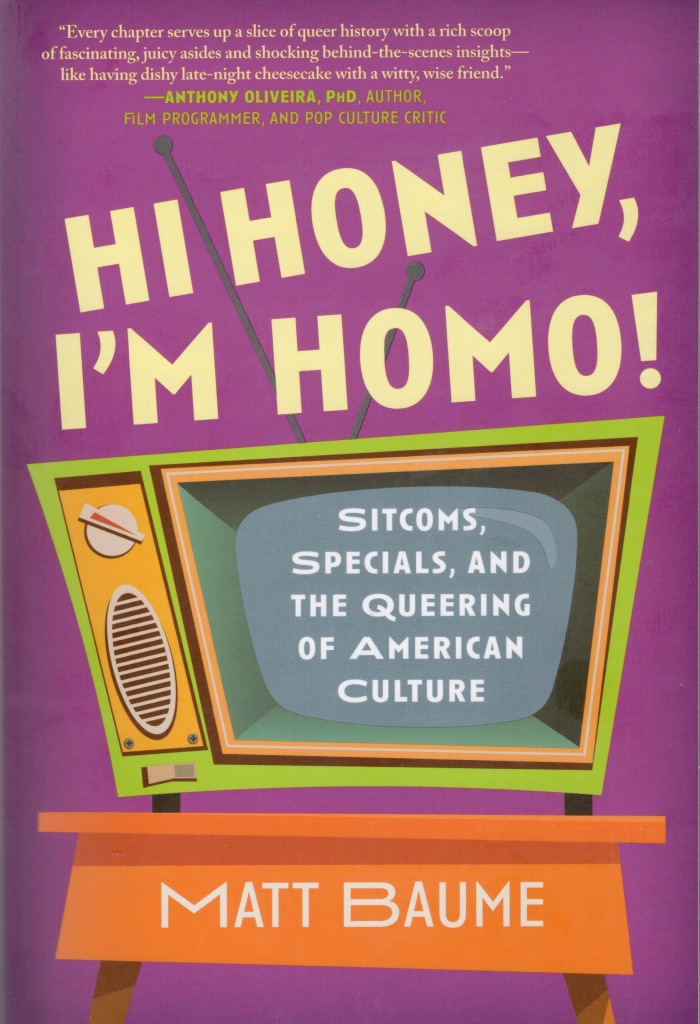
I first found Matt Baume’s Youtube channel during the pandemic, as I was scrambling to find things to watch while i made condom packs and did other make-work at home duties to maintain my paycheck. I may have found him through James Somerton’s channel? But while Somerton is often very dour and doom-and-gloom and “this is how they betray us” (don’t get me wrong, there’s a place for that and it’s needed), Baume is much more cheerful and positive about representation: he presents queer rep in popular culture in the context of the time; what the show/movie creators were trying to do with the rep; why they chose to do the rep in the first place; and the battles and struggles they had to make sure their rep made it to the viewers the way they wanted it to–and how that representation may have helped change hearts and minds when it comes to queer representation in art and culture. So when I found out Baume had written a book about queer representation in network sitcoms–written versions of his Youtube channel most likely–I had to have it.

I’m really glad I read it, too.

The essays contained within are well-written in a light, easy to read and comprehend way, without all the academic language that inevitably drags these kinds of things into the impenetrable territory that gets cited in other academic papers but otherwise never get read. Each chapter, from Bewitched through Modern Family, also contextualizes the queer representation in its time and place within the sociopolitical climate of each show, as well as the queer influences. Bewitched was probably the queerest show to ever air, be a hit and win Emmy Awards before Will and Grace; which makes it all the more memorable is that it was all coding and subtext, with witches standing in for queer people–and the similarities were obvious: they had to hide who they were from mortals for fear of persecution, bigotry, and violence. Sound familiar?

Baume also names and shames all the anti-queer activists of my lifetime, from Anita Bryant to Donald Wildmon (my own personal nemesis) to A Million Moms and so forth; Wildmon himself is probably the worst of them all; much as I loathe Bryant, I think she sincerely believed that queer people were a danger and sinful. I also think Bryant and Phyllis Schlafly were the last true-believer homophobes to lead movements; everything since has been a cynical grift for money and political power. Ronald Reagan and the Republicans saw, in 1980 and with the evangelical turnout in 1976 that carried an actual Christian to the White House (Carter was perhaps the most truly Christian president we’ve ever had; his religious values colored his policy. It’s ironic that Christians hate him as a general rule and always point to him as an example of a failed presidency rather than what his presidency actually proved; a true Christian believer isn’t pragmatic enough to lead a country; because sometimes, as The West Wing noted in an episode title, sometimes you have to kill Yamamoto; things for the greater good that are horrific on a personal level) and noted that “lip-service” to “Christian ideals” was all it took to get “Christians” to vote for you.

And this is a good place to serve as your regular reminder that the “party of family values” elected our only divorced presidents, yet are the same people who tried to remove Bill Clinton from office for lying about a blow job because it was evidence of his poor character and someone with such poor character shouldn’t be president.

I recommend this book, not only because it’s an interesting look at the evolution of queer representation in television comedy series, but because it also is educational by tracing the opposition to queer equality during the same time period.

I also learned by reading the book that Baume was the Communications Director for AFER, an organization that fought for marriage equality. So, buying and reading his book is also an excellent way to say thank you for his advocacy.

Human Nature

Wednesday!

I was tired yesterday. I slept okay Monday night, but not deeply and I did keep waking up so it was a restless night at best–and I sure as hell didn’t want to get up when the alarm went off yesterday morning. I was also behind at the day job when I got there, so had to play catch up a bit between clients. It was all good, but still a bit more stressful than I would prefer; I also kept thinking it was Monday all day which drove me a bit insane.

I also discovered that my insurance actually does not cover hearing aids for adults; I must have missed the part about having to be under eighteen when I looked it up. Which kind of sucks that in order to hear I have to pay for it out of my own pocket. The good news is I’ve made it this far without them, so I guess I can start trying to save up to pay for them somehow, or maybe I can get them financed or something. I’m not entirely sure, but it’s irritating. Our health care system has been fucked up since, well, the Reagan administration (quelle surprise; what modern day horror doesn’t date back to that bastard?), but the decline of the airline industry actually can be dated to Carter; he was the one who deregulated the airlines under the guise of increasing competition so fares would be more competitively priced. We see how well that worked out, haven’t we? American, United, Delta, Southwest and Jetblue are all that are left now from the glory days of air travel–Eastern, Pan Am, TWA, Continental, Northwest and many others having either folded or been taken over by another airline. Glad we have all these choices now, right? (Sorry, I was thinking about how the airline industry has declined over the course of my lifetime while at the airport the other day, and clearly it was still in my subconscious. I love Jimmy Carter, but this was a mistake.)

I slept better last night. I still woke up a couple of times but I feel very much more rested this morning than I did yesterday. I was tired when I got home from the office so immediately put the dishes away and started another load before the fatigue overtook me. I got caught upon Vanderpump Rules–more on that later–and when Paul got home from the gym we watched this week’s Ted Lasso, which was lovely and melancholy at the same time. (My God, how I love Jamie Tartt! Phil Dunster is killing it in the role this season, too. What an incredible character arc–and now we are seeing a lovely redemption for Nate, who disappointed me but we get to see our Nate again this season, which is so nice)

I did manage to work a little on the book yesterday, and it took me a little while to get reacclimated to the story and everything. I think I’ll be back on track with it again today and thru the rest of the week before I leave for Alabama on Saturday morning; and while the drive up there and back over the weekend will probably be tiring, I think I can see the end of the book coming. It might take me awhile to get there, but the end game is there and I need to really focus at some point to get it done. I may have to take a long weekend in mid-May to get there. Heavy heaving sigh. It’s always about time management for me, isn’t it, and being tired? How did I used to do this all the time? Oh yes, I was younger and hadn’t had COVID yet. *shakes fist at universe*

I need to stay away from Twitter more. I get so angry whenever I go there, and am always tempted to say something snarky or in kind to a troll–I don’t always succeed in deleting the tweet before hitting send, either–and while I am not worried about going viral or getting cancelled (if it happens, it happens, you know, and if I fuck up, I kind of deserve it), I am trying not to be that person. I don’t want to troll trolls on-line, nor do I want to get into tweet-fights with anyone. It’s all just a waste of time and energy that can be utilized better elsewhere (I do, however, reserve the right to troll anyone trolling a friend), and does no one any good. Twitter is the worst of us, really; originally intended for people to connect and interact with each other, it basically evolved into a place for people to complain. Oh, someone cut you off in traffic? Tweet angrily about it! You watched a show you didn’t enjoy? Tweet about it! And so on and so on. Twitter can be fun; I’ve certainly had fun there with friends and of course there’s always my “Greg meme” face, which can be used for surprise, shock, or horror (I actually have the picture saved on all devices for easy access and use as “the horror”); for some reason that always makes people laugh. It is a funny photo, and I will always be grateful that Josh Fegley snapped that shot so perfectly timed to get that expression on my face when the Evil Mark said, well, something evil while we were at Drag Bingo at Oz. I’ve tried repeating that photo without success; it was something in and of the moment, I guess.

Or I’m just older and my face sags so much I can’t replicate the expression. One or the other is the most likely, or probably both.

Heavy heaving sigh.

And on that note, I am going to head into the spice mines. Have a lovely day, Constant Reader, and I will check in with you again tomorrow.