Reindeer Boogie

Up ungodly early on a Saturday because I have to cross the river to the West Bank to get my oil changed. One of the most interesting things about this surgery recovery is it seems to have wiped my memory banks or something–kind of like an Apple OS update. Yesterday on my way to PT I checked the car’s systems and was stunned to see that I was due for an oil change. It seemed like I’d just had it done, but now that I think about it, it may have been as far back as June, when I went to Alabama and Kentucky and back. I’ve done a lot of driving since then, including a weekend drive over to Panama City Beach in October, and so it’s not really surprising that it’s due again–and thank God I checked, right?

But I continue to sleep well, and I am really looking forward to sleeping late tomorrow and just lazing around until I feel like getting up. Monday morning I have PT early, and then have to head into the office for my paperwork day. It’ll be a great and interesting week of trying to get everything caught up so I can take my four day Christmas break with a clear conscience–at least as far as work is concerned. My PT visits continue to go well, and I like both therapists I’ve worked with so far. (If you’re local to New Orleans and need physical therapy, I highly recommend Physiofit in Uptown on Magazine Street.) I am hoping I won’t need the brace after I see my surgeon again next Friday, and what a lovely Christmas gift that would be, wouldn’t it? It’s just cumbersome and awkward now, and the greater dexterity I get with my hand the more annoying it is to have to type around having it on. I also have noticed how easily I tire now, too–but I also know my body had a major trauma that it hasn’t completely recovered from just yet, and three weeks of being sedentary wasn’t a huge help; I have to build my stamina back up.

We watched the final episode of Fellow Travelers last night and while it was terribly sad, there was a kind of release at the end as well. It’s an incredible show, and both Matt Bohmer and Jonathan Bailey deserve to be nominated for Emmys next time around. I doubt that it will get a lot of Emmy nods–It’s a Sin, which was also brilliantly done and brilliantly acted, was completely snubbed by the Emmys. Twenty years ago it would have not only gotten a lot of nominations, it would have probably run a clean sweep on award night, but sadly, the history of AIDS and gay suffering simply doesn’t have the cachet it did when everyone wore red ribbons to awards shows and red carpets. I do recommend the show, and I want to move the book up in my TBR pile. (I am taking Raquel’s Calypso, Corpses and Cooking with me this morning and I am hoping I’ll be able to finish it while I wait to get the car back.)

We also started watching the second season of Reacher, which is very fun. Alan Ritchson, who was already huge in the first season, used the time between filming to bulk up even more. He certainly embodies the character physically far better than Tom Cruise could ever hope to, with no offense to Cruise; he’s just not the right physical type, and since one of the best known facts about the character is his enormous size, well…he was never going to please fans of the books. I stopped reading the series about ten or so years ago–I have no grasp of the passage of time, so you’ll have to give me some grace on that, nor do I recall why I stopped reading it. Obviously, Lee Child isn’t missing my money, but I was a big fan of the series and still remember it fondly; there were some terrific books in that series, and The Killing Floor may be one of the best series-launch novels of all time.

I have to work today when I get home from the oil change and other errands this morning; I really need to spend some time with the book today and I also need to work on the house a lot more. The apartment has really slid, and allowing Sparky free range to do as he pleases has resulted in a lot of debris on the floor–and all of my good pens are missing. Paul’s cigarette lighters, highlighters, scissors, spoons, plastic wrap, plastic bags, dryer sheets, and a lot of other miscellaneous stuff is scattered all over the floors both up and downstairs…and he’s also wreaked havoc in the laundry room and the bathroom. The kitchen floor has never really been completely cleaned up since the ceiling collapse, either. I have decided, though, that this year’s Christmas present to myself is going to be a new microwave. My current one is well over ten years old, and it works fine…but I never read the manual and so am never sure how to use for anything than reheating something. Paul uses it more than I do, and he also never cleans it, so it’s always a filthy mess. Since I never really use it, I tend to not pay attention and then I always notice it when I don’t have time to clean it, and then forget. They had a great one on-line at Costco, so I think next weekend I’ll go pick it up, and then donate the old one (after a thorough cleaning) to work so we have one in our department.

And that’s how I know I am officially old: appliances are my preferred gift.

I Know There’s Something Going On

I love cozy mysteries.

I do, and while they may not make up the majority of my reading pile, it’s always a joy to find a new cozy series I enjoy. One of my favorite mysteries of all time, James Anderson’s The Affair of the Blood-Stained Egg Cosy, is definitely a cozy mystery–a house party murder, with secret passages and international espionage and a jewel thief–and is LONG overdue for a prestige mini-series, preferably by either Acorn or Britbox. (I should reread that book; it’s been a hot minute) I don’t think cozies and their writers are given the respect they deserve, ever–rarely do you see a cozy on a Best of the Year list or making the short-list for awards (besides the Agathas), and I’ve heard crime writers slag off the sub-genre, way more times than I would prefer. Anyone who thinks a cozy is lesser or somehow “easier” to write than any other kind of crime novel is more than welcome to give writing one a try. It’s always amusing to me to see the hypocrisy of crime writers whining that literary writers don’t take them seriously…and then in their next breath go on to mock cozy writers. (I did have a wonderful “gotcha” moment with a straight white male mystery writer once; he was complaining about how crime fiction isn’t considered literature, and later on in the same conversation he made a snide remark about cozy writers…and boy did he stumble for words when I replied, “So when lit writers treat you like a cozy writer you don’t like it?” He won’t talk smack about cozies in MY presence again…)

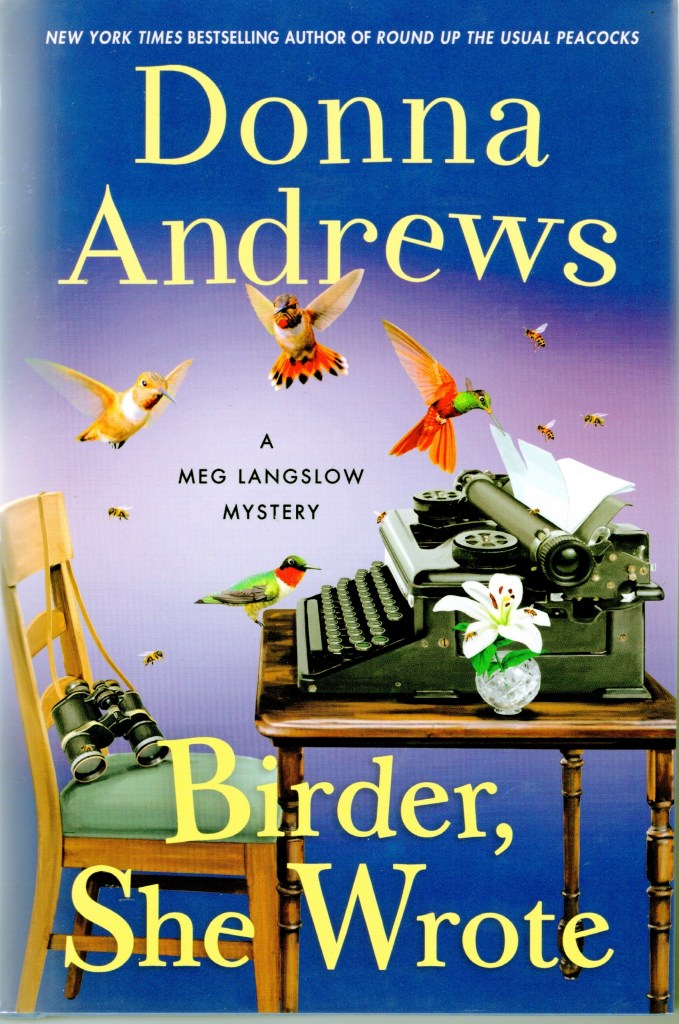
Anyway, I digress. One of my favorite series of all time is the Meg Langslow series by Donna Andrews, and we are on book thirty-three now, with thirty-four on my chair sidetable, halfway finished reading, and Book 35 available for preorder already.

That is a pretty impressive track record, and career. If I wrote a Scotty per year from now on, it would take me until I am eighty-eight to get to book 35. YIKES.

“This is the life,” I said, as I wriggled into an even more comfortable position in the hammock.

I wasn’t talking to anyone in particular. As far as I knew, there was no one within earshot. But just in case there was, I was going to do my best to look–and sound–like someone who was deeply contented and should not be disturbed for anything short of an actual emergency. Although the people most apt to – me were safely occupied elsewhere–Michael, my husband, was teaching his Friday classes at Caerphilly College, and my twin sons, Jamie and Josh, were at school until three.

My-notebook-that-tells-me-when-to-breathe, as I called my comprehensive to-do list and calendar, was nearby, but I’d already checked, and nothing in its pages had to be done right now. For the next hour I was on hammock time. I could read. I could put on my headphones and listen to some music. Or I could just lie here and enjoy the balmy May weather, the masses of blooms in our flower beds, and the fascinating aerial ballet of hummingbirds darting to and from the nearby feeder.

The hummingbirds. I sat up with a frown. The last time I’d found the time to watch them, there had been half a doxen of them, impossibly small, their iridescent jewel-toned bodies sparking in the sunshine as they paused, sipped, and darted away. Now there was onlyone, flitting around the feeder. And he didn’t seem to be feeding–just darting about.

And that title is a gem.

The entire series has bird-puns for titles, which is amazingly hard to do, and if you don’t think so–try coming up with thirty-three bird pun titles for crime novels without looking at Donna’s backlist. I suggested one to her many years ago that I keep hoping she’ll use–but she hasn’t yet, and I despair my bird pun title will ever make it into her canon.

I do feel that I also should, in the interest of full disclosure, let you know that Donna Andrews is not only one of my favorite writers but one of my favorite people in this business. We first met years ago when we were both on the MWA board (she was on The Good, the Bad, and the Emus back then), and I found her to be intelligent, kind, charming and funny. That was when I started reading her, and what a joy this series has been for me all these years. Donna’s books, to me, are the perfect example of why this sub-genre (amateur sleuth, no blood or sex or violence–at least not much, and little to no swearing) is called “cozy”–because that’s how reading one of her books makes me feel, cozy. Honestly, there’s nothing better than curling in my easy chair with a blanket, a purring kitty in my lap, as I revisit my friends in Caerphilly again.

Because she writes so well it seems like a real place, one that I am happy to escape my life into twice a year.

I could talk about this series all day, I love it and the characters so much. Caerphilly reminds me a lot of Schitt’s Creek and Ted Lasso–ensemble casts in places where everyone is kind and looks out for one another, but also doesn’t interfere and lets you make and learn from your own mistakes. This time out, Donna has added a new McMansion style neighborhood to the town, Westlake, with people retiring from major cities to the “rustic” charms of Caerphilly–only to complain incessantly about those very rustic charms to begin with–and beekeeper Edgar is square in their sites, his hives just across a small stream from their backyards. Meg calls them the NIMBYs (not in my backyard), and I think we’ve all encountered these types (which is why dumps and toxic waste always ends up around poorer communities). Someone has poisoned all of Edgar’s bees–and Meg agrees to look into who could have done something so heinous. But while looking for an old African American cemetery, Meg and her friends not only find the cemetery deep in the woods, but they also find the dead body of one of the worst of the NIMBYs, and the game is afoot.

The sadness at finishing the book was derailed by knowing this year’s Christmas Meg murder mystery was already in my TBR pile, which I immediately started reading when I finished Birder She Wrote. Don’t be daunted by the massive backlist, either–if you’ve not read any of these books, you can start anywhere and then work your way through the series; there are never any spoilers other than those from Meg’s personal life–and frankly, I don’t mind those kinds of spoilers, because its fun to go back and see how she met her husband, when they got married, the twins, etc.

Hey Apple TV–this series is a natural for y’all.

Does It Make You Remember

It is impossible for me to express how much books have always meant to me, and how grateful I am, to this day, to my parents and grandmother for encouraging me to read. We’ve always been a reading family–but no one ever has read as much, or as often, as I did. One of my aunts called me “the readingest child I’ve ever seen”–and she was a librarian. Books made sense to me; the worlds I escaped into whenever I opened a book made sense to me, and none of the worries or cares of my childhood bothered me when I was lost in a book. I also loved history, and thus read a lot of it when I was a kid; the basic overview history classes I had were pretty easy for me because I already knew the history in greater depth than the textbook provided.

The Scholastic Book Fairs were always my favorite day every month, and I was always so delighted when my mom would let me order a few–never all the ones I wanted, because I really wanted them all–and it was even more exciting when I found one that was also set in a period of American history. Johnny Tremain remains, to this day, one of my all-time favorites, and when I was a kid, I wanted to write both a mystery series (like the Hardy Boys and Nancy Drew) as well as historical fiction.

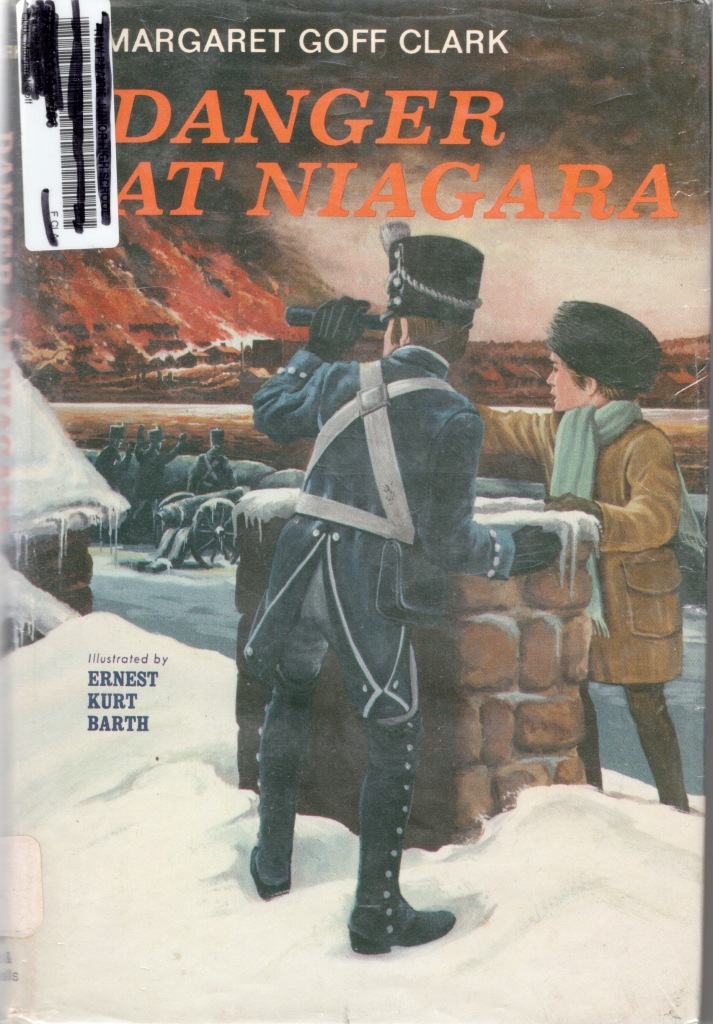
One such book that stuck with me over the years–and didn’t have as big an impact on culture as Johnny Tremain, which won awards and was filmed by Disney–was Margaret Goff Clark’s Danger at Niagara, which was set on the US/Canadian border during the War of 1812 (which few people write about and is mostly forgotten today). A few years ago I was looking for the original hardcover of Johnny Tremain I had read as a child, when a copy of Danger at Niagara was recommended to me by the eBay algorithm. It wasn’t expensive, it was a library remainder, and I thought, what the hell and shelled out the less than five dollars including postage, and the other day while they worked on the ceiling, I reread its 120 pages.

Sorry for the not-clear cover image; my copy is a library discard and there are no clear images of this cover on-line; at least not that I can find.

Exhausted from a day of fruitless hunting, Homan Reed ate a cold supper of cornbread and milk. Hastily he banked the fire and then fell into bed, forgetting his loneliness and the ever-present danger from across the river.

He awoke at dawn, shivering under the heavy quilts, awakened as much by the silence as the cold. He lay still, listening. Gray morning light had come through the small panes of glass Uncle Oliver had carried all the way from Connecticut. A sound that usually penetrated the log walls of the cabin was missing–a sound that was part of the background of his life in this lonely frontier clearing in western New York State.

His hear began to beat too fast, and he sat up in bed, reaching for the buckskin breeches he had laid on top of the quilts. Homan was a good-looking boy, rather small for his almost fifteen years.

There really isn’t much to the story, really. Homan wakes up to realize he has slept through a raid on his little family farm, and their livestock is gone. His uncle brought Homan and his brother up here after their parents died, and his brother is off fighting in the American army in the War of 1812. The Reed place is right across the river from Canada–and of course, at that time Canada was the enemy. Putting myself into Homan’s place was exciting; trying to imagine what it was like to know that not only was the British army capable of crossing the river at any time, their Mohawk allies were also out and about and a constant threat. Shortly after the opening of the book, the American army burns a Canadian town and turns out women, children, the sick and the elderly out into the cold with no shelter or food; to the author’s credit, she makes it clear this is horrible and a war crime; Homan, who witnesses this from inside Fort Niagara (he’s gone looking for his brother and to try to enlist), is horrified and ashamed Americans could do something so heinous–and everyone on the American side of the river knows there will be retaliation and retribution.

As I reread this short book, I paid very close attention to what we now would call propaganda for American supremacy–and there was some, but not as much as I would have thought, and there was less problematic language than I would have expected for the time (it was published in 1967 originally). Yes, Clark refers to the Tuscarora and Mohawk peoples as “Indians,” as do the characters (which is what they would have said at the time, so historically accurate, if offensive) but she treats the natives with respect–no references to them not being human beings, or being savages or uncivilized or anything like that; Homan even has a friend his age from the Tuscarora people. The Mohawks are referred to as the enemy, but in the same way the British are. There are a few mentions of pro-American exceptionalism propaganda–things like “we are a growing power the world needs to respect”, that sort of thing that Americans have always believed and never questioned until the last few decades or so. But Homan is likable enough, and the story itself, of worrying about your safety and losing your home and so forth, resonates still, even if technically Homan and his family were colonizers.

I really do need to reread Johnny Tremain…

All I Want for Christmas Is You

All evidence to the contrary, I do love Christmas. I love the decorations, I love the mentality behind it, I love the festive spirit that people try to keep up during the season, and I even like the music for the most part. (I also find many things wrong with American Christmas, but that’s for another time.) I detest cheap sentimentality, or melodrama for the sake of a cheap emotional response from the audience/reader. I don’t enjoy Hallmark or Lifetime Christmas movies as a genre–predictable, sickly sweet, cloyingly sentimental like cheap perfume–but I don’t care that other people do; my preference is never to yuck someone else’s yum. Obviously, there’s a big market for those films and books, but they generally aren’t for me. I just don’t buy into them when I watch, I suppose, is the best way to put it?

This is also partly why I don’t read a lot of romance novels. But when I saw that David Valdes had written a young adult Christmas romance novel, I thought, you know what? I bet this is really good, so I procured a copy and spent a lovely afternoon reading it.

I loved it.

No one can accuse my dad of being subtle. He loves Christmas the way most guys in the Pioneer Valley love the Patriots. Instead of team jerseys, he has a collection of ugly holiday sweaters that would be kind of impressive if it wasn’t so embarrassing. (Seriously, the llama ones lights up. I can’t.) So I shouldn’t be surprised that when I arrive home for my first, or maybe last, winter break from college, the house looks like, I don’t know, Frosty Con. Snowmen everywhere.

I’m so not in the mood.

Don’t get me wrong: I like Christmas well enough. Even though Halloween is my favorite holiday because of the costumes, I love all the twinkling lights, and you can’t really overplay “All I Want For Christmas Is You.” But’s it been a long day on the bus from NYC, and before it was a long day, it was a long week in a long semester. Not that I’m ready to admit that to my dad.

I purposely chose a bus that would get me home to Lindell while he was working. Yes, it’s, like, almost two miles from the bus stop in front of the old town hall to our place, but dragging my bag for forty minutes was worth it for the chance to come home to an empty house. I need some time alone in the privacy of my own room before Dad gets here and I become the grinch, the carol killer, the fly in the eggnog.

I have to tell him that I’m failing out of school.

And so we meet Cam, first semester Theater major from the small town of Lindell, Massachusetts, coming home with his head bowed and thinking he’s failed at making it in the big city. He was THE theater kid at his high school, but once he’s made it to the city and school of his dreams, he’s just another face in the crowd–and doesn’t feel like he fits in. He’s doing fine in his required courses…it’s the theater ones he’s having trouble with, and his father is working two jobs and he may lose his scholarship. He doesn’t have the heart to disappoint his father and ruin Christmas, so he bides his time with the terrible news–like everyone teen, avoiding the bad news or put it off till later. A chance trip to the new mall in town winds up with him getting a job as an elf in Santaland, where he meets his fellow elves–an older retired military man; a blonde good two-shoes, a Goth girl, and perpetually happy, cheerful and annoying Marco. He also runs into his ex, LeRoy, and isn’t sure if he wants to start up with him again or not; he dumped LeRoy the summer before he left for college, thinking it was better to not try the long-distance thing.

The best part of the job? The elves are in a competition to win a five thousand dollar prize–which will make up for the scholarship he’s losing–by winning a popular on-line vote. As the days pass and he gets to know his fellow elves better, he starts opening up a little bit himself and seeing things from perspectives other than his own. All the other elves help with this process, but especially Marco–who seems to be the embodiment of the Christmas spirit and just a genuinely kind, empathetic soul.

The book is a romantic comedy, so there are funny moments as well as the ones that make you sigh and warm your heart–all of it earned, mind you, and not there for story purposes–but it’s also about Cam growing up into a better, less self-absorbed person who maybe doesn’t project his impressions onto other people and sees them with a kinder eye. Valdes nails the teen voice perfectly; Cam is at heart a good person, if a bit too wrapped up inside his own head with his own issues and problems, but he is deftly drawn and fully conceived, so you root for him even as you groan at his poor choices; you want him to do better, be better, because he really is a good person.

I loved this story from first word to last, and I really wish these kinds of books had been available when I was a teenager. Something like Finding My Elf could be a lifeline for a kid in a bleak rural area who feels so alone and lonely and hopeless.

Perfect Christmas gift for any queer teen you may know, and frankly, it’s a strong enough read for adults, too.

Slow Hand

I slept very strangely last night–for the first time in a very long time I had what I call “stress dreams”; they’re really not quite nightmares, in that they aren’t scary, but rather me dreaming about something that causes me stress. It’s been years since I’ve had one of these–I guess you could say that the ‘test I didn’t study for’ or ‘went to class naked’ fall into that category; I’ve never had either of those–but this was one in which I was going to have to go on stage and perform for something to do with work; but for some reason I needed to have a cricket and as the time for me to go on stage drew nearer, the cricket I was given got away and I couldn’t find it; finally had to go outside and try to catch a new, untrained (it was a dream; of course none of it made the slightest bit of sense) and of course, for some reason my parents were in the audience and I couldn’t find a cricket. I woke up around six and thought, do I want to go back to sleep and into that dream again? But I closed my eyes again, figuring the dream was interrupted, but no–back into this weird dream where I had to have a cricket and go on stage and perform in something vaguely Dickensian.

At seven thirty I woke up again and thought, fuck it, I’d rather be tired than go back into that dream. So I got up and came downstairs to make coffee. And here I am.

I bit the bullet and bought a more expensive (and dependable) vacuum cleaner yesterday–the same model we bought like nine years ago that I didn’t really maintain properly but still managed to work well for nearly seven years; I am going to maintain this one properly–I read the manual, believe it or not–and so part of my day today will include working on the floors. I’m also going to make watermelon gazpacho–I may have to run to the grocery because I need both lemon and lime juice, and I also want to get a bag of ice so I can make a proper dirty martini this evening–still working on getting the taste right–and I also want to work on my writing some as well as get to the gym. I also recognize this is a rather ambitious program for the day; there’s reading I need to get done as well–I really want to finish Robyn Gigl’s By Way of Sorrow, which I was enjoying before I got distracted from it; a great debut by a trans author (which we need more of, by the way), and I’m not really sure what distracted me from it, to be honest…but I’ve not really been doing much reading for a while–but I am enjoying Robert Caro’s The Power Broker.

I guess I should say I am not reading anything new to me, because that is more accurate. I think I mentioned yesterday that I got a lovely tweet from a reader about Mardi Gras Mambo the other night, and then I tried reading it again–I have the ebook on my iPad–but for some reason there was an issue I couldn’t resolve to get it open, and it kept freezing my Kindle app (don’t come for me, I also have iBooks and Kobo and generally try to buy ebooks through platforms that allow percentages to go to either non-profits or independent bookstores; and I also take advantage of deeply discounted sales and I especially love when the books are offered free); yesterday I deleted the app and redownloaded it and voila! Problem solved. I haven’t reread the book in a really long time–I’ve not reread any of the Scottys in a really long time–and as I was reading (skimming mostly) I was remembering things from the time I was writing the book: that the original idea was vastly different from the final iteration; I actually stopped writing it and then trashed everything I had written and started over; the second iteration was also significantly different from the final, and something else happened that kept me finishing; and when I finally went back to finish it I trashed the entire thing for yet a second time and started over completely. It took me–because of the stops and starts–much longer to write than anything else I’ve ever written (that was published); I remember often referring to the book as my own personal Vietnam (although now Afghanistan would be more indicative of endless quagmire) and–now that I think back on it–the inability to finish this book was why I started blogging in the first place. I needed to get back into the habit of writing every day, so I could kickstart my creativity and finish the damned book.

I digress.

But as I was rereading/reskimming, I was amazed at how fucking complicated the plot was, and how much juggling was required to not leave loose ends, to not contradict things that had happened, and I remember that last summer before Katrina (the book was turned in three weeks before that bitch came ashore) how much work I had to do on that manuscript; how I had to keep checking and double-checking to make sure it made sense and I had the right people in the right place and that it was possible for characters to move around the way they did; and how I wanted the pacing to be completely frenetic and crazy because it was taking place over that final weekend of Carnival, and how badly I didn’t want to the book to end the way it did. It was also during the writing that I discovered that the original way I’d planned the trilogy (once I knew it was going to be more than a standalone) couldn’t be completed in this volume and that the personal story–always intended to be resolved by book three–was going to have to roll over into a fourth book….which I eventually (thanks to Katrina) began to think would never happen. I hated leaving it as a trilogy…but how do you write a funny book set in New Orleans after Katrina? I couldn’t think of any way to do it, and when I finally did start Vieux Carré Voodoo, I just jumped ahead a few years. (Although now I am thinking I can go back and do that very thing; maybe I could do a couple of post-Katrina Scottys, to give me some breathing space away from the pandemic and go back to him being younger?) It also made me realize, again, that a lot of the post-Katrina Scotty books I’ve done didn’t have very complex or complicated plots; they were always very straightforward and simple until Royal Street Reveillon. I have several ideas of what to do next with Scotty, and rereading/reskimming Mardi Gras Mambo made me realize–instead of deciding which plot to do next, why not do them all in one? Why NOT write another complicated, complex, all over the map plot with subplots galore? It’ll be hard work, of course, but why am I shying away from hard work?

I’ve also been researching more about folk tales and legends of Louisiana; I saw that someone is doing a graphic novel built around one of them–the Grunch–and as I started digging around into that particular myth/legend, a Grunch story started forming in my mind, and I soon realized Monsters of Louisiana could happen very easily; again, it’s a matter of time to write and time to research.

I did manage, around groceries and getting the mail and trying to get organized and relaxed and everything, to put about another 1200 words into “Festival of the Redeemer.” I also remembered that I had made, years ago, a Pinterest board for Venice, and so I visited it yesterday to look at the pictures to help me with a dream sequence I am writing into the story–I needed to see Venetian Carnival costumes, and oh, did my Pinterest board ever have some fantastic images pinned to it! I had completely forgotten that I’d made a Pinterest board when I was writing Timothy to help out, with images of the house I was basing Spindrift on, and images of rooms to use for descriptions, and so forth…and as I scrolled through these amazing images on my Venice board, I kept thinking to myself, why the fuck don’t you use this website for images for works in progress? This would have come so in handy for the two you’ve just turned in, you fucking moron.

And seriously, it really is a wonder I have a career anymore. I have all these wonderful tools at my disposal to make it easier to write things and then never use them.

And on that note, this floor isn’t going to vacuum itself. Catch you tomorrow, Constant Reader.

Blue Christmas

And a Merry Christmas Eve Eve to you all!

I cannot believe that Christmas Eve is tomorrow. But I have three more days of my holiday weekend, and I am going to try to get some writing done around other things. The apartment is a mess–something I need to focus on today–and I need to do some writing today as well. The Saints game comes on at noon; I think I may actually cook out today–it doesn’t seem that cold outside (granted, I have my fabulous space heater on in the kitchen and it was worth every penny), and even if it is, I won’t be out there in it that much, after all.

It is incredibly tempting, though, to blow it all off and not do a damned thing, as it is every damned day. I know tomorrow and Christmas I will undoubtedly do one of those but it’s a holiday! justifications to not do a fucking thing, kind of like I do on weekends–everyone else gets a weekend! 

This, as you can see, is why nothing ever gets done.

I mean, even now as I glance around the kitchen at the piles of paper than need to be filed and the dishes that need to be washed and the clothes that need to be folded, I just think fuck this I’m going to go read for a while.

I said the other day I needed to diversify my reading in the new year, which means moving all those books I’ve bought by minority writers to the top of the pile. I also think I need to read some non-crime genre novels in the new year; I think reading a lot outside of the genre in which you write helps you as a writer, just as reading the best in your own genre will inspire you. Obviously, reading outside my own experience as a white person should also broaden my mind. And you know, I am really looking forward to this, as well as continuing the Short Story Project going into the new year.

So, I think I am going to spend the rest of 2018 rereading some Stephen King (The Shining and Pet Sematary, to be exact) and then I might give The Other by Thomas Tryon a quick reread as well. And then moving into 2019, I’ll finish the novel I started reading this past week and then move into some minority writers interspersed with some of the non-crime novels I have in the pile.

And we’ll see what happens.

GEAUX SAINTS!

And now, ’tis back to the spice mines with me.

IMG_0972

Real Love

Thursday morning feeling fine. How’s about you and your’n?

I wrote another chapter of Bury Me in Satin last night, and it’s….rough. But it’s a first draft, and usually I use the first draft as more of an extended outline rather than anything else; to get the story out, get a feel for the characters, and work out subplots and whether they work or not. The story, which has swirled amorphously in my mind for years now, is starting to emerge from those shadows and take shape, which is kind of cool (even after however many books it is I’ve written, this still amazes me every time it happens).

The day job move continues apace; yesterday I worked at the main office, helping to pack up stuff and clear things out–as with any move, it’s startling to see how much has accumulated over the years, and stuff that needed to be either shredded or thrown away years ago somehow just got put in a box and filed away somewhere. We all do this, I know; there’s nothing like moving to force you to purge.

I managed to borrow a copy of Alecia Long’s The Great Southern Babylon from my friend Susan yesterday, and I am really looking forward to reading it. I can’t believe, as I have said many times recently, how little actual New Orleans history I’ve read; the only actual history I’ve read is the delightful Frenchmen Desire Goodchildren, John Churchill Chase’s brilliant history of the city, told through how the streets were named; and given the unique and strange street names we have here, it makes for a fun read. I highly recommend it; I may even need to take another read through its pages at some point. One of the most interesting things–to me at any rate–is how little mention there is of queer New Orleans history in so many of these books. It’s hinted at obliquely, or in passing–veiled references to “sodomy shows” and the occasional side reference to male prostitutes in Storyville in Empire of Sin–and even looking through the indexes of some of these books you find no mention of sodomy, homosexuality, or any of the other key secret words you would expect to find–which means my research is going to be difficult if not nigh impossible. But the best news about this is I have so many friends and connections in the city with research–I have a lot of friends at the Historic New Orleans Collection; I have friends who are local historians; and of course there are enormous archives at the UNO library, the public library, and at Tulane.

The only question is when will I have the time to do this research?

Time for me is always the question. And while I self-deprecate and self-lacerate a lot about my laziness, the truth is I just don’t have a lot of spare time–and I can’t work non-stop. You have to be able to recharge, relax, and rest, otherwise the work you do isn’t going to be much good.

But once the day-job move is over and I settle into yet another new weekly schedule and adapt, I think I’ll be able to get things going. And I am really looking forward to spending more time in the library.

IMG_2552

Hold Me Now

Happy Thanksgiving! We have our deep dish pizza in the refrigerator, which we will be heating up later when our friend Lisa comes over to watch some movies; which is what we do every year for Thanksgiving. (Lisa is the one who introduced us to each other.) Today I am going to take a day off from writing and stressing; no news, no worries. Paul is going in to the office tomorrow, so I’ll have tomorrow to do some writing and editing and so forth and I also have Monday off as well. He’s departing to visit his mom for a week one week from today as well. So, yes, today is the day where I am not going to be stressed about anything and just relax and enjoy the day. I’ll probably spend Saturday doing copy edits and working on the Scotty Bible (which means, going through the books with post-it notes to mark pages with references to regular characters so I can check for continuity).

I finished reading Adam Sternbergh’s The Blinds last night, and it is definitely one of the best books I’ve read this year; it’s a remarkable concept, and Sternbergh delivers on it completely. It’s just exceptional. I’m going to review it here, but I am going to let my thoughts on it brew for another couple of days or so. I also started reading Ivy Pochoda’s Wonder Valley last night, and while I am only a few chapters in, it’s already blowing me away. This is some extraordinary writing and character development, people. I have Ivy’s earlier books in my enormous TBR pile, but I wanted to read this one and review it since it’s more current; her books will be moving up in the TBR pile now. I’ve now read some amazing books back to back; If I Die Tonight by Alison Gaylin, Sunburn by Laura Lippman, The Wife by Alafair Burke, and now The Blinds, and as I said, the Pochoda is also exceptional; I’ll be reviewing the others here closer to their release dates.

Glad I am not judging any awards this year or next. Whoa.

After abandoning the other short story I started working on another one. I wrote its first draft about thirty years ago, and of course, it’s terrible, but I liked the main character and I liked the setting, which are about the only things I am keeping for the story. I have, over the years, realized that the story is actually a great noir set up, so I am revising it accordingly, and while the story was originally about unrequited gay desire…I am changing it to something darker. The gay desire will still be there, but it’s just going to be a lot darker. This draft is just to get the story down; after which I will do another draft to deepen the characters, and then another to make the story itself stronger and more horrific/shocking, and then once more for language. This was the problem with the other story; I couldn’t get the story down and it was taking forever. (Although I am now itching to take another run at it, if you can believe that. Lord.)

And on that note I am going back to the spice mines. I need to get this place looking more ship-shape before Lisa arrives, and I have a shit ton of filing and organizing to do.

Here’s something I have always been thankful for: Calvin Klein underwear ads.

644861

Take Time to Know Her

I finished reading  Cleopatra’s Shadows last night. Over all, I enjoyed it, but with all due respect to Emily Holleman, I didn’t love it. I already knew the story of Cleopatra’s sisters, Berenice and Arsinoe, so I wasn’t expecting to learn anything new from it, so that wasn’t the issue I had. I thought it was interesting that the book focused on the brief period of time when Berenice deposed her father and took the Egyptian throne. Usually, fiction about Cleopatra generally begins with Julius Caesar’s arrival in Alexandria and her being snuck into his presence rolled up inside of a rug; which, admittedly, is quite a romantic beginning and you can’t really go wrong starting there. The first book I ever read about Cleopatra–a bio for kids called Cleopatra of Egypt, written by Leonora Hornblow and illustrated by W. T. Mars–began with her fleeing from Alexandria out of fear her brother/husband Ptolemy XIII was going to kill her; and she rose an army and started a civil war. This war interrupted grain shipments to Rome–which was in the midst of its own civil war, between Pompey and Caesar. Caesar had just defeated Pompey, who fled to the court of the Ptolemies; Caesar pursued him there and also aimed to settle the Egyptian civil war. Ptolemy famously beheaded Pompey, thinking he would please Caesar by doing so; instead, he pissed him off, which made Caesar more inclined to be sympathetic to Cleopatra, who was actually Cleopatra VII. But one of the most interesting things to me about Hornblow’s book–which was for kids, mind you–was that she talked about Berenice’s rebellion and usurpation, as well as that of Cleopatra’s younger sister, Arsinoe–and how Cleopatra was present in Rome for the Roman Triumph in which Arsinoe was marched, in chains, behind a chariot…and that was the motivation behind her own suicide when she lost to Rome; she refused to be subjected to the same humiliations in front of the Roman mob that her sister endured.

cleopatra of egypt

I found a copy of it on ebay a few years back, and bought it again. I kind of always wanted to write about both sisters, honestly.

So, obviously, I was very excited to read Cleopatra’s Shadows.

It isn’t that the book wasn’t well-written; it was, and I am sure, as Holleman is a historical scholar, it was undoubtedly incredibly well-researched. What was disappointing to me was that Holleman didn’t give either sister agency. The Ptolemy dynasty,  Macedonian Greeks descended from Ptolemy, one of Alexander the Great’s generals who was rewarded with Egypt after Alexander’s death and the break-up of his empire, was known for it’s intelligent, highly educated and ruthless women. Like the Egyptian pharaohs of old, the Ptolemies married their sisters to keep the dynasty pure, and while there aren’t a lot of records–the burning of the Great Library at Alexandria to blame for this–there is enough evidence that the sister-wives were actually, in many instances, co-rulers and just as ruthless as the males. Each male pharaoh took the name Ptolemy; their sister/wives/queens were named either Cleopatra, Berenice, Arsinoe or Selene–or a combination of two of those names. Again, there is also evidence that Ptolemaic queens disappeared–probably murdered by their husbands, and the ‘pure bloodline’ wasn’t quite so pure, as the unions were sometimes sterile and other women, concubines, were brought in to bear children for the pharaoh. The plotting and machinations of the Ptolemaic court, the struggles for power, are endlessly fascinating to me; even in the children’s book which was my first introduction to the most famous (notorious) Cleopatra this was very clear.

So, the characters of Berenice and Arsinoe as Helleman chose to depict them were disappointing to me. Berenice was, per this novel, the only true child of a royal brother/sister pair; and her father, Ptolemy XII Auletes, the Piper, was not a popular ruler. The premise of this story is that Ptolemy tired of his sister/wife Tryphaena and her inability to bear him a healthy son, so he banished her from court and replaced her with a beautiful concubine, who bore him four children–Cleopatra, Arsinoe, and two young males both named Ptolemy. Berenice’s revolution and overthrow of her father was apparently more based in the bitterness of mother and daughter in being supplanted by the concubine (never named) and her children more than anything else. And while it is all too frequently true that kingdoms and history were shaped by family disputes, rivalries, and romances/loves/jealousies, but I always kind of admired Berenice. The strong woman I always imagined she must have been, strong enough to raise a rebellion against an unpopular king, and to be successful, was not the character Helleman wrote about, who was vacillating, weak, and insecure.

Likewise, the younger sister, whose point of view the story is also told from, Arsinoe, is completely obsessed with her older sister Cleopatra, and barely a page in her point of view passes without so mention of how much she misses her sister. She never thinks about either her father or her mother, and given she is a child, that’s a bit more understandable. But Arsinoe eventually leads her own rebellion against Cleopatra’s rule, so clearly she too is an ambitious young woman as well as intelligent one, one foolhardy enough to rise the Egyptian people up against the Roman legions who have come to Alexandria to back up her sister, and I get no sense of that strong woman in this child. Things just happen to Arsinoe, and while there are slight hints of the politician in her being trained and brought to the fore in the lessons she is learning at the court of a sister who despises both her and her mother, for the most part she is just someone things  happen to–and she never grasps the idea that she should stop being passive and maybe make things happen. The Ptolemies were notoriously ruthless in killing people and relatives who might pose a threat; a pragmatism that may seem horrific to our modern-day sensibilities of family ties but something that was absolutely necessary for them to keep their thrones and their power secure. In fact, Berenice’s advisors want her to kill Arsinoe, but she refuses, and never gives any reason for doing so, which weakens her character still further.

It’s a good read, and it’s well-written and interesting, but I was disappointed with the characters, frankly. I can recommend it to anyone who enjoys historical fiction, and is interested in the period.

And it did revive my interest in the Ptolemies.

And now, back to the spice mines.

Shadow Dancing

I woke up feeling well-rested this morning, and even before the alarm went off (not MY alarm, but still a win in my book). It’s Friday, and I have survived the three day work week after Mardi Gras. Huzzah! Or perhaps I am getting ahead of myself–but waking up rested on a Friday morning and not feeling tired is always a win in my book. Huzzah indeed!

I didn’t write anything yesterday, but I can still blame the post-Carnival malaise, can’t I? Although I have been getting a lot of cleaning and organizing done, which is always a plus, and makes me happy. I also got some things from the Container Store–little trays that attach to the wall, to hold things like shampoo and so forth in the shower. Looks so much better than that horrible metal rack thing hanging from the shower railing. I also hung another one in my bathroom downstairs to hold my shaving supplies to clear up space on the sink. I still have two left, and am not sure what I am going to do with those. I also bought a new hand vacuum, and actually mounted the holder myself in the bathroom on the wall. SO butch.

I’m currently reading a cozy named Peaches and Scream by Susan Furlong, who also did the Alabama library weekend with me a couple of weeks back. She was really nice and funny, so I bought a copy of this first book in her second series and I am enjoying it. I am also looking forward to reading Liane Moriarty’s Big Little Lies, and once I finish that I am digging out Colson Whitehead’s The Underground Railroad; I am going to see him speak on Thursday night and am really looking forward to it.

And the Tennessee Williams Festival/Saints and Sinners is just around the corner. Sheesh, where did this year go?

All right, back to the spice mines. Here’s a hunk for you, to start off the weekend right: