Wednesday morning and the midpoint of the week. Huzzah! Yes, I am back to wishing my life away, as my mother used to call it. But I can abide, you know? I wasn’t rested properly yesterday, I don’t think, or else it was the off-and-on rain/thunderstorms we had yesterday. That wet cold air inside the office just makes me want to curl up somewhere and go to sleep under my pile of blankets, which makes the workday a bit of a slog. Ah, well. It’s supposed to continue like this until the weekend or so, when it’ll just be hot and sunny and humid and miserable. Yay! And Monday is my next infusion (second of three). Soon I’ll be giving myself shots. Can’t wait…although everyone tells me it’s easy; it’s a pre-loaded pen-like device I just need to stick myself with. And it’s not like my job hasn’t gotten me used to sticking myself and other people over the years. Sigh. It’s hard for me, sometimes, to wrap my mind around the whole this is the rest of your life thing. But it could be worse–it can always be worse–so I will accept this and not let it bug me. I’m sure I’ll eventually get so used to it I won’t even give it a second thought. It’s always the first time, you know? Just like I was nervous about the infusion (when they tell you all the things to look out for during, it can be a bit scary: “if you can’t breathe or have shortness of breath”, you know, things like that) until I did it for the first time.
Definitely will be bringing my book with me on Monday.
I guess Ann Coulter got tired of not being a part of the ICE raids and so decided to glorify genocide on social media, suggesting that the European genocide of indigenous Americans didn’t go far enough? She wound up deleting the post, which is more shocking than the post, to be honest; she’s always been one of those “freedom of speech means I can say the most disgusting things without apology” advocates. Ann Coulter has always been hot sewage, and back in the day she used to compete with Rush Limbaugh to see who could say the most revolting, inhuman kind of shit. Back in the 1990s, as I saw my parents and family getting sucked in more and more by Fox News1, I used to actually read books by right-wingers, including Ann Coulter. (My primary takeaway was they needed to hire better ghostwriters.) Don’t ever forget that Coulter also wrote the introduction to Phyllis Schlafly’s autobiography, and Schlafly was a monster. Like attracts like, I suppose. But since she turned on Trump for not being racist enough in his first term (she probably orgasms with every news report about ICE and Alligator Auschwitz), she’s not as popular on the right as she used to be; how very dare she be critical of MAGA’s God Emperor? I mean, she can’t even get booked on her ex-lover Bill Maher’s show anymore. But she deleted the post. What the fuck, Fraulein Coulter? Outrage used to be what got you out of bed in the morning and paid your bills. I certainly don’t believe she grew a conscience in her sixties.
After the stolen election of 2000, I no longer needed to read right-winger’s books because I didn’t really know what I was gaining by reading them anymore–I used to think it was better to know what they were thinking and saying, but this century, they’ve pretty much started saying the private stuff out loud. It’s impossible to go on-line or watch any news or anything without knowing what the Right’s position on anything and everything is–but you can be sure it’s rooted in racism, misogyny, and homophobia…same as it ever was, same as it ever will be.
Plus, sharing what I learned from reading those books and proximity to right wing voters? I was never believed by anyone on the left, so I just wound up being Cassandra on the walls of Troy…and truly understood her madness. It’s horrible not being believed…but everything I warned about is coming true.
Sigh.
It rained off and on all day yesterday–we even got a flash flood advisory in the afternoon–and I wasn’t really fully and completely mentally functional yesterday. My brain was loopy and my body was fatigued; I felt all day like I could go back to bed without a problem. When I got home from work I did some chores (didn’t finish them, though–there’s a load of laundry that needs to be fluffed and folded, and I need to finish the dishes to load in the dishwasher), and then worked on editing for a while. It didn’t go well, but I made progress, and I do feel more awake and rested so far this morning, so maybe tonight will go super-well. Stranger things have occurred, after all. We also watched the second to last episode of We Were Liars after Paul got home (later than usual), and then I went to bed earlier than usual. I think I need to get back into the going to bed at nine thing again. I also didn’t read anything last night because by the time I sat in my chair my brain was misfiring again. Heavy sigh. Maybe tonight? I think I just need to get back into the writing habit again; everything is still rusty and the gears don’t shift accordingly. so I need to retrain my brain and my body and my creativity into productivity again.
I can do it, I know I can.
And on that note, I am heading into the spice mines. Have a lovely Hump Day, Constant Reader, and I will be back again tomorrow morning.
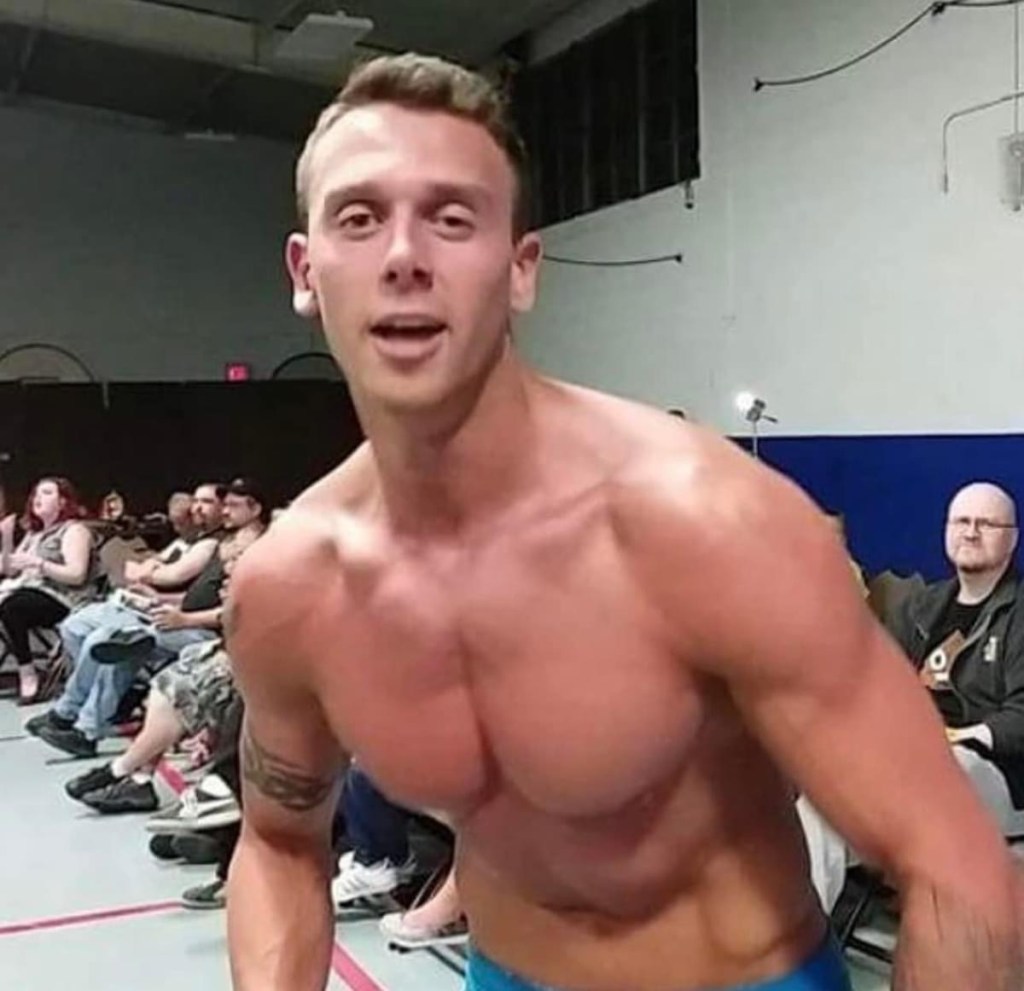
I really appreciate the fact that the majority of pro wrestlers today focus more on their fitness–and have much better bodies than the ones in my youth did.I can easily see this dude dancing shirtless at Oz during Southern Decadence.
In fairness, they were always right-wing; Rush and Fox just confirmed what they thought. ↩︎
Ah, Sunday in the Lost Apartment and how are you doing, Constant Reader? I slept pretty well last night, didn’t want to get out of the comfortable bed this morning, but nevertheless, here I am, having already downed one piece of coffee cake and cup of coffee and about to make a second cup. I don’t feel completely awake just yet, but I am hoping by the time I finish writing this I’ll be all warmed up to get back to my writing. I did some yesterday, about a thousand words or so, and I need to get strapped in and back to work this morning. Yesterday was an okay day; I didn’t get as much written as I would have liked, but I got some writing done. I didn’t read much of my book yesterday. Paul was off getting another tattoo and brought home a pizza from Midway on Freret (which is amazingly good, for the record). He didn’t get home until late, so we watched the first two episodes of The Recruit (there are so many of these similar type shows we’ve watched that we aren’t really sure which one is which, and the plots all kind of blur together, but they’re entertaining enough to watch), and I was tired and went to bed. I did also run my errands yesterday as well, and was very tired when the second episode finished; I was dozing off during it, which was why I thought it best to just go ahead and go on to bed and be done with the day, which is always a good thing now that the timeline of my life is now in the “collapse of the country” final stage. Woo-hoo! Just what I always wanted and dreamed of.
I was thinking yesterday–I saw something somewhere on-line about people “needing to prepare to live in a dystopia”–and it hit me that I already lived in one; New Orleans after Katrina, with so much of the city in ruins and so much not open and so few people here. It was so eerily quiet in those days, a weird stillness that seemed so very wrong, and adapting to schedule my days around when things would be open because if you didn’t pay attention you could miss your window of opportunity to get groceries, of which there wasn’t much to choose from. Same with the gym, the post office, places to eat–there also was a shortage of workers, so that was another drawback to businesses opening. I considered getting a part time job on top of the ones I already had at the time, just to help out…I never did. That was also when I was probably in the best physical condition of my life, too–the only thing I had control over was my body, so I controlled it as much as possible. Good times, right? Sigh.
It’s also Black History Month, which isn’t being celebrated by the government this year since, you know, the country is being run by racists now–well, openly racist and proud of it trash–and are doing everything they can to take us back to the days when being queer was a crime, anyone racialized had no rights when it came to white people, and women were second-class citizens who were completely responsible for home and family (despite the fact that women have always been in the workplace as working professionals–but they were limited to what jobs they could have: secretary, teacher, librarian, waitress, flight attendant, etc.). I know it’s difficult for white people to read Black fiction because they aren’t used to not being the heroic center of the story1; but reading books by voices different than those that cater directly to you is necessary because you need to see other perspectives that are also valid. Works by Wanda Morris and Tananarive Due bring the reality of being Black during Jim Crow to vivid horrific life; I am still reeling from the horrific truth of both Due’s The Reformatory and Colson Whitehead’s Nickel Boys. I can’t encourage people enough to read Black authors, and not just for Black History Month, which is performative support as opposed to actual support–like your rainbows in June that disappear on the 30th, not to be seen again until June 1 of the next year. I appreciate even the performative support, honestly, but it doesn’t fool me that it goes very deep, either.
We all really just want to be left alone to live our lives in peace, you know?
But people who’ve never been oppressed will claim to be oppressed and play victim–how many times have we seen that play out? I’ve seen straight white women call gay men pedophiles (including me) publicly on social media, and then cry and make themselves the victim for the outraged reaction from the gay men. Yes, bitch, I’m the bad one for blocking you for calling me a pedophile. Drink bleach, bitch. I don’t forgive or forget homophobia; it’s the straw that breaks the camel’s back every single time. There’s never any coming back from that–and microaggressions also add up until I can’t make excuses for people anymore–and another life lesson of the last five years have been that even a microaggression has to be called out. If it talks like a homophobe and acts like a homophobe…yeah, they are inevitably a homophobe…and yes, even people who think they are allies can be homophobes. I never wanted to be THAT gay, you know, the militant constantly pointing out how offensive people are being and so forth…but why protect the delicate feelings of snowflakes who clearly don’t give a flying fuck about how I–or any other queer–feel?
I don’t think I’ll ever get tired of the schadenfreude of watching those racist white bitches who gleefully wouldn’t vote for the highly qualified Black woman finding out they are also DEI hires, that they were the primary beneficiary from equal opportunity laws, and now they can just put up with the sexist jokes and the not getting paid the same and not getting promoted that turned working women into feminists in the first place. What’s even more interesting, at least to me, is that the anti-feminist women (Phyllis Schlafly, Ann Coulter, and others of their ilk) who benefited from feminist activism worked to undermine their success–and undermined all other women in the process. I really wish someone would just say to Ann Coulter when she’s bloviating (hilariously, MAGA hates her and the Left will never go anywhere near her, so who precisely is her current audience? Racists who hate Trump? Huge audience there, Ann, well done.) “shut up, no one cares what you think, you’re just a woman who couldn’t get into an Ivy for law school.” (Which is why she hates the Ivys, right there. There’s a lot wrong with the Ivys and the public perception of their ‘greatness’–but not letting Coulter in is worthy of applause.) The hilarity that they also voted to preserve their abortion rights but voted for Trump–you just can imagine how fucking smug they felt in the voting booth–who might ban abortion nation-wide with an executive order made me roll my eyes at the mental gymnastics those smug racist misogynist skanks had to perform to rationalize their votes.
White women have always propped up white supremacy because they “believed” that it protected them. I would even go so far as to say it also afforded them a taste of power that they didn’t get to feel otherwise in their lives (Southern women really lean into that ‘steel magnolia’ thing, which has always bugged the shit out of me. Just say you’re proud to be trash and be done with it), because in antebellum times they had power over their enslaved (check out They Were Her Property sometime) and after emancipation, they were still “above” freed Blacks, even with the power of life or death over the men. (Louisiana’s bizarre inheritance laws, which I researched again for A Streetcar Named Murder, have everything to do with rich men down here having both white families and biracial ones; so they couldn’t disinherit the white family in favor of the biracial one…which was enough of a problem that it had to be legislated here.)
Ugh.
And on that somber sad note, I will head into the spice mines and get to work. Have a lovely Sunday, and I may be back later. One never can be sure.
Precious delicate little snowflakes that they are. ↩︎
That M People song was released in the mid-1990’s, and has become kind of a queer anthem in the time since. It was used in the original American adaptation of Queer as Folk, and it gets played a lot during Pride Month. I loved the M People; I have one of their CD’s and they were prominent on my dance soundtrack of 1994-1996 (“Sight for Sore Eyes” is still a great song I have on Spotify playlists today), which is also a time I am writing about (sidebar: maybe “Never Kiss a Stranger” is a novel not a novella), so it stays fresh in my head.
Pride is a direct response to shame–because so many of us were forced to live in shame about who we are and just existing for so fucking long, we now choose to come out and be proud rather than ashamed of who and what we are, despite the bigots who continue to try to legalize oppression of us while all we really want is to be left alone to live our lives in peace. I will never be made to feel ashamed of myself for who I am any more. And no, I’m not sorry that my existence bothers some people because you know what? Their existence bothers me–-but the primary difference is I am not trying to force them to stop existing or even to like queer people.
Pride is of course one of the seven deadly sins for Christians—Proverbs 16-18: Pride goeth before destruction, And a haughty spirit before a fall. Better it is to be of a lowly spirit with the poor, than to divide the spoil with the proud.
So, the use of the way “pride” for our month of celebration inevitably brings out the faux-christians, screaming about sin and…but as I said, our pride is the opposite of shame, and we are reclaiming ourselves and refusing to be shamed for who we are anymore. And yes, the shaming always comes from christians cishets (I prefer the French pronunciation shah-SHAY) —you know, the ones who are supposed to love without question? And ultimately, my life and my sins are between me and God—and none of your fucking business.
But this post is for those of you who stubbornly refuse to get it: my sexuality doesn’t impact you AT ALL.
Why do they need a whole month? Veterans only get a day is one of my absolute favorites. First, the use of “they”, while politer and not quite as insulting, is really no different from the ever-popular bigoted “you people”; so I guess props are in order for being slightly more polite (although I suppose if they knew it was politer they’d use you people, or to be grammatically correct, those people)? As for veterans only getting a day while we get a month, well, I don’t seem to recall legislation being passed on any level of government legalizing discrimination against veterans. (Although the way our government treats its veterans is disgraceful–and as always, the war hawks who love to send young men and women to risk their lives, mental health, and limbs for a foreign policy predicated on ensuring corporations make as much money as humanly possible will always vote to cut or eliminate veterans’ benefits while waving Support the troops! banners and flags–because they are nothing if not craven, vile, and completely soulless.) The combined efforts of government and medical science were applied for years to criminalize and stamp out the existence of queer people. Homosexuality was still considered a mental illness (!!!!) until I was twelve years old. How precisely does one grow up well-balanced mentally and emotionally when you are repeatedly told that what you are is actually insane? (And coming from a family where mental health issues are genetic…and knowing that I had my own mental health issues already wasn’t helpful; I thought for a long time the two were connected.)
And for the record, May is Military Appreciation Month, and the fact they don’t know this makes a mockery of their religion, their intelligences, and their feigned concern for the military.
If the cishets had to put up with, for one day–a mere twenty-four hours–what queer people do every day, they’d become homicidal.
And telling people they cannot legally discriminate against a fellow American citizen is not forcing them to accept and/or like queer people; it’s merely telling them they must treat queer people with the same respect they’d treat anyone (oh, the horror). The entire point of this country, from its beginning (although it has often failed to live up to that ideal) is that every citizen is equal in the eyes of the law–regardless of anything that might make them slightly different, especially when the difference is so slight as to not be noticeable. I don’t know why this is so hard for people, I really don’t. (And yes the convictions of Greg Stillson last week affirmed this guiding principle for the nation and his worshippers choosing to not accept that is more example of their utter contempt for this country, period. Some ‘patriots’.)
And if you don’t want to be compared to Nazis, then stop coming for marginalized groups and scapegoating them. Your dishonesty is not only un-Christian, but inhuman. It is not for other humans to judge sin; that is, per your own Holy Book and what you theoretically believe, reserved for a God who is very jealous about what is His and what is not. I believe in Christianity as a game-plan or road map to being a good person and doing good things in my life; I do not believe in talking snakes or trumpets so loud they can make walls collapse or that having heatstroke on the road to Damascus was actually divine intervention. I do not believe Paul had visions of Jesus, so anything written by him in the New Testament is suspect and not gospel.
I am also willing to account for that, if need be, if there ever actually is a Judgment Day. But what I believe is between me and God. To paraphrase Cher, I account to three people: myself, Paul, and God.
What I do know is that if there is a God and such a thing as a heaven, going to church three times a week while acting like a hateful piece of trash the rest of the week ain’t getting your ass into your heaven. You’re literally doing the bare fucking minimum, and those three hours or so you’re spending in church are just a waste of your time because you aren’t learning anything or striving to be better.
And any heaven that welcomes people like Phyllis Schlafly, Anita Bryant, Maggie Gallagher et al is not my idea of heaven; spending eternity with those people would be Hell.
This year, Pride seems all the more important–certainly more than it has in years. I haven’t been to Pride in a very long time–I’ve been to a lot of Prides over the years–and probably won’t attend this year either; it’s too hot for one, and the older I get the less I like being hot, sweating, and tired in crowds.
I hate to break it to the homophobic trash, but nothing you say is original or something we haven’t heard a gazillion times before. I’ve said it before and will say it again: fuck all the way off. Miss me with your concerns about “the children” when you aren’t concerned, for example, about the need to teach kindergartners what to do if there’s an active shooter in their school. Miss me with your concerns about “the children” when the states passing the worst anti-queer laws are the same ones where child beauty pageants are the most popular. Where is the outrage about sexualizing children in that instance, Moms for Liberty? Yes, painting a six-year-old’s face like she’s a streetwalker and dressing her provocatively for a chance at a sash and a trophy is absolutely one-hundred-percent okay with you? These are also the same states that allow underage marriage and have almost complete abortion bans.
Moms for Liberty is just another incarnation of the hate group One Million Moms (who never ever had more than fifty thousand members); which is why I always say queers can never completely trust a lot of straight white women. (Let’s never forget that straight white women gave us President Donald Trump. Ever. This should be their everlasting shame.)
It’s also going to be interesting to see what companies and corporations will be making a play for queer dollars during Pride Month, while donating money to anti-queer politicians and stay silent when all these horrendous laws are being passed. Target? Anheuser Busch? Miss me with the rainbows and pride statements this year. You have a chance to stand up when it mattered and instead you turned into pathetic sniveling cowards waving a white flag–proving that your so-called “commitment” to equality and my community was nothing more than a disgusting, shameless attempt to attract queer dollars and the money of our allies. Shame on you both. I don’t drink beer, but when I did I drank a lot of Bud Light in gay bars because of their support of the queer community. But when they had an opportunity to take a principled stand for equality and against bigotry, they crumbled like a finely aged feta. Same with Target, which was even sadder because they had been so supportive. But I will never step inside another Target and I will never order from their website. My Target credit card will get paid off as quickly as possible so they make as little money from me in the future as possible, and I have already cut it up because I will never support that shitty, backstabbing, cowardly piece of shit company again.
I’ve always kind of had an issue with the corporatization of Pride over the years. Yes, I get it; they are usually non-profit organizations who need to raise money to pay expenses and put the show on. You need donors for that–as every nonprofit does–and so the swing to wooing businesses and multi-billion dollar corporations began…as well as the complaints about the merchandizing of Pride. But Pride was, and always has been, an event to celebrate every color in our rainbow and to show the world that we’re here and we aren’t going anywhere; we are not ashamed nor will we be shamed. We aren’t going back into the closet for anyone. Period.
It’s always amused me to listen to people complain about Pride, with the leathermen and the kink fetishists and the drag queens. “I don’t want my kids to see that!” Then keep your fucking kids at home. Any Pride that turns it back on any part of the community is notPride. I’m tired of being penalized because other people have had children—your children are NOT my responsibility.
I already pay taxes to educate them.
I also hate the shaming of kink; the attempt to remove drag queens and the leathermen and so forth from Pride celebrations because that makes the straights uncomfortable frankly disgusts me. Just because some queers have issues with kink—well, that’s their problem, and if anything, we all should be grateful to them. The leathermen and drag queens were out and proud when a lot of their current critics cowered in their closets, while the kinksters and queens were out fighting for the rights of the cowards, creating a community and a world in which they were free to come out…only to want to drive the people responsible for that freedom and community out of Pride. “I want to bring my kids to Pride but I don’t want them to see that.”
What the fuck, people? Don’t you understand that the only reason you can be queer in public with your kids is becauseof the very people you don’t want your children to see? It’s bad enough the straight use “the children” to try to take away our rights; it’s even worse when people within our community try the same tactics. I don’t know, maybe reexamine your own internalized homophobia rather than trying to reshape the community?
The original Prides were protests, and the original parades were protest marches. Seeing how Pride has, over the years, sold its soul and meaning to corporate sponsors saddens me. Those sponsors are mostly interested in queer dollars only (see: Target and Budweiser) and not in actually supporting the community and our rights (see: Target and Budweiser); you can tell by how quickly they back down when the Christofascists have a problem with their support of our community (see: Target and Budweiser).
That shallow support is unwelcomed and unwanted and very transparent.
Learn your history, queers. It wasn’t that long ago—during my own lifetime—that our sexuality stopped being considered mental illness. We’ve come pretty far in those fifty years, but we have a long way to go and the fight is not over. So, come out to Pride, and celebrate our hard-won freedoms. Be visible; because that visibility might help someone else come out and stop feeling shame. Create and live and love and vote and above all else, maintain queer joy in your life.
Because all of those things? Well, they’re also victories.
Several weekends ago, I did an on-line panel for Outwrite DC. The moderator was John Copenhaver (whom you should already be reading), and my co-panelists were the always delightful and intelligent Kelly J. Ford, Margot Douaihy, Renee James, and Robyn Gigl. The video is actually up on Youtube, if you would like to watch it. John’s questions were insightful and intelligent (as always), and the conversation was marvelous, inspiring, and fun; there’s nothing I love more than communing with other queer crime writers (or any writers, to be certain), and I always try very hard to not monopolize panels because I do have a tendency to talk too much–especially if and when I get going on a topic I am passionate about. So, I thought it might be fun to take John’s questions and turn them into a long form interview, for thoroughly selfish and totally self-promotional reasons.
The panel blurb claims that “queer characters are riveting and necessary material for crime fiction and how those stories can shape (and perhaps reshape) the landscape of contemporary crime fiction.” Do you agree with this statement—and why do the stories of queer characters have the potential to shape crime fiction?
I completely agree with this statement. Queer crime fiction has a very proud history that was never really recognized or appreciated by the mainstream crime writers, readers, organizations, and conferences. That is changing for the better.
New blood is always necessary for any genre–horror, romance, crime, literary fiction–because genres tend to stagnate after a certain period of time. The cultural shifts of the late 1960’s and 1970’s echoed in crime fiction, for example; you couldn’t write crime in those periods without addressing all the cultural and social shifts; Ross Macdonald’s later novels are a good example of this. The 1970’s saw a lot of anti-hero books being written. The private eye sub-genre had grown quite stale by this time, which was when the women really moved in and gave it a shot of adrenaline–Marcia Muller, Sara Paretsky, and Sue Grafton blazed that trail, and revitalized a sub-genre that had kind of lost its way. Queer writers and crime writers of color are currently doing the same to the entire genre. Voices and perspectives we aren’t used to seeing are now getting into print and changing how we see, not only our genre, but each other. Crime fiction has always given voice to societal outsiders and outliers; queer people and people of color are the ultimate outsiders and outliers in this country. Who better to tell stories of societal alienation?
Why did you choose your sub-genre? How do you think the sub-genre has influenced the types of characters you write?
Well, I write in several different ones. Chanse MacLeod was a straight private-eye series; Scotty Bradley was more of an amateur sleuth/humorous series, but he does have a private eye license in Louisiana. A Streetcar Named Murder was a cozy, with an amateur sleuth heroine who gets caught up in a family mystery. I’ve also done young adult and “new adult,” whatever that is (it’s been described as ages 16-25), and Gothics with a touch of the supernatural. I tend to write things that I like to read, and I have a varied reading taste. I started writing the Chanse series because I wanted to do a harder-edged private eye series with a queer twist and set it in New Orleans. I didn’t know about J. M. Redmann’s Micky Knight series when I started writing Chanse; would I have done something different had I known she’d already covered the hardboiled lesbian private eye in New Orleans? We’ll never know, I suppose. Scotty was meant to be a lark; a funny caper novel and a one-off. And here we are nine books later…
As for Streetcar, I had been wanting to try a traditional mystery with a straight woman main character for a long time. When the opportunity presented itself, I jumped in with both feet. I like trying new things and pushing myself. Having to follow the “rules” of a traditional cozy was a challenge–especially because I have such a foul mouth in real life. I love noir so am working on two different gay ones at the moment.
Why do you think amateur detectives are appealing? Do you think there’s a reason queer characters often find themselves in the role of amateur detective?
I think it’s because we all think we’re smarter than the police? We enjoy seeing a character we can identify with figuring things out faster than the cops, especially without access to all the evidence, interviews, and forensics the cops do. Murder She Wrote has been off the air for about thirty years and yet the books based on the show continue coming out every year. If we start out in mysteries reading the juvenile series–Nancy Drew and the Hardy Boys and Judy Bolton and all the rest were amateurs, so we always cut our teeth in the genre with them to begin with. Scotty is basically an amateur, even though he has a private eye license he rarely uses; he and the boys never get hired (although they kind of do in the new one, coming this November.)
Let’s talk about place. Greg, your books take place in the South. Why is place important to the crime novel—why is it especially important to the queer crime novel?
Place shapes who we are–not just as queer people, but as people in general. There are similarities between growing up in a small town in the Midwest and growing up in one in the South, but the differences are very marked. I’ve lived all over the country–pretty much everywhere but New England or the Northwest–and always felt, as a Southerner (despite no accent and not growing up there) like an outsider. Couple that with being gay in a time when it was still considered a mental illness, and you have someone always on the outside looking in. But I have that Southern pull to write about the South–although many would say that writing about New Orleans and writing about the South are not the same; like me, New Orleans both is and isn’t of the South, and I feel that very strongly. I’ve written books set in California and Kansas, even one in upstate New York, but I very much consider myself a Southern writer.
Place is even more important in a queer crime novel because place shapes the queer people so much. As a writer, I think one of my strengths is setting and place, and I think that comes from being very much a fan of Gothics growing up. Gothics are known for place and mood, and I think those are two things I do well.
All of you write wonderfully flawed characters. Sometimes, as LGBTQ+ writers, we feel the burden of representation and the urge to write only positive LGBTQ+ characters as an attempt to undo history’s (the dominant culture’s) demonization of us. Unfortunately, that can be limiting—even flattening. Clearly, you’ve all struck a beautiful balance with your characters. Talk a bit about how you approached this issue.
The flaws, to me, are what make the characters seem real. Nancy Drew and the Hardy Boys always annoyed me because they were so perfect; no one is that perfect, and anyone that close to perfect in real life would be irritating and insufferable. I am am quite aware that I am flawed (one of my biggest flaws is believing I am self-aware because I most definitely am not), but I am not trying to be perfect; I just want to be the best version of myself that I can be. By showing queer people with all their facets and flaws and failures and blind spots, we’re showing the reader that we are human; despite what those who hate us say or claim, we are human beings just like everyone else, just trying to get through life and do the best that we can. The villain in my first book was a gay man–and the entire book was a commentary on how we, as queer people, tend to overlook flaws and red flags from members of our own community. Just because someone is queer doesn’t mean they are a good person–and queers with a criminal bent do exist, and often take advantage of that sense of camaraderie we feel with each other, especially when we don’t know the person well. I tend to trust a queer person more readily than I will a straight person, and that’s wrong–which is why I think we feel so much more hurt when queer people betray us.
Speaking of the demonization of LGBTQ+ folks … Ray Bradbury of Fahrenheit 451 fame said, “There is more than one way to burn a book. And the world is full of people running around with lit matches.” What do you think about the current tactics to ban queer books from schools, libraries, and even bookstores in places like Florida, Arkansas, and Texas? Why are they targeting queer books?
This is, I hope, the last gasp of the homophobes who’ve never updated their hate speech in over fifty years. What the hate group “Moms for Liberty” are doing and saying is no different than what Anita Bryant said and did in the 1970’s, what Maggie Gallagher and her evil co-horts at the National Organization for Marriage repeated, then came the One Million Moms…all too often it’s the cisgender straight white women who are the real foes of progressive politics who fight to uphold a bigoted status quo. They always claim they’re concerned moms worried about their children–but are perfectly fine with them being shot up at school; working in a meat factory on the night shift at thirteen (have fun in hell, Sarah Huckabee Sanders, when you get there and French-kiss your Lord and Master Lucifer); or shouldn’t have the right to vote…they know better than a child’s actual parents, you see, about what the child needs or wants. Maybe they should spend more time with their own children than worrying about everyone else’s? Phyllis Schlafly, queen skank of the conservative right, ignored her own family while she embarked on her crusade to strip women of their rights and autonomy–all the while shrieking like a hyena into any microphone nearby that she was fighting progress to save the American family while selling some Leave it to Beaver-like nonsense as reality. I always felt sorry for her gay son. Imagine that as your mother.
As for why, it’s about control and power. I actually respected Anita Bryant more, because she truly believed all the vile, horrible, unChristian things she said and espoused. Most of the others, including the unspeakably vile and disgusting Moms for Liberty, are working a grift for money, attention and power. Hilariously, they’ve sold their souls in the worst possible way in the guise of family, religion and God; if they’ve ever actually read their Bibles, they need to work on their reading comprehension skills as they are both apostates and blasphemers who will spend eternity doing the breast stroke in the lake of eternal fire. Hope they enjoy it.
Sorry your husbands and children don’t love you, but who can really blame them?
What are you working on next? What’s coming up?
I have a short story in an anthology called School of Hard Knox from Crippen and Landru (and somehow got a co-editor credit for the book with Donna Andrews and Art Taylor); Death Drop, the first in a new series from Golden Notebook press, drops in October; and the ninth Scotty comes out in November, Mississippi River Mischief. I am writing a gay noir, and may be writing second books for the new series I started with Crooked Lane last year as well as a sequel to Death Drop, and have a couple of short stories I want to finish to submit to anthologies I’d love to be in.
Growing up as a queer kid in the 1960’s and the 1970’s wasn’t the easiest path to trod. First came the realization that my wiring was different from everyone else’s, followed quickly by the shame from being different and of course, the ever-popular feeling among queer kids when they recognize their queerness that I was the only one in the world and no one, under any circumstances, could ever know. I honestly don’t remember the first time I came across a gay character anywhere–it had to be in a novel, though–and I slowly became aware that it wasn’t just me, but there weren’t any others like me anywhere around me. (I do sometimes wonder how differently my life would have turned out had we never left the Chicago suburbs for the empty plains of Kansas; I certainly would have met other gay men much earlier in my life but….being an out gay man in Chicago in the 1980’s might not have boded well for me otherwise in the long term, if you catch my meaning.) I do remember the first gay characters I saw in film and television; I remember being highly entertained and feeling connected, in some way, to celebrities like Paul Lynde and Charles Nelson Reilly; but Liberace’s flamboyance repelled me. The few times I’d seen gay characters they were horrific stereotypes, and I can remember being confused, thinking I’m not like that, though. I can remember TV movies like That Certain Summer which was about a gay man coming out to his son and his son having to deal with it; I didn’t watch because I was afraid that watching it, even though it was an ABC Movie-of-the-Week, would tip off my parents and my sister that I was like that–or even just curious about it, which wouldn’t fly.
It was Billy Crystal as Jodie Dallas on SOAP that gave me my first real exposure to a continuing regular series character who was a gay man–and his confusion (which had a lot to do with the writers fighting with the network censors and trying to appease the gay community) about his gender and sexuality in that first season struck me as a bit on the absurd side–but I also understood his thinking well had I been born a woman this would have been all a lot easier.
Of course, now, as an adult gay man with years of living the life behind me as well as writing about it, I see how incredibly absurd on its face was that story-line.
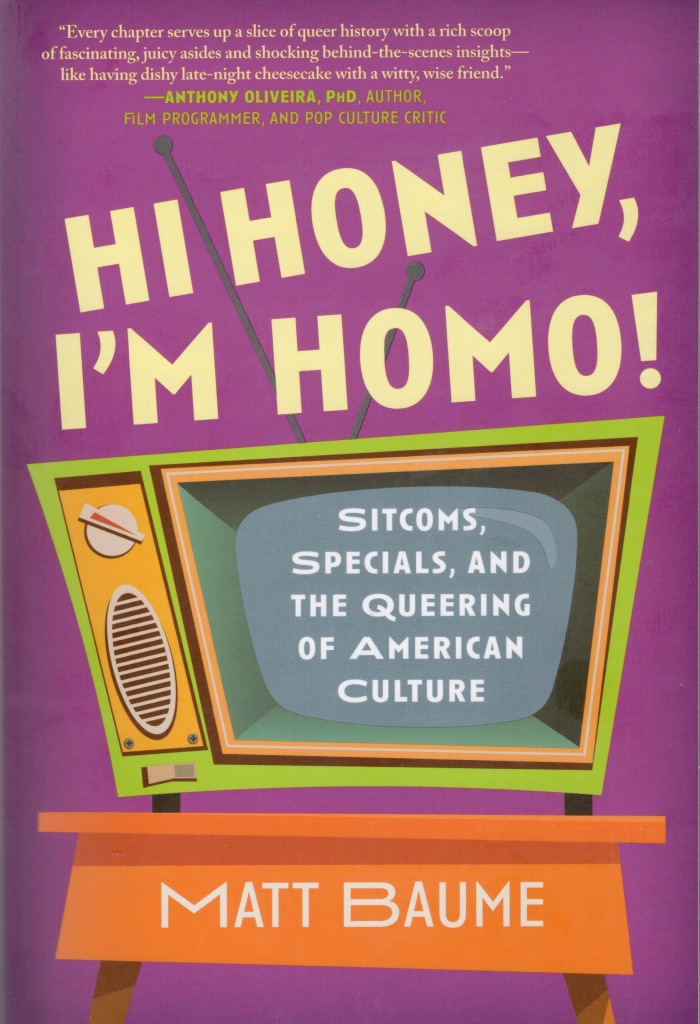
I first found Matt Baume’s Youtube channel during the pandemic, as I was scrambling to find things to watch while i made condom packs and did other make-work at home duties to maintain my paycheck. I may have found him through James Somerton’s channel? But while Somerton is often very dour and doom-and-gloom and “this is how they betray us” (don’t get me wrong, there’s a place for that and it’s needed), Baume is much more cheerful and positive about representation: he presents queer rep in popular culture in the context of the time; what the show/movie creators were trying to do with the rep; why they chose to do the rep in the first place; and the battles and struggles they had to make sure their rep made it to the viewers the way they wanted it to–and how that representation may have helped change hearts and minds when it comes to queer representation in art and culture. So when I found out Baume had written a book about queer representation in network sitcoms–written versions of his Youtube channel most likely–I had to have it.
I’m really glad I read it, too.
The essays contained within are well-written in a light, easy to read and comprehend way, without all the academic language that inevitably drags these kinds of things into the impenetrable territory that gets cited in other academic papers but otherwise never get read. Each chapter, from Bewitched through Modern Family, also contextualizes the queer representation in its time and place within the sociopolitical climate of each show, as well as the queer influences. Bewitched was probably the queerest show to ever air, be a hit and win Emmy Awards before Will and Grace; which makes it all the more memorable is that it was all coding and subtext, with witches standing in for queer people–and the similarities were obvious: they had to hide who they were from mortals for fear of persecution, bigotry, and violence. Sound familiar?
Baume also names and shames all the anti-queer activists of my lifetime, from Anita Bryant to Donald Wildmon (my own personal nemesis) to A Million Moms and so forth; Wildmon himself is probably the worst of them all; much as I loathe Bryant, I think she sincerely believed that queer people were a danger and sinful. I also think Bryant and Phyllis Schlafly were the last true-believer homophobes to lead movements; everything since has been a cynical grift for money and political power. Ronald Reagan and the Republicans saw, in 1980 and with the evangelical turnout in 1976 that carried an actual Christian to the White House (Carter was perhaps the most truly Christian president we’ve ever had; his religious values colored his policy. It’s ironic that Christians hate him as a general rule and always point to him as an example of a failed presidency rather than what his presidency actually proved; a true Christian believer isn’t pragmatic enough to lead a country; because sometimes, as The West Wing noted in an episode title, sometimes you have to kill Yamamoto; things for the greater good that are horrific on a personal level) and noted that “lip-service” to “Christian ideals” was all it took to get “Christians” to vote for you.
And this is a good place to serve as your regular reminder that the “party of family values” elected our only divorced presidents, yet are the same people who tried to remove Bill Clinton from office for lying about a blow job because it was evidence of his poor character and someone with such poor character shouldn’t be president.
I recommend this book, not only because it’s an interesting look at the evolution of queer representation in television comedy series, but because it also is educational by tracing the opposition to queer equality during the same time period.
I also learned by reading the book that Baume was the Communications Director for AFER, an organization that fought for marriage equality. So, buying and reading his book is also an excellent way to say thank you for his advocacy.

 Queer and Loathing in America