New Fire from an Old Flame

I grew up watching soap operas, and yes, soaps also influenced my development as a writer–which means I have to be careful not to slip into melodrama.

I know my grandmother watched them, and so did the lady down the street who babysat us in Chicago: One Life to Live, General Hospital, and Dark Shadows. I’ve always recognized Dark Shadows as a major influence on me as an artist and author; that and the old black-and-white crime movies my grandmother loved to watch with me. It’s why I’ve always had a taste for the dark and Gothic, and Dark Shadows merged horror with mystery in an expert blend that I can vividly recall to this day–and often go there in my work sometimes.

One Life to Live was always interesting, and they did stuff other shows weren’t doing. Viki’s Dissociative Identity Disorder storylines–including when it came back when she was under heavy emotional stress, usually involving memories of her father–was riveting; so was the Carla storyline, in which a beautiful young light-skinned black woman was passing for white, and involved with a white doctor. (I was terribly disappointed to find out, years later, that actress Ellen Holly, the first Black female star of a soap, received death threats and was also victimized by bigotry within the cast and crew and network.) It was never a favorite through the late 1970s and 1980s, but I watched; Erika Slezak was terrific as Viki and Robin Strasser was INCREDIBLE as her arch-enemy and stepmother, Dorian Lord. Andrea Evans returned in the 1980s as Tina, Viki’s ward…only to find out that Tina was actually her half-sister because her mother, Viki’s best friend, had an affair with Viki’s father…which led to yet another return of Viki’s DID.

Like all soaps, it was complicated.

But it was in the 1990s that One Life to Live became must-watch television.

Novelist Michael Malone was hired, out of nowhere, to be the headwriter, and he reshaped the show completely to his vision of what good storytelling should be, and the issues the show should be bringing forward. He introduced some new characters, slowed down the pacing of the show, and dove into the interior lives of the long-term characters, as well as their history. There were any number of explosive storylines during this period that made the show must-watch television; I recorded it every day so I would never miss anything. (All My Children and General Hospital were also having glorious runs at the same time; ABC was firing on all daytime cylinders.)

And then they brought in a new character, a friend of Viki’s son Joey, Billy Douglas–which was also Ryan Philippe’s big break.

Seriously, how adorable was young Ryan Philippe?

Daytime had dipped their toe in the water of queer characters before, before quickly ending the storyline and writing the character out. But in the early 1990s, Malone was willing to push the envelope and confront homophobia in all of its ugliness. It began with the arrival in town of Reverend Andrew Carpenter, who was shortly followed by his father, Sloan, from whom he was estranged. The reason of the estrangement was the father’s rejection of his gay son, who subsequently died from HIV/AIDS. Andrew can’t get past how his father rejected his brother due to homophobia, and they didn’t reconcile before the brother’s death. Already something was building here, and then Joey Buchanan’s (Viki’s younger son) friend Billy–a popular athlete, just elected class president–comes out to him. Joey is surprised, but accepting, and is there for Billy as he agonizes over what to do. Eventually, he goes to Andrew for counseling–and young villainess Marty Saybrooke, whose romantic interest in Andrew has been rebuffed, overhears the counseling session and tells everyone that not only is Andrew gay, but he’s been grooming (the term wasn’t used there) Billy into becoming gay too! The town is then torn asunder over the sudden outbreak of homophobia; Billy comes out to his parents and is rejected by his father, everything comes to a head, and the truth comes out–and Marty would get “punished” for her crimes later, in the most horrific way possible (again, must-watch television)–and Andrew and his father reconcile; the AIDS quilt is brought to Llanview; and people become more accepting of Billy. They introduced a love interest for him, but viewer reaction to this was harsh, and so they wrote Billy out by sending him off to Yale, never to be seen again.

Since then, almost every show gradually had gay or lesbian or bisexual characters, but I have stopped watching soaps, finally giving up on them in the late 1990s because I couldn’t really spare the time to watch anymore. But Billy, acted brilliantly by young Ryan Philippe, and beautifully written, was one of the first and best portrayals of a gay teenager on television, and I’ve been a fan of Philippe ever since.

It’s a shame One Life to Live no longer airs, going down in the bloodbath of soaps after the turn of the century. The show’s run in the first half of the 1990s was extraordinary–including the brilliantly conceived and written gang-rape of Marty that happened at a fraternity party, and the aftermath was explosive and brilliant. One Life to Live at the time also had a fantastic cast, wracking up Emmy wins left and right…and it was shortly after the Billy storyline concluded that they cast Nathan Fillion as Joey–and another fandom was born for me.

I’ve often wondered how much impact that story and character had on the public perception of queer people as well–during the Clinton administration things began to look up a bit from the horror of the 1980s, and I think television definitely had something to do with it, with positive representation.
Athol-Brose

Sunday morning in the Lost Apartment and how the hell are you, Constant Reader? I slept super well last night–much better than Friday night, which felt really great–and am a-rarin’ to go this morning. Yesterday was a good day, frankly and surprisingly. I woke feeling rested and well, managed to get some things going in the morning, and kept getting things done for most of the day. I also took it a little easier than I usually do, resting and relaxing for a bit before getting up again to do something else. Thus I managed to get some things accomplished.

After doing some kitchen organizing yesterday (and filing), I started going through that box of clippings and magazine copies, to better organize them in another box, and found all kinds of things that are marvelous. I’ll do some scanning today, so that there’s an electronic version of everything preserved for all time. The Queer Crime Writers group has expressed some interest in archiving some of the articles and reviews of crime authors and their books…it was funny, but it’s been a long time since I looked at those old issues of Lambda Book Report, and while I am still proud of them, it’s been long enough that I can look at them critically and see the mistakes and flaws and so forth. It was also kind of interesting because I forgot, for one thing, that I interviewed Margaret Cho for Lambda Book Report, or that Paul used to do author interviews, and so forth. It was kind of cool experiencing the nostalgia of seeing them, or the old Saints & Sinners programs from the first years, when I had to do the layout and design for them (which is why they all look so amateur hour) but I also used to do that for Lambda Book Report too. There were also clippings from other gay papers, including the local IMPACT News which then became Southern Voice-New Orleans before folding completely, the Times-Picayune, Gambit, and St. Charles magazine. It’s hard to believe, really, that I’ve been in and around the publishing business for as long as I have. It’s also kind of eerie. I’m trying not to be a cliché, but seriously, where did the time go?

I also walked to the Office Depot during the afternoon rainstorm yesterday to get ink for the printer and some notepads. I live for the 5 x 7 legal pads, and I’ve been down to my last one for quite some time, which inevitably throws me a bit off-balance, as I use them for everything, from grocery lists to “what to do today” lists” and making notes to myself to remind myself of things. I just feel better knowing there are eleven notepads in the cabinet, next to two blank journals, for me to use if and when I need one again. It’s odd how comforting that knowledge is, so it’s clearly one of my (many) neuroses.

I also started watching a true crime series on Hulu–Paul was meeting a friend for dinner and drinks last night, so I was left to my own devices–about Billy Milligan, a serial rapist who had dissociative identity disorder at a time when not much was known a bout it; many people to this day don’t believe Milligan actually had the disorder, but was simply a very good actor (The Crowded Room series on Apple Plus is based on his story), but I stopped watching by the fourth episode. Do I believe DID is a thing? Sure, why not? Even if the Sybil case turned out to be a fraud, I do think the mind is capable of splintering like that when faced with a horrific trauma; ironically, this illness was depicted beautifully over the years for Victoria Lord on One Life to Live (winning her portrayer, Erika Slezak, a ridiculous amount of daytime Emmys over the years); it began when first shown as part of the melodrama with some research done into it; as more information about it became available and more studies were done, that was also explored over the years as it reoccurred, finally culminating with the truth that she was molested by her father–that was the initial trauma that shattered her mind. I’d like to write about this sometime myself, because it’s interesting to me, but it would take a lot of research because I’d want to do it right, you know?

I got a lovely compliment on a story I contributed to an anthology yesterday, which was unexpected and lovely–especially since I hadn’t felt confident about the story when I sent it in. It’s another Alabama story, which makes me happy, and I pulled up the electronic last version I had with me here at the house and…it’s full of mistakes. I just hope that wasn’t the version I sent in. But it’s a story I wrote a long time ago, based in some sort of reality. When we used to visit Alabama in the summer time, my aunt and uncle lived in the county seat in a nice brick one-story three bedroom house whose back yard gently sloped, gradually ending in what my cousins (and everyone) just called “the ditch.” I never really knew how it was created or where it came from–in the story I referred to it as a branch of the river that was dammed up and so it dried up–but it was about twenty feet wide and fifteen foot deep; and the bottom was just as I described it–littered with rusting cans and broken glass and other debris. But it was also cool down there as it was completely shaded by all the trees lining the sides (that’s what gave me the idea that it may have been a branch of the river; it does kind of look the shores of a river); there was also a path from the back of the house to an ancient wooden footbridge to cross to the other side. I wrote the story “The Ditch” originally years ago, I think possibly for a Horror Writers Association anthology, and it was rejected. I liked the story but knew it needed more work, and when I dragged it out to use for this anthology I did a strong revision. It is a much better story now than it was, but please God, tell me I didn’t turn in this error-riddled version. More on that anthology as it develops.

I also made a list of things I need to get done today (yay for little legal pads!) and am feeling pretty good about everything this morning. It really is amazing what a difference sleep makes, isn’t it? I woke up early this morning, am enjoying my morning coffee, and I finally feel like I am part of my own reality again (it always takes a while for me to readjust to my normal daily routine). I also have some writing and reading to do today, and I hope to get to work on the page proofs either today or sometime this week.

And on that note, I am heading back into the spice mines. Have a lovely day, Constant Reader, and I’ll check in again at some point, no doubt.

Dark Shadows (Josette’s Theme)

I always forget this when I am asked about major influences on my life, writing, and career–but probably the biggest influence on me was the television soap Dark Shadows.

“My name is Victoria Winters…”

So began the first episode, with young heroine Victoria speaking over some rather spooky music, usually with a background scene of a light in the window at the great house of Collinwood in the fog, or waves crashing against the beach, or the family cemetery, or even the Old House.

Dark Shadows is probably the root or seed from which Bury Me in Shadows was grown from, now that I think about it more. A haunted old house, an even older house in ruins nearby in the woods that was the original family home, ghosts and secrets from the past–oh yes, the framework is absolutely there, and it never even occurred to me.

When my sister and I were kids, we moved to Chicago from Alabama. I was about two years old, give or take; I don’t remember moving up there nor do I remember ever living in Alabama; my sister was two years older. My parents both got jobs–the point of the move was for climbing the economic ladder; they both got really good jobs in factories while my dad finished his degree. But because they both worked (our friends and neighbors all felt sorry for us because our mom had to work; their moms all were housewives), we needed to be watched while they weren’t home. Our landlady recommended a woman down the street–a mother of six whose two youngest were in their last years of high school–and so we started spending our days with Mrs. Harris, who fed us breakfast and lunch, and Mom would pick us up on her way home from the bus stop. When we started school, we went there for breakfast and lunch but came home after school; school let out at 3:15 and Mom was usually home by 3:30. But it was Mrs. Harris–and my grandmother, who worked a night shift–who got me started watching soaps in the first place. One Life to Life and General Hospital sort of held my attention, but it was Dark Shadows I couldn’t wait for. I used to run home from school to try to catch the last five or ten minutes during school; it wasn’t a problem during the summer.

I loved Dark Shadows.

I was crushed when it was canceled.

I mean, look at that house!!!!

The show wasn’t canceled, although the ratings were starting to slide a bit in the later years. The truism that Dark Shadows‘ producers and writers discovered is one that practically every other continuing series having to deal with the supernatural and supernatural creatures has had to deal with: how do you keep topping yourself and raising the stakes? True Blood, Supernatural, The Chilling Adventures of Sabrina, and countless others have all run headfirst into that wall. Once you’ve done time travel and vampires and witches and werewolves and Frankenstein and other dimensions, what is left to do? I admire them for pulling the plug rather than getting more and more desperate to get the ratings up and eventually damaging the legacy of the show.

The show was a phenomenon the likes of which had never really been seen before in daytime–and the lesson learned from its success (go for the young audience!) would soon lead to the creation of youth-oriented shows like All My Children and The Young and the Restless–and of course in the mid-1970’s soaps would be forever changed when General Hospital introduced the character of teenager Laura Webber, played by an actual teenager, Genie Francis–and daytime was never the same. But Dark Shadows managed something that other soaps hadn’t–they created teen idols. Jonathan Frid as Barnabas, David Selby as Quentin, and even David Hennessey as David Collins were often on the covers of teen magazines like Tiger Beat and 16. The show even licensed FAN FICTION–a series of books based on the characters from the show, but thanks to all the fun stuff with time travel and parallel dimensions, Dark Shadows was perfect for spin-off books that took place in other Dark Shadows universe; one could even say Dark Shadows was one of the first shows to make use of a multi-verse.

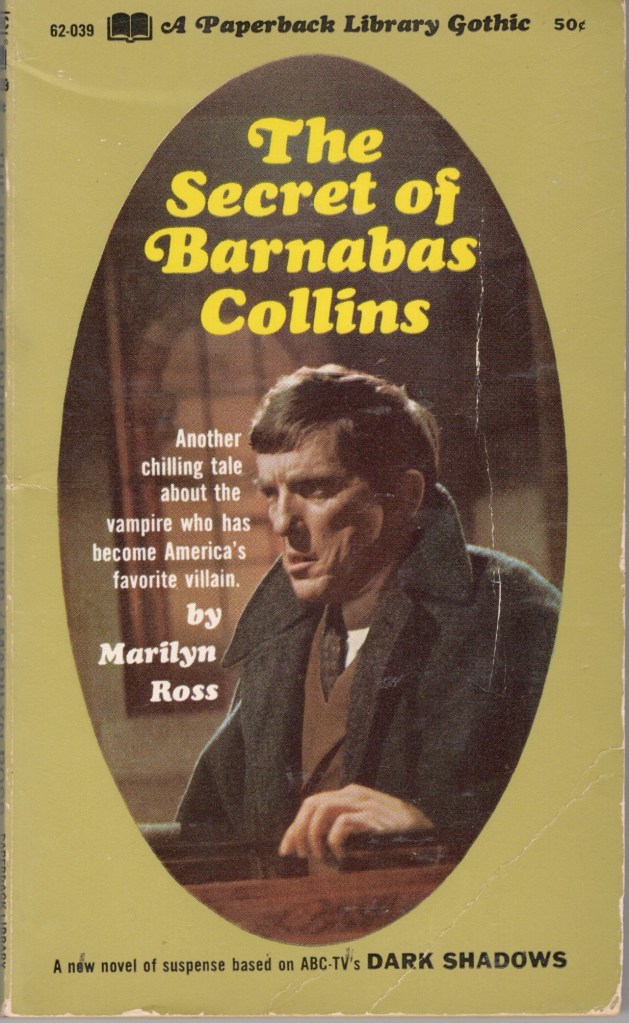
The books were cheap–as you can see in the picture above (a copy sent to me by a friend with whom I bonded over our mutual love of the show) they ran between fifty cents and seventy-five cents a copy; they all had that same gold bordered cover with an oval image of characters from the show, and they were all written by “Marilyn Ross”, which was a pen name for a very prolific Canadian author named  William Edward Daniel Ross; he wrote over three hundred novels during his career, and Marilyn Ross was the name he used for Gothics–and the Dark Shadows books. (He also wrote as Clarissa Ross, and I read some of those novels as well, including The Spectral Mist.) They also weren’t particularly well written, and while they did take place outside the show’s continuity, there were also moments in some of them that didn’t make sense; in one of them, in which Barnabas shows up at Collinwood in the 1910’s, the only son of the family dies in a tragic accident…but if he was the only son, where did the present day Collinses come from? (The earlier books were told from the perspective of Victoria Winters, and in some cases the gimmick was some member of the family was telling Victoria a story about the family history.)

That’s the kind of shit that drives me insane.

But I remember when one of the off-brand television channels in Chicago (not affiliated with a major network) started running repeats of Dark Shadows from the very beginning when we lived in the suburbs in the evenings while the networks ran the evening news–guess what I was watching instead? Yup, Dark Shadows. (I always found it interesting, too, that the young actress who played Victoria Winters originally–Alexandra von Moltke–eventually became infamous as Klaus von Bulow’s mistress Alexandra Isles, who was, in the prosecutor’s theory, the reason Klaus injected Sunny with enough insulin to induce the coma from which she never woke up. But I digress.

I always wanted to write a vampire story similar to that of Barnabas Collins; I have an entire idea for a rural Louisiana version called Bayou Shadows that I’ve tinkered with off and on since the early 1990’s…but then Charlaine Harris started the Sookie Stackhouse series, which was essentially the same thing. I still might write about Bayou Shadows–the town called that has popped up from time to time in my books about New Orleans and Louisiana; most recently in A Streetcar Named Murder, actually–and if people think I’m ripping off Charlaine, so be it.

I’ll know that I’m really ripping off Dark Shadows.

The show also spawned two feature films, Night of Dark Shadows and House of Dark Shadows, each featuring one of the show’s leading men, Jonathan Frid and David Selby, respectively; the first did far better than the second. The show was revived in prime time for a single season in the late 1980’s; I watched it and loved it, of course–even got Paul to watch when it became available on DVD and I rewatched. I wish that show had been given more of a chance, because it was really quite good, and I was curious to see where the story went from that first season. It also had an excellent cast, including Hammer Film star Barbara Steele as Dr. Julia Hoffman. I did watch the Tim Burton film from this century, which had some clever moments but wasn’t quite as good; it went for the silly parody thing The Brady Bunch movies of the 1990’s did, but it didn’t land. The actress who played villainess Angelique in the original series, Lara Parker, has also written some Dark Shadows novels (I have copies but haven’t read them; I really should). Kathryn Leigh Scott, who played the original Maggie Evans on the soap (and in the first film) also has written novels; she was at Long Beach Bouchercon, where I met her and got a signed copy of her book Down and Out in Beverly Heels. She was lovely and couldn’t have been nicer; I really should read that book someday.

I’ve had Dark Shadows on my mind lately because I bonded with Carol Goodman at Bouchercon over our mutual love of Dark Shadows, and the Scotty book still in draft form takes place mostly in a rural parish outside of New Orleans; not the same parish where Bayou Shadows is located, but the next one over.

Sometimes I think it would be fun to reboot the show again, retelling the original story, or picking up from where the television series ended, or even doing a new generation, some forty years later, with David Collins as an adult with children and so forth…Carol and I have joked about coming up with a concept and trying to sell it and be the showrunners…which would be a dream.

Pretty Baby

Tuesday morning and the year continues to wind down in the inimitable way that every year does, with a whimper rather than a bang, like the last of the helium escaping from the leaky balloon.

My new book will be out in sixteen days; slightly more than two weeks. Those who preordered from my publisher (as well as those who requested ARC’s–advance review copies)will be getting them within a few days, actually, which is panic-inducing as well as more than a little bit terrifying. I am not so certain that I am more nervous about the release of this book than I have been around the release of any others in my past, or if this is the same nervous condition I always experience when a book is about to be released with my name (or whatever name I chose to use at the time I signed the contract) on the spine. I don’t remember; I am not certain if that is symptomatic of me aging or if it’s some kind of protective thing the brain does to spare my psyche; much as how one forgets how painful a teeth cleaning or a blood draw is between the last time it was done and the next time such things are scheduled; if we don’t forget how awful or painful or uncomfortable those experiences actually are, we would most likely never schedule another. (It is most fortunate that it will be years before I need another colonoscopy; that is an experience I would prefer to never live through another time, quite frankly.)

But I am nervous about the book. This one, as I have mentioned tirelessly (tiresomely?) takes on a societal and cultural problem for which I have no solution–well, that’s not entirely true, I always have a solution, but it’s never one people are willing to actually adopt–but it’s also kind of shameful that it has actually taken me so long to address this actual social problem; it’s also kind of shameful for me to admit that it took me so long to realize it was actually a problem. I mean, I knew intellectually it was, but I never realized how extant and/or extreme the problem actually was until the last decade or so. Now I am hyper-aware of sexual assault and it’s plainer, but just as ugly sibling, sexual harassment.

When I became aware that I was different from other boys–from other males–I also became aware of strange disparities that caused some cognitive dissonance in my young, unformed mind; why is sexual expertise, and experience, for men something to be lauded and applauded while the same thing is a source of shame for women?

This never made sense to me; how could men get experience and expertise without women? Why was one thing something to be admired in one gender but must be shamed in the other? In order for men to get the “conquests” and “experience” they needed to be admired and respected (the word that so often pops up in older books is “cocksman,” a word I loathed when I first read it and still do to this day), there had to be women to accommodate those needs and desires…which, I guess, was my first introduction to the “madonna/whore” concept. Societal expectations on women were, frankly, ridiculous; they were supposed to be pure and chaste while at the same time doing nothing to inspire passion or desire in a man; to not attract his attention this way; in other words, if a man became overcome with desire to the point that he stopped listening to a woman telling him to stop…it was her fault, not his; men were clearly slaves to their own passions, while women needed to always keep theirs in check, or else.

Boys, after all, will be boys.

I knew the word rape before I actually knew what it meant–from reading history; barbarian hordes and invading armies inevitably “raped and pillaged.” There was the very famous story, part of the founding myth of Rome involving the “rape of the Sabine women”; I think that was around the time where I began thinking rape meant abduction. The 1970’s, and the burgeoning women’s movement, brought with it a discussion of rape into the public sphere; how it actually affected women and how the judicial system essentially punished women for daring to accuse a man of forcing himself on her; this was the horror known as stranger rape, which belied the sad truth that most sexual assaults inevitably are ones where the assailant and the victim knew each other: aka date rape.

Usually, when the subject was brought up on a daytime soap, it was a date rape situation; star-crossed lovers being kept apart for one reason or another until the man at some point becomes carried away and forces himself on his “true love” against her wishes. This played out on Days of Our Lives–later, and more notoriously, on General Hospital and as late as the 1990’s on One Life to Live (ironically, the story as depicted on One Life to Live was brutal and honest and horrible; the storyline went off the rails later as the lead rapist became redeemed and an anti-hero star of the show).

Rape was often used as a plot device in romance novels (horrifying, isn’t it?); who can ever forget the night Rhett get drunk and in his jealous rage rapes Scarlett in Gone with the Wind–which is also the first time in her life she actually enjoys sexual relations with a man? What precisely is the message being sent here to the readers?

One of the things that struck me the most about the Marysville and Steubenville cases–besides the horrific similarities–was the reaction of the girls in the towns about what happened. Rather than feeling solidarity with the victims–and realizing there but for the grace of God go I–the general reaction was the opposite: the victims deserved what happened to them. There are few crimes where the automatic default is to blame the victim–in fact, outside of sexual assault/harassment I can’t think of any–and the level of blaming and shaming in both of these cases was appalling. Steubenville, the more famous of the two cases, resulted in convictions (and notoriously several reporters editorializing the “waste” of the lives of the convicted rapists; my sympathy is with the victims, frankly); no charges were ever filed in the Marysville case, and the victim, Daisy Coleman, eventually committed suicide (that was still years in the future when I first started writing my book).

I couldn’t get past it. I tried to think about it in terms of my own sister: what if this had happened to MY sister? My niece? My mom?

And the hashtag from Marysville haunted my mind: #shedeservedit.

I knew the hashtag was going to be my title, and that I was going to change the Kansas book one last time; my quarterback was still going to disappear at the beginning, but the story wasn’t going to solely be about that. My fictional town already had a decades-long successful high school football program and was already dying economically; with a growing addiction epidemic and declining population as employment possibilities also dried up. And with all that success, with the town’s identity entirely subsumed by its high school football team (ironically, the Trojans), it stood to reason that the town would rally behind its team and the players–and woe be to anyone who stood against any of the team’s abuses.

But…the question remained: could a man–even a gay one, or especially a gay one–write such a book? Was it my place to do so? Was writing this book an attempt to atone for not being aware of the problem for so fucking long? Could I approach it with the proper amount of sensitivity?

I guess there’s nothing left for me to do than wait and see, I suppose. I have my author copies, ARC’s are going out, and soon those who want to read it will be reading it.

And on that cheery note, I am heading into the spice mines. Have a happy Tuesday, Constant Reader.

Vanishing Point

Tuesday morning and I’m doing okay this morning, how are you, Constant Reader? (I ask very sincerely.)

I feel a little sleepy still this morning; not sure how that’s going to play out over the course of my day but it frankly does not bode well. I thought I had slept pretty well–I did wake up a few times–but this morning I am questioning it. I made it through almost the entire day yesterday without feeling tired at all; I did go to bed earlier on Sunday than I usually do, but come on. A half an hour can make that significant of a difference the next morning? I suppose it’s possibly, even if it seems terribly unlikely. I did manage to get a lot done yesterday–maybe not as much as I would have liked, but I did get it done–and same for today; I have a lot to get done, the deadline is pressing, and I actually may have to take my work-at-home days off this week in order to try to get everything done. I don’t think I will have to go anywhere or run any errands other than perhaps a mail run on Saturday, so other than that and going to the gym (I have to do that tonight as well) I should be able to do nothing other than write and work and clean up around here and maybe fill a few more boxes with books (my OCD brain is just itching to start going through the boxes of books in my storage attic and some of the ones I have in the living room, covered by a blanket, that sort of pass for tables). I would also like to finish reading The Russia House at some point and move on to my next read.

I did get some work done on the book last night–not as much as I needed to, so I am going to be playing catch up for a while, hence the consideration of needing to use vacation time this weekend (it’s not a big deal, and I’ve not used much vacation time over this past year thanks to COVID-19; not nearly as much as I would have used otherwise–no Edgar week trip to New York last year and this; no board meeting in New York in January; no trip to Bouchercon in Sacramento last fall, etc.) so maybe taking another couple of days here to get my book done isn’t such a bad idea, and if it’s done–I can enjoy my three day Easter weekend by being lazy and reading and cleaning….and Paul will be free for that weekend as well with my Festival widowhood officially ending this coming Sunday evening. There are also some calls for submissions I’d like to get some short stories written or revised for, and as I have said any number of times, it would be lovely to get some more short stories out there on submission.

Last night I finished watching Visible on Apple Plus, and I have to say I really enjoyed it–and even though it was about queer representation on television–it was also educational for me in ways I hadn’t anticipated it being. The series pulled no punches about representation–pointing out that the growth in queer rep on television for many years was incredibly limited, and primarily to white gay men at that; no lesbians, no bisexuals, no transpeople, no other races or melanin; it also made me realize that I myself had always lumped all queers together without respect to race or even the differences between the letters in our alphabet soup community; it was also incredibly educational on gender issues, particularly those of people who identify as non-binary. And that’s really the thing about our world, isn’t it? We never know everything, and we have to be open-minded about learning about new things, especially when they help broaden our understanding of humanity, what it means to be human, and how every human deserves to be treated with dignity and respect and empathy (until they prove unworthy, through their own actions as an individual and not consider that representative of others like them; i.e. “well, I worked with a trans-woman who was an awful person, so therefore all transpeople must be awful”). I found it overly simplistic in some places, of course–“women and gay men are natural allies” negates the awful truth that many anti-gay organizations were led by women (looking at you, Anita Bryant and Maggie Gallagher) and there are any number of right-wing women today who are not allies to the queer community, and are actually actively hostile to it.

But it was lovely being reminded of how much I’d loved My So-Called Life, and how much that love was due to Wilson Cruz and Rickey. I did think they glossed over HBO’s Angels in America, which certainly deserved as much attention as other shows they talked about, but it seemed to only be a very quick segment about how AIDS was being depicted and moved on very quickly from it….but nothing can cover everything with the depth one would prefer; hence the Planet Egypt series that jumped from King Narmer and Dynasty Zero in episode ahead a couple of thousand years to the 18th Dynasty for episode 2. It was also interesting being reminded of how the American Family Association and others of its ilk hounded Tales of the City off PBS–something I am sure PBS regrets to this day, given how successful it was as well as its follow-ups–and of course, I also remembered (having never forgotten) how seventeen-year-old Ryan Philippe launched his career playing gay teenager Billy Douglas on One Life to Live (I will always be a fan of his forever for this; it could have easily ended his nascent career), but I wish the docuseries had explored that story-line more in depth–it wasn’t just about a gay teenager being rejected by his family and trying to deal with homophobia and being out at that time; the show also tackled HIV/AIDS in a compelling story about how Father Andrew’s gay brother had died from it which was why he was so open and understanding with Billy; how Andrew’s homophobic father had to be brought around to mourn his son instead of being ashamed of his life; and how Andrew was also accused of molesting Billy by a vengeful young woman whose advances Andrew had scorned….and it all concluded with a visit to the AIDS Quilt. It was powerful and moving and must-see TV for me back then–in the early to mid-90’s One Life to Live was the fucking bomb, y’all. (They also covered consent, and the gang rape of a girl at a fraternity party when she’d had too much to drink–decades before we addressed this as a society, and still haven’t resolved the issue, frankly.)

If and when I ever do my book of essays, I may do one on One Life to Live during this time.

And on that note, tis back to the spice mines with me. Have a lovely day, Constant Reader, and I will see you tomorrow.

Mean

When I was a child and lived on the south side of Chicago, elementary school was dismissed every day at 3:15 pm. It took about ten minutes for my sister and I to walk the block home, meaning we usually could just catch the last minutes and closing credits of Dark Shadows every day. This was disappointing, of course, because we loved the show and tried to keep up with it; the older woman down the street with whom our mother left us every morning on her way to catch the bus for her shift spooling wire at an electronics factory in Cicero and fed us both breakfast and lunch also watched, and would tell us the following morning what was going on in Collinwood (she also got us to watch One Life to Live and General Hospital with her; but we weren’t as veste in Llanview and Port Charles as we were with the haunted Collins family).

But at three thirty every day one of the affiliate networks in Chicago showed reruns of old movies, and we generally watched the movie–we weren’t allowed outside unless our mother was home–and she usually got home around four. My grandmother had already given me a taste for old movies and mysteries, so watching the afternoon movie wasn’t a hardship for me, and it kept my sister and I quiet while Mom made dinner and did whatever housewifely and motherly chores she had to take care of before Dad came home.

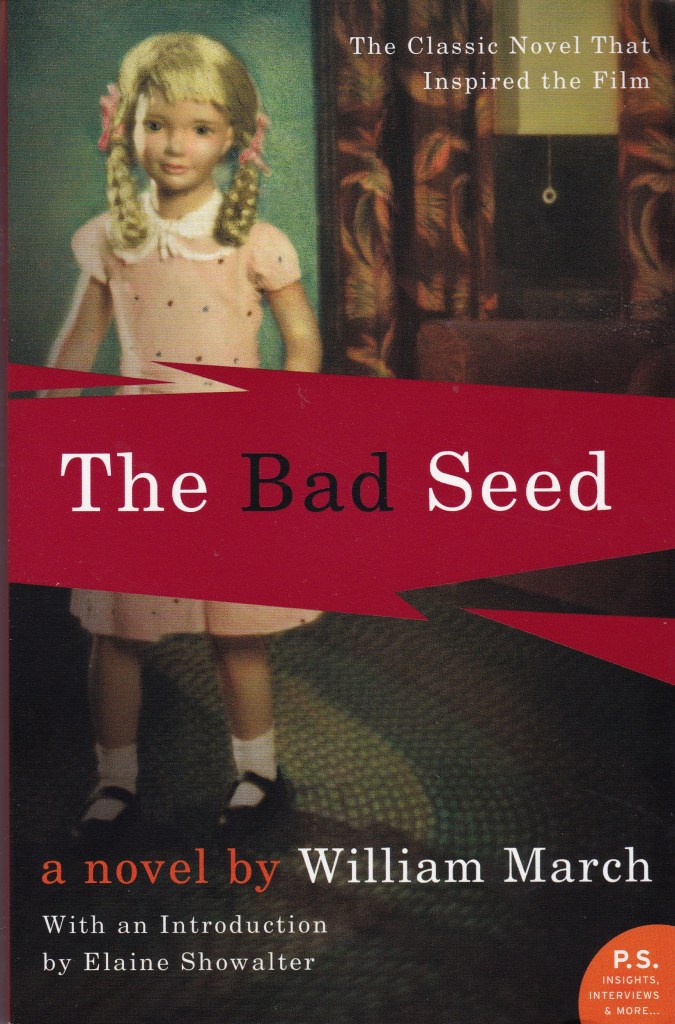
It was watching those afternoon movies where I first encountered The Bad Seed.

Later that summer, when Mrs Penmark looked back and remembered, when she was caught up in despair so deep that she knew there was no way out, no solution whatever for the circumstances that encompassed her, it seemed to her that June seventh, the day of the Fern Grammar School picnic, was the day of her last happiness, for never since then had she known contentment or felt peace.

The picnic was an annual, traditional affair held on the beach, an among the oaks, of Benedict, the old Fern summer place at Pelican Bay. It was here that the impeccable Fern sisters had been born and had lived through their languid, eventless summers. They had refused to sell the old place, and had kept it up faithfully as a gesture of love even when necessity made them turn their town house into a school for the children of their friends. The picnic was always held on the first Saturday of June since the eldest of the three sisters, Miss Octavia, was convinced, despite the occasions on which it had rained that particular day, and the picnic had to be held inside, after all, that the first Saturday of June was invariably a fine one.

If The Bad Seed has lost its ability to shock and horrify, it’s because in the decades since it was published (and adapted into both a play and film) the notion of a child being a killer has gone from being shocking to the general public to one that is kind of accepted; children do kill, and despite all the societal push towards sentimentality toward children. Rhoda is a sociopath, if not a psychopath; her inability to feel remorse or empathy or any other kind of human emotion is chilling to read about–she’s a stone cold killer, and clearly, she thinks nothing of killing to get something she wants: whether it’s the penmanship medal from her school, or a nice trinket promised to her, and then to shut up the janitor who sees through her and threatens to expose her; there’s a progression there. First she kills on impulse to get something she wants, then she coldly and calculatedly kills to protect herself. Rhoda is maturing as a killer, which is very chilling for the reader. The book is told entirely from the point of view of Rhoda’s mother, Christine–who is very slowly coming to realize, time after time, that her child is a monster, despite the innocence of childhood and everything we are taught to think, sentimentally, about children.

Psychology was starting to come into its own in the United States during the 1950’s, and you can see how crime writers took to psychology in that decade: The Bad Seed asks the question of nature v. nurture (although its answer is that it’s nature, genetic, and cannot be helped–and there’s some truth to that. I’m not entirely sure that sociopathy or psychopathy is learned behavior; are these cold-blooded killers born that way or are they creations of their environment? The solution Mrs. Penmark comes up with and executes in the novel is dramatically different from the film–the film had to abide by the Production Code, whereas novels had no such restrictions on them–and I believe the book’s ending actually works better than the film’s.

One thing that the book does brilliantly is depict the emotional turmoil and distress of the mother, slowly beginning to suspect and find proof that her child, that she loves so dearly, is actually a monster.

I first read this book when I was a teenager; I’d already seen the movie when I discovered the book on the shelves at the library, and so I checked it out and read it. I enjoyed it tremendously at the time–and it also had me watching other teens and young children for signs of sociopathy for a few years–and so thought it might be worth a revisit. It was, most definitely; it’s a bit dated, and of course the notion of a killer child isn’t quite so shocking as it was back during the Eisenhower administration–we’ve seen too many real life examples of this, and of course the trope of the killer child has been used, over and over again, in crime fiction and in films, so it’s not the brace of cold water in the face that it once was (kind of like how Beast in View by Margaret Millar was groundbreaking in its time–its still a great read–but what Millar did in that novel has been copied and imitated so much that it’s almost a cliche; one has to read these books with those sort of things in mind). Agatha Christie also used the trope of the sociopathic child (although in a quick google search it turns out Christie’s sociopathic child killer predated The Bad Seed; honestly, Christie did everything first).

It was a very pleasant reread, and as always, it’s interesting to visit (or revisit) books that were considered shocking in their time, only to have them turn out to be fairly tame–I’m looking at you, both Peyton Place and Valley of the Dolls–as well as to see how far the crime fiction genre has progressed. (I still consider Peyton Place to have a place in crime fiction, even though most people don’t. And while the crimes in the book may not be the driving point of the story, those crimes do impact everyone in the town in some way….there’s another essay to be written, probably after I reread the book at some point. It’s been awhile since I’ve revisited both Peyton Place and Valley of the Dolls….perhaps that can be my Christmas present to myself.

Starlight

And so now it’s Sunday.

I won’t lie; I’ve lost my sense of time and date and day already this weekend and I’m perfectly fine with it. I hope everyone who has the good fortune to have the weekend off–I know there are many who do not–are in the same state of what day is this that I found myself in most of yesterday and when i woke up this morning–I overslept again, which was amazingly lovely, but i really need to stop indulging myself this way–and am now awake, on my first cup of coffee, and ready to get shit done today. I did get shit done yesterday–I cleaned and organized quite a bit (not enough, it’s never enough) and while I do have some little bit of cleaning and a lot of organizing left to get done, at least I made a start on it yesterday. My desk, for example, this morning is clean and clear; which will make writing later much easier.

I finished Little Fires Everywhere yesterday–I blogged about it already, so I won’t repeat anything other than that it’s a fantastic book I encourage you all to read–and started reading The Coyotes of Carthage, which was originally recommended to me by my friend Laura, who was lucky enough to receive an advance copy. It, too, is fantastic and unlike anything I’ve ever read before, and I am really looking forward to getting more into it–I will undoubtedly take a reading break or two at some point today. It seems to be a political thriller about dark money and political consultants in a very rural county in South Carolina, with a Black male protagonist, so I am sure it’s going to be quite interesting to read.

But I really also need to write today; I’ve not looked at the manuscript since last weekend, and this “only writing on the weekends for one day” simply cannot continue to stand, really. I have too much to write, and I need to stop giving into the laziness or the tiredness or self-destructive patterns or whatever the hell it is that keeps me from finishing this damned book. Heavy sigh. I also have any number of short stories I need to wade through to pick out some to work on for submission calls.

Again, I think there’s something to that I am so overwhelmed believing I’ll never get everything done so why bother doing any of it thing.

Repeat after me: SELF-DEFEATING.

While I waited for Paul to finish working on a grant last night I watched, or rather, rewatched (although I didn’t really remember watching it before, and I figured, meh, if I’ve already seen it I can do stuff on my iPad while it’s on in the background) a documentary called Master of Dark Shadows, about Dan Curtis and how the show came about, and its legacy (I’m sure most people don’t remember Curtis also produced and directed the mini-series based on Herman Wouk’s novels The Winds of War and War and Remembrance). I was one of those kids who watched Dark Shadows only in the summertime, because my elementary school didn’t get out until 3:15; even though we lived only a block away from the school I couldn’t ever get home fast enough to watch even the end. I did love Dark Shadows–our sitter/caregiver, Mrs. Harris, also watched One Life to Live and General Hospital, which were my first exposures to soaps–and it always stuck in my mind; I always give it credit for my interest in horror and the supernatural. I enjoyed watching the documentary (and for the record, I loved the NBC reboot of the series in prime time in the early 1990’s, and was crushed when it was canceled; I rewatched it with Paul and he too was disappointed it ended on its cliff-hanger) and then we started watching a documentary about a double murder in India called Behind Closed Doors, in which the investigation was so incredibly fucked up–I mean, if the primary take-away from all the other true crime documentaries we’ve been watching has been man is our system seriously fucked up, the takeaway from this one is yeah, but ours is clearly better than others.

Which is kind of scary, really.

While I was also bored yesterday waiting for Paul–and only really sort of watching Master of Dark Shadows–I was right, I’d seen it before–I started looking things up on-line; which was an absolutely lovely example of how one can fall into a wormhole on the Internet. As you know, I’ve been having this Cynical 70’s Film Festival, and thinking about the rise, and proliferation of, conspiracy theories in that suspicious, paranoid decade, and one that I hadn’t remembered until yesterday sprang up into my min, completely unbidden, while I was reading about the Bermuda Triangle: Chariots of the Gods? by Erich von Daniken. Does anyone else remember von Daniken and his theories, which were based in nothing scientific or archaeological? Von Daniken believed that ancient texts–the Bible, the Code of Hammurabi, etc.–all contained evidence that in Ancient Times the Earth was visited by space aliens–Alien Astronauts, as he called them–who brought knowledge and information with them to the primitive creatures of our planet at the time, and also assisted them in the massive building projects that modern man cannot conceive of them building back then–the pyramids, for one thing, and the lines on the plains of Nazca (which I first read about in the Nancy Drew volume The Clue in the Crossword Cipher)–and those aliens with their vastly superior technology, were seen as gods by the primitives and those visits have come down to us in the form of mythology. It’s an interesting idea for sure–but it was all conjecture, with no proof. I read all of von Daniken’s books back in the day; others included The Gold of the Gods, and were simply further conjectures, but he developed quite a following, and set the stage for what is called the pseudo-science of Graham Hancock, his modern day successor. (I’ve also read some of Hancock’s work; his theory that the Sphinx is far older than we suspect based on water wear on its base is interesting, as is his other theory that the Ark of the Covenant’s final resting place is in Ethiopia; before reading that book I had no idea that Christianity was so firmly entrenched there) So, I spent some time looking up von Daniken’s theories yesterday, as well as some other conspiracy theories of the time–I also did a deep dive into the entire Holy Grail Holy Blood thing which provided the basis for The Da Vinci Code and Dan Brown’s entire career; and of course we certainly cannot forget the apocryphal writings of Hal Lindsay and The Late Great Planet Earth–which, really, is where The Omen came from; we forget how “end times” theory truly began flourishing in the 1970’s.

I’ve always been interested in stories about lost books of the Bible, or lost Biblical theory, along with the end-times prophecies Lindsay wrote about; Irving Wallace’s The Word, which was built around the rediscovery of a lost testament of Jesus which would revolutionize and make-over the Christian theology was one of the first novels of this type I read; it was also made into a mini-series, which made me aware of it in the first place (Irving Wallace isn’t really remembered much today, but he was a huge bestseller back in the day, and he wrote incredibly thick novels, mostly about international conspiracies or legal issues–The Seven Minutes, for example, was about censorship and “blue laws”; The Second Lady was about a Soviet conspiracy to replace the First Lady with a lookalike imposter who was a Soviet spy; The Prize was about the machinations around how the Nobel Prize was given out; etc etc etc). The Da Vinci Code fits clearly into this category, as does The Gemini Contenders by Robert Ludlum and The Fourth Secret by Steve Berry (which is about the fourth secret Our Lady of Lourdes–or was it Fatima?–revealed to either Bernadette or the peasant children; Irving Wallace also covered this in The Miracle); Raiders of the Lost Ark and Indiana Jones and the Last Crusade also kind of fit here, as both films are about the search for Biblical relics. I’ve always, always, wanted to write one of these. Years ago I had the idea for one, in which there was a secret document or testament hidden in the Hagia Sophia in Constantinople for years, and that part of the reason the 4th Crusade sacked the city was the Pope’s desire to get his hands on those documents, which were thus smuggled out of the city by the Patriarch and lost forever…this is the idea I always come around to for a Colin stand-alone (I also realize I could do Colin stand-alones set at various times throughout the last twenty years or so of Scotty books, as he is gone a lot of the time on missions), and the working title for it always is Star of Irene, because the Byzantine Empress Irene–contemporary of Charlemagne–has always fascinated me.

But I will never write a Colin stand-alone, or series, unless I get this fucking book finished, so I suppose it’s time for me to head back into the spice mines.

Have a lovely Sunday, Constant Reader.

Go West

Good morning, Thursday; just today and tomorrow before we slide into another delightful three day weekend. Memorial Day! Huzzah! I am always about another day off from the day job–which I completely understand that it sounds like I don’t like my day job, which couldn’t be further from the truth. I just enjoy not having to go to work more than I enjoy going to work; I’m not sure how everyone else comes down on that category, but I’d be more than willing to bet that most people prefer their days off to their days on.

I could be wrong, but I rather doubt it.

Anyway, here I am at the crack of dawn swilling down coffee and trying to get more awake and alert. I am looking at a long day of screening at both buildings (Marine in the morning, Elysian Fields in the afternoon) and right now it seems like its about a million years staring into my face. But I will persevere, and deal with the heavy traffic on the way home just after five. Tomorrow is the Friday of a long weekend, which is absolutely lovely, and my ink cartridge was delivered yesterday so I can pick it up on my way into the office tomorrow and actually start printing shit I need to print again this weekend. Yesterday was a relatively good day, despite being tired–that tired lasted again, like the day before, pretty much all day–but I managed to get my errands accomplished after work and got some organizing and straightening done in the kitchen/office area; always a plus. Paul was a little late getting home last night, but we watched an episode of The Great and then I started streaming The Story of Soaps, an ABC show about the history of the soaps–just to see if it was any good–and it was quite enjoyable; I’ll look forward to watching the rest of it this evening. I watched soaps from the time I was a kid–our babysitter in the summer watched General Hospital, One Life to Live, and Dark Shadows, which is how I got started watching them, and over the years I remained pretty (fairly) loyal to General Hospital and One Life to Live. The summer we moved to Kansas, until we got cable we only got the CBS affiliate from Kansas City, so my mom and I ended up watching the CBS shows–from The Young and the Restless through Search for Tomorrow, As the World Turns, Guiding Light, and The Edge of Night. After cable, we watched General Hospital–it was the late 1970’s by then, and everyone was watching General Hospital by that point.

It’s interesting, in some ways, that our moves–my moves–gradually went west. The suburb we moved to when we left the south side of Chicago was west; from there to Kansas, and from there to California. I started heading more and more east from California, to Houston and then to Tampa, before going north to Minneapolis and coming back south to New Orleans. I never thought about it too much, really; but it’s interesting how I’ve moved around the country and the strange pattern to it. Of course, we’ve been in New Orleans since 1996 (barring that year in Washington), and since I’ve lived here longer than I have anywhere else, I tend to think of New Orleans as home more than I’ve ever thought of the places I’ve lived previously. Granted, had we never left Chicago, I probably would think of Chicago as home, but I’ve literally only been back to Chicago maybe twice, possibly three times, since departing the area in 1975. I’ve never been back to Kansas, and I’ve been to Houston many times since I moved to Tampa–but only twice to Tampa since leaving there (I’ve actually been to Orlando quite a bit; I’d say I’ve visited Orlando more than anywhere other than Houston over the last twenty-odd years).

I tend to not write about Florida, for the most part; while I’ve written about a fictional city in California based on Fresno in the Frat Boy books (the third was set in a different fictional California city, San Felice, based on Santa Barbara), and I’ve written about the panhandle of Florida, I’ve never really based anything on, or written about, the real Tampa or a city based on it (I do have ideas for some stories set in “Bay City”); I’ve not really written about Houston, either. My fiction has always primarily been set in New Orleans, with a few books scattered about other places (Alabama, Kansas, a mountain town in California called Woodbridge) but it’s almost inevitably New Orleans I write about; which makes sense. I live here, I love it here, and I will probably die in New Orleans.

And I’m fine with that, frankly.

“Go West” is also a song I associate with New Orleans, actually. I know it was originally a Village People recording–which I actually never heard before the Pet Shop Boys covered it–but I always associate it with 1994 and when I first started coming to New Orleans; it, along with Erasure’s “Always” were the big hits of the moment that were always being played in gay bars, and I heard them both for the first time on the dance floor at the Parade on my thirty-third birthday; which was also the first time I ever did Ecstasy. So, whenever I hear “Go West” by the Pet Shop Boys, I always think back to that birthday and that trip to New Orleans (“Always” has the same affect, but not as intensely; I’ve never been able to find the proper dance remix the Parade used to play–and in fact, a lyric of the song, “Hold On To The Night”, became a short story I’ve never published anywhere–and haven’t even tried to revise in almost thirty years. It wasn’t a crime story; I was writing gay short stories then, about gay life in New Orleans–and no, I never published the vast majority of them (with the sole exception of “Stigmata”, which was published in an anthology that came and went very quickly), although I did adapt some of them into erotica stories and some could easily be adapted into crime stories…I know a fragment of one, I think, morphed into “Someone to Lay Down Beside Me,” which was published in Jerry Wheeler’s The Dirty Diner anthology, and was probably reprinted in Promises in Every Star.

I should probably pull those stories out again and see if there’s anything I can do with them,

And on that note, I am heading back into the spice mines.

IMG_1080

You Give Love a Bad Name

Christ, what an irritating day this has been so far. I had to get something resolved, and I am glad I managed it, but it also wound up taking two hours and I am really annoyed about losing that time that I’d intended to use a LOT more productively. I am now going to try to shake it off so I can get some work done today…

…or there may be a body count.

I got very little done yesterday; I didn’t sleep well on Friday night and tossed and turned, so I was exhausted and more than a little brain dead yesterday. I did get some work done on the afterward to the short story collection, but not good work and I finally just walked away from the computer. I was also ridiculously exhausted after making groceries, so I just retired to my easy chair with my journal and my book and then did some film streaming. I rewatched an old 1980’s noir, Masquerade, starring Rob Lowe, Meg Tilly,  Kim Cattrall and Doug Savant; I’d really enjoyed the film at the time I saw it on the big screen, and wanted to see how well the movie held up. Tilly plays heiress Olivia Lawrence, sheltered and shy and worth over $200 million since her mother passed away several months before she graduated from college. Unfortunately, her “mother’s last husband”, as she calls him, has an income from the estate plus has the use of her family homes….including the one on the Hamptons, where most of the story takes place. To say they do not get along is an understatement. She becomes interested in Rob Lowe’s character, Tim Whelan, who races sailing boats and is currently employed by the wealthy Morrisons; he is also having an affair with the trophy wife, played by Kim Cattrall. Tim and Olivia meet at a party and begin a romance…only it turns out that Tim and the wicked stepfather are out for Olivia’s money. There’s a murder, a cover-up, and things keep twisting and turning and there’s another big surprise twist about two-thirds of the way through the story.

It does hold up well, and watching the movie I realized something I hadn’t realized before; a lot of the imagery I used in Timothy, how I pictured it all in my head–the estate, the beach, the water, everything–was visualized primarily through my memories of this movie. One thing I’m not quite sure that does hold up; the trope of the wimpy, mousy heiress who is married for her money; this was an extremely popular trope of romantic suspense–think Suspicion, or almost everything Victoria Holt wrote–but this was filmed as noir; which means the points of view come out on display. (So many Victoria Holt novels were built around the mousy heiress who thinks her husband married her for hr money and is trying to kill her!) My friend Rebecca Chance one said that romantic suspense was “noir for women” back in the day, which I’ve always thought was a brilliant take, and a great basis for an essay; perhaps someday I’ll write it.

We also watched a really good gay movie last night, Retake, starring Tuc Watkins (whom I remember from One Life to Live) and Devon Graye, both of whom were really quite good; and the plot, which took a while to get going, was pretty compelling, actually. I do recommend the film.

And now I need to get to work.I should have a cover reveal this week for Survivor’s Guilt and Other Stories, and I also got the final acceptance of the latest version of “Silky Veils of Ardor,” which is going to appear in The Beat of Black Wings, edited by Josh Pachter. I also need to make a to-do list, and I also need to clean the fuck out of this kitchen today.

Okay back to the spice mines.

IMG_4111

Do What You Do

Ah, it’s only midweek and I’ve not made much progress on anything; the kitchen is a mess, and time is just slipping through my fingers on a daily basis. It’s a frustrating feeling, made even all the more frustrating because I know, even as I procrastinate, that I am going to deeply regret the procrastination the following day; and yet, I do it. I suppose this would be fodder for my therapist; why do I defeat myself all the time, or set myself up to fail? Is it a fear of failure, so if I do it to myself it won’t feel like failure?

These are the mysteries of Greg that I ponder on a daily basis.

I did work on a story yesterday, rather than the Scotty book or the website writing I’d promised to do, which I need to do, both of which I should just fucking do and get out of the way. Eye roll.  The story isn’t one I am sure about; it’s one that I originally wrote back in the late 1980s during one of my I’m going to take this writing thing seriously even though I have no idea what I’m actually doing periods when I used to write piles of short stories (rather like I have done this year already), and it’s one that I’ve always thought would work. I’ve taken a run at it again several times over the years, but at last I think I have it in a place where it will actually work. The voice is the key to this story, and I think I’m getting it right; the story itself is working itself out, but once I am finished with it this time around I need to go back and make sure I’ve got the voice right. This is, of course, not one of the stories I’m including in the collection, or the one I need to get the edits done on (of course, see what I mean about being self-defeating?), and the irony, of course, is that the edits aren’t that involved; and yet somehow I just can’t make myself do them.

Idiot.

But so it goes, and how it goes every day of my life. I am often called prolific, which always amuses me to a degree; I think of myself as lazy, because I know how much more I could get–or should be getting–done. I also know about all the time I waste, and how that time could have been used ever so much more productively.

In my own defense, however, I will say that I like this story I am working on–“Fireflies”–and I’ve always liked the story, and am glad that I am finally getting to it. I have so many story partials; so many stories that have been dancing around elusively in my brain for so long, yet whenever I try to finish them they dance away just out of the reach of my fingertips; “Fireflies” is one of those stories. It’s nice to finally be getting it finished, even though I should be working on other things. But I’ve diagnosed what’s wrong with both “Don’t Look Down” and “My Brother’s Keeper” this week; I’ve also figured out what’s wrong with “Once a Tiger” and how I can move forward with it. These are good things, really; and I am getting somewhere with the Scotty book as well with my brainstorming.

I just need to get past this feeling that Chapter Eleven is such a sloppy mess that I don’t want to even look at it again. I either need to go fix it, or move on to Chapter Twelve instead of agonizing over it like an idiot.

We started watching Shooter, a really terrific Ryan Philippe series last night; I think it was a limited series–a one-off, because I don’t really see how it could go another season. He plays one of the top Marine sharpshooter/snipers, who has retired; he is dragged back into the business by an old Marine buddy who now works for the Secret Service to figure out how someone is going to try to assassinate the president. He doesn’t realize he is being set up to take the fall for the assassination, and the conspiracy runs pretty fricking deep; but he manages to get away from the authorities and has to prove his innocence. It’s pretty good–and Ryan Philippe never disappoints. I’ve been a fan since his days as gay teenager Billy Douglas on One Life to Live back in the early nineties; and I am glad to see him keeping his career going on television now that he’s no longer in demand for film roles. He really makes a hot dad.

I also read two short stories for the Short Story Project. First up was “A Bus Ticket to Phoenix” by Willy Vlautin, from Jim Fusilli’s Crime Plus Music:

Otis woke that morning to Lenny in the bathroom yelling on the phone. It was past 11 a.m. at Winner’s Casino in Winnemucca, Nevada. Under the covers he shivered in the cold and could his breath fall out and disappear into the room. He got up to find the window open and the heat off.

He set the thermostat to high, shut the sliding glass window, and looked out to see some snow falling. It covered the van and trailer and the houses behind the motel. He stood seventy-seven years old, tall and thin with greasy brown hair. He found his clothes on the floor, dressed, and walked across the street to the casino. He used the toilet, lost five dollars on video poker, and went to the casino restaurant for breakfast.

Vlautin, the author, is a seasoned professional musician, which explains why this story rings so true and authentic, I suspect. Some old guys, professional musicians who are now getting old and have never made it big, just always managed to find work and have spent almost their entire lives on the road, are now touring with some musclebound young up and comer in country music. The crime is that their stuff keeps disappearing, with something being stolen at every stop on this tour. The singer is kind of a dick, and so is his manager…and while the crime aspect of the story isn’t it’s strength, the depiction of the lonely, melancholy life on the road–and coming to the end of your lives without ever having made it big while continuing on because you can’t do anything else, is the most poignant and powerful part of this story.

I then moved back to Ross Macdonald’s The Archer Files, for another Lew Archer story, “Wild Goose Chase.”

The plane turned in towards the shoreline and began to lose altitude. Mountains detached themselves from the blue distance. Then there was a city between the sea and the mountains, a little city made of sugar cubes. The cubes increased in size. Cars crawled like colored beetles between the buildings, and matchstick figures hustled jerkily along the white morning pavements. A few minutes later I was one of them.

The woman who had telephoned me was waiting at the airport, as she had promised. She climbed out of her Cadillac when I appeared at the entrance to the waiting room, and took a few tentative steps towards me. In spite of her height and her blondness, the dark harlequin glasses she wore have her an oddly Oriental look.

“You must be Mr. Archer.”

A man is on trial in this unnamed northern or central California city for the murder of his much older, much wealthier wife. He clearly killed her for her money, or so the prosecution would have you believe. His only defense is at the time of the murder, he was with another woman–another woman whom he will not name, despite her being his only real chance at acquittal since everyone thinks he’s guilty. It is this woman who has hired Archer, and she has her own reasons for not wanting to be named…and so as Archer goes about his investigation, another murder is committed and he finally solves the case by finding the real killer…and yet everyone involved is guilty to some degree; perhaps not legally, but at least morally. This is the kind of case where the detective needs a long hot shower after to wash the stink off; which is of course, for me as a reader, the best kind of story. (Oh, yes, all that time period racism and misogyny is on display in this story; which kind of, as always, put me off–as you can see in the above opening paragraphs of the story.)

And now, to stop procrastinating and get back to the spice mines.

97612dfb2e439db8a71f6394e6f11103