Cast Your Fate To The Wind

Ah, and here we are, three day weekend in the rearview mirror as we coast headfirst into a Tuesday that is destined to feel like a Monday all day. I set the alarm and got up at seven-ish; an hour later than a work day and really, something completely sensible to do on days off. An extra hour still feels like a treat, and then I have the entire morning to get things done. I washed dishes, made breakfast, wrote two posts, and then dug into the book and cranked out over two thousand words before noon–with the entire day still ahead of me. I wish I could tell you that I worked on some other writing, but I didn’t. I was reading newsletters and magazines that have stacked up (another thing that is stupid–I let magazines pile up, collect dust, and just be clutter rather than simply reading them at first opportunity and then tossing them in the trash–or tearing out an article that may be of interest to me at a later date (can’t imagine how all that paper piled up on me over the years). I am pleased to say I have only three back issues of Texas Monthly (their true crime reporting is stellar) and the latest 64 Parishes to read now. I also watched some news clips on Youtube, fell into a wormhole about the history of the Cathars in southern France and the Albigensian Crusade that killed them all, and finally started reading about the Baptist War in Jamaica–there’ll be more on that at another time, trust me on that– before doing some filing and touching up around here. All in all, it was a lovely weekend, and I am so delighted to be back into the book again (I was worried about picking it back up again after the last few days not working on it), and knowing that my editorial and creative eye is coming back together, too. I still have to get used to my life as it is now, and I know there are going to be bad days that I just need to accept and roll with, and not beat myself up over those sorts of things. Being too tired to write or create is a valid reason for not doing so. It just is painful and the writing isn’t any good, anyway–and it’s not like I need to prove to myself that I can write a goddamn crime novel, do I?

I feel pretty rested and good this morning. We shall see how that develops for the rest of the day. I think we’re pretty busy today; or maybe not; maybe it was next week? We always get busy at the STI clinic after Southern Decadence…which kind of makes me a little proud, because we’ve trained our clients so well that they know about the window periods for the bacterial infections so they wait. (The schedule isn’t that busy; I just checked it–laptop came home with me on Thursday–so yes, it’s next week that is super-busy.) I have to make groceries on the way home from the office tonight; I may be too tired to work on the book tonight but…that’s okay.

Yesterday afternoon I was kind of at loose ends and dangerously close to being bored, when I remembered a conversation at work recently, in which one of my co-workers told me he loves to watch bad movies with a friend to laugh at them, so I asked, as is my wont, if they’d seen Voyage of the Rock Aliens–I have yet to find anyone else who has seen it (I saw it twice in the theater) and so that was in my mind. Right now I can’t remember the brain trail that led me to think of it yesterday, but I did, and the whole movie is up on Youtube…so yes, I rewatched it, and…it really can’t be watched alone to be laughed at properly. Anyway, it was the great Ruth Gordon’s final movie (what an epitaph!), starred Pia Zadora and an incredibly beautiful young Craig Sheffer. It’s a weird mash-up of the bad scifi and beach movies of the 50s and 60s, a lot of the humor is of the time (I’m sure kids today, or even viewers of any age for that matter, would get the Lake Eerie jokes, because the lake was cleaned up), and it’s even more godawful to rewatch after forty years or so. It may even be worth it’s own entry…

We also started watching Kaos, which is demented in a very fun way; a modern twist on Greek mythology. A reboot kind of, if you will. Jeff Goldblum is perfect as Zeus, as is Janet McTeer as Hera. Of course, since it involves Orpheus and Eurydice, it put me in mind of Hadestown, which I saw on Broadway in New York thanks to Mike Ford. I’m looking forward to watching more tonight, if I’m not too tired and Paul isn’t working on a grant the way he has been for the last week or so. Of course, I could unwind with my Alison Gaylin ARC, which I am doling out to myself as a reward for getting things done.

I am very glad that my brain has finally unlocked and I am not only writing again, but writing the way I did before the recent times of troubles. I’m enjoying it, and am having fun with it again. I don’t know if I am all the way there again yet, and I’m not all the way back to normal (or whatever passes for normal in my life) quite yet, but I don’t feel like there’s a dark cloud in my brain and just getting through the day is a triumph anymore. Now that it’s unlocked, I can also see that some of the stories I’ve written over the last four years and not been able to place (or finish)? Now that my mind is more clear than it’s been in a while, I can see what the problems are–the voice and tone of the story. They’re written kind of in a cheery, pleasant tone, and that doesn’t work with what the stories are about. What was I thinking? No, they need to be colder, and more desperate, unsentimental, which isn’t as easy for me as it should be. They need to be harder and colder and crueler, more desperate, in order for the stories to work, which is also pretty cool. I’m so glad I’ve figured this out at long last! I also think part of the reason I made the stories not as dark as they needed to be was because of the shitshow life had become for us all and I didn’t want to write anything dark. My brain was telling me something, wasn’t it?

I also walked to Walgreens to get treats for His Impious Majesty, listening to the My Dad Wrote a Porno podcast and rather enjoying it–it’s really hilarious, you should check it out–when the door opened in my brain and I finally figured out what podcasts actually are: they’re like radio shows of old only with a more modern delivery system. so we’ve kind of circled back around the entertainment my grandparents used to enjoy–radio/podcast, they are basically the same, with the primary difference how you get distributed to listeners, kind of like do-it-yourself radio. Yes, it only took me how many years to figure it out? Heavy sigh. But now that I finally get them, I can start looking for others that could be fun and informational. I just couldn’t wrap my mind around them–sometimes I have to connect newer technology to older so I can understand its purpose. Yes, I am well aware how obtuse I can be, which I think is a part of the wacky brain chemistry that I want to talk to my doctor about. I don’t need medication to control the wandering mind syndrome, as I’ve remembered how to write again, so that’s not an issue. But it would be nice to have a diagnosis rather than simply wondering and self-diagnosing from my reading.

I also started relearning German on Duolingo this weekend, which makes sense. There are crusty memories deep in the recesses of my brain, and doesn’t it make more sense to try triggering my memory rather than starting from scratch with a whole new language. So far, so good. I can order coffee and bread and wine in German now. So, when I am in a German coffee shop I can say, kaffee und brot, bitte.

I didn’t really have much FOMO about Bouchercon over the weekend–obviously, I know I would have had fun had I gone because now I know too many people not to have fun, if that makes any kind of sense to you. I did miss seeing everyone, but my primary regret in not going was not being able to participate in the voting down of removing the DEI (aka inclusion) from the Bouchercon operating by-laws…yes another attempt by a mediocre white man who used to be on the Board and was long associated with it (back in its misogynist, racist, homophobic days where that kind of shit was not only tolerated, but enjoyed) deciding that since he had a problem with inclusion the entire conference should just do away with it. Thanks, Al Abramson, I remember reporting being treated homophobically by programming years ago and you just patted me on the head and basically told me to get over it. Fuck you all the way to hell and back, and don’t think we aren’t fucking organized, you miserable piece of bigoted trash. Can’t imagine why queers felt uncomfortable and unsafe attending your fucking event, and the trash LOC couldn’t even be bothered reassuring us, and in fact, exposed how homophobic the LOC was. But thanks to the alert Board members and some others–CWoC, QCW–rallied the troops, but the Board also refused to consider it and the refusal of this last minute last ditch attempt to make it a Karen-and-Chad conference again. But this is also why we have to be forever vigilant, because there’s always some mediocrity trying to drive out the marginalized.

Must have been a real bitch-slap seeing how diverse the Anthony Awards were.

And on that note, I am heading into the spice mines. Have a lovely Tuesday that feels like Monday, and may be back later.
Drop Me Off In New Orleans

Ah, some more blatant self-promotion! I’ve done some on-line panels so far this year, which has been terrific. Here are the questions from one I did, turned into an interview so I can promote myself! I believe these questions were for a queer crime panel, and the credit for the questions goes to the one and only J. M. (Jean) Redmann; you can order her books here.

Why did you choose your characters and their professions? What drew you to them?

Hmmm. This is tough, because I have so many books and so many different main characters…I think I’ll stick to my two primary series to answer the question. I wanted to write about a gay private detective in New Orleans, and I wanted him to be a big man, a former college football player who may have been able to be a journeyman NFL player had he not been injured in his final college game. I wanted him to be uncomfortable in his gay skin, and the point of his journey throughout the series was to grow and learn until he was finally comfortable in that skin, and able to be loved and give it.

Scotty, on the other hand, was created as a stand-alone character and I wanted him to basically be the antithesis of Chanse; in which he had few if not hang-ups, was completely comfortable being a sexually active gay man with a snarky sense of humor covering an incredibly big and kind heart. He didn’t really need to grow much–he usually is the catalyst for other characters’ growth–but as he’s aged, I’ve really enjoyed his journey.

What attracted you to writing mysteries?

I always liked them. As long as I can remember, my two biggest reading passions were history and mystery, with horror/Gothics close behind. I would check anything out of the library with mystery, haunted, ghost, phantom, secret, or clue in the title. Then I discovered the series books–The Three Investigators, Trixie Belden, et al–and after that there was no turning back.

What does being queer/gay/lesbian bring to your story?

I think queer people have the outsider point of view down to an art form because that’s how we see the world–from the margins. The easiest way to critique society, the culture, and how people interact with each other is from a remove–and queer people see all of those things from a remove through no fault of their own. I didn’t have role models when I was growing up, at least to teach me how to be a decent adult gay human being, so I had to learn it all on my own for the most part. I’ve also been confused and mystified by American culture, philosophy, and society, because it wasn’t designed for people like me. When I came out, I was just at sea in the queer world as I always had been in the straight one, and I’ve never forgotten those experiences, either, and they also inform my work.

How do we deal with how the wider world deals with queer characters? Especially in these times?

It can be depressing, which is emotionally and psychologically dangerous. It’s bad enough experiencing homophobia, but then to immerse yourself in it in order to write about it? Even more horrific. Watching Pray Away this weekend made me furious with the ex-gay movement all over again; listening to queer people hating themselves and their desires in order to be at peace with God in some twisted way? But if God is infallible…this is the doctrine Christianity gets hung up on. They think we’re mistakes, but if their God is infallible, He had to have made us perfect and its willful sin or the devil whispering in our ears. This is their incredibly harmful and dangerous rhetoric. If God tests humans, perhaps he made queer people to test the faithful–and they are failing.

But they can never admit to that.

How do you deal with diversity? No author can be everything their characters need to be, how do you handle reflecting the wider world?

I write mostly about New Orleans, and beyond that, mostly the south with occasional forays into other areas of the country–upstate New York, Kansas, California–and you cannot write about a city like New Orleans realistically without having Black characters, period. New Orleans is a majority Black city. You also can’t write about the South without touching on the issues of race and a problematic history. I’ve always included diverse characters in my books. I don’t like to describe skin color, frankly, and most white writers do it in the form of food, which I find unsettling–do you want to eat them? Cinnamon skin, cocoa, cafe au lait, eggplant, dark chocolate, etc.–I’ve seen all of those used to describe skin color and it always makes me recoil because it’s so damned lazy. I don’t think I would ever write from the perspective of a Black character–there are plenty of Black authors who can do that more authentically, and given how most diversity pledges by major publishers also inevitably end up in quotas, I don’t want to take a spot from a Black creator. I do love reading work by racialized authors, but I would never try to write from that perspective.

How do you use setting? What does it bring to the story?

Setting is one of my strengths, I think, so I always use it to enhance my story. I am also very lucky in that I live in New Orleans, where anything can happen on any given day and you can never go too far over the top about anything–if anything, you have to tone things down to be believable. I think setting is important because it tells you so much about the characters–why do they live there, how has it shaped them, did they live somewhere else, how do they deal with the challenges, what annoys them, what do they love–and is an important foundation for your story.

How do your books start—not the book beginning, but the start of the process of writing the book. Where do the ideas come from and how does that coalesce into a book?

It usually is something I find interesting and I think I should write about that. Sometimes the ideas take years to coalesce and come together, sometimes they are immediate. The Scotty books inevitably begin with three disparate things I want to address in one book, and then I have to figure out how to combine them all into a story. The next Scotty’s prompts are evacuation, statute of limitations, and obsession. It’s coming together in my head enough that I think I’ll be able to write it this fall.

Once you’re writing, what’s your process? Outline? Write from start to finish?

I used to outline, but now I kind of have it in my head and then will only go back and outline when I am stuck, so I can see where I went wrong in the manuscript. I always write from beginning to end. I don’t know how people can write backwards! I’ve thought about trying it sometime, though.

What are the hard parts of writing for you? The parts you enjoy?

Definitely the middle. The middle is soul-destroying, and always triggers Imposter Syndrome. I also hate copy edits, but recognize them as a necessary evil.

I love the actual writing and revising and all of that. There’s nothing like putting down a good word count for the day, regardless of how bad those words might be. I think revising is magic: you take garbage and turn it into something terrific.

Which writers influenced you?

All of them, in one way or another. I especially love Shirley Jackson, Patricia Highsmith, Daphne du Maurier, and John D. MacDonald. Currently? Alison Gaylin, Megan Abbott, Laura Lippman, Michael Koryta, Alex Segura, Michael Thomas Ford, S. A. Cosby, Kellye Garrett, and Alafair Burke–there really are so many. I always take something away from everything I read, whether good or bad.

What are you working on now?

Right now I am writing a sequel to Death Drop, in the Killer Queen series. I also have a ton of short stories and novellas in progress, and I already have ideas for the next three or four (or more) books.

Any advice for newer writers?

Keep writing and keep believing in yourself, and keep reading.

Last words of wisdom?

If you want to be a writer, read Benjamin Dreyer’s Dreyer’s English and Stephen King’s On Writing.

Who Are You?

TRIGGER WARNING: Racism, homophobia, and archaic racist terms.

I learned long ago that the best way to deal with assholes was to develop a razor-sharp quick wit. I don’t know how I trained myself to be snarky and fast with my sense of humor, but at some point in my teens—in college, I think—I realized that not being filtered, and not being able to recognize most social cues, could actually prove to be a powerful defensive tool, if controlled. It has worked marvelously for me ever since. I also learned that a really good thing to do was say things to people I disliked that could be taken as either a compliment or shade, leaving it up to them to decide what I meant.

A few years ago, I had an experience at Left Coast Crime in Albuquerque where my usual biting sense of humor deserted me when I really needed it the most. I’ve grown used to dealing with homophobes and contemptuously cutting them off at the knees; I even relish doing it at times. But this? I’d never dealt with this kind of bigotry before, and my only excuse is that I was caught completely off-guard. I’ve also turned what happened over and over again in my mind in the time since, wondering how I should feel about it. It still hasn’t finished processing yet, and I’ll probably keep processing it for a few more years.

This was my first (and so far, only) time attending Left Coast Crime (unrelated; I want to go again but it just hasn’t worked out). I had always heard wonderful things about it, but the timing was always difficult for me to actually attend; all too frequently it is around the time of the Festivals here. I’d come home to the locks changed, methinks, were I to go away at that time.

At the time, I was still serving as Executive Vice-President of Mystery Writers of America. It was 2021, we hadn’t had any kind of crime publishing events since March 2020, and the events were just starting to slowly to come back. MWA had signed on to sponsor the Lefty banquet, and I felt someone should be there to rep the org at the event, and it wound up being me. I felt a bit uncomfortable about registering and agreeing to do panels; we were a sponsor, and I didn’t want Programming to feel pressured to give me anything because of that (I tried very hard not to use the position to promote myself; I may have been a bit over-zealous on that score, but better safe than sorry). I arrived in Albuquerque on Thursday, had a quiet dinner with a friend, and the next day I went to panels, ran into people, and had a lovely time. I also had dinner plans for Friday that I was excited about–I was having dinner with Marco Carocari, whom I had just met at Saints and Sinners; John Copenhaver, whom I was starting to get to know better; Oline Cogdill, a dear friend of well over a decade; Mia Manansala, whom I met at New Orleans Bouchercon before she was published and I’ve always felt a bit protective of her (my neuroses, not hers) and someone new to me–Wanda Morris, whom I had neither read nor met before.1

Constant Reader, that was such a fun dinner, the kind I always dreamed of being a part of when I was that lonely kid in Kansas wondering what his future would be. We talked about books, writing, gossip, and I believe everyone, other than Oline and I, was up for a Lefty. We toasted their nominations, and when we headed back to the hotel I felt marvelous; giddy almost. I was having a good time and was excited to be around writers again, and I wanted it to keep going. I didn’t want the evening to end…

Little did I know what I was in for as we walked back into the hotel lobby, and we three gays decided to go have a drink at the bar, while the women wisely all went up to bed.

It started with a chair.

So innocuous, so nothing, just a little thing that happens in hotel bars all the time; you join a table without enough chairs so you grab a free one from the next table…but this time? Very different.

Basically, we had decided to join friends at a high-top table with room for eight, with all the chairs already taken and some others pulled up. There was a tall bar chair standing at the next table–a low table, so it didn’t really belong there in the first place–and several people were sitting around that table. I smiled, said, “is anyone using this?” and one of the three people shook their head no, so I took the chair…which bothered the woman who was sitting closest to me and who decided, in her inebriation, that I shouldn’t have the chair.

DRUNK WHITE WOMAN (Henceforth, DWW): You can’t take that chair because you have to sit here and talk to me.

I’d never seen her before in my life, but I’ve also been drunk in public before, so I just smiled as I sat down at the other table, and said politely, with no idea of what I was letting myself in for: “Can’t you talk to me if I sit here?”

DWW: Great!

I nodded to her, hoping that was the end of the interaction. I’d had two drinks at dinner, but wasn’t even slightly buzzed. I had a glass of Pinot Grigio in my clutches, I’d had a marvelous evening already, and I was looking forward to catching up with the others at the table. I started to turn back to the table to talk to my friends, when…she leaned towards me, narrowing her eyes, and saying, in a very low tone, “Are you a mulatto?”2

Needless to say, I was taken aback–not by the assumption, but the language.

I literally thought, are we really still using that word in this year of our Lord 2022?

I didn’t know what to say, I was so stunned and shocked that my ability to lobby back an icy, conversation ending retort, something of which I was so so proud, had deserted me. I just smiled and said, “no,” which she countered with a scoff, “Well, you’re at least a quadroon.3

And rubbed each side of her nose with an index finger, adding with a knowing smirk, “Especially with that nose.”

I said, rather sharply, “I know who all my grandparents were, so no.”

Again, it wasn’t the racial profiling that bothered me, but it was the entitlement and the language she was using.

First and foremost, my racial heritage–anyone’s, really–is no one’s business.

She was being racist to me, but even as I floundered, I couldn’t figure out why I was so flustered and having trouble figuring out what to say next. It didn’t bother me in the least that she thought I was part Black (more on that later), but she was using racist language to inquire, which I was offended by, and I was more than a little insulted by her condescending assumption that I’d lie about it? And again, what business was it of hers if I was or wasn’t? (I’m still not sure how to wrap my mind around this; two years later I am blogging about it in order to process it in my brain.)

AND WHAT IF I ACTUALLY WERE?

And then, finally:

DWW: Where are you from?

ME: New Orleans4.

DWW: (waving her hand, poo-pooing me) Oh, everyone’s mixed there.

Hoping this ordeal was over and still in shock, I turned back to my friends…only to hear her voice loudly asking me, “Are you gay?” I confirmed that yes, I was–and then she went on a long, incredibly tiresome (and repetitive) monologue about how she’s always been good with the “L and the G and the B and the T”, tried bonding with me over hot male asses (in horrific terms: think locker room talk), and just kept on until finally I was able to finally excuse myself. I got up and left my friends, never to return. Definitely made me uncomfortable, so yeah, it also counts as sexual harassment–what I do or don’t do in my bedroom, DWW, is none of your fucking business.

I still can’t believe that happened, that someone felt comfortable using that kind of language to, and about, me about my racial heritage (when I was a child in the 1960’s I knew you don’t use those words, and they usually only appeared in old racist books, like Gone with the Wind), not to mention trying to get into my bedroom and what I do there. It’s not okay for anyone to use those horrible, archaic old terms that were humiliating and degrading even when they were in common use…and I also felt like I’d failed. I should have stopped her, I should have called her out for using racist and homophobic language, not to mention the fact that she felt, in her drunken stupor, perfectly okay to treat me not as a person but as a thing.

That is the real shame I feel. Not that she used such language to me, but I allowed it. I have to do better than that. My silence was complicity.

And yes, I should have filed a complaint with the conference. I’m still ashamed that I didn’t correct her or say anything before I made my escape. But I sensed it also wouldn’t do any good. Alcohol brings your barriers down, after all.

It also wasn’t the first time this has happened–but at least the first time, it wasn’t so offensive.

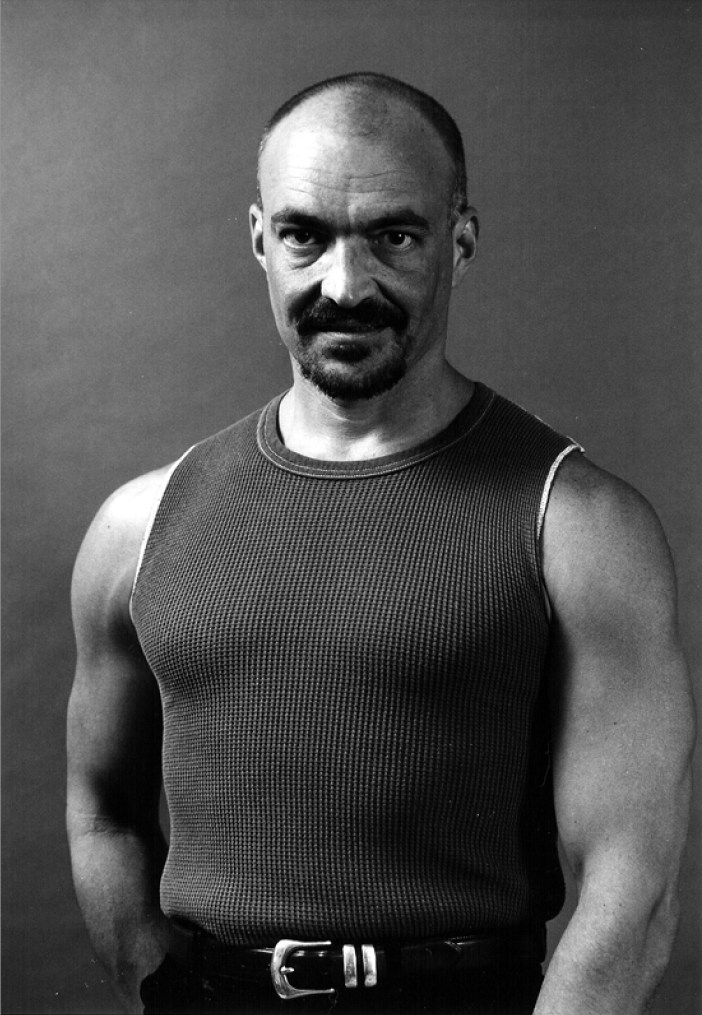
This, for an illustration, was my second author photo.

Taken by Sylvester Q, a photographer in New York, he also loaned me the shirt and some other clothes for the shoot. It was my first professional author photo shoot, and this was the best image, in my opinion, to come out of the session. I used it for Jackson Square Jazz (when I got the book down to reread it for the new edit for the 20-year anniversary edition, I noticed the picture) and for several other books. I don’t remember which image I used to replace this one–I think it’s the black and white one of me sitting and hugging my knees–but I am very well aware that I need new author photos. The one I just referenced was taken in either 2008 or 2009; the one of me with my stack of books is from around 2013 or 2014 (and yes, old age has hit me very hard since those last ones were taken). I did a shoot at Sleuthfest with Morgan Sophia in the summer of 2022; the pictures look like me but I don’t like the way I look in them, so I’ve not really used them.

Anyway, this was the image I provided to the Louisiana Book Festival when I was on a New Orleans Noir panel for their program in 2007 (I think). I don’t remember everyone else that was on it, other than editor/moderator Julie Smith and the person I am about to mention.

I was a little taken aback when said contributor sat down next to me, and exclaimed after we were officially introduced, “But I thought you were Black!”

She’d only seen my photograph in the program.

I was more amused than anything else, and perplexed. But when I looked at my image in the program later, it had printed even darker than the image above, which was already pretty dark. I think it had to do with how the shot was lit more than anything else. It was kind of funny, and it became a story that I told sometimes over drinks.

That wasn’t the first time my genetic heritage has been questioned by someone.

White people have this strange curiosity thing about people’s backgrounds, always trying to figure out where you’re from. “Are you German?” “Are you Italian?” That sort of thing. I will comment on a name–“oh, is that French/Spanish/German etc.”–but I would never ask anyone what are you?

I’d never really thought about it before the LCC incident, but people have very often wondered–and asked–what I am.

And in all honesty, I’ve never liked being asked, mainly because I wasn’t entirely sure.

I guess I am what is I’ve sometimes seen referred to as “ethnically ambiguous5“; in other words, had I been a movie star in Hollywood back in the golden age I probably would have been cast in roles that today would be considered offensive for me to play. People have often–again, this weird thing white people have about trying to figure out “what” I am–taken me for everything from Greek to Italian to indigenous to Syrian to Persian to Latino. I’ve never given it much thought, and I don’t really see it. My skin tone is what is called olive, and I’ve always tanned easily, a very dark brown with some red mixed into it (I’ve only been sunburned twice in my life). My facial features are a curious mix of my family; I look like both my parents, and my nose was broken in high school, with the cartilage never reattaching to the bone. I also shave my head, which apparently adds to the confusion.

Almost all of the ancestors (that I’m aware of, but I only know my father’s side, and there’s not anyone left on Mom’s side who’d know more) were British (Scots, Irish, English and possibly some Welsh) but white people have this weird need to classify people. I don’t know if it’s an American thing, or what, but it happens. Not so much anymore as it used to–maybe people are finally starting to realize that it’s offensive or that it doesn’t matter or some combination of the two.

But still. Basically, the woman in Albuquerque othered me. She looked at me and was confused, so she just had to find out what I was.

What I am. “What ARE you?”

And for the record, what happened to me at Left Coast is the kind of horrifically racist and offensive behavior that racialized people have to deal with multiple times every damned day. In some ways I’m glad it happened; that I got to experience racism targeted directly at me, but at the same time…it shouldn’t happen. To anyone, regardless of who they are or how they identify. It also made me very aware of my own privilege, which is something I do need a reminder about periodically; I get so wrapped up in being marginalized as a gay man that I forget how horrible it is to be a person of color in this racialized country and society and culture.

And ultimately, white people? It’s really none of your fucking business in the first place!

And would people have considered me white in the antebellum South? is a question we might have to revisit at another time.

Part of the struggle in writing this all down and sharing it with you, Constant Reader, comes from not wanting to make myself seem like either a martyr or center the conversation about racist bigotry on me. Unsettling as this all was–the privilege on display, the language used, the shame in not putting her in her place–it was momentary, something that didn’t impact or effect my life in any way; another anecdote for cocktail parties or dinner conversation. The sexual harassment aspect of it, had that been all there was (oh yes, during the ass conversation she also talked about mine), would have merely been something I would have laughed about with friends later, but the racial component was horrible. All I could think about was, really, how lucky she was that I wasn’t biracial.

Which makes me squirm more for not reporting it to the conference–what if she does this to authors or readers of color at one of these events? Was I coward for not only not stopping her but not reporting her? It’s been two years now, and I still am not entirely sure what I think or feel about this, which is very unusual for me; it’s very rare that I am unsettled this way.

But putting it all down has helped somewhat. I probably should have written this years ago.

  1. I did buy her book that weekend, and once I read it became a fan. ↩︎
  2. If you aren’t aware of this word, it’s an old, ugly, and pejorative term used for biracial people during the human trafficking era and the Jim Crow time that came after it. I’ve not heard anyone say the word aloud in at least fifty or so years. AT LEAST. If you want to understand just how offensive it is, it’s root word is mule–the product of interspecies breeding. Go fuck yourself, you horrible racist. ↩︎
  3. Again an archaic deeply problematic word that actually comes from antebellum New Orleans, indicating how much Black blood someone had. These were the days of the “one drop” rule, which meant any Black ancestry, no matter how remote, made you Black in the eyes of the state and the law. Quadroon means one quarter, so the person had a single Black grandparent, the “roon” comes from “maroon”, which is another old and archaic racist term for Black people. Despicable, really. ↩︎
  4. Credit where it’s due, she was using racist language that originated in New Orleans. ↩︎
  5. Which I also find kind of offensive, really. ↩︎

Walking to New Orleans

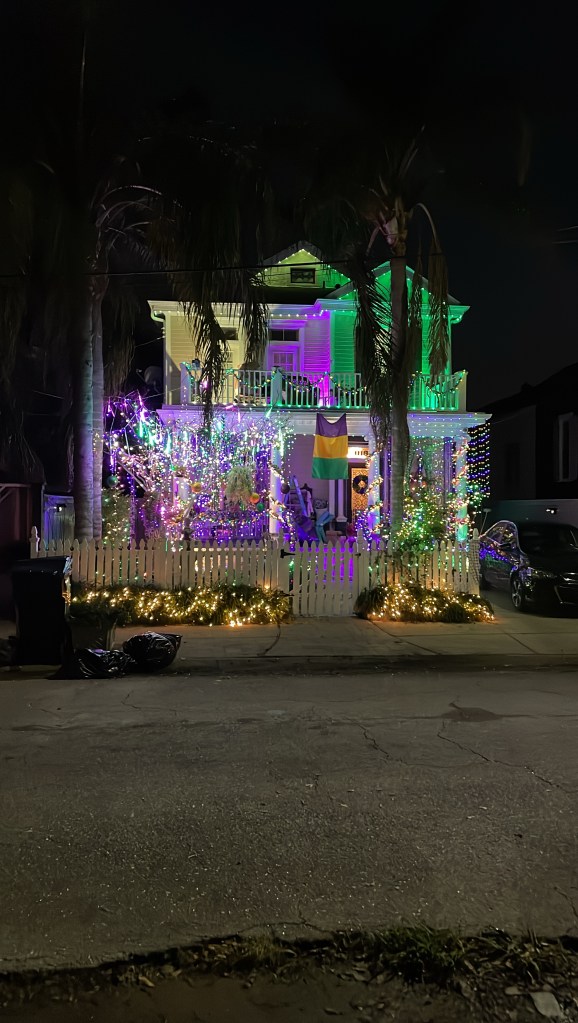
I really need to start taking walks around my neighborhood in the early evening to look at, photograph, and document the Christmas decorations. New Orleans loves holidays, loves costuming, and loves holiday-themed decor; everyone just goes to town for every holiday, and it’s one of the things I love about New Orleans. New Orleans always feels somehow more Christmas season-y than any place I’ve ever lived before, even though we very rarely have a white Christmas here (we did back in 2004); the only place that seems more Christmassy to me is New York–and that has everything to do with Miracle on 34th Street and Macys. When I worked for the airline I used to go to New York for a day every December and buy my mom an ornament from Macys–their Christmas floor was so amazing, always–but now I don’t work for an airline and Mom is gone, so that’s just another one of those nice but bittersweet memories now.

I’ve really been falling down on the job since the surgery about doing blatant self-promotion for Mississippi River Mischief; having major surgery within a few weeks of having two new books drop was perhaps not the smartest decision I have ever made. I always feel weird and uncomfortable doing self-promotion, anyway; I always think people don’t want to hear about this constantly and as you can tell, I’m not really good at it. I know I should be out looking for reviews that are positive and sharing them; but looking for positive reviews inevitably leads you to finding negative reviews, and at this point in time especially I have no interest in reading about how I’ve failed at my job. My books aren’t for everyone–but that doesn’t mean they suck, either. (If I don’t like a book I’m reading, I don’t finish it and I don’t talk about it; I simply say it wasn’t for me when/if asked.)

This enforced rest from the surgery has been an interesting time. I’ve read a lot–mostly short stories, some novels–and streamed a lot of things to watch, but I’ve also been going down a lot of wormholes in my own brain; trying to remember things with a memory that was already starting to fade a bit with age, but it accelerated dramatically after my COVID experience in the summer of 2022…I had already come to realize, recognize, and accept that my memories were faulty all along anyway; we always remember things differently than other people remember the same things because of who we are and how our minds work and how our experiences–and all those little things that make up our personalities and our perspectives–shape us into who we are. I like to paraphrase Joan Didion and say we tell ourselves lies in order to live–we don’t see ourselves as bad or as the villain in any given situation; we reshape events and remember them in ways that exonerate ourselves and push the fault onto others. Over the last years–pre-pandemic, I know that is the case if I can’t remember precisely when–I know I’ve been trying to look at occurrences in my own personal history and trying to be more objective about them all.

In some ways, that was where the story of Mississippi River Mischief came from; I wanted to deal with something from Scotty’s past that I’d brought up in one of the first books in the series (the long out of print Jackson Square Jazz, which hopefully will be available again in time for its twentieth birthday next year) and I’d always wanted to go back and reexamine that incident from Scotty’s past, with an older and much wiser Scotty reflecting on it and how it shaped and developed who he is–only to have it not be how he remembered it in the first place. It crossed my mind briefly while writing Royal Street Reveillon that “oh, the aftermath of this is a good place to deal with this thing from his past1,” and given how and why the underlying case in the new book comes to the Scotty and the guys, and what happened in the last book, this was the book where I had to go there and bring it all back. Yes, Jackson Square Jazz had been out of print since 2010, so the only way anyone could get it was from second-hand sources or libraries, so a couple of pages about Scotty’s past in an unavailable book–well, I did think for a while I wouldn’t have to dredge that up in this most recent book, but it didn’t take long for me to realize that I had to–it was cowardly not to deal with it and pretend I never wrote about it in the first place (especially since I’ve always intended for the book to be rereleased), and it fit in with not only the new story but what happened in the previous book.

And the fact that it was an extremely loaded subject made it all the more important that I address Scotty’s past–being seduced by his wrestling coach in high school–so that he could see it for what it actually was rather than what he remembered it as.

And the fallout will continue into the next one. (Yes, there are going to be at least three more, and I promise not to go four years between Scotty books again.)

  1. Sorry, I’m trying not to give spoilers on a book that is almost six years old! ↩︎

Does It Make You Remember

It is impossible for me to express how much books have always meant to me, and how grateful I am, to this day, to my parents and grandmother for encouraging me to read. We’ve always been a reading family–but no one ever has read as much, or as often, as I did. One of my aunts called me “the readingest child I’ve ever seen”–and she was a librarian. Books made sense to me; the worlds I escaped into whenever I opened a book made sense to me, and none of the worries or cares of my childhood bothered me when I was lost in a book. I also loved history, and thus read a lot of it when I was a kid; the basic overview history classes I had were pretty easy for me because I already knew the history in greater depth than the textbook provided.

The Scholastic Book Fairs were always my favorite day every month, and I was always so delighted when my mom would let me order a few–never all the ones I wanted, because I really wanted them all–and it was even more exciting when I found one that was also set in a period of American history. Johnny Tremain remains, to this day, one of my all-time favorites, and when I was a kid, I wanted to write both a mystery series (like the Hardy Boys and Nancy Drew) as well as historical fiction.

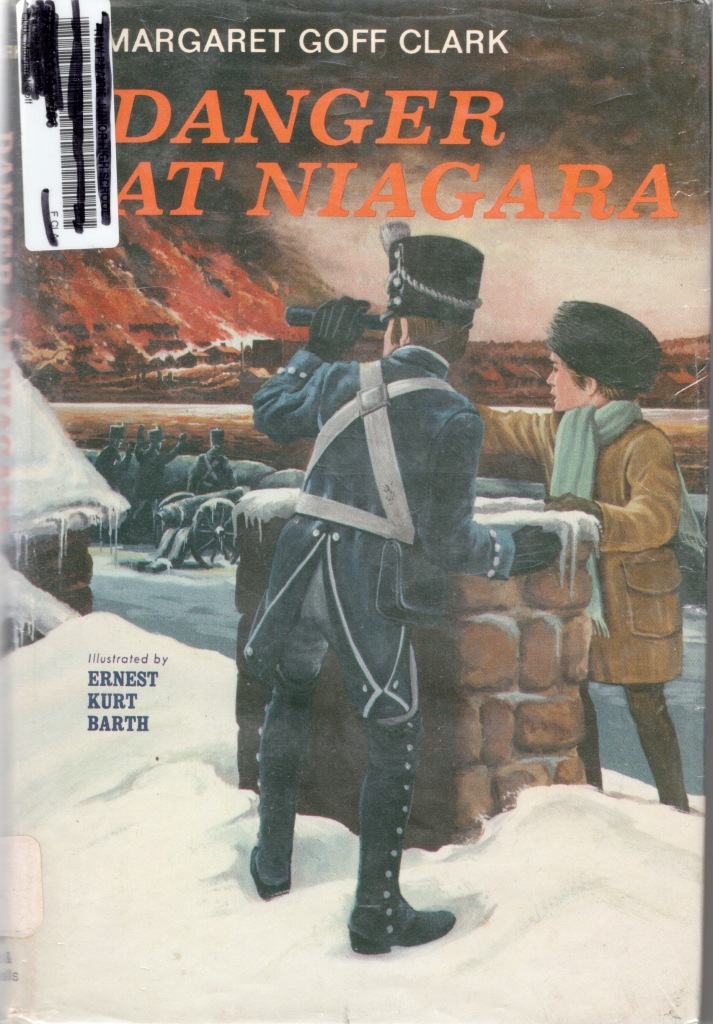
One such book that stuck with me over the years–and didn’t have as big an impact on culture as Johnny Tremain, which won awards and was filmed by Disney–was Margaret Goff Clark’s Danger at Niagara, which was set on the US/Canadian border during the War of 1812 (which few people write about and is mostly forgotten today). A few years ago I was looking for the original hardcover of Johnny Tremain I had read as a child, when a copy of Danger at Niagara was recommended to me by the eBay algorithm. It wasn’t expensive, it was a library remainder, and I thought, what the hell and shelled out the less than five dollars including postage, and the other day while they worked on the ceiling, I reread its 120 pages.

Sorry for the not-clear cover image; my copy is a library discard and there are no clear images of this cover on-line; at least not that I can find.

Exhausted from a day of fruitless hunting, Homan Reed ate a cold supper of cornbread and milk. Hastily he banked the fire and then fell into bed, forgetting his loneliness and the ever-present danger from across the river.

He awoke at dawn, shivering under the heavy quilts, awakened as much by the silence as the cold. He lay still, listening. Gray morning light had come through the small panes of glass Uncle Oliver had carried all the way from Connecticut. A sound that usually penetrated the log walls of the cabin was missing–a sound that was part of the background of his life in this lonely frontier clearing in western New York State.

His hear began to beat too fast, and he sat up in bed, reaching for the buckskin breeches he had laid on top of the quilts. Homan was a good-looking boy, rather small for his almost fifteen years.

There really isn’t much to the story, really. Homan wakes up to realize he has slept through a raid on his little family farm, and their livestock is gone. His uncle brought Homan and his brother up here after their parents died, and his brother is off fighting in the American army in the War of 1812. The Reed place is right across the river from Canada–and of course, at that time Canada was the enemy. Putting myself into Homan’s place was exciting; trying to imagine what it was like to know that not only was the British army capable of crossing the river at any time, their Mohawk allies were also out and about and a constant threat. Shortly after the opening of the book, the American army burns a Canadian town and turns out women, children, the sick and the elderly out into the cold with no shelter or food; to the author’s credit, she makes it clear this is horrible and a war crime; Homan, who witnesses this from inside Fort Niagara (he’s gone looking for his brother and to try to enlist), is horrified and ashamed Americans could do something so heinous–and everyone on the American side of the river knows there will be retaliation and retribution.

As I reread this short book, I paid very close attention to what we now would call propaganda for American supremacy–and there was some, but not as much as I would have thought, and there was less problematic language than I would have expected for the time (it was published in 1967 originally). Yes, Clark refers to the Tuscarora and Mohawk peoples as “Indians,” as do the characters (which is what they would have said at the time, so historically accurate, if offensive) but she treats the natives with respect–no references to them not being human beings, or being savages or uncivilized or anything like that; Homan even has a friend his age from the Tuscarora people. The Mohawks are referred to as the enemy, but in the same way the British are. There are a few mentions of pro-American exceptionalism propaganda–things like “we are a growing power the world needs to respect”, that sort of thing that Americans have always believed and never questioned until the last few decades or so. But Homan is likable enough, and the story itself, of worrying about your safety and losing your home and so forth, resonates still, even if technically Homan and his family were colonizers.

I really do need to reread Johnny Tremain…

Lost in Love

Saturday morning and we’ve at long last made it to the weekend! Huzzah! I have a lot to do this weekend, and I even have to leave the house both nights. This afternoon I am attending a co-worker’s wedding; tomorrow I am having dinner at San Lorenzo with my friend Ellen. Woo-hoo! Yesterday was a good day. I did my work-at-home chores, along with chores, and then ran some errands so I wouldn’t have to do them today–a decision I am very grateful for this morning, believe you me. I then read Angel Luis Colón’s Infested for a while, finished my reread of Death Drop, and watched an episode of Moonlighting. I also rewatched the last two episodes of Our Flag Means Death again–glad I did; I slept through most of them and they were most witty and clever and funny. When Paul got home we started the new season of Elité, but it’s more a habit and completionism to continue watching it at this point. It’s glory days are long past, I barely remember who any of the characters are, and I don’t really remember much of last season, to be honest.

Sigh. But those first three seasons are still epic television. This is kind of what I mean when I talk about shows that keep going because they’re successful when they should have stopped when they were ahead; the season three finale was an excellent stopping place–but at the same time I would have been terribly bummed had the show ended there, too. Be careful what you wish for, right?

The sun was bright and high this morning, just as it was yesterday morning, which leads me to believe the time change should have been this weekend instead of two or three weeks from now. It used to always be in October; and I don’t know why or when it was changed to November, but if we’re going to have to do this every year, can’t we at least have it happen when it always used to happen? I slept really well last night–I’ve been sleeping well all week, actually. I think the change in the weather has helped with that dramatically. I still feel a bit groggy this morning, but that’s okay. I am going to write this and read some more of Infested once it’s posted, and then I have some things to do around here. The wedding window period is from 4-9, with the actual ceremony around five. I am going to try really hard not to be that person who always arrives ahead of the scheduled time and has to sit around waiting for everyone else to show up–the story of my life–and I am quite determined not to even summon a Lyft until four o’clock.

I’m really enjoyed Infested, but I knew I would. I’ve been a long-time admirer of Angel’s work for quite some time now, and his narrative voice is absolutely perfect in this book. I’m not sure if it’s considered middle-grade or y/a–that line is always so blurry–but it’s quite engaging and I really like the main character. I’m also not entirely sure I’ve read a book before that’s set entirely in the Bronx? (And why is it “the Bronx”? It’s not “the Queens” or “the Brooklyn” or “the Manhattan”, but just saying “Bronx” without the article is weird…although I suspect that’s entirely from years of hearing it said with the article.) I am really enjoying it.

I’ve thought about writing for middle grade (I’ve literally thought about writing everything other than fantasy –I even have some science fiction, incredibly bad, in the files) but am not sure if I can do it, which is precisely the reason I should try writing it. I’ve always wanted to do my own kind of Nancy Drew-style series for kids, have wanted to ever since I was a kid reading those books, and I’d really like to at least give it a try at some point before I finally exit the planet or am unable to write anything anymore. Although can I really write for middle-graders when I don’t know any kids that age? Writing is writing, I suppose, and the best thing to do is try it and write the very best book I can with the very best characters I can; I do think two of my strengths as a writer are likable characters and a good narrative style that draws the reader in. Can that translate to middle grade mysteries? I guess I will never know unless I try–and maybe, just maybe, I could write one set in New Orleans?

And on that note, I am heading into the spice mines with my book to read. Have a lovely Saturday; I may be back later; you never know!

Stomp

And here we are at work-at-home Friday again today. I have an MRI scheduled at Tulane Institute of Sports Medicine this morning, but other than that I will be here at home, getting prepared for the refrigerator to arrive and doing other chores around my work-at-home duties. It was an exhausting week, both for me personally and for the world politically. I generally don’t comment on world events, primarily because I am at best a distant observer who depends on news reports and because I don’t feel informed enough to have an opinion. I do know that I abhor brutality and think all death is unnecessary, especially in the name of politics, religion, and racism. The situation in the Middle East–volatile for my entire life–is one without answer, I fear. I also remember how foolishly we all were for thinking the Camp David Accords would bring peace to the region. The only peace it brought was between Israel and Egypt–and that has lasted. I don’t have any answers, and I feel making comments that are uninformed without solutions does not add to the discourse nor move anything forward in a positive manner, so I just keep my mouth shut and hope for an end to the death and slaughter and trauma.

Yesterday was an exhausting day overall. Everything at the office was some kind of haywire in an almost “Mercury must be in retrograde” kind of way, and most of it went on while I was the only person there–which was kind of unsettling. It was also Mom’s birthday so my subconscious was already raw and on edge. But I worked through it, there wasn’t a body count, and I stopped to get the mail on my way home–where I picked up the Box O’Books for Death Drop (yay!) and my Ben Pierce Photography calendar “Beneath the Waters: Images of the Atchafalaya Basin Drawdown”. Ben Pierce is an extraordinary photographer of the natural beauty of Louisiana. I follow him on Facebook and often share his work because it’s so breathtakingly beautiful and evocative; and doesn’t Atchafalaya Basin Drawdown sound like a Scotty title? I’ve been meaning to look into what precisely that means and why they are draining the basin since he started sharing images from it earlier this year; I should perhaps put that on the to-do list? While I was waiting for Paul and playing with Tug (trying to wear him out, in all honesty; he was wired like a circuit party queen last night), who met the laser light/magical red dot for the first time last night. He soon figured out where it was coming from, but still chased it none the less, and eventually when I set it down it also became a toy so there’s no telling where it is this morning. I watched another episode of Moonlighting last night which didn’t seem to hold up as well as previous ones–too much speculation about Maddie’s sex life, which was completely untoward and bothered me–and I also got caught up on Real Housewives of Salt Lake City, which I’ve never really watched very much but started this season at the urging of friends. I’ve yet to watch the reboot of New York, either. I think there’s a blog entry I need to write about reality television shows like these, which I had already started after the completion of the most recent season of Beverly Hills. The out-of-touch narcissism of the SLC women still seems fun and funny to me, while the other franchises have kind of gone off the rails with repugnant behavior (looking at you, Lisa Rinna)–but I’ll save that for the blog post about reality television; which is why I don’t really talk about these shows much on here.

I also read some more of Riley Sager’s Final Girls, which I am enjoying–even if it doesn’t seem like it. One of the casualties of the pandemic was my ability to read quickly; I don’t know what happened, but it’s entirely due to my attention span and not the quality of the books I’m reading; look at how long it took me to read Shawn’s book, which was fucking brilliant. It’s going with me to Tulane this morning so I can read more of it, and then I am coming home to work for the rest of the afternoon. I slept really well again last night. I woke up at six (I do that every morning now, regardless) but the alarm was set for seven so I stayed in bed for another hour, which felt marvelous, really. I feel very rested and centered this morning–which is lovely after the chaotic yesterday I had–and am looking forward to the weekend. I have my to-do list, which is necessary; the refrigerator is being delivered tomorrow, so there’s no point in making groceries until after it arrives (so probably Sunday morning, most like); and of course there’s always, always, always housework to do. Boxes started accumulating again in the living room in front of where the bead chest sits (and the floor’s not terribly stable), so those have to go, and I can do some cleaning before the refrigerator is delivered (we currently have an 8 a.m. to 8 p.m. window, which I assume will change tomorrow morning). The LSU game isn’t until Saturday night, and I am not certain there are any other games of interest this weekend…which doesn’t mean I won’t have a game on all day from eleven a.m. on, of course; I most likely will. (Of course, I just looked, and yes, several games of interest–Notre Dame-USC, Alabama-Arkansas, Texas A&M-Tennessee, and of course Auburn-LSU.)

And on that note, sorry to be so brief but I think I am needing to get headed into the spice mines this morning. I may be back later, I don’t know; but stranger things have indeed happened, so one can never rule anything out. If not, for sure tomorrow morning. Have a terrific Friday, Constant Reader!

NOLier Than Thou

(NOTE: I started writing this post back in January, after I’d returned to New Orleans from my last Mystery Writers of America board meeting–this is to give context to the opening paragraph– as you are no doubt well aware, Constant Reader, that I’ve not been back to New York since January; so this is that same trip where this happened and I started thinking about these things, which have never been far out of the forefront of my mind since then.)

While I was in New York recently, walking around to and fro, here and there, hither and yon, I was always checking my phone (and yes, I hate that I’ve become one of those people) and then shoving it back into my pants pocket without putting it to sleep first or closing the app that was open. As I walked around, of course this led to my phone doing all kinds of weird things –closing an app and opening another, etc.; but at least there were no butt dials, right? At one point, when I pulled out my phone as I took a seat on the subway, somehow what was open on the screen was a google search for my book A Streetcar Named Murder–and when I went to close that screen I touched one of the images by mistake, which took me to the Goodreads page for the book. Bear in mind, I never look at Goodreads for any of my books, let alone Amazon–the temptations to start reading the bad reviews is too great, and while I can usually laugh them off, occasionally–and it depends entirely on my mood, of course–one will get under my skin and it will annoy me, and that’s not good for anyone.

This particular day on the subway the Goodreads page opened to the bad reviews first–its average is four stars, which I will always take because I am not Lauren Hough–and the very first one made me laugh out loud on the subway. Paraphrased, it was basically someone taking umbrage at “someone who doesn’t live here or know the first thing about New Orleans” writing a book about New Orleans. The reason they had come to this conclusion was because Valerie referred to Mardi Gras as “Fat Tuesday”, and according to this one-star reviewer, no one from New Orleans would ever say Fat Tuesday instead of Mardi Gras.

Well, I’ve lived here for twenty-seven years and I have heard any number of locals say Fat Tuesday rather than Mardi Gras, and so of course I had to click on the reviewer’s profile…and grinned to myself when I saw that they actually live in Metairie, not New Orleans…which to locals is a bigger crime than getting something wrong about New Orleans: claiming to be from New Orleans when you actually live in Metairie. (the rejoinder is usually along the lines of “bitch, you live in Metairie.”)

It was also kind of fun to be accused of inauthenticity when it comes to writing about New Orleans, because I personally have never claimed to be an expert on anything New Orleans (others have said that about me, and I always am very quick to reply not even close); the more I learn about the city the more I realize how little I actually know about the city. There’s an extremely rich (and often incredibly dark) history here; it’s hard for me to wrap my mind around the fact that the New Basin canal was there as long as it was, or that there were several train stations around the French Quarter (including one that essentially was in Storyville–rather convenient for the whores and pimps, right?), or that where UNO is now used to be the lake shore resort of Milneburg, or that the only way across the river or the lake was by ferry until Huey Long built a bridge at the Rigolets (the narrow inlet between lakes Pontchartrain and Borgne).

I was on a panel once at the Tennessee Williams Festival with Bill Loefhelm (if you’re not reading Bill’s books, shame on you and correct that immediately) and the question of New Orleans authenticity came up, and Bill’s response (paraphrasing) was that New Orleanians have a tendency to play a game called “NOLier than Thou,” in which they try to one-up each other to see who the true New Orleanian actually is–which is, of course, gatekeeping. (And yes, I immediately turned to him and said, “I like that and am going to steal it” SO CONSIDER IT STOLEN.)

It does bother me somewhat when I read books set in New Orleans written by people who have never lived here; you can tell, but I also get over it pretty quickly; who is to say who can and can’t write about a place? There’s a significant difference between visiting and living here, which I realized almost immediately after we moved here, and that also becomes very apparent in fiction. I had started writing the book that would become Murder in the Rue Dauphine before I moved here, and I realized, once I did live here, that everything I’d written about New Orleans was completely wrong. I didn’t work on the book for another two years; and even then I wasn’t entirely sure I’d lived here long enough to write about the city. So…I kind of cheated by making Chanse MacLeod not a native either; he’d moved to New Orleans after getting his degree in Criminology from LSU, and had been here about six or seven years when the story opened. So he was an outsider, too; so his views on the city and how things work around here were from an outsider’s perspective, like mine; that was easier. With Bourbon Street Blues, I decided that Scotty was not only a native but came from two old-line society families, from the Garden District and Uptown. One of the greatest joys of my publishing career was having the Times-Picayune’s mystery reviewer, as well as the Books Editor, both say repeatedly that I got New Orleans right in my books. (Thanks again as always for all of your support, Diana Pinckley and Susan Larson!)

And I never really worried about it too much from then on. I wrote about New Orleans as I saw it–the potholes, the cracked sidewalks, the leaning houses, flooding streets, oppressive weather and hurricanes. As the years passed, I became more and more aware that my New Orleans writing was primarily confined to the Quarter, the Marigny, the CBD, the Lower Garden District, the Garden District, and Uptown–a very narrow slice of the city, but those were also my slices of the city, so that’s I wrote about. Sometimes I’d venture into another neighborhood–Lakeview, the Irish Channel, English Turn–and sometimes the story would take the characters to another part of Louisiana–the bayou and river parishes, the Maurepas swamp, the Atchafalaya Swamp, Baton Rouge–which, oddly enough, I had no qualms about fictionalizing. I’ve created numerous fictional towns and parishes surrounding New Orleans; I’ve even invented a sleazy gay bar in the Quarter (the Brass Rail).

So, was I doing New Orleans (and Louisiana) right by making stuff up, inventing places like the Royal Aquitaine Hotel, the Brass Rail, Bodytech Health Club, Riverview Fitness, etc.? Sometimes you have to fictionalize things, even if they are based on something that really exists. I never really thought much about it; I felt like I was getting the feel of New Orleans right, that my characters talked the way people in New Orleans do and react the way people here do, and that I was putting enough reality into the books for them to ring true to locals, natives, and tourists. Sometimes the cases are based on, in or around something that actually happened or exist; like the Cabildo Fire, the Fire at the Upstairs Lounge, Hurricane Katrina and the ensuing flood; termite swarms; Huey Long’s deduct box; and even the court case in, I think, Murder in the Irish Channel that triggered the murders was actually based on a civil trial I served as a juror on.

When I started writing A Streetcar Named Murder, I realized a lot of things I was writing about had to be fictionalized; I couldn’t set a murder at a Mardi Gras krewe ball and use an actual krewe that exists in real life, for one thing (like I had to invent a French Quarter hotel for a couple of murders to occur in) and while I didn’t want to use the cheat that Valerie had moved here again, like I did with Chanse, I wanted her to be of New Orleans but not be of New Orleans…so her parents are from Georgia and moved here after college and marriage, so Valerie was born here, went to school here, met and fell in love with and married her husband here–but her roots aren’t very deep, so she is both insider and outsider at the same time. I liked that idea; like how I am of the South but not of the South, she was of New Orleans but not of New Orleans at the same time. When creating Jem Richard in Death Drop, again, he’s a recent transplant to the city but his father is from New Orleans but relocated to Dallas, where Jem was born and raised. Jem spent a lot of his summers in New Orleans when he was growing up with his paternal grandmother, so he too is of New Orleans but not of New Orleans; which I am really liking as a method of storytelling about the city. I also moved Jem to a different part of the city; he lives in the 7th ward, on St. Roch Avenue in what is known as the St. Roch neighborhood (aka what realtors are trying to redefine and rename as the “new Marigny”, in order to raise prices) which is also very close to my office. Part of this was to move the action out of the neighborhoods I usually write about (although he does wind up in both Uptown and the Quarter) and so I could explore another neighborhood/part of the city than what I usually write about.

I also had recently–prior to the pandemic–started feeling more disconnected from the city than I ever had before. Primarily I think this was due to my office moving; we had been on Frenchmen Street in the Marigny, one block from the Quarter and where Scotty lives, so whenever I needed some Scotty inspiration I could walk a block, stand under the balconies of his building and just look around, drinking in the sights and sounds and smells of the block. To get past this, I started joining New Orleans history pages on Facebook, like Ain’t Dere No Mo New Orleans or the HNOC page and various others–you do occasionally run into Confederate apologists and racists there (they usually cry about the “crime” in New Orleans–you know, the usual dog-whistles from the white flight racists who fled to Jefferson Parish or the North Shore to escape desegregation of the public schools) and reading more histories of the city, state, and region–which are incredibly fascinating. That reading/research helped me write my historical Sherlock in New Orleans short story, “The Affair of the Purloined Rentboy”–but I have also since realized I got some things wrong in the story too, but there is just so much to know. I set the story in 1916 for example….without knowing New Orleans was hit by a MAJOR hurricane in 1915 that wiped out any number of settlements and villages around the lakes and the bay shores (that will turn up in a story sometime; the destruction of the lake front village of Freniere is just begging to be fictionalized and written about). When I mentioned this to another writer, who primarily does historicals, she snorted. “It’s impossible to know everything, and would people in 1916 still be talking about a hurricane from 1915?”

Probably, but if it doesn’t have anything to do with the story being told, why would I mention it?

A very valuable lesson, to be sure.

So, yes, lady from Metairie: you caught me. I’m not from New Orleans, you’re correct. But I’ve also published over twenty novels and umpteen short stories set here, and have even won awards for doing it.

And I’ll call it Fat Tuesday if I fucking want to.

The Huey P. Long Bridge at sunset, photo credit Marco Rasi

Say You Will

It really boggles my mind that it took me so long to get into listening to audiobooks. I think it was more of a sense that it didn’t count as reading if I wasn’t holding a book (or my iPad) in my hands and scanning the words with my eyes. I’ve never really liked being read to, either; and while I do enjoy live readings by authors of their work, those generally don’t last more than ten hours. I also worried that, as I do have ADHD and good writing always inspires me and floods my brain with ideas for new work for me or stuff that I am already working on (driving through Alabama, for whatever reason, always is inspiring to me), and it’s very easy to go back to where I was reading when inspiration hit. It’s not quite as easy to do this when you’re listening–I haven’t exactly mastered the rewind thing while driving at eighty miles per hour–so I am always afraid I’ve missed something. But…audiobooks in the car on long trips has literally changed my life and made the drives less irritating, boring and painful.

I have always had a taste for fiction that could be classified as Gothic; two of my favorite writers (Daphne du Maurier and Mary Stewart) were masters of the genre. I thought with the deaths or retirements of the major Gothic authors of the mid to late twentieth century that the style (or sub-genre, if you will) had fallen out of fashion (after it’s peak in the 1970’s and early 1980’s) and I missed them, terribly. What I hadn’t known was authors were still writing them, updating and reinvigorating the field…because the cover styles that always marked a Gothic novel (big spooky house, light in a window, creepy looking tree, woman in a flowing nightgown with long hair running from it and looking back over her shoulder in fear) were actually which became obsolete.

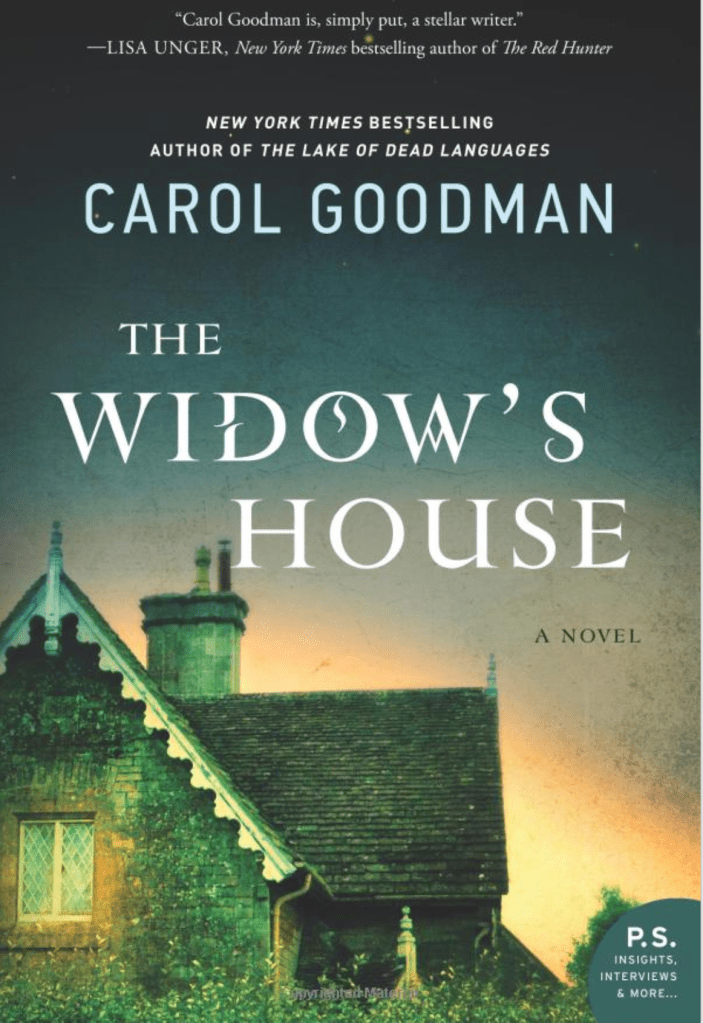
I am so glad I found Carol Goodman.

When I picture the house I see it in the late afternoon, the golden river light filling the windows and gilding the two-hundred-year old brick. That’s how we came upon it, Jess and I, at the end of a long day looking at houses we can’t afford.

“It’s the color of old money,” Jess said, his voice full of longing. He was standing in the weed-choked driveway, his fingers twined through the ornate loops of the rusted iron gate. “But I think it’s a little over our ‘price bracket.'”

I could hear the invisible quotes around the phrase, one the Realtor had used half a dozen times that day. Jess was always a wicked mimic and Katrine Vanderburgh, with her faux country quilted jacket and English rubber boots and bright yellow Suburban, was an easy target. All she needs is a hunting rifle to look like she strode out of Downton Abbey, he’d whispered in my ear when she came out of the realty office to greet us. You’d have to know Jess as well as I did to know it was himself he was mocking for dreaming of a mansion when it was clear we could barely afford a hovel.

It had seemed like a good idea. Go someplace new. Start over. Sell the (already second mortgaged) Brooklyn loft, pay back the (maxed-out) credit cards, and buy something cheap in the country. By country, Jess meant the Hudson Valley, where we’d both gone to college. and where Jess had begun his first novel. He’d developed the superstition over the last winter that if he returned to the site where the muses had first spoken to him he would finally be able to write his long-awaited second novel. ANd how much could houses up there cost? We both remembered the area as rustic: Jess because he’d seen it through the eyes of a Long Island kid and me because I’d grown up in the nearby village of Concord and couldn’t wait to get out and live in the city.

Isn’t that a great opening?

All of Goodman’s novels are unique, but tied together by that strong, literate authorial voice that makes starting to read (or listen) to a new one as comfortable as slipping into your house shoes; the word choices are marvelous, and the sentence/paragraph constructions are so intricate yet not impenetrable to the reader. Goodman’s novels usually have a central core that has to do with education and/or literature of some kind, and are inevitably set in either upstate New York and/or the Hudson Valley or the city itself; but there’s always a brooding, old building involved. The books are also smart and well-paced, and there is often a dual timeline involved, whether it alternates between past and present or does an entire time-jump to reveal the secrets and the truths bedeviling our heroine. Goodman’s heroines are likable, relatable, and understandable.

The Widow’s House focuses primarily on our main character, Clare Martin. Clare met her husband, Jess, in a creative writing seminar at a impressive university near Concord, where she grew up and she and Jess are currently looking for a house they cannot afford. Both were aspiring writers when they met; Jess wrote a debut novel that made a splash but is now ten years overdue on his second (aside: this always amazes me. I don’t think I’ve ever known a writer given an advance who then never delivered a manuscript for ten years or more without consequence, but this always pops up in novels about literary writers–Michael Chabon’s Wonder Boys comes to mind. Then again, most writers I know are genre writers and no crime writer could ever not deliver for ten years–I always feel horribly guilty when I miss a deadline and then it’s usually only an extra month that I need, not ten years. Maybe it’s different for those who write lit-ra-CHOOR) while Clare has buried her own authorial ambitions while working as an editor (and then a freelance one) to support Jess while he writes his book (I also would never let Paul go ten years without working while I couldn’t write so I could support him financially; I feel relatively confident the obverse is also true). The house their realtor is showing them at the opening of this book is called River House, but it’s also a site of many tragedies and deaths and madness, so much so that someone has taken a chisel and changed RIVER HOUSE on the gate column to RIVEN HOUSE. But the master of the crumbling old house is looking for caretakers to live on the property rent-free in exchange for upkeep work on the estate… but the master is the same writing professor in whose class they met–a professor Jess resents for trashing his debut novel in the New York Times, a review Jess is certain has kept him from breaking out as a major (best-selling) literary star. But the deal is too good to pass up, and Clare herself thinks moving there might help her restart her own writing…

Several of Goodman’s other novels tackle the world of the writer–The Stranger Behind You was a particular standout–and boy, could I relate to Clare’s fears and insecurities and anxieties about writing. To make matters worse, there also seems to be a ghost (or two, or maybe even three) at Riven House–but only Clare sees or experiences the haunting, to the point that she begins to question her own sanity. But why? Why would someone gaslight Clare, the wife of an underperforming novelist? There were some times in the book where Jess would be a bit of a emotionally abusive ass to her, and I would get a bit frustrated with her–a point I often had with the heroines of Victoria Holt and Phyllis A. Whitney–for subsuming herself and her needs and desires and dreams in service to his, and he doesn’t seem to appreciate it in the least. The ghost mystery has to do with tragedies in the path; the murder of an illegitimate child, the suicide of its mother, and madness and murder. Clare starts unraveling the mysteries from the past to get to the bottom of what is going on at Riven House–and there’s a marvelous, heart racing conclusion during a massive winter storm and power loss at Riven House, when Clare finally finds the truth and has to fight for her own life.

What a satisfying, thoroughly enjoyable read–which is what you always get from Carol Goodman. If you haven’t read her yet, START. Immediately.

You can thank me later.

But I’m Not

Sunday and I slept late this morning and i am not a bit ashamed of it, quite frankly. The opportunities to sleep in are rare these days–getting up early so often for so long has adjusted and shifted my body clock in ways I’m getting used to but don’t like, and chief among those ways is the inability to sleep in. Yesterday I was up before eight, for example, but this morning it wasn’t even nine when I got up, and I could have easily stayed in bed longer. But there’s spice to mine today, and while there is still a lot of it to get done, I am feeling very good about things this morning. I actually felt really good about them yesterday if I am going to be completely honest. I got two chapters done and finished editing a manuscript (not my own) and turned it in to the publisher, which felt marvelous to be finished with that. Deadlines and juggling projects is something I’ve always done, but something I’ve noticed since the pandemic shutdown is deadlines are much more stressful and demanding on me, and take a bigger emotional toll than they used to. Probably part and parcel of the long COVID rewiring of my brain, but whereas before, I relished the pressure and it drove me to work harder, now it shuts me down and/or depresses me, which has the exact opposite reaction it used to have with me: instead of driving me, I think oh I’ll never get this all done so why bother and I end up blowing things off completely. Depression is quite the bitch, you know.

But I am very pleased with the work I got done yesterday and look forward to today’s work. I also did a load of dishes and laundry yesterday, and some cleaning. But after I was finished with work for the day, my brain was too fatigued to read so I watched movies on television, discovered two gems I’ve been wanting to revisit: Cruising and The Last of Sheila. I wanted to watch Cruising because I remember all the controversies about the movie while it was being filmed (yes, even in rural Kansas we heard about the gays being mad about the movie). I eventually watched it in the mid-1990’s. Paul is a huge Al Pacino fan, and when we moved in together he owned almost the entire Pacino filmography on videocassettes, so one night we watched Cruising. I didn’t much care for it when I watched it the first time, but I’ve wanted to watch it again–when I watched I wasn’t yet a published crime writer–because the story itself is interesting to me. A hot young ambitious cop sent undercover into the gay BDSM/leather community to look for a serial killer? The question of identity and sexual confusion that could arise from playing the part, which entailed going out and picking up (or being picked up) by gay men expecting some sex? I mean, you have to admit that’s a great set-up and concept for story. The Oscar winning director William Friedkin (he won for The French Connection but was much better known for directing The Exorcist) failed and ended up with a deeply flawed film. Pacino was also robbed of a far greater performance due to the homophobic cowardice of the either the director or the studio. Rewatching, the film’s flaws are even more apparent, but it’s a shame. It could have been a great film–and it does remain one of the few Hollywood films that actually depicts gay bar culture of the late 1970s the way it was–but I don’t know what went wrong with it, but it’s still a great idea. I also liked seeing New York as dirty and grimy, the way it was during that time period before gentrification came to Manhattan. It’s also fun seeing old movies where people who went on to greater stardom later had bit parts or cameos; Ed O’Neill popped up on screen at one point, as did several others that made me think, hmmmm.

If I had the time or inclination, I would take that basic framework of an idea and turn it into something stronger than the film. There was also a book it was based on, but it’s rare and used copies are insanely expensive. It also reminded me of a gay crime novel I read as a teenager living in Kansas; I may have been in college, I don’t remember, called A Brother’s Touch by Owen Levy. The book was about a brother who comes to New York to look into his estranged brother’s life after he is murdered–they were estranged because the dead brother was openly gay–and begins to question his own sexuality after being enmeshed into the gay community of Manhattan at the time. It was reprinted recently and I got a copy (by recently I mean in the years since Katrina; I have no concept of time and its passage anymore); I should move it closer to the top of the TBR pile. I wish I could still read as voraciously as I used to…something else that has slowed down with getting older.

After watching this I wanted to rewatch a classic old crime film of the old school, The Last of Sheila, which I’ve always loved. Co-written by Stephen Sondheim and Anthony Perkins and directed by Herbert Ross, it’s a whodunit worthy of Christie herself, in which a widowed producer invites some film community members on hard times for a week on his yacht. Everyone invited was at the party a year before where the producer’s wife Sheila wound up being killed by a hit-and-run driver, and the producer, whose known for loving to play games, has come up with a game for his guests to play. Everyone gets a card, and every day they will stop somewhere they will look for clues to the identity of whoever holds the card of the day–the first is a shoplifter, the second is a homosexual–and of course, the game turns dark and ugly when the producer host–played to sadistic asshole perfection by James Coburn, is murdered…and it turns out the game their host was playing had layers none of the guests knew about going in. The cast is a perfect time capsule of early 1970’s stardom: Richard Benjamin, Raquel Welch, Dyan Cannon, James Mason, Joan Hackett, a beautiful young Ian McShane, and of course, Coburn. It has twists and turns and surprises, and is so markedly clever that it’s hard to describe without spoiling anything…and the surprises are what make it such a great and fun film. This was one of our Sunday movie-after-church movies, I think; I do remember seeing it in the theater and being impressed and amazed. One thing I absolutely loved in the rewatch was the books scattered over every set–they are all mystery novels by Agatha Christie, Ngaio Marsh, Ellery Queen, and Erle Stanley Gardner, which should tip the viewer off that you are in for a mystery influenced by the master crime plotters of the time. It’s really a shame the film wasn’t a success, because it would have been amazing if Perkins and Sondheim had collaborated on more scripts like this one. As I was watching, I kept thinking how much I would love to write a puzzle-type mystery like this one; I’ve always feared such a thing was outside of my wheelhouse so I have always been afraid to try. Who knows? Maybe I will.

I feel very rested this morning and I am not dreading diving into the book this morning, which is nice. I don’t think I have the mindspace and bandwidth to work on multiple things all at the same time anymore, if that makes sense. I don’t know if it has to do with the long COVID rewriting of my brain waves or what, but the last few books I’ve written or worked on–going back to Bury Me in Shadows–have been more stressful than fun for me to write. Writing on a deadline is always stressful, and I rarely, if ever, actually make deadlines. But having multiple projects going on at the same time now feels like I am not devoting enough of my time and attention to any of them, let alone all of them, and that makes me feel uncomfortable about the work. Of course, my last three books–and my last anthology–have all gotten a lot of mainstream award attention, which makes it seem weirder. Which, of course, makes me wonder if the stress and the heavy burden pressure of multiple projects going is somehow making me produce somehow better work than before, and do I really want to mess with that at all? It never ceases to amaze me how neurotic I am about being a writer, and how afraid I am that any change or variation means it’s all over for me now.

I do wonder sometimes if other writers have that same secret fear: that the well will eventually run dry or that we’ll forget how to do what we do. People like to call me prolific; I’ve slowly come to the conclusion that I am and that it’s not a bad thing (I always try to figure out if being called something is bad–which goes back to being called a fairy as a child and thinking he was saying ferry and being very confused). John D. MacDonald was prolific; so were Ellery Queen, Agatha Christie, and Erle Stanley Gardner. I think my insecurities came into play when people started calling me prolific; I am so used to being insulted that I assumed it must be an insult as well, like it was something I should be ashamed of or something. I’ve decided to embrace it as a compliment. I am sure there are literary writers who produce one novel every ten years or so who would think it an insult, but I don’t respect them so don’t really care much what they think. And if I am not as prolific as I used to be–which I am not–it’s nothing to be ashamed of; I’ve gotten older, have gone through some things, and I don’t have the energy that I used to have. My imagination still rages out of control at any and all times, of course, but I don’t have the energy to fool myself into thinking every idea I have will turn into a short story, an essay, or a novel. I certainly won’t live long enough to turn all the ideas I already have into longer works of whatever style and kind.

And on that note, I am diving back into the book. I am getting another cup of coffee and putting some bread in the toaster for later, and I may or may not do another Pride month entry later today. Anyway, you have the loveliest Sunday possible, Constant Reader, and I will check in with you again later.