If You’ve Got the Money, I’ve Got The Time

One of the things I find fascinating about many people is their dedication to nostalgia; their insistence that some past time of their life was somehow this incredibly magical time of innocence (which it could conceivably have been); a utopia paradise of some sort where everything was right with the world and everyone was so happy and–you get the picture. It’s like how people glowingly refer to high school as one of the “best times of their lives” (which, frankly, is terribly sad and tells me more about their present circumstances than I’d care to know); the past wasn’t magic and neither were our childhoods. If they mean I liked life better before I knew how awful it can be, that I can understand–and I do think that is what they actually mean, even if it isn’t what they are actually saying: they preferred life when the bills and putting food on the table was someone else’s responsibility; when the biggest worries were who will I go to the Homecoming dance with and I have to study for that History test and so forth. But my teenaged years weren’t halcyon and rosy. The 1970’s was a very strange decade of reaction to the 1960’s–and for a queer kid, first trapped in a middle to upper middle class suburb of Chicago and then a small rural town in Kansas, it was hard. I’ve no desire to ever relive high school or go back to being a teenager. Sure, it might be easier to be a queer teen  in a Chicago suburb now–but I suspect it’s not that different in a rural high school in Kansas now than it was forty years ago.

Reading was always my escape from the pressures of a world into which I really didn’t fit–and one that from my earliest memories as a child I knew I didn’t belong in. Reading was a godsend for me, and I read ravenously. I was always being told to go outside and play instead of reading; the most effective punishments were the ones either prohibiting me from reading or limiting how much I could read, and the earliest signs of my obsessive/compulsive disorder were evident with my discovery of the mystery series for kids, which was the next gradual move for me as a reader from the Scholastic Book Fair mysteries. My goal has always been to finish collecting all the series I read and collected as a child: the Hardy Boys, Nancy Drew, the Dana Girls, The Three Investigators and Trixie Belden, as well as the lesser known ones like Biff Brewster, Ken Holt (over whom I had a weird bonding moment with James Ellroy), Rick Brant, Vicki Barr, Judy Bolton, Cherry Ames, Kay Tracey, and Connie Blair. (I also collected the Chip Hilton sports series.) I still have the copies I had as a child, and in the aftermath of Hurricane Katrina, I discovered eBay and tried to finish collecting the series. I don’t have room in the Lost Apartment to display them proudly in a bookcase–I have far too many books; and many of them are boxed up and stored–but I refuse to rid myself of them, because I keep holding out hope that someday I will live in an apartment or condo or house where I can have a room filled with bookcases that will also serve as my office.

But eBay gradually led me to collectors’ and fan pages of these books on Facebook..occasionally someone on one of those pages will be selling a copy of something I need to complete my collections.  There is a generic page for series books in general, and then there are individual pages for Nancy Drew and the Hardy Boys, respectively–and probably still others for the other series that I don’t know about. I know there are also fan websites and serious scholarship on the kids’ series–some of them make for interesting reading, if you have some free time (or are wasting time you should be spending on writing). Some of the fan websites also have conferences and trips–the Nancy Drew group, for example, has an annual trip to where one of the books was set, and tours and so forth to visit the places Nancy also went to look for clues in the course of her investigation. (They were in New Orleans a few years ago; I was going to register–it’s not cheap–until I realized it was more about being a fan than anything else.)

And boy, do these people take their series fandom seriously. I’m not as rabid or as devoted as the majority of them; periodically I might reread one of the series books (I’d love to write an essay about the Ken Holt series, which was darker and more hard-boiled than any of the others; which was why James Ellroy and I bonded over them–which is still so weird to me), but I don’t reread an entire series from beginning to end, and while I used to remember plot details quite vividly, as I’ve gotten older those memories are fading.

I’ve not watched the new CW series Nancy Drew–well, I watched the first episode but didn’t keep watching; primarily because I haven’t had time and Paul and I usually watch shows together–at least, I like to give him a chance to watch something I might enjoy before moving on to watch it on my own (like Riverdale). Maybe he’ll be interested in Nancy Drew, maybe he won’t; I thought he’d like Riverdale but he didn’t. Maybe Nancy Drew is something I’ll wind up watching while he’s working in the evenings; I don’t know. But I’ve also not seen the recent film adaptation, Nancy Drew and the Hidden Staircase, either. But boy, do these Nancy Drew fans take their Nancy Drew seriously. They were outraged that Nancy Drew had sex in the first episode (because Nancy of course never had sex in the series; I don’t even think she even enjoyed a chaste kiss from Ned in all 58 of the original books) and Ned Nickerson was black! Nancy Drew was not only having sex but she was having sex with a black teenager!

The pearls were clutched so tightly! And if you stuck a piece of coal up these people’s asses, it would have come out a diamond. There was a lot of moaning and whining about people’s childhoods being ruined (really? Mine is still just fine) and the “horrors of political correctness” and on and on and on. In other words, Nancy should be a virgin and only know white, straight, cishet people. Got it.

Anyway, Hulu recently announced that they are doing a Hardy Boys series; however, instead of Bayport the town is Bridgeport; their first case is their mother’s murder; and rather than being 18 and 17, their ages will be 16 and 12. Their father is off investigating the murder and so he deposits them with their aunt in Bridgeport, but they soon realize their mother’s death is somehow connected to the town–and everyone in town is a suspect.

Yes, these are significant changes to the original canon of the Hardy Boys, but also remember: The Mickey Mouse Club did two serialized versions of the Hardy Boys, making them also about 13 and 14. The Hardy Boys fans are fan with this, of course, and with the other changes Disney made…so what’s the problem? As someone pointed out, in response to all the whining and moaning about ruining characters and childhoods and “political correctness”, someone also commented, grumpily, “I suppose Chet will be slim, gay, and black”–which actually sounded kind of good to me, frankly. The character of Chet is overweight and loves to eat (kind of like Bess in the Nancy series) and also like Bess, his appetite and weight are the subject of lots of jokes, teasing and sometimes humiliation. Not really cool, if we’re being completely honest.

And yes, all of these people are grandparents with graying hair and are white people. All of this whining and complaining over two television series based on characters that have evolved and changed and been rewritten multiple times in the nearly hundred years they’ve been around–to appeal to  new generations of readers. The original versions of the books were all revised in the 1950’s and 1960’s because they were loaded with racial and ethnic stereotypes that were beyond offensive; naturally, the nice old white people prefer the original texts (big shock, right?).

And if any kids’ series need to be turned into television programs, can I vote for The Three Investigators and Encyclopedia Brown?

I am really tired of this whole “you’re ruining my childhood” nonsense. Unless they are traveling back in time to do so, your childhood hasn’t changed.

I’ve always wanted to write a book about kids’ series fans and conventions; I might just have to now. I mean, I get it–people don’t like change, and something that was beloved when you were a child you want frozen in amber forever. But I just wish these people would unpack their issues with the updates and changes–and nothing gets my gorge going more than the ever popular whine of every racist, misogynist, and homophobic piece of shit out there: politically correct. Sorry you don’t feel safe expressing your hateful bigoted opinions any more without consequence.

I’ve also always wanted to write my own middle-grade series; I used to think about that all the time when I was a kid, even up to coming up with characters and titles for the books in the series because of course I did. I don’t know if I can write middle-grade or not; but it’s worth a shot sometime.

And of course, I can talk for hours on the subject of the kids’ series. Perhaps someday I will.

1801217_10152346389544050_285672915_o

Always

Kansas.

We moved to Kansas the summer I turned fifteen. It was a bit of culture shock; we’d been living a middle-to-upper middle class suburb of Chicago for about four years then, after spending eight or nine years in a working-class, very blue-collar neighborhood in Chicago, populated primarily with eastern European immigrants, or second, maybe third, generation Americans from central to eastern Europe. All I really knew about Kansas, before moving there, was that it had been a part of the Dust Bowl during the depression; I’d read about “bleeding Kansas” in history books; and of course, tornadoes and The Wizard of Oz (which is a movie I’ve never cared for; I watched it once as a kid and never again). Neither Nancy Drew nor the Hardy Boys ever had an adventure there; nor had any of the other kids’ series or Scholastic Book Club mysteries I’d read. But it was in Kansas that I actually started writing seriously, and began to think about being a writer when I grew up. (It was also in Kansas that I had the bad creative writing professor, and other bad history professors; I actually cannot think of a single decent teacher I had at the university level in Kansas–but then again, I was incredibly miserable when I lived in Kansas and it’s entirely possible that misery bled over into every other aspect of my life.)

I also don’t want to make it seem as though the five or so years I spent there were completely miserable. I did have fun–I was always desperately trying to have fun to distract me from the terror that arose from my sexuality, which was a secret that must be guarded from everyone at all times; it’s laughable to think about it now, but that terror was very real to me then.

It was in Kansas I started writing about teenagers, and while none of that stuff I’d written was publishable–I still have the handwritten novel I started writing there somewhere; the thought of rereading it turns my stomach as I can only imagine how incredibly bad, trite, and cliched it all was–but those characters have lived on and appeared in my actual published work as an adult; primarily I kept the character names and the basis of who they were, fleshing them out and (hopefully) making them three dimensional. Sara is, to date, the only book I’ve published that is set in Kansas; Laura, the main character in Sorceress, is also from Kansas–but the book is set in California. And of course I’ve been playing with the Kansas book now for something like fifteen years–hopefully, that will be finished and done this year.

I love to read about Kansas, and two of my favorite crime writers–Lori Roy and Sara Paretsky–are also from Kansas; Lori’s first novel, Bent Road (it’s brilliant, as is everything she writes) is set in Kansas; Sara, of course, primarily writes about Chicago but wrote a stand alone several years ago called Bleeding Kansas I’ve always wanted to get around to. Nancy Pickard also wrote two stunningly brilliant novels set in Kansas–The Virgin of Small Plains and The Scent of Rain and Lightning; I cannot recommend them enough. One cannot talk about Kansas books, either, without mentioning Truman Capote’s “true crime novel” In Cold Blood, which I like to reread every now and then.

There’s just something noir about Kansas; I don’t know how to describe it, or why it feels that way to me; but there’s just something about the wide open spaces and the wind, that Peyton Place-like feel to the small cities…Emporia (the county seat; we lived about eight miles out of town in an even smaller town called Americus) even had its own full blown scandal where a minister and the church secretary had an affair and murdered their spouses; it was even made into a two-part mini-series filmed on location in Emporia starring Jobeth Williams as the femme fatale. Those small towns, scattered all over the northern part of Lyon County, once thriving and bustling but now barely hand on when I lived there…the abandoned schools, still standing (they’d all been consolidated into one high school in the 1950’s) in the emptying little towns…our consolidated high school, out in the middle of the country with the football field backing up to a pasture; and the explosive boredom for teenagers. I always turn back to Kansas somehow, whenever I am thinking creatively or wanting to write a new short story–so much material, really. Emporia even had a cult; the old Presbyterian College of Emporia had gone bankrupt sometime in the early 1970’s and The Way International had bought the campus, turning it into The Way College of Emporia and I have to tell you, those kids from The Way College were terrifying–and there were lots of stories and urban legends about what went on there on that campus; how much was true I’ll probably never know, but I do know they used to have armed security guards patrolling the edge of campus, and every teenager knew not to ever get cornered anywhere with no possible escape by two or more of those kids….they always traveled in groups, never less than two and rarely more than six, but always in multiples of two. They always looked very clean cut, but you knew them by the nametags they were required to wear, their empty glassy eyes, and the big smiles on their faces.

There’s also the story of the bloody Benders, serial killers who operated an inn and murdered their guests in the nineteenth century before disappearing; I’m sure every nook and cranny of Kansas has some kind of horrible tale of murder hidden away.

And about three or four miles from our high school–you had to turn right when you reached the state road from Americus to get there; if you turned left towards Council Grove you’d pass this place: an abandoned nuclear missile base, that is still there. We used to go there sometimes for kicks–opening the door and listening to the strange sounds from deep inside and water dripping. I had plenty of nightmares about that missile base.

But the only other gay novelist I know from Kansas is Scott Heim (or at least the only one I know of who sometimes writes about Kansas). I read his debut novel Mysterious Skin sometime in the mid to late 1990’s, and was blown away by it (the film is also quite good). Mysterious Skin is set in Kansas, of course, and while it is a literary novel, and a quite good one, for me there were some elements of noir to the story; I have moved it to the The Reread Project pile and hope to get to it again relatively soon, so i can discuss it with more credibility and authority. I’ve not had the opportunity to read his other two novels, In Awe and We Disappear, but I’m adding them to the “need to get a copy” list.

Over this past weekend I read a short story Scott wrote for Amazon; part of something called The Disorder Collection, along with stories from several other authors. You can buy “Loam” here; it’s well worth the ninety-nine cents.

We agreed to share the driving. The early-morning flights had left us feeling run-down, but my sisters said my eyes looked the least bleary, so I should drive first. The clouds had gone gray; it had started to rain. But we could take our time. The afternoon we’d been dreading lay before us in hot, wet highways flanked by sorghum and corn and glistening shocks of wheat. It was late summer, already harvest season, and the fields shuddered in the wind, the grains full and heavy as though fed with blood.

At the rental counter, a cheery, silver-haired clerk had offered us a white sedan, but Louise had disapproved. “A simple compact is fine,” she said, “and no extra options. Just make sure it’s as black as possible. Is ‘funeral black’ a color?” She’d glanced across the desk to Miriam and me, urging us to smile. No one had smiled since we’d met in the arrival lobby with hesitant hugs.

The clerk didn’t seem to grasp Louise’s reference, but when she collected our licenses, she was attentive enough to catch our dates of birth. She turned and yelled, “Girls, come look–triplets!”

It had been years since we’d been subjected to this kind of foolishness. We watched as her pair of coworkers stood from their desks and approached the counter. I could guess what was coming next: we didn’t look anything alike; we had varying shades of brown and blond hair; even our bodies and the ways we dressed, so different. Louise stopped their small talk before it could start, outstretching her hand to silence the room. “Look, our father just died, okay? Let’s sign what we need to sign and get this over with.”

One of the things I love about Heim’s work–and having only read one novel over twenty years ago and now this short story–is that he often writes about the aftereffects, and the aftermath, of traumas and how the victims deal and cope. This is something that interests me; I often think and wonder about how people who’ve dealt with something–my husband is a serial sex offender; my father murdered my mother, my grandfather was a serial killer–they had no control over cope and go on with their lives; I’m actually writing a story dealing with that sort of thing right now (one of the many stories I have in some sort of progress right now; it’s called “He Didn’t Kill Her”), and also those who were directly victimized–how do they deal? How do they cope? How do they go on with their lives after something so traumatic happens to them?

This is why this century’s reboots and sequels to Halloween interest me, because they show how Laurie Strode, years later, was psychologically damaged and who she became; one of the things I loved about the Scream films is they showed how everything that has happened to her has turned Sydney into a different person from who she imagined she’d be before the murders started.

Heim doesn’t write about the peripherally damaged; he writes about those who actually were damaged first-hand. In “Loam”, his triplets are clearly damaged by something that happened to them when they were children; they are returning to bury their father and clearly have not been back to Kansas in years. It isn’t clear what happened to them–it may have just been bad parenting in the beginning–and it isn’t until they stop at a second-hand store (what we used to call “junk shops” when I was a kid) and find some strange and mysterious pictures of their first grade classmates on a table that the memories of the past–and what they went through–begin to come to the fore.

I do wish Scott Heim would write more. This story, sad and dark and mysterious, is everything I love to read.

This: The afternoon we’d been dreading lay before us in hot, wet highways flanked by sorghum and corn and glistening shocks of wheat. It was late summer, already harvest season, and the fields shuddered in the wind, the grains full and heavy as though fed with blood–I wish I’d written that.

Buy it or borrow it if you have Amazon Prime. It’s very well worth the time.

IMG_0112

Mighty Love

I love nothing more than a great ghost story (which is why, although I loved the book, I was enormously disappointed with Peter Straub’s Ghost Story; it’s an amazing novel and a horror classic and one of my favorite horror novels of all time, but it is emphatically not a ghost story). I’m not sure why I love them so much, but even as a kid, reading the mysteries for kids I always gravitated towards the ones with some kind of ghostly title: The Ghost of Blackwood Hall, The Haunted Fort, The Phantom of Pine Hill, The Ghost at Skeleton Rock, The Haunted Showboat, The Ghost in the Gallery, etc. The ghosts and hauntings in these books were never real–just like the ghosts and monsters on Scooby Doo Where Are You? weren’t–but I still was drawn to them.

There was an ABC Movie of the Week when I was really young that I absolutely loved: The House That Would Not Die. It starred Barbara Stanwyck as a woman who moved into a house she’d inherited from a relative, along with her niece, and of course, the house turned out to be haunted. The story was terrific and it scared me a lot–and you can never go wrong with Barbara Stanwyck; I may even have watched it with my grandmother, who was a big Stanwyck fan. A few years later, we were somewhere–some people my parents knew had invited us over for dinner, and before and after, as the adults, my sister and I were deposited in the den to watch television and entertain ourselves while behaving. They had books, which I gravitated towards, I pulled down a volume of Reader’s Digest Condensed Books and found a ghost story inside. As I started reading, I was drawn into it and I realized it was the same plot, the same story, of the TV movie I’d liked, and kept reading. I read the entire thing that evening–it was condensed, after all–and thought, oh, I’d like to see that movie again.

Flash forward and I am in college, browsing in a second-hand bookstore when I find a worn paperback copy of the book. Pleased and delighted at the opportunity to not only read it again but read the entire version? For fifty cents? Absolutely.

It was Ammie, Come Home, which is one of my favorite ghost stories, and favorite novels, of all time. It was written by Barbara Michaels–for another dollar I picked up two more of her novels, Witch and House of Many Shadows. I loved all three books, but I’ve always preferred Ammie, considered it my favorite. Over the years Michaels–and her alter-ego, Elizabeth Peters-became one of my favorite writers of all time. I love her books, no matter what the name or brand or whatever you want to call it; they are all witty, with strong, likable female characters, there’s some little dash of romantic interest involved in all of them, and a very strong suspense component. The Peters novels were more mysteries; the Michaels sometimes involved the supernatural, and sometimes they didn’t.

But, oh, how I love Ammie, Come Home, and I recently, during my isolation, took it down and made it a part of this year Reread Project.

Ammie Come Home Barbara Michaels Fawcett Crest 1968 harry bennet cover art

By five o’clock it was almost dark, which was not surprising, since the month was November; but Ruth kept glancing uneasily toward the windows at the far end of the room. It was a warm, handsome room, furnished in the style of a past century, with furniture whose present value would have astonished the original owners.. Only the big overstuffed sodas, which face one another before the fireplace, were relatively modern. Their ivory brocade upholstery fitted the blue-and-white color scheme, which has been based upon the delicate Wedgwood plaques set in the mantel. A cheerful fire burned on the hearth, sending sparks dancing from the crystal glasses on the coffee table and turning the sherry in the cut-glass decanter the color of melted copper. Since her niece had come to stay with her, Ruth had set out glasses and wine every evening. It was a pleasant ritual, which they both enjoyed even when it was followed by nothing more elegant than hamburgers. But tonight Sara was late.

The darkening windows blossomed yellow as the streetlights went on; and Ruth rose to draw the curtains. She lingered at the window, one hand absently stroking the pale blue satin. Sara’s class had been over at three-thirty…

And, Ruth reminded herself sternly, Sara was twenty years old. When she agreed to board her niece while the girl attended the Foreign Service Institute at a local university, she had not guaranteed full-time baby-sitting. Sara, of course, considered herself an adult. However, to Ruth her niece still had the touching, terrifying illusion of personal invulnerability which is an unmistakable attribute of youth. And the streets of Washington–ven of this ultrafashionable section–were not completely safe after dark,

Even at the dying time of year, with a bleak dusk lowering, the view from Ruth’s window retained some of the famous charm of Georgetown, a charm based on formal architecture and the awareness of age. Nowadays that antique grace was rather self-conscious; after decades of neglect, the eighteenth century houses of the old town had become fashionable again, and now they had the sleek, smug look born of painstaking restoration and a lot of money.

Ammie, Come Home is possibly one of the best constructed, if not the very best, ghost stories I’ve ever read. As you can see from the opening paragraphs, Michaels does an exceptional job of setting everything up, giving us insights into her main character, Ruth Bennett, and her relationship with her niece. We go on to find out that Ruth is probably in her mid to late forties, was widowed in World War II, never remarried, and for the most part, it’s implied that her husband’s death pretty much was the end of any romance in her life; something she isn’t terribly interested in. This is, of course, foreshadowing–but not the way the reader might think. Yes, in the opening scene of the book, which features her niece Sara getting a ride home from one of her professors, that ah, yes, Ruth and Dr. Pat MacDougal are going to fall in love-but there’s more to Ruth’s history than that, which of course is the mark of the truly terrific writer. We also glean that childless Ruth has grown deeply fond of her niece Sara–and disapproves of Sara’s boyfriend Bruce (mainly because of his youth, the way he dresses, and what she thinks of as his smug superiority).

(This last, by the way, is the only part of the book that feels dated. Written and originally published in the 1960’s, Sara and Bruce are both college students and Pat works at a college–he’s a cultural anthropologist with a specialty in superstitions and rituals–so, as anyone who knows anything about the 1960’s knows, it was a decade of youthful rebellion and anti-establishmentarianism. There are occasional asides from both Ruth and Pat about the generation gap–this was also the first time this phrase was used, during this period–where the kids want to make change. There are a few mild arguments over that, but it’s always very good natured and never gets very deep. But the very generation gap is part of the structure of the novel; when strange things start happening in Ruth’s home, particularly involving Sara–Ruth and Pat immediately think of mental illness; Bruce is the only one open-minded enough to see the truth; that the house is haunted by a malevolent spirit–and there may even be more than one.)

It’s also very clever of Michaels to use that generational divide to explore the notions of the supernatural and a spirit world–because Bruce is given a forty-eight hour deadline to convince the older two in their quartet that Sara isn’t mentally ill but is being haunted. So, as Bruce convinces them–helped by more apparitions and events in the house–the reader is also being convinced that what’s going on in the house is supernatural in origin. How she does it is a master class in suspense/horror writing; and there are some lines that just the reader to the bone: And what looked back at her through Sara’s eyes was not Sara.

The ghost hunters eventually get to the bottom of the haunting of the old house in Georgetown by finding out the deeply hidden truth about what happened there centuries earlier, and finally freeing the spirits trapped to the house.

And maybe the creepiest, yet saddest, thing is the disembodied voice they hear, over and over, in the back yard, calling Ammie….come home…..come home…..Ammie…. —which is described as “it sounded like what the wind would sound like if it had a voice.”

And despite the dated 1960’s references, the book still holds up, over forty years later.

I rediscovered Michaels in the mid to late 1980’s, which was when I also discovered that she also wrote the Elizabeth Peters novels, and that the absolutely delightful Crocodile on the Sandbank, which I’d loved, wasn’t merely a stand alone, but the first book in a long-running, and completely fantastic, series featuring heiress Amelia Peabody and her Egyptologist husband Emerson. There isn’t a single dud in the Amelia Peabody series–and there are smart, funny, clever, and intricately plotted–and over the years the Peabody-Emerson clan had children, raised them, and those children grew up to be involved in the adventures of their parents–and every book, save one, actually took place in Egypt at the turn of the twentieth century. I need to reread Crocodile on the Sandbank, and in fact, would love to revisit the entire series. She wrote two other series as Elizabeth Peters as well–the Vicky Bliss series and the Jacqueline Kirby–as well as stand alones; every Peters novel is a gem, as is every novel she wrote as Barbara Michaels.

And now back to the spice mines.

Hey Good Lookin’

Hey there, Sunday morning, how’s about you doin’?

Well, we’re still here, aren’t we? That’s something to be grateful for, I suppose; I don’t know what horrors today might still have in store for me, or what fresh new ones await on the morrow, but for now–I am okay, we’re all okay, and it’s always okay to take a step back away when you need to because it can be so overwhelming.

Yesterday was lovely. I slept in, I read some emails, I did laundry and cleaned the kitchen. I organized the stuff on the cabinets on the stove-side (downtown in New Orleans) of the kitchen; I had a protein shake for lunch and peanut butter toast for breakfast. I worked on the laundry room shelves, and reorganized the bathroom vanity. I read Daphne du Maurier’s “Ganymede,” which was both creepy and charming at the same time–which only makes it creepier, doesn’t it? I made a shopping list for the next time I go to Costco. I made progress on getting organized, despite the on-going irritations with my computer which finally resulted in it doing a deep crash, but now it seems to be working just beautifully. I didn’t lose anything but time, and well–the one thing to come out of the dramatic shift and change in my work schedule is eight hour days, five days a week–and despite getting up early and having to go to bed early as a result–I find myself with more free time than I had before. There’s no sports to watch on television; this weekend I would have been running around getting exhausted (but having a great time doing it) at TWFest/S&S. That’s correct; that is what would have been the normal madness of life I associate with this time of year–part of the reason, I suspect, I feel so unmoored most of the time; this is anything but a normal time–and I also know, from past experience,  that normal is going to be different from now on. There’s no going back to December 2019, when we were all looking forward to the end of an annus horribilis; we had no idea what horrors our eldritch reality had waiting in store for us in 2020.

An innocent, more carefree and hopeful time. Hard to believe it’s only been three months since Christmas.

But yesterday I stayed away from the news and scrolled past it on the rare occasions I ventured into the Internet yesterday; it made for a much more relaxed day, and I even refused to worry about how many bad things might be happening while I wasn’t paying attention–and then realized with luck, some of the stuff that probably shot by in our daily dystopian news reality, the stuff I’ll never go back and get caught up on, hopefully won’t be necessary. The only news I want to hear at this point is that this whole situation has miraculously resolved itself and everything is back to normal, and if that were the news, I’ll find out soon enough, right?

Right.

But it was lovely to feel like it was my life again, and a normal Saturday. I could feel the tension slowly easing itself out of my shoulder blades as the day passed and I grew more and more relaxed, as the ease of repetition and mindless work put me into a more zen-like state, where my mind could release itself from its bonds and be creative; think creatively and solve problems and get organized; and of course the memories from AFTER Katrina, of going to the gym to develop a routine for every day and sticking to that; setting a routine of things to do to keep me occupied, my mind focused elsewhere than what the reality was outside my front door. None of this is possible now, of course; but I am going to start stretching every morning so at least I am doing something to take care of my body. But I am trying to adapt and change to a new system, a new normal, a new reality; and finding time to write–which I am going to do today–goes a very long way to reestablishing a new reality for me.

We finished watching The Chilling Adventures of Sabrina, and I already miss it. It’s quite an excellent show; and as I mentioned already, Kiernan Shipka is perfectly cast as Sabrina (I also kept thinking, as I watched, what a good Nancy Drew she would make); in fact, everyone is pretty much perfectly cast, and the high production quality of the show is something to see indeed. After we finished Sabrina, we started with the third season of Ozark, and if you haven’t been watching that show, you need to start from the beginning and go to binge-heaven. Cleverly written, beautifully directed and filmed, and remarkably cast–Julia Garner as Ruth is a particular stand-out–Ozark is one of the best shows of the last few years. And then we moved on to Tiger King, the docu-series everyone is talking about, and wow–what an interesting show. The funny thing is I had always wanted to write a book built around the Big Cat Rescue organization run by Carole Baskin; I had a base idea formed around it, and when Paul and I stayed at the Saddlebrook Tennis Resort north of Tampa a few years ago (probably more than a few years ago; I think it was 2012? 2013? Time holds little to no meaning to me anymore) I had considered contacting them to do some research while we were there. The name of the book was going to be The Stripes of the Tiger and I actually came across my file with notes a few days ago when I was organizing and filing in the kitchen. (I often have ideas that hold my interest for a little while and then I see another new, shiny object and move on)

“Ganymede” was a chilling and charming story, as I mentioned earlier–and I can see why it’s compared to “Death in Venice’; there are definitely similarities under the surface of the stories; an older tourist comes to Venice on holiday, becomes obsessed with a much younger, extremely beautiful teenager, and the end result of both stories is death. The Mann story, of course, ends with the death of the tourist from a cholera outbreak; the du Maurier ends very differently. Naturally, I prefer the du Maurier story, which is dark and twisted, and I’ll say it if no one else wants to make the comparison: “Ganymede” also has a lot in common with Lolita. I’ll have more to say about “Ganymede,” but I think I’ll save that for a dedicated post.

And on that note, I am heading back into the spice mines. Have a lovely Sunday, Constant Reader.

ChristopherDaniels_Shirtless_3

Blank Space

Well, that’s over, and there’s a sort of slight return to some semblance of normalcy this morning. I have to work today and tomorrow before the weekend starts up again–and of course, next week is a shortened week in much the same way. I didn’t want to get up this morning because the bed was feeling all kinds of comfortable, but I dragged myself out of bed and am on my first cup of coffee thus far. We’ll see how it goes.

We drove out to Elmwood to see The Rise of Skywalker yesterday, and I enjoyed it. I know there are people up in arms and angry about it–because we can’t, of course, just enjoy anything for the sake of enjoyment anymore without some segment of a fan base getting their balls retracted and their sphincters tightened–but I thought it brought everything to a nice close and the entire film itself was fun. I’ve never understood the toxic parts of fandom, but it definitely exists, and social media has given it much more of  a voice. I never thought The Last Jedi was the worst thing that ever happened to the franchise, and I loved The Force Awakens.  But even Nancy Drew fandom has toxic elements to it (If I have to read one more whine about someone’s fucking childhood being “ruined”…newsflash: your childhood wasn’t ruined and neither were your memories. And if you think they were, well, you might need to seek professional help) and the Star Wars fandom is probably one of the most toxic. But it was a lot of fun, it had a lot of action and some absolutely spectacular visuals, and it did what Star Wars was designed to do–not to make you think, but to thrill to an exciting adventure. I do think The Mandalorian might have taken some of the wind out of its sails, but I am terribly excited to see what else Disney Plus intends to do with television series in that universe.

Once we made it back home, we started streaming The Witcher on Netflix. Paul wasn’t very into it, and it seemed kind of slow to me, but I’m intrigued enough to continue watching.  I did wonder about the wisdom of hiring one of the hottest, handsomest, and sexiest actors working today and then trying to make him look as ugly as possible–and in the two episodes I watched, no shirtless Henry Cavill either. I’m not certain whether Paul will want to continue watching or not, but I thought it was interesting enough, if a little slow. Continuing won’t be a huge priority, but can we just stop calling every new fantasy series “the new Game of Thrones” or whatever network’s “attempt at Game of Thrones”? Game of Thrones was its own thing; a unique, incredibly layered and complicated series with a massive backstory and an enormous world to pull from and so many, many characters; The Witcher is practically an interior show in comparison. And building up audience expectations is always a fool’s game. Nothing is going to be, or will ever replace, Game of Thrones.

I also started rereading The Talented Mr. Ripley yesterday and have some thoughts about it as well, but they will keep until I finish reading it–but it has to do with unlikable characters and why we are so drawn to them.

And now, back to the spice mines.

igyvGheEsrN6ciJtCgrrKdT68lpzUrBOqahYCCJWDjAce2J5ZrTMLP4se8MRk9mrYIZdp6dalrnwMKYY5uNIn2kex8LrLShVj2ZKS1mR2x9mgo6h9-_pqnP3G_Kf-GdJp_7Fl0nRLFV87stIqzuuscs4FLVO=w426-h567-p

U Got the Look

This week, The CW debuted a new version of Nancy Drew. I sort of watched it Thursday night, and will probably watch again so I can pay better attention. It’s definitely a reboot, with a lot of changes–Nancy’s mom died much later in her life, for example, and there’s no Bess. The story is also set in Horseshoe Bay rather than River Heights, and Nancy has hung up her sleuthing cap since her mother’s death and is now working as a waitress in a diner. George Fayne isn’t a close friend but now her boss, and they don’t get along–I expect that to change. Ned Nickerson is not white–a change I liked a lot–and prefers to go by Nick. It’s also a bit more in the vein of Riverdale than the classic Nancy Drew stories, but let’s face it–the real Nancy as originally written is kind of insufferable–bit more on that later.

I’m also sure these changes will enrage the Nancy Drew fanbase–anything other than the way she was originally written by a lot of ghostwriters generally sets them off. I am not such a purist–I recognize that changes have to be made for a different medium, for one thing, and for another–as I said earlier, Nancy was a bit insufferable as originally written.

I did enjoy the movie a few years ago with Emma Roberts (it might be the only time I’ve ever actually enjoyed an Emma Roberts performance, frankly); a lot was changed from the books to the series.

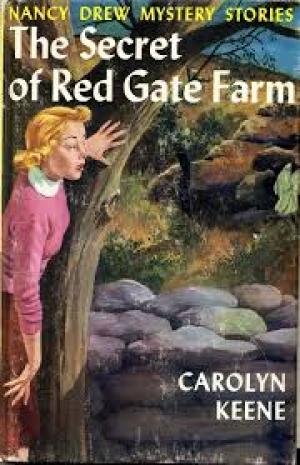
Nancy Drew and I go back to my fifth grade year at Eli Whitney Elementary in Chicago. I was already reading as many mysteries as I could get my hands on–those Scholastic Book Fairs were my favorite part of school–and I was checking out as many mysteries from the library as I could. (This was also the period of time when I discovered Phyllis Whitney’s mysteries for children; the first I read was The Secret of the Tiger’s Eye.) My fifth grade teacher had a big table in the back of the room with books for kids on them; we were on the honor system. We could borrow a book but we were supposed to return it when we finished reading it. The first day of school I wandered back there and looked at the books on the table; the first title to jump out at me was The Secret of Red Gate Farm. Above the title was NANCY DREW MYSTERY SERIES, and on the cover was a picture of a girl with wavy blonde hair, wearing a sweater and a long skirt, hiding behind a tree and looking, her mouth wide open in shock, fear or surprise, staring at the entrance to a cave  as some strangely robed figures entered it. I took it back to my desk, and started reading it.

red gate farm

“That Oriental-looking clerk in the perfume shop certainly acted mysterious, ” Bess Marvin declared, as she and her two friends ended their shopping trip and hurried down the street to the railroad station.

“Yes,” Nancy Drew answered thoughtfully. “I wonder why she didn’t want you to buy that bottle of Blue Jade?”

“The price would have discouraged me,” spoke up Bess’ cousin, dark-haired George Fayne. Her boyish name fitted her slim build and straight-forward, breezy manner. “Twenty dollars an ounce!”

“Oriental-looking.”

Sigh. The great irony is that both the Nancy Drew and Hardy Boys series were rewritten and revised to remove racist stereotypes and language…

Anyway, The Secret of Red Gate Farm enthralled me, as Nancy and her friends tried to help a young girl and her grandmother save Red Gate Farm from mortgage foreclosure while also trying to expose a ring of counterfeiters. There was a list of intriguing-sounding Nancy Drew titles on the back of the book, and back on the table in my fifth grade classroom there were three more titles: The Mystery at Lilac Inn, The Haunted Showboat, and The Clue of the Leaning Chimney. As I scoped around, there was another series novel, but it wasn’t Nancy Drew; it was the Dana Girls The Secret of the Old Well, allegedly written by the same person: Carolyn Keene.

Nancy Drew introduced me to the world of Grosset & Dunlap series–which were actually all produced, for the most part, by the Stratemeyer Syndicate. I eventually found myself reading–and collecting–many of those series, including the Hardy Boys, Dana Girls, Ken Holt, Rick Brant, Biff Brewster, Chip Hilton, and Judy Bolton, among others–I also wound up collecting Trixie Belden and the Three Investigators, too.

I always wanted to write a series like these when I was a kid; I even came up with a list of about forty titles I could use. I wrote one, actually, when I was in the fifth grade–called The Secret of the Haunted Mansion–which, to the best of my recollection, might be the first fiction I ever wrote; alas, it is lost in the mists of time. Periodically, I come back to the thought of writing such a series, but I don’t know that there’s a market for them anymore. Most of the series have gone out of print, with only Nancy Drew and the Hardy Boys, as far as I know, still available; Trixie Belden might be but I’m not sure. I still collect the books–it really pleases my OCD to have the series completed. I’m still missing a few from some of the harder to find series–like Biff Brewster and Ken Holt, and I do think I am missing a couple of Judy Boltons and Dana Girls as well–but I’ve stopped scouring eBay over the last few years because, well, money.

But at some point, I imagine I will go back and try to complete the series.

I do credit these series with a lot of my devotion to the world of crime and crime writing; while I always loved mysteries, it’s entirely possible I would have moved on to something else had I not discovered, and become addicted, to these series. These series led me eventually to Agatha Christie, Mary Stewart, Charlotte Armstrong, and Ellery Queen; and those authors eventually led me to others…and wanting to write crime fiction of my own.

So, thank you, Nancy Drew. It’s kind of your fault.

Bohemian Rhapsody

Is this the real life? Is this just fantasy? Caught in a landslide no escape from reality.

I do love the song. I wasn’t an enormous fan of the movie–primarily because I wasn’t that interested in the trajectory of the bad so much as I was more interested in Freddie and his life–but it was a perfectly good movie about a rock band.

I did finish reading Steph Cha’s Follow Her Home yesterday and I highly recommend it. The writing is exceptionally done well, and her character, Juniper Song, is terrific. I have some other thoughts about the book in my head, but am going to wait until they fully form before I write about it more. But…while I am sure I would have eventually gotten around to reading Steph–I’ve met her and like her–I am glad that I made a point of moving her up in the TBR pile. As I said when I was talking about the Diversity Project the other day, it’s the unconscious bias against minority writers I am fighting against within my own head and within my own choices, and trying to retrain/rewire my brain to not automatically move toward white writers when selecting the next book to read–even if they are women, who are also historically undermined as ‘not as serious as the men’ by not just the industry but by society itself. (I am really itching to start reading Alison Gaylin’s Never Look Back.)

As I’ve mentioned, my reading has always skewed more toward women than men; as a child, I preferred Nancy Drew and Trixie Belden to the Hardy  Boys (although the Three Investigators are my absolute favorite kids’ series, and they were boys), to the point where I was forbidden to read books either by women or about women for a period of time–which quite naturally made me want to read them even more.

The absolute best way to get me to do something is to either forbid me from doing it, or telling me that I can’t do it. Forbidding me makes me want it all the more, and telling me I can’t do something makes me want to prove you wrong.

I am ridiculously excited that Game of Thrones returns tonight for its final season. I am going to be terribly sorry when the show is over; I’ve thoroughly enjoyed the ride from the time Paul and I got the DVD’s from Netflix and starting binge-watching; loved it so much we paid for the HBO app subscription so we could watch it as it aired, once we were caught up. I do want to finish reading the books–I’ve only finished A Game of Thrones–and maybe if I get a long vacation on a beach somewhere, I can finish the entire series that has been published thus far. I really loved the book, and suspect I’ll feel the same way about the rest of the series. Yesterday I spent some time reacquainting myself with some of my favorite moments from the series over the years, thanks to said HBO app–the Battle of the Loot Train, the end of Ramsey Bolton, the trial of Littlefinger, the big reveal about Jon Snow’s parents, the Battle of Meereen, Daenarys conquering the Dothraki by killing all the Khals, Cersei’s revenge on the Sept–and was again, as always, blown away by the sheer scope and scale of the show, and how fucking fantastic it is from top to bottom. Game of Thrones, whether you love it or hate it, is always going to be considered one of the greatest television series of all time, up there with The Wire, The Sopranos,and The West Wing, and deservedly so. We truly are in a marvelous time for television programming.

Friday I was even more ridiculously excited to see the first trailer for the ninth episode of Star Wars and to learn its title: The Rise of Skywalker. I really cannot wait to see this movie, and I suspect we are going to go see it on opening weekend this December if it kills me. It’s very strange to realize that Star Wars has been a part of my life for over forty years now…and while the second trilogy, episodes one through three, aren’t amongst my favorites (I’ve not rewatched them very much), I still have a big love for all things Star Wars, and frankly, Rogue One just might be my favorite Star Wars film of them all.

So, after a really good night’s sleep and waking up later than I usually do, I am going to clean this kitchen and then I am going to work for a while. I might go to the grocery store; we need a few things, but at the same time I should also be able to get the things we need on the way home from work tomorrow, if they are, in fact, so desperately needed. I think I’m going to do that–wait, I mean–because if I’ve learned anything from the Termite Genocide experience, it’s that I hoard food and really need to use the things I already have on hand rather than go out and buy new things to prepare.

I’m actually looking forward to working today, if you can believe that, Constant Reader. I am determined to get the next chapter of the WIP finished, and then I am going to work on these other two ideas I’ve had, and then I am going to spend a couple of hours with the Gaylin novel.

What a lovely Sunday this will turn out to be.

Have a terrific day, everyone–and in one week, it’s Easter!

6a0105349ca980970c014e60bd8fd7970c-500wi

Breakdown Dead Ahead

Friday, and we made it through another week, Constant Reader–and a full week of work at that, on top of the Daylight Saving Change madness. This weekend is St. Patrick’s Day, which means the obligatory parade (and traffic congestion, complete with closed roads) in Uptown, which also means I need to get everything requiring driving finished and out of the way today. Fortunately, today is a half-day and I get off work at one, so I can cruise uptown and do all those errands and hopefully be safely inside my apartment by two-thirty.

My new MacBook Air arrived yesterday, and I’ve already gotten it all set up and taken care of so that it is usable, and I absolutely love it. I still have an issue with connecting it to the cloud, so this afternoon when I get home I’ll go on-line and talk to Apple Support and get that taken care of, after which it will be absolutely good to go. It’s very fast, has a lot more storage than my previous Air, and it’s rose gold–I didn’t specify a color so it defaulted to that, and it’s actually rather pretty.

I also intend to spend the rest of the day–after getting home–laundering the bed linens and devoting the day to finishing reading Alafair Burke’s superb The Better Sister, which hopefully will mean a review over the weekend. I’m also behind on reviewing the stories in Murder-a-Go-Go’s, so I need to get caught up on that as well.

As for my weekend plans, I need to get the Lost Apartment back into some sort of order. The house is being termite-tented later this month (scheduled while we’re staying at the Monteleone for the Festivals, and Scooter will be off to the Cat Practice for boarding and grooming and so forth), and I also intend to spend the weekend rereading the first ten chapters of the WIP and planning out the rest of the book. If the weather is nice–which it probably will be; the last few days have been spectacular–I may take a walk with my camera and take pictures of the Bead Trees of St. Charles. I think we’ll be getting a pizza from That’s Amore for dinner on Sunday as a treat for ourselves, and I do want to get a lot of cleaning and organizing and so forth taken care of this weekend.

And yes, I may start doing some research for the next Scotty book. I have an amorphous idea–I want to have the boys hired to investigate two different cases that end up being linked (the old Hardy Boys/Nancy Drew trick), but the trick is how to link the cases. I have a vague idea of how to do it, but am still not completely certain it’ll work, but the title will most likely be Hollywood South Hustle. I really like the idea of a local case juxtaposed against a case involving a film production scandal…

And on that note, ’tis back to the mines of spice before I head to the office. Happy Friday, Constant Reader!

IMG_0979

I’ll Be There

Thursday–the last full day of work for me this week; Fridays I only work half-days. The weekend looms on the horizon, and in theory, my life should be settling down into a normal routine next week at the day job after weeks of never being completely certain what I would be working the next day. For someone who is an utter control freak about time and scheduling, this has been torturous for me. For some reason I crave structure; I have to be at the office at this time, I can go to the grocery store here and then I can come home and spend this time writing and this time cleaning and this time watching television, relaxing.

And yet I also don’t like being caught in a routine, a rut, if you will.

I am nothing if not a writhing mass of contradictions.

But, like with audiobooks, an old dog can learn a new trick every now and then.

I am currently rereading Erich von Däniken’s Chariots of the Gods?, which I originally read in the 1970’s. The 1970’s was, for some reason–probably all the upheaval of that decade and attempts to recover from the social unrest of the previous decade–a decade of weird conspiracy theory and even more peculiar science; the Bermuda Triangle, UFO’s, Area 54, ancient aliens, etc. I used to read a lot of these books, mainly because they were interesting, even though there were frequently enormous gaps and huge leaps of logic required to follow the authorial reasoning to the points they were trying to make in those days; and even as a teenager I often spotted these logistical flaws. But the concept behind Chariots of the Gods? was one that I was interested in, and while von Däniken’s writing style (in fairness, the book was written in German and translated) left something to be desired, one thing I took away from the book in the first place was the realization that exclamation points used in non-fiction usually means most of the reasoning is bullshit.

(I also loved the movie Stargate, which can probably be directly traced back to reading Chariots of the Gods?)

I kind of love these theories, though, even as I recognized they are problematic. A lot of human history isn’t recorded, and so we are left, for the most part, to wonder about the origins and rise of Egyptian civilization, or what life was like in Ur, or how the idea for written communication began or where it came from, and so forth. I also remember one of the reasons I was partly drawn into the whole Chariots of the Gods? things in the first place was because one of the “sites” he tried to explain away as being designed for ancient astronauts were the strange lines on the plan of Nazca, in Peru–which I had read about in the forty-fourth Nancy Drew mystery, The Clue in the Crossword Cipher. (In retrospect, I am also horribly disappointed neither Nancy or the Hardy Boys–in the original series–never went to Egypt; both Rick Brant and Biff Brewster did, in The Egyptian Cat Mystery and Egyptian Scarab Mystery, respectively.)

But, as I said, even I, a relatively uneducated and unformed preteen, could spot fallacies in logic and reasoning in the book. It was made into a TV special, In Search of Ancient Astronauts, and then a feature film with the same name as the book. Von Däniken wrote several more books–turning it into a virtual cottage industry–but I never read beyond the first.

I was reminded of this recently when I came across an article on Von Däniken’s racism, and that his theories were based in racism (you can read it here), and as I read through the piece, nodding, I was also amazed at how it never occurred to me that essentially, Von Däniken’s theories were predicated on racism and asserting white supremacy by erasing the historical accomplishments of ancient, non-white civilizations. So, I checked the book out of the library to reread it and look for the racial coding–plus, to see if there are as many irrational and illogical leaps made as I remember.

And I also can’t stop thinking about the Bermuda Triangle and other conspiracy theories that were huge in the 1970’s…and wondering why the 1970’s was such a fertile ground for pseudoscience.

And now, back to the spice mines.

IMG_4431

Don’t Let the Sun Go Down On Me

Thursday morning, and my quest to readjust to, ahem, civilian life is getting there gradually. I no longer feel like my batteries need to be recharged–at least, not for the moment–and there is some semblance of order to my kitchen. There’s a load in the dishwasher that needs to be put away, and once again there are dishes in the sink, but the situation is neither as dire nor extreme as it seemed the other day. I’ve still not finished catching up on my email, nor have I had the mental fortitude to get back to reading Circe (which is killing me), nor have I written a single word of fiction this week…but I will. I am almost to the end of my latest journal, which means I’ve been carrying around two with me this week–the almost-finished, and the new one–which means I need to make sure that ideas and story fragments inside of it must be marked or retyped or scanned or something, so as not to be forgotten.

I came up with the idea for a hilarious Nancy Drew type spoof one morning while hanging out with Dana Cameron; actually it’s a little more complicated than that, but that’s the easiest way to describe it, which I happily scribbled away about in my journal, and I also came up with an idea for a crime short story which I am interested in exploring at some point; I have the WIP to work through, and the rewrite of the Scotty manuscript as well. I need to buckle down, don’t I? But I think that this week of readjustment and recharging my brain is necessary. I am inspired and I want to work hard on my writing again, I just haven’t the energy or creative strength to do it this week.

I have to run errands this morning; I don’t have to be at work until later this afternoon.

I am just fascinating this morning, aren’t I?

I am also toying with the idea of writing a supernatural-style series; it’s been on my mind for a while, and while I was in St. Petersburg I thought of a way to make it work, and combine some of the short stories I’ve written about that area of Louisiana already (and yes, The Gates of Evangeline helped with that). I am also becoming more and more interested in the history of Louisiana, and the possibility of a historical series, maybe New Orleans in the pre-WW1 era, or the 1920’s. I can’t decide.

But even though I am not putting words down, I am thinking, and that kind of counts as working, doesn’t it?

And now back to the spice mines.

6164672830_1243ca8506