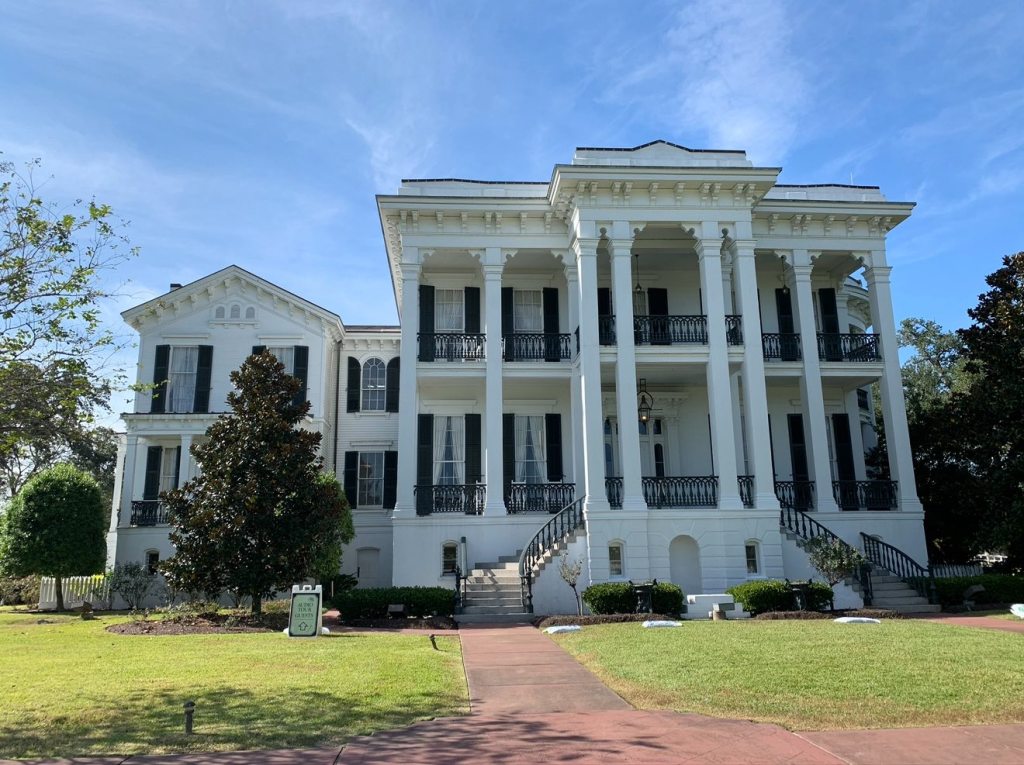
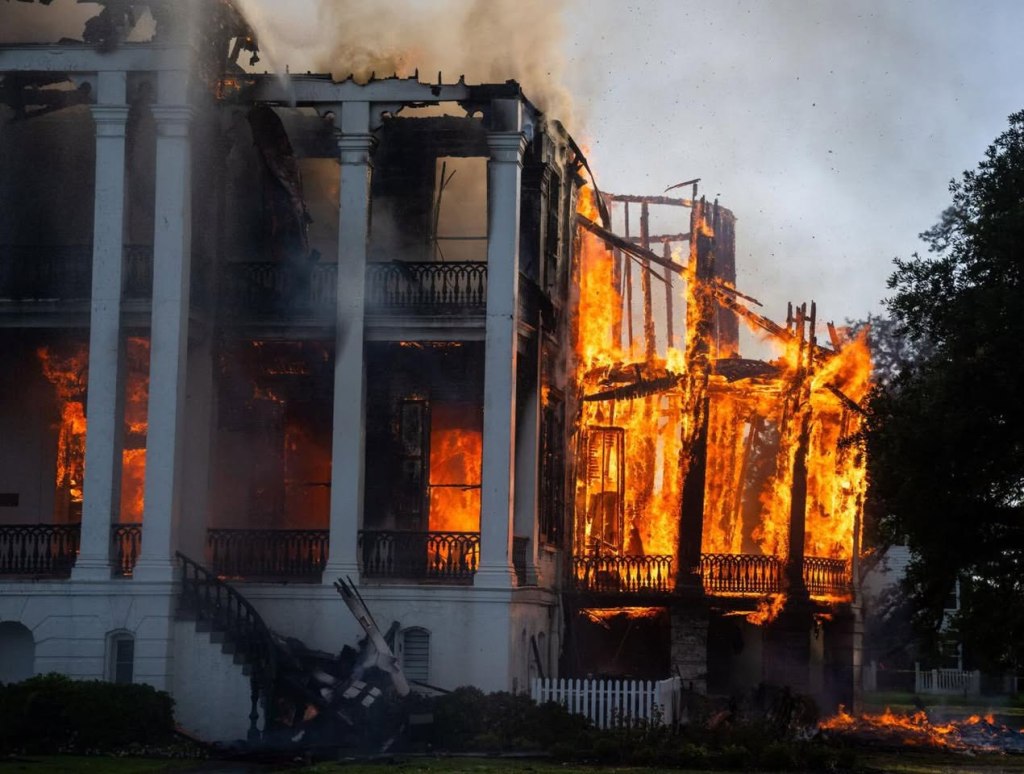
Nottoway Plantation, one of the beautiful old homes along the River Road north of New Orleans, burned to the ground Thursday.1 But what that lovely old historic home actually was? Just a monument to enslavement and stolen wealth. I also can’t help but hope the backstory to the fire is some Gothic shenanigans, a la Rebecca and Manderly burning to the ground.
Nottoway beforeNottoway after
I’ve certainly come a long way from that kid who was raised to believe in white supremacy and the Lost Cause ideology, haven’t I? My relationship to the South has always been fraught, once I began to read more and understand more and deprogram myself from that horrific grooming as a child. I can remember, though, reading Gone with the Wind when I was ten or eleven for the first time and my hackles being raised by the happy, contented enslaved people and how they were described and how they talked. (I loved the story itself, but the racism was so unrelenting and unending and horrible; I need to do a deconstruction of that book sometime–as well as other “make white people feel better about racism” books.)
Nottoway was a beautiful home, but it was also one of the most monstrous sugar plantations in Louisiana with an excessively brutal history. I am not sorry in the least this horrific place–where they teach nothing about the true history of the place and rent out for weddings and parties for white people (“yes, you too can have a Scarlett O’Hara wedding on an old plantation! So what about the brutal treatment of generations of enslaved people?”). It really was nothing more than a monument to oppression, cruelty, and the evil that men can do.
I started dealing with the ghosts of my own Southern past in Bury Me in Shadows, and this new repurposed book from an old manuscript is also going to deal with race in Alabama, too. I just have to finish this damned Scotty book and get it out of my scalp. New Orleans also has its own dark, bloody and brutal history I have to deal with at some point, too. I was reading a piece about Madame LaLaurie and her abuse of her enslaved people, and wondering how to turn that into a short story–and likewise, my Sherlock story will also have to deal with race, because of the Voodoo Queen. I’m not afraid to address any of these issues, really; as long as I do it and am mindful of the potential for offense and/or getting it wrong (I have a great editor, thank God) and tread carefully. You really can’t write about the South authentically without talking about race.
After I finished working yesterday, Paul and I ran some errands (including Costco) and by the time we got back I was completely worn out and exhausted. I started reading a Dana Girls 2mystery (one of the kids’ series I collect) titled Mystery at the Crossroads, which was originally published in 1954–right around when the Hardy Boys/Nancy Drew books began being revised to remove problematic content–and ho boy, is there some problematic content in this book! It’s about “gypsies”–and every handy stereotype about the Romani people is crammed into this book. But it was easy to read, it engaged my brain, and now maybe today I can get back into reading something substantial.
I also rewatched two movies last night–the animated Beauty and the Beast (yes, I get that it’s problematic but I love it) and Jesus Christ Superstar before falling asleep in my chair. Paul woke me at one, and I managed to sleep through the night and this morning I feel rested and good. I have some errands to run today, but I am going to try to just clean and read and rest and relax as much as humanly possible. I am still not 100% recovered from the illness, but I am getting there.
And on that note, I am going to head into the spice mines. Have a lovely day, Constant Reader, and I’ll be back on the morrow, if not sooner.
And yes, the Lost Cause traitors are weeping publicly of the loss. Since it was one of those destination wedding/party places that glossed over its hideous history…good riddance. ↩︎
I will be writing about the Dana Girls for my newsletter at some point; I want to write about all the kids’ series I read growing up. ↩︎
And now its Muses Thursday. How we got here so quickly is a mystery, but here we are. I am slowly waking up, the coffee is helping, and yesterday was actually a very good day, perhaps one of the best I’ve had in a long time. It was the first time in a very long time (several weeks, at least) where I was alert and awake and felt good. I was also in a good mood all day…all of which added up to a very productive day. I ran my errands after work (I left early because parades) and managed to get everything done AND find a place to park close to the house when I got home. I put the laundry away and started working on chores, getting things cleaned up and taken care of. It was nice to wake up on a Thursday and come down the stairs to a tidy kitchen. I watched my reality television shows (Vanderpump Rules, which is actually boring this season, and Real Housewives of Beverly Hills) and then Paul got home. We got to hang and chat for about half an hour before it was time for me to go to bed, and I went out almost immediately. I like this new sleep pattern, and having the right kind of medication that helps me not only sleep deeply but feel very rested when my body and brain finish waking up–it’s much easier than before, that’s for damned sure.
In honor of Muses, I switched to a new pair of every day shoes this morning, and it’s always quite an adjustment. I should probably change every-day shoes more regularly; I have flat feet and my feet (the technical/medical term for it is overpronation; eventually my shoes will reflect that and need to be changed out) roll inward. Shoe inserts have helped dramatically with my ankles, knees, and hips; before using inserts I needed to get new shoes every six weeks. They last longer now, but I still need to change out my shoes more regularly than most…which is why I always buy at least two pairs of shoes every time, so I have the next pair ready to go when I change them out, always buying two pair when I start wearing the second pair and thus no longer have a pair of shoes “on deck”. I also don’t have to walk to the office and home, or stand out on the corner hawking condom packs to partying people all weekend–which of course will help my shoes last longer. (I still miss my old office, though.)
I’m just fascinating this morning, aren’t I?
The Krewe of White Supremacy and the Lost Cause rolled again last night, but once again New Orleans said nix to Nyx and their dying, pathetic parade needs to have its fucking permit pulled once and for all. Let them parade in Metairie or the North Shore where their deeply offensive and archaic values would be more appealing. New Orleans doesn’t forget and holds a grudge forever. You racist skanks and your Confederate flag throws aren’t welcome in New Orleans, and you know it, so why do you bitches keep parading to empty streets and the utter contempt of New Orleans? To prove a point? Think of all the money they waste to prove a point. I can’t wait to write my book about the murder of an all-female all-racist krewe captain. I had no difficulty finding a place to park on my block last night after four, which doesn’t happen on days when the popular parades that everyone goes to–no matter how minor it may be–roll. I could have probably left the office at the usual time yesterday and still been able to find a place to park on my street (note for next year if this year wasn’t their death rattle). Tonight I will drive straight home and probably won’t be able to find a place to park, Sigh.
I am going to Alabama the weekend after Fat Tuesday to meet Dad. I’m really glad to spend the time with him, but I hate the reason for it.
There’s controversy brewing again in the mystery community, and while I generally don’t opine on these kinds of things, I kind of am feeling my oats and I may just have to voice an opinion. I always forget that I had anxiety with my commentary and observations about controversies in publishing because of my volunteer work on the MWA board; I never wanted anyone to ever think I was speaking for the organization when I was not and didn’t want to have to deal with any controversies for the org things I said may have caused. But my anxiety is gone now, I have very few (if any) fucks left to give about anything or anyone, and I have a voice and a platform (no matter how small it may be in the overall scheme of things) so I should make better use of it than introspective navel-gazing about my life and career and so forth. So what if I piss off a few people? No one cares if they piss me off, do they? And I’ve been the target of other people’s bullshit far too many times and for far too long to worry about offending people who find my very existence offensive, so they can fuck right off. I’m not saying I’m going back to channeling my inner Julia Sugarbaker regularly or anything, but I will probably be speaking out more in the future…and I have some definite thoughts about the current one. LOTS of them, in fact.
So, buckle up, buttercup. 2024 is a whole new mentality for me.
And here we are on the third day of the new year, and I am starting to feel more like me again, which is great. I did get tired yesterday afternoon at work (getting up at five for physical therapy truly sucks), but not as bad as I was last week–last week was horrifying, how tired I felt; literally like I needed a jump start or something. It’s also pay-the-bills day, and it has rained all night, which has made it a little warmer outside than it has been. The rain is supposed to let up by noonish, but the colder snap seems to be over for a little while, at least.
Yesterday when I got home I wasn’t super-exhausted, and I did some chores. I finished the laundry I’d started on New Year’s, and also did a load of dishes. I finished reading Glory Be by Danielle Arsenault (more on that later), but Paul was working upstairs once he got home, so I just sat in my chair and watched some documentaries on Youtube. Nothing interesting or new, just some more folklore and legends of the South on the “Dixie After Dark” channel–and all the stories are of murder and ghosts and vengeance and brutality…the South the Lost Cause folks don’t like to mention because it isn’t genteel enough to fit their narrative of a “lost civilization now gone with the wind”, and these stories kind of show up the lies that false narrative creates–like Aunt Jenny, whose husband was strung up in front of her and her children by the Home Guard, and made her sons swear on his corpse that they wouldn’t rest until the men who hanged their father (who opposed the war–Southerners opposed the war?) were all dead. And she got her revenge too, and used the skull of the captain to drink water from for the rest of her life. Learning the history of northwest Alabama in greater detail over the last few years has opened my eyes to a lot of things–and given tons more ideas for things to write.
Which is exactly what I need, right? More things to write?
But overall, it was a nice, relaxing evening and I can’t get over how awake and alive and like a Gregalicious I feel this morning. It’s been a hot minute, you know, and I’m glad to see my decision to not be a slug as much as I would like in the new year is already working out for me. I see my surgeon on Saturday and hopefully can say goodbye to this goddamned brace once and for all. I did also work on the book a bit last night, which also felt good to be getting back into that groove again. I can head straight home from work after my time in the office today, and hopefully will be able to do some writing in addition to cleaning and organizing. I cleared out a shelf in the cabinets last night, and am going to use it for some things I store in the bottom cabinet (espresso machine, milk frother, coffee grinder) which will open up some more room on that side of the kitchen.
I’m not sure what I am going to read next, but the TBR pile is chock full of great books by terrific writers, so I won’t be disappointed by anything I choose. I was thinking about revisiting Larry Kramer’s Faggots, thinking that it might be interesting to revisit it now with the perspective of being in my sixties and looking back at those wild and crazy 1970’s in Manhattan and on Fire Island…but if I am going to do that, I also need to revisit its flip side, Andrew Holleran’s Dancer from the Dance, which I’ve also not read in decades. Or I could just read another mystery. So many choices, so many options.
And on that note, I am heading into the spice mines. Have a lovely Wednesday, Constant Reader, and I’ll be back later, most likely.
I slept well last night but my blankets were all tangled up this morning, indicating the sleep was more restless than it has been for weeks. I also wasn’t in the mood to write my blog when I first woke up, so I decided to read, drink my coffee, and maybe have some breakfast before getting cleaned up. I usually write this over my morning coffee, and since I don’t reread or re-edit once it’s written, that could explain the run-on sentences, word repetitions, and occasional poor grammar no one ever points out to me. This blog began nineteen years ago (!!!) on Livejournal (the anniversary was 12/26), migrated over here in about 2016 or so, and still somehow keeps chugging along. It always surprises me that people read it, to be honest. It was always meant mainly for me, and was originally intended as a daily exercise to get me writing again. I guess it worked. When I started I had published four novels, a few anthologies, and some short stories. Nineteen years later, I’ve way surpassed that total, despite some fallow years in which I produced nothing.
I did some more picking up around here yesterday while watching football games. It was fun watching Mississippi beat Penn State, and don’t even get me started on the Florida State-Georgia game. I get the disappointment at not making the play-offs, but you also knew you were scheduled to play Georgia, another team disappointed in not making the play-offs, but instead of showing everyone that the committee was wrong and showing up to beat Georgia…and Georgia also had star players injured and over a dozen opting out and even more entering the transfer portal. This would have been a play-off game had either Auburn or Georgia beaten Alabama this year, but that’s how things go. Auburn went 13-0 in 2004 and wasn’t invited to the BCS title game. You don’t always get what you want in life or sport, and the question is how you handle that. If this was going to be the case, don’t accept the damned bowl bid. Your fans spent a lot of money to go to that game, and it was incredibly disrespectful to the team, the fanbase, and the university to show up and get embarrassed like that. After Coach O was fired in 2021, LSU went to its bowl game with 39 scholarship players and got trounced by Kansas State….but how does it appear in the record books? KSU 42, LSU 21. Twenty years from now when people look back at the history of college football and bowl games, it will read Georgia 63, Florida State 3. It’s a program and culture problem, and all the FSU fans apologizing for this disgraceful beating–do you quit when you don’t get a raise or promotion you worked hard for and feel like you deserved? The word for that is quitter…and for the record, Georgia played it’s back-ups, walk-ons and so forth in the second half and still beat your ass 21-0.
And if LSU went 12-0 and didn’t get picked for the play-offs…and pulled the same shit? Sure, I’d be angry about the play-offs but I’d also call out the Tigers for embarrassing the state and the university that way.
I’m really enjoying Danielle Arsenault’s Glory Be, and am savoring every word. What a fresh and unique voice! I have to say I am so glad I realized I needed to be better about my reading choices and should read more diverse writers. It’s been a great education for me as a reader, a writer, a person and a citizen. I’m still learning how to be better about race and gender and gender identity and sexuality; and I strongly encourage other readers to do the same. Crime fiction is so much stronger and healthier when it represents everyone, I think, and while I don’t consider reading diverse writers to be the total education I need on any social issues facing the country–I need to read more non-fiction and theory.
I rewatched The Birds yesterday after the football games, and it was pretty much as I remembered it. I’d only seen it twice before; originally as a child edited for television, when it frightened me so badly that I had nightmares (I was prone to them growing up) and for years could never see crows on a jungle gym or a wire without feeling uneasy and then again as a rental in college after I’d read the short story again and wanted to see how faithful the film was to the story. I didn’t care as much for it the second time around–the acting is really terrible and so is the script–but the suspenseful parts still held up and were scary. This third time around confirmed my second viewing; and I noticed some other flaws in the picture. Rod Taylor’s mother isn’t much older than he is, and why is there about a thirty year age gap between him and his sister? I think the short story is better than the film, but I can also see why people like it. I do consider it one of Hitchcock’s lesser films.
Since tomorrow is a day for thinking ahead and coming up with some goals for the new year, I suppose today should be a recap of sorts of this past year. It was, as I mentioned in a previous entry, a rather up-and-down rollercoaster of highs and lows with very little level ground in the middle. The recognition of mainstream award nominations for my work–even queer work–was a delightful surprise this past year. But even more important than that is I think my work is getting better. I had felt, some years ago, that my writing was becoming stale and that I wasn’t growing as a writer anymore; I’d become stagnant and that was one of my biggest fears. I wound up deciding to take some time away from writing books on deadline and write things just for me, things that I wanted to write but also wanted to take the time to do correctly. It was during this time that I worked on both #shedeservedit and Bury Me in Shadows in early drafts, and also started the novellas and working more intently on my short stories. I accepted the challenge of writing stories to themed anthologies, and produced some terrific ones of which I am really proud. When I dove back into series work with Royal Street Reveillon, I wanted to write something non-formulaic for the Scotty series. I also wanted to shake things up with Scotty a bit, as the series was getting a bit too comfortable and safe for me. Royal Street Reveillon certainly was neither comfortable nor safe, and neither was Mississippi River Mischief.
Bury Me in Shadows was not easy for me to write. When I went back to the book after setting it aside for awhile, I realized several things: I couldn’t ignore race and racism, I had to address the Lost Cause narrative, and I also had realized while doing more reading and research that the stories my paternal grandmother used to tell me about the Civil War and Alabama and the family were apocryphal stories you can turn up about almost everywhere in the rural South. The book wasn’t working, in fact, because I was trying to elide those issues because I was afraid of doing it wrong…so it pushed me to do better. And actually addressing those issues made the book easier to write. The same thing was true of #shedeservedit; I’d been working on this book in one form or another since I actually lived in Kansas. But again, I realized when I went back to it that what I was doing didn’t work because I wasn’t going there with toxic masculinity and rape culture because it wasn’t personal enough for my main character, and so I bit the bullet and made it more personal for him. It dredged up a lot of memories, some of them painful, but it also made the book better and stronger. I had been wanting to write a cozy for the longest time, and decided to try it for something different and new–and that became A Streetcar Named Murder. I was also very pleased with it, even though the deadline and the turnaround on it was a bit insane…but I still managed to take my time and turned it into something I was proud of when I got the final author copies.
My two releases of this year–Death Drop and Mississippi River Mischief–are also books of which I feel proud. I also published three terrific short stories this year: “Solace in a Dying Hour” in This Fresh Hell; “The Ditch” in School of Hard Knox; and “The Rosary of Broken Promises” in Dancing in the Shadows.
I think I’m settling finally into an acceptance that I am pretty good at what I do. I may not have the master’s or PhD in creative writing or literature of any kind; but I’ve never really wanted to be an academic writer. I never wanted to be Faulkner, but Faulkner did inspire me to interconnect novels and stories in my own fictional world (also Stephen King). I would like to do some non-fiction studies of genre and writers I enjoy, but in an accessible rather than academic way. Academics used to make me feel stupid and uneducated, and I also used to envy those writers who had that kind of background because I felt it made their work stronger than mine, or gave them insights into writing and building a novel that I’d never had, which made me and my work somehow lesser. But that wasn’t on them; that was on me. I was the one who felt inferior and lesser, not talented or good enough. That chip was on my shoulder and I was the one who put it there. My peers actually consider me a peer, and newer writers look at my longevity and my CV and are impressed by the prodigious output, if nothing else. I used to think all the award nominations were kind of hollow because I so rarely won; which was incredibly ungracious because some writers are never nominated for anything…but it doesn’t mean their work isn’t good. Now, I just find myself grateful to make a short-list of five out of all the possibilities for that slot, you know? I’m lucky, and I’m blessed.
I’ve reflected a lot on my life and my career this past year–Mom’s death had something to do with that–and I’ve identified, in many cases, why I am the way am by remembering the event that triggered the response in my brain of “okay, never want to experience that again” which led to so many self-toxic and self-defeating behaviors. But the bottom line of it all is I’ve finally accepted myself for who I am, have determined to stop self-deprecating, and take some pride in myself and my career and my life. I know the most amazing people and have the most incredible friends. I have a day job where I make a difference in people’s lives. I have an awesome life-partner, an enviable writing career, and I get to live in New Orleans.
Wednesday and we’ve made it halfway through the week, Constant Reader. Didn’t think it was quite possible, did you, when Monday dawned so early and ugly? We expecting thunderstorms today in New Orleans–it feels cooler and damp this morning, but I don’t know when we are supposed to have said storms; probably this afternoon. I slept really well again last night–it’s been lovely getting good sleep lately. I felt a bit tired yesterday when I got home from work, and so took it a little easier on myself when I got home. I managed to get caught up on my emails (such a weird feeling) and did some writing last night. I think I’m still a bit in the post-book malaise phase of things, so writing anything isn’t easy (not that it ever is) but Paul got home late so was left to my own devices once I finished writing for the evening. I did watch some documentaries on Youtube about the Hapsburgs last night (I also discovered an English-language biography about her–Margaret of Austria–which I added to the my list of books to buy…which is almost as out of control as my TBR stack, which is now essentially the entire living room), and I read a short story in Hitchcock’s My Favorites in Suspense anthology; a dark little Charlotte Armstrong story called “The Enemy.” Armstrong was a writer I discovered as a tween, when Mom let me join the Mystery Guild Book Club; I got an omnibus by her (The Witch’s House, Mischief, The Dream Walker) which I greatly enjoyed. I rediscovered Armstrong thanks to the work of both Sarah Weinman and Jeffrey Marks, which enabled me to continue reading in her canon.
Armstrong won an Edgar for Best Novel for A Dram of Poison, a charming if dark little story of suspense; maybe the rare Edgar winner where there’s no dead body but the plot has to do with preventing an accidental death? It’s very clever, and incredibly charming, but beneath that clever charming surface it says something dark and awful about human nature and character–people who are unhappy spreading their misery to others. Armstrong was also made a Grand Master by Mystery Writers of America. Her work may seem a bit dated in the modern day–technology and society have moved on from the times she lived and wrote in–but I think it’s well worth the read. “The Enemy” is that same style of writing as Dram, a serious subject presented charmingly, and the death of a child’s dog the catalyst for an exposé of something darker and nastier…and yes, the plot also hinges on the darkness a human being is capable of creating. It’s a really clever, if slightly dated, story–and you can’t help but smile or laugh at the last line of the story. I am really enjoying these time capsules into the past, to tell you the truth. I bought a few more of these anthologies on eBay yesterday, too. It’s nice to have short story collections around for those times when my brain can’t really focus on reading an entire novel.
I have been listening to Carol Goodman’s The Drowning Tree on Audible, but I may have to break down and finish actually reading a physical copy because I can’t keep listening every day and with my memory a literal thing of the past these days, I’m not sure I remember enough of the story to pick it up again this weekend. I also picked up copies of her new novel, The Bones of the Story, along with Paul Tremblay’s new short story collection, The Beast You Are. I do like Tremblay’s writing–A Head Full of Ghosts was one of the best horror novels of the last decade, and I’ve liked everything else of his that I’ve read–and I think this may even be his second collection. I am also hoping to pull together another collection myself this year–This Town and Other Macabre Stories–but I am not sure if I will have the time. I also got the copy edits for a short story I contributed to an anthology in my inbox last night, so that has to go onto the to-do list, and I still have page proofs to get through. But for the most part, it seems as though I have a guilt-free free weekend, which one can never truly go wrong with, either. I’ll have some errands to run, of course–I always have errands to run–but there’s no stress or pressure on me either, which is kind of nice. I think maybe that’s the reason I’ve been sleeping so well this week? No pressure and my schedule has kind of normalized, gotten back to normal, settled back into the routine my body is used to, perhaps?
Yes, that makes total sense to me.
I also have ideas and thoughts pinging around in my head. I’m itching to get back to the works I have in progress; I want to get a strong first draft of two different novels finished before I leave for Bouchercon next (!!!) month. I actually, finally, made a to-do list yesterday; I am hoping that I can get my life back on track the way it was before the pandemic and the madness of the last few years. That doesn’t mean that my blood pressure won’t continue to go up predicated on the constant assaults on everyone who’s not a cisgender straight man from the demons on the right–which is part of the reason my interest in the Civil War and the 1850’s, that terrible lead-up to the split, has been heightened these last few months. I do see a lot of similarities in the split between conservative v. progressive today, which was predicated along the lines of abolitionist/pro-human trafficking back then. One of the books my father gave me to read was called Southerners in Blue, which was a novelization of the true story (albeit poorly written) of a Union sympathizer and others like him in Winston County, Alabama. (If you’re not familiar with Winston County, the easiest way to explain it is this county did not vote for secession and essentially stated that if Alabama had the right to secede from the Union, the county had the right to secede from Alabama. They did not secede from Alabama, just said they had the right to predicated on the secession arguments being presented, but have gone down in Alabama history and lore as having actually seceded even though they most certainly did not) Basically, in some of the northern counties of Alabama there was basically a second civil war, between the “secesh” and the “Unionist” supporters, and the mountains of north Alabama were filled with deserters from the Confederate Army, This was also novelized into a book called Tories of the Hills by Wesley Sylvester Thompson, which is incredibly rare (my uncle has a copy, which my aunt won’t let be removed from her house–wise, as I would totally steal it). I had read another book also while I was up there, about the Kansas-Missouri border war–which had a decided “secesh” slant to it, of course, while complaining that all previous histories were “unsympathetic to the Missouri slave-owner point of view”. I’m sure he had a point, but simply because there are two sides to every story doesn’t mean each side deserves to be heard, or that each side’s opinion has equal weight. It did spark my interest, though, and I really think there’s a book in this little-known history of north Alabama. Again, it would be difficult to write–lots of potential landmines there–but it’s also, as I said, not very well known and with today’s tribalism mentality–not to mention how loud the Lost Cause fanatics are–it’s hard to wrap one’s mind around the notion that the South wasn’t monolithic in its thinking.
Because no group of people are, really, which is why I don’t like being asked for a gay perspective on anything; I can only speak for myself.
But while I continue to research this aspect of history and try to figure out a way to get a novel out of it, I am going to map out two others. One is already in progress, and the other is a New Orleans ghost story I’ve been wanting to write for quite some time now. The trick is to make it different from every other ghost story I’ve already written. Good luck with that, Mr. Repetitive!
Heavy heaving sigh.
And on that note, I am heading into the spice mines. Have a great Wednesday, Constant Reader, and I will check in with you again later.
Monday morning has rolled around again and I am up before the sun rises yet again. Neither brain nor body wanted me to get up and heed the siren song of the alarm, but there was no escaping the inevitably of getting up and heading into the office yet again. Yesterday was a mixture of days; I got things done in the morning but after making groceries, I was oddly tired and physically exhausted. I did manage to read a few more chapters of Cheryl Head’s marvelous Time’s Undoing, which is very good and I’m enjoying it a lot, even as I wince at the past sections set in 1929, at its unerring and accurate depiction of the Jim Crow South. I honestly, as a Southern man, see no problem with reading about Southern history accurately; and certainly, seeing Jim Crow through the eyes of people of Color is a reminder than no matter how bad I may have thought things were, it still wasn’t a reality I would have had to either face or deal with, and it was so much worse than I can ever imagine it–and I have a very vivid imagination. Yesterday’s exhaustion was unexpected and out of nowhere, particularly coming in the wake of two pretty good days and a good morning as well. But grief is sneaky like that, is never linear, and can literally come from nowhere. There’s also the issues involved with my bout of long COVID from last summer and how my energy levels have never really recovered from that, either.
And don’t even get me started on the memory issues.
I am hopeful for a good week; I know I’ll eventually start experiencing being tired from exerting myself at work; it’s interesting that someone with shyness issues like me has wound up working as a counselor–but one-on-one and with a purpose to the conversation makes it much easier than having a conversation with someone I’ve just met at a party. Small talk is literally my Kryptonite, and of course, being socially awkward is my lifelong jam.
I did rewatch Mildred Pierce last night on TCM after Paul went to the office, and once again I marvel at what a terrific film it was–melodramatic and over-the-top, for sure, but the addition of the murder rescued the movie from not working. I need to reread the book–it’s been a hot minute–but the one thing I’ve never really gotten from either is a sense of who Veda is and why she is the way she is; spoiled and rotten and manipulative. In order for Cain to get his point across about Mildred and her own obsession with mothering, Veda turns out to be horrible and one-dimensional; everyone sees that Veda is horrible except Mildred–obsessed with being the perfect mother and giving Veda everything, it’s also a smothering, all-encompassing kind of love that most teens would rebel against and struggle to get away from. I remember about ten years ago I wanted to write Veda’s point of view; either a retelling of the story from her point of view or a sequel to the novel (no murder, remember?) which picks up with Veda some years later, having parlayed her singing and musical talents into a film career. That’s one of the things I love the most about Cain’s work, really; so much can be read into it, and so many great ideas can be inspired by rereading his work. I’ve not read the entire Cain canon–that “never want to run out of books to read by any author” thing I struggle with–but I’ve read quite a bit. Chlorine is really my first real attempt to write a noir; I cannot wait to get back to work on that. It’s already been delayed for far too long, and once i get through these contracted books, Chlorine is going to be my focus.
Finally, right? LOL. But I do eventually get around to the projects I talk about writing for years, don’t I? I talked about the Kansas book for well over a decade before #shedeservedit saw print.
I think today is going to be a good day. I feel rested this morning, and I slept really well. The toe is still twinging; I am beginning to suspect it really is gout. I went to WebMD (which I always tell my clients not to do) and the list of foods to avoid? Everything I eat, basically. So, I am going to have to bite the bullet, schedule an appointment with my doctor, and get on with things, you know? I don’t why I’ve dithered and dicked around about this for so long, either. Just another thing I didn’t want to have to deal with so I kept kicking the can down the street, which isn’t wise. Nothing ever fixes itself, you know; a lesson I keep having to relearn over and over again. I also need to schedule an appointment with the hearing specialist, a dentist, and make an eye appointment while I am at it. Yay. But I need to start and keep up with all this routine maintenance, especially if I want to start going back to the gym in April. I also need to start doing push-ups, crunches, and stretch every day too. Maybe I will climb back on that horse this evening when I get home from the office; stranger things have happened in the past and will probably continue into the future as well. The kitchen is a mess, too; I made dinner last night, so when I get home tonight I’ll have to clean the kitchen again and maybe even get the rest of the straightening up taken care of as well. I am definitely going to be taking books to the library sale this coming Saturday, and I also want to wash the car this weekend and vacuum it all out. I also want to spend some more time with Cheryl’s book this evening. So, so much to do and work on and get done. I also have to start preparing for moderating panels for the two Festivals coming up in a couple of weeks…yikes.
And on that note, I am heading into the spice mines. Hope you have a lovely day, Constant Reader, and I will check in with you again later.
At some point over the past decade, a movement started on-line to promote the voices of minority writers writing about their experience in fiction, called “#ownvoices”. The focus of the tag was primarily for non-white writers, whose work has been so long marginalized and kept out of the mainstream of publishing; forcing those writers to either not see print or go with either a small press or self-publishing. It brought up some interesting conversations about who gets to tell what story, the importance of representation in fiction, and the need for greater diversity in the popular culture.
Recently, the “who gets to tell what story” debate took on an entirely new meaning and went in an entirely different direction with the publication of a piece in the New York Times that became known as, for simplicity’s sake, “Bad Art Friend.” Who owns a story, and who gets to tell that story? Both women on either side of the conversation appeared, to me, to be kind of assholes; but when it comes down to brass tacks, I strongly believe that if you feel your own story—the story of your own life—belongs to you and only you, then you need to write it; not tell the story to other writers (or other people in general, really) and expect them not to use it. Writers are thieves, every single one of us; anything we ever are told, read, see, and hear goes into the computer of our mind and at some point, might come back out in a fictional form. The fact that the “kidney story” was used as a jumping off point for a short story by a writer fascinated by the story of the woman who donated said kidney—and her need for attention predicated on the ownership of that story—shouldn’t surprise any writer; as I read the piece in the Times myself I kept thinking, I don’t know that I could have resisted writing about this woman either—it’s such a fascinating place to start an examination of both altruism and narcissism, how could anyone resist? I also started, in fairness, to think of the story in terms of crime fiction—how would I build a crime story out of this?
I do know, however, how shitty it feels to have my story taken and told in a way I didn’t much care for; yet that doesn’t mean I couldn’t tell my story how I wanted to, if and when I choose to. Everyone’s take on this has been interesting to watch on social media–you can certainly tell how personal experience effects other writers’ opinions on things–but I think the bottom line of it all is, don’t be a shitty person. Everyone involved in that whole mess was kind of a shitty person, at least in how it was reported–and again, those people involved in the group chat/email or text chain or whatever the hell it was and were actually named in the Times piece? Their story is now being told by someone else. Karma? Serendipity? The arc of justice? Who knows? Who gets to decide?
So, who does get to tell whose story?
Most of my work is fiction, and the majority of it is also set in New Orleans. New Orleans is one of the few cities in the United States with a majority minority population (at least it used to be; I’m not as certain post-Katrina of that fact as I was pre-Katrina) and it would be impossible to write about New Orleans without including non-white characters; that would be science fiction. It might be possible to live in New Orleans and never, ever come across a non-white person; I don’t see how, frankly, but, on the other hand, I’ve read any number of lily-white books set here. The casts of my two series contain one person who is non-white; police detective Venus Casanova, a character I love deeply and have always wanted to write more about. I had two ideas for Venus novels over the years—Stations of the Cross is one, and more recently, Another Random Shooting—but I always held back from writing either of them because I am not a Black woman. I don’t know what it’s like to grow up as a Black woman in New Orleans or in the South, let alone the struggles faced with being a Black woman working for the New Orleans Police Department—the racism, the micro-aggressions, the misogyny—and while I still believe both books would be good ones, I still am not entirely comfortable writing from that point of view—nor am I comfortable taking a publishing slot (if it came to that) from an actual Black woman crime writer, of which there aren’t enough as it is.
Bury Me in Shadows didn’t present the same kind of issue that I have with writing from Venus’ perspective (I also started writing a short story once with her as the main character; I revised it to be from the point of view of her white gay partner on the force, Blaine Tujague), the issue here was that I was going to be looking at and examining the racist history of the South and issues of race themselves…from the point of view of a twenty year old white gay kid. Just what the world needs, right, another white take on racial injustice in the southern United States? The possibilities for offending people were endless; do I have blind spots in my white privilege when it comes to racial injustice? Would those blind spots come across in the book? (I don’t care if I offend Confederate apologists, none of whom would be reading anything I write to begin with for fears of gay contagion.)
One thing my main character Jake’s mother always emphasizes to him is “the heritage is hate, Jake—never forget that.”
Jake has no pride in the fact his ancestors enslaved people, or in the family history of what was once a plantation that has now dwindled to a small amount of acreage that is mostly wooded; his mother refused to raise him that way, and I wanted to show how possible and effective—and important– breaking the generational link passing white supremacy along for centuries can be. Like most white people, Jake really hasn’t thought much about the history or his own privilege—there’s a part in the book where he thinks about how many students of color there were in his elite, private Catholic school—and being there, on the ground soaked in blood and perspiration and oppression, he has no choice but to face up to it, think about it, and be appalled by it all. I didn’t want to write something that could be called, or considered, an oh look another white guy explains racism or even worse, oh look another white person discovers racism is actually a thing and is horrified book; but the land is definitely haunted by its past.
Another theme I worked on within the book is the history of this county is written in blood. That’s a recurrent theme within any of my Alabama fictions; I tend to always write about my fictional Corinth County, and its history is actually very heinous. There’s a short story I’ve been working on for years called “Burning Crosses,” about a lynching that happened there many years ago; during the horrors of the Jim Crow era—in which a young white girl, a student at the University of Alabama, comes to Corinth to research the lynching for the Justice Project—a fictional group at the University that researches all racially motivated killings in the South since Appomattox, to name the victims and so the memories never fade with time. Again, not sure if I am the right person to tell this story, and the possibilities for giving offense with it are endless; so, I continue to work on it, tweaking here and there, and maybe someday I will try to get it published. But Corinth County’s bloody history is very real in my mind, and there are countless book and story ideas (and in-progress stories) I have for continuing to write about it.
Whether I will or I won’t remains to be seen, of course, but there are files and files and files…
So, for today’s BSP about Bury Me in Shadows, I am going to talk about where the actual story that goes to the heart of the plot came from.
My grandmother was probably one of the biggest influences in my life, for both good and bad. I won’t talk about the bad—I was raised to believe you never bleed in public—and there was quite a bit of it; I didn’t speak to her the last thirteen or so years of her life. But the good was good, really. She loved old movies and passed that love of the glory days of Hollywood on to me; she always encouraged me to read and to be a writer; and she was the one who instilled in me my love for crime films and (to a lesser degree) horror ones—what she used to call “scary movies”; I watched The Haunting for the first time with her, and sometimes when I rewatch an old classic, like The Strange Love of Martha Ivers or The Letter, I remember watching it with her on the couch. She was also the one who introduced me to some authors I love, Victoria Holt (The Secret Woman) and Mary Stewart (The Ivy Tree), and she also encouraged my interest in history, which she also really enjoyed. She used to tell me stories about the past all the time when I was young—stories that at the time, and for most of my life, I remembered as being “family history” and was very surprised as an adult to find out they were fairly common legends and stories from all over the South, as well as from books and movies. In other words, none of the stories were true…but when I was thinking about this again the other day it occurred to me that it was entirely possible I was remembering it wrong—it was a long fucking time ago, after all, and my memory has been wrong before. It’s entirely possible she was just telling me stories, that I assumed were family histories…anyway, there were a lot of them, and when I was in college I started writing a lot of the ones I remembered down. They were often tales of blood and murder and crime; sometimes ghost stories.
The Lost Boys, the legend I used as the basis for the book’s background, is one of those stories.
And yes, bits and pieces of the story are apocryphal; sewn together by my grandmother into one story to entertain me.
Long story short: before the Civil War the county where my family comes from (again, not sure if this is true or not; the histories of the area I’ve read indicate that it’s not; so she either was weaving a story for me or I misunderstood the story or altered it in my memory as I got older) used to mostly belong entirely to one family—from which I am theoretically descended from (my grandmother also had a lot of delusions of grandeur)—and after the war, they lost nearly everything, except for a small tract of land that still remains in the family to this day. Anyway, the father and the oldest son went off to war, leaving his wife and two younger sons behind. The father was killed in the war. When the son came home after the war was over, the house had burned to the ground and there was no sign of wife or the two youngest sons anywhere; they’d vanished without a trace. No one ever knew what became of them; and the story, according to my grandmother, was that a deserting Union soldier burned the house and killed them (yes, the same story as appeared in Gone with the Wind, among others; my grandmother also told me another story about a Union deserter committing murder of a defenseless Southern woman—which I also turned into a short story that collects dust in my files), and that on or around the anniversary of their deaths, you could hear the younger boy calling for his mother in the woods near where the old house had been. Good stuff, right? I certainly thought so, and what a great basis for a story.
Of course, when I started researching the history of the county, none of this appeared to be true—the Union army never came any closer to the county than Tuscaloosa, for one, so the odds of a deserter making it all the way there on foot are pretty slim, and especially if no one else saw him—and of course, none of my ancestors owned most of the county. But it was a good story, even if not true, and I felt that writing about it could make for an interesting tale. My main character, Jake, is aware of the old family legend; he wrote a paper about it in high school, but doesn’t believe it’s anything more than a legend. I thought it would be cool to leave the ruins of the original house there, deep in the woods, far from the county road and the current domicile of the family, the crumbling house on the dirt road just off the county road. I also brought in a team of archaeologists from the University of Alabama, excavating the ruins—one of the few sites left that haven’t been excavated—and the professor leading the team, Dr. Brady (named after a historian friend), while intrigued and interested in the legend, isn’t trying to find proof one way or the other; he’s simply interested in what information about how the family lived can be unearthed.
The book is more than this, of course; but the Lost Boys legend was the starting point from which the rest of the book grew. I have a very complicated relationship with Alabama, to be honest; it’s my homeplace and I love the state. It’s stunningly beautiful. Even the poor rural county we came from is beautiful, with rolling hills and small mountains covered in pine forest, hollows filled with kudzu, muddy orange streams and rivers, riotously colored flowering bushes, and the air…oh, how wonderfully clean and fresh and pure the air smells. I love the orange dirt, and how round and smooth the gravel can be. The sky is a gorgeous cerulean, and of course, when it rains, it really rains. I can remember how still and heavy and damp the hot summer air was, the gnats and mosquitoes and dirt daubers and wasps and hornets and bees and horseflies. Whenever I stop as I drive through on my way somewhere else (usually Kentucky or Atlanta), I am always amazed at how lovely the young people are working in the small highway-side town’s fast food places. I remember screen doors with a coil so they’d always shut (or slam, if you just let go), and the big red Coca-Cola coolers with the bottle opener on the side in the general stores—and of course, the big old style Dr Pepper signs, that looked like a clock with only the numbers 10, 2 and 4—because that was the time for a Dr Pepper. (I also remember it was considered a cure-all when you were sick; just heat some Dr Pepper on the stove and add lemon; just like 7-Up was a cure for an upset stomach.)
But the state’s history– enslaved people, what happened to the indigenous tribes, Jim Crow, Selma, the institutionalized racism–is also deeply problematic. How does one write about the problematic history of the state? How do you point out how wrong all of that is without becoming preachy? I’ve often taken issue with white-written narratives about the pre-Civil Rights era in the South, as well as those set during that era and after; I remember reading one book where the heroine was doing research about the history of an incredibly racist town where a race-related murder had occurred, driven by the Klan–but focusing on the good, non-racist, non-Klan members of the town–what I call the see? We aren’t all bad take. I definitely didn’t want to write one of those stories. A few years back, I found a copy of a book I read when I was fairly young–it belonged to my uncle, actually–about the Civil Rights era in Alabama, called The Klansman by William Bradford Huie, whom I believe was actually a journalism professor at the University of Alabama…and it was different than I remembered, yet still chilling. I’m not sure what Huie was trying to do with the book, to be honest; the Klan sympathizers really came across badly, and even those who weren’t out and out members of the Klan were still racists who saw the Klan as a necessary “evil”–the sheriff couldn’t get elected without the support of the Klan, and he spends the book trying to walk the line between pleasing the Klan and not doing anything illegal…but you lie down with dogs, you wake up with fleas. (I read it the same summer as I read To Kill a Mockingbird, which also belonged to my uncle; the two books are forever linked in my mind.)
Bury Me in Shadows may be many things, but it’s not a Lost Cause narrative, nor is it a “look at the nice white saviors” novel, either.
I was a little bleary when I got up yesterday morning (my Fitbit advises me I only slept deeply for 3 hours, 48 minutes; the rest was “light sleep” and I woke up three times), but for whatever reason, I decided to start getting to work on things. I started answering emails (I am very careful with email. I refuse to let it control my life, which it easily can; so I answer emails over the weekends and in the mornings, save my responses as drafts, and send them all after lunch. I do not send emails after five pm CST; I do not read them, either. Email at one point took over my life, which made getting anything done impossible and raised my stress levels to unbelievable heights. I realized anyone who absolutely, positively needs to reach me has my cell phone number…and if I don’t trust you with my cell phone number…you don’t really need an answer right away. And guess what? The world didn’t end, I didn’t miss out on anything, and nothing became harder) while reading coverage of the LSU debacle from Saturday night (one thing I did mean to mention and didn’t yesterday; I try not to be overly critical of college athletes because they are basically kids. It’s easy to forget that when you’re watching on television, but when you see them on the sidelines with their helmets off, or while walking down Victory Hill to the stadium in their suits and ties…you see a bunch of teenagers and young men in their early twenties. They are kids—and those baby faces on those big muscular bodies is a very strange juxtaposition sometimes). I decided on the way home from Baton Rouge that while I do, indeed, love football, I really shouldn’t give up my weekends to it all fall. Now that LSU is definitely out of the running for anything, I’ll probably not watch as much football as I would if they were still in contention for anything. I’ll still watch LSU, and occasionally I may spend an afternoon watching a big game—the SEC title game, the play-offs—I am not going to spend every Saturday pretty much glued to the television all day, flipping between games all day. And I also rarely enjoy watching the Saints—I love them, they’re my guys, my team, my heart—but their games are so damned stressful it’s hard to enjoy them, and when the games is over I am always, win or lose, emotionally and physically and mentally exhausted. So, I decided it made more sense to get things done, check in on the score periodically, and not sweat it too much. (Good thing. Like LSU, the Saints led the entire game, folded like a newspaper in the fourth quarter and wound up losing.) I made groceries, filled the car’s gas tank, and before going, I started weeding shit out of my iCloud and saving it all to my back-up hard drive. I wound up freeing up over four hundred and seven gigabytes in my flash storage, and suddenly my computer was running very quickly again.
And yes, it’s my fault.* I have a gazillion pictures files, going back to digital camera days. I used to back up my hard drive and my flash drives regularly to the cloud—and those folders are enormous. I don’t probably need all of it—I was weeding through bits here and there as I moved the files over to the back-up hard drive (eventually planning on copying them up to Dropbox), and started finding all kinds of interesting things. Story fragments I’d forgotten, book ideas and anthology ideas and essays I’d started; some of these things are in very rough, first draft form—and got left behind as my addled, AHDH-like brain moved on to the next thirty or forty ideas for all of the above. I also was kind of amused to see how I often I plagiarize myself; I had a completely different idea for the book I wanted to call A Streetcar Named Murder fifteen years ago—which I can still use at some point, just have to come up with a new title. I’d forgotten that all the way through the process Need was called A Vampire’s Heart; my editor suggested changing it after I turned the book it. It was a wise choice; my title was very romance sounding and Need was hardly that. It was also interesting seeing, over the years, how many different ideas I’ve had for a gay noir set in the world of ballet (damn you, Megan Abbott!). I discovered that Murder in the Garden District actually began as Murder on the Avenue (a title I can repurpose for an idea I had last week); I found the original files for Hollywood South Hustle, the Scotty book that turned into a Chanse MacLeod, Murder in the Rue Ursulines; I found the files for the Colin book that tells us what he was doing and where he was between Mardi Gras Mambo and Vieux Carré Voodoo; I found the original Paige novel I started writing in 2004, in which an Ann Coulter-like pundit from New Orleans is murdered; I found the first three chapters of the Scotty Katrina book, Hurricane Party High, in which they don’t evacuate during a fictional hurricane, and the chapters where I rewrote it, had the, evacuate to Frank’s sister’s in rural Alabama (and we meet Frank’s nephew Taylor for the first time—and I also remembered that they belonged to some weird kind of religious cult and that Taylor was going to come to New Orleans in the future to visit during their version of rumspringa, but eventually abandoned the idea completely and never did a Scotty/Katrina book; was reminded that Dark Tide began as Mermaid Inn; that I wrote the first chapter of Timothy during the summer of 2003; and if I even tried to list all the iterations that wound up being #shedeservedit, we would be here all day (Sins of Omission, I think, was my favorite earlier title; again, a completely different book with some slight similarities…I may have to take a longer look at some of those iterations because being reminded of them all, I also remembered that I really liked all the versions).
I also found many, many nonfiction pieces I’ve written over the years—many of which I’d long since forgotten about—so maybe that essay collection won’t take quite as long to pull together as I had originally thought. Huzzah!
And I also discovered something else that I knew but had slipped out of my consciousness: that Bury Me in Shadows was called, for the first and second drafts, Bury Me in Satin—which gives off an entirely different vibe, doesn’t it? I wrote a very early version of it as a short story while in college, called it “Ruins,” but never wrote a second draft because I knew it wasn’t a short story; it needed to be a book, and one day I would write it. I was never completely comfortable with the story, to be honest; I wasn’t sure how I could write a modern novel built around a Civil War legend in rural Alabama. I absolutely didn’t want to write a fucking Lost Cause narrative—which is what this easily could have become, and people might come to it thinking it is, and are going to be very angry when they find out it is not that—but I really wasn’t sure how to tell the story…and in my mind, I thought of it as Ruins—which I freely admit is not a great title, and has been over-used.
As luck would have it, I was watching some awards show—I can’t begin to try to remember what year—and one of the nominated groups performed. I’d never heard of The Band Perry before; and the song they performed, “If I Die Young,” absolutely blew me away. (I just remembered, I kind of used the title as guidance when writing Need—always trying to remember he became undead very young) The first two lines of the chorus are this:
If I die young,
Bury me in satin
And I thought to myself, Bury Me in Satin is a perfect title for the Civil War ghost story! Melancholy and sort of romantic; I’ve always thought of hauntings as more about loss than being terrifying (you do not have to go full out jump scare, use gore or blood or violence to scare the reader, and if you doubt me, read Barbara Michaels’ Ammie Come Home), which is why I’ve always loved the Barbara Michaels novels that were ghost stories. That was the feeling I wanted to convey, that sad creepiness, and longing—I wanted a Gothic feel to the book, and I felt that line captured what I wanted perfectly. But as I wrote it, it didn’t quite feel as right as it did in that moment (I still love the song—and the video is interesting and kind of Gothic, doing a Tennyson Lady of Shalott thing), and then one day it hit me: changed ‘satin’ to ‘shadows’, and there’s your perfect title.
And so it was.
Oh dear, look at the time. Till tomorrow, Constant Reader! I am off to the spice mines! Have a lovely Monday!
*I will add the caveat to this that anything stored in the Cloud should not affect the flash storage in the actual computer and its operating system, and yes, I am prepared and more than willing to die on that hill.
And now it’s Saturday. It’s still cold in New Orleans and we still don’t have any heat but it’s not as bad as Texas by any means, and we never lost either power or water pressure. So far we haven’t had a rolling blackout, either–although they were threatened. I spent most of yesterday unpacking and repacking condom packs, while watching history videos on Youtube, done by a local New Orleanian–someone I do not know–correcting revisionist history; it began with his lengthy video on the Confederate propaganda movie Gods and Generals–which I have never seen; I tend to avoid Civil War films because they are all-too frequently Lost Cause narratives at best or defenses of white supremacy at worst–even the ones that don’t center Confederate stories. I have no desire to see either. I was raised on the Lost Cause false-narrative, and I am still kind of bitter about being taught false narratives as truth as a child. I also resent having had to spend so much of my adult life correcting everything I learned that was wrong and/or incorrect; relearning American history without the rose-colored glasses of American exceptionalism and manifest destiny firmly placed on my nose and eyes.
Writing Bury Me in Shadows, methinks, is in some ways for me kind of a reckoning with that “heritage.”
The cold is going to continue through this weekend, but tomorrow is supposed to be relatively normal late winter weather for New Orleans. It will be nice to get back to normal. It’s currently forty degrees and sunny outside, and I’ll take it, thank you very much.
Today I am going to spend most of the day rereading and revising my manuscript. I want to be able to get through the entire thing in one sitting–this way I can catch most of the repetition, and I am going to also be starting to sprinkle the new stuff through the manuscript that needs to be added. I am hoping that on Sunday I can go to the gym and start inputting the changes; Monday I will assess as to whether I believe I can finish before the deadline or not. (I am a firm believer in not waiting until the last minute to let my publisher know the manuscript will be late.) I mean, I do have another full weekend to get it all done, but it’s not going to be super easy. I have to write an entire season of a podcast–or at least, significant excerpts from said podcast–and there’s at least one more chapter that needs to be written. (Depends on the inputted changes I am going to be making as I go; the goal is to make writing that last chapter really easy by making it a “now that everything is over and has been resolved” kind of chapter.)
It’s going to be lovely to be done with the book, to be honest. I started writing this version in the summer of 2015; I wrote the entire first draft in slightly less than one month–without the last chapter; I never did write the last chapter because I knew I was going to have to make changes to the story and why write something I might have to throw completely out? I have always tried to be efficient with my writing–not going off on tangents, not writing things that will have to be cut out later (it’s so painful cutting out entire scenes and chapters)–and knowing that I couldn’t really write the final chapter until I was absolutely certain about the story itself. I know the story now–this is like the eighth draft, seriously, I don’t think I’ve ever written anything that took this many drafts (novels, at any rate; I have short stories that have been through eight or more drafts, seriously). I am looking forward to moving on from it at long last; I want to start planning the writing of Chlorine next, while also finishing some short stories and putting together some proposals for other ideas I have. If all goes well, I will be able to write a first draft of Chlorine in April, a first draft of the next Scotty in May, and then spend the summer revising and rewriting both. I’d like to spend the fall finishing other odds and ends I have in my files–“Never Kiss a Stranger” has been crying to me from the files to be finished, for one, and there are a couple of other novellas and short stories I want get done. Granted, if any of the proposals sell I will have to change my writing schedule, but if none of them do sell…well, I have plenty on hand for me to write.
I may even start a new series. I’ve been thinking that a gay cozy mystery might be fun to write. I love puzzles and lots of suspects and things; I’d love to do something along the lines of James Anderson’s The Case of the Blood-Stained Egg Cosy, which is probably my favorite cozy mystery of all time; a big mansion, secret passages, jewel thieves, international espionage–all taking place over a house party weekend at an English country home. I’ve always felt it was a shame that those wonderful old classic home house party/small village mysteries the British wrote that I loved to read really couldn’t be replicated in the US…and then later realized that is because those stories are completely rooted in the British class system and what would be comparable here and then…yeah, you see where this went, don’t you? Although some day I will figure out how to do one of those…
I WILL. And it will be marvelous.
I also need to reread The Affair of the Blood-Stained Egg Cosy again. It’s really quite marvelous; I do hope it holds up.
I’ve also been sort of paging through/rereading the Three Investigators’ The Mystery of the Fiery Eye, which in some ways was a tribute to Wilkie Collins’ The Moonstone–which I also did with my own Vieux Carré Voodoo–while not finishing the Dana Girls’ The Clue in the Cobweb. I also keep meaning to get back into reading short stories, since my mind is in that weird “I need to finish my book” place where I can’t focus on reading anything new (once the book is done, I am going to spend some serious time with Jess Lourey’s Unspeakable Things, which I had started reading before locking into “finish the book” mode), so it’s either short stories or rereads until I turn this manuscript in. Anyway, that’s one of my favorite Three Investigators books because it, too, involves a treasure hunt with vague clues (or rather, a riddle of sorts) the boys have to figure out in order to find their new young friend August’s inheritance, the Fiery Eye, a cursed jewel stolen from an idol in a fictional southern Asian nation (Constant Reader will note that Vieux Carré Voodoo also involved the need to solve a riddle to find a cursed jewel stolen from a temple in a fictional southeast Asian country). I also recently–and I don’t remember if I shared this here or not–had the epiphany that the Scotty series, in some ways, is in and of itself a tribute to The Three Investigators…if they were adults and gay and in a “throuple”, as such relationships are called nowadays (I first heard the term in a CDC training). It also occurred to me that many kids’ series involve the main character and two close friends–or if the main characters are a pair (the Hardys and the Danas) they’re inevitably given a close pal who shares their adventures (in fairness, the Dana sisters have several friends who fill that role; some of the books involve several of their friends, but the only one whose name I can recall now is Evelyn Starr–although I believe they also had a friend named Doris Garland, but I am not sure about that name). As I thought about this more, I had to wonder if this was an attempt to steer the books away from homoeroticism or the undercurrent of the main character and his/her best friend being more like a couple then as friends….but I also can’t imagine that being a concern when these books were first conceived? (Although Trixie Belden and her best friend Honey Wheeler certainly play out the butch/femme lesbian dynamic rather convincingly–which I think why in later books in the series they played down Trixie’s “tomboyishness” and tried to make her more of a girly-girl.) Nancy Drew’s first four books featured her and her dear friend Helen Corning; in book five Helen vanishes (she shows up in a couple of later books) and is replaced by cousins Bess and George (again, the butch/femme dynamic at play, even though they are made cousins to avoid such thinking…but George is so damned butch and Bess so femme people made the connection anyway). The Hardys have Chet Morton, who is relentlessly fat-shamed and mocked throughout the entire series (Frank and Joe sometimes aren’t the wonderful boys they are made out to be). I have certainly made note of the homoerotic undercurrent in the Ken Holt series (with his best pal Sandy) and the Rick Brant series (with his best pal Scotty) before; there is none of this in the Three Investigators series because there are three of them, and they are vaguely around thirteen; it is doubtful any of them have gone through complete puberty yet because they still think of girls as kind of alien creatures, which really plays strangely in the series where the male leads are in their later teens….the chasteness of the Hardys with their token girlfriends–like Nancy, Bess and George with their token boyfriends–never quite rings true to me. They don’t even kiss! That probably has more to do with their target audience (nine to thirteen year olds) than anything else, but even when I was a prepubescent kid it struck me as strange.
I still want to try writing my own middle-grade series for kids; I think I may take a month this summer and try to write one and see what happens. I’ve been planning such a series since I was a kid, after all, and my writing career lately has seemed to be all about writing the things I’ve been leaving on the back burner simmering for years.
And on that note, I am heading back into the spice mines. My book is calling to me, and I want to read some short stories with the rest of my morning caffeine. Have a lovely day, Constant Reader–and friends in Texas, hope you’re doing okay. I’ve been thinking about all y’all this past week.








 Queer and Loathing in America