Queer people have been very effectively erased from history–and in the cases where it wasn’t entirely possible to erase completely the evidence, it was camouflaged (Hephaestion and Alexander loved each other like brothers!1)or queer kings had “favorites” rather than “lovers” (Edward II, Henri III, Louis XIV’s brother Philippe); so it’s there if you know what to look for. I’ve always loved history, and have always wanted to write historical queer fiction (the fun I could have with Henri III’s mignons!), but have always worried about doing the research, as it’s not easy to uncover information hidden or deliberately removed from the record. Queers–as the afore-mentioned historical figures’ existence proves–have alway been around, sometimes hidden in very plain sight. I don’t have the patience to do in-depth research, partly because I don’t really know how, or even where to start. I know, for example, there were gay bars in New Orleans long before Stonewall; our existence had to be known for it to be made against the law, didn’t it? I’ve done some queer historical short stories, always terrified I was getting things wrong (“The Weight of a Feather” and “The Affair of the Purloined Rent Boy”); and since writing and publishing those stories I’ve since found out things that would have been pertinent to the story. (This is also a big fear of mine about Chlorine, too, if I am being completely honest.)
I’ve read some gay historicals, some of which seemed a bit on the far-fetched side to me, but some authors–like John Copenhaver–do such a great job of it that it seems seamless and fresh and brand new. I love historicals, and always have; so there not being a vast plethora of them out there is kind of disappointing.
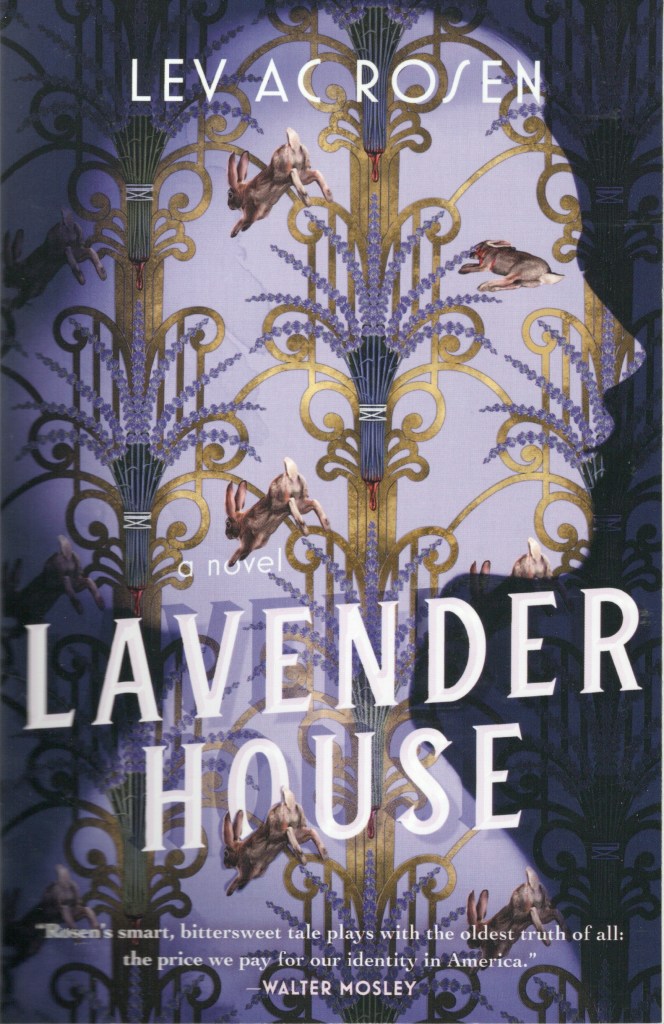
And then there’s Lev AC Rosen’s Lavender House.
I thought I’d have the place all to myself, this early. Like church on a Tuesday–no one but you and God–or in my case, the bartender. But there’s a guy and girl, high school kids or maybe just twenty, sitting at one of the booths in the back. They’re trying to keep their voices low, but he’s failing, getting angry. Something about weiner dogs. It’s weird the things people fight over.
He pounds the table and she whimpers a little. I sigh, feel my body shifting to get up. I don’t have to do this anymore. Hell, no one even wants me to. That’s why I was fired. But some habits you can’t break. So I put down what’s left of my martini, motion the bartender to pour another, and stand up and go to the back of the wrist, tight. Her arm is stretching like a shoelace as she tries to stand up. but he won’t let go. On her other wrist, she’s wearing a charm bracelet. Just a few charms: An eagles, that’s a mascot for one of the local schools, with “1950” under it, so she graduated two years ago. A book, so she’s a reader. And an apple. Teacher’s favorite, or she just really likes apples, maybe. Not enough life lived for many charms. Not enough to cover the bruise, either.
And this is the opening to Lev AC Rosen’s first Evander “Andy” Mills novel, Lavender House. The book dropped onto my radar when it was released; someone asked me if I had read it or not, which made me aware of it. I was also a little confused, because I already had a copy of Jack of Hearts, a well-reviewed (and often challenged) young adult novel…but the author names were just very similar (L. C. Rosen is on the spine of the latter, and yes, they are the same author, doing something like I do, switching up the real name slightly for a pseudonym. It was nominated for a lot of awards, and so I got a copy but never got around to it in the massive book dunes of my TBR pile. I got the follow-ups as they came out, always intending to get around to them at some point. I also have also had some really lovely email exchanges with him, and he seems like a lovely person on top of being a remarkably gifted writer.
Maybe it’s the 1952 setting, but this book made me think of Hammett and Chandler; kind of noir, kind of hard-boiled, but stronger influences (to me, at any rate) thn the Macdonalds and that first generation of writers influenced by the masters. The language and voice and tone are absolutely perfect for Andy.
This opening scene has Andy in a bar in the middle of the afternoon. He was just fired from his job with the SFPD when he was busted in a gay bar raid. His life is ruined, and he feels he has no future–and is also convinced as a “pervert” in 1952 (in San Francisco!) that he doesn’t deserve one. This opening chapter, when we see how much Andy hates himself, threw himself into his job, and kept living his secretive double life, it’s a horrible reminder of what happened to men outed by the cops in the horrible before times; Andy is planning on getting drunk and throwing himself into the bay to drown. Shortly after playing knight-errant for the young woman in the bar, another woman comes in–specifically looking for him. She has a job for him; investigate a strange death at Lavender House, a private compound for her family outside of the city. With nothing to lose and nothing else to do, Andy says “sure” and goes with her.
Lavender House is where a makeshift “found” family of queers live, covering for each other and having a place where they can be themselves, safe from prying eyes and blackmailers. This isn’t easy, because they are a family that owns a prominent soap company, Lamontaine Soaps. The dead woman, Irene, was the matriarch and the head of the company. She died in a fall from a small balcony in her working office, but her widow, Pearl, isn’t convinced it was a tragic accident. As Andy settles into Lavender House, the book switched into a hard-boiled more classic styled mystery, like Knives Out or Ellery Queen; a harder queerer Agatha Christie, if you will. There are lots of suspects, someone is tailing the family whenever they leave the grounds; everyone, it seems, has a reason to want Irene dead, despite their gratitude for her “rescue” of them from the horrifically homophobic outside world. This is a great mystery novel, with lots of clues and twists and turns, so you’re never entirely sure which direction it’s going, and the writing is so exquisite you want to reread the sentences, savoring the poetic music of the words and the rhythm of the language. Just marvelous.
But it’s also more than that–it’s also a window in our not-so-distant past, as a reminder of what gains we’ve made since then, and how dangerous it was to be queer not that long ago. It’s also about Andy letting go of his painful past, embracing who he is at last and being freed from the bonds of the puritanical society he lives in; better to be freely yourself than to hide from everyone. It’s always so much better and easier once you accept yourself and stop trying to fit in as something you aren’t. This is just the start for Andy, and over the course of the case as he becomes more and more comfortable in his own gay skin, the world becomes full of color for him.
I’m really looking forward to follow his journey. High recommended.
- Brothers who liked to fuck each other, that is. ↩︎



 Queer and Loathing in America