And it’s Wednesday, my last day in the office before Christmas holidays. We have the next two days off for the holiday, so we all have a lovely four day weekend. Huzzah? At least I don’t have to make condom packs, which will be kind of nice, but I do have things to do. The book is proceeding apace, if a trifle slowly, but I am happy with the work I am doing on it but the question is, as always, will I get it done in time? Heavy heaving sigh. It is definitely going to be a lot of work to get done in a very short period of time, but it will get done eventually. I will most likely take Christmas day itself off from doing anything; a recharging day, if you will, but that and New Year’s Day should be enough of a recharge to keep me going. I’ve been sleeping much better lately–the cold snap (such as it is) has been an enormous help in that regard–and so am feeling more rested than I have in quite some time. I am also trying really hard to not let my stress levels go up; stress, not fear, is the mindkiller, thank you very much, Frank Herbert.
It’s also Pay-the-Bills Day; huzzah? At least I don’t have to worry about being able to pay the bills, which lessens the sting somewhat. It doesn’t make paying them any more enjoyable, mind you; it just makes it hurt a little less.
I don’t think I will ever stop resenting paying the bills–but you can certainly see that the heat has broken; the power bill this month is less than half of the last one.
Silver linings, you know.
The manuscript is coming along nicely, sort of; I write about 2500-3000 really shitty words per day (a chapter a day, really) and keep going, and then I spend a day trying to clean up the mess I’ve created. It’s working so far, and at the pace I am going I should pass the midway point this weekend–if I stay focused–and might actually get it all finished by the deadline. Huzzah, indeed!
It’s cold again in New Orleans today–well, cold for New Orleans; as always, I assume everyone north of I-10 will snicker behind their hands as they do whenever I complain about it being cold here–but I am actually going to wear a sweatshirt beneath my Crescent Care T-shirt today, and the floor here in the Lost Apartment absolutely felt cold to my stockinged feet this morning so I had to put on my slippers–but I would like to remind everyone it’s not a dry cold down here but rather a damp one. Cold and damp is miserable.
It’s going to be lovely having four days off, which should–laziness, cold, and procrastination aside–enable me to get a lot of work done, as well as organizing and cleaning of the Lost Apartment. I am going to have to start taking boxes out of the attic and determining what is to be done with them; most likely I will be donating a lot of books to the library sale in the future, and I figure if I target one box per weekend minimum it won’t take more than a few months to clean out a lot of what is up there and make room for other things I need to put up there. I really do need to stop buying books for a while; the apartment is quickly becoming overtaken with them yet again, and the TBR stack was already well out of control. Tonight I am going to spend some more time with Vivien Chien’s Death by Dumpling–I want to finish it so I can read Donna Andrews’ The Twelve Jays of Christmas on Christmas itself (after getting my writing done for the day–yes, I am not going to be able to take any holidays off until the book is completed, and all the other things I am writing are done.
Progress. I must always make progress.
And I really need to make that to-do list, which means I need to see what I’ve agreed to write and when it is actually due. I know I have some tighter deadlines than perhaps I would prefer; but that’s the writer’s life and it certainly always has been mine; months with nothing really due for a really long time, then a flurry of requests and deadlines all within a ridiculously short period of time.
And I had wanted to start talking about #shedeservedit every day on here, but I am not sure I have anything to say about it today? Really, it could and should probably wait until the lead-up to the actual release date (1/12/22) but preorders are shipped early–as early as 1/1/22, in fact–and I’ve even gotten my author copies already. So, is it too early to start talking more about this book? My experiences in Kansas? Will people be heartily sick of me talking about it before the book is even released?
Tis a fine line one must walk when doing blatant self-promotion. Although my stand methodology of blog posts is no one else reads this besides you so write about what you want to write about.
It has always, after all, served me well.
And on that note, tis time to head into the spice mines and hope to not freeze to death. 😉 Have a lovely Christmas Eve Eve Eve, everyone!
I was never much of a science fiction fan when I was a kid. I think the first science fiction I actually read was Dune (the original trilogy) when I was in high school; the first book was on my English class reading list. I loved Dune; still think of it fondly to this day, although it’s a bit dense and whenever I return to it kind of think the writing is a bit stiff…but it remains a treasured read of mine. Even Star Wars (I will die on the hill of refusing to call Episode IV A New Hope; when I saw it, it was called Star Wars and they didn’t add this abomination of a title until Return of the Jedi was released years later–I still remember my confusion when viewing The Empire Strikes Back and EPISODE V scrawled across the screen…”What the fuck do they mean, EPISODE V?”) didn’t really turn me into much of a science fiction fan; but as more Dune books were released, I would buy them and read them voraciously. I also read the novelizations of the Star Wars movies, but refused to read anything new and not in the films–the bitterness of being burned by Splinter of the Mind’s Eye (in which Luke and Leia were romantic interests….ewwwwww) still stings to this day; and of course when the sequel trilogy started being released all those books stopped being canon, so it was a wise decision on my part.
But Return of the Jedi did inspire me to try to write science fiction. I wrote a short story in which I created an entire universe–the science undoubtedly didn’t make sense–but it was fun to write, and I realized I needed to be better versed in science fiction if I wanted to write it.
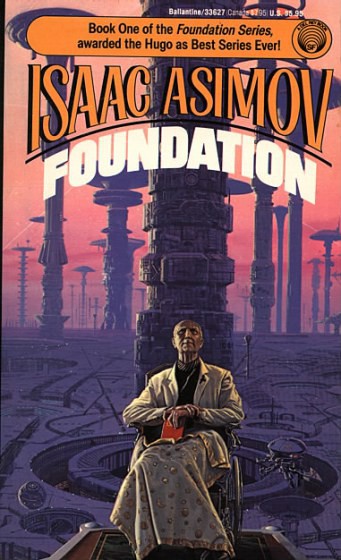
So, I went to the bookstore, asked the clerk “if I wanted to start reading science fiction, where would I start?” She smiled, and retrieved Foundation for me from the science fiction shelves. When she handed it to me, she said, “This book is aptly titled, because it’s basically the foundation for everything published in science fiction ever since.”
And she wasn’t wrong.
His name was Gaal Dornick and he was just a country who had never seen Trantor before. That is, not in real life. He had seen it many times on the hyper-video, and occasionally in tremendous three-dimensional newscasts covering an Imperial Coronation or the opening of a Galactic Council. Even though he had lived all his life on the world of Synnax, which circles a star at the edges of the Blue Drift, he was not cut off from civilization, you see. At that time, no place in the Galaxy was.
There were nearly twenty-five million inhabited planets in the Galaxy then, and not one but owed allegiance to the Empire whose seat was on Trantor. It was the last half-century in which that could be said.
To Gaal, this trip was the undoubted climax of his young, scholarly life. He had been in space before so that the trip, as a voyage and nothing more, meant little to him. To be sure, he had traveled previously only as far as Synnax’s only satellite in order to get the data on the mechanics of meteor driftage which he needed for his dissertation, but space-travel was all one whether one travelled half a million miles, or as many light years.
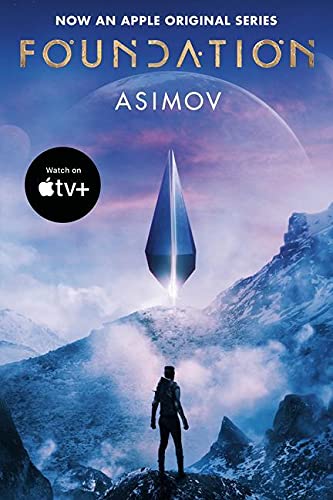
Having read almost all of the Foundation novels (I didn’t read the prequels that came later; ending with Foundation and Earth), I was very excited to see the Apple TV adaptation–while knowing it would be dramatically different (no doubt) from the books. But it was so different I thought it would be wise to go back and reread (or listen) to the original novel again. (It’s also been a very hot minute since I read them all, and I don’t remember everything I’ve read the way I used to…)
(Side note: I had actually read an Azimov novel in the 1970’s–Murder at the ABA–and still have my original paperback copy, purchased at the News Depot on Commercial Street in Emporia, Kansas. I’ve always wanted to revisit it–because it was very insider-y about the American Booksellers Association annual event–now Book Expo America and in decline–as well as about publishing itself, and I wanted to see how spot-on Azimov was with the book. I remember it fondly, and am also curious as to whether or not it still holds up as a mystery novel.)
There are differences; there are characters in the show that don’t exist in the book, there was no Thespin in the book (Anacreon does, however, play an important part in the book), there’s no Genetic Dynasty running the Empire (in fact, little to nothing in the book about the Empire once the Encyclopedists take off for Terminus), and of course, Azimov wrote about white men–the show is much more diverse as well as gender flips both Gaal and Salvor Hardin. If you’re an Azimov purist, you’ll probably dislike the show, I think; I enjoyed it even as I noticed the significant differences. But listening to the audiobook, I also realized that some of those changes were necessary–what worked in the book and was exceptionally clever probably wouldn’t translate well into a visual medium, but listening and getting refreshed in my memory of what the original work actually was made me appreciate the book all the more. I’d remembered it was incredibly smart and clever, particularly in how everything worked out to solve what came to be called “Seldon crises”–a situation where the Foundation was endangered, both from within and without, but the forces working against it eventually led to a point where only one possible action could be taken, and it was inevitably the right one; which meant they had to have an almost religious-like belief in Seldon and his mathematics (and how much did I love that math was the savior of the galaxy?) and trust that taking no action was the proper course of action. I also loved how the Foundation changed and adapted from its original mission (its true purpose was hidden from them to begin with, because foreknowledge would change things and alter outcomes), and how it even developed a religion around its technology to control inhabitants on other planets.
And, as that bookstore clerk all those years ago at the bookstore in Manchester Center Mall told me, the book–and Azimov, really–influenced every science fiction writer and novel that came in his wake. It truly was a foundational text for science fiction. And it’s also not difficult to see where his own influences came from–his Galactic Empire was very similar to the Roman Empire in decline, and the parallels to the decline of the American empire are almost impossible to miss.
I did enjoy the show–the production values are amazing, and it’s a great story as well, if it does get off to a bit of a slow start (but it picks up)–but I am even more glad that the show drove me to revisit the original novel again. It truly is a superb work.
I first discovered Stephen King when I was a sophomore in high school. A friend was carrying a paperback copy of Carrie around with her, and I neither recognized the title nor the author. The cover was interesting looking, in that weird kind of alternate reality type way that speculative fiction covers so often got at that time. “What is this about?” I asked when I picked it up and examined the book.
“It’s about a bullied girl with psychic powers,” she replied. “My mom was worried about letting me read it because she’s afraid I’m like her.”
It rather broke my heart a little to hear my friend, who was overweight and had very bad skin but also incredibly kind and intelligent, say this; but I could also relate a bit because I, too, was picked on and bullied. I, too, knew what it was like to walk past a gaggle of kids both pretty and “cool”, notice that they stopped talking as I approached only to whisper and laugh once I walked by…while simultaneously feeling grateful that they had the decency to whisper so I couldn’t hear what was said (and typing that really made me sad).
I opened the book to the first page and there it was, about halfway down the first page, in italics: Carrie White eats shit.
The preceding sentence, not italicized, read: “Graffiti scratched on a desk of the Barker Street Grammar School in Chamberlain:”
The realism of this, its brutal reality and recognition of the horrors bullied kids face, was like a 2 x 4 across my forehead. I started reading, and kept reading, until the bell rang and I was about thirty pages in, completely drawn into the story. I’d never read anything like it before; it was so real, so honest, so like what high school was actually like as opposed to the cutesy stories I was accustomed to reading about teenagers, where the concerns were “who will take me to Prom?” or “should I go ahead and have sex now or do I wait till I get married?” This was visceral, and I regretfully passed the book back to my friend, thinking, “I’ll look for it at Zayre’s when we go there next.”
My friend, who shared my love of reading, just smiled and said, “I haven’t started it yet–why don’t you go ahead and finish it and then give it back?”
I read it instead of paying attention in my next class–it was Drama, the little play we were rehearsing for class had me assigned stage managing duties, so I really had nothing to do since I wasn’t rehearsing–so I sat in a seat in our school theater, reading. I read it on the bus ride home. I read it when I got home, sitting on my bed with my back propped up by cushions. And I finished it that night–establishing a pattern with King’s fiction that lasted for decades: I would read the book as soon as I got a copy from start to finish, usually in one sitting (It kept my up all night because I couldn’t put it down).
When I saw Night Shift on the wire racks of the News Depot several years later in Kansas, I was terribly excited. A new Stephen King! I bought it immediately and took it home…slightly disappointed to discover it was merely a short story collection, and I wasn’t a big fan of reading short stories; I only read the ones I was required to read for a class assignment.
I read the first story, “Jerusalem’s Lot,” and didn’t like it at all; I put the book aside and didn’t return to it until months later…the next story, however, was “Graveyard Shift” and it was amazing…suffice it to say, I read the rest of the book through in one sitting–and it’s also been my go-to for rereads and so far when I don’t have a lot of time, or I want to simply relax and enjoy reading…one of the reasons for years I would often reread a favorite book.
But last night we started watching Chapelwaite, which I knew was an adaptation of that first story I didn’t care for–and have never reread as a result–and so I decided to go ahead and revisit the story.
I am really glad that I did.
Oct. 2, 1850
Dear Bones,
How good it was to step into the cold, draughty hall here at Chapelwaite, every bone in an ache from that abominable coach, in need of relief from my distended bladder–and to see a letter addressed in your own inimitable scrawl propped on the obscenelittle cherry-wood table beside the door! Be assured that I set to deciphering it as soon as the needs of the body were attended to (in a coldly ornate downstairs bathroom where I could see my breath rising before my eyes).
I’m glad to hear that you recovered from the miasma that has so long set in your lungs, although I assure you that I do sympathize withthe moral dilemma the cure has affected you with. An ailing abolitionist healed by the sunny climes of slave-struck Florida! Still and all, Bones, I ask you as a friend who has also walked in the valley of the shadow, to take all care of yourself and venture not back to Massachusetts until your body gives you leave. Your fine mind and incisive pen cannot serve us if you are clay, and if the Southern zone is a healing one, is there not poetic justice in that?
Yes, the house is quite as fine as I had been led to believe by my cousin’s executors, but rather more sinister. It sits atop a huge and jutting point of land perhaps three miles north of Falmouth and nine miles north of Portland. Behind it are some four acres of grounds, gone back to the wild in the most formidable manner imaginable–junipers, scrub vines, bushes, and various forms of creeper climb wildly over the picturesque stone walls that separate the estate from the town domain. Awful imitations of Greek statuary peer blindly through the wrack from atop various hillocks–they seem, in most cases, about to lunge at the passer-by. My cousin Stephen’s tastes seem to have run the gamut from the unacceptable to the downright horrific. There is an odd little summer house which has been nearly buried in scarlet sumac and a grotesque sundial in the midst of what must once have been a garden. It adds the final lunatic touch.
But the view from the parlour more than excuses this; I command a dizzying view of the rocks at the foot of Chapelwaite Head and the Atlantic itself. A huge, bellied bay window looks out on this, and huge, toadlike secretary stands beside it. It will do nicely for the start of that novel which I have talked of so long (and no doubt tiresomely).
When I first read this story (and disliked it so intensely) I was a teenager completely turned off by the archaic style of writing, as well as the concept of a story told in letters and diary entries (I wasn’t aware of the concept of epistolary fiction at the time; it was also why I stopped reading Dracula when I first tried as a teenager), and the story itself was just kind of…weird–with all its references to things inside the walls and “great worms” and “horrors from beyond the cosmos”…it wasn’t until I read King’s study Danse Macabre that I became aware of Lovecraft’s work and eldritch horrors; but remembering how much I disliked this story, it didn’t exactly inspire me to go on to read Lovecraft or works in a similar vein (the cultural war over Lovecraft in the speculative fiction community over the last decade–not sure of the time line, frankly, and don’t care enough to go look; I am loosely affiliated with that community and have many friends in it, so can’t not be aware but simply observed).
But watching Chapelwaite put me in mind of this source material for the show again, and I decided to reread it this morning, since I’ve never reread the story since its initial read back in the 1970’s. I’ve since read Dracula; Les Liaisons Dangereuses was the book that cured me of my disdain for epistolary fiction–the book is extraordinary–but yet, never gave “Jerusalem’s Lot” another try.
I’m glad I did.
This second read made me appreciation the story a lot more than I did over forty years ago. A quick glance at the copyright page for Night Shift shows that the story was an unpublished work included in this collection and seeing print for the first time; a shame, because it not only shows King’s incredible versatility as a writer but also it’s chilling and creepy; it’s almost Gothic in tone, certainly using a writing style from the past (although I don’t know that a man in 1850 would mention needing to relieve his bladder in a letter to a friend); one that is very formal and I didn’t care for much as a teenager but have come to greatly appreciate in the years since. The story is simple: Charles Boone, after some ill health after the loss of his beloved wife, has inherited a family estate on the coast of Maine. There was a family rift between his grandfather and great-uncle; the death of the former master of Chapelwaite has left Charles as the lone survivor of the family. Once he and his man-servant arrive, they begin to experience strange phenomena that they originally tribute to rats in the walls; but rats don’t explain when no one in the nearby town of Preacher’s Corners will come near the place, or will have anything to do with Charles. A few miles from the house is a pristine yet abandoned village: Jerusalem’s Lot (yes, the same name of the town from King’s classic vampire novel ‘salem’s Lot), and Charles–despite being warned (do people in horror stories ever listen to warnings?) investigate the little town, and…yeah.
GREAT story, and the end is *chef’s kiss*.
Very glad I decided to revisit the story, so thank you, Chapelwaite, for getting me to do so.
And I will add there’s another Jerusalem’s Lot story in Night Shift, “One for the Road”–which I deeply love.
Moving between your sophomore and junior years in high school isn’t easy on any teenager. I wasn’t quite as nervous about this move as I had been when we moved from Chicago out to the suburbs–which was a major shift in everything I was used to, moved me away from friends I’d been going to school with since first grade, and made me that thing no one wants to be: the new kid–primarily because I’d already experienced being the new kid once already, and had never really gotten over it. Suburban life wasn’t good for me, really–I got picked on and bullied alot, called gay slurs pretty regularly, kids didn’t want to be my friend because they’d open themselves up to the same bullying I was experiencing. So, while I was going to miss the people I did consider to be my friends–which was yet another eye-opening experience in and of itself, but more on that later–but I wasn’t going to miss the bullying, the being targeted, the snickers after I walked past people in the halls, and worrying about having a place to sit in the cafeteria every day (my sophomore year I joined Choir to get out of the lunch break–we were always dismissed fifteen minutes early so we could eat, so I would grab something quickly and eat it as fast as I could; I still eat fast to this day).
I even thought it could be a fresh start for me, and all of that could stay in the past.
While I sometimes will joke about how glad I was to get out of Kansas five years later, I appreciated my time there. My high school was actually–given its size–a much better school than the enormous one I attended in the suburbs; I actually learned there and participated in class. I was, of course, horribly lonely; it’s never been easy for me to talk to people I don’t know (painful shyness, to the point of anxiety), and as always, when nervous and uncomfortable I resort to humor and jokes and being a clown. I never felt like I fit in there, but it was so much better than my old school experience–and the slurs didn’t start there until the second semester of my senior year. That was fine; I just had to make it through a few more weeks by then and at that point I was ready to get out of there and move on with my life.
Kansas wasn’t a particularly welcoming place for a gay teenager in the mid-1970’s, but then most places weren’t at the time. I remember thinking I was the only gay kid in Kansas, the only one at either school I attended, and there was absolutely no one I could trust to talk to about it. I missed having real friends, ones like I read about in books or saw in movies and television shows; it wasn’t until much later in life that I realized I never had real friends because I never trusted anyone enough to actually be honest with them, tell them the truth about me–and the real basis of friendship is mutual trust. I obviously have always had serious trust issues–the whole no one can find out hell of my first few decades of life–but I never felt close to people because I didn’t trust them enough to not turn on me, walk out of my life, and/or mock me if I told them the truth.
So, for a long time I rather held it against Kansas and the area where we lived for not being more open and welcoming, and it was unfair. Would rural Alabama have been better? New Orleans? Nebraska or Texas or California? Even in the cities with a big queer population at the time–New York, Chicago, San Francisco–I wouldn’t say the life of queer kids going through the hell of being closeted in public school was better there. Maybe it was, maybe it wasn’t; I don’t know. But when you live in Kansas and are a queer kid in the 1970’s…I felt like I was marooned on a distant planet.
Oddly enough, the little book store in the county seat, the News Depot–they had a massive newspaper/magazine section, and also carried comic books; it was there I started reading them again–that I found the books that were my foundational queer reading: Gordon Merrick’s The Quirk, Patricia Nell Warren’s The Front Runner, and Marion Zimmer Bradley’s The Catch Trap (and yes, I am aware of the allegations against her as well as her husband–and his, I believe, actual crimes; but I cannot deny the book was foundational reading for me, either). The clerk didn’t even give me a second glance whenever I bought one of these books; I also had to bury them in my room in stacks of other books so my mom wouldn’t find them (my biggest fear was always one day my mom would get bored, wander into my room to find something to read, and wonder, ‘The Quirk? What’s that about?”). There were sex scenes in them, too–sex scenes I read over and over again, memorizing the page numbers so I wouldn’t have to use a bookmark or turn down a page, which was far too risky. I already had a vague idea of what gay sex was like, gathered from insults and comments in other books; but these were pretty graphic and left no doubt in my mind whatsoever about what was involved.
And boy, I wanted to find out how it actually felt.
(I never actually found a gay bookstore until I moved to Tampa in 1990. But I would spend hours in bookstores in the years prior looking for anything that might even be remotely gay or gay-friendly; and occasionally I would find something like Dancer from the Dance or The Swimming-Pool Library but what I really wanted was something fun to read with positive gay characters. characters who weren’t stereotypes or to be pitied or felt sorry for; gays who lived their lives openly and proudly, and maybe solved crimes, fell in and out of love, experienced life that wasn’t all solemn and dreary and sad. Don’t get me wrong–I am not dogging either of those books; they are wonderful novels and beautifully written, but…I am a genre guy, not a litfic guy, and I wanted to read some gay crime or horror or romance or something entertaining. Once I discovered the wealth of books and authors that actually existed in the genres? There was no turning back.)
I had always felt like I didn’t belong anywhere–my earliest childhood memories are of me being aware I wasn’t like the other kids, in many ways, and how odd and different I felt. That feeling never changed growing up–hell, there are still times when I feel like I am from another planet–and the moving around didn’t help, either…I do remember thinking, every time I moved to a new city and state as an adult, ah, here we go again–no friends, no life, and no idea how to find anyone who is like me–if there are any people like me.
It was often discouraging. I felt like I was going to always be alone.
By the time I was twenty it was time to go, to leave Kansas and never go back. I felt so stunted, and so unhappy, like my potential hadn’t been tapped and never would if I remained there. I knew if I stayed in Kansas I would wind up probably very unhappily married, with kids and a whole life I didn’t want, had never wanted, but was expected of me. I knew I would never be happy there, completely happy–and so when the chance presented itself to move to California (California! You can imagine how exciting that sounded to me), I took it and never looked back.
With the passing of time and more perspective, a lot of the bitterness I used to feel about my experience there has changed. I don’t know that the experience there now would be any different than it was in the 1970’s, but I suspect that even had we stayed in the suburbs of Chicago those last few years of high school and first years of college would have been equally scarring and stifling; that’s pretty much how it was for queer kids everywhere back then. Some of the kids I was friends with, or knew, from my old high school in Kansas have friended me on Facebook, and me being a big ole queer must not bother them too much; it’s not like I hide it anymore (those days are forever gone) and they don’t unfriend or block me (although my feed could be hidden from their walls; I’ve certainly done that). I’ve revisited Kansas some in my work already–some short stories, a novel here and there–but this latest visit there in the world I created for #shedeservedit might be a bit unfair; but in a town where toxic masculinity has been allowed to run unchecked, I can’t imagine it would be a comfortable place for a gay teen.
And that’s enough for today. Hope you have a lovely Monday, Constant Reader, and I will check in with you again tomorrow.
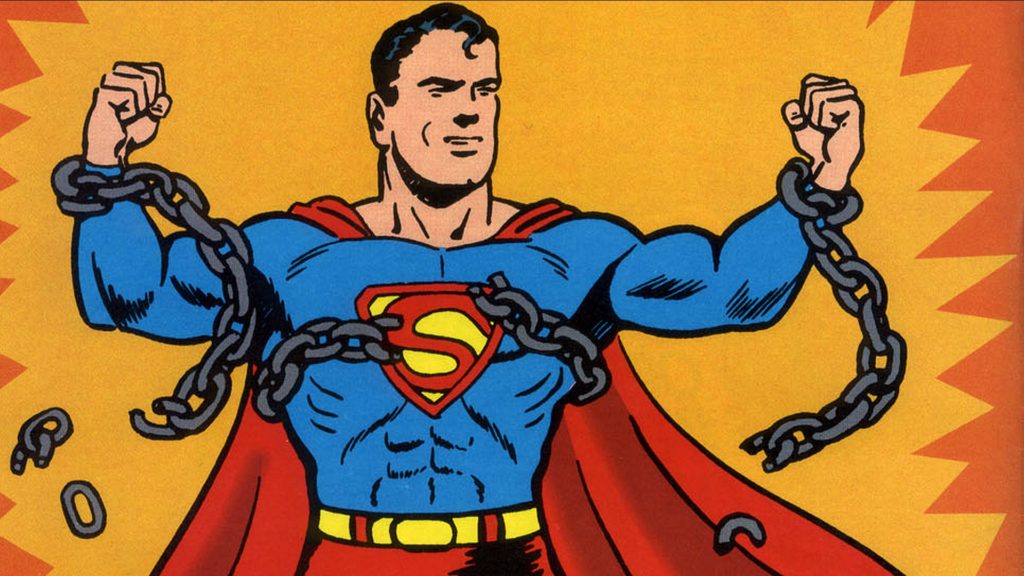
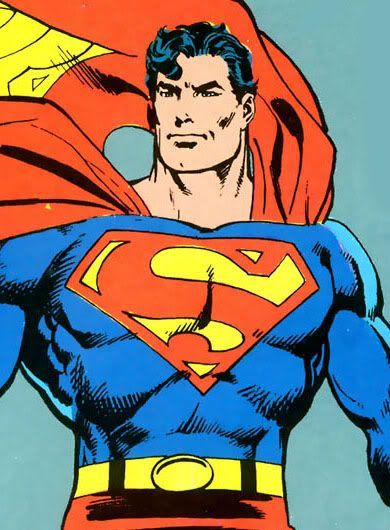
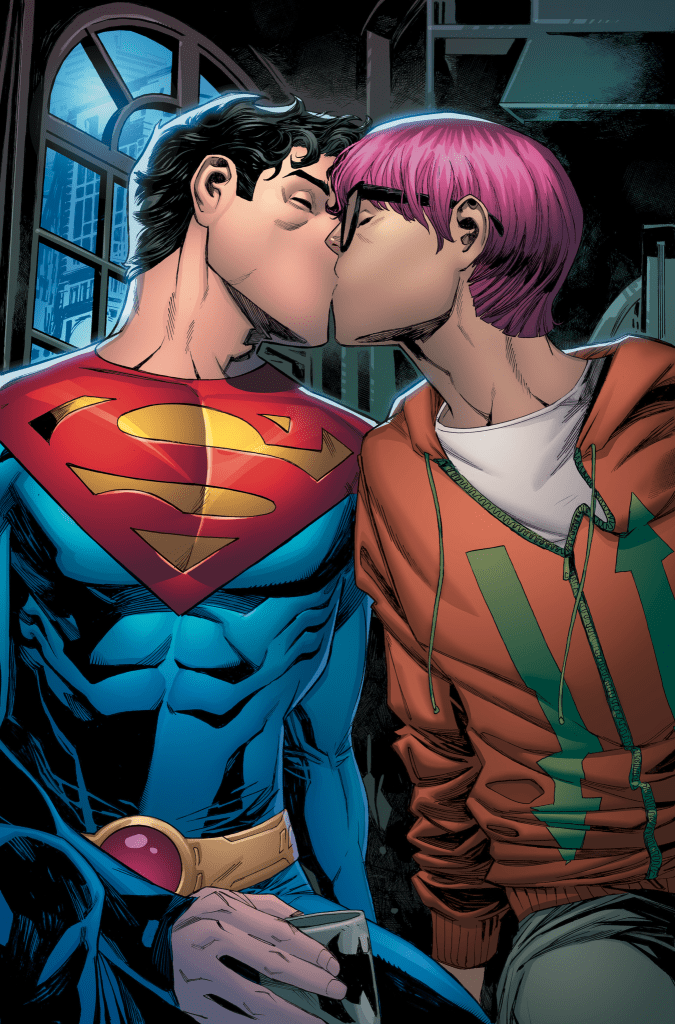
So, on National Coming Out Day this past week, October 11th, the current Superman—Jonathon Kent, son of Lois and Clark—came out as bisexual. When I saw the New York Times piece I literally gasped out loud. This wasn’t some minor character in a team comic; this wasn’t even a second-tier lead of a less-popular title. This was fucking SUPERMAN, the Big Blue Boy Scout, the tentpole character on whom all of DC Comics, and the DC television and film franchises, are built around.
I literally had tears come up in my eyes. This was So. Fucking. HUGE.
I cannot even begin to tell you how much that would have meant to me as a deeply closeted and terrified gay teenager in the Chicago suburbs and later, small town rural Kansas. I really don’t know how best to explain what this meant to me as a sixty-year-old gay man, but here goes.
Oh, Superman. You are the ubiquitous comic book character; since your debut back before the second world war you have become the default; the super-hero every other super-hero is judged against. It’s even right there in your generic name: you are the super man, hence you are Superman.
Superman is kind of the Bill Jones or Joe Smith of comic book heroes: basic, simply named, and the best of them all.
I was a kid when I first started reading comic books about super-heroes. Before I bought my first Action Comics (all I remember is that Lex Luthor was the issue’s villain), I read Archie in all of its iterations; I also read Millie the Model, Dot, Little Lotta, and some others that have faded from memory. The Jewel Osco where my mom used to buy groceries when we lived in Chicago had a comic book vending machine near the entrance, right next to a soda machine dispensing cans of Pepsi and its variants. You put in a dime and two pennies into the appropriate slots, and pushed the appropriate buttons for the comic you wanted; the metal spiral thing holding the comics would spin and drop your comic down, so you could reach in through the door and pick it up. That particular day I wanted a Betty and Veronica, which was A5 but I was in a hurry and accidentally pressed B5 instead; voila, I got an Action Comics instead, much to my bitter disappointment. One of the local independent stations, Channel 32 (which also showed repeats of The Munsters, among other black-and-white classics) aired reruns of the old Superman television show; which I thought, even for my unsophisticated childish palate, was cheesy and silly. I remember grousing about it to my mother—whose response, “Boys read super hero comics anyway” was the kind of thing that usually would guarantee that I would never read a super hero comic book, but I picked it up after we got home and I started reading, certain that I would hate it.
It probably should go without saying that I didn’t hate it.
And it opened an entirely new world for me. Sure, it got a little frustrating from time to time for me (Superman was such a goody two-shoes, but that was kind of his job) and Lois being so desperate (and jealous) to either marry and/or expose his secret identity was annoying; especially because Lois otherwise was such a kick ass woman. There were any number of Superman or Superman-adjacent titles, Lois Lane and Jimmy Olsen had their own titles; Superman often appeared in (and was definitely a charter member of) Justice League of America; there was also Superboy (“Superman as a teenager!”) and Supergirl…it was like the comics readers couldn’t get enough of Superman and his world. I eventually moved on to other DC Comics titles, too—everything Batman (Detective Comics was always my favorite, because there was a mystery to solve) and Flash and Green Arrow and Green Lantern and…yes, my dollar allowance every week for a long time went to comic books (Nancy Drew and the Hardy Boys were $1.50 and my allowance was $1 per week; and no, I couldn’t wait until I had two dollars to get one; I always needed to spend my money as soon I got it on Thursday—Mom’s payday—at either Jewel Osco or at Woolworth’s…because I could always talk Mom into buying me a book if there were Hardy Boys or Three Investigators to be had). When we moved to the suburbs the Zayre’s didn’t carry comics, nor did the grocery store in town; the 7/11 only carried Marvel (I tried with The Mighty Thor, but the continuing story aspect Marvel used irritated me because I would inevitably miss an issue), and when Zayre’s finally started carrying comics, things had… changed. Wonder Woman was no longer an Amazon, and was just an every day modern woman running a boutique (somehow she’d given up her powers). Supergirl had been poisoned, which meant her powers came and went without warning; one moment she’d be super, the next she wouldn’t. It was an attempt to modernize the books, of course, make them appeal to the newer, more sophisticated modern audience of the 1970’s; some of them started addressing social issues and became a lot more adult in theme. (Green Arrow actually became my favorite book during this time; he was drawn naturally—had curly chest hair AND nipples—and he had no powers other than being an expert archer and skill at hand-to-hand fighting). I eventually moved away from comics because I started spending my money on novels—Agatha Christie, Ellery Queen, etc.—and comics were, I thought, really for kids.
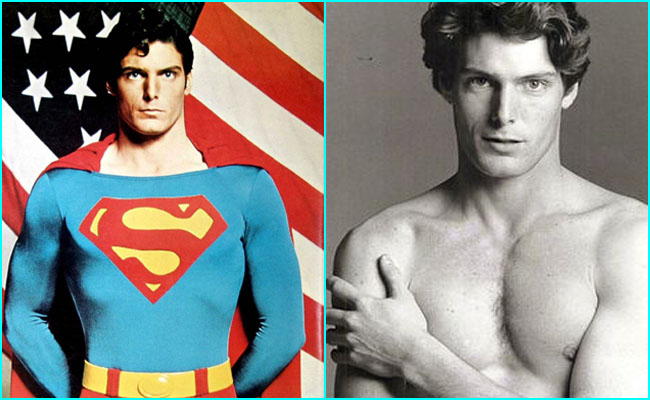
Later on, when we moved to Kansas, I got back into comics again, and things had changed yet again. Some of the Legion of Super-Heroes’ costumes made them look like strippers (male and female); the drawing of the characters had become more natural and realistic (Superman, for example, went from being barrel-shaped to having a narrow little waist and abs showing through his skintight costume), and Wonder Woman was an Amazon again. This was my Howard the Duck period, when I also started delving into Marvel a bit more. Comics always remained of interest to me throughout my life, with me going through periods of collecting and reading in large volumes at different times…before moving on from them again. I am not an expert on comics by any means; I know the names of some artists and some writers, but for the most part, I always paid more attention to story and character (go figure). But I’ve always maintained a love for the characters; and yes, the original Christopher Reeve Superman movie (which I rewatched recently for the Cynical 70’s Film Festival) indeed made me believe a man could fly.
I’ve always had, and always will have, a soft spot for Superman.
To me, Christopher Reeve was Superman–the prior versions of the character, including the popular television show (which I watched religiously) always seemed, to me, to be an actor playing the part; Reeve somehow just was the character. He was so insanely and ridiculously handsome; the body was just right, and he had the right mix of charm and charisma the part demanded. Reeve’s Superman could never be seen as a threat–and he also made it completely believable that no one could tell Clark was him, with different hair, glasses, and street clothes; he physically changed how he stood, his posture, everything about him that was Superman, when he was playing Clark.
Reeve never got enough credit as an actor, frankly.
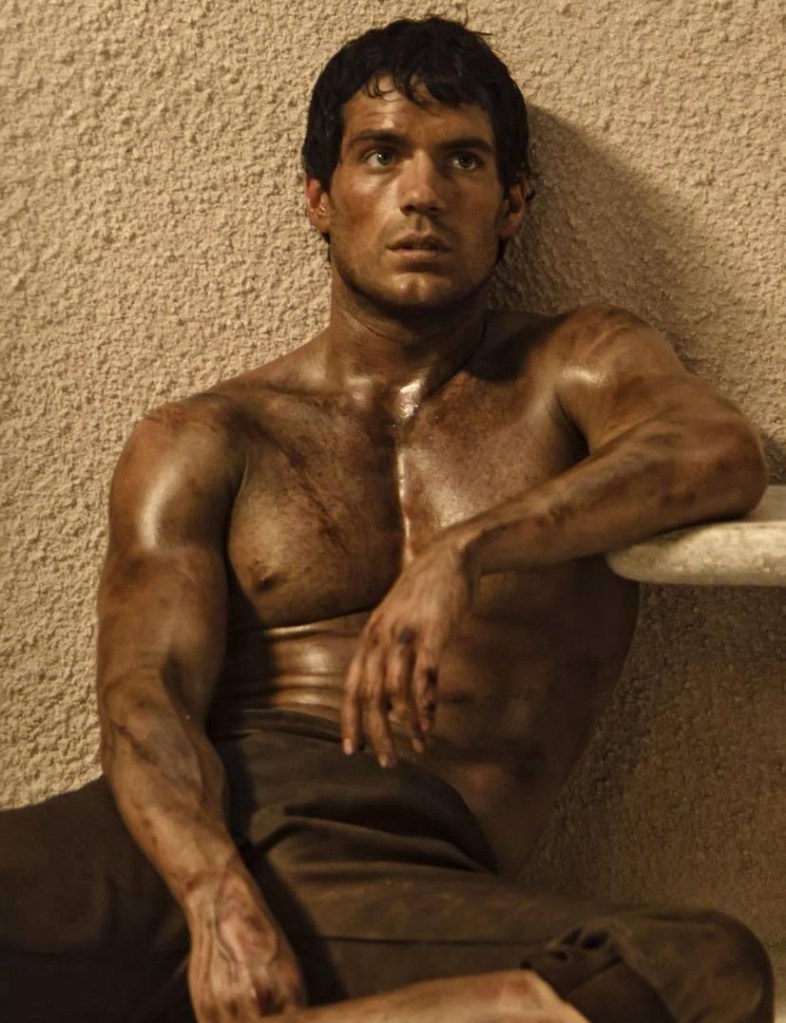
And while my memories of Margot Kidder as Lois Lane aren’t fond ones–I thought she was a fine actress, but miscast–overall, the first two Reeve films were good ones. They could have stopped there, but didn’t–and the last two weren’t good. I enjoyed Lois and Clark (despite what Dean Cain turned into) and Paul and I eventually succumbed to the simple pleasure that was Smallville…but I wanted to see Superman back up on the big screen, where he belonged. I was very excited when they cast Henry Cavill in the part (I’ve been crushing hard on Cavill since first noticing him on The Tudors)….and then came the movies. I enjoyed them for what they were, and I did think some of the changes made to update and modernize the story (how would Americans today react to the discovery of a super being from another planet?)–and you can never go wrong with Amy Adams, either.
But…they forgot the most important thing about Superman: his kindness and genuine concern for people. In the quest to make the DC Film Universe of all that is dark and angsty like the Batman movies–the direction Batman has gone in since the comic mini-series The Dark Knight Returns–was a bad one. Patty Jenkins got Wonder Woman so fucking right–and it was the same basic formula as Superman. Superman used to be derisively called “the world’s oldest Boy Scout”, but that can work with the character, and with the right actor. I think Cavill has the charisma and the charm–and the extraordinarily gorgeous smile–to pull that off; I just wish they would have let him have the chance.
The new show on CW, Superman and Lois, is also excellent; I absolutely love it, and I do think that Tyler Hoechlin is one of the best Supermans of all time, frankly. (The entire cast is stellar, frankly.)
So, as I said earlier, I was pretty fucking jazzed the other day to see the piece in the New York Timesearlier this week about Superman “coming out”–on National Coming Out Day, no less–and even if it turned out to not be Clark Kent, but Lois and Clark’s son Jonathan (in the comics they have the one son; on Superman and Lois they have twin sons, one of whom is named Jonathan), and while I, in my white gay male privilege assumed this meant that he was gay–he’s actually bisexual. But he is attracted to other men, and even has a boyfriend.
There was one particularly noxious piece posted on Medium, which the homophobic piece of trash who wrote it proudly posted on Facebook (I reported his post on Facebook as well as the piece on Medium as hate speech; the Medium piece came down, but the last time I looked, of course Facebook had done nothing about it). I read the whole thing–poorly worded, not grammatical, would have given a C- grade on the construction basics level alone–but the part that I couldn’t get past, the part I can’t forget, was him saying this: But why take one of the few heroes left for the “Straight World” and make him abnormally offensive to us?
Abnormally. Offensive.
I guess I missed the massive closet exodus for the DC and Marvel Universes? Let me see–right off the top of my head, at DC aren’t Batman, Green Lantern, Green Arrow, Nightwing, Cyborg, Aquaman, the Flash, the Martian Manhunter, the Question, Beast Boy, the Elongated Man, and Shazam, all straight? (And that is just off the top of my head., and only DC.) But you know those people who are so afraid of the queers–you know, like the piece of shit who wrote the Medium piece–they just can’t help themselves or keep their fucking mouths shut. Oh, no, Mr. I’ve Never Brought a Woman to Orgasm just can’t let us have anything without letting us know how much it offends their delicate, needle-dicked sensibilities. You know, the same kind of guy who undoubtedly always complains about “cancel culture” and “social justice warriors” and “wokeness” and I don’t have a problem with gay people but why do you have to exist? Those kinds–sad, bitter little men with so little joy in their lives they have to spend their precious time on this planet letting everyone else in the world know how much they object to our existence.
But he has a right to his opinion and we are oppressing him if we call it out for the hateful trash it is…and him for the piece of shit he is.
As my editor at Kensington wrote on a note he included with a copy of a bad review of one of my books, this just reeks with the stench of failed author.
This guy claims to be a crime writer, and claims to work for a publisher (I’ve never heard of it or him before this moment)…but after reading this piece and another one he published on Medium, the real crime is his actual writing.
Fuck off, dude. And know that bisexual Superman is going to have way better sex than you could ever pay for, no matter how long you live.
As the launch date for my book draws nearer and nearer, I find myself not experiencing the kind of stress and anxiety that I usually feel as the clock winds down. Maybe it’s because I am making the effort to promote the book this time around? Finding the time to do so? Paying more attention than I usually do when I have a book coming out? I don’t know why I am feeling so much more relaxed than I ordinarily do in the final days before this release, but it’s nice to have some awareness—other than the usual stopping in the middle of something to think, oh yes, I have a book coming out—is it today or tomorrow? I should probably do something about that, shouldn’t I?
It really is a wonder that I have any career of any kind, seriously.
And maybe it’s just the swing back from the twenty months or so of nightmarish existence, but I do feel like I am doing good work when I am writing these days. I don’t really remember much of the final push to get Bury Me in Shadows finished and out of the way, but I do remember doing the page proofs and thinking, you kind of did what you wanted to with this, well done! One of my big worries whenever I start writing something new is the fear I’ve already written the story, albeit in a different form; I was worried, almost constantly, that I was plagiarizing Lake Thirteen, my other ghost story, in this book. But the stories are very different, and the main character in each are quite different from each other. I think the mood in both books—the atmosphere I was creating—are very similar to each other, but I was trying to do something Gothic and almost dream-like with both.
As I mentioned the other day, I’ve always worried about writing about the South, and Alabama, in particular. How does one write about the South without dealing with the racism, present and past, of the region? How do you write honestly, with realistic Southern characters, without touching on that third rail of enslavement and war? Not all Southerners are racists, of course, just as not all Southerners are homophobes (I do make that point—about them not being all homophobes—in the second or third chapter of the book). But you cannot write about the South without mentioning that whole “Lost Cause/states’ rights” nonsense; that misplaced pride in something that was, at its core, evil. I was not educated in the South; I started school in the Chicago public education system; we moved out to the suburbs for junior high and my first two years of high school, finishing in Kansas. I was never taught in school that the root cause of the Civil War was anything other than slavery; and in all my extensive outside reading of American history, I never came across any of that. (I knew that the Southern politicians were all shouting “states’ rights!” in the lead-up to secession; but this was subterfuge. They couldn’t win the argument about slavery on moral grounds, so they fought against emancipation on Constitutional grounds. And, as I often note whenever someone trots out the tired states’ rights canard, the only right they cared about was the right to own slaves, and they sure as hell wanted the Fugitive Slave Act enforced against the will of the free states, didn’t they?)
I also like to point out that all those lovely, wonderful society ladies in Gone with the Wind—Melanie, Mrs. Meade, Mrs. Elsing, Mrs. Merriweather, etc.—would all be full-on Trump voters today. (I’ve not read the book in years, but while I do remember that in several places, Ashley talks about how he would have freed the enslaved people at Twelve Oaks had the war not come; but Melanie talks about the Lost Cause with all the fervor of a believer at a revival meeting in a tent…which makes Melanie, theoretically the moral center of the book, the biggest racist of the main characters in the story—and yes, I know, Margaret Mitchell did a great job of propagandizing the “Cause” as the Confederacy rather than slavery; but there’s an awful lot of racism and “they were better off enslaved” in that book, which, along with the movie, has done a great job of romanticizing something hideous and ugly )
I could write volumes about Gone with the Wind and how problematic both book and movie are (not the least of which is that Rhett rapes Scarlett but she enjoys it), but that’s an entirely different subject, deserving of its own entry (or two or three) or an essay—but I will say this one last thing on the Gone with the Wind subject: since the movie was released, for decades it imprinted on the minds of white Americans “this is what the antebellum South, and enslavement, was like”—when it was actually nothing of the sort and bore no resemblance to anything true or right.
One of the things I wanted to make clear with Bury Me in Shadows is that the shadow of white supremacy can be overcome and the continuing link, from generation to generation (parents teaching it to their children, who teach it to their children) can be broken by a person not blinded to realities or brainwashed by romantic fantasies; that character in this book for me is Jake’s mother, Glynis Chapman. Glynis rejected the white supremacy/racism she was raised with and did not pass that on to her son. I’ve always felt—and this was best exemplified with that Miss California who all those years ago blamed her homophobia on “It’s how I was raised”; it’s how I was raised is perhaps the laziest, most disgraceful, and embarrassing excuse ever given for perpetuating hatred and discrimination. It essentially states that you are incapable of thinking logically and rationally for yourself; you are incurious, and your parents are God-like, with beliefs and values that are above question. At least own your bigotry and don’t blame it on your parents because at some point, you must become your own person; you either continue to blindly believe everything your parents told you, or you actually become a functional human being capable of making up your own mind rather than simply blindly parroting what you were taught. I began questioning everything quite young, frankly; more so than most, but still to a far lesser degree than I should have. I didn’t question American mythology as young as I should have, but I did start questioning religion quite young–and I am also happy that I never fossilized my beliefs and values but rather kept them fluid and receptive to change based on new information, or more in depth thought.
Racism, and white supremacy, are evil. Period. Race theory has no validity or origin in actual science—the genetic differences between white people and non-white people are so infinitesimal as to be practically non-existent—and were created for no other reason than to justify western European colonialism, exploitation, and looting the resources of the rest of the world for power and money. Originally cloaked in religious fervor (if there was gold and riches for the crown, there were souls to be won for the cross), even American expansionism at the expense of the indigenous people of this continent was called manifest destiny, which gave mass genocide and the theft of land a cloak of holiness: it is the destiny of the white man to rule over others and expand his empire.
And it can’t get more white supremacist than that, can it?
I’ve never understood the notion of racial pride, frankly; likewise, I’ve never really grasped the mentality behind ancestor-worship, as evidenced by Confederate apologists. Regardless of reason, the truth is, and always has been, that the Southern states tried to destroy the union, period. They fired on the flag. The great irony that the Confederate apologists also consider themselves to be more patriotic Americans than those who think the Confederates were traitors–talk about cognitive dissonance–is something that always amuses me. How do you chant USA! USA! during the Olympics or other international sporting events of any kind when you have a Confederate flag decal on your car? Why are you do defensive about the crimes of your ancestors, when you have no more control over what they did during their lifetimes than they have over yours? No one can help who they are descended from and no one pays for the crimes of their ancestors. Confederate monuments never should have been erected (again, the groups that raised the money for them and put them up were run by women like Melanie Wilkes and Mrs. Meade and the other society women from Gone with the Wind) so there should have been no need for discussion, debate, or confrontation over their removal; as I always say, “Where are the statues of Benedict Arnold or the other Tories from the Revolutionary War? Weren’t they just standing behind their values and beliefs? They also saw themselves as patriots–just for the King.” I am incredibly happy not to see the statue of traitor Robert E. Lee every time I drive home from work–I hated having to try to explain the existence of the statue and the circle named for him to visitors…I used to say, “And here’s one of our monuments to treason, Lee Circle” every time I drove around it with a visitor in the car.
So, no, Bury Me in Shadows is definitely not a Lost Cause narrative that romanticizes the antebellum Southern states or the Civil War–and is definitely not the place to look for one.
And here we are on Monday again, with the dark not yet fading as the sun rises over the horizon. This is an abbreviated work week for me, as I have undoubtedly mentioned (essentially daily for over a week; one would get the impression I like when I don’t to report for the day job or something) before. I was quite pleased with how the weekend turned out; I was a bit pressed going into it because there was so much to do and get done, and while I of course didn’t get everything finished that I wanted to (do I ever?) I managed to get quite a bit done. The proofs of the manuscript and the cover for Bury Me in Shadows are now completed and out of my hair; I got the writing for my friends’ website finished, and if the Lost Apartment isn’t as neat, tidy and organized as perhaps I might want, so be it.
I mean, I am always going to have more things to do, no matter how hard I work to get caught up.
Yesterday I didn’t work on Chlorine–at least there’s no word count to show for the day, at any rate. I was thinking about Chapter Four and how to actually write it, but decided that where my mind was going as far as it was concerned, was the wrong direction–and if I were to follow the direction my mind was going, I’d end up writing a bunch of stuff I wouldn’t be able to use in the long run, so I decided that since my mind was going in a direction I didn’t like nor wanted my story to go, I wasn’t going to waste any time or energy trying to make it work, make it right, or do anything with it. I did type up “A Midnight Train Going Anywhere” and soon realized the amorphous idea I had/have for it, wasn’t really going anywhere–it needs more thought, and it needs more of a plan for a story rather then just keep writing and hope something shakes out there as I write. So off into the drawer it goes, until I have a better idea about how to write a train crime story set in the days before Amtrak and while there was whistle stop service at all those little towns spread across the Kansas prairie. But that opening scene I wrote–the base idea I had for it–is still pretty amazing.
And yes, the tiny little town the train stops in is where my main character in Chlorine is from.
We started watching the second season of Ted Lasso last night and while the first two episodes were, while quite good and entertaining, not quite at the level of heartwarming and funny I’d come to expect, it was in episode three that I got that old Ted Lasso feeling again–the kind where the show makes you laugh but also gets you in the feels, too. As Paul said, “it always makes me tear up, which is weird for a comedy, isn’t it?” and I replied, “That’s why we enjoy it so much–because it touches us while it makes us laugh.” had wanted to wait until there were more episodes to enjoy, but alas, we couldn’t put the show off any longer but now have to wait until every Friday for a new one, more’s the pity. But I will say Apple Plus is going a great job with its shows–this and The Morning Show alone are worth the monthly subscription, as well as Physical and I cannot wait for Foundation to finally drop, either. Yes, we have too many streaming services, most likely–but on almost all of them there’s something we love so much that we can’t really drop it.
My God, I have so much to do it’s not even funny.
And on that note, I am heading into the spice mines. Have a fabulous Monday, Constant Reader, and I will check in with you again, as always, tomorrow.
The first Sunday in August. I think we’re in the midst of yet another excessive heat warning today–I’d swear I’d heard that last night on a newsbreak during the Olympics, but haven’t bothered to check yet again this morning. I slept in yet again–again–and am only now getting to my morning coffee, which tastes marvelous. Yesterday wound up being one of those days; the ones where I get very little done and just kind of gave in to the mental and physical exhaustion, turning it into essentially a “rest and recover” day. Finishing Shawn’s book had a lot to do with it; I kind of just sat around for a couple of hours, thinking about it and figuring out what I wanted to say about it when I sat down to write my blog piece about it. I’m still thinking about the book a bit this morning, to be honest; it’s really thought-provoking and very well done. I also spent some time reading the first few chapters of The Other Black Girl by Zakiya Dalila Harris, which is also quite remarkable–definitely off to a good start, and made me feel much better about selecting it as my next read after finishing Shawn’s–and I think I’m going to have a lot of really great reading ahead of me, which is, as always, incredibly exciting. There’s also a new Stephen King and a new Megan Abbott dropping this week, too–life simply doesn’t get better than that, methinks.
All I know is yesterday I overslept, read for a while, wrote a second blog entry and before I knew it was already after four–shocking, to say the least–with the end result that yesterday wound up being an off-day, and you know what else? I think I must have needed an off-day, which is the only proper response. I am trying not to beat myself up over having a lot to do and yet still taking a day off–because most people get to occasionally take a day off, and it’s not the end of the world when and if I myself chose to take one. Today I have things to do to get caught up on, of course–my email inbox is completely out of control, as always, and the Lost Apartment could stand another cleaning, and there’s always writing to do, and I also have to go to the gym this afternoon–but all of those things will inevitably get done, as they always inevitably do. I shall have to consult the to-do list, of course; and perhaps make another one with additional things, like I want to get my various state “bibles” made eventually, starting with Alabama (in this instance, a ‘bible’ means recording names, places, geography, etc. so it’s all in one place and easily consulted when writing something new set there; I want to do one for Alabama, Louisiana, Kansas, and California, as well as one for both the Chanse and Scotty series; it’s way overdue in each instance, which is why there are so many continuity errors–but mostly in the state stories more than anything else). I guess this is what one calls “world-building”? All of my books are inevitably, in some roundabout way, connected; even the main character in Chlorine is from Kahola County (he’s from the tiny, population 63, town of Furlong, a whistle stop on the Missouri Pacific railroad line) and thus it is connected with the others, too. (I really need to finish Chapter Three today if it kills me; it’s a transitional chapter and as we know, I always have trouble with transitional chapters). I also need to type up my notes from my editorial call as a guideline to the final polish on #shedeservedit; which I need to focus on this month–which will not be easy to do with an unfinished Chapter 3 hanging over my head, you know?
But I think I am going to try to keep the burner on beneath Chlorine; it’s just on a slow cook rather than being brought to a boil at the moment. It would be great to be able to get these revisions done and then be able to get the first draft of Chlorine finished this month as well; almost too much to hope for, really. I also need to get some other things further under control, and much as I would like to take yet another day off from everything and just spend the day reading, I don’t think that’s either wise or in the cards. I am going to try to get this finished, spend an hour with The Other Black Girl, and then get to work on other things that need to be worked on before heading to the gym. I generally am exhausted when I get home from the gym–inevitable, particularly with us in a excess heat warning–and while drinking my protein shake I’ll probably spend some more time with The Other Black Girl. This is the last full week of work I have for a while; the following two weeks we are being given a long holiday type weekend with the agency closing on the 13th and the 16th; and then the following week after that second short week Im on vacation for most of it because of Bouchercon–and no matter what happens (or doesn’t, for that matter) with Bouchercon I am still going to take that time off, and then it’s Labor Day, and you know…it’s August, and August, from all indicators, is going to be miserably hot this year anyway, so I need to take what I can get from all of this.
And once the Olympics are over, and our moratorium on watching outside television ends, we are going to have a lot to watch–Ted Lasso, Outer Banks, and several others as well, which is quite interesting and exciting, methinks.
I also saw a wonderful looking Spanish series, set in the 1720’s, on Netflix that looks like it could be quite entertaining, The Cook of Castamar–and you know Paul and I are crazy about some Spanish language shows.
I am also kind of pleased to have Bury Me in Shadows all finished except for the proofing. That’s always a lovely feeling, really.
So–let’s tally everything, shall we? I am in the midst of writing a new novel, the midst of revisions of another, and planning yet a third; I am pulling together a short story collection AND an essay collection; and a collection of novellas. That’s six books right there that are in some sort of progress for me; and of course I am also co-editing the Bouchercon anthology for Minneapolis. So, seven books in some sort of progress–no wonder I am so fucking scattered and on edge all the time, always certain I am forgetting something!
And on that note, I should probably get another cup of coffee and take a look around and see what I need to get to first–after an hour of reading the Harris novel, of course.
Wednesday and hump day; it’s the Wednesday between bi-weekly Pay the Bills Days and all the bills are paid and thus all is right in a Gregalicious world. Huzzah? HUZZAH!
I didn’t want to get up this morning–definitely didn’t want to get out of bed–which is a lovely contrast to a few weeks ago when I was getting up earlier than usual because I couldn’t sleep. The caffeine experiment also seems to continue to work–I wasn’t tired from less caffeine yesterday, didn’t crash from caffeine drop in the middle of the afternoon, and felt fine when I got home from work (other than exhaustion from being out in a heat advisory, which convinced me to skip the gym last night and try again tonight). I worked on Chlorine a little before being sucked into the Olympic vortex last night, but tonight I am going to try to get more work on Chlorine done and maybe do some editing etc. rather than staring at the television for most of the evening. I am really enjoying working on Chlorine–it hit me yesterday that I am having a lot of fun with the character voice, and another key to his character, who he is, came to me last night–more than anything, he’s a survivor, a queer man in a horribly homophobic society doing what he has to do in order to survive and work and keep going without being destroyed in the process–and as such, he has to make some moral compromises…but he truly sees those compromises as endemic to Hollywood and the system; everyone has to make compromises in Hollywood.
I am really, really liking the character, and really really liking writing it. I mean, yesterday I got to write the line “I’ve never cared much about dames.” That inordinately pleased me to no end, and is emblematic of the voice and the tone I am striving for in this book. And I’m actually believing this will be a really good one–which is a feeling I rarely get when I am in the midst of writing something, if ever.
So, I am just kind of basking in the glow of writing something I am enjoying and am proud of at the same time, since it’s such a unique experience for me.
I’m also speaking to my editor tomorrow about #shedeservedit, which she apparently thinks, in her own words, is “amazing”, which nevertheless means I’ll be taking a break from other writing relatively soon in order to do the revisions and edits on it for its January release. At long last, “the Kansas book” will be out there for people to read. I’ve kind of worked on this book, in one form or another, since 1977, really; it’s been a long time a-bornin’, as they used to say in the olden days in the rural midwest. There are some other Kansas book ideas in my head, but unless something really jumps out and grabs me by the throat, this may very well be my last Kansas book. Alabama, on the other hand…one of the things I need to do (which I forgot to add to the to-do list I created yesterday) is go through the Alabama stuff I’ve already written and clear up discrepancies and so forth, as well as make a list of who’s who in the county and the county’s history and so forth. I will be revisiting Corinth County again–for some reason, I’m thinking that one of the supporting characters from Bury Me in Shadows (namely, Beau Hackworth) may even get his own book at some point, and there are numerous other Corinth County stories I want to tell. I may even do some more California books, for that matter…and there’s definitely a book with a Houston tie-in I want to write eventually.
I guess we’ll see how it all turns out.
But I am pretty jazzed I’ve somehow made it to Wednesday relatively unscathed.
This bodes well for the future, methinks. And in a few more weeks I get a four day weekend; they are closing the agency on the 13th and the 16th as a thank you to the staff for working through the pandemic (which isn’t over yet, but I appreciate the long weekend) and we also all got a raise for the year, which was also rather nice. Bouchercon in New Orleans is also happening in a few weeks–at least, so far it is still happening–and while it’s going to involve social distancing and masking, I am still looking forward to seeing my friends whom I’ve not seen in years now. Years.
But if Louisiana’s numbers keep worsening…sigh.
And on that note, I am going to get my day started. Have a lovely Wednesday, Constant Reader!
Wednesday has rolled around again, as it always does, and last night was another restful sleep of the same sort I had on Monday; restful but awake or half-awake the majority of the time. I am beginning to wonder, quite frankly, if this is just another affect of getting older; the inability to sleep deeply every night. Yesterday I wasn’t as tired as I feared I would be, which actually was kind of nice, and I do think this will be the case this morning too. I intend to go to the gym this evening for a workout with weights after work–so being tired will not be helpful in the least. Maybe that will put me into a deep sleep tonight.
Maybe it won’t–which is more likely.
We watched two more episodes of The Capture last night on Peacock, which is incredibly good. I still have absolutely no clue what’s going on, but the suspense is so ratcheted up that I cannot wait to get home tonight so we can finish watching it. I want to start reading Laurie R. King’s A Monstrous Regiment of Women, the second in her Mary Russell series, but focus is so important when reading and what little focus I have these days really needs to be spend on the revision of Bury Me in Shadows, which needs to be finished by the end of the month–so time is running out on me, as always. I was thinking about how I reacted to rereading the manuscript with an eye to edits last weekend, and how I always am enormously dissatisfied with the final product when it is released. Don’t get me wrong, I am proud of every book I’ve written, as each represents surmounting a struggle of some sort in some way, and finishing and publishing a novel is always an accomplishment, regardless of how it turned out in the end. I was dissecting this in my head last night while I was making tacos for dinner (nachos for Paul); my strengths are premises, titles, and character–but inevitably whenever I start writing a book most of the time I don’t know how it’s going to end. I try to figure out how to end a book before I start writing it–but on the rare occasions when I have figured out the end beforehand, I question that as I write and inevitably change my mind at least once, if not twice, and as a result, I never am completely confident in my endings. Adding to the neuroses in my brain, the last few chapters of a book generally don’t get as much attention as earlier chapters, either, which makes my insecurity even worse.
I really do wish I could slap my first creative writing teacher across the face for doing such a number on me that it has lasted all these years. FUCKER.
Then again, he typed smugly, I’m about thirty-six novels, five novellas, and fifty short stories into my career; he’s still unpublished, forty years later. So, there’s that…and the fact I never forget a grudge.
I’ve also been toying with some 1970’s research in my spare moments–looking up things and trying to remember things from my tween years–like “sissy bars” (and no, it’s not a bar for effeminate gay men, though it is a great name for a gay bar). I remembered “sissy bars” as being the high bar on boys’ bicycles that girls’ bikes didn’t have back then; turns out it’s actually the back bar at the end of a bike that the passenger behind the driver/rider can lean back on for balance. (I still remember it the other way; and that other bar doesn’t seem to have a name, which is weird.) I’ve been wanting to write about the early 1970’s in the Chicago suburbs for quite some time–I have an idea based on a murder that happened in our suburb when I was a freshman in high school, You’re No Good, which could be a lot of fun to work on and write–and my main character from Lake Thirteen (Scotty?) was from that same fictional suburb…which leads me back into that weird Greg Universe where all of my books are somehow connected, between New Orleans, Alabama, Chicago and it’s suburbs, California, and Kansas–which I completely forgot that I was doing. (Aside: Bury Me in Shadows is set in Corinth County; which is where the main character in Dark Tide was also from; where I set the story “Smalltown Boy”; and where Frank and Scotty’s nephew Taylor is from, making his first appearance in Baton Rouge Bingo.) But the early 1970’s was an interesting and somewhat volatile time, between Vietnam, the economic crisis, and Watergate; where television gave us stuff like The Partridge Family and Love, American Style and horrible variety shows; when the post World War II economic boom in the United States was beginning to crumble and fade away; when Top 40 radio ruled the AM channels and everything was still on vinyl or eight-track tapes, before cable television and 24 hour news and no Internet or cell phones. But… as I mentioned earlier, while I have a great premise and a terrific title, I don’t know the story or how it ends…but that won’t stop me from obsessively researching the period.
And on that note, tis time to head back into the spice mines. Have a great day Constant Reader!









 Queer and Loathing in America