Monday morning has rolled around again and I am up before the sun rises yet again. Neither brain nor body wanted me to get up and heed the siren song of the alarm, but there was no escaping the inevitably of getting up and heading into the office yet again. Yesterday was a mixture of days; I got things done in the morning but after making groceries, I was oddly tired and physically exhausted. I did manage to read a few more chapters of Cheryl Head’s marvelous Time’s Undoing, which is very good and I’m enjoying it a lot, even as I wince at the past sections set in 1929, at its unerring and accurate depiction of the Jim Crow South. I honestly, as a Southern man, see no problem with reading about Southern history accurately; and certainly, seeing Jim Crow through the eyes of people of Color is a reminder than no matter how bad I may have thought things were, it still wasn’t a reality I would have had to either face or deal with, and it was so much worse than I can ever imagine it–and I have a very vivid imagination. Yesterday’s exhaustion was unexpected and out of nowhere, particularly coming in the wake of two pretty good days and a good morning as well. But grief is sneaky like that, is never linear, and can literally come from nowhere. There’s also the issues involved with my bout of long COVID from last summer and how my energy levels have never really recovered from that, either.
And don’t even get me started on the memory issues.
I am hopeful for a good week; I know I’ll eventually start experiencing being tired from exerting myself at work; it’s interesting that someone with shyness issues like me has wound up working as a counselor–but one-on-one and with a purpose to the conversation makes it much easier than having a conversation with someone I’ve just met at a party. Small talk is literally my Kryptonite, and of course, being socially awkward is my lifelong jam.
I did rewatch Mildred Pierce last night on TCM after Paul went to the office, and once again I marvel at what a terrific film it was–melodramatic and over-the-top, for sure, but the addition of the murder rescued the movie from not working. I need to reread the book–it’s been a hot minute–but the one thing I’ve never really gotten from either is a sense of who Veda is and why she is the way she is; spoiled and rotten and manipulative. In order for Cain to get his point across about Mildred and her own obsession with mothering, Veda turns out to be horrible and one-dimensional; everyone sees that Veda is horrible except Mildred–obsessed with being the perfect mother and giving Veda everything, it’s also a smothering, all-encompassing kind of love that most teens would rebel against and struggle to get away from. I remember about ten years ago I wanted to write Veda’s point of view; either a retelling of the story from her point of view or a sequel to the novel (no murder, remember?) which picks up with Veda some years later, having parlayed her singing and musical talents into a film career. That’s one of the things I love the most about Cain’s work, really; so much can be read into it, and so many great ideas can be inspired by rereading his work. I’ve not read the entire Cain canon–that “never want to run out of books to read by any author” thing I struggle with–but I’ve read quite a bit. Chlorine is really my first real attempt to write a noir; I cannot wait to get back to work on that. It’s already been delayed for far too long, and once i get through these contracted books, Chlorine is going to be my focus.
Finally, right? LOL. But I do eventually get around to the projects I talk about writing for years, don’t I? I talked about the Kansas book for well over a decade before #shedeservedit saw print.
I think today is going to be a good day. I feel rested this morning, and I slept really well. The toe is still twinging; I am beginning to suspect it really is gout. I went to WebMD (which I always tell my clients not to do) and the list of foods to avoid? Everything I eat, basically. So, I am going to have to bite the bullet, schedule an appointment with my doctor, and get on with things, you know? I don’t why I’ve dithered and dicked around about this for so long, either. Just another thing I didn’t want to have to deal with so I kept kicking the can down the street, which isn’t wise. Nothing ever fixes itself, you know; a lesson I keep having to relearn over and over again. I also need to schedule an appointment with the hearing specialist, a dentist, and make an eye appointment while I am at it. Yay. But I need to start and keep up with all this routine maintenance, especially if I want to start going back to the gym in April. I also need to start doing push-ups, crunches, and stretch every day too. Maybe I will climb back on that horse this evening when I get home from the office; stranger things have happened in the past and will probably continue into the future as well. The kitchen is a mess, too; I made dinner last night, so when I get home tonight I’ll have to clean the kitchen again and maybe even get the rest of the straightening up taken care of as well. I am definitely going to be taking books to the library sale this coming Saturday, and I also want to wash the car this weekend and vacuum it all out. I also want to spend some more time with Cheryl’s book this evening. So, so much to do and work on and get done. I also have to start preparing for moderating panels for the two Festivals coming up in a couple of weeks…yikes.
And on that note, I am heading into the spice mines. Hope you have a lovely day, Constant Reader, and I will check in with you again later.
Thursday and my last day in the office this week. Woo-hoo?
I slept really well again last night and feel very rested. Yesterday was a good day; today feels kind of like it might be one, too. I suppose we shall simply have to wait and see how it all plays out, won’t we? But when I got home last night I felt pretty good. I picked up my copy of Cheryl Head’s Time’s Undoing, which I really want to spend some time with this weekend, since I’ve been looking forward to reading it once it was announced to be forthcoming. Cheryl’s a terrific writer and a wonderful person, and it has been a pleasure and joy watching her career take off since we first met all those years ago.
I didn’t get much done last night, nor did I even get to read much either; not sure what happened to last evening once I got home, to be honest. I know I worked on the dishes for awhile, but never finished. Scooter was, as always, feeling needy and screaming for attention, and once I get in the easy chair and he starts sleeping/purring in my lap, I’m a goner. I know I watched a lot of Youtube videos but I honestly can’t remember doing much of anything other than going down Internet wormholes on my iPad. Today I believe is a slow day at the office, which should help me get caught up on things I am behind on there, and of course tomorrow is my work-at-home day. Tomorrow morning I am going to try to replace the dryer fuse–I do remember debating about trying to do this last night and finally deciding not to try, because of the extreme frustration that would result from that not being the thing that is actually wrong with the dryer, plus it’s not going to be terribly easy to begin with; I have to pull the dryer out from where it is snugly place beside the washing machine in a very small laundry room; it has to come all the way out and be turned around so I can access the back of it (I am dreading seeing what it looks like behind and beneath the dryer), which is going to be an irritating pain in the ass.
And of course, there’s always the chance Scooter will go back there and won’t come out. Heavy heaving sigh. But I am looking forward to being in New Orleans this weekend, and I am starting to feel a lot better about everything. It still sneaks up on me now and then–when people offer condolences, it becomes problematic as I tend to choke up when talking about it with people face to face–but when I am on my own, I tend to be able to handle it without breaking down, if that makes sense? It’s when I talk about it with kind people that it overwhelms me; I know they are trying to be a comfort and it’s coming from a very good place…but it’s rough. Everything’s rough, really, and I’m still trying to figure out everything and processing it all. I am definitely not over it yet, acceptance is beginning, but it still sneaks up on me from time to time.
Sorry to be so dull and keep going on about it. It is what it is, after all, and no amount of moping or sadness is going to change anything. I do think I need to spend some time writing about my mom, though; writing always helps, and fictionalizing things is always the best way for me to handle things that happen to me. Writing my essay “I Haven’t Stopped Dancing Yet” and Murder in the Rue Chartres was enormously helpful to my healing process in the years after Hurricane Katrina; even last night as I was thinking about the Title IX issue in my old school district in Kansas (which I am becoming more and more obsessed by) and thought, you could write a book about this, and from the perspective of a queer adult from that school district who goes down a rabbit hole after his mother dies and…
Kind of pulled back a bit from that one as it developed, but it’s not a terrible idea.
And I already have so much else to write on the agenda. I’ve got to get these two manuscripts revised, I need to move on to Chlorine and the other one I have in progress, and of course I wanted to get all those novellas finished this year and I don’t think that is going to happen unless I get out of this malaise and affix my nose to the grindstone again. And there are short stories I need to get written.
Okay, on that note I am heading into the spice mines. Have a lovely Thursday, Constant Reader, and I will check in with you again tomorrow.
Wednesday and somehow it’s pay-the-bills day again, but it’s also the first of March. February was clearly a write-off for me on almost every level, so March is going to have to be a “get your shit together” month for me. I am hoping that I will get a lot done this weekend, too. Fingers crossed, at any rate.
I went down a wormhole the other day; I’m not really sure how I wound up where I did, but I know I was thinking about places I’d lived (the Mom thing again) and so was looking at our suburb in Chicago, the county in Kansas, and so forth. So you can imagine my shock and surprise when I came across an article about an eighth grader in my old school district in Kansas being victimized by homophobia. (Homophobia in Kansas doesn’t surprise me–I experienced it first hand for five years–but what surprised me was an eighth grader in my old school district is an out lesbian. Long story short, kids on the bus were being kids on the bus (I do not miss riding the bus) and swearing, etc. At some point there were some slurs being tossed about, and as the young girl responded, “There’s nothing wrong with being a lesbian. I’m a lesbian” at a time when the bus had one of those moments where everything goes silent for a moment. The bus driver, being garbage, thought that was horrifying (as the security videos from the bus later showed, said bus driver had no problem with junior high and elementary school kids yelling fuck and asshole and faggots and the n-word; no, the girl said lesbian so she must be punished. The school district didn’t even review the tapes, and despite having a three-strikes policy for bus riders; decided her saying lesbian was three strikes and she was banned for a week from riding the bus. The family appealed to the principal,. who refused to even review the tapes; the family went to the school board and the press–and it became a thing. Cheerleaders at my old high school wore rainbow ribbons in their hair to show support at games (way to go, cheerleaders!) and parents and teachers got involved. A library aide who was giving out rainbow pins at my school was fired; which triggered resignations from the teaching staff. Finally, the ACLU got involved, and the principal–who was being transferred in a big promotion to Emporia High–and the bus driver were terminated, and the school board rescinded the principal’s job offer at Emporia High. The eighth grader did eventually switch schools, but finally got justice of a sort.
And shortly thereafter, she went missing. There are no news reports that she’s been found since she was reported missing, which is heartbreaking and sad.
And of course, my mind started whirling about another Kansas book for me based on this story. But I don’t have a title for it…and I can’t write anything without a title. But I have a lot of other things I need to do before I can even think about writing this book, but I can start doing research when I have a spare moment or am too tired to read or focus on a movie or TV show.
And at least I am thinking creatively again, which feels lovely. I’ve been rather listless since getting back to New Orleans, but I am hoping that settling back into my daily routine of getting up in the dark and going to the office every day will snap me back into my reality. I’d like to wash the car and clean it out this weekend, and I should probably do more cleaning up around the house this weekend. I want to start eating healthier than I have been (my weight has been out of control for far too long) but I also know that I need to start exercising more. I think I am going to start doing crunches and stretching every day while waiting to find out what’s the deal with my big toe (reasons to succeed, not excuses for failing). I think I may go to Urgent Care on Friday morning before work–on the other hand, I could also go tonight; they’re open until 8…but I also don’t want to take a chance on having to go somewhere this evening for X-rays, either. Heavy sigh. Why am I so bad at making decisions for my personal life? Why do I actively avoid making decisions in my private life?
Probably because I have such a shitty track record with decision making. What can I say? It is what it is.
At least I slept well last night. I was exhausted when I got home yesterday. The dryer fuse arrived in the mail yesterday but I was too worn out to bother with trying to move the dryer and fix it; that will be a chore for Friday morning, methinks. I did finish a load of laundry in the carriage house last night and emptied the dishwasher, preparatory to refilling it…but I got so tired standing at the sink washing the dishes that I gave up part of the way through and left them to soak until I get home tonight, which should make washing them all that much easier. I did provide Scooter with a sleeping lap while I watched some documentaries on Youtube; don’t ask me what they were because I don’t remember a whole lot of them (I told you I was tired last night) but I know I watched some of History Guy’s biographies of past presidents–definitely Benjamin Harrison (we have the same birthday, over a century apart–but I’m also not sure what else I watched, either. I tend to mindlessly scroll through social media on my iPad while I am sitting there watching the videos so that could also have something to do with it. I’ve also decided that my next read with be Bobby Mathews’ Living the Gimmick (I think that’s the title; I know it’s verb the Gimmick), which is set in the world of professional wrestling in Alabama, which should be very interesting. I read the opening paragraph last night and really liked it, so hopefully when I get home tonight I won’t be too tired to watch. I know Paul won’t be home early enough to watch The Mandalorian tonight, which means I have to avoid spoilers everywhere until this weekend when we will be able to watch.
But today I feel rested and wide awake and ready to go; we were also terribly busy yesterday at the office; the first time in years we’ve had a full schedule of someone booked every half hour (we went back to the old “someone every half hour” in January), so I was rather hopping yesterday at work, and being so tired really didn’t help; although I did get a jolt of adrenaline at some point that rode me through the afternoon until I was completely exhausted at the end of my work day.
And on that note, I am going to head into the spice mines. Hopefully tonight, I will have the energy to get things done that need to get done and be productive again. Have a great Wednesday, and I’ll check in with you again tomorrow.
Masculinity is something I’ve always felt I viewed from the outside.
It’s very strange; for someone who doesn’t look back very often and has a rather healthy disdain for nostalgia, for some reason since the pandemic started, I’ve been revisiting my past a lot. I don’t know, perhaps it was triggered by having dinner with an old friend from high school a while back (which also inspired me to write a horribly dark short story); or perhaps it’s because of short stories or novel ideas I’ve been toying with, but lately, I’ve been thinking about my past much more so than I usually do, and what it was like for me growing up. I wrote a Sisters in Crime quarterly column several years ago about the first time I realized, once and for all, that I was indeed different from everyone else–it centered the first time I heard the word fairy used towards me as a pejorative, as well as the first time I was called a faggot. I’ve also been examining and turning over issues of masculinity inside my head for quite some time (most of my life). #shedeservedit was itself an examination of toxic masculinity and how it reverberates through a small community when it’s allowed to run rampant and unchecked: boys will be boys. Some short stories I’ve published have also examined the same subject.
What can I say? My not being the American masculine ideal has played a very major part in shaping my life and who I am; how could it not? I used to, when I was a kid, pray that I’d wake up the next morning and magically be turned into the kind of boy I was supposed to be, the kind that every other boy I knew–from classmates to cousins to everything I watched on television and at the movies.
Society and culture have changed in many ways since I was a little boy who didn’t fit so easily into the conformist role for little boys; roles for male and female were very narrowly defined when I was a child, and children were forced into conforming to those roles almost from birth. Boys were supposed to be rough and tumble and play sports and get dirty and like bugs and frogs and so forth; girls were supposed to be feminine and play with dolls or play house, wear dresses and mother their baby dolls. Boys weren’t supposed to read or enjoy reading (but I was also supposed to get good grades and be smart), and that was all I wanted to do when I was a kid. I used to love Saturdays, when my mother would go to the grocery store and drop me off at the library on her way. I loved looking at the books on the shelves, looking at the cover art and reading the descriptions on the back. I loved getting the Scholastic Book Club catalog and picking out a few books; the excitement of the day when the books I’d ordered arrived and I could go out on the back porch when I got home and read them cover to cover. I was constantly, endlessly, pushed to do more “boyish” things; I played Pee-wee baseball (very much against my will), and later was pushed into playing football in high school–which I hated at first but eventually came to love…which just goes to show, don’t automatically hate something without trying it. But yeah, I never loved playing baseball. I was enormously happy when we moved to Kansas and I discovered, to my great joy, that my new high school didn’t have a team.
One less traditionally masculine thing for me to participate in was always a bonus.
The things that I really wanted to do weren’t considered masculine pursuits, and as a general rule I was denied them as much as possible. My parents forbade me from reading books about girls–Nancy Drew, the Dana Girls, Trixie Belden–which, quite naturally, made me want them more (my entire life the best way to get me to do something is to tell me either not to do it or tell me I can’t do it…either always makes me want to do it). Oddly enough, when my reading tastes became more adult–when I moved from children’s books to reading fiction for adults–they didn’t seem to care that I was reading books by women about women quite so much as they did when I was younger; either that, or they gave up trying as they finally saw me as a lost cause–one or the other; I don’t know which was the actual case. Maybe my embrace of football in high school overrode everything else suspect about me. It’s possible. My family has always worshipped at the goalposts…and I kind of still do. GEAUX TIGERS!
I spent a lot of my early life trying to understand masculinity and how it worked; what it was and why it was something I should aspire to–and never could quite wrap my mind around it. The role models for men always pointed out to me–John Wayne, etc.–never resonated with me; I always thought they were kind of dicks, to be honest. The whole “boys don’t cry, men never show emotions, men make the money and the entire household revolves around their wants and needs” shtick never took with me, and of course, as I never had any real sexual interest in women…the whole “locker room talk” thing was always kind of revolting to me, because I always saw girls as people. It probably had something to do with the fact that I was more likely to be able to trust girls than boys; I had so many boys decide they couldn’t be friends with me anymore because at some point other kids calling me a fairy began having an negative impact on their own lives all through junior and senior high school (to this day, I’ve never understood this; why were we friends before, and what changed? It wasn’t me…I didn’t suddenly switch gears from butch boy to effeminate overnight) it’s little wonder I have difficulty ever trusting straight men…but in fairness, I have trouble trusting everyone. But I never quite understood the entire “boys are studs girls are sluts” thing, but I also never truly understood the dynamics of male/female attraction. Yes, I dated in high school; I dated women in college before I finally stopped entirely. And yes, I also have had sex with women, back then–but never really enjoyed it much.
In all honesty, I still don’t understand masculinity, at least not as it was defined in my earlier decades of life. I’ve never understood the cavemen-like mentality of responding with violence (no matter how angry I get, I never get violent); I’ve never understood the refusal to recognize that women are human beings rather than life support systems for vaginas and wombs and breasts; I’ve never understood the mentality that a man’s desires should trump (see what I did there?) bodily autonomy for women. No man has a right to a woman’s body, nor does any man have a right to tell a woman what she can or cannot do with her body. Maybe always being an outsider looking in and observing has something to do with my mindset, maybe my difference and always having mostly female friends most of my life is what shaped me into understanding these things.
I also mostly only read women’s books, to be honest. There are some straight male writers I read and admire (Ace Atkins, Bill Loefhelm, Michael Koryta, Harlan Coben, Chris Holm, Stephen King, Jeff Abbott and Paul Tremblay, just to name a few) but I really have no desire to read straight male fantasies that reduce women to caricatures and gay men, if they do appear, as stereotypes; but after I recently read I the Jury by Mickey Spillane, a comment someone left on my post gave me a whole new perspective on how to read such books from the 40’s 50’s, and 60’s; the perspective of reading these books as examples of post-war PTSD…and that opened my eyes to all kinds of questions and potential critical analyses; that the horrors of World War II and what the veterans saw and experienced shaped the development of the culture of toxic masculinity that arose after the war (not that toxic masculinity didn’t exist before the war, of course, but the war experience certainly didn’t help any and it most definitely reshaped what “being a man” meant). I was thinking about doing a lengthier critical piece, on I the Jury, along with the first Travis McGee novel, and possibly including Ross Macdonald, Richard Stark and possibly Alistair MacLean. There’s certainly a wealth of material there to take a look at, evaluate, and deconstruct–and that’s not even getting into Ian Fleming and James Bond.
I’ve also always found it rather interesting that Mickey Spillane was Ayn Rand’s favorite writer. Make of that what you will.And on that note, I am off to bed. The last two days have been long ones, and tomorrow and Sunday will also be long days. I’m planning on driving back to New Orleans on Sunday–timing it so I get back after the parades are over so I can actually get home–regardless of what happens here. It’s not been an easy time here, and I am very tired.
I grew up loving both horror and crime stories–those wonderful old black and white Universal monster movies used to scare me to death, not to mention all the marvelous ghost stories and mysteries that got filmed back in the day. I also watched a lot of the 1950’s paranoia horror monster movies–Godzilla and its ilk–and those also used to give me horrible nightmares. I also liked how twisted horror comic books like The Witching Hour, House of Mystery and House of Secrets were. I’ve always wanted to write those kinds of stories, but if you think I have zero confidence in my abilities as a crime/mystery writer, there’s even less when it comes to my writing of horror. I never feel like I ever get it right, you know, and my stuff is macabre and peculiar and slightly twisted, but it’s not really scary. But like I did with the mystery novels and movies I watched as a child, I was always looking for myself in those tales and not finding myself. Oh, every once in a while there would be some homoeroticism in some horror I would be reading (Peter Straub’s If You Could See Me Now comes to mind), but for the most part, there wasn’t much. Thomas Tryon’s The Other resonated with me–it wasn’t until decades later that I learned Tryon was gay, and that sensibility infused all of his work, hence my connection with it–but usually when gays showed up in horror they inevitably were effeminate and soon to become victims. (Kill your gays has always been a thing, clearly.)
When I was going through my “I want to be the gay Stephen King” phase in the 1980’s, I didn’t put gay characters or themes in any of my stories–although rereading my attempts at horror from then now, I can see the sensibility was always there–but the horror novel I started writing in about 1986 or 1987, The Enchantress, had a gay point of view character, even though I didn’t really know what I was doing. I was always afraid, you see, to include gay characters in anything I hoped to get published because I was so busy keeping my two lives completely separated that I feared writing sympathetic gay characters would out me. (During my many writings about my high school students from Kansas, one of them was actually gay and was probably the most realistic and honest character in all of those writings) Trying to salvage those stories now, decades later, I sometimes will revise one and make the point of view character gay–which inevitably makes the story work better, incidentally–and they see publication eventually; “Crazy in the Night” was one of those stories, and another morphed into Bury Me in Shadows, actually. Just this morning I was thinking about some more of those old stories and how to make a couple of them work–partly because I spent the last two mornings reading Other Terrors: An Inclusive Anthology from the Horror Writers Association, edited by my friends Vince Liaguno and Rena Mason. The point of the anthology was to focus and highlight horror stories from marginalized writers–where they are marginalized by race or religion or sexual orientation or gender identity, and it includes stories from some of the top names in horror publishing today.
As with any anthology, some stories stick with the reader more than others; this isn’t a dis on any of the contributors to the anthology–every story was incredibly well-written–it’s just that everything is subjective and some stories stick with the reader longer than others. For me, the standouts were Jennifer McMahon (“Idiot Girls”); Alma Katsu (“Waste Note”); Gabino Iglesias (“There’s Always Something in the Woods”); Hailey Piper (“The Turning”); Larissa Glasser (“Kalkriese”), Michael Thomas Ford (“When The Lovelight Gleams”); M. E. Bronstein (“The Voices of Nightingales”); and S. A. Cosby (“What Blood Hath Wrought”). These were the ones that really resonated me, with the connections of strong writing, three dimensional characters, and completeness of the story. For many of the contributors, this is my first experience with their work, and I will definitely look out for more of their work. These were the ones that made me start thinking about ideas and stories and characters; stories that not only were enjoyable and immersive to read but also kick-started my own creativity and inspiration.
And what more can you ask from a reading experience, as a fellow writer?
Now I want to write more horror.
Definitely check the book out, Constant Reader, I think you’ll enjoy it.
So, when Ellen Byron was preparing to interview me for our live stream event from Murder by the Book, she sent me some questions to prepare myself with. They were good questions, actually, and I thought that taking time to answer them when I can think about the responses would be an excellent BLATANT SELF-PROMOTION post.
So, without further ado, here we go!
What inspired your book? Series premise and the specific story?
That’s an interesting story, actually. I had been toying with the idea of writing a cozy for a long time–I’ve always liked them–but never was sure I could do it; there were rules, after all, and I’m terrible about following rules, always have been. Several friends have been encouraging me for years to do it, but I always hesitated. It was (I thought) outside of my comfort zone, and while I would toy with ideas here and there, none ever came to anything. My partner’s office is near a costume shop, and he’d had to go in there one day for some reason or another, and as is his wont, he struck up a conversation with an employee about the costume business, how they made money, how they stayed open all year, etc etc etc. He’s very curious. Anyway, that night I mentioned to him that someone had yet again suggested I write a cozy, and he wasn’t sure what one was, so I gave him a thumbnail overview, and he said, “Oh, you should do a costume shop” and proceeded to tell me about his conversation with the shop employee. I agreed it was an interesting idea, and stowed it away in the back of my head for future reference, and would think about it now and then, come up with characters and a community for the main character to be a part of, and so on. But at the same time I kept thinking New Orleans wasn’t the right place for a cozy series–basically looking for ways to fail instead of reasons to succeed, which is the underlying theme of my life, really–and so it went. An editor I’ve worked with before was interested in the idea of my writing a cozy series, so I wrote up a proposal and sent it off. They liked it, but couldn’t sign it, and recommended I take it somewhere else, so I did. It evolved from a costume shop to an antique shop during the process of me signing a contract with Crooked Lane; they liked everything about my idea except for the shop itself, so I had to change that. I went down to Magazine Street and walked for a block, writing down every kind of shop I saw, and sent the list in–and we all came to an agreement about the series being structured around an antiques business. As for the story, well, I wanted to talk about and explore the gentrification of New Orleans that has been ongoing almost this entire century, and how real estate has just exploded around here. (It still staggers me that our rent was $450 when we first moved here; the lowest rent I’ve seen advertised in our neighborhood is around $1500 for less than thousand square feet. Our original apartment now rents for $2500 per month now, which is insane.) What happens to Valerie–the fear of a new tax assessment pricing her out of her house–actually happened to a friend of mine; and the prices just seem to keep going up all the time. You can’t even buy a condo in my neighborhood for less than $350, 000 now–the asking prices for houses in the neighborhood are completely insane. Every time I see a new listing in the neighborhood for half a million dollars or more I think, we really should have bought when we moved here–but home-ownership is New Orleans isn’t something Paul or I have ever been terribly interested in. Termites, tornados, hurricanes, floods, black mold–no thanks! But man, what a return on our investment had we bought in 1996!
We both write series set in New Orleans. Why do you find it so inspiring? Especially when you’ve lived in so many other places?
I’ve lived all over the country–we’re from Alabama, and I’ve lived in Chicago on the south side, the suburbs, Kansas, Fresno, Houston, Tampa, Minneapolis and then New Orleans. New Orleans is the only place I’ve ever been to where I felt like I belonged, where I fit in; where I didn’t seem like the eccentric one. New Orleans embraces its eccentrics and doesn’t judge them, and I like that. I knew that first time I came here on my birthday in 1994 that if I moved here all my dreams would come true. And they have, which has been kind of lovely. And no writer could ever exhaust the inspiration New Orleans provides. I’ve written fifteen books set here and countless short stories at this point, and haven’t even scratched the surface. I’ve never written about the music scene here, for one glaring example, or restaurants or the food industry or…you see what I mean? There’s not enough time in my life to write everything I want to about New Orleans.
Tell us about your protagonist. Where did the inspiration for her come from?
My sister never had any interest in going to college or having any kind of career other than being a wife and mother. She was a straight A student and had numerous scholarship offers, but had little to no interest. I used to always think she had wasted her potential, but gradually came to the realization that she has the life she always wanted when she was growing up, and has never missed having a career outside of the home–so rather than feeling bad about her lost potential, I should have been happy that her dreams came true. I started thinking about that more, and thought that would make a great starting place–a woman like my sister who wasn’t really very interested in college but went because it was expected of her…only to fall in love, get married, and drop out when she had twins. I really like the idea of a woman who’s not yet thirty, who wasn’t really sure what she wanted from life and then sidetracked to wife-and-mother, but with her kids now off to college and her husband having died…what do you do for the rest of your life when you’re a widow at thirty-eight and your kids have left for college? And the more I thought about her, the more I liked her and wanted to write about her.
Why did you choose the Irish Channel as the neighborhood?
My Scotty series is set in the French Quarter, and the Chanse series was set in the lower Garden District (where I’ve always lived and always default to it for that very reason), so I wanted to do something different this time out. Before I moved here, I had friends who lived in the Channel and I loved their house and I loved their neighborhood. I had already started writing a novella set in their old house, and I thought, why not use that same house for this series? The Channel did used to be considered a bad part of town, too, when we first moved here (so was the lower Garden District, which we didn’t know), and so I thought the gentrification issue would work better there than in my neighborhood. That part of the Channel is one I used to spend a lot of time in. As my character mentions in the book, I used to hang out at the Rue de la Course coffee shop at the corner of Magazine and Harmony–it was where I would meet friends for coffee. I’m still bitter it closed.
Similarities in our series: both widows, both have family mysteries, both live in the Irish Channel, you have jokes about potholes, I have a plot point about them. Let’s talk about NOLA’s potholes.
Oh, the potholes! Ironically, an active one ate one of my car tires a few weeks ago. Usually, if I am going someplace and have to turn around, there’s usually room for me to make a U-turn or I can turned into a driveway and turn around. This particular day the bar on the corner had reopened after being sold, closed, and renovated for a few months. So, there were cars everywhere, including blocking the driveways, and I thought, fine, I’ll just go around the block, which I hadn’t done in years. Because I hadn’t done that i years, I forgot there’s a massive pothole right when you make the turn so you have to jog left to avoid it. I hit the pothole, hard, and when I did, I thought oh that’s not good and as I continued driving I noticed the car was pulling to the left–which was the tire that hit the pothole. Sure enough, it was flat. It had a nail in it, and I happened to hit the pothole perfectly so that the nail dragged, tearing a hole in the tire. So, yes, New Orleans is a city of potholes–all different shapes, sizes, and depths. When the streets flood the water hides the potholes, and if they are really deep…the one on our street (which is reforming after being filled in and paved over for like the fiftieth time) ate a pick-up truck when that end of the street flooded a few years ago, so our street was blocked until the water went down and a tow truck could get in.
You have a Nolier than thou joke – I have OhNo!LA, an app that’s a runner in the book.
I wish I could claim credit for that joke, but I stole it from Bill Loefhelm, another New Orleans crime writer when we were on a panel together talking about writing about New Orleans and the need to get things right. He responded to a question about accuracy by saying something like “Yes, you really don’t want to set off the Nolier-Than-Thou people” and it still makes me laugh whenever I think about it because it’s so true! In all honesty, I am one of those people–nothing is more infuriating to me than reading something set in New Orleans that doesn’t get it right–but I’ve loosened up some as I’ve gotten older. I was even wondering if that was still a thing while I was writing this book…but since it’s come out I’ve seen any number of locals posting reviews and comments about “how (he) got New Orleans right” so it is still a thing. (And I’m glad and grateful people think I get ir right.)
How would you say your past experiences and jobs in life inform your writing?
I always say that life is material, as is every experience you’ve had. I’ve had so many jobs over the years and have been fired so many times I can’t keep track of them all anymore. But I also had a huge variety of jobs–fast food to retail to food service to banking to insurance to an airline to being a personal trainer to managing a health club to being a magazine editor to my present job working in an STI clinic as a sexual health counselor. Whenever I am creating a character and need a job for them, I inevitably fall back on one of my experiences. The main character in The Orion Mask worked at an airport–I’ve written a lot of characters who work for airlines–and so I try to get away from my own experiences once I catch myself doing it again. I have always had jobs that required interaction with other humans, so I’ve gotten to observe a lot of human behavior. I’ve written about high school students in Kansas (where I went to high school). I’ve written about fraternities because I was in one (hard as it is to believe now). I played football in high school, I’ve written about football players in high school. The only places I’ve lived that I’ve not written about are Chicago, Houston, and Tampa (I have written about Florida, but just the panhandle, where I spent of time as a kid).
I read a blog post where you talked about your relationship with the city. How has it morphed over the years and where does it stand now? It sounded like doing promotion and writing about the city reignited your love for it. What’s your writing process? You write in different genres. Is the process different?
As sad as it is to admit, it’s very easy when you live here to start taking New Orleans for granted. As I said before, I usually am so focused on what I am doing–work, writing, errands, chores, etc.–that I don’t pay much attention to my surroundings as I should (I think we are all guilty of this to some degree). About a year before the pandemic, my day job moved. I had worked in our office on Frenchmen Street for well over ten years–right across the street from Mona’s, in that block between Decatur and Chartres, so I was a block outside the Quarter five days a week, and we also used to do a lot of testing in the French Quarter gay bars and passing out condoms during Carnival, Southern Decadence, and Halloween. So I used to spend a lot of time in and around the Quarter. It was lovely–I could go to the Walgreens or the Rouse’s on Royal and there was a bank branch on Chartres Street, too, by the Supreme Court building. Anytime I didn’t have anything in the house to pack for lunch I could just walk into the Quarter and get something not only amazing but inexpensive. I used to walk past where Scotty lives all the time. After we moved into our new building in the 7th Ward, I don’t go into the Quarter much anymore. So I was starting to feel a bit disconnected from New Orleans already before the pandemic shut everything down. But I realized when I started doing promo for this book that I am not disconnected from New Orleans. I’ve just lived here so long that I don’t take as much note of the unusual or the weird as I used to–it’s become normalized to me. I’ve acclimated. It’s still just as weird and wild and crazy here as it always has been, it just doesn’t strike me as weird and wild and crazy the way it used to. I need to take more walks and spend more time exploring the city and checking things out. I don’t know if all the hidden places I used to take friends to eat in the Quarter are still there, either. Maybe after Mardi Gras…
Thursday morning and I slept really well last night. About time, right? But it’s amazing what a good night’s sleep makes, especially coming after two consecutive nights of insomnia. It’s lovely not to feel tired, you know? I was so tired when I got home from work yesterday that my eyes were almost crossing. I was too tired to think, too tired to write, too tired to do much of anything, so I just collapsed into my easy chair–Scooter actually slept in my lap all evening, and when I got up, he’d curl up in the chair again waiting for me to come back, which was very sweet–and then I watched the documentary God Forbid, which focuses on the Jerry Falwell Jr. pool boy scandal that ended Falwell’s career, from the pool boy’s point of view, which made it a lot more interesting.
It also explored how Falwell’s father led the evangelicals into politics and set us on the downward path that put our entire democracy into the peril it still faces today. The original Falwell was a monster–racist, homophobic, misogynist–and perverted Christianity for money and power. He isn’t the first to do this–look up “Father Coughlin” sometime–and maybe not event the worst (anything is possible), but the damage done to the fabric of the culture and society, predicated on the evangelical desire to make this a Christofascist nation (definitely not what the Founders wanted), by this man and his son may even prove irreparable in the long run. Who knows? Falwell Jr. was important to the election of Trump and the evangelical embrace of this thrice-married ungodly and unChristian wannabe dictator, too. And it got the evangelicals what they’ve wanted since Falwell Senior realized that open racism wasn’t a winning ticket–but abortion could be: the overturn of Roe v. Wade. Would Falwell have backed Trump if Michael Cohen hadn’t known about the sick sexual games the Falwells were playing with a young, naïve young man named Giancarlo Granda? It would make an epic crime novel, truly–I loved John D. Macdonald’s examination of a Midwestern megachurch, One More Sunday, which I really enjoyed.
I have had this idea for a crime novel built around a cult-like church for quite some time. When I was living in Kansas, there was a college in Emporia that was owned and operated by just such a cult-like church. The College of Emporia, a Presbyterian school, had gone bankrupt and closed in 1973. A few years later it was purchased by The Way International and transformed into The Way College of Emporia. The Way College was strange. Their campus was closed to outsiders and patrolled at night by armed guards. There was all kinds of gossip around the county about what went on there and the kinds of things they believed and did; the students always wore name-tags and travelled in pairs–and would often try to corner other young people and proselytize. When I was working at McDonalds, for example, I observed them do this to a girl who was cleaning tables in the lobby. They essentially waited until she was in a part of the place that had only one way out, and once she was back there cleaning tables, they blocked the way out to talk to her. They always had this weird look on their faces, too–their eyes always seemed either glazed or vacant or both, and they always had a zombie-like smile that didn’t reach their eyes. One of the many iterations of the Kansas book took place over two time-lines, one in the 1970’s and the other the present day; where the quarterback’s murder in a sex scandal in the 1970’s gave rise to a megachurch in the town. I have done some research in the Way International (they sold the Way College and its campus to Emporia State University sometime after we left Kansas) and even have a book written by someone who belonged and got out.,,so I would never say never.
Oh, and thank you, Brazil, for ousting your Fascist. Well done!
Unfortunately, my exhaustion last night means that I have fallen another day behind on the book, which isn’t good. But it was really out of my hands, to be honest. I was so tired I don’t even really remember driving home from work last night–which is NOT a good thing at all. But I am hoping that feeling rested and not being exhausted will make a difference tonight. I am halfway done–it’s planned to be twenty chapters, and I finished Chapter Ten on Tuesday–so tonight I am going to go back and reread and edit the first half of the book. It’ll take some serious work–the kind where I have to close the Internet browsers to avoid distraction–because some of the earlier chapters need to be moved around and rearranged; the order in which the story unfolds needs to be switched up a bit–and I need to outline the first half as well as make a character list and due a timeline. I also realized that my usual Scotty thing to do–parody the opening of a famous novel–doesn’t have to be a parody of a famous novel opening–and I’ve always wanted to write something that opened the way Dark Shadows did (“My name is Victoria Winters”), so why not do that? “My name is Scotty Bradley” or something along those lines. I wonder if Victoria’s opening monologue from episode one is on-line anywhere? Better add that to the list.
And on that note, Constant Reader, I am going to head into the spice mines. Have a great Thursday, and I will talk to you again tomorrow.
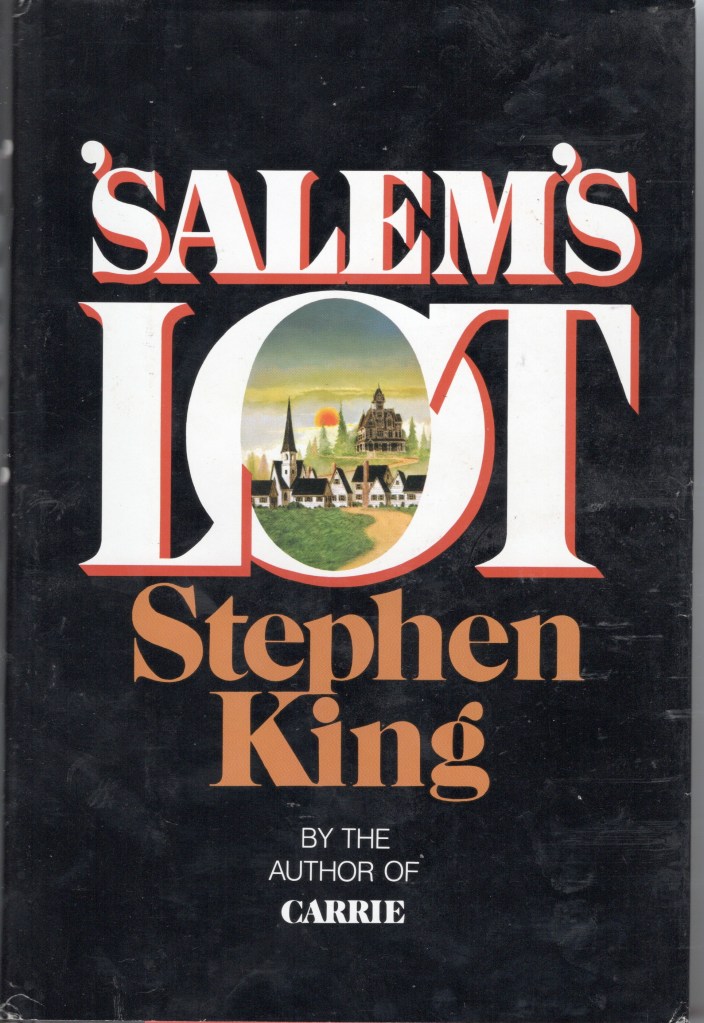
I often refer to ‘salem’s Lot as “Peyton Place, but horror.” Because while Stephen King’s second novel (and still one of my favorites) absolutely does its job as a wrenching piece of horror fiction, it’s also a truly insightful and meaningful look at a small town (population 1300) and how everyone knows everyone, as well as the way their lives intersect and connect and cross intricately; we get to know a lot of the townspeople before they succumb to the horror that is overwhelming their little town. If you took the vampires out of the story, you’d have to replace them with something, as there’s no story without them, but at the same time, this novel along with Needful Things some twenty or so years later, are remain two of the best books about life in small towns that I’ve ever read.
I used to reread old Stephen King novels a lot for comfort, losing myself in the worlds he creates and enjoying the stories, the writing, and the characters. ‘salem’s Lot is definitely one of my favorites of his; definitely always in the Top 5, with perhaps only The Stand outranking it.
Almost everyone thought the man and the boy were father and son.
They crossed the country on a rambling southwest line in an old Citroen sedan, keeping mostly to secondary roads, traveling in fits and starts. They stopped in three places along the way before reaching their final destination: first in Rhode Island, where the tall man with the black hair worked in a textile mill; then in Youngstown, Ohio, where he worked for three months on a tractor assembly line; and finally in a small California town near the Mexican boarder, where he pumped gas and worked at repairing small foreign cars with an amount of success that was, to him, surprising and gratifying.
Wherever they stopped, he got a Maine newspaper called the Portland Press-Herald and watched it for items concerning a small southern Maine town named Jerusalem’s Lot and the surrounding area. There were such items from time to time.
He wrote an outline of a novel in motel rooms before they Central Falls, Rhode Island, and mailed it to his agent. He had been a mildly successful novelist a million years before, in a time when the darkness had not come over his life. The agent took the outline to his last publisher, who expressed polite interest but no inclination to part with any advance money. “Please” and “thank you,” he told the boy as he tore the agent’s letter up, were still free. He said it without too much bitterness and set about the book anyway.
The boy did not speak much. His face retained a perpetual pinched look, and his eyes were dark–as if they always scanned some bleak inner horizon. In the diners and gas stations where they stopped along the way, he was polite and nothing more. He didn’t seem to want the tall man out of his sight, and the boy seemed nervous when the man left him to use the bathroom. He refused to talk about the town of Jerusalem’s Lot, although the tall man tried to raise the topic from time to time, and he would not look at the Portland newspapers the man sometimes deliberately left around.
When the book was written, they were living in a beach cottage off the highway, and they both swam in the Pacific a freat deal. It was warmer than the Atlantic, and friendlier. It held no memories. The boy began to get very brown.
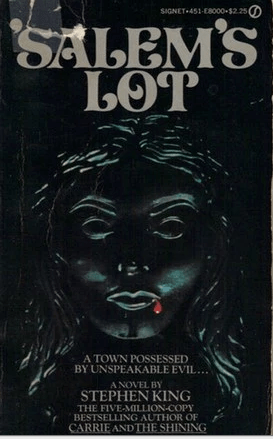
This is the cover of the version I originally read in high school–I bought it off the paperback rack at the Safeway in Emporia, Kansas. I kept that copy for years; eventually replacing it with a hardcover reprint in the 1990′, before finally getting an old copy with the original cover on eBay (which has since turned out to be a first edition; I love finding all the mistakes in it as I reread it).
I had read Carrie in paperback in one night when I’d borrowed it from a friend; it was only in the last decade that I finally acquired a copy of it to keep and reread periodically (I bought it to read the opening shower scene at Banned Books Night; ironically, the objections to the book have nothing to do with explicit talk about menstruation, or bullying, or violence…people object to the book because of its depiction of Christianity, particularly in the case of Carrie’s fanatic mother, Margaret (whom I always see in my head as Piper Laurie, who should have won an Oscar). I don’t think Carrie was the book that made me begin to question Christianity, to be honest; I think I already was questioning it before I read the book, but it was one of the first times I’d see a disparaging representation of someone committing horrifying abuses in the name of Jesus, or how the way the religion viewed sexuality could be taken to such horrific extremes. But I loved the book and became interested in Stephen King as an author. I was aware of ‘salem’s Lot before I found a copy while grocery shopping with my mom; I’d known he’d published a second book because I saw it in the book club ads (Doubleday, Book of the Month, etc.) in magazines. I had no idea what the book was about when I started reading it–I had no clue it was about vampires, and vampires never even crossed my mind when I started reading. It was a Saturday (Mom always drove into Emporia on Saturday to buy groceries), and I repaired to my room with the book (my homework was already done, and whatever college football game was on that Saturday was of no interest to me) and started reading. I finished reading it at around two in the morning, and was completely blown away by it. There was no way I was going to stop reading, and there was no way to stop reading once the big reveal about the vampires happened and the pace picked up.
The book was utterly terrifying, and it started raining later on that day as I read. I was living in a small town (population 973) and my bedroom window looked out at a corn field that was right across the street. I started seeing, as I read, a lot of similarities between Jerusalem’s Lot in the book and my little town–the characters, the interconnectedness of the community, and like Ben Mears, I was still kind of a stranger in the town. I just remember that when I got to the part where Danny Glick comes to Mark Petrie’s window, the storm outside brushed a tree branch against my window and I literally jumped, the book flying out of my hands and landing across the room in the middle of the floor.
It was also the first time I remember reading a book whose main character was a writer–something Stephen King returns to quite regularly, write what you know indeed–which also helped me connect with the book more; Ben Mears was a publisher novelist of minor success, but had published three books already and hadn’t graduated from college. He also seemed like a real person, living and breathing and absolutely real; it wasn’t until this reread that I realized how much physically he’s like King–tall and slender with thick black hair.
But it was also the first time I’d read anything about vampires that was so clearly set in the real world, in the real present, and with real characters I could relate to–which made it even more terrifying. I started thinking about how easy it would be for, say, a vampire to come to our small little town and how quickly people could be turned, primarily because no one would believe it was actually happening until it was too late–which King handled beautifully in the book.
Sunday morning and there’s an LSU game tonight (GEAUX TIGERS!). There’s no way of knowing how good LSU is going to be this year, so I guess tonight’s the night we find out. I watched some of the games yesterday–Georgia certainly looked impressive, and good for Florida and Ohio State winning their big games yesterday, but again, it’s also too early to know anything for sure. Were the two top-ranked teams from the PAC-12 (Oregon and Utah) overrated, or will they rebound (although that shellacking the Ducks got from Georgia had to sting) to make a play-off run after all? The only thing you can ever be sure of in college football is Alabama will be a contender.
Yesterday was a very good day. We had a downpour and flash flood warning for most of the afternoon, but fortunately I had already run the errand I had to run; this morning I have an errand to run as well, and then i am going to come home and order Costco for delivery (just a few things we need) and I intend to spend the day writing. I spent the day organizing and cleaning (which is always an incredibly pleasant way for me to spend the day) and cleaned out kitchen cabinets in order to throw away a lot of items that I had purchased for single, one-time use and had never used again. My cake carrier, for example; I bought that to carry birthday cakes I’d made to work. I used to make our nurse a red velvet cheesecake for his birthday every year–but he’s left the agency and it is highly unlikely I’ll ever make another cake that needs to be transported; if I do, I guess I can just get another one. I also was throwing away things I don’t use but take up space in the kitchen–the big metal salad mixing bowl, the big plastic salad container, muffin tins, etc.–and then reorganized the shelves and made more room for things. I also cleaned things off the tops of the cabinets. It now looks a lot less cluttered in the kitchen and when I open the cabinets.
There’s still some work to be done on the cabinets, but I feel very good about the progress made yesterday. I also did the floors.
I also spent some time revisiting Bourbon Street Blues yesterday. I didn’t give it a thorough read, more of a skim, but it had been a hot minute since I last read the book and…Constant Reader, it wasn’t bad. The book came out nineteen years ago, and I of course wrote it twenty years ago. It’s had to believe it’s been that long, isn’t it? I wrote it when we lived in the apartment on Sophie Wright Place after we moved back to New Orleans in 2001; it’s the only book I wrote there, because I wrote the next two after we moved onto this property and were living in the carriage house. I also realized that the reason I am so hard on myself when I read my own work is primarily because I have trained my mind over the years to read my stuff critically and editorially, with an eye to revision–and that doesn’t change once the book is actually in print. Bourbon Street Blues is not a bad book at all–there’s even some really clever lines in it. Someone had actually responded to one of my blog posts about the stand alone books that they’d like to see me do the same for the series book; I feel like I may have done that already, but it’s not a bad idea. I need to revisit the Scotty series anyway in order to write the new one (which was part of the reason I picked up Bourbon Street Blues yesterday) and since I have trouble focusing enough to read other people’s work at the moment, why not reread the entire series from start to finish? It certainly can’t hurt.
I have been bemoaning how bad the writing is for this new Scotty book I am writing and yesterday, as I cleaned and organized and reread Bourbon Street Blues, I began to see why precisely the work I’ve already done isn’t good and what precisely was/is wrong with what I’ve already done. The bones are there, of course, and it can be saved, which is what I am going to do today. I know precisely know how to make this book work, how to structure it, how to introduce the new characters and the plots for the book, and it’s a marvelous feeling. After I finish this–and then write my entry on Bourbon Street Blues–I am going to go run that errand, come home and get cleaned up, place the Costco order for delivery, and then dig into redoing the initial three chapters of the book and maybe even dive into another. I also am going to spend some time today with Jackson Square Jazz; I may bring the iPad with me so I can keep reading the Scotty series during Bouchercon–but then again, I have other things I am taking with me to read, too. But those are for the airport and the flights primarily; I can lug my iPad around in my backpack and then between panels or when I am sitting alone in the lobby I can pull it out and scan through another Scotty book quickly. It’s also not a bad idea for me to start working on (at last) pulling together the Scotty Bible I’ve always said I needed to pull together. (I also kind of need to pull together all the information on the Gregiverse; the world in which all of my books are actually set, from Alabama to New Orleans to California to Kansas to Chicago’s suburbs…)
I also have a short story submission I need to look over before sending it in for the blind read–next year’s Bouchercon anthology is the market–but I am not sure I’ll have the time or if I know precisely how to fix it.
And on that note, I am going to head into the spice mines. I’d like to have another productive day today, so…lots to do before the LSU game tonight.
I also love the word “enchantress.” Go figure. Must be something about the sibilant s.
I moved from Kansas to Fresno, California in February of 1981. It was cold and there was snow on the ground when I boarded an Amtrak train at 2 in the morning with my mother. I fell asleep before the train left the station in Emporia; when I woke up it was gray outside and we were in western Kansas. The trip seemed endless, and our train was delayed because of weather crossing the Rocky Mountains; that part was terrifying, honestly. There were times when there was only enough room on the mountain ledges we rode over for the train tracks, and the wind was powerful enough to rock the train. I’ve always been afraid of heights, so obviously this was completely terrifying for me. I had brought books with me to read on the train, but I’d finished them all by the time we reached Barstow, California–missing our connecting train by half an hour–and thus were stuck there for twelve hours until the evening train to Fresno.
You haven’t lived until you’ve spent twelve hours in a train station in Barstow, California.
(Although reading everything in the magazine rack in that train station completely fueled my soap opera obsession–but that’s a story for another time.)
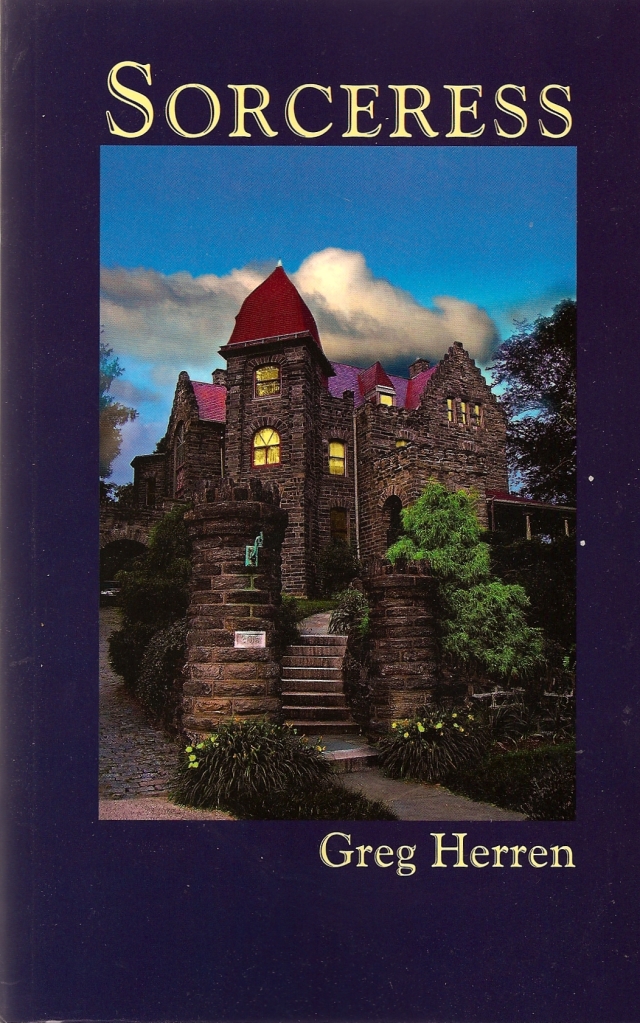
After I finished writing the first draft that became Sara I put the manuscript aside and started working on another one, which I called Sorceress.
Why was the move on Amtrak to California pertinent to the story of Sorceress and how it came to be? Because it’s one of the few books–in fact, the only book–I’ve written under my own name that is set in California (all the Todd Gregory ‘fratboy’ books are set in California).
It was a beautiful day to die.
The sun was shining and she could hear the birds singing in the trees outside. Through the window on the other side of the room she could see a gorgeous blue sky with wisps of white cloud drifting aimlessly. The house was silent around her, and she closed her eyes again, biting her lower lip.
Her throat was sore and she was thirsty.
There was a glass pitcher of water sitting on the nightstand just out of her reach. Drops of condensation glistened in the sunlight as they ran down the sides, pooling on the wood. She licked her lips and dry-swallowed again.
“Please.” She’d intended to shout, but all that came out was a hoarse whisper. Tears of frustration filled her eyes.
This can’t be happening to me, she thought as the tears began to run down her cheeks. She felt the wetness against her lips, flicking her tongue out to catch the moisture.
It might not be much, but it was something.
She tugged at the handcuffs again, and moaned as the raw skin around her wrists rubbed against the metal, dull arrows of pain shooting up her arms.
That isn’t going to work. You’ve got to think of something else. There has to be something.
As if on cue, the phone on the other side of the room began ringing.
If only I could reach the phone!
“If only I weren’t handcuffed to this stupid bed,” she said aloud.
If only, if only, if only.
A grandfather clock began tolling somewhere in the house.
Five o’clock. Maybe four more hours until the sun goes down.
She was safe until the sun went down.
She heard footsteps comingdown the hall towards the closed door.
“I’m thirsty!” she shouted. “Please! I’m so thirsty!”
The footsteps stopped. She was about to shout again when heard the footsteps start again—only now they were moving away from her door.
She closed her eyes.
Not a bad opening, huh?
I started writing the novel Sorceress sometime in 1992 or 1993; I’m not sure which. Sorceress was the easiest of the early manuscripts for me to write, and this was because I knew the story, from start to finish, before I started writing it–which is incredibly rare for me; I even knew the middle, which I always have the most trouble with. I originally wrote Sorceress in the late 1980’s as a novella that originally clocked in at around seventeen thousand words. But even as I wrote that incredibly long short story (at the time all I knew about novellas was that Stephen King sometimes wrote really long stories, like “The Mist”) and had always put it aside, because I knew there was more story there and it needed to be longer–novel length, in fact. So when I finished the first draft of Sara and was ready to move on to something else, I decided to finally expand Sorceress out into a novel.
Fresno wasn’t a pretty city, by any means. It had a desert climate (the entire San Joaquin Valley has a desert climate) that was very dry and climbed to well over 100 degrees in the heart of the summer (sometimes even getting up to over 110) and was all brown, mostly; brown, palm and orange trees, and concrete in the unforgiving sun. My parents bought a house in a subdivision in a city that bordered Fresno yet somehow wasn’t considered a suburb. It had a pool, two orange trees, and several eucalyptus trees. These seemed exotic and cool and fun–until you realized how much fruit one tree, let alone two, could produce, and there was no way to keep up with them, either; inevitably, the back yard was always dank with the sickly-sweet smell of rotting oranges. The eucalyptus trees with their slim, silvery leaves were also a pain in the ass; those leaves would get into the pool, and unless fished out, became water-logged and sank to the bottom, where they would stain and/or discolor the bottom of the pool. It seemed like those little leaves were always fluttering through the air and unerringly landing in the water.
Never again will I live a place where I am responsible for a swimming pool.
But the true beauty of Fresno was its location. It was within a few hours’ drive of many wonderful places: Yosemite, Sierra, and Kings Canyon parks, San Francisco, and Los Angeles. LA was the furthest away–four hours down the Grapevine; and the final descent through the mountains into the plains on the other side was one of the steepest highways I’ve ever driven down–but in college I also made friends with students who came from some of those mountain communities–Sonora, Oakhurst, Coarsegold, Tuolumne–and wound up visiting them at times. I spent most of my time visiting the mounts in either Sonora or Tuolumne. I’d never spent much time in the mountains before or since, and the thing that always stuck in my head was how close the stars in the night sky seemed up there, almost like you could reach up and grab one. I decided to create my own version of these small mountain towns and call it Woodbridge. When I started writing Sorceress as a novel, I set it in the countryside in the mountains outside of “Woodbridge.” By this time, I had already discovered y/a horror, obviously, and so “Woodbridge” was going to be the anchor of all my stories–they were all going to be connected, and in some ways the center of that fictional universe I was building was going to be Woodbridge (Sleeping Angel is also set in Woodbridge). I also put a college there; a campus of the University of California (UC-Woodbridge) which also gave me college students to play with as well as the high school kids. Laura, my main character, was originally from the same area of Kansas where Sara was set; I even mentioned her in passing in Sara, as a friend who’d moved away to California and who had been betrayed after she left by her best friend and her boyfriend…which also figured into the plot of Sorceress.
Sorceress was also the first book I wrote where I followed the Gothic tropes: a young woman all alone in the world after the death of her parents is summoned by an elderly aunt she didn’t know existed to California. The elderly aunt has a huge Victorian mansion in the mountains, a man-servant/housekeeper/butler, and once there Laura begins to suspect that not only are things not the way they seem, but that her own life might be in danger. There’s also a hint of the paranormal here as well…and some of the kids Laura meets in Woodbridge also figured into some of my other books for young adults as well.
When I had the opportunity to write something on spec for Simon and Schuster teen in the summer of 2005, Sorceress was the one I chose to revise and rewrite for them. I felt it was the most complete and needed the least amount of work, plus I loved the entire Gothic mood of the story. Then of course Katrina came along and knocked that right out of my head; I kept trying to revise it but focus was incredibly difficult, and finally I gave up. This is the story I mentioned in conversation with a friend, who was later given a job as an acquisitions editor, and this is the story she wanted me to pitch to her. I did, but they didn’t pick it up, but when she went out on her own later and started her own small press specifically for juvenile and y/a fiction, she wanted Sorceress, so I dragged it back out and went to work on it again. It was released in 2010, I believe; it’s hard to remember dates these days for me. Anyway, this is the book where I told Bold Strokes I was publishing a y/a with a friend’s small press, which got the response “you know, we do y/a too” that led to me giving them both Sara and Sleeping Angel, and led to all the others.
I also wrote another Woodbridge story–a very long novella–that I intend to either revise as a novella or expand out into a novel. This story directly references events in Sorceress and Sleeping Angel, as well as characters…so while it might be entirely too late to release another book in that linked universe I originally intended to create, a good story is a good story. I just am not sure about the ending of that one, which is one of the reasons it remains in the drawer.