Sunday morning and everything aches. I went out to Iris yesterday by myself (see previous post) and had a lovely time. It was indeed a gorgeous day and a wonderful reminder of how much I love everything about Carnival–and why I put up with the challenges of living inside the box; because once you are safely home and have parked your car, the convenience of the parades being only a half-block away simply cannot be beat. I got a lovely haul of beads, caught numerous plushies and cups and various other toys–including a super-hero Iris cape–which I gave to the children who were near where I was standing. I also gave away a lot of beads. Despite my gradual exhaustion that came on slowly, it was marvelous and despite having to spend the rest of the day in my easy chair (and still feeling the muscle fatigue this morning) I do not regret going out there, just as I will not regret going out there for Orpheus tomorrow.
I guess the Super Bowl is tonight and I also suppose we may end up watching. I don’t really care about either team that much, honestly; I lived in Kansas so I have a connection to the Chiefs, and I also lived in California and San Francisco is the motherland of my people. Of course, I’ll wind up rooting for Taylor’s boyfriend because it is fun watching the MAGAts lose their minds over this. I also love that “liberals” have now ruined football for them. They can’t root for Taylor’s boyfriend so they’ll root for the queer homeland and Nancy Pelosi’s team?
Mwa-ha-ha-ha-ha! Eat shit and die, MAGAts. You don’t own football, either.
Paul stayed up late Friday night working and so he was asleep until shortly after I came in from the parades to find a toy for Sparky on our doorknob from the neighbor ladies; it’s one of those serpentine tunnels for cats, and Sparky loves his already. I think I’m going to get him some more toys once i get the house back into some semblance of order. I am going to try to work on that today and work on some writing as well; I also want to spend some time reading Lina Chern’s book, which I’ll probably do after I finish this post. It’s quite good actually, despite my taking so long to read it–which definitely should not be seen as a criticism of the book, which will get its own entry at some point. Once he got up we watched My Best Friend’s Exorcism on Prime. It’s based on the Grady Hendrix novel, and I do need to read his work. (I really loved Paperbacks from Hell, which was his first book, about the horror boom of the 1970’s thru the early 1990’s.) He’s also openly gay, and the movie is terrific. It’s set in the 1980’s, and while I was a teenager in the 1970’s I was only in my twenties during the 1980’s, so all of it–cultural references, clothes, the music–was also pleasant nostalgia for me. (The 1980’s was a difficult time for me, but I really need to confront that decade and my memories and move past them at some point.)
I then showed Paul the pilot for Abbott Elementary, and we then binged the entire first season and well into the second before it was time for me to call it a night. This show is amazing, and I had always meant for us to get around to it. I’m glad we finally are watching, because the cast is fantastic; the writing is sharp, crisp and funny; and the characters are fun and interesting. Highly recommended, and looking forward to getting back into it before watching the Super Bowl (or not. I can certainly follow the game on social media).
And on that note, I am bringing this to a close. Have a lovely Sunday, Constant Reader, and I’ll catch you again later.
So, are you ready for some MORE blatant self-promotion?
During the Bold Strokes Book-a-thon, the other panel I was on had to do with writing young adult fiction (the other panelists were amazing, I might add), and once again, I am answering the questions sent to us by the moderator to turn into an interview with JUST me (because it’s all about ME ME ME) but I do urge you to seek out the video of the panel. It was terrific, and I was definitely the most uninteresting person on the panel, seriously; this is NOT self-deprecation. (I bought everyone’s books during the panel, I might add; definitely check out Lauren Melissa Ellzey.)
What is the definition of Young Adult? How does it differ from other genres?
I think it’s primarily an age distinction, to be honest, which is something that always makes me uncomfortable. Growing up I read far above my age level; when I was in seventh grade I was reading at a college level, per the tests and so forth. I mean, I did read The Godfather when I was ten; my parents, despite their conservative religious beliefs and values, let me read whatever I wanted without having to ask permission–I think when I asked Mom if I could read something the last time she replied “Read whatever you want, I don’t care” and after that I never asked again. When I was a kid, there was no such thing as young adult; everything was either for adults or “juvenile.” The juvenile category contained multitudes, beginning with the Little Golden Books and picture books to kids’ mysteries to Judy Blume. I think sometime in the 1980’s the genre was separated into “juvenile” for kids 8-12 and “young adult” for 12-18.
But there are kids like me, who can read above their age/class level and others who can’t read at their age/class level, and I think in some ways that differential could be harmful for those who are below-average readers–reading is the most crucial aspect of education, because if you can’t read…and no matter how many ways they try to make the language around slower readers more accepting and less stigmatizing…it doesn’t really help kids to be told they’re below average or not as smart or quick as the other students. (One of my primary problems throughout my education is I would understand something the first time, while others inevitably didn’t, and as the teacher explained for a second or third or more time, my ADD would kick in and my mind would wander because I didn’t need to listen and then wouldn’t be listening when the teacher moved on.
Ah, well.
Oh, and all subgenres of fiction also have the middle grade/juvenile and young adult sub-sub-genres.
Why or how did YOU choose YA?
I don’t know that I chose y/a so much as it chose me.
I started writing when I was a child (all my childish scribblings are lost to moves and time passing), and I wrote about kids my age. My first attempts at writing were always some kind of kids’ mystery series, a la The Hardy Boys and The Three Investigators (I’d still like to do this, frankly), and when I became a teenager, I started writing about teenagers. I wrote a bunch of short stories while in high school about the same group of kids going to the same high school. Those stories slowly but surely grew into a sprawling, handwritten novel about the county with plots and subplots and main characters and minor characters and all of this history; a “Peyton Place in Kansas kind of thing”. I worked on it for like five years, and eventually had this enormous sprawling mess that needed to be revised and rewritten and typed…and since I didn’t know how to type, made that part of it a problem. So I shoved it into a drawer and started pulling from it rather than revising it; taking out plots and characters and using them in other books and other stories.
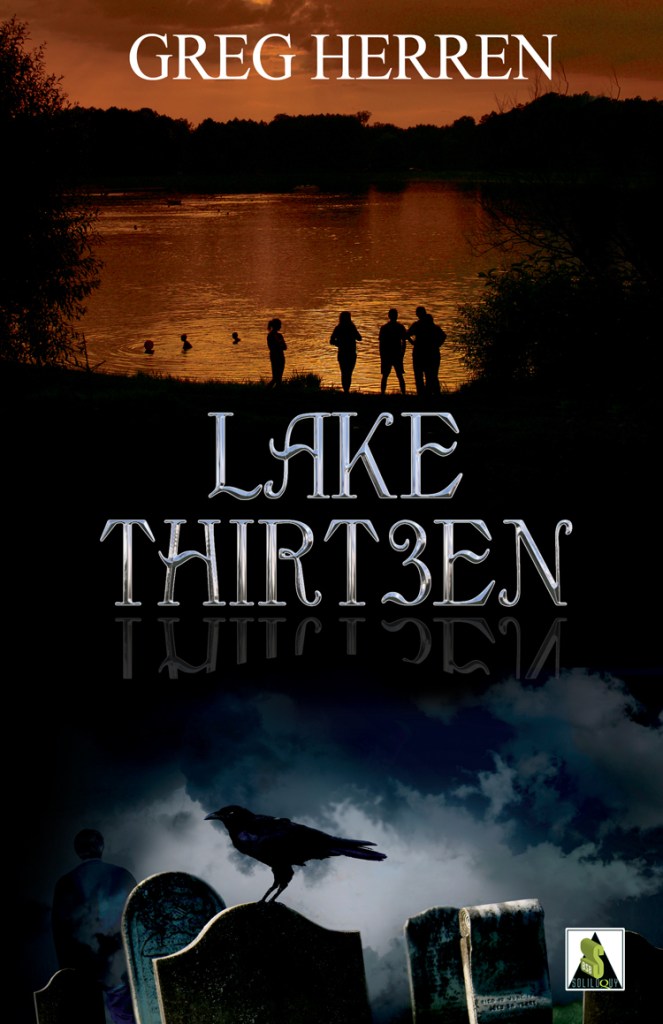
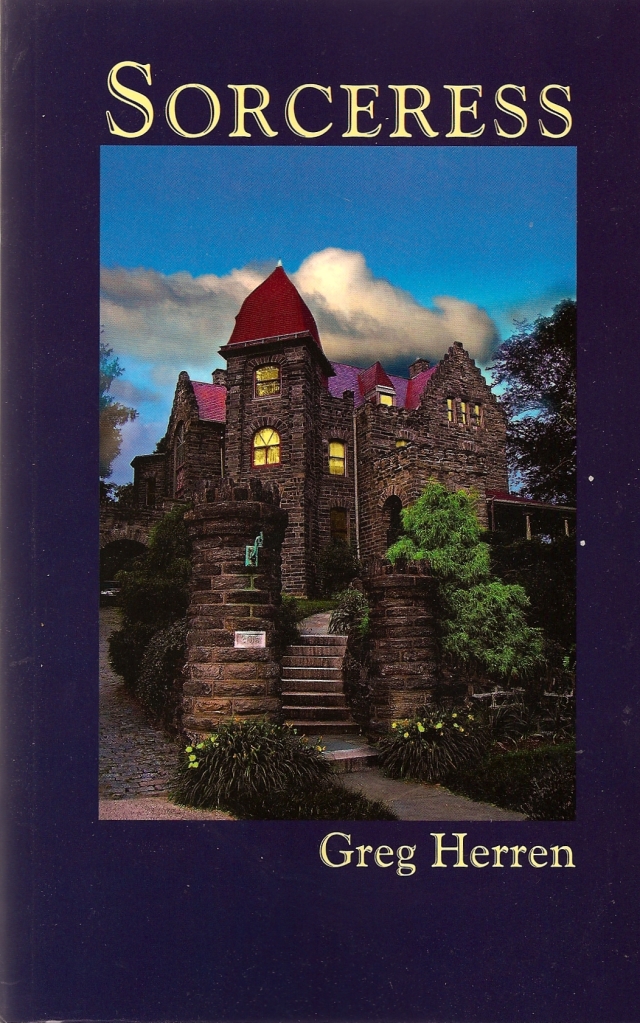
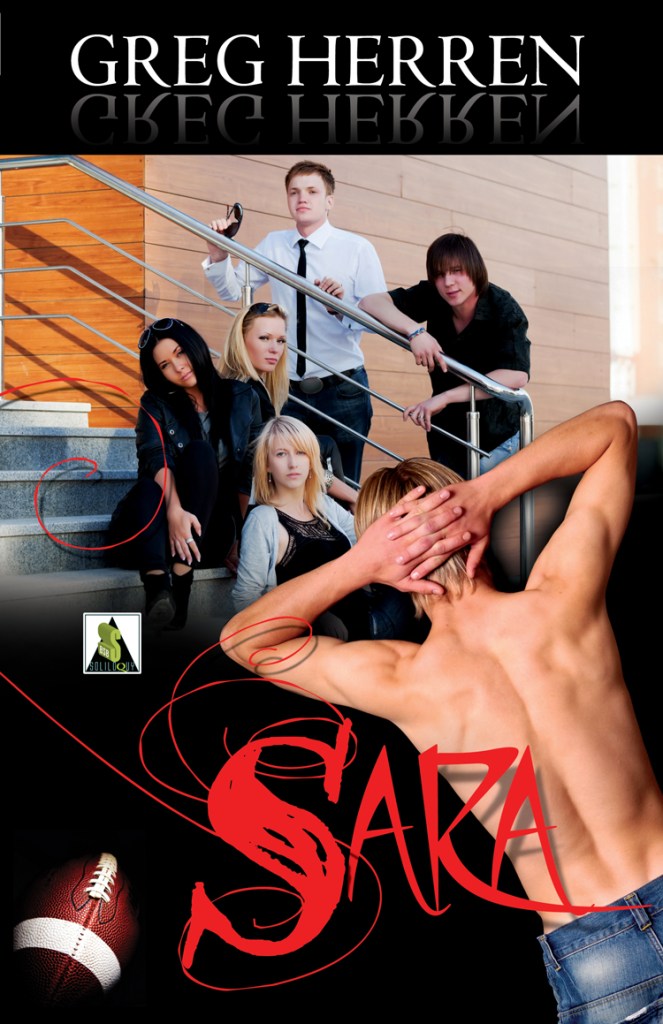
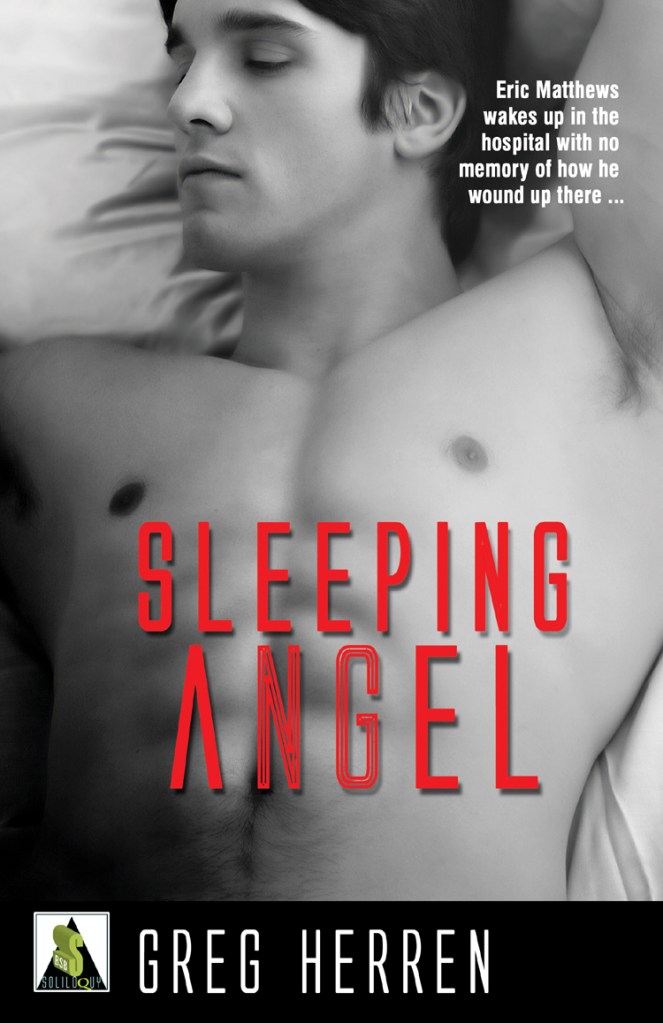
After I finished that, I spent the next five years mostly working on short stories. I started another book, more horror than anything else, but never got further than the third chapter. I finally decided to write a horror novel built from my old manuscript and those short stories from high school. I was about three chapters into it when I discovered two things: there was a big market in y/a horror at the time (Christopher Pike and R. L. Stine were HUGE during this period) and so I bought some of them. When I finished, I thought, “You know, I should turn Sara into a y/a novel” (because I thought somehow that would be easier? Foolish, foolish rookie) and so… I did. I was right in that thinking of it in those terms made it possible for me to finish a draft, but I wasn’t very happy with it so I put it aside and started writing another one, Sorceress, which was also horror but also had some strong Gothic moments in it. When I finished that one, again I wasn’t pleased with it so I started another–Sleeping Angel–which was the one I thought really had potential. I never finished that draft–by this time I’d discovered that gay fiction and nonfiction existed, so I started reading that and trying to write about gay characters instead.
Those manuscripts remained in my drawer for well over a decade, until a friend of mine took a job as a young adult acquisitions editor, and she wanted to work with me. I told her I’d written three (although it was technically two and a half), and gave her a brief synopsis of them. She liked Sorceress the best, so I started revising and editing it and turning it into something publishable. Once it was all done, she’d left that publisher, but started her own small press for y/a books for underrepresented teens, and she wanted to launch the press with Sorceress. I said “okay” and we were off. I eventually realized I needed to let Bold Strokes know, and when I did, I got an email back saying you know we do y/a, too? And so I sold the other two to them, and have never looked back since then.
Are there specific rules for writing YA (things you can’t do)? Does Bold Strokes add on or impose specific or additional rules?
I don’t pay too much attention to rules, frankly. There’s no graphic sex in my books, but it’s hinted at. I also try to swear less in young adult books than I do in adult fiction, which is probably not as big of a deal as I think it is? The society I grew up in was a lot more puritanical–believe it or not–that the one we live in today. So I always default to that setting, and then have to shake it off. Swearing isn’t as big of a deal as it used to be. No one thinks they’re marrying a virgin anymore, and on and on. And having been attacked for daring to accept an invitation to speak to queer high school students, I tend to tread softly. There have been a couple of times where I’ve had to change language, or how a scene went, because my editor thought it might be problematic; and frankly, I never want to be offensive, so I have no problem with it. I don’t see it as a free speech issue the way so many intentionally offensive writers claim it is. I shouldn’t take offense to someone calling me a faggot? Grow the fuck up. The so-called free speech “crusaders” are always defending hate speech as well as trying to shut up the people who find it objectionable. You do not have a constitutional freedom from consequences or getting a negative response to things you say and do, period. It’s really not hard to understand unless you want to be passive/aggressive and childish and a moron.
How do you remember back to these days, specifically how it felt or feels? (this is coming from your moderator who is much older than you are)
Well, for one thing, I’ve always kept a journal and I still have them all. (I was insufferable when I was younger, seriously.)
My sister has a theory that we forget a lot of the pleasant memories from our childhoods, but remember the traumas in great detail. I believe the truth of that, because school was a nightmare for me from the day we moved to the suburbs until I was done with it. I remember how it felt to read Greg Herren sucks cock on a desk at school. I remember how it felt to be mocked, laughed at, and bullied by assholes. I do remember the good things, though I tend to always focus on the bad.
The first thing I always do is abandon whatever “wisdom” about life I’ve theoretically learned since leaving high school, and put myself into the teenager mindset: they think they are the main characters in everyone they know’s story, and everything is the end of the world or their life is ruined and you are the most horrible parent ever! I’m not entirely sure I’ve escaped thinking that way, to be brutally honest: I am horribly selfish.
How do you come up with your characters? Your stories?
I am weird in that I inevitably always start with a title. I hear something or read something and think, that would make a good title. The next question is what story would fit that title? And it kind of goes from there. The title may change, the character names and story might change and evolve, but I can’t write anything that doesn’t have a title. Bizarre, I know. Usually with my young adult stuff it’s an idea I’ve had for a number of years and finally decide to explore whether it’s a novel or a short story, and go from there.
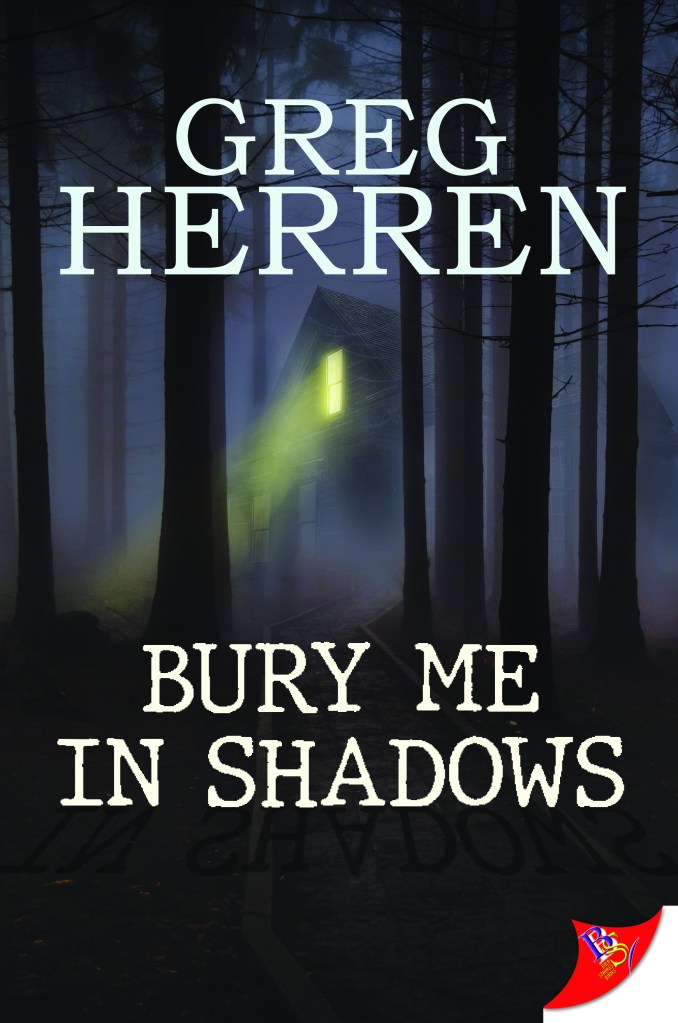
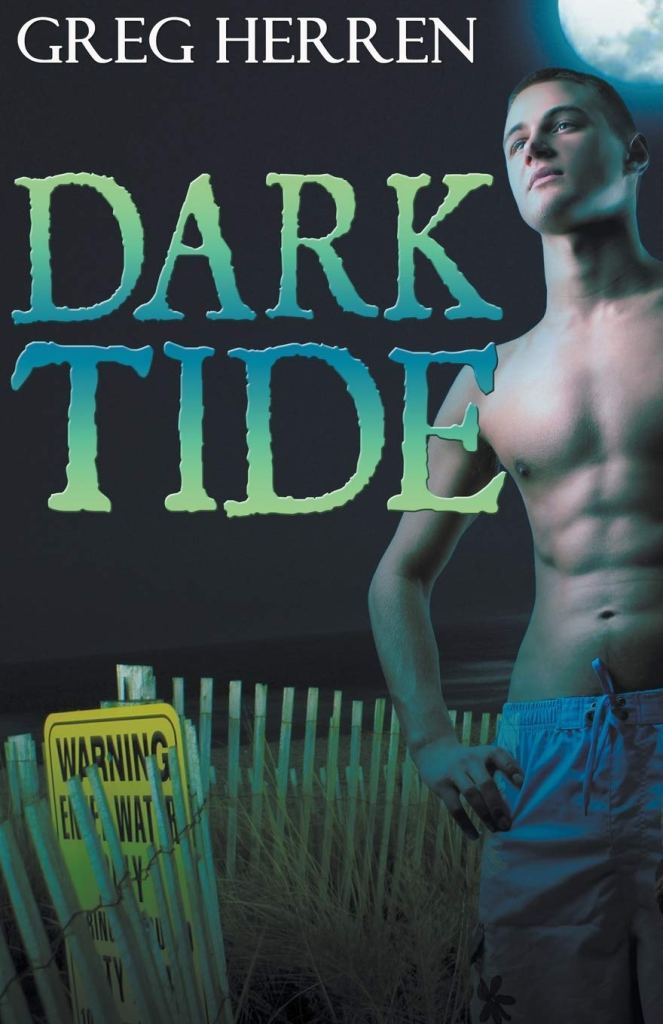
Dark Tide was originally called Mermaid Inn, Bury Me in Shadows was originally Ruins, but the others pretty much stayed the same from beginning to end.
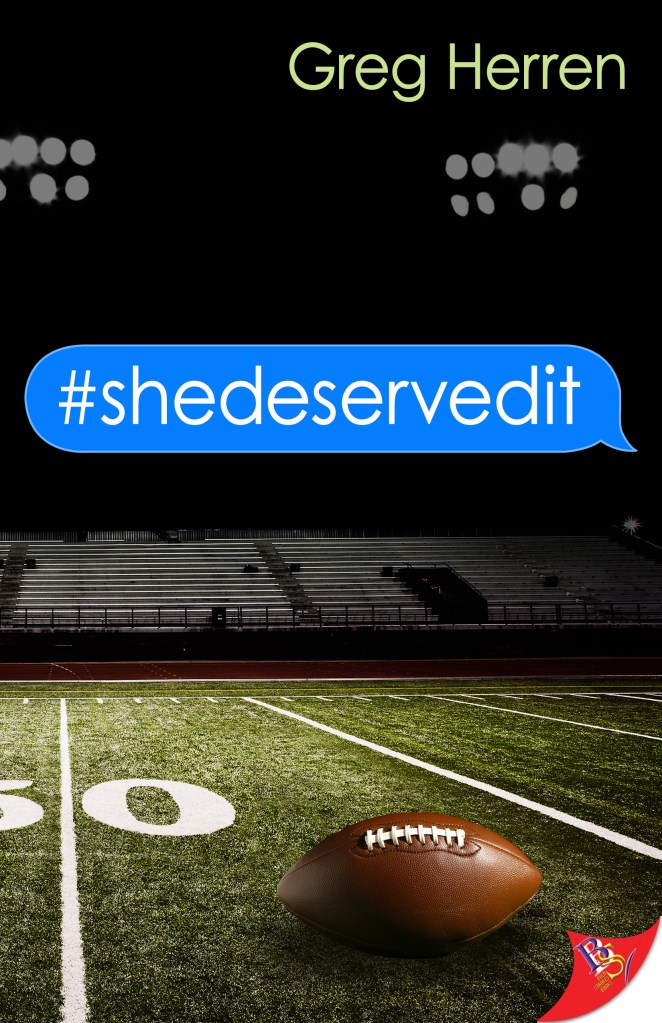
I wrote #shedeservedit because I was angry about the Steubenville/Maryville rape cases, and remembered stories and gossip from when I was in high school and college…and rethinking them through a more evolved brain about women and misogyny… well, it made me angrier. I had already planned on writing a story set in the same town with the same characters and opening with the same murder (I always referred to it as “the Kansas book” for years), but the motive was something I always had trouble grounding in reality. After those cases…it clicked in my head. You need to write this story about small town misogyny, protecting the star jocks from the girls at all cost, and make that the plot. It was easy to write because I was angry. Making it a compelling read was harder, because the subject matter was sickening to me.
I needed to write that book, and I don’t regret doing it, either…but it’s not exactly a feel good story people can escape into, either.
Why do you think YA is so popular?
It’s more accessible, I think. I mentioned reading ability before, and I do think that most readers aren’t into the Great Literary Tomes, hundreds of pages of beautiful writing with no real point or story. People kind of want to escape their cares and worries, and y/a books tend to be really entertaining. We’re competing with phones and tablets and streaming, so we need to write entertaining and engaging books.
Any specific must do-s or must-haves to get your writing each day?
I’m not nearly as anal about that as I used to be, before I returned to work full-time. I am very aware that I have little time to waste when I write, and thus must seize whatever opportunities to write show up. But if pressed, coffee. I can’t write unless I’ve had coffee when I got up.
I think this is all of them, but I could be wrong.
One of the things I had listed on goals for 2023 was to be better at marketing myself and my work. This also requires a complete reboot of my brain and how it functions; I have always been embarrassed to praise myself or talk about myself in non-negative ways, and this year I realized, with shock and horror and not a little bit of awe, that whenever I demeaned or belittled myself and my work publicly, I was undermining myself. What I saw as “charming humble self-deprecation” or “eccentric author doesn’t take himself seriously in a charming manner” might not be coming across the way it was intended. But shaking the habit of a lifetime of religious and family training to always be humble, never brag or boast, and to always remember to simply be satisfied with having done the best I could and let the praise come from outside, isn’t easy. I had always intended, for example, to join Canva and start producing my own graphics (because I am horrible with technology and learning new things, and I have so little time to learn things); I finally did that yesterday morning AND created my own first graphic for my Facebook home page image–the covers of both new books, my author photo, and the message Out This Month! –and it wasn’t terribly hard to do, and it was a kind of fun creative exercise that is easily manageable and another fun thing for me to do on Saturday mornings: make a new graphic for social media!
It’s a start. I also need to work on my website.
I am also doing Blatant Self-Promotional posts every day for each book–or at least I am trying. Three blog posts a day is a lot, frankly, and my brain is already so fried and overburdened with the upcoming surgery that there’s not a lot of space up there for much more than I am already doing, and it’s been a struggle trying to come up with promotional topics about each book every day. I also worry in promoting Death Drop and talking about drag that I am exposing my own ignorance on the topic on a daily basis, chasing potential readers away. Sigh. You see the trap anxiety sets for me on a regular basis? The fucking anxiety makes me second-guess myself all the time, which isn’t great, especially for someone it also gives self-esteem issues to.
Yesterday was an interesting day for college football. It was lovely watching Missouri destroy, dismantle, and all around just humiliate Tennessee. Missouri is one of those teams I don’t dislike; I sometimes forget they’re in the SEC but there’s some residual distaste for them from when we lived in Kansas–one thing KU and K-State fans can agree on is pure hatred for Missouri–but in the SEC, they’ve never bothered me much; probably because LSU plays them so infrequently. Georgia embarrassed Mississippi last night, which means the Tide is peaking at the right time and remember back when everyone was wondering if the Alabama dynasty was over? Yeah, it’s Georgia and Alabama playing for the SEC title again in Atlanta this year, same is it ever was. And of course, last night LSU took Florida apart in Tiger Stadium. Can we talk about Jayden Daniels for a moment? Even with a slightly more average defense, LSU would be in the national title conversation and without Daniels, we’d probably not have a single SEC win, other than maybe Mississippi State. He was phenomenal last night, setting all kinds of records and basically looking the best player in college football all year. His consistency has been insanely off the charts, and so have the numbers he’s been putting up, and if it weren’t for the 2019 team, this would be the greatest offense in LSU history–which makes the shitty defense all the more painful, really.
And now LSU has beaten Florida five times in a row. That’s the longest LSU winning streak in the series, and this was the last time the rivalry game will be played every year. If that doesn’t have Billy Napier’s job in trouble, remember–they still have a rivalry game left with a Florida State team that beat LSU in the opener and has only gotten better ever since. Paul and I were at the 2019 Florida game, which was a 42-28 thriller with Burrow torching the Gators the whole time. LSU wasn’t even supposed to be able to stay on the field with Florida during the next two seasons–and won both games, including the Shoe Game in 2020, which ended Florida’s play-off hopes. (They also honored the national championship baseball team during the game last night–the team that defeated Florida 2 out of 3 for the championship, which was some epic shade.) This year’s loss to Alabama was disappointing, especially since if Daniels hadn’t been hurt we might have been able to hang with them a bit more, but LSU is still further ahead in the rebuilding process than we should be, and that’s a credit to Coach Kelly and his staff–excluding the entire defensive coaching staff. The Tigers can get to 9-3, and ten wins if they win out–with Georgia State and Texas A&M the only games left, and both are winnable. The Saints play today at noon, but I am not sure I have the emotional stability to watch! (And USC lost, too–always a joy when Lincoln “too good for LSU” Riley gets his ass handed to him.)
I didn’t get as much done yesterday as I wanted to, because I did get distracted and sucked into football games, and Tug just wanted to cuddle all day, pretty much, so I spent the day in my easy chair with the games on while playing with my phone and iPad. I can have a day off every once in a while, can’t I? I think I am also going to slow down on the BSP, at least for a bit–and then I think yeah but you might disappear off-line after the surgery so you should do as much as you can before hand. This is also a valid point. I made shrimp creole last night, which turned out amazing, and it also felt nice to be cooking again, you know: It’s been a hot minute since the last time I cooked anything for real, and it was kind of a warm-up for me because I want to make mac-n-cheese tomorrow as well as a red velvet cheesecake for work. Ambitious, wouldn’t you say? I also bought cake pans yesterday while making groceries, because I don’t have a cake pan anymore, apparently; I’ve also lost my cake carrier–which I suspect was a casualty of a declutter during the pandemic, so I’ll have to buy another. Sigh.
And I just KNOW that after a buy a new one, the old one will turn up someplace where I put it where I wouldn’t forget that I put it. I outsmart myself on a fairly regular basis. But tomorrow morning are all my pre-surgery appointments, which is when I am going to find out exactly what the hell my recovery process is going to look like. And maybe this week my dentures will finally be ready; we can only hope.
And on that note, I am going to head into the spice mines. Have a lovely Sunday, Constant Reader, and I will check in with you again probably later–because the call of the Blatant Self-Promotion will undoubtedly prove too strong to resist.
The state’s nickname is “sportsmen’s paradise,” because all of the macho male outdoor sports–hunting, boating, fishing–are available here in abundance. We’re also called the Pelican State (most prevalent) and several other nicknames, not all of which are complimentary.
Louisiana has always been a conservative state, despite the existence of New Orleans. Originally French then Spanish before becoming American, Louisiana also was a part of the Confederacy and had an economy based on enslavement. We weren’t that far removed from David Duke’s gubernatorial bid (which came all too close to succeeding), and I remember Paul had gone on site visits with his boss at the Arts Council south of the city, and came home saying, completely in disbelief, that “people had yard signs saying ‘this is Duke country’–and me replying, sadly, “in the South they don’t bother to hide the racism–they see it as a positive.” But you cannot really go anywhere in Louisiana without being awed by the natural beauty on display here. I love Madisonville, and the Tchefuncte River area. It’s always a lovely drive to take 90 east when you head north (yes, I am aware I am saying you take an east-west highway to go north; welcome to New Orleans), and head out through the Venetian Isles area and drive along that narrow strip of land separating the lakes, crossing the Rigolets bridge and heading into Slidell.
A while ago, I was following a Twitter conversation about Burt Reynolds movies from the 1970s. Mind you, when I was living in Kansas our movie options were limited. There was a drive-in movie theater on the way from our little town Americus to the county seat of Emporia, and there was a small twin cinema on Commercial Street. The summer before my senior year Smokey and the Bandit opened on a Friday, and the following Friday Star Wars opened in the other theater. Both movies ran for about three months….so I saw them both repeatedly as there was very little else to do. The 1970’s were an interesting time for depictions of rural Southern sheriffs; Jackie Gleason hamming it up and going completely over the top. This was also the same time period that gave us corrupt politician Boss Hogg and the inept sheriff and deputies he controlled. These were always played for laughs, but the thing is–there really wasn’t anything funny about these types of characters in real life. Political and police corruption have always gone hand-in-hand in the Southern states; the police merely existing to enforce and enable the existing power structure. That Twitter conversation, along with reading Ethan Brown’s Murder on the Bayou and the various true crime documentaries about the Jeff Davis 8, put me in mind of writing about that kind of corruption. But I also kept wondering, but is this still true in the South? Do these kind of corrupt power structures still exist in the South? Would this read like a period piece?
And then the Murtaugh scandal broke.
Guess what? It IS still like this in the rural South. Thanks, Murtaughs!
I already had an idea for the next Scotty, and was pulling it all together, using a relatively minor political scandal here locally as the starting point for the story–which involved a conservative politician getting involved with a teenaged boy who worked at the food court at a mall, mostly buying him presents–clothes, underwear, swimsuits–and having the kid send him pictures wearing it. The age of consent in Louisiana is seventeen, and the kid was over seventeen, but while still being an icky thing, it wasn’t illegal–and they never did anything beyond that. It was mostly a harmless flirtation, until the kid, who was gay, realized that the nice man buying him gifts was actually a hardcore far right family values politician, so he went public. I still needed a murder, but I thought it would be simple to come up with one–the politician would have every reason in the world to kill to protect his secret, and he had his parish sheriff’s department to help commit and/or cover up the crime.
I did borrow two of the Murtaugh crimes for the book, but as starting points more than anything else, and came up with my own theories of said crimes for my own story–I wasn’t writing true crime, after all, and I wasn’t interested in proving the guilt of the Murtaughs. What I was interested in was exploring the decline and fall of a politically powerful family that had controlled a parish in Louisiana for well over a hundred years, almost like an absolute monarchy with primogeniture. I had also originally started the story with the kid coming to Scotty and Frank (through Scotty’s old buddy and former workout partner, David, who now teaches at NOCCA) because he gets a text from an unknown number which contains one of the pictures he has sent his older male friend (that he doesn’t know is a family values politician), and is worried about his own future if the information comes out. I wrote an entire draft of this story, but it didn’t work and I didn’t care for it…which was when it clicked into place: use two of the Murtaugh crimes to start with, and built it out from there. I decided that the kid at the mall wasn’t the original target of the politician, and that the original target was killed in a hit-and-run accident the year before; I also used the boat crash, turning it from a boat hitting a bridge to a pick-up truck hitting a bridge and pitching the passengers in the back into the bayou.
I also liked the teenager/older man dynamic, because it had played out with Taylor in the previous book–and Scotty had his own past with an older man when he was a teenager, which I was finally able to circle back around to.
I also invented the parish–surprisingly enough, there is no St. Jeanne d’Arc Parish in Louisiana–but it’s based loosely on what are known as the bayou and river parishes (Terrebone, Lafourche, St. Charles, St. John the Baptist). I already had a fictional parish on that side of the river (Redemption), but I decided Redemption wouldn’t work for this book, so I made it a neighboring parish.
As Constant Reader is aware–because I am nothing if not repetitious–I spent ages two to nineteen in the midwest, and the last five of those in rural Kansas. I’ve blogged endlessly about it, have written several books set there, and often blame (some of) my emotional scarring on the experience. It’s one of the reasons that stupid fucking song from earlier this year (“Try That in a Small Town”) was so ridiculous and offensive; yet another tired round of ammunition from people who equate cities with evil and rural life with purity and goodness–to which I always say “Someone’s never read Peyton Place, let alone lived in a small fucking town.” Big cities certainly don’t corner the market on crime and sin and lawlessness; small rural communities can be just as vile and horrible as any metropolis.
Shirley Jackson didn’t set “The Lottery” in Times Square for a reason.
There’s an entire essay to be written about the moral rot of the Bible Belt and rural America–and make no mistake, rural America is every bit as corrupt, sinfully evil, and dangerous as the worst neighborhood in any big city–but this is not the time, as I am here to talk about this marvelous novel I read very quickly last night.
“Can you see me?” Cole yelled over to them. He was standing on the south shore of the reservoir, barefoot and facing the water. He looked like he was thinking, but Janet knew better. The scrunch in Cole’s expression came from trying to keep his belly in a six-pack.
“I’ve got you,” Victoria yelled back as she framed her brother. She was using his phone and struggling with the device. “How do you zoom on this thing?” she asked as she shuffled to the edge, not looking at her feet and focusing on Cole. Janet could see a pink stamp of tongue at the corner of Victoria’s mouth as she tried her best to get the shot her brother wanted.
“You’ve got to be in portrait mode when you go live.”
Janet meant it as a polite pointer, but as the words came out of her mouth, they sounded like a dig. SHe didn’t mean it to be a dig, but she couldn’t help it, either. Her tone was why people thought she was such a bitch. Her tone and that she kind of was. Whatever–it was fun to watch the sheep quiver.
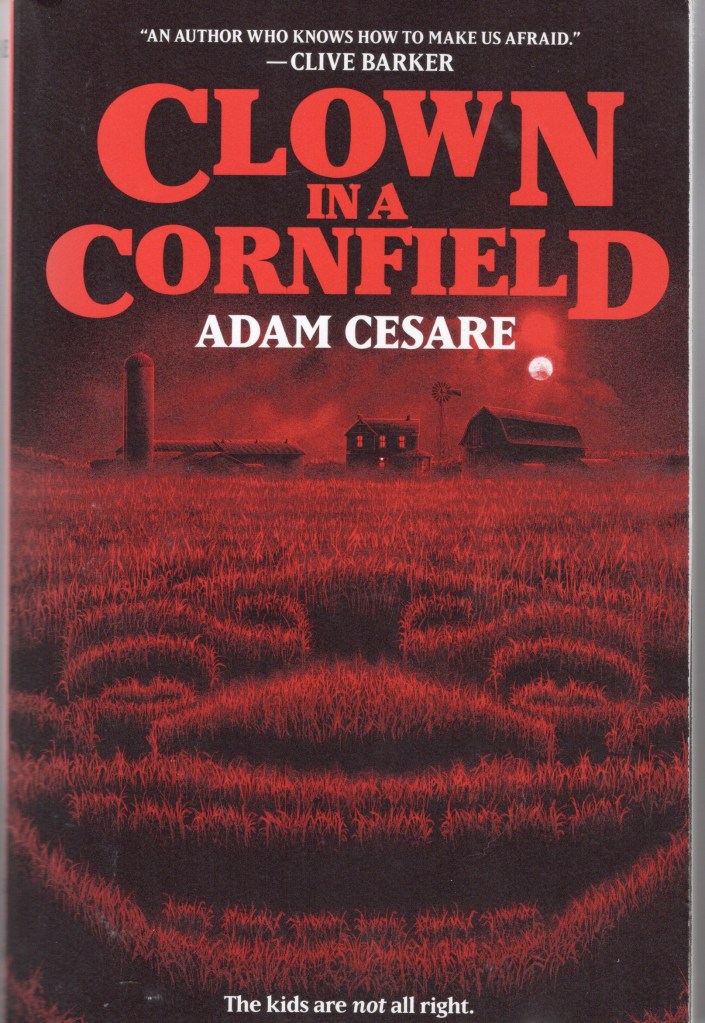
I don’t remember how Adam Cesare and his y/a horror thriller Clown in a Cornfield first came to my attention; if it was a suggestion from a website or if I saw someone talking about it on social media or I don’t know where, but I am very glad it did. The book is absolutely right up my alley–young adults, horror, small town Midwestern America (you know, “the REAL America,” right, Sarah Palin?), and terrifying clowns. I’ve never been afraid of clowns–although many people are, and I can respect that. The white greasepaint, the garish hair and eye make-up, the clothes–it’s not hard to see how something intended to entertain children (remember, fairy tales in their original form are horrifying) can easily become something that is absolutely terrifying. John Wayne Gacy, notorious serial killer who preyed on children, worked as a clown for kids’ parties–which is very unsettling, and of course, who can ever forget Stephen King’s masterclass of clown horror, It? Killer clowns have become kind of a cliché…but they still work.
Clown in a Cornfield works on its basic surface level–it’s a scary story that reads quickly and raises the adrenaline and is chockfull of surprises and twists; like the novel version of a slasher movie. (Something I’ve always wanted to do, frankly.) It takes place over the course of a couple of days, and is set in the small dying town of Kettle Springs, Missouri, where main character Quinn Maybrook and her father have just moved from Philadelphia; it’s hinted early on that the tragic death of her mother is why they moved during her senior year: a fresh start in a wholesome rural small town in the REAL America…which turns out to be all too real. The town is dying because the corn syrup processing plant shut down, and the town is losing population. The above few paragraphs are from the prologue–which sets up the rest of the book. There’s a tragic death at the reservoir that day, which changes the kids and changes the town–as though they’ve finally crossed a line they were dancing very close to the edge of and there isn’t any turning back.
The willful and wild teens of the town have planned a surprise during the Founders’ Day parade which Quinn witnesses when the prank goes haywire, and she learns there’s a lot of anger directed at the town’s teenagers–the kids from above who have a Youtube channel where they film themselves playing pranks on people around town–and the idea is that the pranks have become dangerous and the kids are out of control. The next night there’s a party out in a cornfield, and that’s when the corn syrup company’s mascot, Frendo the Clown, shows up with a crossbow and the body count starts to rise.
I really enjoyed this book. It was well written and works very well on all of its multiple layers, from the basic story which is well paced and exciting, to the layers of social critique, satire, and politics that it also manages to be. I found myself caring about the main characters and rooting for them, and while I saw one major surprise coming way ahead of time, there were a lot of other shocks and surprises along the way that made up for the telegraphing.
There’s also a sequel now, and I am looking forward to the second installment. I think you’ll like it, too, Constant Reader, so give it a whirl–thank me later.
We have a new refrigerator, and it is marvelous in our eyes.
The delivery was actually two hours early and went incredibly smoothly. I did have to take the kitchen apart and rearrange a lot of things, which triggered the old your filing system is completely out of control and has been for quite time, and the duplicates, dear God, the duplicates. But having a new, working refrigerator (we really put up with the malfunctioning old one, which was never the same after whatever evacuation that was in 2008–Ike? Isaac? who knows. So, this kind of was the impetus for me to reorganize the cabinets, throw out a lot of stuff I didn’t even know I had (forcing me to recognize that I still have food hoarding issues), and do something constructive with the filing. This morning I am going to move the rest of the food over from the carriage house refrigerator, and make notes on what I need to get at the grocery store. My hope is to get that all done this morning, spend some time reading the Elizabeth Hand (which I am greatly enjoying), and then tackle the filing and get this under control once and for all.
And this is just a small step forward in a big journey I am taking–in which I need to organize and/or discard things I no longer need. I have more ideas than I will ever write about, or have the time to write; I get more ideas every fricking day. Do I really need to hold onto old file folders crammed full of ideas I don’t even remember that I have? And if I do remember it, and it turns into something–I will just create a new file rather than go look for the old. I should scan old contracts, shred tax returns, and who knows what kinds of treasures I may find in the files as they come together at long last? I’m still unsure of the system I am going to use, but I need to get all the things that are like each other together–files about Alabama, files about New Orleans and Louisiana, files about Kansas and California and Chicago and its suburbs and Houston and Florida and crime stories and all kinds of things; research versus actual fiction–book ideas v, short story ideas; fiction vs nonfiction–and so forth.
I also worked on the laundry room some, and also managed to watch a lot of football games–Alabama against Arkansas, Tennessee-Texas A&M, and finally Auburn-LSU. I still don’t know what to think about the conference race this year, other than both divisions go through Georgia and Alabama again this year, and I don’t see anyone beating Georgia during the regular season. Texas A&M’s loss at Tennessee is their second in conference and third overall; no division title or shot at the play-offs for them; yet they are a good team and can still play spoiler. Tennessee still has Alabama and Georgia and Kentucky. The West is pretty much still up for grabs, with Alabama in the catbird seat; still tied for first even if they somehow lose to LSU. I don’t know what happened to Auburn after the Georgia game–which they had a shot at winning–because that team didn’t show up in Tiger Stadium last night. LSU’s defense, which finally started playing at a higher level in the second half of last week’s Missouri game, looked really good…or was Auburn’s offense really that bad? I thought their defense was for real–but how good were they really, because they didn’t look like an elite SEC West defense last night. LSU does have an incredible offense, no mistake or question, but are they really forty-eight points on Auburn good? After Georgia escaped them with a 27-20 win on the plains? That’s why you play the games, people–anyone can win on any given Saturday.
I slept very well last night, which was awesome. I feel quite well rested this morning, and so today’s chores do not sound either ominous or terrible. The filing is indeed going to be a chore, as is moving the food back over and making two grocery runs, but better to get it all over with today, wouldn’t you think, so I can go home straight from work tomorrow? We’re having a “professional development day” that starts at City Park at ten in the morning, after which we go to Dillard for a presentation and then back to Ralph’s on the Park for another. Lunch and dinner are being provided, which means I am not going to be able to eat anything, most likely, which will be very unpleasant for me, I think, but I’ll deal with it. Tug is also settling in more–it’s very obvious that he knows he is home, and this is where he belongs. So bold, so curious, so playful, so adorable. He sleeps completely relaxed and sprawled out on whichever laps he chooses, and he’s started doing to Scooter thing where he’ll go back and forth between us for naps, which is adorable.
And he does love chasing the red dot.
He’s having particularly big kitten energy this morning, too.
And on that note, I am going to go start moving the food back over and making the grocery list. Have a lovely Sunday, Constant Reader, and I may be back later; if not, then tomorrow.
Monday and back to the office with me today. Weekends are simply not long enough, ever, and should always be at least three days, methinks. Yesterday I witnessed the dreadful Saints performance, and it was not a good weekend for Louisiana football fans; the only glimmer of light locally was Tulane’s victory. I finished reading Shawn’s book, which was marvelous, and then picked out my first Halloween Horror read: Riley Sager’s Final Girls, and it’s long past time I’ve read this book. It’s rather embarrassing that I’ve not yet gotten to it. I also downloaded the audiobook of The Only Good Indians by Stephen Graham Jones for this weekend’s drive to the Redneck Riviera, and read another Alfred Hitchcock Presents short story, from Stories for Late at Night, “The Ash Tree” by M. R. James, which was delightfully creepy and reminded me of Daphne du Maurier’s “The Apple Tree”–and that in turn made me think about creepy trees as a trope in horror, and thought perhaps I should give the trope a whirl at some point. We watched the Scouts Honor: The Secret Files of the Boy Scouts documentary–which was just as creepy and awful and horrific as I thought it would be, as well as yet another pointed reminder of how straight people have failed to protect children since, oh like forever, and then cover it up as much as possible but then have the nerve to accuse queer people of pedophilia and grooming?
Sure, Jan.
We also watched the Jennifer Garner Apple Plus series The Last Thing He Said, which wasn’t great but wasn’t terrible, either; it just kind of evolved and wasn’t very thriller-ish or suspenseful. I also predicted one of the bigger plot twists in the first episode long before it played out in the show, but it was well done and an interesting story; but it wasn’t very thrilling or suspenseful; it never really seemed like there was any danger or stakes. It ws talked about a lot, but never part of the show’s reality? It was interesting enough to hold our interest–although I think I may have approached telling the story in a different manner than they did. It’s an interesting thought, at any rate.
It’s lovely having a kitten in the house, even if it means being more alert and having to get up more regularly because there was a crashing sound from somewhere else inside the apartment–usually followed by a galloping kitten moving at high speed away from the noise and mayhem he caused. He woke me up this morning by knocking my glasses off my nightstand table and then playfully batting them around on the floor, and once I took those away from him he went for the broom. He’s incredibly sweet, though, and I love that he’s so fearless and feels comfortable and at home enough to play. He slept on me for most of the Saints debacle yesterday, through the Boy Scout movie, and then moved back and forth between me and Paul during the Jennifer Garner show.
I also started writing the opening of a short story or a novel or something at any rate while watching the Boy Scouts documentary–part of it and the scandal was in New Orleans–and had an idea for the opening scene for something so I started writing it down; mainly about a college student away from home for the first time who’s obsessed with true crime and wants to be a true crime writer but isn’t sure how to get started chasing her dream other than majoring in Journalism at Liberty State in Liberty Center, Kansas–the town from #shedeservedit, why not reuse it? I don’t know why I started writing this when there are so many other things I should be working on. But that’s also life, you know, when you’re a writer–at least for me, there are always so many other ideas and thoughts and stories banging around in my head that it’s sometimes hard to focus on what I need to get done.
Heavy heaving sigh.
I never did make that to-do list for the week, so perhaps that should be the first thing on the list (I often do this so I can cross something off the list immediately; it’s satisfying and always seems to keep off working on getting the list completed). I also think that once I finish reading the Riley Sager I am going to reread a classic Stephen King that I’ve not revisited in a long time, The Dead Zone, which used to be one of my favorites and is still one that I think about a lot–especially during the rise of the former president, who eerily reminded me of the character of Greg Stillson, written thirty or forty years or so before the rise of the reality host/failed real estate mogul. (I’d considered rereading it in the wake of the 2016 election, but didn’t have the strength; I think now would be a good time.) I liked the opening of the Sager; which was encouraging. I hope to be able to get several books read this month…I think my reading is going to start picking up again, hallelujah. I think having a cat sleeping my lap while I read was what I was missing, and why it was hard for me to read since we lost Scooter. (I promise not to turn this into a Tug stan blog, seriously.) Today is going to be his first day left at home on his own for a while; we’ll see how he handles that.
And on that note, I am heading into the spice mines. Have a lovely Monday, Constant Reader; I’m sure I’ll be around again later on.
Several weekends ago, I did an on-line panel for Outwrite DC. The moderator was John Copenhaver (whom you should already be reading), and my co-panelists were the always delightful and intelligent Kelly J. Ford, Margot Douaihy, Renee James, and Robyn Gigl. The video is actually up on Youtube, if you would like to watch it. John’s questions were insightful and intelligent (as always), and the conversation was marvelous, inspiring, and fun; there’s nothing I love more than communing with other queer crime writers (or any writers, to be certain), and I always try very hard to not monopolize panels because I do have a tendency to talk too much–especially if and when I get going on a topic I am passionate about. So, I thought it might be fun to take John’s questions and turn them into a long form interview, for thoroughly selfish and totally self-promotional reasons.
The panel blurb claims that “queer characters are riveting and necessary material for crime fiction and how those stories can shape (and perhaps reshape) the landscape of contemporary crime fiction.” Do you agree with this statement—and why do the stories of queer characters have the potential to shape crime fiction?
I completely agree with this statement. Queer crime fiction has a very proud history that was never really recognized or appreciated by the mainstream crime writers, readers, organizations, and conferences. That is changing for the better.
New blood is always necessary for any genre–horror, romance, crime, literary fiction–because genres tend to stagnate after a certain period of time. The cultural shifts of the late 1960’s and 1970’s echoed in crime fiction, for example; you couldn’t write crime in those periods without addressing all the cultural and social shifts; Ross Macdonald’s later novels are a good example of this. The 1970’s saw a lot of anti-hero books being written. The private eye sub-genre had grown quite stale by this time, which was when the women really moved in and gave it a shot of adrenaline–Marcia Muller, Sara Paretsky, and Sue Grafton blazed that trail, and revitalized a sub-genre that had kind of lost its way. Queer writers and crime writers of color are currently doing the same to the entire genre. Voices and perspectives we aren’t used to seeing are now getting into print and changing how we see, not only our genre, but each other. Crime fiction has always given voice to societal outsiders and outliers; queer people and people of color are the ultimate outsiders and outliers in this country. Who better to tell stories of societal alienation?
Why did you choose your sub-genre? How do you think the sub-genre has influenced the types of characters you write?
Well, I write in several different ones. Chanse MacLeod was a straight private-eye series; Scotty Bradley was more of an amateur sleuth/humorous series, but he does have a private eye license in Louisiana. A Streetcar Named Murder was a cozy, with an amateur sleuth heroine who gets caught up in a family mystery. I’ve also done young adult and “new adult,” whatever that is (it’s been described as ages 16-25), and Gothics with a touch of the supernatural. I tend to write things that I like to read, and I have a varied reading taste. I started writing the Chanse series because I wanted to do a harder-edged private eye series with a queer twist and set it in New Orleans. I didn’t know about J. M. Redmann’s Micky Knight series when I started writing Chanse; would I have done something different had I known she’d already covered the hardboiled lesbian private eye in New Orleans? We’ll never know, I suppose. Scotty was meant to be a lark; a funny caper novel and a one-off. And here we are nine books later…
As for Streetcar, I had been wanting to try a traditional mystery with a straight woman main character for a long time. When the opportunity presented itself, I jumped in with both feet. I like trying new things and pushing myself. Having to follow the “rules” of a traditional cozy was a challenge–especially because I have such a foul mouth in real life. I love noir so am working on two different gay ones at the moment.
Why do you think amateur detectives are appealing? Do you think there’s a reason queer characters often find themselves in the role of amateur detective?
I think it’s because we all think we’re smarter than the police? We enjoy seeing a character we can identify with figuring things out faster than the cops, especially without access to all the evidence, interviews, and forensics the cops do. Murder She Wrote has been off the air for about thirty years and yet the books based on the show continue coming out every year. If we start out in mysteries reading the juvenile series–Nancy Drew and the Hardy Boys and Judy Bolton and all the rest were amateurs, so we always cut our teeth in the genre with them to begin with. Scotty is basically an amateur, even though he has a private eye license he rarely uses; he and the boys never get hired (although they kind of do in the new one, coming this November.)
Let’s talk about place. Greg, your books take place in the South. Why is place important to the crime novel—why is it especially important to the queer crime novel?
Place shapes who we are–not just as queer people, but as people in general. There are similarities between growing up in a small town in the Midwest and growing up in one in the South, but the differences are very marked. I’ve lived all over the country–pretty much everywhere but New England or the Northwest–and always felt, as a Southerner (despite no accent and not growing up there) like an outsider. Couple that with being gay in a time when it was still considered a mental illness, and you have someone always on the outside looking in. But I have that Southern pull to write about the South–although many would say that writing about New Orleans and writing about the South are not the same; like me, New Orleans both is and isn’t of the South, and I feel that very strongly. I’ve written books set in California and Kansas, even one in upstate New York, but I very much consider myself a Southern writer.
Place is even more important in a queer crime novel because place shapes the queer people so much. As a writer, I think one of my strengths is setting and place, and I think that comes from being very much a fan of Gothics growing up. Gothics are known for place and mood, and I think those are two things I do well.
All of you write wonderfully flawed characters. Sometimes, as LGBTQ+ writers, we feel the burden of representation and the urge to write only positive LGBTQ+ characters as an attempt to undo history’s (the dominant culture’s) demonization of us. Unfortunately, that can be limiting—even flattening. Clearly, you’ve all struck a beautiful balance with your characters. Talk a bit about how you approached this issue.
The flaws, to me, are what make the characters seem real. Nancy Drew and the Hardy Boys always annoyed me because they were so perfect; no one is that perfect, and anyone that close to perfect in real life would be irritating and insufferable. I am am quite aware that I am flawed (one of my biggest flaws is believing I am self-aware because I most definitely am not), but I am not trying to be perfect; I just want to be the best version of myself that I can be. By showing queer people with all their facets and flaws and failures and blind spots, we’re showing the reader that we are human; despite what those who hate us say or claim, we are human beings just like everyone else, just trying to get through life and do the best that we can. The villain in my first book was a gay man–and the entire book was a commentary on how we, as queer people, tend to overlook flaws and red flags from members of our own community. Just because someone is queer doesn’t mean they are a good person–and queers with a criminal bent do exist, and often take advantage of that sense of camaraderie we feel with each other, especially when we don’t know the person well. I tend to trust a queer person more readily than I will a straight person, and that’s wrong–which is why I think we feel so much more hurt when queer people betray us.
Speaking of the demonization of LGBTQ+ folks … Ray Bradbury of Fahrenheit 451 fame said, “There is more than one way to burn a book. And the world is full of people running around with lit matches.” What do you think about the current tactics to ban queer books from schools, libraries, and even bookstores in places like Florida, Arkansas, and Texas? Why are they targeting queer books?
This is, I hope, the last gasp of the homophobes who’ve never updated their hate speech in over fifty years. What the hate group “Moms for Liberty” are doing and saying is no different than what Anita Bryant said and did in the 1970’s, what Maggie Gallagher and her evil co-horts at the National Organization for Marriage repeated, then came the One Million Moms…all too often it’s the cisgender straight white women who are the real foes of progressive politics who fight to uphold a bigoted status quo. They always claim they’re concerned moms worried about their children–but are perfectly fine with them being shot up at school; working in a meat factory on the night shift at thirteen (have fun in hell, Sarah Huckabee Sanders, when you get there and French-kiss your Lord and Master Lucifer); or shouldn’t have the right to vote…they know better than a child’s actual parents, you see, about what the child needs or wants. Maybe they should spend more time with their own children than worrying about everyone else’s? Phyllis Schlafly, queen skank of the conservative right, ignored her own family while she embarked on her crusade to strip women of their rights and autonomy–all the while shrieking like a hyena into any microphone nearby that she was fighting progress to save the American family while selling some Leave it to Beaver-like nonsense as reality. I always felt sorry for her gay son. Imagine that as your mother.
As for why, it’s about control and power. I actually respected Anita Bryant more, because she truly believed all the vile, horrible, unChristian things she said and espoused. Most of the others, including the unspeakably vile and disgusting Moms for Liberty, are working a grift for money, attention and power. Hilariously, they’ve sold their souls in the worst possible way in the guise of family, religion and God; if they’ve ever actually read their Bibles, they need to work on their reading comprehension skills as they are both apostates and blasphemers who will spend eternity doing the breast stroke in the lake of eternal fire. Hope they enjoy it.
Sorry your husbands and children don’t love you, but who can really blame them?
What are you working on next? What’s coming up?
I have a short story in an anthology called School of Hard Knox from Crippen and Landru (and somehow got a co-editor credit for the book with Donna Andrews and Art Taylor); Death Drop, the first in a new series from Golden Notebook press, drops in October; and the ninth Scotty comes out in November, Mississippi River Mischief. I am writing a gay noir, and may be writing second books for the new series I started with Crooked Lane last year as well as a sequel to Death Drop, and have a couple of short stories I want to finish to submit to anthologies I’d love to be in.
…on a flight to Dallas this afternoon. However, in delightful news, I am sharing the Dallas-San Diego legs of the trip in both directions with none other than the Lady H, aka Lady Hermione, aka Carsen Taite. That is always fun. I don’t have enough time changing planes in Dallas on the way out to get Whataburger on the way (I’ll get Shake Shack at New Orleans airport before I leave) but here’s hoping I can get it on the way home, because I know I will be starving by the time I get to Dallas. (I just checked; I have two hours in Dallas on the way back so Whataburger fer shur! The departure flight is at eleven something California time, so I probably won’t eat anything before boarding….unless there’s donuts or something at the San Diego airport, which I am sure there is.) It’s truly sad how excited I can get about food options that I don’t normally have access to, isn’t it?
But I am all packed and ready to head to Metairie for my eye appointment on the way to the airport. It would probably be more accurate to say I overpacked–I really don’t know why every time I go to something like this I have to take so much with me, including books–what if I run out of something to read!?!?!? Um, bitch, you’re going to a convention for mystery readers. There will be free books in my conference book bag. Books will be given away at various times over the weekend. There’s a book room and several book sellers.
But yes, by all means, Greg, weight yourself down bringing coal to Newcastle.
My supervisor and I were looking around yesterday for pictures of our old office on Frenchmen Street for a presentation she is doing at the US Conference on AIDS (she’ll leave the day I return to work), and we couldn’t find any, anywhere. I knew I probably had some in my archive of photographs on the back-up hard drive (which is horribly horribly disorganized), and so I went digging around in those files after I finished packing last night. Oh, the memories–and oh, the fucking receipts! Apparently–not really a surprise to anyone who knows me–I’ve been keeping receipts for decades. Old assholish behavior from people who should know better that I’d completely forgotten about–both the person and the behavior. Also, some people have been assholes for a very long time. Stick with what you’re good at, I guess? But yes, at some point I am going to have to organize those picture files–and there are tons of duplicates.
So.
Many.
Duplicates.
Nevertheless it was a fun way to pass an hour or so while the laundry laundered and the dishes washed in their respective machines. There are so many things I need to be better about–the picture files, for example, could be incredibly useful for inspirations and/or putting me into the mood to write a particular kind of story. I found the photo file of the pictures I used to help me visualize and write Timothy; I did do this for Mississippi River Mischief, but never took the time to look at the photos before diving into writing or trying to get the work done. It probably would have helped some, and therefore I need to remember the value of visual aids for my writing going forward. I am taking stuff with me to edit over coffee, or to muse over and/or think about; I always take my journal with me when I go to panels because people say things I want to remember later, or make me think about something I am working on, sometimes solving a puzzle I’d be trying to untangle. I love being around other writers, I really do. It’s always fun, and I get to hang around smart people and listen to them tell funny stories and laugh and be amazed that I get to know all these amazingly brilliant and smart and witty people and get to call them friends? The teenaged kid in Kansas whose house had a corn field across the street and dreamed big dreams in that bedroom with the ugly beige walls and brown shag carpeting would have slept well and gotten through life a little easier had he known his life would turn out even better than he’d ever dared to dream. I complain a lot. I whine a lot. I get irritated easily and my temper frays and flares a little more lately than I’d prefer, frankly. It’s also so, so easy to go down the dark path to depression and who cares and why bother and all that morose self-pitying nonsense that doesn’t make anything any better but certainly can make everything seem worse. But I do know how incredibly lucky and blessed I am. People also seem to think I’ve led an interesting life. I don’t think so, but it’s also all I know so it just seems normal to me. I get to write books and stories and get them published. People read them, seem to like them, and want me to write more of them. I even get nominated for awards here and there and now and again…quite a lot of times, actually.
And while it may not seem like it most of the time when I’m complaining, I’m pretty happy with my life and how it’s all turned out. I’ve also realized that I’m incredibly lucky and blessed with my writing career. I’ve been nominated for the Anthony Award seven times now–twice for Best Anthology, once for Best Short Story, once for Best Paperback/Ebook Original, twice for Best Children’s/Young Adult, and once for Best Humorous. That’s really not a bad haul, you know. I’ve also been nominated for a Lefty and an Agatha and a Shirley Jackson and a Macavity–not bad for a big old queer writer of queer books, you know? It’s also lovely seeing these mainstream awards starting to slowly recognize queer writers and our books. I also found, you see, a lot of pictures of conferences and signings and readings and book events and conferences from throughout the length of my varied and odd career. It’s been a lovely ride so far, and I really wish I would allow myself the luxury of enjoying myself and enjoying my career.
My goal for this weekend is to have as much fun as possible, hug as many people as I can, and relax and enjoy the ride as a three-time Anthony nominee. That’s pretty amazing, and something that queer teenager back in Kansas couldn’t have dared to dream.
And on that note, I am going to head into the spice mines. I need to do one more load of dishes before i depart and the kitchen will be thus clean. Have a lovely day, Constant Reader, and as always I will probably be updating social media with today’s travel shenanigans. Don’t know if or when I will be back here, but will do my best.
Thursday morning and another lovely night’s sleep. I think the exhaustion from the excessive heat is helping me sleep better, ironically; I’m not getting much more used to it, either; it bothers me just as much as it did when we went into our insanely long streak of excessive heat advisories that I swear began in May. I’ve noticed that there aren’t Creole tomatoes in the grocery store anymore, which is bitterly disappointing; I love Creole tomatoes, and I’d have been willing to swear last year I could get them through August and into early September–but maybe the heat is killing them, I don’t know. It wouldn’t surprise me. When I lived in Kansas I remember one brutally hot summer where the corn wilted in the fields; that wasn’t pleasant. But today is my last day in the office for the week and Paul gets home on Saturday, which is marvelous and delightful and I cannot wait to see him, of course. I won’t say that I’m lonely, but last night when I got home after running errands I was just beat, you know? I didn’t write anything, either, or read. I’m afraid I went into a wormhole on-line, sitting in my chair and just scrolling through my social media feeds until I went to bed. I guess I needed the night of nothing and not thinking, so I am not going to regret the lost time last night (a whole new Greg, as you see I am being kinder to myself about these things) and while today is probably going to be a more intense day at work (my schedule is busier than it has been lately), I am caught up on everything else and everything is going smoothly. Not being fatigued or foggy in the morning helps. I think I am now officially used to this work schedule, much as I loathe it.
But do I really loathe it, or is it just the habit of a lifetime hating waking up to an alarm? I think the latter is far more likely. I always feel like I could sleep more when the alarm goes off, but lately I’m awake before the alarm goes off, and then hit snooze twice because a. the alarm is set eighteen minutes fast and b) each time I hit it, it gives me another nine minutes. So when I turn it off after the second time, it’s actually six a.m. And I am already awake.
I have some more proofing to do and am waiting for the edits for Mississippi River Mischief to arrive so I can get that out of my hair. I’ve not been particularly motivated to write this week–and have been blaming the heat for my laziness (see? doing it again)–but hopefully this weekend I will be able to get some done. I have to look for the stuff for my driver’s license today, so I can get up and go in the morning–I really don’t want to have to wait until next week when Paul is back, because the license expires on my birthday next weekend, and that’s shaving it a little close for my liking. Something always goes wrong, you know?
College football season is nigh, and while I am always excited and hopeful for a new football season (GEAUX TIGERS!), I am seeing a lot of hype about where LSU is going to be this year and how much more improvement there will be over last year. I don’t think anyone took LSU very seriously last year (the early losses to Florida State and Tennessee being directly responsible for that), and it wound up being a surprise banner year. LSU had never beaten both Auburn and Florida in away games in the same season EVER, and of course, LSU hadn’t beaten Alabama in Baton Rouge since 2010 (which is why they stormed the field, haters–no one beats Alabama regularly so whenever you do you celebrate the hell out of it. How many times has Georgia beaten Alabama this century? Once? Maybe twice? Tennessee snapped a 17 year losing streak against them last year…), so clearly they overperformed and surprised people. No one expected to see LSU in Atlanta playing for the SEC championship–and at least LSU kept the score closer than TCU did in the national title game. So the expectations are high amongst fans and sportswriters, which means the possibilities of bitter disappointment are also high. I’m just looking forward to an enjoyable season–and this season is the last one of college football as we currently know it before realignment changes everything for next season. But it’s always fun to see how the season plays out–even if LSU underperforms.
And that first season of football will take place while I am in San Diego for Bouchercon. I think LSU plays Florida State that Sunday night, and I may get home in time to catch the end of the game. The last time I was traveling during an LSU season opener was when we were flying back from Pisa and they were playing Wisconsin. I kept checking the score while we were waiting to board, and LSU was behind. When we landed in New York I checked and LSU had come from behind and won. Let’s hope that tradition holds, shall we?
And on that note I am heading into the spice mines. Y’all have a great day, and I will check in with you again later.