Monday and back to the office with me today. Weekends are simply not long enough, ever, and should always be at least three days, methinks. Yesterday I witnessed the dreadful Saints performance, and it was not a good weekend for Louisiana football fans; the only glimmer of light locally was Tulane’s victory. I finished reading Shawn’s book, which was marvelous, and then picked out my first Halloween Horror read: Riley Sager’s Final Girls, and it’s long past time I’ve read this book. It’s rather embarrassing that I’ve not yet gotten to it. I also downloaded the audiobook of The Only Good Indians by Stephen Graham Jones for this weekend’s drive to the Redneck Riviera, and read another Alfred Hitchcock Presents short story, from Stories for Late at Night, “The Ash Tree” by M. R. James, which was delightfully creepy and reminded me of Daphne du Maurier’s “The Apple Tree”–and that in turn made me think about creepy trees as a trope in horror, and thought perhaps I should give the trope a whirl at some point. We watched the Scouts Honor: The Secret Files of the Boy Scouts documentary–which was just as creepy and awful and horrific as I thought it would be, as well as yet another pointed reminder of how straight people have failed to protect children since, oh like forever, and then cover it up as much as possible but then have the nerve to accuse queer people of pedophilia and grooming?
Sure, Jan.
We also watched the Jennifer Garner Apple Plus series The Last Thing He Said, which wasn’t great but wasn’t terrible, either; it just kind of evolved and wasn’t very thriller-ish or suspenseful. I also predicted one of the bigger plot twists in the first episode long before it played out in the show, but it was well done and an interesting story; but it wasn’t very thrilling or suspenseful; it never really seemed like there was any danger or stakes. It ws talked about a lot, but never part of the show’s reality? It was interesting enough to hold our interest–although I think I may have approached telling the story in a different manner than they did. It’s an interesting thought, at any rate.
It’s lovely having a kitten in the house, even if it means being more alert and having to get up more regularly because there was a crashing sound from somewhere else inside the apartment–usually followed by a galloping kitten moving at high speed away from the noise and mayhem he caused. He woke me up this morning by knocking my glasses off my nightstand table and then playfully batting them around on the floor, and once I took those away from him he went for the broom. He’s incredibly sweet, though, and I love that he’s so fearless and feels comfortable and at home enough to play. He slept on me for most of the Saints debacle yesterday, through the Boy Scout movie, and then moved back and forth between me and Paul during the Jennifer Garner show.
I also started writing the opening of a short story or a novel or something at any rate while watching the Boy Scouts documentary–part of it and the scandal was in New Orleans–and had an idea for the opening scene for something so I started writing it down; mainly about a college student away from home for the first time who’s obsessed with true crime and wants to be a true crime writer but isn’t sure how to get started chasing her dream other than majoring in Journalism at Liberty State in Liberty Center, Kansas–the town from #shedeservedit, why not reuse it? I don’t know why I started writing this when there are so many other things I should be working on. But that’s also life, you know, when you’re a writer–at least for me, there are always so many other ideas and thoughts and stories banging around in my head that it’s sometimes hard to focus on what I need to get done.
Heavy heaving sigh.
I never did make that to-do list for the week, so perhaps that should be the first thing on the list (I often do this so I can cross something off the list immediately; it’s satisfying and always seems to keep off working on getting the list completed). I also think that once I finish reading the Riley Sager I am going to reread a classic Stephen King that I’ve not revisited in a long time, The Dead Zone, which used to be one of my favorites and is still one that I think about a lot–especially during the rise of the former president, who eerily reminded me of the character of Greg Stillson, written thirty or forty years or so before the rise of the reality host/failed real estate mogul. (I’d considered rereading it in the wake of the 2016 election, but didn’t have the strength; I think now would be a good time.) I liked the opening of the Sager; which was encouraging. I hope to be able to get several books read this month…I think my reading is going to start picking up again, hallelujah. I think having a cat sleeping my lap while I read was what I was missing, and why it was hard for me to read since we lost Scooter. (I promise not to turn this into a Tug stan blog, seriously.) Today is going to be his first day left at home on his own for a while; we’ll see how he handles that.
And on that note, I am heading into the spice mines. Have a lovely Monday, Constant Reader; I’m sure I’ll be around again later on.
Several weekends ago, I did an on-line panel for Outwrite DC. The moderator was John Copenhaver (whom you should already be reading), and my co-panelists were the always delightful and intelligent Kelly J. Ford, Margot Douaihy, Renee James, and Robyn Gigl. The video is actually up on Youtube, if you would like to watch it. John’s questions were insightful and intelligent (as always), and the conversation was marvelous, inspiring, and fun; there’s nothing I love more than communing with other queer crime writers (or any writers, to be certain), and I always try very hard to not monopolize panels because I do have a tendency to talk too much–especially if and when I get going on a topic I am passionate about. So, I thought it might be fun to take John’s questions and turn them into a long form interview, for thoroughly selfish and totally self-promotional reasons.
The panel blurb claims that “queer characters are riveting and necessary material for crime fiction and how those stories can shape (and perhaps reshape) the landscape of contemporary crime fiction.” Do you agree with this statement—and why do the stories of queer characters have the potential to shape crime fiction?
I completely agree with this statement. Queer crime fiction has a very proud history that was never really recognized or appreciated by the mainstream crime writers, readers, organizations, and conferences. That is changing for the better.
New blood is always necessary for any genre–horror, romance, crime, literary fiction–because genres tend to stagnate after a certain period of time. The cultural shifts of the late 1960’s and 1970’s echoed in crime fiction, for example; you couldn’t write crime in those periods without addressing all the cultural and social shifts; Ross Macdonald’s later novels are a good example of this. The 1970’s saw a lot of anti-hero books being written. The private eye sub-genre had grown quite stale by this time, which was when the women really moved in and gave it a shot of adrenaline–Marcia Muller, Sara Paretsky, and Sue Grafton blazed that trail, and revitalized a sub-genre that had kind of lost its way. Queer writers and crime writers of color are currently doing the same to the entire genre. Voices and perspectives we aren’t used to seeing are now getting into print and changing how we see, not only our genre, but each other. Crime fiction has always given voice to societal outsiders and outliers; queer people and people of color are the ultimate outsiders and outliers in this country. Who better to tell stories of societal alienation?
Why did you choose your sub-genre? How do you think the sub-genre has influenced the types of characters you write?
Well, I write in several different ones. Chanse MacLeod was a straight private-eye series; Scotty Bradley was more of an amateur sleuth/humorous series, but he does have a private eye license in Louisiana. A Streetcar Named Murder was a cozy, with an amateur sleuth heroine who gets caught up in a family mystery. I’ve also done young adult and “new adult,” whatever that is (it’s been described as ages 16-25), and Gothics with a touch of the supernatural. I tend to write things that I like to read, and I have a varied reading taste. I started writing the Chanse series because I wanted to do a harder-edged private eye series with a queer twist and set it in New Orleans. I didn’t know about J. M. Redmann’s Micky Knight series when I started writing Chanse; would I have done something different had I known she’d already covered the hardboiled lesbian private eye in New Orleans? We’ll never know, I suppose. Scotty was meant to be a lark; a funny caper novel and a one-off. And here we are nine books later…
As for Streetcar, I had been wanting to try a traditional mystery with a straight woman main character for a long time. When the opportunity presented itself, I jumped in with both feet. I like trying new things and pushing myself. Having to follow the “rules” of a traditional cozy was a challenge–especially because I have such a foul mouth in real life. I love noir so am working on two different gay ones at the moment.
Why do you think amateur detectives are appealing? Do you think there’s a reason queer characters often find themselves in the role of amateur detective?
I think it’s because we all think we’re smarter than the police? We enjoy seeing a character we can identify with figuring things out faster than the cops, especially without access to all the evidence, interviews, and forensics the cops do. Murder She Wrote has been off the air for about thirty years and yet the books based on the show continue coming out every year. If we start out in mysteries reading the juvenile series–Nancy Drew and the Hardy Boys and Judy Bolton and all the rest were amateurs, so we always cut our teeth in the genre with them to begin with. Scotty is basically an amateur, even though he has a private eye license he rarely uses; he and the boys never get hired (although they kind of do in the new one, coming this November.)
Let’s talk about place. Greg, your books take place in the South. Why is place important to the crime novel—why is it especially important to the queer crime novel?
Place shapes who we are–not just as queer people, but as people in general. There are similarities between growing up in a small town in the Midwest and growing up in one in the South, but the differences are very marked. I’ve lived all over the country–pretty much everywhere but New England or the Northwest–and always felt, as a Southerner (despite no accent and not growing up there) like an outsider. Couple that with being gay in a time when it was still considered a mental illness, and you have someone always on the outside looking in. But I have that Southern pull to write about the South–although many would say that writing about New Orleans and writing about the South are not the same; like me, New Orleans both is and isn’t of the South, and I feel that very strongly. I’ve written books set in California and Kansas, even one in upstate New York, but I very much consider myself a Southern writer.
Place is even more important in a queer crime novel because place shapes the queer people so much. As a writer, I think one of my strengths is setting and place, and I think that comes from being very much a fan of Gothics growing up. Gothics are known for place and mood, and I think those are two things I do well.
All of you write wonderfully flawed characters. Sometimes, as LGBTQ+ writers, we feel the burden of representation and the urge to write only positive LGBTQ+ characters as an attempt to undo history’s (the dominant culture’s) demonization of us. Unfortunately, that can be limiting—even flattening. Clearly, you’ve all struck a beautiful balance with your characters. Talk a bit about how you approached this issue.
The flaws, to me, are what make the characters seem real. Nancy Drew and the Hardy Boys always annoyed me because they were so perfect; no one is that perfect, and anyone that close to perfect in real life would be irritating and insufferable. I am am quite aware that I am flawed (one of my biggest flaws is believing I am self-aware because I most definitely am not), but I am not trying to be perfect; I just want to be the best version of myself that I can be. By showing queer people with all their facets and flaws and failures and blind spots, we’re showing the reader that we are human; despite what those who hate us say or claim, we are human beings just like everyone else, just trying to get through life and do the best that we can. The villain in my first book was a gay man–and the entire book was a commentary on how we, as queer people, tend to overlook flaws and red flags from members of our own community. Just because someone is queer doesn’t mean they are a good person–and queers with a criminal bent do exist, and often take advantage of that sense of camaraderie we feel with each other, especially when we don’t know the person well. I tend to trust a queer person more readily than I will a straight person, and that’s wrong–which is why I think we feel so much more hurt when queer people betray us.
Speaking of the demonization of LGBTQ+ folks … Ray Bradbury of Fahrenheit 451 fame said, “There is more than one way to burn a book. And the world is full of people running around with lit matches.” What do you think about the current tactics to ban queer books from schools, libraries, and even bookstores in places like Florida, Arkansas, and Texas? Why are they targeting queer books?
This is, I hope, the last gasp of the homophobes who’ve never updated their hate speech in over fifty years. What the hate group “Moms for Liberty” are doing and saying is no different than what Anita Bryant said and did in the 1970’s, what Maggie Gallagher and her evil co-horts at the National Organization for Marriage repeated, then came the One Million Moms…all too often it’s the cisgender straight white women who are the real foes of progressive politics who fight to uphold a bigoted status quo. They always claim they’re concerned moms worried about their children–but are perfectly fine with them being shot up at school; working in a meat factory on the night shift at thirteen (have fun in hell, Sarah Huckabee Sanders, when you get there and French-kiss your Lord and Master Lucifer); or shouldn’t have the right to vote…they know better than a child’s actual parents, you see, about what the child needs or wants. Maybe they should spend more time with their own children than worrying about everyone else’s? Phyllis Schlafly, queen skank of the conservative right, ignored her own family while she embarked on her crusade to strip women of their rights and autonomy–all the while shrieking like a hyena into any microphone nearby that she was fighting progress to save the American family while selling some Leave it to Beaver-like nonsense as reality. I always felt sorry for her gay son. Imagine that as your mother.
As for why, it’s about control and power. I actually respected Anita Bryant more, because she truly believed all the vile, horrible, unChristian things she said and espoused. Most of the others, including the unspeakably vile and disgusting Moms for Liberty, are working a grift for money, attention and power. Hilariously, they’ve sold their souls in the worst possible way in the guise of family, religion and God; if they’ve ever actually read their Bibles, they need to work on their reading comprehension skills as they are both apostates and blasphemers who will spend eternity doing the breast stroke in the lake of eternal fire. Hope they enjoy it.
Sorry your husbands and children don’t love you, but who can really blame them?
What are you working on next? What’s coming up?
I have a short story in an anthology called School of Hard Knox from Crippen and Landru (and somehow got a co-editor credit for the book with Donna Andrews and Art Taylor); Death Drop, the first in a new series from Golden Notebook press, drops in October; and the ninth Scotty comes out in November, Mississippi River Mischief. I am writing a gay noir, and may be writing second books for the new series I started with Crooked Lane last year as well as a sequel to Death Drop, and have a couple of short stories I want to finish to submit to anthologies I’d love to be in.
…on a flight to Dallas this afternoon. However, in delightful news, I am sharing the Dallas-San Diego legs of the trip in both directions with none other than the Lady H, aka Lady Hermione, aka Carsen Taite. That is always fun. I don’t have enough time changing planes in Dallas on the way out to get Whataburger on the way (I’ll get Shake Shack at New Orleans airport before I leave) but here’s hoping I can get it on the way home, because I know I will be starving by the time I get to Dallas. (I just checked; I have two hours in Dallas on the way back so Whataburger fer shur! The departure flight is at eleven something California time, so I probably won’t eat anything before boarding….unless there’s donuts or something at the San Diego airport, which I am sure there is.) It’s truly sad how excited I can get about food options that I don’t normally have access to, isn’t it?
But I am all packed and ready to head to Metairie for my eye appointment on the way to the airport. It would probably be more accurate to say I overpacked–I really don’t know why every time I go to something like this I have to take so much with me, including books–what if I run out of something to read!?!?!? Um, bitch, you’re going to a convention for mystery readers. There will be free books in my conference book bag. Books will be given away at various times over the weekend. There’s a book room and several book sellers.
But yes, by all means, Greg, weight yourself down bringing coal to Newcastle.
My supervisor and I were looking around yesterday for pictures of our old office on Frenchmen Street for a presentation she is doing at the US Conference on AIDS (she’ll leave the day I return to work), and we couldn’t find any, anywhere. I knew I probably had some in my archive of photographs on the back-up hard drive (which is horribly horribly disorganized), and so I went digging around in those files after I finished packing last night. Oh, the memories–and oh, the fucking receipts! Apparently–not really a surprise to anyone who knows me–I’ve been keeping receipts for decades. Old assholish behavior from people who should know better that I’d completely forgotten about–both the person and the behavior. Also, some people have been assholes for a very long time. Stick with what you’re good at, I guess? But yes, at some point I am going to have to organize those picture files–and there are tons of duplicates.
So.
Many.
Duplicates.
Nevertheless it was a fun way to pass an hour or so while the laundry laundered and the dishes washed in their respective machines. There are so many things I need to be better about–the picture files, for example, could be incredibly useful for inspirations and/or putting me into the mood to write a particular kind of story. I found the photo file of the pictures I used to help me visualize and write Timothy; I did do this for Mississippi River Mischief, but never took the time to look at the photos before diving into writing or trying to get the work done. It probably would have helped some, and therefore I need to remember the value of visual aids for my writing going forward. I am taking stuff with me to edit over coffee, or to muse over and/or think about; I always take my journal with me when I go to panels because people say things I want to remember later, or make me think about something I am working on, sometimes solving a puzzle I’d be trying to untangle. I love being around other writers, I really do. It’s always fun, and I get to hang around smart people and listen to them tell funny stories and laugh and be amazed that I get to know all these amazingly brilliant and smart and witty people and get to call them friends? The teenaged kid in Kansas whose house had a corn field across the street and dreamed big dreams in that bedroom with the ugly beige walls and brown shag carpeting would have slept well and gotten through life a little easier had he known his life would turn out even better than he’d ever dared to dream. I complain a lot. I whine a lot. I get irritated easily and my temper frays and flares a little more lately than I’d prefer, frankly. It’s also so, so easy to go down the dark path to depression and who cares and why bother and all that morose self-pitying nonsense that doesn’t make anything any better but certainly can make everything seem worse. But I do know how incredibly lucky and blessed I am. People also seem to think I’ve led an interesting life. I don’t think so, but it’s also all I know so it just seems normal to me. I get to write books and stories and get them published. People read them, seem to like them, and want me to write more of them. I even get nominated for awards here and there and now and again…quite a lot of times, actually.
And while it may not seem like it most of the time when I’m complaining, I’m pretty happy with my life and how it’s all turned out. I’ve also realized that I’m incredibly lucky and blessed with my writing career. I’ve been nominated for the Anthony Award seven times now–twice for Best Anthology, once for Best Short Story, once for Best Paperback/Ebook Original, twice for Best Children’s/Young Adult, and once for Best Humorous. That’s really not a bad haul, you know. I’ve also been nominated for a Lefty and an Agatha and a Shirley Jackson and a Macavity–not bad for a big old queer writer of queer books, you know? It’s also lovely seeing these mainstream awards starting to slowly recognize queer writers and our books. I also found, you see, a lot of pictures of conferences and signings and readings and book events and conferences from throughout the length of my varied and odd career. It’s been a lovely ride so far, and I really wish I would allow myself the luxury of enjoying myself and enjoying my career.
My goal for this weekend is to have as much fun as possible, hug as many people as I can, and relax and enjoy the ride as a three-time Anthony nominee. That’s pretty amazing, and something that queer teenager back in Kansas couldn’t have dared to dream.
And on that note, I am going to head into the spice mines. I need to do one more load of dishes before i depart and the kitchen will be thus clean. Have a lovely day, Constant Reader, and as always I will probably be updating social media with today’s travel shenanigans. Don’t know if or when I will be back here, but will do my best.
Thursday morning and another lovely night’s sleep. I think the exhaustion from the excessive heat is helping me sleep better, ironically; I’m not getting much more used to it, either; it bothers me just as much as it did when we went into our insanely long streak of excessive heat advisories that I swear began in May. I’ve noticed that there aren’t Creole tomatoes in the grocery store anymore, which is bitterly disappointing; I love Creole tomatoes, and I’d have been willing to swear last year I could get them through August and into early September–but maybe the heat is killing them, I don’t know. It wouldn’t surprise me. When I lived in Kansas I remember one brutally hot summer where the corn wilted in the fields; that wasn’t pleasant. But today is my last day in the office for the week and Paul gets home on Saturday, which is marvelous and delightful and I cannot wait to see him, of course. I won’t say that I’m lonely, but last night when I got home after running errands I was just beat, you know? I didn’t write anything, either, or read. I’m afraid I went into a wormhole on-line, sitting in my chair and just scrolling through my social media feeds until I went to bed. I guess I needed the night of nothing and not thinking, so I am not going to regret the lost time last night (a whole new Greg, as you see I am being kinder to myself about these things) and while today is probably going to be a more intense day at work (my schedule is busier than it has been lately), I am caught up on everything else and everything is going smoothly. Not being fatigued or foggy in the morning helps. I think I am now officially used to this work schedule, much as I loathe it.
But do I really loathe it, or is it just the habit of a lifetime hating waking up to an alarm? I think the latter is far more likely. I always feel like I could sleep more when the alarm goes off, but lately I’m awake before the alarm goes off, and then hit snooze twice because a. the alarm is set eighteen minutes fast and b) each time I hit it, it gives me another nine minutes. So when I turn it off after the second time, it’s actually six a.m. And I am already awake.
I have some more proofing to do and am waiting for the edits for Mississippi River Mischief to arrive so I can get that out of my hair. I’ve not been particularly motivated to write this week–and have been blaming the heat for my laziness (see? doing it again)–but hopefully this weekend I will be able to get some done. I have to look for the stuff for my driver’s license today, so I can get up and go in the morning–I really don’t want to have to wait until next week when Paul is back, because the license expires on my birthday next weekend, and that’s shaving it a little close for my liking. Something always goes wrong, you know?
College football season is nigh, and while I am always excited and hopeful for a new football season (GEAUX TIGERS!), I am seeing a lot of hype about where LSU is going to be this year and how much more improvement there will be over last year. I don’t think anyone took LSU very seriously last year (the early losses to Florida State and Tennessee being directly responsible for that), and it wound up being a surprise banner year. LSU had never beaten both Auburn and Florida in away games in the same season EVER, and of course, LSU hadn’t beaten Alabama in Baton Rouge since 2010 (which is why they stormed the field, haters–no one beats Alabama regularly so whenever you do you celebrate the hell out of it. How many times has Georgia beaten Alabama this century? Once? Maybe twice? Tennessee snapped a 17 year losing streak against them last year…), so clearly they overperformed and surprised people. No one expected to see LSU in Atlanta playing for the SEC championship–and at least LSU kept the score closer than TCU did in the national title game. So the expectations are high amongst fans and sportswriters, which means the possibilities of bitter disappointment are also high. I’m just looking forward to an enjoyable season–and this season is the last one of college football as we currently know it before realignment changes everything for next season. But it’s always fun to see how the season plays out–even if LSU underperforms.
And that first season of football will take place while I am in San Diego for Bouchercon. I think LSU plays Florida State that Sunday night, and I may get home in time to catch the end of the game. The last time I was traveling during an LSU season opener was when we were flying back from Pisa and they were playing Wisconsin. I kept checking the score while we were waiting to board, and LSU was behind. When we landed in New York I checked and LSU had come from behind and won. Let’s hope that tradition holds, shall we?
And on that note I am heading into the spice mines. Y’all have a great day, and I will check in with you again later.
Growing up as a queer kid in the 1960’s and the 1970’s wasn’t the easiest path to trod. First came the realization that my wiring was different from everyone else’s, followed quickly by the shame from being different and of course, the ever-popular feeling among queer kids when they recognize their queerness that I was the only one in the world and no one, under any circumstances, could ever know. I honestly don’t remember the first time I came across a gay character anywhere–it had to be in a novel, though–and I slowly became aware that it wasn’t just me, but there weren’t any others like me anywhere around me. (I do sometimes wonder how differently my life would have turned out had we never left the Chicago suburbs for the empty plains of Kansas; I certainly would have met other gay men much earlier in my life but….being an out gay man in Chicago in the 1980’s might not have boded well for me otherwise in the long term, if you catch my meaning.) I do remember the first gay characters I saw in film and television; I remember being highly entertained and feeling connected, in some way, to celebrities like Paul Lynde and Charles Nelson Reilly; but Liberace’s flamboyance repelled me. The few times I’d seen gay characters they were horrific stereotypes, and I can remember being confused, thinking I’m not like that, though. I can remember TV movies like That Certain Summer which was about a gay man coming out to his son and his son having to deal with it; I didn’t watch because I was afraid that watching it, even though it was an ABC Movie-of-the-Week, would tip off my parents and my sister that I was like that–or even just curious about it, which wouldn’t fly.
It was Billy Crystal as Jodie Dallas on SOAP that gave me my first real exposure to a continuing regular series character who was a gay man–and his confusion (which had a lot to do with the writers fighting with the network censors and trying to appease the gay community) about his gender and sexuality in that first season struck me as a bit on the absurd side–but I also understood his thinking well had I been born a woman this would have been all a lot easier.
Of course, now, as an adult gay man with years of living the life behind me as well as writing about it, I see how incredibly absurd on its face was that story-line.
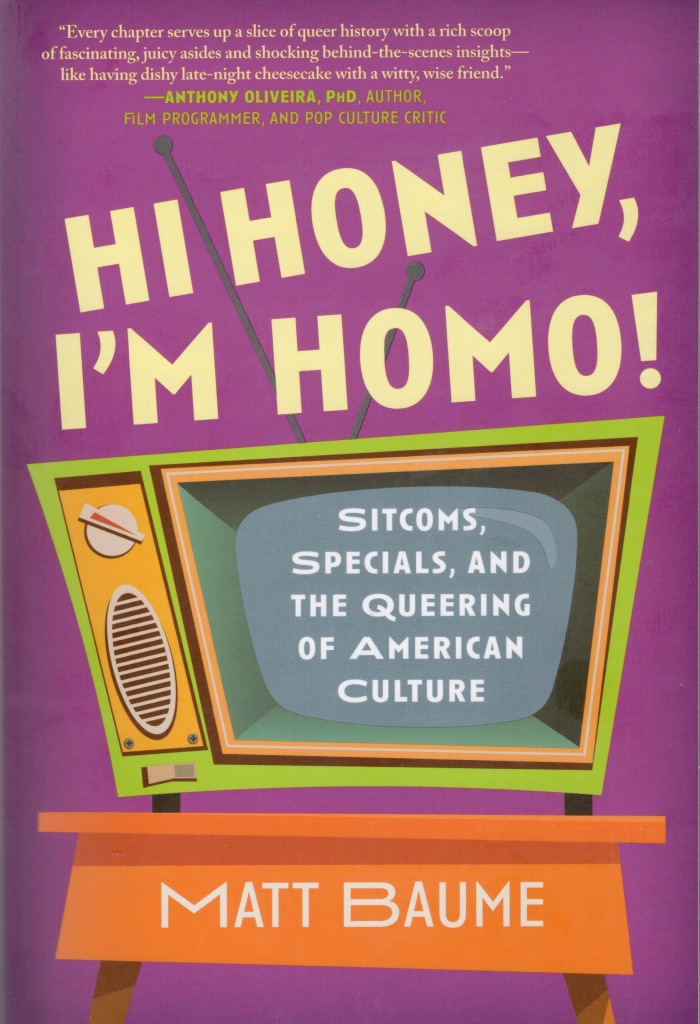
I first found Matt Baume’s Youtube channel during the pandemic, as I was scrambling to find things to watch while i made condom packs and did other make-work at home duties to maintain my paycheck. I may have found him through James Somerton’s channel? But while Somerton is often very dour and doom-and-gloom and “this is how they betray us” (don’t get me wrong, there’s a place for that and it’s needed), Baume is much more cheerful and positive about representation: he presents queer rep in popular culture in the context of the time; what the show/movie creators were trying to do with the rep; why they chose to do the rep in the first place; and the battles and struggles they had to make sure their rep made it to the viewers the way they wanted it to–and how that representation may have helped change hearts and minds when it comes to queer representation in art and culture. So when I found out Baume had written a book about queer representation in network sitcoms–written versions of his Youtube channel most likely–I had to have it.
I’m really glad I read it, too.
The essays contained within are well-written in a light, easy to read and comprehend way, without all the academic language that inevitably drags these kinds of things into the impenetrable territory that gets cited in other academic papers but otherwise never get read. Each chapter, from Bewitched through Modern Family, also contextualizes the queer representation in its time and place within the sociopolitical climate of each show, as well as the queer influences. Bewitched was probably the queerest show to ever air, be a hit and win Emmy Awards before Will and Grace; which makes it all the more memorable is that it was all coding and subtext, with witches standing in for queer people–and the similarities were obvious: they had to hide who they were from mortals for fear of persecution, bigotry, and violence. Sound familiar?
Baume also names and shames all the anti-queer activists of my lifetime, from Anita Bryant to Donald Wildmon (my own personal nemesis) to A Million Moms and so forth; Wildmon himself is probably the worst of them all; much as I loathe Bryant, I think she sincerely believed that queer people were a danger and sinful. I also think Bryant and Phyllis Schlafly were the last true-believer homophobes to lead movements; everything since has been a cynical grift for money and political power. Ronald Reagan and the Republicans saw, in 1980 and with the evangelical turnout in 1976 that carried an actual Christian to the White House (Carter was perhaps the most truly Christian president we’ve ever had; his religious values colored his policy. It’s ironic that Christians hate him as a general rule and always point to him as an example of a failed presidency rather than what his presidency actually proved; a true Christian believer isn’t pragmatic enough to lead a country; because sometimes, as The West Wing noted in an episode title, sometimes you have to kill Yamamoto; things for the greater good that are horrific on a personal level) and noted that “lip-service” to “Christian ideals” was all it took to get “Christians” to vote for you.
And this is a good place to serve as your regular reminder that the “party of family values” elected our only divorced presidents, yet are the same people who tried to remove Bill Clinton from office for lying about a blow job because it was evidence of his poor character and someone with such poor character shouldn’t be president.
I recommend this book, not only because it’s an interesting look at the evolution of queer representation in television comedy series, but because it also is educational by tracing the opposition to queer equality during the same time period.
I also learned by reading the book that Baume was the Communications Director for AFER, an organization that fought for marriage equality. So, buying and reading his book is also an excellent way to say thank you for his advocacy.
Monday and back to the office with me this morning, woo-hoo! Yesterday was kind of nice. It rained overnight and we had a couple of amazing thunderstorms in the morning which cooled everything off (for a quick moment) so I was able to cuddle up under my blankets with a cup of coffee and finished reading Megan Abbott’s amazing Beware the Woman (get a copy now and you can thank me later–I prefer cash), before doing some chores around the house and getting a handle on the kitchen/office mess situation. Yesterday afternoon around one I checked the temperature and it was a mere 78 degrees here. In July, in the afternoon. Madness, am I right? But it gradually started climbing again, as always, but it was a lovely respite from the brutality that has been this summer.
I also read a short story from one of the Alfred Hitchcock Presents, “Lady’s Man” by Ruth Chatterton, which I found interesting as it was nothing more than a little ghost story, set at a country home of none other than Noel Coward! I’m sure this must be the same Ruth Chatterton who’d been a film star in the 20s and 30s; a quick Google search answers the question that yes, the film star also was a writer! How delightful. The tale was told in a conversational style, as though Ms. Chatterton was making interesting conversation at a formal dinner, which made it really fun to read, even though the chills weren’t quite as pronounced as they were in some of the other stories I’ve read in these books. I do love revisiting these old anthologies and stories from another time.
I also spent some time going through my recent journals and marking pages with sticky notes that are applicable to things I am currently working on or thinking about going to work on. I usually brainstorm and think in my journals. It used to be just the act of writing something down was necessary for me to remember it later–which is why I never needed to really consult my notes in the Olden Days–but that is clearly no longer the case. Even writing stuff here in blog posts is no guarantee I will remember it later. It was also interesting because so much of my journal is just me scribbling, free associating names and titles then who the people are who got with both, quotes I like with attribution, and then the most bizarre things that literally make no sense at all; where did this thought come from? Is it original or did I see it somewhere and wrote it down? It’s always fun to see just how schizophrenic my creativity is when I don’t try to harness it. I actually wrote longhand in my journal last night while watching a documentary–I sometimes takes notes in case I want to blog about it later–and wound up writing several pages of a personal essay about my own experience going to Boys’ State in Kansas the summer I turned sixteen. (Yes, I was watching Boys’ State on Apple Plus, which was filmed at the Texas Boys’ State, which was interesting and well done, and a lot like I remembered it being all those years ago in a different state.) That evolved into me writing about always feeling like an outsider, observing from a slight remove, and went on for quite some time, rather indulgently, and I kind of was amused. There I was, feeling like I was creatively stifled and not able to write, yet writing in longhand in a journal, no less. It wasn’t fiction, of course, but it was still a creative expression, a free form exercise in stream of consciousness writing to see where my mind went–and inevitably, as always, I had to take the piss out of myself.
And that led to another page about my difficulties in taking myself seriously, and thus self-sabotaging myself and my career.
It truly is a wonder I have a career, or for that matter, even had one to begin with.
One thing that did come from that free form writing was a reiteration of something I think I may have posted here recently, that I should take just as much pride in my novels as I do in my published short stories. Sounds bizarre, doesn’t it, but my inner editor always wants to find and fix things in the novels, which inevitably leads to me wishing I could have another pass at it, and the reality is I will always feel like I should have taken another pass at a novel manuscript before it went to print. I need to get over that, or to at least keep it to myself and my journals rather than dragging my own work on my blog. I AM proud of my books, every single one of them, and every single one of them was the best book I was capable of writing at the time I wrote it. As I believe I continue to learn and grow as a writer the more I write, I will always think of my past work as something done when I wasn’t as mature a writer and was still learning because I am always learning. And hope to always continue learning and get better, not just as an author but as a person.
The older I get, the more I realize I don’t know, and how much I will never know. It’s kind of humbling, really.
I did decide what the next book I am going to write is going to be, and that’s a good thing. I was pretty sure of what it was going to be, because it’s in my head and needs to come out more than anything else at the moment–but there’s always something else nagging at the back of my mind saying write me write me! It has the potential to be very good, but I still need to figure some things out. I know how it starts and I know how it ends and I know the back story; I just don’t know the middle and how to get from Act One to the start of Act Three; I always struggle with the second act. I started writing it for a friend who was an acquiring editor, it was something I had been wanting to do for a while and he was interested in acquiring it once it was finished, or at least a first draft completed. So, while I was working on two other books at the same time, I was also taking one day every week and writing a three thousand word chapter and emailing it to him. I had completed Chapter Four and needed a transitional chapter that wasn’t boring or expository, so I had to put more thought into it than I had the previous four. This was last fall, when things started to get out of control in my personal life and with everything else, when I started falling behind on everything and my anxiety was out of control and I just didn’t have the headspace or creative energy to spare to figure out that chapter, so I stopped working on it.
But I never stopped thinking about it.
So, now I have to write it. I may continue to send it to him although he is no longer an acquiring editor, but he’s also a friend and I respect his opinion (he is remaining unnamed because I cannot say kind things about him publicly), so maybe I will. He was very encouraging, and sometimes I need a little bit of a push every now and then. I’ve also mentally worked out some of the kinks in those first chapters, too. I think it will be fun to write; I know I was enjoying it when I was working on it before, and it wasn’t like fuck, I don’t want to work on the structure and plot and meaning of this fucking thing, it was yeah, let’s figure this shit out.
That’s a good sign, methinks.
I’ve also decided my next read is going to be Kelly J. Ford’s The Hunt. I love Kelly and I love Kelly’s work, so I can’t wait to see what this is about. She has a truly masterful grasp of the rural South, and that voice! Oh, that authorial voice! She takes me back to my childhood summers in rural Alabama, shows those folks with a clear and unblinking eye, and then writes with language so beautifully and magnificently constructed that it makes me feel seen, home, and alive. I have some more fabulous books coming–what a summer for releases! New books to come from Laura Lippman and Angie Kim and Michael Koryta on top of all the treasures that have already been released this year? I’ve got Eryk Pruitt’s latest and Scott Von Doviak’s latest on their way, with a new Donna Andrews right on their heels. I need to stop slacking and get back to reading on top of everything else! Mon Dieu, how am I ever supposed to keep up?
There simply isn’t enough time in every day, is there?
There were also short stories in my journals–either the idea or the openings or an outline–that I’ve never transferred out or transcribed, which also needs to be done. God, there are so many short stories in progress…it’s daunting just thinking about it.
But it was a good weekend. I got some rest and I accomplished some things. I got better organized, with a short way to go, and am proceeding with plans to get everything back together again and start writing again, clearly and clear-headedly moving forward on something I’m really interested in writing, something I’ve wanted to write for a very long time–and it’s enormously satisfying knowing I am finally going to be working on it for real.
And on that note, I am heading into the spice mines. Have a lovely Monday, Constant Reader, and I may be back later. I tend to turn up like a bad penny here and there, now and again.
Wednesday and we’ve made it halfway through the week, Constant Reader. Didn’t think it was quite possible, did you, when Monday dawned so early and ugly? We expecting thunderstorms today in New Orleans–it feels cooler and damp this morning, but I don’t know when we are supposed to have said storms; probably this afternoon. I slept really well again last night–it’s been lovely getting good sleep lately. I felt a bit tired yesterday when I got home from work, and so took it a little easier on myself when I got home. I managed to get caught up on my emails (such a weird feeling) and did some writing last night. I think I’m still a bit in the post-book malaise phase of things, so writing anything isn’t easy (not that it ever is) but Paul got home late so was left to my own devices once I finished writing for the evening. I did watch some documentaries on Youtube about the Hapsburgs last night (I also discovered an English-language biography about her–Margaret of Austria–which I added to the my list of books to buy…which is almost as out of control as my TBR stack, which is now essentially the entire living room), and I read a short story in Hitchcock’s My Favorites in Suspense anthology; a dark little Charlotte Armstrong story called “The Enemy.” Armstrong was a writer I discovered as a tween, when Mom let me join the Mystery Guild Book Club; I got an omnibus by her (The Witch’s House, Mischief, The Dream Walker) which I greatly enjoyed. I rediscovered Armstrong thanks to the work of both Sarah Weinman and Jeffrey Marks, which enabled me to continue reading in her canon.
Armstrong won an Edgar for Best Novel for A Dram of Poison, a charming if dark little story of suspense; maybe the rare Edgar winner where there’s no dead body but the plot has to do with preventing an accidental death? It’s very clever, and incredibly charming, but beneath that clever charming surface it says something dark and awful about human nature and character–people who are unhappy spreading their misery to others. Armstrong was also made a Grand Master by Mystery Writers of America. Her work may seem a bit dated in the modern day–technology and society have moved on from the times she lived and wrote in–but I think it’s well worth the read. “The Enemy” is that same style of writing as Dram, a serious subject presented charmingly, and the death of a child’s dog the catalyst for an exposé of something darker and nastier…and yes, the plot also hinges on the darkness a human being is capable of creating. It’s a really clever, if slightly dated, story–and you can’t help but smile or laugh at the last line of the story. I am really enjoying these time capsules into the past, to tell you the truth. I bought a few more of these anthologies on eBay yesterday, too. It’s nice to have short story collections around for those times when my brain can’t really focus on reading an entire novel.
I have been listening to Carol Goodman’s The Drowning Tree on Audible, but I may have to break down and finish actually reading a physical copy because I can’t keep listening every day and with my memory a literal thing of the past these days, I’m not sure I remember enough of the story to pick it up again this weekend. I also picked up copies of her new novel, The Bones of the Story, along with Paul Tremblay’s new short story collection, The Beast You Are. I do like Tremblay’s writing–A Head Full of Ghosts was one of the best horror novels of the last decade, and I’ve liked everything else of his that I’ve read–and I think this may even be his second collection. I am also hoping to pull together another collection myself this year–This Town and Other Macabre Stories–but I am not sure if I will have the time. I also got the copy edits for a short story I contributed to an anthology in my inbox last night, so that has to go onto the to-do list, and I still have page proofs to get through. But for the most part, it seems as though I have a guilt-free free weekend, which one can never truly go wrong with, either. I’ll have some errands to run, of course–I always have errands to run–but there’s no stress or pressure on me either, which is kind of nice. I think maybe that’s the reason I’ve been sleeping so well this week? No pressure and my schedule has kind of normalized, gotten back to normal, settled back into the routine my body is used to, perhaps?
Yes, that makes total sense to me.
I also have ideas and thoughts pinging around in my head. I’m itching to get back to the works I have in progress; I want to get a strong first draft of two different novels finished before I leave for Bouchercon next (!!!) month. I actually, finally, made a to-do list yesterday; I am hoping that I can get my life back on track the way it was before the pandemic and the madness of the last few years. That doesn’t mean that my blood pressure won’t continue to go up predicated on the constant assaults on everyone who’s not a cisgender straight man from the demons on the right–which is part of the reason my interest in the Civil War and the 1850’s, that terrible lead-up to the split, has been heightened these last few months. I do see a lot of similarities in the split between conservative v. progressive today, which was predicated along the lines of abolitionist/pro-human trafficking back then. One of the books my father gave me to read was called Southerners in Blue, which was a novelization of the true story (albeit poorly written) of a Union sympathizer and others like him in Winston County, Alabama. (If you’re not familiar with Winston County, the easiest way to explain it is this county did not vote for secession and essentially stated that if Alabama had the right to secede from the Union, the county had the right to secede from Alabama. They did not secede from Alabama, just said they had the right to predicated on the secession arguments being presented, but have gone down in Alabama history and lore as having actually seceded even though they most certainly did not) Basically, in some of the northern counties of Alabama there was basically a second civil war, between the “secesh” and the “Unionist” supporters, and the mountains of north Alabama were filled with deserters from the Confederate Army, This was also novelized into a book called Tories of the Hills by Wesley Sylvester Thompson, which is incredibly rare (my uncle has a copy, which my aunt won’t let be removed from her house–wise, as I would totally steal it). I had read another book also while I was up there, about the Kansas-Missouri border war–which had a decided “secesh” slant to it, of course, while complaining that all previous histories were “unsympathetic to the Missouri slave-owner point of view”. I’m sure he had a point, but simply because there are two sides to every story doesn’t mean each side deserves to be heard, or that each side’s opinion has equal weight. It did spark my interest, though, and I really think there’s a book in this little-known history of north Alabama. Again, it would be difficult to write–lots of potential landmines there–but it’s also, as I said, not very well known and with today’s tribalism mentality–not to mention how loud the Lost Cause fanatics are–it’s hard to wrap one’s mind around the notion that the South wasn’t monolithic in its thinking.
Because no group of people are, really, which is why I don’t like being asked for a gay perspective on anything; I can only speak for myself.
But while I continue to research this aspect of history and try to figure out a way to get a novel out of it, I am going to map out two others. One is already in progress, and the other is a New Orleans ghost story I’ve been wanting to write for quite some time now. The trick is to make it different from every other ghost story I’ve already written. Good luck with that, Mr. Repetitive!
Heavy heaving sigh.
And on that note, I am heading into the spice mines. Have a great Wednesday, Constant Reader, and I will check in with you again later.
Sunday and I slept late this morning and i am not a bit ashamed of it, quite frankly. The opportunities to sleep in are rare these days–getting up early so often for so long has adjusted and shifted my body clock in ways I’m getting used to but don’t like, and chief among those ways is the inability to sleep in. Yesterday I was up before eight, for example, but this morning it wasn’t even nine when I got up, and I could have easily stayed in bed longer. But there’s spice to mine today, and while there is still a lot of it to get done, I am feeling very good about things this morning. I actually felt really good about them yesterday if I am going to be completely honest. I got two chapters done and finished editing a manuscript (not my own) and turned it in to the publisher, which felt marvelous to be finished with that. Deadlines and juggling projects is something I’ve always done, but something I’ve noticed since the pandemic shutdown is deadlines are much more stressful and demanding on me, and take a bigger emotional toll than they used to. Probably part and parcel of the long COVID rewiring of my brain, but whereas before, I relished the pressure and it drove me to work harder, now it shuts me down and/or depresses me, which has the exact opposite reaction it used to have with me: instead of driving me, I think oh I’ll never get this all done so why bother and I end up blowing things off completely. Depression is quite the bitch, you know.
But I am very pleased with the work I got done yesterday and look forward to today’s work. I also did a load of dishes and laundry yesterday, and some cleaning. But after I was finished with work for the day, my brain was too fatigued to read so I watched movies on television, discovered two gems I’ve been wanting to revisit: Cruising and The Last of Sheila. I wanted to watch Cruising because I remember all the controversies about the movie while it was being filmed (yes, even in rural Kansas we heard about the gays being mad about the movie). I eventually watched it in the mid-1990’s. Paul is a huge Al Pacino fan, and when we moved in together he owned almost the entire Pacino filmography on videocassettes, so one night we watched Cruising. I didn’t much care for it when I watched it the first time, but I’ve wanted to watch it again–when I watched I wasn’t yet a published crime writer–because the story itself is interesting to me. A hot young ambitious cop sent undercover into the gay BDSM/leather community to look for a serial killer? The question of identity and sexual confusion that could arise from playing the part, which entailed going out and picking up (or being picked up) by gay men expecting some sex? I mean, you have to admit that’s a great set-up and concept for story. The Oscar winning director William Friedkin (he won for The French Connection but was much better known for directing The Exorcist) failed and ended up with a deeply flawed film. Pacino was also robbed of a far greater performance due to the homophobic cowardice of the either the director or the studio. Rewatching, the film’s flaws are even more apparent, but it’s a shame. It could have been a great film–and it does remain one of the few Hollywood films that actually depicts gay bar culture of the late 1970s the way it was–but I don’t know what went wrong with it, but it’s still a great idea. I also liked seeing New York as dirty and grimy, the way it was during that time period before gentrification came to Manhattan. It’s also fun seeing old movies where people who went on to greater stardom later had bit parts or cameos; Ed O’Neill popped up on screen at one point, as did several others that made me think, hmmmm.
If I had the time or inclination, I would take that basic framework of an idea and turn it into something stronger than the film. There was also a book it was based on, but it’s rare and used copies are insanely expensive. It also reminded me of a gay crime novel I read as a teenager living in Kansas; I may have been in college, I don’t remember, called A Brother’s Touch by Owen Levy. The book was about a brother who comes to New York to look into his estranged brother’s life after he is murdered–they were estranged because the dead brother was openly gay–and begins to question his own sexuality after being enmeshed into the gay community of Manhattan at the time. It was reprinted recently and I got a copy (by recently I mean in the years since Katrina; I have no concept of time and its passage anymore); I should move it closer to the top of the TBR pile. I wish I could still read as voraciously as I used to…something else that has slowed down with getting older.
After watching this I wanted to rewatch a classic old crime film of the old school, The Last of Sheila, which I’ve always loved. Co-written by Stephen Sondheim and Anthony Perkins and directed by Herbert Ross, it’s a whodunit worthy of Christie herself, in which a widowed producer invites some film community members on hard times for a week on his yacht. Everyone invited was at the party a year before where the producer’s wife Sheila wound up being killed by a hit-and-run driver, and the producer, whose known for loving to play games, has come up with a game for his guests to play. Everyone gets a card, and every day they will stop somewhere they will look for clues to the identity of whoever holds the card of the day–the first is a shoplifter, the second is a homosexual–and of course, the game turns dark and ugly when the producer host–played to sadistic asshole perfection by James Coburn, is murdered…and it turns out the game their host was playing had layers none of the guests knew about going in. The cast is a perfect time capsule of early 1970’s stardom: Richard Benjamin, Raquel Welch, Dyan Cannon, James Mason, Joan Hackett, a beautiful young Ian McShane, and of course, Coburn. It has twists and turns and surprises, and is so markedly clever that it’s hard to describe without spoiling anything…and the surprises are what make it such a great and fun film. This was one of our Sunday movie-after-church movies, I think; I do remember seeing it in the theater and being impressed and amazed. One thing I absolutely loved in the rewatch was the books scattered over every set–they are all mystery novels by Agatha Christie, Ngaio Marsh, Ellery Queen, and Erle Stanley Gardner, which should tip the viewer off that you are in for a mystery influenced by the master crime plotters of the time. It’s really a shame the film wasn’t a success, because it would have been amazing if Perkins and Sondheim had collaborated on more scripts like this one. As I was watching, I kept thinking how much I would love to write a puzzle-type mystery like this one; I’ve always feared such a thing was outside of my wheelhouse so I have always been afraid to try. Who knows? Maybe I will.
I feel very rested this morning and I am not dreading diving into the book this morning, which is nice. I don’t think I have the mindspace and bandwidth to work on multiple things all at the same time anymore, if that makes sense. I don’t know if it has to do with the long COVID rewriting of my brain waves or what, but the last few books I’ve written or worked on–going back to Bury Me in Shadows–have been more stressful than fun for me to write. Writing on a deadline is always stressful, and I rarely, if ever, actually make deadlines. But having multiple projects going on at the same time now feels like I am not devoting enough of my time and attention to any of them, let alone all of them, and that makes me feel uncomfortable about the work. Of course, my last three books–and my last anthology–have all gotten a lot of mainstream award attention, which makes it seem weirder. Which, of course, makes me wonder if the stress and the heavy burden pressure of multiple projects going is somehow making me produce somehow better work than before, and do I really want to mess with that at all? It never ceases to amaze me how neurotic I am about being a writer, and how afraid I am that any change or variation means it’s all over for me now.
I do wonder sometimes if other writers have that same secret fear: that the well will eventually run dry or that we’ll forget how to do what we do. People like to call me prolific; I’ve slowly come to the conclusion that I am and that it’s not a bad thing (I always try to figure out if being called something is bad–which goes back to being called a fairy as a child and thinking he was saying ferry and being very confused). John D. MacDonald was prolific; so were Ellery Queen, Agatha Christie, and Erle Stanley Gardner. I think my insecurities came into play when people started calling me prolific; I am so used to being insulted that I assumed it must be an insult as well, like it was something I should be ashamed of or something. I’ve decided to embrace it as a compliment. I am sure there are literary writers who produce one novel every ten years or so who would think it an insult, but I don’t respect them so don’t really care much what they think. And if I am not as prolific as I used to be–which I am not–it’s nothing to be ashamed of; I’ve gotten older, have gone through some things, and I don’t have the energy that I used to have. My imagination still rages out of control at any and all times, of course, but I don’t have the energy to fool myself into thinking every idea I have will turn into a short story, an essay, or a novel. I certainly won’t live long enough to turn all the ideas I already have into longer works of whatever style and kind.
And on that note, I am diving back into the book. I am getting another cup of coffee and putting some bread in the toaster for later, and I may or may not do another Pride month entry later today. Anyway, you have the loveliest Sunday possible, Constant Reader, and I will check in with you again later.
So, one of the things I’ve decided to do for Pride Month is spend the entire month talking on her about, well, being a gay American and how that impacted (and continues to impact) my life every day. I have written numerous essays over the years, many of them with a very limited audience, and I’ve always had an eye to collecting them into a book, or using them to build a memoir of sorts around. But…this one I am sharing with you all this morning was very well received. I was asked to write a letter to my sixteen-year-old self, agreed to do it, and then completely forgot about it. I received a reminder email about it, which I read when checking my phone at the train station in Florence where we were waiting for the train to Venice. Horrified, I sat down in the first class car (we splurged), opened my laptop, and started writing. I reread it several times, made some edits, and then, as we were pulling into the station in Venice, I emailed it in. It went live overnight while we were in Venice, and when I checked in on-line the following day (taking the train back to Florence) I was shocked to see it had gone a bit viral (for me), being shared a lot and getting lots of likes and comments. Anyway, here it is, my letter to a sixteen year old me while on a train in Italy. (Rereading this made me laugh–as I pretended I had written it before the trip, so they wouldn’t know I waited to the last minute. For the record, I always wait till the last minute, and I also didn’t want them to know I’d forgotten about it.)
Dear Greg as a 16 year old:
I am writing to you on your birthday; our birthday, I would suppose. We have just turned 53 (I am going to henceforth refer to our disparate selves in the singular; Teen Greg as you; current self in the first person—the royal-sounding “we” sounds a bit on the pompous side). In two days, I am leaving for Italy. Italy! As a teenager, you are perhaps lying on your bed, either reading a book (if I recall correctly, that summer before your senior year you worked your way through James Michener; Centennial being the last one you read before school started) or daydreaming of being a writer, of being an adult, of getting out of Kansas, of being a success and traveling the world.
I know there are times when you wonder if you will ever leave Kansas, if your dream of being a writer will come true. I know there are times when you despaired of this; but please rest assured that on your 53rd birthday you will have published over thirty novels and fifty short stories. You will be president of the local chapter of Mystery Writers of America as well as serving a term on the national board and chairing several committees. You will have edited almost twenty anthologies, and been nominated for awards more times than you can remember—and will have even won some.
I know you think you are different from everyone else you know at your school, and in some ways you are. Your classmates will fall in love and marry, have children and watch those children grow up and marry and have children of their own. But that difference you are so ashamed of, the one you carefully hide from everyone you know and deny when confronted, is nothing you need feel shame for. I know there are nights when you lie in your bed and wonder if you will ever feel love, will ever be worthy of being loved, or whether your difference will force you to live your life, and walk your path, alone. I know that in 1977 it seems impossible not to be ashamed of who you are, and weight of that secret weighs heavily on your heart. But I can assure you that not only will the day come when you can hold your head high and shout at the top of the lungs I am a gay man, but likewise, you will find a love so pure and beautiful and remarkable that some nights before you go to sleep you will think about how lucky and blessed you are in wonder. There will be times when you are reading a book and you will look up at the man you love as he sits on the couch playing with your cat and you will be so suddenly overwhelmed with love that your eyes will fill with tears.
And several months before you turn 53, you and the man you love will decide to jointly celebrate your birthdays as well as the landmark of your nineteenth anniversary together with an eight day trip to Italy, visiting Pisa, Venice, Florence and Tuscany.
Just as you once dreamed.
As for never getting out of Kansas, you will find your true home on the day you turn 33. You will get out of a cab and step onto the cracked and tilted sidewalks of New Orleans and become overwhelmed with a sense of belonging and home. And two short years later, two weeks before you turn 35, you will move to New Orleans where you will hopefully live out the rest of a life that proved richer and more amazing than you could have ever hoped.
Yet as I write this, I realize that knowing these things lie in your future will affect the decisions and choices you make. Part of who I am now is because of the sorrows and sadness and bad choices you will make in your future. Even one different choice, one different path, will change your timeline and it is possible, even very likely, that I would not be sitting at my desk after packing for this trip to Italy writing this letter to you. I would not change my current reality for anything. I live in the city I love with the man I love doing the work I love living a life I love.
So I am glad I cannot actually let the 16 year old me know what the 53 year old me knows. I prefer to believe that writing this letter will send the positive energy back through time to give you the strength to always persevere, always survive, and always keep moving forward.
And maybe that is where my strength came from; maybe that is how I managed to find the way to hold my head high and keep chasing my dreams.
As lovely as it would be to tell you this, that every one of your dreams will not only come true but better than you dreamed them, I am glad that I cannot.
With all my love,
Greg at 53
Almost ten years ago. Wow, that was a long time ago.
On my Agatha Award nominees panel for Best Children’s/Young Adult at Malice Domestic a few (has it been that long already?) weeks ago, moderator Alan Orloff asked me the following: Greg, your book tackles multiple contemporary societal problems. How do you balance writing about such tough topics with ensuring that your work is compelling and hits the right mystery/suspense notes?
It was a great question, and as usual, I hadn’t read the questions before the panel so I answered off-the-cuff (I don’t know why I do this rather than prepare; I guess it’s either a preference to try to think quickly in the moment or sheer laziness or a combination of the two) and while I do like the answer I provided on the panel, the question lodged in my brain and I’ve been thinking about it ever since, and thought, hey, this could make a good blog entry, so here we are.
On the panel, I said something along the lines of how it’s often very difficult for people to understand situations or experiences they haven’t had themselves; which is why it was important to write about these things–so that the reader can see and feel, even if peripherally, what it’s like to go through something incredibly hard and life-changing, and develop empathy and sympathy by being able to put yourself into that moment and situation and wonder how would I handle something awful like this? As much as we like to shield young people and children from problems and suffering and so forth (or at least pay lip service to it; think of the children is far too often used as a cudgel to bludgeon non-conformists with), the reality of life is bad things happen. Never think bad things can’t happen to you because they happen to everyone without rhyme or reason or provocation. If one person reads this book and it makes them change the way they think about the topics covered in it, or enables them to feel sympathy for someone else in that situation, then the book had the effect intended. I have always tried to include social issues in my work because it’s important to me. I write mysteries and crime fiction because I want to see justice in an unjust world–and that hatred of injustice drove me to write this book.
And it isn’t difficult to balance the mystery/suspense notes with a social issue; if you build the crime around the issue, you’re still writing a crime novel, just one illustrating a social issue.
Basically, I wrote this book because I was angry.
The Steubenville rape case–there was a parallel one in Marysville, Missouri, that didn’t get nearly as much attention as the Steubenville story–made me very angry. And the more I read about both cases, the angrier I got. It shames me to admit that it took these two cases to finally break through my own societal grooming as a male to finally understand what it was like to be female in our society. It shames me to admit because it shouldn’t have taken me so long to get it, to understand. It took me a very long time to finally wrap my head around feminism and feminist issues…mainly because I could never understand the mentality that women were somehow lesser than men. Women aren’t another species, after all, and yes, the mores and expectations of our culture and society do shape boys and girls in different ways, marking the differences with sexist and misogynist tropes and ideas. I never understood why a girl who had sex was a slut, while the boy was a stud. I remember when the story about the Spur Posse in the 1990’s (I collected a lot of articles about them; I had wanted to write a book called When Stallions Die based around that case) broke and how that also kind of changed my world-view a little bit. (I often say that I spent most of my adulthood unlearning everything I was taught before I was an adult.) When I was growing up a husband could rape his wife and not be charged; as her husband he had a right to her body, and even rape itself was rarely reported (women didn’t want to be shamed, understandably, and it was always her shame, not the rapist’s), if ever prosecuted. I remember when I was in college there were rumors about a campus rapist–the girls whispered about it amongst themselves, and of course, they talked to me about it–which I also always wanted to write about.
So, in the wake of Steubenville and Marysville, I decided that it was long past time to write about it.
I had been toying with something I called “the Kansas book” for years. I had created this town and these characters when I was actually in high school, and wrote a rambling, disorganized, really bad handwritten first draft between the ages of 16 and 23. When I finished it I knew nothing would ever come of it because it was beyond repair. However, I have borrowed characters, scenes, and storylines from that original manuscript numerous times over the years since; and I had been trying to write a newer, better version of it. I knew I wanted the story to start with the discovery of the dead body of a star football player at the local high school, but I never really could get any traction with it. I kept thinking, this is trite and tired and been done so many times already.
But after Steubenville, while also having conversations with my women friends, it clicked in my head and I knew how to make the story work: rip it from the headlines! And I knew the body was one of the players who’d been involved in the “she deserved it” rape of a cheerleader over the summer. I knew that I wanted to make it damned clear how misogynist and sexist our legal system is, as well as our culture when it comes to protecting young girls and women. I started remembering things from my own past, things that made me embarrassed and ashamed and angry at myself. I had participated in the culture of toxic masculinity myself. I’d indulged in petty gossip about girls, and slut-shamed. I remembered a story I’d been told about how a cheerleader in another town, when I was in high school, had gotten drunk and pulled a “train” on six football players–a story I still remember, over forty years later.
And I wondered about that. That story made the rounds–and I didn’t even go to the same high school. And everyone shook their heads and clucked their tongues in shame at this girl’s slutty behavior. Can you believe what a slut she is?
I started thinking that maybe, just maybe, they had gotten her drunk? Too drunk to resist, too drunk to know what was happening? And I began to think that was probably a much more likely story than the one I’d been told. No seventeen year old high school girl goes to a party thinking “I’m going to take on the football team tonight!”
I think it was 2015 when I decided to change how I wrote. I was on a treadmill back them, book after book after book, deadline after deadline after deadline. It seemed like my life was nothing more than a long series of deadlines, one after the other and I could never relax because I had another deadline. I was tired of the stress involved in producing and the shame of missing deadlines, which meant missing the next and the dominoes would fall, one after the other. I decided I was going to not sign contracts for anything until I had a completed manuscript, so I wasn’t starting from scratch every time I turned something in and started the next one.
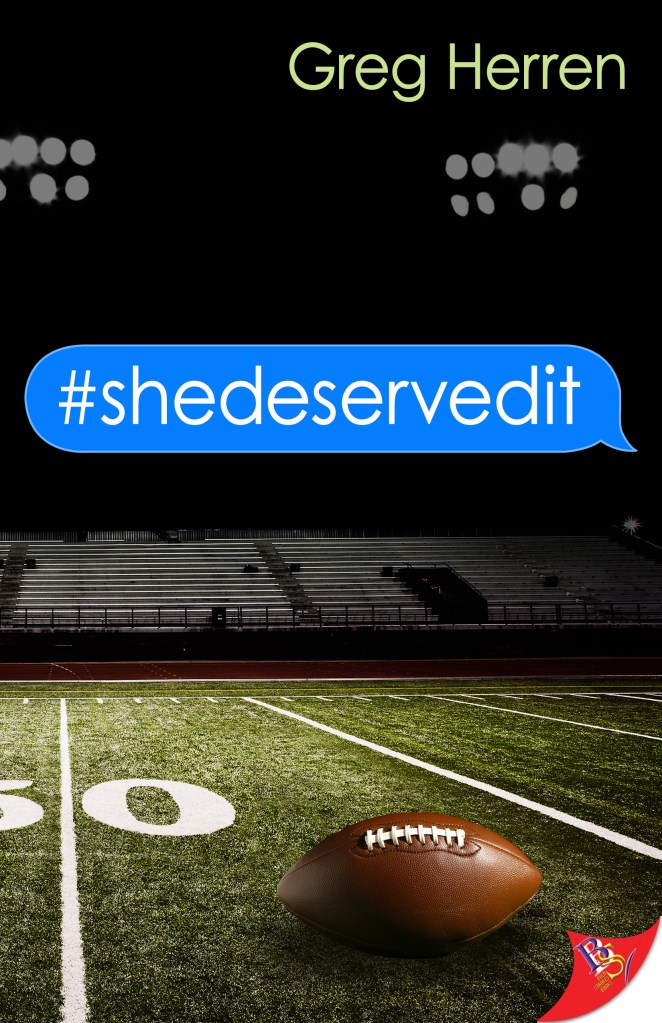
And finally, in July of 2015, I sat down and started writing a book I was no longer calling ‘the Kansas book’ in my head, but rather #shedeservedit.
I wrote over 97,000 words in one month–that’s how angry I was–and there wasn’t even a last chapter because I didn’t know how to finish the book. I sat on it for years, pulling it out every now and then, tinkering with it some more, but never really feeling it was ready–and I still didn’t know how to end it. I finally signed a contract for it because otherwise I probably would have never finished it and just kept futzing with it until I died, and I thought it was an important book to get out there. Sure, I went around and around about it; am I the right person to tell this story? Should someone else be writing it? I started reading other y/a novels about sexual assault, but they always left me feeling unsatisfied; the endings never really worked for me, which was the same problem I was having with this book. But I finally decided the best thing for me to do was sign the contract and give my editor a chance to look it over and give me input…and I am incredibly blessed to have an exceptional one in Ruth Sternglantz. The book is much better than it ever could have been without her insights, her vision, and her sensitivity. I was also very proud of this book when it was released, and I still am. I was both honored and shocked when it made the Agatha shortlist; even more so when it made the Anthony as well.
Alex jogs down the gravel path, his rubber cleats making crunching sounds on the shiny, sparkling white stones. The field, still lit up from the game, looks forlorn and lonely. The sod is chewed up from impacts and cleats and falling bodies. Some debris blows around in the slight warm wind, heavy with coming rain—plastic bags, strands from purple and gold pom-pons on a stick, wrappers from cheeseburgers and hot dogs sold at the concession stands. State championship flags snap and crackle on their poles on either side of the scoreboard. The janitorial team works their way up from bottom to top, picking up trash carelessly left behind by the crowd who’d filled the iron rows of seats.
The scoreboard still reads HOME 48 VISITORS 7.
He’s forgotten his arm pads on the sideline by the bench. He took them off when Coach Musson pulled the starters from the game when the fourth quarter started because the game was already won. He didn’t realize he’d left them behind until Coach Musson’s short post-victory pep talk was over and he went to his locker to take off his pads. His mom always says he’d forget his head if it wasn’t attached. Maybe she’s right. He could just get new ones, sure, but he’s superstitious about these arm-pads. He’d worn them all season last year when they’d won State again.
He knows it’s stupid, but why risk jinxing things?
He’s coming down from the adrenaline rush of the game, beginning to feel tired. His arm pads are right where he’d tossed them, underneath the bench where the big orange coolers of Gatorade sit during the game. The pads are just lying there, graying gold, his name written in purple marker on them.
He’s thirsty but wants to just sit for a minute. Let the locker room clear out a bit before he goes back to shower and change.
The wind is picking up. The summer has been long and hot and dry, but it’s supposed to start raining around midnight. There’s a bruise on his right calf, purple outlined in yellow and orange. He doesn’t remember getting hit there. He never remembers the hits. The games go by so fast. He spends every Friday afternoon with his stomach knotted. The pre-game warm-up seems to last forever. But once the whistle blows and the ball is kicked off the tee, time flies. Later his muscles will ache, the bruises will come up, his joints will start hurting.
He knows he can’t sit for long. India, his girlfriend, is waiting for him. He’s hungry—he can never eat before a game. He wants to grab something to eat before he has to be home. He hates his stupid curfew, but as his dad likes to remind him all the damned time: my house, my rules.
This wasn’t the original opening; originally the book opened with the quarterback missing and Alex, his best friend, goes out looking for him only to find his body floating in the river. But my editor recognized that wasn’t where the story began; we needed to see the night before and not in flashback, to set up everything for the rest of the story. (I am very stubborn and often need someone else to say to me, this isn’t working and this is why for me to give up on trying to make something work when it never will no matter how hard I try.)
I’m very proud of this book. I think for once I actually succeeded in what I was trying to do–and that was, of course, thanks to my editor’s wisdom–and while I most likely won’t win the Anthony (a very strong field), I am so pleased that the book got some recognition.




 Queer and Loathing in America