Tuesday morning and am easing back into the week somehow. I was a bit tired yesterday, and felt a little low energy, like the prelude to an onset of something. By the time I got home from work I truly felt lousy, so relaxed for a while, took some Dayquil, and let my mind wander while watching the news, this week’s John Oliver episode, and decided to peek in on the most recent episode of The White Lotus, to see what everyone was talking about on social media all day yesterday. Okay, got it. We’ll probably watch the entire season once it’s all available; it definitely piqued my interest and I will have forgotten all or most of this by the time we watch anyway–one of the benefits of this truly shitty memory thing I have going on anymore. I did work on the book a bit, and knew what to do, but was just too fatigued to do it. I hate when that happens. But this morning I feel better than I did yesterday morning, so here’s to a productive day. I really hate feeling under the weather. Tired is an entirely different thing I don’t mind so much, but being sick can fuck all the way off.
The world, and country, continue to burn to the ground as the MAGA government by billionaire further establishes and consolidates power to the executive branch. (Thanks again, Sycophant Schumer. Your interview in the New York Times only served to further underscore how out of touch with your constituents and your base you are. You’re as big a disgrace as Roger P. Taney and James Buchanan. You fucking own this, you and the other nine who knifed the base in the back. Oh, and thanks again for shivving Biden last summer, you fucking piece of shit, and handing the White House back to the Right. Remember, we sent the Rosenbergs to the chair. We are where we are because of Democratic cowardice. I will never forget.) It’s hard not to get worried, stressed or be anxious. My job is federally funded, after all, and they are coming for queers and queer books, too. Woo-hoo, nothing like having both of your careers hanging over the precipice, is there? My Social Security and Medicare apparently are also on the line, so after a lifetime of working hard and paying into both systems, I’ll never be able to retire…voluntarily, at any rate.
Thank God I have anxiety medications. Thanks again, Senator Schumer and the Asinine Nine.
Heavy heaving sigh.
I am pleased with how the book is coming along, even if I was too brain-dead last night to do much more work on it. It’s going to be pretty good, I think, nice and spooky and Gothic and creepy. Years ago I read a John D. MacDonald novel called Murder in the Wind, which takes place during a hurricane, when a bunch of motorists take shelter in an abandoned house–all strangers, but one car contained a psychopathic criminal–and that’s kind of the tone I want to merge with the usual Scotty tone to pull the whole story off. I know MacDonald was a sexist writer whose work was very much of its time and some of it hasn’t aged well, but the man could write and tell a story and create some memorable characters, plots and situations; I’m sure a revisit of his canon would also turn up some racism and homophobia, too. I do think, were he to be alive and writing now, he’d be more woke than conservative; almost all of his later Florida novels had to do with environmentalism and how greed and corruption were destroying the state (Condominium, anyone?), and I have often longed for someone to write those kind of Louisiana books…I also think Carl Hiassen style novels about Louisiana would also be kind of awesome. Don’t look at me, I’m not a strong enough plotter to write anything like Haissen, just as I am not familiar enough with the environmental disasters conservative greed and corruption create to write about them…and doing the research would probably make me anxious again. I know I’ve always wanted to write about cancer alley and the poor Black communities poisoned by it, but how do you tell that story when there’s no justice in the end for anyone? Not to mention the disappearing wetlands. Who knows how long Louisiana can still call itself “sportsmen’s paradise” once everything is ruined down here?
Louisiana, and New Orleans, never cease to be sources of inspiration, you know?
And who knows? Stranger things have happened.
And on that note, I am heading into the spice mines. Have a lovely Tuesday, Constant Reader, and I may be back later. One never can be entirely sure.
The bare curve of a male ass–do we think it will trigger Meta’s puritans?
Yesterday was a good day, productive both for day job business and chores and things around the apartment. My PT, as noted yesterday, didn’t seem as difficult as it had the last few times, which was awesome, and like I said, I got shit done yesterday. I started rearranging and reorganizing and making the kitchen more functional (which also required me to throw out a bunch of shit I was just hoarding, really), which is long overdue. I need to work on that some more today before I run errands. I had hoped to not have to leave the house either day of this weekend, but I decided yesterday to postpone the Apple Store trip until Sunday morning–and Paul ordered some things that require me to go by the post office, which means I am going to make a stop at the Fresh Market on the way home from the postal service. We watched this week’s Abbott Elementary, which is terrific, and then we finished True Detective: Night Country (I am guessing that all the men that hated this season? Misogyny, period. How dare a crime show center women? How dare a crime show be run and written by a woman? I enjoyed it, thought it was very well shot, and so they didn’t tie up every loose end? Ryan Murphy never does, either, and studios keep throwing hundreds of millions of dollars at him. And this season engaged me so much I am curious about rewatching season one and watching the other two, as well).
I also listened to the Bad Gays podcast on James Buchanan (shout out to myself for my story “The Dreadful Scott Decision,” which was in The Faking of the President anthology and centered on Buchanan and his “mysterious” sexuality), which I greatly enjoyed.
I feel good this morning. There’s a little bit of fatigue, but it’s not terrible in the least. (It always hits on the second day with full force, so tomorrow will be a challenge.) I want to do some writing to day (actually, need to) and of course I need to keep working on the apartment, and I have some things to assemble that I’ve order. I also want to read more in my book, and possibly watch some classic gay cinema later on today. I don’t know what Paul will be doing today, but I suspect he’ll go to the office and I won’t see him for most of it. I want to watch Christopher and His Kind first, and of course need to finish my rewatch of Saltburn so I can finally finish my entry on it. (Interesting how I’ve recently become obsessed with openly gay writers of the mid-twentieth century, isn’t it?) I’m still enjoying Feud, but it feels like it’s getting repetitive and is being too drawn out; like four episodes might have been sufficient instead of the planned eight.
All right, it’s a bit brief but I really need to get back to work around here this morning, so more coffee, perhaps a bit of breakfast, and a brief one-hour repair to my chair to read for a bit. And on that note, I am heading into the spice mines. Have a lovely day, Constant Reader, and I will probably be back a little later.
One of the most frustrating things about being a queer American is the absence of any kind of history, really. Oh, sure, there’s Stonewall and some other riots/protests in the years leading up to Stonewall; the Mattachine Society and the Daughters of Bilitis. But since historians have done such a marvelous job of erasing us, trying to find our history isn’t the easiest task. You have to look for clues, coding, and signs.
Because, you know, we’ve always been here. We have also always consistently, despite the muzzling of the overarching culture and society’s constant attempts to erase us from the pages of history, managed to sneak traces of our existence and our sensibilities into the art of the times. Ever wonder why so many statues and paintings decorating cathedrals, cemeteries, and palaces in Europe are depictions of well-muscled, physically beautiful men? Because the artists were gay and the only way they could make art celebrating the beauty of the male body was to do so in a religious setting. (The depictions of the martyrdom of St. Sebastian, in particular, are insanely homoerotic; one such painting was used for the cover art of Anne Rice’s Violin, which I think may be her finest novel.)
This entry’s title is also one of those sneaky gay songs passing for straight. Good old Cole Porter, the witty and intelligent composer and songwriter and overall bon vivant. Queer coding is everywhere in old books and movies and television shows and music. (I’m currently reading Matt Baume’s marvelous Hi Honey I’m Homo, which focuses on queer representation on old television series from the 70s and 80s, focusing primarily on comedy shows.)
There have been queer Kings and Queens and Emperors–and two of the greatest military minds of all time were gay Kings: Alexander the Great and Frederick the Great. But our history always gets erased–and homophobic historians will argue till their dying breath that unless there’s definitive proof, those sexualities and identities cannot be named. This is both infuriating and frustrating; take the instance of King James I of England–he of the King James Version of the Bible. He didn’t have female favorites–he had male ones, and he gifted them titles, money, jewels and estates and raised them into high positions of power. But because there’s no diaries where King James admits to taking it up the bum or going down on Robert Carr, there’s no proof. Well, likewise, the only proof the man was straight was because he was married and had children…which was also his duty as King. I know of no women favorites of King James. Likewise, there are no letters or journals written by Frederick the Great where he talks about some soldier having a nice ass or having sex with some hot young ambitious Prussian noble. So, no, there’s no actual proof. There are no photographs, no videos, no nothing. But…while he was married, he had no children; and he would go years without seeing his wife. Women were banned from his court. He also wrote his actually confirmed gay secretary a letter during the course of which he said: “My hemorrhoids affectionately greet your cock.” (The hoops historians will leap through to deny that Frederick the Great was a big ole bottom, and that sentence doesn’t mean what it actually said, are worthy of Ringling Brothers.) There was a lot of gossip, and Frederick’s preference for young men was openly gossiped about at other European courts. And most of his art collection celebrated homoeroticism.
I would love to write a biography of Frederick, seriously.
I also find Louis XIV’s younger brother “Monsieur,” Philippe, duc d’Orléans, fascinating as well–another one who’d be interesting to write about, especially since he is known as the Father of Europe; almost every European monarch from at least 1800 is one of his descendants, despite his sexuality and his predilection for wearing women’s clothes to court.
My story in The Faking of the President addressed this erasure; I chose James Buchanan to write about because he is the only president who never married and he was allegedly in a long-term relationship with Senator Rufus King (Andrew Jackson referred to Buchanan as “Aunt Fancy”). There’s no evidence that Buchanan and King were actually a couple; all of Buchanan’s correspondence was burned, on his instructions, when he died. I wrote my story about a gay historian who firmly believed Buchanan was gay…and after effectively wrecking his academic career, someone contacts him who claims to have the long lost letters to Buchanan from his fiancée when he was a very young man–and the letters will prove his thesis.
Believe me, I get the frustrations he experienced. I don’t think I’d go to the same lengths he did to get that proof, but I empathized.
But this also is an issue in even more recent history. When I was with Mystery Writers of America, at one point I wanted to try to figure out how many queer authors were members…but the impracticality soon became evident. First, you have to start with the question of what precisely counts as queer fiction, and what is a queer book? Is it the sexuality of the author what matters? What if they are openly queer but don’t write queer characters and stories? What about a straight person who writes queer stories and characters? Does that count? Lambda Literary went through hell over this, and there’s literally no way to please everyone. Is it the book, or the author? I’ve always been a firm believer that it’s the book when it comes to awards. Yes, the author gets the award, but it’s for writing the book. So, in my opinion, I would consider Call Me By Your Name a gay novel, despite the author being straight, and my own A Streetcar Named Murder to not be one, despite my being gay. The argument can be made, of course, that being gay gives me a different perspective and point of view that’s more queered than that of straight writers, but I don’t think there’s any “gay sensibility” to Streetcar.
Maybe I’m wrong. I’m not the final word on my books, really.
But this becomes problematic in two regards: one, if someone never officially stated anywhere that they weren’t straight, can it be inferred? Not every man or woman who never married was queer; but marriage itself isn’t proof of heterosexuality because a lot of queer people marry opposite sex spouses and get divorced when they come out later. I was engaged at nineteen; does that serve as proof to future generations that I was straight, despite all of my writings to the contrary? People still don’t feel completely comfortable coming out TODAY, let alone before Stonewall. Take Cornell Woolrich, for example. He never married, lived with his mother for a very long time, and was an alcoholic, pretty much had a miserable, horrible life. He never said he was, but would he have during the time in which he lived? Likewise George Baxt, who wrote a series about an openly gay Black police detective in the 1960’s. Baxt never made any announcements or pronouncements one way or the other; some of his acquaintances have said that he was but Baxt himself never did in any meaningful, definitive way. So, was Baxt or someone else the first gay crime writer? Joseph Hansen was definitely out, and his David Brandstetter series was not only groundbreaking but still remains one of the definitive gay crime series.
Secondly, it also becomes a matter of privacy as well. I know any number of authors who identify as queer but don’t write queer; how do you know how far out of the closet someone actually is in their life? There’s a hugely successful thriller writer who is a gay man, but I won’t say his name here or to anyone else because I don’t know how out he is…and whose business is it, anyway? There’s a hugely successful crime writer that I know for a fact is a lesbian. But if I google her name and lesbian, there are no hits. I generally put myself into their place, really, and ask myself, okay, what if you had somehow managed to start getting published when you were closeted? You wouldn’t have written books or stories about gay men, for one, and for another, I absolutely hated when people speculated about my sexuality–because it never meant anything good formewould come of it.
I’ve never been militant about people’s need to come out, and I also don’t think it’s anyone’s place to out anyone; with the caveat that if you are closeted and actively doing the community harm, you absolutely should be outed. That congressman from Illinois, the über-conservative congressman from Illinois who was outed? Ah yes, Aaron Schock. He deserved it–and while I don’t think he ever repented from his self-loathing brand of conservatism, he certainly has been living the gay high life since it happened. J. Edgar Hoover should have been outed; he was a monster, as was the always disgusting Roy Cohn. But actors and singers? Models? Writers? People who are just navigating their lives and coming to terms with who they are? Everyone should have the time and space to come out when they are ready.
The closet is a horrible place, and it seriously fucks with the people who are living there. I can be empathetic because I know how hard it is, how terrifying it can be. It can twist people (Aaron Schock, for example, clearly felt the need to be über-homophobic just to show he wasn’t one of those people, and yes, that is twisted and sick and sad, and why I am able to feel some empathy–not sympathy–for him as his life must have been hellish, even if it was his choice), and warp them into horrific behavior….but accountability, respect, and atonement are also necessary if the closet turns you into an Aaron Schock. I mean, how much self-loathing had to be there in his mind?
Not everyone has to be a spokesperson. It depends on your level of comfort. And please give people the grace to come out at their own pace and on their own terms. Struggling to accept and love yourself–realizing there’s nothing wrong with you–is a process that isn’t made easier by speculation. I’ve indulged in speculation about actors and singers and other public figures. That kind of speculation usually happens because there are so few queer role models in the public sphere; but I can also understand why people in the public sphere would want their privacy. Being a role model is daunting and full of pressure and potholes and dips and swerves in the road. And it also begs the question–what do we out queers owe to the rest of the community? What is our responsibility? Can we opt out of those things if we aren’t comfortable? I’m certainly not comfortable speaking for the entire community; I always say “in my experience” rather than making my own the community’s.
And we do live in dark times. There is a vast right-wing conspiracy (thank you, Madam Secretary, for that accurate phrase) to wipe queers off the face of the country–and don’t you dare call me an extremist for thinking that. We are being dehumanized and devalued on a daily basis by a bunch of evil people who think they are somehow doing God’s work (that arrogance alone will keep them from Heaven), and if dehumanization isn’t the first step towards eradication, study your Weimar Republic history. This country is at a tipping point–and it wouldn’t take much to tip us over into becoming the 4th Reich, which is terrifying. Oh, Greg, you always look at the worst case scenario!
That may be true, but I’m rarely wrong–and usually the reality is much worse than I imagined.
But I still hold out hope that decent people in this country outnumber the monsters, and that decency will inevitably prevail again. The importance of coming out, because the more of us there are and the more visible we are, cannot be underestimated. This is also where that lack of history bites us in the ass. It’s very easy for haters and bigots to dismiss us as “something new” or “it was better when you were quieter” or the ever-popular “I don’t care just don’t shove it in my face” (which literally has the opposite effect on me–tell me that and I will rub your nose in it) because we’ve been erased from history and a lot of the language around us is new. Language has changed and evolved over the course of my life, as we get more information and learn more, and yes, that means you have to keep up and might actually make a mistake by saying something you didn’t know had become dated or offensive. I am learning all the time, and want to continue to learn because I want to keep growing into the best version of myself that I can be (thank you again, Ted Lasso) and I don’t understand people who don’t want to grow but would rather stagnate and calcify.
Friday and it’s a work-at-home Friday, at that. I have data to enter and forms to check for accuracy–always an exciting day around the Lost Apartment–but also, working at home today is a return to normalcy and routine around here after the big disruption. My grocery order has been rescheduled from today till tomorrow, which is fine; it wasn’t going to be the easiest thing in the world to get them today, frankly. I am going to swing by the office to get more work this morning, and then I am going to swing by Lowe’s/Home Depot or whatever that is just up the road from the office to get the replacement fuse for the dryer–yes, I am going to make an attempt to fix it myself, which seems like madness but if I can spend about fifteen bucks to save us six hundred, I am going to do that very thing. I mean, it makes financial sense, and one of my goals for this year is to make better financial decisions.
It’s also hard to believe and/or imagine that February is almost gone. I mean…usually the month is lost to Carnival, so this year it was lost to something else.
Paul was late getting home last night, so I watched the new Netflix documentary about the Murdaugh murders in South Carolina, and then watched some short documentaries about the presidents on Youtube, starting with James Buchanan and then working my way through John Quincy Adams, Polk and Wilson (i may watch more of them today; I do love my US History, and it’s been a hot minute since I’ve watched anything on US History–but I did yesterday). I also watched a documentary about Fort Proctor on Lake Borgne (which is still there but it is cut off from land by water and is only reachable by boat; you can’t really go inside either because it’s not stable) and I really want to write Fort Proctor into a book at some point, or something, even a short story or two.
There’s just so much about New Orleans that needs and deserves to be written about, you know?
Today I also need to end the wallowing self-indulgence of grief and start digging my way out into the world again. I did finish One Night Gone yesterday and really enjoyed it (more to come on that score), and now can go back to Body and Soul Food. One of the things I want to make certain I am doing from now on is taking a bit of time every day to go ahead and do some reading; if I don’t make a point of it I will never get through this TBR stack, and there are so many wonderful choices in my TBR stack that it’s sometimes hard to pick out my next read. (I’ve also almost finished–at long last–Robert Caro’s exhaustive work on the career of Robert Moses, The Power Broker, which is kind of scary, given it’s great Robert Caro-like length) I need to finish the clean-up/organization of my workspace (which means more filing, but so be it), and I think I’d like to wash the car at some point this weekend as well. I am slowly developing a plan for today’s errands that will make them more time-efficient; the question is, do I want to get Five Guys today? I did have it recently as a treat (I don’t remember when; remember, I have no concept of time and dates anymore), so maybe it’s too soon to have it again or something, but I neither know nor care. We’ll see how I feel when it’s time for me to head over there, once I’ve gotten through the great joy that is this morning.
I slept really well again last night and my toe doesn’t seem to hurt when I walk on it this morning–it’s still sore, make no mistake about that, but it’s a lot better. I still think I need to talk to my doctor (honestly, I don’t know why I have so many issues when it comes to medical assistance that I pay for through my insurance, but it’s a lifelong thing, really) about it, but I’m not sure what good that may or may not do but I suppose it’s better than never having it checked out and just being in pain for the rest of my life. I mean, if it’s something that needs treatment, I should kind of know that, don’t you think?
I also feel decent this morning, rested, at any rate. I’ve been sleeping well every since I returned home, which is a relief and not much of a surprise. It shouldn’t surprise me that there are emotional states that overrule sleeping medications and exhaustion, although I will admit I was worried this inability to sleep would follow me home from Alabama, which it thankfully did not. Now all I need to do is get back to work on the manuscripts and so forth and everything else that is due–my inbox, Jesus Christ the Lord, my inbox–and start working my way through that to-do list (which is by no means comprehensive).
And Outer Banks is back today! Huzzah!
And on that note, I am going to have some more coffee before heading into the spice mines. Have a lovely Friday, Constant Reader, and I’ll check in with you again soon.
So, last night I was sitting in my easy chair waiting for Paul to come home–he was quite late; I spent the entire evening debating whether or not to just watch a movie while I waited; I never did and wasted the majority of the evening, so tonight when I finish working I am going to just pick something on TCM and start watching–I got tagged by Nikki Dolson on Twitter. Nikki was congratulating me (and Thomas Pluck) for being listed as “Other Distinguished Mystery and Suspense of 2020” in the back of Best Mystery and Suspense Stories of 2020, edited by Steph Cha and guest edited by Alafair Burke! I stared at my phone screen in disbelief for quite a few minutes, trying to process the enormous thrill and honor two women I greatly admire and respect, not just as authors but as intellects and people, had bestowed upon one Gregalicious. The book won’t be released until October 12th, but I am still agog and aglow with the thrill and shock of almost being included in it–with a gay story, no less, about hidden gay American history. Yes, the story was “The Dreadful Scott Decision” from The Faking of the President, edited by Peter Carlaftes, and ironically, I was just telling a friend the other day about how gracious Peter was about my story, which was utterly and completely different from everyone else’s in the book; everyone else set their story during the President’s incumbency and also set them in the White House. Mine was about James Buchanan, theoretically, but was set in the present day and had nothing in the White House, nothing in Washington, nothing in general–so while my story stood out like a sore thumb from the others, Peter never said a word, never asked me to change anything, never asked me to do anything different. In fact, he was incredibly supportive and encouraging.
Three Rooms Press has always been delightful to work with–I worked with them for Florida Happens, as well–and the entire experience was marvelous.
It’s been a good week for me, career-wise. Not only did this happen (aren’t you glad I am not boring you to tears with my usual “short stories are so hard” and “I have no confidence in writing short stories because of my evil college professor” the way I usually do when something good happens to me with a short story?), but I signed a book contract for a new series on Monday–more on that later–AND I also found out yesterday that an anthology I’d written a story for (completely forgotten) is finally being released this fall as well….looking at the contract, I am due a rather nice and hefty fee for my story as well. So, yeah, this has been a great week for me and my career thus far; and now I get to wait for publishing (or life) to pull the rug out from under me again.
Yesterday was a good day, if weird. I kept thinking it was Thursday (likewise I keep thinking today is Friday), but I made a list of things I wanted to get done yesterday (the micro list) and the good news is I made it through the micro list–but the bad news is I haven’t made the macro list yet. But it’s fine, really. I picked up the mail, dropped off a book I am returning, and then stopped in the Irish Channel to take pictures and get a sense of the part of the neighborhood where I am setting the new series. It was sooooo hot yesterday–I mean, furnace level, and I kept thinking, I’m supposed to be hanging out with Wendy this afternoon and having dinner with Laura and Alison and Wendy later…as I walked around taking pictures and sweating. I also realized as I was doing this that I had pictured the neighborhood differently; my primary memory of it was when my friends Lisa and Carrie rented half a big Victorian on Constance Street back in 1995 (the same house I am using for “Never Kiss a Stranger”, actually) and I realized my memories don’t match because they lived further down town in the Irish Channel. It’s not a big deal that my memories were off–I am not using the exact houses on the block I’ve chosen anyway; the pleasure of fiction–but it was a bit of a surprise and a bit of a reminder that I need to not completely count on my memories and sometimes need to actually go look at the area I am writing about. After I got home from my research trip, I changed and walked to the gym in the heat–and my God, it was hot. I was drenched in sweat when I got to the gym (they’ve started getting the new equipment in) and put myself through a Leg Day (which I am still feeling this morning, to be honest), then walked home. I was drenched in sweat by the time I got back to the Lost Apartment, and was also drained of energy by the heat and the sunshine–so I chose to not work on the book yesterday and start doing clean-up and organization stuff around the Lost Apartment, and I did get a lot done, actually. Today I am not leaving the house (I was thinking about doing the gym again, but it looks just as miserably hot out there today as it was yesterday and it can wait until tomorrow, quite frankly). I have some other errands I have to run tomorrow as well, so I am just going to make a micro list for tomorrow as well. I don’t have to go back to the office until Tuesday, which is nice, but I want to get even further in the revisions of the book today (ideally, finishing it tomorrow so I can let it sit for a day or two before going over it again). I also spent some more time brainstorming the new series last night, which I think I am going to try to make funnier than I originally intended it to be.
And as low as I had been feeling about my current manuscript, I have to say the love my writing has been shown this week has really made me feel much better about it. Writing and publishing is always highs and lows, peaks and valleys; a rollercoaster of sorts, if you will–and I seem to spend most of my time in the lows and the valleys for some reason–probably a mental issue of my own having to do with fearing and mistrusting happiness and joy, probably–so yes, positive reinforcement is as necessary for me as it is rare. And of course, even as I am aglow with happiness and joy over this latest bit of positive reinforcement, that ugly little voice in my head is there, whispering its poison: you’re excited about ALMOST making the final cut? My, how pathetic IS your little career?
I fucking hate that voice, for the record.
But I am not letting it harsh my buzz this morning. I am going to finish this, drink some more coffee, eat something, and then I am going to get to work. The book isn’t going to fix itself, after all, and the Lost Apartment most definitely isn’t going to spend a single second cleaning itself…and Megan Abbott’s book is calling me.
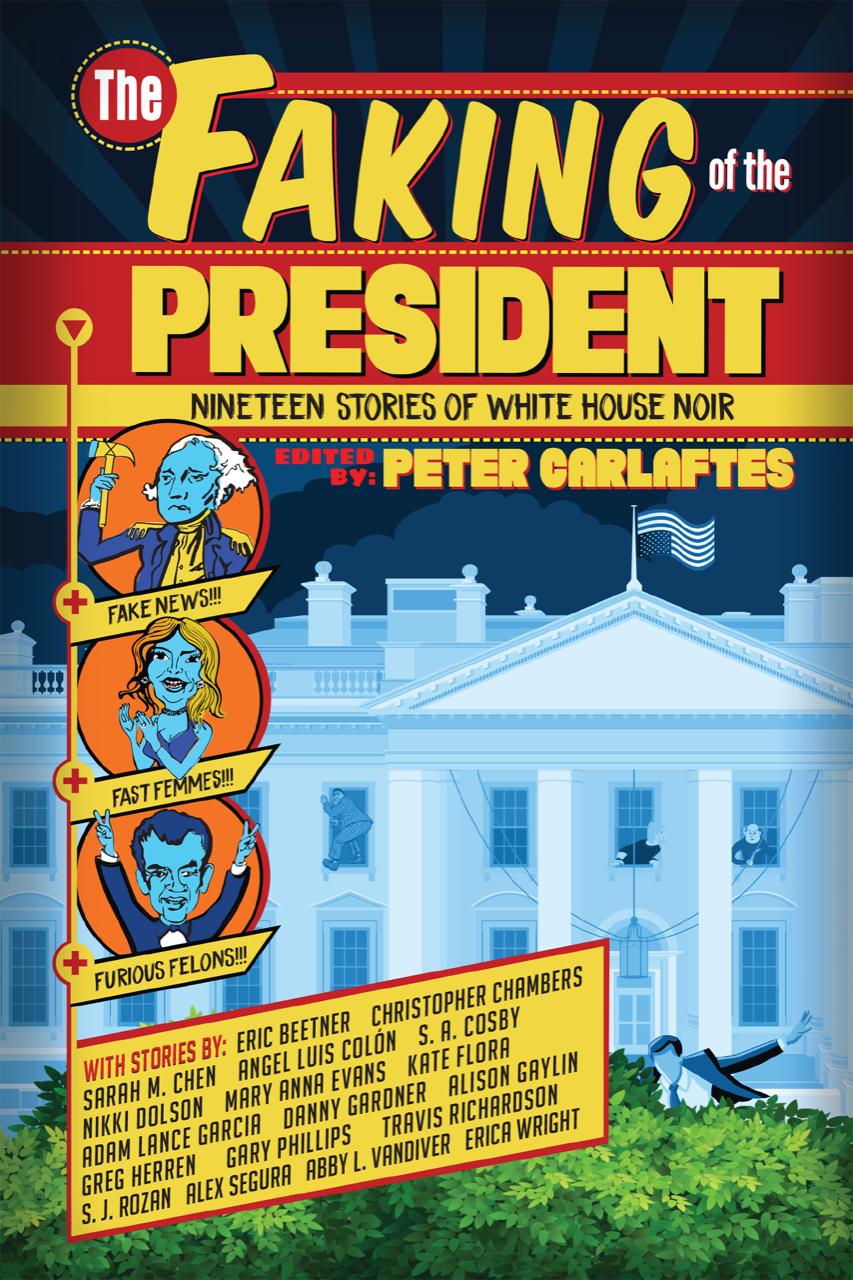
This week a new anthology with a story by one Gregalicious is dropping, The Faking of the President, edited by Peter Carlaftes and from Three Rooms Press. Three Rooms also produced the 2018 St. Petersburg Bouchercon anthology I edited, Florida Happens, and thus it was lovely to be working with Peter, Kat, and the Three Rooms Press gang again. The book has turned out to be absolutely lovely, and I couldn’t have been more pleased to be asked to write a story for this.
The concept behind the book was, of course, to create noir stories built around a president. I was torn at first when asked to choose a president; there were any number of them that I truly like and admire….yet so many mediocrities. The 1850’s, the lead up or prelude to the Civil War, has been of particular interest to me of late, and I decided to chose someone from that period, where we had a string of mediocre presidents take up residence in the White House: Zachary Taylor, Millard Fillmore, Franklin Pierce, and finally James Buchanan. Buchanan is widely considered to be (or was considered to be, YMMV) the worst president in American history; he was the last president before Lincoln’s election and the outbreak of the Civil War. Buchanan did nothing to stop the coming eruption of war; if anything, he exacerbated the ill feeling between the two sections of the country. All the 1850’s presidents were Yankees with Southern sympathies; they were called “dough-faces” at the time (I don’t know why that particular term was used; so don’t ask. Google is your friend), and yes, many parallels between that time and our present day kind of exist, if you care to look to see them. Buchanan also conspired with the worst Chief Justice to ever lead our Supreme Court, Roger B. Taney, in the court decision that flamed the fans of regional hatred into an unforeseen heat that made the war even more inevitable than it already had been; Buchanan and Taney thought they were putting the slavery question to bed once and for all with the Dred Scott v. Sandford decision; by striking down the Missouri Compromise and the Kansas/Nebraska Acts as unconstitutional, the two attempted to make slavery the law of the land and permissible in the vast unsettled (by white people) territories as well as make it legal in the states that prohibited it.
Yeah, that kind of backfired.
Buchanan was also the only president who never married; and while there is certainly no proof or evidence that is conclusive, it is widely suspected that Buchanan was our first gay president. He lived, for example, for a long time with Senator Rufus King of Alabama; Andrew Jackson jeeringly called Buchanan “Aunt Fancy”; and their surviving letters bespoke an affection and longing between the two that went a bit deeper than being just good buddies. So, as a gay writer, I decided to write about Buchanan. But writing a period story set in the DC of the late 1850’s seemed a bit much and certainly more than I could handle; plus I couldn’t really come up with a plot. I thought about having Buchanan murder a slave he’d been forcing to be his lover and the ensuing cover-up; I made several abortive attempts at writing that story before finally abandoning the idea.
I had no idea what I was going to write–until I read an article on-line somewhere about Buchanan’s mysterious sexuality and sexual preferences, and the author said something along the lines of but for some historians, short of finding daguerrotypes of Buchanan naked with another man, nothing will ever serve as conclusive proof for the deniers.
And there it was. I started writing “The Dreadful Scott Decision.”
The cheap whiskey tasted like flavored turpentine, burning so intensely as it went down it felt like it was leaving scorch marks in its wake. Scott Devinney was just high enough from the joint he was smoking to consider that a plus—a sign that he was still alive no matter how numb he felt.
He was sitting in the dark in his cheap apartment near campus, streaming the panel he’d been on at the presidential historians’ conference at UCLA the previous weekend. It had aired live on a PBS network in Los Angeles—it took him a while to figure out how to access it, and now that he was watching it was even worse than he feared. He’d always suspected Pulitzer prize-winning historian Andrew Dickey was a homophobe; his behavior on the panel proved it without question.
Alas, Scott allowed Dickey to get under his skin. He wasn’t proud of that, and his doctoral advisor, Dr. Keysha Wells-Caldwell—also head of the department at UC-San Felice—wasn’t happy, either.
He wasn’t about to apologize to Andrew Dickey, though. He’d die first.
“You have no proof!” Dickey wagged his finger at Scott on the computer screen, his face reddened and his voice raising. “Just like the activists who try to claim Lincoln was gay without proof, there is no proof Buchanan was, either, no matter how bad you want him to be!”
He sighed and closed the window. He didn’t need to watch himself screaming in rage, embarrassing himself and the university in the process.
Which was what Keysha really cared about.
At one time, I seriously considered becoming a historian. I’ve always loved history, have loved to read it and study it, and even write it (I still would love to do a Tuchman-like study of regnant women in the 16th century called The Monstrous Regiment of Women), but as with so many other things, poor professors in college stomped that desire right out of me. (The other problem, of course, being that I could never decide on a period to specialize in–although if forced I probably would have chosen the 16th century) I have heard, over the years, from friends who work in academia as well as reading books and so forth set in the academic world, how cutthroat and nasty the war over tenure can be; office politics as played by the Borgias or the Medici. My story “Lightning Bugs in a Jar” was sort of set in the academia milieu; I even considered writing a series about a college English professor at one time–it’s still there on the backburner; I may write it still. One of the novels I wrote under a pseudonym was set at a quasi-Seven Sisters style college in New England, and of course, my Murder-a-Go-Go’s story “This Town” was about sorority girls, and of course several Todd Gregory novels were set in fraternities.
So, what better idea for this story than a gay Buchanan historian, attempting to prove to the world that Buchanan was, indeed, the first gay president? And how far would he go to get that proof–which is the noir angle I needed for the story? And so the story was born…and you can order a copy here, or from any retailer.
And as you can see from the cover above, there are some fantastic writers who contributed to this book. I am very pleased to be sharing the table of contents with these amazing writers, and a bit humbled. Check it out–you won’t be sorry!
Saturday, and later this afternoon is the SEC championship game (GEAUX TIGERS!). But this morning I am going to focus on cleaning up and straightening things up around here, as well as trying to get some writing done. I’ve been horribly lazy this week; I made some decent progress at the beginning of the week on the Bury Me in Shadows revision–comparatively speaking, I didn’t do that much–and I need to get back on that horse before it escapes the barn and leaves me in the dust.
Last night, we started watching V Wars on Netflix. It’s entertaining, and good enough, but it feels a little…I don’t know, familiar? The premise of the show is that melting ice in the Arctic frees up some biohazard that awakens an inactive gene in human DNA–not everyone has that gene–and turns them into vampires. As the germ (I am calling it a germ; they hadn’t really gotten into what it is yet in the show) spreads, more people become vampires–and these vampires are brutal killing machines, whose victims don’t also become vampires (at least, not so far). It’s okay….entertaining enough but it didn’t grab either one of us, probably because it’s too similar to other shows we’ve watched/seen; The Strain, for one example. Ian Somerholder is gorgeous as ever as the main character–as he gets older he gets better looking; he now looks like he could be Rob Lowe’s brother, and he’s a good enough actor to carry the show. The dialogue was a bit stiff, and some of the situations in the first episode or two seemed a bit over the top, ridiculous, and unbelievable. The problem with plague stories like this is the slow development–the inevitable “only one person who figures out the truth and has to convince everyone else as more people die” trope; who in the cast is going to die, etc. etc. etc. Stephen King brilliantly did this in The Stand; once the plague was spreading he jumped ahead a week or so to the point where most people were dead and the survivors were coming to terms with the end of civilization, trying to figure out what to do next, and then begin having the dreams that drive the rest of the story. The Walking Dead put Rick Grimes into a month-long coma, and when he woke up most of humanity had turned into walkers. Both The Strain and V Wars depend on the “fighting impending doom” narrative to build suspense; but it also makes the story drag a bit. As Paul said, “when do we get to the wars part?” Because the very title makes it abundantly clear that the plague is going to spread and it’s going to come down to a war between those afflicted and those who are not–of course, our noble doctor wants a cure to save the afflicted; the government is more concerned with a vaccine and killing the infected–setting up the inevitable conflict between the forces we’re supposed to be rooting for, even though whether they are on the right side or not remains to be seen. We might come back to it at another time, but it just didn’t grab us. Your mileage might vary. The show is based on a book by Jonathan Maberry, and it apparently became the most-watched show in the world on Netflix the day it dropped–so kudos to all involved. It’s done very well, as I said; it just didn’t grab us. Check it out–you might like it. It’s entirely possible we just weren’t in the right place at the time. And we’ll probably go back to it. Anyway, kudos to Jonathan–who is an incredibly nice and generous man–for having a major Netflix hit.
This morning I have some chores to do around the house before I run to the grocery store to pick up a few things; I really don’t want to go, and am looking for excuses not to. But it won’t kill me to go, and it’s never a bad thing to get out of the house. Today we’re going to have our last “tailgate” of this year’s college football season–barbecuing burgers and dogs for the SEC championship game–and I really need to get this apartment under some sort of control. After I finish this I am going to spend some more time answering my emails and cleaning out that inbox once and for all, and then I am going to work on the manuscript for a little but before I head to the grocery store. I’ve been writing a lengthy entry about this LSU season–I started writing it after the Alabama game, and then realized I should wait until the season is over to post it; that way I can reflect on the entire, magical season; I’ll undoubtedly finish that tomorrow morning and finally post it.
Yesterday I got an ARC of an anthology being released next year that I contributed to: The Faking of the President, edited by Peter Carlaftes and from Three Room Press (who did the Florida Happens anthology and were an absolute dream to work with). It contains my story “The Dreadful Scott Decision”, which, of course, is a play on the Dred Scott Decision, a horrific Supreme Court ruling that made secession and the Civil War just a little bit inevitable; and yes, I wrote about James Buchanan. I’m very pleased with my story, and I am even more pleased to be in this anthology, with co-contributors on the level of Alison Gaylin, Eric Beetner, Sarah M. Chen, Nikki Dolson, S. A. Cosby, S. J. Rozan, Alex Segura, Erica Wright, Angel Luis Colon, Gary Phillips, and several more people whose talents I’ve long admired. You’re going to want to pre-order this one, people.
It’s also the time of the year when everyone is making their best of lists; I am slightly uncomfortable doing that, quite frankly–although I always do qualify my choices by calling such lists The Best Books I Read This Year, which is really what all of those lists boil down to. I read a lot of amazing books this year, and am completely terrified that I’ll miss one in making such a list; but seriously, 2019 was an amazing year in crime fiction–and the women are fucking killing it. Steph Cha, Jamie Mason, Lisa Lutz, Alison Gaylin, Laura Lippman, Kellye Garrett, Rachel Howzell Hall, Angie Kim–I could go on forever.
Which reminds me, I also want to spend some time with Laura Benedict’s The Stranger Inside this weekend.
And on that note, I am going to make another cup of coffee and get going on my day. Hello, spice mines!
I have always been amazed at how uninterested Americans–particularly the ones who worship symbols like the flag, the national anthem, etc.–are in learning, and learning from, our shared history as a country.
This observation is not, by the one, a partisan one, despite my comment about American symbols; the vast majority of Americans, no matter how they fall politically, have little to no interest in our history…and thus, we are doomed to repeat it, over and over again.
Friday, as is my wont, I chose to take comfort in rereading some history; in particular, the Dred Scott v. Sandford Supreme Court decision.
Everyone knows the name, and everyone knows what the ruling was. Historians and jurists both agree it was without question the worst Supreme Court ruling in our history, and it certainly deserves every degree of vilification it has received since it entered our collective history, if not more.
Essentially, the case was about this: Dred Scott was a slave whose owners had taken him into free states, and therefore, by living in a free state, was entitled to his freedom. The case, from beginning to end, went on for nearly twenty years. The Chief Justice of the Supreme Court, Roger B, Taney, threw the case out based on these legal considerations:
Negroes could not be United States citizens, therefore they could not sue in federal courts;
the laws of Illinois could not affect him in Missouri, where he now lived;
his residence in Minnesota Territory north of the Missouri Compromise line could not confer freedom because the Missouri Compromise was unconstitutional.
The Missouri Compromise was legislation reached in attempt to settle the slavery question; Missouri was allowed into the Union as a slave state, but a line was drawn across the continent below Missouri. Anything new state or territory above the line was free; anything below slavery was legal. This ruling essentially said that slavery followed the flag, and any anti-slavery laws in states in the north did not apply to slaves brought into those states or territories.
Taney’s ruling in the first part was actually even worse than quoted above (from Robert Leckie’s The Wars of America, a really good summary of each war the United States has participated in, through Vietnam); his actual ruling said “Negroes and descendants of slaves.” There were more free people of color living in the United States than most people commonly suppose; in New Orleans, they were an entire class of society, with rules and etiquette and customs (an excellent mystery series is Barbara Hambly’s Benjamin January series, set in New Orleans in the 1830’s; Benjamin is a free man of color and went to medical school in Paris, but as a black man he cannot practice in the United States. Anne Rice also wrote a terrific novel about the free people of color, The Feast of All Saints). This ruling invalidated their citizenship–it might have been second-class, but it was still citizenship nonetheless. The newly elected president, James Buchanan, connived with Taney to come up with the ruling, and put pressure on other justices to agree to the ruling, thinking it would end the slavery question once and for all.
Needless to say, it did not settle the slavery question. Instead, it inflamed passions on both sides, with the almost inevitable election of Abraham Lincoln, secession, and civil war.
Taney remained chief justice until he died in 1864, and is known to history as one of our worst Supreme Court justices. The Dred Scott decision lives on in infamy, even if most people don’t really know what the case was about, what it’s background was, and what happened because of it. During the Civil War, both Lincoln and Congress not only ignored Taney but the rest of the Supreme Court as well. Lifetime appointments, you see, and pro-slavery justices appointed to appease the slave-owning southern states–they could not trust the court to be impartial–which they showed they were definitely not in the Dred Scott case–and it took decades for the court to regain its luster and credibility.
Which, of course, they proceeded to destroy again in the 1890’s with the Plessy v. Ferguson decision, which essentially legalized segregation. It wasn’t until Brown v. Topeka Board of Education that the arc of American justice began to bend away from racism, bigotry, and legalized discrimination.
I also had a brief moment of hilarity yesterday when I imagined what social media might have looked like (had it existed) in the 1850’s, with the abolitionists and the proslavery people fighting about the legality of owning people.
Someone had posted, about a year ago, somewhere about something about how we all need to pull together as Americans!!! The country has never been this divided!!!
The excess of unnecessary punctuation should give you an idea of where the poster fell on the political spectrum.
That was, however, one of the few times I broke my rule of “do not engage on social media” and replied, The hundreds of thousands killed in the Civil War would beg to differ with that statement.
There has always been a divide in this country; rural v. urban, rich v. poor, conservative v. progressive. Our country has never quite lived up to the lofty ideals it was founded upon; slavery was written into the Constitution, the Supreme Court ruled it legal and then later legalized segregation. Religious, gender, racial and sexuality-based bigotry continue to this day.
That divide will always be there, and sometimes it’s more rancorous than others. We are living in a particularly rancorous time; but if you look back through American history, as I tend to do, you will see that rancor and hatred between opposing opinions has always existed.
Everyone knows that George Washington, for example, had wooden teeth. But in the eighteenth century dentistry was not what it is today and dental hygiene and health was almost primitive. It was very rare for anyone past the age of forty in that time to actually keep their teeth. They all wore false teeth. Washington’s just fit him poorly, and newspapers that resisted his presidency mocked him for his bad dentures. So, George Washington’s teeth have entered American lore and everyone knows that about the first president.
As a nation, we really need to know and understand our history better.




 Queer and Loathing in America