Puppy Love

Thank God, my sister was never into Donny Osmond or his brothers. But he was everywhere on Top Forty radio in the 1970s, and later he teamed up with Marie–which was actually worse than his solo/with his brother efforts, but for some reason they were enormously popular1, which I never understood. But then I’ve never understood a lot of things that were popular in our culture.2

And “puppy love” is kind of a creepy saying, anyway.

My first infusion is now scheduled, for this coming Monday morning. I am winding down the prednisone; half a pill this week and next, then a quarter pill for the next two, and the massive swelling of my ankles and feet (side effect of the prednisone) has gone down significantly, which is why it is easier for me to walk now than it was before. There was a slight hang-up, of course, with my insurance (I know, gasp) but it got straightened out and the treatments are now approved. For the record, I will never take the word of an insurance company trying to make money for its shareholders about what is or isn’t “medically necessary,” thank you very much. How much of everyone’s time did this waste? How on earth is this considered an effective use of staff time? Our system is so broken. I am getting good care, and I am very grateful for that, but at the same time I shouldn’t have to spend so much time stressing about what is going to be covered and what is not when I am trying to get well. It seems counterproductive to the healing process, but I am not an insurance company employee, so what do I know?

I worked a bit on the story yesterday–broke through the middle and realized what I am writing will need to be restructured in the next draft, but I do like where it’s going–and was also kind of tired by mid-afternoon. I think it was the relaxation from the insurance approval; I hadn’t realized how much that was bothering me under the surface. It also rained all afternoon–marvelous downpours with thunder and lightning, which kind of made me sleepy. I think we’re going to have a very tropical summer this year in New Orleans, where it’s so humid it rains every afternoon. I didn’t read anything when I got home–the traffic on the highways was dense and moving very slow–but just kind of relaxed for a moment before working on the story very briefly. I’m glad I figured it out, though–I was getting a little worried, as I always do when writing doesn’t come as easily as it used to. The story is over two thousand words now, which pleases me; it’s been a hot minute since I wrote that much on anything, so that’s a win, thank you very much.

But it’s Thursday and my last day in the office for the week. The schedule is very light in the clinic today, so I’ll be able to get a lot of Admin work taken care of, which will have me all caught up on the office work before Remote Friday, which will again be admin work, just at home (I save stuff that I can do at home for Remote Fridays), and then it’s the weekend. I should do chores tonight, so I don’t have to do them this weekend, but the house does need to have some picking up and cleaning done. I want to finish writing this story and work on some other writing this weekend, all the while getting the reading done. I should be able to finish my three current reads this weekend before moving on to the next three; I think probably Mia Manansala’s new y/a, along with a Jay Bennett 3reread of one of his y/a’s, and my adult reread will probably be another Barbara Michaels, perhaps The Crying Child, which I’ve not reread in forever.

Those are some really good choices, don’t you think?

I also have some library books for research that I need to get through and make notes so I can return them. One is for Chlorine, and the other is for my deconstruction of Gone with the Wind and Lost Cause mythology–primarily focusing on how the Confederate widows and their daughters drove that mythology (because they couldn’t accept the fact their husbands, fathers and sons were treasonous losers, so they deified them, to the detriment of the country to the present day).

And of course, LSU plays this weekend in the College World Series, so I’ll definitely have that on, too.

And on that note, I am heading into the spice mines. Have a great day, Constant Reader, and I’ll be back tomorrow morning.

  1. I did like his comeback hits in the early 1990’s–“Sacred Emotion” and “Soldier of Love”, though. Go figure. ↩︎
  2. Don’t even get me started on Jonathan Livingston Seagull, which was the Number One bestseller for two full years in the early 1970s. ↩︎
  3. Bennett is mostly forgotten today, but he wrote y/a noir/suspense, won two Edgars from three nominations, and was a master. I’ll probably do a newsletter about him someday, once I get through his entire canon. ↩︎
The Tracks of My Tears

Well, we made it to Thursday, didn’t we? Yesterday was a good day. I slept really well the night before, didn’t have to get up early (and Sparky let me sleep an extra hour; he’s started getting into bed and cuddling up to me every morning around four which is nice), and had a nice doctor visit. I lost more weight–honestly!–and am now under 180, which has been since at least the late nineties that I weighed so little. I did stop at Raising Cane’s to get lunch on my way into the office, and it was very good and very filling. It was a slow day at the office, too, so I was able to get a lot of my Admin work caught up as well. I didn’t feel exhausted, either, which was super nice…and of course I work from home tomorrow and Monday is a holiday, so huzzah! I do want to slowly and carefully work on the house some more over the weekend, and keep building up my own strength.

I really hate being feeble, but my body has been through a major trauma and I’m older, so I need to get over my impatience and take it easy–which is hard for me, because I always see it as being lazy (thanks Mom and Dad!) rather than being something necessary. Maybe if I can get on a roll with my reading and start doing some more writing.

I started writing my essay about Gone with the Wind and how it basically is the Bible of Lost Cause Mythology, which also reminded me of an earlier, equally foul (if not more so) book that was also made into a successful film: Thomas Dixon’s The Clansman, which was filmed as Birth of a Nation and preceded Gone with the Wind by a few decades, priming the pump, as it were. (I downloaded those books from Project Gutenberg, but can’t bring myself to read them.) I’ve really come to hate the Lost Cause myth over the years, but have to admit it’s not surprising that it was allowed to develop and become a horrible part of our history (and present) because stubborn Southerners refused to believe they were, or ever could have possibly been, wrong about anythin1g. (Yet they call themselves “the real Americans” now.)2

I slept well again last night, which is great; maybe uninterrupted sleep is going to be a thing for me again and praise Jesus and pass the ammunition, you know? Yesterday was actually a pretty good day, overall. I got a lot of work done at the office, always a plus to be ahead on my work, and we watched two more episodes of The Last of Us after I made dinner. I fell asleep in my chair instead of cleaning the kitchen the way I’d intended to, but I can do that when I get home tonight. Tomorrow is a work-at-home day for me, and of course that glorious three day weekend of rest, relaxation, and reading right behind it. Huzzah! I feel like I’m getting some of my strength back–a little, not a lot–and the process is going to be slow (I need to be more patient) and steady and hopefully by the end of the summer I’ll be back to some semblance of normality and weight.

And on that brief note, I will bring this to a close and head into the spice mines. Have a lovely Thor’s Day, Constant Reader, and I will be back at some point soon.

  1. William Bradford Huie–a problematic journalist who committed some serious crimes by “protecting sources” in the Emmett Till case–wrote a book about the civil rights movement in north Alabama in the late 1960s called The Klansman, which showed three different perspectives–and the one from the bigoted police chief who does not believe he is a bigot is probably the best depiction of the Southern bigot mentality I’ve ever read; but the book is horrifically brutal and difficult to read. ↩︎
  2. There are some excellent novels that show the horrors of what the Jim Crow South was like: The Reformatory by Tananarive Due; Time’s Undoing by Cheryl Head, and anything by Wanda M. Morris–all writers you should be reading. And yes, they’re fiction, but so is the Lost Cause myth. ↩︎

The All American Boy

I was a bit productive last night after work. I got off later than usual–after five–and we’d been busy all day as well, which was lovely. We’ve not seen that many people in a day in quite some time, and I’d forgotten what that felt like. I chose to take the highway home again after work, and it wasn’t terrible, to be honest. Yes, the ramp to 90/Westbank was backed up as always, and so was the twin spans over the river, but it was better than driving through the city and dealing with all the idiots and stupidity–which I was definitely not in the mood for. I came home, hung out with Sparky for a while, and then started working. I finished a load of laundry and started another. I emptied the dishwasher and refilled it. I cleaned off my desk and filed stuff (I really need to get the overall organization in this corner revamped, revised, and made more efficient and less clutter-prone). I have a meeting this morning on-line, after which I will do my work-at-home duties and do some writing. I was going to run some errands later, but I think they can keep until tomorrow, as I’d rather be around here all day and get things done. It’s a good plan, at any rate. We’ll see how well I obey those dictates.

I also slept well before Sparky decided it was time for me to get up and feed him. I went back to bed, and then of course that started his passive/aggressive ways of getting me up. I do like having a cat alarm–I’d missed that in our cat-free months last year. Sparky still has a lot of extra energy, but I like that about him, and I like that he has his own way of being affectionate. Such a completely different kind of cat personality than Scooter, but all cats are different and getting to know them is part of the joy of having one.

Mmmm, my coffee is quite marvelous tasting this morning.

I was checking my blog drafts page and was stunned to see how many drafts of entries I’ve started and not completed; several books, movies, and topics I wanted to write about, and of course, I need to either finish them or abandon and delete them. Some were kind of similar and started months (years) apart, so I need to get that figured out, and I really should finish writing about the things I started writing about. It was also startling to see that now my blog has become like everything else I write about–drafts and ideas and notes that aren’t completed. Heavy heaving sigh. In the olden days of live journal, I never did this; I always finished every entry I started (probably because I didn’t know whether you could save unfinished drafts there; I discovered the feature when I moved it over here). As a completionist, you can imagine how much this gets under my skin. I’m trying not to let it bother me, but it’s not working so far.

Sigh.

It’s been a weird week, really. I lost my respect for some people–looking at you, Dwayne Johnson, but I always preferred John Cena anyway, and turns out he’s an actual ally–and my concerns and worries about the decline in freedom for everyone (except straight white cisgender men) and the establishment of the 4th Reich in this country, depending on how the election turns out this fall. All of us who tried to warn you back in 2016 (and earlier, in my case) were 100% right about everything, so by all means don’t listen to us again now. I don’t understand the nihilistic mentality of voting third party to “teach us a lesson about progressive purity”–but it’s usually people too young to understand (and they don’t want to understand) how everything works. The irony that they think the Constitution and the system will protect them from a right-wing autocracy is so misinformed to the point of willful ignorance shows me, at any rate, why they shouldn’t be taken seriously or listened to. Back in 2016 I worked with two young cisgender white girls who couldn’t bring themselves to vote for Hillary because “she didn’t leave her husband for cheating on her” and “she’s corrupt and gross.” How does your loss of reproductive freedom feel, you willfully ignorant bitches? Thank God you proved your feminist and progressive purity! I, for one, will never forgive anyone who refused to see the danger we were facing in 2016, and I especially will never forgive people who mocked me for my concerns. Hope you need an abortion this year, bitches.

There’s been a lot of talk over the last decade or so about the art v. the artist; the first time I think I heard about this was the issue of H. P. Lovecraft’s deeply rooted racism in the speculative fiction community. I’ve not read much Lovecraft, if any, and that was something I felt I was missing in my education in speculative fiction, and probably why I never really have thought of myself as a specfic writer–I’d never read Lovecraft, and hadn’t reread or revisited Poe since high school. I still intend to at some point–thank you, Project Gutenberg, so I didn’t have to pay for them–but that will certainly effect my opinions whenever I can bring myself to read some of the stories. I used to read things all the time when I was growing up and throughout my adult life that don’t hold up now on rereads that went right past me on the first read because that was how things were in society and the culture at the time. I loved Gone with the Wind, both book and film, for decades before I began to realize how incredibly problematic both were. I keep meaning to go back and read it again now, but I don’t know that I can handle the idyllic portrait it paints of the old South, the war, and Reconstruction. (By the way, you know those white lady Trumpers? They are in this book as the ladies of Atlanta, and saintly Melanie was the worst of them…although a retelling as a Real Housewives of Reconstruction would be interesting. I know a Black writer retold the story from the perspective of a biracial half-sister of Scarlett’s, which I’ve always wanted to read.) Even Margaret Mitchell herself has some issues with the movie’s depiction of Tara because, in her words, it was a “working farm.”

The reason I am bringing this up is because the Chatelaine of Castle TERF showed her flat ass again this week. I did read the Harry Potter series and I did see all the movies, and I did enjoy them, even if I never had any desire to revisit them. The longer the series went on, the worse the books got, in my opinion, longer and more convoluted the stories got and she often never wrapped up anything; there were a lot of subplot false starts that looked promising that she abandoned. There was veiled anti-Semitism and fatphobia in the books that I marked as I read them as well as in the movies–straight from her hard drive. There were no queer people in her books until she retconned Dumbledore long after the fact–something all queer people should have been so fucking grateful for that we (in her mind) should have fallen on our knees in front of her and kissed the hems of her skirts for all eternity. She is the perfect example of how money corrupts weak minds. This week her TERFdom showed itself in announcing she would never accept apologies from Emma Watson and Daniel Radcliffe for daring not to agree with her hateful stance against transpeople, that she veils in worries about bathroom/changing room rapes…which basically comes from her assumption that all men want to do is rape women, to the point they’ll pretend they have gender dysmorphia merely to gain access to women only spaces for ease of rape/sexual assault. That’s kind of anti-male misogyny on top of the transphobia. All men are rapists, transwomen are actually men, and therefore all transwomen are rapists…and her wealth, like Elon Musk’s, have convinced her somehow that she is special and therefore her opinions have more value and weight than anyone else’s. Seriously TERF Queen, I am so sorry you had the entire world at your feet and your dark and twisted soul made you Housemaster of Slytherin and Voldermort’s mistress. I take a lot of pleasure in knowing how miserable your money and success have made you…and that you’ve decided the message of your Harry Potter series–everyone is equal, no one is better than anyone else and love is the key–was as phony as she is.

So, yes, it’s hard for me to enjoy art when I know the artist is a horrible person. And I don’t have to consume or pay for their art, just as I wouldn’t expect people who don’t like my values and beliefs to buy and consume mine.

Whew! I think I better get going on my day–this turned out longer than intended! Have a great Friday, Constant Reader, and I may be back later. Stranger things have happened on a Friday!

Johnny Be Good

I love Stephen King, and have since I first read Carrie when I was thirteen.

I will also go out on a limb and say that while he has written some amazing fiction and novels in the last forty years, the run of novels between (and including) Carrie and Misery in the 1970s and 1980’s was probably one of the greatest runs of incomparable work ever accomplished by any writer in any sub-genre or genre of fiction, period. There wasn’t a single stinker in that run, and even the one I personally dislike ( Pet Sematary) isn’t bad–it’s actually a testament to King’s skill that I’ve refused to reread it since that first time; it made me incredibly uncomfortable in so many ways viscerally that I’ve really never wanted to read it again.

And isn’t that the real point behind horror?

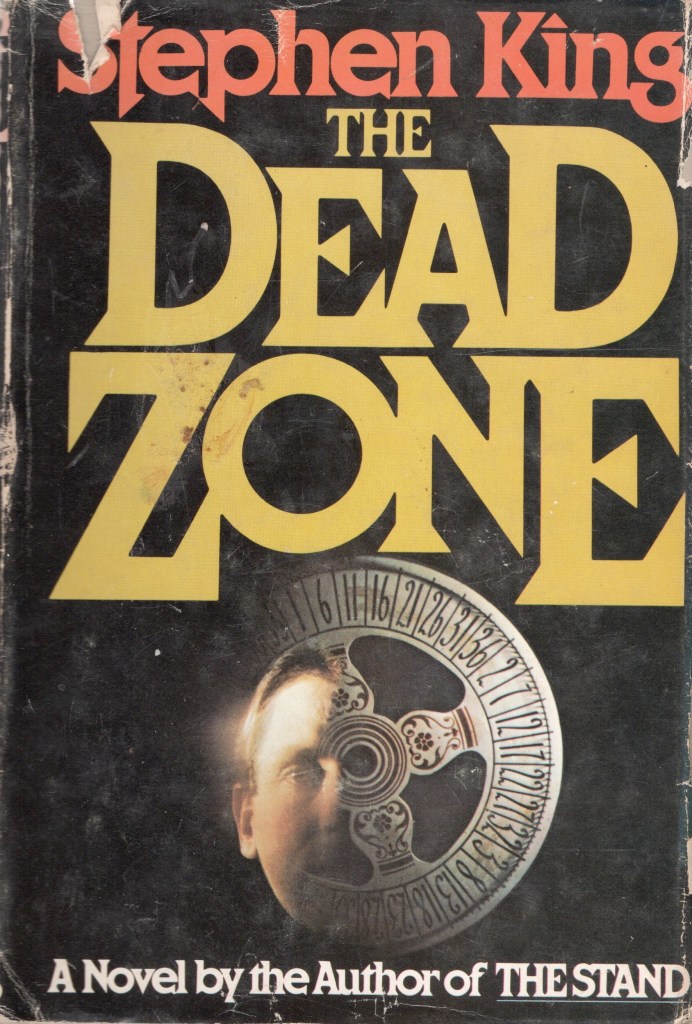
I also saw something recently about how people who suffer from anxiety often rewatch movies/television shows and reread books when they are anxious because there’s comfort in knowing how something ends. It had never occurred to me that this was a thing, but I used to reread books all the time when I was younger, often picking one up and just opening it at random and diving into the story again. I reread most of the earlier Stephen King novels countless times, as I have also reread books like Gone with the Wind and kids’ series books and other particular favorites. I still reread some periodically, like Rebecca and The Haunting of Hill House. When I picked up The Dead Zone to reread it–I realized that I don’t really reread the way I used to when I was younger. On the rare occasions when I thought about it, I figured it was because I don’t have the time and there are so many unread books around the house that I shouldn’t revisit something when I have unread books collecting dust and moldering on the shelves. But reading that about people with anxiety made me recognize myself and I also realized that I don’t reread as much as I used to (or rewatch) because I don’t have as much anxiety as I did when I was younger. (Don’t get me wrong, I still have too much of it for me to be comfortable going forward without doing something for it, you know.)

I’d thought about rereading The Dead Zone in the wake of the 2016 election; I had posted on social media early on during that campaign season, “Is anyone else reminded of Greg Stillson?” But I couldn’t, just as I couldn’t go back and revisit Sinclair Lewis’ It Can’t Happen Here or The Handmaid’s Tale or any of the other great collapse of American democracy novels. But this reread…made me truly appreciate all over again what a literary genius Stephen King actually is–and an American treasure.

By the time he graduated from college, John Smith had forgotten all about the bad fall he took on the ice that January day in 1953. In fact, he would have been hard put to remember it by the time he graduated from grammar school. And his mother and father never knew about it at all.

They were skating on a cleared patch of Runaround Pond in Durham. The bigger boys were playing hockey with old taped sticks and using a couple of potato baskets for goals/ The little kids were just farting around the way little kids had done since time immemorial–their ankles bowing comically in and out, their breath puffing in the frosty twenty degree air. At one corner of the cleared ice two rubber tires burned sootily, and a few parents sat nearby, watching their children. The age of the snowmobile ws still distant and winter fun still consisted of exercising your body rather than a gasoline engine.

Johnny had walked down from his house, just over the Pownal line, with his skates hung over his shoulder. AT six, he was a pretty fair skater. Not good enough to join in the big kids’ hockey games yet, but able to skate rings around most of the other first-graders, who were always pinwheeling their arms for balance or sprawling on their butts.

Now he skated slowly aruond the outer edge of the clear patch, wishing he could go backward like Timmy Benedix, listening to the ice thud and crackle mysteriously under the snow cover farther out, also listening to the shouts of the hockey players, the rumble of a pulp truck crossing the bridges on its way to U. S. Gypsum in Lisbon Falls, the murmur of conversation from the adults. He was very glad to be alive on this fair, winter day. Nothing was wrong with him, nothing troubled his mind, he wanted nothing…except to be able to skate backward, like Timmy Benedix.

So begins the prologue to The Dead Zone, a King classic that doesn’t get nearly the respect it probably should–especially in wake of the 2016 election. Johnny does, in fact, learn how to skate backwards, but is so excited about it he doesn’t notice he is heading right into the hockey game, where he gets hit broadside by a teenager and sent sprawling, hitting his head on the ice and knocking himself out. As he slowly comes back to consciousness, he starts muttering things that make no sense to the worried kids and adults gathered around him, including saying to “stop charging it’ll blow up”. But then he wakes up, is fine, goes home and doesn’t even tell his parents what happened (imagine a child knocking himself out and the parents not even being told today–never happen). A few days later one of the men’s car battery is dead, he jumps it–and it blows up in his face; only no one remembers the things Johnny was muttering; everyone’s forgotten about it.

The second part of the prologue introduces us to the other main character of the book, or the person who is fated to have the biggest impact on John’s existence, which also begs the question of fate and destiny; these two men’s lives are going to intersect, and the rest of the book follows their lives–primarily focused on Johnny’s, with the occasional swing over to see what’s going on with Greg Stillson and his climb to power and success. That prologue introduction to the traveling Bible salesman in Oklahoma who kicks a dog to death lets us know who he is right from the very start–he’s the bad guy, the reason all these things are happening to Johnny so their lives will cross.

Johnny’s story has three acts: first, the car accident that leaves him in a coma for five years (and introduces us to him, his love interest Sarah, and his parents) and inevitably ends with him catching the Castle Rock Strangler, using the abilities that he woke up from the coma with; the second, which concludes with the vision about the graduation party ending in fire and mass death; and the third, where he realizes he is the only person who can stop Stillson’s political rise, the country’s descent into fascism and a final cataclysmic nuclear war (which was an every day reality for us all back when this book was written, by the way).

The most interesting character to me, always, from the story of The Trojan War (I loved mythology and ancient history as a child) was Cassandra, the princess who was given the gift of prophecy accidentally (her ears were licked by one of Apollo’s temple snakes; he cursed her by having no one believe her and this frustration drove her mad); I always wanted to write from her perspective. John Smith is a modern-day Cassandra, a young man who unwillingly was given the gift to see the future as well as have psychic visions, and his story plays out very similarly to Cassandra’s, and asks the big question: if you had the knowledge and foresight to stop Hitler in 1932, even if it meant killing him, would you do it? The personal good vs. the collective good?

I thoroughly enjoyed this reread, and it definitely holds up, even if it is a time capsule of the 1970s, which also made it a big more fun.

(Oh, and that fall he took as a child? While it is never really explained where his abilities come from, King implies that that first head injury awakened the talent in him; the later head injury and coma woke it up again and gave it more power.)

Tishbite

And suddenly it’s Sunday, and I go back to the office tomorrow. Paul leaves on Wednesday for ten days, so Wednesday night is going to feel really weird and off when I get home from work. No cat, no Paul, and that has the potential to be incredibly sad and lonely, if I allow it to go that way. I don’t think I’ll be able to manage just goofing off when I get home from work while he’s gone; not to mention the time we usually spend together every night. I will most likely finish watching My Adventures with Superman while he’s gone, and I’ll probably watch Heels on Starz, with Stephen Amell; obviously, it’s a drama series built around a local wrestling promotion–and since my current WIP does the same (it’s not about the promotion, but the promotion plays a part in the book), it couldn’t hurt to watch, right? I just have to be careful not to steal, er “borrow”, anything from the show. (I doubt I will; the promotion is really back story more than anything else.)

But yeah, next weekend is going to be weird as shit around here. I’ll have to get used to sleeping alone–always an issue for me; changes to sleeping situations never are particularly easy for me to adapt to, ever–and without Scooter to cuddle up next to me in the bed, it’ll be particularly lonely. Ah, well.

I started reading Kelly J. Ford’s The Hunt yesterday, and I have to say wow. From the very first page she pulls you into the story, and the authorial voice! Magnificent. I still haven’t read Real Bad Things, her previous novel, yet; I don’t want to not have another book by her to read (my usual author-fan neurosis kicking into gear) but I am also thinking I may read it on the plane to Bouchercon, depending on how far along I am with my TBR pile by then–I have, after all, books by Eli Cranor, S. A. Cosby, Alison Gaylin, Laura Lippman, and Michael Koryta to get through yet as well–but with Paul gone, I will either be reading or writing every night when I get home from the office, so maybe I can get a lot of this reading caught up on. I also want to read this original text version of The Mark on the Door (The Hardy Boys) so I can write about it, too. I was also thinking it might not be a bad idea to take some of these really old blog posts I never finished and copy them into Word documents…because they really are longer form personal essays that require more work than just what I think off the top of my head–I actually have to look things up and do research to be effective, and I can save them in a folder called blog essays so I know where they are when and if I decide to ever look at them or try to finish them because it bothers me that I have all these unfinished drafts saved on the blog–many of which I tend to forget about until I’m reminded when I see the draft, which isn’t exactly conducive to finishing it. There’s one particularly old one where I wanted to read and talk about Uncle Tom’s Cabin, probably one of the most famous books ever published in this country and one that actually effected societal change…but it’s undoubtedly, from the modern lens, incredibly problematic, which is why I wanted to read it. I also have an electronic copy of The Clansman, which is the book Birth of a Nation was based upon, which clearly is a problematical text; perhaps someday I can do a lengthy personal essay about both of those books, along with Gone with the Wind, in the context of the Lost Cause mythology I was raised to believe (never really did because I could never get past the evil that was chattel slavery, no matter how much any of the latter two authors tried to convince their readers that it was benevolent and better for the enslaved than freedom…even typing that, I can’t wrap my mind around the fact people believe that bullshit, or even more insanely, some still clearly do).

I also spent some time doing research into Filipino immigration to Louisiana (because I am looking into writing about them) in the eighteenth century as escapees from enslavement on Spanish galleons in the Gulf of Mexico. Louisiana truly is the melting pot I was taught growing up as a part of American exceptionalism; Louisiana had immigrants from all over the world and from every imaginable “race” (which is not biology but a social construct, and no one will ever convince me otherwise), from the Isleños from the Canary Islands to the Filipinos who settled at St. Malo just off the coast-line on the opposite shore of Lake Borgne from New Orleans–I am also interested in the idea that there was also a settlement of escaped formerly enslaved people in the East called “maroons”–not to mention the enslaved people brought here unwillingly from west Africa as well as the Caribbean islands. Europeans were well represented here by French, English, and Spanish; Jews also came over in the eighteenth century, as well as Germans (There’s a town called Des Allemandes–the Germans–on the west bank of the Mississippi, and an entire stretch of the river called the German Coast), and of course there are Cajuns, Armenians, Greeks and Americans, too. There is a quite large Vietnamese immigrant community in New Orleans East, too. I’ve always felt New Orleans had a darkness to her; the slave trade flourished here (New Orleans was what they meant by being “sold south” or “sold down the river”–and it was so bad those words and phrases were considered threats)…which also reminds me I should revisit Barbara Hambly’s Benjamin January series, which I always recommend to people interested in reading about New Orleans and its history. All of the former slave states have a darkness to them, which is what I am exploring in my Alabama and Louisiana researches on now; how to incorporate that theme, of the suffering embedded in the blood-soaked soil and how so many souls cannot possibly be at rest.

That’s kind of what my revision of this nearly forty year old short story is becoming, and that’s kind of why I am stuck in the part I am at now; when the two boys are told the Civil War legend about the ghost of the cemetery. The original story was one that has since turned out to be apocryphal, a story my grandmother told me as truth when I was a child. I have found an equally bloody and horrifying legend based in the actual grisly history of the region from whence I sprang, and I am trying to get the tone right. I think the man telling the story to the boys would not have been a Union sympathizer but a Lost Cause believer, which makes telling the story and getting the tone right much more difficult. I think I’ve figured out the way to do it right–I don’t really care if Lost Cause sympathizers are ever offended by my writings about the South, to be perfectly clear if it wasn’t already–but I am of course worried that I’ll blow it so had to rest my brain and think about it some more yesterday. I also scribbled some backstory on my main character for the book I just started writing in my journal, which was very cool. After getting the mail and the groceries yesterday I was just drained–the heat really can suck the life right out of you–and so I just sheltered in the apartment and did some cleaning and organizing and thinking, really.

We watched two movies, Renfield and They Cloned Tyrone, both of which were quite enjoyable but completely different. I wasn’t so sure about Renfield, which I assumed was simply a modern take on the Dracula story from Renfield’s point of view, which I thought was a clever idea–but I didn’t realize it was intended to be a comedy. The female lead is Awkwafina–which I did not know and didn’t see her once in any preview of the movie I ever saw, which was some peculiar marketing. I wouldn’t have even thought twice about watching the film had I known she was in it–and she was amazing, as always. I am really becoming a fan. They Cloned Tyrone was a tech horror movie, filmed like a 70’s blaxploitation film, and it was interesting and clever and really smart (although part of it reminded me very much of an Edgar award winning novel from a few years ago that I loved) and we really enjoyed it before watching some more Nora from Queens before turning it in for the evening.

Today I am going to get cleaned up a bit, get ready for the week and do some writing. I want to get this short story revision completed as well as taking another shot at revising the third chapter of the WIP. I do need to do some more straightening and organizing–as always–and there’s a load of dishes in the dishwasher that need putting away. I am feeling better rested, which is lovely, and I am hoping to carry that energy, along with some positivity, into this new week. I do have some errands that will need to be run this week, alas, but I think most nights I’m probably just going to come straight home from work and either read or write or clean and organize. There will of course be nights when I am horribly lazy and won’t do a thing, but I am getting bored with being lazy and am feeling like I need to be producing in one way or another–making myself useful in my spare time. That of course is a neurosis in and of itself; the refusal to accept and allow myself to have down time where I am not doing something or anything or even thinking; sometimes I just need to mindlessly go down Youtube wormholes for the evening, and sometimes I even learn something when I do.

And on that note, I am heading into the spice mines. Have a lovely Sunday however you choose to spend it, Constant Reader, and I will check in with you again later.

Play with Fire

Well, I met quota again last night which was marvelous. It’s still a bit chilly this morning. By the weekend it should be back into the seventies (it was yesterday as I ran my errands after work; it’s sixty-one this morning but it does feel colder outside of my bed and blankets), as the Alabama and Kansas State fans start arriving for the Sugar Bowl. LSU is also playing on New Years’ Day in the Citrus Bowl against Purdue, which will probably be the only game I actually watch that day.

There’s been a conversation going on over at Book Twitter lately that doesn’t really impact me in any way, but it’s been kind of interesting to follow. The conversation has to do with concerns about what is and isn’t considered y/a fiction as well as what is, or should be, considered age-appropriate reading material for teenagers and pre-teens. It doesn’t impact me because no one considers me a young adult writer, for one thing; despite having written numerous books with younger and/or teenaged characters (Sorceress, Sleeping Angel, Sara, Lake Thirteen, Dark Tide, Bury Me in Shadows, #shedeservedit), most people think of me as a gay mystery writer. Everything published under my own name is a mystery novel of some sort, whether it’s one of the series books or one of the stand-alones. I’ve never really marketed myself as a writer of young adult fiction, really; I shy away from that, I think, because of The Virginia Incident and the subconscious fear that one day that controversy might resurrect itself (which is ludicrous, and I know that; it certainly would have by now and it hasn’t, which further proves my belief that The Incident had nothing to do with me or my writing or my career and everything to do with systemic homophobia and othering used for political gain). It just seems weird to me that in less than five years after that happened–when I was deemed a menace to America’s youth–I could publish books for teenagers without a single whiff of complaint or scandal or even the raise of a single eyebrow.

Interesting, isn’t it? Almost like the whole thing was just more smoke and mirrors whose sole intent was to rile the homophobic base.

I just love that my existence is considered by some as a constant and continued threat to children.

One of the things that has always mystified me over the years is what is and isn’t considered age-appropriate. Intellectually I was far more advanced that most of my classmates (my emotional and personal maturity being an entire other subject–I’d say I am still behind on that score) and I started reading early. The library and the Scholastic Book Fairs were my best friends as a child, and I read everything I could get my hands on. I loved history, from which grew an appreciation and love for historical fiction (which I really don’t read much of anymore, which is odd. I really want to read Hilary Mantel’s Cromwell books…) and of course, my grandmother got me interested in “scary” movies and mysteries.

You’d think I’d be a huge fan of historical mysteries, but I actually don’t read many of them. I did love Elizabeth Peters’ Amelia Peabody series, and I’ve become a huge fan of Laurie R. King’s Mary Russell series…I think exploring historical mysteries might be a project for 2023.

But the point was I was reading books far too advanced for most people my age when I was young. I freely will admit that in my first read of Gone with the Wind at age ten I didn’t know Rhett raped Scarlett the night of Ashley’s surprise birthday party–it wasn’t until a reread in my late teens where I thought oh, this isn’t right–let alone that she enjoyed being overpowered and forced. I also read The Godfather when I was ten, and there was no mistaking anything about Sonny Corleone and Lucy Mancini. He had a cock the size of a horse’s and her vagina was apparently the Lincoln Tunnel. (Although the she felt something burning pass between her thighs still mystifies me to this day.) I also read The Exorcist when I was ten and I was also very well aware of what was going on in the crucifix masturbation scene. As a kid, I was fascinated by these sex scenes (aka “the dirty parts”), and it wasn’t until I was older than I began to question the entire Sonny-Lucy thing (and why it was even in the book in the first place); and while the crucifix scene was gross, shocking and basically icky to me at ten–when I reread the book sometime in the past decade it seemed prurient, to be honest–used primarily for shock value and to get people to talk about it.

So, yes, I started reading books for adults when I was around ten. I also read Antonia Fraser’s Mary Queen of Scots and Robert K. Massie’s Nicholas and Alexandra that same year–I remember doing a book report on Mary Queen of Scots and my teacher not believing that I had read the thick volume; he started opening the book at random and asking me questions–which I was able to answer, so he grudgingly accepted the book report and gave me an A. (Teachers have doubted me all of my life; can’t imagine why I am insecure about my intelligence…)

Over the course of my teens I also read books by Harold Robbins, Sidney Sheldon, Jackie Collins, Jacqueline Susann and Gordon Merrick-every last one of them crammed to the gills with racy sex scenes. I was also reading Stephen King, Irving Wallace, Herman Wouk, Agatha Christie, Ellery Queen, Jean Plaidy, Victoria Holt, Phyllis A. Whitney and any number of authors who wrote for adult audiences not teens. Were there things in the books I didn’t understand? Sure there were. Were there things in those books that were probably inappropriate for teenagers? Undoubtedly. (I’ve also never forgotten the scene in Joyce Haber’s The Users where a Liza Minnelli-based character fucked herself with her own Oscar; some images are simply too vivid to forget methinks.)

This is one reason I shy away from calling some of my books with teenagers “young adult” novels. Megan Abbott’s Dare Me centered teenagers, but I would never consider Dare Me a young adult novel. I was thinking about this the other night while watching Sex Lives of College Girls (it’s hilarious, you really should be watching); can I authentically write about teenagers anymore? Have I ever been able to? I don’t speak their language anymore, and I haven’t been one in over forty years (!!!!); I don’t know the technology they use or their slang or what they watch or listen to. I don’t know what today’s teens think about virginity and sexuality these days; do the tired old tropes still exist? Does that whole “good girl/bad girl” dynamic still exist, or are today’s teenaged girls a bit more sophisticated than they were when I was in high school when it comes to sex and sexuality? (Contrasting two high school shows with queer content makes you wonder–there’s the jaded cynicism of the rich kids in Elite vs the wholesome purity and innocence and sweetness of Heartstopper, which also had me wondering–although I feel certain Heartstopper might be closer to reality than Elite…or that’s just my hope?) Of course I have other ideas for more books about young people–I have another in-progress one that’s been sitting around for a very long time that I need to repurpose–and I’d kind of like to write more at some point, but I don’t know. My suburban 70’s serial killer preying on teenaged boys book would be told from the perspective of a twelve year old, but it would definitely not be a young adult novel–but will probably be marketed and sold as one.

And on that note I am heading into the spice mines on my last day in the office for 2022. Check back in with you later, Constant Reader.

(You’re Gone But) Always in My Heart

The late Joan Didion famously said we tell ourselves stories in order to live. I’ve parsed the statement any number of times–it’s most commonly taken to mean that it’s important we tell stories of the human experience (the good, the bad, the mediocre and all the varieties in between) to better understand ourselves, our society and culture. I had never read Didion myself until several years ago; of course I knew who she was and what she had written–although if asked before reading her work, I would have only been able to name Play It as It Lays, which I still haven’t read. One of my co-workers had a library copy of her Miami in his officer a few years ago, and I idly picked it up when I was in his office. He recommended very strongly that I read Didion, and so it was with Miami I started; the opening line (Havana dreams come to dust in Miami) sold me on the book. I enjoyed it, and went on to read other works of hers: A Book of Common Prayer, Slouching Toward Bethlehem, and After Henry, among others. I loved the way she wrote; that the complexity of her work came from her poetic use of language and words rather than on complicated sentences. It was reading Didion’s essays (and Laura Lippman’s) that made me start thinking about writing essays myself; I started one trying to use a similar style to Didion–which was interesting–but think it’s rather more important to stick to my own voice, for better or for worse; there was only one Didion, and there should only be the one.

As I was being interviewed the other night I was talking about my re-education; about having to unlearn and relearn things from when I was a kid. I’ve been thinking about this a lot lately; part of it was turning sixty this past year, part of it was writing two books back-to-back that are sort of based in my own personal history–so remembering what Alabama and Kansas were like for me meant exploring a lot of my past, reliving and rehashing it with the perspective of time having passed and with a coldly sober, unemotional eye. I remembered, as I was talking about the Lost Cause and other American mythology we are taught as children (Washington and the cherry tree; Honest Abe the rail-splitter; and so many other Americans of the past we have deified) , the Didion quote and found a new meaning in it. When I was a child, I remember that in the South, for some reason, my cousins and their friends and the adults never would refer to someone as a liar; etiquette, perhaps, or politeness being behind this oddity. What they said instead of saying you were lying was “Oh, you’re telling stories.” If someone was a liar, you’d say “he tells stories.”

We tell ourselves stories in order to live.

Given this weird rural Southern thing about “telling stories”, this can be reinterpreted as we tell ourselves lies in order to live–and it all falls into place, because we do tell lies to ourselves in order to live with ourselves, within this culture, within this society. Never has this been more evident than is this strange battle the right has started about Critical Race Theory–which wasn’t being taught in any American public school below the collegiate level. If there’s nothing in American history that we should be ashamed of, why is there so much opposition to the truth? Why are we taught lies in order that we may live?

The war cry of the white Southerners who want to keep their monuments to white supremacy and treason has been “Heritage not hate!” But the heritage is hate, which was the entire point of Bury Me in Shadows. You cannot have it both ways: you cannot celebrate a history of treason against the United States, while claiming to be “more patriotic” that other Americans who do not celebrate the killing of American soldiers (ask Jane Fonda about how posing on an enemy gun goes over). The bare facts of the matter are that some (not all) of the states where it was legal to enslave people were afraid they would lose their right to enslave people, and as such they decided they were better off starting their own country. They wanted a war they couldn’t possibly win, and the fact that it didn’t end quickly has more to do with the incompetence of the Union generals and their political ambitions (there are reasons there are no statues of George McLellan anywhere to be found) than the righteousness of the Confederate cause and the brilliant leadership of Robert E. Lee. They abhor Sherman as a war criminal (“he waged war on civilians!” Um, we also firebombed Dresden during the second world war, and what were Nagasaki and Hiroshima if not the obliteration with atomic weapons of civilian populations? Sherman said “war is hell”–you cannot start a war and then complain about how the other side chooses to fight it.). They claim it had nothing to do with slavery and everything to do with “states’ rights”…when the reality is the only state right they were concerned about was the right to enslave people–they certainly wanted the federal government to enforce the Fugitive Slave Act against the wills of the free states, didn’t they? Their end game in Congress and the courts was to force the federal government to permit enslavement in every state of the union and every territory; this was the crux of the Dred Scott Decision of the Supreme Court, which more than anything else set the stage for the war.

If there’s nothing terrible about the actual history, why so much fear around the truth?

We tell ourselves lies in order to live.

If the truth is too terrible to be faced, then it absolutely needs to be.

There’s nothing quite so romantic as a lost cause, is there? Whether it’s the Jacobites in England with their toasts to “the King across the water”; the emigres from the French Revolution; or the Confederacy, losing sides inevitably always romanticize their defeat and the loss of a better world their victory would have created. An entire industry has developed in this country around the mythology of the Lost Cause; how could it not when one of the most successful American films of all time portrays the Lost Cause so sympathetically? The opening epigram of Gone with the Wind reads “There once was a land of Cavaliers and cotton fields known as the Old South…” And yet the movie depicts an incredibly classist society, predicated on the enslavement of Africans; the entire idea behind the founding of this country was the elimination of class distinctions–the equality of all.

But even Margaret Mitchell, when asked if the Tara in the movie was how she pictured it as she wrote about it, scoffed and said, “Tara was a farm.”

And not everyone in the old South was rich or owned a plantation. Not everyone was an enslaver, and not everyone was on board with the Lost Cause. But we rarely hear about the Southerners who fought on the Union side in the war; we never hear about Southerners who were abolitionists; and we never hear about the atrocities inflicted on those loyalist Southerners by the rebels, either.

And speaking of war crimes, what about Andersonville?

We tell ourselves lies in order to live.

We cannot celebrate our achievements without acknowledging our failures. It is far worse to not learn from a mistake than making the mistake in the first place. It is not unpatriotic to look at our history, culture, and society critically, to examine and evaluate how we are failing to live up to the ideals upon which our country was founded. The Founding Fathers were not mythical gods of infallibility; they were all too human, with all the concomitant jealousies, pettiness, arrogance and ego that comes with it. They were, for one thing, mostly unable to conceive of a society where women and non-white people were deserving of equality under the law. But they also knew they were not perfect, which was why they created a system that could adapt to the changing tides of history.

George Santayana’s famous quote, “Those who cannot learn from history are doomed to repeat it” is something I think about every day. I also love the George Bernard Shaw quote, “What we learn from history is that we learn nothing from history.

We need to stop telling ourselves lies. The truth might seem to be too much to be faced; it might be ugly and hideous and shameful…but it will also set us free.

Pretty Baby

Tuesday morning and the year continues to wind down in the inimitable way that every year does, with a whimper rather than a bang, like the last of the helium escaping from the leaky balloon.

My new book will be out in sixteen days; slightly more than two weeks. Those who preordered from my publisher (as well as those who requested ARC’s–advance review copies)will be getting them within a few days, actually, which is panic-inducing as well as more than a little bit terrifying. I am not so certain that I am more nervous about the release of this book than I have been around the release of any others in my past, or if this is the same nervous condition I always experience when a book is about to be released with my name (or whatever name I chose to use at the time I signed the contract) on the spine. I don’t remember; I am not certain if that is symptomatic of me aging or if it’s some kind of protective thing the brain does to spare my psyche; much as how one forgets how painful a teeth cleaning or a blood draw is between the last time it was done and the next time such things are scheduled; if we don’t forget how awful or painful or uncomfortable those experiences actually are, we would most likely never schedule another. (It is most fortunate that it will be years before I need another colonoscopy; that is an experience I would prefer to never live through another time, quite frankly.)

But I am nervous about the book. This one, as I have mentioned tirelessly (tiresomely?) takes on a societal and cultural problem for which I have no solution–well, that’s not entirely true, I always have a solution, but it’s never one people are willing to actually adopt–but it’s also kind of shameful that it has actually taken me so long to address this actual social problem; it’s also kind of shameful for me to admit that it took me so long to realize it was actually a problem. I mean, I knew intellectually it was, but I never realized how extant and/or extreme the problem actually was until the last decade or so. Now I am hyper-aware of sexual assault and it’s plainer, but just as ugly sibling, sexual harassment.

When I became aware that I was different from other boys–from other males–I also became aware of strange disparities that caused some cognitive dissonance in my young, unformed mind; why is sexual expertise, and experience, for men something to be lauded and applauded while the same thing is a source of shame for women?

This never made sense to me; how could men get experience and expertise without women? Why was one thing something to be admired in one gender but must be shamed in the other? In order for men to get the “conquests” and “experience” they needed to be admired and respected (the word that so often pops up in older books is “cocksman,” a word I loathed when I first read it and still do to this day), there had to be women to accommodate those needs and desires…which, I guess, was my first introduction to the “madonna/whore” concept. Societal expectations on women were, frankly, ridiculous; they were supposed to be pure and chaste while at the same time doing nothing to inspire passion or desire in a man; to not attract his attention this way; in other words, if a man became overcome with desire to the point that he stopped listening to a woman telling him to stop…it was her fault, not his; men were clearly slaves to their own passions, while women needed to always keep theirs in check, or else.

Boys, after all, will be boys.

I knew the word rape before I actually knew what it meant–from reading history; barbarian hordes and invading armies inevitably “raped and pillaged.” There was the very famous story, part of the founding myth of Rome involving the “rape of the Sabine women”; I think that was around the time where I began thinking rape meant abduction. The 1970’s, and the burgeoning women’s movement, brought with it a discussion of rape into the public sphere; how it actually affected women and how the judicial system essentially punished women for daring to accuse a man of forcing himself on her; this was the horror known as stranger rape, which belied the sad truth that most sexual assaults inevitably are ones where the assailant and the victim knew each other: aka date rape.

Usually, when the subject was brought up on a daytime soap, it was a date rape situation; star-crossed lovers being kept apart for one reason or another until the man at some point becomes carried away and forces himself on his “true love” against her wishes. This played out on Days of Our Lives–later, and more notoriously, on General Hospital and as late as the 1990’s on One Life to Live (ironically, the story as depicted on One Life to Live was brutal and honest and horrible; the storyline went off the rails later as the lead rapist became redeemed and an anti-hero star of the show).

Rape was often used as a plot device in romance novels (horrifying, isn’t it?); who can ever forget the night Rhett get drunk and in his jealous rage rapes Scarlett in Gone with the Wind–which is also the first time in her life she actually enjoys sexual relations with a man? What precisely is the message being sent here to the readers?

One of the things that struck me the most about the Marysville and Steubenville cases–besides the horrific similarities–was the reaction of the girls in the towns about what happened. Rather than feeling solidarity with the victims–and realizing there but for the grace of God go I–the general reaction was the opposite: the victims deserved what happened to them. There are few crimes where the automatic default is to blame the victim–in fact, outside of sexual assault/harassment I can’t think of any–and the level of blaming and shaming in both of these cases was appalling. Steubenville, the more famous of the two cases, resulted in convictions (and notoriously several reporters editorializing the “waste” of the lives of the convicted rapists; my sympathy is with the victims, frankly); no charges were ever filed in the Marysville case, and the victim, Daisy Coleman, eventually committed suicide (that was still years in the future when I first started writing my book).

I couldn’t get past it. I tried to think about it in terms of my own sister: what if this had happened to MY sister? My niece? My mom?

And the hashtag from Marysville haunted my mind: #shedeservedit.

I knew the hashtag was going to be my title, and that I was going to change the Kansas book one last time; my quarterback was still going to disappear at the beginning, but the story wasn’t going to solely be about that. My fictional town already had a decades-long successful high school football program and was already dying economically; with a growing addiction epidemic and declining population as employment possibilities also dried up. And with all that success, with the town’s identity entirely subsumed by its high school football team (ironically, the Trojans), it stood to reason that the town would rally behind its team and the players–and woe be to anyone who stood against any of the team’s abuses.

But…the question remained: could a man–even a gay one, or especially a gay one–write such a book? Was it my place to do so? Was writing this book an attempt to atone for not being aware of the problem for so fucking long? Could I approach it with the proper amount of sensitivity?

I guess there’s nothing left for me to do than wait and see, I suppose. I have my author copies, ARC’s are going out, and soon those who want to read it will be reading it.

And on that cheery note, I am heading into the spice mines. Have a happy Tuesday, Constant Reader.

Take Good Care of Her

As the launch date for my book draws nearer and nearer, I find myself not experiencing the kind of stress and anxiety that I usually feel as the clock winds down. Maybe it’s because I am making the effort to promote the book this time around? Finding the time to do so? Paying more attention than I usually do when I have a book coming out? I don’t know why I am feeling so much more relaxed than I ordinarily do in the final days before this release, but it’s nice to have some awareness—other than the usual stopping in the middle of something to think, oh yes, I have a book coming out—is it today or tomorrow? I should probably do something about that, shouldn’t I?

It really is a wonder that I have any career of any kind, seriously.

And maybe it’s just the swing back from the twenty months or so of nightmarish existence, but I do feel like I am doing good work when I am writing these days. I don’t really remember much of the final push to get Bury Me in Shadows finished and out of the way, but I do remember doing the page proofs and thinking, you kind of did what you wanted to with this, well done! One of my big worries whenever I start writing something new is the fear I’ve already written the story, albeit in a different form; I was worried, almost constantly, that I was plagiarizing Lake Thirteen, my other ghost story, in this book. But the stories are very different, and the main character in each are quite different from each other. I think the mood in both books—the atmosphere I was creating—are very similar to each other, but I was trying to do something Gothic and almost dream-like with both.

As I mentioned the other day, I’ve always worried about writing about the South, and Alabama, in particular. How does one write about the South without dealing with the racism, present and past, of the region? How do you write honestly, with realistic Southern characters, without touching on that third rail of enslavement and war? Not all Southerners are racists, of course, just as not all Southerners are homophobes (I do make that point—about them not being all homophobes—in the second or third chapter of the book). But you cannot write about the South without mentioning that whole “Lost Cause/states’ rights” nonsense; that misplaced pride in something that was, at its core, evil. I was not educated in the South; I started school in the Chicago public education system; we moved out to the suburbs for junior high and my first two years of high school, finishing in Kansas. I was never taught in school that the root cause of the Civil War was anything other than slavery; and in all my extensive outside reading of American history, I never came across any of that. (I knew that the Southern politicians were all shouting “states’ rights!” in the lead-up to secession; but this was subterfuge. They couldn’t win the argument about slavery on moral grounds, so they fought against emancipation on Constitutional grounds. And, as I often note whenever someone trots out the tired states’ rights canard, the only right they cared about was the right to own slaves, and they sure as hell wanted the Fugitive Slave Act enforced against the will of the free states, didn’t they?)

I also like to point out that all those lovely, wonderful society ladies in Gone with the Wind—Melanie, Mrs. Meade, Mrs. Elsing, Mrs. Merriweather, etc.—would all be full-on Trump voters today. (I’ve not read the book in years, but while I do remember that in several places, Ashley talks about how he would have freed the enslaved people at Twelve Oaks had the war not come; but Melanie talks about the Lost Cause with all the fervor of a believer at a revival meeting in a tent…which makes Melanie, theoretically the moral center of the book, the biggest racist of the main characters in the story—and yes, I know, Margaret Mitchell did a great job of propagandizing the “Cause” as the Confederacy rather than slavery; but there’s an awful lot of racism and “they were better off enslaved” in that book, which, along with the movie, has done a great job of romanticizing something hideous and ugly )

I could write volumes about Gone with the Wind and how problematic both book and movie are (not the least of which is that Rhett rapes Scarlett but she enjoys it), but that’s an entirely different subject, deserving of its own entry (or two or three) or an essay—but I will say this one last thing on the Gone with the Wind subject: since the movie was released, for decades it imprinted on the minds of white Americans “this is what the antebellum South, and enslavement, was like”—when it was actually nothing of the sort and bore no resemblance to anything true or right.

One of the things I wanted to make clear with Bury Me in Shadows is that the shadow of white supremacy can be overcome and the continuing link, from generation to generation (parents teaching it to their children, who teach it to their children) can be broken by a person not blinded to realities or brainwashed by romantic fantasies; that character in this book for me is Jake’s mother, Glynis Chapman. Glynis rejected the white supremacy/racism she was raised with and did not pass that on to her son. I’ve always felt—and this was best exemplified with that Miss California who all those years ago blamed her homophobia on “It’s how I was raised”; it’s how I was raised is perhaps the laziest, most disgraceful, and embarrassing excuse ever given for perpetuating hatred and discrimination. It essentially states that you are incapable of thinking logically and rationally for yourself; you are incurious, and your parents are God-like, with beliefs and values that are above question. At least own your bigotry and don’t blame it on your parents because at some point, you must become your own person; you either continue to blindly believe everything your parents told you, or you actually become a functional human being capable of making up your own mind rather than simply blindly parroting what you were taught. I began questioning everything quite young, frankly; more so than most, but still to a far lesser degree than I should have. I didn’t question American mythology as young as I should have, but I did start questioning religion quite young–and I am also happy that I never fossilized my beliefs and values but rather kept them fluid and receptive to change based on new information, or more in depth thought.

Racism, and white supremacy, are evil. Period. Race theory has no validity or origin in actual science—the genetic differences between white people and non-white people are so infinitesimal as to be practically non-existent—and were created for no other reason than to justify western European colonialism, exploitation, and looting the resources of the rest of the world for power and money. Originally cloaked in religious fervor (if there was gold and riches for the crown, there were souls to be won for the cross), even American expansionism at the expense of the indigenous people of this continent was called manifest destiny, which gave mass genocide and the theft of land a cloak of holiness: it is the destiny of the white man to rule over others and expand his empire.

And it can’t get more white supremacist than that, can it?

I’ve never understood the notion of racial pride, frankly; likewise, I’ve never really grasped the mentality behind ancestor-worship, as evidenced by Confederate apologists. Regardless of reason, the truth is, and always has been, that the Southern states tried to destroy the union, period. They fired on the flag. The great irony that the Confederate apologists also consider themselves to be more patriotic Americans than those who think the Confederates were traitors–talk about cognitive dissonance–is something that always amuses me. How do you chant USA! USA! during the Olympics or other international sporting events of any kind when you have a Confederate flag decal on your car? Why are you do defensive about the crimes of your ancestors, when you have no more control over what they did during their lifetimes than they have over yours? No one can help who they are descended from and no one pays for the crimes of their ancestors. Confederate monuments never should have been erected (again, the groups that raised the money for them and put them up were run by women like Melanie Wilkes and Mrs. Meade and the other society women from Gone with the Wind) so there should have been no need for discussion, debate, or confrontation over their removal; as I always say, “Where are the statues of Benedict Arnold or the other Tories from the Revolutionary War? Weren’t they just standing behind their values and beliefs? They also saw themselves as patriots–just for the King.” I am incredibly happy not to see the statue of traitor Robert E. Lee every time I drive home from work–I hated having to try to explain the existence of the statue and the circle named for him to visitors…I used to say, “And here’s one of our monuments to treason, Lee Circle” every time I drove around it with a visitor in the car.

So, no, Bury Me in Shadows is definitely not a Lost Cause narrative that romanticizes the antebellum Southern states or the Civil War–and is definitely not the place to look for one.

Who Do You Think You Are

Sunday morning is here, and along with it sunshine and no doubt smothering humidity–later today I will be heading to the gym for the beginning of this week’s workout schedule and also trying to get some other things done today. I have to finish the web copy I promised to do today, and I am itching to get back to my writing. Yesterday was a very good day on every level–I was highly functioning for a change, and it felt wonderful, more like the kinds of days I am used to having, or rather, got used to back when I was regularly highly functioning. I did sleep very deeply last night–I did have some very strange dreams, though; all I remember is they involved Taylor Swift and losing teeth–but I woke up very well rested this morning and ready to go. I am awake and not sleepy-tired, my muscles don’t ache or feel tired, and we watched some amazing television last night.

And I actually started writing another Scotty book yesterday–nothing like creative ADHD, right?

But the opening scene for this book has been in my head for quite some time now. One day recently as I was toying with an idea for the next Scotty book, this line popped into my head: “I’m really worried about Taylor” (those who have read Royal Street Reveillon will understand) and then another sentence came to me recently: It was the Monday after Mother’s Day and the termites were swarming. I’d initially thought the swarming termites line was the opening for a short story, and yet…couldn’t figure out a story for it to go along with. The other day it hit me: the two sentences go together, and are the perfect opening for the next Scotty. Yesterday when I sat down to write, these two sentences were swirling together in my head and I thought, why not go ahead and put it down on paper, so it’s there when I’m ready to go back to work on another Scotty? I don’t even know what I am going to call this one yet. I had already–because of these openings, and knowing they wouldn’t work for the next Scotty I had planned to write–so I decided to push Twelfth Knight Knavery back in the Scotty schedule to be the one after this one. I am going to leave it as “untitled Scotty book” for now. I have two stories I want to weave together into this one, and another subplot, but I’ve not taken the time to actually map any of that out or anything as yet. But hey, I wrote nearly twelve hundred words before turning my attention back to “Festival of the Redeemer,” and I am going to take that as a win.

And “Festival of the Redeemer” is now sitting at over seventeen thousand words. Not too bad, really; I’d estimate that I wrote well over four thousand words between the Scotty (around 1200) and the novella yesterday. The story also took an incredibly dark turn, too–I’d always intended it to, of course, but still–the turn was so much darker than I’d planned it even kind of caught me a bit off-guard. I do like it, though–it is a first draft, and as such is very sloppy and slipshod and is going to need some serious revisions and edits, but I am pleased with it. This twisted tale seems so perfect for Venice–and it may turn out, after revisions and edits, to be much longer than the original planned twenty thousand; but word counts are inevitably goals, anyway, and more a measure of progress than anything else.

Have I ever mentioned how much I actually love writing? It makes me so happy to be writing, and it’s so satisfying; there’s really nothing like it, and I can’t even remember the last time that I derived so much pleasure from actually doing it; I don’t remember going into the zone the way I have been lately–I feel like it’s been years since I went into the zone where the words just flowed out of me and I lost track of time and word counts and so forth; which is probably why I’ve been having so many concerns about burn out and losing my ability to write–always a fear for me, always–and yet here it is back again, and I feel centered again. I feel like the last malaise last forever–at least for years–and now I am past it, and even if what i am writing is not anything I should be writing… but if I am going to publish a collection of novellas I have to actually write them, don’t I? And this one is really going somewhere–even if that place is somewhere incredibly dark…and you know what? HUZZAH FOR SOMEWHERE INCREDIBLY DARK.

But when I get this done–I think I may even get this first draft finished today or tomorrow-I am going to get that short story draft finished next and then I am going to get back to Chlorine. I need to get that first chapter revised and rewritten; a good task for this week, I think, and then I am going to work on that other proposal I want to get turned in to see if anything comes of it. Hey–you never know, right? You never know until you put it out there.

I also managed to clean the kitchen yesterday and worked on the filing, The area around my desk is a lot more neat and tidy than it has been, and my inbox is almost completely emptied out. This feels like a major accomplishment, and it’s nice to look over there and see just a few loose papers in there–which I may even get rid of today.

It’s amazing what I can do when I’ve slept, seriously.

We finished watching Elite last night, and it was terrific–perhaps not as good as the earlier seasons, which is a very high bar to reach; but with a cast reshuffle and an effective reboot of storylines, not surprising. We had three seasons to get to know the original cast, and with half of them gone (oh, how I miss Lucrezia!) and their replacements coming in, the story had to go into a bit of overdrive to get them involved with the original cast, and there were times it felt a bit forced and like it went too far too fast. The ending of the season was satisfying, and the next season–with two more characters being added–is now really well set up.

We then moved on to Apple Plus, with Rose Byrne’s new starring vehicle Physical, and I really enjoyed it–the three episodes that had dropped already, at any rate. Byrne plays a dissatisfied housewife whose own gifts and talents are being subsumed by that horrific housewife trope of the time–and even her supposedly “progressive” husband subscribes to that old patriarchical notion of what women’s value was in the progressive movement–they were there to fuck, feed, and clean up after the men; the men did all the thinking and the women did all the work. Then she discovers an aerobics class at a mall…and finds it incredibly empowering; rediscovering herself and who she is through the class. She’s not completely likable–she has a horrible inner monologue voice that is snarky and bitchy and judgmental (if funny at time)–but she’s understandable, and Byrne brings her charisma and likability along with everything she does. It will be interesting to see how the show develops.

After that, we switched over to Amazon Prime to watch the first episode of their mini-series adaptation of Colson Whitehead’s The Underground Railroad, a book that I loved and thought was absolutely brilliant. Here is slavery in all of its degradation, abuse, and horror–the Georgia plantation depicted here isn’t the prettified Tara of Gone with the Wind, and these slave owners and overseers aren’t the genial paternalistic Gerald O’Hara the Lost Cause movement insisted were the reality. It was incredibly difficult to watch, but necessary; my own discomfort in watching, I kept reminding myself, was nothing compared to what the enslaved people endured, and my white fragility needed to look the reality directly in the face and deal with it. These are my ancestors; and even if the family legends my grandmother told me when I was a child was mythology and lies, they certainly believed enough in this horrible system to fight and die for it.

And if I learned anything from Hurricane Katrina, it’s that no matter how terrible something looks and appears on television, the reality and its scope is a thousand times worse. The show is beautifully shot–the cinematography is stunning; and the beauty of the production, and the care taken, only adds to the horror of what the viewer is witnessing.

I kept thinking, the entire time I watching, heritage not hate, huh? Fuck all the way off.

And now I am heading back into the spice mines. Have a lovely Sunday, everyone.