I am tired this morning and really wishing I had taken the day off so I can sleep in and get my act together today; the apartment is a mess and there are errands that I should run not to mention chores that built up while I was Festing this weekend. I am also a bit drained, like my batteries need recharging. I slept decently last night (Scooter kept waking me up throughout the night) but I easily felt like I could sleep more. Ah, well, no choice but to buckle up and dive headfirst into the week and just go to bed early every night so I can get somewhat recharged. I think the weekend went very well; I just wish I could divide myself up (or have clones) so I can see and hang out with everyone I want to; the problem is there is so little time to see and do everything and it kind of slips through my fingers. I also should have taken more time off from work–today, for example–to make it easier on me both physically and intellectually, so that I can commute from home to take care of Scooter while still seeing people and getting to do a lot more. I had to leave last night after dinner and walked home (it was rather hot and humid all weekend, which is unusual for March so I was sweating a lot, which is also unpleasant because even after it dries you feel sticky still), and of course was soaked and tired when I got home. (I walked home twice from the Quarter this weekend, which is more walking than I’ve done since probably Carnival, 2018.) Probably not the best thing to do, but no streetcar ever passed me on the walk home either night, but once I started walking I just kept walking and after I walk past Poydras I’m like kind of dumb to catch a cab or call a Lyft now so wind up walking on. It’s usually once I’ve walked under the highway that I think yeah walking wasn’t the best decision here.
The panel I moderated went well, I thought; my panelists (Marco Carocari, John Copenhaver, Kelly J. Ford) were spectacular, witty, smart and presented themselves extremely well and made me look intelligent and like a good moderator, so thanks, y’all. We had a nice turnout and some good questions from the audience. My reading went well on Saturday (I was also glad to get a chance to read “This Town”, which I’ve not had a chance to do before), and of course, I had some lovely meals with friends during the course of the weekend. Everyone seemed to be having a good time over the course of the weekend (one of the best things, for me, about Saints and Sinners is how it’s so incredibly upbeat; everyone is in a collegial mood, if not a good one. I generally come away from S&S inspired and ready to get back to the keyboard–and I do feel that way this morning, or would if I didn’t feel so tired. (I really should have taken a Lyft home last night; it was a bad decision to walk…but the exercise was something I needed and I need to do more of, and just because I’m out of shape and not used to walking distances anymore should serve as a wake-up call to start getting back in shape.) But my coffee is doing the trick this morning, and I am waking up mentally. Physically everything is tired–my toe is sore, another reason I shouldn’t have walked home twice–but mentally I’m okay, and I bet my shower will wake me up this morning. I probably should have taken one before I went to bed.
And now it’s reality time again, and back to the ritual of sleep, work, write, cuddle with the cat while watching television. The apartment somehow is a mess–I don’t know how that happened when neither one of us was home for most of the weekend, but it’s the case. I have laundry to do and dishes to put away and I need to go through the refrigerator and clean out stuff that spoiled over the weekend (always a joy!) and rearrange the rugs and the floors need cleaning and…sigh. It really never ends, does it? And I need to get back to work on the book. I was going to bring it with me to the Monteleone so I could work on it over the weekend, but as I was packing I said to myself you always do this and then you never even THINK about it and my interior voice was 100% correct. I am going to probably take the first half of the revision to my easy chair tonight at some point and start doing a line edit on it. I don’t think my brain is functioning well enough today for me to be able to work on revising tonight, but a line edit to check for sentence structure and rhythm and overuse of the same words? That I can do with a purring kitty asleep in my life…and I may just go to bed early, too.
Gosh, so many options! But I definitely need to get gas soon. I’d forgotten that I didn’t get gas Friday morning, which was on my errands-list before heading to the Quarter. But what a lovely weekend it was, from beginning to end. I had drinks with friends–lots and lots of drinks–and some lovely meals (Palace Cafe, Mr. B’s Bistro–one can never go wrong with a Brennan restaurant), and lots of laughter and hilarity and good times. I love being around writers.
And now I can look ahead to my trip to Bethesda for Malice Domestic, which will be the next time I will be around writers for an entire weekend, which is marvelous. (After that, it won’t be until Bouchercon in San Diego, which is far too long.)
And I think I am definitely reading Scorched Grace next. I heard Margot Douaihy read from it this weekend, and after listening to her on panels… yeah, I need to read about the lesbian amateur private eye nun with a gold tooth sooner rather than later.
And on that note, I am going to drag my butt to the office and get this week going. Have a lovely Monday, Constant Reader.
Sunday morning in the Lost Apartment and I am sitting here, swilling my coffee and feeling very rested and relaxed, which is absolutely lovely. I came home last night after the Saints and Sinners anthology launch/reading; because I was exhausted and Scooter was home alone since Friday afternoon when I got my Lyft down to the Quarter. (And my poor baby kitty was lonely and needy, too.) I’m going to leisurely get ready this morning before I head back down to the Quarter. I have to moderate a panel at 1 with John Copenhaver, Kelly J. Ford, and Marco Carocari; and then I want to see the TWFest panel right after, moderated by Jean Redmann, with Shawn Cosby as one of the speakers (I don’t remember the other panelists and I don’t want to get it wrong, and of course, have no program here to consult. I was very tired yesterday. I had an eight am breakfast yesterday morning before my panel (young adult fiction) and so of course, spent the night at the hotel only to not sleep a wink all night–I should have just come home and gotten up early yesterday, dumb decision–and so was dragging most of the day. I had a reading in the late afternoon as well–I read from “This Town” from Murder-a-Go-Go’s, edited by the divine Holly West, and it went really well. I was also in the same reading session as Cheryl A. Head, Margot Douaihy, Chris Clarkson, and a couple of others whose names I’m blanking on. Everyone read very well, and Chris was on my young adult panel (he wrote That Summer Night on Frenchmen Street, which I am looking forward to read); he’s very charming and fun to talk to and smart. He also lives in our neighborhood!
As always, S&S is a whirlwind and the time just seems to fly by every day. I’ve had the great good fortune to be palling around with my panelists–which hopefully will make the panel easier to moderate–and been having a marvelous time. I’m feeling rather inspired about my own writing and my career–S&S always has that effect on me; all writer/lit cons do, really–and while I slept amazingly well last night, I know I’m probably going to tire out easily today. I also forget that I am not used to being around a lot of people all the time, plus public speaking has always tired me out; I have such stage fright that always triggers an adrenaline rush that departs from my body once its over, leaving me drained and tired. I think I’ve also changed my mind about what my next read is going to be; Margot’s book Scorched Grace, which she read from yesterday, just sounds so inventive and clever and original that I think I just want to go ahead and read it instead of Christopher Bollen’s The Lost Americans, which I am also really looking forward to, and then I want to read Chris Clarkson’s book. I am a reader first and foremost, and there’s nothing I love more than discovering great new books and finding new-to-me authors. (There’s also a lot of great books coming out this year yet, too–a new Shawn Cosby, a new Megan Abbott, a new Lou Berney, a new Laura Lippman; what an amazing year for reading this is going to be!)
My books also sold out this weekend by yesterday afternoon, which was really lovely.
This is also going to be a rough work week, as I will be heading into the week feeling exhausted and tired already. But that’s really okay; I will survive and that will make next weekend’s rest and relaxation that much better and needed.
It’s always weird every year when the Festivals are over. It’s always weird to go into the literary bubble for a weekend and then have to reenter reality again. But that’s the way my life goes; this weird duality and parallel lives I am living this time around. And everyone is always so kind about my books and my panels, it’s actually rather lovely. I guess I have, just by sheer determination and dogged perseverance, managed to stick around this crazy business for twenty-one years as an author; twenty-six if you count when I first started getting paid to write, and somehow maybe settled, unknowingly, into a ‘respected elder’ place. I don’t know, maybe my work has been respected all this time and I, being the oblivious type who always takes compliments with several spoonfuls of grains of salt, never noticed because I always had a bit of a chip on my shoulder. Something to think about, anyway, on those rare occasions when I can just sit around and reflect on my life, career, and the passing of time. (I know I’ve recently had some insights on situations and people in the past that I didn’t quite see or understand at the time; the wisdom from time passing, I suppose.)
And on that note, I am heading into the spice mines. I want to eat something and get cleaned up before I head back down to the Quarter; my panel is at 1 I think. Talk to you tomorrow, Constant Reader!
Friday and Saints and Sinners starts today! In fact, the box office is probably already open and people are picking up their badges and bags and programs as I type this. I’ll be heading down there later this afternoon–taking a Lyft to the Monteleone–because I do have some things to get done this morning and early afternoon. I’ve taken today off from work because I’ll be losing the weekend to Saints and Sinners, so all the things I usually do on the weekends, I have to do before I head down there today. I’ll be coming back tomorrow night to spend the night with Scooter and make sure he’s okay, and then of course after the closing on Sunday I have to get back home because I have to get up early for work on Monday morning. I will undoubtedly be drained and tired from all the talking and walking and socializing–things I’m generally not used to anymore–so I am glad that I took the time to get ahead of day job work this week so there won’t be a lot of pressure for me to get things done Monday; it’s nice to ease your way back into your reality after a weekend of talking about books and writing.
I didn’t get as much done as I might have hoped for last night, alas. I did get some good work on the book done, which is great, and I did do some things around here. I also spent some time watching this week’s Superman and Lois, which I am still enjoying but the recasting of Jonathan hasn’t really stuck with yet–which makes me feel bad for the replacement actor (I always thought of Al Corley as Stephen on Dynasty, even though his replacement Jack Coleman played the part far longer)–but I like the way the show portrays Superman and I also like the “cozy” aspects of the setting being Smallville. I meant to pick out a book to start reading last night but couldn’t decide which one; I’m thinking The Lost Americans by Christopher Bollen (his A Beautiful Crime is perhaps one of my favorite queer crime novels, for any number of reasons) or Margot Douaihy’s Scorched Grace, which sounds really fantastic. I also have any number of other crime novels on hand, and I’ve also been thinking that I should probably read in another genre for a while to cleanse the palate in a way; that’s kind of why Scorched Grace is appealing; it looks and sounds highly original and deeply clever. I won’t have time to read anything this weekend anyway, if I don’t have time to get started today on my reading. I am almost finished with The Power Broker, too; and I have a lot of thoughts about the book that coincide with other massive books I’ve read about political power and those who have and wield it which I will undoubtedly share with you, Constant Reader, once I’ve finally finished the book.
It’s a bit overcast outside this morning, and I also feel very well rested. I slept very well last night and I allowed myself to sleep later than usual. I woke up at three, five, and again at six, and decided that it was better to sleep in–although I probably should have gotten up early so I can sleep tonight at the hotel. Paul got the same massive suite he had last year, so it’s kind of fun to have that place as an escape from everything. I’ll take pictures and post them once I get down there. I do have to run get the mail, do some laundry and more cleaning as well as writing and editing this morning. I am also resisting the urge to take the manuscript with me down there this weekend; I doubt very seriously that I would ever have the time to actually sit down and work on it. I think I’ll just take the laptop and see if I can keep revising rather than copy-editing the first half just yet.
I stepped away from this for awhile and came back to it, after getting to work on the laundry and the dishes issues (unloading and putting away; washing and starting another load in the dishwasher). I am going to be able to run the errands in a little bit, and then I’m going to straighten up around here and try to get heading down to the Quarter a little earlier than I’d planned. I probably should pick up some things for the room–sodas and so forth–but maybe not. I don’t know. I always end up taking more stuff with me than I need, which I just then have to lug back home with me.
And on that note, I am going to bring this to a close and do more work around the house so I can run the errands and get down to Saints and Sinners. Have a lovely Friday morning, Constant Reader, and I will check in with you again later.
And we’ve made it to Wednesday, Constant Reader! Isn’t it marvelous? Paul is moving into our suite at the Monteleone today; I will be moving (sort of) down there on Friday, but will be going back and forth between the Lost Apartment and the hotel over the weekend. Scooter is going to lonely and needy and definitely not happy, but who knows how their brains work and what their concept of time is? I am going to not head down to the Quarter until later in the afternoon on Friday anyway, and I’ll probably head back home after the reading/anthology launch on Saturday night before heading back on Sunday morning. I also have to do a reading on Saturday afternoon, so I probably should decide what I am going to read sometime before then and maybe practice a little bit?
I did get some work done on the book yesterday (huzzah!) which always feels good, and overall, outside of how cold it was at work (seriously, it felt like we were working in a refrigerator at the office yesterday; my knit cap was on most of the day), was a pretty good day. Yay for good days! I’m starting to feel more like myself than I have in a very long time, which is pleasant. I was beginning to think old Gregalicious was gone for good, another casualty of a pandemic, a crumbling society, and too much change too fast in too short a time. It’s nice to have the old Greg feeling again’; one where I am not stressed and have anxiety non-stop and can actually come home from the office, do some chores and some writing, and then relax in my easy chair with a purring kitty sleeping in my life and actually not feel guilty for not doing anything.
Because you know , sometimes you just have to do nothing. And enjoy it.
I went down another research rabbit hole the other day, too–I really want to write a book set in a foster-care home or an orphanage; crime or horror or some combination of both. One popped up on Facebook the other day on one of my old New Orleans pages; I think ain’t there no more is the page. Anyway, there was a Catholic boys’ orphanage in the area (actually, it was Marrero, so on the West Bank) called Hope Haven, where the boys were emotionally, physically, and sexually abused for years. (Thank God it’s closed now.) But it hits all my sweet spots, especially with the Archdiocese and the Catholic Church as the villains of the piece. And of course it was closed down after the scandals started hitting, about ten years ago.
I slept okay last night–not the greatest; I didn’t want to wake up this morning and I feel sleepy still, which means I’ll be dragging unless coffee comes to my rescue. I suppose I should be grateful that this is the first iffy night’s sleep I’ve had in a while. A lot of it, I think, has to do with Paul packing last night. I had already gone to bed by the time he got home, and he started packing once he was here. I woke up when he came home, and then had some issues falling back asleep but finally did. But here I am, forced out of bed at an ungodly hour, gradually and slowly waking up as I slurp my coffee and hope that time will slow down so I can put off going into the office. It’s really more the getting ready and driving over there that I dread more so than actually getting to the office, being there, and working. I just wish today were Thursday already, so the weekend would be closer. I am taking Friday off, so I don’t have to worry about any working-at-home duties, and can just spend the day at home doing things and getting packed and prepared to head down there before I actually do.
And of course, Paul won’t be coming home tonight or tomorrow, so Scooter is going to be needing lots of attention, so after I get home tonight and do some work–it’ll be over to my easy chair to be a cat bed for the rest of the evening.
And on that note, I am heading into the spice mines. Have a lovely Wednesday, Constant Reader, and I’ll check in with you again tomorrow.
Well, this would normally be a work-at-home Friday blog, but we have a staff meeting that I have to go in for this morning, so there’s that. But we made it through another week, Constant Reader, and lived to tell the tale, which is marvelous, of course. I got to sleep an extra hour later this morning, which is lovely, and I am now having a quite delicious cup of coffee. The doctor doesn’t think I have gout; rather, he thinks it’s an infection of sorts, and prescribed an antibiotic cream. I am also supposed to keep the foot elevated as much as possible, as well as to soak it in hot water and epsom salts several times a day as well as taking Advil three times per day to get the rest of the swelling down. I’m glad it’s not gout, of course, but I’m also not certain that it isn’t. But we’ll see how it goes this weekend; if it’s all better by Monday I guess he was right.
I’m actually rather excited that it’s the weekend almost; I am looking forward to diving headfirst into the manuscript and making excellent progress. I feel good this morning, too–not like low energy, or like it’s not going to be a good day on any level–so that’s a good thing. I think my body has adapted to the time change and to getting up in the morning again, which is always helpful. I think the time change is why I had such a shitty sleep Sunday night which made Monday kind of a lost day for me. I was tired after going to the doctor and had things to do when I got home–putting away dishes, laundry, etc.–and by the time I was finished I was a bit fatigued, and of course once Scooter crawled into my lap it was over. I watched a documentary about how the Kansas State football team–once one of the worst in the sport–rebranded and rebuilt itself into a winning team, something no one ever thought would ever happen. (I love when traditionally terrible football teams turn it around; I kind of have a soft spot for both Kentucky and Vanderbilt, for example, in the SEC because they rarely, if ever, succeed. I have a thing for underdogs–and no one should ever think a traditionally bad team can’t be turned around; not when you have the New Orleans Saints example right in front of you, either.)
I’m not sure how much Paul is going to be around as the countdown to the festivals continue. I know the SEC Gymnastics meet is this weekend and he’ll want to watch that, so maybe he’ll be around on Saturday. *shrugs* Who knows? But I have a lot of work to get caught up on, and of course all the chores around the apartment that I am behind on need to be done. Groceries shouldn’t be a need this weekend since Paul will be out of the house starting on Wednesday, and I am not sure when or how much time I am going to be down in the Quarter that weekend, either. I can always go hole up in Paul’s suite to write and edit, if need be, but there’s also the possibility–a very high one–of overstimulation; I’m still not used to being around large groups of people. I was never great in those situations to begin with; after the pandemic I’m not even remotely as close to being decent in those situations. I know at Bouchercon I would get overwhelmed in the bar so always tried to stay out the outer fringes of that enormous crowd. So, we’ll see how all this goes with my flagging energy and my inability to remember things.
This was also a big week for awards shortlists; the Hammett Prize, the Lambdas, and the Thriller Award finalists were all announced this week. Lots of friends, as always, nominated for awards, but my joy for Barb Goffman, who landed a Thriller nomination for Best Short Story for her contribution to Land of 10000 Thrills, “The Gift” knows no bounds. It’s always lovely when people who’ve contributed stories to one of my anthologies gets recognized for their work; primarily because it reflects well on my editorial choices and I can also take a tiniest little piece of credit for publishing the story in the first place. (Like how I am always excited when something I’ve contributed a piece to gets a nomination or a win; How to Write a Mystery‘s almost complete sweep of everything it qualified for was a bit of a thrill since I had a piece in it.) The Lefty Awards will be presented on Saturday, but I have zero chance of winning since I am not there–since attendees vote over the weekend, not being there is a hindrance (not that I would have run around begging people to vote for me anyway) to winning. (I probably would still have zero chance of winning even were I there; there are some juggernauts in the category with a strong track record of winning awards.) I do miss being there and seeing everyone, but with the Festivals coming up this next weekend and me going to Malice next month…there’s no way I could have squeezed a trip to Left Coast in this month without a complete physical, mental and emotional collapse.
Well, I didn’t finish writing this entry before I had to leave for work; the time somehow slipped through my fingers and the next thing I knew, I was worried about being late and rushed on out of here, leaving this as a task to finish after work-at-home duties. I did manage to get the prescription for the medicated gel for my toe my doctor prescribed, and it seems to be working. I’ve only used one application and the ache/pain seems to be gone, and I can bend it again without agony running up to my brain, so I guess my doctor knows what he’s talking about. I hate doubting my doctor; I’d much rather believe everything he says without question. I don’t want to be one of those patients, but when you’re a natural-born worrier with a touch of obsessiveness, well, that’s a line that I am always afraid I am going to cross with my doctor. Maybe now I can just relax and believe everything he says.
As if.
Hilariously, it’s now even later on Friday evening and this still isn’t finished or posted. I started doing laundry and pruning books and cleaning/straightening/organizing, and got sidetracked from this yet again until I sat down, woke up the computer and saw the cursor blinking here on this page, and thought, whoops, if I don’t my streak of daily posts will come to an end and so here I am , trying to finish this while still leaving things to talk about on here tomorrow morning. (I did a quick reread of The Celluloid Closet by Vito Russo, the first time in decades, and was a bit surprised at what year his book finished in; I was like, wow, I was actually looking forward to hearing his thoughts on Priscilla and To Wong Foo…more on that tomorrow morning.) I have also continued to put the gel on my toe and I cannot believe the significant difference it has made already. Definitely saving whatever is leftover in case this ever happens the fuck again, right? Sheesh.
And on that note, I am finally going to bring this to its inevitable and long overdue close. It’s been a hot minute since it took me all day to write an entry. Be back in the morning, and have a lovely evening.
So, when Ellen Byron was preparing to interview me for our live stream event from Murder by the Book, she sent me some questions to prepare myself with. They were good questions, actually, and I thought that taking time to answer them when I can think about the responses would be an excellent BLATANT SELF-PROMOTION post.
So, without further ado, here we go!
What inspired your book? Series premise and the specific story?
That’s an interesting story, actually. I had been toying with the idea of writing a cozy for a long time–I’ve always liked them–but never was sure I could do it; there were rules, after all, and I’m terrible about following rules, always have been. Several friends have been encouraging me for years to do it, but I always hesitated. It was (I thought) outside of my comfort zone, and while I would toy with ideas here and there, none ever came to anything. My partner’s office is near a costume shop, and he’d had to go in there one day for some reason or another, and as is his wont, he struck up a conversation with an employee about the costume business, how they made money, how they stayed open all year, etc etc etc. He’s very curious. Anyway, that night I mentioned to him that someone had yet again suggested I write a cozy, and he wasn’t sure what one was, so I gave him a thumbnail overview, and he said, “Oh, you should do a costume shop” and proceeded to tell me about his conversation with the shop employee. I agreed it was an interesting idea, and stowed it away in the back of my head for future reference, and would think about it now and then, come up with characters and a community for the main character to be a part of, and so on. But at the same time I kept thinking New Orleans wasn’t the right place for a cozy series–basically looking for ways to fail instead of reasons to succeed, which is the underlying theme of my life, really–and so it went. An editor I’ve worked with before was interested in the idea of my writing a cozy series, so I wrote up a proposal and sent it off. They liked it, but couldn’t sign it, and recommended I take it somewhere else, so I did. It evolved from a costume shop to an antique shop during the process of me signing a contract with Crooked Lane; they liked everything about my idea except for the shop itself, so I had to change that. I went down to Magazine Street and walked for a block, writing down every kind of shop I saw, and sent the list in–and we all came to an agreement about the series being structured around an antiques business. As for the story, well, I wanted to talk about and explore the gentrification of New Orleans that has been ongoing almost this entire century, and how real estate has just exploded around here. (It still staggers me that our rent was $450 when we first moved here; the lowest rent I’ve seen advertised in our neighborhood is around $1500 for less than thousand square feet. Our original apartment now rents for $2500 per month now, which is insane.) What happens to Valerie–the fear of a new tax assessment pricing her out of her house–actually happened to a friend of mine; and the prices just seem to keep going up all the time. You can’t even buy a condo in my neighborhood for less than $350, 000 now–the asking prices for houses in the neighborhood are completely insane. Every time I see a new listing in the neighborhood for half a million dollars or more I think, we really should have bought when we moved here–but home-ownership is New Orleans isn’t something Paul or I have ever been terribly interested in. Termites, tornados, hurricanes, floods, black mold–no thanks! But man, what a return on our investment had we bought in 1996!
We both write series set in New Orleans. Why do you find it so inspiring? Especially when you’ve lived in so many other places?
I’ve lived all over the country–we’re from Alabama, and I’ve lived in Chicago on the south side, the suburbs, Kansas, Fresno, Houston, Tampa, Minneapolis and then New Orleans. New Orleans is the only place I’ve ever been to where I felt like I belonged, where I fit in; where I didn’t seem like the eccentric one. New Orleans embraces its eccentrics and doesn’t judge them, and I like that. I knew that first time I came here on my birthday in 1994 that if I moved here all my dreams would come true. And they have, which has been kind of lovely. And no writer could ever exhaust the inspiration New Orleans provides. I’ve written fifteen books set here and countless short stories at this point, and haven’t even scratched the surface. I’ve never written about the music scene here, for one glaring example, or restaurants or the food industry or…you see what I mean? There’s not enough time in my life to write everything I want to about New Orleans.
Tell us about your protagonist. Where did the inspiration for her come from?
My sister never had any interest in going to college or having any kind of career other than being a wife and mother. She was a straight A student and had numerous scholarship offers, but had little to no interest. I used to always think she had wasted her potential, but gradually came to the realization that she has the life she always wanted when she was growing up, and has never missed having a career outside of the home–so rather than feeling bad about her lost potential, I should have been happy that her dreams came true. I started thinking about that more, and thought that would make a great starting place–a woman like my sister who wasn’t really very interested in college but went because it was expected of her…only to fall in love, get married, and drop out when she had twins. I really like the idea of a woman who’s not yet thirty, who wasn’t really sure what she wanted from life and then sidetracked to wife-and-mother, but with her kids now off to college and her husband having died…what do you do for the rest of your life when you’re a widow at thirty-eight and your kids have left for college? And the more I thought about her, the more I liked her and wanted to write about her.
Why did you choose the Irish Channel as the neighborhood?
My Scotty series is set in the French Quarter, and the Chanse series was set in the lower Garden District (where I’ve always lived and always default to it for that very reason), so I wanted to do something different this time out. Before I moved here, I had friends who lived in the Channel and I loved their house and I loved their neighborhood. I had already started writing a novella set in their old house, and I thought, why not use that same house for this series? The Channel did used to be considered a bad part of town, too, when we first moved here (so was the lower Garden District, which we didn’t know), and so I thought the gentrification issue would work better there than in my neighborhood. That part of the Channel is one I used to spend a lot of time in. As my character mentions in the book, I used to hang out at the Rue de la Course coffee shop at the corner of Magazine and Harmony–it was where I would meet friends for coffee. I’m still bitter it closed.
Similarities in our series: both widows, both have family mysteries, both live in the Irish Channel, you have jokes about potholes, I have a plot point about them. Let’s talk about NOLA’s potholes.
Oh, the potholes! Ironically, an active one ate one of my car tires a few weeks ago. Usually, if I am going someplace and have to turn around, there’s usually room for me to make a U-turn or I can turned into a driveway and turn around. This particular day the bar on the corner had reopened after being sold, closed, and renovated for a few months. So, there were cars everywhere, including blocking the driveways, and I thought, fine, I’ll just go around the block, which I hadn’t done in years. Because I hadn’t done that i years, I forgot there’s a massive pothole right when you make the turn so you have to jog left to avoid it. I hit the pothole, hard, and when I did, I thought oh that’s not good and as I continued driving I noticed the car was pulling to the left–which was the tire that hit the pothole. Sure enough, it was flat. It had a nail in it, and I happened to hit the pothole perfectly so that the nail dragged, tearing a hole in the tire. So, yes, New Orleans is a city of potholes–all different shapes, sizes, and depths. When the streets flood the water hides the potholes, and if they are really deep…the one on our street (which is reforming after being filled in and paved over for like the fiftieth time) ate a pick-up truck when that end of the street flooded a few years ago, so our street was blocked until the water went down and a tow truck could get in.
You have a Nolier than thou joke – I have OhNo!LA, an app that’s a runner in the book.
I wish I could claim credit for that joke, but I stole it from Bill Loefhelm, another New Orleans crime writer when we were on a panel together talking about writing about New Orleans and the need to get things right. He responded to a question about accuracy by saying something like “Yes, you really don’t want to set off the Nolier-Than-Thou people” and it still makes me laugh whenever I think about it because it’s so true! In all honesty, I am one of those people–nothing is more infuriating to me than reading something set in New Orleans that doesn’t get it right–but I’ve loosened up some as I’ve gotten older. I was even wondering if that was still a thing while I was writing this book…but since it’s come out I’ve seen any number of locals posting reviews and comments about “how (he) got New Orleans right” so it is still a thing. (And I’m glad and grateful people think I get ir right.)
How would you say your past experiences and jobs in life inform your writing?
I always say that life is material, as is every experience you’ve had. I’ve had so many jobs over the years and have been fired so many times I can’t keep track of them all anymore. But I also had a huge variety of jobs–fast food to retail to food service to banking to insurance to an airline to being a personal trainer to managing a health club to being a magazine editor to my present job working in an STI clinic as a sexual health counselor. Whenever I am creating a character and need a job for them, I inevitably fall back on one of my experiences. The main character in The Orion Mask worked at an airport–I’ve written a lot of characters who work for airlines–and so I try to get away from my own experiences once I catch myself doing it again. I have always had jobs that required interaction with other humans, so I’ve gotten to observe a lot of human behavior. I’ve written about high school students in Kansas (where I went to high school). I’ve written about fraternities because I was in one (hard as it is to believe now). I played football in high school, I’ve written about football players in high school. The only places I’ve lived that I’ve not written about are Chicago, Houston, and Tampa (I have written about Florida, but just the panhandle, where I spent of time as a kid).
I read a blog post where you talked about your relationship with the city. How has it morphed over the years and where does it stand now? It sounded like doing promotion and writing about the city reignited your love for it. What’s your writing process? You write in different genres. Is the process different?
As sad as it is to admit, it’s very easy when you live here to start taking New Orleans for granted. As I said before, I usually am so focused on what I am doing–work, writing, errands, chores, etc.–that I don’t pay much attention to my surroundings as I should (I think we are all guilty of this to some degree). About a year before the pandemic, my day job moved. I had worked in our office on Frenchmen Street for well over ten years–right across the street from Mona’s, in that block between Decatur and Chartres, so I was a block outside the Quarter five days a week, and we also used to do a lot of testing in the French Quarter gay bars and passing out condoms during Carnival, Southern Decadence, and Halloween. So I used to spend a lot of time in and around the Quarter. It was lovely–I could go to the Walgreens or the Rouse’s on Royal and there was a bank branch on Chartres Street, too, by the Supreme Court building. Anytime I didn’t have anything in the house to pack for lunch I could just walk into the Quarter and get something not only amazing but inexpensive. I used to walk past where Scotty lives all the time. After we moved into our new building in the 7th Ward, I don’t go into the Quarter much anymore. So I was starting to feel a bit disconnected from New Orleans already before the pandemic shut everything down. But I realized when I started doing promo for this book that I am not disconnected from New Orleans. I’ve just lived here so long that I don’t take as much note of the unusual or the weird as I used to–it’s become normalized to me. I’ve acclimated. It’s still just as weird and wild and crazy here as it always has been, it just doesn’t strike me as weird and wild and crazy the way it used to. I need to take more walks and spend more time exploring the city and checking things out. I don’t know if all the hidden places I used to take friends to eat in the Quarter are still there, either. Maybe after Mardi Gras…
Writing a cozy set in New Orleans seemed, at first, to be a little daunting.
One of the key tenets of a cozy is the sense of community one gets while reading it (see Donna Andrews’ Meg Langslow series for the perfect example; I love Caerphilly, Virginia, and enjoy revisiting twice a year to see how everyone is doing), and it took me a moment to readjust my thinking from “community means a small town” to “no, you moron, anything can be a community; and you can certainly find community in New Orleans.” And then I remembered Leslie Budewitz’ superlative Spice Shop series, which is set in Pike’s Market in Seattle. Seattle is a city, just as New Orleans is; and sure, it might be easier to just invent an entire new fictional small town to set a cozy series in, but if anything, there’s more sense of community in New Orleans than I’ve ever felt in other cities…and it was really about creating a community around my character, Valerie, and picking a neighborhood for her in which to live took me a while as I weighed pros and cons; the only thing that was definite was she was NOT going to live in the French Quarter (there’s a throwaway line where she thinks about how long it’s been since she’s been to the Quarter, and maybe she and her two best friends should arrange to have dinner at Galatoire’s or Antoine’s–yes, I used two of the better known restaurants in the city and the Quarter for the examples, but I also knew I could mention them without needing to explain them to the reader). I did go back and forth about the Marigny or Bywater, but finally decided to put her into a neighborhood that did not flood during Katrina, which narrowed the choices dramatically.
New Orleans is a city of neighborhoods, and those neighborhoods used to be so distinct that knowing what part of the city someone lived would automatically create some assumptions–just as how the ever-popular question of where’d you go to high school used to be another way to connect with someone you’ve just met–there are any number of differences between those who went to Newman or Jesuit or Holy Cross or Ursulines or Ben Franklin or Warren Easton or McMain Magnet. New Orleans is a small enough city that chances were, you’d also know (or ar related to )someone else who’d gone to that high school at the same time, or you also knew other people who lived in their neighborhood. Obviously, the French Quarter is perhaps the most famous neighborhood in New Orleans, followed by the Garden District, working down through the Marigny, the Bywater, Mid-city, Gentilly, Lakeview, Broadmoor, etc. (With the gentrification of the city over the past sixteen or so years, realtors have also started creating new neighborhoods–which can be confusing. For example, they are trying to rebrand the Central Business District–the CBD–into SoMa, South of Market, which makes no fucking sense whatsoever as there is no market for the area to be south of; I often will have someone mention one of these new neighborhoods by name to me and I have no idea what they are talking about. They are also trying to rebrand the 7th Ward as the “new Marigny”…good luck with that.)
Scotty lives in the Quarter, and Chanse lives in the Lower Garden District–I’ve also written a lot of stories set in that neighborhood, which is also where I’ve always lived, and is quite distinct from the actual Garden District–I used to joke that we lived four blocks and three decimal points from the Garden District. So having done those neighborhoods already extensively, I wanted to pick a new place for Valerie to live and for me to write about.
I’ve always kind of been partial to the Irish Channel, although we’ve always lived in the Lower Garden District (distinct from the Garden District). I wrote one book about the Irish Channel already (aptly titled Murder in the Irish Channel), and of course, when I needed a place for Valerie to live, I decided the Channel would be the perfect place for her. Twenty years or so ago there will still blighted and crumbling houses in that neighborhood just waiting to be purchased, renovated and gentrified. The stretch of Magazine she lives near used to be one of my favorite parts of the city–I met any number of people for coffee at the Rue de la Course that used to be there, I used to really enjoy the Semolina’s restaurant as well as the Middle Eastern place whose name I can’t remember now (Byblos? it was the last restaurant meal in New Orleans before Hurricane Katrina), and of course I sometimes shopped at the A&P or the Walgreens–before I realized Prytania and Tchoupitoulas were the easiest and quickest ways to get uptown; I wasted a lot of time stuck in Magazine Street traffic back in the day. Our friends Carrie and Lisa used to rent half of an enormous Victorian house near Third and Constance; I loved that enormous, drafty and dusty old house (it’s actually where my main character in my in-progress novella Never Kiss a Stranger lives), and was very sorry when they moved further uptown. Paul and I used to have a lot of fun looking for costumes and other home decor in the numerous thrift shops on Magazine; the one for St. Vincent de Paul (at the corner of Robert and Magazine, which eventually closed and became a Vitamin Shoppe; I don’t think the space is currently in use) was amazing. They used to sell handmade wooden tables and bookcases, made by monks in a monastery somewhere in northern Louisiana, and this furniture was not only solid, but it was inexpensive. We still have the bookcases and tables–one of them is my desk, the other is Paul’s–and I don’t think we spent much more than a hundred dollars on the two tables and the four bookcases. We must have bought that all after we moved back here after the year that should be forgotten; we didn’t move much furniture there or back.
But oh, how I would love to get some more of those bookcases. They are sooooo solid…
Plus, putting Valerie in the Irish Channel gives me the opportunity to write about St. Patrick’s Day–which I’ve never done with either of my other series–at some point in the future.
The Irish Channel obviously takes its name from the fact that many Irish immigrants settled there when they came to New Orleans. The Historic Landmarks Commission defines its boundaries as Jackson Avenue to Delachaise Street and Magazine Street to Tchoupitoulas. However, the New Orleans City Planning Commission defines the boundaries of the Irish Channel as these streets: Tchoupitoulas Street, Toledano Street, Magazine Street, First Street, the Mississippi River and Napoleon Avenue.
See what I mean about how confusing the city can be? We can even properly define the boundaries of our neighborhoods. I’ve always considered the Channel to start at Jackson (as does the Garden District proper) and end at Louisiana; with the other boundaries Magazine and Tchoupitoulas.
But I did think having her live so close to Louisiana Avenue–between Seventh and Harmony–would put her right smack dab into the heart of that neighborhood and in walking distance of practically anything she might need. I wanted her to be able to be able to do her errands most of the time on foot, because that also (in my mind) cemented the sense that it was a neighborhood and a community, if that makes sense? And once I’d picked where she lived, I was able to start building her community around her.
I do not recall which was my first story under the name Todd Gregory, and I am far too lazy to wade through everything to try to find out. I used the name the first time sometime between the release of Bourbon Street Blues and Mardi Gras Mambo, so we’re looking at sometime between 2003 and 2006, and I think it was either “The Sea Where It’s Shallow” or “The Sound of a Soul Crying”; I could also be mistaken in my memory. I’m not really sure of much anymore, and when I try to pin down a specific moment in the timeline of my life I am inevitably proven to be incorrect.
Although maybe my CV may hold the answer–hang on, let me check. Okay, per my CV I started using the name in 2004, and it was actually a story called “Wrought Iron Lace,” which was published in an anthology called A View to a Thrill, with the connecting theme voyeurism (the other two stories, to be fair, came out the same year). Ah, “Wrought Iron Lace,” my gay erotica version of Rear Window, in which a gay man in a wheelchair with two broken legs watches someone move in from his balcony across the courtyard, and his balcony also affords him a view into his new young neighbor’s bedroom, with the inevitable of course happening. (The courtyard set up was one I had wanted to use for quite some time; I loosely touched on it in Murder in the Rue Dauphine but I had wanted to do a kind of Tales of the City kind of thing about gay men living around a courtyard in the Quarter and kind of forming a little family group, a la the Maupin novel as well as Valley of the Dolls and call the novel The World is Full of Ex-Lovers. I returned to the courtyard set-up for another story, written and published as Greg Herren called “Touch Me in the Morning,” where I also used two of the characters I thought up for that novel. Another scene I originally imagined for that novel became the short story “Someone to Lay Down Beside Me,” which appeared as a Todd Gregory story in the anthology Dirty Diner.)
But one of the things that had interested me, the more time I was out and around gay people, was how many gay men I knew had been in college fraternities–myself included. Almost every gay man I knew who’d been in a fraternity also had lots of prurient tales of illicit sexual experiences with their fraternity brothers–something that never once happened to me (I never once had sex with any of my fraternity brothers; to the best of my knowledge I am the only gay man to pass through the doors of my chapter), and that eventually led to me doing my final erotica anthology under my own name: FRATSEX.
FRATSEX was a good anthology, but I was not prepared for it to become a phenomenon. It earned out, thanks to preorders and subsidiary rights sales, before it was published, something that has never happened to me since; I got a royalty check for the book a month before it was released–and it continued selling for years. I got substantial checks for FRATSEX every six months until Alyson decided it no longer need to honor its contracts and pay its authors and editors the contractually obligated royalties twice a year it had agreed to, before it finally went belly-up after years of bad management and even worse business decisions. (I should point out that usually erotic anthologies had a very short shelf life; they usually never sold out their initial run, never did additional print runs, and certainly were gone within a year of release. FRATSEX was most definitely not that.)
But when Kensington decided to pass on the next Scotty book, they came back to me with another offer for something else: a gay erotic fraternity novel intended to follow the same sales path as FRATSEX. I had no idea what to call the book–but the money was too good to pass up, and so I signed the contract for a book whose working title was Fraternity Row. (I had suggested A Brother’s Touch or My Brother’s Keeper for titles; both of which icked out Marketing.) I think it was my editor who struck gold with Every Frat Boy Wants it.
As I walk into the locker room of my high school to get my backpack, I’m aware of the sound of the shower running. Even before I walk around the corner that will reveal the rows of black lockers and the communal shower area just beyond, I can smell that pungent smell; of sweat, dirty clothes and sour jocks. I would never admit it to anyone, but I love that smell. Especially when it’s warm outside—the smell seems riper, more vital, more alive. For me, it is the smell of athletic boys, the smell of their faded and dirty jockstraps. At night, when I lie in my bed alone jacking off in the dark quiet, I close my eyes and I try to remember it. I imagine myself in that locker room after practice, the room alive with the sound of laughter and snapping towels, of boys running around in their jocks and giving each other bullshit as they brag about what girls they’ve fucked and how big their dicks are. I try to remember, as I lie there in my bed, the exact shape of their hard white asses, whose jock strap is twisted just above the start of the curve, and below the muscled tan of their backs. It’s the locker room where I first saw another boy naked, after all—the only place where it’s acceptable to see other boys in various states of undress. The locker room always haunts my fantasies and my dreams.
And now, as I reach the corner, I hesitate. Who could still be showering at this time? Everyone else has left; baseball practice is long over, and I’d be in my car heading home myself if I hadn’t forgotten my bag and I didn’t have that damned History test tomorrow. Could it be Coach Wilson? I shudder as I have the thought. I certainly hoped it wasn’t him. He was a nice man, but Coach Wilson was about a hundred years old and had a big old belly that made him look like he’d swallowed every single basketball in the equipment room. I take a deep breath and walk around the corner.
Maybe it was—um, no, that was too much to hope for. Just get your bag and go.
The locker room is filled with steam from the hot water in the shower. Wisps dance around the overhead lights, and it was so thick I could barely see the floor and make out the row of black painted metal lockers. Yet, through the steam, I can barely see a tanned form with his back turned to me, his head under the water spigot, hot water pouring down over his muscled back and over the perfectly round, hard whiteness of a mouth-wateringly beautiful ass. I catch my breath as I stare, knowing that I shouldn’t be—the right thing to do is call out a ‘hello’, pretend not to look, get what I need and get the hell out of there. But I am utterly transfixed by the sheer beauty of what I am seeing. I bite down on my lower lip, aware that my dick is getting hard in my pants as I watch. I can’t tear myself away—I don’t want to turn and go or stop staring, the body is too perfect. And with the wetness cascading down over it, the glistening flow of the water emphasizing every defined muscle in the lovely male form that has haunted my dreams and my fantasies ever since I transferred here my junior year and started going to this small rural high school. Go, hurry, before he turns around and catches you watching—what are you going to say? Um, sorry I was staring at your ass?
But still I keep standing there, continuing to run the risk he’ll catch me, every second passing making it more likely. How long can he stand there like that without moving?
We-ell, that certainly starts off with a literal bang, doesn’t it?
I had no idea how to write this book, or what it was even going to be about when I signed the contract (I always say yes to money and try to figure it all out later). I’d had an idea, years before, for a book about a fraternity while I was actually living in one, and came up with three main characters: Eric Matthews, Chris Moore, and Blair Blanchard. The three were all friends, all pledge brothers, and all different. Eric came from an upper middle-class family, Chris was strictly middle-class and had a job, and Blair was the son of two movie stars, an aspiring actor himself, and was always intended to be gay gay gay. I had originally wanted to write a Lords of Discipline sort of novel about a fraternity and a secret society within the fraternity–still might; I think it’s a good idea–and so I thought, well, you belonged to a fraternity, and you created a fictionalized version of it for this book idea, so start there.
I fictionalized both Fresno and Fresno State into Polk and CSU-Polk, and my fictional fraternity’s physical house was based on the actual fraternity house, as well as the way its parking lot adjoined a sorority’s at the end of a cul-de-sac, with the fraternities’ parking lots on one side of the little road and the sorority ones on the other side, just like at Fresno State. My fictional fraternity house had a two story dormitory wing attached to the chapter room and meeting/party space/cafeteria, and so on. I created an entirely new character, closeted eighteen year old Jeff Morgan, who had just moved to Polk right after high school graduation (his family was transferred) and enrolls in summer school. In the opening sequence, Jeff is actually in his Economics class and bored, having a very vivid and erotic daydream about a boy he’d had a crush on in high school. Jeff is so involved and vested in the daydream he doesn’t even notice that the class was dismissed until a handsome classmate snaps him out of the daydream…that classmate is Blair Blanchard, who befriends Jeff and invites him to come hang out at his fraternity. It’s also soon apparent that Blair is not only openly gay but has no issue with it; he doesn’t really talk about it around the house, but everyone knows. Blair is the first openly gay person Jeff has ever known–Jeff is from Kansas and hopelessly naïve–and thinks he’s falling in love with Blair; but he isn’t sure how Blair feels about him.
Every Frat Boy Wants It is really Jeff’s story, and about how Jeff slowly comes into himself as a person; accepting his own sexuality and embracing who he is–while having a strange relationship with Blair that he doesn’t quite understand. It’s his first relationship of any kind, and he doesn’t understand why Blair keeps pushing him away–leads him on, turns him off, and so forth, on and on and on–and is told really in a series of vignettes, essentially sex scenes with both elaborate set-ups and follow-ups that have lasting impacts on him, with the story of his unrequited love for Blair running through them all. He even winds up shooting a porn film while on vacation with Blair in Palm Springs at Blair’s movie star father’s place. Eric and Chris turn out to be pledge brothers of Jeff’s–he eventually has a three way with them; they don’t identify as gay but “play around with each other”–until, of course, the very end when Blair and Jeff finally get past all their misunderstandings and disagreements and jealousies and commit, once and for all to each other.
The book did very well–that scorching hot cover also didn’t hurt–and they asked me for a sequel.
That sequel became Games Frat Boys Play, and was adapted from another novel idea I’d had lying around for quite some time (never throw anything away!).
My favorite memory of this book, though, is that I had to go to a conference in Atlanta for the weekend for a queer specfic event. (I still don’t know why I was invited; at that point I had edited one horror anthology and that was it, really) and the book was due. I was in Atlanta for four days; I did my panels and spent the rest of the time holed up in my room, writing madly in a desperate attempt to get this damned book finished and venturing across the street for Arbys whenever I got hungry. I set a writing record for myself that weekend–21000 words in three days–and the book was finished before I drove back to New Orleans. So whenever I talked about writing over twenty thousand words in a weekend? This is the book I am talking about.
I know I’ve told this story about a hundred times, but I think it matters to the entire Scotty canon review thing that I’m doing now, and it kind of does shape the rest of the series. One afternoon when I was heading to work at the old CAN office on Frenchmen Street, I always parked on Kerlerec Street, which was one of the few places in the Marigny neighborhood that wasn’t restricted to two-hour parking and a potential ticket (I didn’t get a parking spot until I went full time). I got out of the car, locked it, and saw some people riding towards me on bicycles. I said good morning and they said good morning back and smiled and kept going. I took a few more steps before realizing that was Brad and Angelina and a couple of the kids! I smiled to myself–one of the things I love most about New Orleans is the regular celebrity sightings–and of course, they lived not far from my office at the time. As I kept walking, some thoughts started riffing in my brain: Brad is blond and not all that tall; Scotty is also blond and not all that tall. Brad and Angelina live essentially right around the corner from Scotty. What if Scotty was walking home one night and when he’s in front of their house someone takes a shot at him, mistaking him for a Brad type actor living in the Quarter? Someone is trying to kill him and since Scotty looks like him, they hire him to get to the bottom of it as well as to run interference?
I really liked the idea–Hollywood South Hustle (keeping the “H” alliteration I was going for when the book was going to be Hurricane Party Hustle)–and when I got home that night I wrote the proposal and first three chapters in a fever…spent a few days refining and polishing it, and submitted it to my Scotty publisher–and they turned it down.
Womp womp.
Around the same time, my Chanse publisher–who had yet to make an offer on the next book in the series–suddenly made an offer but gave me a two month turn around on the book. It was do-able, of course, but I thought I deserved something in return for that insane turnaround and so asked for a two book contract and more money; they were clearly desperate since they agreed to both. And I thought, Hmm, I can just turn that Scotty book into a Chanse book and thus it became Murder in the Rue Ursulines (and it wasn’t as easy as I thought it would be but that’s a story for another time).
And then one day, I was walking from the parking lot at my old office to where the Gay Easter parade was lining up (my office had a carriage and I rode) and as I walked underneath a balcony I barely avoided getting drenched (those who turn their balconies into lush gardens have to water them, after all, and the excess water has to go somewhere; it’s one of those Quarter hazards we’ve accepted) and in a flash, I thought that very thing–walking under balconies in the Quarter can be hazardous–and then imagined Scotty on his way to the Gay Easter parade to ride on his parents’ business’ float when he gets drenched by someone watering their balcony garden. And just as quickly as I had that thought, I thought of course Scotty would be dressed as a slutty Easter bunny in a white speedo and rabbit ears and tail and then it just got really funny to me. The next morning I wrote that scene, which grew into the first chapter, and since I needed to wrap up the personal story left hanging in the previous book, I ended the chapter with him seeing someone in the crowd he thought was Colin–a thought he quickly dismisses as impossible, and we were off to the races.
No live organism can continue for long to exist sanely under conditions of absolute reality; even pigeons and palmetto bugs are supposed, by some, to dream. New Orleans, not sane, stood by itself inside its levees, holding darkness within; it had stood there for almost three hundred years and might stand for three hundred more. Within, walls continued to tilt, bricks crumbled sloppily, floors were termite-chewed and doors sometimes shut; silence lay steadily against the wood and stone of New Orleans, and whoever drank there there, drank alone.
Yeah, right. People only drink alone in New Orleans by choice.
My name is Scotty Bradley, and I’m a private dick who works the mean streets of New Orleans. I right wrongs. I help the downtrodden find justice. I punish the guilty. I ferret out crime, and protect the innocent while punishing the guilty. Criminals tremble when they hear my name, and get out of town if they know what’s good for them. Dame Justice may be blind, but I see all too clearly. The helpless come to me when everyone else has failed, when hope is gone, and the night seems darkest. I’ve got a mean right hook and never back down from a fight. I drink my martinis shaken, not stirred—because I like my gin like miscreants who cross my path, bruised and a little battered. I am on a never-ending quest for truth, justice, and preserving the American way of life. I rescue dreams and bring nightmares to an end. Don’t call me a hero, because any one of you would do the same if given the chance. There is no case too small for me to handle, and there is no case so large that it is intimidating. I’ve taken down a corrupt political machine, and would gladly do it again tomorrow. I’ve found lost treasures and stared down the Russian mob. I’ve stared evil in the face until evil blinked and backed away in mortal terror. I have—
Yeah, right. And I have a bridge across the Mississippi for sale, if you’re interested.
My name is really Milton Bradley, like the board game company—my parents have a slightly twisted sense of humor. Scotty is my middle name, but it’s what everyone calls me. I really am a private eye—bonded, and licensed by the state of Louisiana. I was born and raised in New Orleans and have lived here my entire life except for two misspent years at Vanderbilt University up in Nashville. I live on Decatur Street with my partner, Frank Sobieski. We’re business partners, and life partners. We met on a case a couple of years back, and it was pretty much love at first sight. Frank is one of the most gorgeous men I’ve ever seen outside of a porn movie. He’s in his early forties, about six foot two, and when he had hair, it was blond. Now that he’s balding, he shaves it down to a little buzz. He has the most hypnotic blue eyes, a strong chin, and a scar on the right side of his face. He also started lifting weights in his twenties—and there’s not an ounce of fat on his hugely muscled, amazingly defined body.
He also has one of the most amazing butts I’ve ever laid eyes on. Woof!
Well, okay—it was lust at first sight. Love came later.
I love treasure hunts, always have, and have always wanted to write one. One of my favorite series when I was a kid (they’re still actually quite fun to read now) are the Three Investigators series; which was originally called the Alfred Hitchcock Mystery Series as he introduced each case and sometimes even referred potential clients to the boys. Many of those books were treasure hunts, and those were always my favorite books. One of their adventures, which was also a favorite, was called The Mystery of the Fiery Eye and was loosely based on Wilkie Collins’ The Moonstone, which I read as a teenager and have always remembered fondly. I decided I wanted to do an homage to both books; the treasure everyone is looking for is a stolen, notorious jewel that is very important to a south Asian religious cult, and it’s name was Kali’s Eye, because it was mounted in an enormous statue of her in a temple in a very small, remote south Asian country.
And it was stolen during the Vietnam War, and they’ve been looking for it ever since.
After Scotty gets soaked in his slutty Easter bunny attire, he swears very loudly and the person on the balcony hears him. Turns out to be an old family friend–Scotty wasn’t really paying attention to where he was; his mind was elsewhere as he walked–and gets invited up, so the friend, Doc–he was a professor at University of New Orleans when Scotty’s parents went there–can give him a towel and run his outfit through the dryer quickly. While Scotty is there, Doc gives him an old stuffed toy Scotty had left there years ago, when he was a small child. This strikes Scotty as odd, but he humors Doc and takes the stuffed bunny. When he gets to the parade, his mother is thrilled to see Mr. Bunny, so he gives it to her.
And later, when he is walking home, there are cops at Doc’s. He fell to his death from his balcony, and his apartment was ransacked. Then the new tenant on the top floor of Scotty’s building (he and Colin gave up that apartment after Colin disappeared) wants to hire Scotty and Frank to solve a mystery for him–but soon he, too, is murdered–and also turns out to not be who he had claimed to be. Are these two murders connected, and if so, how?
My absolute favorite part of the book to write was the treasure hunt itself; when Scotty and Frank realize that Doc left clues behind for Scotty to solve and find the missing jewel; which takes them on a trail from the apartment on Decatur Street uptown in the rain. That was so much fun, and of course, when I was polishing the manuscript before turning it in, I had to actually go and follow the trail I’d set out for them to make sure it was accurate and worked and was something someone could actually follow…and of course, it was pouring that day so I did it, like they did, in the pouring rain.
I dedicated the book to my friend Poppy Z. Brite, a writer I’ve long admired and whose friendship I have always cherished. He was always a big fan of the Scotty books, and his support meant the world to me. He was actually the person who convinced me–one drunken night at the House of Blues for a Banned Books Night reading–that I could indeed write another Scotty book, and the boost of confidence was just what I needed to get back to work on this series. (And the Vietnam stuff was a nod to a private joke between us.) And it was, indeed, fun to get back to work on Scotty and produce another book.
And here I am, all these years later, writing another one. Go figure.
That’s not entirely true, you know. Yes, Bourbon Street Blues was always supposed to be a stand alone (I know you’re tired of the story) and they offered a two book series deal and I took it, thinking I would just figure it out later. Well, I did figure it out later; and when I started writing Bourbon Street Blues I already knew there would be a second book and so I had to set it up in the first as well as plant seeds for the next one after that–if there was going to be another one after that. I didn’t know for sure or not whether there would be a third, so when I was writing the first I kept the personal story as simple as I could in case there wouldn’t be a third and I could wrap it all up with the second if need be. But by the time I finished writing Jackson Square Jazz I was already pretty confident there would be a third (the first had just come out and was doing extremely well) so even if the third still ended up not being contacted, everything wrapped up as nicely as possible at the end of Jackson Square Jazz.
I decided the main mystery plot of the book would have to do with the Cabildo Fire of 1988.
When Paul and I had first moved here, sometime within that first year we saw a documentary on our local PBS station (WYES, for the record, thanks for asking, you there in the back) about the Cabildo Fire. I can only imagine how the city reacted to the news that a fire had broken out in one of our most beautiful buildings and recognizable landmarks–especially given its proximity to the landmark of the city: St. Louis Cathedral, and on its other side, the Presbytere. The documentary focused on the remarkable methods the New Orleans Fire Department went to, not only to fight the fire and prevent its spread to other historic buildings nearby, but to preserve the contents of the inside. The Cabildo is the Louisiana State Museum, and it’s filled with all kinds of artifacts and art documenting the history of New Orleans and the Louisiana territory. They brought fire-fighting boats to the levee, and borrowed more from the Coast Guard. They began hosing down the buildings around the Cabildo so they’d be too wet for the fire to spread.
And firemen were sent inside to remove as much of the contents before they turned the hoses on the Cabildo itself.
They literally lined paintings, framed historic documents, and various other historical artifacts with a variety of values along the fence surrounding Jackson Square, delaying until they had no other choice but to turn the hoses onto the Cabildo.
How easy it would have been to walk off with something priceless in its historic value, I thought, thinking of Robin Cook’s marvelous Sphinx and its opening with the tomb of Tutankhamun being robbed before flashing forward to the present day where a young female Egyptologist happens upon a magnificent statue from antiquity; a golden statue of Pharaoh Seti I. I pictured another young woman, in an antiques shop in the Quarter, happening upon something that looks like an artifact lost during the Cabildo Fire (they saved over 80% of the museum’s contents, by the way), and decided upon the Louisiana Purchase treaty. I could also call the book Louisiana Purchase (which also is the name of the state’s food assistance program; you get a Louisiana Purchase card with an amount loaded onto it every month), and possibly weave something about a food assistance program scandal of some sort woven into it as well. I viewed this as a spin-off stand alone for my character Paige Tourneur from the Chanse series (I had always wanted to write about her), and I thought, you know, the Cabildo Fire and some McGuffin gone missing from the museum would make a great plot for the second Scotty book.
The more I thought about it, the more I liked it.
And, being a dutiful writer, I contacted the administrative offices of the Louisiana State Museum and made an appointment to discuss my book and the fire with Executive Director Jim Sefcik.
And when I met with Jim, I discovered, to my great surprise, that not only had he been working there the day of the fire…it was his first day on the job.
“I was sitting in La Madeleine having coffee and a pastry,” he said (where Stanley is now used to be a La Madeleine; I used to get coffee there all the time during the Williams Festival), “when I heard a fire engine. I looked out the window and saw a firetruck pull up onto the pedestrian mall and stop in front of the Cabildo. As I thought that can’t be good another one pulled up from the other direction and THAT was when I saw the smoke.”
He gave all the credit to the fire chief for how everything was saved–“I just kept saying yes yes, whatever you think is best”–and I remember saying, “Well, at least you got it over with on your first day.”
He laughed, and replied, “Yes, now whenever there’s a crisis of any kind I just think well, at least the Cabildo isn’t on fire and that kind of puts things into perspective.”
He even gave me Polaroid snapshots of the aftermath of the fire; they’d scanned the originals long since to archive them. I just found them again Saturday when I was cleaning out cabinets, you can imagine my delight to stumble over them all these years later.
He also explained to me why the Louisiana Purchase treaty wouldn’t work as the MacGuffin (the original is stored in a vault at the Library of Congress; the display in the Cabildo is a copy and it is multiple pages long) and suggested the Napoleon death mask as a suitable alternative–even telling me a wonderful story about how the one in the Cabildo (there were four or five made) disappeared and then turned up in trash dump about thirty years later.
And he was right. It worked perfectly.
Danger is my middle name.
Okay, so that’s not strictly the truth. My middle name is Scott. But when you’re first name is Milton and you’re last name is Bradley, you’ve got to do something. Yes, that’s right, my name is Milton Bradley, and no, I’m not an heir to the toy empire. My parents, you see, are counter-culturalists who own a combination tobacco/coffee shop in the French Quarter. They both come from old-line New Orleans society families; my mom was a Diderot, of the Garden District Diderots. Mom and Dad fell in love when they were very young and began rebelling against the strict social strata they were born into. The Bradleys blame it all on my mom. The Diderots blame my dad. My name came about because my older brother and sister were given what both families considered to be inappropriate names: Storm and Rain. According to my older brother, Mom and Dad had planned on naming me River Delta Bradley. Both families sat my parents down in a council of war and demanded that I not be named after either a geological feature or a force of nature. After hours of arguing and fighting, Mom finally agreed to give me a family name.
Unfortunately, they weren’t specific. So she named me Milton after her father and Scott, which was her mother’s maiden name. Hence, Milton Scott Bradley.
My older brother, Storm, started calling me Scotty when I was a kid because other kids were making fun of my name. Kids really are monsters, you know. Being named Storm, he understood. My sister Rain started calling herself Rhonda when she was in high school. Our immediate family still calls her Rain, which drives her crazy. But then, that’s the kind of family we are.
So, yeah, danger really isn’t my middle name, but it might as well be. Before Labor Day weekend when I was twenty-nine, my life was pretty tame. I’m an ex-go-go boy; I used to tour with a group called Southern Knights. I retired from the troupe when I was twenty-five, and became a personal trainer/aerobics instructor. The hours were great, the pay was okay for the most part, and I really liked spending a lot of time in the gym. Every once in a while I would fill in dancing on the bar at the Pub, a gay bar on Bourbon Street, when one of their scheduled performers cancelled—if I needed the money. That Labor Day weekend, which is Southern Decadence here in New Orleans, I was looking forward to meeting some hot guys and picking up the rent money dancing on the bar. I certainly wasn’t expecting to be almost killed a couple of times or to have my apartment burn to the ground. I also didn’t expect to wind up as an undercover stripper for the FBI.
It’s a really long story.
The one good thing that came out of that weekend was I met a guy: Frank Sobieski, this mound of masculine, hard muscle with a scar on his cheek, who also happened to be a Fed. They don’t come any butcher than Frank. We hit it off pretty well, and he decided that once his twenty years with the FBI were up, he’d retire and move to New Orleans. I’ve always been a free agent. It’s not that I didn’t want to have a boyfriend, I just never thought I would find one. I enjoyed being single. I mean, young, single and gay in New Orleans is a lot of fun. It doesn’t hurt that people find me attractive, either. I’m about five nine, with wavy blondish hair that’s darker underneath. I wrestled in high school, mainly because the other kids were bullying me because they sensed I was gay. I’ve been working out ever since. Anyone who tells you being in shape doesn’t make a difference in your life is lying. It does.
But I needed a reason for the death mask-MacGuffin to come across Scotty’s path.
So, I turned back to the personal story of Scotty again.
It’s October now, been about five or six weeks since Labor Day and Halloween looms. There’s not been another word from Colin since the end of Bourbon Street Blues and Frank has put in for his retirement while he and Scotty are doing the long-distance thing; Scotty is finding it a bit restraining and having never really wanted or care about being in a relationship, is starting to have second thoughts about giving up his freedom. He has just come back from visiting Frank in DC and that visit has set his teeth on edge and made him even more nervous about Frank moving to New Orleans. David picks him up at the airport, hands him a joint, and Scotty goes on a bender…
…and wakes up with a massive hangover in bed the next morning, realizing to his horror that he is not in bed alone.
How relatable is that? I know I’ve been there more times than I care to remember.
And I realized, the trick is the key linking Scotty to said MacGuffin and the mystery, and as a big figure skating fan I decided to make him a figure skater, in town for Skate America. Scotty doesn’t know he’s a skater until he’s actually at the event and sees him warming up on the ice–and then he gets a note to meet him at his hotel room at the Hotel Aquitaine later that evening, along with the room’s key card–but Scotty shows up only to find a dead man with a knife in his chest.
This one was fun, and having Scotty’s weird ‘psychic’ power allow him to commune with the ghost of a long-dead fireman who knows the answer everyone is looking for was also a lot of fun. (I liked the concept of having Scotty and his mom go down to watch them fight the fire when he was a little boy.)
What a fun book this was to write!
I introduced a very fun Texas millionaire who collects things and doesn’t care how he acquires them (I even brought him back in Baton Rouge Bingo); was able to bring Colin back only to find out he’s not really a cat burglar but actually an international agent-for-hire working for the Blackledge Agency and thus created the “who will he wind up with” romantic triangle; and even had Scotty living in half of David’s shotgun while his home on Decatur Street was being rebuilt (which I had forgotten about until the skim-rereads and changes something with the new book). I also had Scotty get kidnapped again, and this book had the first of his many car accidents. It also contained Scotty’s first trip (in the series) to the West Bank.
One thing I forgot to mention when I was writing about Bourbon Street Blues the other day was how the series (books) were always intended to be insane and over-the-top*; always. The problem I always have with writing this series is stopping myself because something strains credulity and then I have to remind myself, “this series was always intended to be like New Orleans itself: completely unbelievable until experienced personally, and always over the top and ridiculous.”
Which is part of the fun, you know?
*For one example, Bryce Bell, the young skater, lands a quad-axel at Skate America. To put that in the proper perspective, to date no one had landed one competitively, although there’s a young American skater who can land them in practice….eighteen years later.
PS: When this book was released, I got asked a lot if I had posed for the cover; the same thing happened with Bourbon Street Blues; I was always apologizing for not being the cover model. With this book, I assumed it was the same thing…but later I realized they weren’t asking about the guy in front with this shirt open but the guy in back kissing his neck. At the time, I had a goatee and shaved head; this guy also has this and he does kind of look like me. What can I say?





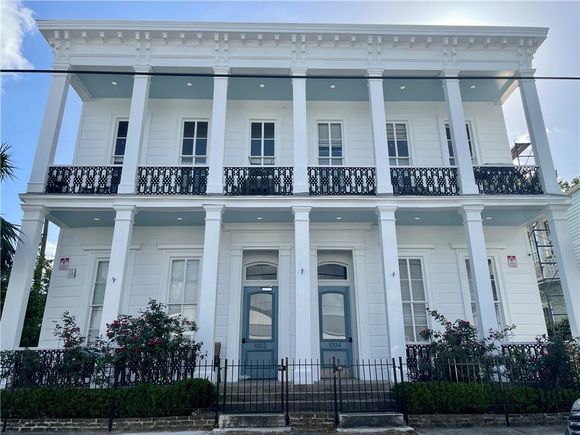


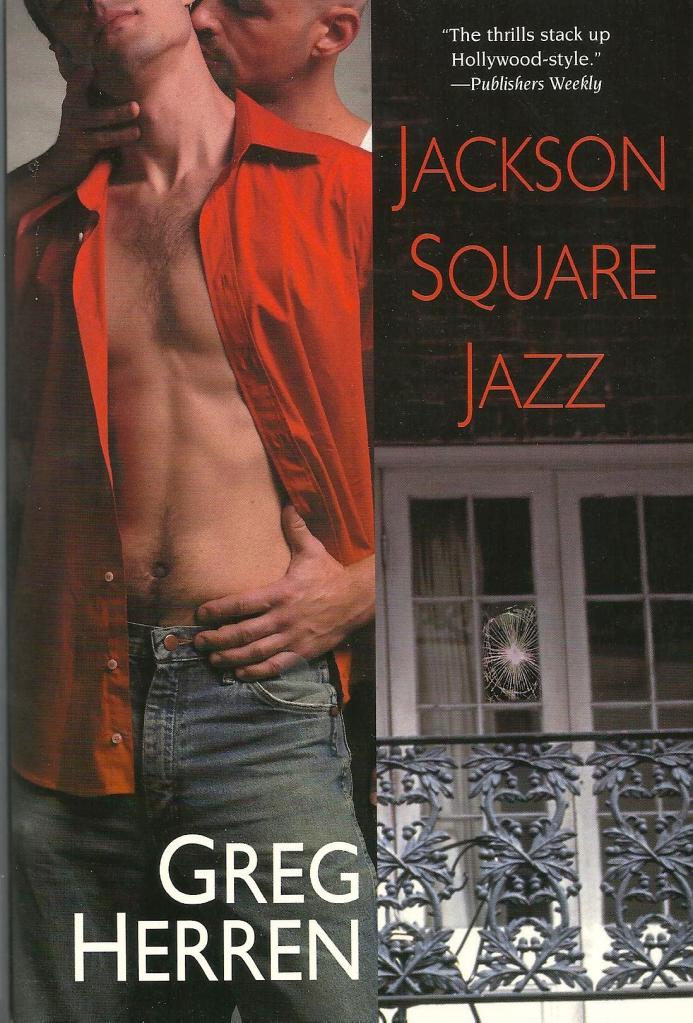
 Queer and Loathing in America