Saturday morning and I slept late, and feel a bit fatigued. I graduated from PT yesterday, which was awesome–but I’ll miss going. I really liked my therapist.
I headed down to the Quarter in a Lyft yesterday after finishing my work-at-home duties, and didn’t have time to write yesterday, which I hope to do this morning. We (Paul) have that lovely suite up on the fourteenth floor of the Monteleone again–but of course I come home every night to take care of Sparky (who was waiting in the window when I got home). I went to the opening reception at the Keyes House in the Quarter (it’s called BK House now instead of its old name; in which the B stands for the general who started the Civil War–he was from New Orleans), which is an absolutely beautiful space, and I just realized I didn’t take any pictures, which I should do more of today and tonight. After the reception, where I ran into any number of delightful people (namedropping here–but amongst those I ran into were Rob Byrnes, Carol Rosenfeld, Amie Evans, Eric Andrews-Katz, Susan Larson, Trebor Healey, and Margot Douaihy), I went to eat (well, to watch them eat) with Steven Reigns, Karl (K. M.) Soehnlein, Marco Carocari, his husband Mark, and Trebor Healey. We went to that bar that used to be Yo Mama’s but has a different name now. It was lovely going down memory lane with Steven over all the years of Saints & Sinners, and remembering how it all happened in the first place all those years ago. Twenty-one years now, which is pretty amazing for a queer lit fest.
Then again, I married a pretty remarkable person.
I have to read today, and I think I have settled on my story from School of Hard Knox, “The Ditch,” because it’s an Alabama story and I can pull out my accent for it. Maybe not at first, but as I get into the story more, absolutely. I’ll also need to rehearse a bit this afternoon before I head down there again. I think today I’ll wear more sensible shoes than I did yesterday, so I can take the streetcar down and walk home at the end of the evening. It’s a lovely walk and the evenings are so cool and temperate…I really wanted to walk home last night rather than taking a Lyft home, but my shoes–I was wearing my new black-and-white saddle shoes, and I worried about walking all that way in them. Not that they would be uncomfortable, but the wear-and-tear on them for that long of a walk–that’s what my Adidas are for. I also noticed on the way to the Quarter in a Lyft (thanks, Tedzin, for the ride) that the Appellate Court building on Camp Street was named for John Minor Wisdom, who’d served there with distinction for over twenty years; it just struck me as funny yesterday that a Federal Appellate court building was named minor wisdom, which I am going to have to use in a book sometime.
I also did some chores and filing and straightening up around here yesterday, so the workspace is a lot less cluttered and a lot more functional now. I’ve also decided on a major project for this summer–getting rid of paper files. I don’t need a paper file for anything that isn’t really something in progress right now, but it’s also a massive undertaking that would require going through all the files…and there are so many files…but condensing them and cleaning out the files that I don’t really need much anymore would also make the workspace more functional and the apartment far less cluttered looking. I have so many ideas I won’t be able to write them all unless I not only live to well over a hundred but don’t get any NEW ideas for the rest of my life.
I think it’s safe to assume that’s never going to happen.
Sigh, I also have to start pulling my taxes together for my accountant. Sigh. What an odious chore, but like I’ve always said–there’s nothing more patriotic than paying your taxes so the country continues to be funded. That doesn’t mean I don’t take every deduction I can and try to get the bill down as much as possible, but I don’t ever complain about paying taxes. I kind of like paved roads and infrastructure and so forth. Call me a libtard; I wear it as a badge of honor–unlike the con(servative) artists out there, or the cosplay Christians who missed all the important messages of their religion to be better people.
And on that note, I think I am going to go sit and read for a bit before I amp up for writing. Have a great day, Constant Reader–I doubt I’ll be back later, but stranger things have happened.
Work at home Friday, my last PT appointment, and the opening reception of Saints and Sinners is tonight. Woo-hoo! I also revised and edited and rewrote chapter two of the book, and started writing a new short story and did some more research on that elusive book I hope to write in the second half of the year if I stay motivated and on track.
I had dinner with friends last night after work, too. We ate at Besame, on South Rampart on the uptown side of Canal. It’s a fusion place, I think Peruvian? I had fish (Mahi-Mahi, pan seared) and grits. The fish was in this amazing green chile sauce that was insanely delicious, and the grits were a variation I’d never had before, but also were quite delicious. It really is amazing how good the food in New Orleans is, which I always forget–like I always forget how stunningly beautiful it is here, and how lucky I am to have gotten to live here for a third of my life, almost half, really; I was thirty-four when we moved here and I’ll be sixty-three this year. I also woke up to a fabulous thunderstorm, and I also have PT this morning–my very last session. I’ll miss the people at PhysioFit; it really was a terrific experience and they are all so friendly, helpful, and nice. It could have been so much worse…
It’s so lovely being creative again–I really was getting worried that it was gone for good. This was one of the longest fallow periods I’ve had since after Hurricane Katrina, really, and I think I will always be worried about the creativity drying up at some point; but it has always come back before so I should probably not worry about it. I’m also not used to having long fallow periods; usually it will only last about a month and then I just kick myself in the ass and get into gear again. I am hoping to get a lot of writing caught up on this weekend. I’ll be dipping in and out of S&S all weekend; not really needing to be down there until the afternoons, so I have my mornings to write before heading to the Quarter, and I am actually excited about that. I’ve also taken Monday off, to recover from the weekend and write some more.
Oh! The most important thing about last night was the night was clear after dinner. I’d taken a Lyft to the restaurant because it was raining, and I was going to take one home, too–but I decided to walk, and when I got tired or ran out of steam, would summon a driver then. Constant Reader, not only did I never run out of steam or get tired, I am not exhausted this morning, either–so I really think I may have snapped back into normalcy (for me) again. I did sleep super well after getting that writing finished (I started before leaving for dinner), and today after PT and work-at-home duties, I’m hoping to get some writing done before I head down for the opening reception at the BK (Beauregard-Keyes) House, which is beautiful; I always like going to events there. It’s across the street from the Ursulines Convent, and there’s a lovely view of it from the front porch of the BK House.
And on that note, I am going to get cleaned up for PT and head on out. Have a lovely Friday and–I may be back later. You never know.
Friday morning work at home and up early for PT blog. I slept very well last night, but didn’t get much of anything done when I got home from work. I wasn’t super tired or anything, but Scooter was feeling needy and the next thing i knew it was time for bedand I’d wasted the entire evening. But that’s okay. I’m not sure why he’s been so needy when I get home the last two nights, but he has been and I don’t mind letting him sleep in my lap so he feels loved. He’s such a darling. He also was cuddling with me in the bed this morning after the alarm started going off. Much as I miss Scooter, I’m glad we rescued this sweet playful boy.
I’ve picked out my next read, and it’s a short one, The Cook by Harry Kressing, which is the book the film Something for Everyone was based on. I think I am getting to the point where I am ready to finish my long-overdue post about Saltburn, and reading the book potentially could be a help on that score. I also want to read some of the other short books I have on hand, and hopefully that will get me deep into reading again. It would be great to spend an hour a day at least reading; the days when I used to compulsively read, and get so involved in a book that I’d blow off everything else I had to do in order to finish it. Heavy sigh. I don’t know why I’m having so much difficulty reading these days; and I do strongly suspect that the two things–inability to read and inability to write much–are very linked together. Something for me to work on this weekend, at any rate.
I had a breakthrough on the story I’ve been struggling to finish writing, and so I am hopeful that today, once I am done with work-at-home duties, will be able to dive right in and get this draft finished. I’d like to edit “When I Die” tonight as well; Lord knows I’ve printed enough hard copies of that damned story in order to get it edited easily enough soon, sheesh. I am debating changing the story a bit–why would they go out into the swamp that night, I am not convinced the reason I gave them in the original draft is good enough–and I am considering changing the make-up of the cast as well; instead of two guys and two girls, maybe three or four guys instead? A fraternity hazing ritual or something? That might be more compelling than what I had written already. I don’t know, really. I guess rereading the story will make a difference, and then start picking it apart.
I also have errands to run this weekend as well, and definitely need to wash the car again. What a glamorous life, right? But the festivals are next weekend, and I won’t be staying in the Quarter because of Sparky–who will definitely be needy–so I am not sure how much I am going to be able to get done then. Heavy heaving sigh.
I do love my new saddle shoes. I wore them to work the other day to break them in (so I can wear them next weekend) and they are so comfortable. I think maybe I am going to try to develop, this late in life, my own sense of style and start wearing the types of clothes I’ve always wanted to. I kind of want a cape coat, like the ones Barnabas wore on the original Dark Shadows, which I’ve always thought looked cool and always wanted. I am also thinking about getting a walking stick for dressier occasions, too. I’ve never really been much into clothes, primarily because I’ve always felt like men’s clothes were always too staid and patriarchal for me, so I never cared. But now that men’s clothes are getting more stylish? Sign me up. I think I want a cape, too, and a denim duster. I love the way younger male celebrities are mixing things up with their formal wear, and trying new styles and looks and I think it’s wonderful; definitely one of the best outcomes from more gender fluidity in society–and really, it’s all just drag, isn’t it?
And I kind of need to be more serious about everything to do with my career. I need to get that website finished, I need to get new author photos done, and of course all kinds of work that needs to be done on the house.
At least I’m thinking about making improvements to my life and everything, right, rather than just coasting along again and letting life happen to me?
So on that note, I am heading into the spice mines. Have a lovely Friday, and I may be back later; stranger things have happened.
Every once in a while, I need to remind myself of how much I love my home town.
I was thinking about this the other day. I think part of the malaise I’ve been experiencing lately has everything to do with my creative muscles being tight and unexercised for so long–and almost every time I manage to write fiction, it’s so exhausting and draining that I can’t write more, either. Monday got derailed early, and that night we had another torrential, street-flooding thunderstorm…and the kitchen roof started leaking again. I mean, it only does this during that kind of rain; but we have many downpours like that over the course of a year. That kind of kicked the malaise back up into higher gear–I just am so tired of having to deal with things like this over and over when all I really want to do is just go about my day, moving from A to B and getting things done and being productive. It all becomes so much, you know? The rise of queer hate to levels not seen since the 2004 election (may you roast forever on a spit in hell, Karl Rove), and it’s very tiring. It’s also tiring to think that I may be living in the last days of the American experiment with democracy, too–and the fact that far too many of my fellow Americans are just fine with that is kind of upsetting.
Such good Germans.
But I do love New Orleans, even if I have to remind myself of that from time to time. I do; there’s just something about this city that is in my blood, my DNA, and my being; I cannot imagine being happy anywhere else. I could exist somewhere else, of course, but I really don’t want to really just exist anymore. My blog is getting feisty again because I am feeling feisty again and pissed off about a lot of things. I’ve also been immersing myself in gay and queer culture again lately–Capote and Isherwood, anyone?–and remembering how hard life used to be for people like me (see Fellow Travelers and It’s a Sin), it invigorates my senses and intellect against injustice and unfairness as it always does. Recounting stories of my past recently as well as all the introspection I’ve been doing since losing Mom last year (and really, I started thinking about it more during the pandemic, and a lot of it was because of It’s a Sin) has me remembering things, how they used to be, and what New Orleans is like now as opposed to how it was when I first moved here all those years ago, or all the times I came to visit when I worked for Continental. The city is different now than it was then–sleepily crumbling away in the hot sun and heavy wet air–and I’ve been a bit resistant to those changes. I don’t like that it’s insanely expensive to pay rent or buy a home here now–one of the strengths of the city was how many working class people owned homes here, and that seems to be going away as the city continues gentrifying itself.
Monday I also gave a co-worker a ride home from the office, and since it was a torrential rain, I drove her into the Quarter and let her out at her door on St. Ann Street close to the corner at Dauphine. I honestly can’t remember the last time I drove through the Quarter, and I really don’t go down there much anymore other than for the TWFest/S&S. I took Dauphine out of the Quarter, and a lot has changed since the 1990’s, or even the last time I drove through. I think during the festivals this year I am going to explore the Quarter a bit more than I have the last few years, and hopefully drink in some more atmosphere. I’ve kind of felt a little phony writing the Scotty books lately, since I am rarely if ever down there now since my office moved, and have been telling myself I need to explore and take pictures again.
I was thinking Tuesday night when I got home from work that I was becoming as bad as all those locals who look back nostalgically for the past and the way things used to be. I also know I am glossing over what the mid to late 1990’s were really like here, as well as for us. New Orleans has changed and has never remained the same throughout its history, but the foundation of the city remains the same. I want to write about that time in New Orleans (“Never Kiss a Stranger”), so that’s it preserved forever, those days when the sodomy laws hadn’t been overturned yet, and when the gay bars always got raided in the weeks leading up to Decadence so that we knew they were “letting” us have Decadence; the people we thought were insane in state politics in 1996 are now running things and trying their damnedest to turn Louisiana back to 1860 and shoving their religion down everyone’s throats. My primary issue with still writing about the city has nothing to do with how much I love the city, or how I feel about things around here, but mainly because I don’t know what it’s like to go out on the weekends to the bars in the Quarter, or what it’s like for gay men in their forties here now.
So yes, I am looking forward to writing the next Scotty–and revisiting the Chanse series, as I’ve been doing, has me actually considering doing another Chanse story. I have two ideas for him, actually, but am not sure either is going to amount to anything.
If you will recall from my last entry about the Chanse series, I had a new editor for the second book in the series. I had also written a proposal for the follow-up, Murder in the Rue St. Claude, which was going to be about a nursing home and an angel of death. The second book ended with a tragedy for Chanse, and the last scene of the book was Chanse saying goodbye to someone before their life-support was turned off. I did a trickery and was going to have the person be in the nursing home, still living, only a suspicious death happens there and one of the workers talks to Chanse about her fears. The editor wasn’t the most professional or organized person, and I had to send the proposal to her three times on request with no contract offer. I was very irritated by this, but there were also a lot of changes going on there–including moving the offices from LA to New York, which I thought was an incredibly stupid business decision…and I wound up with yet another new editor right before Katrina hit. I honestly wasn’t sure if I would go back to writing ever again–one of the lulls in my career–but things eventually settled down and I started house sitting for a friend in Hammond over on the north shore while I waited for the city to reopen so I could drive into the city and get some more things from the house. I did, my friends’ trip was cut short, and I was going to return to Kentucky to my parents’ after one more swing by the apartment to pick up things. Imagine my surprise that my mail service was open, my grocery store and bank were open, and so was my gym. We’d moved into the main house from the carriage house, which hadn’t been rented yet as it needed some work before the hurricane, and so….I just moved back into the carriage house and cleaned up around the property and kept an eye on the main house, as well as emptying out the water from the machines that were trying to keep the insides of the apartments dry (the roof was gone).
While I was in Hammond, my new editor got me to reluctantly co-edit an anthology about New Orleans called Love, Bourbon Street (a title I hate to this day), and he was trying to talk me into writing a Chanse book about Katrina. I didn’t really want to, but he kept insisting and finally, I gave in and agreed to write it. However, the nursing home I was researching was a place they left people to die in–wasn’t touching that with a ten foot pole–and it occurred to me that I could wrap the case around Hurricane Katrina. He was hired by the client the Friday before Katrina, and obviously he couldn’t do the job now.
And that was the seed from which Murder in the Rue Chartres (no title at the time of contract) grew.1
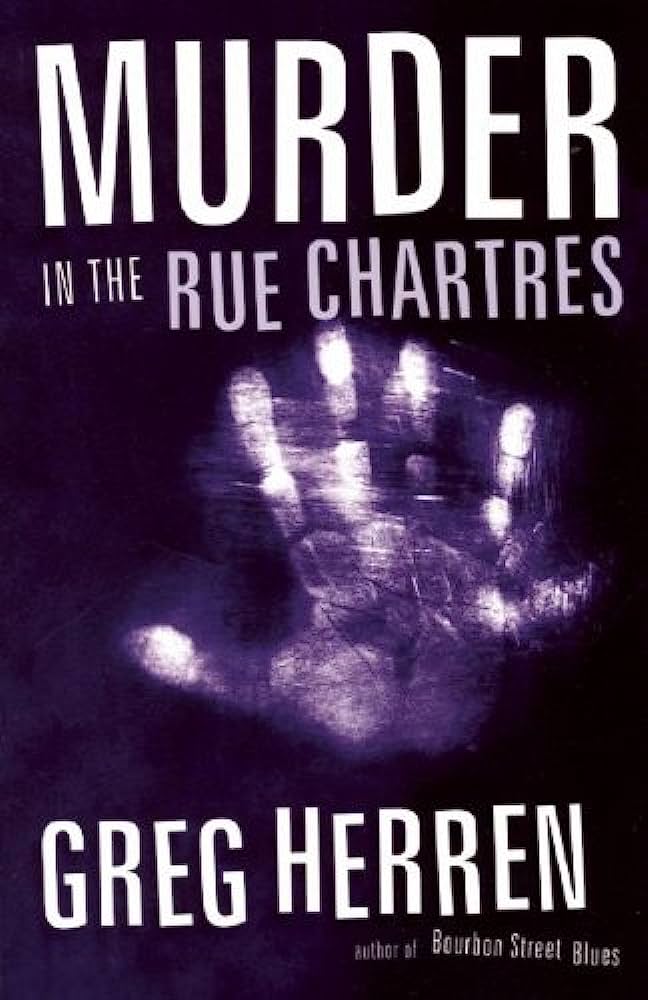
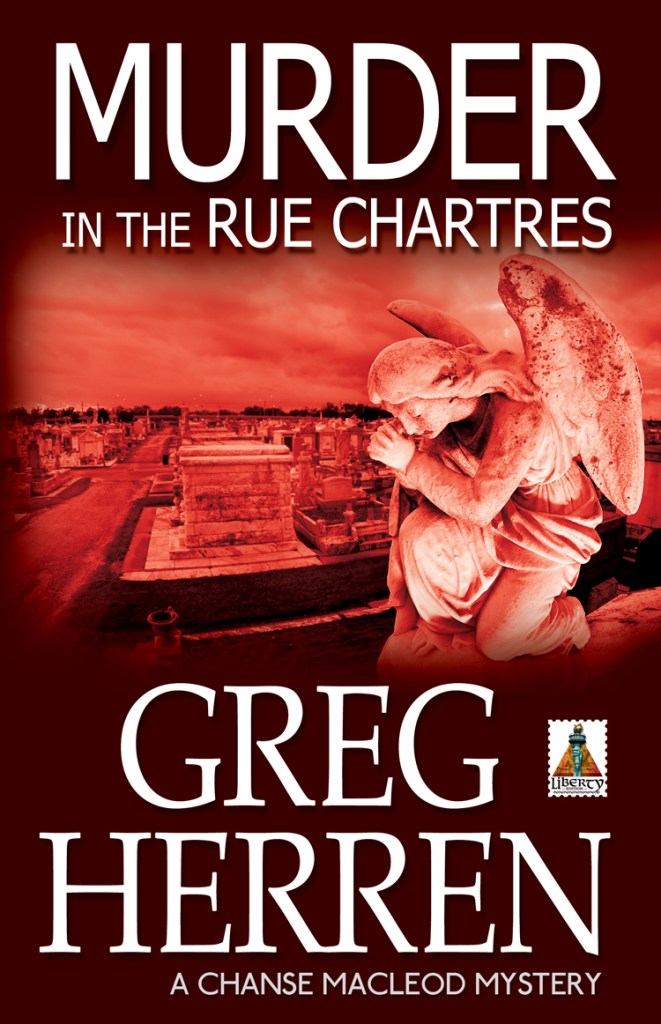
This is the original cover from Alyson Books.This is the new cover for the Bold Strokes ebook
It was six weeks before I returned to my broken city.
Usually when I drove home from the west, as soon as I crossed onto dry land again in Kenner, excitement would bubble up inside and I’d start to smile. Almost home, I’d think, and let out a sigh of relief. New Orleans was home for me, and I hated leaving for any reason. I’d never regretted moving there after graduating from LSU. It was the first place I’d ever felt at home, like I belonged. I’d hated the little town in east Texas where I’d grown up. All I could think about was getting old enough to escape. Baton Rouge for college had been merely a way station—it never occurred to me to permanently settle there. New Orleans was where I belonged, and I’d known that the first time I’d ever set foot in the city. It was a crazy quilt of eccentricities, frivolities, and irritations sweltering in the damp heat, a city where you could buy a drink at any time of day, a place where you could easily believe in magic. I couldn’t imagine living anywhere else. Any time I’d taken a trip before, within a few days I’d get homesick and started counting the hours until it was time to come home.
But this time wasn’t like the others. This time, I hadn’t been able to come home, and had no idea how long it would be before I could. Now, I was nervous, my stomach clenched into knots, my palms sweating on the steering wheel as I sang along to Vicki Sue Robinson’s “Turn the Beat Around” on the radio. It was everything I’d feared for the last few weeks when I thought about coming home, the anxiety building as the odometer clocked off another mile and I got closer to home.
It was different.
The most obvious thing was the lack of traffic. Even outside the airport, the traffic was usually heavy, sometimes slowing to a complete standstill. But other than a couple of military vehicles, a cement mixer, and a couple of dirty and tired looking sedans, I-10 was deserted. There was a film of dirt on everything as far as I could see, tinting my vision sepia. Huge trees lay toppled and debris was everywhere. Signs that used to advertise hotels, motels, restaurants, storage facilities, and pretty much any kind of business you could think of were now just poles, the signs gone except for the support skeleton. Buildings had been blown over, fences were wrecked and down, and almost everywhere I looked blue tarps hung on roofs, their edges lifting in the slight breeze. My breath started coming a little faster, my eyes filled, and I bit down on my lower lip as I focused back on the road.
No cars joined at the airport on-ramp, or the one at Williams Boulevard just beyond it. No planes were landing or taking off.
Most of the writing I did in the fall of 2005 was my blog, which at the time was on Livejournal. (The old stuff is still there, but I started making things private after a year because of plagiarism; I guess people thought they could steal my words if they were on a blog.) I documented as much of the experience as I could, so people outside of Louisiana could see that the city wasn’t fully recovered despite no longer being in the news. American attention had moved past New Orleans by the spring of 2006.
When I started writing the book, I was really glad I had done that with the blog, because more than anything else it reminded me of the emotions I was going through, that horrible depression and not remembering things from day to day, the need for medications, panic attacks, depression, and the way the entire city just seemed dead. I did repurpose a lot of stuff that was on the blog–rewritten and edited, of course–and I could tell, as I wrote the book, that I was either doing some of the best work of my life to that point or I was overwriting it mercilessly. You never can be sure.
But I also needed to flesh out the murder mystery I came up with, and I also wanted to write about a historical real life tragedy of the Quarter. The client who hired him that Friday before Katrina roared into the Gulf and came ashore was engaged, and she wanted Chanse to find her father, who’d disappeared from their lives when she and her brothers were very young. But what happened to her father? Who killed her, and why? Was her murder a reaction to her looking for him?
I had started using Tennessee Williams quotes to open my New Orleans novels with the third (Jackson Square Jazz: “A good looking boy like you is always wanted” from Orpheus Descending) and I liked the conceit so much I kept doing it. I knew someone who’d built a crime novel around the basic set up of Cat on a Hot Tin Roof, and I thought, what if the person who knows all the answers has been in a mental hospital for decades? Then what if Mrs. Venable had succeeded in getting Catherine locked up with all of Sebastian’s secrets lobotomized out of her head?
I named the family Verlaine as a nod to the Venables, and aged Mrs. Venable as well as gender swapping her (this was also a bit influenced by The Big Sleep), and I was off to the races.
My editor wrote me when he finished reading the manuscript and told me it was one of the best mysteries he’d ever read. The reviews! My word, I still can’t believe the reviews, and how good they were. I got a rave in the Times-Picayune, Library Journal and Publishers Weekly.
And yes, it won a Lambda Literary Award for Best Gay Mystery.
The irony that two books I wanted nothing to do with, let alone write or edit, ended up with each winning Lambda Literary Awards, does not escape me. ↩︎
Saturday morning in the Lost Apartment and there are six parades today (I was wrong yesterday; I substituted Alla in for Druids for last night’s parades. I told you I don’t have the schedule memorized!), which can make for a long day and of course means I can’t really go anywhere at all today as I am trapped inside the parade route. They did move them all up so they roll during the morning and afternoon (threat of heavy rains in the evening) and if I am not mistaken they have done the same tomorrow? I was too tired and was almost asleep by the time the parades got to the neighborhood last night–and slept for just over ten hours, so clearly–Gregalicious was exhausted yesterday, and then some.
I had a doctor’s appointment that went swimmingly well yesterday morning (establishing primary care with a new doctor, whom I really liked on first meeting; he had a good manner, didn’t seem distracted, and asked probing follow-up questions to things I talked about–genetic predispositions to things and so forth, and genuinely seemed interested and had suggestions and answers for me about other things. His office building also has free parking, with is also lovely. That appointment took a very long time, so I didn’t have to wait terribly long before yesterday morning’s PT…in which my therapist Jacob introduced a weight bar to the therapy, so yes, we’ve moved on from dumbbells to that, and he even found a way to make planks more painful and tiring. So after making a quick grocery run (and still forgot a few things) I managed to come home for work-at-home duties. After that was completed, I tried reading for a little while to no avail, and finally watched the LSU-Arkansas Gymnastics meet, in which LSU got back to business and scored the highest team score in LSU Gymnastics History, which was pretty awesome. After that we tried to watch an episode of Lupin but we both fell asleep, which was a shame because it looked like a really good episode.
Today I am going to do more chores and try to get some more writing and reading done. There are six (!!!) parades, all starting at about a half-hour or so of each other (9, 9:30, 10, etc.) so they should all be past by the early evening –so if I want to run an errand or we needed something, I could easily (in theory) get out of the box tonight. I don’t think we will, really–we are low on crunchy salty snacks but that’s not a tragedy or anything to really be worried or concerned about. I do want to get the dishes and kitchen done, and establish some kind of order to the house (not easy with Mr. Wants To Get In Everything running around looking for play). Yesterday afternoon Sparky managed to get to the sink counter, from there to the top of the refrigerator, and then climbed up on top of the cabinets. In my imagination I saw everything stored up there some crashing down (and there were dishes soaking in the sink, so yes, it could have proved catastrophic) but it only took about ten minutes for him to get bored up there and realize it’s a long way down and start whimpering, so I had to get the little ladder out and climb up on the counter myself so I could reach and grab him so I could get hime down. He didn’t like that, either–he was clawing and terrified until I was able to put him down on the counter so he could jump to the floor and scramble off to safety, Sigh, the adventures of Big Kitten Energy are certainly something to experience.
I don’t think I’ll skip parades entirely today–I might go out every now and then just to take some pictures, watch the marching bands, and get a sense of the crowd and the energy of this Carnival. I don’t really remember the last Carnival I attended, which was actually the 2022 one (I was gone for 2023, 2021 was cancelled and was the year of the house floats, which was so amazing and so New Orleans); but I’ve no recollection of that year’s festivities at all. Maybe I should go back and look at my blog entries for then? Maybe I don’t need to really remember it much, either. Most of my Carnival memories are those of long ago, when we also used to go out all the time and truly celebrate the season before we got too old to walk to the Quarter and come home in the cold gray foggy mornings to rest up for a while before starting all over again. Carnival really is a magical time, and all it takes it to walk down to the corner on a beautiful day and once I catch that first throw I am right back into the spirit of things.
But still too old to walk to the Quarter.
I did finally take a walk around the neighborhood last night once I was finished with work for the day. I walked for about forty minutes, just around the neighborhood and down streets I rarely, if ever, venture down. It was indeed a beautiful day, in the low seventies and sunny, and that was still the case when I went on my walk as the cops were putting up barricades and closing streets, parking spaces disappearing throughout the neighborhood as people parked and walked over to the Avenue in their festive garb with coolers and rolling carts filled with food and ice and alcohol, boas were everywhere and goofy hats and those rugby striped shirts in the Carnival colors of purple, gold and green. But the end result of that unexpected exercise is tired legs and a sore lower back this morning (which could also have been from the PT as well) so I am going to just relax for a bit this morning and do some reading as I finish my coffee. There’s always FOMO involved in skipping parades–and the neighborhood did smell like grease and peppers and onions last night; that particular Carnival smell that becomes hardly noticeable by the second weekend, as the trees along the Avenue become festooned with sparking strings of beads in every color imaginable. Fences, porches and railings spring beads like crepe myrtles erupt with blossoms every spring.
There’s a winsome magic about Carnival, so that as it progresses you grow less frustrated with the parade traffic and the difficulty finding a place to park at home and the crowds of people and the trash growing exponentially on your street. Even just now typing all of this I’ve started thinking oh you can spend the afternoon out there which is, in and itself, the mentality that leads to pure exhaustion.
And on that note, I am going to my easy chair to read and swill coffee for a moment or two. Have a lovely Saturday wherever you are, and remember–it’s Carnival in New Orleans, so celebrate a bit for us. You’re allowed.
Whenever I am writing or creating a character, the first step I need to accomplish in order to keep going with them is that I need to know what they look like in my head before I can start. The first step is for me to know what they look like. I generally use real people are models for a starting point for my characters–but they do evolve from that initial “how they look” base and extrapolate the rest of their appearance from there. I also don’t base characters on real people, for the record–because you can’t. You can never base a character completely on someone else because you can’t get inside their head or know all of their life experiences and the things that shaped who they are and why they do the things they do.
This is the base-line physical model for Scotty I used when creating him. Scotty’s evolved since then.
This wasn’t the base model for Frank, but you get the idea; he’s pretty close to what I pictured.And this is where I started from with Colin.
I don’t base characters on real people because it’s impossible to do–you can only base a character on your perceptions of who that person is; you cannot know every experience they’ve had, every trauma, every event that occurred that shaped and changed and evolved them into who they are. This is why people–even ones you think you know really well–will always surprise you at some point. I’ve lived with Paul for twenty-seven years and he still surprises me. I didn’t know any of these men–all models for BGEast.com–at the time and of the three of them, the one I actually know is the one whom I didn’t actually use as the physical model for one of the three, and I didn’t meet him until the first three books were already in print and available.
But when I was creating Scotty, I wanted the readers to have fun with the books. I didn’t want to write anything dark or tragic or heavy; I already had the Chanse series to do that with. Chanse was a six foot four two hundred and twenty pound mass of neuroses, insecurities, cynicism, and bitterness; I really didn’t want to do that again because what would be the point of doing two series that were exactly the same? I wanted them both to capture the feel and spirit of New Orleans, but from very different perspectives. Chanse wasn’t happy about being a gay man; he was still struggling with it in the first book and slowly became resigned to it, rather than embracing it. Once Scotty told his parents and came out to them, he never looked back and started looking for his joy. Scotty’s family loved and embraced him as he was, and other than both sets of grandparents cutting off his access to his trust funds when he flunked out of college–which has nothing to do with him being gay; that was an attempt to get him to go back to school. The trusts were originally set up to become his when he turned thirty anyway, so he never really had to worry about the future–which is an incredible privilege. Even working as a personal trainer and some-time go-go boy for the money wasn’t that big of a deal; his landladies were family friends who’d never evict him in the first place and his parents would always come through for him anyway.
I also made his siblings the same as Chanse’s–I don’t know if that was intentional or not, but while Scotty is the youngest with an older brother and sister, Chanse was the eldest with a younger brother and sister he isn’t close to. Scotty’s family was tight, while Chanse’s was not. Chanse’s sister is married to an accountant for an oil company and lives in Houston; his brother still lives in their hellhole of a small city, Cottonwood Wells (small city, large town; I am never sure which is the right one) and I broached their relationship in the short story “My Brother’s Keeper.”
And I had Scotty live in the French Quarter as opposed to Chanse’s apartment on Coliseum Square; Scotty is that rarity in New Orleans–someone born and raised in the Quarter. Chanse was an import from Texas who moved to New Orleans after graduating from LSU; Scotty has always been here other than the two failed years in Nashville at Vanderbilt.
I wanted him to have absolutely no hang-ups or issues about being a gay man. I wanted him to embrace his sexuality and enjoy his sex life and have that Auntie Mame mentality of “life’s a banquet and most poor suckers are starving to death”; Scotty wants to have fun and enjoy his life. He doesn’t think he’s ever destined to find a boyfriend or life partner in the first book–he’s too unabashed a slut1 who loves getting laid and doesn’t want to tie himself down, plus most men he meets tend to be too serious for him. Scotty has no hang-ups or issues about his body, either. As a wrestler in junior high and high school his body became strong, muscular and lean; he never says whether he thinks he’s attractive or not–he says other people seem to find him irresistible in the first book, and he admits he doesn’t see what others see but they see it so okay. He’s become more serious as he’s gotten older and as he’s dealt with bad things–but he doesn’t go into a depressive state or withdraw from the world when bad things happen; he faces them head-on, and his motto (life doesn’t give you anything you can’t handle–it’s how you handle it that matters) is one we could all aspire to, really.
While taping Susan’s show last week I did say that Scotty was the idealized version of myself and the life I would love to have–sans the murders and kidnappings and shootings, of course–and naturally a lot of his traits have come from within my own mind; but while I find his mentality and life view aspirational, I often fall short. Scotty has a genuine kindness to him as his inner core that I don’t always default to, much as I wish I could and did. I am a lot more like Chanse than Scotty, even if they are kind of different aspects of my personality and who I am.
It’s sometimes hard for me to wrap my mind around the fact that I’ve been writing Scotty now for twenty years. Bourbon Street Blues came out on May 1, 2003. Twenty years of Scotty books, but only nine–like one every other year rather than every year.
And I also sometimes wonder if my subconscious somehow keeps track of Scotty, because I keep discovering things about him that I wrote years ago that were just kind of throwaways that now I can circle back to and create story arcs for these character traits and personal histories for the newer books.
There’s also a scene in Bourbon Street Blues where he proudly states he doesn’t have sex for money because he “prefers to keep (my) amateur status.” ↩︎
Sunday morning and I managed to get a lot done yesterday while watching games occasionally. I got bored watching Georgia throttle Florida, laughed about the Kansas win over Oklahoma, watched Tulane almost blow a significant lead and lose to Rice, and got bored with Tennessee-Kentucky so switched over to Elité on Netflix–and this seventh season is simply terrible. We have one more episode in this season and it’s over, and I can’t say I’m sorry to see it go.
But I did get a lot done yesterday. I cleaned. I ran errands,,,and I worked on the filing. Yes, there’s still work to be done, but my workspace no longer looks like I need to. just take a flamethrower to it, and even the laundry room is beginning to look like it’s more together than it should be. I do have to do some refiling, but everything is properly sorted and where it needs to be, if not alphabetized properly. I also discovered a lot of duplicate files–I am sure there are even more to be found, once the filing truly starts getting compiled and sorted properly. I also need for some of these files to just go away; I am never going to get to all of these ideas and I am never going to write all these stories and novels or essays and nonfiction books, either. But which ones to keep, which ones to abandon for good? I’ve been saving ideas and files and stories and scenes and characters for well over forty years now; you can only imagine how much I’ve forgotten about that are buried deep within this insane file-hoarding situation; it’s almost as bad as my book situation.
But getting all this clutter and debris sorted and put into a semblance of order also helped me get focused more–I think perhaps that’s been part of the problem with focusing on writing anything, really; knowing how out of control the filing had gotten and not knowing where anything was, or what I was working on could be found, and so forth. I’m going to try to get back to work on my next book today–after I get some more of these blog entry drafts completed and posted–and I am also going to try to work on the files some more. I decided that I am not, after all, going to be able to get my story “The Blues Before Dawn” finished in time to submit to the Bouchercon anthology, so it’ll go back into the files for now for a while. I never could quite get the story write, but that opening–my main character walking home in the misty morning hours of the Quarter while listening to someone playing the blues on a saxophone on a balcony, hidden away in the fog. I love that image, and I know that my main character is an apprentice waiter at Galatoire’s and sometimes turns tricks for money at Ma Butler’s bordello in Storyville; I also know it’s a Sherlock Holmes story from the perspective of someone who has a crush on Mr. Holmes–and now has to depend on Sherlock to save him from wrongly being accused of murder. The rest? Not so much…and it’s due on Tuesday, so that’s not going to happen. A pity, yes, but a Sherlock story from the perspective of a sometime male harlot was a long shot for the Bouchercon anthology anyway.
I did start reading The Lonely Ghost by Mike Ford, which is quite delightful, along with a reread of Ammie Come Home by Barbara Michaels (also one of my favorite books of all time, and definitely one of the greatest ghost stories of all time) when I had a few down moments to spend (I’ll get back to The Lonely Ghost later on this morning), and I also have to make a cheesecake this morning and get the white bean chicken chili started so it’ll be ready for tonight and the rest of the week, of course. Halloween is going to be one of those frantic unsettling days, but that’s okay; I can make it through it all.
I slept really well last night, which was lovely; my sleep lately has been pretty marvelous, honestly. Relaxing in the evenings last week, letting the anxiety not get to me, and getting good night’s sleeps this past week was really kind of lovely and nice. I also slept late this morning, opting to stay in bed later than I usually do because it frankly felt nice, you know? Today I am also planning some self-care and grooming, which will be nice. Maybe even take a walk later in the day, when it starts cooling down? Although without the humidity yesterday’s low eighties felt marvelously and delightfully cool.
And on that note, the spice ain’t gonna mine itself, so off I go. Have a marvelous Sunday, Constant Reader, and I’ll check in with you again.
I withdrew a short story I had submitted to a magazine in September of 2022; thirteen months is more than enough time to decide whether or not you want a story or not, and if you haven’t gotten to it by now, well, how long do you need? There’s a serious conversation about short story publishing that needs to be had at some point–but I think that aspect of the business isn’t taken as seriously as “book” publishing, and there aren’t many people who primarily focus on the short form for the abuses of writers that occur in that small part of the business to really be brought to public attention because, let’s face it, nobody really cares. I know that one of the big name prestigious crime short story publishers always takes twelve to fourteen months to respond to submissions…and when you know that going in, that’s one thing. This market I’ve published in before and it’s never taken even a fraction of this long to get a response to a submission; it had been pending on Submittable since the day after I clicked “submit.” It may be right for another market I am looking at right now–and I had wanted to include it in my next short story collection as a republished story. Heavy heaving sigh.
Maybe someday I will do a blog post about the slog publishing short stories can often prove to be. I was in one anthology that sat on my story (and everyone else’s) for at least three years (more like four, if not five); finally released the book but never sent me a print copy (I did get the electronic one) and I never did get the really nice check they offered me to get me to write the story. There were rarely any updates, either–and certainly none since it finally saw “print.”
Sigh. The glamorous life of a writer is mostly spent tracking down payments and author copies, seriously. Well, maybe not mostly, but it takes up a lot more time and energy than a non-writer might think.
I slept really well last night, with Tug making his usual five a.m. supplication, and I’ve already discovered a quirk: if I give him food, he will squeak at me until I dump out his water bowl and refill it–every single time. He won’t even start eating until he hears the water running in the sink. Granted, I always change out the water every time I feed him–but it’s part of his routine and he won’t eat until he knows he’s getting fresh water to go with the food. I think he’s completely settled into our lives as our house cat, too. He certainly believes he’s Lord of the Manor, and when he’s full grown he’s going to be a terror–because even pint-sized as he is now, he can get up to places you wouldn’t think; he’s a climber, so any possibility of a Christmas tree again is completely gone; which is fine, really. I do love Christmas, but it’s really for kids, and the older I get the more I care about the time off than holiday joy and gifts and things like that.
I made groceries on the way home last night at the Carrollton Rouse’s, which is becoming my favorite Rouse’s; the ones on the CBD and on Tchoupitoulas are convenient, but the one on Carrollton has more selection; which means going there I can get everything in one stop, whereas at either of the others I need to go to another vendor to get the rest of the things I need, which is very frustrating; and so even the extra time it takes to get up there and back is actually made up by the times savings of only going to one store. I was also very tired when I got home–we’d had a rather busy day at the office–so I didn’t read or do anything much other than put the groceries away; Paul had a board meeting so he didn’t get home until late, either. I did work on my story “The Blues Before Dawn”, and made some decent headway on it; the question is whether I want to make it another “Sherlock-in-New-Orleans” story, which I kind of want to do; I think I’ll do that for a draft and then do a second where the detective isn’t Sherlock, but I like the idea of writing a Sherlock story from someone else’s perspective, as well. I really like the idea of writing a bunch of Sherlock short stories in 1916 New Orleans, with Storyville (cliché, I know) and the Italian immigrants in the Quarter and the little Chinatown district on either side of Canal and illicit queer bars servicing sailors and so forth; how fun is that? And of course the Opera House was still there in the Quarter too–and people still spoke French in New Orleans, or at least the bastardized Louisiana version of it. I think my goal for the weekend is to finish a draft of the story and do some more work on the second Valerie novel.
And I have to go into the office tomorrow for my work-at-home day; which I may switch over to Monday; I’m not sure and I haven’t really decided yet, to be honest. I have to go in for a benefits meeting, and was thinking that maybe the thing to do would be to work in the office since I have to go there anyway; but….now I am thinking I should just go for the meeting and maybe work at home around it; I am not sure, and I suppose I will decide tomorrow morning when I get up–depending on when I get up, that is. Frankly, I am leaning towards just going in for the meeting and being done with it and coming back home. I like not having to get up on Friday mornings–even if I rarely sleep past seven as it is–but the lack of alarm going off is actually quite lovely.
And on that note, I am heading into the spice mines for the day. Have a great one, Constant Reader, and I’ll check in with you again later.
(NOTE: I started writing this post back in January, after I’d returned to New Orleans from my last Mystery Writers of America board meeting–this is to give context to the opening paragraph– as you are no doubt well aware, Constant Reader, that I’ve not been back to New York since January; so this is that same trip where this happened and I started thinking about these things, which have never been far out of the forefront of my mind since then.)
While I was in New York recently, walking around to and fro, here and there, hither and yon, I was always checking my phone (and yes, I hate that I’ve become one of those people) and then shoving it back into my pants pocket without putting it to sleep first or closing the app that was open. As I walked around, of course this led to my phone doing all kinds of weird things –closing an app and opening another, etc.; but at least there were no butt dials, right? At one point, when I pulled out my phone as I took a seat on the subway, somehow what was open on the screen was a google search for my book A Streetcar Named Murder–and when I went to close that screen I touched one of the images by mistake, which took me to the Goodreads page for the book. Bear in mind, I never look at Goodreads for any of my books, let alone Amazon–the temptations to start reading the bad reviews is too great, and while I can usually laugh them off, occasionally–and it depends entirely on my mood, of course–one will get under my skin and it will annoy me, and that’s not good for anyone.
This particular day on the subway the Goodreads page opened to the bad reviews first–its average is four stars, which I will always take because I am not Lauren Hough–and the very first one made me laugh out loud on the subway. Paraphrased, it was basically someone taking umbrage at “someone who doesn’t live here or know the first thing about New Orleans” writing a book about New Orleans. The reason they had come to this conclusion was because Valerie referred to Mardi Gras as “Fat Tuesday”, and according to this one-star reviewer, no one from New Orleans would ever say Fat Tuesday instead of Mardi Gras.
Well, I’ve lived here for twenty-seven years and I have heard any number of locals say Fat Tuesday rather than Mardi Gras, and so of course I had to click on the reviewer’s profile…and grinned to myself when I saw that they actually live in Metairie, not New Orleans…which to locals is a bigger crime than getting something wrong about New Orleans: claiming to be from New Orleans when you actually live in Metairie. (the rejoinder is usually along the lines of “bitch, you live in Metairie.”)
It was also kind of fun to be accused of inauthenticity when it comes to writing about New Orleans, because I personally have never claimed to be an expert on anything New Orleans (others have said that about me, and I always am very quick to reply not even close); the more I learn about the city the more I realize how little I actually know about the city. There’s an extremely rich (and often incredibly dark) history here; it’s hard for me to wrap my mind around the fact that the New Basin canal was there as long as it was, or that there were several train stations around the French Quarter (including one that essentially was in Storyville–rather convenient for the whores and pimps, right?), or that where UNO is now used to be the lake shore resort of Milneburg, or that the only way across the river or the lake was by ferry until Huey Long built a bridge at the Rigolets (the narrow inlet between lakes Pontchartrain and Borgne).
I was on a panel once at the Tennessee Williams Festival with Bill Loefhelm (if you’re not reading Bill’s books, shame on you and correct that immediately) and the question of New Orleans authenticity came up, and Bill’s response (paraphrasing) was that New Orleanians have a tendency to play a game called “NOLier than Thou,” in which they try to one-up each other to see who the true New Orleanian actually is–which is, of course, gatekeeping. (And yes, I immediately turned to him and said, “I like that and am going to steal it” SO CONSIDER IT STOLEN.)
It does bother me somewhat when I read books set in New Orleans written by people who have never lived here; you can tell, but I also get over it pretty quickly; who is to say who can and can’t write about a place? There’s a significant difference between visiting and living here, which I realized almost immediately after we moved here, and that also becomes very apparent in fiction. I had started writing the book that would become Murder in the Rue Dauphine before I moved here, and I realized, once I did live here, that everything I’d written about New Orleans was completely wrong. I didn’t work on the book for another two years; and even then I wasn’t entirely sure I’d lived here long enough to write about the city. So…I kind of cheated by making Chanse MacLeod not a native either; he’d moved to New Orleans after getting his degree in Criminology from LSU, and had been here about six or seven years when the story opened. So he was an outsider, too; so his views on the city and how things work around here were from an outsider’s perspective, like mine; that was easier. With Bourbon Street Blues, I decided that Scotty was not only a native but came from two old-line society families, from the Garden District and Uptown. One of the greatest joys of my publishing career was having the Times-Picayune’s mystery reviewer, as well as the Books Editor, both say repeatedly that I got New Orleans right in my books. (Thanks again as always for all of your support, Diana Pinckley and Susan Larson!)
And I never really worried about it too much from then on. I wrote about New Orleans as I saw it–the potholes, the cracked sidewalks, the leaning houses, flooding streets, oppressive weather and hurricanes. As the years passed, I became more and more aware that my New Orleans writing was primarily confined to the Quarter, the Marigny, the CBD, the Lower Garden District, the Garden District, and Uptown–a very narrow slice of the city, but those were also my slices of the city, so that’s I wrote about. Sometimes I’d venture into another neighborhood–Lakeview, the Irish Channel, English Turn–and sometimes the story would take the characters to another part of Louisiana–the bayou and river parishes, the Maurepas swamp, the Atchafalaya Swamp, Baton Rouge–which, oddly enough, I had no qualms about fictionalizing. I’ve created numerous fictional towns and parishes surrounding New Orleans; I’ve even invented a sleazy gay bar in the Quarter (the Brass Rail).
So, was I doing New Orleans (and Louisiana) right by making stuff up, inventing places like the Royal Aquitaine Hotel, the Brass Rail, Bodytech Health Club, Riverview Fitness, etc.? Sometimes you have to fictionalize things, even if they are based on something that really exists. I never really thought much about it; I felt like I was getting the feel of New Orleans right, that my characters talked the way people in New Orleans do and react the way people here do, and that I was putting enough reality into the books for them to ring true to locals, natives, and tourists. Sometimes the cases are based on, in or around something that actually happened or exist; like the Cabildo Fire, the Fire at the Upstairs Lounge, Hurricane Katrina and the ensuing flood; termite swarms; Huey Long’s deduct box; and even the court case in, I think, Murder in the Irish Channel that triggered the murders was actually based on a civil trial I served as a juror on.
When I started writing A Streetcar Named Murder, I realized a lot of things I was writing about had to be fictionalized; I couldn’t set a murder at a Mardi Gras krewe ball and use an actual krewe that exists in real life, for one thing (like I had to invent a French Quarter hotel for a couple of murders to occur in) and while I didn’t want to use the cheat that Valerie had moved here again, like I did with Chanse, I wanted her to be of New Orleans but not be of New Orleans…so her parents are from Georgia and moved here after college and marriage, so Valerie was born here, went to school here, met and fell in love with and married her husband here–but her roots aren’t very deep, so she is both insider and outsider at the same time. I liked that idea; like how I am of the South but not of the South, she was of New Orleans but not of New Orleans at the same time. When creating Jem Richard in Death Drop, again, he’s a recent transplant to the city but his father is from New Orleans but relocated to Dallas, where Jem was born and raised. Jem spent a lot of his summers in New Orleans when he was growing up with his paternal grandmother, so he too is of New Orleans but not of New Orleans; which I am really liking as a method of storytelling about the city. I also moved Jem to a different part of the city; he lives in the 7th ward, on St. Roch Avenue in what is known as the St. Roch neighborhood (aka what realtors are trying to redefine and rename as the “new Marigny”, in order to raise prices) which is also very close to my office. Part of this was to move the action out of the neighborhoods I usually write about (although he does wind up in both Uptown and the Quarter) and so I could explore another neighborhood/part of the city than what I usually write about.
I also had recently–prior to the pandemic–started feeling more disconnected from the city than I ever had before. Primarily I think this was due to my office moving; we had been on Frenchmen Street in the Marigny, one block from the Quarter and where Scotty lives, so whenever I needed some Scotty inspiration I could walk a block, stand under the balconies of his building and just look around, drinking in the sights and sounds and smells of the block. To get past this, I started joining New Orleans history pages on Facebook, like Ain’t Dere No Mo New Orleans or the HNOC page and various others–you do occasionally run into Confederate apologists and racists there (they usually cry about the “crime” in New Orleans–you know, the usual dog-whistles from the white flight racists who fled to Jefferson Parish or the North Shore to escape desegregation of the public schools) and reading more histories of the city, state, and region–which are incredibly fascinating. That reading/research helped me write my historical Sherlock in New Orleans short story, “The Affair of the Purloined Rentboy”–but I have also since realized I got some things wrong in the story too, but there is just so much to know. I set the story in 1916 for example….without knowing New Orleans was hit by a MAJOR hurricane in 1915 that wiped out any number of settlements and villages around the lakes and the bay shores (that will turn up in a story sometime; the destruction of the lake front village of Freniere is just begging to be fictionalized and written about). When I mentioned this to another writer, who primarily does historicals, she snorted. “It’s impossible to know everything, and would people in 1916 still be talking about a hurricane from 1915?”
Probably, but if it doesn’t have anything to do with the story being told, why would I mention it?
A very valuable lesson, to be sure.
So, yes, lady from Metairie: you caught me. I’m not from New Orleans, you’re correct. But I’ve also published over twenty novels and umpteen short stories set here, and have even won awards for doing it.
And I’ll call it Fat Tuesday if I fucking want to.
The Huey P. Long Bridge at sunset, photo credit Marco Rasi