I’ll Remember

Monday morning and I got home from Malice Domestic yesterday afternoon after a rather odd but interesting time at the airport–more on that later. I was very tired–exhausted would not be hyperbole–but also very glad I was home. I had a lovely, wonderful, splendid time; the only regrets I have are that there were times when I was tired and had to go rest in my room for a while and take a break rather than spend that time catching up with old friends while getting to know the new ones. I had trouble sleeping the entire trip, which was unfortunate; even going two days without having any Coke didn’t do the trick (and once it didn’t work, why continue depriving myself?). But what a marvelous, friendly event Malice Domestic turned out to be this year! I also got to thank some people in person for their kindnesses over the last year which was also lovely. I read Ellen Byron’s marvelous Wined and Died in New Orleans on the trip up, so didn’t mind the flight delay or the rush hour traffic my cab from the airport was unfortunately timed to cross paths with. But because of the delay I went for a long time without eating–nothing from my yogurt before I left for the airport until about eight o’clock that evening–so my blood sugar dropped and I never really caught up on it over the course of the weekend. That and the no sleep resulted in a very tired Gregalicious who arrived at the Lost Apartment much later than scheduled–which was yet another life lesson.

On my way to the airport in a Lyft (wonderful, friendly driver named Tyrone who got a 25% tip), just as he dropped me off Southwest texted me of a half hour delay on my flight. No worries–I got to the airport about two hours before the flight, so…an extra half hour, no big deal. Of course, it’s Washington National…small, cramped, overcrowded, and not many options for food once you’re past security. And then it seem like every half hour there was another text with another hour delay. Tired and uncomfortable, I started getting annoyed. But as the delays continued to pile up–along with gate changes, which meant moving and trying to find another place to sit–I moved from irritation to acceptance to amusement, along with a lot of empathy for the airline employees. While they never said what the problem was, I’d assumed it was weather–but now this morning, I am beginning to think it was a mechanical issue. The last text I got extending the delay to make it another two and a half hours after the airport was followed shortly thereafter by another text changing the gate and now moving the flight up from its previous 3:45 departure (originally scheduled for 12:45) to 2:00 pm, which clearly meant they’d exchanged an aircraft and crew for the original one I was supposed to be on. So, that was cool, and the flight was two-thirds empty, so I got an entire row to myself just as I did on the way up to DC. I also hadn’t eaten, and there was nowhere to eat during the delay other than a pizza place (and I wasn’t in the mood for pizza) so was starving by the time I retrieved my bag and car and headed for home. I stopped and got Paul and I dinner–I knew there wouldn’t be anything in the Lost Apartment to eat–and then came home, exhausted and happy to be back home. I love conferences; I love seeing my people and my friends and making new ones and discovering new books and writers to enjoy. My Agatha nominees panel was marvelous, and excellently moderated by Alan Orloff. I was fun being on a panel with Elizabeth Bunce again (and her Myrtle series is marvelous; check it out) and Frances Schoonmaker was an absolute delight. We also somehow all three wound up wearing red and black to the banquet, which was a delightful surprise. I got to sit next to Valona Jones (aka Maggie Toussaint) at the table–she’s lovely– as was everyone else at my table. Didn’t win–so, as per my post the other day, it now seems real to me, and I got my nominees’ certificate which I am going to proudly hang somewhere in the my office space. But there’s also no disgrace in losing to Nancy Springer and Enola Holmes, either. I got to talk about my book, which was nice-when you’re as prolific as I am, sometimes conferences fall in such a way that I’ve had two out since the last conference, so sometimes I don’t get to talk about a book that I’ve written anywhere publicly other than here and social media. I also loved the questions Alan asked us on the panel; I’m thinking I may answer them at length on here because they were that great kind of question that you could literally spend an hour talking about instead of just the limited time we had for the panel. (I was also thinking I should maybe talk more about the book again? I don’t know. It was lovely. I had a lot of people tell me they’d read it and even more telling me it was a great title…so maybe I should talk about it some more? I don’t know.) I got to sit next to Mariah Fredericks at the signing, so I got to meet and talk to her a bit and she’s delightful (her latest, The Lindbergh Nanny, sounds amazing). I am glad I got to spend some time with friends, too–there was lots of laughter, which was wonderful–and I never got over-served, which was also a first for me at a mystery conference! Maybe that was why I couldn’t sleep? Nah, definitely not that. I also got to talk about being banned for the first time in years; for one thing, it’s hard to believe it happened eighteen years ago and now everyone is dealing with the shit I dealt with back then, too….so it occurs to me that in light of the return of the banning, I should probably write about it again from the perspective of how things are now. I also was thinking I should write about how much I love Elizabeth Peters/Barbara Michaels after going to the appreciation panel; she helped found Malice, which always puts Malice into a special place in my heart already because I loved her work.

Anyway, I got home while it was still light out, unloaded my suitcase into the washing machine and got that started; put my dress clothes in a pile to take to the dry cleaner’s; and then spent the evening relaxing with Paul and Scooter while we watched Ghosted (the new Chris Evans/Ana de Armas action/adventure rom-com which was actually kind of cute and fun–the two stars are likable and charming and have good chemistry) and then more episodes of The Watchful Eye, which is quite strange and oddly entertaining. We’ll probably finish off the series tonight. I do have a lot to do today–I took the day off, and am very glad I did, as I was exhausted and OMG, I slept so good; there’s nothing like your own bed, seriously–and then we’ll need to find something new, although I think there are some shows we watch dropping new seasons this month. I have to get the mail, pick up a prescription, gas up the car, have a doctor’s appointment, need to get groceries, and have a ZOOM meeting tonight. I also have to dig back into the book; I am so horribly behind on this revision it’s not even funny. ANd it’s May already. Jesus. I also started reading Lori Roy’s marvelous Edgar winning Let Me Die in His Footsteps from 2015; Constant Reader, it is quite wonderful and I honestly can’t wait to finish reading it. Lori Roy is one of my favorite current authors, and doesn’t get nearly the attention she should. (She’s also one of those rare authors who hit the ultimate dual–Edgars for Best First Novel and later for Best Novel.) The kitchen is a mess, as always, but I’m glad I spent some time before the trip trying to get that shit caught up because it isn’t nearly as bad as it could be (and was).

And now I have a day to get caught up on life after being in my author bubble for a few days to ease my reentry into my regular life. I won’t get to be AUTHOR again until Bouchercon in San Diego. But that’s okay, you know. I like the balance of the two different parts of my life, and there’s nothing like working in an STI clinic to keep you not only humble but grounded in the real world.

And on that note, I am heading into the spice mines. Have a lovely day, Constant Reader, and thanks again to everyone at Malice Domestic for a simply marvelous weekend.

Play with Fire

Well, I met quota again last night which was marvelous. It’s still a bit chilly this morning. By the weekend it should be back into the seventies (it was yesterday as I ran my errands after work; it’s sixty-one this morning but it does feel colder outside of my bed and blankets), as the Alabama and Kansas State fans start arriving for the Sugar Bowl. LSU is also playing on New Years’ Day in the Citrus Bowl against Purdue, which will probably be the only game I actually watch that day.

There’s been a conversation going on over at Book Twitter lately that doesn’t really impact me in any way, but it’s been kind of interesting to follow. The conversation has to do with concerns about what is and isn’t considered y/a fiction as well as what is, or should be, considered age-appropriate reading material for teenagers and pre-teens. It doesn’t impact me because no one considers me a young adult writer, for one thing; despite having written numerous books with younger and/or teenaged characters (Sorceress, Sleeping Angel, Sara, Lake Thirteen, Dark Tide, Bury Me in Shadows, #shedeservedit), most people think of me as a gay mystery writer. Everything published under my own name is a mystery novel of some sort, whether it’s one of the series books or one of the stand-alones. I’ve never really marketed myself as a writer of young adult fiction, really; I shy away from that, I think, because of The Virginia Incident and the subconscious fear that one day that controversy might resurrect itself (which is ludicrous, and I know that; it certainly would have by now and it hasn’t, which further proves my belief that The Incident had nothing to do with me or my writing or my career and everything to do with systemic homophobia and othering used for political gain). It just seems weird to me that in less than five years after that happened–when I was deemed a menace to America’s youth–I could publish books for teenagers without a single whiff of complaint or scandal or even the raise of a single eyebrow.

Interesting, isn’t it? Almost like the whole thing was just more smoke and mirrors whose sole intent was to rile the homophobic base.

I just love that my existence is considered by some as a constant and continued threat to children.

One of the things that has always mystified me over the years is what is and isn’t considered age-appropriate. Intellectually I was far more advanced that most of my classmates (my emotional and personal maturity being an entire other subject–I’d say I am still behind on that score) and I started reading early. The library and the Scholastic Book Fairs were my best friends as a child, and I read everything I could get my hands on. I loved history, from which grew an appreciation and love for historical fiction (which I really don’t read much of anymore, which is odd. I really want to read Hilary Mantel’s Cromwell books…) and of course, my grandmother got me interested in “scary” movies and mysteries.

You’d think I’d be a huge fan of historical mysteries, but I actually don’t read many of them. I did love Elizabeth Peters’ Amelia Peabody series, and I’ve become a huge fan of Laurie R. King’s Mary Russell series…I think exploring historical mysteries might be a project for 2023.

But the point was I was reading books far too advanced for most people my age when I was young. I freely will admit that in my first read of Gone with the Wind at age ten I didn’t know Rhett raped Scarlett the night of Ashley’s surprise birthday party–it wasn’t until a reread in my late teens where I thought oh, this isn’t right–let alone that she enjoyed being overpowered and forced. I also read The Godfather when I was ten, and there was no mistaking anything about Sonny Corleone and Lucy Mancini. He had a cock the size of a horse’s and her vagina was apparently the Lincoln Tunnel. (Although the she felt something burning pass between her thighs still mystifies me to this day.) I also read The Exorcist when I was ten and I was also very well aware of what was going on in the crucifix masturbation scene. As a kid, I was fascinated by these sex scenes (aka “the dirty parts”), and it wasn’t until I was older than I began to question the entire Sonny-Lucy thing (and why it was even in the book in the first place); and while the crucifix scene was gross, shocking and basically icky to me at ten–when I reread the book sometime in the past decade it seemed prurient, to be honest–used primarily for shock value and to get people to talk about it.

So, yes, I started reading books for adults when I was around ten. I also read Antonia Fraser’s Mary Queen of Scots and Robert K. Massie’s Nicholas and Alexandra that same year–I remember doing a book report on Mary Queen of Scots and my teacher not believing that I had read the thick volume; he started opening the book at random and asking me questions–which I was able to answer, so he grudgingly accepted the book report and gave me an A. (Teachers have doubted me all of my life; can’t imagine why I am insecure about my intelligence…)

Over the course of my teens I also read books by Harold Robbins, Sidney Sheldon, Jackie Collins, Jacqueline Susann and Gordon Merrick-every last one of them crammed to the gills with racy sex scenes. I was also reading Stephen King, Irving Wallace, Herman Wouk, Agatha Christie, Ellery Queen, Jean Plaidy, Victoria Holt, Phyllis A. Whitney and any number of authors who wrote for adult audiences not teens. Were there things in the books I didn’t understand? Sure there were. Were there things in those books that were probably inappropriate for teenagers? Undoubtedly. (I’ve also never forgotten the scene in Joyce Haber’s The Users where a Liza Minnelli-based character fucked herself with her own Oscar; some images are simply too vivid to forget methinks.)

This is one reason I shy away from calling some of my books with teenagers “young adult” novels. Megan Abbott’s Dare Me centered teenagers, but I would never consider Dare Me a young adult novel. I was thinking about this the other night while watching Sex Lives of College Girls (it’s hilarious, you really should be watching); can I authentically write about teenagers anymore? Have I ever been able to? I don’t speak their language anymore, and I haven’t been one in over forty years (!!!!); I don’t know the technology they use or their slang or what they watch or listen to. I don’t know what today’s teens think about virginity and sexuality these days; do the tired old tropes still exist? Does that whole “good girl/bad girl” dynamic still exist, or are today’s teenaged girls a bit more sophisticated than they were when I was in high school when it comes to sex and sexuality? (Contrasting two high school shows with queer content makes you wonder–there’s the jaded cynicism of the rich kids in Elite vs the wholesome purity and innocence and sweetness of Heartstopper, which also had me wondering–although I feel certain Heartstopper might be closer to reality than Elite…or that’s just my hope?) Of course I have other ideas for more books about young people–I have another in-progress one that’s been sitting around for a very long time that I need to repurpose–and I’d kind of like to write more at some point, but I don’t know. My suburban 70’s serial killer preying on teenaged boys book would be told from the perspective of a twelve year old, but it would definitely not be a young adult novel–but will probably be marketed and sold as one.

And on that note I am heading into the spice mines on my last day in the office for 2022. Check back in with you later, Constant Reader.

When It Comes to Love

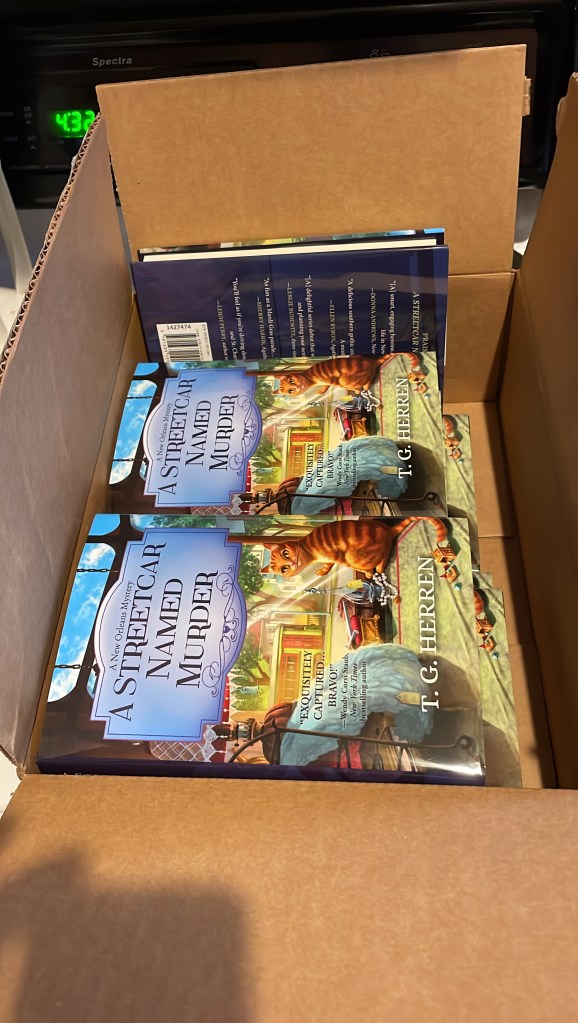
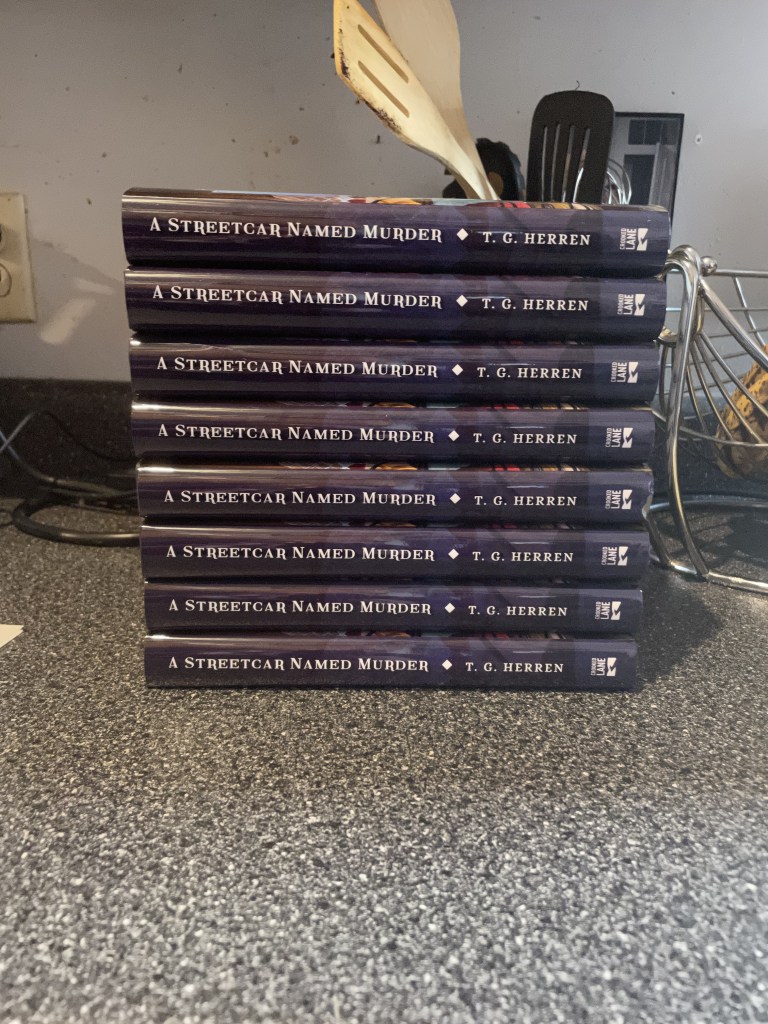
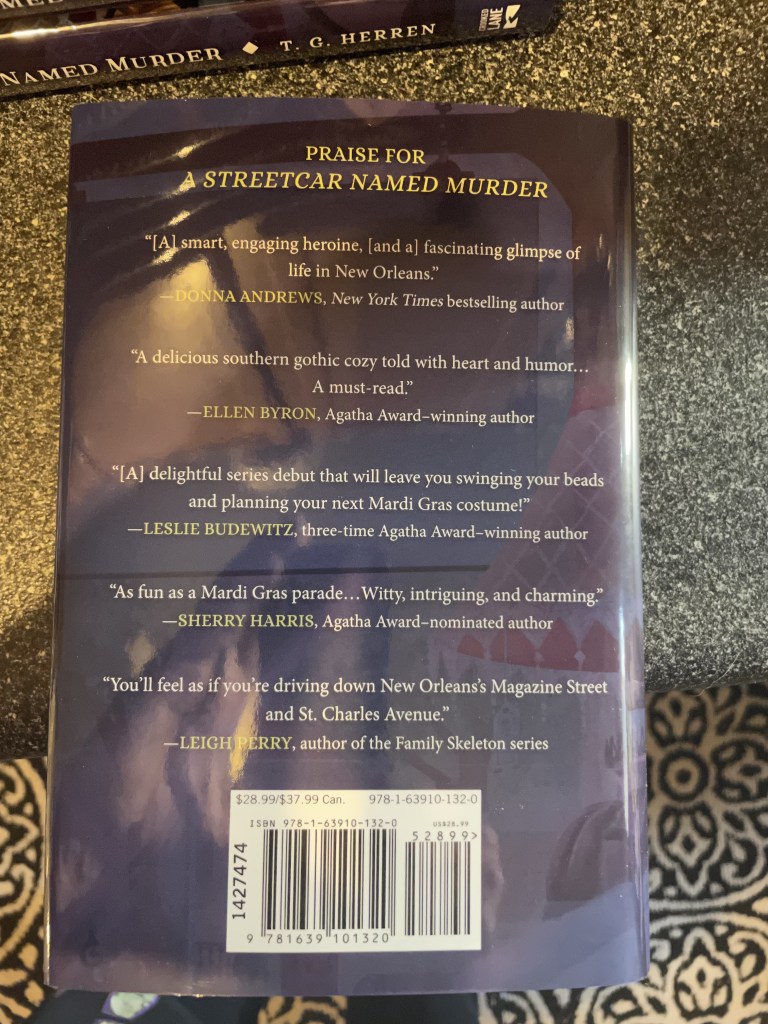
If you follow me on social media you will know already that I got my box o’books of A Streetcar Named Murder this week. The book looks stunningly beautiful, seriously; I couldn’t be more pleased with everything about the book’s packaging. The cover is gorgeous; and stacked up together they look especially gorgeous, as you can see in these delightful images from my kitchen counter.

So, Greg, why did you write a cozy mystery?

The same reason I write anything–primarily because I wanted to, and to see if I could, you know. actually write one. I’ve always liked them–I love traditional mysteries, always have–and have always admired how authors pull off the crime aspect of the story. Sure, there’s a bit of an imaginative stretch required to read a series–how realistic is it that an every day citizen will continually get involved in the solving of a crime, through no fault of their own? But…no one bats an eye about the realism of private eye series, and let’s face it: private eyes involved in murder investigations are just as rare. They spend most of their time on insurance claims or, you know, infidelity. Likewise, police investigations are often very straight-forward, without the usual twists and turns and surprises a writer needs to include to keep the reader turning the pages. The Scotty series–despite him actually becoming a licensed private eye, fits more into the cozy genre than it does the private eye; for one thing, it’s funny, and for another, Scotty is never hired, he always stumbles over a body somehow–to the point that it’s almost a running joke in the series.

I had always wanted to write a mainstream series centered around a straight woman, to be honest. I mean, let’s face it, I’ve done that queer mystery, both series and stand-alones, and I always like to keep my work fresh and interesting for me–I cannot imagine the hell writing something that bores me would be. Early on, before I sold my first book, a major figure in the crime fiction world told me that every so often she wished she could write something else, but “all anyone wants from me is *series character*,” but very quickly added, “But I’m still grateful people want that.” I always remembered that–obviously, I still do–and so while I would be eternally grateful were I ever to achieve that level of great success, I tried to always diversify my writing so I’d never get bored. The Chanse series was very different from the Scotty series; the stand-alone novels are rarely set in New Orleans; and so on.

I’ve tried spinning off my Paige character from the Chanse series into her own series; I always liked the character and thought she was a lot of fun and could carry her own stories quite nicely. I still think so, but audiences didn’t respond to her when I did finally give her those own stories–but there could have been any number of reasons why that didn’t work. The books were marketed and sold as cozies–which I think was a mistake, because I didn’t write them as cozies. Sure, Paige was a single woman, working for Crescent City magazine and a former crime reporter for the Times-Picayune, which gave her some credibility as an investigator, but Paige was sharp-tongued and foul-mouthed. Had I known that the books would be marketed to the cozy audience, I wouldn’t have used Paige–she was too centered in my head as who she was for me to change her significantly in her own series–and would have simply come up with someone new. The books were also electronic only, and oddly enough, my readers tend to prefer to read me in print hard copies.

I had actually tried writing a cozy series before–I had this great idea for one, about an English professor at a university in a fictional Louisiana town on the north shore (based on Hammond); I called it A Study in Starlet and wrote a strong introductory chapter, trying to channel my inner Elizabeth Peters/Vicky Bliss; sarcastic but not bitchy, but it never got anywhere. I actually became rather fixated on my fictional Hammond (which I called Rouen, pronounced “ruin”, and I did want to call one of the books The Road to Rouen), which I may still write about at some point–I never say never to anything–but I am digressing. But I always had it in the back of my head that I should try writing a mainstream cozy at some point in my career. And this came about in a very weird way–it’s a long story–but I wound up pitching the idea I had to Crooked Lane and they offered me a contract, which was quite lovely. (Incidentally, I signed the contract electronically on the Friday before Hurricane Ida; the last email I got from Crooked Lane that Friday afternoon after signing the contract said you’re going to be getting some emails from the team next week so keep an eye out for them and welcome aboard! So, of course the power went out on Sunday morning…)

I originally was going to write about a costume shop. There’s one across the street from Paul’s office that has a showroom and an enormous warehouse; they do a lot of costume work for film, theater, and television, which seemed like a great backdrop for a series with all kinds of potential stories for the future. Crooked Lane didn’t like that, and asked me to come up with something else, so I walked down Magazine Street writing down the kinds of businesses I saw. An antique shop was one of them, and that was what they liked. My working title for the book was Grave Expectations, because it involved an inheritance, but they didn’t like that title either, and I reached back into my archives for a title for the original spin-off idea I had for launching the Paige series–I wrote like 100 pages of the first Paige book in 2004 and it never got used–and grabbed the title from it: A Streetcar Named Murder, and hence, the title was born.

And…I had three months to finish the book, as they wanted it by January 15th. And of course there was the power situation in New Orleans, and…

Heavy sigh. I will leave the rest of the story for another day and time.

I slept really well last night; woke up again at five and since it wasn’t the alarm yanking me out of the clutches of Morpheus this morning, I feel rested. I was very tired last night when I got home; I hit the wall around three yesterday afternoon and when I got home it was the easy chair for me. We watched more Big Mouth, and then I retired to bed around ten. I am working at home tomorrow, so am hopeful this will be a good weekend for writing. I do want to watch both the LSU-Arkansas and Alabama-Mississippi games this weekend–as they could determine who wins the SEC West for the season (and I cannot believe that LSU is in the driver’s seat; I was hoping for an 8-4 season and feared that was unlikely), but I also need to get caught up on my writing and everything. Yikes.

And on that note, I am heading into the spice mines. Have a lovely Thursday, Constant Reader!

The Ledge

And here it is, Tuesday morning and dark outside my windows as I have my morning coffee preparatory to getting ready for work. It’s getting to be that time of year where I drive to and from work in the dark, which is always a bit debilitating; you feel like you’ve spent the entire day at work when you don’t get to spend any time outside–even if just going to and from work–in the sunshine. The weather has cooled here a bit over the last week, which has been lovely (and early in the season for coolness). My back is much better–there’s still some tightness and slight pain involved–but I think i can actually head to work today and not be in the kind of pain I was in last week, which is kind of nice. It’s still there, but I am learning how to not trigger it–the irony of which is that I am having to use good posture at all times so as not to inflame the pain, which means had I been using good posture most of my life I might not have this problem right now.

But it’s something I can live with today; something I wasn’t so sure about as recently as Sunday. So taking the days of rest, with the alternating hot and cold, was probably a very smart thing to do. I will be taking the generic Ben-Gay with me to work today, too–just in case. But I can sit comfortably without it, which is something I can honestly say was not the case as recently as Sunday. And now of course I have to start digging myself out from under–which is a lot of catching up I need to get done. I also have to do some digging around and figure out what is missing from some projects that I need to get finished, and I also need to get back to writing. There’s an anthology deadline next month–more like three weeks from now–that I wanted to submit something to, but I seriously doubt I am going to be able to have the time or the energy to revise anything the way I want it to be revised to submit to this anthology, so I am probably going to have to let it go once and for all.

We watched Cold Blooded: The Clutter Family Murders last night, a documentary series about the In Cold Blood murders and of course Truman Capote’s famous book that was written about the case (which remains, to this day, one of my favorites) as well as the film made from the book (which I’ve never seen, but Paul’s friend the actress Brenda Curran was in, playing Nancy Clutter). I’ve been to both Holcomb and Garden City, back when I lived in Kansas and when I also had no idea Holcomb was where the crimes happened (I didn’t read In Cold Blood until I lived in California). One of the things I’ve always found interesting about these old rural crimes is how they always talk about how the “community changed” after it happened and how people never used to lock their doors…and everyone could just knock and enter other people’s homes. I wasn’t raised that way; my mother was very obsessive about always making sure everything was locked up–cars, homes, wherever–and used to get mad at me when, as a lazy not really paying much attention teenager used to sometimes leave the car unlocked. Paul is much the same as my mom; sometimes I forget to lock the car, and when I am home by myself I forget sometimes to lock the front door–someone would have to scale the fence, which isn’t easy, to get back to our apartment door–but that’s also a part and parcel of the false sense of security we all have about being safe in our homes. Once I am inside I am safe.

Which really isn’t true.

I spent some more time with Donna Andrews’ delightful new Meg Langslow novel last night while I waited for Paul to finish working so I could make dinner, and it’s delightful. I don’t know how she manages to do this with a series that has lasted as long as hers has; I think there may be more than twenty volumes in the series now? But each one is a delight. I love the town of Caerphilly, I love her family, and most of all I really enjoy Meg. I love highly accomplished, confident, efficient women like her; she’s yet another drily humorous main character in the vein of Elizabeth Peters’ Amelia Peabody and Laurie R. King’s Mary Russell (I really am overdue for reading another book in that series) and while my own poor Valerie is hardly in the same vein as these remarkable women characters, I’d kind of like to keep developing her into a series because, well, I kind of grew attached to Valerie and her friends while writing A Streetcar Named Murder, and I’d kind of like to revisit them again in another book. I have a title and an idea for the next book in the series, should Crooked Lane want another, and while I felt fairly confident they’d hate the title, I just this weekend came up with a potentially better title for it…and now that I am writing this, i cannot for the life of me remember what that title was, nor do I think I made a note of it (which is why you should always make a note of it).

Ah, well, perhaps it will come back to me at some point.

I also woke up to proofs of an anthology I contributed a story to that has been in the works for many years now, which means the book is finally going to be released which is great news. My story is called “A Whisper from the Graveyard” and I really don’t remember much, if anything, about the story because it’s frankly been so long. But I will need to proof it–check for typos and missing words and such–which will be a nice way to get reacquainted with the story, at the very least. I vaguely have some idea about the story–I know it’s a private eye story, with a gay detective who has just tested HIV positive and it’s set in the early 1990’s, so it’s a death sentence as far as he knows–and is hired by someone to find someone else? I don’t remember–it really has been a long time since I wrote this story.

But I am also completely overwhelmed with work and being behind on everything and I really need to start making a to-do list so I can sort all this shit out and get things done that need to be done. I know I need to go back to work on Scotty and my other project; there’s any number of other things I need to get done, and I also need to start figuring out promo for A Streetcar Named Murder else no one will buy it and that will be the end of that.

The great joy of being a writer.

And on that note, I am heading into the spice mines. Happy Tuesday everyone (except Buccaneer fans)!

Louisiana Bayou

The traditional mystery, to quote Rodney Dangerfield, “don’t get no respect.”

I’m not sure why that is, to be perfectly honest. I do have my suspicions and opinions, most of which inevitably circle back to the root of so many societal ills: misogyny. Traditional mysteries, often called (both respectfully and derisively) cozies, are, as a general rule, primarily written by women, tell women’s stories, and theoretically, the primary market for them is women. So naturally, much like the entirety of the romance genre, it is subject to derision, not being taken as seriously as darker works, and often is shut out during awards seasons (the primary exception being the Agatha Awards, given at Malice Domestic, which is primarily focused on the traditional mystery). They generally also don’t get a lot of review coverage, because women mystery writers also traditionally don’t get their fair share of print reviews in major publications, either–and the ones who usually do trend to the darker side.

I will also admit that I, too, am guilty of being more drawn to the darker, harsher, more noir side of crime fiction in my reading–which is kind of ironic, as one of my favorite series writers of all time is Elizabeth Peters, who didn’t write dark but rather light-hearted and funny; the Amelia Peabody series is one of the all-time greats. I also love Ellen Hart’s and Donna Andrews’ and and Miranda James’ and Elaine Viets’ series; but a few years ago I realized I wasn’t giving the subgenre enough love and attention, so focused on consciously reading more traditional mysteries. I have since discovered other terrific traditional mystery writers by expanding my scope and not just reaching for the next thing that sounds interesting. I discovered Kellye Garrett’s terrific Detective by Day series, Leslie Budewitz, Sherry Harris, Julia Henry, Hannah Dennison, and far too many others to name. (Also, shout outs to Raquel V. Reyes and Mia P. Manansala for outstanding new series over the last year or so.)

And then of course there’s Ellen Byron.

In some cities, a middle-aged woman dancing down the street dressed as a cross between a 1970’s disco queen and Wilma Flintsone would be unusual. But this was New Orleans, where the unusual was the everyday.

The woman dancing past Ricki James-Diaz, dodging the broken concrete in the Irish Channel’s worn sidewalks, happened to be her landlady, Kitty Kat Rousseau, who lived on the other side of Ricki’s double-shotgun cottage on Odile Street. “On your way to rehearsal?” Ricki called to Kitty from the porch. Kitty belonged to the ABBA Dabbo Do’s, one of the Crescent City’s many synchronized dance and marching troupes that entertained at parades and special events.

“You know it, chère.” Kitty did the hustle, then paused. “Whew, spinning made me dizzy.” She leaned against a lamppost, trying to regain her equilibrium. “I’m glad you caught me. I wanted to wish you good luck today.”

Ricki used the back of her hand to wipe a drop of perspiration from her forehead, the result of nervrs, not the mid-August heat. “Thank you so much.”

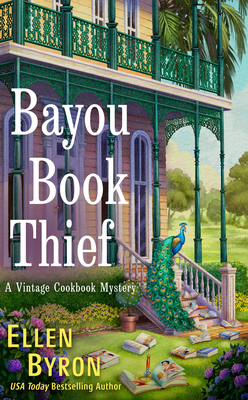
I’ve been meaning to read Ellen Byron for quite some time now; I’m not really sure why I haven’t. Ellen and I met electronically, but I am not exactly sure I remember precisely how; a Facebook group, or something. I don’t know, but Ellen–who graduated from Tulane University and whose daughter was attending Loyola–wanted to meet for dinner on a trip here to get her daughter settled into an apartment and the rest was history. She has written two series already–the Cajun Country series (which I need to read) and the Catering Hall mysteries as Maria DiRico. She’s doing a prelaunch party for the first in her new series, the Vintage Cookbook series, the first of which is called Bayou Book Thief. She graciously asked me to do the event with her, and as such I spent yesterday afternoon reading the book…which is absolutely charming.

The premise of the book is the Ricki (full name: Miracle Fleur de Lis James-Diaz, thank you very much) has returned to New Orleans to escape two awful experiences: the freak accident death of her husband, a viral Youtube video-maker (think Jackass) who choked to death doing one of his stunts, and of course the video of his death–he filmed it live–has gone viral. If that isn’t bad enough, her employer (she curated his collection of rare first editions) was convicted of a massive Bernie Madoff-like fraud scheme. Having been born in New Orleans and lived there her first seven years of life till her adoptive (yes, she was abandoned at Charity Hospital as an infant) parents moved to Los Angeles, she has decided to return to the city of her birth, maybe find her birth mother, and start a new business–selling vintage cookbooks and vintage serving ware in a shop in the Bon Vee museum, which used to be the home of one of the city’s legendary restauranteurs, Genevieve “Vee” Charbonnet. The board president approves her idea, and the story is off to the races as Ricki gets to know her co-workers, the Bon Vee family, from administration to the tour guides to the docents, as well as those who work in the little café on the grounds.

Soon, one of the more irritating tour guides (let’s face it, he’s a dick) turns up dead in a trunk and dropped off at the mansion with some boxes of donated books for the shop. Ricki herself has had a few run-ins with the victim, and she’s also the one who finds the body. Worried about whether or not she herself is a suspect, as well as what damage the murder might do to her new business, Ricki starts looking into the murder herself–while also developing a weird relationship/friendship with the female police detective looking into the case. But this murder is just one of several mysteries surrounding Ricki and her life at the mansion, and many complications that arise from her working there and her amateur sleuthing.

Bayou Book Thief is a lot of fun, and is filled with endearing, likable characters along with some marvelous observations and truths about New Orleans–watching out for tree roots as you walk along the sidewalks; the horror of your air conditioning going out while it’s still hot; being in a bar during a Saints game; and above all else, that the city is really a very small town at heart. I really enjoyed it, and look forward to the next in the series, Wined and Died in New Orleans.

Join us tonight at five pm at Blue Cypress Books. It’ll be a fun time.

Mary Mary

I have always loved strong female characters, having cut my reading teeth on Nancy Drew, Trixie Belden, Vicki Barr, the Dana Girls, Judy Bolton, and Cherry Ames, just to name a few. As an adult reader of mysteries, two of my favorite series are Elizabeth Peters’ Amelia Peabody series (simply the best) and Donna Andrews’ Meg Langslow series (also a gem of a series); primarily because I love the characters of Amelia and Meg both so very much. They are both fiercely intelligent women with a very dry sense of humor, and are the kind of strong women that everyone around them comes to depend on for support–and droll wit. The death of Dr. Barbara Mertz (who wrote as Peters AND as Barbara Michaels) ended the Peabody series forever, much to my heartbreak; the Meg Langslow series is going strong still, so I am hopeful that I will have years and years of reading pleasure yet to come from Donna.

And then, last year I discovered Mary Russell.

The envelope slapped down onto the desk ten inches from my much-abused eyes, instantly obscuring the black lines of Hebrew letters that had begun to quiver an hour before. With the shock of the sudden change, my vision stuttered, attempted a valiant rally, then slid into complete rebellion and would not focus at all.

I leant back into my chair with an ill-stifled groan, peeled my wire-rimmed spectacles from my ears and dropped tjem onto the stack of notes, and sat for a long minute with the heels of both hands pressed into my eye sockets.

I was already a fan of Laurie R. King from her brilliant Kate Martinelli series, about a lesbian police detective. (If you’ve not read that series, you need to–it’s one of the best of the last thirty years.) I was reluctant to read the Mary Russell series, as Constant Reader may remember from my previous posts about earlier books in this series; for any number of reasons, but primarily not ever really getting into the Sherlock Holmes/Conan Doyle stories. This shifted and changed when I was asked to contribute a Sherlock story to Narrelle Harris’ The Only One in the World anthology; this required me to go back and do some reading of Doyle, and having worked with Laurie R. King on the MWA board, I decided to give her feminist take on Sherlock a go.

And I have not regretted that decision once.

Mary has stepped up to replace Amelia Peabody as one of my favorite on-going series; I love the character–a strong-minded, fiercely independent woman of no small intelligence who is more than capable of going toe-to-toe with Mr. Holmes. Theirs is, despite the age difference, a true partnership of equals; I love that Holmes, in King’s interpretation of him, isn’t quite so misogynistic or incapable of feeling–which I don’t think I’ve ever seen in a male-written version. I like King’s Holmes; the strong female character who is his equal was the perfect solution to whatever misogynistic issues I may have had with other interpretations. I also love that Russell is also pursuing a life of the mind; her studies into theology at Oxford are not just asides to add color and flavor to the character but are just as important to whom she is as a character as the love interest/relationship with Holmes. As I also have an amateur’s curiosity into the history of Christianity and how the faith changed and developed throughout the centuries following the New Testament stories…how that was shaped and influenced by men with not the purest of motives…is something I’ve always been interested in.

I think the first book that challenged Christian orthodoxy in a fictional form that I read–the first time I became aware of the possibilities that the BIble wasn’t actually the pure word of God and had been edited and revised repeatedly in the centuries since Christ ostensibly lived, died and was resurrected–was, of all things, a book by Irving Wallace called The Word (Wallace isn’t really remembered much today, but he wrote enormous books of great length that were huge bestsellers, and the subject matter and style of the books was essentially that they were very bery long thrillers: The Prize was about the maneuvering to win a Nobel; The Plot was about an international conspiracy to kill JFK; The Second Lady was about a Soviet plan to kidnap the First Lady and replace her with a lookalike who was a Soviet agent; etc etc etc). The premise of The Word is simply that a new testament, a document hidden away for centuries in a monastery in Greece, claims that not only did Jesus not die on the cross but went on to live for many decades, preaching his own ministry and even visiting Rome. This, of course, is a cataclysmic document–it would change everything everyone had ever known and believed…if it is indeed authentic.

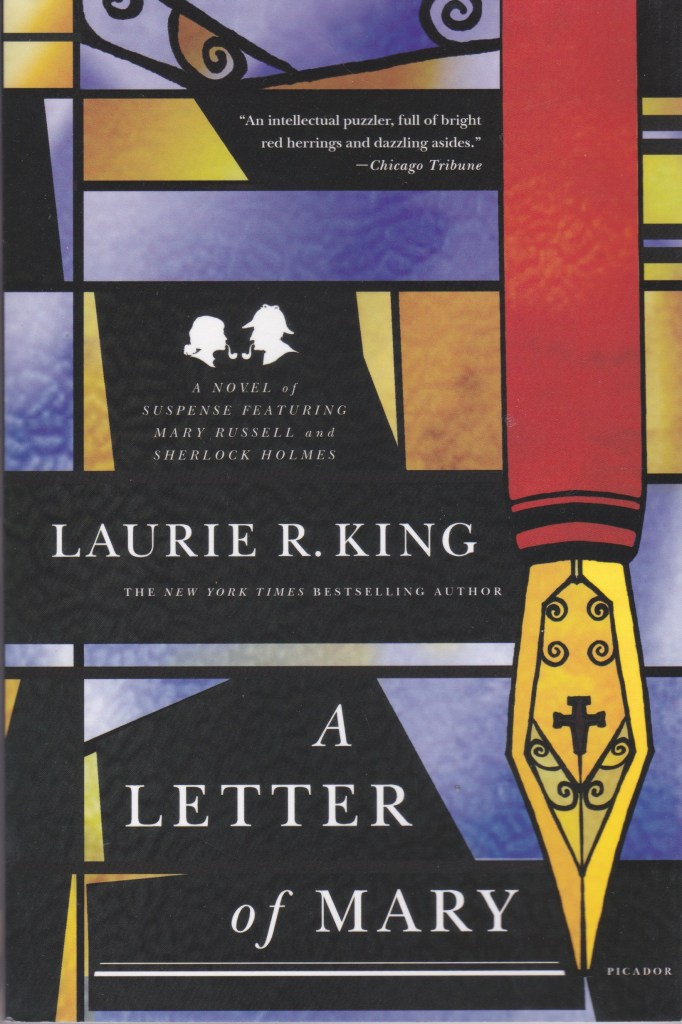
I’ve always loved a good thriller with a base in theology, ever since; and A Letter of Mary is just that, even if more of a mystery than a thriller. The role of Mary Magdalen has been questioned a lot in the last few decades–not the least reason of which is Holy Blood Holy Grail–an interesting concept if one that has been proven to based in a falsehood in the times since (or was THAT part of the Vatican’s plot?)–which inevitably led to Dan Brown’s The Da Vinci Code. I don’t find the idea that the Magdalen was a beloved disciple of Jesus–and that she may have been his favorite–a reach; likewise, there’s nothing I’ve ever seen in the actual New Testament that essentially says she was a prostitute, a “fallen woman.”

This book begins with Russell despairing over her research only to receive a letter that she and Holmes are going to be receiving a visitor–someone they met during their time in the Holy Land some time earlier–glossed over in The Beekeeper’s Apprentice but apparently explored more deeply in O Jerusalem! The visitor, an older heiress of no small means who is fascinated with archaeology and has been funding digs in the Holy Land, presents the pair with a gift as well as an ancient letter, unauthenticated, which is ostensibly a letter from Mary Magdalen some years after the death of Christ, written to a sister as the city of Jerusalem falls under seige by the Romans during the Jewish Wars, around 70 AD, that saw the sack of the city and the start of the diaspora; which makes it very clear that, if authentic, the Magdalen was one of the disciples and heavily involved in the ministry of the Christian church. Their guest returns to London, and is killed when she is stuck by a car the following day. Holmes and Russell sniff around the crime scene and find evidence that the old woman was murdered…but by whom? Why? Is this about the letter from Mary?

King always tells a great story–you never can go wrong with one of her books, really–and the characters are so well-defined, so real, that even if she didn’t tell a great story, you want to read about those characters more, get to know them better, and cheer them on to their successes and sympathize with their failures. Her writing style is also a joy to read; the Mary Russell voice is so different and so clearly distinct from Kate Martinelli that you can’t not marvel at her mastery.

The next book in the series is The Moor, and I am really looking forward to it.

Salvation Theme

Reading has always been my escape from the realities of the cruel, cold world. As long as I can remember, I found solace in books–I could always open a book and escape from realities I didn’t want to participate in, or when the world became too much, there was always the comfort of a story about other people and another world where I could go to get away from it all.

When I was a kid, I was more interested in stories about women and girls than I was in stories about boys; I couldn’t really relate to boys as easily as I did to girls. This was, I think, a part of the strict gender divide in the society and culture I was born into; there were specific and clear differences between things for boys and things for girls. Girls played at housekeeping and mothering; boys were supposed to be outdoorsy and adventurous and active. I was not an outdoorsy, adventurous, active little boy; all I wanted to do was be left alone with a book–and the more my parents tried to get me interested in boy things the harder I stubbornly resisted. I never understood why it was so wrong that all I ever wanted to do was read.

I think that part of the reason I’ve always preferred books by and about women are because I can relate to them more, if that makes sense. As someone who never became vested in what society viewed as what masculine behavior is, those behaviors–not always necessarily toxic, but certainly steeped in it–inevitably make me lose interest in the character and their story.

Likewise, one of the reasons I preferred Mary Stewart to Victoria Holt and Phyllis A. Whitney (still love Holt and Whitney, though) is because her heroines weren’t passive; they didn’t sit still for being victimized or playing the victim but rather took charge of the situation and were just as capable as any man. This is why one of my favorite fictional series characters of all time were those created by the great Elizabeth Peters: Jacqueline Kirby and Vicky Bliss were also take-charge characters who didn’t suffer fools gladly, and of then there’s her creation who may be my favorite series character of all time: Amelia Peabody. God, how I love Amelia Peabody. Peters’ death was a blow for me; knowing there would be no more books with Peabody and Emerson and Ramses and Nofret and Walter and Evelyn and David….

But then I had the enormous good fortune to discover Mary Russell.

I sat back in y chair, jabbed the cap onto my pen, threw it into the drawer, and abandoned myself to the flood of satisfaction, relief, and anticipation that was let loose by that simple action. The satisfaction was for the essay whose last endnote I had just corrected, the distillation of several months’ hard work and my first effort as a mature scholar: It was a solid piece of work, ringing true and clear on the page. The relief I felt was not for the writing, but for the concomitant fact that, thanks to my preoccupation, I had survived the compulsory Christmas revels, a fete which ha reached a fever pitch in this, the last year of my aunts controls of what she saw as the family purse. The anticipation was for the week of freedom before me, one entire week with neither commitments nor responsibilities, leading up to y twenty-first birthday and all the rights and privileges pertaining thereto. A small but persistent niggle of trepidation tried to make itself known, but I forestalled it by standing up and going to the chest of drawers for clothing.

My aunt was, strictly speaking, Jewish, but she had long ago abandoned her heritage and claimed with all the enthusiasm of a convert the outward forms of cultural Anglicanism. As a result, her idea of Christmas tended heavily toward the Dickensian and Saxe-Gothan. Her final year as my so-called guardian was coincidentally the first year since the Great War ended to see quantities of unrationed sugar, butter, and meat, which meant the emotional excesses had been compounded by culinary ones. I had begged off most of the revelry, citing the demands of the paper, but with my typewriter fallen silent, I had no choice but crass and immediate flight. I did not have to think about y choice of goals–I should begin at the cottage of my friend and mentor, my tutor, sparring partner and comrade-in-arms, Sherlock Holmes. Hence my anticipation. Hence my trepidation.

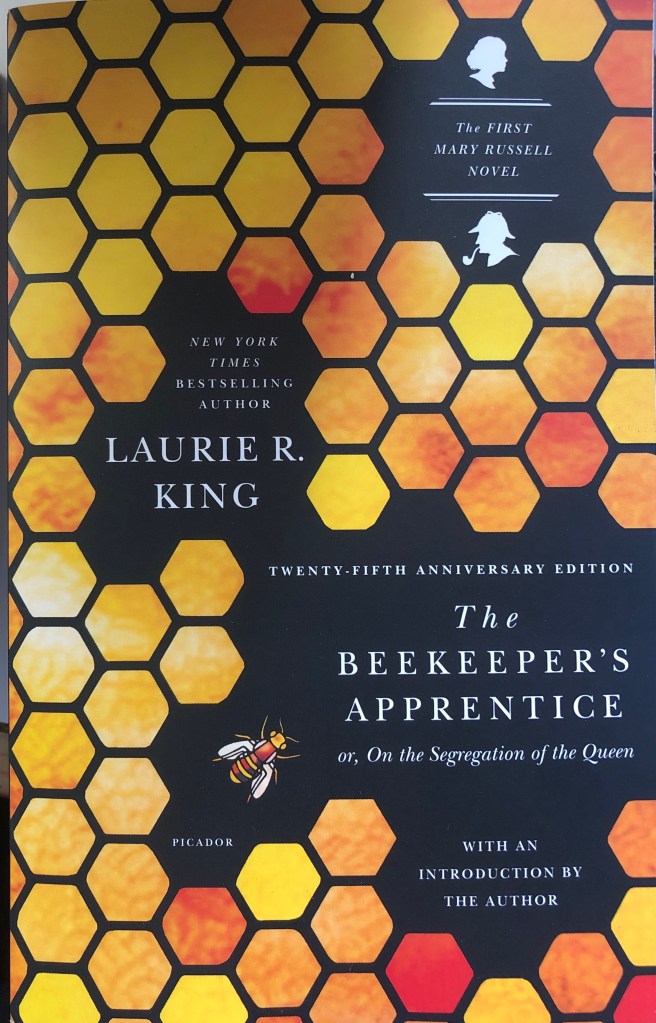
I first encountered Mary Russell last year when I read the first of her adventures with Holmes, The Beekeeper’s Apprentice, which took place over several years and was really a loosely connected series of different stories that showed the growing bond between the teenaged girl and the retired detective. Her wit, her style, her fierce intelligence–and her refusal to be a sidekick or passive made me fall madly in love with her–despite my long-held antipathy towards Sherlock Holmes. (I have since read more of Doyle, and find the antipathy I once felt fading; in no small part, I think, because last year I had to write my own spin on Holmes and Watson, which really changed everything I thought, felt, and believed about them.) I’m not sure what made me select the second Mary Russell to read recently; I do intend to read them all, of course, but there are sixteen or so (!) of them, and then there are King’s stand alones, and I’d also love to revisit her Kate Martinelli series, which is how I first came to read King in the first place. But I digress.

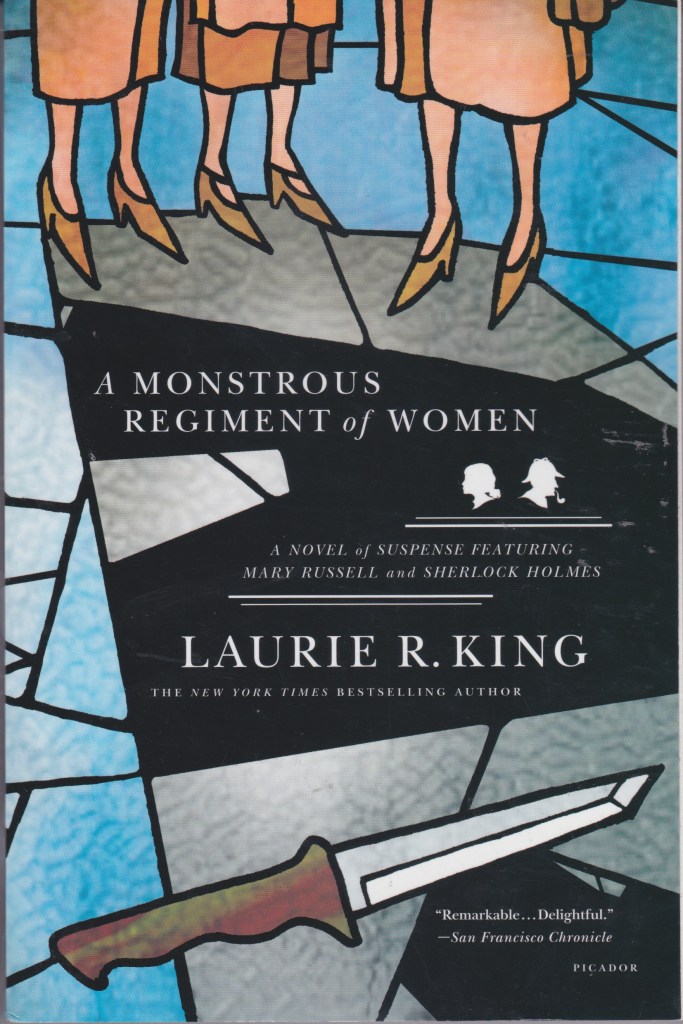
A Monstrous Regiment of Women is, of course, a terrific title; and I knew, of course, the source for it: the tedious Scot religious bigot John Knox’s 1550’s pamphlet primarily attacking Queen Mary I of England (aka Mary Tudor), “The First Blast of the Trumpet Against the Monstrous Regiment of Women,” in which he blamed the sad state of Christendom at the time at the irreligious and unprecedented amount of women in power at that time in Europe–and, as I have said many times before, the sixteenth century had more powerful women running countries than any century before or since (and I’ve always wanted to write a history of that century, focusing on those women, and using that very same title King used here). So, going into the book, and knowing that Mary was studying theology at Oxford in the latter half of the first book, I assumed (correctly) that this book would have religion, and women, at its heart, so I sat down with the book rather eagerly.

It did not disappoint.

The book opens, as noted above, around Christmas time, just before Mary finally achieves her majority and comes into the inheritance her benighted aunt/guardian has been enjoying herself with since Mary’s family perished in an auto accident when she was fourteen. Rather the celebrate the holiday with her aunt and the aunt’s hangers-on, Mary escapes the house and goes in search of her old comrade, Holmes. This leads her to London and an encounter with a friend from earlier in her education at Oxford, which in turn leads her to the New Temple of God and its leader, Margery Childe–charismatic, suffragette, and also a religious mystic. (I was put in mind of Aimee Semple McPherson, who has always fascinated me and I’ve always kind of wanted to write about.) But there’s something unholy going on at the New Temple, and perspicacious Mary can’t quite put her finger on what’s wrong there–but it intrigues her and she gets deeper and deeper into what’s going on there.

There’s also a switch-up in the dynamic between her and Holmes in this book, but it is also to King’s credit that the groundwork for this was laid almost from the very beginning of The Beekeeper’s Apprentice, and it neither seems out of place or untoward, either for the story or the characters–and despite the awkwardness this change-up creates between the two of them in their all-too-brief encounters in the story (for make no mistake about it; this is clearly Mary’s story, and Holmes no more than a supporting player on this stage), it makes sense and it also answers one of the questions the first book aroused in me; how can King keep writing about this opposite-sex pair through an entire series without the question of chaperoning and so forth not coming up, or them simply remaining good friends while the deep and growing affection between them is so plainly right there on the page?

The writing is masterful and intelligent, and the story–with its interesting twists and turns, along with some exciting ventures along some of the more disreputable sections of London–is so well paced and plotted that you simply cannot put the book down. I was, quite literally, only on chapter three when I picked the book up again yesterday morning; within moments I was a captive of King’s magic and completely incapable of putting the book down–to the point that I resented having to take breaks to get coffee or go to the restroom or feed the cat. I had decided, when I sat down with the book, that I had to stop reading at noon so I could get back to my own manuscript. Noon came and went, and still I kept reading. At one I flipped to the back to see how many more pages were left, and decided that it was ridiculous and incomprehensible to stop reading so close to the end, and I wouldn’t be able to completely focus on my own while I was so worried about how Mary was going to escape the peril in which King had placed her. So…rationalizing if I don’t finish my own editing today I can always finish tomorrow I plowed forward.

And–without spoilers–I will say King did an incredibly accurate and chilling depiction of how drug addiction takes hold of people.

She also explores the question of women’s role in the Christian religion beautifully, weaving these theological questions and issues seamlessly into the narrative. Each chapter begins with a quote about just that–either from the Bible or the great Christian philosophers, exposing the vicious misogyny that has poisoned that faith almost from the very beginning.*

I loved this book, loved loved loved it, and am really looking forward to the next, A Letter of Mary.

If you’ve not yet started this series, wait no more.

*I also made note of these quotes so I can shamelessly use them myself!

Exit

Thursday morning and errands and things to get done this morning. I am giddy this morning because I actually slept deeply and well last night, and finally feel rested in every way–physically, emotionally, and mentally–and Christ, if I could only start every day well-rested like this I could conquer the world. This morning I have to take Paul to Metairie for some medical things–nothing serious, y’all, calm down–and so I scheduled my work hours so I could have the morning off today. It’s also a gorgeous day outside, looks like, so huzzah for that–last week I reached the point where I thought it was never going to stop raining, seriously. Much as I love the heavy rains of New Orleans and our marvelous thunderstorms–five consecutive days can be a bit much.

I was very tired after work yesterday, but I managed to force myself to do things that don’t require much brain power–laundry, two loads of dishes, straightening up, cleaning counters and filing and so forth–to get it out of the way so I don’t have to waste any free time on the weekend doing it. I never am entirely sure how my kitchen gets so out of control between Monday and Wednesday, really, but it does and then I wind up spending time on the weekends getting the house under control, which is irritating. But with me feeling rested today, there’s absolutely no reason I can’t get some reading and writing finished this weekend; when I finish my work-at-home duties today and tomorrow, I can read and work on the apartment–hopefully finishing that all off tonight, so tomorrow night I can just write when I finish with the condom packing–and be nice and rested and ready to go when the weekend rolls around.

We finished watching The Capture last night, and while it didn’t have the ending I wanted it to have, the ending was absolutely and completely believable and realistic; anything else would have felt forced; tacked-on as an audience-pleaser. And while the ending really was cynical…it felt real. The show really dealt incredibly well with the dichotomy of how difficult it can be to keep the population safe from threats–which can sometimes come into conflict with the individual rights and freedoms individuals have from state intrusion. It’s murky; is it okay to trample of individual rights to protect the many? And once you start down that road, isn’t it easy to abuse that power, especially when there is no oversight from the other branches of government? We really enjoyed the show, and I was incredibly glad they didn’t cheat the ending. It also examined these morally complex issues really well, and I also liked that the characters were capable of compromising their own ethics and values when necessary to get the end result they desired. It was a much more complex and cerebral thriller show than most of its contemporaries. I do recommend this highly.

Of course, now that we’ve finished it, now begins the search for something new to watch. Yay.

Well, I never finished writing this yesterday or posted it; something that happens rarely but does sometimes happen. I had to stop to run the errands, and when I got home I had to start working, and since I’d taken the morning off I had to work later last evening than I usually do, so I never got back around to finishing this. Sorry about that, Constant Reader. But it was a good day, overall, and I also got another good night’s sleep last night, which was also quite marvelous. I am working at home al day today–condom packing and some data entry–and on my lunch break I need to run to the bank to deposit a royalty check (huzzah for royalties!) and pick up some things at the grocery. Sleep makes such a difference to my quality of life, seriously. We also got new pillows at Costco yesterday (one of the errands) and they are wonderful, absolutely wonderful. After work today I am going to the gym, and then settling in to continue watching the show we discovered last night on Acorn: Line of Duty, which is a look at the internal operations of a British police station. It’s quite good, and the plot is incredibly interesting; Anti-corruption is looking at a multiple Officer of the Year winner because his case-closing record is a bit too good to not have been manipulated in some way; we see things from the perspective of the award-winning officer (who is, indeed, too good to be true) and the investigator looking into him–who’d recently been sent down from anti-terrorism because of a heinous mistake in which an innocent man was killed–and it’s indeed very well done. There are also four seasons, so we’re set for a few nights, at any rate.

While Paul was seeing his doctors and so forth yesterday I started reading Laurie R. King’s second Mary Russell novel, A Monstrous Regiment of Women, and I cannot even begin to tell you, Constant Reader, how much you should be reading this series. It’s so well done, so well written, and the way King brings Mary and Sherlock Holmes and their post World War I world to life is so beautifully done and compelling…give her all the awards, seriously. These novels remind me so much of my beloved Amelia Peabody novels by the deeply missed Elizabeth Peters that I wish I had discovered them earlier. But the lovely news is King has an enormous backlist, and I am looking forward to catching up on the entire series at leisure. I’ve also been appreciating Holmes more these days–mainly because I wrote my own Holmes story last year for the first time, and kind of want to do it again; there really is a book idea in Sherlock Holmes and the Axeman (but the Axeman was never caught, alas), and the case lasted over a year….and since the period I’ve dropped Holmes into is that same period…it would be weird if Holmes wouldn’t insert himself into the Axeman case. It’s such an interesting story, and so New Orleans….but fictionalizing it is the puzzle, isn’t it?

This weekend, I have to get really moving on the revision/final edit of Bury Me in Shadows–it’s due next Saturday, and while I can certainly take next Saturday all day to work on it (I tend to turn things in very very late on the day they are due), I should think I need to get the majority of the work out of the way already. It’s going to be a big week anyway–the Edgars are being awarded on Thursday–but constant juggling and multi-tasking seems to be my stock in trade these days (well, it has been for a long time; sometimes it feels like I am juggling chainsaws), so it’s little wonder I am always worn out and tired.Bury

Plus, my neuroses always wear me out–and there are plenty of them.

I also, while making condom packs yesterday, fell into a new Youtube wormhole, in which this rather cute young straight guy was listening to Taylor Swift for the first time, and it was quite entertaining to see him growing from someone who was vaguely aware of her into a massive fan by the time he’d listened to about six of her songs–by the last video he was a full-fledged Swiftie (to the point where he actually said “I’m not straight or bi or gay or pan, I am a Taylor-sexual” which made me laugh). I must admit I was much the same–someone who was vaguely aware of her, knew she was heavily criticized and her love life was tabloid fodder, and pretty much knew her primarily for her dating life and the Kanye incident(s) ore than anything else. I do remember driving somewhere–I think it was for the Murder in the Magic City event in Birmingham; I’m not entirely sure, but I know I was driving in Alabama–with my iTunes on shuffle when a song started playing that immediately hooked me. I glanced over at the screen on my dashboard and was a little surprised: it was Taylor Swift’s “Red,” which to this day I don’t know why I had down-loaded. I replayed it three times, loving it a little more every time–it’s still one of my favorites of hers–and when I stopped for gas I checked the library on my phone and saw four more songs of hers: “Love Story, “You Belong with Me”, “Mean,” and “Shake It Off.” I recognized the last two, but had no idea what the first two were. I do remember seeing her perform “Mean” on an awards show and downloading it–it’s from the Red album, so I have to assume it was around the same time I downloaded “Red”–but I literally don’t remember those first two. (I do remember one of my co-workers at the Frenchmen Street office had been a fan, and that was how I heard “Shake It Off”).

For the record, her recent releases–including her rerecording of her Fearless album–are really good.

And on that note, tis off to the spice mines with me. Have a lovely day, Constant Reader, and I will check in with you again tomorrow.

Californian Grass

I really didn’t want to get up this morning–the bed was incredibly comfortable and loving–but Scooter needs an insulin shot every twelve hours so I hauled myself out of bed to make sure he got his shot when he needed it, and then I was up, so I stayed up. I am feeling incredibly lazy this morning as well–never a good sign, ever–particularly as I have so much to get done today. Our HVAC system was acting strangely yesterday–it didn’t automatically turn off the way it was supposed to when it reached a set temperature; at one point it was 60 degrees downstairs, so I turned it off. This morning it doesn’t feel like it’s freezing downstairs–and that’s not the hot coffee’s effect, either–so maybe it’s working the way it should now. The electricians who installed it are coming by today, so I intend to get some more information about how it works from them–I must have been doing something wrong yesterday, I would imagine. I just looked–the current temperature is what it is set to and it’s not on–so I think maybe I didn’t have it set on fan auto but just on fan, which I think means it will just run and run and run.

Yesterday was a thrilling day of data entry and condom packing; I got the date entry done and so this morning will be reading up on things on-line about developments and so forth with the COVID-19 virus before repairing to my easy chair to make condom packs and watch movies or binge a show (I still am looking at you, Dare Me, for a rewatch all at one time to see what I missed watching weekly). Yesterday I watched Friday the 13th again, and then, as though to punish myself further, I watched Friday the 13th Part II for the first time (I grimly was considering watching the entire series, but I really don’t think I have the patience or fortitude to do so). As I watched the original again, I was struck–just as I was the first time I watched it, right around the time we got our first “smart” television–how cheaply it was made. The entire thing looked like it was filmed with a camcorder as a high school class project (but I don’t think camcorders were readily available when the film was made), the writing and dialogue is terrible, and about the only thing it has going for it is a very young Kevin Bacon (straight from his role on Guiding Light) in a bikini and having a sex scene before getting killed by an arrow coming up from below the bed through the mattress. I always forgot Bacon was in the first one of these…but I decided to watch the second because–well, I still had condom packs to make and Prime suggested it, so here we are. You can tell the first film was an unexpected hit out of nowhere, because while the acting and writing in the sequel are equally as bad as the original–you can see they had a bigger budget. Better lighting, better sets, better cinematography–all the technical aspects of making a film were greatly improved from the first film….if the acting and writing remained as bad and trite and one-dimensional. The story also left something to the imagination–how did Jason survive in the lake all those years? Is he a demon or a ghost or what? It was also interesting to see he hadn’t yet donned the hockey mask yet–apparently, this was added in the third film, which I may watch at some point but certainly don’t have the stomach for today. The cast of the second was also larger than the first, and it also never explains why Camp Crystal Lake becomes, after the last string of murders, a place for camp counselors to go get training for their jobs, and it doesn’t even look it was filmed in the same place…although the nearby town seems to be the same place, and some of the townies from the first movie carry over to the second. I never got into the got slasher movies of the time when they were popular when I was a teen–I later came to appreciate Halloween and Nightmare on Elm Street–but these films were also a bridge from the almost infantile, cheesy teen-targeted movies of the 60’s and 70’s to the teen films of the 1980’s, when John Hughes basically flipped the script on what a teen movie looked like.

Saints and Sinners begins today (well, it actually launched last night) and there’s all kinds of lovely things–panels and so forth–over the course of the weekend that are completely free to watch on the Tennessee Williams Festival’s Youtube channel. Check it out! (I’d post a link to the actual page, but there doesn’t seem to be one, which is odd….here is the link to the opening video, which will take you to the page. ) I am doing a panel on Sunday at 3 CST (don’t forget we lose an hour overnight on Sunday), talking with four women mystery writers (Carrie Smith, Cheryl Head, Carsen Taite, and J. M. Redmann) about crime and romance and inspiration and why do we all write about crimes and justice–or the lack thereof. It’s weird that both it and the Tennessee Williams Festival are both virtual this year; that’s two years in a row I’ve not spent the long weekend living at the Hotel Monteleone in the Tennessee Williams Suite (I look forward to that every year). Next year, though….

I picked up a library book yesterday: Eric Arnesen’s Waterfront Workers of New Orleans: Race, Class, and Politics 1863-1923. Yes, it’s more research into New Orleans history, but that’s a terrific time period to cover, and if I am going to continue to take inspiration from New Orleans history as well as write historical fiction set here, I need to know more about it. My current knowledge of New Orleans and its history is but a mere drop in the Lake Pontchartrain of fact and information that exists out there–I have yet to even get down to the Quarter to use any of the archives and collections housed there–and I haven’t even read all the New Orleans histories I have here in the Lost Apartment…but I am getting there. I also saw a sign that the Friends of the Library were having a book sale, so I walked back to the carriage house of the Ladder Library, and browsed briefly, conscious of time and that I was on my half hour lunch break. I found a nice hardcover copy of John LeCarre’s The Russia House and picked it up, along with a couple of better copies of several Nancy Drew and Hardy Boys mysteries to replace worn copies in my collection (for those who like to keep track of these things, the Nancy Drews were The Clue in the Diary, The Haunted Showboat, and Mystery of Crocodile Island; the Hardy Boys were The Secret of the Old Mill, The Twisted Claw, and The Hardy Boys Detective Handbook, which I’ve never had a copy of and was delighted to pick one up in such good condition, practically mint!), and then as I was rather leaving and feeling rather self-satisfied, I glanced at the “free book giveaway” table, and saw one of the few Elizabeth Peters novels I’ve never read, The Camelot Caper, and believe you me I grabbed it and kept walking. I also learned that I can donate books to the library for their sales (intellectually I knew this in the back of my brain; but only recently have I started seriously thinking about pairing down the vast library I own, and it was good to not only get this confirmation but to learn how the process works–baby steps, Constant Reader, baby steps).

And if you’re ever In New Orleans and are a bibliophile, I do recommend the Ladder Library, housed in what used to be the Ladder estate. The library and its grounds are simply beautiful, and I kind of want to set a story of some kind there.

And on that note, I’m heading into the spice mines. Maybe your Friday be lovely and fulfilling, Constant Reader.

Mary’s Song (Oh My My My)

I am the first to admit that I am a crime writer who was always kind of meh about Sherlock Holmes. I read some of the novels and some of the stories when I was in junior high, and while I enjoyed them somewhat, I was never particularly driven to go on to read the rest. I did read the Nicholas Meyer pastiches in the 1970’s–The Seven-Per-Cent-Solution, The West End Horror–but was never particularly driven to go back to Doyle. I never actually went back to Doyle (until recently; bear with me) but Holmes is so ubiquitous, so part of the crime fiction zeitgeist that it was impossible not to be aware of him and iconic parts of his canon, even the ones I’d not read–Irene Adler, Professor Moriarty, Mary who married Watson–and of course, like many others, I’ve watched a great deal of the Holmes film canon, including Young Sherlock Holmes, and am a big an of the Benedict Cumberbatch interpretation; we even watched the first few seasons of the Americanized Holmes, Elementary. But for the most part I’ve avoided pastiches and the originals, with the exception of a story here and there by one of the modern-day aficionados who worship at the altar of Sherlock.

I have always known that my lack of Sherlockian knowledge was perhaps detrimental to my career as a crime writer. Several years ago, I managed to find a gloriously beautiful hardbound edition of the Baring-Gould The Annotated Sherlock Holmes, and I have periodically dipped into it; no more so than when I was tasked to write my own Sherlock story, which became “The Affair of the Purloined Rentboy.” Writing the story, putting my own interpretation on someone else’s characters and breathing life into them to try to make them engaging and new while respecting the originals was quite a challenge for me, one at many times I felt I was not equal to bringing to fruition. The story was written and then revised with editorial input, which made the story much stronger (in my opinion) than how I’d originally envisioned it, and it also unlocked potential in my creative brain: I want to, and plan to, return to the New Orleans of 1916 that I created for iteration, and even see how some other historic stories about New Orleans could easily fit into my Sherlock world, could prove to be cases for the great brain residing at 821 B Royal Street in the French Quarter.

I also decided that reading Laurie R. King’s Mary Russell series was long overdue.

And seriously, what a treat it was.

Dear Reader,

As both I and the century approach the beginnings of our ninth decades, I have been forced to admit that age is not always a desirable state. The physical, of course, contributes its own flavour to life, but the most vexing problem I have found is that my past, intensely real to me, has begun to fade into the mists of history in the eyes of those around me. The First World War has deteriorated into a handful of quaint songs and sepia images, occasionally powerful but immeasurably distant; there is death in that war, but no blood. The twenties have become a caricature, the clothing we wore is now in museums, and those of us who remember the beginnings of this godforsaken century are beginning to falter. With us will go our memories.

I do not remember when I first realized that the flesh-and-blood Sherlock Holmes I knew so well was to the rest of the world merely a figment of an out-of-work medical doctor’s powerful imagination. What I do remember is how the realisation took my breath away, and how for several days my own self-awareness became slightly detached, tenuous, as if I too were in the process of transmuting into fiction, by contagion with Holmes. My sense of humour provided the pinch that woke me, but it was a very peculiar sensation while it lasted.

Now, the process has become complete: Watson’s stories, those feeble evocations of the compelling personality we both knew, have taken on a life of their own, and the living creature of Sherlock Holmes has become ethereal, dreamy. Fictional.

I first discovered Laurie R. King’s work with her Kate Martinelli series; I received a review copy of Night Work when I was editor of Lambda Book Report. I wasn’t familiar with the series, which caught me off guard–how did I not know about a crime series with a lesbian police detective as the protagonist?–and the book itself caught me completely off-guard. It was brilliant, so strongly written and the characters so real I was quite literally shocked to find out, many years later, that King was not herself a lesbian. I went back and read the entire series, loved each one, and was saddened when King ended the series with Book 5, moving on to a new series with Mary Russell–a series so completely different and disparate from the Martinelli series I didn’t see how it could work…and then add in the fact that it was actually a Holmes pastiche, and well, I wasn’t terribly interested.

It was sometime during the past year while working alongside King on the Mystery Writers of America board of directors (I will never get used to the big names I rub elbows with through my years of volunteering with MWA), and in the wake of my own Sherlockian writing experience, I thought, you love and admire her as a writer AND as a person, you should read her Mary Russell series.

It was quite literally one of the smartest decisions I have ever made.

I finished reading Book One of the Mary Russell/Sherlock Holmes series, The Beekeeper’s Apprentice, and as you can see from the above paragraphs, immediately I was immersed in the story. The voice, the style, everything about the character and the story was as far removed from the more hard-boiled, gritty Martinelli series, but the intelligence and warmth and humor was still there–only in a completely different manne, a completely different way. You could read a Kate book and then a Mary and easily believe it was two different authors, they are so different. This is genius, by the way; the ability to create such completely different worlds, completely different characters, completely different voices? And I was riveted by Mary Russell. By the end of the first chapter I was crazy about her–she reminds me of two of my favorite female series characters of all time, Elizabeth Peters’ Amelia Peabody and Donna Andrews’ Meg Langslow–and her warmth and intelligence and humor…she was more than a match for Holmes, and by seeing Holmes through the eyes of an intelligent, independent woman rather than an admiring doctor also helped greater humanize Holmes himself, something I never got from the Doyle works (but that could also entirely be my own failing; I am going to leisurely revisit Doyle this year methinks), and I also found myself caring about them deeply–not just about the case, but about them as people.

So, if you’re avoiding this series because you aren’t a Sherlockian, you’re being ridiculous because you can have no knowledge of Holmes whatsoever to enjoy this, and I can’t see how you can’t enjoy this if you are a Sherlockian. This is a version of Holmes that deserves to be shared on a screen–television or theater, it doesn’t matter–and I can also see any number of today’s younger actresses playing this role. And while I have only seen the television adaptation of The Alienist, but the young female detective played so brilliantly by Dakota Fanning, Sara Howard, seems to also have a lot in common with Mary Russell.

I cannot wait to read the next A Monstrous Regiment of Women, and not just because of that great title resonating with me (I’ve always wanted to write a history of the 16th century by exploring the many powerful regnant women, pilfering that title from the John Knox tract denouncing the most ‘unChristian’ fact of so many powerful women on the scene at the same time).

Color me a big fan!