Tuesday morning and I didn’t spring out of bed joyously this morning, but I feel pretty okay this morning. I slept well, just wanted to sleep longer. It rained heavily last night, which was nice–you know I love me some rain when I am safely inside and warm and comfortable. The rain was supposed to bring cold weather with it, but it’s only 51 this morning, which isn’t that terrible. My whole attitude towards cold weather is changing, isn’t it? I didn’t mind the cold in Kentucky–it was bitterly cold on Thanksgiving; my windshield froze over while I was at my sister’s–so what on earth is happening to me? #madness, indeed. Granted, it wasn’t at zero or even close to it; that, methinks, would be an entirely different story.
I did find my copy of The Postman Always Rings Twice last night, and that opening line–“They threw me off the hay truck about noon”–is such a great opening. I think the other noirs I am going to read this month will include The Falling Sparrow by Dorothy B. Hughes1, another Jim Thompson novel (I have several on-hand), a Silvia Moreno-Garcia modern neo-noir, and maybe some short stories, and/or a Cornell Woolrich novel. The well (or TBR pile, you choose) is very deep in the Lost Apartment. I also have to write my reviews of O Jerusalem and Fever Beach for the newsletter, too. Sigh. So much to write, so little time in which to do it all, y’know? But that just means I need to go back to my OCD organization and to-do lists so I can get things done.
I also managed to go over the edits and copy edits of Hurricane Season Hustle, so it is finished for me other than the page proofs. I also got a short story I sent to an anthology a few months ago back with its edits, which is also kind of cool. I always love to sell a short story, you know? I am more confident with my novels than I ever can be with my short stories, and I was thinking last night as I sat in my chair watching The Real Housewives of Salt Lake City that I may try something different when it comes to writing short stories, but I’ll inevitably always fall back on my usual way of doing things. I think we’re going to be busy in the clinic this morning, which will keep me hopping all day. I have to stop again at the store to make some groceries on my way home tonight, and the kitchen is a mess, and I have another load of dishes to unload so I can wash the ones in the sink and run the dishwasher again and the household chores never end, do they? I have measured my life by washing dishes, or something like that.
I was able to leave work early yesterday (Friday was a paid holiday for eight hours; I usually put in about four on a normal work-at-home Friday, so had to shave some time off yesterday. No, I never over-explain, do I?), and so ran by the Fresh Market on the way home and also ordered groceries for delivery. I got home and finished the laundry, put the dishes away and ran another load through the dishwasher. I got caught up on the news and have reached the point where I just shake my head in bewilderment, sadness, and disgust. Heavy heaving sigh. Is there now a light at the the end of the tunnel of horrors? One can only hope, but this dismantling of our institutions and eroding of trust in them has been –and continues to be–nothing more than a disgrace.
Our new LSU football coach, Lane Kiffin, arrived in Baton Rouge yesterday to a cheering crowd at the airport and people lined up along the drive from there to the campus. Controversy about the move continues to swirl, driven by the so-called “talking heads” who know absolutely nothing but somehow think they’re relevant? Dad and I talked about how useless and stupid so many of them are nowadays–“professional bull-shitters,” is what Dad calls them, and accurately–but they have to talk and weave and bullshit in order to earn their ridiculous salaries. I don’t care what you think about this, just as I don’t really care about anything you think, really. And all the unctuous moralizing by trash like Stephen A. Smith and Colin Cowshit and all the rest of the idiots? Spare me. All you are doing is enhancing the victim complex LSU fans and Louisiana residents already have, and they’ll just circle the wagons and it just endears Kiffin to the fans and residents here all the more. It also doesn’t hurt that he’s buddies with Coach O, either. They are billboards and signs all over the state welcoming him.
I do not remember any of that happening for Brian Kelly, mind you.
So, we’ll see how this new era of LSU football will work out for us. Everyone here is excited, as I said, and I am optimistically hopeful but cautious.
And on that note, I am heading into the spice mines for this fine Tuesday morning. Have a lovely day, Constant Reader, and I’ll be back on Pay-the-Bills Wednesday tomorrow morning.
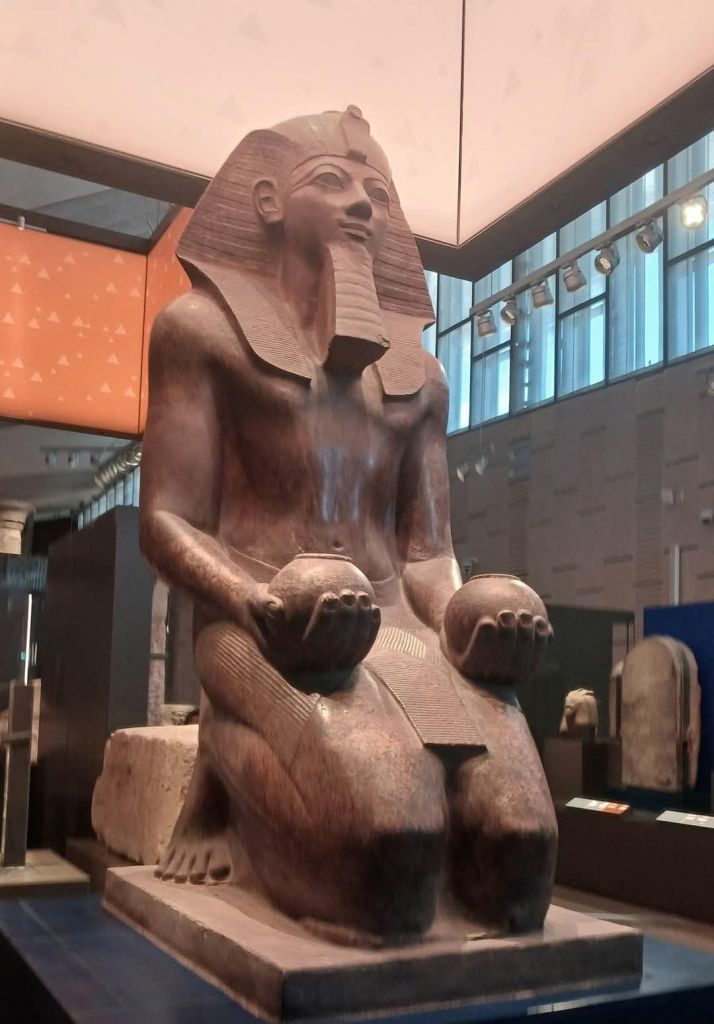
Pharaoh Thutmose III, successor to the female pharaoh Hatshepsut
Remote Friday! I slept decently last night, which was a lovely thing. Sparky cuddled with me this morning when he got hungry, which was very sweet–I’d rather wake up to a cuddling, purring kitty than to an alarm any day. I’ve always believed alarms were unnatural, forcing you to wake from sleep before you’re ready or you’ve had enough. But that’s all part and parcel of the tyranny of capitalism we’re all subjected to most of our lives, and we’re all about to be (or already been) sacrificed on the altar of Ayn Rand acolytes who only read The Fountainhead or Atlas Shrugged, and not her actual philosophy. (Whenever someone mentions her admiringly, I always ask if they’ve read her essay collection The Virtue of Selfishness and the answer is always no…so I stop listening to anything they say and see no point in arguing with them from a place of better knowledge;1 and the true believers are just another branch of the MAGA family tree of cruelty and bigotry.) Must get up, must make money to spend money to keep the economy going…and round and round it goes.
I was very tired when I got home from work last night and sadly, didn’t get much of anything done. I came home, fed and played with Sparky, and then collapsed into my easy chair with a tired body and worn out brain. Thursdays really are my least favorite day at the office. Paul got home later than I would have liked, but I have to say this year I’ve seen more of him than I usually do during my Festival widowhood, so in a way I’m kind of glad the building collapsed? He’s going to be gone most of today, too, once he gets up, and I am going to be doing my remote work and writing and doing chores and getting the house as in order as I can manage. That always makes me feel better; I always find a messy apartment to be kind of…unsettling and oppressive, which has everything to do with fears of being a hoarder. I’m letting go of my need to never get rid of a book under any circumstance, but that comes from the reality of limited space options. I’ve also cut back on my buying books all the time, and limiting myself to new books from friends, or their recommendations. That has definitely helped financially, too. (But I will never donate my kids’ series books, ever.)
I also want to get some reading done this weekend. I want to get further into my revisit of Moonraker, and I have already moved Christa Faust’s The Get Off to the on-deck position of the TBR list. I’ve been waiting for this book for fourteen years! I love Christa’s voice and her style of writing, as well as how fierce she is, and boy, does that ever come across in the Angel Dare trilogy. Angel is an unusual heroine, and I do think the series will become noir classics to shelve alongside James M. Cain, Patricia Highsmith, and Cornell Woolrich2. I’d love to see them filmed, to be honest, and what a great role she’d be for an ambitious actress.
I did try to write some last night to little or no avail. I really need to get back into that saddle again and get things going. Deadlines loom overhead, and the Festivals are next weekend, and I am going to be super busy during both–I have several things I have to do, and I have all kinds of friends coming into town to speak at one or both. It’s going to be so exhausting, I am already kind of dreading how tired I’ll be. Not to mention commuting to the Quarter and back so we don’t have to board Sparky…and all that walking. Yes, I am going to be completely exhausted…but at least nothing I am doing is in the morning, thank you God, so I can at least sleep in some.
And on that note, I am heading into the spice mines. Have a lovely Friday, Constant Reader, and I’ll check back in with you either later today or tomorrow morning. We shall see, shan’t we?
I read Ayn Rand in my twenties–I read her short novel Anthem in high school–and studied her philosophy, which required reading her non-fiction. I saw the fallacy in her “objectivism”, the flaw that unspools the entire thing, almost immediately, which gave me the knowledge to know she–and everything she believed, was patently predicated on a lack of understanding of human nature and behavior, and most of her acolytes embraced only the parts that confirmed their own biases while ignoring the rest. Check out her writings on religion sometime, and ask yourself how Paul Ryan and others–anyone, really–could be a “devout Christian” and an objectivist, when she wrote and believed that religion was ignorant superstition and unworthy of an intellectual. ↩︎
Note to self: revisit Cain, and read more in the Woolrich and Highsmith canons. ↩︎
Sunday morning and I am driving to Alabama later on. Woo-hoo!
I finished the revisions of the manuscript yesterday, and sent it off to the editor and breathed an enormous sigh of relief. I do think it’s a good book, and should there be a second one, I think it will be even better than this one, to be honest with you. I feel like I’ve been operating for a very long time under some sort of dark cloud, which makes things that should be incredibly obvious and apparent mysterious and unknowable instead. It was also an enormous relief to get it finished. I think I caught everything I needed to catch, and added what needed to be added. There might still be some tweaks and/or additions that need to be made, but I think it’s pretty solid right now and that’s a load off my mind, especially with a trip on the horizon tomorrow and not knowing how available I will be over the next week to make changes and/or get things done. I am actually departing on this trip with an actual clear conscience; there’s nothing really hanging over my head. Sure, I’ll have the edits for the Scotty at some point and the proofs/copy edits for this one, but I feel like I have finally gotten out from under everything and can breathe at long last.
Whew.
Then after that I went into my easy chair and collapsed, ready to watch the finals of the College World Series. LSU defeated Florida in eleven innings, thanks to another home run in the eleventh, and what an exciting and thrilling and nerve-wracking game it was. Props to Florida, they played some amazing defense, stranding a lot of LSU runners on base. After the pitchers’ duel with Wake Forest the other night, all the hits and men on base seemed almost weird, like I was watching a different type of game altogether. But then Cade Beloso blasted one out of the park in that eleventh inning (Tommy White, aka Tommy Tanks, heroically knocked one out to pull the Tigers back to 3-3, causing the game to go extra innings) and Paul and I were cheering and screaming. LSU fans also blasted through the Rocco’s College World Series Jello Shot Challenge, going over thirty thousand before they drank Rocco’s out of jello shots. LSU fans, notorious for traveling and drinking bars dry, has done it again! We did it in Atlanta for the college football playoffs in 2019; we may have done it in Dallas for the women’s final four in basketball this year; I know there’s another place it happened.
Never start a land war in Asia, or challenge LSU fans to a drinking contest. Period.
I am going to be listening to Carol Goodman in the car; the book is The Drowning Tree, which I am looking forward to, and I packed Megan Abbott’s Beware the Woman, Eli Cranor’s Ozark Dogs, and Alfred Hitchcock Presents My Favorites in Suspense to read to take with me; I doubt that I’ll have much time to read, but you never know. Dad and I are going to a minor league baseball game on Wednesday night in Lexington, and he’s made noises in the past about taking me sight-seeing when I come up sometime–so I imagine we’ll go visit the Kentucky Derby museum and the Cassius Clay home (we tried doing this once before when I was there for Thanksgiving, but everything was closed for the holidays or for COVID). I also have to pack and I need to run by the grocery store to lay in supplies; after I finished with the edits yesterday I wasn’t really in the mood to go out into the heat. I also need to clean out the refrigerator before I go; Paul won’t make salads, and even if he did make one, he wouldn’t slice up an onion or cut up a cucumber or use cherry tomatoes, so I may as well toss all of that. When I get back, that Sunday we’re going to have to make a Costco run as well as me making a grocery run. At least that week I only have to go in on Monday before the holiday for the 4th on Tuesday, and then three more days to finish off the week before the next weekend. It felt weird yesterday to be actually caught up on everything at long last; I’ve felt like I was drowning for the last three or four years, and finally now I can come up for air. The books still need work–I am waiting for the edits on Mississippi River Mischief, and of course will have to proof the new one as well–but I am caught up and that albatross (or albatrosses) have been removed from around my neck at long last.
I finished reading that Hilda Lawrence novella yesterday too, and it was really quite good. The premise of the story is a classic from that era (Cornell Woolrich also wrote a brilliant story with a similar premise, whose name I am blanking on right now), and it was interesting how it was constructed; I’m not sure you could publish a story structured the way this one was (“Composition for Four Hands” is the name of the story), because the point of view was constantly changing, but those POV changes made the story seem even more interesting that it already was. The premise of the story is wealthy Mrs. Manson has been invalided–we never are really told what precisely is wrong with her–but she cannot speak and she cannot move….and she’s certain someone in the house is trying to kill her, and she can’t communicate with anyone. While she is certain, she also cannot entirely remember what happened to her–but she knows it wasn’t an accident, which is what everyone else believes, and while she is lying there helpless, trying to figure out who she can trust while trying to figure out a way to communicate–yes, it’s very suspenseful and terrifying and so well-written you can absolutely empathize and put yourself into Mrs. Manson’s dreadful position. It’s fun to read old crime stories of suspense and mystery, to get a feel for the old styles of writing and story construction, plus it gives me a better feel for writing. I try not to “edit” when I read–it’s not as easy to turn off editor mode as one might think–because ultimately I read for pleasure first and foremost; any other edification that comes from reading is merely lagniappe for me.
And on that note, I’d best be signing off here and heading into the spice mines and start getting ready for the trip. I need to pack still, and of course I have to do some cleaning and make groceries. I don’t know how much I am going to be able to post once I get on the road and on this trip; I’ll probably never finish the pride posts I started, but hey, one also never knows. Stranger things have happened, after all. So maybe I’ll be around, maybe I won’t. If not, have a lovely week, Constant Reader, and I’ll talk more with you later.
One of the most frustrating things about being a queer American is the absence of any kind of history, really. Oh, sure, there’s Stonewall and some other riots/protests in the years leading up to Stonewall; the Mattachine Society and the Daughters of Bilitis. But since historians have done such a marvelous job of erasing us, trying to find our history isn’t the easiest task. You have to look for clues, coding, and signs.
Because, you know, we’ve always been here. We have also always consistently, despite the muzzling of the overarching culture and society’s constant attempts to erase us from the pages of history, managed to sneak traces of our existence and our sensibilities into the art of the times. Ever wonder why so many statues and paintings decorating cathedrals, cemeteries, and palaces in Europe are depictions of well-muscled, physically beautiful men? Because the artists were gay and the only way they could make art celebrating the beauty of the male body was to do so in a religious setting. (The depictions of the martyrdom of St. Sebastian, in particular, are insanely homoerotic; one such painting was used for the cover art of Anne Rice’s Violin, which I think may be her finest novel.)
This entry’s title is also one of those sneaky gay songs passing for straight. Good old Cole Porter, the witty and intelligent composer and songwriter and overall bon vivant. Queer coding is everywhere in old books and movies and television shows and music. (I’m currently reading Matt Baume’s marvelous Hi Honey I’m Homo, which focuses on queer representation on old television series from the 70s and 80s, focusing primarily on comedy shows.)
There have been queer Kings and Queens and Emperors–and two of the greatest military minds of all time were gay Kings: Alexander the Great and Frederick the Great. But our history always gets erased–and homophobic historians will argue till their dying breath that unless there’s definitive proof, those sexualities and identities cannot be named. This is both infuriating and frustrating; take the instance of King James I of England–he of the King James Version of the Bible. He didn’t have female favorites–he had male ones, and he gifted them titles, money, jewels and estates and raised them into high positions of power. But because there’s no diaries where King James admits to taking it up the bum or going down on Robert Carr, there’s no proof. Well, likewise, the only proof the man was straight was because he was married and had children…which was also his duty as King. I know of no women favorites of King James. Likewise, there are no letters or journals written by Frederick the Great where he talks about some soldier having a nice ass or having sex with some hot young ambitious Prussian noble. So, no, there’s no actual proof. There are no photographs, no videos, no nothing. But…while he was married, he had no children; and he would go years without seeing his wife. Women were banned from his court. He also wrote his actually confirmed gay secretary a letter during the course of which he said: “My hemorrhoids affectionately greet your cock.” (The hoops historians will leap through to deny that Frederick the Great was a big ole bottom, and that sentence doesn’t mean what it actually said, are worthy of Ringling Brothers.) There was a lot of gossip, and Frederick’s preference for young men was openly gossiped about at other European courts. And most of his art collection celebrated homoeroticism.
I would love to write a biography of Frederick, seriously.
I also find Louis XIV’s younger brother “Monsieur,” Philippe, duc d’Orléans, fascinating as well–another one who’d be interesting to write about, especially since he is known as the Father of Europe; almost every European monarch from at least 1800 is one of his descendants, despite his sexuality and his predilection for wearing women’s clothes to court.
My story in The Faking of the President addressed this erasure; I chose James Buchanan to write about because he is the only president who never married and he was allegedly in a long-term relationship with Senator Rufus King (Andrew Jackson referred to Buchanan as “Aunt Fancy”). There’s no evidence that Buchanan and King were actually a couple; all of Buchanan’s correspondence was burned, on his instructions, when he died. I wrote my story about a gay historian who firmly believed Buchanan was gay…and after effectively wrecking his academic career, someone contacts him who claims to have the long lost letters to Buchanan from his fiancée when he was a very young man–and the letters will prove his thesis.
Believe me, I get the frustrations he experienced. I don’t think I’d go to the same lengths he did to get that proof, but I empathized.
But this also is an issue in even more recent history. When I was with Mystery Writers of America, at one point I wanted to try to figure out how many queer authors were members…but the impracticality soon became evident. First, you have to start with the question of what precisely counts as queer fiction, and what is a queer book? Is it the sexuality of the author what matters? What if they are openly queer but don’t write queer characters and stories? What about a straight person who writes queer stories and characters? Does that count? Lambda Literary went through hell over this, and there’s literally no way to please everyone. Is it the book, or the author? I’ve always been a firm believer that it’s the book when it comes to awards. Yes, the author gets the award, but it’s for writing the book. So, in my opinion, I would consider Call Me By Your Name a gay novel, despite the author being straight, and my own A Streetcar Named Murder to not be one, despite my being gay. The argument can be made, of course, that being gay gives me a different perspective and point of view that’s more queered than that of straight writers, but I don’t think there’s any “gay sensibility” to Streetcar.
Maybe I’m wrong. I’m not the final word on my books, really.
But this becomes problematic in two regards: one, if someone never officially stated anywhere that they weren’t straight, can it be inferred? Not every man or woman who never married was queer; but marriage itself isn’t proof of heterosexuality because a lot of queer people marry opposite sex spouses and get divorced when they come out later. I was engaged at nineteen; does that serve as proof to future generations that I was straight, despite all of my writings to the contrary? People still don’t feel completely comfortable coming out TODAY, let alone before Stonewall. Take Cornell Woolrich, for example. He never married, lived with his mother for a very long time, and was an alcoholic, pretty much had a miserable, horrible life. He never said he was, but would he have during the time in which he lived? Likewise George Baxt, who wrote a series about an openly gay Black police detective in the 1960’s. Baxt never made any announcements or pronouncements one way or the other; some of his acquaintances have said that he was but Baxt himself never did in any meaningful, definitive way. So, was Baxt or someone else the first gay crime writer? Joseph Hansen was definitely out, and his David Brandstetter series was not only groundbreaking but still remains one of the definitive gay crime series.
Secondly, it also becomes a matter of privacy as well. I know any number of authors who identify as queer but don’t write queer; how do you know how far out of the closet someone actually is in their life? There’s a hugely successful thriller writer who is a gay man, but I won’t say his name here or to anyone else because I don’t know how out he is…and whose business is it, anyway? There’s a hugely successful crime writer that I know for a fact is a lesbian. But if I google her name and lesbian, there are no hits. I generally put myself into their place, really, and ask myself, okay, what if you had somehow managed to start getting published when you were closeted? You wouldn’t have written books or stories about gay men, for one, and for another, I absolutely hated when people speculated about my sexuality–because it never meant anything good formewould come of it.
I’ve never been militant about people’s need to come out, and I also don’t think it’s anyone’s place to out anyone; with the caveat that if you are closeted and actively doing the community harm, you absolutely should be outed. That congressman from Illinois, the über-conservative congressman from Illinois who was outed? Ah yes, Aaron Schock. He deserved it–and while I don’t think he ever repented from his self-loathing brand of conservatism, he certainly has been living the gay high life since it happened. J. Edgar Hoover should have been outed; he was a monster, as was the always disgusting Roy Cohn. But actors and singers? Models? Writers? People who are just navigating their lives and coming to terms with who they are? Everyone should have the time and space to come out when they are ready.
The closet is a horrible place, and it seriously fucks with the people who are living there. I can be empathetic because I know how hard it is, how terrifying it can be. It can twist people (Aaron Schock, for example, clearly felt the need to be über-homophobic just to show he wasn’t one of those people, and yes, that is twisted and sick and sad, and why I am able to feel some empathy–not sympathy–for him as his life must have been hellish, even if it was his choice), and warp them into horrific behavior….but accountability, respect, and atonement are also necessary if the closet turns you into an Aaron Schock. I mean, how much self-loathing had to be there in his mind?
Not everyone has to be a spokesperson. It depends on your level of comfort. And please give people the grace to come out at their own pace and on their own terms. Struggling to accept and love yourself–realizing there’s nothing wrong with you–is a process that isn’t made easier by speculation. I’ve indulged in speculation about actors and singers and other public figures. That kind of speculation usually happens because there are so few queer role models in the public sphere; but I can also understand why people in the public sphere would want their privacy. Being a role model is daunting and full of pressure and potholes and dips and swerves in the road. And it also begs the question–what do we out queers owe to the rest of the community? What is our responsibility? Can we opt out of those things if we aren’t comfortable? I’m certainly not comfortable speaking for the entire community; I always say “in my experience” rather than making my own the community’s.
And we do live in dark times. There is a vast right-wing conspiracy (thank you, Madam Secretary, for that accurate phrase) to wipe queers off the face of the country–and don’t you dare call me an extremist for thinking that. We are being dehumanized and devalued on a daily basis by a bunch of evil people who think they are somehow doing God’s work (that arrogance alone will keep them from Heaven), and if dehumanization isn’t the first step towards eradication, study your Weimar Republic history. This country is at a tipping point–and it wouldn’t take much to tip us over into becoming the 4th Reich, which is terrifying. Oh, Greg, you always look at the worst case scenario!
That may be true, but I’m rarely wrong–and usually the reality is much worse than I imagined.
But I still hold out hope that decent people in this country outnumber the monsters, and that decency will inevitably prevail again. The importance of coming out, because the more of us there are and the more visible we are, cannot be underestimated. This is also where that lack of history bites us in the ass. It’s very easy for haters and bigots to dismiss us as “something new” or “it was better when you were quieter” or the ever-popular “I don’t care just don’t shove it in my face” (which literally has the opposite effect on me–tell me that and I will rub your nose in it) because we’ve been erased from history and a lot of the language around us is new. Language has changed and evolved over the course of my life, as we get more information and learn more, and yes, that means you have to keep up and might actually make a mistake by saying something you didn’t know had become dated or offensive. I am learning all the time, and want to continue to learn because I want to keep growing into the best version of myself that I can be (thank you again, Ted Lasso) and I don’t understand people who don’t want to grow but would rather stagnate and calcify.
And here’s Tuesday, rolling in like a thunderstorm across the plains.
Sorry, I am clearly thinking too much about Kansas these days. I’m a bit more tired this morning than I was yesterday morning–not quite as awake and lively as I was yesterday morning, but that’s okay. I do feel somewhat rested, and hopefully the cappuccino will make up for the rest. I wasn’t tired when I got home from work yesterday, so I actually cleaned up some of the weekend mess I hadn’t gotten to–including the floors–so when I got up this morning I came down to a clean apartment and an organized kitchen, which was actually quite lovely. Tonight after work I am going to the gym–it will inevitably be a half-assed workout, as the Tuesday night one generally is; tired from the day and too many people at the gym, I inevitably get impatient waiting for people to finish their lackadaisical “I fuck around with my phone for five minutes between sets” bullshit and wind up skipping an exercise. I’ve never understood this mentality, quite frankly; I try to keep the rest between sets (and different machines) to a minimum in order to keep my heart rate up and help burn fat more efficiently with each exercise. I prefer to spend no more than half an hour working out–including the warm-up stretches–because the longer you are there doesn’t mean you actually are working harder or more efficiently or effectively. And yet there are so many people who think they need to spend an hour there or it’s not a good workout….but if you are allowing you’re heart rate to slow and your muscles to get cold between sets or exercises, you’re not working out as effectively as you may think. All exercise works, of course–even if you’re not doing it properly, you will get some results from exercise–but as my first trainer explained to me nearly thirty years ago–why not be as efficient as possible, and get the most from your workout you can?
I am, after all, all about the efficiency.
I managed to get a lot done yesterday, which was also lovely and efficient. I got a lot of my emails under control–well, let’s not get too crazy, but I was able to get a lot of it answered–and I came up with another idea for a short story (I know, I know, it’s a never-ending thing here; idea after idea after idea) but its more pulpy; I’ve never really written pulpy stuff–although I love it–and when the idea came to me I was like, very cool, I’ve always wanted to write something like this (which begs the question, “why have you never had a pulpy idea before?” I don’t know. But I’d like to write something that rawly emotional, morally bankrupt, and hard-boiled…the title I came up with is certainly Cornell Woolrich worthy) and of course I started scribbling in my latest journal (I am so glad I decided to keep a journal again; I rarely write daily entries about my life the way I used to years ago–the blog serves that purpose, I suppose–but it’s nice to have something to write ideas down into again, doodle and scribble while trying to unlock a puzzle in something I am currently writing, notes about movies I’m watching, etc. It’s a real treasure trove for me). Once Paul got home from the gym we watched another episode of Resident Alien, which is really quite fun–even though it takes a seriously dark turn here and there–but even with the dark turns, it’s always interesting. It can go from seriously funny in one scene to remarkably dark in the next, which is a curious choice. we’re all caught up on the episodes that have already aired, so tonight we’ll probably move along to season two of Mr. Mercedes, streaming on Peacock now. Then that new Eva Green show should be dropping around Valentine’s Day, which is this weekend (!).
I’ve not commented on the pandemic Carnival much, primarily because thinking about it makes me sad. As frustrating and exhausting as Carnival can be–I am not missing the ‘need to plan my work schedule around the parade schedule’ dilemma I usually have to deal with every year–I do miss the parades; I miss heading down to the corner to hang out with neighbors and watch the bands and walking krewes and flambeaux carriers and catching things flung from passing floats. No matter how tired I am, I always get a rush of adrenaline when parades are going past and love being out there on the street. It’s also a lovely time of year in which the community seems to come together. We’re not having that camaraderie refresher this year, which is a pity; I feel like we all could use, as a nation, some kind of camaraderie building “we’re all in this together” kind of thing, and I’ve always felt bad for the rest of the country that they don’t get to have the bonding experience Carnival is for New Orleans residents. I went uptown yesterday after work to get the mail and saw some marvelous house-float decorations; I really need to go out for a drive one evening and take pictures of all the amazingly decorated houses. New Orleans, after all, loves nothing more than decorating for holidays…I wonder what the skeleton house on St. Charles is doing for Yardi Gras?
And on that note I am heading into the spice mines. Have a lovely Tuesday, Constant Reader, and I will see you tomorrow.
I see it’s time for all of the “end of the year” lists, from the best of’s to the worst of’s, and literally, I had to scroll back through my blog to find my “favorite” short story of the year to reply to a tweet in order to enter a giveaway–and it was such a confounding year that I just posted the first one I came to, whether it was the best or not–“The Day I Died” by Cornell Woolrich, and immediately after I hit send, I thought, “that wasn’t even my favorite Woolrich story I read last year; that was ‘It Had to Be Murder’ (filmed as Rear Window)”. But that’s indicative of the kind of year this 2020 has been, not just for me but for others: I can’t remember shit. I can’t remember what I read and when I read it; was the Diversity Project this year or last? When did I started the Reread Project? And the Short Story Project certainly didn’t het much traction here on the blog this past year. This year now blends with other years in my memory, and I am not sure when I read things or what I liked or what movies I watched or television shows I enjoyed–and there were a lot; but was this year the year we started watching foreign language shows like Elite and Dark? I know I watched a lot of films for the Cynical 70’s Film Festival–still have a lot to go on that, for that matter–but as for reading….I know I read some books this past year, and I know I started the Reread Project–not just to revisit books I’d enjoyed, but to get back into reading because the pandemic shutdown–and the basic state of the world in chaos–made it hard for me to focus.
Even more maddening, the lack of focus also hurt my writing schedule (which really needed no assistance–I can not write all by myself without assistance from outside influences, thank you very much), and I cannot keep track or remember what I wrote and what I sold and so forth. I know I wrote my first ever Sherlock Holmes pastiche this past year, and it will be out in the new year–“The Affair of the Purloined Rentboy” (and I am so glad to finally get that title used; although, in fairness, the title I had lying around forever was The Purloined Stripper; I was originally thinking to parody Poe titles with the Chanse series, hence Murder in the Rue Dauphine. But the publisher (Alyson Books) wanted to brand them with the Murder in the titles, and once I made Scotty a stripper and wrote about him, I revised the plot and made Chanse’s boyfriend a former gay-interest video wrestler and that book became Murder in the Rue St. Ann instead)–and I also sold some other stories, like “The Snow Globe” and “Night Follows Night”–but it also seems like I sold more stories than that? I think this was the year “The Silky Veils of Ardor” came out in Josh Pachter’s The Beat of Black Wings, and of course “The Carriage House” came out in Mystery Tribune this year. Was this also the year of “The Dreadful Scott Decision” and The Faking of the President? I think that may be the case.
I do know I spent most of the year trying to get Bury Me in Shadows finished and ready to go–it’s still not completely finished–and I also started researching Chlorine. I kind of am feeling a bit discombobulated lately–no idea what day it is; I really had to stop and think this morning before recognizing that it’s actually Sunday. Crazy, right? I went shopping yesterday to make groceries and get the mail and air up the car tires again–the ‘tires are out of balance’ light came on the other day, which means they are low in air–and then I came home. I spent some time trying to locate my copy of Otto Friedrich’s City of Nets, which I may have read already and donated; the library also didn’t have it, so rather than going through the storage space I ordered the ebook, which was only $7.99. I spent some time with it yesterday reading it–it’s a period that always fascinates me; my interest in Hollywood begins to die out in the 1980’s, and beyond 1990 my interest wanes considerably.
Last night we watched two movies: 1917 and Bombshell, neither of which proved to be very involving. Both movies were very well done, but…I really didn’t feel any emotional involvement with either. Bombshell was probably the more interesting of the two–primarily anchored by Charlize Theron’s terrifyingly spot-on performance as Megyn Kelly, which really dominated the film, and I’m glad there’s a film sort of documenting the crazy goings-on at Fox before the 2016 election; in all honesty I’d pretty much forgotten many of the pertinent details about Gretchen Carlson and Megyn Kelly’s departures from Fox News, but once the movie had finished all I really thought–I’m a really terrible person, I admit it–was that while the working environment at Fox was indeed terrible for women….it also wasn’t a big surprise to me? Why would anyone think that a network that was so definitively anti-women would be a nurturing environment for women? But as we saw with the “#metoo” movement…men have been abusing their power and victimizing women over whom they have power–whether real or perceived–since the beginning of time, and that cuts across the political divide. And while there was some reckoning, there wasn’t nearly enough–and I am sure it is still going on in companies and businesses and corporations today.
But again, Charlize Theron was eerily perfect as Megyn Kelly; I’m sure Kelly didn’t care for it, and she has since proven that she’s still a garbage human being despite everything that happened and everything she experienced; she’s still anti-feminist, still homophobic, still racist—now she just spews her bile on Twitter instead of in front of a camera. Same with Gretchen Carlson–and I am willing to bet that both of them learned nothing from their own experience and still question women bringing charges against men.
I know that S. A. Cosby’s Blacktop Wasteland was one of the best books I read last year, along with The Coyotes of Carthage. Elizabeth Little’s Pretty As a Picture was also a favorite. I think this year included my first-ever read of Mary Stewart’s Thunder on the Right (is there a more hard-boiled, noir setting than a convent in the Pyrenees?), and I also enjoyed Daphne du Maurier’s The Scapegoat (although I recently read a review which suggested the book would have been much more interesting as told by the other doppelganger’s point of view, which is a very interesting suggestion). I know I reread several of Stewart’s books, including Airs Above the Ground, The Moon-spinners, and This Rough Magic, and in the case of the latter two, I remembered so little of them from my original read it was like reading something new. I also read a lot of histories of New Orleans and Louisiana, which was a lot of fun as well–and of course, my Chlorine research led me to reading some gay Hollywood histories–as well as some basic Hollywood histories. I know I also greatly enjoyed Kelly J. Ford’s Cottonmouths.
Highlights of my television viewing have to include at the very top two of the best comedies ever done on television, Schitt’s Creek and Ted Lasso. Both shows were both funny and tender and heartwarming, and one of the great pleasures of 2020 has been watching other people discover how magic and wonderful both shows are. Paul and I also got into foreign language television at long last, thoroughly enjoying shows like Dark Desire, The Club, White Lines, and several others, but two of the best were Elite (from Spain) and Dark (from Germany), but Babylon Berlin was probably my favorite watch of the year. We also thoroughly enjoyed The Morning Show, Little Fires Everywhere (the book was also pretty spectacular), and of course, The Mandalorian. I also would be remiss without shout-outs to two of my favorite trashy binge-watches, Outer Banks and Tiny Pretty Things. Ozark continues to be terrific, as was the second season of Castle Rock and HBO’s The Outsider. We also saw Mr. Mercedes‘s first season on Peacock, and liked it a lot as well.
I still miss Game of Thrones, disappointing final season notwithstanding.
As for movies….I spent most of my time with my Cynical 70’s Film Festival, which included some rewatches (Cabaret, which I love more every time I see it) as well as first time watches of films like The Candidate, The Parallax View, Three Days of the Condor, The French Connection, and Chinatown; all of which served as an interesting re-education into the decade that was the 1970s, and probably one of the more formative decades of my life. There are still some 70’s films I need to see for this–I really want to rewatch The Last Picture Show, which I’ve not seen in years, as well as The Sting, What’s Up Doc, Alice Doesn’t Live Here Anymore, A Woman Under the Influence, Starting Over, An Unmarried Woman, Saturday Night Fever, and so many others. It was such an interesting decade for film…but of the rewatched films, the ones I have always loved–Don’t Look Now, Cabaret, Chinatown–I appreciated even more than I have on previous watches, if that makes any sense. Of the ones I hadn’t seen before, I think my favorite would have to be The Conversation, which was simply brilliant, and a perfect illustration of what the 1970’s were really about on many different levels.
There are a lot of books coming out in the new year that I am excited for; new novels from Alison Gaylin and Laura Lippman and Megan Abbott at the top of the list, of course, and so many others! There’s never enough time to read everything I want to read or watch everything I want to watch, let alone write everything I want to write….which sounds like an excellent place to wrap this up and head back into the spice mines.
November 1st, or All Saints’ Day; which is the perfect day for a Saints game, don’t you think? LSU lost yesterday, badly, and while it was incredibly disappointing to watch, I felt worse for the players. We always forget, regardless of how talented they are, they’re really little more than kids. And since so many starters are either true freshman or sophomores…I think they’ll be really good next year…if they can survive what looks to be a season on par with the late 1990’s. Yeesh.
I am up ridiculously early because of Daylight Savings time; I’d be up early regardless, but I am wide awake and decided, since I have to get up early the next three mornings, that it made sense to go ahead and get up now–one advantage of the so-called “extra hour” (because if 2020 needs anything, it’s more time) is that by not using that hour to get extra sleep, I can recalibrate my body clock to my own advantage for the next few mornings. The sun isn’t up yet completely, but the cutting down of the crepe myrtles next door–many of them, but not all–means that my workspace and kitchen are going to be flooded with a lot more direct sunlight, which is going to make it unbearable in here once it gets hot again; which means I am going to need to do something about window coverings, whether it’s curtains or blinds. We’ll see how much time I have before that becomes a massive priority–hell, it might become one later this morning.
I was still very tired and physically exhausted yesterday. I ran my errands, and then working on cleaning up our side of the house–leaves, branches, debris–and so I watched the LSU game, doing some cleaning and organizing around here in the meantime, and then for Halloween watched House of Dark Shadows on Hulu. I originally saw this movie in the theater–my grandmother, who got me started watching the soap in the first place–took me, and it was a very different take on the Barnabas Collins story. For one thing, there was no redemption of the character; he remained an evil, cruel vampire till the end, when he was killed for his crimes, and he also kind of killed off the entire family, other than Elizabeth and David, by the end. It was straight up more horror than melodrama, and the movie did well enough to inspire a sequel (with none of the same characters or actors), but it really wasn’t as good a story as the redemption of the vampire arc the show did.
I also took the time to read four novellas of Cornell Woolrich, collected together in one volume with the name Four Novellas of Fear (which is really not the best title, as it gives the impression that the novellas are more horror than suspense/crime; which is what they really are). The novellas are all interesting takes, some of which are dated and wouldn’t work today, alas: “Eyes That Watch You”, the first, was my favorite, in which a woman who is completely paralyzed and cannot speak overhears her daughter-in-law and her lover plotting to kill the woman’s son. Unable to communicate and warn him, the crime takes place…and then she becomes determined, somehow, to expose the murderers to the cops and send them to the chair. Great concept, marvelously handled. The next, “The Day I Died,” is about a man who finds out his wife is planning to kill him for the insurance; he comes home early from work and surprises her with the man she has hired to kill him. The hired assassin winds up dead, and the hard-boiled heroine convinces her husband to go through with the plan–they have a ready made corpse whose face they can disfigure and claim it’s suicide. But as he leaves town he runs into a co-worker on the bus…and now he has to kill the co-worker somehow. It’s very noir, very well done–but again, wouldn’t work in a modern setting because of technology and the difficulty of disappearing in the modern world. The third story, “You Won’t See Me Again,” is about a young newly married couple who have an argument, and she walks out–storming home to mother. When she doesn’t return–as he suspects and expects her to, after a day or so–it becomes a missing persons case and of course, the husband is always the prime suspect in those cases. So now he has to find not only the wife he loves to make sure she’s safe, but also to clear her name. It’s yet another story that wouldn’t work in today’s world because of technology, but it’s a charming time capsule. Likewise, “Murder Always Gathers Momentum” is about the slow descent into crime of a person who is broke and desperate and owed money he was cheated out of; rather than confronting the man and asking for his money he decides instead to break into his house and steal it. He’s caught, commits murder, realizes how easy it is to become a criminal, and starts killing people to cover his initial crime….(this is very similar to Agatha Christie’s Murder Is Easy, in which Dame Agatha and Miss Marple also explored the idea that once you’ve killed, it becomes easier to keep killing) and there’s a terrific ironic twist at the end, worthy of The Twilight Zone or Alfred Hitchcock Presents.
Despite being dated, I enjoyed all four novellas–which were all very distinct and different, and cynical in their own ways. I certainly enjoyed them more than I enjoyed Night Has a Thousand Eyes, that’s for certain, and my own curiosity about Woolrich–who was a gay man, an alcoholic, and horribly unhappy in his personal life–deepened. (Just as watching The Other the other day, and thinking about the author of the book, Thomas Tryon–a closeted gay actor of the 1960’s who turned to writing novels in the 1970’s–reminded me that I had once thought him worthy of a biography, and I still kind of think that way; I just wish I had the time to devote to doing the research and traveling to Connecticut to examine his papers and so forth; he was also the long-time lover of the first gay porn star, Cal Culver, which is also an interesting footnote to his interesting life as well as of gay historical interest.)
I’m trying to decide what to read next, and have narrowed it down to four options (and may choose something else entirely): Owen Laukkanen’s Deception Cove; Shirley Jackson’s Life Among the Savages (which I may have already read, but I don’t remember finishing it); The House on the Strand by Daphne du Maurier; or The Hot Rock by Donald Westlake. I am leaning toward to du Maurier because I am thinking it may be time to finish her canon; but the others all look tremendously good, which inevitably always makes choosing difficult. I also want to start reading short stories again–I still have two volumes, for example, of Shirley Jackson stories to read–and I need to get back to my writing–if I can only remember where I was. I know I was rereading Bury Me in Shadows in order to get a grasp of the story–I also have been thinking about the tweaks it needs–and the deadline looms. I also need to revise my story “The Snow Globe,” there’s about a million emails to catch up on, and there’s also the bills to pay.
Heavy heaving sigh. I also want to make it to the gym this morning. One good thing that has happened in this past week is managing three workouts; my body feels wonderful, my muscles feel more stretched and better than they have since the pandemic closed my old gym (we belonged there for eighteen years) and that’s got to count for something, doesn’t it? I think so, and I like that I am developing better workout habits. I’ll worry about correcting my diet and going full on Mediterranean diet after a few more weeks.
I’m also going to write a story–or rather, try to finish one–for the next Mystery Writers of America anthology. Getting a short story into one of those is on my bucket list, and I have two potential in-progress stories for this one; three, really: “Condos for Sale or Rent,” “Please Die Soon,” and “A Dirge in the Dark”. I guess I’ll need to read what’s been done on all four stories and then see about finishing any or all of them…it’s not a bad idea to get all three stories written, pick one to submit to the MWA anthology, and then send the others to other markets.
So many stories in progress.
The sun is rising and the loss of the trees has also made a significant difference to my view–which isn’t nearly as pretty or scenic as it was before, and will take some getting used to. The great irony is my landlady has been trying to get the property owner next door to trim the trees back for years–and trying to get her to trim them regularly, as they are problematic for hurricanes/tropical storms. It took Zeta for her to take the risk presented by the crepe myrtles seriously, with the end result that some were not only trimmed back dramatically, but others were removed entirely. I may have to hang up a small blanket or something in the meantime as a stopgap until I have the time and financial means to get curtains or blinds.
And on that note, I must head into the spice mines and start working on getting caught up, a Sisyphean task at best. Have a lovely Sunday, Constant Reader, and enjoy your Feast of All Saints.
And just like that, it’s Thursday again. Wow, where did this week go? It seems as though time is taking an eternity to pass–pre-pandemic times now seem as far back in the past as the Bronze Age–and yet here were are, at the Ides of October. Time keeps on slipping into the future…
I have to proof one of my stories this week; as Constant Reader may (or may not) remember, I sold “Night Follows Night” to an anthology of queer horror called Buried, being edited by Rebecca Rowland, and the galleys to proof dropped into my inbox this week. “Night Follows Night” is the story that begin its life as “This Thing of Darkness” and then was changed to “And The Walls Came Tumbling Down” before I finally settled on “Night Follows Night,” which may be the name of an old noir movie? Let me check the Google…hmmm, nothing coming up. I think I ran across it sometime when researching something–maybe it’s an old Cornell Woolrich title?–and thought, that actually fits my story better than “And The Walls Came Tumbling Down”, and so I changed it. (But “And The Walls Came Tumbling Down” is a great title, and I am going to use it for another story at some point, I am sure.) Anyway, I am quite pleased with how the story turned out, and I also like the cover art for the anthology quite a bit. I’ll share it when I can, and of course will be happy to provide purchase information and so forth when it’s available.
And the story is one of the best examples of how something completely mundane can inspire a story: this story was born when I went to make groceries in a particularly bad mood one morning and wound up with a shopping cart that wobbled because of a loose, squeaky front wheel. I tried a second; same thing. The third cart was also in the same condition, so I sighed and gave up, thinking as I pushed the cart into the store (Tchoupitoulas Rouse’s, in case you were wondering) and thought to myself, why do I always get the cart with the wobbling squeaky wheel as I went to the cantaloupes, picked one up, and thumped it…and then thought, do I really know what I am listening for when I thump a melon and then the story started forming in my head…and miracle of miracles, I still remembered it when I got home from the store, and scribbled down notes before putting away the groceries…and once the groceries were safely stored, I sat down at the computer and started writing. I think I submitted it somewhere it got rejected from; but nevertheless, I am very pleased that it’s finally found a home.
The LSU-Florida game this weekend has been postponed, possibly to December, because of a coronavirus outbreak on the Gators team. (Nick Saban and the athletic director at Alabama also both have tested positive this week; maybe having even a shortened season wasn’t the best idea?) Obviously, I am disappointed–even if they lose, I look forward to seeing LSU play every Saturday–but let’s face it; this football season is abnormal and weird and should have been skipped entirely. Whoever winds up winning the National Championship is going to have an asterisk next to their name, since it was a shortened, non-normal season to begin with, whether it’s college or pro; so while I understand the need to make bank for both…it really is amazing what a difference a lack of crowd noise makes when watching a game on television. Part of the fun of home games at LSU is the roars of the crowd in the background; listening to them spell out T-I-G-E-R-S after a touchdown, etc. etc. etc. The Saints games in the Dome with no crowd are equally strange and uninvolving. Who would have ever guessed?
Certainly not me–the guy who hates laugh tracks on comedy shows.
I started writing something new this week–yes, not something I am supposed to be revising, or finishing, or anything like that, you know, like I am supposed to be doing and I don’t know if I am going to be able to finish a first draft. It’s called “Parlor Tricks,” and it’s a short story that opens at a tedious dinner party in the Garden District–a trope I’ve used before, most notably in “An Arrow for Sebastian”–and one of the guests is a celebrity medium (Easter egg alert: the same woman who told Scotty’s parents he had the gift when he was a child) who, after dinner, conducts a seance, and it’s from the point of view of a non-believing young woman. I’m not really sure where the story is going to go–having her become convinced the medium has powers would be too cliched and has been done many times–but there’s a small kernel of an idea germinating there that I can’t quite force out into the open somehow; this, you see, is precisely why I have so many unfinished stories in the files.
Scooter continues to be much better, now that he’s getting insulin twice a day; but I still continue to be concerned that he isn’t eating enough. He is permitted to have a can and a quarter of this special diet wet food, but he won’t eat it if it’s been sitting out for a while, and he also wants a fresh spoonful whenever he gets hungry. He’s always been weird about eating–he’ll eat whatever is in the center of the bowl and then act like it’s empty once he can see the bottom, despite their being a ring of food around the empty space–and this is carrying over to the wet food, with the end result that we are wasting about a half-can of it every day. He’s going back to the vet for a follow-up visit this weekend; I am hoping we can dispense with the insulin shots, frankly.
I am working from home today and tomorrow; this was my first week of three days in clinic, and I wasn’t nearly as tired last night as I thought I might be, but I was definitely getting sleepy around ten–which is when I’ve been going to bed. I woke up at six again this morning, but stayed in bed for another hour or so, but feel very well rested this morning as I drink my coffee and keep adding another spoonful of wet food in Scooter’s bowl once he can see the bottom again. We started watching The Haunting of Bly House last night, but Paul didn’t really care much for it (he didn’t like The Haunting of Hill House either; I wound up watching it on my own) so that’s probably what I’ll watch this week while making condom packs, and we’ll have to find something else to watch in the evenings. There’s only a few films left in the Cynical 70’s Film Festival any way; and this month is supposed to be my month to watch (or rewatch) horror films anyway–and since their true American heyday began in the 1970’s…they are kind of an off-shoot of the Cynical 70’s Film Festival anyway.
I also remembered that usually every October is when I reread The Haunting of Hill House, and I got down my worn and much-read copy last night after I got home from work. Christ, that opening is such genius! I also think it’s smart to read a haunted house story again while I am writing a ghost story, and perhaps maybe rereading some of my favorite Barbara Michaels ghost stories might be in order. It is the season, after all, and it couldn’t hurt to read some more of Nathan Ballingrud’s North American Lake Monsters: Stories, either. (I’ve not done my annual reread of Rebecca in quite some time, either. I guess I can’t call it the ‘annual reread’ if I am not rereading it annually, can I?)
One thing I was doing between clients yesterday was looking fora classic book opening to parody for the next two Scotty books–yes, I have two in mind; French Quarter Flambeaux and Quarter Quarantine Quadrille–and as you may know if you’ve read the series and paid attention, each book opens with a parody of a famous novel’s famous opening (amongst those I’ve parodied thus far include Rebecca, The Haunting of Hill House, A Tale of Two Cities, and Anna Karenina) and I’ve picked out An American Tragedy by Theodore Dreiser for the former and I think I found one for the latter; but right now I cannot remember what it was. For you Scotty fans, the story for French Quarter Flambeaux is already starting to take form in my mind; it has to do with a closeted Jefferson Parish elected official, the collapse of a hotel on Canal Street, Carnival, and of course the conclusion to the spy intrigue began in Royal Street Reveillon; the second book will be the recycling of a Scotty plot that was originally planned to be the fourth book in the series–and yes, there’s possibly even a third brewing in my mind. I’m not entirely certain I should keep writing the Scotty books, to be honest; I love the characters and I greatly enjoy writing them, but at the same time writing a Scotty book always seems like a safe choice for me; so I need to, if I keep writing them, make them complicated and take chances with them and push myself creatively. 2020 has been a rough year for everyone, and it’s definitely, I feel, taken a toll on my creativity. I guess we shall see, shall we not?
And on that note, tis time for me to head back into the spice mines. Have a lovely Thursday, Constant Reader.
I went down a wormhole thought pattern of sorts this morning, triggered by reading a Crimereads essay about spy novels, and their genesis; it mentioned that Rudyard Kipling’s Kim was one of the first spy novels, and I also realized that only had I not read Kim, I’m not entirely sure I’ve ever read Kipling; however, a quick Internet search just not has reminded me that I have, indeed, read Kipling: Rikki-Tikki-Tavi, The Jungle Book, Captains Courageous, but I really don’t remember anything about them (let’s be honest, all my memories of The Jungle Book are naturally from the Disney animated film). I may have also even read Just So Stories, but am not entirely sure. I’m sure Kipling’s work does not stand the test of time–just the title of the poem “The White Man’s Burden” made my eyes almost pop out of my head when I came across it this morning–as they undoubtedly reflect the white supremacist view of Imperialism and the need for the British Empire.
On that same note, I feel relatively certain that the M. M. Kaye novels I once enjoyed (Shadow of the Moon and The Far Pavilions) probably wouldn’t hold up well, either.
I always read for pleasure and for enjoyment; to escape the world in which I found myself inhabiting and feeling like a changeling for the most part; I still do, for the most part. I haven’t been paid to write a book review in over a decade; I’ve always felt that as an author myself, there was a conflict of interest in accepting pay to read and critique another author’s work, and there was always, inevitably, the possibility that an honest view on something that didn’t work for me as a reader would be seen as a vindictive move on my part to torpedo another author, out of jealousy or spite or both. There are any number of these reviewers being employed, and paid quite handsomely, by major newspapers, and I don’t want to be one of them. I don’t like writing negative reviews, and if I am reading something I don’t care for, having to finish reading it because I am being paid to write about would inevitably make me resent the book and its author and would thus color the review.
I generally read things I think fall under my purview as a writer–mostly crime novels, some horror now and then, and maybe something every once in a great while, that would be considered literary. Often these are books by writers I already have discovered, or new ones recommended to me by others whose tastes I respect–The Coyotes of Carthage came to me in this way; Lisa Unger was recommended to me by numerous friends; and yes, Paul Tremblay came to me as a recommendation from a friend. I know I need to expand my horizons to improve as a writer, which is why I am not only committed to the Diversity Project (books by marginalized writers) but also to the Short Story Project. The Diversity Project has been a terrific learning experience, and the Short Story Project has helped me become a better short story writer. I’ve been trying to read New Orleans history lately–with a dash of Louisiana thrown in for flavor–in order to get a better sense of the city and state, so that I can write about them both more knowledgeably; plus there is so much inspiration in reading about the past of both city and state! It’s also incredibly humbling to know how little of that actual history I did know, and even though I knew how rich that history was, I had no idea just how much of a gold mine of inspiration and ideas it would prove to be.
Like I said, I tend to read things I think I will enjoy, and if I am not enjoying the experience, I inevitably stop reading. I have started things and put them aside, only to go back to them again and greatly enjoy them; Paul Tremblay’s A Head Full of Ghosts being the best and most recent example of this I can remember; I started it, got several chapters in, and wasn’t feeling it. I went back to it months later and couldn’t put it down, and frankly, after The Cabin at the End of the World, Tremblay is becoming one of my current favorite authors.
So, I’ve been wrong about books before, and I’ve also been wrong about authors before. Hence the dilemma in being a book reviewer, and why I have chosen for many years now to seek extra income by reading for reviews. I enjoy writing about books I enjoyed on here, my blog; that’s part of its reason for existence, and I also curate what I read and write about here. No one chooses for me what I read or what I write about; and I will only review something negatively if the writer is, frankly, long dead; and even then, it’s simply an explanation of why the book didn’t work for me (an example of this latter type was Night Has a Thousand Eyes by Cornell Woolrich; I appreciated the book but there were things about it I didn’t like, that I felt didn’t “play”, but since he is long dead–over fifty years–I wasn’t overly concerned about hurting his feelings….and I have enjoyed other works of his).
I often talk about how my education in what the Academy considers to be classic American literature (British, too, for that matter) is sorely lacking. It’s something that I occasionally wonder about; should I go back and read these so-called classics as decided by a group of people whose opinion I generally don’t respect very much? It’s entirely possible, I know, that books I was forced to read as a teenager in high school and college were actually better than I thought at the time because I loathed being forced to read anything and I despised the way they were taught by pompous pseudo-intellectuals with tenure (I really enjoyed mocking that world in my story “Lightning Bugs in a Jar”, and will probably mine it again at some point as story fodder).
But I can honestly say I went back twice to reread The Great Gatsby only to discover that I loathed it even more than I remembered loathing it the first time; I also spent some time in my twenties trying to read other works by the writers I was forced to read and found that I did, in fact, enjoy some of them. I hated Sinclair Lewis when I was forced to read Main Street in college; I later went back and enjoyed both Elmer Gantry and It Can’t Happen Here very much. I disliked Fitzgerald’s This Side of Paradise very much, and I loathed the Hemingways I was forced to read (The Old Man and the Sea, A Farewell to Arms) so much that I just can’t bring myself to read anything else of his. I was very surprised, actually, to find myself enjoying Faulkner quite a bit, and I keep meaning to go back and reread both The Sound and the Fury and Sanctuary–but there are also a lot of other Faulkner novels I’ve not read, and probably should. I also despised Tom Sawyer and the other, celebrated Mark Twain short stories I was forced to read; but as an adult greatly enjoyed Puddinhead Wilson, The Prince and the Pauper, A Connecticut Yankee in King Arthur’s Court, and Life on the Mississippi.
But I am not someone who became a writer because I wanted to have a legacy, or be lionized; I became a writer because I wanted to tell stories, and I wanted to tell the stories that I wanted to tell. I never had any desire to have my work be taught in colleges, or for students to be forced to write papers about my work. I always say that sort of thing isn’t up to me to decide, and it’s never been my aim. If I’m forgotten after I die, well, I won’t be the first.
I justify to myself not reading a lot of literary fiction by saying there simply isn’t enough time for me to read everything that I actually want to read, let alone find the time things people think I should read. But I also have this sense in my mind that perhaps I am missing out on something; I know I’ve read books that have gotten critical acclaim that were more on the literary side and liked them very much and learned from reading them. Colson Whitehead, for example, is simply brilliant while also writing genre fiction–The Nickel Boys and Underground Railroad were stunningly brilliant; I really need to read more of his work–and thinking about Colson Whitehead led me to thinking about, of all people, Cormac McCarthy. I’ve not read McCarthy, but from what I have gathered from what I have heard about his work is it technically is also genre fiction; The Road is a post-apocalyptic dystopian novel, after all–a friend whose opinion I respect read and hated the book, so I’m probably not going to go there–so I started going through his canon on the web and I finally settled on one to add to my TBR pile at some point, Outer Dark, because it too sounds like genre fiction. We shall see how that goes, shan’t we?
Laura Lippman often says that genre fiction is literature, and by claiming literary classics as genre (the most common is, of course, Crime and Punishment) we are demeaning the great genre work, which stands on its own without the necessity of claiming Dostoevsky or Faulkner’s Sanctuary as crime fiction (although I do believe Sanctuary is pulpy noir of the best kind). I do agree with her to some degree; as I said, I do think Sanctuary is noir, and an argument could be made that An American Tragedy by Dreiser is as well. (I’ve also pointed out numerous times that The Great Gatsby is really a murder mystery told in reverse) But her point is spot on: genre fiction doesn’t need to claim classics from the Academy in order to be recognized as literature, and claiming those books does make it seem like trying to make fetch happen.
I also like to believe that my best work is still ahead of me.
Several years ago–more than I really care to recall, really–another writer told me he was “getting older and becoming more concerned with <his> legacy.” This took me aback. I’d never given a thought to such a thing, and to this day, it’s not something I give much thought or consideration to; I still don’t, really. I mean, it’s not really up to us as writers to worry about what legacy we leave behind, is it? I have always assumed once I am dead and gone both me and my work will eventually be forgotten; and even if by some weird, bizarre chance I should have some sort of revival or discovery by some future gay mystery scholar–who cares? I mean, won’t I be dead and beyond caring about such things?
Why should I be concerned about whether I’m just as unknown after death as I was when I was alive?
I became interested in Cornell Woolrich a few years ago; I don’t remember why exactly, or how he came to my attention; I just remember ordering this book and several others over the years. Woolrich has been dead for quite some time, and isn’t really remembered very much today outside of some enthusiasts of crime fiction history. I was very surprised to find out that some of his stories and novels had been filmed; “It Had to Be Murder,” for example, became Hitchcock’s Rear Window, which is something, right? Woolrich was gay and an alcoholic–so many writers of the period were (and frankly, I think using a typewriter for writing had a lot to do with it)–and he eventually died from complications from alcoholism. I thought it would be nice to read some of his work, particularly during Pride Month.
Every night he walked along the river, going home. Every night, about one. You do that when you’re young; walk along beside the river, looking at the water, looking at the stars. Sometimes you do that even when you’re a detective, and strictly speaking, have nothing to do with stars.
He could have taken the bus, ridden home as all the others did, when he came off duty. It wasn’t even the shortest route to where he lived, this walk beside the river. It took him out of his way a little. He didn’t mind that. It sounded better when you whistled, with the water there beside you. It made the stars seem brighter, and it made you want to look at them more, when the water was there below them to catch them upside down. It made you dream better; those dreams you have in your head in your twenties. You can’t dream in a bus, with all your fellows around you.
And so–every night he walked along the river, going home. Every night, about one, a little after.
It really took me awhile to get through this one, to be honest. I started it a few years ago, and it didn’t really grab me; this time I was determined to see my way through to the end. Sickness, and other things–it’s not like the world isn’t ablaze, after all–kept me from completing it, and in all honesty, even finishing it yesterday morning forced me to start skimming. It’s a great concept, but it’s got too much filler.
The concept behind it–a man who can see the future tells a rich man he knows when he is going to die, and the effect this has on the rich man and his daughter–is quite excellent; it’s in the execution that it falters. The opening is strong enough: Shawn, a young policeman, tends to walk home along the river after his shift is over. On this particular night he comes across a trail of things–money, a compact, a lipstick, things that might have fallen out of a woman’s purse; he eventually finds the purse, and the woman it belongs to is on a bridge, ready to jump. He stops her, takes her to an all-night diner, and she tells him the sad story of how her father and she became involved with this man who can see the future and how desperate she and her father have become as the man’s other predictions come true and they become convinced her father is going to die.
But the telling of the story is over half the length of the book, and Woolrich doesn’t take it into prose; he uses the device of her desperately telling her sad tale of woe precisely the way I just described it–she’s telling him the story, and the story drags precisely for that reason: it’s passive storytelling, not active, and certainly not how I would have told it. It’s a personal preference, and Woolrich IS a very good writer; I just don’t think he should have told it so passively. The suspense and drama comes from the question of whether the man with the gift of prophecy is actually a fraud or for real; but if it’s fraud, to what end? The second half of the book moves much faster, but also has a lot of dead weight/filler as well, hence the skimming; it may just be a more dated style. I also find it kind of hard to believe that the New York police would take this story seriously enough to put up to eight men on it–and there’s a horrific scene where the cops, needing access to an apartment so they can eavesdrop on the prophet, essentially set up the woman who lives there (and has been arrested for solicitation before, but not for over six years) for solicitation so they can use her apartment–and dismiss this horrifying abuse of power and her civil rights as just and necessary; and even laugh about her being sent away for at least thirty days!
But overall, it’s a good story and well-told, if a bit slow in places. Woolrich had a way with words, for sure, and sure, I think it’s worth a read; if for no other reason than to see how writers in the past handled suspense.









 Queer and Loathing in America