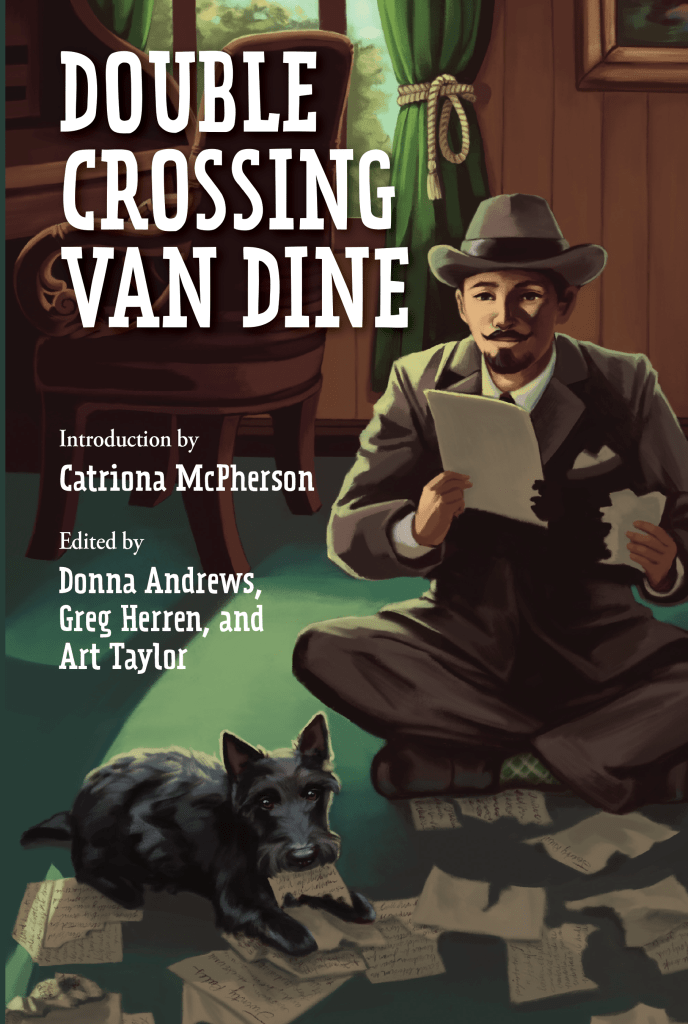
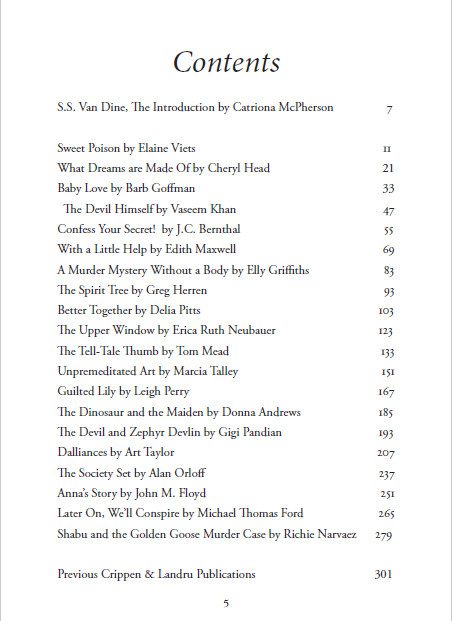
I have written another Alabama story! It will be in the Crippen & Landru anthology Double Crossing Van Dine, which you can preorder right here. My story is called “The Spirit Tree,” which was a lot of fun to write, and am very excited that the anthology will release later this month/early September. I again got an editing credit (along with Donna Andrews and Art Taylor, both of whom do a lot more work than I do on these books), and I do absolutely love that cover.
Isn’t this a great cover?
Turn right on Simmons Road and in a half mile, your destination will be on the right.
Tom Forrester slowed his official State Bureau of Investigation SUV and glanced in the rearview mirror. Nothing behind him but blacktop state highway back to the S curve he’d just negotiated. He flipped on the turn signal and made the turn onto a back road. It stretched out before him, a narrow expanse of red dirt and gravel down to the bottom of a hollow and climbing back up the other side. He was getting a headache and wished again he’d asked for someone to come with him. He’d never been to Corinth County before, hadn’t even driven through it. Yes, it was in his district, but it was remote. At least an hour to the nearest interstate. Outsiders had to want to come to Corinth County to get there.
It amazed him that there were still these random remote counties all over the deep South, seemingly untouched by the outside world.
But the county seat, for all its population of about three thousand, had a Wal-Mart and a McDonalds, and almost every house or trailer he’d seen from the road had a satellite dish either in the yard or affixed to the building. Was anything truly remote anymore?
The road wasn’t wide enough for two cars, so he hoped he didn’t meet anyone coming from the other direction. A cloud of red dust followed closely behind the vehicle. At the bottom of the hollow there was a small stream flowing through corrugated iron beneath the pitiful road. And he noticed a rusty barbed wire fence running along the front of the pine forest on the left side, caught a glimpse of a rusted tin roof surrounded by overgrowth.
It looked…familiar.
Not a bad start, right?
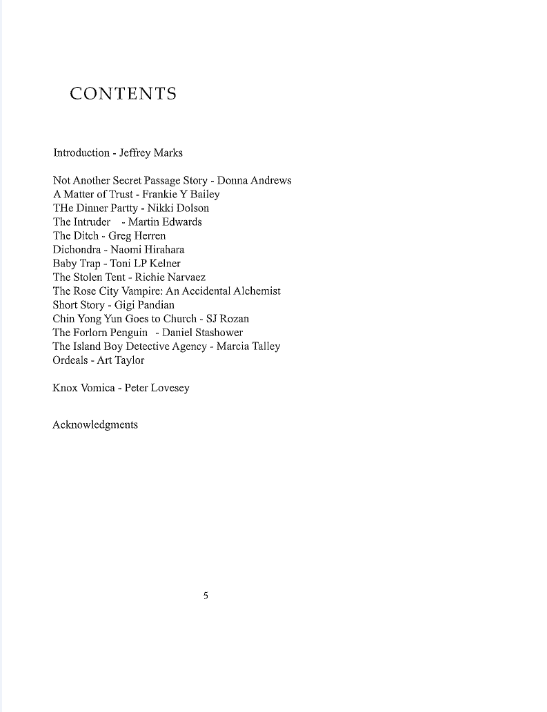
The anthology also has an impressive table of contents:
Mine was: The problem of the crime must be solved by strictly naturalistic means. Such methods for learning the truth as slate-writing, ouija-boards, mind-reading, spiritualistic séances, crystal-gazing, and the like, are taboo. A reader has a chance when matching his wits with a rationalistic detective, but if he must compete with the world of spirits and go chasing about the fourth dimension of metaphysics, he is defeated ab initio.
So, yes, like I did in the last anthology of this nature that I was in, chose supernatural/occult as my way of breaking said rule. I’ve done this before, of course, in novels; two subgenres I prefer are crime and horror–and I do love crossing/blurring the lines between the two of them.
Several years ago (it may have been last year; my grasp of time isn’t the best anymore) I read a book called Salvation on Sand Mountain, about snake-handlers in north Alabama (I’d also watched a documentary called Alabama Rattlesnake) which reminded me of a bit of country magic. When I was a little boy–a very little boy–I remember visiting someone in Alabama–and there was a small tree beside the front porch, with bottles slipped over the ends and catching the sun in colorful flashes and making tinkling sounds when the wind blew the branches together. I asked, and was told it was a ‘spirit tree,’–the sound of the bottles kept evil spirits and ghosts out of the house. I’d forgotten about it until I read it in the book, and I remembered it all very clearly.
So, I sat down and wrote an opening scene, in which a state investigator is going to a crime scene, and when he gets there, there’s a spirit tree beside the porch. I had no idea what to do with the story–how to finish it, who was murdered and why, etc.–and it went into the files. When I was asked for a story (and a by-line credit) for this anthology, I looked for the supernatural rule, claimed it, and pulled out “The Spirit Tree.”
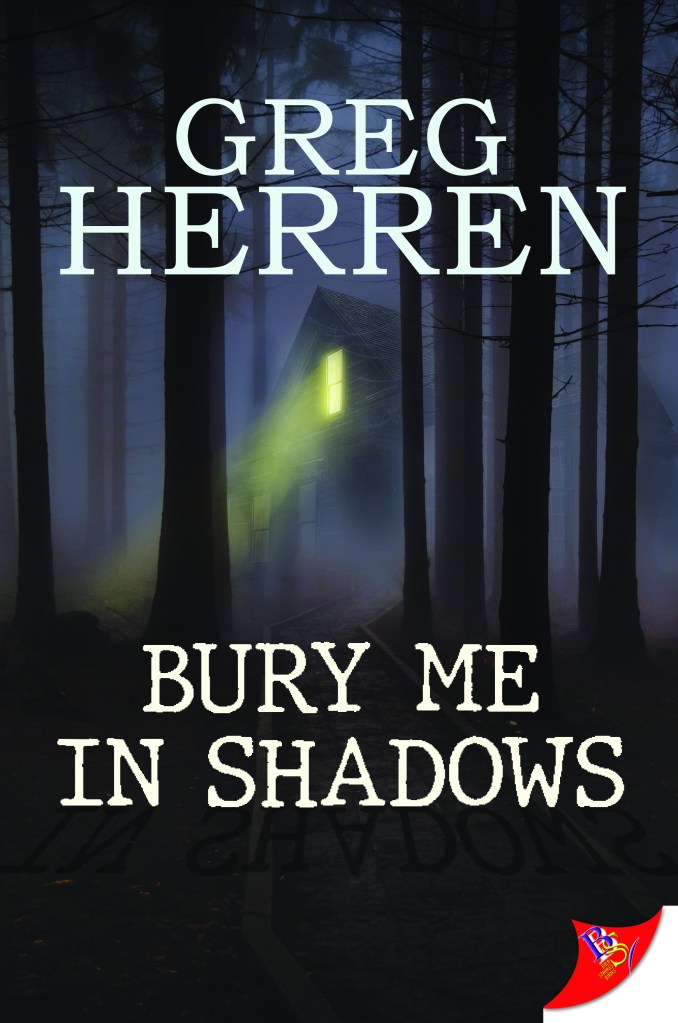
Yes, it’s another Corinth County story, like Bury Me in Shadows and “Smalltown Boy” and “The Ditch,” not connected to the others by anything other than location, really, but it’s location is pretty much everything!
Hope you enjoy it–and the rest of the contributors are exceptional writers, so I know you’ll enjoy theirs, too! What are you waiting for? PRE ORDERS ARE ALWAYS WELCOMED!
Thursday and my last day in the office for the week. I slept well again last night–didn’t want to get out from under my pile of blankets this morning, yet again–and we also had an amazing thunderstorm last night. Lightning was very close, the thunder rolled for what seemed like forever, and twice the power fluttered on and off before I went to bed. I had a good day at work yesterday–got a lot done there–and picked up the mail on the way home and there was plenty of it, too. This weather is the return of the system that was supposed to flood us this past weekend; it made a U-turn and basically came back. There’s no flood watch or anything, so it’s not as scary this time around, methinks. I did some chores when I got home before my usual catch-up on the news, and once Paul got home we started watching Untamed. We were on our second episode of the evening when the power blinked out then back on the first time, and it took forever for the wireless server to come back on line–Netflix is always slow to load, too–so we gave up for the evening. We’ll probably finish the show in another night or two, and then will have to find something new to watch again. Huzzah.
I am also still reeling a bit from how much my bi-monthly medication costs (#madness). It’s almost two hundred thousand dollars per year. Granted, that also includes the cost of the injection device that I have to attach to myself every eight weeks (I thought it was four; this is much better on me). It is on its way, and should be arriving sometime Friday at the postal service, so I can pop it into the refrigerator and keep it there until I need it in September. I have to go to the service on Friday anyway; I received the title pages for Double Crossing Van Dine anthology to sign (my co-editors, Donna Andrews and Art Taylor, have already signed them; I’m last to go) for the clothbound edition of the anthology. My story “The Spirit Tree,” is another Alabama story, for the record; yet another return to Corinth County! So one of the things I need to do either tonight or tomorrow morning is sign them.
Apparently I need to watch last night’s episode of South Park? Social media is completely abuzz with clips and general hilarity about this new episode, which targets Dumble-dumb. Something to stream while bonding with my precious Sparky tonight, at any rate. I also need to check my to-do list as well as make a more comprehensive one for the weekend. I have plenty of work to do at home tomorrow, of course, and lots of chores and writing and editing and cleaning to do around that, as always. I am trying to get my email inbox cleaned out, and I also need to do some studying on things. I don’t think I have to sign up for Medicare before I actually retire or stop working, according to what I have read, which is kind of a relief; I’d rather not deal with that frustrating red tape until I actually have to, you know?
Insurance shouldn’t be this crazy and complicated and irritating, frankly.
Neither should life.
I also want to get another newsletter out–either about the recent trend by gymbros to build up a beautiful butt1, or my one about the kids’ series featuring Vicki Barr, (pre-feminist) stewardess! I also owe a gazillion emails…sigh.
And on that note, it’s off to the spice mines with me. Have a lovely Thursday, Constant Reader, and I will be back in the morning.
The Temple of Poseidon
So much of a gym trend that Men’s Health published an article about it! ↩︎
Monday morning and up too early for PT before work. Heavy sigh. My body aches this morning–my back is especially tight–which means today will be exhausting. It’s a paperwork/admin day anyway–unless I have to cover for someone–and it’s also terribly cold this morning: 41 degrees, to be exact. I collapsed into bed last night somewhere around nine, and was dead to the world in a matter of minutes. It was a good night’s sleep, but I really need to sleep late sometime soon–probably not till this weekend, alas.
I did listen to River Road by Carol Goodman in the car both ways instead of The Drowning Tree, and as always, loved every minute of it. I still had some time left to listen to something, but only had a short time left, so I went ahead and started an Amazon Short by Zakiya Dalila Harris, “His Happy Place”, which was decidedly creepy but also extremely well done. More on both to come, of course, once I’ve gotten back into (what passes for) a normal routine around here. This will probably be a rough, tiring week, but I hope to manage. This weekend I am going to drop off beads and books for donations, and will also hopefully keep working on the apartment.
The coffee is starting to work, which is nice. My brain and body are starting to wake up, which is great. I’m also a bit hungry, so will probably make something to eat before I leave. I have dry noodles at the office to have for lunch, and will take some breakfast snacky things with me. Tomorrow I know we are going to be super-busy in the clinic, which will make for a rough day as well. Fortunately, I enjoy my job! But this weekend will be the hard reset I need, and I just have to make it through this week, which seems to be stretching out far into the distance and is a bit overwhelming to contemplate. I also need to make a grocery list, and today I have to run some errands after I get off work. Tomorrow I’ll make groceries after work, and hopefully I’ll start feeling more settled in. Sparky was a bit stand-offish when I got home yesterday–just mewed at me reproachfully for a while, but after a few hours he forgave me and was very affectionate, obviously having missed me while I was gone. I do kind of feel like our earlier cats were more Paul’s than mine, but Sparky is kind of mine. Of course, I was chair bound for almost three weeks, so he had a place to cuddle and sleep and hang out all day, and now of course no one’s home with him all day. Once the Festivals are over, he’ll be home more and then he and Sparky can bond some more.
So really, my return to normality after Carnival has been pushed back on the calendar because of the trip over the weekend. My word, how my imagination was out of control while driving and staying in Alabama. I remembered stories and ideas I’d forgotten about as well as having more ideas (just what I need, right?) and I also figured out how to finish off my short story collection. I am hoping to get some more stories finished this week and get off to submissions while working and planning my next book. I also have a shit ton of unfinished drafts here I’d like to get done at some point so I can clear out the drafts folder.
I also took a lot of pictures this weekend, to help me describe places when I write about Alabama some more. I also realized that fictionalizing the place where I was born means it doesn’t have to be exactly the same in my work than it is in real life, you know? But that’s also my own stubborn brain trying to make everything correct when it doesn’t have to be, which happens a lot. It’s not like New Orleans, which appears as it is in my work. Corinth County is based on where we’re from, but it’s not the same. I had an idea for something completely new on my way up there; there was an In Cold Blood-kind of slaying there in the late 1960’s; a couple who ran a corner store were brutally killed and robbed, and so when I got home I started looking for information about it on-line (I’ve done this before, but not for a potential writing project; more out of idle curiosity when I was writing Bury Me in Shadows) and interestingly enough, there have been any number of crimes down there over the last forty or so decades; in fact, in one article about another murder I read a quote from someone at a café in town that the county “seems to be cursed”–which I must have read before because that has always been the underlying theme of the fictional county; it’s even in Bury Me in Shadows with people saying “the history of this county is written in blood.” Anyway, I would be interested in writing about that 1967 shooting–either fictionally or as true-crime.
And on that note, I need to get ready for PT and then heading straight to work from there. Have a lovely Monday; I may be back later as one never truly knows.
Tuesday night as I talked with Jean, Candice and Harry about my two latest books I suddenly realized–towards the end of the conversation–that technically I have a third book out in current release with my name on the spine.
To wit, this marvelous anthology:
Which, if you like, you can order right here! There are two options to choose from–the clothbound special edition with the cover page signed by all three of us, or the less expensive paperback. I believe there’s also an ebook option.
And look at this table of contents:
How is that for some amazing company to be in, eh? Not to mention the co-editor credit with Art Taylor and Donna Andrews, who are as equally lovely as people as they are insanely talented writers (and highly intelligent people). I mean, my story is sandwiched in between stories by Martin Edwards and Naomi Hirahara, for fuck’s sake.
Rarified air, indeed.
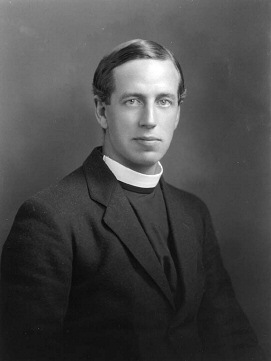
So, who is this Father Knox, and what are these commandments that had to be broken?
Father Knox himself
Father Knox was an early twentieth century mystery writer, who was also a member of the Detection Club, along with contemporaries like G. K. Chesterton and Agatha Christie–speaking of rarefied air–and he came up with the ten commandments for mystery novels:
The Criminal must be someone mentioned in the early part of the story but must not be anyone whose thoughts the reader has allowed to follow.
All supernatural or preternatural agencies are ruled out as a matter of course.
Not more than one secret room or passage is allowable.
No hitherto undiscovered poisons may be used, nor any appliance which will need a long scientific explanation at the end.
No (outdated racist term for someone of Chinese ancestry) must figure in the story.
No accident must ever help the detective, nor must he ever have an unaccountable intuition which proves to be right.
The detective must not himself commit the crime.
The detective must not light on any clues which are not instantly produced for the inspection of the reader.
The stupid friend of the detective, the Watson, must not conceal any thoughts which pass through his mind; his intelligence must be slightly, but very slightly below that of the average reader.
Twin brother, and doubles generally, must not appear unless we have been dully prepared for them.
I mean, how fun would it be to write a story breaking any of these rules, let alone a book doing so (hmmm, tempting–this would be a great fun thing for a Scotty adventure)?
I chose commandment two: all supernatural or preternatural agencies are ruled out as a matter of course, so I wrote a suspense story that may (or may not) have a supernatural agency involved; “The Ditch,” which is also a Corinth County story and one I am particularly pleased with.
I am going to begin reading the anthology, perhaps a story a day, as part of my Short Story Project (always ongoing) as well as to help promote the anthology, which has as fine a collection of contributors as I’ve ever been associated with.
Today already feels off. That’s the time change, no doubt; it’s hard to believe I slept as well as I did last night–I went to bed early so I could get up earlier by the clock than by the body, figuring that was the easiest way to transition into getting up early for work this week. The weekend, which held such promise, was derailed by having to deal with getting my delivery items that were supposed to come Friday night delivered yesterday; they finally did come and it was taken care of–but the delivery window was 1-3, which fucked up the rest of the day for me to run the other errands I wanted to get done, which now have to be done this morning. It’s fine, but any change to routine triggers the anxiety so I am trying to not let it defeat me this morning. But the change in plans did kind of end up wasting my Saturday; the delivery came around two-thirty, and it was already too late for me to go out running errands. Of course this morning I am thinking no it wasn’t too late for you to start your errands but my mind works a certain way and usually I can’t see these things except in highsight.
I did read some of the novellas I have partially finished that have been lying around for years, which begs the question I could have sworn I’ve worked on these things more recently than the files I am finding, so have I lost track of all time completely? But for the one I am thinking of, it absolutely makes the most sense, as I now remember I’d actually submitted it to an anthology, which meant trimming it down from the length that it originally was. I have found a call for submissions which includes novellas–which was why I was looking at them again yesterday–which has me thinking about revisions and rewrites and what can be done with these manuscripts. One is slightly longer than forty thousand, and only needs a minimum of twenty-five thousand more to become an actual novel. I reread it yesterday, and it does center a bad trope that would have to be super-creatively pulled off to work, but I also think recentering the main character from a straight cisgender white high school girl to a gay teenager could easily help with that. (It also needs a name change, “Spellcaster” doesn’t really work and was also a drawback to what I had done.) The one I was looking for was “Fireflies,” which is another Corinth County story (I feel like I should always explain that the locals pronounce it “carnth”) and is one of the more disturbing county stories I’ve done, but I also think it’s one that works for the submission call. Or not; we shall see.
The other one I was able to read was “Festival of the Redeemer,” which is another attempt at a du Maurier-like story set in Venice. Rereading “Don’t Look Now” recently, of course, put me in mind of this story, which is one of the few novellas that has an actual full draft done. (Several of the others are incomplete–“The Scent of Lilacs in the Rain,” “A Holler Full of Kudzu,” and “Once a Tiger”.) Rereading it yesterday reminded me of what I was doing with it–or trying to, at any rate–and I could see where I lost the thread and the voice, which was the most important thing about the novella. I also need to get organized on the next book project I am going to work on, but I need to write a proposal first. That’s the big goal for today; get better organized, run those errands, get the proposal organized, and start pulling the next book together. One step to getting things better organized is to complete a thorough to-do list and actually pay attention to it; these lists do no good if you don’t consult them at least once a day. I had gotten a great start on one this past week, so I think I am going to work on pulling that together.
I also need to measure the workstation windows before I head to Lowe’s.
The Saints are playing today at noon, but I think that’s the best time for me to be running errands and potentially hanging window blinds, so I think that’s enough stress and anxiety for me today–I can follow the Saints game on social media. A Haunting in Venice is streaming now, so we may go ahead and watch some movies later on, as we are all caught up on the shows we are watching (I am episodes behind on Foundation, but the beauty of streaming is you can always catch up at some point), and there’s another movie streaming now I am interested in seeing even if I can’t think of its name at the moment. I’ve already made a grocery list for today–I am making ravioli for dinner tonight and need to pick up some bread to go with it–and am hopeful that sometime either this week or next I will get my teeth at last and I can bid adieu to the soft diet…just in time for my surgery. I’ve done some research–which I’d been avoiding–on the recovery time from this type of surgery and mine is more complicated than the basic one I am finding out about on-line, so this is bare-minimums I am looking at–probably at least three weeks on medical leave from the office, which I will need to go talk to Admin and HR about at some point this week so I can get it taken care of, or at least get the process started. I will also need physical therapy for three to four months. Yay. Ah, well, at least I have the resources that this won’t bankrupt me, which is a good thing.
And on that note, I am going to get to work on things this morning and take advantage of this extra hour I have this morning rather than wasting it. So, have a lovely Sunday, Constant Reader, but be warned–there’s more blatant self-promotion coming along at some point.
I know very little about the culture, history, values, and faith of the native American population of this continent. Most of what I do know isn’t reliable; being gleaned from books and histories and television shows and movies and other media, most of which were steeped in racism and white supremacy, and cannot really be depended upon for any kind of accuracy whatsoever.
If anything, it should be looked at with a highly jaundiced and very critical eye.
I’ve been trying to educate myself more about the indigenous natives of Alabama, for example; as I delve more deeply into writing about my fictional Corinth County, I need to learn more about the area and the natives who originally lived there–and what they believed and their spirituality. I do not want to write–or even imagine– anything rooted in white supremacy and racism. I never played “cowboys and Indians” when I was a child–I was never into little boy things, ever–and was never terribly interested in Westerns, but was aware that white people wore thick make-up to play Native-Americans on film and television…which even as a child made me wonder why they didn’t just find Native-Americans who wanted to be in show business (because I found it incredibly hard to believe there weren’t any). I always assumed Cher was at least part Native because of “Half-Breed,” so you can imagine my shock and surprised to find out she’s actually of Armenian descent. The Village People had a non-native in native garb as part of their nod to gay masculine archetypes (probably this came from the book and movie Song of the Loon, plus decades of Hollywood’s sexualization of the loin-clothed Native warrior).
And as you get older, and do more reading and studying on the subject, you begin to see things that were plainly obvious all along, but somehow you never really connected the dots.
The first time I ever read anything that treated the native population with dignity, respect and understanding was James Michener’s Centennial*, which remains my favorite of his works and one of my favorite books of all time. The hit movie Billy Jack, which came out while I was in junior high school, was also about mistreatment of modern-day Natives by bigoted white people and their government, but I think the social message of the movie got lost in white tween boys’ fascination with Billy Jack’s fighting skills, because that was all they talked about. I don’t think I ever heard anyone ever say “It’s terrible how we treat the natives.” The late 1960s and 1970s began to see a change in how we see the native population, as well as the history of the European conquest of the continent–not everyone, of course, but at least with those who were trying to be better about racism and racial issues and the long history of oppression of the native populations.
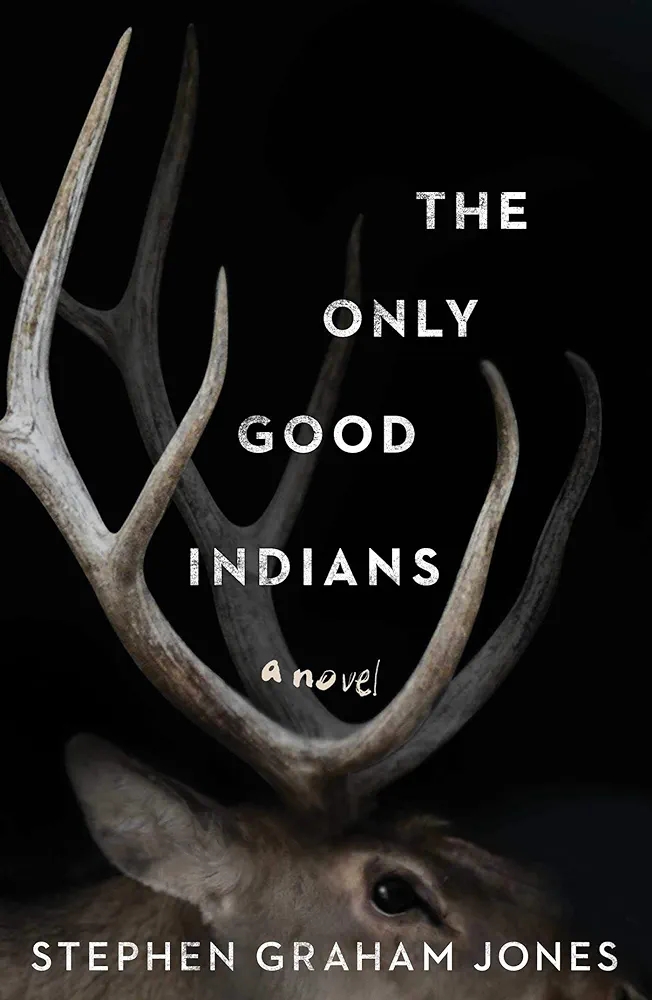
I had heard a lot of great things about Stephen Graham Jones, a native American horror writer who has taken the genre by storm. I’ve been wanting to read him for quite some time, and so I decided to listen to The Only Good Indians on my drive to Panama City Beach and back this past weekend.
And it did not disappoint.
The headline for Richard Boss Rivs would be INDIAN MAN KILLED IN DISPUTE OUTSIDE BAR.
That’s one way to say it.
Ricky had hired on with a drilling crew over in North Dakota. Because he was the only Indian, he was Chief. Because he was new and probably temporary, he was always the one being sent down to guide the chain. Each time he came back with all his fingers he would flash thumbs-up all around the platform to show how he was lucky, how none of this was ever going to touch him.
Ricky Boss Ribs.
He’d split from the reservation all at once, when his little brother Cheeto had overdosed in someone’s living room, the television, Ricky was told, tuned to that camera thay just looks down on the IGA parking lot all the time. That was the part Ricky couldn’t keep cycling through his head: that’s the channel only the serious-old of the elders watched. It was just a running reminder of how shit the reservation was, how boring, how nothing. And his little brother didn’t even watch normal television much, couldn’t sit still for it, would have been reading comic books if anything.
First of all, I want to address what a terrific writer Jones is–although this is hardly ground-breaking news. For me, the strongest part of the story was the authorial voice and the tone set by it. I can’t say whether something like this–like anything written by people outside of my own experience–is authentic or not, but it was completely believable. I truly got a sense of what it is like to be a Native-American living in North America in the present day; the mind-numbing poverty and dealing with the incessant racism from white people. His characters were three-dimensional and fully realized; the dialogue sounded right, the rhythm of the words he used to create a melody of syllables and sounds sang from the page. I felt like I was there in every scene, in the room with the characters and bearing mute witness to what they were experiencing, and what they were going through and experiencing, with the fully-realized life experiences coming into play with every word they said and every action, every thought, every movement. The deceptive simplicity of the prose was powerful and resonated; it sounded like poetry coming through my speakers.
I also found myself really interested in basketball–which is very unusual.
I also realized, as I was listening, spellbound behind the wheel of my car, that there was also commonality of human experience here; the poverty, the worries about money and the future and the bleakness of the helpless acceptance of despair–this is definitely a horror novel, but it’s also a stinging indictment of poverty and societal inaction in the face of it; their resigned acceptance of their fate mirrors the more callous resignation most people feel when thinking about poverty in these United States–“nothing I can do about it.”
While telling a strong story that is almost impossible to step away from, Jones also educates us cleverly with a sentence here and there–I’d never thought about where the term buck naked came from, and there are so many of these sprinkled throughout the book; terms and phrases that white people use without a second thought but come from a long history of racism and prejudice; the title itself is taken from the horrific saying “the only good Indian is a dead Indian.” I myself am always careful not to refer to the native population by the colonizing name assigned to them by the lost Spaniards looking for spices; it was jarring hearing it over and over again, and made me a bit uncomfortable–but I suspect that was the entire point. (I think the worst was when the junior high school basketball prodigy Denora was thinking about playing a game against white schools, and the horrible signs and things their students yelled at her and her teammates–the one that was particularly offensive was Massacre the Indians!, which reminded of the trash Chicago Bears fans holding up signs when playing the Saints in the NFC title game after the 2006 season: “FINISH WHAT KATRINA STARTED!”, which turned me from someone with a nostalgic affection for the NFL team in the city where I spent most of my childhood into someone who wants them to lose every fucking game they play.
Massacre the Indians.
There’s no doubt in my mind reservation kids have to deal with this kind of bullshit all the time, and its embarrassing and infuriating at the same time. The cruelty is always the point.
But I digress.
I really enjoyed this book. I felt like reading it somehow helped me reach a better understanding of a situation I was already aware of, while being incredibly entertaining at the same time. I cannot state that enough: what a great experience this book was from beginning to end. The tension and suspense were ratcheted up with every chapter and sentence; the monster was terrifying and horrifyingly relentless, and the characters were all strongly rendered in both their strengths and their flaws.
When I finished the book, I couldn’t help but wonder if this book, and others by Jones, were being pulled from library shelves because reading them might make white people feel bad. The book made me remember again why controlling access to what anyone can read is about control more than anything; we can’t let people read diverse points of view or see opposing opinion is the underlying message of the banners, and quite frankly, grow a fucking pair already! Seriously, who is calling who a snowflake?
Read this book! You can thank me later. And now I want to read more of Jones’ work.
*Centennial may not have been historically accurate in its depiction of the Arapahoe tribe, but I feel that it showed how the US government broke promise after promise to them, and the depiction of their systemic extermination was not done in a “manifest destiny” way. The ugliness of the US and its racism was right there on full display.
Work at home Friday, after I run some errands and take care of some things this morning. I have to go to the OMV to get a real ID (driver’s license expires Sunday), and since I am going over there, I am going to swing by the West Bank Petco to look at kitties (the SPCA has some they’ve farmed out to Petcos). That’s an exciting morning, isn’t it? I am taking Kelly J. Ford’s The Hunt with me, so I won’t be bored and since I have to sit around and wait, I might as well read. It’s been bothering me lately that my attention span just hasn’t been there for novels since the heat wave broke me several weeks ago–which is when I switched over to short stories in the Alfred Hitchcock Presents anthologies–and I’d like to get this book read before I leave for Bouchercon, primarily so I can hopelessly fanboy over her all weekend (I’ll also be fanboying over Margot Douaihy all weekend, too, among many others as I always do at Bouchercon). I’ve already picked out my books to take with me on the trip (the latest S. A. Cosby, Alison Gaylin, and Laura Lippman will be going to San Diego with me, with Donna Andrews batting clean up), and also already know I will probably get no writing done while I am there. I don’t really have anything due–there will be page proofs for Mississippi River Mischief to go over at some point–but everything else is up in the air for now.
I did manage to get the edits taken care of on Mississippi River Mischief and turned it in last night, so other than the afore-mentioned page proofing, it’s effectively finished. Since the other book–I’ll post about it this weekend, no worries–is also finished and now out of my hair, I have nothing pressing at the moment. Woo-hoo! I also picked up the mail and stopped at Fresh Market to lay in supplies for a weekend of not getting into the car at all. I wrote for a while, and came to a realization about this short story I could never get to work that I’ve been revising, so I am going to go into author mode and talk about writing, so bear with me.
This particular story, “Whim of the Wind.” was the story I wrote when I took creative writing again after switching universities after my first horrendous creative writing experience (if I haven’t said it enough, the professor told me I’d never be a published writer). This story was beloved by my class and my professor, who told me I should submit it to literary magazines. I did a few times, it was always rejected, and there was a slight flaw in the story–but no one who read it could ever give me any insight into how to fix the story. It was also my first Alabama story, my first visit to my fictional Corinth county, and so it’s always kind of been precious to me. I never could figure out how to revise it or what to do with it…but as I’ve been revising it (it’s now twice as long as it was, and I’ve not finished), it’s been changing some. I think what everyone was responding to was the voice–I’ve used it again since, and people always respond to that aspect–and really, as long as the voice is intact and preserved, that’s all that really matters. I also realized last night something else–I was having to change the climactic scene in the story, and as such had to come up with a different Civil War legend to build it around–and I realized this story, along with two other, had been written using the same trope, that I have since learned was apocryphal–the evil Yankee deserter. I wrote this story using it, I wrote “Ruins” using it, and I wrote another, “Lilacs in the Rain,” also using it (that story has morphed into a novella renamed “The Scent of Lilacs in the Rain”); so yes, I wrote three short stories based on the same, apocryphal, Civil War urban (rural?) legend. Bury Me in Shadows evolved out of “Ruins,” and I blew up the trope in that book; that was the “Yankee deserter” story I was meant to write. So, the other two need different legends, and I found a good one for “Whim of the Wind”–but again, a delicate subject I’ll need to be very careful with–and now maybe I can make “The Scent of Lilacs in the Rain” actually work, now that I know what I need to do with it. I am also having a lot of fun looking into Alabama history and finding these great legends and stories and folk tales that I should be able to find something to use.
I slept really well last night, and feel pretty good this morning. Don’t feel so great about having to go to the West Bank, but that’s okay; it’s a routine change I can live with, and I can actually do my weekend grocery shopping over there as well–and I can get Five Guys to bring home for lunch. I think after that I will have laid in enough supplies to not have to leave the house for the rest of the weekend–I may go get the mail tomorrow–and I want to clean, organize, read, and write all weekend. Paul got home late last night (another grant) so we didn’t get a chance to watch anything last night–he walked in while I was watching a Youtube documentary about the usurpation of the English throne by the House of Lancaster that set the dangerous precedent (for kings) that incompetent ones could be overthrown and replaced…and eventually led to the Wars of the Roses. I also was watching some videos–someone did a series of the greatest plays in LSU football history, which was very fun to watch and relive (I really should do an in-depth post about my love of LSU football; not that everyone who’s paying attention doesn’t already know about it, of course, but I love football and it’s fun for me to write/talk about it. I also find the fandom interesting, too.)..and they were grouped by stretches of time, eras, if you will (2007 season got its own video)–and also guided by the scarcity of available digitized video from the far distant past. (I was also thinking “don’t the networks that originally aired the games have tape? Can’t it be digitally remastered? I know the SEC Network has done this with some classic games from the past; it’s a project the NCAA should back fully, as it’s the history of the sport.) It’s very fun to revisit past games and my memories–LSU is never boring to watch, ever–and I am very excited about the upcoming season, both for LSU and the Saints. I worry that everyone is over-hyping LSU (something I always worry about) but given the over-performance from last year, it’s kind of understandable, really. LSU came out of nowhere to win ten games, beat Alabama, and beat both Florida and Auburn on the road in the same season for the first time in program history. So, yeah, understandable. I was thinking before last season that it was going to have to be a wash–new coach, rebuilding after two down years, etc.–and that this year would be the one where the Tigers would make a run. I am excited for our new quarterback for the Saints, too–he, like me, also went to Fresno State, so I have even more reason to root for him and like him–and they seem to be doing well in the preseason. GEAUX SAINTS!
I did work on the revision of “Whim of the Wind” yesterday–it’s amazing to me that I’ve taken a story that barely over two thousand words and added another almost three thousand to it, and it still isn’t done–but I am feeling good about the story, now that I’ve recognized my attachment to it that actually was hindering me from revising it. It’ll always exist in that original version, after all, and nothing I do to it in current or future versions are ruining that precious first version that meant so much to me as an aspiring writer. Sentimentality–the very thing I am always trying to guard against when it comes to almost everything in my life–got the best of me with this story. The other story I turned it at the same time, which I’ve also never been able to correct, perhaps now I can fix it, too. I had thought about expanding the other one (which is actually incredibly problematic on many levels by modern standards) into a novel, and perhaps I still will; I’ve started slowly world-building around the panhandle of Florida the same way I have with Corinth County in Alabama, but there’s no crime or mystery or supernatural thing going on in that story; so it would be a coming-of-age romance….but I may know a way (that just came to me) and there were some other ideas about it, too. You never know, right? Why not riff for a while and see what comes up?
I’m kind of getting excited about writing again, can you tell?
And on that note, I should start getting ready for the OMV and get that hellish experience over with once and for all. Have a lovely Friday, Constant Reader and you never know–I may be back later.
And here we are, on a very hot Saturday July morning in New Orleans, feeling rested and relaxed, which is becoming the norm and I have to say I really quite like it. I think some of it has to do with the lessening of stress and anxiety with the lightening of my over-all schedule; it’s nice not being constantly busy and always feeling guilty (anxious, stressed) about the things undone when I had to call it quits for the day from sheer exhaustion…and then of course that stress/anxiety/guilt made it impossible for me to sleep. I even cut back drastically on my caffeine intake during this period–cutting back to only three cups of coffee (which is probably still too much, really) and only one 16 ounce bottle of Coke per day. It’s helped my sleep some–and I am not willing to up my caffeine intake to find out, either–but I’ve been sleeping so well the last few weeks since I recovered from the trip that I am almost not afraid talking about it will jinx it…but the streak continued again last night. I’m not sure what the difference is–probably the reduction in stress and anxiety.
Finding out that my mother suffered from anxiety was also incredibly helpful. Finally, at age sixty-one, nearly sixty-two (less than a month away), I realize that I, too, suffer from almost crippling anxiety, but never realized it because it’s just my reality, if that makes sense? Everything stems from anxiety: the self-deprecation, the not taking my work as seriously as I should as well as being dismissive of it rather than proud, the issues with public speaking–all of it stems from anxiety. But that’s because it’s always been for me, I just figured, as one would, that it was normal and everything else has the same issues because that’s all I know. The Xanax has helped somewhat with reducing my anxiety or lessening it enough for me to be functional, and now recognizing that it is an actual chemical brain condition that I’ve had most of my life has opened my eyes in many ways, and I am trying to rewire my brain to accept and understand that anxiety causes me to want to self-destruct at times. I wish I had known this about twenty years ago, even forty, but would it have made a difference?
Yesterday wasn’t a bad day, really. I woke up later than usual (same this morning, staying in bed until just past seven thirty like a lazy slattern) and feel very rested. I spent most of the day going over forms doing Quality Assurance as well as did some on-line trainings. Once the work day was over, I repaired to my easy chair with my journal and scribbled notes in it for awhile until Paul got home from the gym. We watched this week’s episodes of Minx (smart adding Elizabeth Perkins to the cast for the second season), The Crowded Room, and Hijack, and moved on to some more Awkwafina is Nora from Queens, which is rapidly becoming one of my favorite half-hour comedies of all time (the queefing episode is a non-stop laugh riot, seriously).
Today I want to spend some more time on a kitchen cleaning project, in which I am cleaning out the drawers and the cabinets in the kitchen. Things tend to accumulate around here, and there are things that get tossed in drawers that I’ll never need, have never needed, and just held on to for some reason unknown to my conscious brain. I also want to work on the kitchen rugs (which never stay in place, ever) and the floors a bit more. I need to purge more books, too, and work on the kitchen. There’s a mess now because I cleaned out some things already and now that stuff is scattered all over the kitchen and I need to either find a place for it all or toss it, I also am going to spend some more time with Megan Abbott’s Beware the Woman over my coffee and perhaps a few more Alfred Hitchcock Presents short stories before I run today’s errands: groceries, mail, library sale to drop off books, and maybe a car wash. The tire pressure light has been on in my car since I drove home from Kentucky, but the heat has been so intense I’m not sure I’ve been able to get an accurate gauge reading of the tire pressure; I’ll probably swing by the gas station before doing any errands to try equalizing the pressure again. I also want to spend some time trying to write today–whether it’s a new book project, a revision of a short story, or even a brand new short story entirely (that Malice anthology deadline is approaching), but I want to get back into writing again, flex and stretch those creative muscles that have been so dormant for so long.
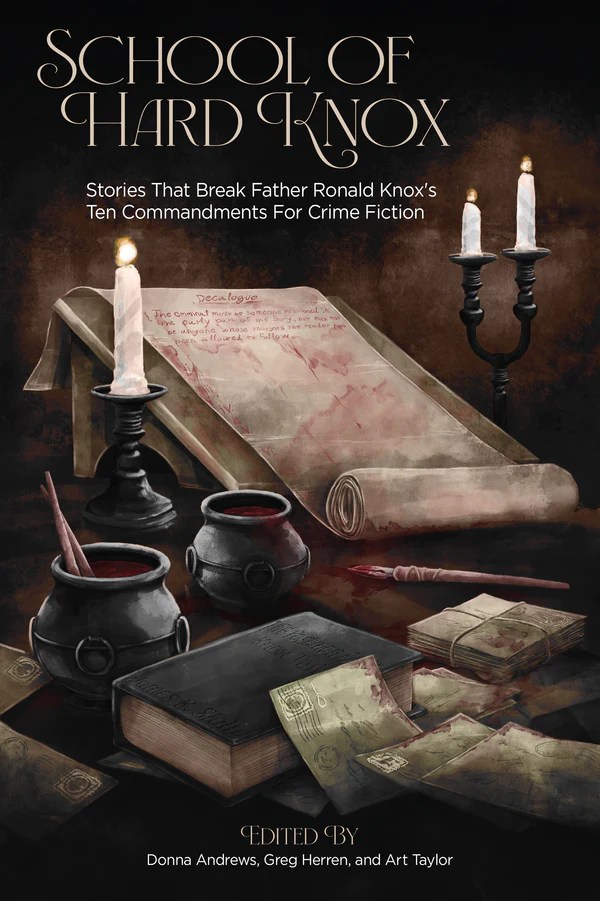
I got the table of contents for another anthology that I am appearing in, School of Hard Knox, edited by the amazing Jeffrey Marks and coming from Crippen & Landau. The author of the Father Knox crime series, back from the Golden Age, had come up with a list of ten rules that should never be broken by a crime/mystery writer; we each chose a rule and wrote a story breaking it. Mine was “no supernatural events or beings”; which was kind of perfect for me. I dug out an old Alabama/Corinth County story that had been moldering in the archives for decades called “The Ditch,” which I revised and rewrote and made much stronger. I was pleased when the story was accepted, and I was even more pleased to be told that the copy editor thought my story was “powerful.” (I’ll write more about the story, and the anthology, when its release date is imminent.) I also got paid for my story “Solace in a Dying Hour,” and cannot wait to get my contributor copies of This Fresh Hell. I don’t know why I get so much satisfaction out of selling and publishing short stories; but subconsciously I think of each sale/publication as another knife into the corpse of that wretched college writing professor who told me I’d never publish. Given how revenge and “I’ll show you” will always drive me to prove someone wrong about me, I’m starting to think that professor may have been a blessing? I’ve certainly proven him wrong with over forty novels, fifty short stories, and over twenty anthologies edited, not to mention countless articles, interviews, book reviews, and essays I’ve published over the years.
Anyway, here is the TOC for School of Hard Knox:
Introduction – Jeffrey Marks Not Another Secret Passage Story – Donna Andrews A Matter of Trust – Frankie Y Bailey THe Dinner Partty – Nikki Dolson The Intruder – Martin Edwards The Ditch – Greg Herren Dichondra – Naomi Hirahara Baby Trap – Toni LP Kelner The Stolen Tent – Richie Narvaez The Rose City Vampire: An Accidental Alchemist Short Story – Gigi Pandian Chin Yong Yun Goes to Church – SJ Rozan The Forlorn Penguin – Daniel Stashower The Island Boy Detective Agency – Marcia Talley Ordeals – Art Taylor Knox Vomica – Peter Lovesey
Look at those names. I am so honored and thrilled to be in an anthology enabling me to share the interior with these amazing, glittering names. More on this anthology as things develop–release date, cover reveal, etc. I’m very excited to be in this book, which will be a strong contender for Best Anthology short lists next year, as well as the stories making Best Short Story shortlists. I’m particularly proud of my story, to be honest. I think my metier in writing is writing about Alabama, to be completely honest. I know I am known as a “New Orleans writer,” and to be sure, my greatest success has come from writing about New Orleans, but I feel more drawn to writing about Alabama now that I am in my sixties. I am sure some of it has to do with losing Mom–somehow, it’s like writing about Alabama keeps me connected to her in some weird, complicated and twisted logic only my brain is capable of making, but it’s true.
I’ve also decided that I am going to submit to the Nashville Bouchercon anthology, even though I am not going. The theme, being Nashville, has to do with music, and its being edited by the incomparable Brendan DuBois, who is a fantastic short story writer and has found enormous success as a co-writer with James Patterson (I also like Brendan; we served on the MWA board together and he’s really a great guy). I would love to be edited and work with Brendan, and I think the story I’m going to write for it is “The Blues Before Dawn,” a period New Orleans story from before the first world war, which I’d been thinking about turning into a Sherlock Holmes in New Orleans story. That might make it stand out from the rest, one never knows. It also could get selected out by the anonymous readers who could be homophobic–it happens, and one can never be sure if your story isn’t good enough or if its homophobia–another joy of being a gay writer of gay stories.
And on that note, I am making another cup of coffee and going to read Megan Abbott for awhile. Have a great Saturday, Constant Reader, and I am sure to be back again later.
I was born in Alabama but didn’t grow up there. I was two years old when my parents migrated north in search of work, good jobs, and a better life for our family. My parents, however, were very Southern, so I was raised with their values and beliefs (which were very Southern and of their time) but being confronted with very different values and beliefs at school every day opened up my mind in ways that it may not have been had I grown up in Alabama. Our neighborhood in Chicago, near Lawndale Park (our nearest major cross street was 31st and Pulaski), was the perfect representation of America’s vaunted ‘melting pot’; our neighborhood was filled with first or second generation European immigrants; many from eastern Europe, who fled either before or after the war. There were Czechs, Poles, Austrians, Hungarians, and Serbs; in the fourth grade we even had a Muslim girl from Yugoslavia. She had the most delightful first name which I’ve never forgotten–Zlatiça–even as her last name is lost in the clouds of memory. It was also very confusing trying to figure out where the immigrant kids (either they were born in another country or their parents/grandparents were) came from, given that the maps of Europe had been redrawn barely twenty years earlier. The Czech children I knew didn’t identify as Czech but rather as Bohemian; they also called their language that. It took years of study and reading up on history to realizing Bohemia became Czech after the first world war; for many years I believed Bohemia still existed under that name but had somehow been folded into another country or something; I don’t remember. I do remember being confused. Until I finally wrapped my mind around the post WWI renaming of the region, I always just assumed Bohemia was a German region. Reading history didn’t help much in that regard, as Bohemia was part of the Holy Roman Empire for centuries (in fact, the Thirty Years’ War kicked off in Bohemia).
But there was a lot of racism in our neighborhood too; the white European immigrants detested the brown immigrants from Mexico and Central America; I vividly remember the way our babysitter would sneer the word Mexican when referencing anyone brown. There was also a lot of strife in Central America at that time; I think both Guatemala and Nicaragua were enduring civil wars of some sort, hence the influx of Central American refugees and immigrants. I remember Martha, a girl in the sixth grade, telling me about how soldiers came and shot up her village, killing dozens of people she knew and members of her family. She was very calm and unemotional as she told me about it, which is pretty remarkable for a child who couldn’t have been more than ten or eleven, talking about a trauma she witnessed when she was six or seven. (Now I know she was dissociating; and I do remember her telling me calmly that she felt like she wasn’t even there as it happened; like she was watching it all happen from a distance.) Ironically, we became friends because we exchanged Nancy Drew or Hardy Boys mysteries; this conversation came about because we were reading a Hardy Boys book set in Central America; I want to say Footprints Under the Window, but it may have been something else….but she wanted me to know that the depiction of Central America in the book was nothing like the reality.
My grandmother used to tell me wonderful stories when I was a kid about my family history and the history of the county we’re from in Alabama. As a wide-eyed innocent and naïve child, I believed everything she told me, and always wanted to fictionalize those stories. I was in my early twenties when I wrote a short story based on one of those tales; about the Lost Boys and the evil renegade Yankee soldier who burned the house down and presumably murdered the two boys of the house. The story was called “Ruins,” and while I was pleased with the story I felt the story was too short; there was more to the story than I could fit given the length restrictions. I always thought of the story as a kind of an abstract or lengthy synopsis of the novel I would write someday. But it was also a Civil War story, and I wasn’t sure how I could write a Civil War ghost story without being, frankly, offensive. I tucked it away in a drawer and would think about it from time to time–usually when driving through Alabama on my way north–but still couldn’t wrap my mind around it. I worried and fretted and feared and doubted myself constantly. I told the story once to another writer friend of mine, and she urged me to write it…in fact, she hounded me about it for about twelve or thirteen years before I decided to take a deep breath, put on my big boy pants, and take that risk.
“Was this an accident, or did you do it on purpose?”
I opened my eyes to see my mother standing at the foot of my hospital bed, her heart-shaped face unreadable as always. The strap of her Louis Vuitton limited edition purse was hooked into the crook of her left arm. Her right hand was fidgeting, meaning she was craving one of the rare cigarettes she allowed herself from time to time. Her dove gray skirt suit, complete with matching jacket over a coral silk blouse, looked more rumpled than usual. Her shoulder length bob, recently touched up as there were no discernible gray roots in her rigid part, was also a bit disheveled. She wasn’t tall, just a few inches over five feet, and always wore low heels, because she preferred being underestimated. Regular yoga and Pilates classes kept her figure slim. She never wore a lot of make-up, just highlights here and there to make her cheekbones seem more prominent or to make her eyes pop. Looking at her, one who didn’t know better would never guess she was one of the top criminal attorneys in the country or that her criminal law classes at the University of Chicago were in high demand.
I could tell she was unnerved because she’d allowed her Alabama accent to creep slightly back into her speech. She’d worked long and hard to rid herself of that accent when she was in law school, because she said no one took her seriously when she spoke or else thought she was stupid once they’d heard it. The only times she used it now was when she wanted someone to feel superior to her, or she’d been drinking, or she was upset.
It worked like a charm getting her out of speeding tickets.
I hadn’t been asleep, nor had I been awake either, hovering in that weird in-between state where it seemed like I’d been living for the last three or four days.
“It wasn’t on purpose.” I managed to croak the words out. My throat was still raw and sore from having my stomach pumped. My lips were dry and chapped, and my eyes still burned from the aftermath of the insane drug-and-alcohol binge I’d gone on in the aftermath of the break-up with fucking Tradd Chisholm. “It was an accident.” I shifted in the hospital bed, trying to sit up more, the IV swinging wildly. The memory of that last and final fight with Tradd flashed through my head.
The main character in the original short story was only twelve, and the cousin he shares the adventure with was supposed to be fourteen. I was writing a lot of short stories at the time set in Alabama, with the idea to tie them all together in some ways–and was also reading a lot of Faulkner at the time, so yeah, a fictional county in Alabama where all the stories were set and were interconnected was kind of derivative; I kind of smirk to myself now when I think about the hubris of aspiring to be Faulkner-esque, especially at that time, when everything I wrote was pretty much garbage. Ah, the hubris of youth. But I did write a lot of “Corinth County” short stories back in the day, and while the writing may have been atrocious, the idea behind them and the core themes were good and had potential.
When I started thinking about turning the short story into a novel, I soon realized that the characters were too young, so I aged them. I originally aged them to teenagers, and in the first attempt at a rough first draft, I got about two chapters in with my main character, Jake, being banished the summer before his senior year to help take care of his dying grandmother back in rural Corinth County. The original first line was something like The summer before my senior year my mother ruined my life. Properly self-absorbed, narcissistic, everything’s about me teenager, right? My original thought was he was a student at a Catholic all boys’ school, was openly gay, and had a crush on a classmate…and having just found out said classmate had gotten a summer job lifeguarding, managed to get himself and his female best friend jobs at the concession stand at the pool, so he could be around his crush and see him all the time. His banishment for the summer had to do with his lawyer mother accepting a co-counsel role in a major trial in California and being gone; she has also kicked out her fourth husband (a much younger tennis pro) and so she can’t leave him alone in Chicago for the summer. The other option was staying with his father and his second family in the suburbs, which was equally unappealing, so he choses Alabama…and is picked up at the airport in Birmingham by another teenager who’d been taken in by Jake’s grandmother when his own mother died. This character, Kelly Donovan, was originally meant to become close with Jake and participate in all the mysteries Jake encounters at his grandmother’s. I also wanted to play with Jake’s being strongly attracted to Kelly, who is some kind of distant cousin, and straight.
But I scrapped that beginning, too. Would a young senior in high school in rural Alabama, a star athlete, be so accepting and open to Jake’s sexuality? Probably not…and he would also be worried and nervous about his patron’s grandson coming to stay there. As I delved more deeply into Jake’s character and who he was, I started thinking it made more sense for him to be older. Why not have him be a student at Tulane, and living in New Orleans? But if he was living in New Orleans, what would make his mother exile him to rural Alabama for the summer? And the more I thought about Jake…the more I realized there was underlying trauma in his life. I didn’t want his mother to be homophobic, but her mother, the dying family matriarch? Yes, yes, that worked better. I made him a loner, but someone who didn’t want to be a loner. He didn’t ever feel like he had friends at his Catholic school; and coming to Tulane he met his first, real boyfriend…which ended up being a disaster. And then realized, what if he goes on a binge–easy enough to do in New Orleans–after a bad break-up and winds up in the hospital? And if he had tried once before to kill himself…yes, yes, this is a MUCH better backstory and pulls the actual plot of the book together much better.
I also knew I wanted to touch on themes of homophobia in the rural South, as well as the horrors of modern-day Southern racism and the South’s racist past.
When I started doing research for the book, I soon learned that many of the old family/county stories my grandmother used to enthrall me with were all apocryphal; almost every region of the South has some version of the stories she told me; the story of the Lost Boys, a local legend which was the foundation of the book, pops up all over the old South–almost every state and every region of the old Confederacy has a version of the story, complete with renegade Union soldier (think Gone with the Wind), and so I decided to address that trope in the book while also using it. But I also added another layer to the story–the Lost Boys may not be the only ghosts at the old Blackwood place, which has a tragic and bloody and horrifying history, as does the entire county. I also started lessening Kelly’s importance to the story–he’s still there, he’s still a character who also gets a big reveal later in the book–but Kelly’s behavior to Jake is abominable and homophobic, establishing some conflict between the two of them as well. Part of this was because of the change in the story, but then I needed to partner-in-crime as well as potential love interest, so I came up with Beau Hackworth (the Hackworths are a large and poor family in the county; I’ve used that family before in stories; my main character in Dark Tide was a Hackworth from Corinth County).
And of course, when you’re writing about a Southern rural county and the Civil War, you cannot avoid the issues of race, prejudice, Jim Crow, and enslavement. I wanted to make it very clear that this wasn’t some “Lost Cause” romantic fantasy that perpetuates the lies and mythologies that sprang up in the South decades after the actual war ended. Jake’s mother raised him not to be racist or prejudiced, as she tells him several times, “We do not take pride in the fact our ancestors enslaved people. The heritage is hate, and don’t ever forget that.” I did wonder if I was being too generous to white people with this, but on the other hand I wasn’t interested in writing from the perspective of someone racist. I will be the first to admit that I worried about being offensive in this book; the last thing I would ever want to do is be insensitive on the subject of race. But I also knew and trusted my editor enough to know she wouldn’t let me get away with anything, and I also had to trust myself to handle it all sensitively. There were a couple of things she saw in the manuscript that could potentially be considered problematic–but they were also easily fixed.
I was very pleased with the end result, and I do think it is one of my best books. I was absolutely thrilled when it was nominated for two Anthony Awards last year at Bouchercon.
And it also goes to show that you cannot play it safe, and things that scare you are precisely the things you should write about .
(For the record, I will add Cheryl A. Head’s Time’s Undoing is one of the best crime novels ever written about racism in Alabama. Beautifully written and brilliantly told, it should really be required reading.)
It never ceases to amaze me the way this series has been embraced by readers, or that twenty years after turning in the first one here I am writing the ninth (or it is the eighth?) volume. It just goes to show that trying to come up with a plan for your writing career (at least in my case) is a fool’s game. Revisiting my work the way I have been recently–in part because I am writing another book in this seemingly endless series–has also reminded me of plans that have gone awry over the years; things I was trying to do with my writing and the series and the stand-alones that somehow got lost in the shuffle of trying to make a living while trying to be a writer at the same time as well as balance volunteer work, editing, and my relationship and my responsibilities around the house; and sometimes wondering if maybe I shouldn’t revisit and/or revive those plans. I’d like to get a lot of projects I’ve been thinking about for years or have in some sort of progress finished at long last before I come up with anything new–the problem, of course, being that there’s always something new poking its way out from the deep dark corners and recesses of my creative mind.
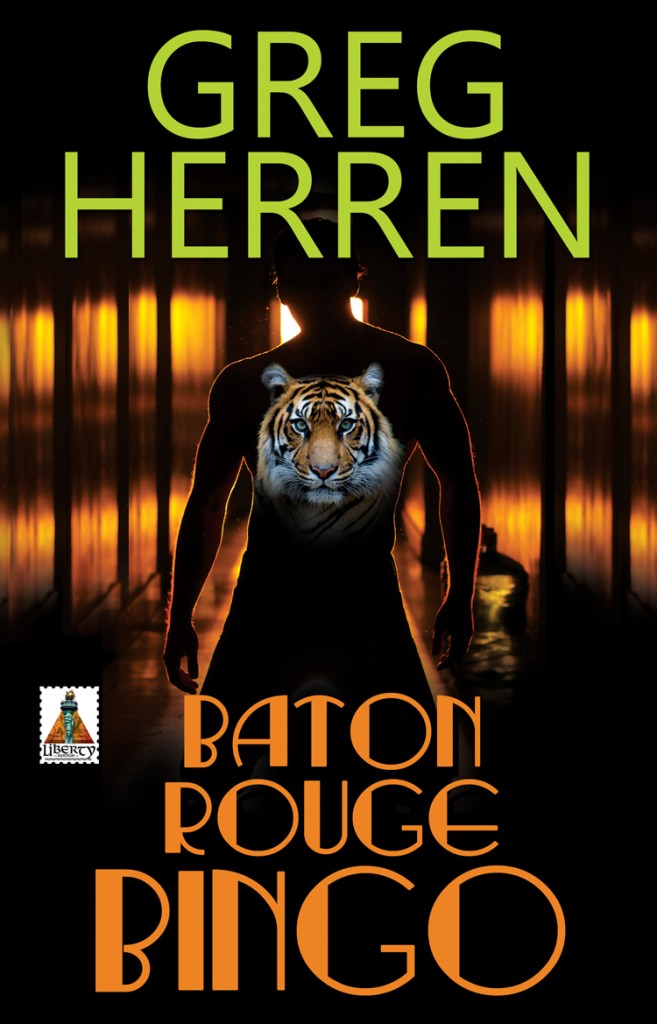
I famously said on a panel at Saints and Sinners, when asked about the potentiality of another book in the Scotty series, that if I could “think of a way to include Mike the Tiger from LSU along with Huey Long and his deduct box, I would” and of course, a few days later it struck me across the face like a bitch slap from Joan Crawford as Mildred Pierce, and so I started making notes as the story started forming in my head.
I’d been wanting to write about Huey Long ever since I’d read the T. Harry Williams oral biography, Huey Long, which won every award on the planet back in the early 1950’s when it was originally published. I’d been trying to sort out fact from fiction when it came to Long for quite some time by the time someone recommended the Williams volume to me; I was very interested to find out what the actual truth about Long was, separated out from all the noise. I knew about the Kingfish from my US History text book, which devoted an entire paragraph to the “most dangerous politician in American history, the demagogue from Louisiana” without getting into much depth about his rise, what he did, and why he was so reviled.
The GPS in our brand new Explorer announced that it was about ninety miles to Baton Rouge from New Orleans when Frank punched in the coordinates into it before pulling away from the curb at the airport.
I stifled a laugh. It might only be ninety miles, but to a New Orleanian it’s like being sucked into a wormhole and winding up in another dimension.
Of course, New Orleanians are horrible snobs about the city’s suburbs, always making snarky jokes about needing shots and a passport to head over to the West Bank or out to Metairie, so it should be no surprise that we also look down our noses at the rest of Louisiana. We act like there’s no intelligent life outside of Orleans Parish; nowhere decent to eat, no art or culture to speak of, and certainly no one we’d want to associate with could possibly live out there. It’s not true, of course—but we like to pretend it is.
As my Louisiana History teacher at Jesuit High School once sniffed contemptuously, “President Jefferson offered Napoleon $10 million dollars for New Orleans, and for an extra five million he threw in the rest of the continent west of the Mississippi.”
Needless to say, this snobbish disdain for the rest of Louisiana was hardly endearing—which quite frequently means New Orleans gets screwed over by the state legislature.
So, when Frank first mentioned this trip to Baton Rouge, I reacted the way any true New Orleanian would. I scrunched up my face like I’d smelled something really awful and said, “Ew. Do we have to?”
He rolled his eyes. “Yes, we do, and we need to buy a new car.”
This was even more horrifying to me than going to Baton Rouge, to be honest. I hate to drive—I always have. I don’t even like riding in cars. Given the way people drive in New Orleans, it’s understandable. Most drivers in New Orleans don’t use their signals, ignore street signs and traffic laws if inconvenient, and no one here knows how to make a left turn properly at an intersection. It always amazes me that there aren’t more traffic fatalities.
As I had mentioned in my entry on Who Dat Whodunnit, I had always liked LSU; how can you not love a team that actually has a LIVE TIGER mascot? But of course I was always Auburn first then Alabama; LSU was my third favorite SEC team, and after we moved here it kept creeping closer and closer until I only rooted against LSU when they were playing Auburn, which then became I’m happy whoever wins but after Katrina? I went all in on LSU. Paul and I went to our first game in 2010, the Mississippi game, and it was incredibly exciting and I became an even bigger fan; there literally is nothing like a Saturday night in Death Valley, and remember–I’d gone to plenty of college games in my life before that experience, and I thought the Auburn-Florida game in 1993 was the biggest and most exciting game day experience I’d ever had…
…and then I went to an LSU rivalry game at night in Tiger Stadium, and no, there’s absolutely nothing like that experience, anywhere, any time. And I love Mike the Tiger. (every time I go to a game I stop by the habitat to see if he’s out in the yard so I can say hello; he’s such a beautiful animal.) Constant Reader is undoubtedly very tired of listen to me about my LSU fandom and how much I love going to games in Tiger Stadium, but there probably wouldn’t be LSU football as we know it if not for Huey Long. Huey Long turned LSU from a small-enrollment C level state university into what is today, or at least got it started. He’s the reason the stadium is shaped the way it is (he wanted to expand the stadium but there was no money in the budget for it–but there was money to build a new dorm…so he built the dormitory into the stadium. The stadium only stopped being a functioning dorm in the 1980’s or 90’s I believe, and I think there’s a plan to refurbish and reopen the dorm…so yes, Tiger Stadium is the only football stadium in the world that can also serve as a dorm…and the football stadium was used as a staging center for the evacuation of New Orleans after the Katrina flood), and he encouraged the students to raise the money to get a live tiger mascot.
When I was puzzling over how to work all of these elements into a modern-day crime novel, there was a bomb threat on the LSU campus which resulted in an evacuation of the campus. The administration made sure Mike the Tiger was secured and evacuated safely before the general evacuation call, and of course, the students who think football is over-emphasized and prioritized over the university’s primary role as an institute of higher learning (they aren’t wrong, for the record) were furious and outraged that the tiger was giving a priority over the students. I don’t blame them in the least for those horrible optics, but I also understood where Admin was coming from; it was all a part of their safety strategy, and I am sorry, when you have a live tiger habitat on your campus, you kind of have to take that into consideration. Would you want to try to evacuate a tiger during the chaos of a general campus evacuation? How many things could go wrong in that situation? (And the question of whether there should be a live tiger habitat on a college campus is certainly one that should be discussed–traditions aren’t always a good thing–but not in the midst of a chaotic situation and a threat to campus safety. And as I understand it, his team of vets and veterinary students moved very quickly and it resulted in perhaps a fifteen minute delay in the general evacuation call? And leaving him on an abandoned campus was just not an option. So I decided to start my book with Scotty and Frank heading to Baton Rouge, getting caught in the evacuation panic traffic, while Mom is currently being arrested for slapping the state Attorney General. Mike gets kidnapped during the evacuation by a rabid animal rights’ movement, and the leader of the group turns out to not only be from New Orleans but also connected to Huey Long–her grandfather worked for him, and was killed in a car accident shortly after Huey was assassinated.
And at the root of everything is the deduct box. the big strongbox of cash Huey always kept on hand to pay for “unexpected expenses” no one wanted a record of–and I even brought back a villain from the past. I also introduced a new character to the family dynamic: Taylor Rutledge, Frank’s nephew from Corinth County, Alabama (see? all of my books are connected), disowned by his religious rural Southern parents after he came out to them and comes to New Orleans to live with them (I had an eye to spinning Taylor off into his own y/a crime series, but it hasn’t happened yet).
And this book has, perhaps, one of my favorite scenes ever in a Scotty book–when he realizes the bad guys have set he and Taylor adrift at sea…and Mike the Tiger is also on the boat with them (hat tip to Life of Pi).
And having now introduced a new character to the family dynamic, I could hardly call it quits on the series after that–so I knew there was going to be yet another.




 Queer and Loathing in America