Tune in Tomorrow

Ah, the wonderful world of daytime soaps. It’s so weird to me that there are only four (The Young and the Restless, The Bold and the Beautiful, Days of Our Lives, and General Hospital) left on the air. At the height of my soap addiction, I watched more than four of them. I mean, you literally could spend the entire day from about eleven till three thirty watching them back then–four and a half hours solid of soaps. Usually there would be some kind of Good Morning America show on, followed by game shows, and then came the dramas. A lot of those game shows came and went, but ones like The Price is Right never seemed to go out of favor with audiences while the others waxed and waned.

Dark Shadows was the one I really loved when I was a kid, and to this day I still remember it fondly.

When we moved to Kansas in the mid 1970s, the town where we lived was only able to pick up one television station, a CBS affiliate out of Kansas City–less than half a year after we moved there we were able to get cable–but that first summer we lived there and I didn’t know anyone? All I did was read and watch television…and with only one channel, there really wasn’t much choice during the day so Mom and I started watching the CBS shows, and I am sure I am going to forget one here: Love of Life, The Young and the Restless, Search for Tomorrow, As the World Turns, Guiding Light and Edge of Night. (The latter was always one of my favorites, because there was a shit ton of crime. It was really a law-and-order soap, originally created to compete with Perry Mason on radio and had all the markings of a soap, with the usual love triangles, adultery and questionable parentage like all the others–but there was also always a very tangled and complicated murder mystery story running, usually connected to organized crime and sometimes not–but the main characters of the show were inevitably district attorneys and lawyers. Everyone on this show was eventually either murdered or went on trial for murder, which I thought was interesting.)

But the next summer, when I was at home all day, Mom still watched Y&R, but she’d moved on to shows I used to watch with my baby sitter in Chicago (General Hospital and One Life to Live) and a newer one I used to watch with my sister, All My Children, before switching back to CBS for Edge of Night. This was, of course, the beginnings of the General Hospital phenomenon of the late 1970s/early 1980s, primarily focused on Laura (and later, Luke and Laura) and while I did enjoy those stories…my favorites quickly became the Quartermaines, and Jane Elliott as Tracy, in particular. I became obsessed with the shows, watching them whenever I could, and then one day I found this book at a second hand store when I was about seventeen:
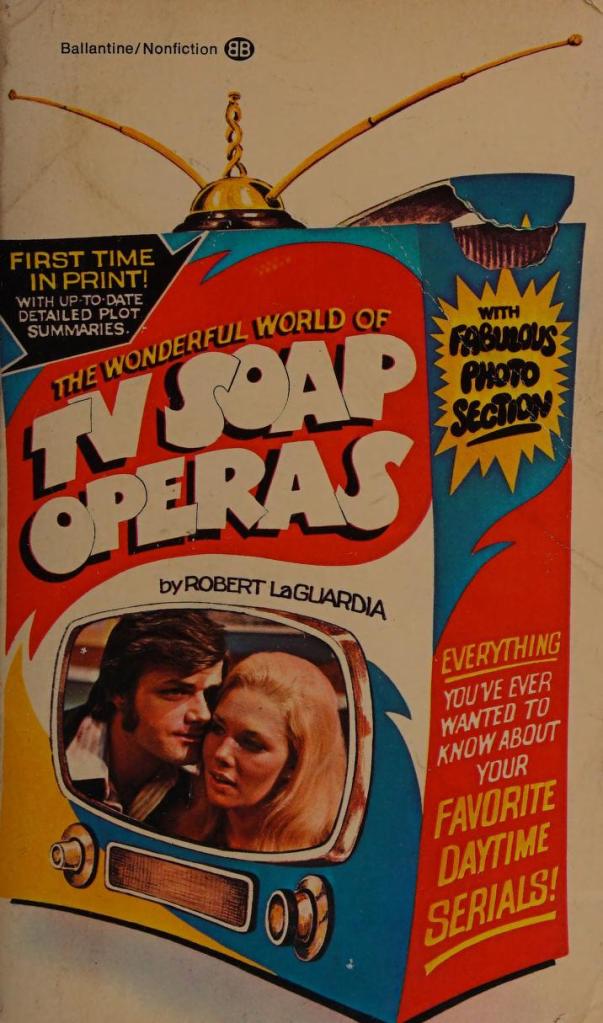
It was already out of date; at the time it was published the most popular show airing was NBC’s Another World (General Hospital was breaking all ratings records in the present day), so a lot of the book, when talking about modern times, focused on Another World, and its primary ratings driver, the love triangle between Steve, Alice and Rachel (George Reinholt, Jacqueline Courtney, first Robin Strasser and then Victoria Wyndham as Rachel; Reinholt and Courtney made the book’s cover). By the time I got to the book, Another World‘s ratings were already in free fall and ABC was in firm control of daytime’s ratings. It was also more of a puff piece rather than any in-depth reporting and digging. It was all about how talented and hard-working every one involved in daytime was, and conflicts and other off-camera issues were completely ignored. (It was updated several times, and the last edition I had a copy of, Soap World, was much better and not so “aren’t they all AMAZING?”)

But what was interesting to me about the book the most–and Soap Opera Digest–was that they both had summations/summaries of the soap’s plots from the beginning (not everything, obviously, but the main through plots and popular stories); that was how I actually learned how to write a synopsis. Interested in soaps and fascinated by these summaries, I started doing my own–inventing soap operas, coming up with the family relationships and marriages and so forth, and then would start writing the summaries. I also used to always have a bit of fun writing soap spoofs, generally casting my friends as “characters” and coming up with story lines and writing those summaries, even mini-episodes. I did several of these over the years, but the best was the one I wrote around my fraternity friends, The Young and the Pointless–and I have to say, I learned a lot writing that one. The others I’d done earlier didn’t last long and I’d get bored with it and stop; Y&P (as I called it) ended up being three “seasons” of twenty or so “episodes”, and I soon began understanding the struggles of soap writers–how do you top yourself with a story line? The need to constantly bring in new characters and subplots and balancing everything, until it became a bloated mess and I “canceled” it myself after the third season.

The first book I ever wrote, which I’ve mentioned before, was a sprawling soap opera about a small city in Kansas. Again, it was a learning experience and a difficult one at that; writing this book taught me about overwriting and filler; how bad dialogue can be if you don’t speak it aloud as you write it; and again, balancing characters and plots and subplots and story and keeping track of it all was insane. I’ve borrowed things from it over the years–plots, subplots, characters, locations, etc.–but always knew there was no point in trying to trim it down and use it as is. Murder in the Garden District’s case, in fact, was lifted fully from that manuscript; it was the main story. And I’ve used names from that manuscript repeatedly; they pop into my head unbidden and it isn’t until later that I realize where they came from and I change them.

I watched many soaps over the years; I’d often watch other soaps with friends who watched those shows and would get into them for a bit before going back to my solid three: All My Children, One Life to Live, and General Hospital. I wrote a paper in college for a graduate level course on American culture in the 20th century; the paper was called “How Storylines on Daytime Television Drama Series Reflected Changes in the Mainstream Culture.”1 It was over a hundred pages long, and traced how the soaps went from being primarily marriage and divorce drama to mining social issues for story. I got an A on the paper, of course (I always got A’s on anything I had to write), and I’ve always had some of that information left in my head; and of course as the 1980’s began, they began casting beautiful young men with exceptional bodies to play heroes and villains on the shows–John Wesley Shipp is one I’ve never forgotten, and he’s still a handsome older man today, and so I was also able to occasionally see beautiful men shirtless or in speedos. I approved of this trend 100%.
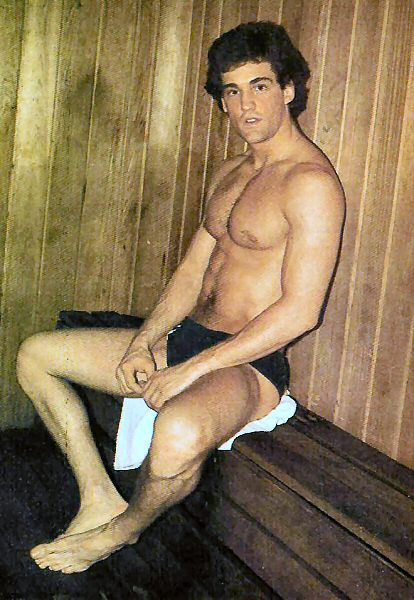
John Wesley Shipp also did these kinds of photo shoots. My God, that body.

I eventually stopped watching them in the mid-1990’s, when I realized I could keep up with them or use that time to write; I chose to write instead. But even though I no longer watched, I kept up with them some on line and so forth. The twenty-first century purge was horrible to watch, as shows that had once been a popular mainstay of daytime television were mercilessly canceled between 2001 and 2012. It’s hard to believe there are only four left airing, and there haven’t been many in prime time for decades–although the continuing nature of the soaps is now the nature of almost every television series–that cliffhanger shit really does get people to tune back in.

But I always remember them fondly. There were so many wonderful stories over the years–including some completely insane ones–and characters, too. Luke and Laura on General Hospital, Greg and Jenny on All My Children, Viki’s dissociative identity disorder on One Life to Live, and all the wonderful murder mysteries and insane courtroom dramas are all remembered fondly by me–and then of course there was Erica Kane.

It just doesn’t seem like daytime anymore, without Susan Lucci chewing everything in sight as Erica Kane every afternoon, does it?

  1. I really wish I had a copy of it, but it disappeared over the years and many cross-country moves. ↩︎

You Make Me Feel Brand New

Saturday morning and we had a marvelous thunderstorm last evening. Paul got caught in it, coming home from the gym, but it was also a flash-flood alert storm, too. I should have curled up in bed with a book, but settled for the easy chair, my chair blanket, and a sleeping kitten. We wound up watching Godzilla Minus One, which was enjoyable. It’s funny that I can watch these movies so comfortably and easily now and enjoy them, when they terrified me as a child. I think it was WGN in Chicago that would run them and call them “creature features” (which was probably the case everywhere) and that always stuck in my head. I had such bad nightmares that Mom and Dad banned me from watching the monster movies, but the vampire/wolfman/Frankenstein monster movies also were nightmare material for me. I know I also used to have Dark Shadows nightmares, too.

Having a big imagination when you’re a child isn’t always a good thing.

I haven’t had nightmares in years, at least not ones I remember–I don’t remember any of my dreams anymore when I wake up, which used to be a thing for me. Not sure how or why that changed over the years, but it did. Maybe it’s because I use my imagination so much to write and create that it’s too drained for me to dream anymore. That might be the case, but then again who knows?

I spent some time in the laundry room working on the shelves, and I did purge more books to take to the library sale today. I am going to do that and go to the gym today–errands are first, of course–and then I think tomorrow morning I’ll cross over to the West Bank to go make some groceries. I have to clean out the refrigerator today, too. I’ve been kind of low energy this three day weekend; and not getting nearly as much done as I would have liked this weekend, but that’s life these days, you know? There’s also today. I want to work on the files and do some writing today, get rid of these boxes of books, and maybe clean some. I need to do the dishes and the kitchen, too. I also need to clean myself up; I haven’t shaved since Monday and my face is itchy and scratchy. I’ve really been a slacker this weekend thus far, but I am also not beating myself up over it. It is what it is, and sometimes I need down time just like everyone else. (I do miss my old energy levels, though.) I haven’t checked today’s weather, either. I am hoping for some rain this morning so I can curl up with my book for a while this morning before lugging the books to the library–but that’s going to open up so much space in the living room! I am really enjoying this progress I am making on the house, you know. I may even attack that last file drawer today, too.

As you can tell, the coffee is starting to work its magic on my brain and I am starting to feel alive and awake. I definitely am going to get through some of this stuff this morning, huzzah! (A quick check of the weather indicates rain at ten, so huzzah!)

I have also been thinking about the book projects a lot these last few days, which has been cool and helpful. I keep getting Imposter Syndrome every time I think about the WIP–but not the usual kind, thank God; this time it’s more “are you sure you’re telling this right?” before realizing that the plan for this book was to always over-write it to begin with and then trim it down and turn it into something I can take pride in; which isn’t how I usually write books in the first place. I also realized that I am not in fact finished with Chapter 3, either; I rushed it and did one of those “I can fill this in later because I want to call this done now” things that I always regret and resent during the revisions, so this weekend I need to get back to that chapter and really finish this draft so I can move on to the next. I also need to get back to work on some short stories, too. I’ve really got to stop letting my mind have the night off more regularly!

And on that note, I am going to head into the spice mines. I need to get the books organized in their boxes for ease of transfer, get the dishes finished, and maybe–just maybe–work on the floors some. I’ll also probably be back later at some point, too. Have a lovely day and catch you later, Constant Reader!

Roll Away the Stone

Saturday morning and Sparky flatly refused to let me sleep in this morning, but in fairness, I got a little more than an hour of extra sleep. My back feels a bit stiff this morning, but I do feel rested, and the coffee will most likely clear the cobwebs. I have to run to the grocery store today, and that may be all I need to leave the house for today, which is perfectly fine with me. It looks beautiful outside, but I am sure it is the usual forecast for New Orleans: hot, humid, chance of rain. I haven’t looked at the hurricane center yet to see what’s going on with the tropical systems trying to form, but I’ll most likely do that once I’ve finished this.

Yesterday was a nice work-at-home day. I did pick up the mail (got my copy of James Polchin’s Shadow Men, a queer true crime case from the 1920s, which is all kinds of awesome). After I finished working for the day, Paul and I finished watching season 3 of Bridgerton, which we both greatly enjoyed, before moving on to The Acolyte and the new season of The Boys, which is its last. I did some writing–I started pulling the novella apart, in order to do an outline and get a better idea about how to expand it; I actually want to start writing today, if I could be so lucky, I also intend to spend some time reading today; I need to reread some things I have in progress, and would also like to get started on my next read, Horror Movie by Paul Tremblay, which I am really looking forward to; Tremblay is one of my favorite writers. I also want to get the house cleaned up some, as well as make a grocery run at some point in the afternoon. (We don’t need much, really, but really need what I have to get.)

I also worked on my body culture pride post, which actually has now turned into quite a lengthy personal essay; so much so that I may not ever post it here. The essay itself can go on my Substack; I’ve been putting the Pride posts there as well as here because, I don’t know, it just seemed like a better place for them–which seemed silly to post them in both places. Last night, the recognition that the essay was probably a Substack only post made me think about what I am doing with a Substack and a blog, and last night I realized that I should use the Substack for longer form personal essays and keep the blog as it has always been; a daily report on my life and the occasional discussion of a book, television show, or film I’ve greatly enjoyed; the reviews might go in both places, too. I think I can still make the body culture post, but the essay will have to be whittled down and revised; maybe I should do it from the perspective of life lessons learned from getting in shape and actually working as a personal trainer. (Again, seeing that turn into a longer form essay even as I talk about it here and think about it as I type.) Writing these is also an exercise in memory for me, which also is kind of helpful as I am researching the early 1970s in the Chicago suburbs.

I have to admit I greatly enjoyed season three of Bridgerton. Penelope has been one of my favorite characters since the show started, and I’ve always deeply empathized with her as she was ignored, made fun of it, and made to feel invisible. It made sense for her to be Lady Whistledown, and the choice given to her by the show–either Lady Whistledown or the love of her life–was very cleverly done. I wanted her and Colin to resolve everything and get their happily ever after, but I didn’t think it was fair she had to give up who she was in order to get it, you know? This season really emphasized how shitty life really was for these society women during that period, and I’ve always been fond of the actress who plays her mother (she was magnificent in Rome as Atia of the Julii), and this season gave her a chance to really shine as well, as she realized the daughter she always overlooked and never thought would amount to anything was actually the true jewel of her children–and who made the best match in the end. (I also predicted the end several episodes in, involving the Featherington money and title.) It was, all in all, very well done, and I think it may be my favorite of all the seasons, and precisely because Nicola Coughlin is such a compelling actress. It’s nothing serious, of course; Bridgerton is a light fluffy confection, meant to look beautiful and present this wonderful tapestry of what Regency England could have been like, and who doesn’t love a tricky romance with obstacles that must be overcome?

I’ve always wanted to write a romance, but in all honesty am not really sure if I can. I think I’ll put that on the writing agenda for 2025. Why not try? It would most definitely be a challenge to write, and I always prefer challenges.

And on that note, I am going to finish this, get another coffee, and get my day underway. Have a lovely Saturday, Constant Reader, and I’ll probably be back later on. I’m tricky like that. 🙂

This is NOT why I am a football fan, but it certainly doesn’t hurt. 🙂

16 Candles

Paul moved into the Monteleone yesterday for the weekend, so I find myself home alone with Sparky, who either feels needy when there’s only one of us here, or gives me a lot more attention when Paul’s not home to make me feel less lonely. I’ll be spending most of my weekend down there myself–although I am hoping to get some writing done every morning before I head down there for the panels and parties and things. A boy can dream, at any rate. Sparky was pretty needy after I got home from work, and spent most of the night either sleeping in my lap, following me around, or riding on my shoulders.

I did spend some time going down an Internet research rabbit-hole for the new book I am looking forward to writing later this year, The Summer of Lost Boys. I found a Facebook page for the suburb we lived in that is going to be the basis for the story (the same suburb the main character of Lake Thirteen was from), and spent some time between clients going down memory lane and remembering people, places and things I’d forgotten in the ensuing fifty years or so since we lived there. (FIFTY YEARS???) Most of the members of the group are people I didn’t know or don’t remember, but there were certainly some familiar names there–including some of my bullies. Charming, but glad to see they don’t look so great now. It was a strange suburb, really. When we moved out there it really wasn’t much of a town or anything; it was mostly subdivisions that were going up very rapidly. The town (or village; it’s still called The Village of Bolingbrook) started developing more after we moved out there…the end of the street we lived on was a field about a block away from our hose…within a few years, the Ivanhoe subdivision went up in that field. We got our own high school in 1974; I was going to be in the first graduating class for BHS that had gone to BHS all four years; the older grades has spent some years attending Romeoville High in the next town over. I am going to try to immerse myself in the period–culturally, politically, and so forth–which should make the book more interesting, or at least to people my age. I’m kind of excited about it, to tell you the truth. (And yes, some of my earliest post-pubescent crushes are also there. Also didn’t age well, but hey, we’re all in our sixties now.)

I’ve also picked out the other stories I want to use to fill out my next short story collection. Those two stories need a bit of work, but I hope I can get this whole thing finished relatively soon, so I can move on to the novellas I want to finish, the two books already in progress, and then this new one I want to do. See? I’m feeling ambitious and driven again, which is lovely. I wrote some more last night, and it was good work; revising the second chapter and pulling the story and everything together, and I’ve found the voice again, which is so crucial and was part of the problem I was having before.

I also spent some more time with Taylor Swift: The Eras Tour (Taylor’s Version) last night and realized…I’ve liked every song thus far, and I am well into the second hour of the film. I will undoubtedly write about it once I’ve finished watching, but it’s an excellent way to hear her music–some of it for the first time–and think, I really need to listen to her albums in the car and this is why she’s the biggest star in the world right now. It’s also a pretty amazing show; the girl knows how to please an audience and make them happy.

And on that note, I am heading into the spice mines. Have a lovely Thursday, Constant Reader, and I’ll be back probably at some point later today.

Season of the Witch

I read a lot of Norah Lofts when I lived in the suburbs of Chicago.

I originally found her through her historical fictional biographies of royal women, or royal-adjacent. I was in a Henry VIII phase–the whole six wives thing–and I saw a copy of her book about Anne Boleyn–The Concubine–on the wire racks at Zayre’s, so I bought it. It was very well done, and Lofts tried to get into the head of Anne and who she was, the reasons she basically changed Western civilization, and gave me an entirely new perspective on the infamous Anne. From there I went on to A Rose for Virtue (Napoleon’s stepdaughter/sister-in-law Hortense de Beauharnais, Queen of Holland), The King’s Pleasure (Katherine of Aragon), Crown of Aloes (Isabella of Castile), The Lost Queen (Caroline Matilda of Denmark), and Eleanor the Queen (Eleanor of Aquitaine)1. I also read, from there, some of her historical fiction, which I greatly enjoyed (Nethergate comes to mind). What I liked most about Lofts was she was not, in any way, a sentimental writer; her stories didn’t end happily all the time (especially her books about royal women; they all died miserable). I always wanted to read her Nativity novel, How Far to Bethlehem?, or her book Esther (obviously, the Bible’s Queen Esther). I remembered Lofts sometime within the last four or five years, and got a copy of her ghost story collection, which I enjoyed.

And then I remembered one whose plot I really couldn’t recollect–The Little Wax Doll, and got a second hand copy on-line.

It was like reading an entirely new novel, and I am glad I revisited it, believe you me.

The interview had been arranged to take place in London at half past three on a Saturday afternoon. This was a time so extremely convenient to Miss Mayfield that she was disposed to regard it as providential. It had saved her from the embarrassment of having to ask for time off to attend an interview in which she might not be successful, and from which she might be obliged to return to face her present Head’s resentment. In her diffident attempt to maintain secrecy she had left Alchester without the precaution of obtaining a testimonial. This she recognised as the action of a fool, but she had taught in the ugly Midland town for a bare two years, and she carried in her shabby handbag a coolly eulogistic report of her twenty years’ work in Africa, If that did not suffice, and if the interview showed any sign of leading to a new appointment, then would be time enough to approach Miss Stevens and break the news she was contemplating a move,

Canon Thorby had written, “Claridge’s Hotel would be convenient for me, since I have another appointment there earlier in the day. I shall be waiting for you and if you ask at the desk someone will will point me out to you.”

He wrote on thick smooth paper which justified the term “cream-laid.” His writing was small, elegant, meticulously legible. It called up an imaginry vision of the writer, plump, rubicund, with a fringe of silvery hair and tranquil blue eyes. Kindly, perhaps a trifle pompous.

As I said earlier, I didn’t really remember much of this story, other than the main character was an older schoolteacher moving to an idyllic village in East Anglia to teach at the village school, and the little rural village has some pretty dark secrets that she’s going to stumble into. Another thing I’d forgotten–although I should have remembered from reading her ghost story collection–was how compelling a writer she was. There are beautiful turns of phrase everywhere, as well as observations about life–particularly in a small village–that are really spot on, clever and insightful.

I also love that her heroine is a woman many people would overlook–particularly in the time in which this book was written (originally published in 1960)–a dowdy, plain spinster in either her late thirties or early forties. I wouldn’t have thought much about it when I first read the book, but the deep devotion of her attachment to a woman named Ruth, with whom she built a school and hospital in Kenya and worked there with her for forty years, and her determination to save enough money so she and Ruth can retire together and share a cottage blissfully for the rest of their lives?

In this read, this friendship just screamed lesbian to me.

Deborah Mayfield could easily have turned into a stereotype–the old maid schoolteacher–but Lofts isn’t interested in stereotypes; she created a character who is interesting by virtue of the journey she takes over the course of the story. She is a bit unsure of herself at the beginning of the book, always afraid of calling attention to herself and just keeps her opinions to herself. But as she falls in love with this interesting little village and blossoms with not only her students but the other villagers–she still sees herself as a nonentity, not really seeing herself as the others see her–she also, slowly but surely, finds herself being pulled into a strange situation which makes her, always questioning herself, question herself further. Surely, what she suspects cannot be? There can’t be people who believe in the dark arts and witchcraft in this town? But it’s really the only explanation, and as she gets pulled further and further into the odd circumstances regarding her student Ethel and her grandmother Granny Rigby–to the point where she is willing to give up her comfy little home and job to try to call out what’s going on in Walwyk–she begins to get a sense of her own power; the inability to stand by and do nothing while something untoward is going on strengthen her resolve and makes her stronger.

Then about halfway through the book there is a huge plot twist, which throws everything into a different, just as suspenseful and thrilling, direction–and one in which Deborah finally comes into her own, managing to get her way back to Walwyk in order to stop a horrible outcome that isn’t predestined.

One of the other things I like about the book is Lofts’ lack of sentimentality. The ending of the book makes it seem as though the day has been saved…but has it, after all? I also love that we never really know if there is actually witchcraft going on in the town–or maybe it just looks like it? Lofts leaves this up in the air as well–which she probably wouldn’t get away with today.

A terrific reread, and a terrific author I am very happy to rediscover.

  1. She also wrote The Lute Player, about Richard the Lionhearted, his wife Berengaria, and the minstrel Blondel–which was my first exposure to the idea that Richard, the great English hero, was queer. That revelation was a bit life changing, as I began looking for hints of homosexuality being covered up in history books. ↩︎

Hurts So Good

Ah, Monday morning back to work blog today. I have to leave early as I have a PT appointment at four today, but that’s okay. I also have to run errands, and I will already be uptown, which is terrific. (Mail and make a little groceries, for those who are unsure what I mean by errands.) I’m usually in a good mood when I finish PT (it’s the endorphins), so hopefully that will make running the errands in the cold a little easier. It should get up to the sixties by the time I leave the office today. Parades begin next weekend (not this coming one, but the next) and I am not even remotely in the slightest prepared to deal with all the aggravation, exhaustion and fun that comes from living inside the box1, as we call it here. While it does mean having easy access to parades and catching throws, it also makes navigating every day life incredibly difficult.

Sigh.

I feel very rested this morning, after a weekend spent feeling tired most of the time. I managed to do very little this weekend other than rest and cleaning and chores. Maybe the strength PT on Friday wore me out far more than I had originally suspected; after all, it’s the first taxing kind of exercise I’ve done in over a year. (I also have to leave work a little early today as well for a session later this afternoon.) I didn’t get much done this weekend, sadly, but I consider progress on the house to be progress of a kind at any rate. I also started reading Lina Chern’s Play the Fool, which I am enjoying; the voice is quite original and delightful. We also watched another episode of Lupin last night, which is also quite good.

I was struggling there for a moment to remember what precisely I did yesterday while Paul took calls and worked upstairs; I just remembered that I spent most of the day finishing the original BBC series of Brideshead Revisited. I can see why the show was so popular back when it originally aired and why it own so many Emmys–Americans have always thought British productions of anything to be vastly superior to anything produced here–and it did remind me a lot of Downtown Abbey, which also led me to wonder why Americans are so fascinated by the British upper class. I know I certainly used to be, but my lack of knowledge regarding Brideshead seemed like a missing cultural touchstone for me, and now that I’ve seen it–yes, I can see how influential it was. There would be no Downton without Brideshead, but the original is far less soapy than the later show….and of course, Upstairs Downstairs was truly the original Downton, a soapy show about a wealthy family’s ups and downs as well as their servants. I don’t imagine the occasional thoughts I would have while watching–deep criticisms of the class system and the disproportionate division of wealth in British society of the time; how it would have sucked to have been one of their servants–would have occurred to me had I watched when I was younger. I also felt that there was more to the relationship between Charles and Sebastian than mere friendship; which is another thing it has in common with Saltburn; an ambiguous love relationship between two men. I was also rather disappointed that Sebastian disappeared from the show about halfway through so it could focus on Charles and Julia, which I felt was giving Sebastian, whom the show really centered at first, very short shrift indeed. I will go ahead and read the book–my education in Evelyn Waugh was sorely neglected–but I feel that watching the series has given me enough grounding to explore Saltburn again through that experience.

It’s chilly again this morning but nothing terribly unbearable, thank the Lord. I do feel rather good this morning, and hope I can ride that feeling through the work day, into PT and making groceries again after work tonight. This is an actual full work week, of which there have been few for quite some time for me, so we’ll see how I feel when Friday rolls around again, shall we?

It’s been an interesting and slightly uneven January so far, bit of an up and down month, in all honesty. Life is always a rollercoaster, isn’t it? Ups and downs and never certain when the next curve or sudden drop is coming, all at great speeds that sometimes never give you a chance to catch your breath. There’s nothing life can give us that we can’t handle, as Scotty always says, it’s how you handle it that matters. I’ve always found that emotional responses or reactions are often counterproductive and exhausting, and if you can somehow switch the emotional component down or off or mute it so you can engage your logical brain and figure out how to handle it and what you need to do next to start the getting through it process might not be the absolute healthiest way to handle anything, but it has always worked for me and is why people always think I am so good in a crisis–I am very good at ignoring the macro while focusing on the micro. The problem with that, of course, is that you never go back and process the feelings and emotions; they’ve been securely buried for the moment and inevitably, that results in me thinking oh I don’t need to process that after all!

When in fact I really do need to.

That’s been happening a lot for me since the concurrent COVID pandemic/shutdown coupled with me turning sixty and eventually losing my mom. I’ve been thinking about things from my past a lot more than I ever allowed myself to, identifying the lessons I’ve taken from bad experiences and how I turned that into I don’t ever want to feel like this again s so I will never do that again which may not have been exactly healthy. I don’t think I’ve ever gotten over that sense of not belonging anywhere when I was a kid, which was partly being a gay kid (I didn’t know that specifically, but I also knew I was different from the other kids) as well as having some chemical issues in my brain (ADHD, anxiety, etc.), added to the sense of not belonging because I was from Alabama and living in Chicago. New Orleans was, in fact, the first place I’ve ever felt like I belonged, and that’s part of the reason I love it here so much. There wasn’t any single one thing to blame; I always thought it was this or that or the other, but rather the combination of everything that made my childhood so incredibly difficult for me (and pretty much my life until about thirty-three or so).

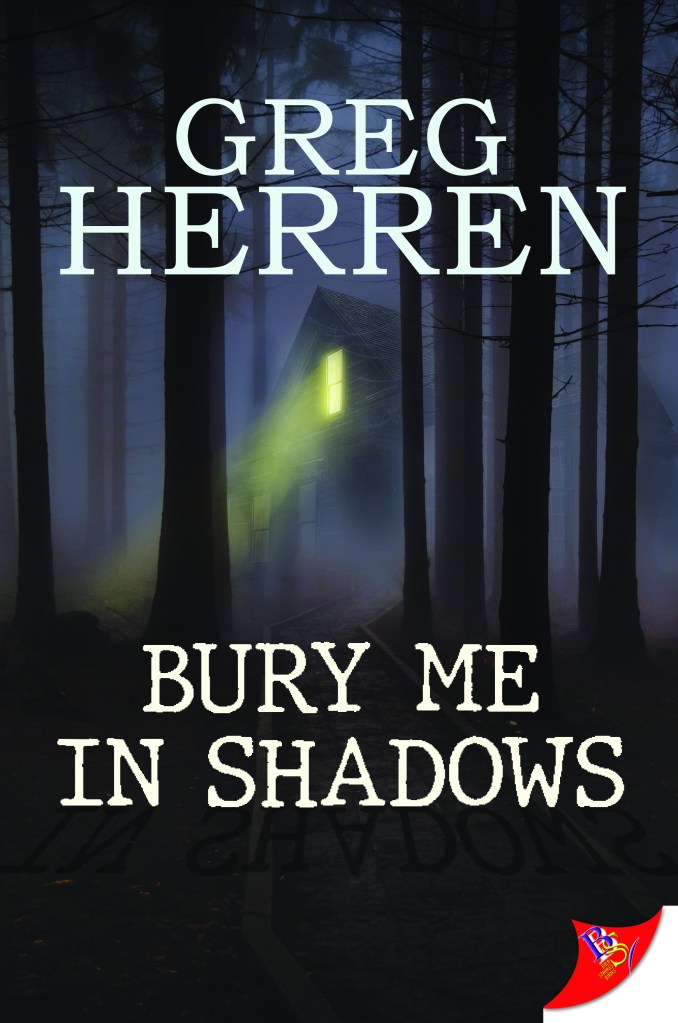
I think the real reason–I was asked this on the young adult panel this weekend–I write about teenagers is I am still trying to make sense of my own experiences. I also think that my past is also filled with very rich material for my writing. I learned that with both Bury Me in Shadows and #shedeservedit–writing about things that I have had trouble understanding in my own life fictionally has not only made my work better but also has helped me process things in a healthier way than I ever have before.

And on that note, I am heading into the spice mines. Have a lovely Monday, Constant Reader.

  1. “The box” means inside the parade route for Carnival; the box being formed by Canal, Napoleon, St. Charles and Tchoupitoulas. Once parades have started you cannot cross any of those streets, and yes, I live just inside the box on the St. Charles side of the rectangle. ↩︎

Little Jeannie

We have a new refrigerator, and it is marvelous in our eyes.

The delivery was actually two hours early and went incredibly smoothly. I did have to take the kitchen apart and rearrange a lot of things, which triggered the old your filing system is completely out of control and has been for quite time, and the duplicates, dear God, the duplicates. But having a new, working refrigerator (we really put up with the malfunctioning old one, which was never the same after whatever evacuation that was in 2008–Ike? Isaac? who knows. So, this kind of was the impetus for me to reorganize the cabinets, throw out a lot of stuff I didn’t even know I had (forcing me to recognize that I still have food hoarding issues), and do something constructive with the filing. This morning I am going to move the rest of the food over from the carriage house refrigerator, and make notes on what I need to get at the grocery store. My hope is to get that all done this morning, spend some time reading the Elizabeth Hand (which I am greatly enjoying), and then tackle the filing and get this under control once and for all.

And this is just a small step forward in a big journey I am taking–in which I need to organize and/or discard things I no longer need. I have more ideas than I will ever write about, or have the time to write; I get more ideas every fricking day. Do I really need to hold onto old file folders crammed full of ideas I don’t even remember that I have? And if I do remember it, and it turns into something–I will just create a new file rather than go look for the old. I should scan old contracts, shred tax returns, and who knows what kinds of treasures I may find in the files as they come together at long last? I’m still unsure of the system I am going to use, but I need to get all the things that are like each other together–files about Alabama, files about New Orleans and Louisiana, files about Kansas and California and Chicago and its suburbs and Houston and Florida and crime stories and all kinds of things; research versus actual fiction–book ideas v, short story ideas; fiction vs nonfiction–and so forth.

I also worked on the laundry room some, and also managed to watch a lot of football games–Alabama against Arkansas, Tennessee-Texas A&M, and finally Auburn-LSU. I still don’t know what to think about the conference race this year, other than both divisions go through Georgia and Alabama again this year, and I don’t see anyone beating Georgia during the regular season. Texas A&M’s loss at Tennessee is their second in conference and third overall; no division title or shot at the play-offs for them; yet they are a good team and can still play spoiler. Tennessee still has Alabama and Georgia and Kentucky. The West is pretty much still up for grabs, with Alabama in the catbird seat; still tied for first even if they somehow lose to LSU. I don’t know what happened to Auburn after the Georgia game–which they had a shot at winning–because that team didn’t show up in Tiger Stadium last night. LSU’s defense, which finally started playing at a higher level in the second half of last week’s Missouri game, looked really good…or was Auburn’s offense really that bad? I thought their defense was for real–but how good were they really, because they didn’t look like an elite SEC West defense last night. LSU does have an incredible offense, no mistake or question, but are they really forty-eight points on Auburn good? After Georgia escaped them with a 27-20 win on the plains? That’s why you play the games, people–anyone can win on any given Saturday.

I slept very well last night, which was awesome. I feel quite well rested this morning, and so today’s chores do not sound either ominous or terrible. The filing is indeed going to be a chore, as is moving the food back over and making two grocery runs, but better to get it all over with today, wouldn’t you think, so I can go home straight from work tomorrow? We’re having a “professional development day” that starts at City Park at ten in the morning, after which we go to Dillard for a presentation and then back to Ralph’s on the Park for another. Lunch and dinner are being provided, which means I am not going to be able to eat anything, most likely, which will be very unpleasant for me, I think, but I’ll deal with it. Tug is also settling in more–it’s very obvious that he knows he is home, and this is where he belongs. So bold, so curious, so playful, so adorable. He sleeps completely relaxed and sprawled out on whichever laps he chooses, and he’s started doing to Scooter thing where he’ll go back and forth between us for naps, which is adorable.

And he does love chasing the red dot.

He’s having particularly big kitten energy this morning, too.

And on that note, I am going to go start moving the food back over and making the grocery list. Have a lovely Sunday, Constant Reader, and I may be back later; if not, then tomorrow.

The Man of Metropolis Steals Our Hearts

I have always loved Superman, ever since I accidentally pressed the wrong button on the comic book vending machine at the Jewel Osco on Pulaski Avenue in Chicago as a child and got Action Comics instead of the Betty and Veronica I wanted. I was disappointed, and asked my mom for some more change so I could get what I actually wanted, which was when my mom decided to teach me a valuable life lesson: if you hurry and don’t pay attention you won’t get what you want–and sometimes that’s the end of it. So always, always make sure you’re picking the right thing. (I still do, to this day, and whenever I “forget” and rush–it inevitably ends badly.)

I wasn’t happy about it, but made the best of it. I had a comic book, after all, and while I had never shown any interest in super-heroes and their comics before, I decided to read it when I got home.

Once I did, I was done with the Archie and the world of Riverdale for good. I started reading DC Comics–I already knew about Batman from the television show, which we watched every week with its epic cartoonish campiness–and all the other titles that involved Superman even if only in a peripheral way. Both Jimmy Olson and Lois Lane also had their own titles, there were at least three titles alone devoted to Superman, and of course, Justice League of America. There was a Superboy title, too, and of course we can’t forget Linda Danvers, Supergirl. I read them all, and finally stopped buying them when they reached the (to me then) insane price of a dollar per issue. But I never lost my sentimental attachment to DC Comics and their heroes. I was also terribly bummed when the peripheral titles, like Superboy, Jimmy Olson–Superman’s Pal, and Superman’s Girlfriend, Lois Lane–were cancelled. For the most part, Lois’ adventures that didn’t involve Superman–when she was actually doing her job as an investigative reporter–often involved her in mysteries she had to solve, which were a lot more interesting to me than her schemes to expose Clark as Superman, or to get Superman to marry her. The old television series, with George Reeves, was often shown in reruns on alternative non-network local channels, and while I of course watched, I was kind of disappointed with how bad and cheap the effects looked. Batman’s television show was campy, of course, and highly entertaining–but campy. Wonder Woman was also campy and cheesy, but had Lynda Carter, who personified both the super-hero and her alter-ego, Diana. (When I was watching Superpowered: The DC Story the other night Carter said something I thought was very perceptive and explained thoroughly her role on the show: “I didn’t play them as separate characters–I just played her as Diana, the Amazon Princess, with a strong belief in equality and that there’s a better way than fighting.”)

So, when they Superman movie was announced sometime in the mid-1970’s, I knew I’d go see it, but didn’t have a lot of high hopes. But the tagline was fantastic.

You’ll believe a man can fly.

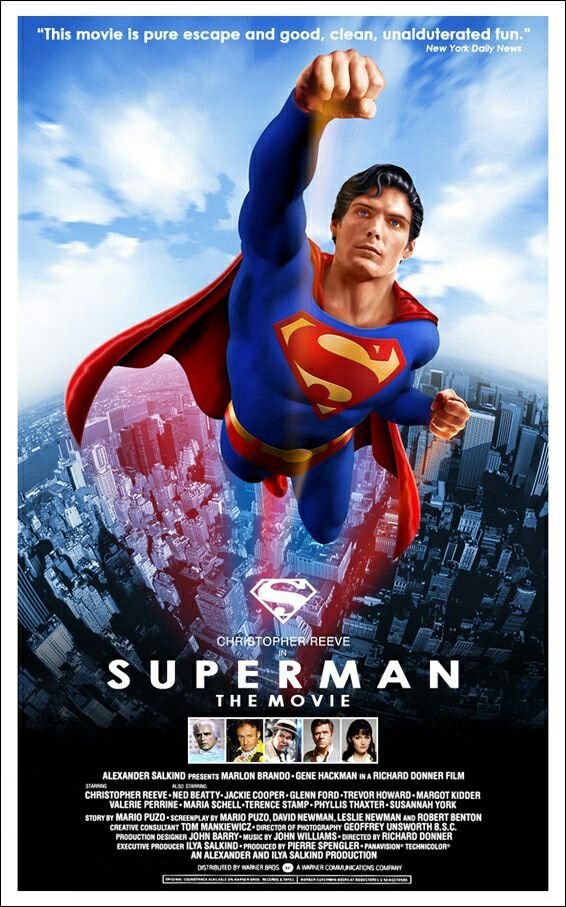
I think I was at the theater, waiting to watch either The Deer Hunter or Animal House, when they played the preview for the upcoming December release Superman The Movie, starring Christopher Reeve and Margot Kidder (among many other major names in supporting roles–from Marlon Brando to Gene Hackman to Ned Beatty to Valerie Perrine). I knew they were making the movie, and I had allowed myself to get a little excited about it as a Superman fan. I’d always found previous Superman adaptations–mostly the television show–to be so inexpensively done that it was almost comical. But special effects had been changed forever by the one-two punch of 1977’s Star Wars and Close Encounters of the Third Kind, and I also knew they were spending a LOT of money on this adaptation, so when the screen and theater went dark, and you just heard a voice saying “You’ll believe a man can fly” and then…there he was, flying. I caught my breath because it looked so real. And when Christopher Reeve turned his face to the camera, smiled, saluted and somehow got his eyes to twinkle, I also knew the movie was perfectly cast. I couldn’t wait for the movie to finally open (I think I also saw the sequel on its opening weekend), and yes, when it finally came to the Petite Twin Theater (apparently still there? No, no movie theater on Commercial Street anymore, alas) I saw it on that first weekend.

I’ve always loved Superman, and Christopher Reeve was fantastic in the part; the bar every actor who puts on the suit has to clear.

Obviously, the recent announcement that David Corenswet has been cast to play Clark/Superman in the new reboot of the film franchise, replacing Henry Cavill, has me thinking about Superman again. I was very pleased, frankly, when Cavill was originally cast; I’d first noted him playing Charles Brandon on The Tudors and thought, “that is one fine-ass man.” I thought he was the perfect choice to play the dual roles of Clark and Superman; he is drop dead gorgeous, for one, and his eyes have the ability to twinkle when he smiles and the dimples? Just take me now, Henry.

Mr. Cavill fills out the suit rather nicely, does he not?

The Henry Cavill version of Superman, which followed on the heels of a failed reboot with Brandon Routh (who returned to the televised DC Universe–the Arrowverse–in Legends of Tomorrow. I always felt bad for Routh, who I didn’t think got a fair break, either), wasn’t the best interpretation of the character but that wasn’t Cavill’s fault; that was the vision of the director and writers and the studio; and while I think I can understand the need to update Superman, the need to darken his story a la The Dark Knight 1980’s Batman reboot was a mistake. Superman is the World’s Biggest Boy Scout; he stands for hope and truth and all those things we used to believe embodied the United States; if anything, Superman was the personification of the idea of American exceptionalism.

David Corenswet certainly has the right look for the part; he’s from the Ryan Murphy stable of dark-haired blue-eyed square jawed hunks who regularly appear on his television series. I first saw Corenswet in The Politician, and then again in Hollywood. I found the following fan art through a Google search, as there are no available official images of him as the Big Blue Boy Scout. James Gunn’s vision for the DC Universe is one I am interested in seeing; while I didn’t enjoy the second and probably won’t watch the third (I’ve come to detest everything about Chris Pratt over the last few years), I did think the first Guardians of the Galaxy movie was pitch-perfect for a popcorn super-hero type movie.

But I do hope they move away from the dark broodiness of the Cavill version. I enjoyed them (and love Henry Cavill for reasons that should be obvious; look at the posted picture above again), but they didn’t feel right for Superman movies. The underlying theme and element of all the Superman stories is his positive energy and determination to protect people from harm and most importantly, lead by example. One of the core elements of the original Superman series (before the first of many DC reboots of their universe) was that Superman’s most sacred vow was that he would never take a life, no matter who or how much they deserved death. That didn’t matter to Superman, whose pursuit of justice was limited to capturing the bad guys and turning them over to the judicial system. It wasn’t his job to determine justice and punishment.

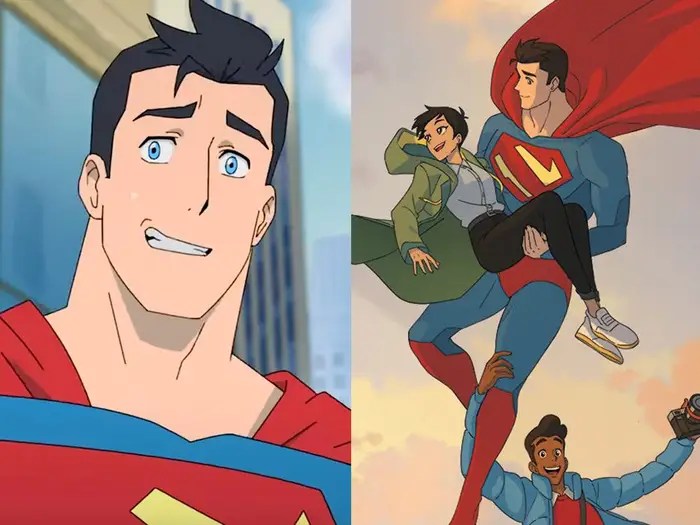
I keep hearing good things about the animated DC movies and series, but have yet to really watch any of them. I don’t know why I have this automatic resistance to animated super-hero shows/movies; I love Disney animation, and there are literally hours of DC animated entertainment available for streaming. I’d been hearing good things about a new DC animated series on MAX called My Adventures with Superman, so while I was waiting for Paul the other night (and was tired of LSU football highlight videos) I decided to give My Adventures with Superman a chance.

Constant Reader, I am so glad I did.

The show is utterly charming. It’s very well animated, for one–Clark/Superman is handsome, which is weird to say about a cartoon–and it’s refreshingly well-written with more emphasis on the characters and who they are, as well as their relationships with each other, over the adventure aspects of it, which makes it all the more likable and enduring. The premise is that Clark, Lois, and Jimmy Olson are all interns at the Daily Planet; Clark and Jimmy are just starting, and Lois is given the job of breaking them in and showing them the ropes. Lois is ambitious and determined to become a star reporter, and her impetuosity and ambition quickly leads them all into trouble–not only with the bad guys, but with Perry White back at the paper. Fortunately, Clark is, well, Superman, so all turns out for the best and Lois gets the scoop of all time: there’s a super-man amongst us! Which gets all three of them hired on staff. Clark is exactly the way he should be: kind, thoughtful, empathetic, a little bit shy–and the cold open of episode 1, which has young Clark suddenly discovering that he can, actually, fly; and his excitement and wonder at discovering this sudden new ability slowly begins to fade–imagine learning at age ten or eleven that you have super-powers–and he begins to wonder not only who he is, but what he is….then after the opening credits it flashes forward to Metropolis and Clark and Jimmy–roommates–getting ready for their first day as interns. The chemistry between the three of them–truly the Holy Trinity of the Superman stories is Clark, Lois and Jimmy (it’s so nice to see Jimmy Olson finally getting something to do and being included as something more than just a bit part, which is a nice nod to Superman history), and I am really looking forward to watching more of it.

And the art is fantastic.

Well done, DC. I hope this series lasts and is a hit–and I hope James Gunn is watching so he can see how to do the Big Blue Boy Scout properly.

Song of the South

I am both of the South and not of the South.

I was born in Alabama but didn’t grow up there. I was two years old when my parents migrated north in search of work, good jobs, and a better life for our family. My parents, however, were very Southern, so I was raised with their values and beliefs (which were very Southern and of their time) but being confronted with very different values and beliefs at school every day opened up my mind in ways that it may not have been had I grown up in Alabama. Our neighborhood in Chicago, near Lawndale Park (our nearest major cross street was 31st and Pulaski), was the perfect representation of America’s vaunted ‘melting pot’; our neighborhood was filled with first or second generation European immigrants; many from eastern Europe, who fled either before or after the war. There were Czechs, Poles, Austrians, Hungarians, and Serbs; in the fourth grade we even had a Muslim girl from Yugoslavia. She had the most delightful first name which I’ve never forgotten–Zlatiça–even as her last name is lost in the clouds of memory. It was also very confusing trying to figure out where the immigrant kids (either they were born in another country or their parents/grandparents were) came from, given that the maps of Europe had been redrawn barely twenty years earlier. The Czech children I knew didn’t identify as Czech but rather as Bohemian; they also called their language that. It took years of study and reading up on history to realizing Bohemia became Czech after the first world war; for many years I believed Bohemia still existed under that name but had somehow been folded into another country or something; I don’t remember. I do remember being confused. Until I finally wrapped my mind around the post WWI renaming of the region, I always just assumed Bohemia was a German region. Reading history didn’t help much in that regard, as Bohemia was part of the Holy Roman Empire for centuries (in fact, the Thirty Years’ War kicked off in Bohemia).

But there was a lot of racism in our neighborhood too; the white European immigrants detested the brown immigrants from Mexico and Central America; I vividly remember the way our babysitter would sneer the word Mexican when referencing anyone brown. There was also a lot of strife in Central America at that time; I think both Guatemala and Nicaragua were enduring civil wars of some sort, hence the influx of Central American refugees and immigrants. I remember Martha, a girl in the sixth grade, telling me about how soldiers came and shot up her village, killing dozens of people she knew and members of her family. She was very calm and unemotional as she told me about it, which is pretty remarkable for a child who couldn’t have been more than ten or eleven, talking about a trauma she witnessed when she was six or seven. (Now I know she was dissociating; and I do remember her telling me calmly that she felt like she wasn’t even there as it happened; like she was watching it all happen from a distance.) Ironically, we became friends because we exchanged Nancy Drew or Hardy Boys mysteries; this conversation came about because we were reading a Hardy Boys book set in Central America; I want to say Footprints Under the Window, but it may have been something else….but she wanted me to know that the depiction of Central America in the book was nothing like the reality.

My grandmother used to tell me wonderful stories when I was a kid about my family history and the history of the county we’re from in Alabama. As a wide-eyed innocent and naïve child, I believed everything she told me, and always wanted to fictionalize those stories. I was in my early twenties when I wrote a short story based on one of those tales; about the Lost Boys and the evil renegade Yankee soldier who burned the house down and presumably murdered the two boys of the house. The story was called “Ruins,” and while I was pleased with the story I felt the story was too short; there was more to the story than I could fit given the length restrictions. I always thought of the story as a kind of an abstract or lengthy synopsis of the novel I would write someday. But it was also a Civil War story, and I wasn’t sure how I could write a Civil War ghost story without being, frankly, offensive. I tucked it away in a drawer and would think about it from time to time–usually when driving through Alabama on my way north–but still couldn’t wrap my mind around it. I worried and fretted and feared and doubted myself constantly. I told the story once to another writer friend of mine, and she urged me to write it…in fact, she hounded me about it for about twelve or thirteen years before I decided to take a deep breath, put on my big boy pants, and take that risk.

“Was this an accident, or did you do it on purpose?”

I opened my eyes to see my mother standing at the foot of my hospital bed, her heart-shaped face unreadable as always. The strap of her Louis Vuitton limited edition purse was hooked into the crook of her left arm. Her right hand was fidgeting, meaning she was craving one of the rare cigarettes she allowed herself from time to time. Her dove gray skirt suit, complete with matching jacket over a coral silk blouse, looked more rumpled than usual. Her shoulder length bob, recently touched up as there were no discernible gray roots in her rigid part, was also a bit disheveled. She wasn’t tall, just a few inches over five feet, and always wore low heels, because she preferred being underestimated. Regular yoga and Pilates classes kept her figure slim. She never wore a lot of make-up, just highlights here and there to make her cheekbones seem more prominent or to make her eyes pop. Looking at her, one who didn’t know better would never guess she was one of the top criminal attorneys in the country or that her criminal law classes at the University of Chicago were in high demand.

I could tell she was unnerved because she’d allowed her Alabama accent to creep slightly back into her speech. She’d worked long and hard to rid herself of that accent when she was in law school, because she said no one took her seriously when she spoke or else thought she was stupid once they’d heard it. The only times she used it now was when she wanted someone to feel superior to her, or she’d been drinking, or she was upset.

It worked like a charm getting her out of speeding tickets.

I hadn’t been asleep, nor had I been awake either, hovering in that weird in-between state where it seemed like I’d been living for the last three or four days.

“It wasn’t on purpose.” I managed to croak the words out. My throat was still raw and sore from having my stomach pumped. My lips were dry and chapped, and my eyes still burned from the aftermath of the insane drug-and-alcohol binge I’d gone on in the aftermath of the break-up with fucking Tradd Chisholm. “It was an accident.” I shifted in the hospital bed, trying to sit up more, the IV swinging wildly. The memory of that last and final fight with Tradd flashed through my head.

The main character in the original short story was only twelve, and the cousin he shares the adventure with was supposed to be fourteen. I was writing a lot of short stories at the time set in Alabama, with the idea to tie them all together in some ways–and was also reading a lot of Faulkner at the time, so yeah, a fictional county in Alabama where all the stories were set and were interconnected was kind of derivative; I kind of smirk to myself now when I think about the hubris of aspiring to be Faulkner-esque, especially at that time, when everything I wrote was pretty much garbage. Ah, the hubris of youth. But I did write a lot of “Corinth County” short stories back in the day, and while the writing may have been atrocious, the idea behind them and the core themes were good and had potential.

When I started thinking about turning the short story into a novel, I soon realized that the characters were too young, so I aged them. I originally aged them to teenagers, and in the first attempt at a rough first draft, I got about two chapters in with my main character, Jake, being banished the summer before his senior year to help take care of his dying grandmother back in rural Corinth County. The original first line was something like The summer before my senior year my mother ruined my life. Properly self-absorbed, narcissistic, everything’s about me teenager, right? My original thought was he was a student at a Catholic all boys’ school, was openly gay, and had a crush on a classmate…and having just found out said classmate had gotten a summer job lifeguarding, managed to get himself and his female best friend jobs at the concession stand at the pool, so he could be around his crush and see him all the time. His banishment for the summer had to do with his lawyer mother accepting a co-counsel role in a major trial in California and being gone; she has also kicked out her fourth husband (a much younger tennis pro) and so she can’t leave him alone in Chicago for the summer. The other option was staying with his father and his second family in the suburbs, which was equally unappealing, so he choses Alabama…and is picked up at the airport in Birmingham by another teenager who’d been taken in by Jake’s grandmother when his own mother died. This character, Kelly Donovan, was originally meant to become close with Jake and participate in all the mysteries Jake encounters at his grandmother’s. I also wanted to play with Jake’s being strongly attracted to Kelly, who is some kind of distant cousin, and straight.

But I scrapped that beginning, too. Would a young senior in high school in rural Alabama, a star athlete, be so accepting and open to Jake’s sexuality? Probably not…and he would also be worried and nervous about his patron’s grandson coming to stay there. As I delved more deeply into Jake’s character and who he was, I started thinking it made more sense for him to be older. Why not have him be a student at Tulane, and living in New Orleans? But if he was living in New Orleans, what would make his mother exile him to rural Alabama for the summer? And the more I thought about Jake…the more I realized there was underlying trauma in his life. I didn’t want his mother to be homophobic, but her mother, the dying family matriarch? Yes, yes, that worked better. I made him a loner, but someone who didn’t want to be a loner. He didn’t ever feel like he had friends at his Catholic school; and coming to Tulane he met his first, real boyfriend…which ended up being a disaster. And then realized, what if he goes on a binge–easy enough to do in New Orleans–after a bad break-up and winds up in the hospital? And if he had tried once before to kill himself…yes, yes, this is a MUCH better backstory and pulls the actual plot of the book together much better.

I also knew I wanted to touch on themes of homophobia in the rural South, as well as the horrors of modern-day Southern racism and the South’s racist past.

When I started doing research for the book, I soon learned that many of the old family/county stories my grandmother used to enthrall me with were all apocryphal; almost every region of the South has some version of the stories she told me; the story of the Lost Boys, a local legend which was the foundation of the book, pops up all over the old South–almost every state and every region of the old Confederacy has a version of the story, complete with renegade Union soldier (think Gone with the Wind), and so I decided to address that trope in the book while also using it. But I also added another layer to the story–the Lost Boys may not be the only ghosts at the old Blackwood place, which has a tragic and bloody and horrifying history, as does the entire county. I also started lessening Kelly’s importance to the story–he’s still there, he’s still a character who also gets a big reveal later in the book–but Kelly’s behavior to Jake is abominable and homophobic, establishing some conflict between the two of them as well. Part of this was because of the change in the story, but then I needed to partner-in-crime as well as potential love interest, so I came up with Beau Hackworth (the Hackworths are a large and poor family in the county; I’ve used that family before in stories; my main character in Dark Tide was a Hackworth from Corinth County).

And of course, when you’re writing about a Southern rural county and the Civil War, you cannot avoid the issues of race, prejudice, Jim Crow, and enslavement. I wanted to make it very clear that this wasn’t some “Lost Cause” romantic fantasy that perpetuates the lies and mythologies that sprang up in the South decades after the actual war ended. Jake’s mother raised him not to be racist or prejudiced, as she tells him several times, “We do not take pride in the fact our ancestors enslaved people. The heritage is hate, and don’t ever forget that.” I did wonder if I was being too generous to white people with this, but on the other hand I wasn’t interested in writing from the perspective of someone racist. I will be the first to admit that I worried about being offensive in this book; the last thing I would ever want to do is be insensitive on the subject of race. But I also knew and trusted my editor enough to know she wouldn’t let me get away with anything, and I also had to trust myself to handle it all sensitively. There were a couple of things she saw in the manuscript that could potentially be considered problematic–but they were also easily fixed.

I was very pleased with the end result, and I do think it is one of my best books. I was absolutely thrilled when it was nominated for two Anthony Awards last year at Bouchercon.

And it also goes to show that you cannot play it safe, and things that scare you are precisely the things you should write about .

(For the record, I will add Cheryl A. Head’s Time’s Undoing is one of the best crime novels ever written about racism in Alabama. Beautifully written and brilliantly told, it should really be required reading.)

Skidmarks on My Heart

Wednesday and somehow it’s pay-the-bills day again, but it’s also the first of March. February was clearly a write-off for me on almost every level, so March is going to have to be a “get your shit together” month for me. I am hoping that I will get a lot done this weekend, too. Fingers crossed, at any rate.

I went down a wormhole the other day; I’m not really sure how I wound up where I did, but I know I was thinking about places I’d lived (the Mom thing again) and so was looking at our suburb in Chicago, the county in Kansas, and so forth. So you can imagine my shock and surprise when I came across an article about an eighth grader in my old school district in Kansas being victimized by homophobia. (Homophobia in Kansas doesn’t surprise me–I experienced it first hand for five years–but what surprised me was an eighth grader in my old school district is an out lesbian. Long story short, kids on the bus were being kids on the bus (I do not miss riding the bus) and swearing, etc. At some point there were some slurs being tossed about, and as the young girl responded, “There’s nothing wrong with being a lesbian. I’m a lesbian” at a time when the bus had one of those moments where everything goes silent for a moment. The bus driver, being garbage, thought that was horrifying (as the security videos from the bus later showed, said bus driver had no problem with junior high and elementary school kids yelling fuck and asshole and faggots and the n-word; no, the girl said lesbian so she must be punished. The school district didn’t even review the tapes, and despite having a three-strikes policy for bus riders; decided her saying lesbian was three strikes and she was banned for a week from riding the bus. The family appealed to the principal,. who refused to even review the tapes; the family went to the school board and the press–and it became a thing. Cheerleaders at my old high school wore rainbow ribbons in their hair to show support at games (way to go, cheerleaders!) and parents and teachers got involved. A library aide who was giving out rainbow pins at my school was fired; which triggered resignations from the teaching staff. Finally, the ACLU got involved, and the principal–who was being transferred in a big promotion to Emporia High–and the bus driver were terminated, and the school board rescinded the principal’s job offer at Emporia High. The eighth grader did eventually switch schools, but finally got justice of a sort.

And shortly thereafter, she went missing. There are no news reports that she’s been found since she was reported missing, which is heartbreaking and sad.

And of course, my mind started whirling about another Kansas book for me based on this story. But I don’t have a title for it…and I can’t write anything without a title. But I have a lot of other things I need to do before I can even think about writing this book, but I can start doing research when I have a spare moment or am too tired to read or focus on a movie or TV show.

And at least I am thinking creatively again, which feels lovely. I’ve been rather listless since getting back to New Orleans, but I am hoping that settling back into my daily routine of getting up in the dark and going to the office every day will snap me back into my reality. I’d like to wash the car and clean it out this weekend, and I should probably do more cleaning up around the house this weekend. I want to start eating healthier than I have been (my weight has been out of control for far too long) but I also know that I need to start exercising more. I think I am going to start doing crunches and stretching every day while waiting to find out what’s the deal with my big toe (reasons to succeed, not excuses for failing). I think I may go to Urgent Care on Friday morning before work–on the other hand, I could also go tonight; they’re open until 8…but I also don’t want to take a chance on having to go somewhere this evening for X-rays, either. Heavy sigh. Why am I so bad at making decisions for my personal life? Why do I actively avoid making decisions in my private life?

Probably because I have such a shitty track record with decision making. What can I say? It is what it is.

At least I slept well last night. I was exhausted when I got home yesterday. The dryer fuse arrived in the mail yesterday but I was too worn out to bother with trying to move the dryer and fix it; that will be a chore for Friday morning, methinks. I did finish a load of laundry in the carriage house last night and emptied the dishwasher, preparatory to refilling it…but I got so tired standing at the sink washing the dishes that I gave up part of the way through and left them to soak until I get home tonight, which should make washing them all that much easier. I did provide Scooter with a sleeping lap while I watched some documentaries on Youtube; don’t ask me what they were because I don’t remember a whole lot of them (I told you I was tired last night) but I know I watched some of History Guy’s biographies of past presidents–definitely Benjamin Harrison (we have the same birthday, over a century apart–but I’m also not sure what else I watched, either. I tend to mindlessly scroll through social media on my iPad while I am sitting there watching the videos so that could also have something to do with it. I’ve also decided that my next read with be Bobby Mathews’ Living the Gimmick (I think that’s the title; I know it’s verb the Gimmick), which is set in the world of professional wrestling in Alabama, which should be very interesting. I read the opening paragraph last night and really liked it, so hopefully when I get home tonight I won’t be too tired to watch. I know Paul won’t be home early enough to watch The Mandalorian tonight, which means I have to avoid spoilers everywhere until this weekend when we will be able to watch.

But today I feel rested and wide awake and ready to go; we were also terribly busy yesterday at the office; the first time in years we’ve had a full schedule of someone booked every half hour (we went back to the old “someone every half hour” in January), so I was rather hopping yesterday at work, and being so tired really didn’t help; although I did get a jolt of adrenaline at some point that rode me through the afternoon until I was completely exhausted at the end of my work day.

And on that note, I am going to head into the spice mines. Hopefully tonight, I will have the energy to get things done that need to get done and be productive again. Have a great Wednesday, and I’ll check in with you again tomorrow.