I cannot believe I am writing my tenth Scotty book–the series that wasn’t supposed to be a series, then turned into a trilogy, and here we are on the tenth volume. I started writing the first book when we moved back to New Orleans in August of 2001, and here I am, nearly twenty-four years later, writing another one. I never dreamed this series would last this long, would continue to draw readers (or keep the ones I had), and do so well for me. 1
I’ve told the story of how I came up with the idea for him many times before (sometimes I wonder how much that story has adapted and changed over the years), but basically I had the idea for the story of Bourbon Street Blues first; one year Paul and I had managed to get the prime balcony spots at the Parade to look out over the Southern Decadence crowd one afternoon and I saw one of the dancers from the night before trying to make his way through the crowd in his cut-off sweatpants and string-strapped tank top, carrying his bag of “dance wear,” and not having much luck, as he kept getting stopped and touched and flirted with when the poor guy was just trying to get to work. It was mildly amusing, and then I wondered about how hard it would be to try to get away from someone trying to harm you in such a crowd, and then it became about the dancer trying to get away from the crowd, and I actually scribbled it down on a cocktail napkin, which I put in my wallet and found, a few days later. I did open a document and type up the note and some other thoughts and ideas, but I never thought anything would ever come of “Decadence stripper thriller,” but it was always there in my files. Every so often I would come across it, and think, I really do need to do something with that. I had already written a short story called “Bourbon Street Blues,” which had nothing to do with the stripper (although it actually was the seed from which Death Drop sprouted from–so yes, the moral of this overarching story is never throw any ideas or thoughts away because they will come in handy someday.
And isn’t this cover magnificent?
Bold Strokes always does well by my covers.
This title was actually originally the title I was going to use for Scotty IV (which ultimately became Vieux Carré Voodoo)–only back then it was Hurricane Party Hustle, and it was supposed to be set during an evacuation; I wanted to do something Man in the Iron Mask-ish, with the boys being hired by a gay man who was disfigured by having acid thrown in his face, to find out where his attacker–scion of a wealthy and powerful local family–has escaped to, and if the family was lying about not having any contact with him–and the whole thing would take place during an evacuation for a hurricane that didn’t come here; which was my primary experience with hurricanes at the time, and I always thought it was kind of an interesting and surreal thing to experience. There would also not be a lot of cops around during that time, either, which could make it even more fun and interesting.
Scotty III was delayed for a year because of personal problems and issues, but I finally turned in Mardi Gras Mambo a year and four months late; I also included the proposal for the fourth book, Hurricane Party Hustle, which I intended to be Scotty’s last hurrah. I would tie up all the hanging threads from Scotty III and bring the series to its natural close, at which point I was going to do something different; I was also planning on ending the Chanse series after one more book. I decided I was going to go back to school and get my master’s in creative writing, and maybe even a PhD. I got all of that set into motion, but within a couple of weeks, Katrina came along and blew up the lives of everyone in its path, and obviously, I couldn’t write a hurricane book for Scotty after the catastrophic failure of the federally built and maintained levees. I certainly couldn’t write anything funny. After a few years had passed, I decided hurricanes were not something I should write about2, and came up with another idea for Scotty–the movie star lookalike book, which I thought could be absolutely hilarious. But time had passed, and the publisher didn’t think Scotty had an audience anymore, so they passed on it. (I eventually used that for a Chanse book, only he didn’t look like the movie star, it was someone else.)
And every time I finish writing a Scotty, I’m never sure if I am going to write another. I never say never to him, though, the way I did with Chanse; I’ll always write Scotty if there is a way to make it interesting for the readers and challenging for me. I don’t want to write them by rote (which is where I felt I was going with Chanse), and so, yeah, as long as fun ideas that are challenging keep coming to me, I’ll keep going. I never want to get bored writing him, you know what I mean? That’s just not any fun. I decided to write this one as a challenge to myself and I am having a lot of fun with it.
And I changed the title from party to season; and have it take place during an actual hurricane in the city. Party just seemed too frivolous, and I don’t to give anyone that wrong idea.
I’ll let you know when it’s up for preorder, Constant Reader, and thank you for always reading him.
I also just remembered that my first friend, as a child, was named Scotty. Interesting. He was the first friend, come to think of it, who decided not to be my friend one day and never spoke to me again without me ever knowing why. Hmmm. ↩︎
I dealt with Katrina and its aftermath, as well as another hurricane evacuation, in the Chanse series, which I did finally end in the teens. ↩︎
I don’t remember the first time I saw that phrase somewhere, and I don’t know where it originates from, but actually–being gay used to be a crime (and our “supreme court” seems determined to make that so again), so I’ve always wondered if that was where it started from. I do like the phrase, though.
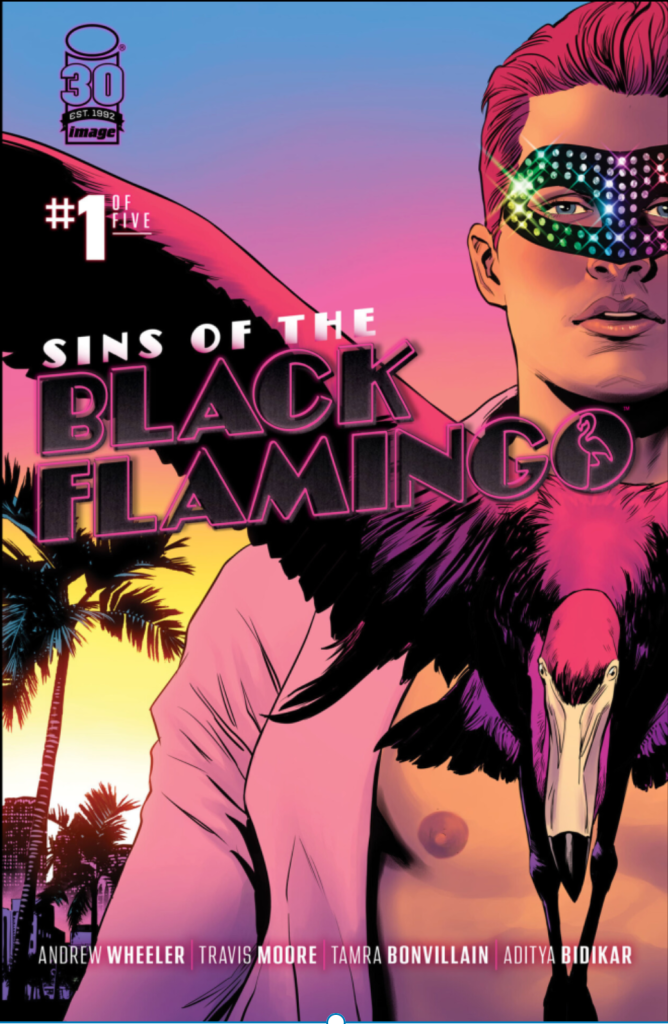
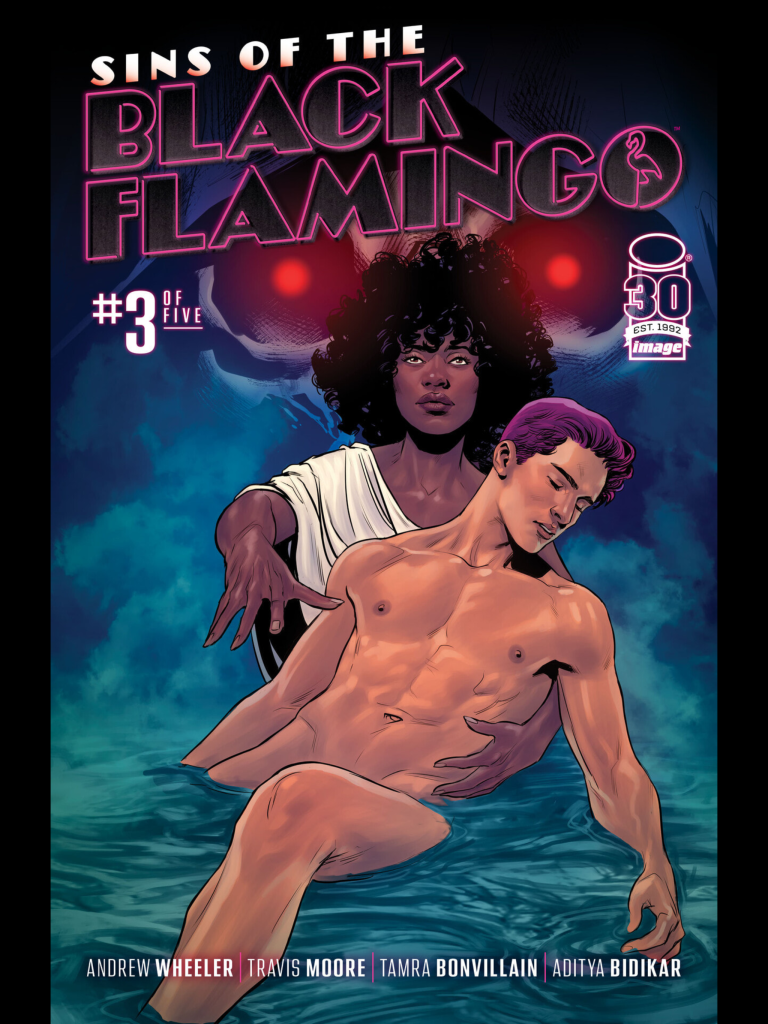
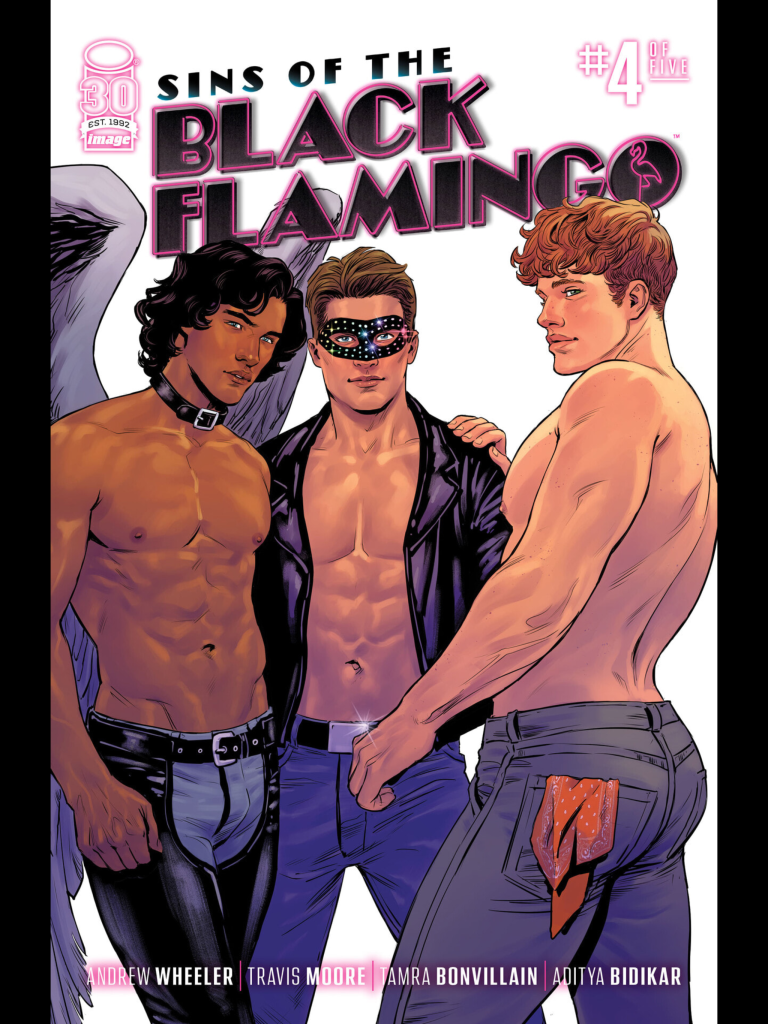
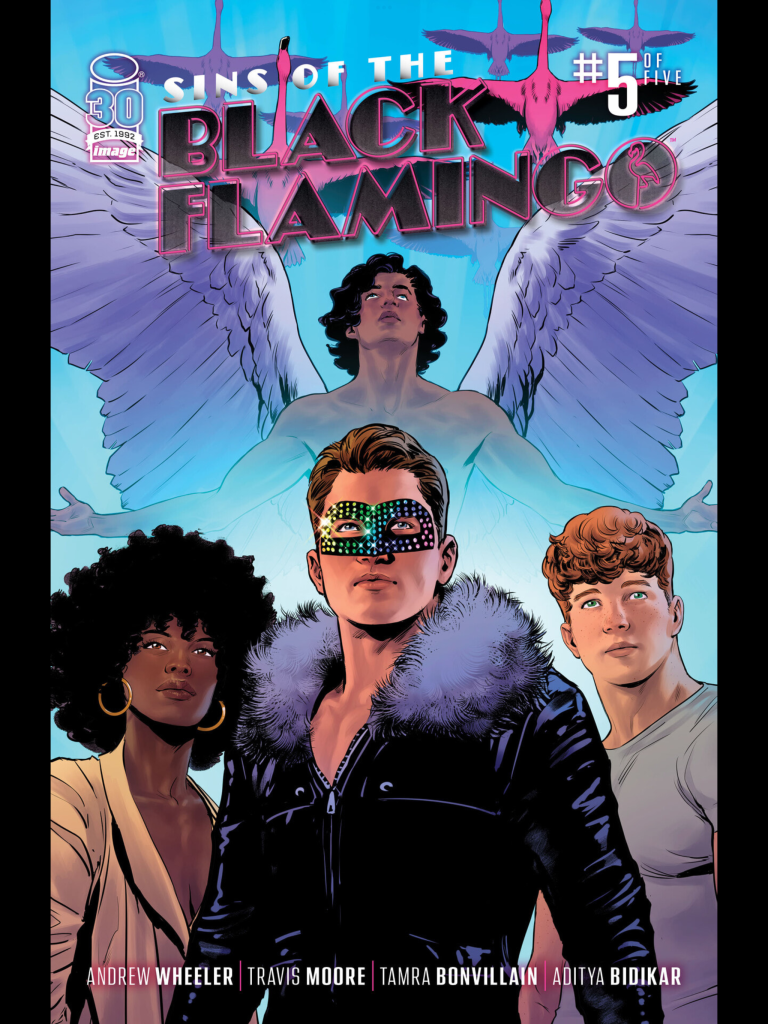
I also don’t remember how Sins of the Black Flamingo came to my attention, but it did. I subscribed so as not to miss an issue, and intended to read it all in one sitting so I could write about it…but never got around to it, like a loser, and as I was looking through the draft entries for the blog the other day, I saw that I’d started an entry after reading the first issue…but never finished reading the book nor, obviously, finished writing the entry.
the book nor, obviously, finished writing the entry.
And since the main character is gay…what better time to finish reading it, and blogging about it, then during Pride Month?
It did make sense to me.
I’ve read comic books for most of my life (in fact, comics are why I bought an iPad in the first place), but I’ve also taken long breaks from them, so am neither an expert nor even a super fan (although I would love to do a crime novel set in and around a comic books store; which could be fun and comical). I remember comics I read as a kid, and have some vague memories of other times when I dipped into the comics world as an adult. My iPad is filled with comics that I’ve never gotten around to reading—but what a lovely long weekend reading them all would make! Or maybe just take the iPad with me on a trip and read comics the whole time?
Anyway, I digress. I do need to do a longer form essay about my comics history while stressing the importance of how little I do know about my beloved comics…maybe for Pride next year, since it would take some serious rereading and research to do properly…and it could tie into one of the books currently in progress…but I am getting away from the purpose of this post: Sins of the Black Flamingo.
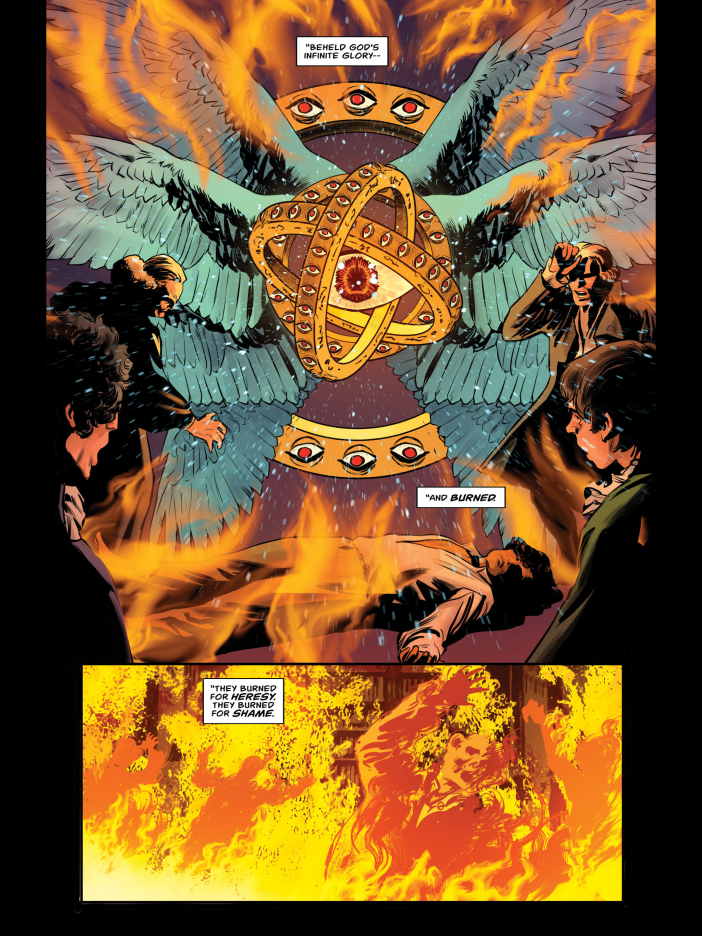
I mean, isn’t this art amazing?
Comic books helped shape me and my tastes. The original DC superheroes I followed were still drawn as ideal men of the past, like the 40s and 50s, big with a barrel torso, and muscular but not defined. DC Comics hadn’t really updated its characters from their early days much; but it was during my childhood at the end of the 60s and early 70s that they began modernizing their comic characters, their costumes, and how they looked—which I also noticed. This was also around the time that men’s bodies became more sexualized, and what was hot and sexy for men began to change. The women super-hero’s costumes also became more sexualized, as were their bodies (the Legion of Super-Heroes ALONE had some of the more revealing sexy costumes. Queer super-heroes (although why I never made the connection about Wonder Woman and the Amazons with their island of women only is a mystery to me) were non-existent and wouldn’t start showing up until the late 1980s and early 1990s—and it’s still a few and far-between kind of thing (the Will Peyton Starman run always seemed queer to me, which I’ll need to explore at another time).
So, you can imagine my delight to find this run with a gay burglar as the main character, who wears a costume and is extremely good at his job (I’ve always had a soft spot for burglars in fiction) and that was why I subscribed to the series. (Still shaking my head at how long it took me to finally read them all, and there was an pretty amazing cliff-hanger at the end of #1.)
But when I was a kid, the characters and story interested me more than the artwork, and even with my love of the characters and stories, I never followed either artists I enjoyed or writers, either. Which is probably not the best way to enjoy them, really; it was a friend who was an exceptional artist and comics fan in the 1980s who made me aware I should be paying attention to the artists and the writers…and I did find some extraordinary comics by looking for artists and writers of books from there on. The two I remember the most from that time are Todd McFarlane and John Byrne.
Sins of the Black Flamingo is self-classified as “occult noir,” which is a term I absolutely love and now can recognize that occult noir is something I absolutely love and probably write…and will most likely explore more in my own work going forward, since I now know what to call it, because supernatural never really fit in the same way and I don’t feel like the books I write are actually full-fledged horror, but occult noir? Oh, hell, yes.
Anyway, the Black Flamingo is the alter-ego of our hero, Sebastian Harlow. The Flamingo is probably one of the top cat burglars in the world (as you may know, I love cat burglars and originally made Colin one in Bourbon Street Blues), and Sebastian is this interesting combination of my two series characters, of all things; he looks and is built like Scotty, with the same approach to sex as he did before he met the boys, but has the dark worldview and cynicism of Chanse MacLeod…so naturally, I was going to be drawn to the character. IN the very beginning of Book One, he is hired to steal something from a right-wing museum—basically a museum dedicated to honoring white supremacy. It isn’t until he steals the item they’ve hired him to find that we learn the backstory behind the item…and a golem named Abel is brought to life, and Abel is hunky AF, I might add.
We also meet Sebastian’s close friend and ally, Ofelia, a Black witch—and yes, this is very much occult noir. The art is fantastic, and done by Travis Moore, with Tamra Bonvillain as colorist, Aditya Bidikar, and editor Andy Khouri, and Andrew Wheeler was the writer.I highly recommend this—if for no other reason than it’s a great gay story with an interesting main character, and who would have ever thought they’d see a gay circuit party within the pages of a comic?
I do hope there’s more adventures in store for the Flamingo in the future. Highly recommended.
And now we come to the last (so far) Chanse novel, lucky number seven.
Took me awhile to get here, didn’t it? But it also took me awhile to get around to writing the seventh Chanse book. I worried a lot about this series as it developed–mainly because my original plan had derailed, and I never really sat down and mapped out the rest of the series with the new calibrations, so I was flying by the seat of my pants for the last two books, and in retrospect that sense that the series was going stale was a direct result of that fly by the seat of my pants style, which never worked for Chanse. So, essentially I’d forgotten how to write the series, and so…when I was running into problems with the seventh, it was easy enough to believe I was out of story for him and the series itself was becoming repetitive and stale. I’ve come up with more story for him since then–I’ve written a Chanse short story and started a novella, and had an idea for another entire book, so maybe I will revisit Chanse again in the next few years?
I had always thought of the series as lasting for seven novels, and when I sat down to come up with ideas for the seventh book, I started thinking about ending the series. The Chanse series, as you may have noticed once you’ve read these entries, almost ended every single time I published one–and by this time I felt like I was running out of ideas for him, and felt like I was writing by the numbers; following the same story beats and patterns I had already established in earlier books rather than pushing myself. I also worried that if I kept writing something I felt was getting stale, the book quality would also start to slip. I never wanted to be one of those authors who just keep writing the same old series long past its expiration date. Yes, they always sold well and yes, the income was nice…but…-and I began thinking that I may need to end the series before the readers began to notice the stories were starting to fall into a recognizable pattern; certainly the stories were beginning to have the same beats repeated, over and over. I wasn’t happy to not write another Chanse book, after all; Chanse really launched my publishing career and the series was very good to me over the years–but I felt it was the right decision for the time.
The electronic gate began rolling to the left with a loud clamor.
I closed the driver’s side window of my “billet silver” Jeep Cherokee, shivering. I turned the heater back up to high. I was cold even though I was wearing my black trench coat and a black knit Saints cap. It was in the low thirties. The sky was gray and covered with clouds, the air the kind of chilly damp that goes right to your joints. Last night there had been a freeze warning for all of southeastern Louisiana, so I’d had to turn all my faucets on to a trickle all night to keep the exposed pipes under my house from freezing. The grass on either side of the paved driveway had turned brown, and in the rearview mirror I could see the grass on the levee on the other side of the road behind me had as well.
This cold snap had every New Orleans weathercaster worked up into the kind of energetic, wide-eyed frenzy they usually reserved for hurricane season. The possibility of snow either tonight or sometime tomorrow had them practically drooling. The one currently breathlessly going on and on about how we all needed to bring inside all pants and pets inside before sunset was getting on my nerves, so I turned the radio off. It had snowed maybe three times in all my years of living in New Orleans. Those rare, occasional snowstorms always brought the city to its knees. Businesses closed, people holed up in their homes afraid to drive anywhere, and nothing got done.
I drummed my fingers on the steering wheel as the gate lumbered open slowly. My lower back was starting to ache, which wasn’t a good sign. I pressed the button on the steering wheel thatcontrolled the heater in the driver’s seat. Heat always seemed to help with the pain, but taking a pain pill wasn’t an option. Not if I wanted my brain to be functional when meeting a pair of prospective new clients, anyway.
Finakky, the gate was open wide enough for me to drive through, and I pushed the gas pedal down.
With the big metal gate open, I could see the house. In spite of myself I gasped. I’d seen Belle Riviere depicted many times on postcards, but the reality took my breath away.
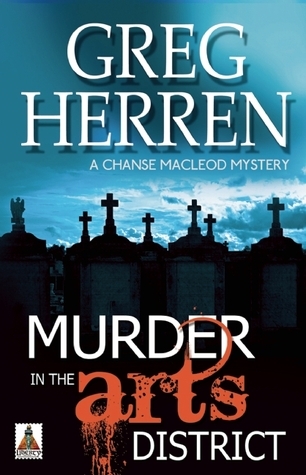
The Arts District has always been in my neighborhood (sort of); it’s just on the other side of Highway 90 on Camp, with the nexus being I guess Camp and Julia Street. The Ogden Museum of Southern Art is across the street from the Community Arts Center, the Arthur Roger Gallery is there, and there are any number of smaller galleries scattered throughout the area, which is why White Linen Night is held there. I had thought about setting the case during White Linen, but…it’s so miserably hot. The last time I went, in the 1990’s, I literally thought I was going to have heat stroke–and I’ve never gone again. Writing about it would mean going again, and there was just no way I was going to do that.
The plot was actually brought to me by way of a friend who knew one of the people involved in the real life case; which I found fascinating. My friend’s friend was one of those effortlessly sexy and beautiful men; the kind everyone’s eyes turn to when he walks into the room, and being one of those, he landed a very wealthy partner more than double his age. (Yes, I know, age-gap relationships are real, but doesn’t everyone assume the younger, pretty one in these types of relationships are in it for the money?) Anyway, the story was they had been robbed, and the burglars had stolen some of their art. They reported it to the police, but the police didn’t believe their story, and thought they were committing insurance fraud!
This was very bizarre to me, but it centered on art and galleries, which is why I wanted to do with this book, and so I thought, I can make this work. I used the same basic premise–age-gap gay relationship; older guy is wealthy, younger has sordid past; art stolen and the cops don’t believe their story so they hire Chanse. I also wanted to get into how Chanse–a former college football player and a long time gym regular–was aging, and the aches and pains. He had a back injury from a car accident, and it was still bothering him in this book. He also was still dating the guy he met in a previous case–Rachel Sheehan’s younger brother–but I wasn’t sure where that was going so edited a lot of it out.
And when I finished writing it, I still thought that was a little too paint-by-the-numbers and not enough of a challenge to write–so maybe it’s time to give him a break, and that’s what I did. I do think the novella I want to write is more of a novel, really; and I like the idea and I also have another. So who knows? Chanse may be coming back at some point.
And I am not dissing the book–I’m proud of it, and think it’s one of the better Chanse books, for that matter.
It was the sixth Chanse, and I was trying something different with the opening of this one. I hadn’t read Ross Macdonald before I became a writer, and I was very much in the “John D. is my favorite Macdonald crime writer” camp. I had been on panels with Chris Rice a few times and he raved about Ross every time, so I kept thinking you need to read Ross Macdonald and so, sometime after Katrina, I started reading the Archer novels, moving on to stand alones and the short stories eventually. When it was time for me to write this book, I thought, tryto write an opening in Ross Macdonald’s style, and try to keep that world-weary, cynical pov through the whole book.
The house was a tired-looking single shotgun, badly in need of paint and listing to one side. It was in the middle of a block on Constance Street, facing the river. There was a rusted cyclone fence around the front yard. A statue of the Blessed Virgin Mary sat inside a circle of stone to the left of the walk leading to the front gallery. I put my car into park and verified the address—sorry I’d quit smoking for maybe the ten thousandth time.
In my line of work, it’s never a good idea to make a decision when you’re tired.
But I’d given my word, even though I’d been ready to fall asleep. It didn’t mean I had to take the job—whatever it was. All I had to do was find out what the problem was, maybe even just give some advice—which would most likely be eithernothing anyone can do or this is a job for the police.
Besides, whoever lived in this dump sure as hell couldn’t afford a private eye.
I shut off the engine and got out of the car. It was already over eighty degrees, and it wasn’t even noon yet. Beads of sweat popped out on my forehead. Early April, and it felt like summer already. I sighed and pushed the gate open. It only opened about six inches before it caught on the cracked pavement of the walk and stopped. I sighed and stepped through, catching my jeans on the fence with a slight ripping sound. I swore under my breath and examined the tear. The jeans weren’t new, but it was still annoying.
This book had several different inspirations.
First, the casino used to have MMA fights every weekend, so we had MMA fighters in the city. One of their requirements to fight was they had to have a current negative HIV and Hep C test, and guess what we do at my job? For the longest time, all these hot young fighters would come into the office every Saturday to get cleared to fight, and they came in fairly regularly. I used to talk to them a lot–I wrestled, and MMA is a lot more violent–to get some kind of idea why they did this, how they got into it, and so on. I had thought about writing a mystery about a murdered MMA fighter, but could never really get my mind around it…and then I decided, what if he was the client? Interesting.
The second source of inspiration came from a decision of the Archdiocese of New Orleans to close some churches/parishes in the city, and my friend Billy Martin was involved in the protests to save Our Lady of Good Counsel (it was a gorgeous church), even getting arrested. I wanted to do something around this as it was something that actually happened, and I also got to skewer the Archdiocese (any place that could hire David Vitter’s horrific wife to be their legal counsel deserves every skewering it gets)…so I filed that thought away.
The third and final inspiration was serving on jury duty for a civil trial. It was, of all things, a Katrina insurance fight–in which the insurance company was trying to not pay out a claim (all of us in the jury were like, “why on earth would you allow a Katrina insurance case to go to trial in New Orleans? We fucking hate insurance companies.” The fact that it was Lloyd’s of London (who became famous in the wake of the San Francisco earthquake when the president of the company wired the San Francisco office, “pay every claim”) made it even more of an eyeroll for me. An apartment complex on the west bank had sustained damage in the storm, and the insurance company was claiming they didn’t have to pay out “because the claim is for issues that predated Katrina and the place was a shithole” while claiming the complex could have reopened after Katrina “because it was gorgeous” and so they didn’t have to pay out for lost income. The first person who was called to the stand was the complex’s forensic accountant who corroborated all of the plaintiff’s claims and basically made it clear that Lloyd’s was just trying to get out of a huge payment. After he testified, we took a long lunch as they were all in conference…and the claim was settled. I think the lawyers from Lloyd’s hoped that the plaintiff would eventually back down and wouldn’t go to court–and they called that bluff and were decimating Lloyd’s in court.
I mean, the place couldn’t be a shithole and a beautiful property available for rental. Make up your fucking minds, trash at the insurance company.
And what if the MMA fighter’s mom was fighting the closing of her church, had worked for someone suing an insurance company, and then she disappears?
Yes, that was a lot of fun to write. And I was pretty pleased with how it turned out in the end, too. It was also my first Chanse novel with Bold Strokes, and they gave me that beautiful cover above that I love. It made a lovely transition for the series.
Interestingly enough, the plot of Murder in the Garden District is the oldest of all my books, dating back to the late 1970s/early 1980’s.
Weird, huh?
But the murder mystery plot I used for this book was the same one I used for that dreadful novel I handwrote between 1980 and 1984. In the book, the girl from the wrong side of the tracks winds up marrying the wealthiest man in town, who is more than twice her age and has a daughter only slightly younger than she is–and he also has a monstrous, domineering bitch of a mother who hated her new daughter-in-law. He is shot and killed one night, and the young wife is the primary suspect. I always liked that plot and story, and so when it was time to write Murder in the Garden District I took that plot and turned it into a Chanse mystery. I also was able to pull out a subplot involving his landlady and employer, Barbara, that I had always wanted to do and thought it made the most sense to entwine the two stories in this book.
I also wanted to deal with Chanse’s estrangement from his family, with the possibility of reconciling with his mother, who was now dying of cancer at MD Anderson in Houston. This book was, on almost every level, about mothers.
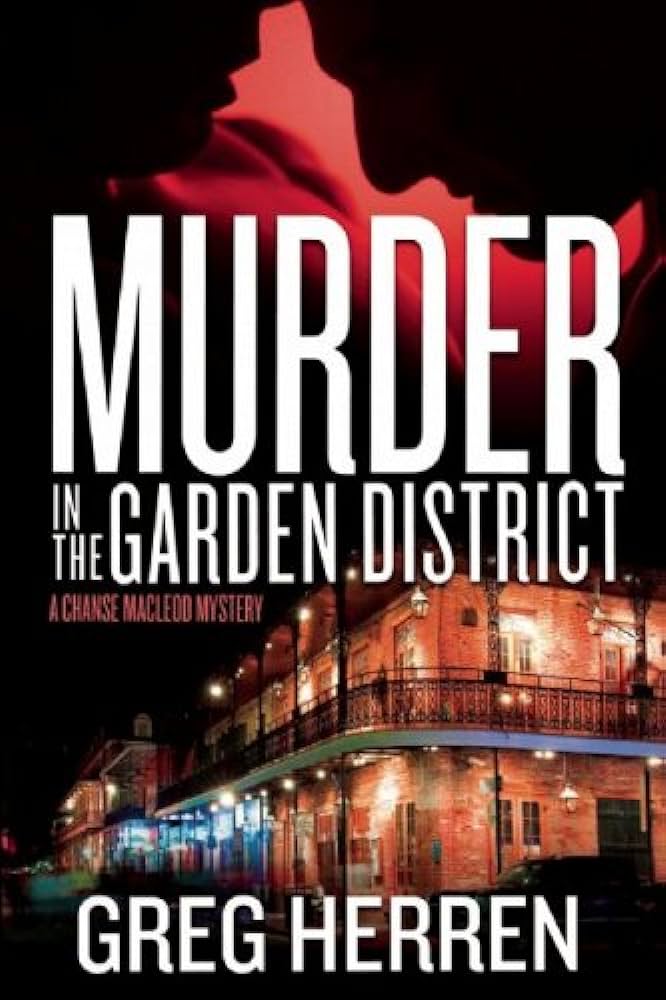
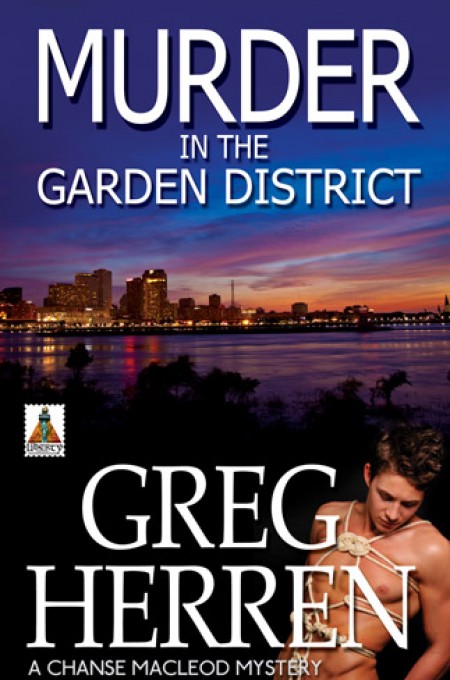
Alyson’s original coverThe Bold Strokes cover for the new edition.
I climbed out of my car and immediately started sweating. Christ, I thought, tempted to loosen the uncharacteristic tie I was wearing, this better be worth it. I slammed the car door and headed for the front gate of the Palmer House. I’d been driving back from Houston when Barbara called, asking that I come by at four to meet a prospective client. She’d ordered me to wear a tie, which meant it was one of her society friends. And society friend meant deep pockets, which is always a good thing. I wiped the sweat off my forehead. So much for making a good impression, I thought as I opened the gate and headed up the walk to the house.
The Palmer House was a historic landmark of the Garden District, and also happened to be the home of my landlady and employer, Barbara Castlemaine, who’d inherited it from her first husband. Built before the Civil War, it was a monstrous looking Italianate house painted a dark burgundy with black shutters. Black wrought iron lacework adorned the upper and lower galleries that ran around the house. The big brick fence that provided it with a semblance of privacy on two sides of the lot leaned toward the sidewalk at a gravity-defying angle from the immaculately kept lawn. A black wrought iron fountain bubbled in the center of a two-foot high box hedge.
I rang the bell at precisely four o’clock. “Hey, Cora.” I said when the door opened.
Cora had been Barbara’s housekeeper for as long as I’d known her, and Barbara once told me that Cora had worked at the Palmer House since she was a teenager. I had no idea how old Cora was—her face was free of wrinkles and there were no signs of gray in her hair. She was wearing her black uniform with the white apron and little hat to match. Her face creased into a smile.
“Chanse! Always nice to see you.” She lowered her voice and stepped onto the porch, pulling the door almost closed behind her. “How’s your mama?”
I had always wanted to deal with Chanse’s family issues from the very beginning. If you remember, I originally planned this series as being seven books. At this point, it was Book 5 and I had gone off-plan with what I had envisioned, thanks to Hurricane Katrina. When it was time to write this one, I remembered that old plot from that old book of mine, which I saw as relatively easy to adapt to a New Orleans murder mystery–and a way, when I mapped out the old plot, to bring Chanse’s family back into the story and deal with his relationship, always fraught, with his mother. Chanse grew up in a trailer park with parents who were miserable with their life choices, drank too much, and weren’t the most loving of parents. As I thought about it, I also remembered a story I wanted to do with his brother–sending him back home to his small city in eastern Texas to try to clear his brother of a murder charge, and made notes on it, as well (it would become my story “”My Brother’s Keeper,” which was in Survivor’s Guilt and Other Stories). I merged the original plot with the issue of his mother dying of cancer, and I also took the plot from a now-dead Chanse book (I think this was supposed to originally be Book 4) involving his landlady/boss’ past, and folded it into Murder in the Garden District. It is his landlady that drags him into this case, as a favor to someone who knows her darkest secret, which she eventually has to reveal to Chanse.
I also wanted to write about a powerful Louisiana political family, which became the Sheehans of the Garden District, with the murder victim having just announced his candidacy for state-wide office. Warren Sheehan wasn’t a good person, and as Chanse looks further and deeper into Warren’s history and past…maybe his murder was actually for the best as he was a monster. His much younger white trash wife from the West Bank, his daughter from a first marriage, the grasping hateful mother…yeah, I had a lot of fun writing this book, and I think it’s one of the standouts of the series, in all due modesty.
Chanse’s landlady/boss, by the way, was named Barbara Villiers Palmer Castlemaine, which was actually the name of one of the most notorious mistresses of King Charles II of England; but I’d always loved the name and gladly appropriated it for this character.
This was also my last book for Alyson, as they went through another upheaval and everyone I’d worked with on the previous book had been fired and I now had someone new to work with. Alyson folded up its tent and closed up shortly after the book came out. i was never paid my final portion of the advance…and never saw another dime out of them. They kept my books in print and kept selling them…but never paid me another cent. I wasn’t sorry they closed–it was really the only way I’d ever leave them and take the series elsewhere, and it was a relief. I’d been given the runaround from them and had to constantly get used to new people to work with on every title I did for them…yeah, wasn’t sorry about this, but I was pretty pissed about being robbed.
Dream Lover: Monday morning back to the office blog; in which I had a productive weekend; finished a short story; figuring out what I need to do; thinking about being a Louisiana tourist; and back to the gym.
Ah, the torturous path Murder in the Rue Ursulines took on its way to the book stores.
There was, if you will remember, a lot of turmoil going on at Alyson at the time. I had worked with a different editor for every Chanse book, and as I waited and waited and waited for an offer for the fourth book, my third editor was fired as the company reorganized its publishing arm yet again, with the end result that they didn’t make an offer on the book until they realized that the fall catalogue had been neglected during these transitions and they made the offer so long as the book could be finished in six weeks (I hadn’t started writing it yet) but I said yes on two conditions: I could work with an outside editor of my choosing, and the contract had to be for two books, rather than one–so I wouldn’t have to go through this again for the fifth book in the series. I kind of figured they wouldn’t meet my demands–but they did, of course, and then I had to write a draft of a book in six weeks.
Constant Reader, I managed it.
The original Alyson cover on the left; the Bold Strokes edition on the right.
“Chanse MacLeod to see Loren McKeithen,” I said to the pretty woman at the reception table. She looked to be in her late thirties, and of mixed racial heritage, her skin the color of a delicately mixed café-au-lait, her hair copper-colored. She gave me a wide smile. There was a wedding ring on her left hand, and a diamond tennis bracelet on her right wrist. Her nails were done in a French manicure. On her forehead was a smudged cross made of gray ash. I was tempted to ask what she’d given up for Lent, but decided against it.
“Have a seat, and I’ll let him know you’re here.” She gave me a smile, picking up her phone. “It shouldn’t be more than a few minutes.”
I nodded and took a seat in an overstuffed leather chair, picking up an issue of Crescent City magazine and idly paging through it. I was tired, probably way too tired to be taking on a new job. The aspirin I’d taken hadn’t kicked in yet, either. Every muscle in my body ached. I’d planned on spending my entire Ash Wednesday in bed, or lazing around my apartment, recovering from the overindulgence of the last five days. But Loren was a good guy, and threw me some work every now and then. So, I’d roused myself out of my post-Mardi Gras stupor and come to his office.
Besides, it never hurts to have a prominent attorney in your debt. You never know when you’re going to need one.
This story actually started out as a Scotty book, what I thought would be the fourth in that series, Hollywood South Hustle. This book was inspired by something that happened to me on my way to work one morning. When I originally went to work part-time at the NO/AIDS Task Force part time, I worked out of the CAN (Community Awareness Network) office on Frenchmen Street in the Marigny. Full time staff had free parking in a lot around the block on Elysian Fields; I had to find street parking in the neighborhood, which was never a guarantee. This particular morning I found a place to park over on Kerlerec, and as I was locking up my car a family on bicycles was coming around the corner at Chartres. The adults raised a hand in greeting and I automatically said “Good morning” pleasantly back to them with a smile, and it wasn’t until after they rode past that I realized it was Brad and Angelina and two of their kids; they lived a few blocks away. As I continued on my way, I smiled at the coolness of the moment and I thought Brad has hair the same color as Scotty and is about the same age and size as Scotty and he lives right around the corner and wouldn’t it be interesting if Scotty was walking past their house and someone shot at him, thinking he was Brad? And that would be the start of something. The more I thought about it as I walked, stopping at the little Vietnamese grocery to buy cigarettes, the more i liked it, and by the time I sat down at my desk the entire story was taking shape in my head.
And yes, instead of doing work that day (I didn’t have any), I wrote up the story, the idea, the title, and began the proposal. I also wrote the first chapter and over the rest of that week I wrote the first five, feeling like I was onto something. I polished up the proposal and the first chapters, while continuing to write, and sent it to Kensington, who held the option on the series. While i waited to hear back from them, never doubting for a moment they would exercise their option and take the book, I kept writing. It was incredibly easy, and I was clocking between three and seven thousand words per day.
The day after I finished writing the first draft, Kensington didn’t exercise their option and cut the series loose.
So, when Alyson came back to me with a book contract offer and a due date that was only six weeks out from signing the contract…I thought, I can just turn this Scotty book into a Chanse book, easy-peasy.
NARRATOR VOICE: It was not, in fact, easy.
Scotty books are not easily adapted into something else, particularly when the new adaptation is more serious than something meant to be farcical and funny and over-the-top crazy…plus, Chanse and Scotty are completely different physical types. I had to change a lot of things, which took the “looks like” gambit down from three to two–but I think that worked better with fewer people and I was a bit concerned that the previous Scotty had also involved three look-alikes…problem solved. But it was a lot harder to do than I originally thought (nothing is ever as easy I think it is when I am pondering what to do), and in retrospect, it probably would have been much easier to simply write something entirely from scratch, but why do things the easy way when I can make it much harder?
Murder in the Rue Ursulines did well; it sold well and got decent reviews, and I’ve always felt it wasn’t a proper follow-up to Rue Chartres.
Work-at-home Friday, and what a full day I have in front of me. I have work at home duties to get done, a telephone appointment, and an on-line team meeting today. After I am done with my work duties, I get to head over to the gym to work out on my own for the first time since 2022 (!!!), and at some point we’ll be doing a Costco run. Yesterday was a very good day; it was the first time in years that I woke up feeling rested and awake and good to go–and it lasted all day. I wasn’t tired when I got home, despite picking up the mail and making groceries. I hung out with Sparky, watched this week’s episode of Feud, and made notes for writing to come. I also typed up notes for other stories, so I could create computer files. Paul got home in time for me to spend a little time with him before going to bed, and I slept very well. Apparently, overnight Sparky figured out how to get on top of my dresser and started knocking everything off, so all my stuff was put inside a drawer. Sigh. He really is too smart for our own good. He’s lucky he’s both sweet and adorable.
I also have some thoughts about stuff that’s been going on in the world and in my publishing world lately. They aren’t fully formed and ready to be vocalized as of yet, but I figure those thoughts will come together and written about at some point over this weekend to come. This is my first normal weekend after three straight abnormal ones (two weekends of parades followed by a trip to Alabama), so while I am probably vastly over-estimating how much I can or will get done, I am hopeful that I’ll get a lot of it done. I was pleased yesterday to see how much I had gotten done off my to-do list without consulting it, and I am also already feeling alert and awake and no longer tired, either. This was how yesterday went, so here’s hoping that today will be the same: energy and mental acuity all day.
It would be nice to get all these blog entries in draft form finished, too. We shall see. Tomorrow I’ll be taking books and beads out to donate in the morning, swing past the post office most likely afterwards, and then come home to clean and write. I also want to rewatch Saltburn this weekend so I can finish that entry–which is also more of an essay abstract. And I did write some more on my short story “When I Die,” which is getting longer but has finally started getting to the good part. I also have four more “where the idea for this book come from” entries on the Chanse series to finish as well. I also have some other chores around here this morning I need to take care of during breaks–the dishes, some filing, and some laundry. There’s trash to take out, too, and I kind of want to really start making progress on the apartment. I want to get the floors done this weekend and I want to move furniture in the kitchen for cleaning and so forth, too. As I said, I am feeling ambitious about this weekend, and since I am not going into the weekend exhausted and needing rest…I have high hopes.
I also need to get my entry about Carol Goodman’s River Road finished. I really enjoyed it, and if you aren’t reading her books, the good news is it’s never too late to start and there’s a terrific backlist.
And on that note, a load of laundry is finished and needs to be folded, so I am heading into the spice mines for the day. No worries, I am sure I will be back again later, okay? Have a lovely Friday in the meantime!
If you will recall from my last entry about the Chanse series, I had a new editor for the second book in the series. I had also written a proposal for the follow-up, Murder in the Rue St. Claude, which was going to be about a nursing home and an angel of death. The second book ended with a tragedy for Chanse, and the last scene of the book was Chanse saying goodbye to someone before their life-support was turned off. I did a trickery and was going to have the person be in the nursing home, still living, only a suspicious death happens there and one of the workers talks to Chanse about her fears. The editor wasn’t the most professional or organized person, and I had to send the proposal to her three times on request with no contract offer. I was very irritated by this, but there were also a lot of changes going on there–including moving the offices from LA to New York, which I thought was an incredibly stupid business decision…and I wound up with yet another new editor right before Katrina hit. I honestly wasn’t sure if I would go back to writing ever again–one of the lulls in my career–but things eventually settled down and I started house sitting for a friend in Hammond over on the north shore while I waited for the city to reopen so I could drive into the city and get some more things from the house. I did, my friends’ trip was cut short, and I was going to return to Kentucky to my parents’ after one more swing by the apartment to pick up things. Imagine my surprise that my mail service was open, my grocery store and bank were open, and so was my gym. We’d moved into the main house from the carriage house, which hadn’t been rented yet as it needed some work before the hurricane, and so….I just moved back into the carriage house and cleaned up around the property and kept an eye on the main house, as well as emptying out the water from the machines that were trying to keep the insides of the apartments dry (the roof was gone).
While I was in Hammond, my new editor got me to reluctantly co-edit an anthology about New Orleans called Love, Bourbon Street (a title I hate to this day), and he was trying to talk me into writing a Chanse book about Katrina. I didn’t really want to, but he kept insisting and finally, I gave in and agreed to write it. However, the nursing home I was researching was a place they left people to die in–wasn’t touching that with a ten foot pole–and it occurred to me that I could wrap the case around Hurricane Katrina. He was hired by the client the Friday before Katrina, and obviously he couldn’t do the job now.
And that was the seed from which Murder in the Rue Chartres (no title at the time of contract) grew.1
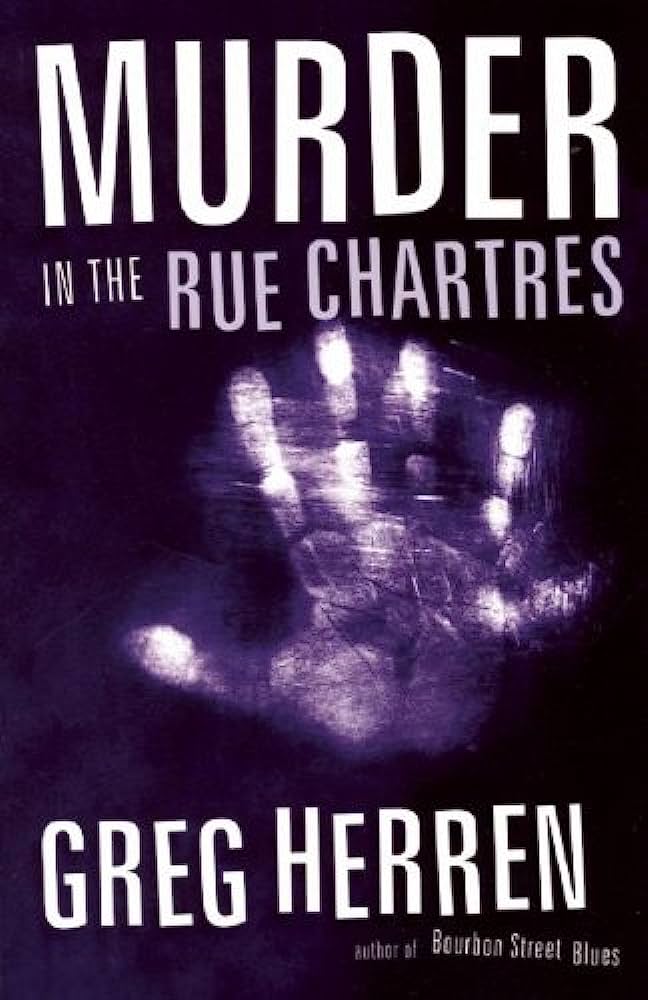
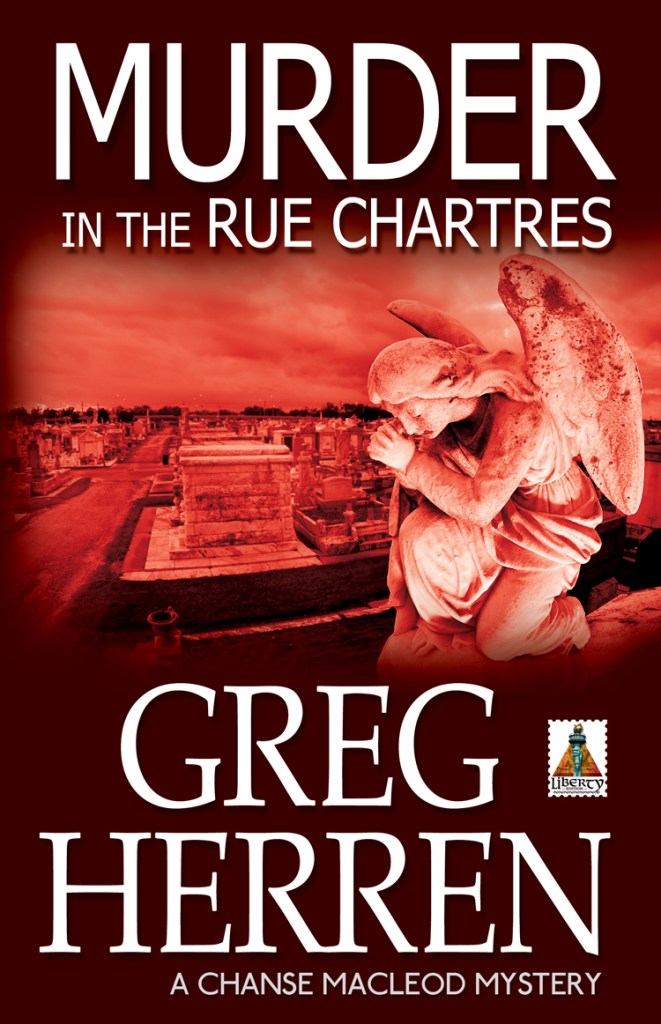
This is the original cover from Alyson Books.This is the new cover for the Bold Strokes ebook
It was six weeks before I returned to my broken city.
Usually when I drove home from the west, as soon as I crossed onto dry land again in Kenner, excitement would bubble up inside and I’d start to smile. Almost home, I’d think, and let out a sigh of relief. New Orleans was home for me, and I hated leaving for any reason. I’d never regretted moving there after graduating from LSU. It was the first place I’d ever felt at home, like I belonged. I’d hated the little town in east Texas where I’d grown up. All I could think about was getting old enough to escape. Baton Rouge for college had been merely a way station—it never occurred to me to permanently settle there. New Orleans was where I belonged, and I’d known that the first time I’d ever set foot in the city. It was a crazy quilt of eccentricities, frivolities, and irritations sweltering in the damp heat, a city where you could buy a drink at any time of day, a place where you could easily believe in magic. I couldn’t imagine living anywhere else. Any time I’d taken a trip before, within a few days I’d get homesick and started counting the hours until it was time to come home.
But this time wasn’t like the others. This time, I hadn’t been able to come home, and had no idea how long it would be before I could. Now, I was nervous, my stomach clenched into knots, my palms sweating on the steering wheel as I sang along to Vicki Sue Robinson’s “Turn the Beat Around” on the radio. It was everything I’d feared for the last few weeks when I thought about coming home, the anxiety building as the odometer clocked off another mile and I got closer to home.
It was different.
The most obvious thing was the lack of traffic. Even outside the airport, the traffic was usually heavy, sometimes slowing to a complete standstill. But other than a couple of military vehicles, a cement mixer, and a couple of dirty and tired looking sedans, I-10 was deserted. There was a film of dirt on everything as far as I could see, tinting my vision sepia. Huge trees lay toppled and debris was everywhere. Signs that used to advertise hotels, motels, restaurants, storage facilities, and pretty much any kind of business you could think of were now just poles, the signs gone except for the support skeleton. Buildings had been blown over, fences were wrecked and down, and almost everywhere I looked blue tarps hung on roofs, their edges lifting in the slight breeze. My breath started coming a little faster, my eyes filled, and I bit down on my lower lip as I focused back on the road.
No cars joined at the airport on-ramp, or the one at Williams Boulevard just beyond it. No planes were landing or taking off.
Most of the writing I did in the fall of 2005 was my blog, which at the time was on Livejournal. (The old stuff is still there, but I started making things private after a year because of plagiarism; I guess people thought they could steal my words if they were on a blog.) I documented as much of the experience as I could, so people outside of Louisiana could see that the city wasn’t fully recovered despite no longer being in the news. American attention had moved past New Orleans by the spring of 2006.
When I started writing the book, I was really glad I had done that with the blog, because more than anything else it reminded me of the emotions I was going through, that horrible depression and not remembering things from day to day, the need for medications, panic attacks, depression, and the way the entire city just seemed dead. I did repurpose a lot of stuff that was on the blog–rewritten and edited, of course–and I could tell, as I wrote the book, that I was either doing some of the best work of my life to that point or I was overwriting it mercilessly. You never can be sure.
But I also needed to flesh out the murder mystery I came up with, and I also wanted to write about a historical real life tragedy of the Quarter. The client who hired him that Friday before Katrina roared into the Gulf and came ashore was engaged, and she wanted Chanse to find her father, who’d disappeared from their lives when she and her brothers were very young. But what happened to her father? Who killed her, and why? Was her murder a reaction to her looking for him?
I had started using Tennessee Williams quotes to open my New Orleans novels with the third (Jackson Square Jazz: “A good looking boy like you is always wanted” from Orpheus Descending) and I liked the conceit so much I kept doing it. I knew someone who’d built a crime novel around the basic set up of Cat on a Hot Tin Roof, and I thought, what if the person who knows all the answers has been in a mental hospital for decades? Then what if Mrs. Venable had succeeded in getting Catherine locked up with all of Sebastian’s secrets lobotomized out of her head?
I named the family Verlaine as a nod to the Venables, and aged Mrs. Venable as well as gender swapping her (this was also a bit influenced by The Big Sleep), and I was off to the races.
My editor wrote me when he finished reading the manuscript and told me it was one of the best mysteries he’d ever read. The reviews! My word, I still can’t believe the reviews, and how good they were. I got a rave in the Times-Picayune, Library Journal and Publishers Weekly.
And yes, it won a Lambda Literary Award for Best Gay Mystery.
The irony that two books I wanted nothing to do with, let alone write or edit, ended up with each winning Lambda Literary Awards, does not escape me. ↩︎
Oddly enough, the second Chanse was the fourth novel I published, and therein lies a tale.
Funny how with these earlier books there’s always a story, isn’t it?
So, I sold Murder in the Rue Dauphine to Alyson in September of 1999–but the pub date wasn’t until February 2002. I saw no point in writing a sequel to the book immediately; primarily because there was a nearly two and a half year wait between signing the contract and when they were able to schedule me in. So, I figured I had about a year and a half before I needed to get it finished (everyone told me it would be released a year after the first, and in all honesty, what was the point of writing two or three books while waiting for the first to come out so the others could be scheduled?), and so, with time to spare and a lengthy period of time to “waste”, I decided to start thinking about the “what ifs”–what if the book sells super-well and is popular? What if this isn’t just a one-off standalone and could be turned into a series? The more I thought about it, the more I liked the idea and I liked letting my mind roam.
So, what would I do if the series took off and I needed to write more?
Being creative and full of energy in my late thirties, and thrilled to death that now I wouldn’t die without having published a novel, I reread the manuscript and my analysis of who Chanse was and why he was who he was, and I started mapping out a personal journey for him, that lasted several books. He was a cynical loner, with a couple of friends, and he was still really not adjusted to being gay when the first book opens. He was estranged from his immediate family of younger sister and brother and his parents; he never returned to Cottonwood Wells after leaving for LSU. He’s ashamed of his family but he also knows they will never accept his sexuality, either, so it’s very easy for him to cut them off almost entirely. So, his journey was going to be like that of the main characters of the show Moonlighting; each case would teach himself something about life and himself, and he would grow from the lesson learned in each book. Each book going forward would have a life lesson for him (Rue Dauphine did as well; the lesson was ‘you can’t just trust someone automatically because they’re queer.’); and the one he’d learn in the second book would be about love and trust (the third would be about sacrifice, the fourth would deal with his family, the fifth would have him fall in love with someone else, the sixth would deal with him dealing with losing his best friend to her husband and realizing he does need other people, and the seventh, the swan song for the story, would find him ready to finally commit to someone and live with them, so the series would be seven books long).
Shortly after I sold the first book, I again learned that lesson myself–the case in the first book was inspired by a gay con artist who’d gotten involved with a non-profit here in the city and then blew out of town overnight, having stolen/embezzled a shit ton of money and leaving a pile of debts behind. I had written to a local color magazine for the gay community (I can’t remember the name!) about writing for them. I wrote something for them, and they hired me to be editor of the magazine, as the business was expanding and it would free up the founder to focus on the new directions while I ran the magazine. It was fun, I got to work with a lot of fun new friends, and…then it all blew up in our faces. It was very similar to the earlier situation–a gay con artist blows into town, makes a lot of promises, runs up a lot of debt and then it just blew up completely. Turns out the guy was a con artist with a record of credit card fraud, and he was on the FBI watchlist so yes, I did get interviewed several times by the local office of the FBI.
The second book, which had the working title Murder in the Rue Royal, was based on that story, but I had already been playing around with a stalker storyline, and then I realized how I could cross the two stories into one seamlessly and write the book. I managed to get another first draft finished when a two-book deal to write the Scotty series for Kensington and Alyson dropped the option for the second book, saying “two mystery series with a gay main character in the same city by the same author are too similar to each other”–which I took as a challenge to make Bourbon Street Blues and Scotty as different as I possibly could to prove them wrong. So, the manuscript went into a drawer and I started happily working on Scotty instead…and again, it was a stand-alone that morphed into a series.
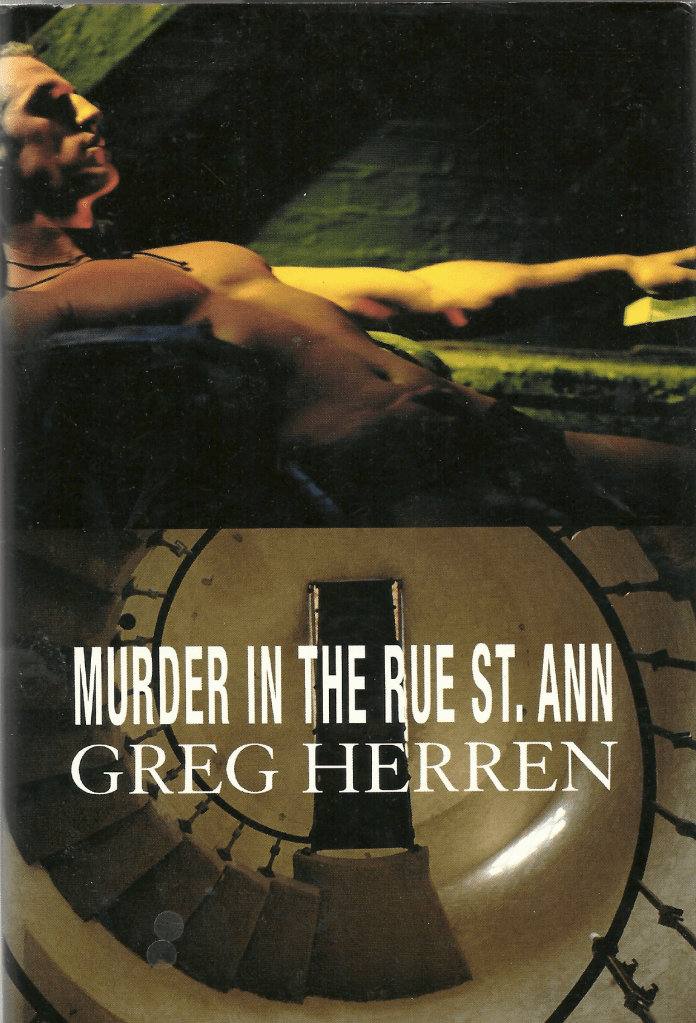
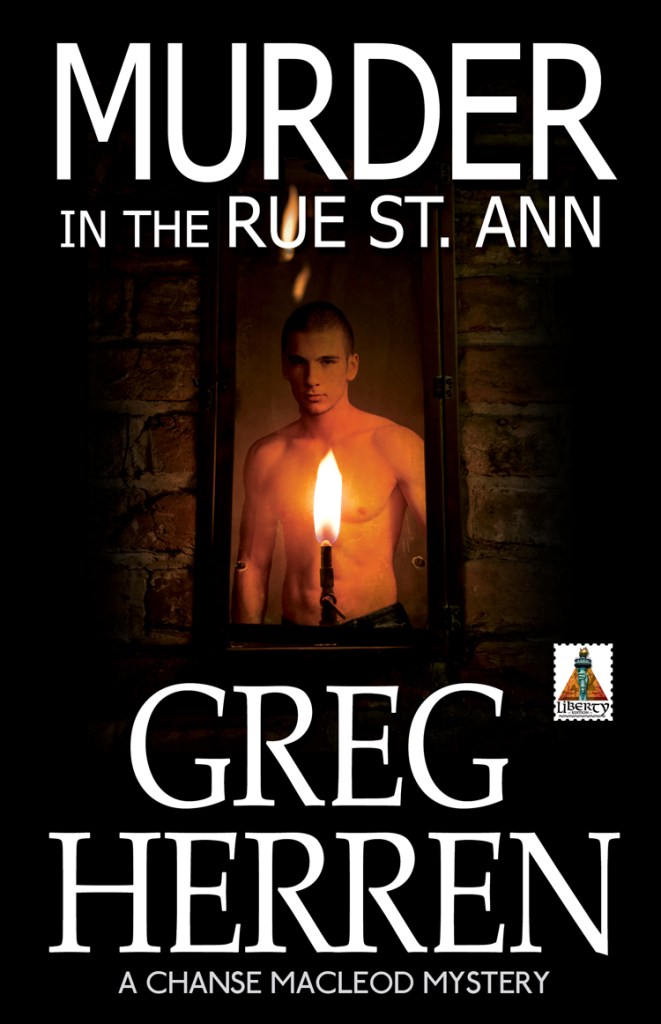
This was the Insightoutbooks edition cover of Murder in the Rue St. AnnThis is the new cover the book got when Bild Strokes Books republished the book as an ebook.
I took a streetcar named St. Charles down to Canal, crossed the street and walked down to Royal.
It was eleven o’clock in the morning on one of those splendidly sunny September days that makes you glad to be alive. Taking the streetcar had been a good idea. The long heat of summer had broken, and the air was crisp and in the mid-seventies. The sky was that blue unique to New Orleans, with wispy white clouds scattered across its expanse. There was just a hint of cool moisture in the air. There were a lot of people milling around the sidewalks on Canal— a good sign for the tourist season. Canal used to be the main shopping drag of the city, with huge department stores like Maison Blanche and D. H. Holmes. Those were long gone. They had either gone out of business or fled to the suburbs— now it was mostly hotels, fast food, and Foot Lockers.
There were hopes that putting the Canal streetcar line back in place would stimulate a recovery for the street. So far, all the construction work had simply made the Quarter difficult to get to from uptown. Add to that the chore of trying to find a place to park that would get me a ticket in two hours or cost ten dollars, and I was kind of glad I was having car trouble—the streetcar down and a cab home was very simple.
Not that riding the streetcar didn’t bring its own set of aggravations. If the cars ran on any fixed schedule, I’d never been able to figure it out. You could wait for one for half an hour and then three in a row, all packed to the gills, would show up. The streetcar ostensibly operated as public transportation, but was also a de rigeur tourist attraction. There was no way of telling when you’d be able to catch one with a place to sit. But when you did, it was nice to find a window seat on a sunny day and enjoy the city clacking by.
So, when Alyson chose to drop the Chanse series after I signed with Kensington, Murder in the Rue Royal went back into a drawer, which was fine–it wasn’t a good book–and I moved on with my life. The advance for signing with Kensington paid for our move back to New Orleans from Washington, and moving back here was absolutely worth ending the Chanse series for, seriously. I still didn’t have an agent, but I’d been signed to book contracts by two publishers already, and I figured it might be easier now. We accomplished the move, get our new apartment set up on Sophie B. Wright Place, and started putting our lives back together. I don’t remember the timeline of how it came to be, but I was still working with Alyson on my first and second erotic anthologies (Full Body Contact and FRATSEX), so I was aware when my editor left and a new person, that I knew slightly, moved from assistant editor to senior editor. We were talking on the phone one day about Full Body Contact and she casually mentioned, “I don’t see your second Chanse book here on the schedule, what’s going on?” and I told her the story, “Oh for fuck’s sake, when can you get it done by?” and that became the second contract for Chanse.
So, after finished Jackson Square Jazz and turning it in, I broke out Murder in the Rue Royal (the title had already been changed on the contract to Murder in the Rue St. Ann; my new editor didn’t like the alliteration) from the drawer, blew the dust off it, and reread the manuscript. I looked at my timeline for the series, and saw that this was the one where he was supposed to fuck up his relationship, but I didn’t see it in the manuscript. I reread the first book, thought long and hard about Chanse and who he was at this point in his life and after several long days of musing it hit me, between the eyes: jealousy. Jealousy would be what fucks up his relationship, and it only made more sense to me that Chanse would be the jealous one. Paul had a loving, accepting family and was more secure in and of himself as a gay man and what he wanted out of life. Paul was considering becoming ground-based at the New Orleans airport so he could settle down and have more of a life with Chanse, which also has Chanse very alarmed and makes the jealousy even more intense….so what would be the thing that would set Chanse’s jealousy off? Something from Paul’s past that Chanse didn’t know but finds out about in the worst possible way?
I had had some issues, believe it or not, with stalkers over the years. I had always wanted to write about a stalker, so what if Paul had a stalker? Why would Paul have a stalker? And then it occurred to me that Paul had a past he wasn’t ashamed of, but had never mentioned to Chanse. Not out of a fear that Chanse wouldn’t understand, but mainly because he had no need to tell him because it wasn’t anything dark. He had done some nude modeling when he was younger and he had also done some soft-core wrestling fetish porn, which is where the stalker came from. And what if I could work the con man he’s been hired by was someone Paul knew from the soft-core fetish porn? What if the guy contacted Paul because he’d been getting threatening notes on top of everything else going on in his life? And what if Chanse ran into Paul when he was leaving the con man’s offices, which brings all this out about Paul’s past? What if it shook a jealous, possessive, insecure Chanse enough for them to fight about it? And what if Paul disappears after the con man is murdered?
That was something I could work with, and so I did.
I’ve always called Murder in the Rue St. Ann my most under-appreciated work. By the time the book had come out, Paul had lost his eye to the muggers and we were in recovery mode. I didn’t do much of anything to promote the book (other than a signing at Outwrite in Atlanta, where I signed all of my books until they closed), and it kind of came and went quickly. I felt it was the most unappreciated of all my books. Jackson Square Jazz had come out earlier in the year before Paul was attacked, and it sucked all the oxygen up that year intended for me–it was the Lambda nominee, not Rue St. Ann–and I didn’t pay much attention to the book after it came out, either. The ‘christians” came for me a few months after the book’s release as well, and then Katrina…so yeah, Rue St. Ann got no press, got no attention, but somehow still managed to sell well.
I did have the next one planned, Murder in the Rue St. Claude, which there was a proposal in for, but Alyson was also going through other, deeply concerning changes that showed how little the higher-ups knew about anything, let alone publishing. But that’s a tale for another time, I think.
Tuesday morning, up early and dark is pressing up against my windows. I slept better last night than I have since Friday night, but woke up out of a deep sleep to go to the bathroom around two in the morning and wasn’t able to get back to it–my body was relaxed completely and resting, but my mind was still working. I feel rested this morning but I don’t know how long that’s going to last…I imagine I am going to run out of steam at some point this afternoon, but I also have to get the mail and make groceries, too. I had also wanted to cook some things for dinner tonight–or to at least have something to take for lunch this week (today is a Lean Cuisine). I feel better, though, this morning than I have in a few days upon waking, so I am taking that as a good sign. It’s been nice having all this out of the office, but it’s kind of weird going back. Outside of unemployment periods, I don’t think I’ve ever not worked for this long since probably high school?
I hope I can remember how to do my job.
It’s also cold this morning–forty-nine degrees, according to my phone–which makes going outside less agreeable and certainly undesirable. I can put the brace on over a jacket, take it off to remove the jacket and put it back on, which makes total sense and I don’t understand why this is something I am initially hesitant to do? The PT went well yesterday and I have the full range of motion back for the elbow; and my fingers are getting more dextrous and ny hand grip stronger. (I kind of felt guilty when he said, ‘yes, keep doing your home exercises because they are working’–because I haven’t been doing them…I told you, I am a terrible patient.) I was exhausted from the PT and from not having slept for two nights, so I wound up not doing much of anything yesterday other than reading deeper into Calypso, Corpses and Cooking by Raquel V. Reyes, which I am enjoying–I really like her character, Miriam–and a likable main character is crucial in a cozy mystery. Nurse. Sparky spent most of the afternoon curled up asleep in my lap, which was comforting and calming and adorable, and then when Paul got home we started watching the Big Vape documentary on Netflix (I think?), which is interesting and got me started thinking about smoking. I smoked from ages 16 to 50, a whopping 34 years, before finally quitting, and frankly, I don’t miss it. I do remember how much i used to actually enjoy smoking, but I’ll never smoke another cigarette in my life. The cultural view on smoking certainly has changed over the course of my life–when I was a kid, you could smoke anywhere and pretty much most people seemed to smoke. My parents did, my grandparents did (not my maternal grandmother; Mom was the only smoker in her family, but pretty much everyone on my dad’s side did), and they used to smoke with the windows up with us in the car. No one thought much about it, of course; despite the surgeon general’s warning about carcinogens getting more and more explicit and fervent as the years passed. I tried smoking in junior high but didn’t inhale, and didn’t much care for it; I tried again the night I graduated from high school and essentially smoked for the next thirty-four years. I still smoked cigarettes when I started writing–which is why Chanse was a smoker and all of his friends were (I did get some pushback from readers about the smoking; a friend who was also a smoker joked that his favorite thing about Murder in the Rue Dauphine was that all the good guys smoked and all the bad people didn’t) but I never really addressed him quitting in the books; I just stopped writing him as a smoker after I quit–and the reason I quit was because Skittle died from cancer. That guilt–that I helped contribute to Skittle’s death–was all it took, even though the cancer he had wasn’t caused from second-hand smoke…just the thought that it could have been a contributing factor was too much for me and I refused to do that to another cat–because by then we were definitely confirmed cat people and it just doesn’t feel like home without a cat in it.
There will be more on Big Vape when we finish watching.
I also am going to be getting back to writing. I signed a contract for a sequel to Death Drop and need to get that finished and out of the way. I wasn’t able to get as much done during this lengthy time off because, well, I had surgery and the recovery–while not as painful as i feared–did drain a lot of my energy, and the enforced rest also made it a little harder to get motivated. I did manage to read more than usual, but the ceiling disaster and repair, the recovery, the physical therapy, and the just now changed medications to deal with my brain chemistry issues was a lot to deal with. I’m also not beating myself up over not getting more done because for fuck’s sake, even as mad as I get at myself for not getting things done…I’m giving myself a break on this. It’s not been an easy year, from beginning to end; but like I always say–if you’re going to have bad things happen, isn’t it best for them to happen all at the same time? That probably sounds insane, but in all honesty–when Paul was attacked and lost his eye? That was the best time for the Christian scum to come for me because I was so focused on getting Paul through what he was dealing with that I couldn’t give them very much attention, one way or the other. (At any other time, I would have been freaking the hell out.) And the weird thing is, professionally this was a great year. I was nominated for an Agatha and a Lefty for the first time, I was nominated for three Anthonys, and I have two books out, and I did some short stories that I am pretty damned proud of–it’s just weird that the highs always come with the lows…or maybe the highs make up for the lows? That’s probably the best way to look at it.
And on that note, I am heading into the spice mines. Have a great day, Constant Reader, and I’ll be back at some point.






 Queer and Loathing in America