Baby Got Back

Tuesday!

I am trying to gradually wean myself off prescription sleep assistance–the last thing in the world I need is an addiction–and so my sleep on Sunday night wasn’t terribly deep or restful; I wound up spending most of Monday wishing I could just curl up somewhere and go back to sleep. No such luck, nevertheless, so I soldiered through the day, knowing that Tuesday would be my long day and hoping that the sleepiness I endured all day Monday would enable me to sleep deeply and restfully on Monday night.

And no, that wasn’t the case. Yay, another long day of feeling tired, sleepy and basically out of it. Huzzah.

I started working my way through Royal Street Reveillon last night, making notes and catching things that need to be corrected in the next draft–and frankly, there’s not as much as I would have thought there would be. Granted, it’s much easier as you read through a hard copy, making notes on the manuscript–going into the electronic files and making those changes and updates is a whole other story. But I am hoping I’ll get it finished by mid-September, and turned in then as well. Fingers crossed.

I also finished Part 3 of my Bouchercon homework; Eryk Pruitt’s What We Reckon:

Scan

It will end much like this, thought Grant as the fire flickering up his nostrils gave way to a slow, mellow drip down the back of his throat. No sooner had he chased away the sweats, the whispers, the steady but fevered panic that so often wrapped its fingers tight around his windpipe than did he eyeball the rest of the kilo–still shrink-wrapped with only a jagged hole, hardly big enough–and consider into what further mayhem he might find himself.

It was good coke, sure, but Grant had not reason to think it wouldn’t be. Back in South Carolina, Bobby had been his best friend and would hardly look sideways at shit that wasn’t of a particular quality. You want to put bullshit powder into your face, Bobby used to say, then go down past Decker Boulevard. Bobby had a reputation. Folks around town knew he had the good shit. They knew how to get a hold of him night or day. What they didn’t know was where he stashed it, but Grant did, so a fool and his narcotics were quickly parted.

The only thing better than good cocaine, he thought as he plucked another pinch from the hole in the package, is stolen cocaine.

Any tranquility, perceived or otherwise, came crashing to a halt with a knock at the motel room door. Grant quickly shuffled away the brick of cocaine into a hollowed-out King James Bible, then scooted it beneath the bed. He perked an ear. Listened. Held his breath.

“Hey, Grant,” called a voice from outside. “Open up. I ain’t standing out here all day.”

What We Reckon is a fun ride; a tale of two ne’er-do-wells on the fringes of society, changing names and identities as they move across the South, dealing and doing drugs; crossing people and turning on each other depending on the drug and their mood at the moment. It reads as a very raw, very 70’s style noir; a cross between Barry Hannah and James Crumley, and also very visual: I kept seeing this as one of those dark and gritty 70’s films.

Now I move on to James Ziskin’s  Cast the First Stone.

I’ll Be Over You

Saturday morning in the Lost Apartment. I have work to do, errands to run, an apartment to clean, and weights to lift. And rather than getting started on any of it this morning, I am rather sitting in my chair, swilling coffee, and wasting time on the Internet.

Meh, it happens.

Today I am going to spend some time writing, and reading–I want to get further along in Eryk Pruitt’s What We Reckon (#boucherconhomework) and last night I had an absolutely brilliant idea of how to structure that panel. Mwa-ha-ha. The panelists may not think it’s brilliant, but do, and am in charge.

Power corrupts, and absolute power corrupts absolutely.

MWA-HA-HA-HA-HA!

This is going to be fun.

Next up in the Florida Happens anthology is a story by Debra Lattanzi Shutika. From her website:

“Hello, I’m Debra Lattanzi Shutika, author of Beyond the Borderlands: Migration and Belonging in the United States and Mexico (2011, University of California Press), an ethnography that explores the lives of Mexican immigrants and their American neighbors in Kennett Square, Pennsylvania and the transformation of their home community in Mexico.  Beyond the Borderlands is the winner of the 2012 Chicago Folklore Prize.

I direct the Field School for Cultural Documentation, a collaborative project with the American Folklife Center at the Library of Congress.  The Field School has completed eight community-based documentation projects, including the occupational culture of Arlington National Cemetery, two years in the Columbia Pike neighborhood in Arlington, VA (2011-12) the Alexandria Waterfront (2014), Arlington County Community Gardens in 2016 & 2017. We have also held two residential field schools in West Virginia. One in Morgan County in 2012 and most recently in the West Virginia Coalfields in 2018.

I also write fiction. My short story “Frozen Iguana” will appear in the 2018 Bouchercon anthology Florida Happens, and “Mirrors” appeared in Richard Peabody’s Abundant Grace: The Seventh Collection of Fiction by D.C. Area Women.  I’m revising a novel, The Other Kate, a mystery about postmodern changelings.

My current academic projects include a book-length ethnography about a documentation project with the National Park Service on the 50th Anniversary of Summers in the Parks.

I teach Folklore, ethnographic writing and ethnographic research methods at George Mason University.”

Her website is here.

debra lattanzi shutika

And here is how “Frozen Iguana” opens:

Thunk

Jimmy turned off the water and stood in the shower, shivering.

Thunk

Thunk, thunk thunk.

He looked up at the ceiling tile expecting a dent from the last—

Thunk

He wrapped a towel around his waist and eased out of the steamy bathroom, the trailer floor creaking with every step.

Jimmy pulled the blinds back from the front door window. The thermometer read 36 degrees, the sixth day of the Florida freeze. The iguanas had started to fall out of the trees like junkies after a hit. Across the way a car door slammed. At midnight, Jimmy watched his neighbor Kate, wearing her scrubs, her auburn hair tied back in a ponytail, hop down from her truck and head for her trailer. For the next hour, he made the pilgrimage to the window to watch the comings and goings of the park. Three and a half Buds later, Jimmy fell asleep for the night on the couch.

There is nothing more annoying that the repetitive sound of frozen iguanas hitting the roof of your trailer, with the possible exception of a man hammering at your neighbor’s door. Jimmy stumbled out of bed and looked outside. It was six in the morning and there was a cop. At Kate’s door.

As the unofficial mayor of Paradise Lake trailer park, Jimmy Dickson knew every resident’s story. Jimmy stayed clear of the junkies and pushers, and he watched over the lost souls who somehow ended up here. Kate was one of his favorites.

He grabbed his hat and stepped outside.  Kate hollered, “Calm down!” Her breath rose in small clouds.

“You Kate Lucci?” The cop towered over Kate.

This is a terrific story, and I love so much that she chose to write a story around the south Florida iguana issue. I have a friend who lives on the Wilton River in Fort Lauderdale, and the iguanas–who live on an island just across from his property–drive him insane. They eat the fruit from his trees, they leave piles of iguana shit everywhere, and I have to say, in the morning when you are relaxing alongside the pool with your morning coffee, it’s a bit of a shock to see something moving out of the corner of your eye and then look over and see an enormous iguana just on the other side of the screen.

And yes, during a cold spell there a few years back there was, as Steve said, an ‘iguana holocaust’–most of them freezing to death. But it wasn’t permanent, and they are back.

The story is set in a trailer park in Broward County during a freeze–with frozen iguanas falling out of the trees fairly regularly. Kate works in a rehab facility, and one of her neighbors is in recovery for opioid addiction–and has overdosed. The cops dismiss it as just another relapsed junkie overdosing, but Kate doesn’t believe the story. The victim’s addiction had cost her custody of her kids, who were being brought over for a visit the next day–which means the relapse, at least to Kate, doesn’t make sense. Dismissed by the cops, with the assistance of another resident in the park Kate keeps looking into the strange relapse, continuing to find other indications that it may have been murder, and finally solves the case herself. What a great lot of fun!

And now I suppose I should get back to work.

Tender Love

One of the more interesting things I’ve noticed this year about this year’s Bouchercon anthology (Florida Happens) is that three of this year’s contributors (Hilary Davidson, Barb Goffman, and Susanna Calkins) are also finalists for the Anthony in the Short Story category. (I am hoping to find the time to read the stories and talk about them on here as well; along with my on-going talking about the nominees for Best Original Paperback and the stories in Florida Happens.) Not a bad pedigree for my anthology, wouldn’t you say?

Next up in terms of our short stories in Florida Happens is Hilary Davidson’s “Mr. Bones.”

34535827_10215894075241894_7172627381826355200_o

Hilary’s bio reads:

Award-winning novelist and travel writer Hilary Davidson got her start in journalism in 1995, when she moved to New York for five months to intern at Harper’s Magazine. Afterwards, Hilary joined the staff of Canadian Living magazine in Toronto as a copy editor. Her first freelance article, “Death Takes a Holiday” — about a New Orleans cemetery — was published by The Globe & Mail. She left her day job to write full-time in June 1998. She went on to write 18 nonfiction books (17 of them for Frommer’s Travel Guides) and articles for wide array of publications including Discover, Martha Stewart Weddings, American Archaeology, Chatelaine, and CNN Travel.

Hilary’s debut novel, The Damage Done, won the 2011 Anthony Award for Best First Novel, and the Crimespree Award for Best First Novel. The book was also a finalist for a Macavity Award and an Arthur Ellis Award. The novel’s main character, Lily Moore, is, like Hilary, a travel writer. While their personal lives have little in common, they do share a few things, such as a love of vintage clothing, classic Hollywood movies, and Art Deco design. The second book in the series is The Next One to Fall and the third is Evil in All Its Disguises. Hilary’s first standalone novel, Blood Always Tells, was published by Tor/Forge in April 2014 and released as a trade paperback in March 2015. Her next novel is One Small Sacrifice, which will be published by Thomas & Mercer in spring 2019.

Her short fiction has won the Derringer Award, the Spinetingler Award, and two Readers’ Choice Awards from Ellery Queen. Hilary’s story “The Siege” was a finalist for the 2016 Anthony Award for Best Short Story. Her stories have appeared in Ellery Queen Mystery Magazine, Thuglit, Beat to a Pulp, Crimespree, All Due Respect, Crime Factory, Spinetingler, and Needle: A Magazine of Noir. Her work is featured in many anthologies, including Beat to a Pulp: Round One and Round TwoCrimefactory: First ShiftThuglit Presents: Blood Guts, & WhiskeyPulp InkD*CKED; and Trouble in the Heartland: Crime Fiction Inspired by the Songs of Bruce Springsteen

Hilary has served as an At-Large Director on the National Board of the Mystery Writers of America from January 2012 to January 2016. She has previously served on the Mystery Writers of America’s New York Board as well.

Pretty impressive, eh? Not mentioned in the above is her collection of short stories, The Black Widows Club, which you can buy here. I have it, and I need to get back to it; the stories I’ve read are pretty awesome.

You can visit her website here.

And so, without further ado, is the opening of her contribution to Florida Happens, “Mr. Bones.”

I’d be the first to admit that Mr. Bones wasn’t going to win any prizes for Pet of the Year. He was a pugnacious alley cat with mouse breath and an anger-management problem, but I loved him. So when I got home from a three-day dermatology conference in New York and discovered he was missing, I was devastated.

“Tell me exactly what happened,” I pleaded with my boyfriend.

“Nothing happened. Your cat just hasn’t come home,” Andrew said.

We were standing in the kitchen, and I couldn’t help but turn and look at the door to the backyard. Mr. Bones’ three bowls were there — dry food, wet food, and water — and they were all full.

“He didn’t eat anything today?” I asked. “Was he sick?”

 “Come on, Monica. There’s always something wrong with that cat.”

“What time did he go out this morning?”

 “I don’t know. It was early. He woke me with his screaming to get outside.”

“Are you okay?” I asked him.

“What do you mean?”

 “Your hand is bandaged up.”

 “Oh, that’s nothing,” he said. “I was cutting an avocado. Should’ve known not to try that without you around.” He gave me a sweet smile, which made him look even more like Tom Hiddleston than usual. “I picked up takeout from Moe’s for dinner. I know you love their Southwest Salad with tofu.”

Andrew and I had been living together for almost six months, and it was going well. But I was too wound up about Mr. Bones to think about eating. “Thanks, but I need to look for Mr. Bones. He’s probably sulking right now.”

I stepped outside onto the patio behind the house. “Honey, I’m home!” I called out. Something rustled in the warm stillness of the night, but my cat didn’t come running. If he heard me, he would have, because he was more like a dog in that way. I called for him and waited.

Andrew rapped on the storm door. “Come on, Monica. He’ll be back when he’s ready.”

Oh, pets.

We love our little furry buddies, don’t we? And losing them is always heartbreaking; something you never get over but just learn to live with. (I still get sad remembering my childhood dog, or our previous cat, Skittle, whom we lost eight years ago.)  The bond between pet and owner is always powerful. I’ve never written a story about a pet–not sure why that is; I just never have. (I gave Scotty and the boys a cat in Garden District Gothic, though.) There are also some great pet short stories by crime writers–“Ming’s Biggest Prey” by Patricia Highsmith and “Less Than a Dog” by Agatha Christie are two particular favorites of mine–and Hilary Davidson’s “Mr. Bones” certainly belongs with those two classic tales. Monica a dermatologist, returns from a convention to find that her cat has gone missing in her absence, and her live-in boyfriend’s antipathy to the situation as she searches the neighborhood for her missing pet is notable–as is the nastiness of the old cat-hating woman who tears down her fliers. So, what happened to Mr. Bones?

And now, back to the spice mines.

A Different Corner

Very tired today; a late night of bar testing got me home late last night, and so my sleep–always an issue–was not good last night. The end result is that I am very foggy and tired today, with a lot of spice to mine.

Heavy heaving sigh.

But I am very pleased to report that I finished reading Nadine Nettman’s Uncorking a Lie last night, and might I add that my Bouchercon homework is ever so much more fun than any homework I’ve ever had previously in my life?

Scan

PAIRING SUGGESTION:

CREMANT DE LOIRE–LOIRE VALLEY, FRANCE

A sparkling wine made primarily from the Chenin Blanc grape, ideal for beginnings.

When bottles of wine are sold for large amounts of money, they end up in the news. Sometimes it;s because the bottle was rare and other times the final price was noteworthy or even extreme. Yet the seller is never really emphasized in the articles. It’s always the buyer.

The buyer, who paid thousands and thousands of dollars for a bottle of wine, often with the notion to safely tuck it away in a cellar where it might not be moved again. I understand saving special bottles for long periods of time, but to know that a wine would never be released from the bottle, never get to live out its purpose of being enjoyed and savored, always gave me a tinge of sadness.

This time I knew the buyer well. Paul Rafferty was a longtime customer of Trentino and although he had an extensive collection of unique bottles kept safely in his wine cellar, he was also known for occasionally opening rare wines, sometimes at the restaurant where I had the honor of uncorking the bottle and releasing the story.

I never deny the fact that I am, for all intents and purposes, a peasant. There are a lot of things about manners and etiquette, for example, that I neither know nor understand. My family has very poor, rural Southern roots; it was in my parents’ generation that the cycle of poverty was broken and our family moved from blue-collar/working class to comfortably middle class. I am always worried I am committing some social faux pas because I simply don’t know any better; I simply stick to the basic manners of being polite when a guest but there’s always that niggling doubt in the back of my mind that I am going to do something that makes my host or hostess think to themselves oh yes, I always forget Greg is white trash. Smart, but still white trash.

Wine is one of the things I don’t understand or get; something I don’t know a lot about. I am always afraid to order wine with dinner or in a bar setting because I don’t know what I’m looking for; for many years I simply differentiated between wines as “red” or “white”; I still get thrown every once in a while by all the many different varieties that fall under each color–and then, of course, there’s rose. Sigh.

Uncorking a Lie is a terrific traditional mystery, in that the main character, through whose point-of-view we see the story, is not a professional investigator of any type but a sommelier at Trentino, a nice restaurant in San Francisco. Katie has recently passed her certification exam and is studying for her Master Sommelier certification. She is invited to a special dinner at Paul Rafferty’s mansion in Sonoma where he plans on opening and serving a bottle he bought at auction for nineteen thousand dollars; once the bottle is opened Katie realizes that the bottle is, actually, a counterfeit. She informs Paul’s assistant–and less than an hour later the assistant is dead. Paul asks her to get to the bottom of the counterfeit bottle of wine, and now we are off to the races.

This was a very fun read with a likable main character; and even though I don’t know much about wine, Nettman’s discussions about wine were not only not over my head, but made me even more interested in learning more about wine.

Look forward to reading more in this series!

Dreamtime

A rare late night of bar testing has left my day free; I am going to go to the gym, do some cleaning, and maybe even some writing before I head into the office. We’ll see how it goes, shan’t we?

I am still reading Nadine Nettman’s Uncorking a Lie, and am really enjoying it thus far. I have to say, one of the most interesting thing (to me) about this year’s Anthony nominees for Best Paperback Original is how different all the books are–something I will talk about more when I’ve finished reading them all. (I am also making notes of questions to ask each writer as I read their books; best way to prep for moderating a panel!)

Next up for The Short Story Project is the next story in Florida Happens, which happens to be “There’s an Alligator in My Purse” by Paul D. Marks.

The Teaser

She makes a beautiful corpse, doesn’t she?”

“You just kill me.”

“No, I just killed her.”

“You know what they say, live fast, die young and leave a good lookin’ corpse.”

“Or at least a dead one,” I said, with a wink.

I’m a pro. I like to do a competent job. I like to have my marks look presentable, both for themselves and for my clients. It’s good for word of mouth and getting killed is hard enough, on both the mark and their family, so at least they should leave a suitable lasting impression.

I also take a lot of pictures. Much easier in these digital days. Back in the day, it was hard to take pictures of dead bodies to your local photo store to get developed—some of them even called the cops. And I like to add a little art to my work. Give the client a little something extra for their money, so I try to shoot from interesting angles, in low key light, like in an old film noir. I find it works on two levels. It gives me satisfaction and, of course, it gives my clients some kind of closure.

Let me fill you in on some of what led us here. Someone has to tell the story and it might as well be me. I’m probably the only one who can see the big picture. True, I wasn’t there for everything, but I was there for enough of it and I heard about the rest from first person sources. How much of it you should trust, well, that’s another story. You don’t know me and I don’t know you, but I like to think I’m a pretty reliable source. So, this is the tale as best I know it.

Paul D Marks -- _MG_5669Edit-2 d1.jpg

Paul D. Marks is the author of the Shamus Award-winning mystery-thriller White Heat, which Publishers Weekly calls a “taut crime yarn,” and its sequel Broken Windows (dropping 9/10/18). Publisher’s Weekly says: “Fans of downbeat PI fiction will be satisfied…with Shamus Award winner Marks’s solid sequel to… White Heat.” Though set in the 1990s, both novels deal with issues that are hot and relevant today: racism and immigration, respectively. His short stories appear in Ellery Queen and Alfred Hitchcock Mystery Magazines, among others, and have won or been nominated for many awards, including the Anthony, Derringer and Macavity. His story “Windward,” has been selected for the Best American Mystery Stories of 2018, edited by Louise Penny & Otto Penzler, and has also been nominated for both a 2018 Shamus Award and Macavity Award for Best Short Story.  “Ghosts of Bunker Hill” was voted #1 in the 2016 Ellery Queen Readers Poll. He is co-editor of the multi-award nominated anthology Coast to Coast: Private Eyes from Sea to Shining Sea. You can find him on-line at his website, link right here!

When asked  about how he came up with his story, he replied:

The genesis of my story, “There’s an Alligator in My Purse,” was inspired by the theme of the Bouchercon anthology, which was originally “Sunny Places, Shady People”. So I wanted plenty o’ sun and plenty o’ shady people. I could have gone one of two ways with the story: a serious noirish mystery, which is more what I’m known for…if I’m known. Or, since people seem to make fun of Florida so much the other choice was humor and satire. I chose the latter. I thought it would be fun to get a little crazy. And though I mostly write serious crime stories, I have done some humorous and satirical stories in the past, so it was time for another shot at that.

I started with the title, which just came to me out of nowhere, as these things often do. I thought it was funny. Okay, funny. Now what? Now I have to build a story around it. And hopefully make the rest of the story have at least a chuckle or two. So I had to figure out who would have an alligator in their purse – yes, there really is one! – and why. I just let my mind wander. And had fun with it. This story was a hell of a lot of fun to write and I hope others enjoy reading it as much as I enjoyed writing it.

The story, though he claims otherwise, is both noirish and funny. It’s very clever in the way it takes a classic hard-boiled/noir trope and spins it on its head, while turning it inside out at the same time. It’s also kind of written like a film; there are quick cuts between scenes, so the story flows in a cinematic way, which was a lot of fun. I greatly enjoyed this story–and have enjoyed Paul’s work in the past as well (we were both nominated for the 2017 Macavity for Short Story, which gave me the occasion to read his “Ghosts of Bunker Hill”, which is quite marvelous), and I am looking forward to reading his novel White Heat when it works its way up in my TBR pile.

And now, back to the spice mines.

Your Wildest Dreams

Good morning! It’s Thursday, everyone, and with a short day at the office ahead of me and just one more day before the weekend, I am feeling good. Not as good perhaps as I should, but I slept really well last night, don’t have to be at work until later this afternoon, and I am going to even go to the gym this morning before it’s time to go to work.

I call that a winning day, don’t you?

I am reading Lori Rader-Day’s The Day I Died as prep work for my moderating duties at Bouchercon next month. I am, in case you weren’t paying attention, Constant Reader, moderating the panel highlighting the Anthony Award finalists for Best Paperback Original. After I finish Lori’s book I’ll be reading Bad Boy Boogie by Thomas Pluck, What We Reckon by Eryk Pruitt, Cast the First Stone by James Ziskin, and Uncorking a Lie by Nadine Nettmann. I’m enjoying Lori’s book–I also enjoyed the previous one of hers I’d read, Little Pretty Things, and as I’ve said before, there’s no one more fun to traverse the back roads of rural Alabama on a rainy morning with. All of these books had been in my TBR pile for quite some time, so it’s great to have an excuse to pull them out and read them.

I worked a little more on “Please Die Soon” yesterday; the story is becoming even creepier the more I work on it–although I think I may have done some overkill with it. But I am going to keep going with it, and once I am finished with the first draft I’ll figure it out in the revision process. I am also letting “A Whisper from the Graveyard” sit for a while–I know there’s some serious tweakage needed in it as well before submitting it–and I am starting to get to work on the August/September project as well. Exciting times for a Gregalicious.

And before I go to the gym this morning, I’m going to try to get the house straightened up a bit.

And while I know I’ve already talked about my story in Florida Happens (“Cold Beer No Flies”) I intend to spend the rest of this month’s focus on The Short Story Project on the stories and authors in the book, to try to whet your appetite for either preordering the book or buying it at Bouchercon. We are doing a launch for the book there on Thursday at 1; all the authors present gathering to sign and/or discuss the book and their story. And of course, it’s just easier for me to start by talking about my own.

Dane Brewer stepped out of his air-conditioned trailer, wiped sweat off his forehead and locked the door. It was early June and already unbearably hot, the humidity so thick it was hard to breathe. He was too far inland from the bay to get much of the cooling sea breeze but not so far away he couldn’t smell it. The fishy wet sea smell he was sick to death of hung in the salty air. It was omnipresent, inescapable. He trudged along the reddish-orange dirt path through towering pine trees wreathed in Spanish moss. The path was strewn with pine cones the size of his head and enormous dead pine needles the color of rust that crunched beneath his shoes. His face was dripping with sweat. He came into the clearing along the state road where a glorified Quonset hut with a tin roof stood.  It used to be a bait and tackle until its resurrection as a cheap bar. It was called My Place. It sounded cozy—the kind of place people would stop by every afternoon for a cold one after clocking out from work, before heading home.

The portable reader board parked where the parking lot met the state road read Cold Beer No Flies.

Simple, matter of fact, no pretense. No Hurricanes in fancy glasses like the touristy places littering the towns along the gulf coast. Just simple drinks served in plain glasses, ice-cold beer in bottles or cans stocked in refrigerated cases at simple prices hard-working people could afford. Tuscadega’s business was fish, and its canning plant stank of dead fish and guts and cold blood for miles. Tuscadega sat on the inside coast of a large shallow bay. The bay’s narrow mouth was crowned by a bridge barely visible from town. A long two-lane bridge across the bay led to the gold mine of the white sand beaches and green water along the Gulf Coast of Florida. Tourists didn’t flock to Tuscadega, but Tuscadega didn’t want them, either. Dreamers kept saying when land along the gulf got too expensive the bay shores would be developed, but it hadn’t and Dane doubted it ever would.

Tuscadega was just a tired old town and always would be, best he could figure it. A dead end the best and the brightest fled as soon as they were able.

 He was going to follow them one day, once he could afford it.

Towns like Tuscadega weren’t kind to people like Dane.

“Cold Beer No Flies” was originally conceived of back when I lived in Kansas, as far back as when I was a teenager. There was a bar in Emporia called My Place, which was an okay place–it had a concrete floor, just like the one in my story–and it also had one of those rolling readerboard signs along the road, and it literally read that: MY PLACE COLD BEER, NO FLIES. I always thought that was funny, and I always wanted to write a story called “Cold Beer No Flies.” I think I wrote the original first draft of the story in the 1980’s, and it languished in my files all these years. When it came to be time to write something for Florida Happens, I picked out “Cold Beer No Flies”, read the first two drafts of what I had written before, and decided to reboot the story and adapt it to the Florida setting. I’d always seen it as a noir story, and in rewriting/adapting it to fit this I needed to obviously move the setting from Kansas to Florida. I also had the bright idea to set it in the panhandle; I figured (rightly) that the majority of stories would be set in the beach communities literally the southern coasts of the state, and not many people would be moved to right about either the interior parts or the panhandle. I picked a dying, rotten little small town and placed it on a panhandle bay, similar to the little town my grandparents retired to in the early 1970’s. I also wanted to look at, and explore, what it’s like to grow up gay and working class in such a place–very redneck, very conservative, very backwards, very religious, very homophobic. The story turned out very creepy, I think, which was precisely what I was going for, and I hope you enjoy it when the time comes, Constant Reader.

And now, back to the spice mines.

536a946bd2915add3da2f3ce62e4968b--rugby-men-rugby-players

Take Me Home

Saturday morning and I feel great. If you think that means I slept well last night, you would be correct in that assumption.  It’s amazing what a difference it makes; those of you who have no trouble sleeping at night and can get amazing rest every night? You have no idea how lucky you are, and how much I envy you.

Today I have errands to run, a house to clean, a workout to do; as long as I stay motivated I can easily get all of these things done. I also have writing to do–I want to finish “A Whisper from the Graveyard” this weekend, and I also want to finish making my notes on the Scotty book, at which point I need to revise the outline I did (after finishing the first draft) so I can start the massive edit/rewrite for the second draft I need to get done. As I also mentioned the other day, I also need to start reading the books on the Anthony shortlist for Best Paperback Original, since I am moderating that panel at Bouchercon this year. To jog your memory, those books are, as follows: The Day I Died by Lori Rader-Day; Bad Boy Boogie by Thomas Pluck; Uncorking a Lie by Nadine Nettman; What We Reckon by Eryk Pruitt; and Cast the First Stone by James Ziskin. I got some good reading ahead of me, don’t I? Yes I do!

Huzzah! This is, after all, always a good thing.

I am, alas, as always, behind on my writing schedule. I had wanted to get Scotty finished this month (ha!) before embarking on an a project that will consume August and September; and then I had wanted to work on the WIP in October and November before starting on Bury Me in Satin in December. I don’t see that happening now, alas, since I got so little done on Scotty this month. Then again, you never know. If I can maintain good sleeping habits and maintain meeting goals and staying motivated every day in the face of the oppressive heat of a New Orleans August, I just might be able to get back on schedule.

Here’s hoping.

I did finished reading Jessica Knoll’s The Favorite Sister this week.

the favorite sister

A man whose name I do not know slides his hand under the hem of my new blouse, connecting the cable to the lavalier mic clipped to my collar. He asks me to say something–sound check–and for a single reckless beat, I consider the truth. Brett is dead and I’m not innocent.

“Testing. Testing. One. Two. Three.” I’m not only dishonest. I’m unoriginal.

The sound guy listens to the playback. “Keep your hair off your left shoulder as much as you can,” he tells me.  I haven’t had my ends trimmed in months, and not because my grief has bested my vanity. I’m hoping viewers are better able to see the resemblance to my sister. I have nice hair. Brett had beautiful hair.

“Thanks,” I reply, wishing I could remember his name. Brett would have known it. She made a point of being on a first-name basis with the crew–from the gaffer to the ever-rotating harem of production assistants. My sister’s speciality was making underappreciated people feel appreciated. It’s a testament to that quality that we are all gathered here today, some of us prepared to tell heroic lies about her.

This is Knoll’s second novel; her first, Luckiest Girl Alive, was stunningly brilliant and I loved it. I also believe she may have made the Edgar shortlist for Best First Novel. In this book, Knoll again takes as her theme ambitious women and the conflicts they have with each other, set against the backdrop of a reality television series which is clearly based, in some ways, on the Real Housewives shows. The show, Goal Diggers of New York, ostensibly focuses on five women who are all entrepreneurs, don’t have kids, and in most cases are also single. Goal Diggers has the same pedigree as the Real Housewives shows; originally intended as a docu-series focusing on real women and the struggles they have running businesses and so forth, it has descended into a ratings-hungry juggernaut predicated on pitting the women against each other emotionally and forcing them into feuds. The ultimate cleverness of the book is it follows, basically, the same trajectory as if it were, indeed, a reality show about women; it reads like a season of a Real Housewives franchise. There are three main point-of-view characters–sisters Kelly and Brett, and Brett’s former best friend, an author of color named Stephanie. Kelly narrates the action in the present, after all the events of the book are finished–the device used is her filming what is known as a ‘talking head’ interview; where the camera is trained on the cast member and asked questions. The rest of the book is about the filming of the most recent season of Goal Diggers, which ended in tragedy; that is shown from the alternating POV’s of Brett and Stephanie, who manufactured a feud for the season as a storyline but the ‘fake feud’ actually runs far deeper, with a far worse betrayal at its heart, than anything that was taped for the series. The book addresses a lot of current hot topics in our culture and society: racism, homophobia, same-sex marriage, sexism. It’s very hard to talk about the book without giving spoilers; like a season of a reality show, the twists and turns the plot takes are part of the joy the reader gets from the story, and to discuss them would spoil it for new readers. But it’s very well-written, and the characterizations are quite strong.

I have to say, I enjoyed every second of reading this book, and I can’t wait for Knoll’s next one.

And now, back to the spice mines.

Love Touch

Tuesday!

Time keeps slipping through my fingers. There’s only one week left in July, and there’s so much I have to do before August 1! Heavy heaving sigh. There’s nothing else for me to do but gear up, buckle down, and get to work.

Yay?

In other exciting news, the Bouchercon program was announced and I have three, yes, three, panels this year! Such a bounty of riches!

They are all on Friday, September 7, and first up, at noon is:

A Nooner–The Sex Panel

Helen Smith (M)
Hillary Davidson
Christa Faust
Greg Herren
Catriona McPherson

Fun, right?

Then, at three:

Anthony Nominated Paperback Originals

Greg Herren (M)
Nadine Nettman
Thomas Pluck
Eryk Pruitt
Lori Rader Day
James Ziskin

and then, last but not least, at 4:

The Rainbow Connection–LGBTQ Inclusivity

Terri Bischoff (M)
Kelly J. Ford
Greg Herren
Kristen Lepionka
Catherine Maiorisi
CS Poe

All I know for sure is I will be ready for a drink at five.

Today’s story for the Short Story Project is “Witch War” by Richard Matheson, from The Best of Richard Matheson:

Seven pretty little girls sitting in a row. Outside, night, pouring rain–war weather. Inside, toasty warm. Seven overalled little girls chatting. Plaque on the wall saying: P.G. CENTER.

Sky cleaning its throat with thunder, picking up and dropping lint lightning from immeasurable shoulders. Rain hushing the world, bowing the trees, pocking earth. Square building, low, with one wall plastic.

Inside, the buzzing talk of seven pretty little girls.

“So I say to him–‘don’t give me that, Mr. High and Mighty.’ So he says, ‘Oh yeah?’ And I say, ‘Yeah!'”

“Honest, will I ever be glad when this thing’s over. I saw the cutest hat on my last furlough. Oh, what I wouldn’t give to wear it!”

“You too? Don’t I know it! You just can’t get your hair right. Not in this weather. Why don’t they let us get rid of it?”

“Men! They make me sick.”

Seven gestures, seven postures, seven laughters ringing thin beneath thunder. Teeth showing in girl giggles. Hands tireless, painting pictures in the air.

This is a story that leaves you wanting a lot more. Those seven girls? They are the entire military might of whatever side they are fighting for, and as the story progresses their gossip and chatting about clothes and make-up and the things girls theoretically talk about when they are in groups is interrupted because the enemy is launching an attack, and the girls go to work….and then go back to their gossiping and chatting once the battle is over and the enemy annihilated. Very reminiscent of Ender’s Game by Orson Scott Card, I also think this would have made a terrific novel; the story really leaves you wanting more.

And now back to the spice mines.

59961988699ac4c62f2a733b8f4274ba

When I Think of You

Tuesday and my long day on a long week.

But I got this in my inbox yesterday:

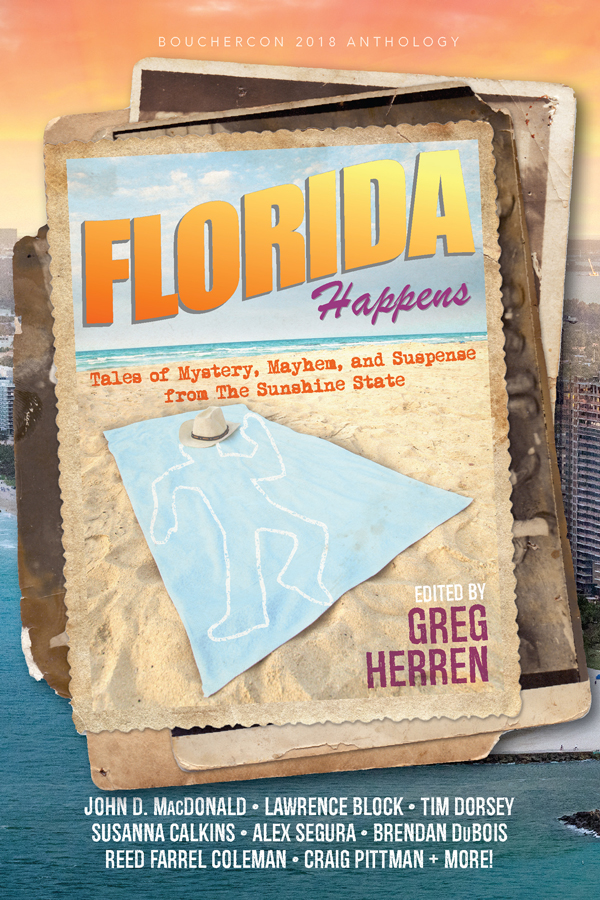
Florida Happens final cover

Isn’t that nice? I absolutely love that cover.

Table of contents:

Intro by Tim Dorsey

The Burglar Who Strove to Go Straight by Lawrence Block

The Best Laid Plans by Holly West

There’s An Alligator in My Purse by Paul D. Marks

Mr. Bones by Hilary Davidson

Cold Beer No Flies by Greg Herren

Frozen Iguana by Debra Lattanzi Shutika

The Fakahatchee Goonch by Jack Bates

The Case of the Missing Pot Roast by Barb Goffman

How to Handle a Shovel by Craig Pittman

Postcard for the Dead by Susanna Calkins

The Hangover by John D. MacDonald

Muscle Memory by Angel Luis Colon

The Unidentifieds by J. D. Allan

All Accounted for at the Hooray for Hollywood Hotel by Eleanor Cawood Jones

Southernmost Point by Neil Plakcy

Quarters for the Meter by Alex Segura

Breakdown by Brendan DuBois

Winner by Michael Wiley

Frontier Justice by John M. Floyd

When Agnes Left Her House by Patricia Abbott

The Ending by Reed Farrel Coleman

Nice, right?

And here’s the opening for my story, “Cold Beer No Flies”:

Dane Brewer stepped out of his air-conditioned trailer, wiped sweat off his forehead and locked the door. It was early June and already unbearably hot, the humidity so thick it was hard to breathe. He was too far inland from the bay to get much of the cooling sea breeze but not so far away he couldn’t smell it. The fishy wet sea smell he was sick to death of hung in the salty air. It was omnipresent, inescapable. He trudged along the reddish-orange dirt path through towering pine trees wreathed in Spanish moss. The path was strewn with pine cones the size of his head and enormous dead pine needles the color of rust that crunched beneath his shoes. His face was dripping with sweat. He came into the clearing along the state road where a glorified Quonset hut with a tin roof stood.  It used to be a bait and tackle until its resurrection as a cheap bar. It was called My Place. It sounded cozy—the kind of place people would stop by every afternoon for a cold one after clocking out from work, before heading home.

The portable reader board parked where the parking lot met the state road read Cold Beer No Flies.

Simple, matter of fact, no pretense. No Hurricanes in fancy glasses like the touristy places littering the towns along the gulf coast. Just simple drinks served in plain glasses, ice-cold beer in bottles or cans stocked in refrigerated cases at simple prices hard-working people could afford. Tuscadega’s business was fish, and its canning plant stank of dead fish and guts and cold blood for miles. Tuscadega sat on the inside coast of a large shallow bay. The bay’s narrow mouth was crowned by a bridge barely visible from town. A long two-lane bridge across the bay led to the gold mine of the white sand beaches and green water along the Gulf Coast of Florida. Tourists didn’t flock to Tuscadega, but Tuscadega didn’t want them, either. Dreamers kept saying when land along the gulf got too expensive the bay shores would be developed, but it hadn’t and Dane doubted it ever would.

Tuscadega was just a tired old town and always would be, best he could figure it. A dead end the best and the brightest fled as soon as they were able.

He was going to follow them one day, once he could afford it.

Towns like Tuscadega weren’t kind to people like Dane.

You can preorder it here , or from your local independent. DO IT.

Don’t make me come over there.


Take on Me

Well, that was a week. Here it is Friday morning and I haven’t posted in days. I started writing a post the other day about a short story I’d read, but there’s a lot to digest and think about in regard to that story, so it’s not an entry I can just dash off the top of my head while I am waking up over coffee, the way I usually do. (I have several of those posts in the draft file.) This week also signaled the deadline for submissions for this year’s Bouchercon anthology, Sunny Places Shady People, so I was downloading stories, sending acknowledgements of receipt, and then logging them all into the submissions spreadsheet. The deadline was yesterday, so I am pleased to report that’s all done and caught up. Now comes the tricky part, though, and I only have a month to corral the initial readers, assign stories, track their scores and then sent out rejections and acceptances, corral the contracts and bios, and pick the story order. At least Mardi Gras will be over week after next.

Anticipating having to work on the anthology so extensively this month, I was trying to get as much done on everything else as I could before this weekend–later this morning I am off to Alabama–and I am pleased to report that I am now partway through Chapter Three of the new Scotty, and also on Chapter Three of the WIP. The Scotty book actually feels like a Scotty book in this iteration, which was an enormous relief; I was worried I might have been done with him and not by choice.

I also revised two short stories this week of my own, which wasn’t as easy as I would have liked. One of them needs to go through another revision/rewrite, I think; the other is finally done. Huzzah! I have two more that I also need to revise/rewrite, but there’s no rush on those as there’s no particular anthology or deadline for them to be submitted; those are going out into slush piles. I also got a submissions call for another anthology I want to try for; I actually have multiple first drafts of short stories that would fit that anthology, so it’s a matter of picking one and going from there.

So, Gregalicious has turned back into a writing/editing machine, and it kind of feels good you know? It’s been a while since I’ve been motivated and working this hard. Is there a connection between that and also getting back into the gym regularly? Perhaps, but I’m not looking either gift horse in the mouth, you know?

And now, I need to clear out my email inbox before I go the gym and then hit the road.

Happy weekend, Constant Reader!

tumblr_o5h18dblnH1uzn77yo1_540