Galveston

So here we are, on yet another Tuesday morning. Yesterday wasn’t a complete loss for me; I was very tired after going out and getting myself tested in the morning, so I came home and decided to take a “Greg Day”; no emails, no work,  and as little social media as possible. Easier said than done, of course, but you know–that’s how the ball bounces sometimes. I did get further into my reread of Ammie, Come Home (I always forget the damned comma in the title) by Barbara Michaels–one of the best Gothic ghost stories ever published, even if a little dated today–and I read a few chapters of Barbara Tuchman’s A Distant Mirror–the 14th century is my second favorite century, behind the 16th–and when my brain couldn’t focus to read, I watched some videos on Youtube that sent me into yet another wormhole, this one of videos about American Horror Story.

In my defense, it started with a video about Jessica Lange’s roles on the show, which led to Sarah Paulson, and Lily Rabe, and…you get the picture.

And then, of course, ESPN replayed that particular Monday night football game from back in September, 2006. That warm night when the Saints played their first home game since the 2004 season. A year after Katrina, when the roof came off the Superdome and people died and still others were trapped there for days. When the city was almost completely destroyed, its economy gone, her people scattered. Our futures were uncertain that bleak fall of 2005, and even throughout 2006, with our abbreviated Mardi Gras and frustratingly slow, it seemed, recovery. We’d almost lost the Saints to San Antonio when the city drowned, but they’d stayed–and the true hero of that was Tagliabue at the NFL, not Tom Benson–and now the Superdome, long a symbol of the city and now a monument to its worst moments, was ready to reopen and create a new identity for itself, just as the city was seeking to be reborn, just as those who lived here were waiting for hope. I remember that day in the city–I knew the Saints were winning but I was busy; the Lost Apartment was still lost and still wouldn’t be finished for another two months. All we had was a tiny old black and white portable television in the carriage house, whose carpet had been ripped up to be replaced but hadn’t yet so there were carpet tacks sticking up out of the bare, scarred exposed wood. We were sleeping on a mattress on top of a box spring on the floor. Paul’s desk and computer were set up in one corner of the room, the staircase and railing took up another side and the little television, which was rarely watched, sat on top of a dresser. I ran errands that day and sensed something in the air–I knew the Saints were winning games but wasn’t paying attention because I was busy trying to make a living and keep myself to the very strict schedule I had to follow in order to have the slightest chance of getting anything done. But i could feel it when I went out to the car, in the air. People were wearing Saints jerseys, or at least black and gold, everywhere I looked. Saints flags were flying on the front of houses (we take flags seriously in New Orleans). Everyone was in Saints gear–the post office, the grocery store, Walgreens, everywhere–and when I got home I looked it up on-line: yup, the Superdome was reopening for Monday Night Football, and we were playing the hated Falcons. Paul and I watched on that little black and white television, screaming and cheering and getting a little teary eyed.  It gave us something we hadn’t had in a long time–hope. They called the game both “ReBirth” and “Domecoming”; both fit.

And while the Saints had always been our team before, that night they became OUR TEAM. Even New Orleanians who weren’t football fans became Saints fans that night. And the sheer joy with which the team played that night was so apparent, and so obvious, and they made it so clear they were doing it for the city…I’ve rarely felt so connected with a football team the way I did with that 2006 Saints team.

As glorious as winning the Super Bowl was, I have to say I think the Domecoming game was probably the greatest moment in Saints history.

Watching the game last night during another social and societal upheaval–one that is affecting the entire world and not just us this time–reminded me of that feeling. Tears spilled out of my eyes once again as Steve Gleason blocked that punt and the Dome erupted; listening to that crowd, seeing their faces and the tears of joy on their faces…having something like the Saints to cheer for, to help us through the hard times, and to give us hope again for the first time since Katrina crossed southern Florida…it’s hard to explain that, I guess.

Try to imagine what it’s going to be like when we have sports again–or the first time you can go out to a restaurant again, or what it’s like to be free of this worry and burden and fear…heady stuff, frankly.

And now…now I am feeling tired again, so I am going to go lie down for a bit. Stay safe, everyone.

Evans1

Amarillo by Morning

So, this morning when I woke up, as my first cup of coffee brewed, I dialed the COVID-19 testing hot-line for staff at the day job and made an appointment to get tested. They scheduled me for 9:20 am; I was called at around eight thirty, which left me with about fifty minutes to wake up, drink some coffee, and pull myself together. Our clinic’s COVID testing set-up is in the parking garage which is the ground floor of our building; staff simply drives into the garage and pulls up to the area where the tents and check-in desk are set up, and the doctor comes out and swabs your nose. Needless to say, as I swilled down coffee and brewed another quick cup to take with me in the car, my nerves were definitely feeling a bit frayed. Saturday was a better day than Friday; yesterday was better than Saturday. So far this morning I seem to feel okay other than fatigue–going up stairs to put on a T-shirt and shorts to drive over to the office made my legs and hips ache a bit; it also triggered a small coughing fit (note: the only time my lungs feel tight is when I cough; other than that I breathe fine and they don’t phase me at all. But when I cough, I feel a tightness in the center of my chest that is pretty severe–but as I said, once the coughing spasm passed, I feel fine) but I got dressed and drove over to the office. It didn’t take long as the streets are pretty empty–there’s some traffic, to be sure, and a pandemic and over-burdened hospitals doesn’t seem to be stopping people from driving like thoughtless assholes–and then I pulled into the garage, got checked in, signed my consent to be tested form, and Dr. Halperin came out and swabbed both nostrils.

And while I can see why the vice-president thought it was invasive–I imagine anything put it any of his orifices would be invasive to him–it really wasn’t that bad. It’s certainly not the worst thing I’ve ever had done to me; I’d certainly rather get my nostrils swabbed like that on a regular basis than have an abscessed tooth ever again, and the worst part of it wasn’t the invasiveness at all. The worst part is the chemical on the swab–it doesn’t quite burn per se, but the closest experience I can think of to it is when you accidentally and deeply inhale mothballs; my eyes watered and it burned a little bit, but not painfully.

In a best case scenario, the test results will be back within 2-4 days–it may be longer, who knows? But I have to go into a strict quarantine until the results do come back, which means not leaving the house or running any errands or doing much of anything. Of course I have gloves and masks, so I can theoretically do some things and leave the house if necessary, but I shouldn’t really take the risk of infecting someone else by going out in public until I know for a certain whether I currently have it, or did have it, or don’t have it at all. I was also a little confused because I’d assumed there would be a blood draw to go with the swab test, but I am also conditioned to thinking about testing for different viruses (HIV, syphilis, and Hep C) so I assumed the testing would also have to involve blood. But then I realized, afterwards as I was driving home, that mucous doesn’t carry the HIV, syphilis or Hep C viruses (virii?); but the COVID-19 virus can be airborne transmitted–which means it must be in the mucous membranes along with the antibodies.

At least that makes testing for it that much easier, so that’s kind of a plus?

I also noticed, this morning, a little bit of PTSD kicking in from the good old HIV/AIDS pandemic days–“oh, look, I need to get tested for a potentially fatal virus and have to wait days to get the results back”–but I quickly tamped that down, shoved the lid closed and firmly padlocked it. I suppose it’s a bit of a surprise that particular version of all the PTSD’s I have locked behind various doors in my brain took so long to try to worm it’s way out, but it did finally show up and I was able to beat it down rather easily.

Thank you, coping mechanisms, developed over several decades of seemingly endless trauma.

I didn’t have to take a nap yesterday, but after we finished watching Miss Fisher and the Crypt of Tears, a lovely stand-alone film follow-up to the wonderful Miss Fisher series from Australia (it was kind of an Indiana Jones-lite adventure, set in Palestine in 1928 and quite fun), I got down my copy of Barbara Tuchman’s A Distant Mirror and opened it up to the chapter about the Black Death. Yes, I recognize that my recent fascination with plagues and epidemics and pandemics is probably morbid, given the current state of affairs in the world, yet my curiosity had always had a bit of morbidity to it and it’s really not surprising that it would take this kind of turn. (And I’m actually kind of glad; I was glad to finally read “Death in Venice” even if it left me a little cold; and it also led me down the path to rereading “The Masque of the Red Death”, and back into my Daphne du Maurier short stories) Realistically, while everyone talks about the Spanish influenza pandemic of a hundred years ago, primarily because it was the most recent pandemic (note to self: reread Katherine Anne Porter’s “Pale Horse Pale Rider”), the worst pandemic in history was clearly the bubonic plague, the Black Death, or, as it was known more simply during the fourteenth century, “the pestilence.”

Here’s how the chapter opens:

In October 1347, two months after the fall of Calais, Genoese trading ships put into the harbor of Messina in Sicily with dead and dying men at the oars. The ships had come from the Black Sea port of Caffa (now Feodosiya) in the Crimea, where the Genoese maintained a trading post. The diseased sailors showed strange black swellings about the size of an egg or an apple in the armpits and groin. The swellings oozed blood and pus and were followed by spreading boils and black blotches on the skin from internal bleeding. The sick suffered severe pain and died quickly within five days of the first symptoms. As the disease spread, other symptoms of continuous fever and spitting of blood appeared instead of the swelling or buboes. The victims coughed and sweated heavily and died even more quickly, within three days or less, sometimes in 24 hours. In both types everything that issued from the body–breath, sweat, blood from the buboes and lungs, bloody urine, and blackened excrement–smelled foul. Depression and despair accompanied the physical symptoms, and before the end “death is seen seared on the face.”

The disease was bubonic plague, present in two forms: one that infected the bloodstream, causing the buboes and internal bleeding, and was spread by contact; and a second, more virulent pneumonic type that infected the lungs and was spread by respiratory infection. The presence of both at once caused the high mortality and speed of contagion. So lethal was the disease that cases were known of persons going to bed well and dying before they woke, of doctors catching the illness at a bedside and dying before the patient. So rapidly did it spread from one to another that to a French physician, Simon de Covino, it seemed as if one sick person “could infect the whole world.” The malignity of the pestilence appeared more terrible because its victims knew no prevention and no remedy.

The chapter is pretty horrific, and it’s hard to imagine what it must have been like to live through in the fourteenth century. It’s impossible to know how many people died because they died so quickly that graveyards overflowed and burial pits had to be dug; people simply dragged the bodies of their dead loved ones to the pits and dumped them there. Estimates were obviously guesses and sometimes exaggerated; one monk’s reported death toll for one particular city, in fact, was more than what its recorded population showed. But it’s not inaccurate to guess that one third of the European population died during the pestilence; towns disappeared, families completely died out. Farms went untended because the farmers and their families died; there were also undoubtedly consequential deaths, not from the plague but because of it; young children whose parents had died starved to death, etc. Naturally they thought it was the end of the world, a punishment from God for sin; and the fourteenth century, which Ms. Tuchman describes as “calamitous”, was certainly ripe for that kind of belief.

One of the interesting things to me about this current pandemic is–and this may entirely be because I am not paying attention and my social media is sort of a bubble; but I cannot believe someone would be saying this about the pandemic and no one i know would notice it and be outraged enough to post about it–where are the evangelicals? Where are all those “end times” preachers and ministers and con artists to prey on the fears of their congregation? Why isn’t anyone pointing out that this could actually be the “rapture” where God is calling his own to him? I have seen that some trashbag minister called this God’s punishment for the gays–but it didn’t gain any traction.

Maybe one of the outcomes of this pandemic will be the ending of that nonsense. I rather doubt it, but you know, hope springs eternal.

I did read for a while yesterday–I got further into Ammie Come Home and I read a short story by Harlan Ellison, “On the Downhill Side”, from his collection Deathbird Stories, which I’d originally read years ago, before I moved to New Orleans, and this story is set in New Orleans. Oddly enough, when I opened the ebook in my Kindle app on the iPad (I was actually looking to see if the collection included his Edgar winning “The Whimper of Whipped Dogs”–it does) it was already opened to that story, so I read it, and as always with Ellison, loved it–and while it certainly is brilliantly written, it was written by someone who didn’t live here. I did love the story; like all of Ellison’s stories, the humanity in it was overwhelming and identifiable and relatable. I’ll probably give it, at some point, its own entry here.

And now I am feeling a bit tired, so I am going to go rest for a bit.

Sexy-Shirtless-Guys-8

Love Touch

Sunday morning, as I sit here in my cool workspace swilling coffee, trying to wake up and figure out what to do with the rest of my day. I need to go to the grocery store and I should also probably make an attempt to go to the gym; but I can’t seem to find my iPad, which makes doing cardio pointless (I read or watch TV on my iPad while on the treadmill; perhaps not having my iPad is simply an excuse for not going; what if it’s gone, lost, stolen? I am trying not to think that way and am hoping that I simply left it at the office. If not, I am terribly screwed because I don’t know where it is and I currently don’t have the cash on hand to replace it. So, yes, let’s just continue pretending happily that it’s as the office, shall we?)

I could, of course, just go to the gym and do weights. That always feels good, at any rate. Perhaps once I finish swilling this coffee….

I slept late yesterday, and I slept even later today. I spent most of yesterday not only reading but doing chores around the house, on the pretense that today I would not only go to the grocery store and the gym, but I would also spend some time writing today. I need to finish a short story; I need to revise still another, and there’s that new one struggling to take root in my brain that I haven’t really decided what to do with just yet. There are two others swirling around up there in my head, as well as others I’ve not thought about or have forgotten about in the meantime. But now, now as I wake up I feel more confident about running the errands and going to the gym and actually doing some writing today.

I’ve been reading The History of Western Philosophy by Bertrand Russell, and greatly enjoying it; is there anything quite like well-written non-fiction? It’s why I love Joan Didion and Barbara Tuchman; one of the things I love to do while reading is to learn, and non-fiction fills that need quite beautifully. I also like non-fiction that makes me think; which is why I am looking forward to reading Dead Girls by Alice Bolin. I still would love to do a collection of my own essays, book reviews, and so forth; but egad, what an odious chore pulling all of that together would be. I struggle with essays, but I also think that the writing of essays; the ability to pull thoughts from my head and extrapolate them out to their fullest meaning, is vitally important and a skill-set I wish I had honed more properly. A friend once pointed out to me, as I bemoaned my inability to write essays, that my blog itself is nothing more than years of personal essays. That took me aback, because it was, in many ways, correct; there is definitely some truth to that, but it’s hard for me to take the blog seriously in that fashion, because so much of it is simply written off the top of my head in the morning as I wake up and drink coffee and try to figure out what to do with the rest of my day.

One of the problems for me with personal essays is, ultimately, the issue of self-deprecation, which I’ve addressed in previous blog entries about my writing and my career and my books; who am I to write about this subject? Am I expert enough in this to write about it, or am I simply talking about things that smarter, better-educated people have written about long ago and having the hubristic belief that I am the only person to see this truth for the first time? 

And, in considering myself self-deprecatingly as not that special or particularly smart, I defeat myself and never write the essay.

And of course, there is the problem of all the lies my memory tells me.

But yesterday, I took the afternoon to finish read an ARC of Lou Berney’s new novel, November Road, and was blown away by it.

Scan.jpeg

Behold! The Big Easy in all its wicked splendor!

Frank Guidry paused at the corner of Toulouse to  bask in the neon furnace glow. He’d lived in New Orleans the better part of his thirty-seven years on earth, but the dirty glitter and sizzle of the French Quarter still hit his bloodstream like a drug. Yokels and locals, muggers and hustlers, fire-eaters and magicians. A go-go girl was draped over the wrought-iron rail of a second floor balcony, one book sprung free from her sequined negligee and swaying like a metronome to the beat of the jazz trio inside. Bass, drums, piano, tearing through “Night and Day.” But that was New Orleans for you. Even the worst band in the crummiest clip joint in the city could swing, man, swing.

A guy came whipping up the street, screaming bloody murder. Hot on his heels–a woman waving a butcher knife, screaming, too,

Guidry soft-shoed out of their way. The beat cop on the corner yawned. The juggler outside the 500 Club didn’t drop a ball. Just another Wednesday night on Bourbon Street.

Lou’s previous novel, The Long and Faraway Gone, won every crime-writing award under the sun that it was eligible for: Edgar, Anthony, Macavity, and I don’t know what all; it was the crime publishing equivalent of the EGOT. It was, obviously, an exceptional novel. I met Lou when we were on a panel together at the Raleigh Bouchercon, along with Lori Roy and Liz Milliron; moderated by the amazing Katrina Niidas Holm. It was funny, because the panel topic was, I think, writing about small towns which, in fact, none of us on the panel really did, but we had fun with the topic and I know I brought up Peyton Place at least once and pointed out that suburbs are small towns with the primary difference being suburbs are bedroom communities for cities while small towns aren’t attached in any way to a larger city. It was fun and spirited and I liked Lou, thought he was incredibly smart, as were Liz and Lori. Lori and Lou went on to win Edgars for that year; and I admire their work tremendously. I’ve not had the opportunity to read Liz’ work; but she did have a terrific story in the New Orleans Bouchercon anthology, Blood on the Bayou.

Anyway, I digress.

I’ve been looking forward to November Road since I finished reading The Long and Faraway Gone, but I still need to go back and read Lou’s first two novels, Whiplash River and Gutshot Straight. 

I also have to admit, I was a little hesitant about Lou’s new book; it’s built around the Kennedy assassination in 1963, which always gives me pause (I have yet to immerse myself in Stephen King’s 11/22/63). I’m not sure why I don’t care to read fiction around the Kennedy assassination, but there you have: an insight into my mind. But the Kennedy assassination, while a primary plot device, is just that: a device to set the story in motion. Frank Guidry is involved with a mob boss in New Orleans, and after the Kennedy assassination he is given instructions to fly to Dallas, retrieve a car, and drive it to Houston to dispose of it. While he is doing this, he realizes that he is getting rid of evidence that may be of vital importance to the investigation into the president’s murder–and as such, is a loose end who knows too much and figures out he’s got to disappear now because they’re going to want to kill him. And sure enough, they do send someone after him, Paul Barone, a remorseless killer and tracker. The cat-and-mouse game between them builds suspense throughout the book.

But it’s not just about Frank, and it is a credit to Berney’s talent, creativity and imagination in that he throws in another primary character, constructed carefully in all the facets and layers that make her live and breathe: Charlotte. Charlotte is a wife and mother in a small town in Oklahoma, married to a useless drunk fuck-up with whom she had two daughters, and her salary working for the local town photographer is the primary thing keeping a roof over their heads. Her own ambitions for being a photographer herself are constantly shat upon by her boss, her society and culture and environment: she is a woman, a wife and mother, and in 1963 that so thoroughly defines her that any other ambition she might have throws her identity as wife and mother into question. Trapped, with the walls closing in on her closer every day, Charlotte takes the president’s assassination as a sign for her to run away with the girls and start over. Charlotte is an extraordinary character;  her relationship with her daughters is the strong backbone of this story. You root for her, you want her to make her escape and make her dreams come true.

Frank and Charlotte cross paths in New Mexico, and Frank sees them as his salvation; his murderous pursuers might be thrown off as they are looking for a single man, not one traveling with his wife and kids; the book becomes even stronger and more suspenseful once they are all together. Frank and Charlotte become close, despite not being completely honest with each other; they are both keeping their cards close to their vests, but yet form a loving bond. WIll they escape, or will they not?

November Road reminded me a lot of Laura Lippman’s Sunburn; the same kind of relationship building between a man and a woman where a lot of information, important, information, is held back from each other, and that lack of trust while falling in love is an important theme in both books: women trying to make their best lives, even if it means making morally questionable decisions, while becoming involved with a man who isn’t completely honest with her. Berney’s writing style, and tone, and mood, also put me in mind of Megan Abbott’s brilliant Give Me Your Hand. If you’ve not read yet the Lippman and Abbott novels, I’d recommend getting them and holding on to them until Berney’s book is released in October and reading them all over the course of a long weekend.

Bravo.

Perfect Way

I submitted a story to Cemetery Dance yesterday, and felt very accomplished after having done so. As I have said before, getting a story published in Cemetery Dance is a bucket list item for me, and I am reasonably proud of the story; we’ll see what happens. But I’m glad I did it; glad I spent the morning and early afternoon revising and polishing it. And hopefully,  if they don’t use the story I’ll get a chance to submit to them again at some point.

To celebrate, I went to the gym and did cardio, continuing my iPad screening of Troy: Fall of a City–which is starting to, sadly get a little boring. I’ll keep watching, though–I want to see how they play the story out, plus it’s helping me with my pronunciation of all their names; most of which I’ve been saying wrong my entire life, since I was a kid and read The Windy Walls of Troy.

I also spent some time last night with my journals; basically going through them and marking the pages where I wrote notes on the Scotty book, which should make the next revision much easier. Huzzah! I am also glad that I did this because not only did I find some ideas for short stories I’d forgotten, as well as how some of the short stories I have written since the first of the year were born, but I also discovered that I had roughly sketched out a couple of scenes for Bury Me in Satin, which I typed up last night–remember, I’d started writing the opening on the 4th, but was incredibly pleased to see that I’d actually handwritten not only the opening but some other scenes from the first and second chapter that needed to be transcribed. So, I am pretty far ahead on this one already, which is kind of awesome. I’m having lunch today with a friend, which will be lovely, and then I am going to run a couple of errands before coming home and doing some more writing.

I may even (gasp) return to the gym for the third consecutive day: madness.

I also spent part of the day reading about the Dreyfus Affair in Barbara Tuchman’s book The Proud Tower, which takes a look at life and the issues confronting the great powers from 1895-1914; basically, the set-up for World War I. I’d heard of the Dreyfus Affair, of course, and Emile Zola’s participation; but I didn’t know the entire story, and, well, you really can’t go wrong with reading Barbara Tuchman on a subject you want to know about.  I love reading history, and I always make a point of trying to read some around the 4th of July (I also took down Catherine Drinker Bowen’s history of the Constitutional Convention Miracle at Philadelphia, which should be required reading for all Americans); Tuchman is the kind of historian I would have liked to have been, writing the kinds of things I would have liked to have written had my career path gone in that direction (I still toy with The Monstrous Regiment of Women, a history of the sixteenth century, built around all the women who held power–more women held power in that century than any before or since). The Dreyfus Affair was really something, and even more horrific, in many ways that time in France is reflected in modern day American society as well.

The next story in Promises in Every Star and Other Stories is “The Porn King and I”:

He is beautiful.

He is everything I want in a lover.

Thick curly black hair.

Blue eyes.

Muscles rippling under tan skin.

A hard, round, beautiful ass.

The cock of Apollo.

I first saw him in a poster in the adult book store on Decatur Street. The poster was black with just a picture of him, hands on hips, wearing a jock strap. His face was smiling, a warm, inviting smile that would melt anyone’s heart and stir their groin. His tanned skin gleamed. At the bottom of the poster in red capital letters it said: CODY DALLAS IN THE SEX SENSE. I stood, staring for a few moments, my glance going from that pretty face down the neck to the beautifully shaped chest, smooth and silky, down the abs that looked carved out of stone, to the top of the jock. His hard-on was unmistakable beneath the white cloth. I walked over to the counter. “Do you have that film?” I pointed back over my shoulder with my thumb.

The counter boy was just that; a boy. He didn’t look old enough to be working in a sex shop. Hell, he didn’t look old enough to have hair on his balls. Bleached blonde hair standing up spikily over black roots. A straggle of hair on his chin that was supposed to be a goatee. He weighed maybe 130 pounds. His baggy jeans hung off his hips. A black Marilyn Manson t-shirt. Pierced nose and eyebrow. Tattoos on both arms. He grinned at me. Braces.

“Yeah. Only $59.95 or did you want to rent?”

“I’ll buy.”

I walked home to my apartment on Chartres Street. Opened the door. Switched on the television with the remote. Opened the box and popped the video in. Hit play as I pull off my shirt, kick off shoes, strip naked. Reach underneath the couch for the fresh bottle of poppers and the lube. Fast forward through the opening credits. First scene.

It’s him. He is wearing Daisy Dukes and work boots. No shirt. The sun glistens on the muscles in his back. He is trimming a bush with garden clippers. Every movement he makes causes muscles to ripple. Someone is watching from the house. Behind the curtains a face appears. Cut away to from behind the curtains. He looks beautiful, oh so beautiful. Camera pulls back. The man at the window is naked. Thinner. Not as muscled as Cody. Lean wiry muscle.

Cody looks up at the window and smiles. The man in the window beckons. Cody puts the clippers down and walks to the door. It opens.

I open the bottle of poppers. My eyes are glued to the screen. I lift it up to my right nostril. I close off the left and start inhaling. Deeply. The scent fills my nose, my sinuses, my lungs. I shift it to the other nostril. Inhale.

“The Porn King and I” was, ironically, inspired by something that actually happened; I was walking into the Quarter on a warm early summer evening. I walked past a house right on the sidewalk with its enormous windows open–anyone could have climbed into the house; something that has always amazed me about the Quarter and those that live there–and on the wall was a framed and mounted poster of a porn star (I do not recall, all these years later, precisely which porn star it was; I am thinking Kris Lord but that might be wrong). It inspired a story about a lonely man who talks to the poster, like it’s real, and eventually there’s a scene where a young man catches him talking to the poster, climbs in through the window, and they have nasty hot passionate sex. When I was asked to write this story for one of the Best Gay Erotica volumes, I stripped out the poster and the guy walking by on the street, leaving the main character’s obsession with a porn star, and renting the video from Tower Videos on Decatur Street (which is, sadly, no longer there); the sex scene thus became three-sided: there’s the main character watching the video and masturbating; what he’s imagining in his head as he masturbates; and, of course, what is actually happening on the television screen. I thought it was a clever take.

And the stuff I stripped out? I eventually used in a story about a lonely guy who lives in the Quarter and how a gorgeous young man talks to him through the window, and what transpires then. The story was called “Mr. Lonely” and was published in the original Saints and Sinners anthology.

And now, back to the spice mines.

35955028_10214570345151125_1878586835202998272_o

Cat’s in the Cradle

The death of Agnes Nixon this past week saddened me, and spurred me to write two blog posts about her greatest, and most famous, creations; All My Children and One Life to Live. I watched both shows, along with General Hospital, off and on for over thirty years; I only stopped watching soaps when I needed the time I spent watching them to write–a decision I’ve never really regretted all that much. But I watched, over the years, many different soaps at one time or another: The Edge of Night, Dark Shadows, Love of Life, Search for Tomorrow, As the World Turns, Guiding Light, The Young and the Restless, Another World, Days of Our Lives, The Bold and the Beautiful, Capitol, Love is a Many Splendored Thing–it’s really quite staggering. And at night, I remember watching Peyton Place with my mom as a kid–although I don’t really remember much of it–and later, I was a huge Dynasty fan. I did watch Dallas, Knots Landing, and Falcon Crest during the 80’s night time soap heyday; I also watched others that didn’t last very long, like Emerald Point NAS, Flamingo Road, Paper Dolls, and Bare Essence.

It’s pretty safe to say I am a fan of the serial/continuing story format. When I was in college, I managed to get into a graduate level English course despite being an undergraduate because I was able to write a paper that was good enough to get me in; it was on Popular Culture in the 20th Century, and attendance wasn’t required–always a plus for me–and there were no tests; you only had to write a lengthy paper on some aspect of popular culture in the 20th century for your grade. I chose to write about soaps; the paper, which would wind up being 120 or so typewritten pages long, was title “How Changes in Daytime Drama Storylines Have Reflected Changes in American Culture and Society Since the 1950’s.”

God, how I wish I still had a copy of that paper.

I really wanted to work for the soaps in the 1980’s; my ambition switched from being a mystery and/or horror writer to being a soap writer. I still think it would be a lot of fun, even if there are very few soaps left to work for. But writing that paper required me to do a lot of research into the soaps and their histories; I’ve never minded doing research if it was a subject I was interested in. So, I kind of became a mini-expert in the soaps, and their histories, and there were a lot of interesting trends. It was interesting how moralistic the soaps were–something that hadn’t changed from their early days; back when there was a Motion Picture Code and a Comic Books Code, and censors for television (do they still have censors?); in which someone who did something bad always had to be found out and punished. (An interesting aside: one of the bad things that characters could do, and be forgiven/rehabilitated for and not necessarily punished for, was rape. But that’s a subject for another time–but I want to go on record to say that characters who had long runs on soaps, and in fact became very popular, at one time were rapists: Luke on General Hospital, Mickey on Days of Our Lives, John on As the World Turns, Roger on Guiding Light, Todd on One Life to Live; far too many for it to be a one-off, and enough to make it a trend. Even in prime time, on Dynasty Adam raped Kirby and was never prosecuted; she later agreed to marry her rapist.)

I even wrote, as a joke, a soap parody when I was in college, with my friends as characters. I called it The Young and the Pointless, and it was primarily for my amusement, and that of my friends. Basically, I looked at my friends and asked myself the question, if you were a character on a soap, what kind of character would you be?  I came up with the storylines myself; borrowing liberally from the storylines I’d learned so much about writing the paper, and ironically, my friends couldn’t get enough of it. They really became invested in the story; one even told me “My character wouldn’t say this.” Every day they would ask “have you written any new episodes?” It finally became over-bloated, because people who weren’t in it originally wanted to be, and I tried to be accomodating, and I cancelled it at long last midway through the third “season”. But it was a valuable learning experience for me, in that I learned that 1. I could write stories that interested people and made them want to keep reading; 2. I learned valuable lessons in creating characters and writing dialogue; and 3. I learned how to plot out a story. It was more like the classic parody SOAP than a real soap opera, but it was so much fun to write. I still have the originals somewhere–I’d always intended to type it up and make copies for the friends who were characters in it. Alas, some of them have died in the years since–a rather sobering thought–but The Young and the Pointless lives on in my files.

Yesterday LSU won, beating Missouri 42-7 at Tiger Stadium; their first win under interim head coach Ed Orgeron. LSU looked terrific; the defense played incredibly well, and the offense misfired a couple of times, but over all looked terrific. Unfortunately, it’s hard to tell if that was because they’ve come together as a team and are playing up to their potential, or if Missouri just isn’t particularly good; but LSU looked much sharper against Missouri than they did a few weeks ago against Jacksonville State. Their schedule now turns into Murderer’s Row, with games against Florida, Arkansas, Alabama, Ole Miss, and Texas A&M, so we shall see.

I wound up not being as productive yesterday as I’d intended; I did a lot of laundry and did some cleaning, but not all the cleaning I’d wanted to do. I also didn’t do any writing; I wound up getting sucked into watching some games on television (the last five minutes of the Georgia-Tennessee game was amazing; it reminded me of the last three minutes of the 2009 Georgia-LSU game, where LSU went ahead 12-7, only to fall behind with forty seconds left 13-12, but scored with less than twenty seconds left to pull off the win 20-14). Amazing.

I also spent some time opening Antonia Fraser’s Mary Queen of Scots and reading random sections yesterday; I originally read the book when I was eleven. The Queen of Scots has always interested me, and also, she was one of that ‘monstrous regiment of women’ who held power in the sixteenth century–when, as I’ve mentioned before, more women were in positions of power throughout Europe than any time prior or since. I also read some of Barbara Tuchman’s essays in Practicing History, and again, thought about how much I would love to write a book about the sixteenth century.

God, how I love history.

And now, I need to make up for the work I didn’t get done yesterday, so it’s off to the spice mines I go.

Here’s a hunk for you to enjoy:

img_1103


Tie a Yellow Ribbon Round The Old Oak Tree

Good morning and Happy Saturday, Constant Reader! This is my first full free weekend since Labor Day–no Decadence outreach, no LSU tickets, no Bouchercon, no AIDS Walk. Paul’s off at tennis, despite having an abscessed tooth extracted this past week, and the house is silent–I don’t know where Scooter is, having vanished after getting fed and a his morning handful of ‘you’re a very spoiled kitty here have some treats.’ I am doing laundry and will most likely clean today, but I also intend on working on short stories today. I came across an interesting submissions call the other day that I have an unfinished story that would be perfect for, so I am going to try to finish the story that I was asked for, edit two more, and finish writing that one–and maybe even work on the fratboy porn novel. I have to head out to Walgreen’s at some point, but other than that I don’t even have to leave the house this weekend unless I want to. I may go do some cardio later, but I may leave that up in the air as well.

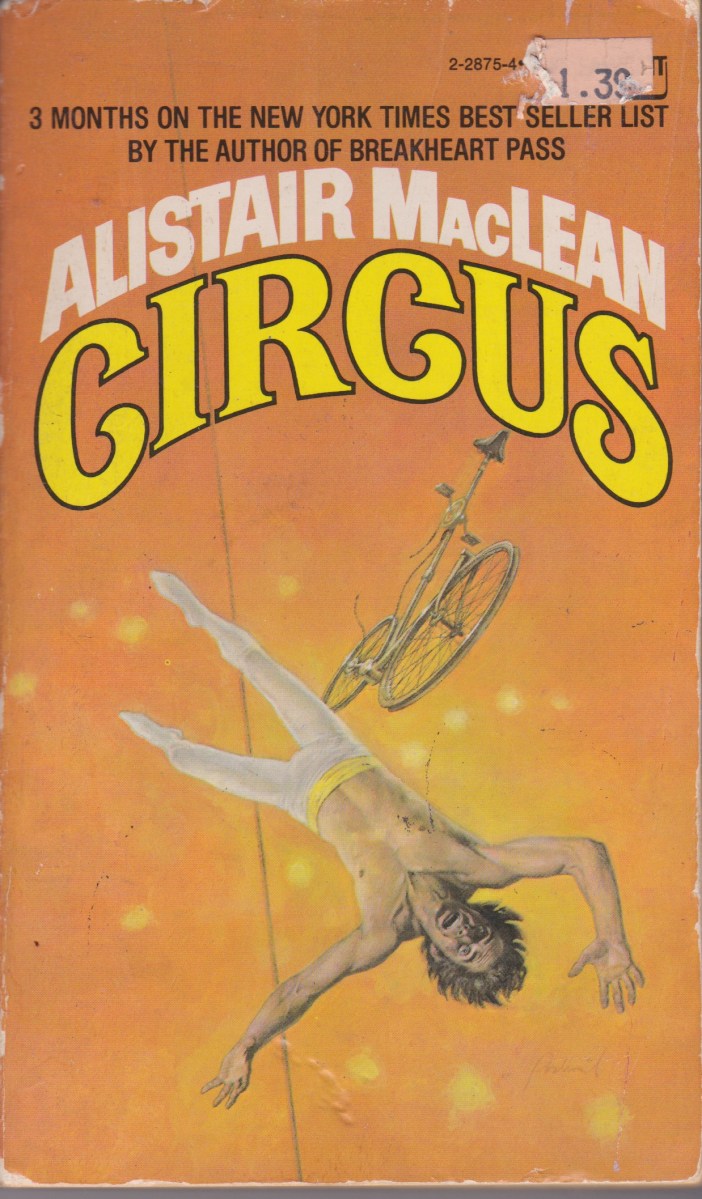
I am reading several books at the moment–some nonfiction; The Proud Tower and Practicing History: Collected Essays by Barbara Tuchman, in addition to The Tigress of Fiori, which is still on my nightstand, and I am now reading Puppet on a Chain by Alistair MacLean; someone had mentioned him recently on Facebook, and I remembered enjoying his work in the 1970’s and 1980’s, and also that I had never finished reading all of his books. Someone had mentioned Puppet on a Chain as a favorite, and it was one I hadn’t read, so it was off to eBay I went to get a bunch of his work. The first book of his I read was Circus–the young gay boy couldn’t help but be drawn to the cover design of a ripped muscular bare-chested man in white tights falling from a high wire. That may have been my first bare torso book cover purchase….hmmmm.


circus
Can’t imagine why that caught my eye, can you?

It’s also, I find, very interesting to read thriller writers from the past, to see how much the genre has changed. Obviously, back then the big enemy was Communism and the Soviets; World War II was also recent enough so Nazis weren’t out of the question, either. I also bought some Helen MacInnes novels I hadn’t read while I was there; I look forward to making my way through that stack of books at some point when I have time.

Ha ha ha ha! I even typed that with a straight face.

So, that’s my day; finishing “Lightning Bugs in a Jar” and “The Scent of Lilacs in the Rain,” editing “The Weight of a Feather” and “Death and the Handmaidens”, cleaning, watching college football, and listening to my new download of Fleetwood Mac’s remastered, deluxe version of the vastly underrated Mirage album, which I am really enjoying. I’d forgotten how much I really liked the album, and the early versions of the songs are, in some cases, better than the version that was eventually released on the album–Christine McVie’s early version of “Hold Me” is less lick, and without those interesting harmonies overdubbed (which I do like, don’t get me wrong), you can see how the song could actually be performed live; and the early version of Stevie Nicks’ “That’s Alright” (one of my favorite songs of hers) is actually much more country; I’ve always thought Stevie should record an album of country songs.

I also may start editing and correcting Bourbon Street Blues, so that ebook can finally get going. It’s been way too long since people have been able to get it anywhere other than ebay and from used bookstores.

Okay, off to mine spice! Have a lovely day, everyone!