Monday back to the office blog. I did get stuff done yesterday, but I also apparently wore myself out, because later in the day I kept falling asleep. Paul came down later in the day and we watched two more episodes of Night Country, which we are really enjoying, and then I went to bed relatively early.
The biggest news coming out of yesterday was I wrote almost two thousand words and finished that short story, “When I Die.” It needs a revision, but I am going to let it sit for a week or so before taking my red pencil to it. I also cleaned out some things from the kitchen, did a load of dishes, and cleaned/reorganized my two supply drawers, which makes finding things a lot easier…as well as throwing out stuff I no longer need (if I ever did) and I am quite pleased with the result. I am gradually digging my way out of the hole I’ve been in since even before the pandemic, and it kind of feels nice, to be honest. It feels nice to feel like I have some say in what happens to me again, that I have some control and power over my life. It’s probably illusory, but I can live with the illusion quite happily, thank you very much.
I have a lot of practice living with illusions, thank you very much. In fact, I much prefer my fantasy world than the real one, thank you very much.
Heavy heaving sigh. I do feel a little more tired this morning than I remember feeling last week, but again it’s physical, not mental. I am supposed to go back to the gym tonight–I see my therapist Friday morning–which will undoubtedly exhaust me. The exercises themselves aren’t terrible, and really–the walking there and back is the worst, most tiring part of the entire enterprise. And as it progressively gets hotter as summer draws near, there’s that unpleasant aspect of it as well. But it also is stupid to drive such a short distance and try to find a place to park that’s even remotely close enough for the drive to make any sort of sense; this is the kind of thing that nags at me, comes back to haunt me when I am tired and trying to just let my mind go. But it also stands to reason that the more I make that walk, the easier it will get, and I wanted to start taking more walks in the evening anyway, didn’t I? I need to really get over myself at some point, don’t I?
But I am very pleased that I got that story finished yesterday, and I got ideas for how to finish other stories, which always makes the weekend feel more productive. I am glad I dropped off books at the library, preparatory to another cull, and of course I am glad I washed the car–which I’d like to start doing every other week. The car looks better when it’s clean, and what I really need to have done is use some rubbing compound on it and have it waxed again. That would actually be a really cool thing to do when I visit Kentucky next.
I was also thinking this weekend that on one day of my future weekends, I should use the car to go exploring–in the East, for one, and old Highway 51 along the west lake shore, as well as the north shore and Irish Bayou and Spanish Fort and so on. I should also head over to Houma and Terrebonne Parish, drive out to Grand Isle…there’s so much of Louisiana to explore, and I was thinking Avery Island, where they make tabasco sauce, would be an interesting place to visit as well–not to mention everything all along the River Road, from the plantations to the towns to the Cajun influences. It will undoubtedly inspire more work from me, too.
There’s always so little time, it seems.
And on that note, I am heading into the spice mines. Have a lovely Monday, Constant Reader, and I may be back later.
One of the things I’ve always lamented is the shortage of Black Louisiana crime writers.
There have been Black characters who were the main characters in Louisiana crime series, but they were always written by white people and while I did enjoy some of the books, I always felt a little uncomfortable with reading them. Can a white person really do a Black main character in a Louisiana crime series justice? I am sure if I went back and reread them now I’d find them more problematic than I did in the first place.
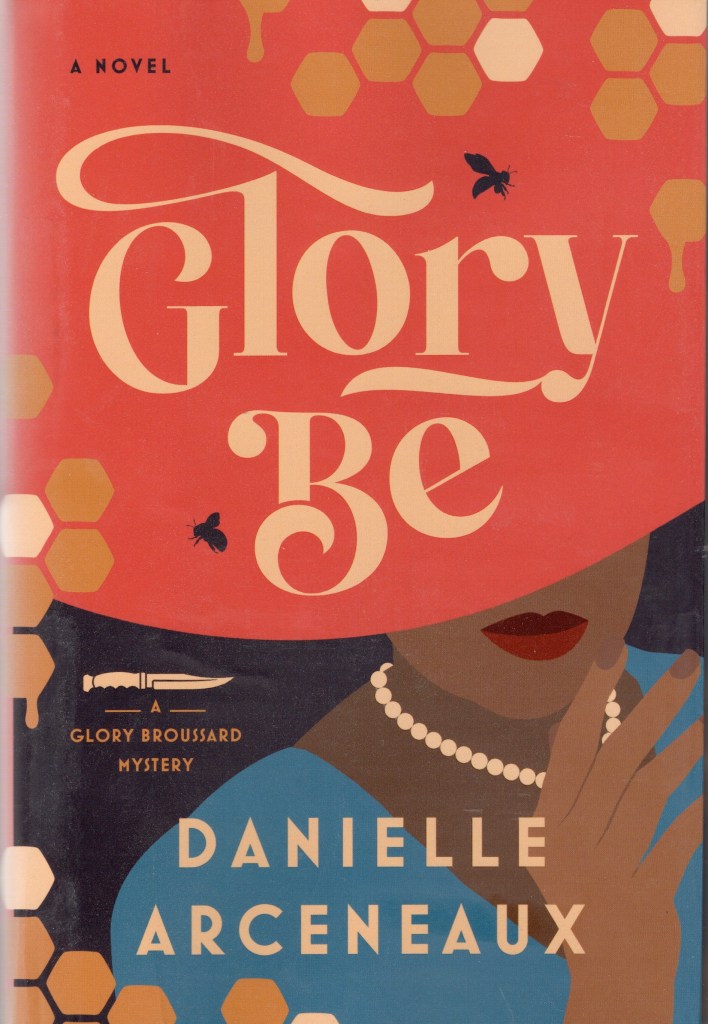
So, when my friend Ellen Byron recommended that I should read Danielle Arseneaux’ debut novel, Glory Be, I couldn’t wait to get a copy and read it.
And I am so grateful that I did, because it’s an absolute joy.
Glory Broussard was tired of waiting. She figured this barista was new, and she would know since she was a regular at CC’s Coffee House. With each drink order, he nodded and flipped through the pages of a thick manual, going back and forth between the espresso machine and the book.
It didn’t help that he was grinning like a goddamn fool at that white woman. She was wearing a pink ribbed tank top, and as far as Glory could tell, no bra.Her jean shorts were so scant that you could see the bottom curve of her ass. Glory had seen enough of this recently at the Acadiana Mall to know it was not an accident but a trend, and a disgraceful one at that. Wet hair crept down to her waist, making her look like a creature that had crawled out of the Atchafalaya Swamp.
Glory edges up to the counter, closely behind the braless woman. “Excuse me,” she said to the barista. “Are you the only one working behind the counter? Y’all should be better staffed for the after-church crowd.”
“I’m not sure. I’m new here.”
“Clearly.” She wiped the sweat from her forehead, a useless gesture in Louisiana this time of year.
What made this even more exciting to me was the book wasn’t set in New Orleans–as so many inevitably are–but in Lafayette, which was also refreshing. Lafayette is a more Cajun city than New Orleans, and is the heart of what we call Acadiana here. I really like Lafayette; I went up there with some friends who were touring Louisiana and had a great time and some truly great food. It’s also a gorgeous little city, too, with lots of charm and its own Carnival, and very different than New Orleans.
The above is the opening sequence in which Arsenault introduces us to Glory Broussard, a deftly drawn, deeply complex character who worked as the produce manager at a grocery store for years until she got custody of her ex’s betting book in the divorce and took over for him, spending every Sunday after church at CC’s and taking bets. Glory is prickly and proud, and never takes any slight lightly. By the end of the first chapter her best friend, a nun she grew up with named Sister Amity Gay, has committed suicide. Glory doesn’t believe it for a minute and is furious when the police write it off as a suicide, even though she is certain Amity would have never committed suicide…so she decides to take it upon herself to investigate for them.
The investigation itself is worthy enough for reading, but the way the book is structured, the way Arsenault slowly plays out her cards letting us get to know Glory better by revealing why she is the way she is at the opening of the book truly kicks into gear where her lawyer daughter Delphine shows up, ostensibly to help her fight the condemnation of her house the city is processing because of complaints–and by showing the house through Delphine’s eyes, as well as her mother, gives us an entirely new perspective on Glory herself, as she also recruits Delphine to help her look into Amity’s death…and oddly enough, there are any number of motives for someone to want Amity out of the way–including the corruption behind a new petrochemical plant’s approval that Amity is fighting–as well as a connection to the drug kingpin of Acadiana.
I loved getting to know Glory, I loved seeing her take charge of her own life again after several years of depression, and the pages simply flew past. Arsenault has an amazing gift for a turn of phrase, all of them purely Louisiana, and a masterful authorial voice.
One of the great joys of my life has always been history. One of the many reasons I love New Orleans so much is because the city has never completely paved over and replaced its history; on a foggy night in the French Quarter, the sound of mules pulling tour carriage clopping on the streets can make you feel like you’ve somehow stepped through a window into the past, and I love that. I’ve never known much beyond some basics of New Orleans and Louisiana history; and I’ve been going down rabbit holes since right around the start of the pandemic, learning more and more about the history here. It’s humbling to realize how little I actually did know. I knew when the French arrived; I know how English Turn got its name and when Louisiana was turned over to Spain (1763, to be exact) and when it became American (1803). I also know Napoleon sold Louisiana to the Americans before he succeeded in forcing the Spanish to return it to France….so he could sell it to the Americans. I know New Orleans fell to the Union in 1862 during the Civil War; I know a little bit about Storyville and Huey Long; and I know that the landing boats used for the Normandy invasion in World War II in 1944 were built here. I know a smattering of things post-war about New Orleans–but the gaps in my knowledge are staggering, and I know even less about the rest of the state’s history.
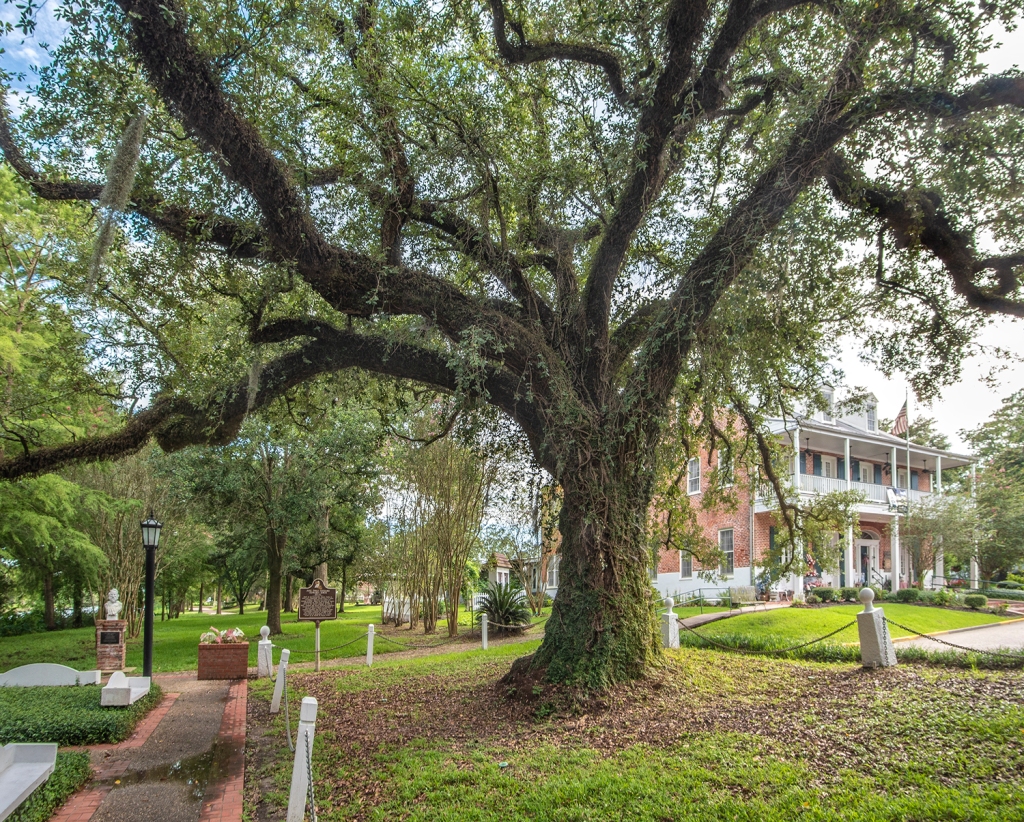
I know that the Cajuns are actually Acadians, from French Nova Scotia, kicked out after the French and Indian War and forced to resettle elsewhere–many of them, after a long and mostly horrific journey, arrived in the swampy wetlands of Louisiana and made their home here. I know that Longfellow’s epic poem “Evangeline”, about two lovers tragically separated during what is called le grande derangement–the Great Expulsion–who promise to find each other once they reach Louisiana. It’s a tragic poem, and of course the Evangeline Oak in St. Martinsville is supposedly the”place” that the fictional lovers finally found each other after so many years, but their pairing was simply not meant to be–the story is a tragedy, after all–but that was how the “Cajuns” came to be Louisianans, and even after they arrived it wasn’t easy for them here. The Creoles of New Orleans looked down their aristocratic noses at the lower class farmers, and so they settled in the part of Louisiana still known as Acadiana to this day.
I have a copy of Evangeline somewhere. I really should read it.
One of these years, I am going to explore my state more. I’ve lived in Louisiana now for almost twenty-seven years, and I’ve never done much in terms of exploration, sight-seeing, and research. The Atchafalaya Basin fascinates me, as does Acadiana. The more I read about the history of both New Orleans and Louisiana, the more I realize how little I know (I always laughed off being called a “New Orleans expert,” because there’s literally a library filled with information about the past of both the city and the state to completely humble me and make me realize I know actually very little about either, and definitely do not qualify to be called expert on anything Louisiana.
I’ve slowly started writing about the rest of Louisiana, but I often fictionalize the places I write about; they are loosely based on the reality but I get to play around with that sort of thing and that’s better for me than trying to write about the real places and making it all up. My first time outside of New Orleans writing about Louisiana was really Bourbon Street Blues, when Scotty is kidnapped by the bad guys and winds up deep in a swamp. “Rougarou” was when I came up with a fictional town and parish outside of New Orleans, which I’ve used since then again. Need had portions that were set in the rural parishes outside of the New Orleans metropolitan area. The Orion Mask and Murder in the Arts District also were heavily reliant on being set (at least partially) in a fictional parish between New Orleans and Baton Rouge. “Solace in a Dying Hour” is another one of these stories. Oh, and Baton Rouge Bingo also had a lot of action outside of New Orleans as well.
I probably should have majored in History for college, but what would I have done with that kind of degree other than teach? Ah, the paths not taken, since I never had any desire to be a teacher, probably my subconscious saying um, you cannot be a teacher because of who you really are which was probably smart. Besides, I wouldn’t have ever been able to pick a period to specialize in; I would have had to be like Barbara Tuchman, interested in everything and picking certain periods that intrigued me for study. How could I ever choose between the Wars of Religion and seventeenth century France, or the Hapsburgs in Spain and Austria? Although I suppose I could have specialize entirely in the sixteenth century, primarily because it was such a tumultuous transitional century. I wish I was a trained researcher, but I suppose I could still learn how to do research properly despite my great age; the problem is time. Fall Saturdays are given over to college football (and I am not giving up one of the great joys of my life) and of course Sunday I watch the Saints. But if I am going to write historical fiction set in New Orleans or Louisiana, why wouldn’t I avail myself of all of the magnificent research facilities here in the city? UNO, Tulane, Loyola and I’m sure Xavier all have archives in their libraries documenting the past here; there’s the Historic New Orleans Collection and the Williams Research Center and really, so so very much. I also need to explore the bayou parishes and the river parishes, and make my way further north to explore Acadiana…and if I ever want to write a book based on the Jeff Davis Eight, I would need to go visit that parish and look around, get a grasp for how it feels and looks there.
So much to do, so little time…and one of the great problems about Louisiana and New Orleans history is trying to decipher what is fact and what is fiction; as so many “historians” and “writers” (looking at you, Robert Tallant and Harnett Kane) often wrote legends and lore as historical fact. I’m not sure how much of Gumbo Ya-Ya is actually true or not, but for writing fiction…perhaps it doesn’t matter as much how right it is? I have this idea for a story, predicated on something I recently discovered again–I have a tendency to forget things–but there was a community just outside of New Orleans called St. Malo, which was settled by Filipinos who’d escaped bondage on Spanish sailing ships. Filipinos in Louisiana in the eighteenth century? But it’s true; and the community was mostly houses and buildings built over the water; the 1915 hurricane destroyed it completely and it was never resettled, with those who survived moving into the city proper. I have an idea for a story called “Prayers to St. Malo” that would be built around that, but the story is still taking shape. There is always more to learn about regional history here…and since I am doing such a deep dive into Alabama history, why not continue diving in regional here?
Louisiana is unique and special and different–which is why I think I felt at home here that fateful thirty-third birthday when I came to New Orleans to celebrate it. New Orleans was the first place I ever felt like I belonged, and I’ve never regretted moving here. I just wish I’d started diving into the local history sooner.
I got up again before seven this morning–despite staying up an hour or so later last night than I usually do; I was waiting, hoping Paul would be coming home, but he didn’t get home again until after I went to bed. I didn’t get nearly as much done yesterday as I would have liked because I got distracted by reading Kellye Garrett’s marvelous Like a Sister, and by the time I finished the book it was late afternoon and the tiredness I was feeling yesterday morning–I mentioned it, remember? I wasn’t as awake and alert as I had been the day before–I decided to just kick back and relax for the rest of the day. I watched a lot of history documentaries on Youtube; watched a lot of news worried about Ukraine; and then last night I decided to watch The Drowning Pool, a 1970’s film version of Ross Macdonald’s book–with significant changes made to the book–moving it to Louisiana for one (more on this later). When the movie was finished I went to bed, and woke up early again this morning (body clock has reset, for good or ill). I have to make groceries this morning, as well as gas up the car (can’t wait to see how much gas costs today; but I am more than willing to pay more to save Ukrainian lives, frankly) and head home for some more editing work. I am going to work on my manuscript today; and I have a manuscript from Bold Strokes I need to get edited this week as well. Lots of heavy lifting to get done this week, but I think I can manage.
I also need to select my next book to read. I’ve narrowed it down some; the leading contenders include Harlem Shuffle by Colson Whitehead, The Twelve Jays of Christmas by Donna Andrews, The Prophets by Robert Jones Jr., and All Her Little Secrets by Wanda M. Morris. A plethora of treasures in my TBR pile, no? There’s also some short story collections and anthologies I want to start working my way through–not to mention a short story I need to write by the end of the month (see why I need lists?)–so I think once I get home from the grocery store I will most likely have to make this week’s to-do list. I also have some emails to write for sending tomorrow. But I don’t feel as paralyzed this morning as I usually am by a daunting pile of work that needs doing. We’ll see how I feel when I get home from the grocery store, though, I suppose. Usually dealing with the groceries wears me out and I am pretty much useless afterwards; I don’t know if that is actual physical or mental exhaustion or laziness settling in. I know that my energy levels have significantly decreased over the past pandemic years, and sometimes I do wonder if it’s maybe Long COVID; exhaustion and loss of energy seems to be one of its leading symptoms, and of course, both tend to trigger depression, which creates a massive downward spiral. But I keep testing negative for it, so what do I know?
So, The Drowning Pool starring Paul Newman as Lew Archer, renamed Lew Harper in the movie, and the location was moved from southern California to Louisiana for some reason. The movie is very cynical, so it definitely fits into my Cynical 70’s Film Festival, but it’s not a very good movie. (I’ve read the book, and while the family structure of the film seemed familiar, there’s a lot of significant diversion from the book.) One of my favorite parts of the movie is one of those things Louisiana/New Orleans people always point out in movies and television shows: the geography makes no sense. Harper is summoned to New Orleans by an old flame, whom he meets in a Royal Street antique shop for some reason. She doesn’t anyone to know she’s hired him, so why would you meet in the Quarter? The airport is in Kenner; why would you make him drive all the way into the heart of the city when you could have simply met him at a lounge or bar out near the airport, where they would be a lot more anonymity? Anyway, the old flame (Joanne Woodward, wasted in a role far beneath her talents) has gotten him a room at a motel in the small town she lives in, and she runs off, promising to be in touch…and here is the weird Louisiana geography part. He leaves the Quarter, takes the causeway across Lake Pontchartrain, eventually crossed the river in Baton Rouge, and then winds up somewhere in swampy Acadiana. That’s all fine…but why would you take the causeway to the north shore to get to Baton Rouge when I-10 heads directly there from New Orleans? He added at least another hour to his trip by crossing the lake. There’s another scene where he’s tracking someone down, following his girlfriend as she gets off the St. Charles streetcar, crosses the street, and enters a home. Harper later refers to the man’s “apartment in the French Quarter”–um, the streetcar doesn’t run through the Quarter, it didn’t in 1975, and it was clearly St. Charles Avenue (there are several more of these, in fact; the bayou area near the town was clearly filmed in the Manchac Swamp). The plot is convoluted and didn’t make a lot of sense–blackmail, Joanne Woodward’s husband is a closet case, someone has stolen an account book from a local oil baron’s company that exposes their pay-offs and bribes and other illegal activities–and Newman, while handsome and charming, doesn’t really put a lot of effort in the role. Your mileage might vary, of course, but I found it to be disappointing. The only thing about the film of note was very young Melanie Griffith playing Woodward’s nymphet teenage daughter…and I kept wondering how old IS she to be so sexualized in a film? But it was also the 1970’s…in catching up on the 1970’s films I’m constantly amazed at how much unnecessary nude scenes for women there are, or gratuitous sex scenes that add nothing to the plots in these films. But I also appreciate the grittier, more realistic if cynical point of view of the films; there’s nothing pretty or noble about humanity in these movies…which also kind of explains how “hopeful” movies like Rocky and Star Wars were so enormously successful during the latter part of the decade.
And on that note, i think I am going to head into the spice mines. Have a lovely Sunday, Constant Reader, and I will check in with you again tomorrow.
And just like that it is Saturday again. Another good night of sleep–I did wake a few times, but had little to no difficulty in falling back to sleep, which was lovely–and I feel relatively well-rested this morning. Yesterday was, of course, a work-at-home Friday, and I had to take a bit of a break to go to the West Bank to get the car serviced; it was perhaps a bit overdue on the oil change, and I also learned something new about my car–it doesn’t really desperately need an oil change until the orange wrench lights up on the dashboard, or once a year, whichever comes first. I’ve had the car for nearly four years or so at this point, and since I have slightly less than 17,000 miles on it in that amount of time–hence the answer about the oil change. I’m still, obviously, unused to having a car produced so recently; all the old rules about oil changes and service and everything else stemming from having an ancient car no longer applies. It’s quite lovely, actually, but I am still not used to it, frankly.
I also love my car dealership–they are always so professional, courteous, and friendly. I have never had a single bad experience with them, and should the day come that I would replace my car, obviously I would go there and buy the new car from them. As much as I resent that car payment depleting my checking account every month–and the insurance payment–I really do love my car and am very pleased with it. It runs like a dream, I love that my phone syncs with the car stereo via bluetooth so I can make hands-free calls when I drive if I so choose–I generally choose not to, but there have been times I’ve been in the car and gotten a call. needed to take, and I prefer the hands-free method, frankly. I also grabbed lunch at Sonic since I was over there already–I always do this, and it had been a while since I’d had Sonic (there’s also a Five Guys on Manhattan Boulevard now; but I wanted tater tots so Sonic was the obvious choice), and then settled in for an afternoon of condom packing and watching movies.
Yesterday I was talking about 80’s Neo-noir, triggered by a rewatch of the terrific Angel Heart, and so as I scrolled through the watch-lists I’ve made on various streaming services (some of them really need to be cut out, quite frankly) I came across The Big Easy on Prime. This is a film that is almost universally reviled in New Orleans; I’ve not watched it since we moved here, but it also, like Angel Heart, piqued an interest in New Orleans I had always had, so it also played a small part in my eventually winding up living here, so it always has a special place in my heart for that very reason. I also thought it might be interesting to rewatch it after living here for nearly three decades, and to see it from the perspective of a local (I will always be a local, an important distinction from a native here). It wasn’t long into the film before I started laughing and cringing, to be honest, but it’s also a fun movie to watch because, as with anything filmed here, you start trying to pick out the various locations where it was shot. It also had some very weird geography for New Orleans, as does every movie filmed and set here.
But the movie is not completely terrible. When I originally saw it, in the theater, I had an enormous crush on Dennis Quaid–insane grin and all–because of that extraordinary body he had as a young man, and he also had charisma and charm on screen. Having him play a Cajun cop in New Orleans wasn’t perhaps the best casting choice; but given the way the role was written and the screenplay itself, he wasn’t bad–he did the best he could with what he was given to work with. It’s another one of those movies that assumes New Orleans is a Cajun city, which it is not; there are Cajuns in the city, yes of course, but they aren’t the dominant demographic nor do you here Cajun accents everywhere you go; I’d say I don’t think I’ve ever heard a Cajun accent, or Cajun language, used here. (One of my former co-workers was from Lafayette, in the heart of Acadiana, and he would talk Cajun to me sometimes; I always enjoyed it. The Cajuns are, frankly, fascinating to me, and I would love to study their culture and history more) The film also portrayed the New Orleans police department in a non-too-flattering light; almost all of the cops are corrupt in some casual way, whether it’s actually the drug trade or taking kickbacks from the “widows and orphans” fund, including detective Remy McSwain; the police department is practically a family business for the McSwains. Ellen Barkin, with her own style of unique beauty and sexiness, plays a new ADA in the city, Ann Osborn, and her job is primarily to investigate corruption in the police department–she was brought in by the Feds. Again, the role was written in a horribly sexist way; Ann is smart and capable and hard-working–why else would the Feds bring her in, particularly when the corruption is so deeply embedded that it’s such an accepted part of the police culture that no one even thinks twice about it? And yet Remy is so hot and charming and sexy, she struggles between her ethics and her knowing he’s corrupt and basically turns into an idiot in his presence at all times–clumsy, bumping into things, dropping things–and of course, she only wears her glasses when she’s working. Eventually she brings him around to recognizing that he’s one of the bad guys, and they combine forces–and have steamy sex scenes–to close the case they are both investigating, an apparent drug war between rival gangs which may not be real, just made to look real. The city looks beautiful–there are so few places in this country that look so astonishingly beautiful on film (hence the draw for me) and the story itself is a pretty decent one. But they managed to get so much wrong about New Orleans–beginning with the fact no one here calls it that, or “N’awlins.” I can certainly see why the film is so loathed here. It was adapted into a television series that began airing when Paul and I first moved here, and if the movie’s depiction was bad, the television show’s was even worse. We hate-watched it until it got so bad it wasn’t even campy anymore; the series was up on Prime for awhile, and I rewatched the first episode but had to turn it off after ten minutes because I couldn’t take how terrible it actually was.
I also started reading a short story by Patti Abbott yesterday, from the Lawrence Block anthology From Sea to Stormy Sea while I was waiting for them to finish servicing my car, and I intend to finish reading that story today–it’s amazing to me how quick and efficient the service at my dealership is–and I will probably read some more stories in that anthology over the course of the weekend. I have a lot of work to get done–so much work–and I really need to start working on the book as well. Time is slipping away fairly quickly, which means February will be incredibly stressful for me if I don’t get my shit together, but at least there are no parades to have to plan around this year.
And now to the spice mines with me. Have a lovely weekend, Constant Reader.
I am from the South, which is probably something Constant Reader is sick of hearing about–but I feel like I always need to make that clear. While I grew up in Chicago and Kansas, I have always identified as Southern, as being from Alabama. It’s where I was born, and it’s where, as we say down here, my people are from. I was raised and shaped by natives of Alabama, who were raised and shaped and became who they were in Alabama, because of Alabama, and who identify completely as Alabamians.
I’ve now lived in the south for twenty five years this coming August 1st; even though many Southerners don’t think of New Orleans as Southern. (I would not dispute that thought, either; New Orleans is of the South but is not the same as the rest of the South…but once you cross the Orleans Parish line you are definitely back in the South, but southern Louisiana, while still similar, isn’t the same because of Acadiana.)
My relationship with the South, and with being Southern, is a complicated one, and one that I am constantly evaluating and examining, over and over again. I have pride of region, which is definitely a Southern trait; woe be to those who might condemn or stereotype or insult the region to my face. I am aware of the faults, and the flaws, and the horrors; I don’t need anyone to tell me or lecture me about its history and how it came to be the way that it is now., or of it’s racist history or of the current racism which still seems to be the majority opinion here. I’ve heard all the inbreeding jokes, and jokes about toothless people and hillbillies and white trash and people of Wal-mart and so forth; so by all means, keep them to yourselves. I also have always understood the difference between heritage and hate; I may have been very young but I remember the Civil Rights Movement vividly.
I was never a fan of Confederate statues, for example; I never understood the insistence on venerating men I didn’t consider heroes but traitors, even when I was young. I remember always thinking, but they lost, and they hated the United States, why should we revere that? The cognitive dissonance of being “patriotic Americans” while venerating those who fired upon the flag and tried to start their own country disturbed me when I was a kid and it never made sense to me, and no matter how many times the mythology of the happy slave was spoon-fed to me, whether it was Gone with the Wind (both book and movie), or any of the many other examples from fiction, film and television. The Biblical example of Pharaoh and Egypt (beyond their reject of the one God), holding the Hebrews in bondage as slaves was always right there, too.
And if might equals right, hadn’t the complete and utter defeat of the Confederacy, in such an incredibly humiliating fashion, a complete defeat that left the rebellious slave states in smoking ruins and their economy wrecked (much as Germany was after World War II), further proof that slavery and secession were wrong?
And yet it is an incredibly beautiful part of the country, whether it’s the gorgeous Smoky Mountains in Tennessee and North Carolina or the massive live oaks of New Orleans, the swamps of Louisiana andthe pine forests of Mississippi and Alabama, the lower Ozarks in Arkansas, the beaches of Alabama and Florida’s Gulf Coast. Savannah and Charleston and New Orleans are beautiful cities; the college campuses of the Southern states are breaktaking in their beauty.
Driving through Mississippi and Alabama, the countryside is so beautiful, the , with the pine tree forests and the red earth, the sloping hills and flowing rivers, that it always inspires my creative brain to think about stories and writing and books. I love the South, despite all the things that are wrong with it, because it’s also a part of me, of who I am. I love its contradictions–like how when you drive through the Smoky Mountains at night you will come across three enormous crosses rising out of the fog that announce the presence of a megachurch…and the same highway exit also plays host to Triple X Super Store.
It’s also interesting that I am returning to my first real manuscript about Alabama, set in a fictional recreation of the part of Alabama from which I came originally, while reading Kelly J. Ford’s debut novel, Cottonmouths–because even though Ford’s book is about Arkansas, the small country town and its surrounding rural area is very similar to my Alabama.
From behind, the woman standing with a guy next to the Love’s Truck Stop air pump looked like any other woman: long hair, too skinny, big purse, big sunglasses. But when the woman turned and smiled, Emily’s chest tightened and her insides tingled in a forgotten but familiar way. Rumors of Jody’s return had come as whispers around town, but until now Emily had lacked proof.
A warm breeze blew petroleum fumes and cigarette smoke into her face while she sought further confirmation of who she’d seen. Gas spilled onto her hand. Startled, she released the trigger on the pump and swiped her hand across her jeans. She sheltered her eyes from the sun to scan the parking lot. But the woman and the guy were gone.
Back on the highway, Emily tried to keep her mind as empty and barren as the farmland that rolled by. When that didn’t work, she turned up the radio and hit scan, unable to settle on the station offerings from the nearest town–country or Christian or the same four pop songs on repeat interspersed with commercials for pawn shops and car lots. Midway through the miles she punched the radio off and tried to tell herself that her new fast food job and her time at home were temporary, though she’d been back a month already.
Cottonmouths is many things, all wrapped up into a compelling story told with gorgeous language. Emily, the main character, has essentially flunked out of college and is wrestling, as so many Southern queers do, with the bipolarity of a deeply Christian small town/rural upbringing struggling against her deepest secret of desire for other women. She’s an outsider, which gives her the ability to see everyone and everything around her with brighter clarity than the insiders have the chance to see–she can see the hypocrisy in her deeply Christian town, and the abhorrence of difference, which makes her feel not only like an outsider but horribly, terribly lonely. It is this lesbian desire within her that ultimately led to her flunking out of college, an inability to come to terms with who she actually is despite being raised in a way that makes her loathe who she actually is. So she has returned to the dying little town of Drear’s Bluff, with its explosive boredom, feeling like a failure for flunking out of college and terrified to admit to people outside her parents that she has failed. She can only find a part time job working fast food in nearby Fort Smith–a job she is too ashamed to admit to her parents she has had to take.
And more than anything, she feels trapped. She wants to escape this town, escape its suffocating claustrophobia, and be free–but she needs money to do that, and without money–as is all too true for most people, she cannot escape.
The return of her best friend from high school, Jody, whom she sees at the Love’s Truck Stop, is the trigger that starts the story in motion. Jody, whom the good people of Drear’s Bluff consider “white trash”, has a baby and is unmarried and living in the old trailer parked on her family’s land. Emily’s past with Jody is also fraught; her family took Jody in when she was a teenager when her mother took off, and one night Emily made a move on her–and the next day Jody was gone, back to her mother and out of her life. This guilt has always plagued Emily; wrapped up in the strict confines of the narrow-minded Christianity she was raised with, and with Jody back now, Emily isn’t so sure what she wants or needs–but those unresolved feelings of first love and desire have now bubbled back up to the surface again.
Cottonmouths is what I would call “rural Southern noir;” while crime and criminal activity is a driving force to the story, it’s also more than that–it’s a compelling portrait of a slice of American life so many Americans it doesn’t affect do not want to face: the death of the small town way of life, the loss of employment opportunity, the collapse of hope for something better. It’s about different kinds of yearnings, and how hope can be twisted into seeing criminality as the only way out. Like Daniel Woodrell and Tom Franklin, Flannery O’Connor and so many others, Ford shows us the reality of rural Southern life; how the deep religious belief can go hand in hand with smug superiority and class warfare–how those who theoretically follow Christ, who ministered to the poor and sick, can somehow hate the poor and look down on them.
There are so many little touches here that ring so true–Love’s Truck Stops, which are scattered throughout the south along its highways and byways; the prayer circles where they drink Virgin Bloody Mary mix; the judgment for not attending church twice on Sundays and for Bible study on Wednesdays; and the viciousness of gossip and the fear that everyone will talk about you, and judge you, and laugh at you–or rather, passive-aggressively shake their heads while murmuring Christian platitudes while the gleam of enjoyment shines in their eyes.
I enjoyed this, and I am really looking forward to what comes next from Kelly J. Ford.
Hulu is streaming a two-part true crime documentary about a string of unsolved murders of women in Jefferson Davis Parish, Murder in the Bayou. I have a copy of Ethan Brown’s book of the same title, released a few years ago, but haven’t read it yet (instead, it’s sits on a shelf in the mini-bookcase to the right of my desk, where I also keep other nonfiction–histories, true crime, cultural studies–about both New Orleans and Louisiana; books which I delve into periodically in order to come up with ideas for stories (novels and short stories and novellas, etc.), or background for the same. (One of the many reasons I laugh when people refer to me as ‘a New Orleans expert’ is because I am everything but an expert on the city; there are literally hundreds of volumes of reference books information about New Orleans I’ve not read and know nothing about) Mr. Brown came to the Tennessee Williams Festival a few years ago, but I didn’t get to meet him or see any of his panels, but I did pick up his book that weekend.
So, you can imagine my surprise the other night when I opened the Hulu app on my television (ten years ago that sentence would have been as unintelligible to me as Latin) and I saw it listed as a show I might be interested in. “Huh,” I thought, clicking on it, “I wonder if this is the same story as the book I’ve not read?”
Sure enough, it was.
I finished watching the show yesterday afternoon, and then of course, got the book from the bookshelf and started reading it…and didn’t stop until I was finished. I hadn’t intended to do that; I actually started writing this post after I finished watching the documentary series and simply reached over to the bookcase and pulled it out–mainly to see if there were photographs in it–many true crime books do–and since it didn’t, I started reading…and then couldn’t stop. I’ll talk some more about both the documentary and the book in another entry; I want to think about it some more, and the issues that came to mind while watching/reading–but again, as I said earlier, it was yet another example of how little I know about not just New Orleans, but Louisiana in general. As I read more New Orleans history, and get to know my city better with each read, I find myself expanding my former-tunnel vision view focusing on New Orleans only to expand out into Louisiana as well. It’s a truly fascinating state, really–as someone said in the documentary, there are three Louisianas: New Orleans; north Louisiana; which is really part of the Protestant Bible Belt and could just as easily be part of Arkansas; and south Louisiana, which is overwhelmingly French and Catholic; heavily Cajun, in all honesty. I’ve been thinking a lot about the Atchafalaya basin, too; I sort of have an idea about writing about that area. Most of my Louisiana fiction has been confined to writing about New Orleans, or places on the I-10 corridor between New Orleans and Baton Rouge, and sometimes dabbling on the North Shore. I am sure every state has just as rich and diverse and colorful a history as Louisiana/New Orleans; but I also don’t live there, and Louisiana with its strange mix of Creoles, Cajuns, Spanish, and Americans, with the attendant cultures, brews up a strange and endlessly fascinating gumbo.
I realized also yesterday while going through my blog drafts that I have never published my blog entry about reading Gary Krist’s Empire of Sin, which was what sent me down the Louisiana/New Orleans history rabbit hole in the first place.
“The crime,” as detectives would later tell the newspapers, was “one of the most gruesome in the annals of the New Orleans police.”
At five a.m. on the sultry morning of May 23, 1918, the bodies of Joseph and Catherine Maggio, Italian immigrants who ran a small grocery store in a remote section of the city, were found sprawled across the disordered bedroom of the living quarters behind their store. Both had been savagely attacked, apparently while they slept. Joseph Maggio lay face-up on the blood-sodden bed, his skull split by a deep, jagged gash several inches long; Catherine Maggio, her own skull nearly hewn in two, was stretched out on the floor beneath him. Each victim’s throat had been slashed with a sharp instrument.
A blood-smeared ax and shaving razor–obviously the murder weapons–had been found on the floor nearby.
The book opens with an examination of the strange case of New Orleans’ most famous serial killer: the Axeman. Julie Smith wrote an entire novel based in the story called The Axeman’s Jazz; it might be the second or third Skip Langdon novel. Poppy Z. Brite wrote a short story with the same name, and of course, American Horror Story: Coven also included the Axeman in its litany of past New Orleans horrors–in the Ryan Murphy version, he stumbled into the Robicheaux School for Girls (read: witches) and they killed him; his ghost haunting the house ever since. The mystery of the Axeman’s identity, of course, has never been solved–as well as the why.
Empire of Sin, however, isn’t about the Axeman entirely; it’s really a history of the Storyville district (again, another notorious part of New Orleans history, probably best known for its appearance in the Louis Malle film Pretty Baby, which probably, with its creepy pedophilia, wouldn’t hold up too well today), and really focuses on the man known as the mayor of Storyville, Tom Anderson, who rose to great wealth, notoriety, and political power through his successful bordellos there–even going so far as to providing the district with its own police force. It’s a story of immorality, the struggle between reformers trying to turn New Orleans into a city free from sin (they won small victories but New Orleans remains New Orleans to this day) and Anderson’s struggle against those “virtuous reforms.” He eventually failed, and Storyville was shut down, but Krist tells a fascinating story, extrapolating his tale of Storyville’s struggle to stay open and functioning (the money being made there brought with it the ability to, of course, buy off the police and politicians), along with the stories of corruption, murder, prostitution, violence and racism extant in the city at the time. It’s also a story of how Storyville also, surprisingly enough, gave birth to jazz music, and provided a way for musicians of color to make a successful living playing music. Storyville was the incubator that provided sustenance to the musicians playing this new form of popular music, enabling them to make a living while developing a wholly American form of music.
Reading Empire of Sin is what sent me down the road to reading history, as I said before, and as I love history, it also made me aware of just how little about New Orleans I actually do know. Discovering little throwaway bits in the book–that there were male prostitutes who serviced men with “more exotic tastes”–reminded me of how frequently, and almost completely, queer history has been successfully erased, and that made me start thinking about, well, doing something more about it. Reading this book inspired two short stories I’ve not finished–“The Blues before Dawn” and “A Little More Jazz for the Axeman”–and also inspired a potential series set during the time. It’s also what gave me the idea for my collection of noir/crime/horror stories that I want to write, Monsters of New Orleans.





 Queer and Loathing in America