Dance with Me (One Last Time)

Paul will be home tonight, hopefully before I go to bed, and it’s about time. Much as I love Sparky and have appreciated the attention, I’d prefer having Paul at home. I just realized last night that this weekend is Championship Saturday for college football and I. Don’t. Care. This play-off thing is definitely odd; when it was limited to four teams and everyone else went to bowls, the bowls absolutely lost something. I didn’t find myself watching as many as I used to, and sometimes didn’t even watch the four team play-off. I’d usually watch the title game, but if LSU wasn’t in it I ‘d usually go to bed before it was over and not know who won until the following morning; that year Georgia finally pulled off the come-from behind to beat Alabama in the title game was one of those years where I thought, damn should have watched that to the end but…watching highlights was also fine. If LSU goes to a bowl, I’ll watch that for sure, but anything else? Kind of doubtful. Too many games and too much to keep track of, thank you very much. Maybe it’ll be exciting and I’ll get caught up in it.

Or maybe not. We’ll see.

I slept well again last night, but was a bit on the tired side when I got home. I worked for a little while before my brain started going a bit on the haywire side, so I called it an evening and repaired to my chair with Sparky and The Demon of Unrest. It’s so weird; it’s like my brain can only handle one creative task at a time. Now it’s in reading mode, so it seems like all it can really do is handle that, rather than editing or writing. It’s interesting to read about a time in our collective history where everything hung in the balance and no one knew what was going to happen next, or what the next day would bring as the tensions over Fort Sumter began rising. That’s the thing about history. I have a basic overview of a lot of history, particularly US or European, but there’s still a lot of things I don’t know the entire story of, like Fort Sumter. I knew the shelling of Fort Sumter was the start of the Civil War, but the histories I’ve usually read simply used that as the starting point of the war: Lincoln was elected, the slave states had a problem with that, and the secession crisis began1. It’s also wild to imagine that so much time passed between the election, the certification of the Electoral College vote, and the inauguration. It is so eerily reminiscent of the 2020 election insanity, and oh-so-much stupidity I’ve seen in this country for I don’t know how fucking long, so I’ll just say “since Fox News became the press agency for the far-right.” I think that, plus how good of a writer Erik Larson is, makes this book kind of unputdownable for me.

But Paul will be home tonight and all will be right in (my) world again. This apartment, which always seems so small to me most of the time, always seems so enormous and empty while he’s gone. Sigh. I think I’ll order a pizza for us tonight for dinner. He won’t get home until later in the evening, but if he’s hungry it’ll be there for him and if he’s not, well, there’s tomorrow’s lunch. It just makes the most sense to me. My weight has also seemed to stabilize at the usual 203 (I dropped down to 197 while in Kentucky but it’s gone back to the usual since then), which is fine. If I ever start making it back to the gym, then I’ll be checking my weight more often. I was going to start back up while Paul was gone, but I just kind of slid into that lethargic lonely state that kind of just took over last week. My creativity has seemed to find an outlet in writing those essays for ye olde Substack lately, which I’ve kind of run with, but I need to take control of my creativity again and harness it, whip it into working shape, and shift into a higher gear. (How many metaphors did I mix in that last sentence?) I’m also thinking that it’s probably not a bad idea to move all the drafts for longer entries here over there, since that’s where they’ll wind up if I ever finish writing them. That will also helped that nagging annoyance about all the unfinished drafts I have in my folder here. I mean, I still haven’t written about Agatha All Along, which I absolutely loved. I also want to write about Joe Locke, whose success I am enjoying, and adorable Jonathan Bailey, who is everywhere right now because of Wicked. It’s so nice seeing how many working, openly queer actors there are in show business right now. This is a really good thing; and progress I hope we can maintain in the face of this most recent, horrible election. (But at least the popular vote margin keeps narrowing–not that it will matter to any Republican. They are claiming a sweeping mandate, which they also did in 2004, and look how that turned out–so badly the country elected a biracial man to two consecutive terms.)

And no, I am saving my sympathies for the people who didn’t vote for this upcoming administration. You voted for him, shut the fuck up and deal with the consequences, I don’t want to hear a fucking word from you ever again. I know no one likes to remember any further back than last week, but the first term of the felon was such an enormous success…(sarcasm) I can see why he was reelected–to the everlasting disgrace of this country.

And yes, I will continue to maintain that straight white people are the worst thing that ever happened to this continent–and they keep doubling down on their sheer awfulness.

Sigh.

And on that note, I am heading into the spice mines. Have a lovely Tuesday, Constant Reader, and I will check in with you again either tomorrow or later today; one can never be too sure about anything, can they?

  1. One of my favorite things since 2016 is seeing people making the ahistorical claim that “the country has never been divided like it is now,” to which I always reply, “several hundred thousand American dead in the Civil War would like a word.” ↩︎


Hang in There, Girl

Sunday morning and the last day of my little staycation. It began with stomach distress, and is ending on a morning where I feel pretty good and rested. I didn’t do much of anything this entire time, other than chores and some cleaning and filing and organizing, but while not pushing myself to an insane level, I hope to get some things done today. I am punishing myself by not allowing myself to watch today’s Saints game; I am also going to try not to turn on the television itself until after five sometime this evening. Yesterday I ran my errands in the morning and did some more cleaning around the house while listening to music, and then turned on the television for football games. I watched some of Tennessee-Vanderbilt (was really pulling for Vanderbilt), some of the Iron Bowl and some of Arkansas-Missouri, and then watched LSU-Oklahoma for the grand finale of the day. The Tigers won (yay!) 37-17, and there were some upsets–Ohio State lost to Michigan again; Syracuse upset Miami; South Carolina surprised Clemson–so it has, indeed, been a wacky season. I also finished reading The Rival Queens, which was a lot of fun, and started reading my new fiction read (Winter Counts by David Heska Wanbli Weiden, which I’ve been wanting to read for several years now; lovely man, too) and my new non-fiction read, Erik Larson’s The Demon of Unrest, about the lead up to the fall of Fort Sumter after Lincoln was elected president. It’s very good–I love Larson’s work–and it’s kind of timely, particularly in reference to the division in today’s country, and it’s been a while since I’ve read a Civil War narrative (the last was Gore Vidal’s Lincoln), so it’s kind of interesting to dive into it.

I am going to try to do some writing today. I want to reread Hurricane Season Hustle again, and pull everything together on it, as well as to start perhaps revising some of my short stories and to finish an essay for the substack; I have several percolating, but the one I am leaning towards working on is “Recovering Christian,” which is about my relationship to religion and to God, really, and how being groomed to be religious as a child can be very detrimental to that child’s well-being. Ooooh, look at me taking on organized Christianity. ’bout time, as some would say. I remember when, growing up, the rules for polite society and conversation were that you never talked about money, religion, or politics. It certainly hasn’t helped anything that these things have all so much in the zeitgeist, ever since the unholy marriage of evangelical Christianity and the Reagan Republicans. I always took freedom of religion and the separation of church and state very seriously; reading so much History, particularly of the sixteenth and seventeenth centuries, when the soil of Europe was soaked with blood over faith (The Rival Queens details that struggle in France after 1559) had a lot to do with it, just as that recent history drove the founders to put up explicit blocks to keep government and religion from being poisoned by each other–which is where we are now. Modern day Christians are driving believers away even as they grasp for more power.

I also figured out yesterday that the reason I was so lethargic on Friday was because it was too cold in the apartment. I was shivering yesterday morning–it was colder yesterday morning than it was Friday–when I remember, d’oh, the heat works properly now so I switched the upstairs and downstair thermostats to heat and within an hour, the apartment was toasty and warm and bearable. It is lovely again this morning (thank you, heater!), but I can also tell it’s cold again this morning–the windows around my desk always let me know how cold it is outside! (When I think about how much we used to freeze around here until the old system died…) In fact, Sparky is a kitty puddle in my easy chair right now, curled up inside the folds of the blanket resting in the chair–he’s always needier and cuddlier when it’s cold. He wouldn’t leave my chair yesterday, even when I’d get up for something to eat or drink–he stayed inside the blankets and waited for me to come back, which he never does. He usually runs ahead of me into the kitchen every time I get up to beg for food or treats or both. He also started trying to get me up around five this morning.

I am not berating myself for using this time off to rest and recalibrate and to get ready to sprint to the end of the year. I’ve got some chores to do this morning, but I am going to read for a bit with my morning coffee first, get cleaned up, and then try to seriously tackle this downstairs, which has been out of control due to my own laziness for quite some time. I need to take these rugs out and shake them, then replaced and vacuumed to within an inch of their life, and I also should do the stairs. Paul will be home Tuesday night (thank God), and then we have a few weeks before the disruptions of Christmas and New Year’s. A new year of horrors is coming; hard to get excited about that, you know? But my role in the resistance this time is to call out bullshit and lies and bigotry whenever I see it or experience it. If it makes me a target, it makes me a target; as a gay author, I am already on a list somewhere, you can be sure of that–my money’s on the Family Research Council, anything that has to do with that fetid Dobson family, and Tony Perkins. So, if they are going to come for me anyway, may as well go down swinging.

And on that rather somber note, I am heading into the spice mines for the rest of the day. I may be back later–I’m debating doing a post on The Rival Queens–but will most definitely be back tomorrow morning before I start my new work week. Have a lovely Sunday, and I’ll talk to you later, Constant Reader.

(You’re Gone But) Always in My Heart

The late Joan Didion famously said we tell ourselves stories in order to live. I’ve parsed the statement any number of times–it’s most commonly taken to mean that it’s important we tell stories of the human experience (the good, the bad, the mediocre and all the varieties in between) to better understand ourselves, our society and culture. I had never read Didion myself until several years ago; of course I knew who she was and what she had written–although if asked before reading her work, I would have only been able to name Play It as It Lays, which I still haven’t read. One of my co-workers had a library copy of her Miami in his officer a few years ago, and I idly picked it up when I was in his office. He recommended very strongly that I read Didion, and so it was with Miami I started; the opening line (Havana dreams come to dust in Miami) sold me on the book. I enjoyed it, and went on to read other works of hers: A Book of Common Prayer, Slouching Toward Bethlehem, and After Henry, among others. I loved the way she wrote; that the complexity of her work came from her poetic use of language and words rather than on complicated sentences. It was reading Didion’s essays (and Laura Lippman’s) that made me start thinking about writing essays myself; I started one trying to use a similar style to Didion–which was interesting–but think it’s rather more important to stick to my own voice, for better or for worse; there was only one Didion, and there should only be the one.

As I was being interviewed the other night I was talking about my re-education; about having to unlearn and relearn things from when I was a kid. I’ve been thinking about this a lot lately; part of it was turning sixty this past year, part of it was writing two books back-to-back that are sort of based in my own personal history–so remembering what Alabama and Kansas were like for me meant exploring a lot of my past, reliving and rehashing it with the perspective of time having passed and with a coldly sober, unemotional eye. I remembered, as I was talking about the Lost Cause and other American mythology we are taught as children (Washington and the cherry tree; Honest Abe the rail-splitter; and so many other Americans of the past we have deified) , the Didion quote and found a new meaning in it. When I was a child, I remember that in the South, for some reason, my cousins and their friends and the adults never would refer to someone as a liar; etiquette, perhaps, or politeness being behind this oddity. What they said instead of saying you were lying was “Oh, you’re telling stories.” If someone was a liar, you’d say “he tells stories.”

We tell ourselves stories in order to live.

Given this weird rural Southern thing about “telling stories”, this can be reinterpreted as we tell ourselves lies in order to live–and it all falls into place, because we do tell lies to ourselves in order to live with ourselves, within this culture, within this society. Never has this been more evident than is this strange battle the right has started about Critical Race Theory–which wasn’t being taught in any American public school below the collegiate level. If there’s nothing in American history that we should be ashamed of, why is there so much opposition to the truth? Why are we taught lies in order that we may live?

The war cry of the white Southerners who want to keep their monuments to white supremacy and treason has been “Heritage not hate!” But the heritage is hate, which was the entire point of Bury Me in Shadows. You cannot have it both ways: you cannot celebrate a history of treason against the United States, while claiming to be “more patriotic” that other Americans who do not celebrate the killing of American soldiers (ask Jane Fonda about how posing on an enemy gun goes over). The bare facts of the matter are that some (not all) of the states where it was legal to enslave people were afraid they would lose their right to enslave people, and as such they decided they were better off starting their own country. They wanted a war they couldn’t possibly win, and the fact that it didn’t end quickly has more to do with the incompetence of the Union generals and their political ambitions (there are reasons there are no statues of George McLellan anywhere to be found) than the righteousness of the Confederate cause and the brilliant leadership of Robert E. Lee. They abhor Sherman as a war criminal (“he waged war on civilians!” Um, we also firebombed Dresden during the second world war, and what were Nagasaki and Hiroshima if not the obliteration with atomic weapons of civilian populations? Sherman said “war is hell”–you cannot start a war and then complain about how the other side chooses to fight it.). They claim it had nothing to do with slavery and everything to do with “states’ rights”…when the reality is the only state right they were concerned about was the right to enslave people–they certainly wanted the federal government to enforce the Fugitive Slave Act against the wills of the free states, didn’t they? Their end game in Congress and the courts was to force the federal government to permit enslavement in every state of the union and every territory; this was the crux of the Dred Scott Decision of the Supreme Court, which more than anything else set the stage for the war.

If there’s nothing terrible about the actual history, why so much fear around the truth?

We tell ourselves lies in order to live.

If the truth is too terrible to be faced, then it absolutely needs to be.

There’s nothing quite so romantic as a lost cause, is there? Whether it’s the Jacobites in England with their toasts to “the King across the water”; the emigres from the French Revolution; or the Confederacy, losing sides inevitably always romanticize their defeat and the loss of a better world their victory would have created. An entire industry has developed in this country around the mythology of the Lost Cause; how could it not when one of the most successful American films of all time portrays the Lost Cause so sympathetically? The opening epigram of Gone with the Wind reads “There once was a land of Cavaliers and cotton fields known as the Old South…” And yet the movie depicts an incredibly classist society, predicated on the enslavement of Africans; the entire idea behind the founding of this country was the elimination of class distinctions–the equality of all.

But even Margaret Mitchell, when asked if the Tara in the movie was how she pictured it as she wrote about it, scoffed and said, “Tara was a farm.”

And not everyone in the old South was rich or owned a plantation. Not everyone was an enslaver, and not everyone was on board with the Lost Cause. But we rarely hear about the Southerners who fought on the Union side in the war; we never hear about Southerners who were abolitionists; and we never hear about the atrocities inflicted on those loyalist Southerners by the rebels, either.

And speaking of war crimes, what about Andersonville?

We tell ourselves lies in order to live.

We cannot celebrate our achievements without acknowledging our failures. It is far worse to not learn from a mistake than making the mistake in the first place. It is not unpatriotic to look at our history, culture, and society critically, to examine and evaluate how we are failing to live up to the ideals upon which our country was founded. The Founding Fathers were not mythical gods of infallibility; they were all too human, with all the concomitant jealousies, pettiness, arrogance and ego that comes with it. They were, for one thing, mostly unable to conceive of a society where women and non-white people were deserving of equality under the law. But they also knew they were not perfect, which was why they created a system that could adapt to the changing tides of history.

George Santayana’s famous quote, “Those who cannot learn from history are doomed to repeat it” is something I think about every day. I also love the George Bernard Shaw quote, “What we learn from history is that we learn nothing from history.

We need to stop telling ourselves lies. The truth might seem to be too much to be faced; it might be ugly and hideous and shameful…but it will also set us free.

Homage

Gore Vidal was one of three rather important gay male writers who emerged from the wreckage of World War II (the others being Tennessee Williams and Truman Capote), and I have always enjoyed reading his work–even if it’s not page turning material; I like the way he writes and I like the way he tells his stories.

He wrote six or seven major works of fiction based in American history that tell, in their own way, a more clear-eyed vision of what American history was and how the nation developed; called the Narratives of Empire, they certainly weren’t published in order but rather, I gather, in the order that struck his fancy; he was also busy writing other things and feuding with other writers–notably Capote, Norman Mailer, and William F. Buckley–and he obviously had a flair for the outrageous and controversial; The City and the Pillar, a very frank and daring and sympathetic look at the experiences of one young man navigating the world as a gay man, made him so controversial he was unpublishable for a number of years; he spent the time writing mysteries under the name Edgar Box and writing screenplays. Myra Breckinridge, which undoubtedly does not hold up to modern scrutiny and eyes; the book was clearly intended as satire, examining societal gender constructs and views on sexuality as well as the role of women. I read it for the first time maybe ten years ago, and it struck me as quaint; an artifact of a time certainly less enlightened, but trying to head for the light. (It may be worth a reread.) He also wrote Julian the Apostate, which I greatly enjoyed and read one year beside the pool during Saints & Sinners, back when it was in May and we used to always spend the weekend at the Olivier House on Toulouse Street.

But the Narratives of Empire began with, I think, Washington DC, followed by 1876 and later Burr; he also wrote about the aftermath of the Spanish-American War and the growth of the American empire in Empire, which I have also read and greatly enjoyed. I’ve not read all the titles yet; but reading Lincoln next after Empire made the most sense to me as some of the real-life characters depicted in that book are also in Lincoln, and it’s been a very long time since I read anything about Lincoln.

Elihu B. Washburne opened his gold watch. The spidery hands shows five minutes to six.

“Wait here,” he said to the driver, who said, “How do I know you’re coming back, sir?”

At the best of times Congressman Washburne’s temper was a most unstable affair, and his sudden outbursts of rage–he could roar like a preacher anticipating hell–were much admired in his adopted state of Illinois, where constituents proudly claimed that he was the only militant teetotaller who behaved exactly like a normal person at five minutes to six, say, in the early morning of an icy winter day–of the twenty-third of February, 1861, to be exact.

“Why, you black—!” As the cry in Washburne’s throat began to go to its terrible maximum, caution, the politican’s ever-present angel, cut short the statesman’s breath. A puff of unresonated cold steam filled the space between the congressman and the Negro driver on his high seat.

Heart beating rapidly with unslaked fury, Washburne gave the driver some coins. “You are to stay here until I return, you hear me?”

Growing up with Southern parents and the so-called “Southern heritage”, Lincoln’s place in history was, to say the least, still resented. The lionization of Lincoln after his death was, in some part, made possible by his murder; there’s not telling what the judgment of history would be on him had he lived to serve out his second term. Would we revile Lincoln for the reconstruction policies he would have followed? How different would the face of our present day nation be had he lived? An enormous mythology has sprung up around Lincoln since his death; “Honest Abe the rail-splitter” is a tale told to school children to this day, or how a young girl told him to grow a beard, and so on and so forth. The Civil War has been analyzed and written about endlessly; no one person could ever hope to read and digest all the documentation that exists of the conflict, let alone all the books published centering the war. I was always interested in Lincoln–even as a child I couldn’t wrap my mind around the mentality that people claiming to be “patriotic Americans” reviled Lincoln and glorified the Confederacy; I still am unable to consider such without triggering a massive amount of cognitive dissonance in my brain–and read lots of children’s books about him, but by the time I was an adult I was no longer interested in reading further biographies of the man. I am relatively uninterested in the possibility that he may have had relationships with men; without definitive proof that will always be a theory, and let’s face it, there is more evidence (although nothing conclusive) about his predecessor James Buchanan’s sexuality than there ever will be about Lincoln’s–hence my story “The Dreadful Scott Decision” I wrote for The Faking of the President.

Lincoln’s task was to preserve the Union in the face of its collapse, and that is what he strove to do. Was secession constitutional? Lincoln didn’t think so; the Constitution did not provide for the dissolution of the Union but at the same time it stated that any rights or restrictions not granted to the federal government in the document thereby fell to the individual states. So, does that mean the states held the right to leave the union? Andrew Jackson certainly didn’t think so, since he threatened to send federal troops into South Carolina during the nullification crisis. Part of the reason I actually wanted to read this book at this time was because of the stark reminder that Lincoln’s presidency, and the Civil War, serve as proof that mollifying white supremacy and continually compromising with an angry volatile minority, never ends well. (We are seeing it again now with the old Confederate states allied with their rural midwestern states…and of course as always, the ones threatening insurrection or secession claim to be “true patriots.”

Whatever, Mary.

Lincoln serves to humanize the man, and is also equally frank about Lincoln’s own white supremacist beliefs. Is Vidal’s assertion that Lincoln wanted to take the freed slaves and colonize them into Central America or somewhere back in Africa while reimbursing the slave owners for the loss of “property” accurate? It’s not the first time I’ve heard this (never heard it in school, though) and it seems likely to me. I also liked how Vidal got the panic of what it was like to live in Washington during there war so spot on; we never think about that, or how Maryland was a slave state surrounding the district, or that slavery existed and was legal in the district itself; slaves built the White House and the Capital. We never see into Lincoln’s head or from his point of view in this book–a masterful trick of Vidal’s, who thus leaves Lincoln a mystery to the reader.

It’s a compelling narrative, and it also shows us the point of view throughout of one of the conspirators who were hanged for plotting to kill him–David Suratt–and this jumping around from points of view–either of those who admired Lincoln, hated him, or thought him incompetent–gives a more three-dimensional view of the man we have deified for the last 156 years. He was definitely smart, a master politician, and, as Vidal says in the closing paragraphs of the book–if Washington was the father of our country, Lincoln was the father of our modern country.

Highly recommended.

Man of Constant Sorrow

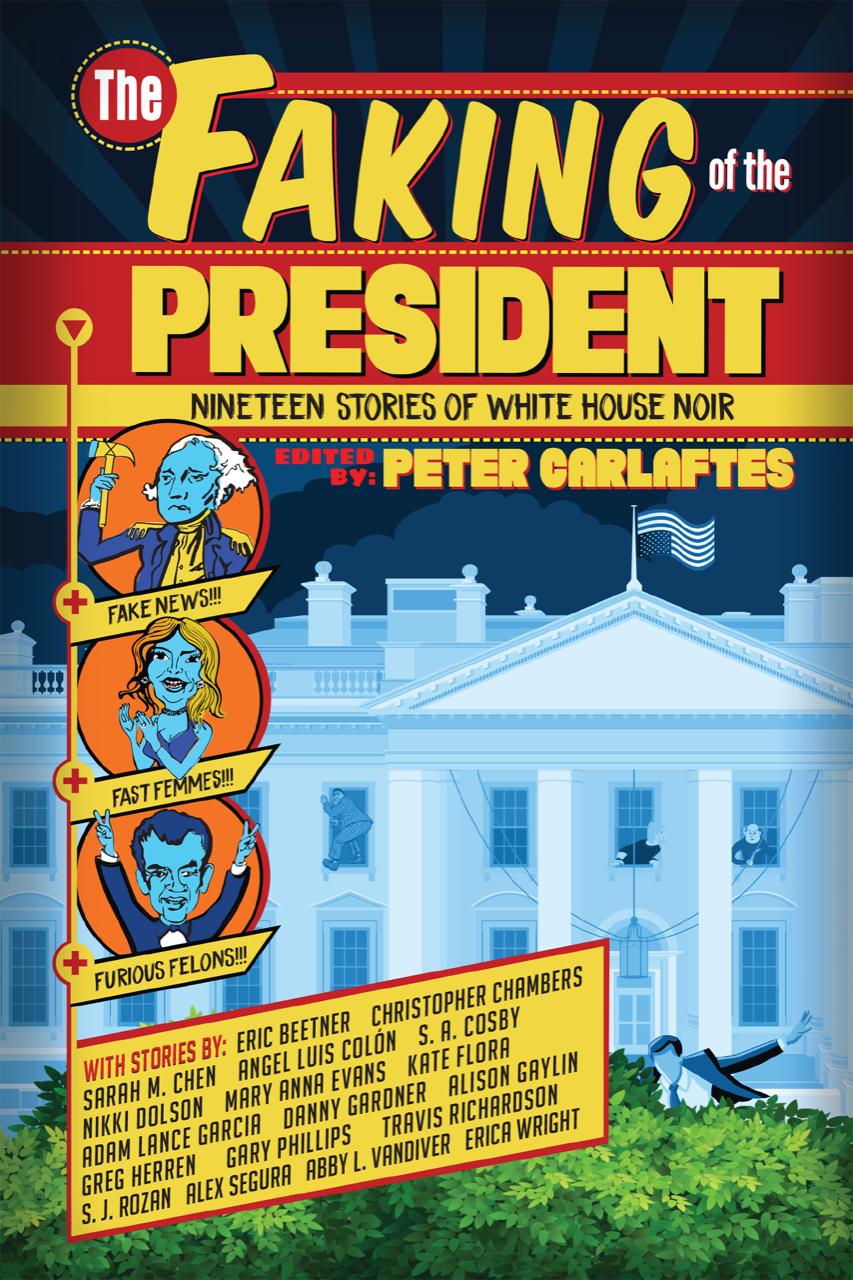
This week a new anthology with a story by one Gregalicious is dropping, The Faking of the President, edited by Peter Carlaftes and from Three Rooms Press. Three Rooms also produced the 2018 St. Petersburg Bouchercon anthology I edited, Florida Happens, and thus it was lovely to be working with Peter, Kat, and the Three Rooms Press gang again. The book has turned out to be absolutely lovely, and I couldn’t have been more pleased to be asked to write a story for this.

The concept behind the book was, of course, to create noir stories built around a president. I was torn at first when asked to choose a president; there were any number of them that I truly like and admire….yet so many mediocrities. The 1850’s, the lead up or prelude to the Civil War, has been of particular interest to me of late, and I decided to chose someone from that period, where we had a string of mediocre presidents take up residence in the White House: Zachary Taylor, Millard Fillmore, Franklin Pierce, and finally James Buchanan. Buchanan is widely considered to be (or was considered to be, YMMV) the worst president in American history; he was the last president before Lincoln’s election and the outbreak of the Civil War. Buchanan did nothing to stop the coming eruption of war; if anything, he exacerbated the ill feeling between the two sections of the country. All the 1850’s presidents were Yankees with Southern sympathies; they were called “dough-faces” at the time (I don’t know why that particular term was used; so don’t ask. Google is your friend), and yes, many parallels between that time and our present day kind of exist, if you care to look to see them. Buchanan also conspired with the worst Chief Justice to ever lead our Supreme Court, Roger B. Taney, in the court decision that flamed the fans of regional hatred into an unforeseen heat that made the war even more inevitable than it already had been; Buchanan and Taney thought they were putting the slavery question to bed once and for all with the Dred Scott v. Sandford decision; by striking down the Missouri Compromise and the Kansas/Nebraska Acts as unconstitutional, the two attempted to make slavery the law of the land and permissible in the vast unsettled (by white people) territories as well as make it legal in the states that prohibited it.

Yeah, that kind of backfired.

Buchanan was also the only president who never married; and while there is certainly no proof or evidence that is conclusive, it is widely suspected that Buchanan was our first gay president. He lived, for example, for a long time with Senator Rufus King of Alabama; Andrew Jackson jeeringly called Buchanan “Aunt Fancy”; and their surviving letters bespoke an affection and longing between the two that went a bit deeper than being just good buddies. So, as a gay writer, I decided to write about Buchanan. But writing a period story set in the DC of the late 1850’s seemed a bit much and certainly more than I could handle; plus I couldn’t really come up with a plot. I thought about having Buchanan murder a slave he’d been forcing to be his lover and the ensuing cover-up; I made several abortive attempts at writing that story before finally abandoning the idea.

I had no idea what I was going to write–until I read an article on-line somewhere about Buchanan’s mysterious sexuality and sexual preferences, and the author said something along the lines of but for some historians, short of finding daguerrotypes of Buchanan naked with another man, nothing will ever serve as conclusive proof for the deniers.

And there it was. I started writing “The Dreadful Scott Decision.”

faking of the president cover


The cheap whiskey tasted like flavored turpentine, burning so intensely as it went down it felt like it was leaving scorch marks in its wake. Scott Devinney was just high enough from the joint he was smoking to consider that a plus—a sign that he was still alive no matter how numb he felt.

He was sitting in the dark in his cheap apartment near campus, streaming the panel he’d been on at the presidential historians’ conference at UCLA the previous weekend. It had aired live on a PBS network in Los Angeles—it took him a while to figure out how to access it, and now that he was watching it was even worse than he feared. He’d always suspected Pulitzer prize-winning historian Andrew Dickey was a homophobe; his behavior on the panel proved it without question.

Alas, Scott allowed Dickey to get under his skin. He wasn’t proud of that, and his doctoral advisor, Dr. Keysha Wells-Caldwell—also head of the department at UC-San Felice—wasn’t happy, either.

He wasn’t about to apologize to Andrew Dickey, though. He’d die first.

“You have no proof!” Dickey wagged his finger at Scott on the computer screen, his face reddened and his voice raising. “Just like the activists who try to claim Lincoln was gay without proof, there is no proof Buchanan was, either, no matter how bad you want him to be!”

He sighed and closed the window. He didn’t need to watch himself screaming in rage, embarrassing himself and the university in the process.

Which was what Keysha really cared about.

At one time, I seriously considered becoming a historian. I’ve always loved history, have loved to read it and study it,  and even write it (I still would love to do a Tuchman-like study of regnant women in the 16th century called The Monstrous Regiment of Women), but as with so many other things, poor professors in college stomped that desire right out of me. (The other problem, of course, being that I could never decide on a period to specialize in–although if forced I probably would have chosen the 16th century) I have heard, over the years, from friends who work in academia as well as reading books and so forth set in the academic world, how cutthroat and nasty the war over tenure can be; office politics as played by the Borgias or the Medici. My story “Lightning Bugs in a Jar” was sort of set in the academia milieu; I even considered writing a series about a college English professor at one time–it’s still there on the backburner; I may write it still. One of the novels I wrote under a pseudonym was set at a quasi-Seven Sisters style college in New England, and of course, my Murder-a-Go-Go’s story “This Town” was about sorority girls, and of course several Todd Gregory novels were set in fraternities.

So, what better idea for this story than a gay Buchanan historian, attempting to prove to the world that Buchanan was, indeed, the first gay president? And how far would he go to get that proof–which is the noir angle I needed for the story? And so the story was born…and you can order a copy here, or from any retailer.

And as you can see from the cover above, there are some fantastic writers who contributed to this book. I am very pleased to be sharing the table of contents with these amazing writers, and a bit humbled. Check it out–you won’t be sorry!